Cambridge A Level Sociology 9699 — 2010 May/June Paper 1 · Variant 2
9699/12/M/J/10 · 50 marks · ≈56 min
The question paper and its mark scheme, free to read here and free to download. This is Cambridge’s own paper, exactly as it was sat.
Question paper2 pages
Mark scheme7 pages
Answers below. Sit the paper first if you are practising.
Paper as text
Question paper, page 1
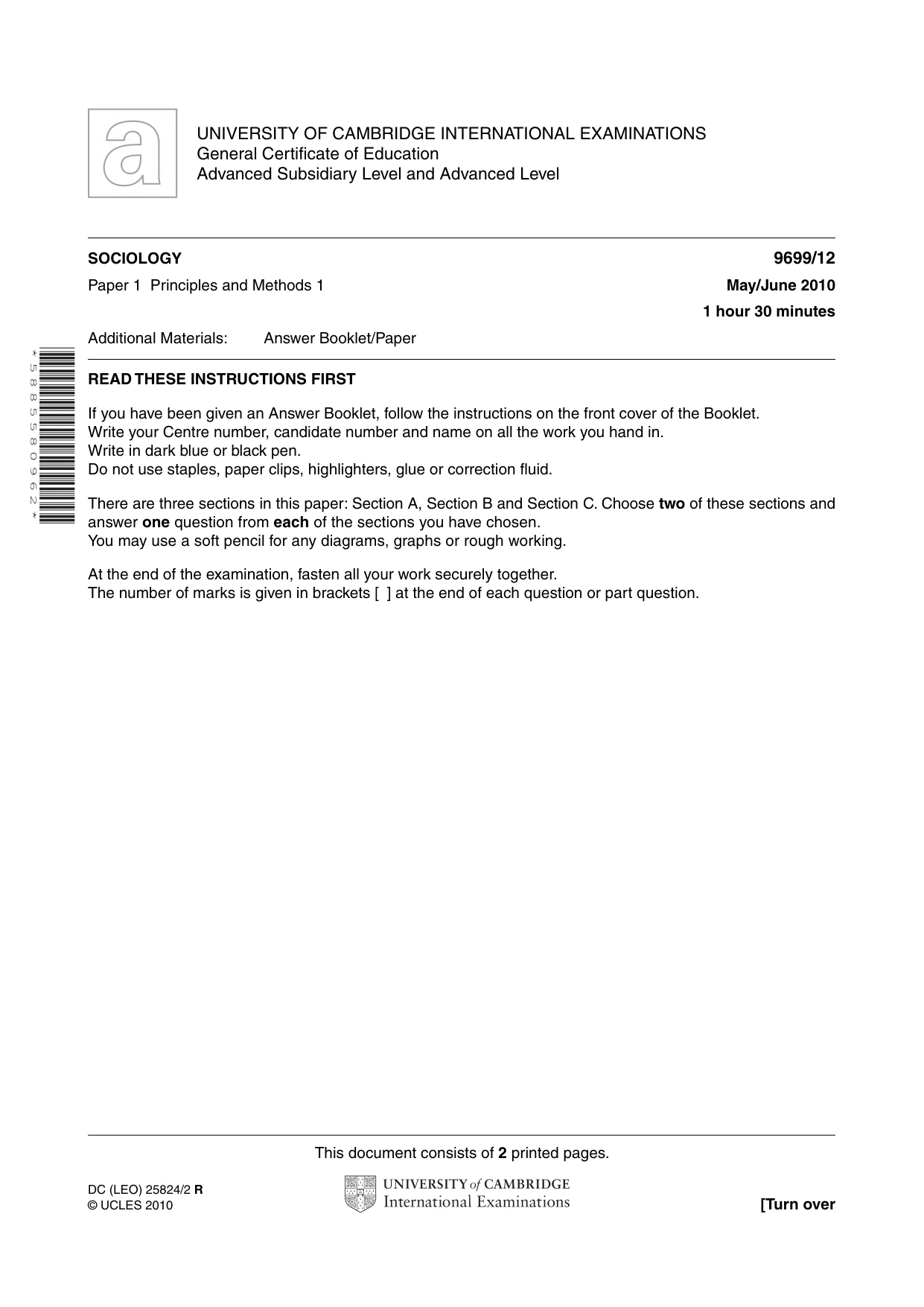
This document consists of 2 printed pages. DC (LEO) 25824/2 R © UCLES 2010 [Turn over UNIVERSITY OF CAMBRIDGE INTERNATIONAL EXAMINATIONS General Certificate of Education Advanced Subsidiary Level and Advanced Level READ THESE INSTRUCTIONS FIRST If you have been given an Answer Booklet, follow the instructions on the front cover of the Booklet. Write your Centre number, candidate number and name on all the work you hand in. Write in dark blue or black pen. Do not use staples, paper clips, highlighters, glue or correction fluid. There are three sections in this paper: Section A, Section B and Section C. Choose two of these sections and answer one question from each of the sections you have chosen. You may use a soft pencil for any diagrams, graphs or rough working. At the end of the examination, fasten all your work securely together. The number of marks is given in brackets [ ] at the end of each question or part question. SOCIOLOGY 9699/12 Paper 1 Principles and Methods 1 May/June 2010 1 hour 30 minutes Additional Materials: Answer Booklet/Paper * 5 8 8 5 5 8 0 9 6 2 *
Question paper, page 2
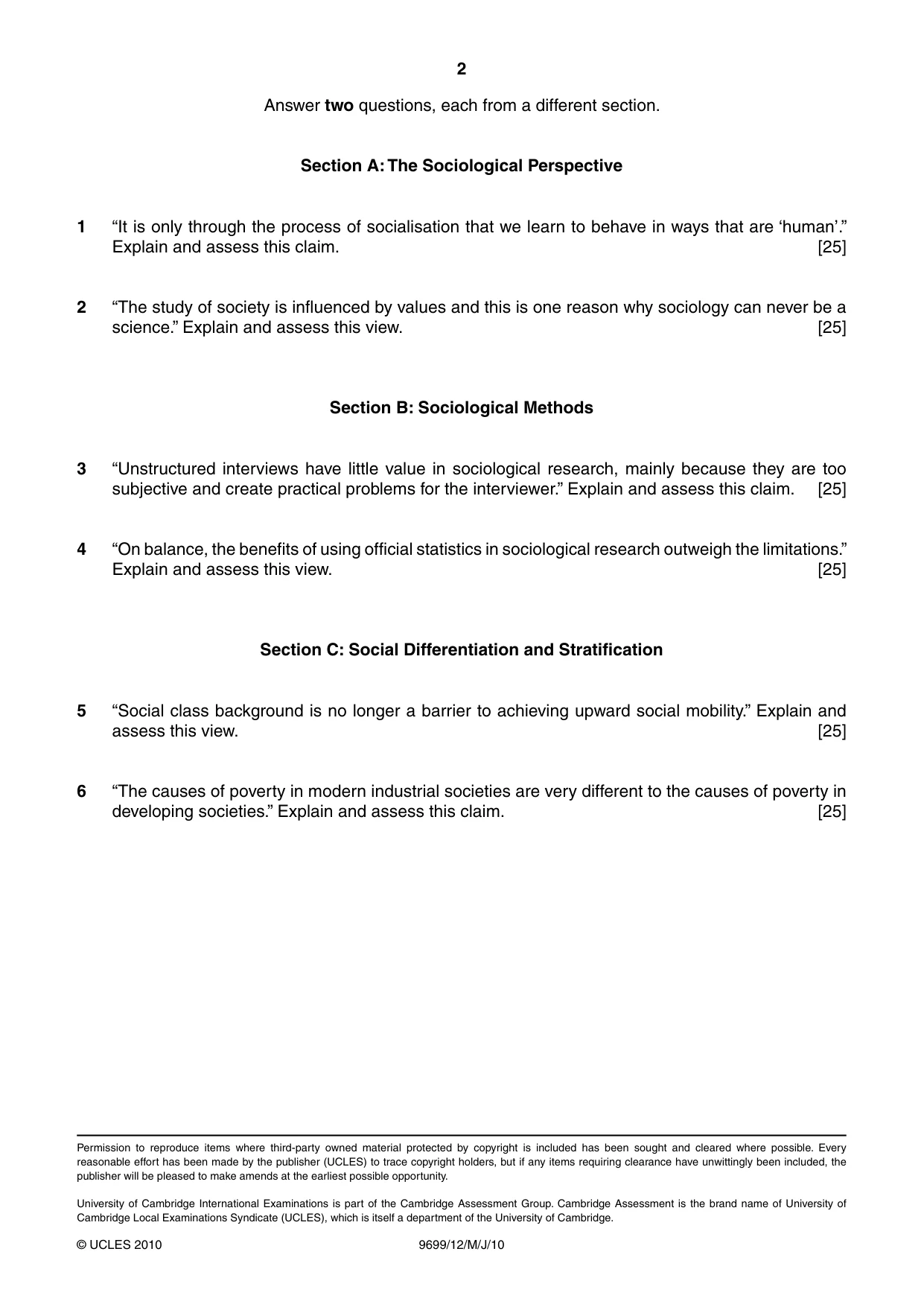
2 9699/12/M/J/10 © UCLES 2010 Answer two questions, each from a different section. Section A: The Sociological Perspective 1 “It is only through the process of socialisation that we learn to behave in ways that are ‘human’.” Explain and assess this claim. [25] 2 “The study of society is influenced by values and this is one reason why sociology can never be a science.” Explain and assess this view. [25] Section B: Sociological Methods 3 “Unstructured interviews have little value in sociological research, mainly because they are too subjective and create practical problems for the interviewer.” Explain and assess this claim. [25] 4 “On balance, the benefits of using official statistics in sociological research outweigh the limitations.” Explain and assess this view. [25] Section C: Social Differentiation and Stratification 5 “Social class background is no longer a barrier to achieving upward social mobility.” Explain and assess this view. [25] 6 “The causes of poverty in modern industrial societies are very different to the causes of poverty in developing societies.” Explain and assess this claim. [25] Permission to reproduce items where third-party owned material protected by copyright is included has been sought and cleared where possible. Every reasonable effort has been made by the publisher (UCLES) to trace copyright holders, but if any items requiring clearance have unwittingly been included, the publisher will be pleased to make amends at the earliest possible opportunity. University of Cambridge International Examinations is part of the Cambridge Assessment Group. Cambridge Assessment is the brand name of University of Cambridge Local Examinations Syndicate (UCLES), which is itself a department of the University of Cambridge.
Mark scheme, page 1
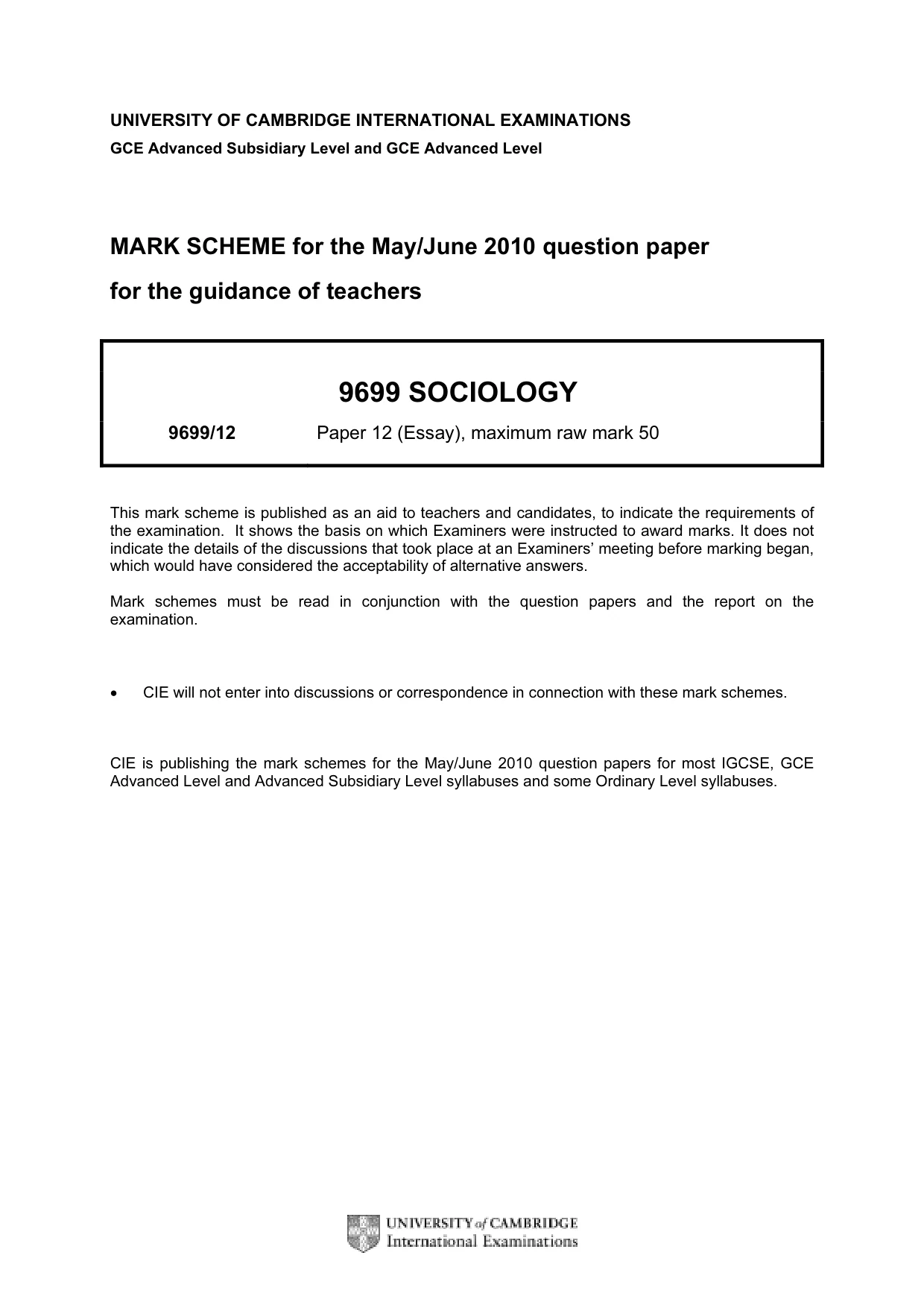
UNIVERSITY OF CAMBRIDGE INTERNATIONAL EXAMINATIONS GCE Advanced Subsidiary Level and GCE Advanced Level MARK SCHEME for the May/June 2010 question paper for the guidance of teachers 9699 SOCIOLOGY 9699/12 Paper 12 (Essay), maximum raw mark 50 This mark scheme is published as an aid to teachers and candidates, to indicate the requirements of the examination. It shows the basis on which Examiners were instructed to award marks. It does not indicate the details of the discussions that took place at an Examiners’ meeting before marking began, which would have considered the acceptability of alternative answers. Mark schemes must be read in conjunction with the question papers and the report on the examination. • CIE will not enter into discussions or correspondence in connection with these mark schemes. CIE is publishing the mark schemes for the May/June 2010 question papers for most IGCSE, GCE Advanced Level and Advanced Subsidiary Level syllabuses and some Ordinary Level syllabuses.
Mark scheme, page 2
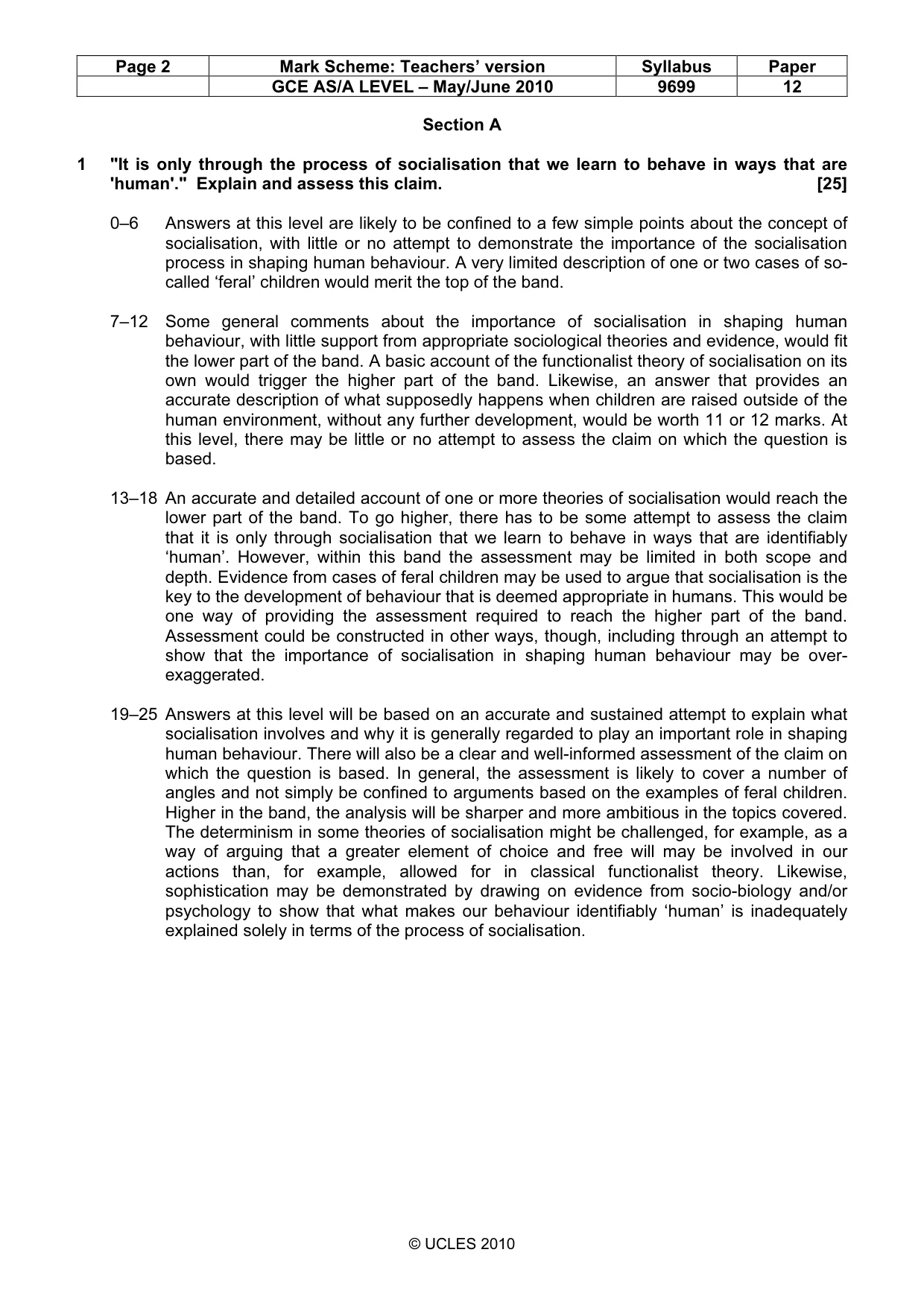
Page 2 Mark Scheme: Teachers’ version Syllabus Paper GCE AS/A LEVEL – May/June 2010 9699 12 © UCLES 2010 Section A 1 "It is only through the process of socialisation that we learn to behave in ways that are 'human'." Explain and assess this claim. [25] 0–6 Answers at this level are likely to be confined to a few simple points about the concept of socialisation, with little or no attempt to demonstrate the importance of the socialisation process in shaping human behaviour. A very limited description of one or two cases of so- called ‘feral’ children would merit the top of the band. 7–12 Some general comments about the importance of socialisation in shaping human behaviour, with little support from appropriate sociological theories and evidence, would fit the lower part of the band. A basic account of the functionalist theory of socialisation on its own would trigger the higher part of the band. Likewise, an answer that provides an accurate description of what supposedly happens when children are raised outside of the human environment, without any further development, would be worth 11 or 12 marks. At this level, there may be little or no attempt to assess the claim on which the question is based. 13–18 An accurate and detailed account of one or more theories of socialisation would reach the lower part of the band. To go higher, there has to be some attempt to assess the claim that it is only through socialisation that we learn to behave in ways that are identifiably ‘human’. However, within this band the assessment may be limited in both scope and depth. Evidence from cases of feral children may be used to argue that socialisation is the key to the development of behaviour that is deemed appropriate in humans. This would be one way of providing the assessment required to reach the higher part of the band. Assessment could be constructed in other ways, though, including through an attempt to show that the importance of socialisation in shaping human behaviour may be over- exaggerated. 19–25 Answers at this level will be based on an accurate and sustained attempt to explain what socialisation involves and why it is generally regarded to play an important role in shaping human behaviour. There will also be a clear and well-informed assessment of the claim on which the question is based. In general, the assessment is likely to cover a number of angles and not simply be confined to arguments based on the examples of feral children. Higher in the band, the analysis will be sharper and more ambitious in the topics covered. The determinism in some theories of socialisation might be challenged, for example, as a way of arguing that a greater element of choice and free will may be involved in our actions than, for example, allowed for in classical functionalist theory. Likewise, sophistication may be demonstrated by drawing on evidence from socio-biology and/or psychology to show that what makes our behaviour identifiably ‘human’ is inadequately explained solely in terms of the process of socialisation.
Mark scheme, page 3
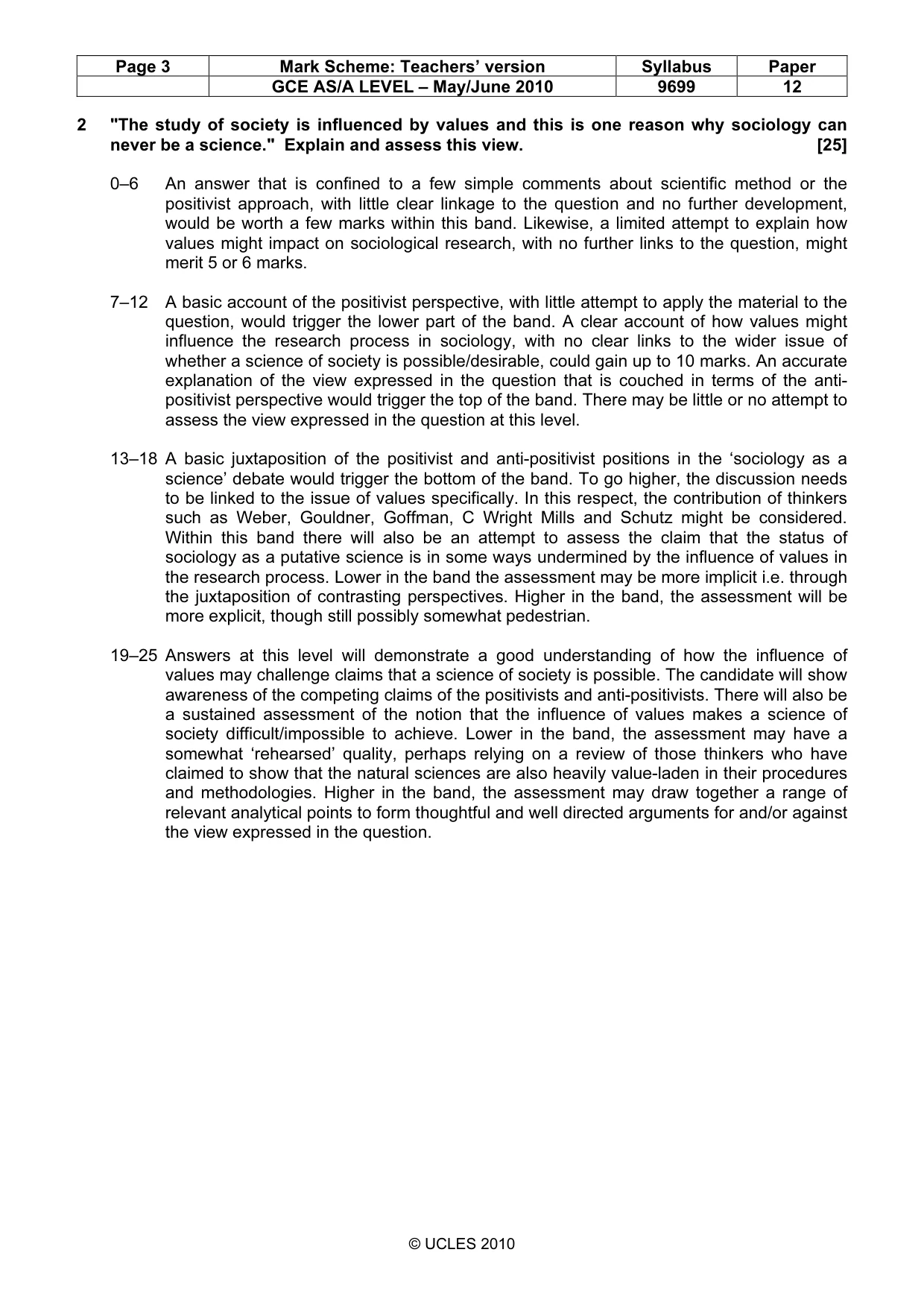
Page 3 Mark Scheme: Teachers’ version Syllabus Paper GCE AS/A LEVEL – May/June 2010 9699 12 © UCLES 2010 2 "The study of society is influenced by values and this is one reason why sociology can never be a science." Explain and assess this view. [25] 0–6 An answer that is confined to a few simple comments about scientific method or the positivist approach, with little clear linkage to the question and no further development, would be worth a few marks within this band. Likewise, a limited attempt to explain how values might impact on sociological research, with no further links to the question, might merit 5 or 6 marks. 7–12 A basic account of the positivist perspective, with little attempt to apply the material to the question, would trigger the lower part of the band. A clear account of how values might influence the research process in sociology, with no clear links to the wider issue of whether a science of society is possible/desirable, could gain up to 10 marks. An accurate explanation of the view expressed in the question that is couched in terms of the anti- positivist perspective would trigger the top of the band. There may be little or no attempt to assess the view expressed in the question at this level. 13–18 A basic juxtaposition of the positivist and anti-positivist positions in the ‘sociology as a science’ debate would trigger the bottom of the band. To go higher, the discussion needs to be linked to the issue of values specifically. In this respect, the contribution of thinkers such as Weber, Gouldner, Goffman, C Wright Mills and Schutz might be considered. Within this band there will also be an attempt to assess the claim that the status of sociology as a putative science is in some ways undermined by the influence of values in the research process. Lower in the band the assessment may be more implicit i.e. through the juxtaposition of contrasting perspectives. Higher in the band, the assessment will be more explicit, though still possibly somewhat pedestrian. 19–25 Answers at this level will demonstrate a good understanding of how the influence of values may challenge claims that a science of society is possible. The candidate will show awareness of the competing claims of the positivists and anti-positivists. There will also be a sustained assessment of the notion that the influence of values makes a science of society difficult/impossible to achieve. Lower in the band, the assessment may have a somewhat ‘rehearsed’ quality, perhaps relying on a review of those thinkers who have claimed to show that the natural sciences are also heavily value-laden in their procedures and methodologies. Higher in the band, the assessment may draw together a range of relevant analytical points to form thoughtful and well directed arguments for and/or against the view expressed in the question.
Mark scheme, page 4
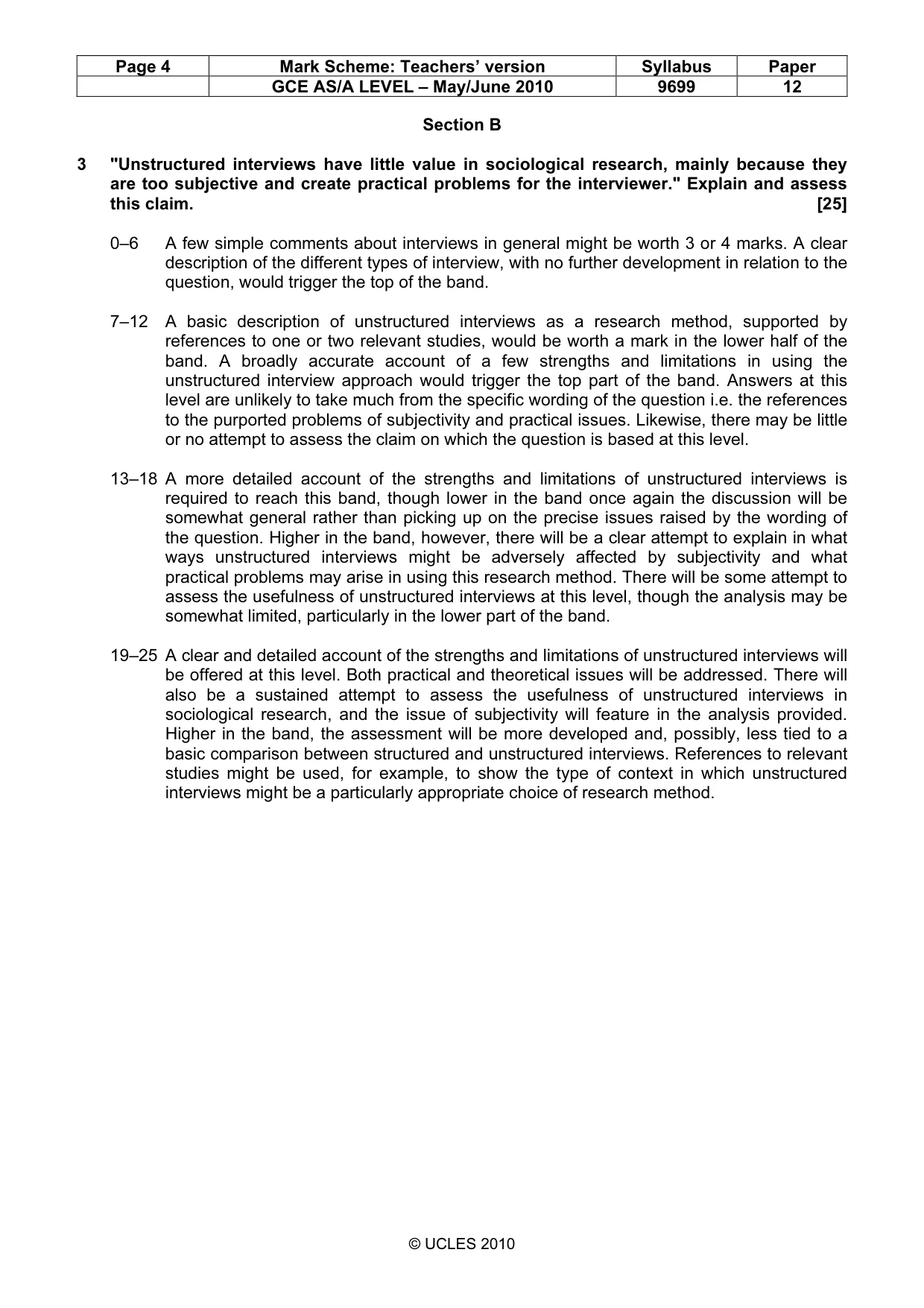
Page 4 Mark Scheme: Teachers’ version Syllabus Paper GCE AS/A LEVEL – May/June 2010 9699 12 © UCLES 2010 Section B 3 "Unstructured interviews have little value in sociological research, mainly because they are too subjective and create practical problems for the interviewer." Explain and assess this claim. [25] 0–6 A few simple comments about interviews in general might be worth 3 or 4 marks. A clear description of the different types of interview, with no further development in relation to the question, would trigger the top of the band. 7–12 A basic description of unstructured interviews as a research method, supported by references to one or two relevant studies, would be worth a mark in the lower half of the band. A broadly accurate account of a few strengths and limitations in using the unstructured interview approach would trigger the top part of the band. Answers at this level are unlikely to take much from the specific wording of the question i.e. the references to the purported problems of subjectivity and practical issues. Likewise, there may be little or no attempt to assess the claim on which the question is based at this level. 13–18 A more detailed account of the strengths and limitations of unstructured interviews is required to reach this band, though lower in the band once again the discussion will be somewhat general rather than picking up on the precise issues raised by the wording of the question. Higher in the band, however, there will be a clear attempt to explain in what ways unstructured interviews might be adversely affected by subjectivity and what practical problems may arise in using this research method. There will be some attempt to assess the usefulness of unstructured interviews at this level, though the analysis may be somewhat limited, particularly in the lower part of the band. 19–25 A clear and detailed account of the strengths and limitations of unstructured interviews will be offered at this level. Both practical and theoretical issues will be addressed. There will also be a sustained attempt to assess the usefulness of unstructured interviews in sociological research, and the issue of subjectivity will feature in the analysis provided. Higher in the band, the assessment will be more developed and, possibly, less tied to a basic comparison between structured and unstructured interviews. References to relevant studies might be used, for example, to show the type of context in which unstructured interviews might be a particularly appropriate choice of research method.
Mark scheme, page 5
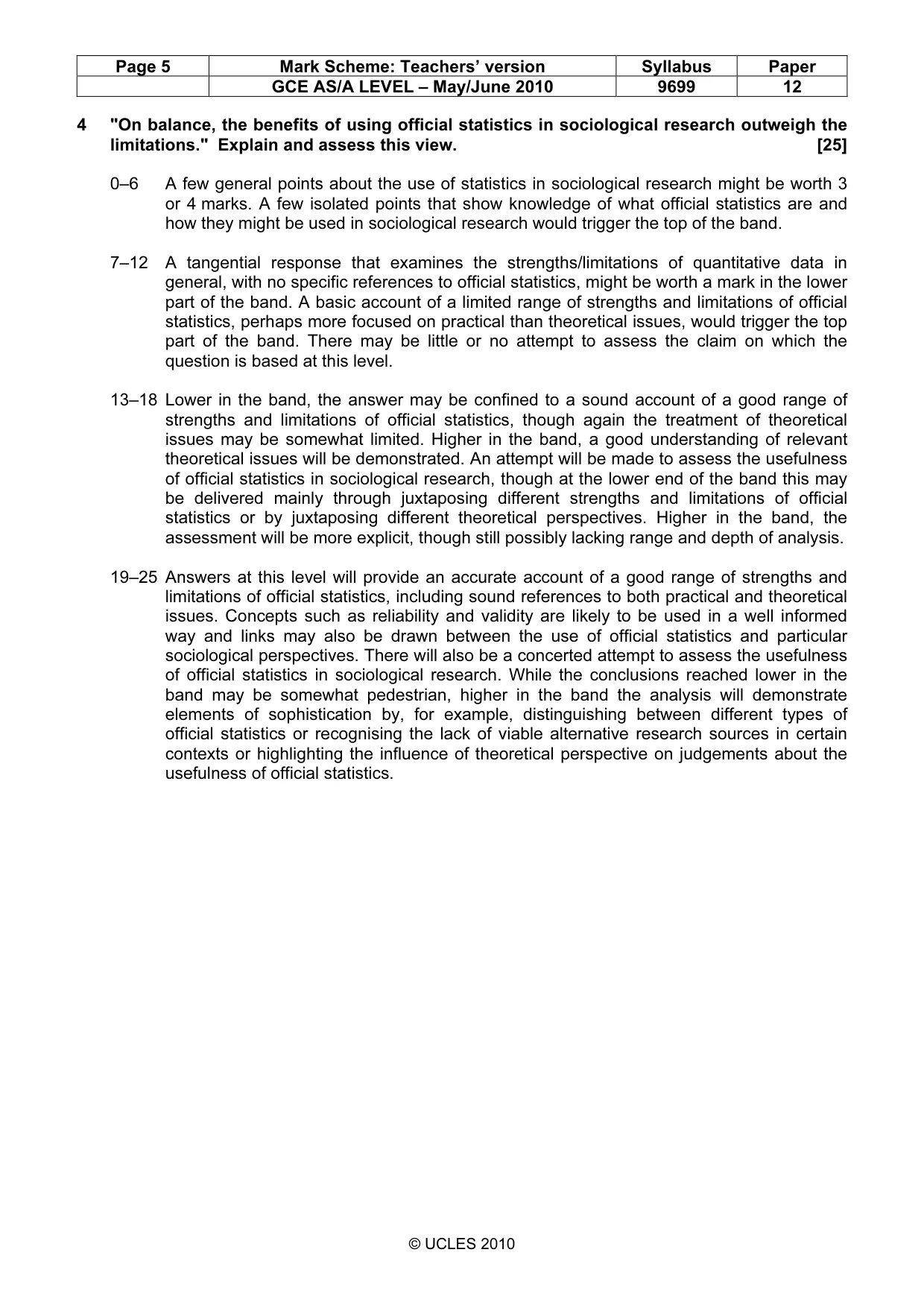
Page 5 Mark Scheme: Teachers’ version Syllabus Paper GCE AS/A LEVEL – May/June 2010 9699 12 © UCLES 2010 4 "On balance, the benefits of using official statistics in sociological research outweigh the limitations." Explain and assess this view. [25] 0–6 A few general points about the use of statistics in sociological research might be worth 3 or 4 marks. A few isolated points that show knowledge of what official statistics are and how they might be used in sociological research would trigger the top of the band. 7–12 A tangential response that examines the strengths/limitations of quantitative data in general, with no specific references to official statistics, might be worth a mark in the lower part of the band. A basic account of a limited range of strengths and limitations of official statistics, perhaps more focused on practical than theoretical issues, would trigger the top part of the band. There may be little or no attempt to assess the claim on which the question is based at this level. 13–18 Lower in the band, the answer may be confined to a sound account of a good range of strengths and limitations of official statistics, though again the treatment of theoretical issues may be somewhat limited. Higher in the band, a good understanding of relevant theoretical issues will be demonstrated. An attempt will be made to assess the usefulness of official statistics in sociological research, though at the lower end of the band this may be delivered mainly through juxtaposing different strengths and limitations of official statistics or by juxtaposing different theoretical perspectives. Higher in the band, the assessment will be more explicit, though still possibly lacking range and depth of analysis. 19–25 Answers at this level will provide an accurate account of a good range of strengths and limitations of official statistics, including sound references to both practical and theoretical issues. Concepts such as reliability and validity are likely to be used in a well informed way and links may also be drawn between the use of official statistics and particular sociological perspectives. There will also be a concerted attempt to assess the usefulness of official statistics in sociological research. While the conclusions reached lower in the band may be somewhat pedestrian, higher in the band the analysis will demonstrate elements of sophistication by, for example, distinguishing between different types of official statistics or recognising the lack of viable alternative research sources in certain contexts or highlighting the influence of theoretical perspective on judgements about the usefulness of official statistics.
Mark scheme, page 6
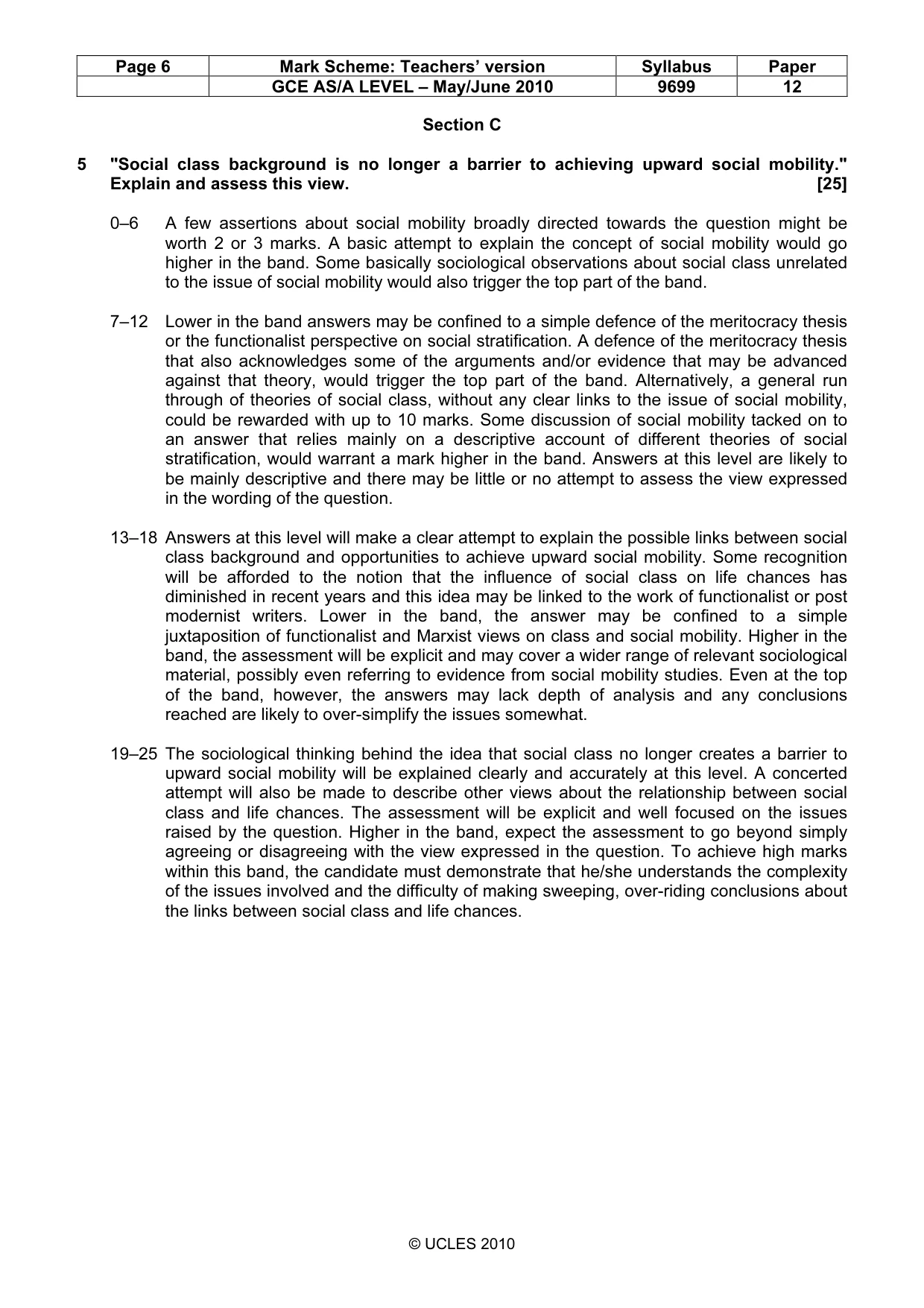
Page 6 Mark Scheme: Teachers’ version Syllabus Paper GCE AS/A LEVEL – May/June 2010 9699 12 © UCLES 2010 Section C 5 "Social class background is no longer a barrier to achieving upward social mobility." Explain and assess this view. [25] 0–6 A few assertions about social mobility broadly directed towards the question might be worth 2 or 3 marks. A basic attempt to explain the concept of social mobility would go higher in the band. Some basically sociological observations about social class unrelated to the issue of social mobility would also trigger the top part of the band. 7–12 Lower in the band answers may be confined to a simple defence of the meritocracy thesis or the functionalist perspective on social stratification. A defence of the meritocracy thesis that also acknowledges some of the arguments and/or evidence that may be advanced against that theory, would trigger the top part of the band. Alternatively, a general run through of theories of social class, without any clear links to the issue of social mobility, could be rewarded with up to 10 marks. Some discussion of social mobility tacked on to an answer that relies mainly on a descriptive account of different theories of social stratification, would warrant a mark higher in the band. Answers at this level are likely to be mainly descriptive and there may be little or no attempt to assess the view expressed in the wording of the question. 13–18 Answers at this level will make a clear attempt to explain the possible links between social class background and opportunities to achieve upward social mobility. Some recognition will be afforded to the notion that the influence of social class on life chances has diminished in recent years and this idea may be linked to the work of functionalist or post modernist writers. Lower in the band, the answer may be confined to a simple juxtaposition of functionalist and Marxist views on class and social mobility. Higher in the band, the assessment will be explicit and may cover a wider range of relevant sociological material, possibly even referring to evidence from social mobility studies. Even at the top of the band, however, the answers may lack depth of analysis and any conclusions reached are likely to over-simplify the issues somewhat. 19–25 The sociological thinking behind the idea that social class no longer creates a barrier to upward social mobility will be explained clearly and accurately at this level. A concerted attempt will also be made to describe other views about the relationship between social class and life chances. The assessment will be explicit and well focused on the issues raised by the question. Higher in the band, expect the assessment to go beyond simply agreeing or disagreeing with the view expressed in the question. To achieve high marks within this band, the candidate must demonstrate that he/she understands the complexity of the issues involved and the difficulty of making sweeping, over-riding conclusions about the links between social class and life chances.
Mark scheme, page 7
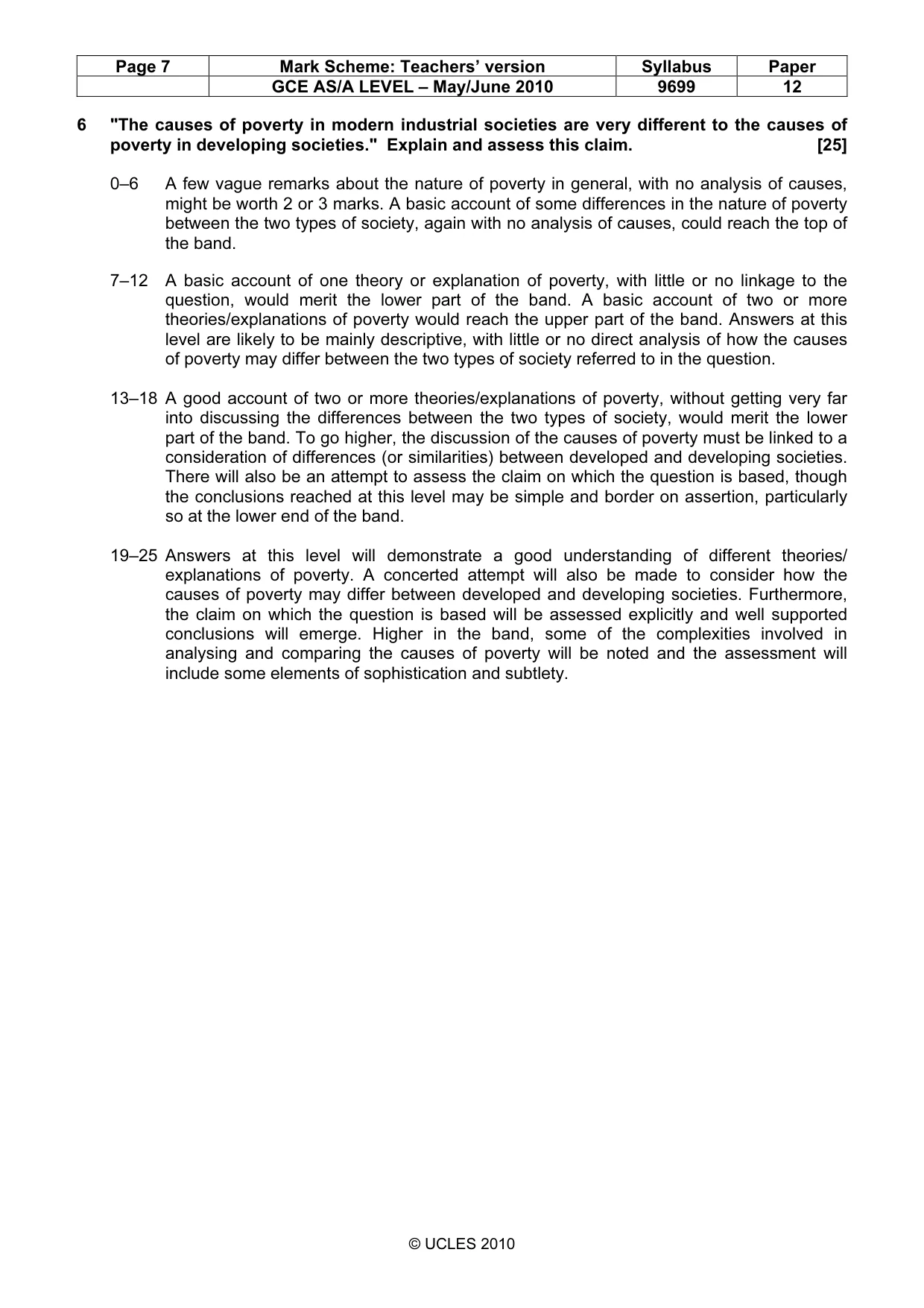
Page 7 Mark Scheme: Teachers’ version Syllabus Paper GCE AS/A LEVEL – May/June 2010 9699 12 © UCLES 2010 6 "The causes of poverty in modern industrial societies are very different to the causes of poverty in developing societies." Explain and assess this claim. [25] 0–6 A few vague remarks about the nature of poverty in general, with no analysis of causes, might be worth 2 or 3 marks. A basic account of some differences in the nature of poverty between the two types of society, again with no analysis of causes, could reach the top of the band. 7–12 A basic account of one theory or explanation of poverty, with little or no linkage to the question, would merit the lower part of the band. A basic account of two or more theories/explanations of poverty would reach the upper part of the band. Answers at this level are likely to be mainly descriptive, with little or no direct analysis of how the causes of poverty may differ between the two types of society referred to in the question. 13–18 A good account of two or more theories/explanations of poverty, without getting very far into discussing the differences between the two types of society, would merit the lower part of the band. To go higher, the discussion of the causes of poverty must be linked to a consideration of differences (or similarities) between developed and developing societies. There will also be an attempt to assess the claim on which the question is based, though the conclusions reached at this level may be simple and border on assertion, particularly so at the lower end of the band. 19–25 Answers at this level will demonstrate a good understanding of different theories/ explanations of poverty. A concerted attempt will also be made to consider how the causes of poverty may differ between developed and developing societies. Furthermore, the claim on which the question is based will be assessed explicitly and well supported conclusions will emerge. Higher in the band, some of the complexities involved in analysing and comparing the causes of poverty will be noted and the assessment will include some elements of sophistication and subtlety.
What you needed in this session
Cambridge’s own grade thresholds for 2010 May/June, Paper 1 · Variant 2. A higher threshold means an easier paper — the bar moves with how the cohort did.