Cambridge A Level Physics 9702 — 2015 May/June Paper 3 · Variant 2
9702/32/M/J/15 · 2 questions · 40 marks · ≈45 min
The question paper and its mark scheme, free to read here and free to download. This is Cambridge’s own paper, exactly as it was sat.
Question paper12 pages

Mark scheme4 pages
Answers below. Sit the paper first if you are practising.
Questions as text
Q1 · In this experiment, you will investigate the forces acting on a wooden strip in…
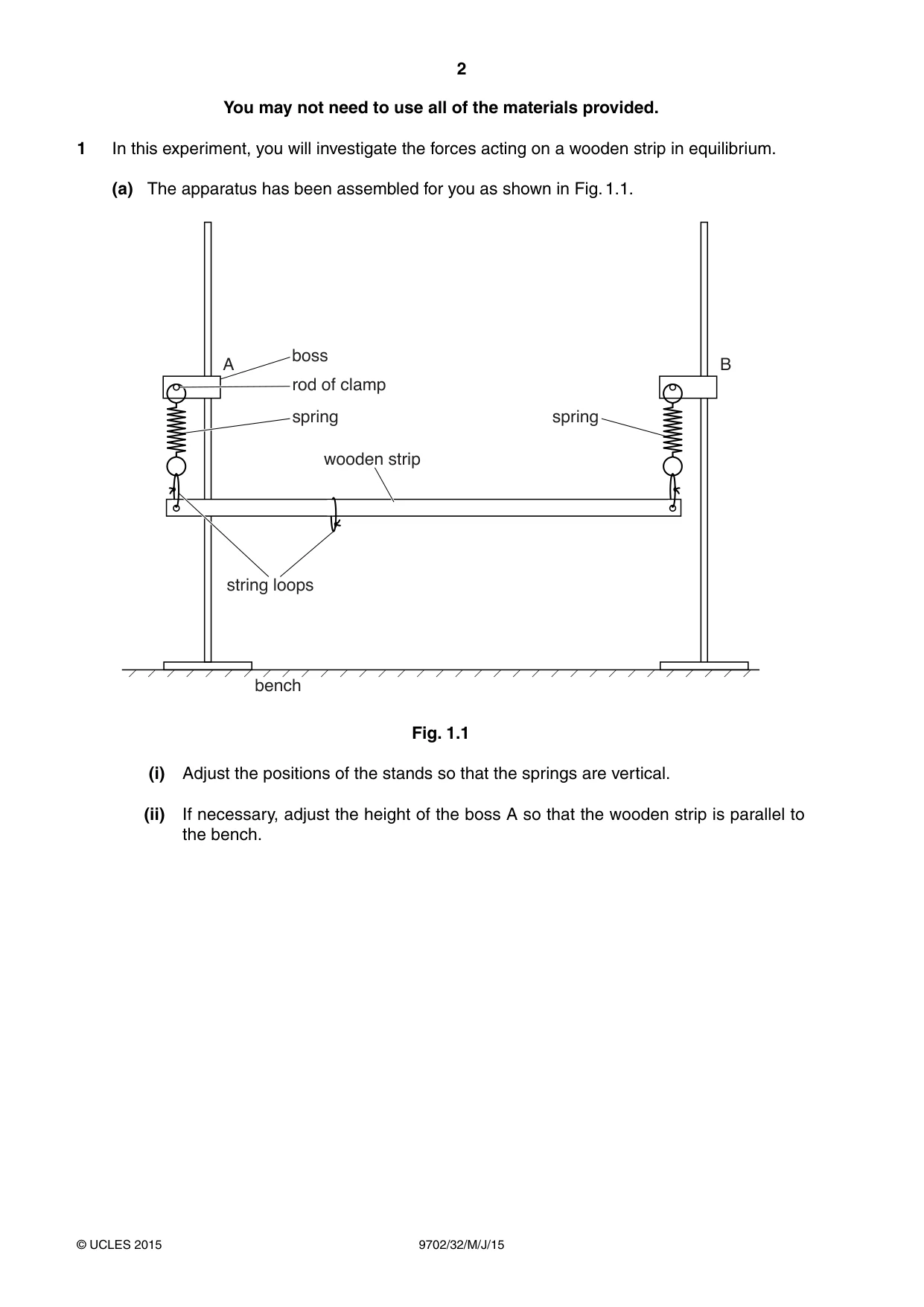
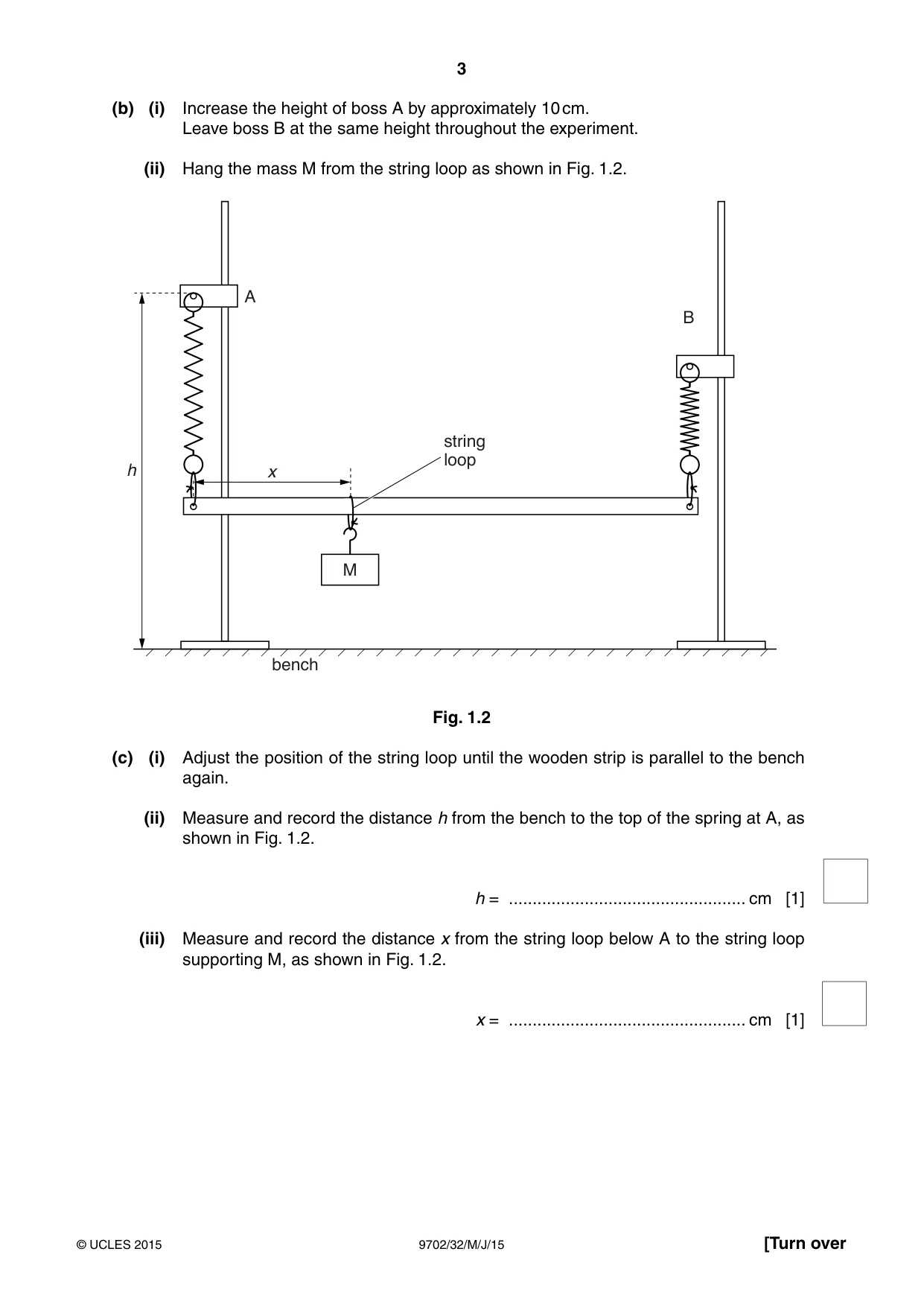
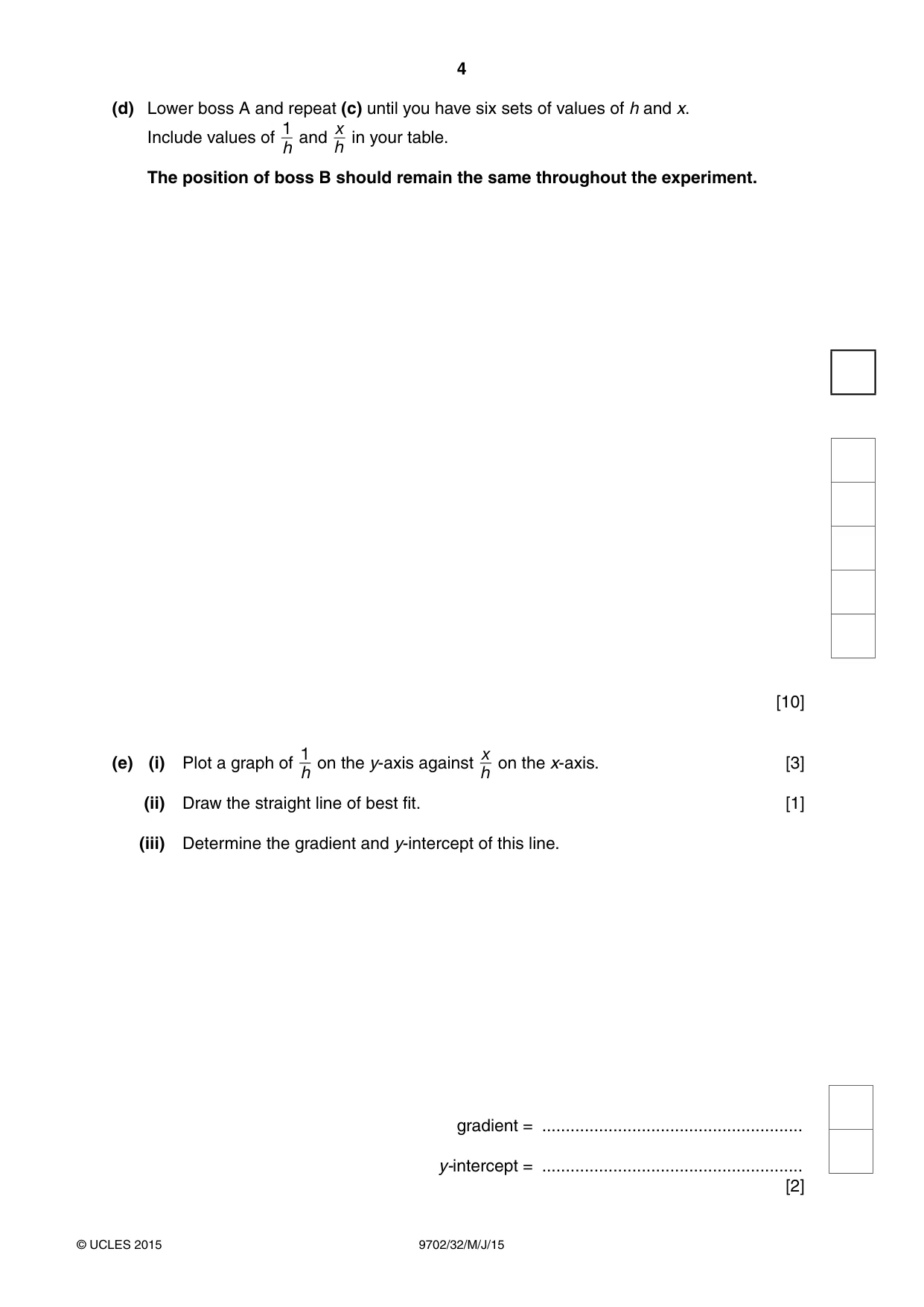
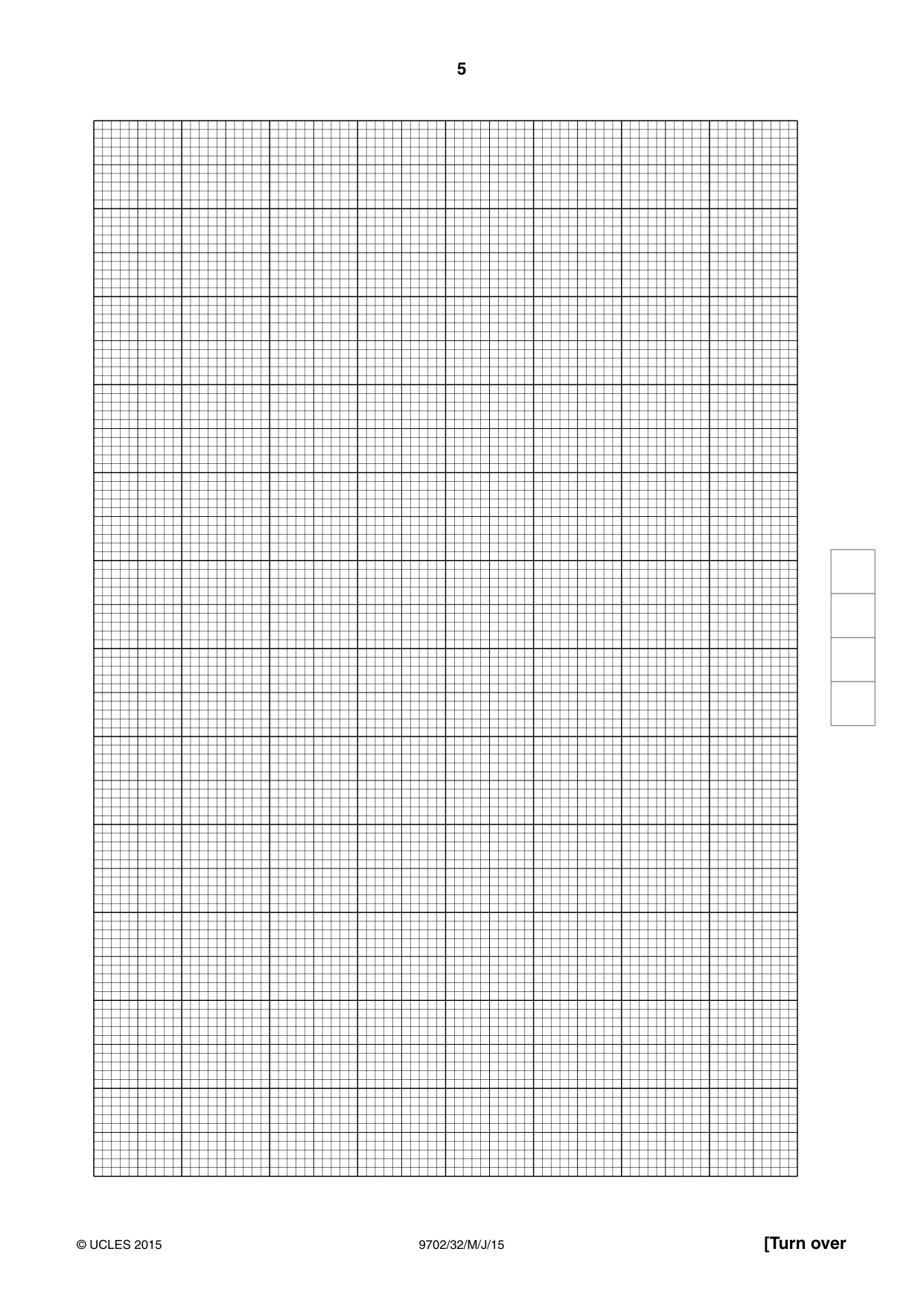
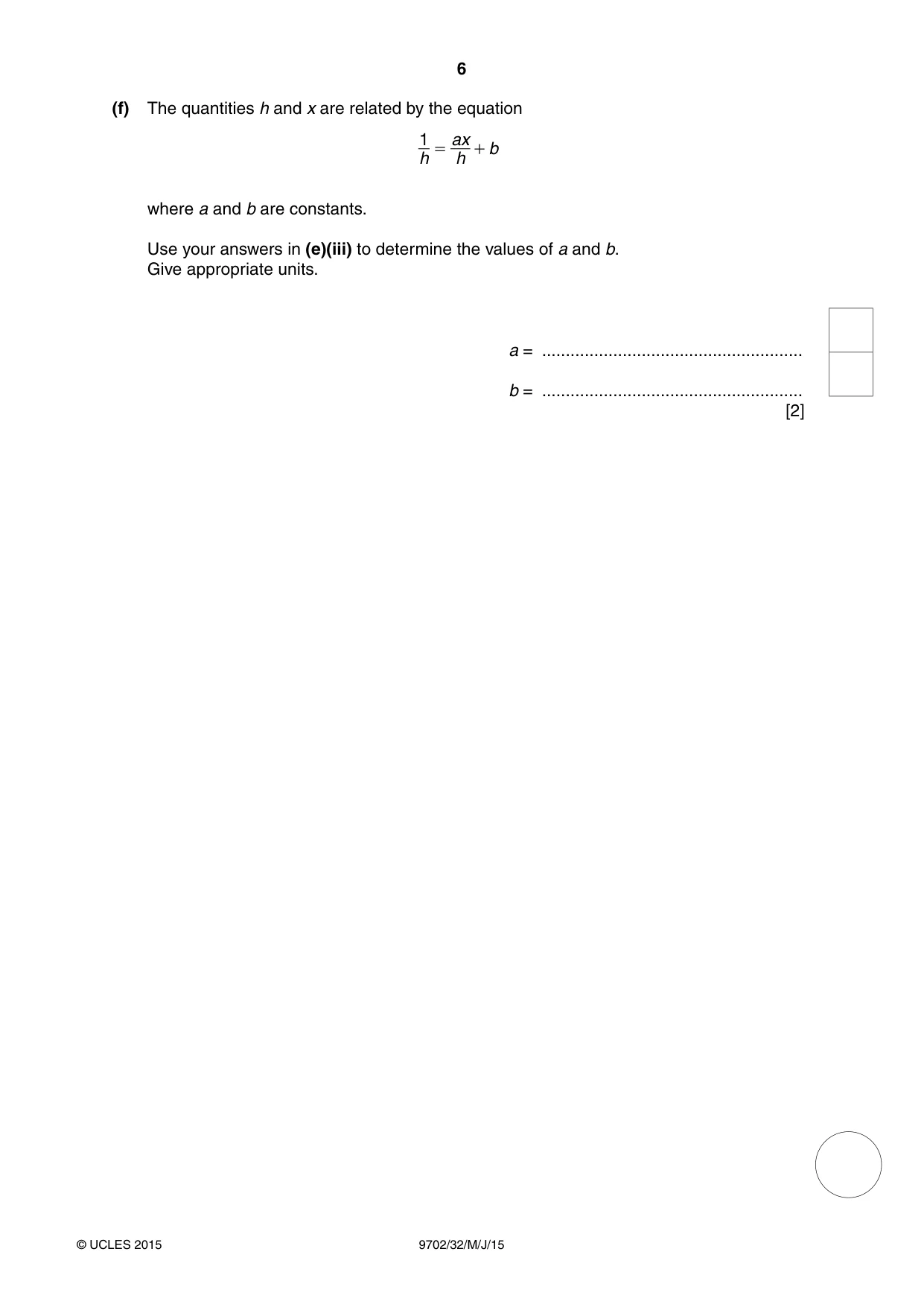
1 In this experiment, you will investigate the forces acting on a wooden strip in equilibrium. (a) The apparatus has been assembled for you as shown in Fig. 1.1. boss A B rod of clamp spring spring wooden strip string loops bench Fig. 1.1 (i) Adjust the positions of the stands so that the springs are vertical. (ii) If necessary, adjust the height of the boss A so that the wooden strip is parallel to the bench. (b) (i) Increase the height of boss A by approximately 10 cm. Leave boss B at the same height throughout the experiment. (ii) Hang the mass M from the string loop as shown in Fig. 1.2. A B string loop h x M bench Fig. 1.2 (c) (i) Adjust the position of the string loop until the wooden strip is parallel to the bench again. (ii) Measure and record the distance h from the bench to the top of the spring at A, as shown in Fig. 1.2. h = .................................................. cm [1] (iii) Measure and record the distance x from the string loop below A to the string loop supporting M, as shown in Fig. 1.2. x = .................................................. cm [1] (d) Lower boss A and repeat (c) until you have six sets of values of h and x. 1 x Include values of and in your table. h h The position of boss B should remain the same throughout the experiment. [10] 1 x (e) (i) Plot a graph of on the y-axis against on the x-axis. [3] h h (ii) Draw the straight line of best fit. [1] (iii) Determine the gradient and y-intercept of this line. gradient = ....................................................... y-intercept = ....................................................... [2] (f) The quantities h and x are related by the equation 1 ax = + b h h where a and b are constants. Use your answers in (e)(iii) to determine the values of a and b. Give appropriate units. a = ....................................................... b = ....................................................... [2] Please turn over for Question 2. You may not need to use all of the materials provided.
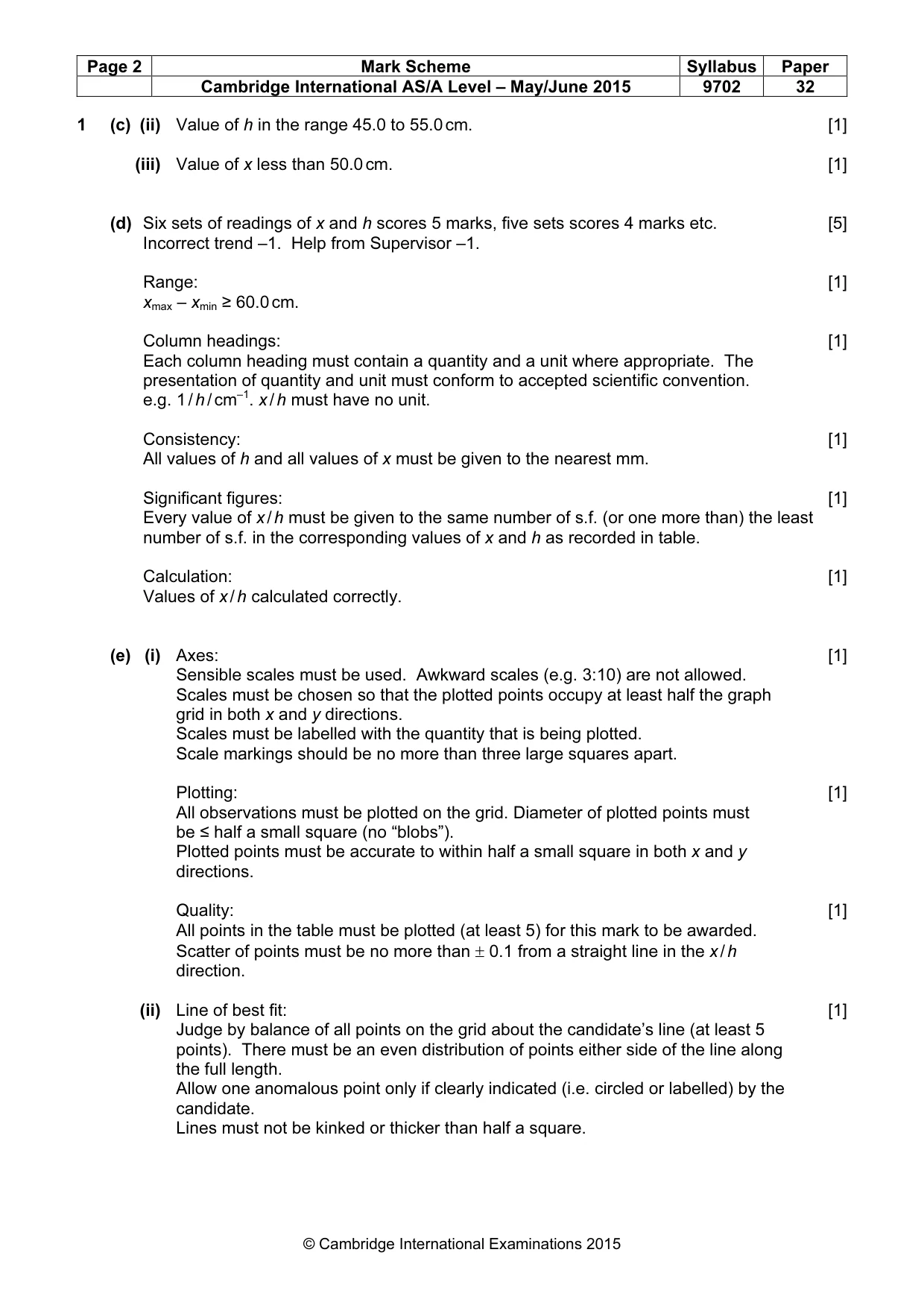
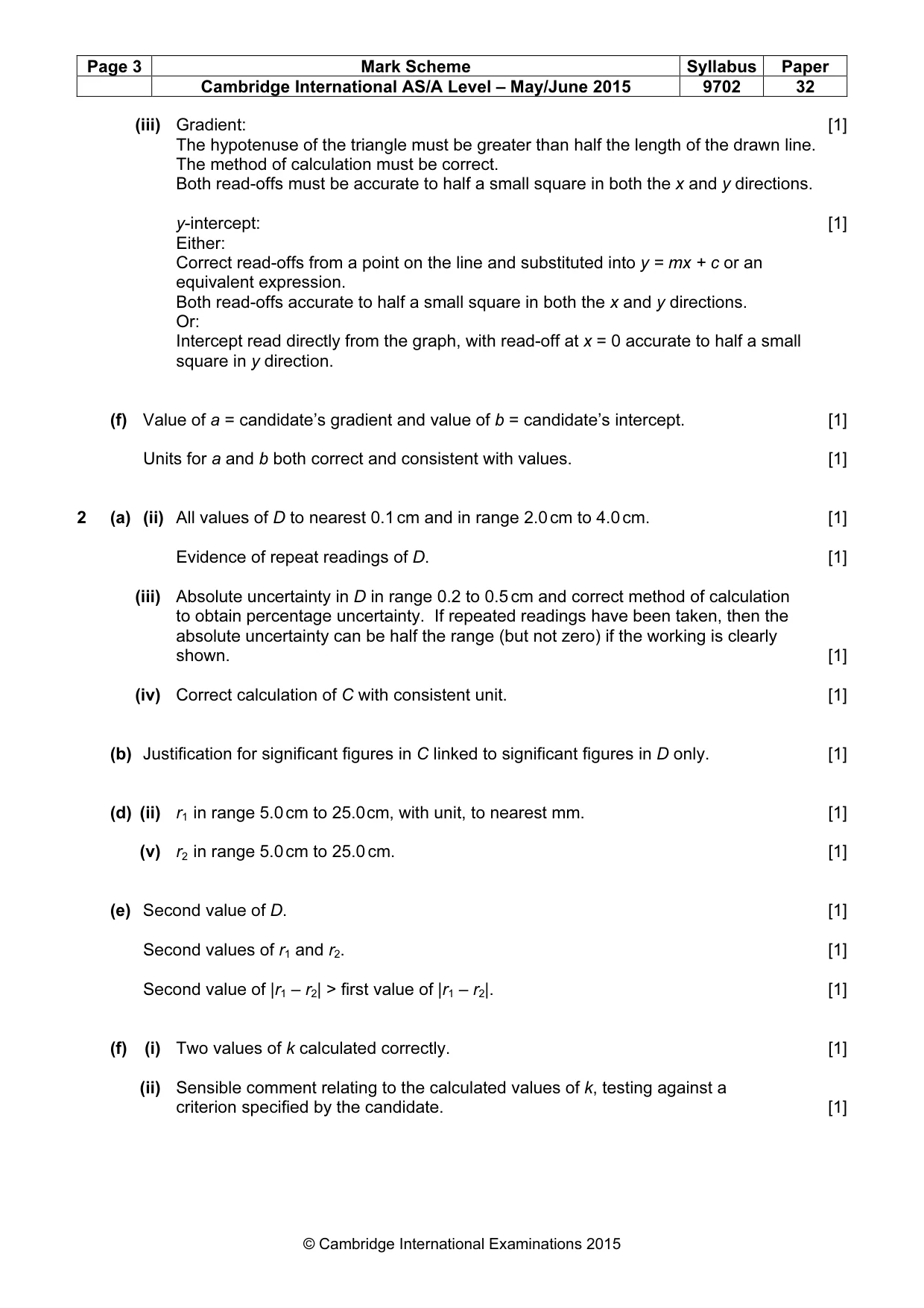
Mark scheme: 1 (c) (ii) Value of h in the range 45.0 to 55.0 cm. [1] (iii) Value of x less than 50.0 cm. [1] (d) Six sets of readings of x and h scores 5 marks, five sets scores 4 marks etc. [5] Incorrect trend –1. Help from Supervisor –1. Range: [1] xmax – xmin ≥ 60.0 cm. Column headings: [1] Each column heading must contain a quantity and a unit where appropriate. The presentation of quantity and unit must conform to accepted scientific convention. e.g. 1 / h / cm–1. x / h must have no unit. Consistency: [1] All values of h and all values of x must be given to the nearest mm. Significant figures: [1] Every value of x / h must be given to the same number of s.f. (or one more than) the least number of s.f. in the corresponding values of x and h as recorded in table. Calculation: [1] Values of x / h calculated correctly. (e) (i) Axes: [1] Sensible scales must be used. Awkward scales (e.g. 3:10) are not allowed. Scales must be chosen so that the plotted points occupy at least half the graph grid in both x and y directions. Scales must be labelled with the quantity that is being plotted. Scale markings should be no more than three large squares apart. Plotting: [1] All observations must be plotted on the grid. Diameter of plotted points must be ≤ half a small square (no “blobs”). Plotted points must be accurate to within half a small square in both x and y directions. Quality: [1] All points in the table must be plotted (at least 5) for this mark to be awarded. Scatter of points must be no more than ± 0.1 from a straight line in the x / h direction. (ii) Line of best fit: [1] Judge by balance of all points on the grid about the candidate’s line (at least 5 points). There must be an even distribution of points either side of the line along the full length. Allow one anomalous point only if clearly indicated (i.e. circled or labelled) by the candidate. Lines must not be kinked or thicker than half a square. (iii) Gradient: [1] The hypotenuse of the triangle must be greater than half the length of the drawn line. The method of calculation must be correct. Both read-offs must be accurate to half a small square in both the x and y directions. y-intercept: [1] Either: Correct read-offs from a point on the line and substituted into y = mx + c or an equivalent expression. Both read-offs accurate to half a small square in both the x and y directions. Or: Intercept read directly from the graph, with read-off at x = 0 accurate to half a small square in y direction. (f) Value of a = candidate’s gradient and value of b = candidate’s intercept. [1] Units for a and b both correct and consistent with values. [1]
Q2 · In this experiment, you will investigate the force from the surface of water acting on a…
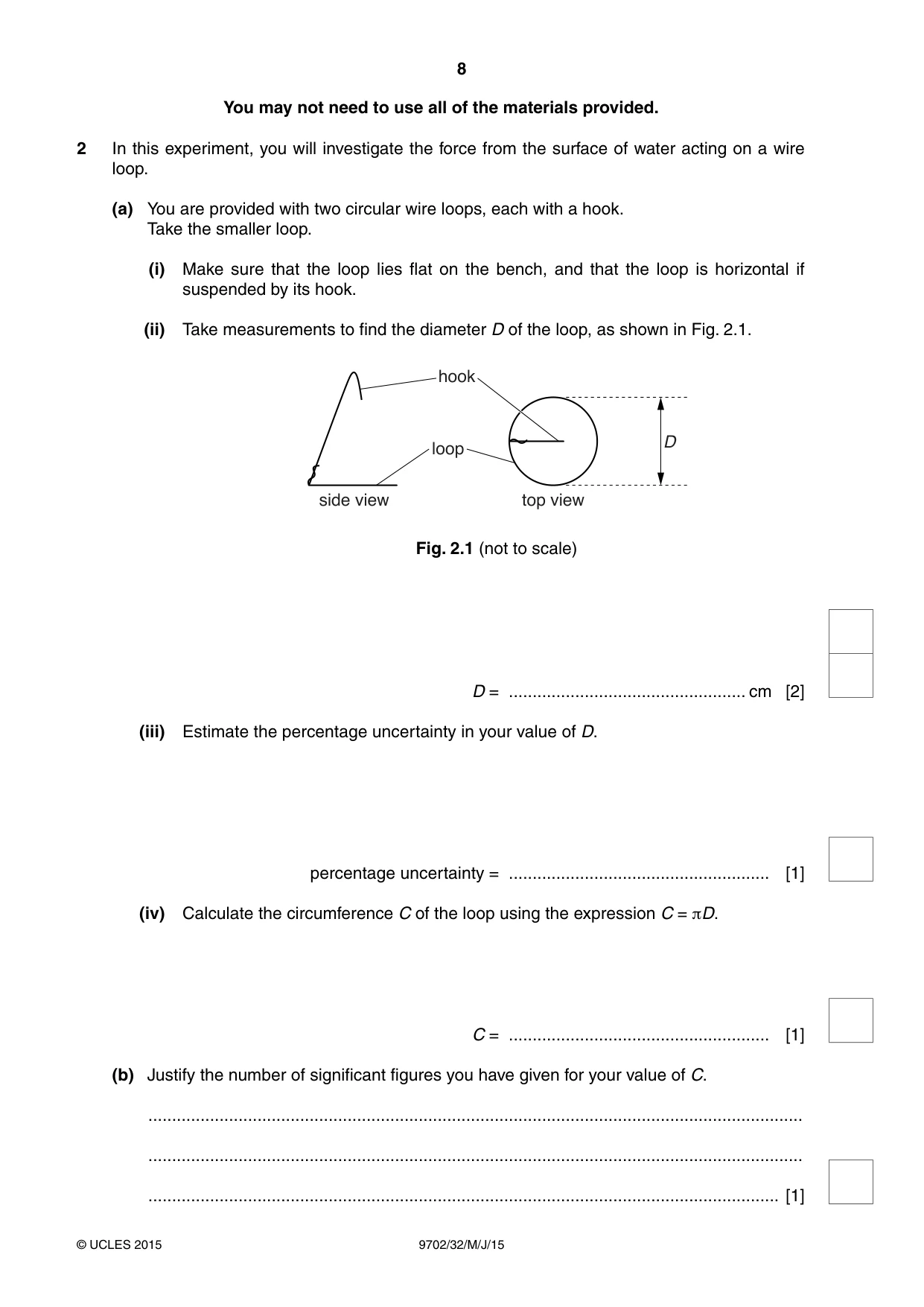
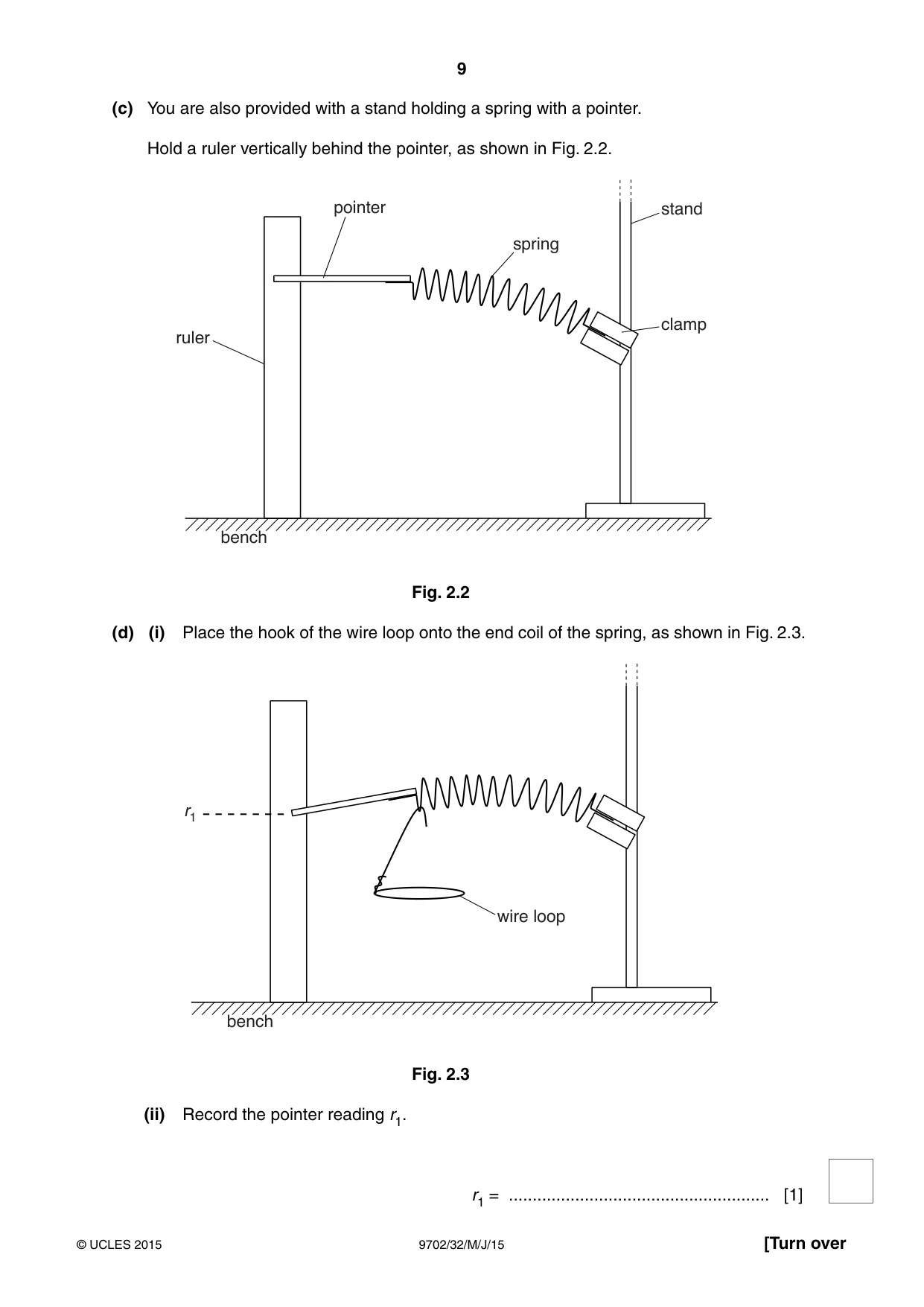
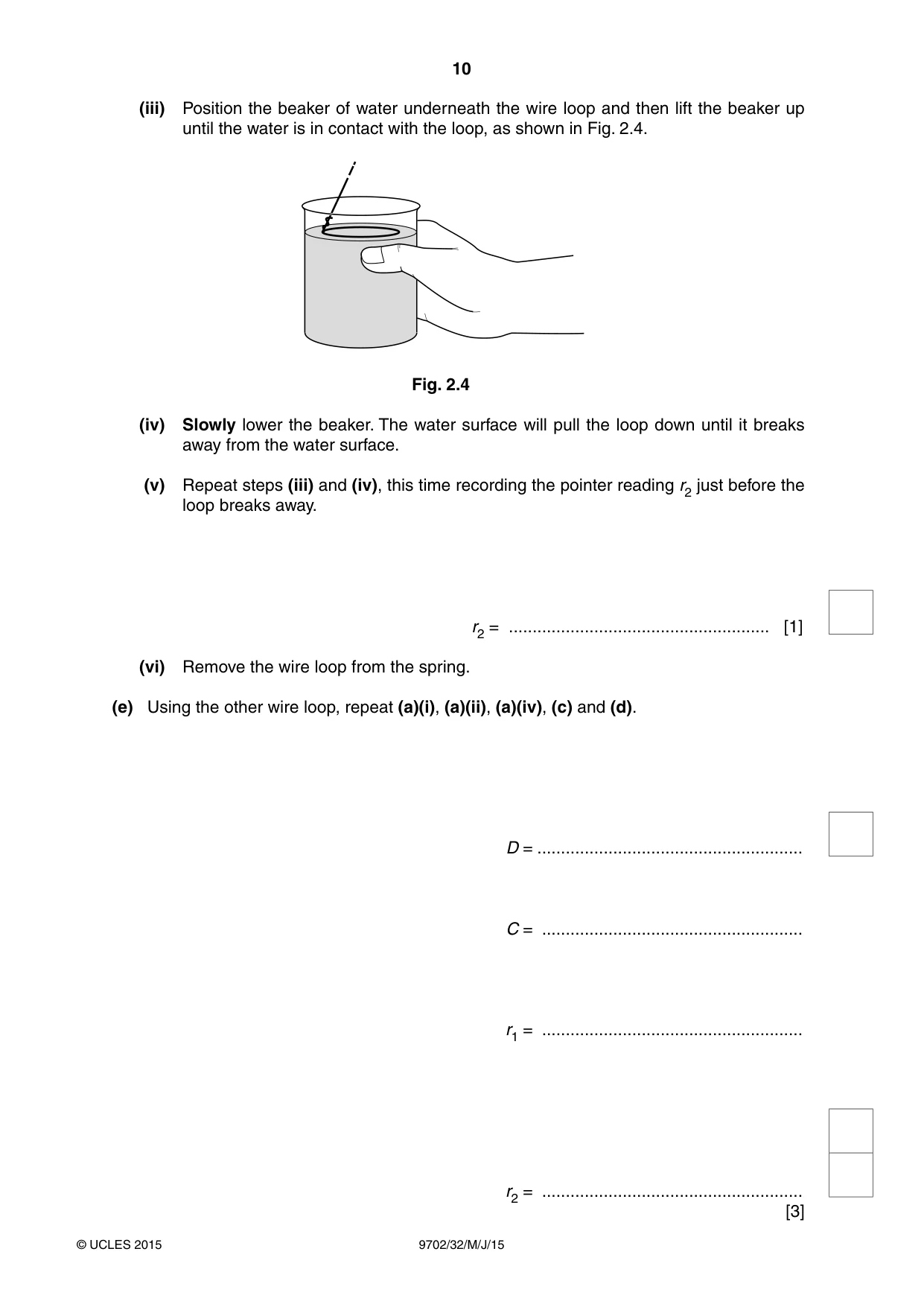
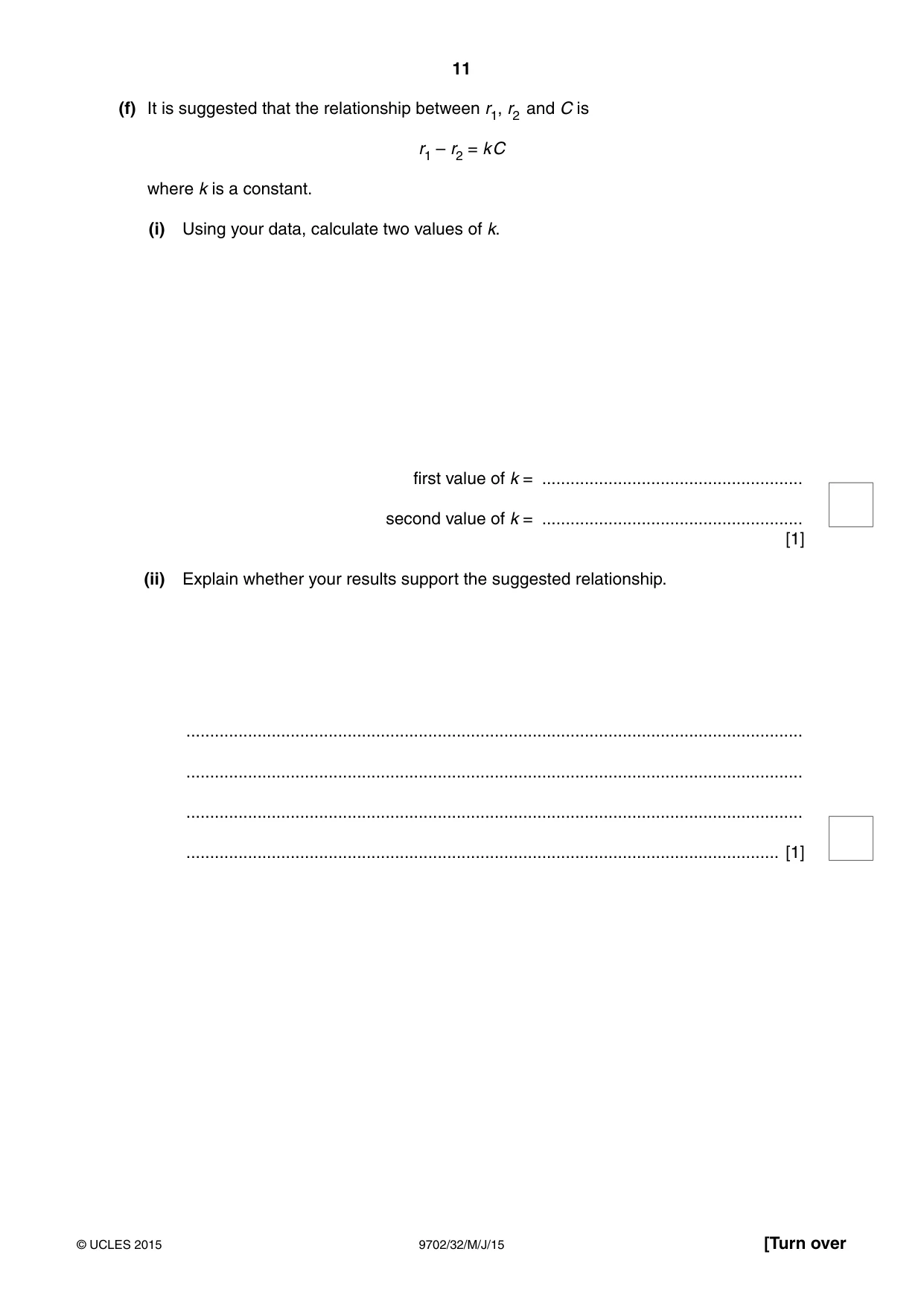
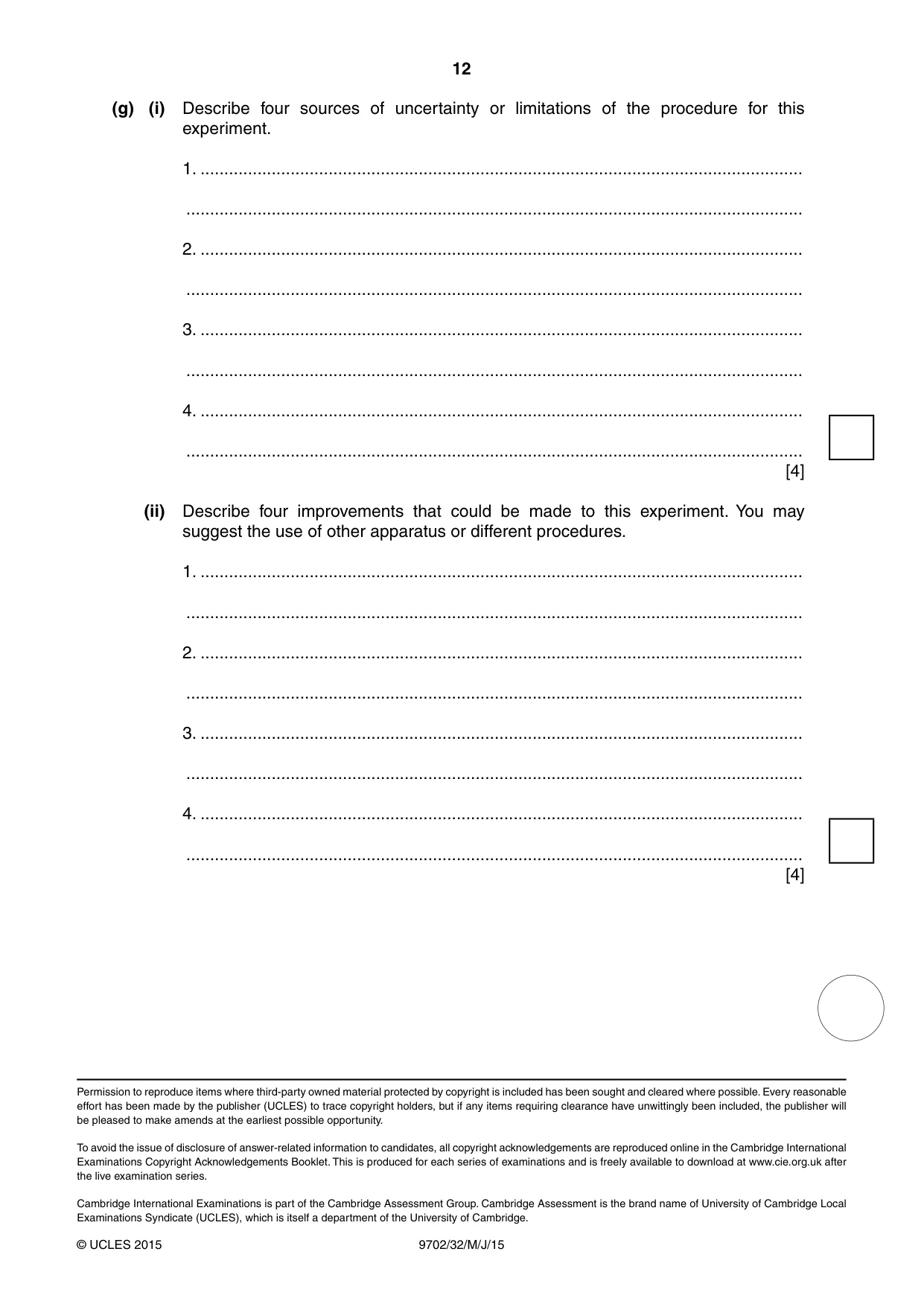
2 In this experiment, you will investigate the force from the surface of water acting on a wire loop. (a) You are provided with two circular wire loops, each with a hook. Take the smaller loop. (i) Make sure that the loop lies flat on the bench, and that the loop is horizontal if suspended by its hook. (ii) Take measurements to find the diameter D of the loop, as shown in Fig. 2.1. hook D loop side view top view Fig. 2.1 (not to scale) D = .................................................. cm [2] (iii) Estimate the percentage uncertainty in your value of D. percentage uncertainty = ....................................................... [1] (iv) Calculate the circumference C of the loop using the expression C = πD. C = ....................................................... [1] (b) Justify the number of significant figures you have given for your value of C. .......................................................................................................................................... .......................................................................................................................................... ..................................................................................................................................... [1] (c) You are also provided with a stand holding a spring with a pointer. Hold a ruler vertically behind the pointer, as shown in Fig. 2.2. pointer stand spring clamp ruler bench Fig. 2.2 (d) (i) Place the hook of the wire loop onto the end coil of the spring, as shown in Fig. 2.3. r1 wire loop bench Fig. 2.3 (ii) Record the pointer reading r1. r1 = ....................................................... [1] (iii) Position the beaker of water underneath the wire loop and then lift the beaker up until the water is in contact with the loop, as shown in Fig. 2.4. Fig. 2.4 (iv) Slowly lower the beaker. The water surface will pull the loop down until it breaks away from the water surface. (v) Repeat steps (iii) and (iv), this time recording the pointer reading r2 just before the loop breaks away. r2 = ....................................................... [1] (vi) Remove the wire loop from the spring. (e) Using the other wire loop, repeat (a)(i), (a)(ii), (a)(iv), (c) and (d). D = ........................................................ C = ....................................................... r1 = ....................................................... r2 = ....................................................... [3]
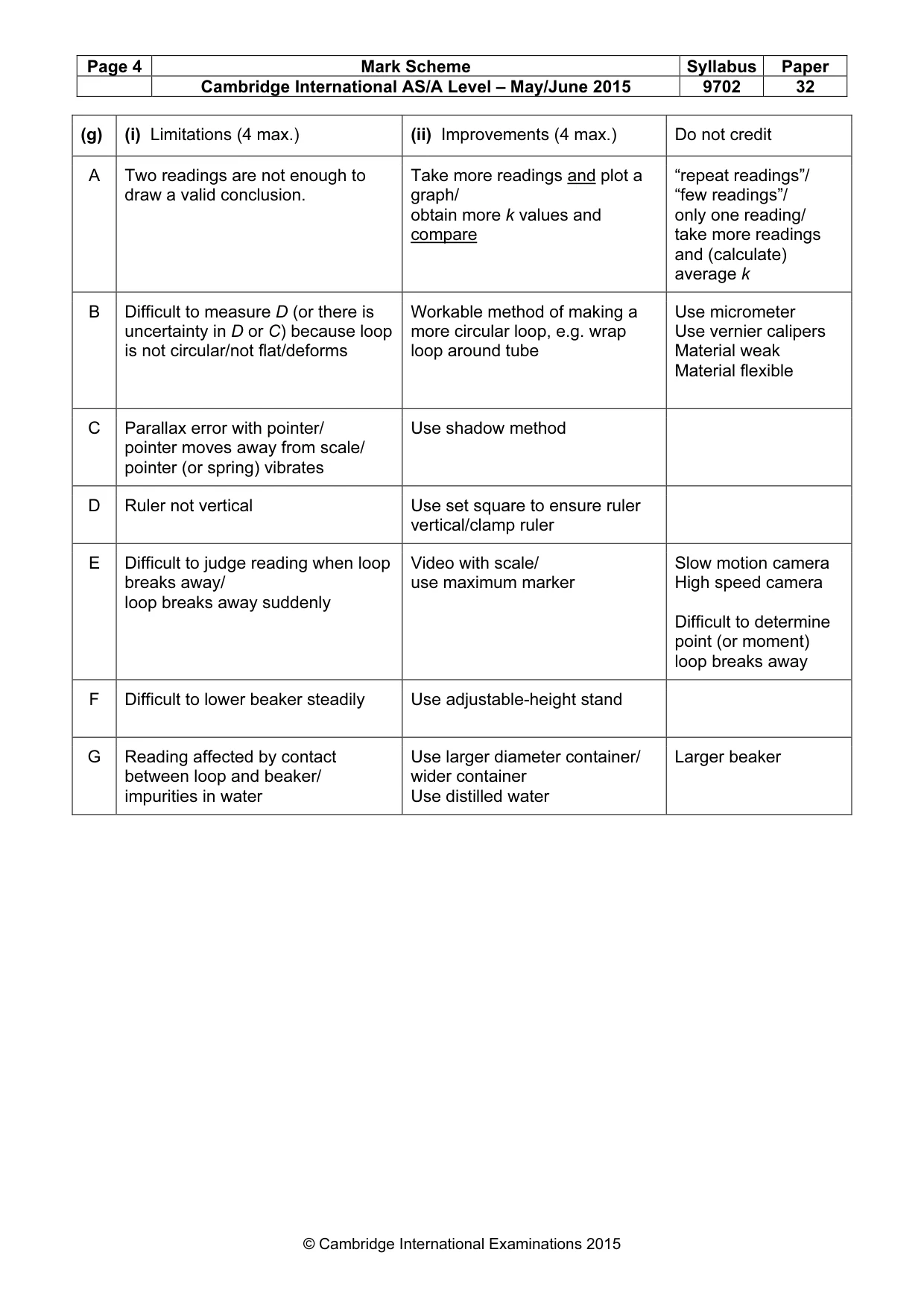
Mark scheme: 2 (a) (ii) All values of D to nearest 0.1 cm and in range 2.0 cm to 4.0 cm. [1] Evidence of repeat readings of D. [1] (iii) Absolute uncertainty in D in range 0.2 to 0.5 cm and correct method of calculation to obtain percentage uncertainty. If repeated readings have been taken, then the absolute uncertainty can be half the range (but not zero) if the working is clearly shown. [1] (iv) Correct calculation of C with consistent unit. [1] (b) Justification for significant figures in C linked to significant figures in D only. [1] (d) (ii) r1 in range 5.0 cm to 25.0 cm, with unit, to nearest mm. [1] (v) r2 in range 5.0 cm to 25.0 cm. [1] (e) Second value of D. [1] Second values of r1 and r2. [1] Second value of |r1 – r2| > first value of |r1 – r2|. [1] (f) (i) Two values of k calculated correctly. [1] (ii) Sensible comment relating to the calculated values of k, testing against a criterion specified by the candidate. [1] (g) (i) Limitations (4 max.) (ii) Improvements (4 max.) Do not credit A Two readings are not enough to Take more readings and plot a “repeat readings”/ draw a valid conclusion. graph/ “few readings”/ obtain more k values and only one reading/ compare take more readings and (calculate) average k B Difficult to measure D (or there is Workable method of making a Use micrometer uncertainty in D or C) because loop more circular loop, e.g. wrap Use vernier calipers is not circular/not flat/deforms loop around tube Material weak Material flexible C Parallax error with pointer/ Use shadow method pointer moves away from scale/ pointer (or spring) vibrates D Ruler not vertical Use set square to ensure ruler vertical/clamp ruler E Difficult to judge reading when loop Video with scale/ Slow motion camera breaks away/ use maximum marker High speed camera loop breaks away suddenly Difficult to determine point (or moment) loop breaks away F Difficult to lower beaker steadily Use adjustable-height stand G Reading affected by contact Use larger diameter container/ Larger beaker between loop and beaker/ wider container impurities in water Use distilled water
What was in this paper
The subtopics covered by these 2 questions, and how many questions each got. Open one in a new tab to see every Cambridge question on it.
What you needed in this session
Cambridge’s own grade thresholds for 2015 May/June, Paper 3 · Variant 2. A higher threshold means an easier paper — the bar moves with how the cohort did.