Cambridge A Level Physics 9702 — 2012 May/June Paper 3 · Variant 5
9702/35/M/J/12 · 2 questions · 40 marks · ≈45 min
The question paper and its mark scheme, free to read here and free to download. This is Cambridge’s own paper, exactly as it was sat.
Question paper12 pages
Mark scheme4 pages
Answers below. Sit the paper first if you are practising.
Questions as text
Q1 · In this experiment, you will investigate how the current in a circuit depends on the…
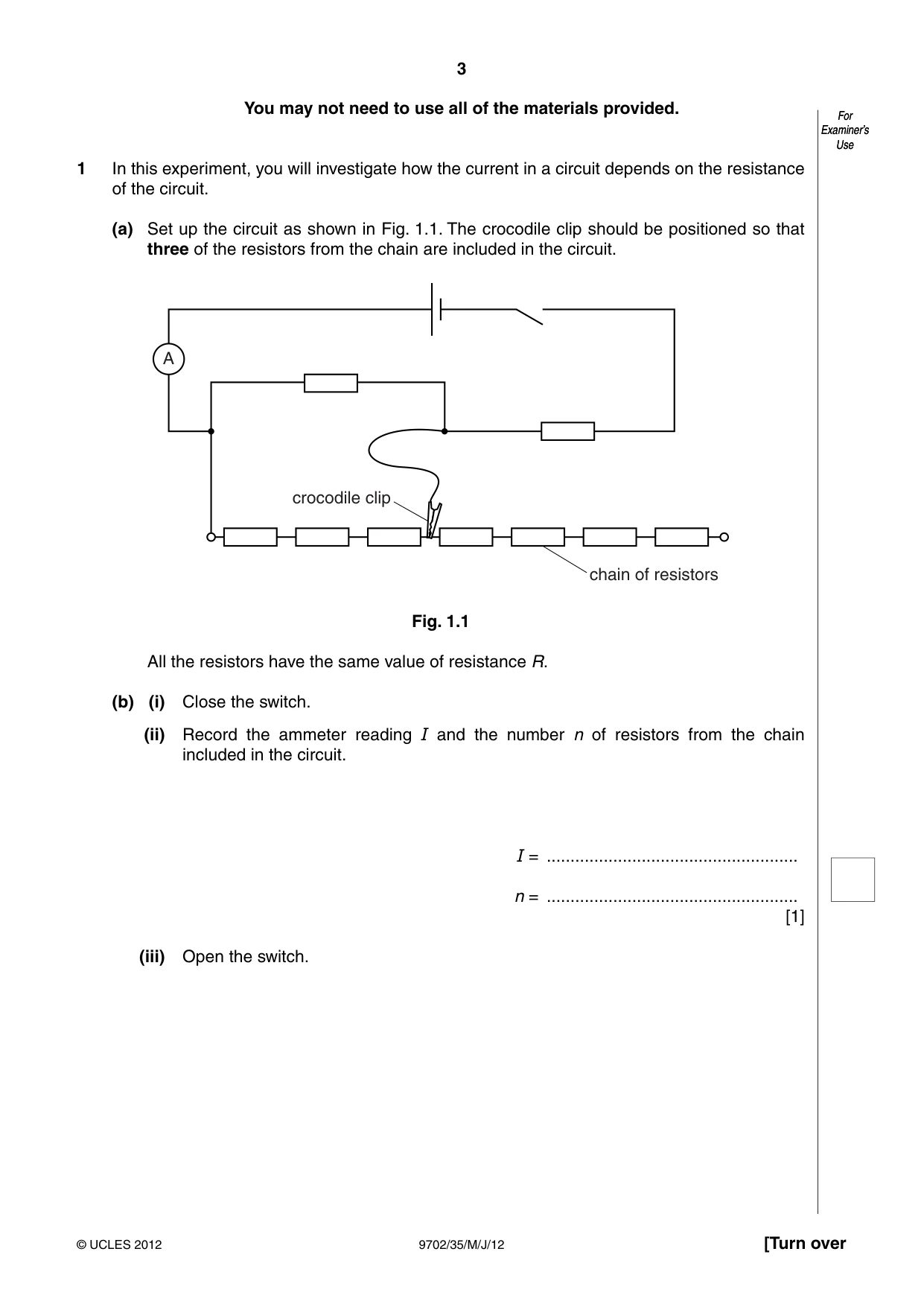
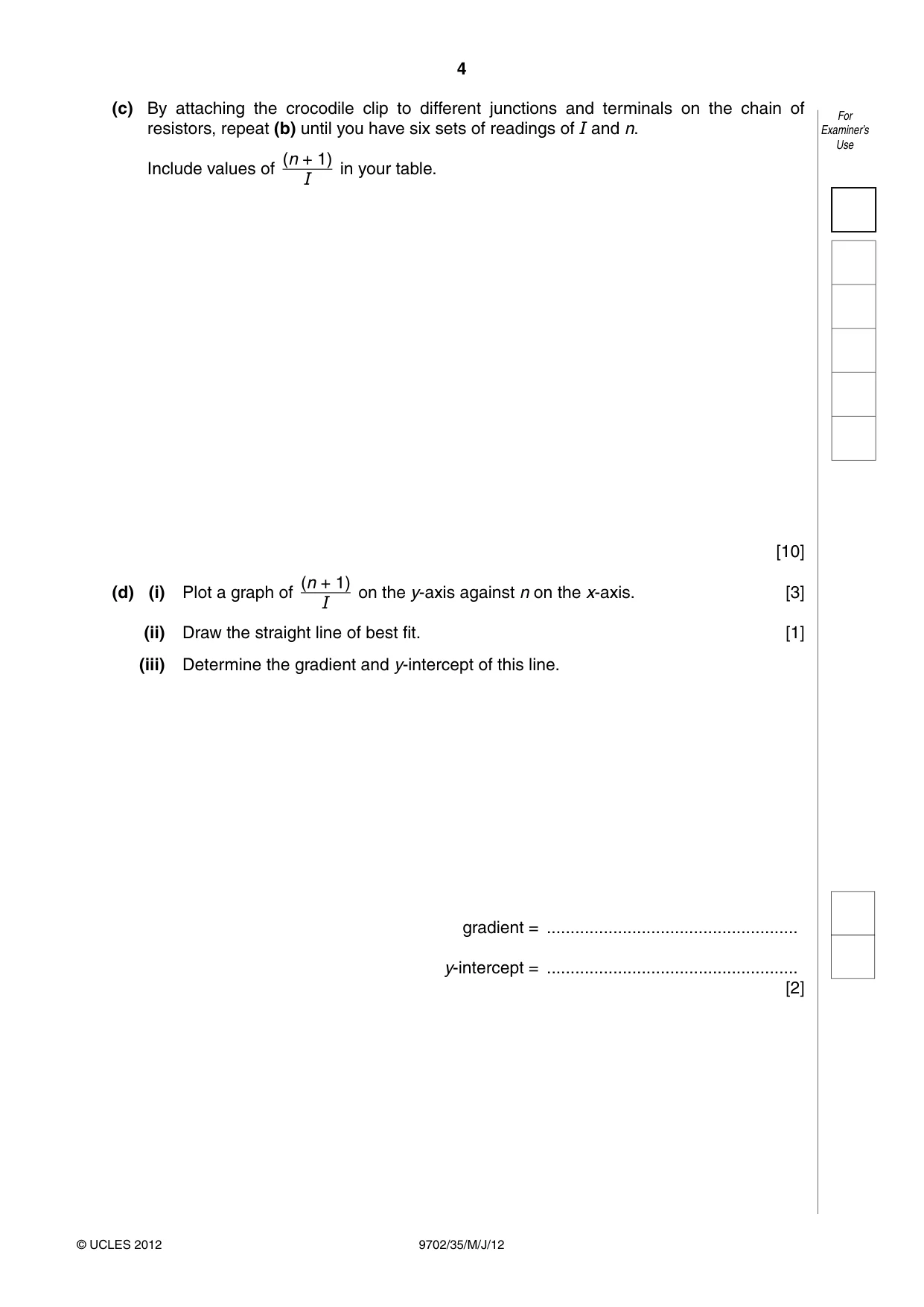
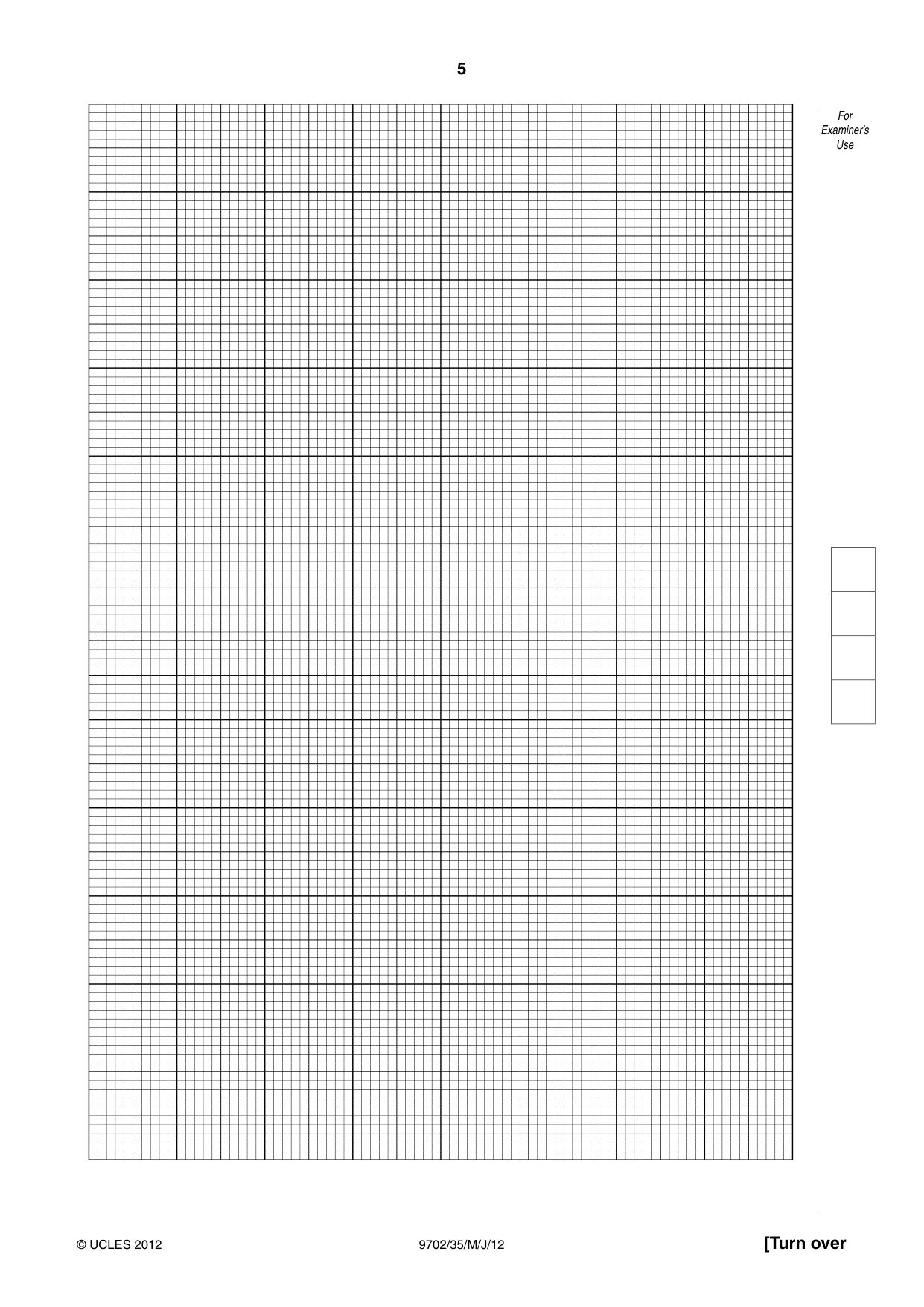
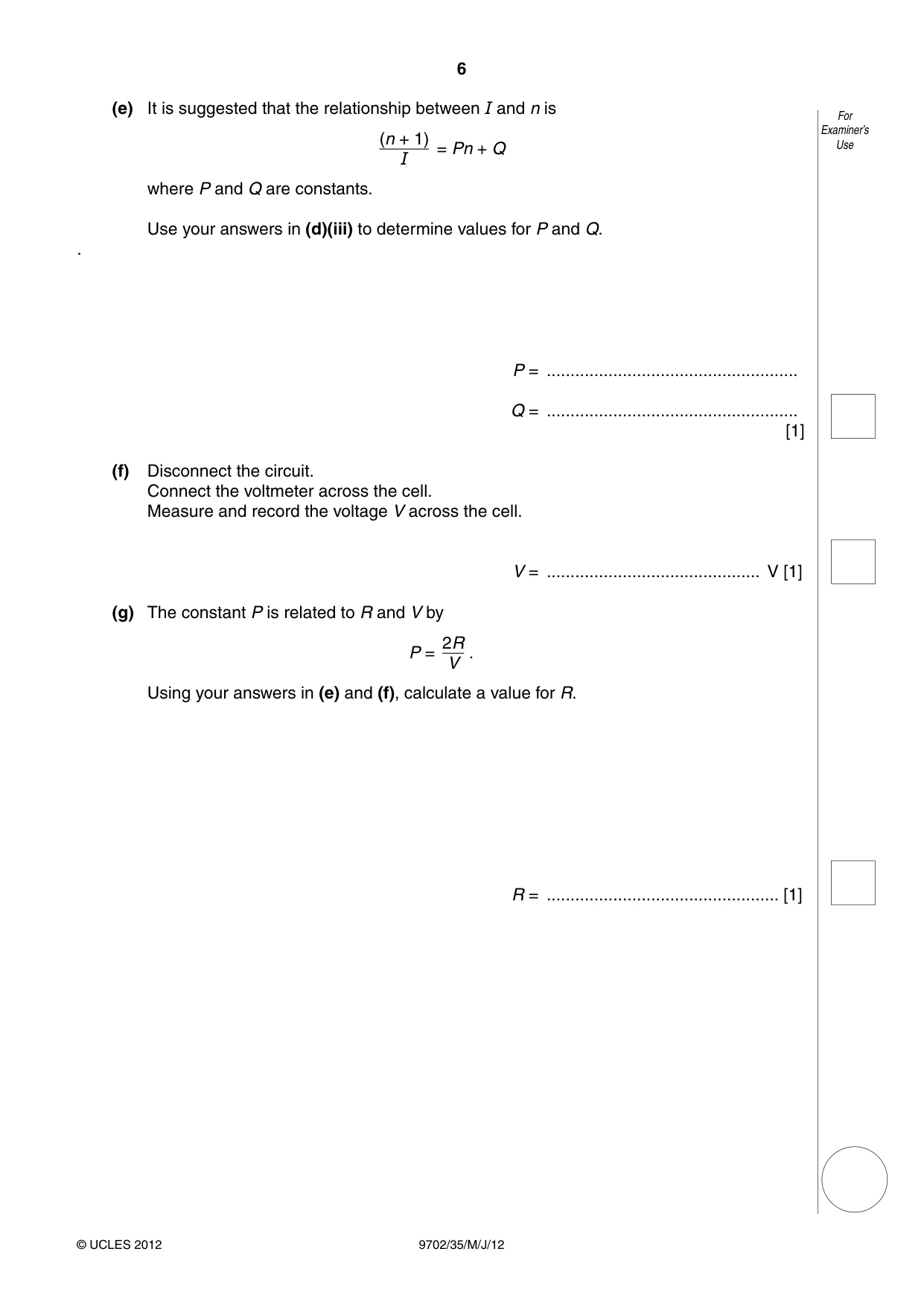
1 In this experiment, you will investigate how the current in a circuit depends on the resistance of the circuit. (a) Set up the circuit as shown in Fig. 1.1. The crocodile clip should be positioned so that three of the resistors from the chain are included in the circuit. A crocodile clip chain of resistors Fig. 1.1 All the resistors have the same value of resistance R. (b) (i) Close the switch. (ii) Record the ammeter reading I and the number n of resistors from the chain included in the circuit. I = ..................................................... n = ..................................................... [1] (iii) Open the switch. (c) By attaching the crocodile clip to different junctions and terminals on the chain of For resistors, repeat (b) until you have six sets of readings of I and n. Examiner’s Use (n + 1) Include values of in your table. I [10] (n + 1) (d) (i) Plot a graph of on the y-axis against n on the x-axis. [3] I (ii) Draw the straight line of best fit. [1] (iii) Determine the gradient and y-intercept of this line. gradient = ..................................................... y-intercept = ..................................................... [2] For Examiner’s Use (e) It is suggested that the relationship between I and n is For Examiner’s (n + 1) Use = Pn + Q I where P and Q are constants. Use your answers in (d)(iii) to determine values for P and Q. . P = ..................................................... Q = ..................................................... [1] (f) Disconnect the circuit. Connect the voltmeter across the cell. Measure and record the voltage V across the cell. V = ............................................. V [1] (g) The constant P is related to R and V by 2R P = . V Using your answers in (e) and (f), calculate a value for R. R = ................................................. [1] You may not need to use all of the materials provided. For Examiner’s Use
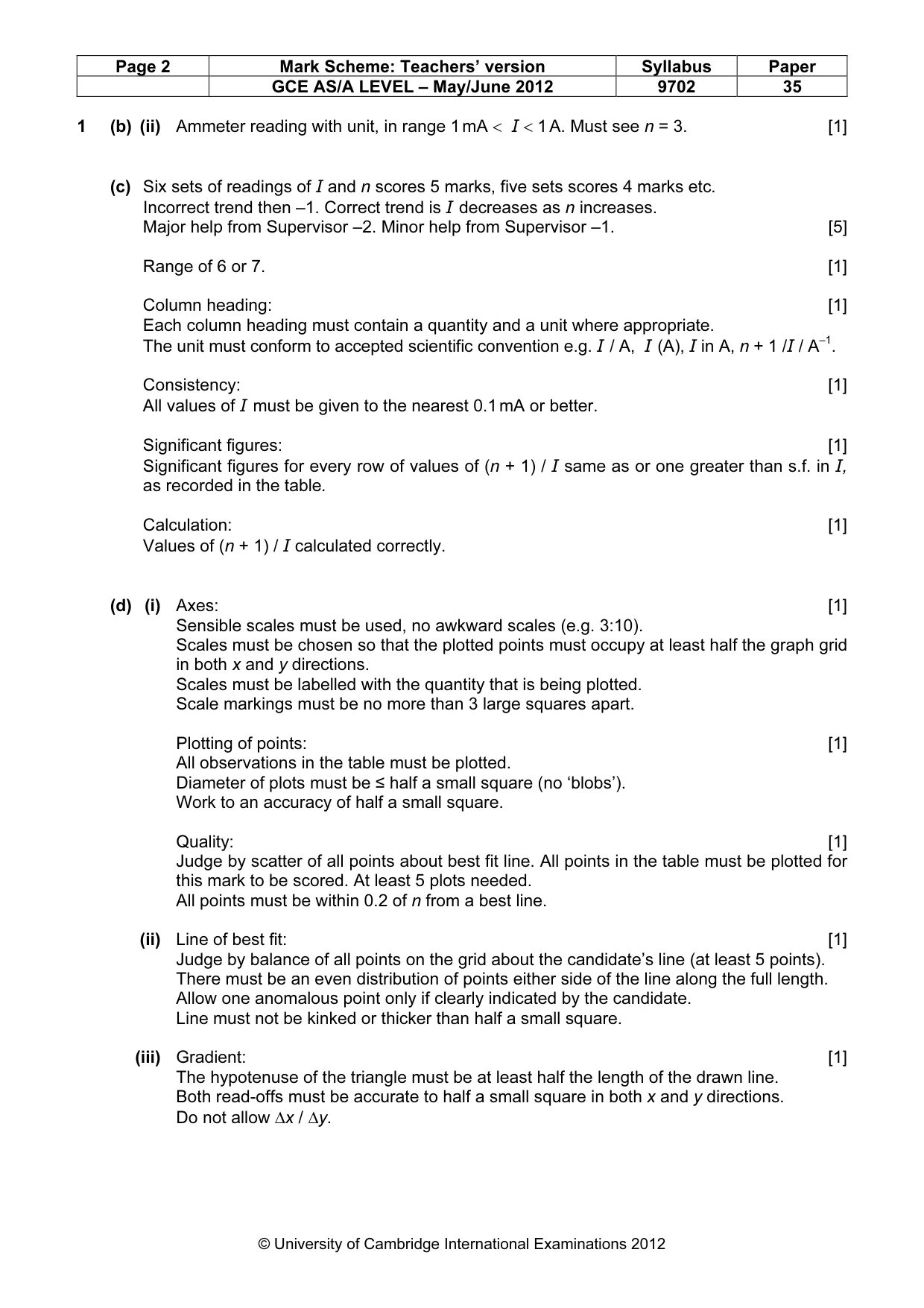
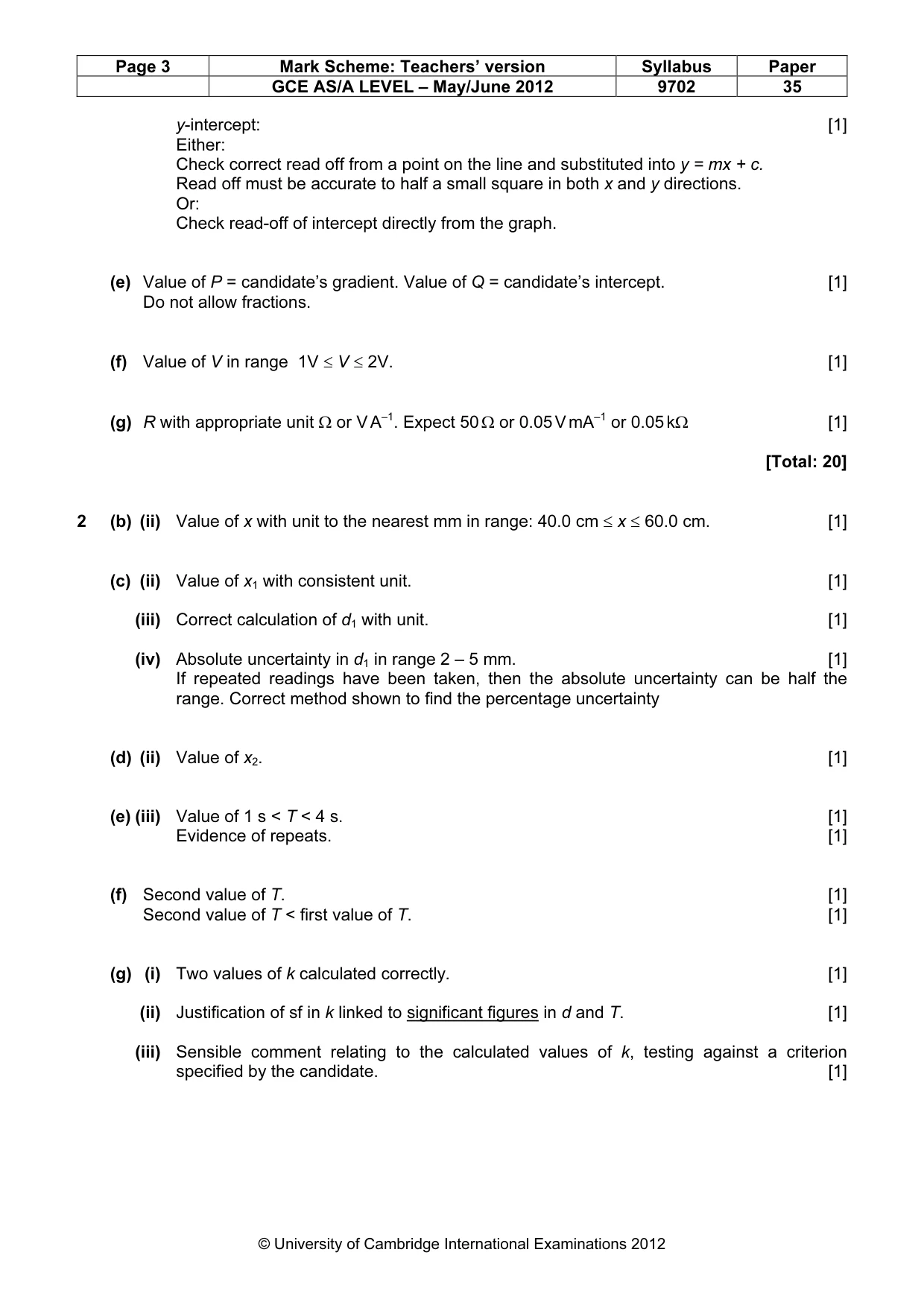
Mark scheme: 1 (b) (ii) Ammeter reading with unit, in range 1 mA < I < 1 A. Must see n = 3. [1] (c) Six sets of readings of I and n scores 5 marks, five sets scores 4 marks etc. Incorrect trend then –1. Correct trend is I decreases as n increases. Major help from Supervisor –2. Minor help from Supervisor –1. [5] Range of 6 or 7. [1] Column heading: [1] Each column heading must contain a quantity and a unit where appropriate. The unit must conform to accepted scientific convention e.g. I / A, I (A), I in A, n + 1 /I / A–1. Consistency: [1] All values of I must be given to the nearest 0.1 mA or better. Significant figures: [1] Significant figures for every row of values of (n + 1) / I same as or one greater than s.f. in I, as recorded in the table. Calculation: [1] Values of (n + 1) / I calculated correctly. (d) (i) Axes: [1] Sensible scales must be used, no awkward scales (e.g. 3:10). Scales must be chosen so that the plotted points must occupy at least half the graph grid in both x and y directions. Scales must be labelled with the quantity that is being plotted. Scale markings must be no more than 3 large squares apart. Plotting of points: [1] All observations in the table must be plotted. Diameter of plots must be ≤ half a small square (no ‘blobs’). Work to an accuracy of half a small square. Quality: [1] Judge by scatter of all points about best fit line. All points in the table must be plotted for this mark to be scored. At least 5 plots needed. All points must be within 0.2 of n from a best line. (ii) Line of best fit: [1] Judge by balance of all points on the grid about the candidate’s line (at least 5 points). There must be an even distribution of points either side of the line along the full length. Allow one anomalous point only if clearly indicated by the candidate. Line must not be kinked or thicker than half a small square. (iii) Gradient: [1] The hypotenuse of the triangle must be at least half the length of the drawn line. Both read-offs must be accurate to half a small square in both x and y directions. Do not allow ∆x / ∆y. GCE AS/A LEVEL – May/June 2012 9702 35 y-intercept: [1] Either: Check correct read off from a point on the line and substituted into y = mx + c. Read off must be accurate to half a small square in both x and y directions. Or: Check read-off of intercept directly from the graph. (e) Value of P = candidate’s gradient. Value of Q = candidate’s intercept. [1] Do not allow fractions. (f) Value of V in range 1V ≤ V ≤ 2V. [1] (g) R with appropriate unit Ω or V A–1. Expect 50 Ω or 0.05 V mA–1 or 0.05 kΩ [1] [Total: 20]
Q2 · In this experiment, you will investigate how the rotational motion of an object depends…
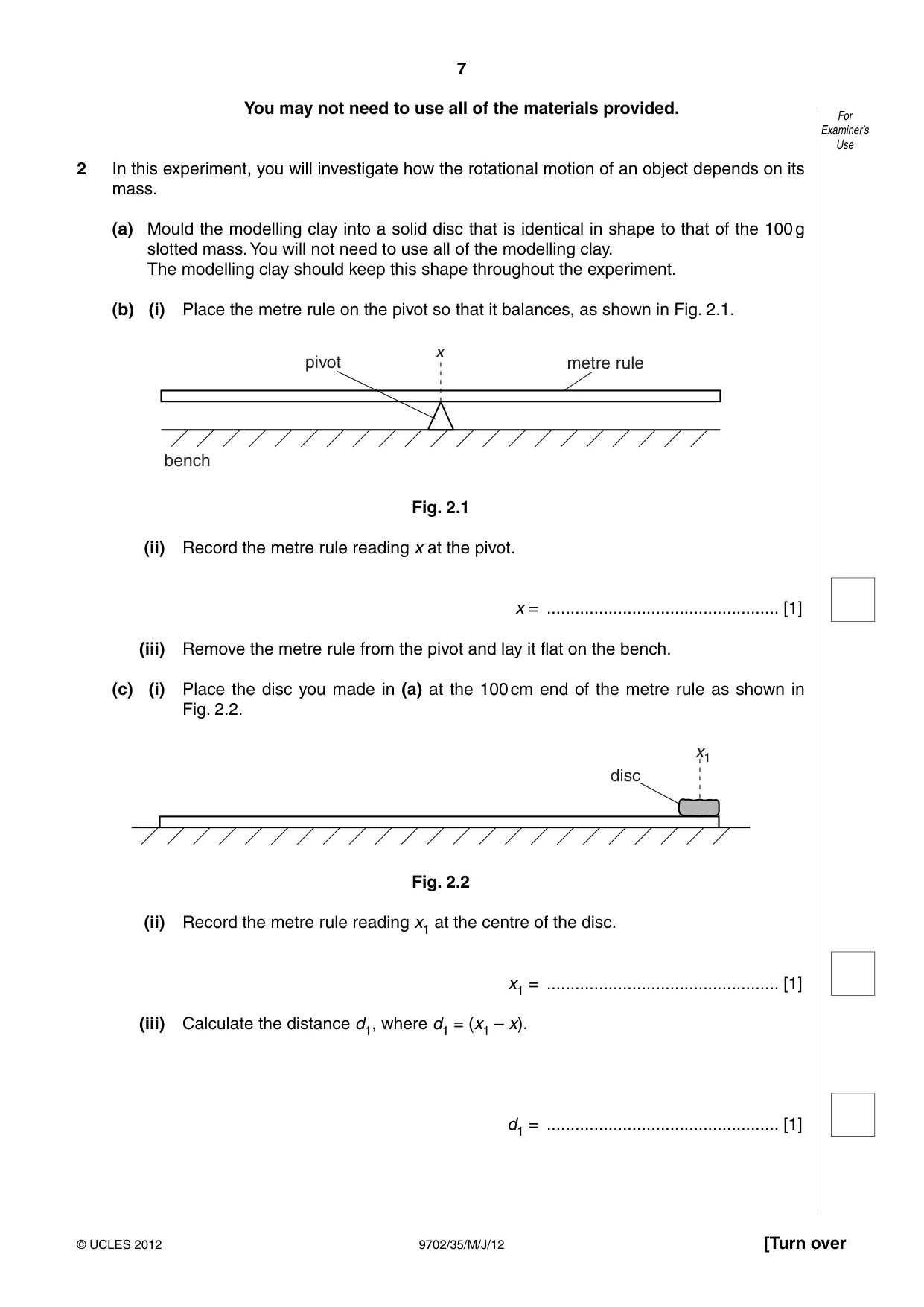
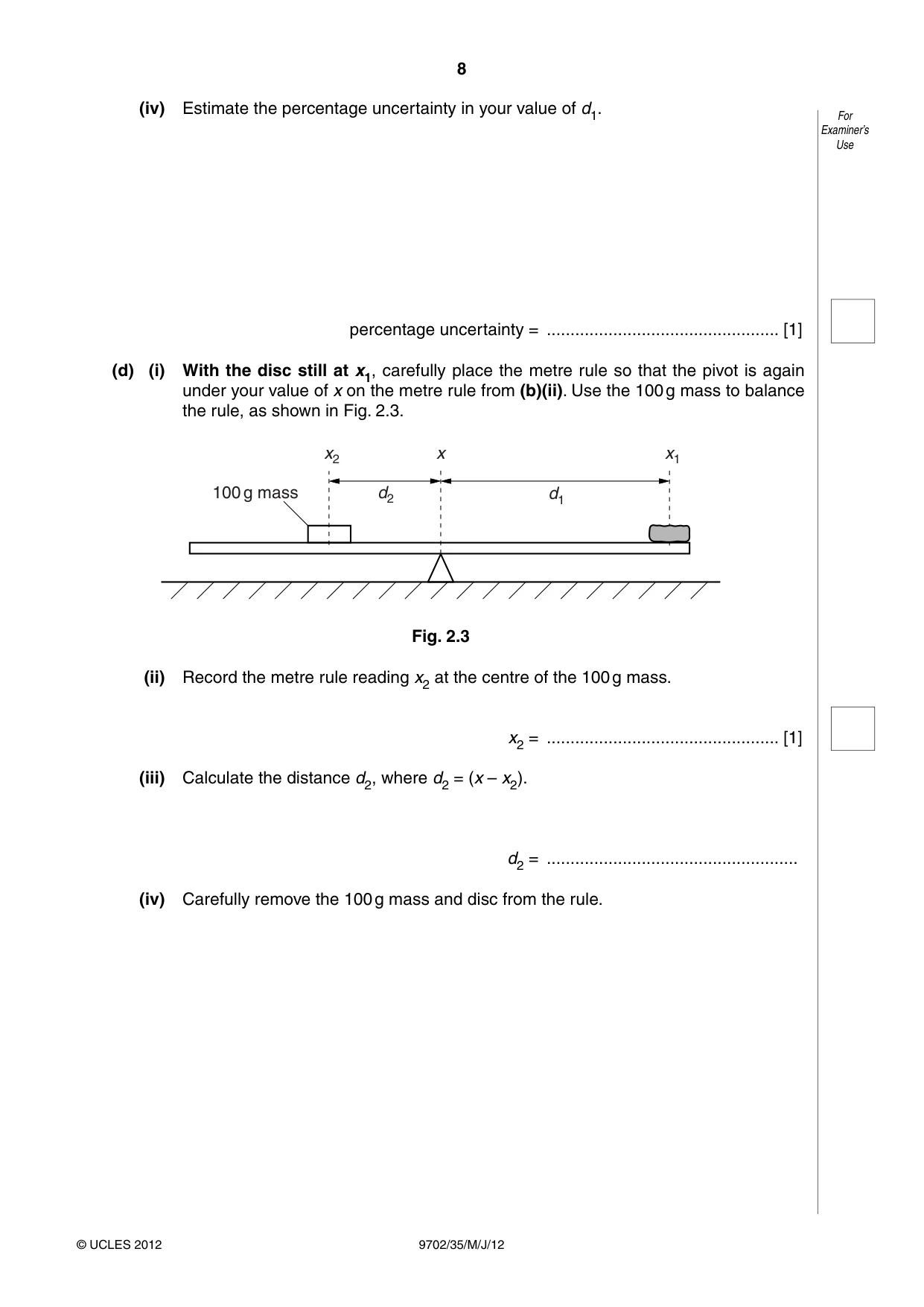
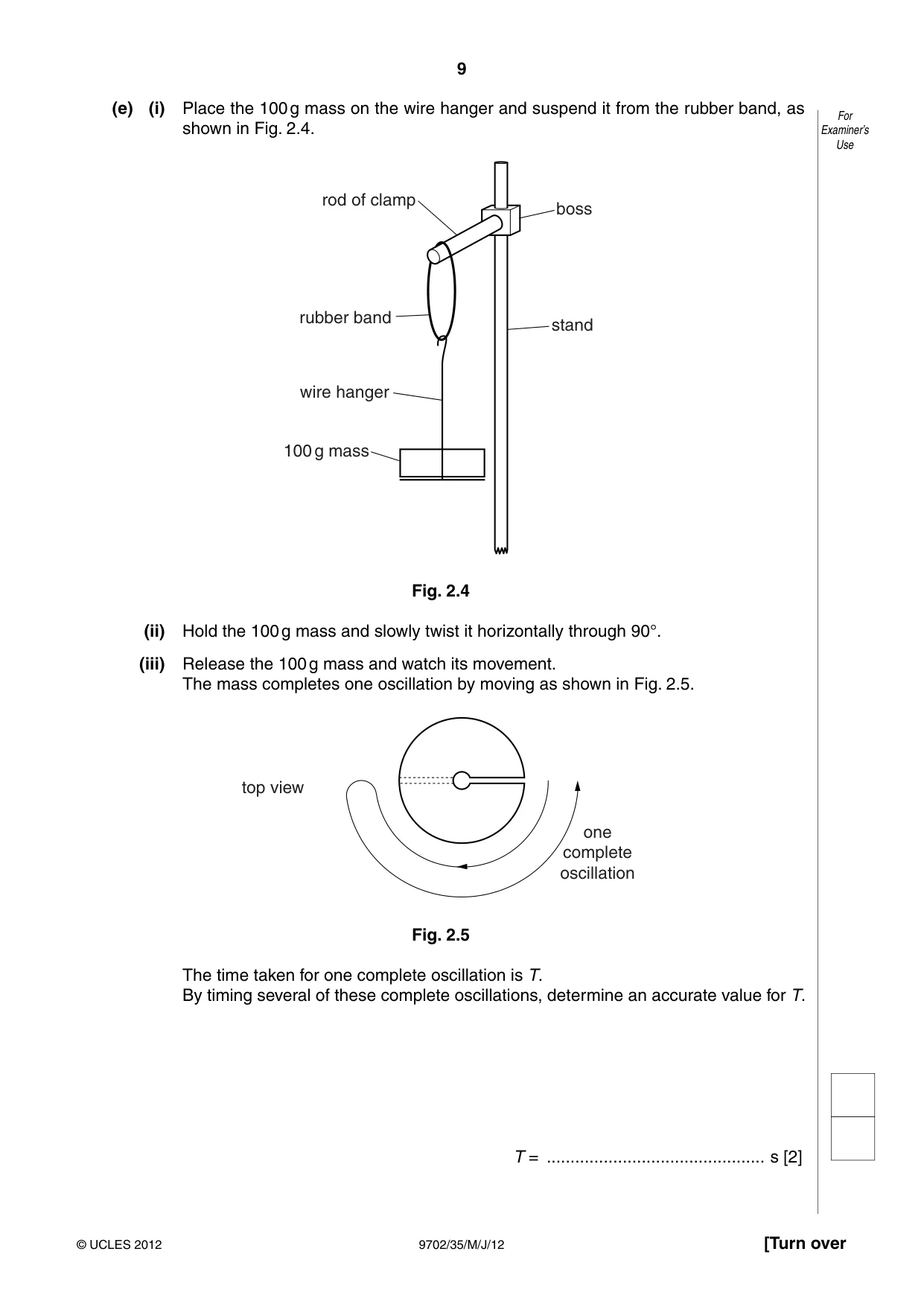
2 In this experiment, you will investigate how the rotational motion of an object depends on its mass. (a) Mould the modelling clay into a solid disc that is identical in shape to that of the 100 g slotted mass. You will not need to use all of the modelling clay. The modelling clay should keep this shape throughout the experiment. (b) (i) Place the metre rule on the pivot so that it balances, as shown in Fig. 2.1. x pivot metre rule bench Fig. 2.1 (ii) Record the metre rule reading x at the pivot. x = ................................................. [1] (iii) Remove the metre rule from the pivot and lay it flat on the bench. (c) (i) Place the disc you made in (a) at the 100 cm end of the metre rule as shown in Fig. 2.2. x1 disc Fig. 2.2 (ii) Record the metre rule reading x1 at the centre of the disc. x1 = ................................................. [1] (iii) Calculate the distance d1, where d1 = (x1 – x). d1 = ................................................. [1] (iv) Estimate the percentage uncertainty in your value of d1. For Examiner’s Use percentage uncertainty = ................................................. [1] (d) (i) With the disc still at x1, carefully place the metre rule so that the pivot is again under your value of x on the metre rule from (b)(ii). Use the 100 g mass to balance the rule, as shown in Fig. 2.3. x2 x x1 100 g mass d2 d1 Fig. 2.3 (ii) Record the metre rule reading x2 at the centre of the 100 g mass. x2 = ................................................. [1] (iii) Calculate the distance d2, where d2 = (x – x2). d2 = ..................................................... (iv) Carefully remove the 100 g mass and disc from the rule. (e) (i) Place the 100 g mass on the wire hanger and suspend it from the rubber band, as For shown in Fig. 2.4. Examiner’s Use rod of clamp boss rubber band stand wire hanger 100 g mass Fig. 2.4 (ii) Hold the 100 g mass and slowly twist it horizontally through 90°. (iii) Release the 100 g mass and watch its movement. The mass completes one oscillation by moving as shown in Fig. 2.5. top view one complete oscillation Fig. 2.5 The time taken for one complete oscillation is T. By timing several of these complete oscillations, determine an accurate value for T. T = .............................................. s [2]
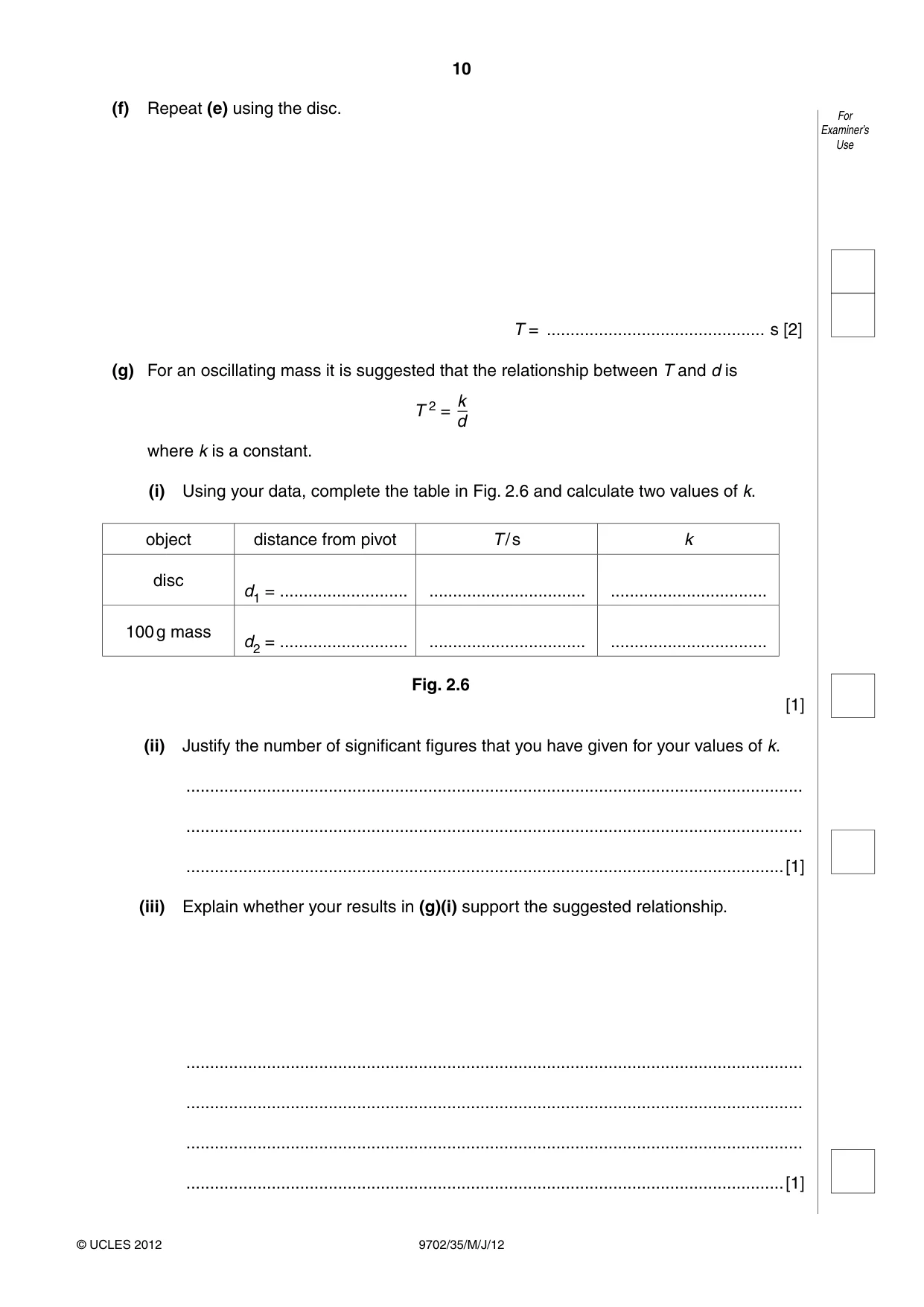
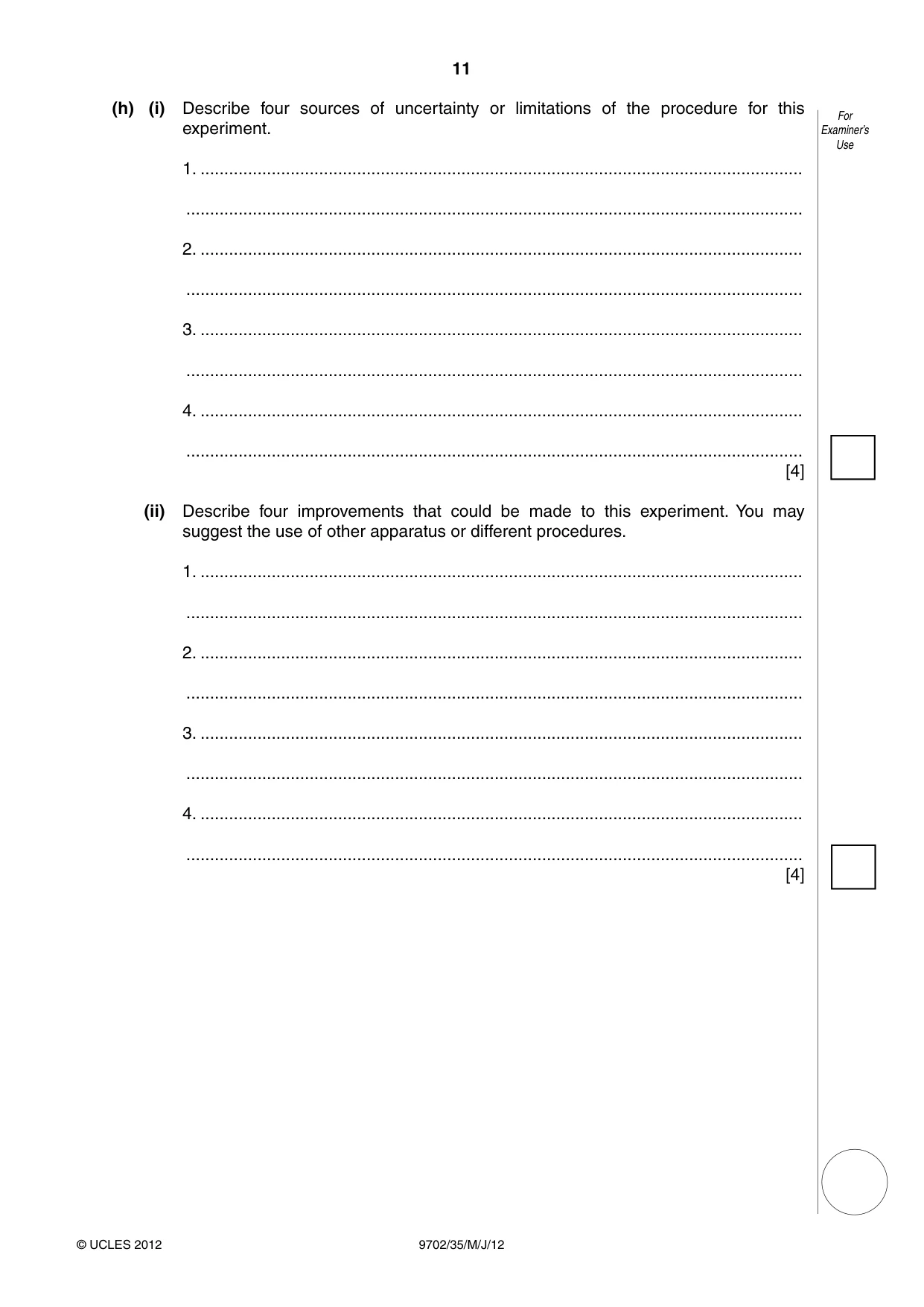
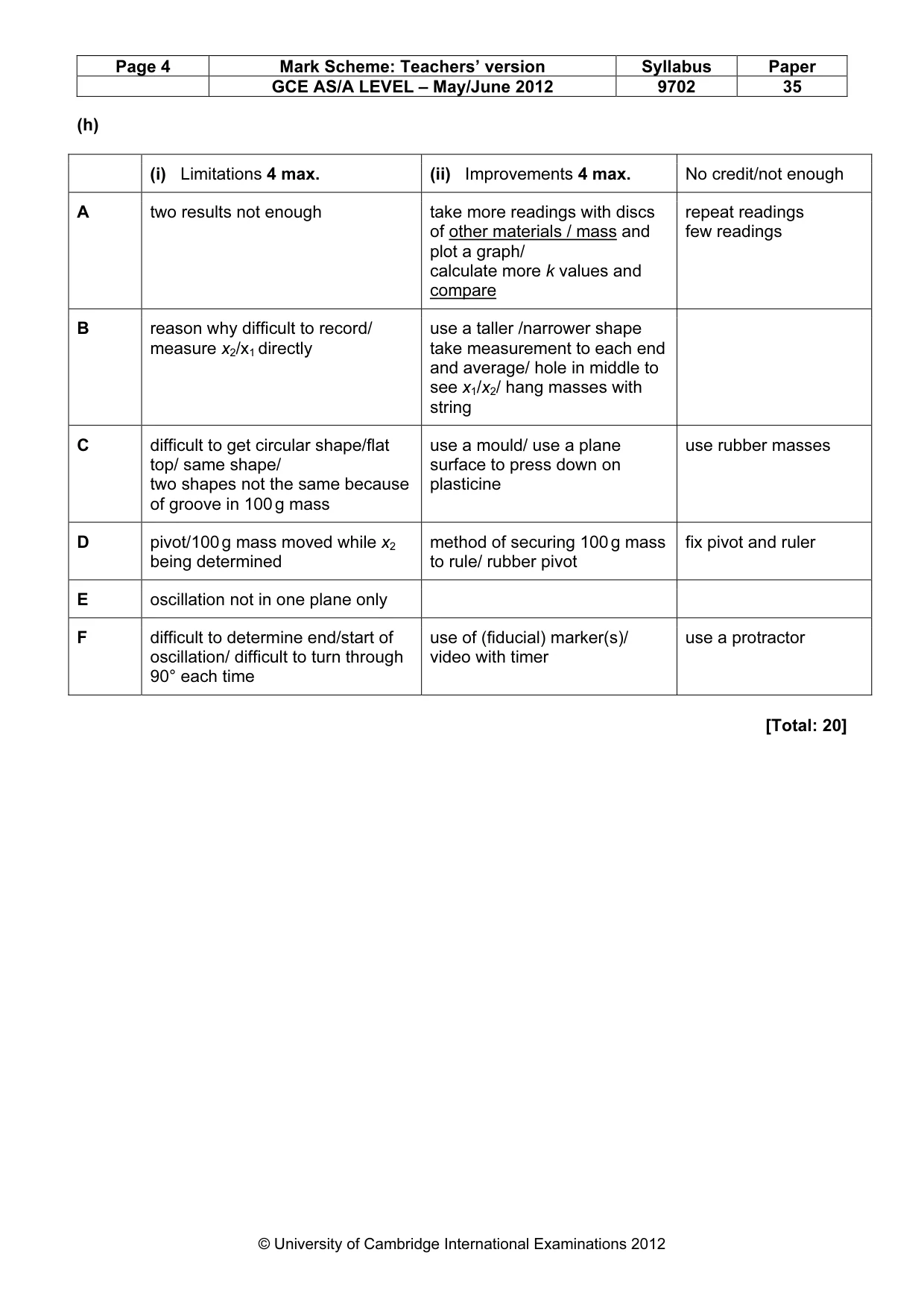
Mark scheme: 2 (b) (ii) Value of x with unit to the nearest mm in range: 40.0 cm ≤ x ≤ 60.0 cm. [1] (c) (ii) Value of x1 with consistent unit. [1] (iii) Correct calculation of d1 with unit. [1] (iv) Absolute uncertainty in d1 in range 2 – 5 mm. [1] If repeated readings have been taken, then the absolute uncertainty can be half the range. Correct method shown to find the percentage uncertainty (d) (ii) Value of x2. [1] (e) (iii) Value of 1 s < T < 4 s. [1] Evidence of repeats. [1] (f) Second value of T. [1] Second value of T < first value of T. [1] (g) (i) Two values of k calculated correctly. [1] (ii) Justification of sf in k linked to significant figures in d and T. [1] (iii) Sensible comment relating to the calculated values of k, testing against a criterion specified by the candidate. [1] GCE AS/A LEVEL – May/June 2012 9702 35 (h) (i) Limitations 4 max. (ii) Improvements 4 max. No credit/not enough A two results not enough take more readings with discs repeat readings of other materials / mass and few readings plot a graph/ calculate more k values and compare B reason why difficult to record/ use a taller /narrower shape measure x2/x1 directly take measurement to each end and average/ hole in middle to see x1/x2/ hang masses with string C difficult to get circular shape/flat use a mould/ use a plane use rubber masses top/ same shape/ surface to press down on two shapes not the same because plasticine of groove in 100 g mass D pivot/100 g mass moved while x2 method of securing 100 g mass fix pivot and ruler being determined to rule/ rubber pivot E oscillation not in one plane only F difficult to determine end/start of use of (fiducial) marker(s)/ use a protractor oscillation/ difficult to turn through video with timer 90° each time [Total: 20]
What was in this paper
The subtopics covered by these 2 questions, and how many questions each got. Open one in a new tab to see every Cambridge question on it.
What you needed in this session
Cambridge’s own grade thresholds for 2012 May/June, Paper 3 · Variant 5. A higher threshold means an easier paper — the bar moves with how the cohort did.