Cambridge A Level Physics 9702 — 2011 May/June Paper 3 · Variant 4
9702/34/M/J/11 · 2 questions · 40 marks · ≈45 min
The question paper and its mark scheme, free to read here and free to download. This is Cambridge’s own paper, exactly as it was sat.
Question paper12 pages

Mark scheme4 pages
Answers below. Sit the paper first if you are practising.
Questions as text
Q1 · In this experiment, you will investigate the angle through which a loaded beaker rolls as…
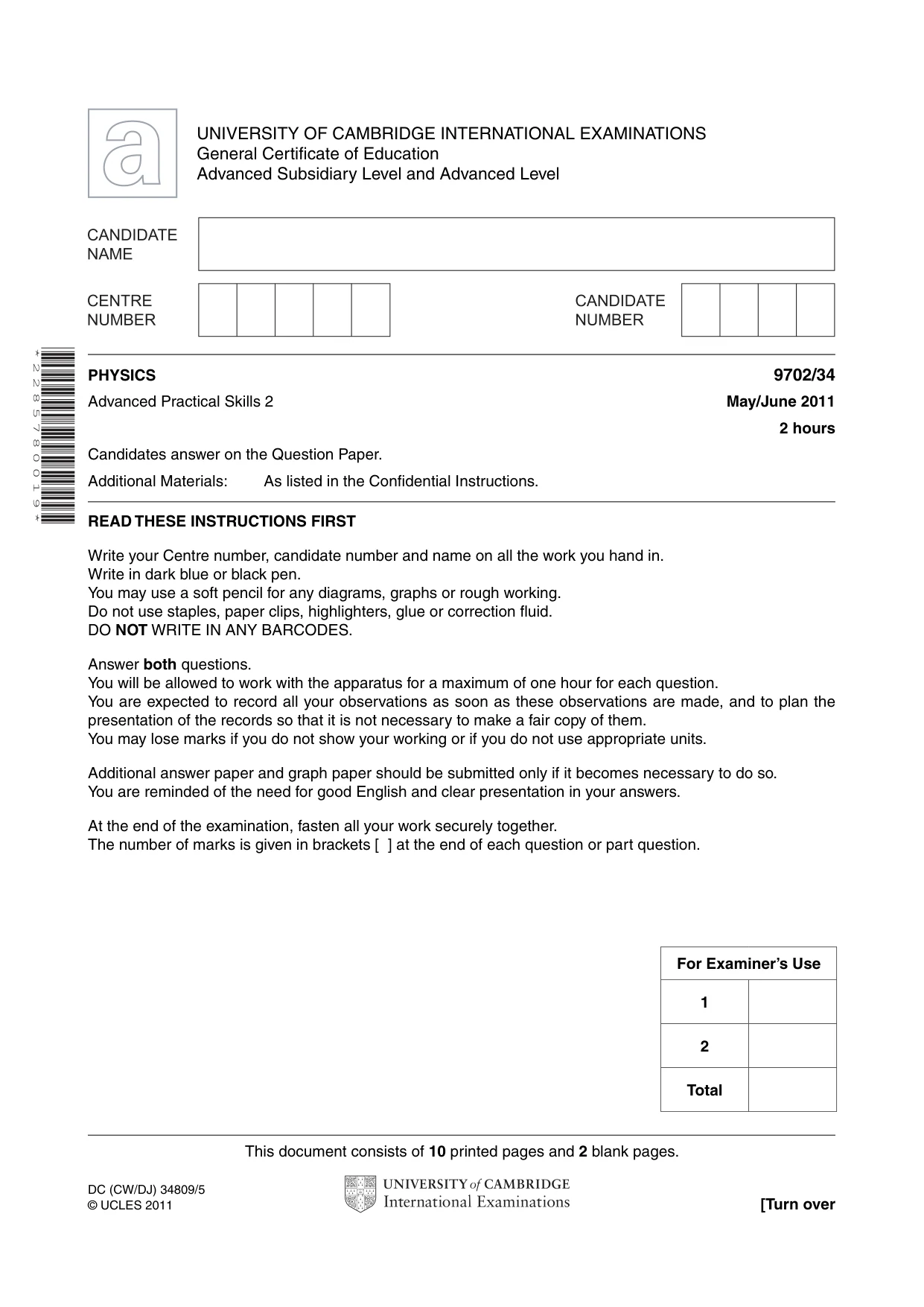
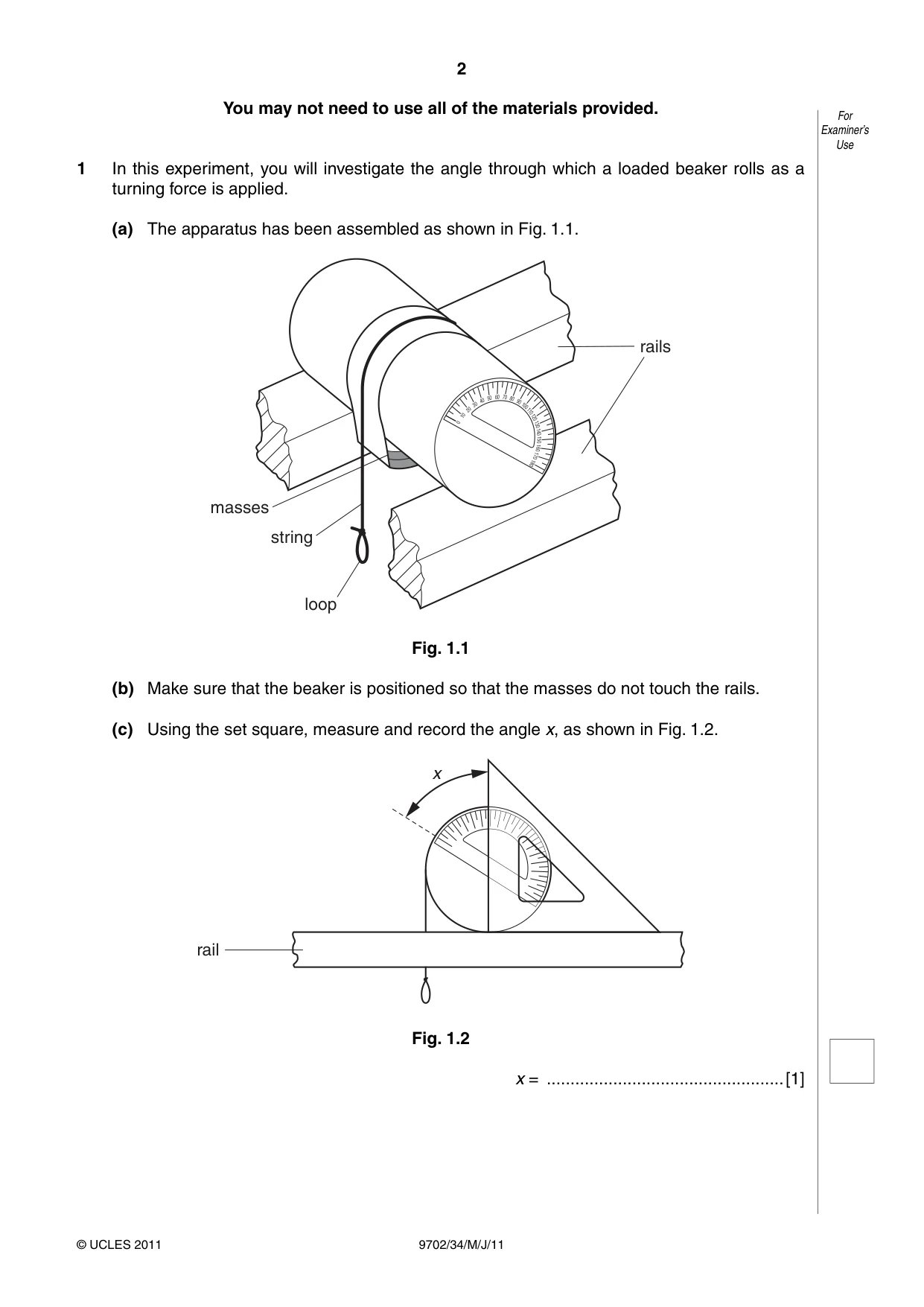
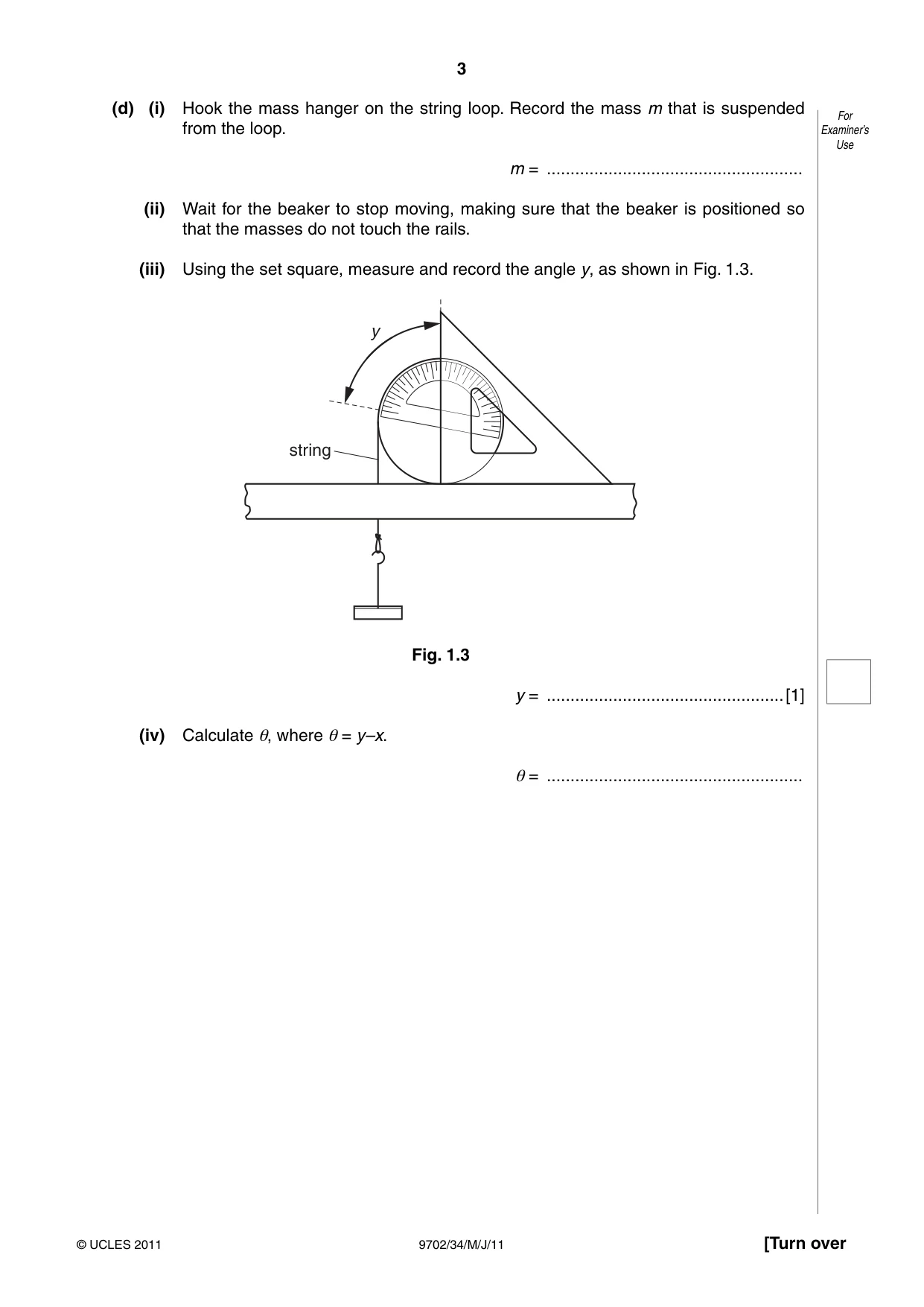
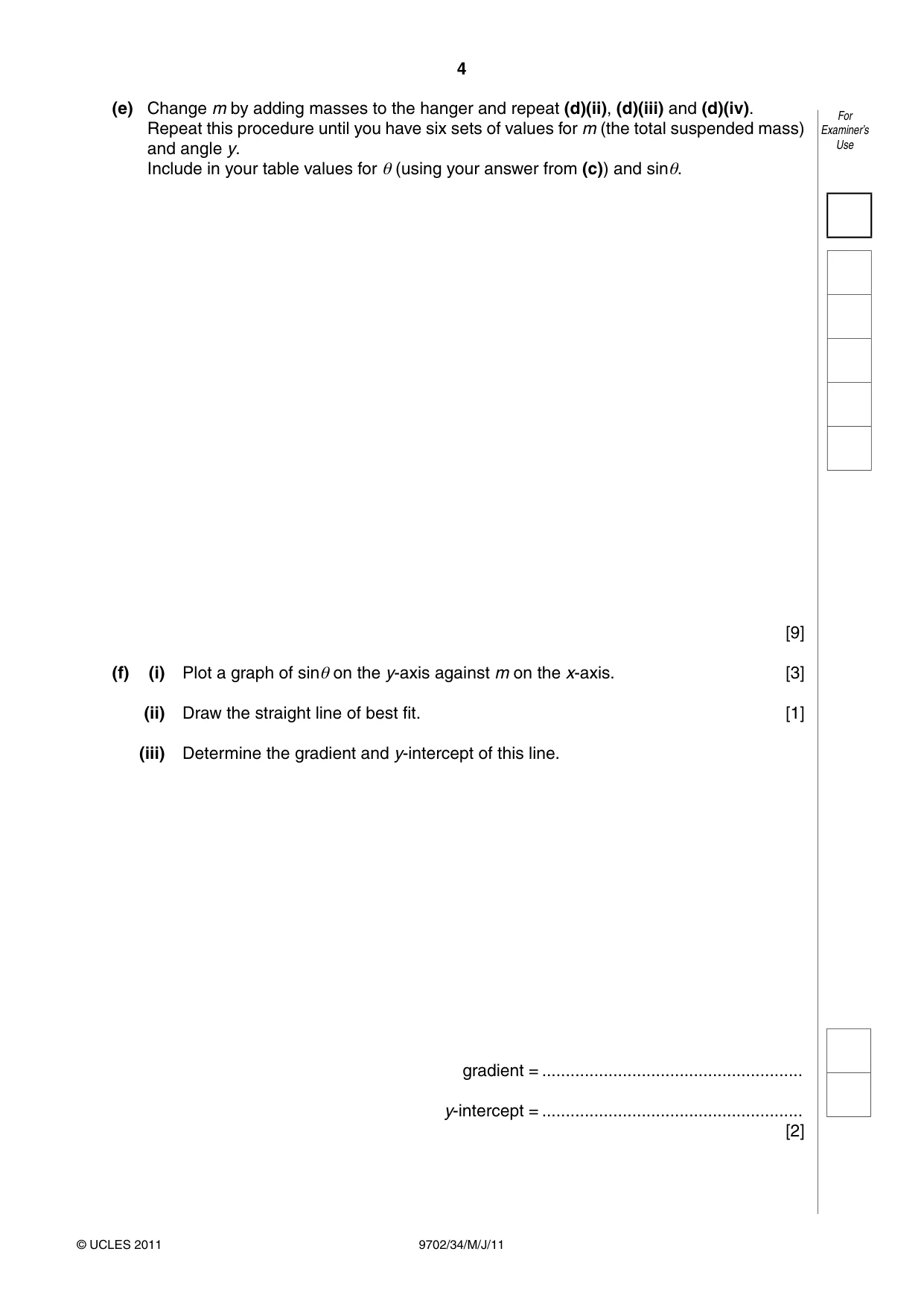
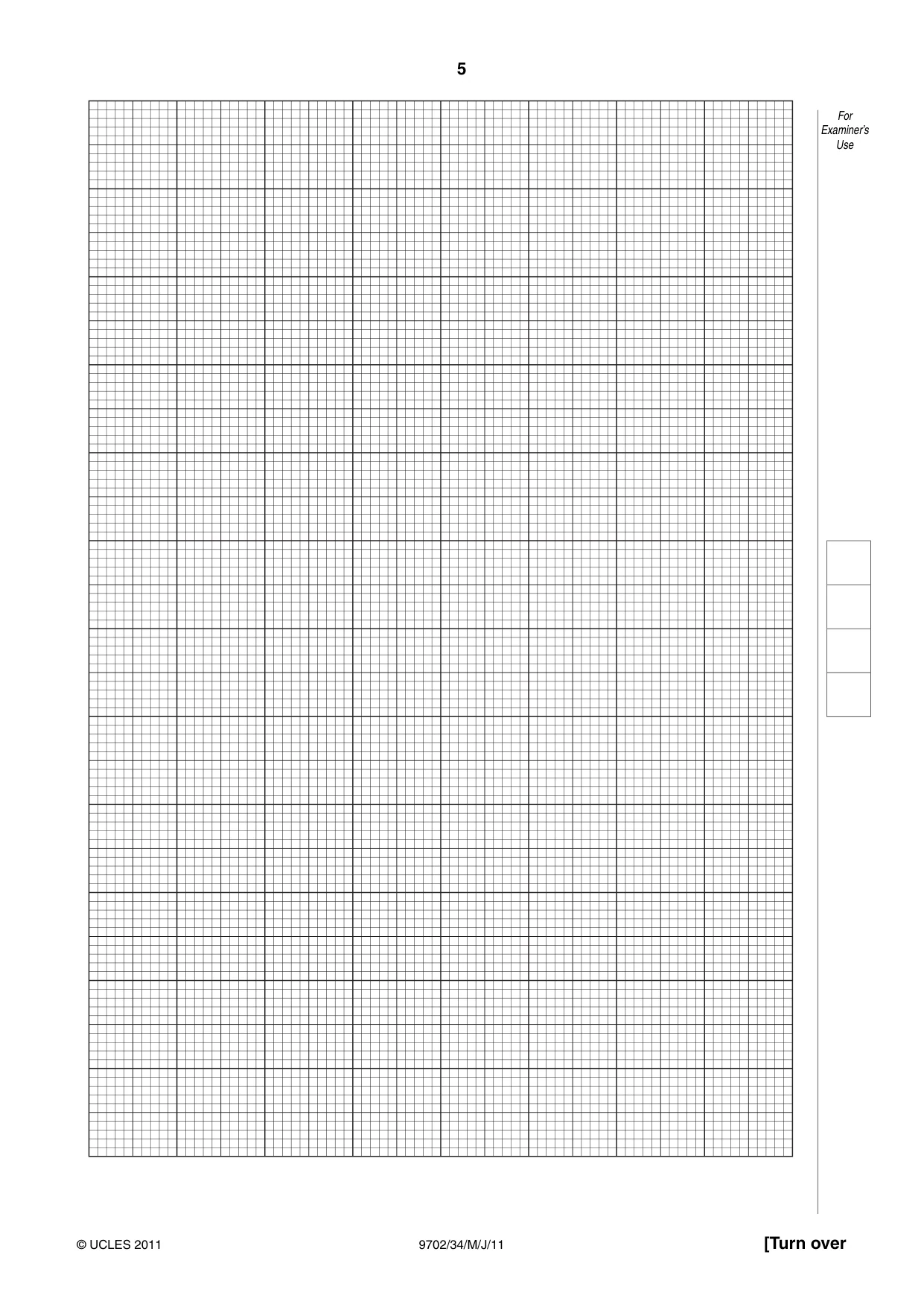
1 In this experiment, you will investigate the angle through which a loaded beaker rolls as a turning force is applied. (a) The apparatus has been assembled as shown in Fig. 1.1. rails 30 40 50 60 70 80 90100 20 110 10 120 0 130 140 150 160 170 180 masses string loop Fig. 1.1 (b) Make sure that the beaker is positioned so that the masses do not touch the rails. (c) Using the set square, measure and record the angle x, as shown in Fig. 1.2. x rail Fig. 1.2 x = ..................................................[1] (d) (i) Hook the mass hanger on the string loop. Record the mass m that is suspended For from the loop. Examiner’s Use m = ...................................................... (ii) Wait for the beaker to stop moving, making sure that the beaker is positioned so that the masses do not touch the rails. (iii) Using the set square, measure and record the angle y, as shown in Fig. 1.3. y string Fig. 1.3 y = ..................................................[1] (iv) Calculate θ, where θ = y–x. θ = ...................................................... (e) Change m by adding masses to the hanger and repeat (d)(ii), (d)(iii) and (d)(iv). For Repeat this procedure until you have six sets of values for m (the total suspended mass) Examiner’s and angle y. Use Include in your table values for θ (using your answer from (c)) and sinθ. [9] (f) (i) Plot a graph of sinθ on the y-axis against m on the x-axis. [3] (ii) Draw the straight line of best fit. [1] (iii) Determine the gradient and y-intercept of this line. gradient = ....................................................... y-intercept = ....................................................... [2] For Examiner’s Use (g) (i) Unhook the masses from the string loop and remove the beaker from the rails. For Examiner’s (ii) Take measurements to determine the radius r of the beaker. Use r = ..................................................[1] (h) It is suggested that the relationship between θ and m is r m sinθ = + b a where a and b are constants. Using your answers from (f)(iii) and (g)(ii), determine the value of a. Give an appropriate unit. a = ..................................................[2] You may not need to use all of the materials provided. For Examiner’s Use
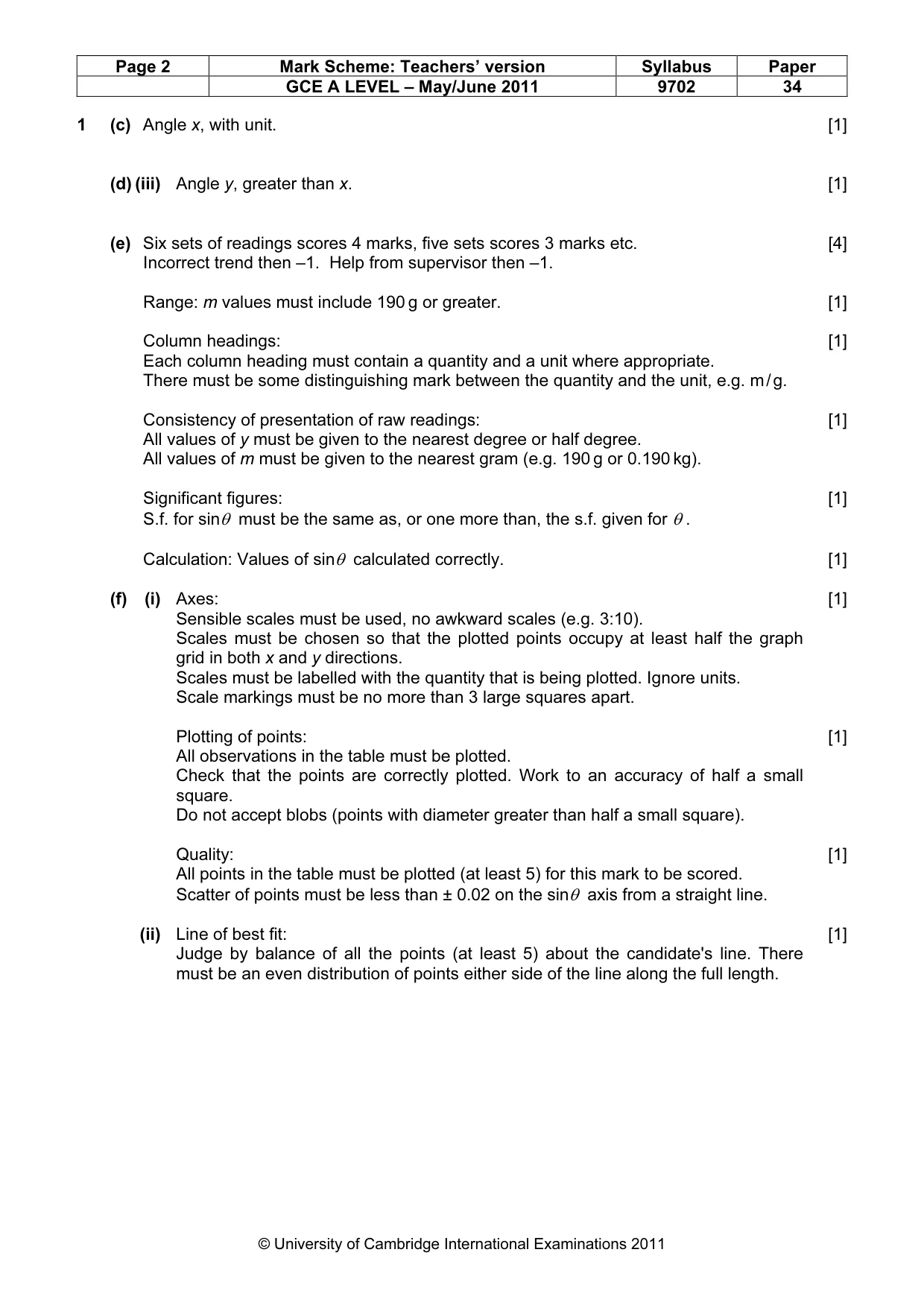
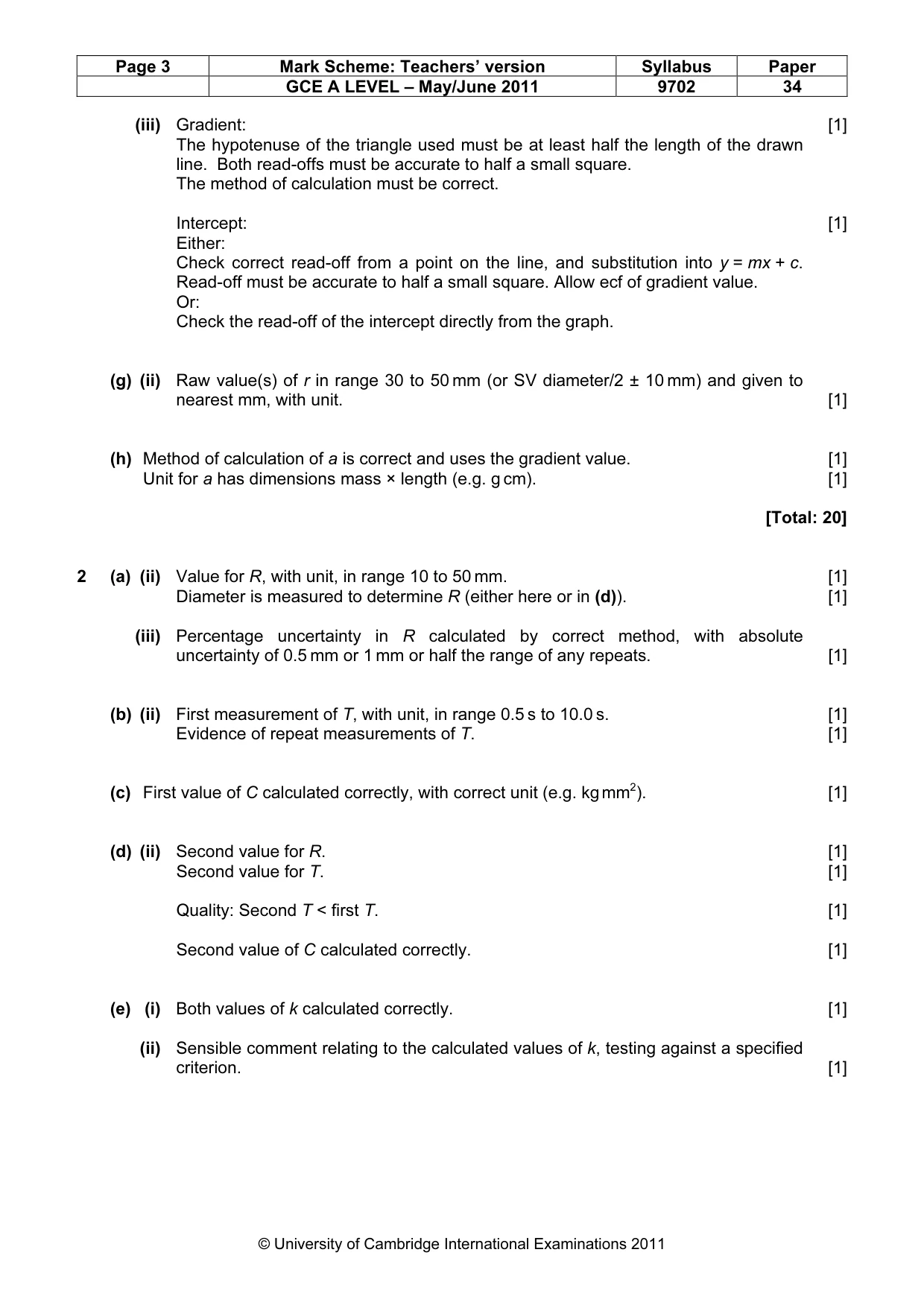
Mark scheme: 1 (c) Angle x, with unit. [1] (d) (iii) Angle y, greater than x. [1] (e) Six sets of readings scores 4 marks, five sets scores 3 marks etc. [4] Incorrect trend then –1. Help from supervisor then –1. Range: m values must include 190 g or greater. [1] Column headings: [1] Each column heading must contain a quantity and a unit where appropriate. There must be some distinguishing mark between the quantity and the unit, e.g. m / g. Consistency of presentation of raw readings: [1] All values of y must be given to the nearest degree or half degree. All values of m must be given to the nearest gram (e.g. 190 g or 0.190 kg). Significant figures: [1] S.f. for sinθ must be the same as, or one more than, the s.f. given for θ . Calculation: Values of sinθ calculated correctly. [1] (f) (i) Axes: [1] Sensible scales must be used, no awkward scales (e.g. 3:10). Scales must be chosen so that the plotted points occupy at least half the graph grid in both x and y directions. Scales must be labelled with the quantity that is being plotted. Ignore units. Scale markings must be no more than 3 large squares apart. Plotting of points: [1] All observations in the table must be plotted. Check that the points are correctly plotted. Work to an accuracy of half a small square. Do not accept blobs (points with diameter greater than half a small square). Quality: [1] All points in the table must be plotted (at least 5) for this mark to be scored. Scatter of points must be less than ± 0.02 on the sinθ axis from a straight line. (ii) Line of best fit: [1] Judge by balance of all the points (at least 5) about the candidate's line. There must be an even distribution of points either side of the line along the full length. GCE A LEVEL – May/June 2011 9702 34 (iii) Gradient: [1] The hypotenuse of the triangle used must be at least half the length of the drawn line. Both read-offs must be accurate to half a small square. The method of calculation must be correct. Intercept: [1] Either: Check correct read-off from a point on the line, and substitution into y = mx + c. Read-off must be accurate to half a small square. Allow ecf of gradient value. Or: Check the read-off of the intercept directly from the graph. (g) (ii) Raw value(s) of r in range 30 to 50 mm (or SV diameter/2 ± 10 mm) and given to nearest mm, with unit. [1] (h) Method of calculation of a is correct and uses the gradient value. [1] Unit for a has dimensions mass × length (e.g. g cm). [1] [Total: 20]
Q2 · In this experiment you will investigate the motion of a mass suspended from a rubber band
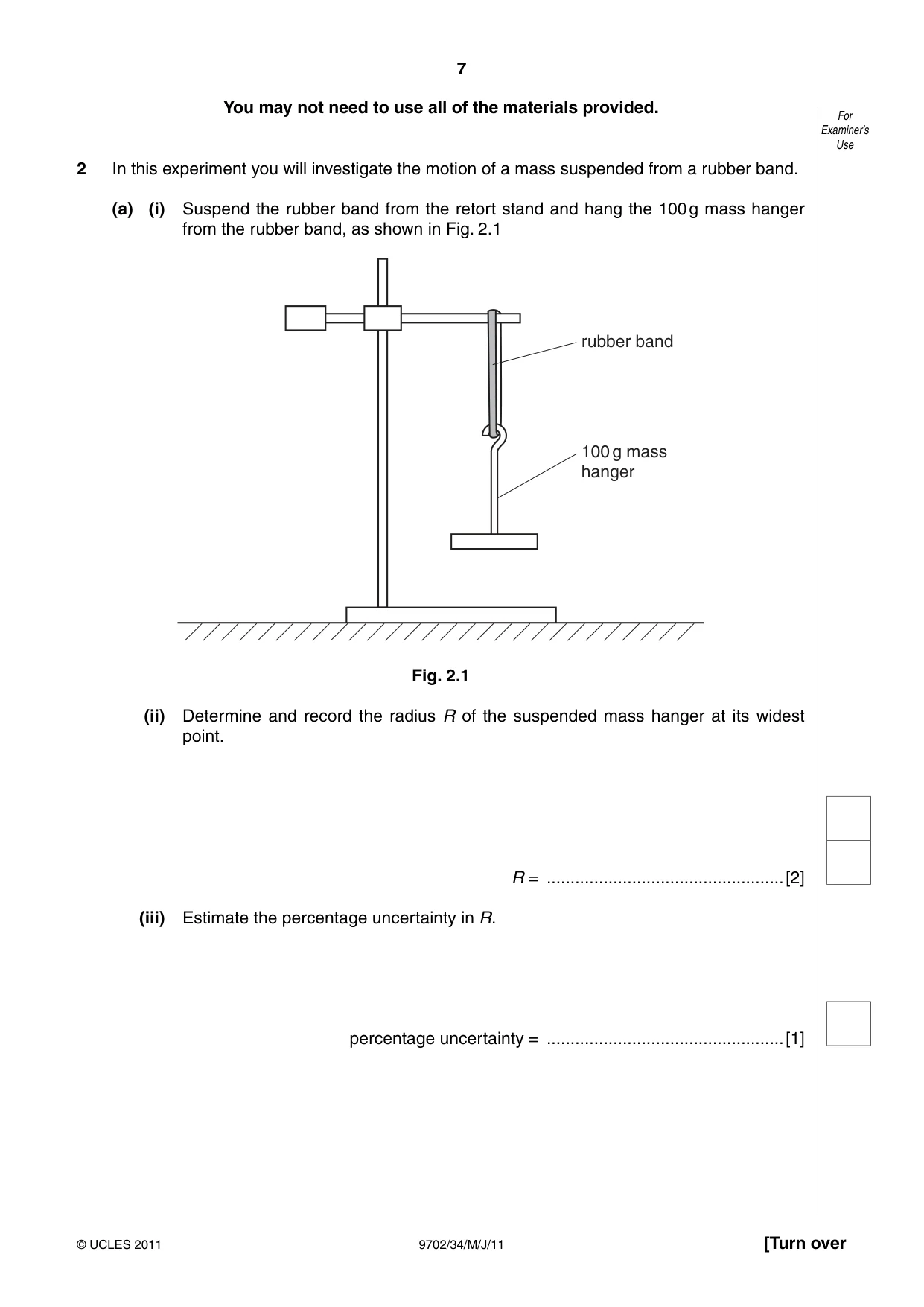
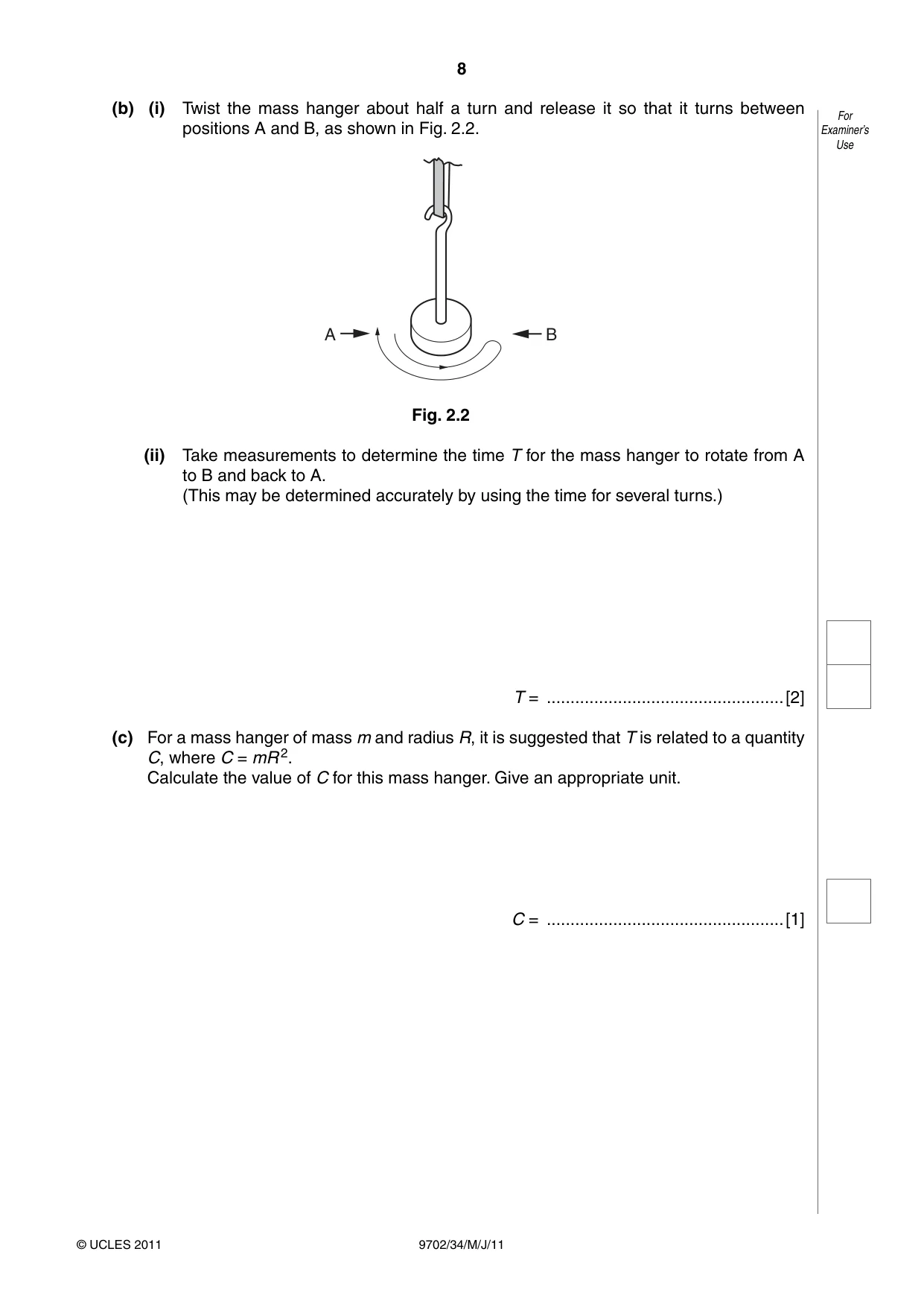
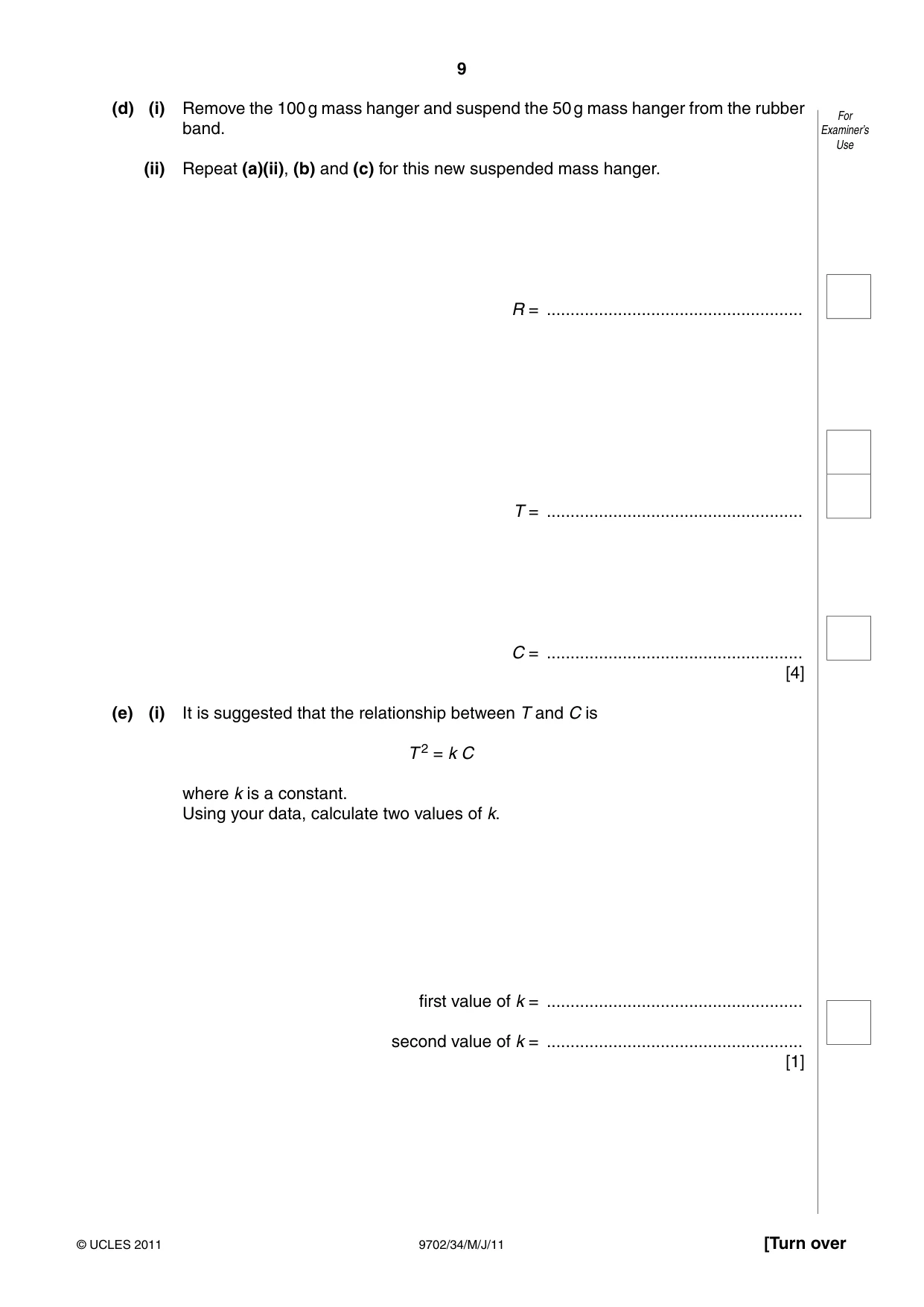
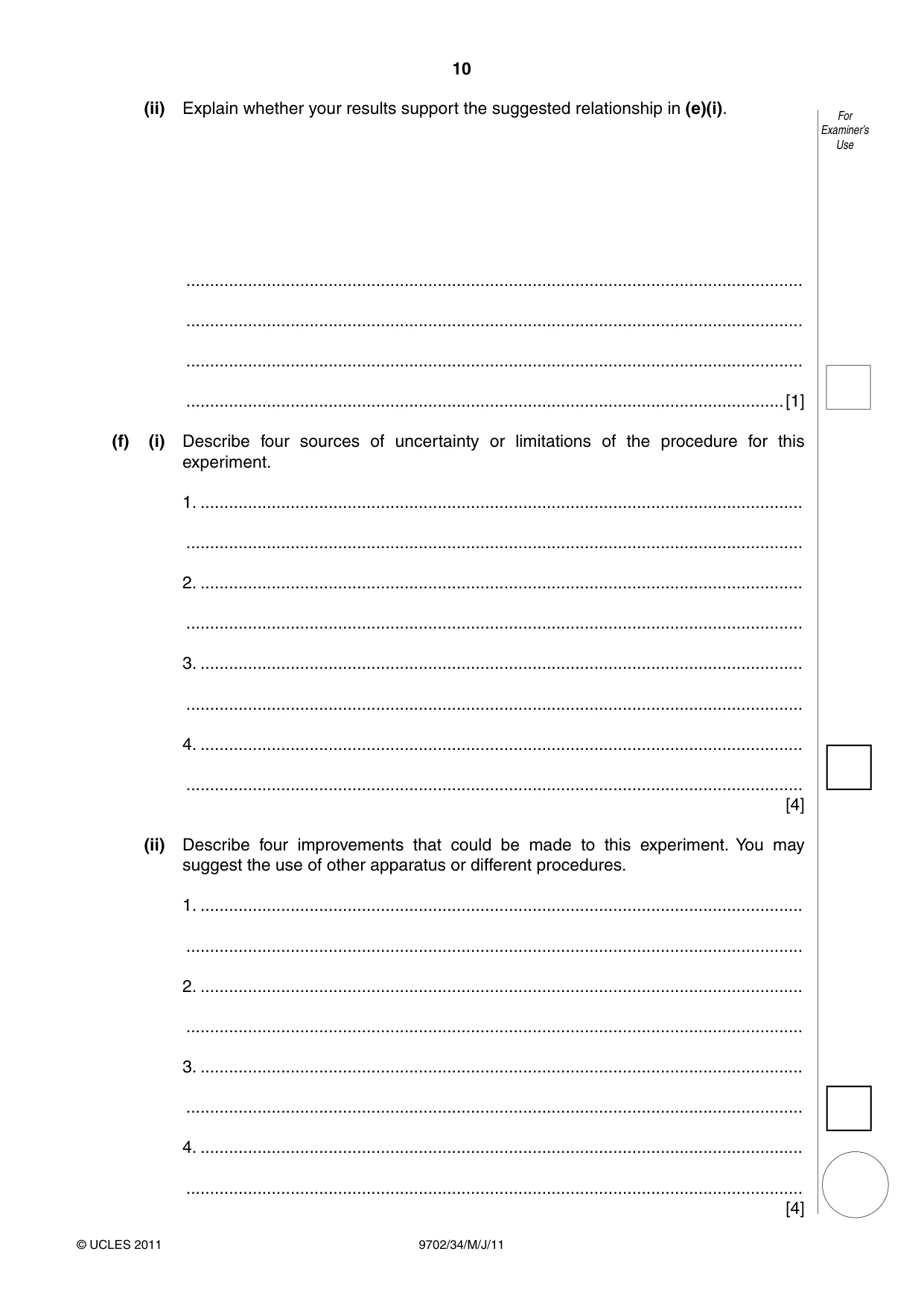
2 In this experiment you will investigate the motion of a mass suspended from a rubber band. (a) (i) Suspend the rubber band from the retort stand and hang the 100 g mass hanger from the rubber band, as shown in Fig. 2.1 rubber band 100 g mass hanger Fig. 2.1 (ii) Determine and record the radius R of the suspended mass hanger at its widest point. R = ..................................................[2] (iii) Estimate the percentage uncertainty in R. percentage uncertainty = ..................................................[1] (b) (i) Twist the mass hanger about half a turn and release it so that it turns between For positions A and B, as shown in Fig. 2.2. Examiner’s Use A B Fig. 2.2 (ii) Take measurements to determine the time T for the mass hanger to rotate from A to B and back to A. (This may be determined accurately by using the time for several turns.) T = ..................................................[2] (c) For a mass hanger of mass m and radius R, it is suggested that T is related to a quantity C, where C = mR 2. Calculate the value of C for this mass hanger. Give an appropriate unit. C = ..................................................[1] (d) (i) Remove the 100 g mass hanger and suspend the 50 g mass hanger from the rubber For band. Examiner’s Use (ii) Repeat (a)(ii), (b) and (c) for this new suspended mass hanger. R = ...................................................... T = ...................................................... C = ...................................................... [4] (e) (i) It is suggested that the relationship between T and C is T 2 = k C where k is a constant. Using your data, calculate two values of k. first value of k = ...................................................... second value of k = ...................................................... [1]
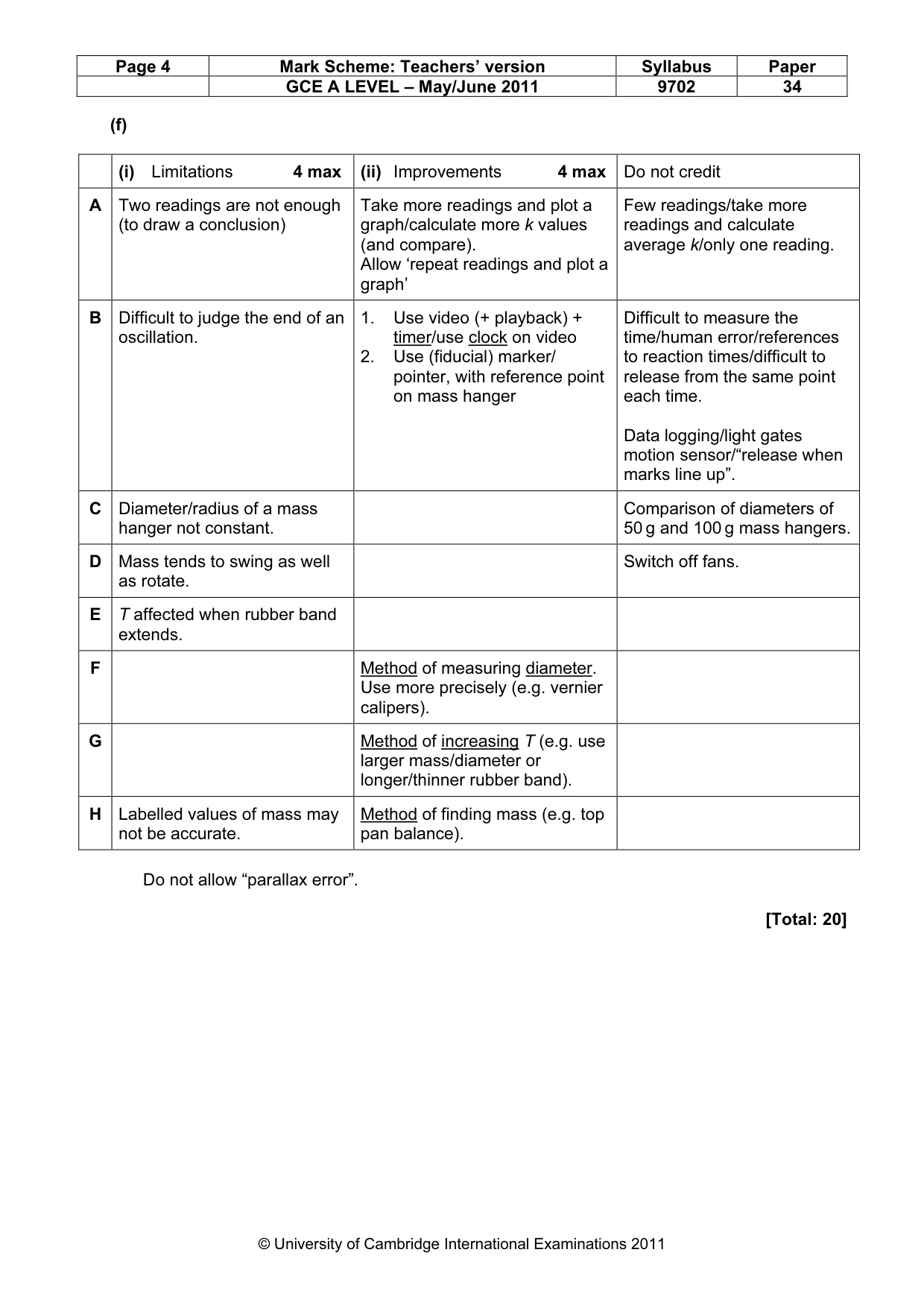
Mark scheme: 2 (a) (ii) Value for R, with unit, in range 10 to 50 mm. [1] Diameter is measured to determine R (either here or in (d)). [1] (iii) Percentage uncertainty in R calculated by correct method, with absolute uncertainty of 0.5 mm or 1 mm or half the range of any repeats. [1] (b) (ii) First measurement of T, with unit, in range 0.5 s to 10.0 s. [1] Evidence of repeat measurements of T. [1] (c) First value of C calculated correctly, with correct unit (e.g. kg mm2). [1] (d) (ii) Second value for R. [1] Second value for T. [1] Quality: Second T < first T. [1] Second value of C calculated correctly. [1] (e) (i) Both values of k calculated correctly. [1] (ii) Sensible comment relating to the calculated values of k, testing against a specified criterion. [1] GCE A LEVEL – May/June 2011 9702 34 (f) (i) Limitations 4 max (ii) Improvements 4 max Do not credit A Two readings are not enough Take more readings and plot a Few readings/take more (to draw a conclusion) graph/calculate more k values readings and calculate (and compare). average k/only one reading. Allow ‘repeat readings and plot a graph’ B Difficult to judge the end of an 1. Use video (+ playback) + Difficult to measure the oscillation. timer/use clock on video time/human error/references 2. Use (fiducial) marker/ to reaction times/difficult to pointer, with reference point release from the same point on mass hanger each time. Data logging/light gates motion sensor/“release when marks line up”. C Diameter/radius of a mass Comparison of diameters of hanger not constant. 50 g and 100 g mass hangers. D Mass tends to swing as well Switch off fans. as rotate. E T affected when rubber band extends. F Method of measuring diameter. Use more precisely (e.g. vernier calipers). G Method of increasing T (e.g. use larger mass/diameter or longer/thinner rubber band). H Labelled values of mass may Method of finding mass (e.g. top not be accurate. pan balance). Do not allow “parallax error”. [Total: 20]
What was in this paper
The subtopics covered by these 2 questions, and how many questions each got. Open one in a new tab to see every Cambridge question on it.
What you needed in this session
Cambridge’s own grade thresholds for 2011 May/June, Paper 3 · Variant 4. A higher threshold means an easier paper — the bar moves with how the cohort did.