Cambridge A Level Physics 9702 — 2009 May/June Paper 3 · Variant 2
9702/32/M/J/09 · 40 marks · ≈45 min
The question paper and its mark scheme, free to read here and free to download. This is Cambridge’s own paper, exactly as it was sat.
Question paper12 pages

Mark scheme4 pages
Answers below. Sit the paper first if you are practising.
Paper as text
Question paper, page 1
This document consists of 10 printed pages and 2 blank pages. SPA SHW 00236 4/08 T08038/7 R © UCLES 2009 [Turn over UNIVERSITY OF CAMBRIDGE INTERNATIONAL EXAMINATIONS General Certificate of Education Advanced Subsidiary Level and Advanced Level READ THESE INSTRUCTIONS FIRST Write your Centre number, candidate number and name on all the work you hand in. Write in dark blue or black pen. You may use a soft pencil for any diagrams, graphs or rough working. Do not use staples, paper clips, highlighters, glue or correction fluid. DO NOT WRITE IN ANY BARCODES. Answer both questions. You will be allowed to work with the apparatus for a maximum of one hour for each question. You are expected to record all your observations as soon as these observations are made, and to plan the presentation of the records so that it is not necessary to make a fair copy of them. The working of the answers is to be handed in. Additional answer paper and graph paper should be submitted only if it becomes necessary to do so. You are reminded of the need for good English and clear presentation in your answers. At the end of the examination, fasten all your work securely together. All questions in this paper carry equal marks. * 8 9 6 0 5 8 8 2 8 7 * PHYSICS 9702/32 Paper 32 Advanced Practical Skills 2 May/June 2009 2 hours Candidates answer on the Question Paper. Additional Materials: As listed in the Confidential Instructions. For Examiner’s Use 1 2 Total
Question paper, page 3
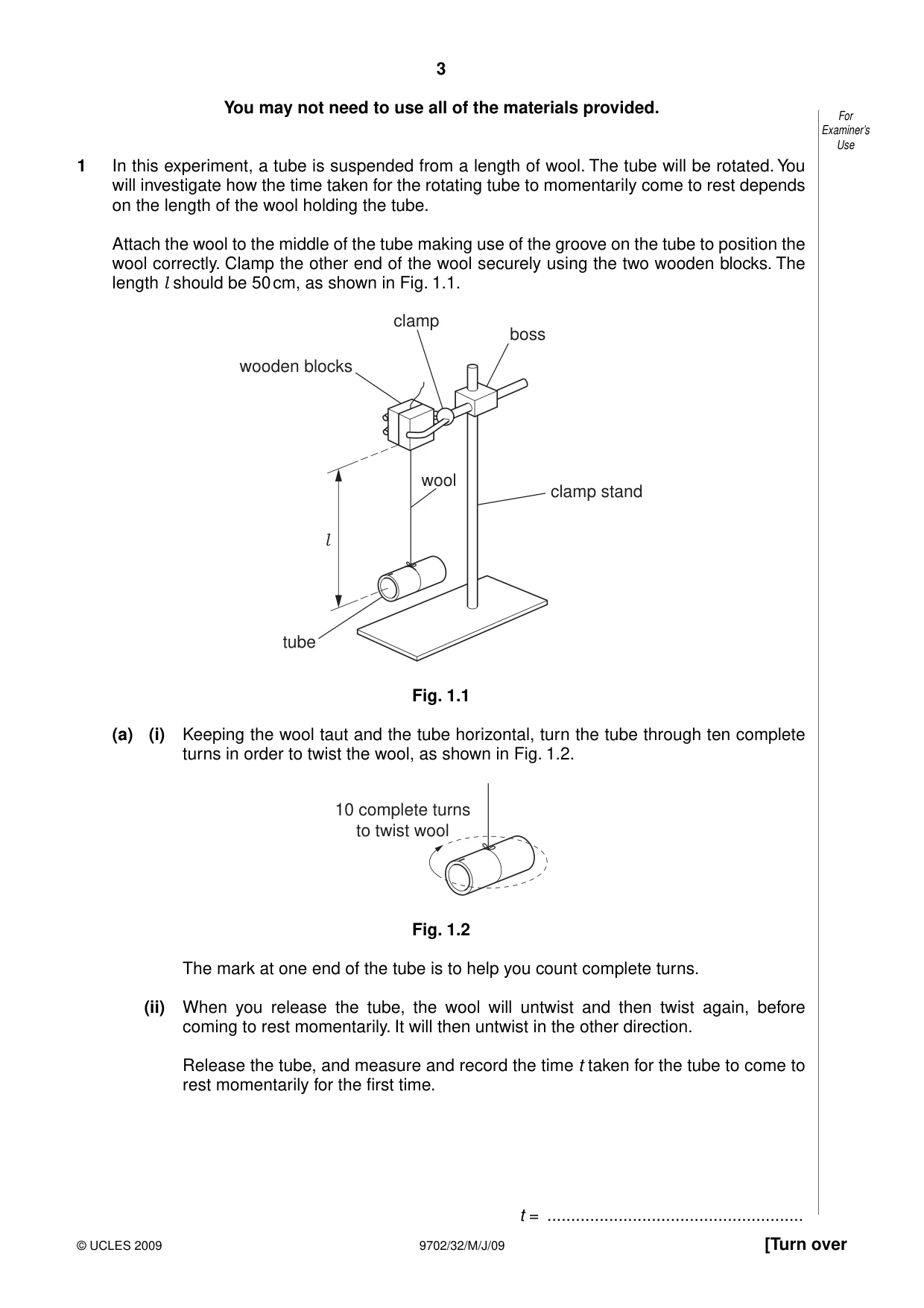
9702/32/M/J/09 © UCLES 2009 [Turn over For Examiner’s Use You may not need to use all of the materials provided. 1 In this experiment, a tube is suspended from a length of wool. The tube will be rotated. You will investigate how the time taken for the rotating tube to momentarily come to rest depends on the length of the wool holding the tube. Attach the wool to the middle of the tube making use of the groove on the tube to position the wool correctly. Clamp the other end of the wool securely using the two wooden blocks. The length l should be 50 cm, as shown in Fig. 1.1. l wooden blocks tube clamp boss clamp stand wool Fig. 1.1 (a) (i) Keeping the wool taut and the tube horizontal, turn the tube through ten complete turns in order to twist the wool, as shown in Fig. 1.2. 10 complete turns to twist wool Fig. 1.2 The mark at one end of the tube is to help you count complete turns. (ii) When you release the tube, the wool will untwist and then twist again, before coming to rest momentarily. It will then untwist in the other direction. Release the tube, and measure and record the time t taken for the tube to come to rest momentarily for the first time. t = … 3
Question paper, page 4
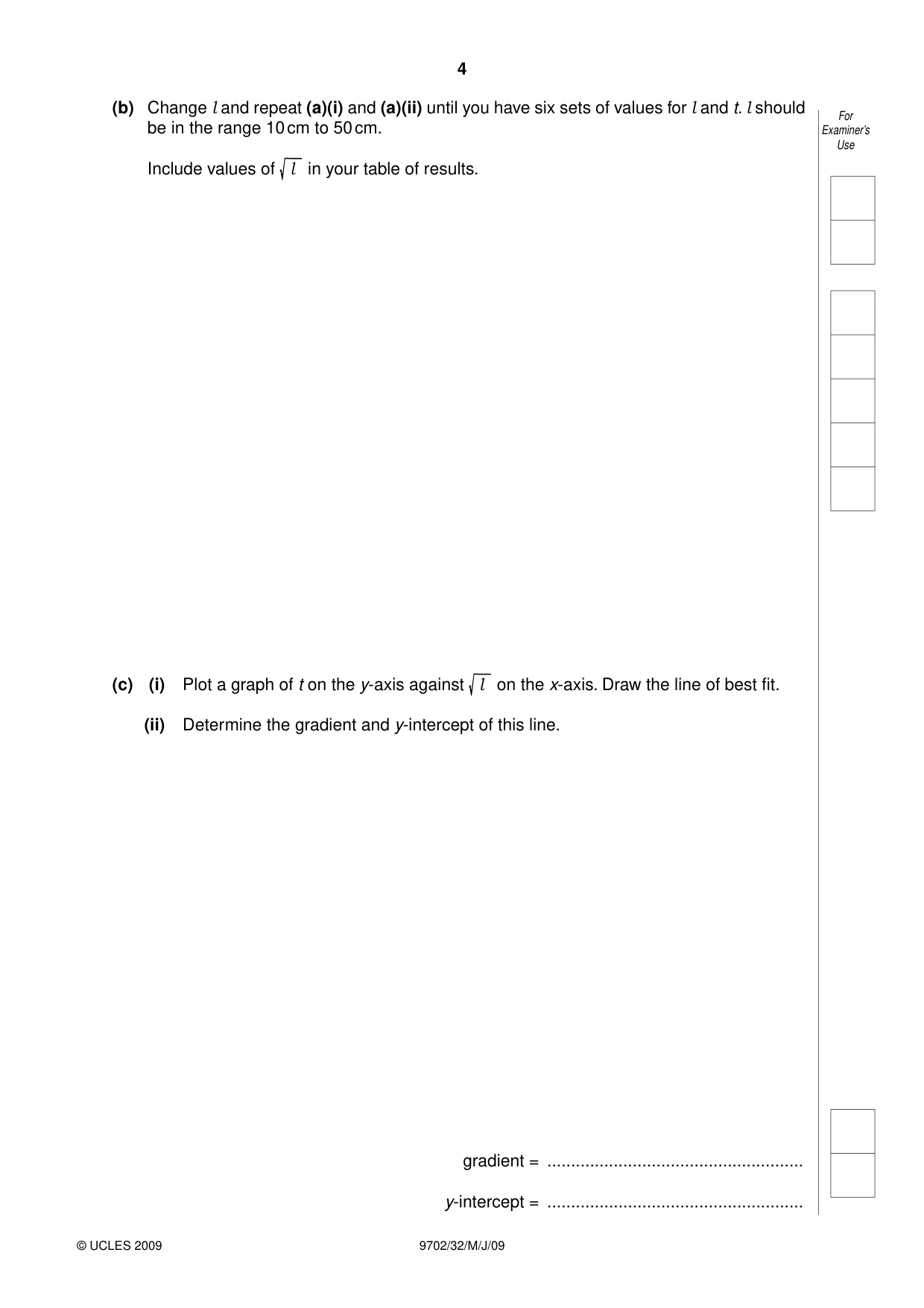
4 9702/32/M/J/09 © UCLES 2009 For Examiner’s Use (b) Change l and repeat (a)(i) and (a)(ii) until you have six sets of values for l and t. l should be in the range 10 cm to 50 cm. Include values of l in your table of results. (c) (i) Plot a graph of t on the y-axis against l on the x-axis. Draw the line of best fit. (ii) Determine the gradient and y-intercept of this line. gradient = … y-intercept = …
Question paper, page 5
5 9702/32/M/J/09 © UCLES 2009 [Turn over For Examiner’s Use
Question paper, page 6
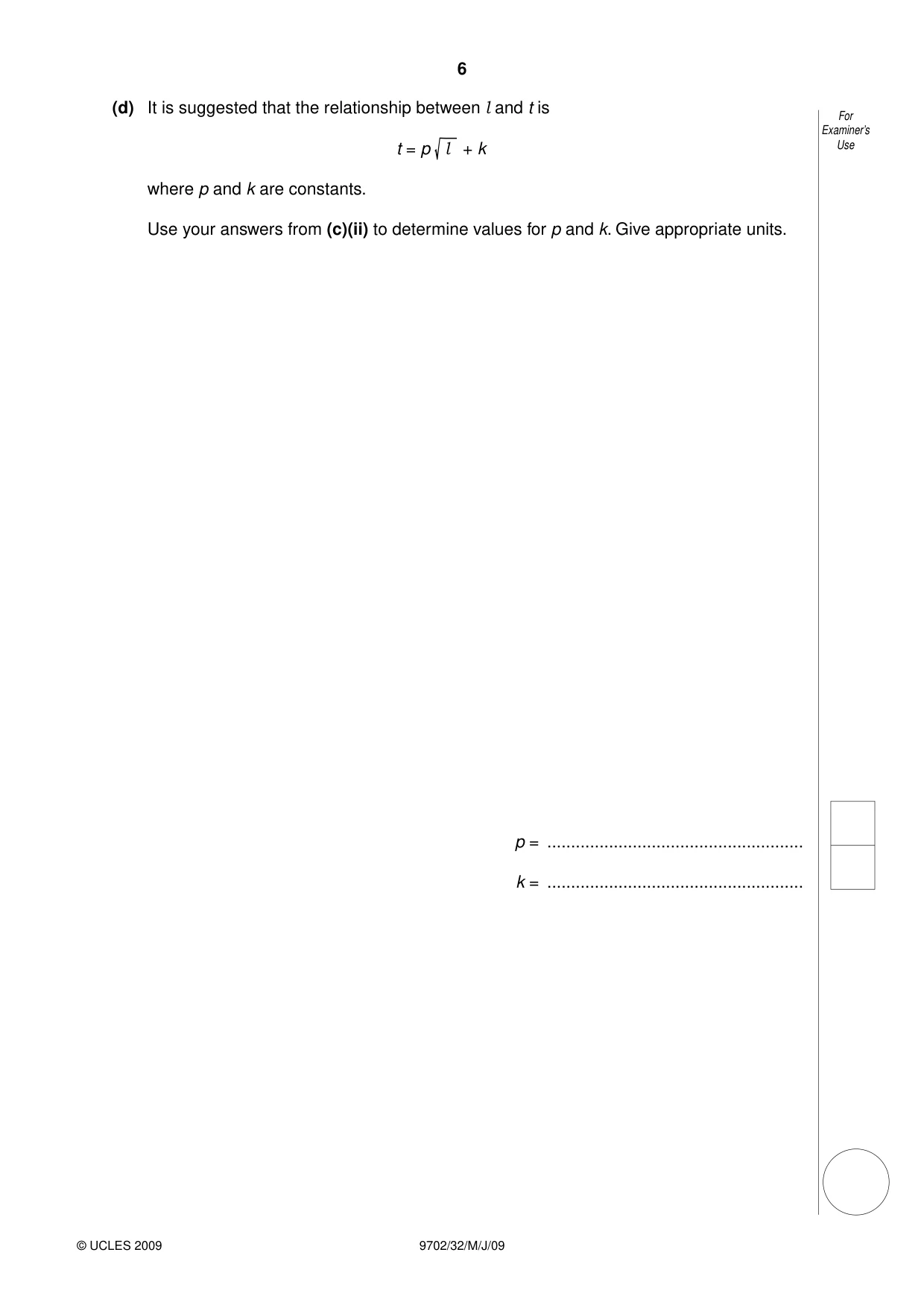
6 9702/32/M/J/09 © UCLES 2009 For Examiner’s Use (d) It is suggested that the relationship between l and t is t = p l + k where p and k are constants. Use your answers from (c)(ii) to determine values for p and k. Give appropriate units. p = … k = …
Question paper, page 7
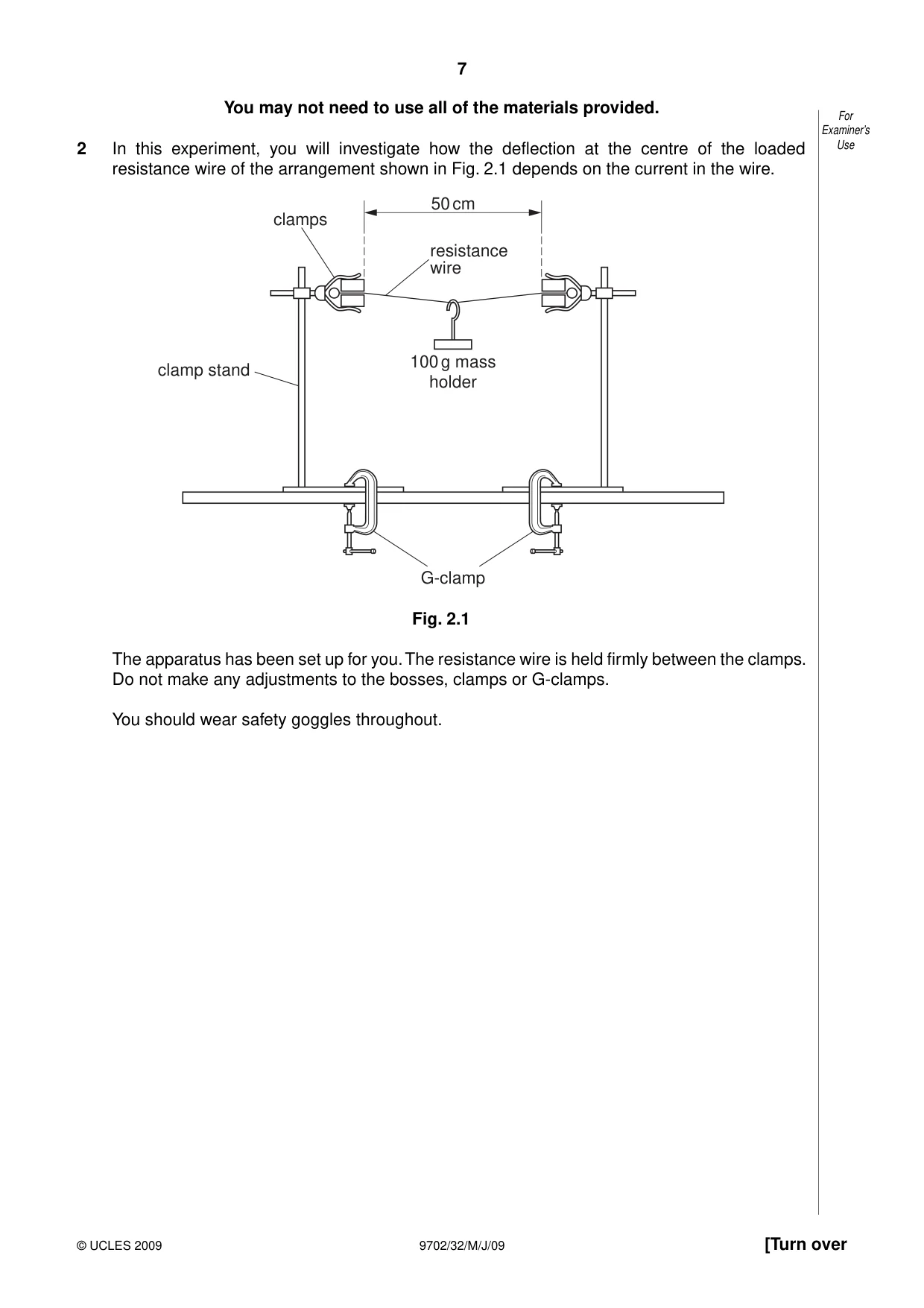
7 9702/32/M/J/09 © UCLES 2009 [Turn over For Examiner’s Use You may not need to use all of the materials provided. 2 In this experiment, you will investigate how the deflection at the centre of the loaded resistance wire of the arrangement shown in Fig. 2.1 depends on the current in the wire. clamps resistance wire 100 g mass holder clamp stand G-clamp 50 cm Fig. 2.1 The apparatus has been set up for you. The resistance wire is held firmly between the clamps. Do not make any adjustments to the bosses, clamps or G-clamps. You should wear safety goggles throughout.
Question paper, page 8
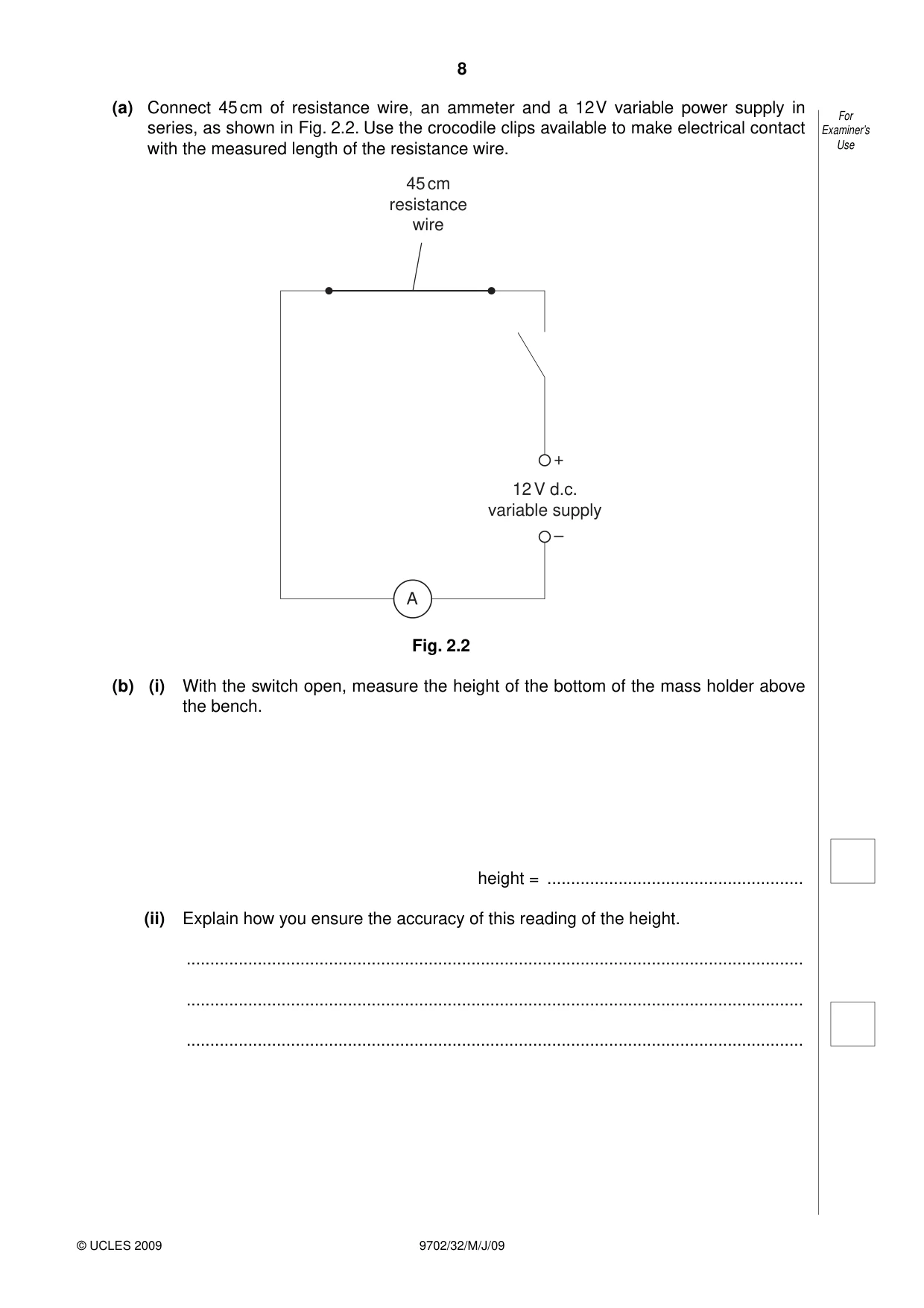
8 9702/32/M/J/09 © UCLES 2009 For Examiner’s Use (a) Connect 45 cm of resistance wire, an ammeter and a 12 V variable power supply in series, as shown in Fig. 2.2. Use the crocodile clips available to make electrical contact with the measured length of the resistance wire. A 12 V d.c. variable supply + – 45 cm resistance wire Fig. 2.2 (b) (i) With the switch open, measure the height of the bottom of the mass holder above the bench. height = … (ii) Explain how you ensure the accuracy of this reading of the height. … … …
Question paper, page 9
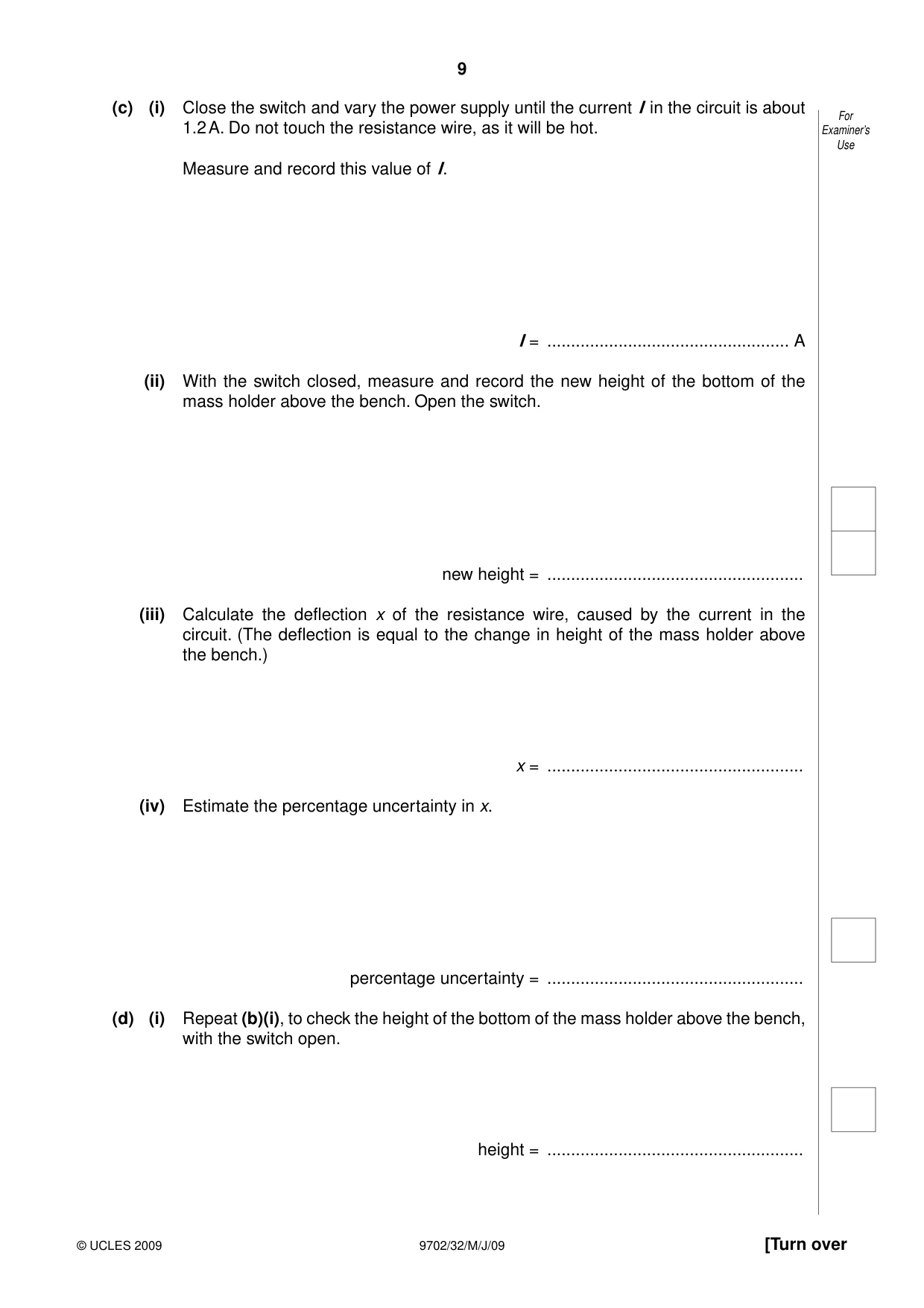
9 9702/32/M/J/09 © UCLES 2009 [Turn over For Examiner’s Use (c) (i) Close the switch and vary the power supply until the current I in the circuit is about 1.2 A. Do not touch the resistance wire, as it will be hot. Measure and record this value of I. I = … A (ii) With the switch closed, measure and record the new height of the bottom of the mass holder above the bench. Open the switch. new height = … (iii) Calculate the deflection x of the resistance wire, caused by the current in the circuit. (The deflection is equal to the change in height of the mass holder above the bench.) x = … (iv) Estimate the percentage uncertainty in x. percentage uncertainty = … (d) (i) Repeat (b)(i), to check the height of the bottom of the mass holder above the bench, with the switch open. height = …
Question paper, page 10
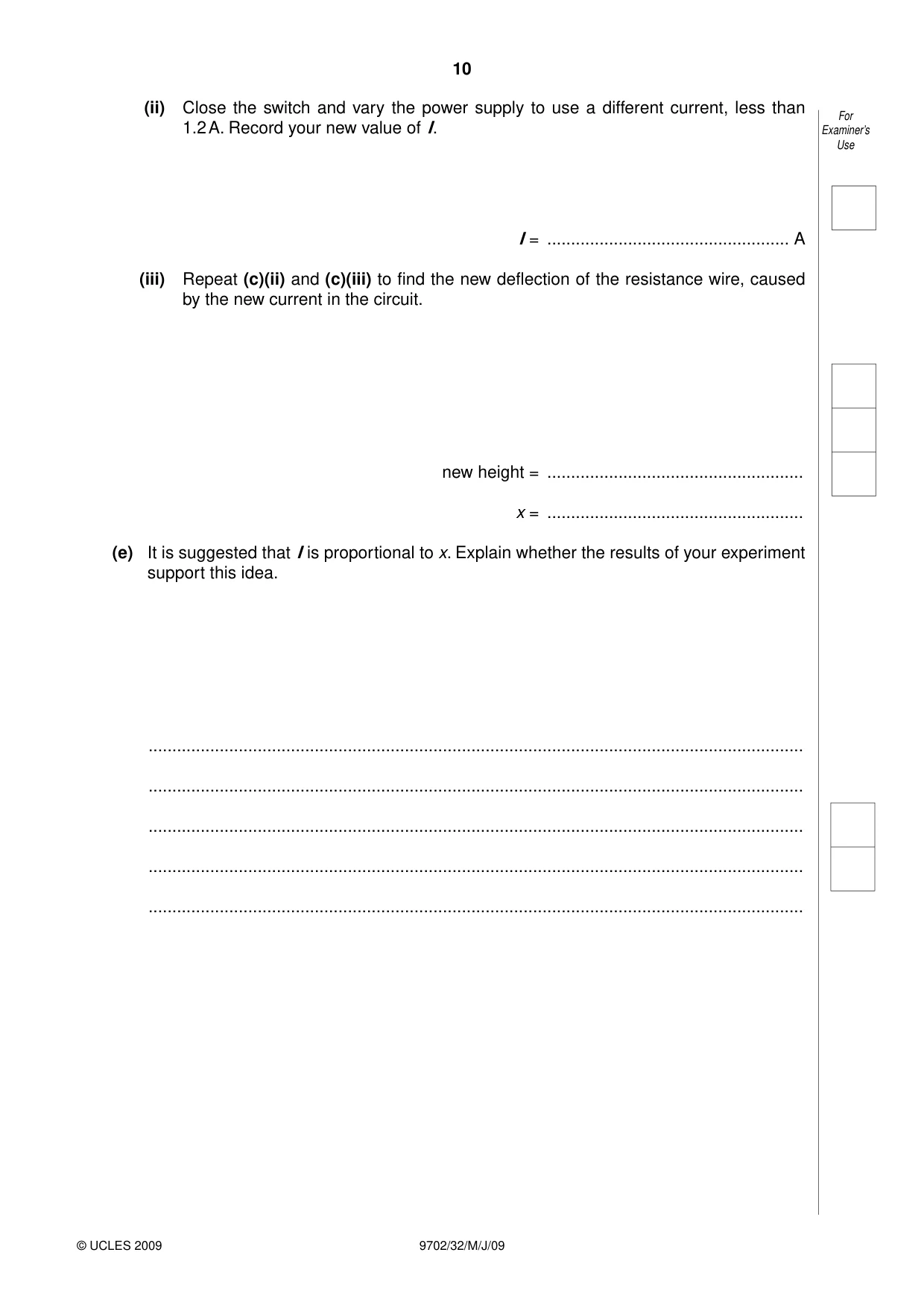
10 9702/32/M/J/09 © UCLES 2009 For Examiner’s Use (ii) Close the switch and vary the power supply to use a different current, less than 1.2 A. Record your new value of I. I = … A (iii) Repeat (c)(ii) and (c)(iii) to find the new deflection of the resistance wire, caused by the new current in the circuit. new height = … x = … (e) It is suggested that I is proportional to x. Explain whether the results of your experiment support this idea. … … … … …
Question paper, page 11
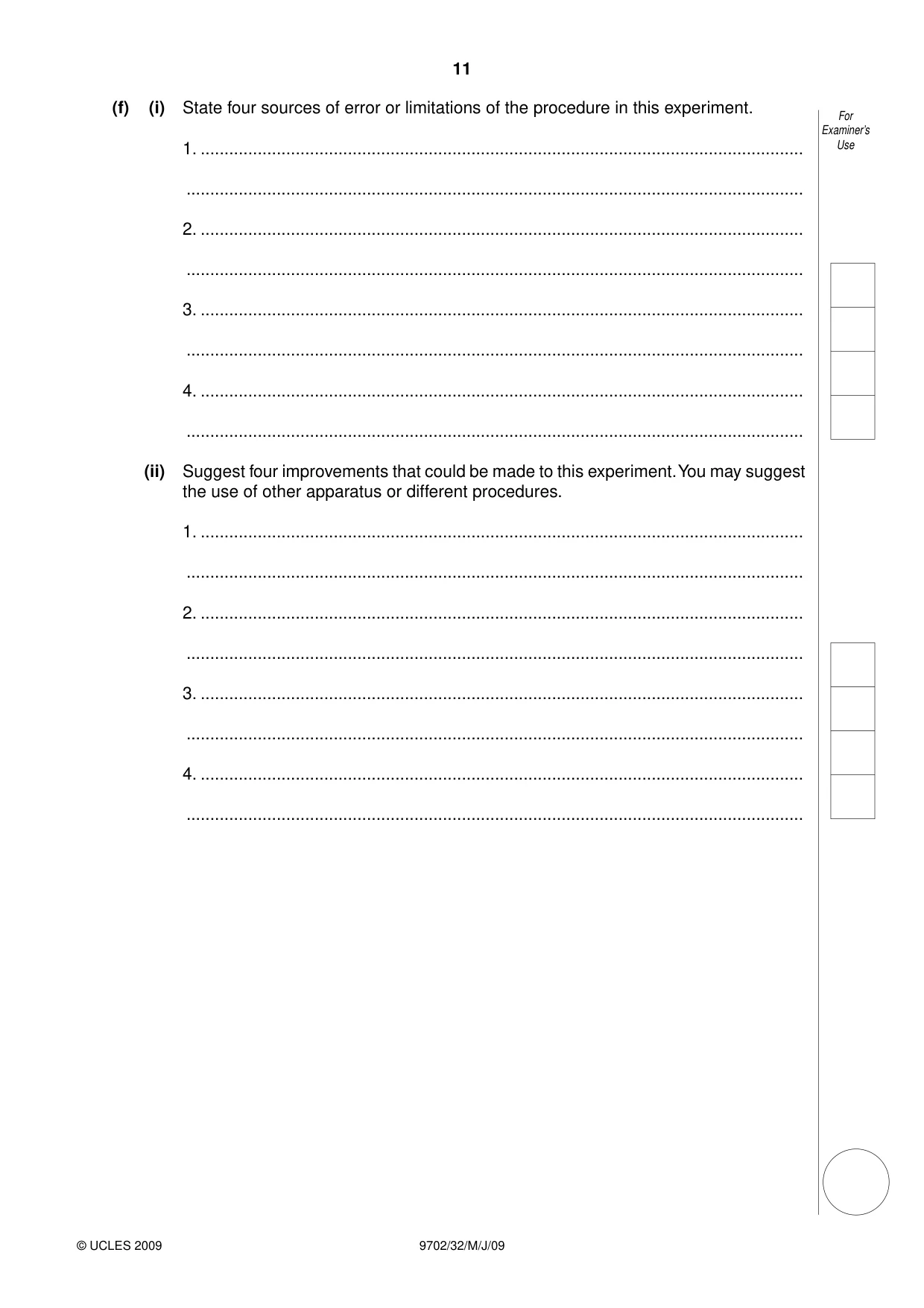
11 9702/32/M/J/09 © UCLES 2009 For Examiner’s Use (f) (i) State four sources of error or limitations of the procedure in this experiment. 1. … … 2. … … 3. … … 4. … … (ii) Suggest four improvements that could be made to this experiment. You may suggest the use of other apparatus or different procedures. 1. … … 2. … … 3. … … 4. … …
Question paper, page 12
12 9702/32/M/J/09 BLANK PAGE Permission to reproduce items where third-party owned material protected by copyright is included has been sought and cleared where possible. Every reasonable effort has been made by the publisher (UCLES) to trace copyright holders, but if any items requiring clearance have unwittingly been included, the publisher will be pleased to make amends at the earliest possible opportunity. University of Cambridge International Examinations is part of the Cambridge Assessment Group. Cambridge Assessment is the brand name of University of Cambridge Local Examinations Syndicate (UCLES), which is itself a department of the University of Cambridge.
Mark scheme, page 1
UNIVERSITY OF CAMBRIDGE INTERNATIONAL EXAMINATIONS GCE Advanced Subsidiary Level and GCE Advanced Level MARK SCHEME for the May/June 2009 question paper for the guidance of teachers 9702 PHYSICS 9702/32 Paper 32 (Advanced Practical Skills 2), maximum raw mark 40 This mark scheme is published as an aid to teachers and candidates, to indicate the requirements of the examination. It shows the basis on which Examiners were instructed to award marks. It does not indicate the details of the discussions that took place at an Examiners’ meeting before marking began, which would have considered the acceptability of alternative answers. Mark schemes must be read in conjunction with the question papers and the report on the examination. • CIE will not enter into discussions or correspondence in connection with these mark schemes. CIE is publishing the mark schemes for the May/June 2009 question papers for most IGCSE, GCE Advanced Level and Advanced Subsidiary Level syllabuses and some Ordinary Level syllabuses.
Mark scheme, page 2
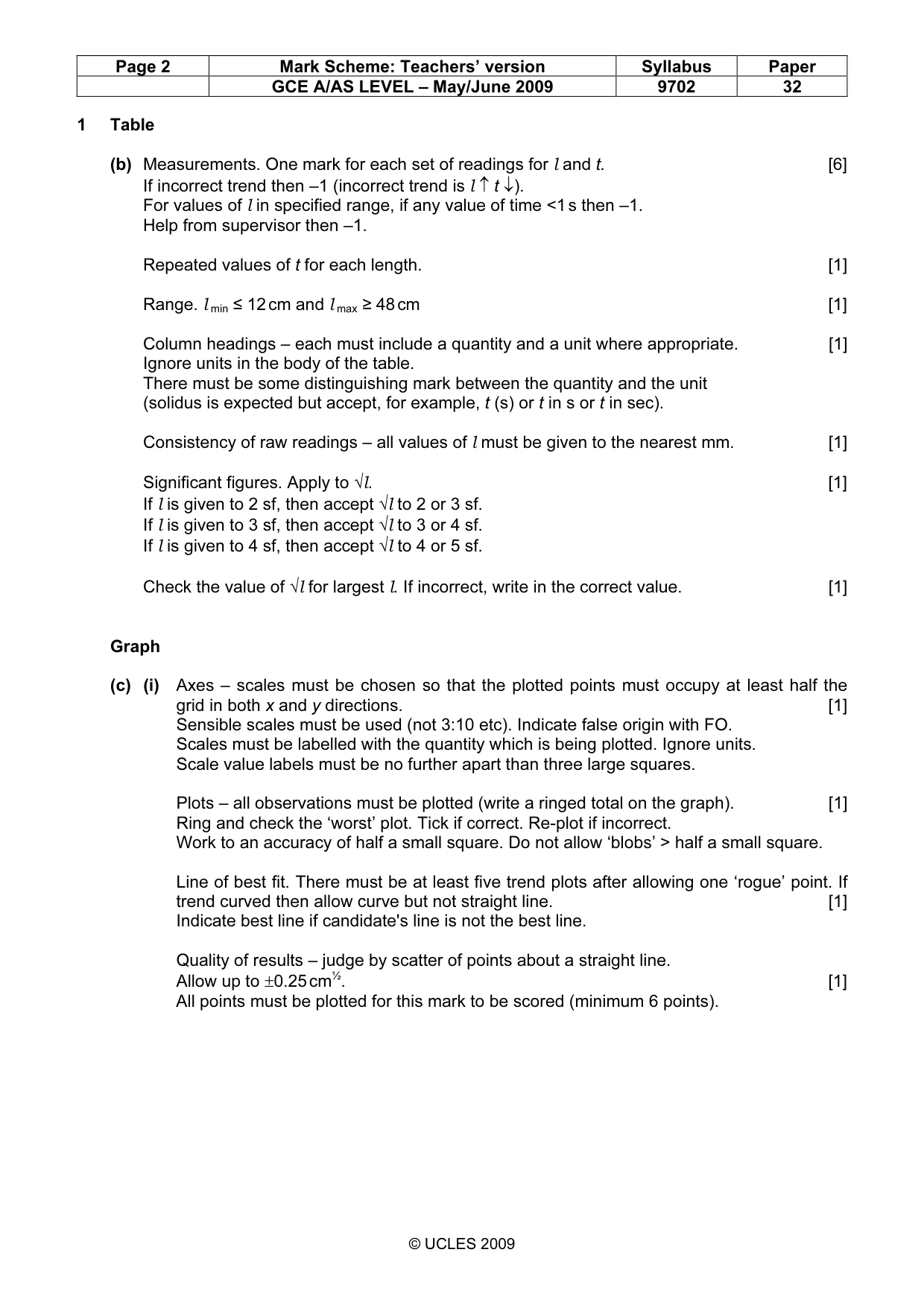
Page 2 Mark Scheme: Teachers’ version Syllabus Paper GCE A/AS LEVEL – May/June 2009 9702 32 © UCLES 2009 1 Table (b) Measurements. One mark for each set of readings for l and t. [6] If incorrect trend then –1 (incorrect trend is l ↑ t ↓). For values of l in specified range, if any value of time <1 s then –1. Help from supervisor then –1. Repeated values of t for each length. [1] Range. l min ≤ 12 cm and l max ≥ 48 cm [1] Column headings – each must include a quantity and a unit where appropriate. [1] Ignore units in the body of the table. There must be some distinguishing mark between the quantity and the unit (solidus is expected but accept, for example, t (s) or t in s or t in sec). Consistency of raw readings – all values of l must be given to the nearest mm. [1] Significant figures. Apply to √l. [1] If l is given to 2 sf, then accept √l to 2 or 3 sf. If l is given to 3 sf, then accept √l to 3 or 4 sf. If l is given to 4 sf, then accept √l to 4 or 5 sf. Check the value of √l for largest l. If incorrect, write in the correct value. [1] Graph (c) (i) Axes – scales must be chosen so that the plotted points must occupy at least half the grid in both x and y directions. [1] Sensible scales must be used (not 3:10 etc). Indicate false origin with FO. Scales must be labelled with the quantity which is being plotted. Ignore units. Scale value labels must be no further apart than three large squares. Plots – all observations must be plotted (write a ringed total on the graph). [1] Ring and check the ‘worst’ plot. Tick if correct. Re-plot if incorrect. Work to an accuracy of half a small square. Do not allow ‘blobs’ > half a small square. Line of best fit. There must be at least five trend plots after allowing one ‘rogue’ point. If trend curved then allow curve but not straight line. [1] Indicate best line if candidate's line is not the best line. Quality of results – judge by scatter of points about a straight line. Allow up to ±0.25 cm½. [1] All points must be plotted for this mark to be scored (minimum 6 points).
Mark scheme, page 3
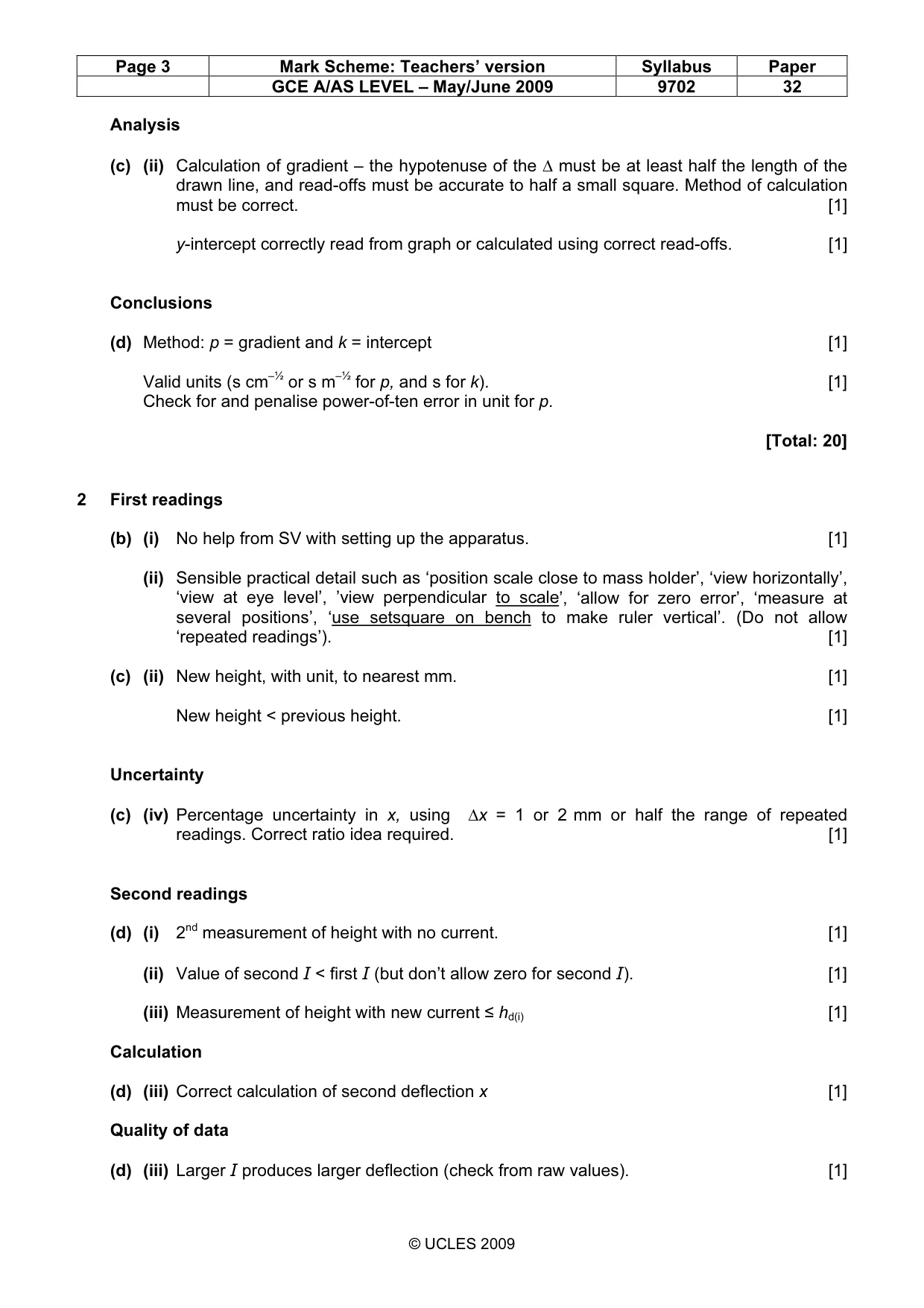
Page 3 Mark Scheme: Teachers’ version Syllabus Paper GCE A/AS LEVEL – May/June 2009 9702 32 © UCLES 2009 Analysis (c) (ii) Calculation of gradient – the hypotenuse of the ∆ must be at least half the length of the drawn line, and read-offs must be accurate to half a small square. Method of calculation must be correct. [1] y-intercept correctly read from graph or calculated using correct read-offs. [1] Conclusions (d) Method: p = gradient and k = intercept [1] Valid units (s cm–½ or s m–½ for p, and s for k). [1] Check for and penalise power-of-ten error in unit for p. [Total: 20] 2 First readings (b) (i) No help from SV with setting up the apparatus. [1] (ii) Sensible practical detail such as ‘position scale close to mass holder’, ‘view horizontally’, ‘view at eye level’, ’view perpendicular to scale’, ‘allow for zero error’, ‘measure at several positions’, ‘use setsquare on bench to make ruler vertical’. (Do not allow ‘repeated readings’). [1] (c) (ii) New height, with unit, to nearest mm. [1] New height < previous height. [1] Uncertainty (c) (iv) Percentage uncertainty in x, using ∆x = 1 or 2 mm or half the range of repeated readings. Correct ratio idea required. [1] Second readings (d) (i) 2nd measurement of height with no current. [1] (ii) Value of second I < first I (but don’t allow zero for second I). [1] (iii) Measurement of height with new current ≤ hd(i) [1] Calculation (d) (iii) Correct calculation of second deflection x [1] Quality of data (d) (iii) Larger I produces larger deflection (check from raw values). [1]
Mark scheme, page 4
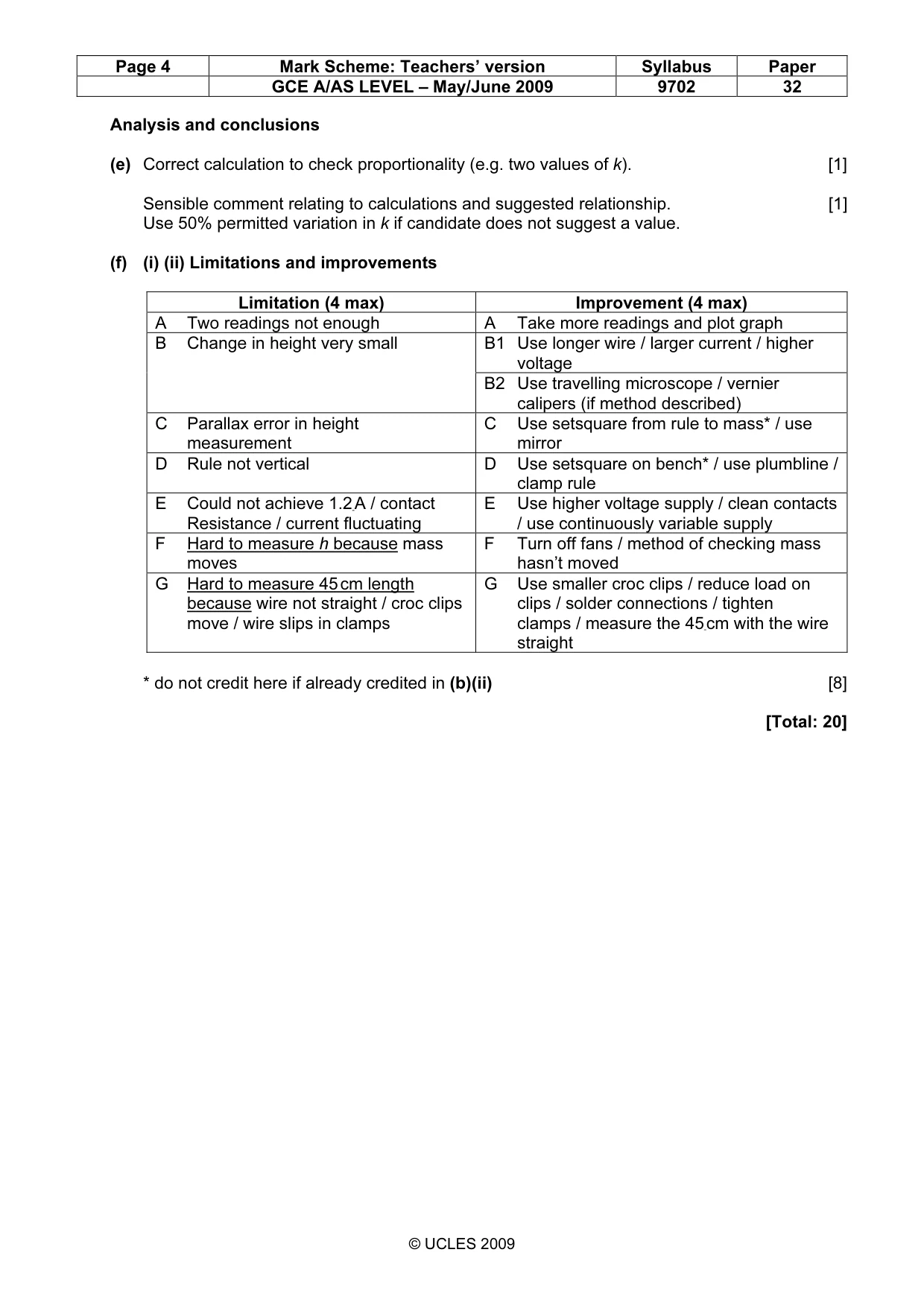
Page 4 Mark Scheme: Teachers’ version Syllabus Paper GCE A/AS LEVEL – May/June 2009 9702 32 © UCLES 2009 Analysis and conclusions (e) Correct calculation to check proportionality (e.g. two values of k). [1] Sensible comment relating to calculations and suggested relationship. [1] Use 50% permitted variation in k if candidate does not suggest a value. (f) (i) (ii) Limitations and improvements Limitation (4 max) Improvement (4 max) A Two readings not enough A Take more readings and plot graph B Change in height very small B1 Use longer wire / larger current / higher voltage B2 Use travelling microscope / vernier calipers (if method described) C Parallax error in height measurement C Use setsquare from rule to mass* / use mirror D Rule not vertical D Use setsquare on bench* / use plumbline / clamp rule E Could not achieve 1.2 A / contact Resistance / current fluctuating E Use higher voltage supply / clean contacts / use continuously variable supply F Hard to measure h because mass moves F Turn off fans / method of checking mass hasn’t moved G Hard to measure 45 cm length because wire not straight / croc clips move / wire slips in clamps G Use smaller croc clips / reduce load on clips / solder connections / tighten clamps / measure the 45 cm with the wire straight * do not credit here if already credited in (b)(ii) [8] [Total: 20]
What you needed in this session
Cambridge’s own grade thresholds for 2009 May/June, Paper 3 · Variant 2. A higher threshold means an easier paper — the bar moves with how the cohort did.