Cambridge A Level Physics 9702 — 2005 Oct/Nov Paper 3 · Variant 1
9702/31/O/N/05
The question paper and its mark scheme, free to read here and free to download. This is Cambridge’s own paper, exactly as it was sat.
Question paper8 pages
Mark scheme3 pages
Answers below. Sit the paper first if you are practising.
Paper as text
Question paper, page 1
This document consists of 6 printed pages and 2 blank pages. SPA (MML 8097 3/04) S89128/2 © UCLES 2005 [Turn over UNIVERSITY OF CAMBRIDGE INTERNATIONAL EXAMINATIONS General Certificate of Education Advanced Subsidiary Level and Advanced Level PHYSICS 9702/03 Paper 3 Practical Test October/November 2005 1 hour 15 minutes Candidates answer on the Question Paper. Additional Materials: As specified in the Confidential Instructions. READ THESE INSTRUCTIONS FIRST Write your Centre number, candidate number and name on all the work you hand in. Write in dark blue or black pen in the spaces provided on the Question Paper. You may use a soft pencil for any diagrams, graphs or rough working. Do not use staples, paper clips, highlighters, glue or correction fluid. Answer the one question. You are expected to record all your observations as soon as they are made, and to plan the presentation of the records so that it is not necessary to make a fair copy of them. The working of the answers is to be handed in. Marks are mainly given for a clear record of the observations actually made, for their suitability and accuracy, and for the use made of them. Additional answer paper and graph paper should be submitted only if it becomes necessary to do so. You are reminded of the need for good English and clear presentation in your answers. At the end of the examination, fasten all your work securely together. Centre Number Candidate Number Name If you have been given a label, look at the details. If any details are incorrect or missing, please fill in your correct details in the space given at the top of this page. Stick your personal label here, if provided. For Examiner’s Use
Question paper, page 2
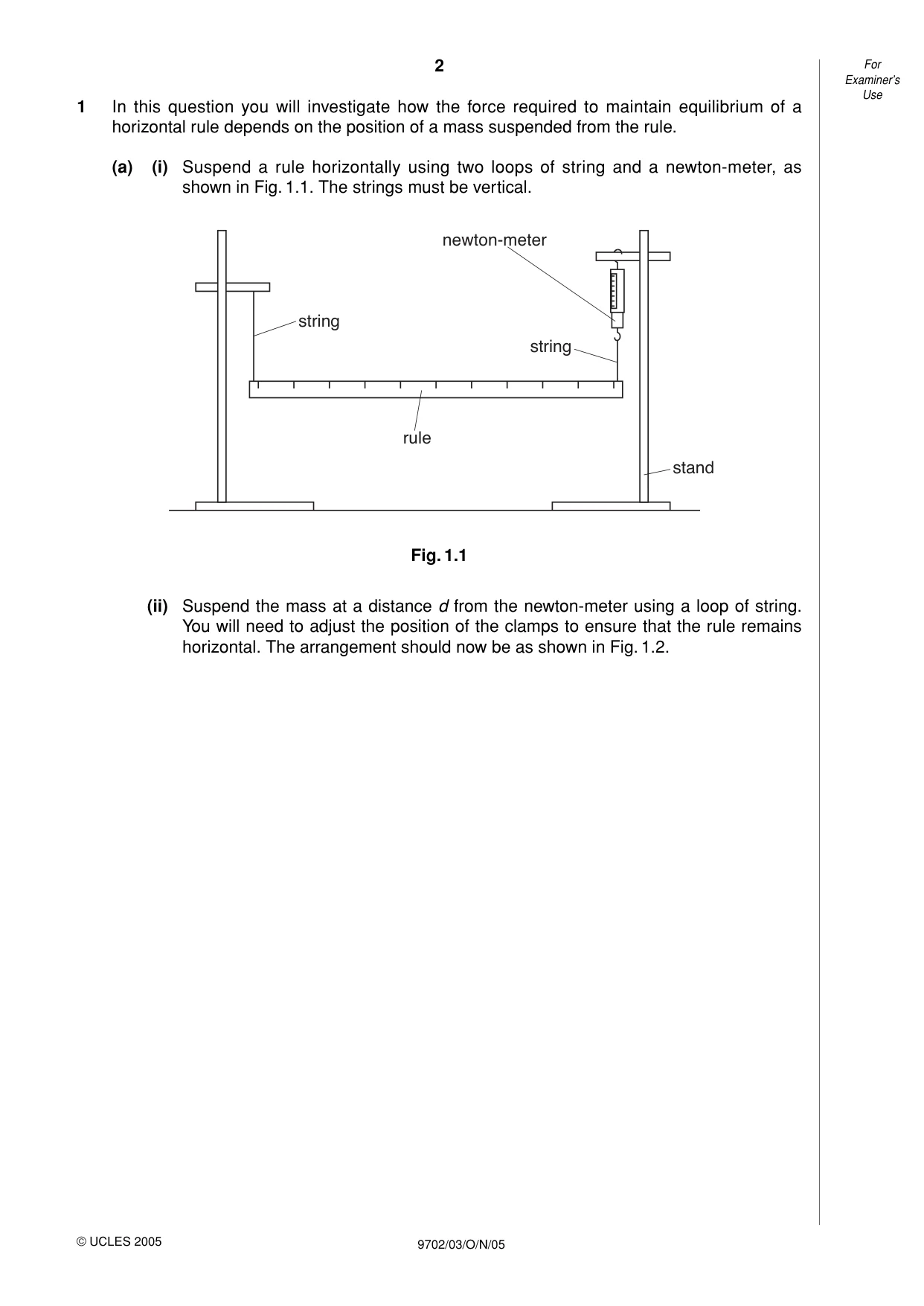
1 In this question you will investigate how the force required to maintain equilibrium of a horizontal rule depends on the position of a mass suspended from the rule. (a) (i) Suspend a rule horizontally using two loops of string and a newton-meter, as shown in Fig. 1.1. The strings must be vertical. Fig. 1.1 (ii) Suspend the mass at a distance d from the newton-meter using a loop of string. You will need to adjust the position of the clamps to ensure that the rule remains horizontal. The arrangement should now be as shown in Fig. 1.2. newton-meter string string stand rule 2 For Examiner’s Use 9702/03/O/N/05 © UCLES 2005
Question paper, page 3
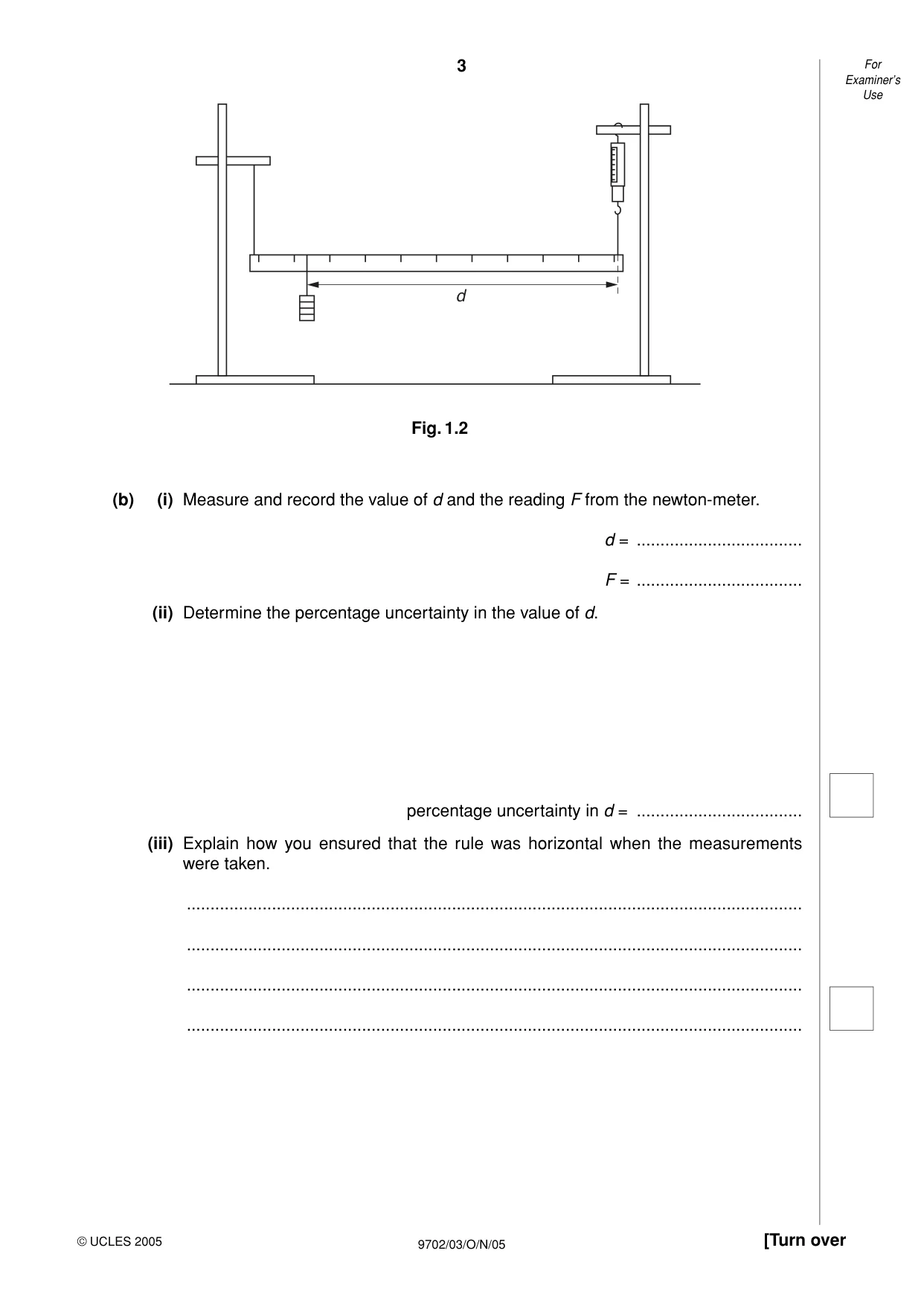
Fig. 1.2 (b) (i) Measure and record the value of d and the reading F from the newton-meter. d = … F = … (ii) Determine the percentage uncertainty in the value of d. percentage uncertainty in d = … (iii) Explain how you ensured that the rule was horizontal when the measurements were taken. … … … … d 3 [Turn over For Examiner’s Use 9702/03/O/N/05 © UCLES 2005
Question paper, page 4
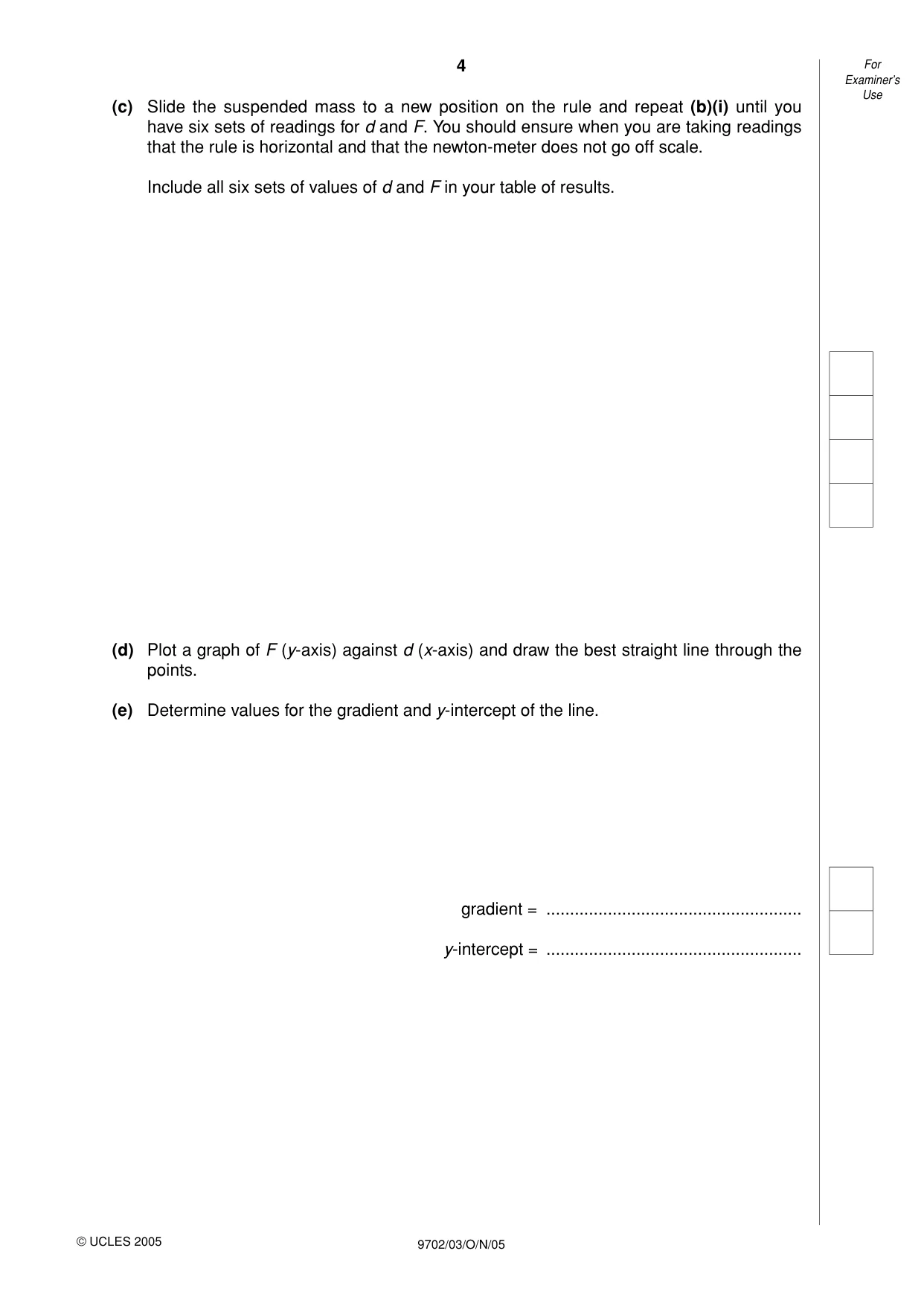
(c) Slide the suspended mass to a new position on the rule and repeat (b)(i) until you have six sets of readings for d and F. You should ensure when you are taking readings that the rule is horizontal and that the newton-meter does not go off scale. Include all six sets of values of d and F in your table of results. (d) Plot a graph of F (y-axis) against d (x-axis) and draw the best straight line through the points. (e) Determine values for the gradient and y-intercept of the line. gradient = … y-intercept = … 4 For Examiner’s Use 9702/03/O/N/05 © UCLES 2005
Question paper, page 5
5 [Turn over For Examiner’s Use 9702/03/O/N/05 © UCLES 2005
Question paper, page 6
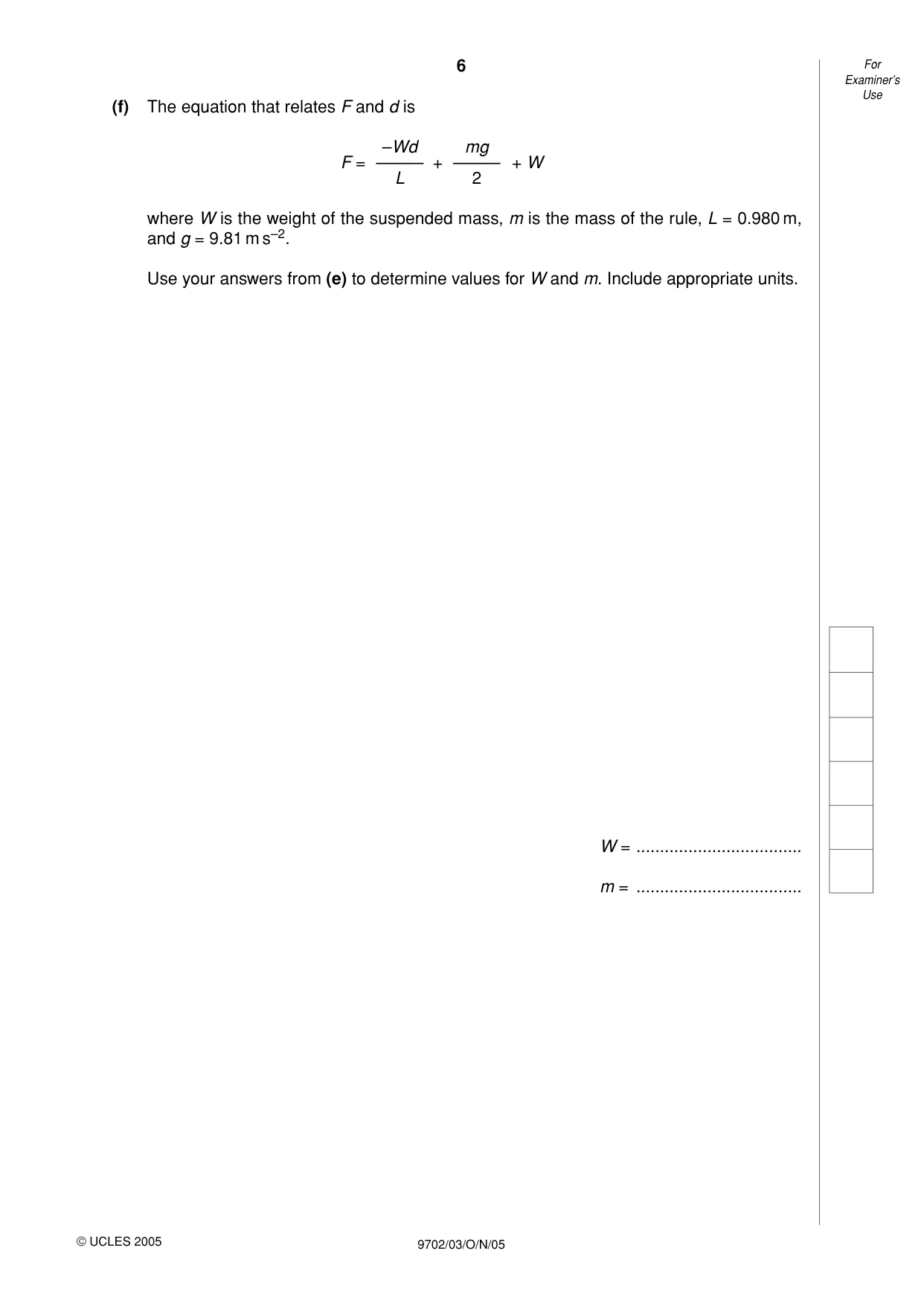
(f) The equation that relates F and d is –Wd mg F = ––––– + ––––– + W L 2 where W is the weight of the suspended mass, m is the mass of the rule, L = 0.980 m, and g = 9.81 m s–2. Use your answers from (e) to determine values for W and m. Include appropriate units. W = … m = … 6 For Examiner’s Use 9702/03/O/N/05 © UCLES 2005
Question paper, page 8
BLANK PAGE Permission to reproduce items where third-party owned material protected by copyright is included has been sought and cleared where possible. Every reasonable effort has been made by the publisher (UCLES) to trace copyright holders, but if any items requiring clearance have unwittingly been included, the publisher will be pleased to make amends at the earliest possible opportunity. University of Cambridge International Examinations is part of the University of Cambridge Local Examinations Syndicate (UCLES), which is itself a department of the University of Cambridge. 8 9702/03/O/N/05
Mark scheme, page 1
UNIVERSITY OF CAMBRIDGE INTERNATIONAL EXAMINATIONS GCE A Level MARK SCHEME for the November 2005 question paper 9702 PHYSICS 9702/03 Paper 3 (Practical Paper) maximum raw mark 25 This mark scheme is published as an aid to teachers and students, to indicate the requirements of the examination. It shows the basis on which Examiners were initially instructed to award marks. It does not indicate the details of the discussions that took place at an Examiners’ meeting before marking began. Any substantial changes to the mark scheme that arose from these discussions will be recorded in the published Report on the Examination. All Examiners are instructed that alternative correct answers and unexpected approaches in candidates’ scripts must be given marks that fairly reflect the relevant knowledge and skills demonstrated. Mark schemes must be read in conjunction with the question papers and the Report on the Examination. The minimum marks in these components needed for various grades were previously published with these mark schemes, but are now instead included in the Report on the Examination for this session. • CIE will not enter into discussion or correspondence in connection with these mark schemes. CIE is publishing the mark schemes for the November 2005 question papers for most IGCSE and GCE Advanced Level and Advanced Subsidiary Level syllabuses and some Ordinary Level syllabuses.
Mark scheme, page 2
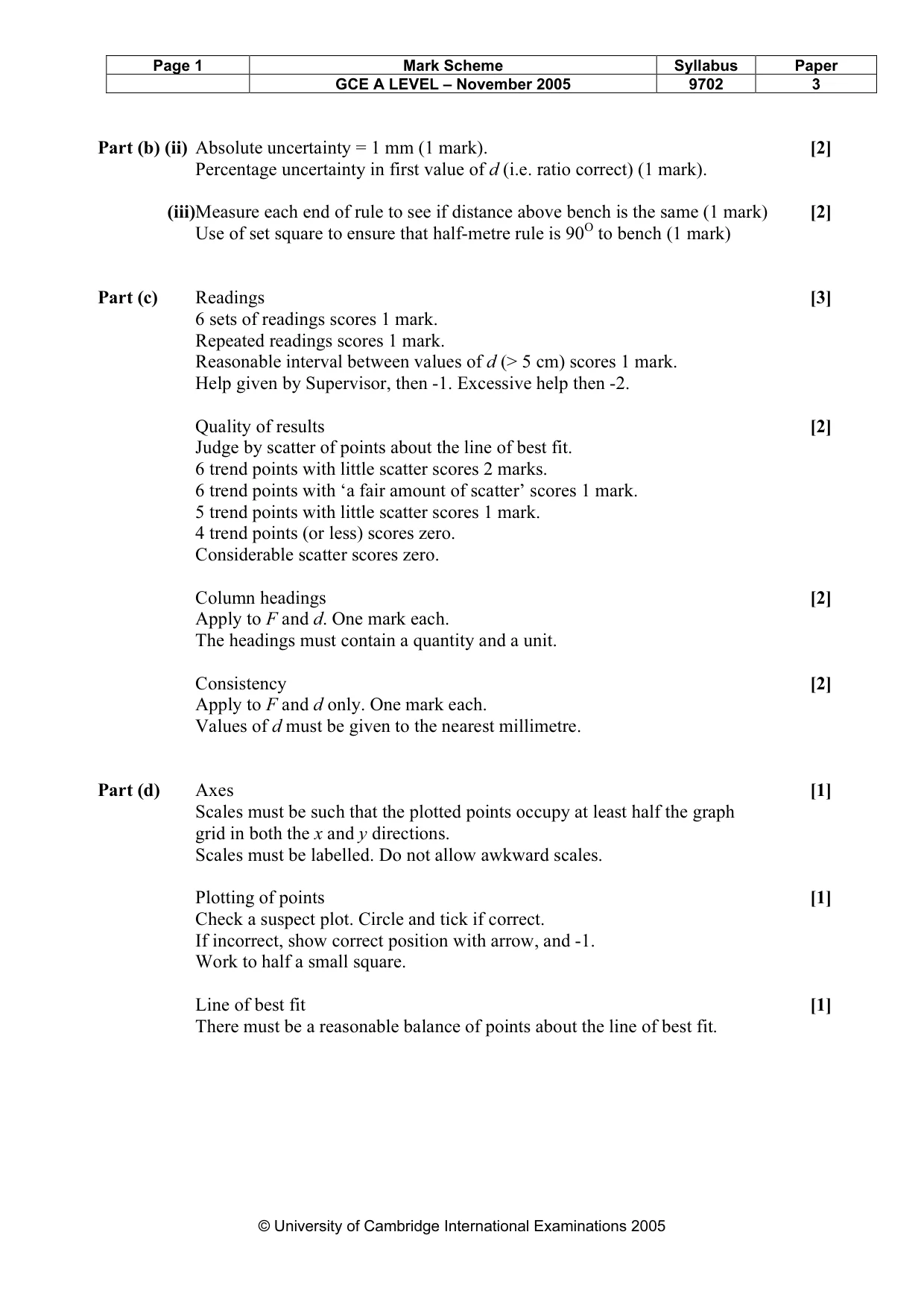
Page 1 Mark Scheme Syllabus Paper GCE A LEVEL – November 2005 9702 3 © University of Cambridge International Examinations 2005 Part (b) (ii) Absolute uncertainty = 1 mm (1 mark). [2] Percentage uncertainty in first value of d (i.e. ratio correct) (1 mark). (iii)Measure each end of rule to see if distance above bench is the same (1 mark) [2] Use of set square to ensure that half-metre rule is 90O to bench (1 mark) Part (c) Readings [3] 6 sets of readings scores 1 mark. Repeated readings scores 1 mark. Reasonable interval between values of d (> 5 cm) scores 1 mark. Help given by Supervisor, then -1. Excessive help then -2. Quality of results [2] Judge by scatter of points about the line of best fit. 6 trend points with little scatter scores 2 marks. 6 trend points with ‘a fair amount of scatter’ scores 1 mark. 5 trend points with little scatter scores 1 mark. 4 trend points (or less) scores zero. Considerable scatter scores zero. Column headings [2] Apply to F and d. One mark each. The headings must contain a quantity and a unit. Consistency [2] Apply to F and d only. One mark each. Values of d must be given to the nearest millimetre. Part (d) Axes [1] Scales must be such that the plotted points occupy at least half the graph grid in both the x and y directions. Scales must be labelled. Do not allow awkward scales. Plotting of points [1] Check a suspect plot. Circle and tick if correct. If incorrect, show correct position with arrow, and -1. Work to half a small square. Line of best fit [1] There must be a reasonable balance of points about the line of best fit.
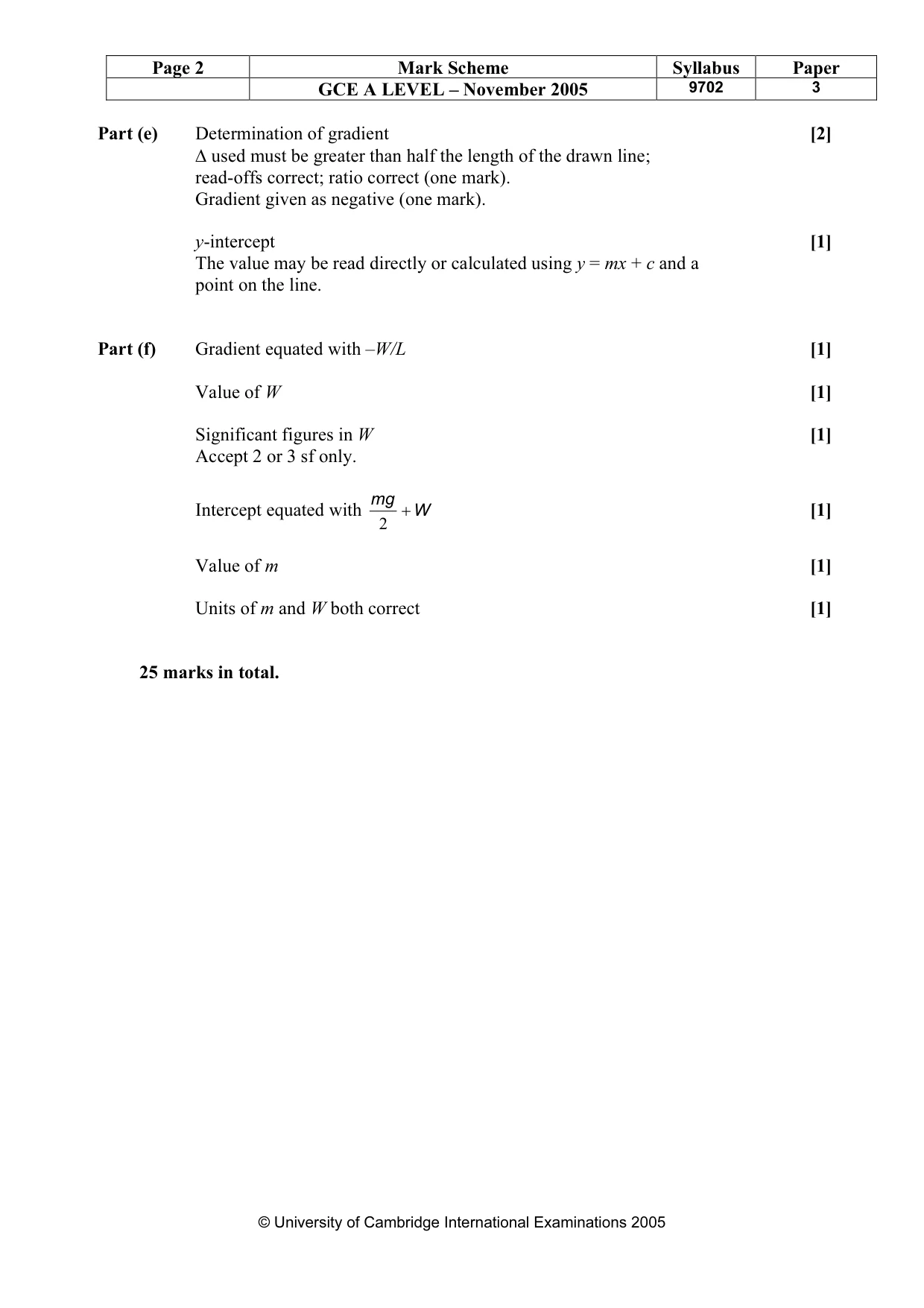
Mark scheme, page 3
Page 2 Mark Scheme Syllabus Paper GCE A LEVEL – November 2005 9702 3 © University of Cambridge International Examinations 2005 Part (e) Determination of gradient [2] ∆ used must be greater than half the length of the drawn line; read-offs correct; ratio correct (one mark). Gradient given as negative (one mark). y-intercept [1] The value may be read directly or calculated using y = mx + c and a point on the line. Part (f) Gradient equated with –W/L [1] Value of W [1] Significant figures in W [1] Accept 2 or 3 sf only. Intercept equated with W mg + 2 [1] Value of m [1] Units of m and W both correct [1] 25 marks in total.