Cambridge A Level Nepal Studies (AS Level only) 8024 — 2016 May/June Paper 1 · Variant 0
8024/10/M/J/16
The question paper and its mark scheme, free to read here and free to download. This is Cambridge’s own paper, exactly as it was sat.
Question paper12 pages
Mark scheme
No mark scheme is in the library for this paper.
Paper as text
Question paper, page 1
This document consists of 12 printed pages. DC (ST/SG) 123572/3 © UCLES 2016 [Turn over Cambridge International Examinations Cambridge International Advanced Subsidiary Level * 2 8 4 8 9 0 6 7 6 4 * NEPAL STUDIES 8024/01 Paper 1 Multiple Choice May/June 2016 1 hour Additional Materials: Multiple Choice Answer Sheet Soft clean eraser Soft pencil (type B or HB is recommended) READ THESE INSTRUCTIONS FIRST Write your Centre number, candidate number and name on the Answer Sheet in the spaces provided unless this has been done for you. Write in soft pencil. Do not use staples, paper clips, glue or correction fluid. DO NOT WRITE IN ANY BARCODES. There are thirty questions on this paper. Answer all questions. For each question there are four possible answers A, B, C and D. Choose the one you consider correct and record your choice in soft pencil on the separate Answer Sheet. Read the instructions on the Answer Sheet very carefully. Each correct answer will score one mark. A mark will not be deducted for a wrong answer. Any rough workings should be done in this booklet.
Question paper, page 2
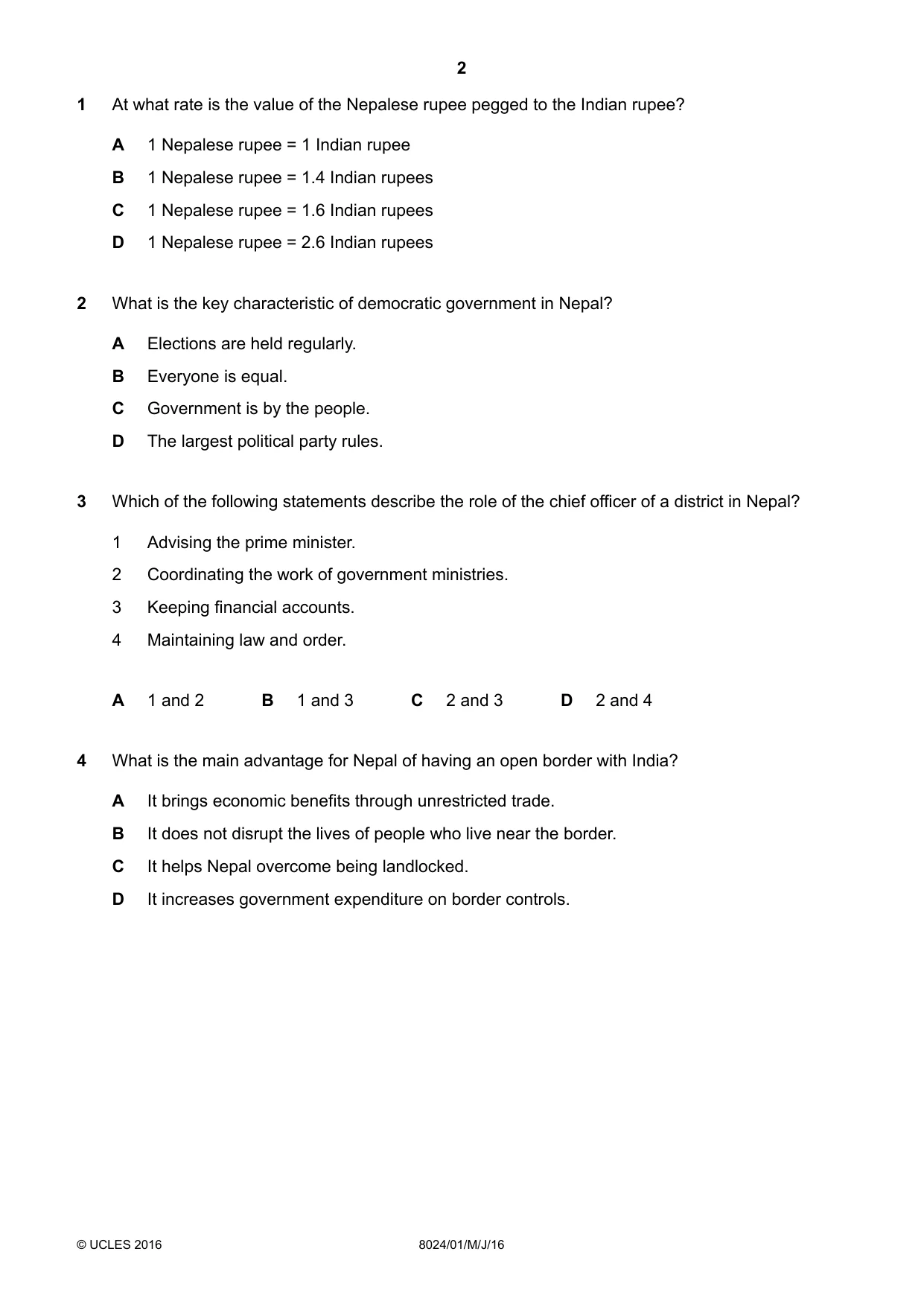
2 8024/01/M/J/16 © UCLES 2016 1 At what rate is the value of the Nepalese rupee pegged to the Indian rupee? A 1 Nepalese rupee = 1 Indian rupee B 1 Nepalese rupee = 1.4 Indian rupees C 1 Nepalese rupee = 1.6 Indian rupees D 1 Nepalese rupee = 2.6 Indian rupees 2 What is the key characteristic of democratic government in Nepal? A Elections are held regularly. B Everyone is equal. C Government is by the people. D The largest political party rules. 3 Which of the following statements describe the role of the chief officer of a district in Nepal? 1 Advising the prime minister. 2 Coordinating the work of government ministries. 3 Keeping financial accounts. 4 Maintaining law and order. A 1 and 2 B 1 and 3 C 2 and 3 D 2 and 4 4 What is the main advantage for Nepal of having an open border with India? A It brings economic benefits through unrestricted trade. B It does not disrupt the lives of people who live near the border. C It helps Nepal overcome being landlocked. D It increases government expenditure on border controls.
Question paper, page 3
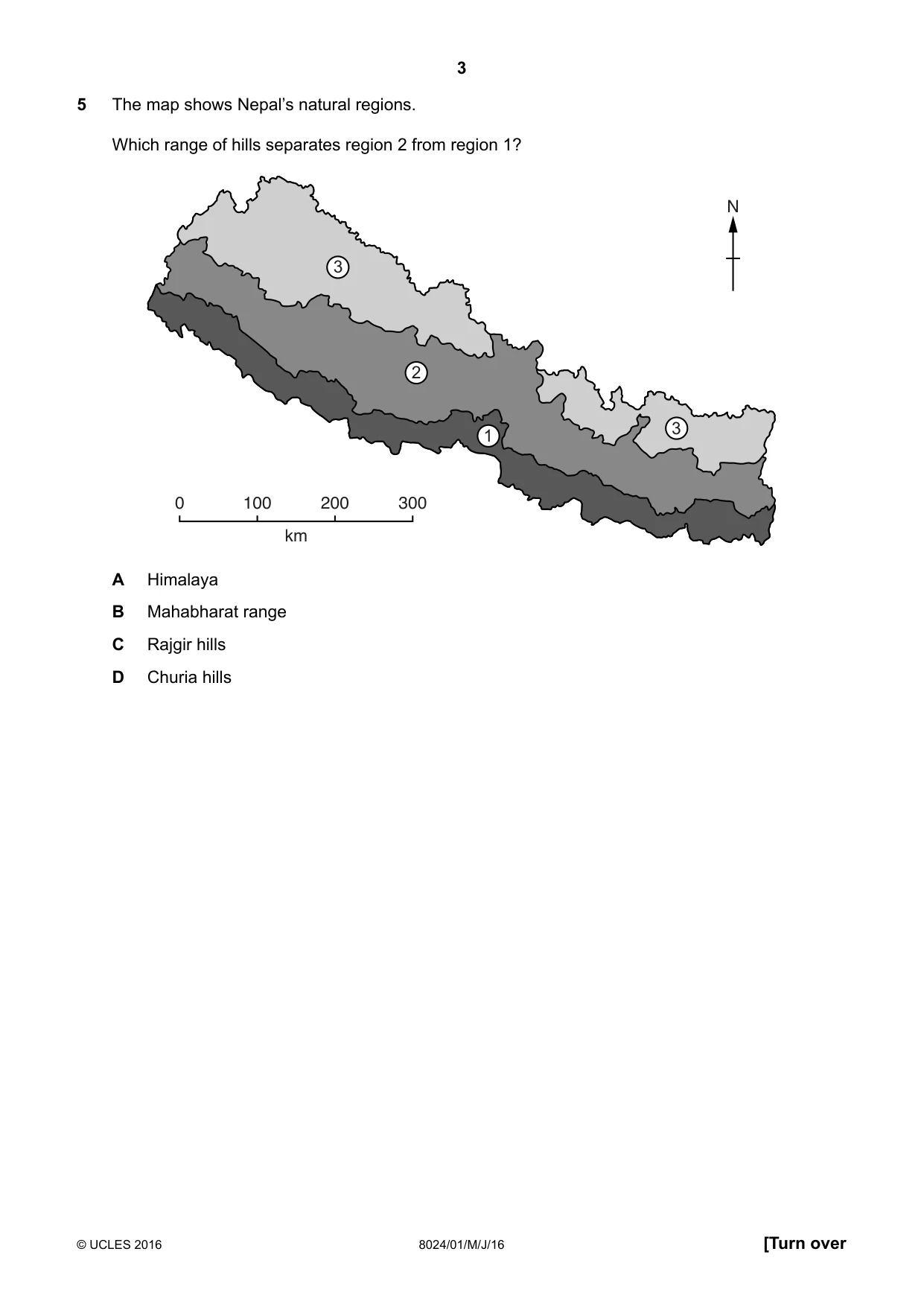
3 8024/01/M/J/16 © UCLES 2016 [Turn over 5 The map shows Nepal’s natural regions. Which range of hills separates region 2 from region 1? 1 2 3 3 km 0 100 200 300 N A Himalaya B Mahabharat range C Rajgir hills D Churia hills
Question paper, page 4
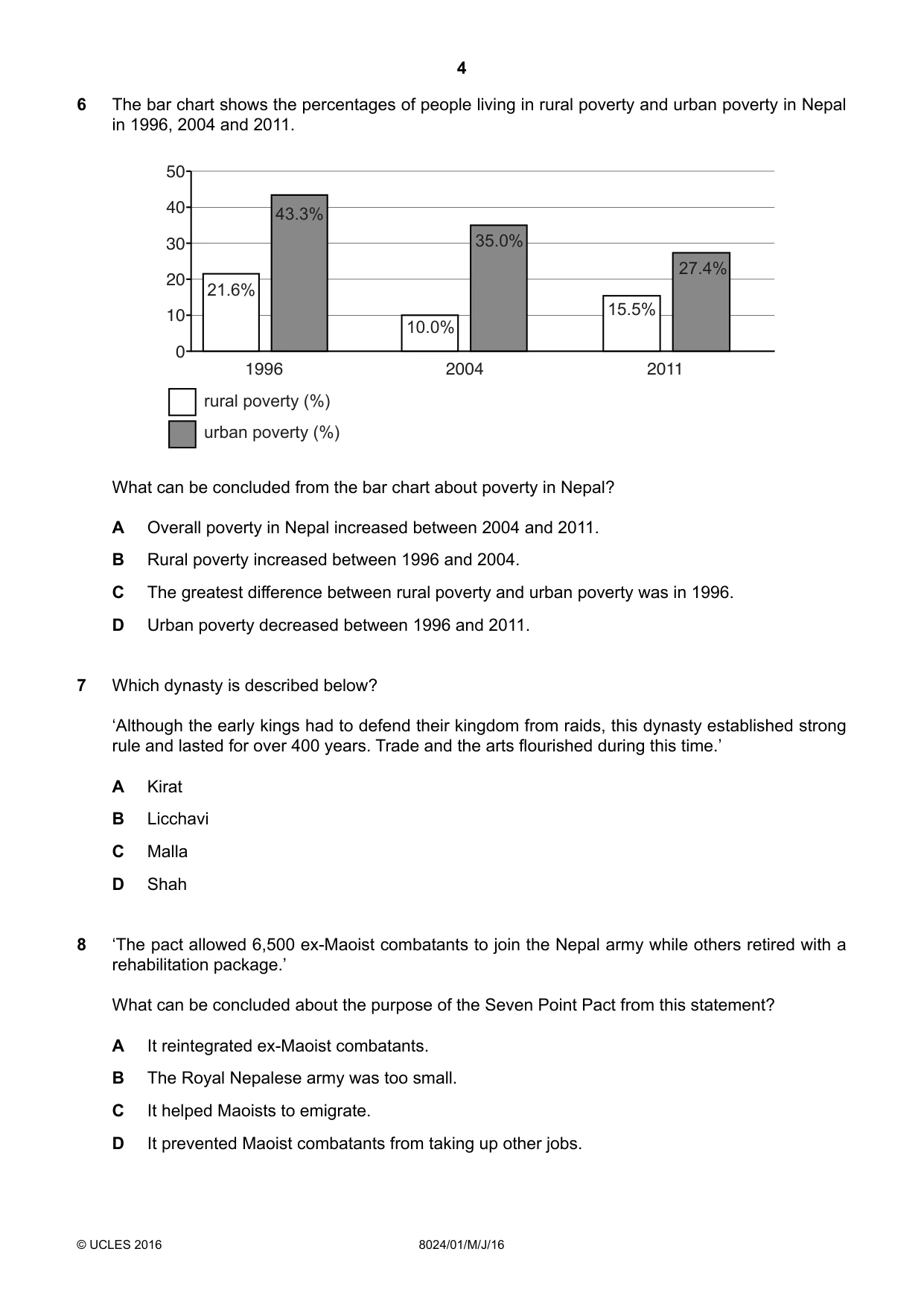
4 8024/01/M/J/16 © UCLES 2016 6 The bar chart shows the percentages of people living in rural poverty and urban poverty in Nepal in 1996, 2004 and 2011. rural poverty (%) urban poverty (%) 1996 2004 2011 50 40 30 20 10 0 43.3% 21.6% 10.0% 35.0% 15.5% 27.4% What can be concluded from the bar chart about poverty in Nepal? A Overall poverty in Nepal increased between 2004 and 2011. B Rural poverty increased between 1996 and 2004. C The greatest difference between rural poverty and urban poverty was in 1996. D Urban poverty decreased between 1996 and 2011. 7 Which dynasty is described below? ‘Although the early kings had to defend their kingdom from raids, this dynasty established strong rule and lasted for over 400 years. Trade and the arts flourished during this time.’ A Kirat B Licchavi C Malla D Shah 8 ‘The pact allowed 6,500 ex-Maoist combatants to join the Nepal army while others retired with a rehabilitation package.’ What can be concluded about the purpose of the Seven Point Pact from this statement? A It reintegrated ex-Maoist combatants. B The Royal Nepalese army was too small. C It helped Maoists to emigrate. D It prevented Maoist combatants from taking up other jobs.
Question paper, page 5
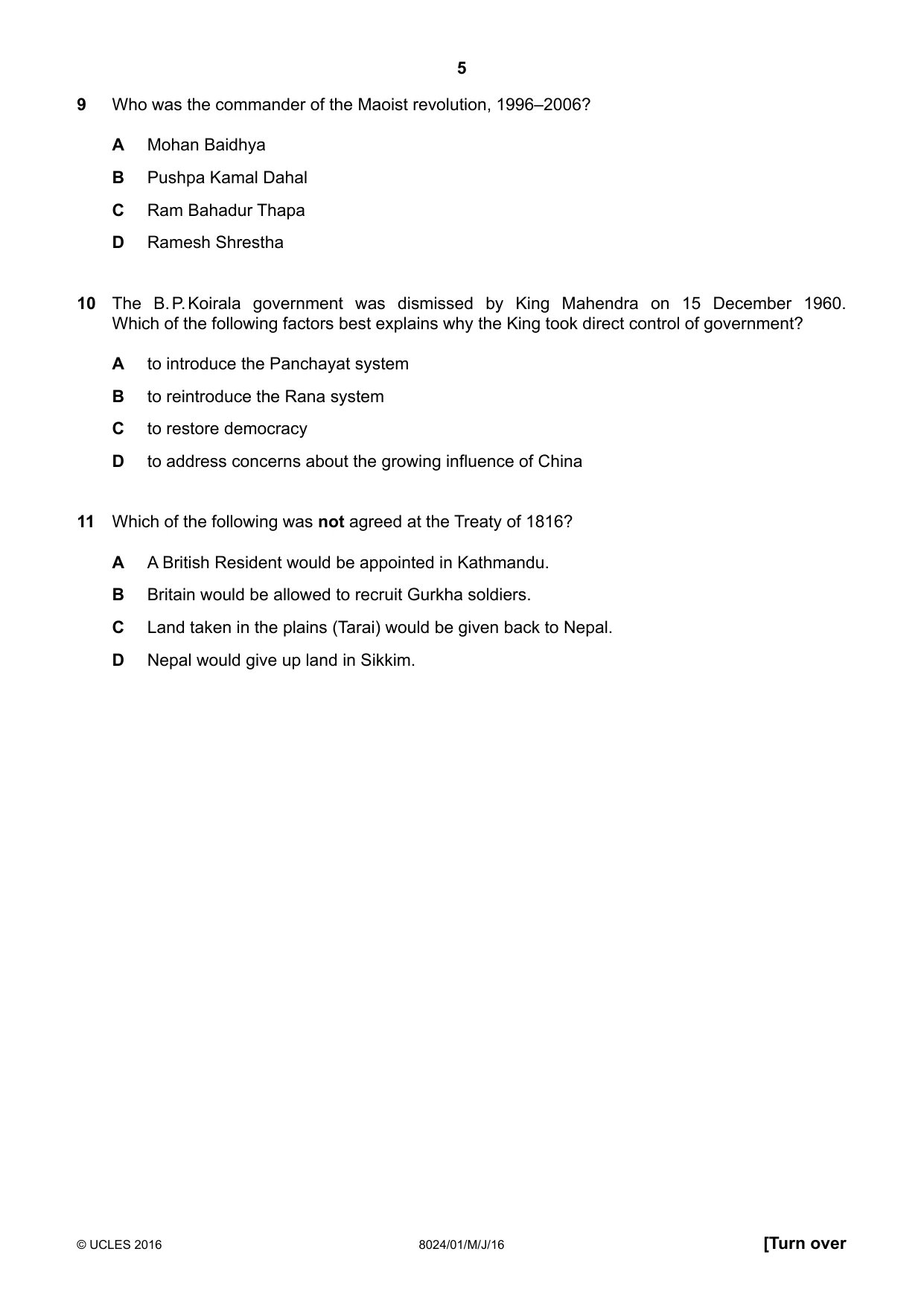
5 8024/01/M/J/16 © UCLES 2016 [Turn over 9 Who was the commander of the Maoist revolution, 1996–2006? A Mohan Baidhya B Pushpa Kamal Dahal C Ram Bahadur Thapa D Ramesh Shrestha 10 The B. P. Koirala government was dismissed by King Mahendra on 15 December 1960. Which of the following factors best explains why the King took direct control of government? A to introduce the Panchayat system B to reintroduce the Rana system C to restore democracy D to address concerns about the growing influence of China 11 Which of the following was not agreed at the Treaty of 1816? A A British Resident would be appointed in Kathmandu. B Britain would be allowed to recruit Gurkha soldiers. C Land taken in the plains (Tarai) would be given back to Nepal. D Nepal would give up land in Sikkim.
Question paper, page 6
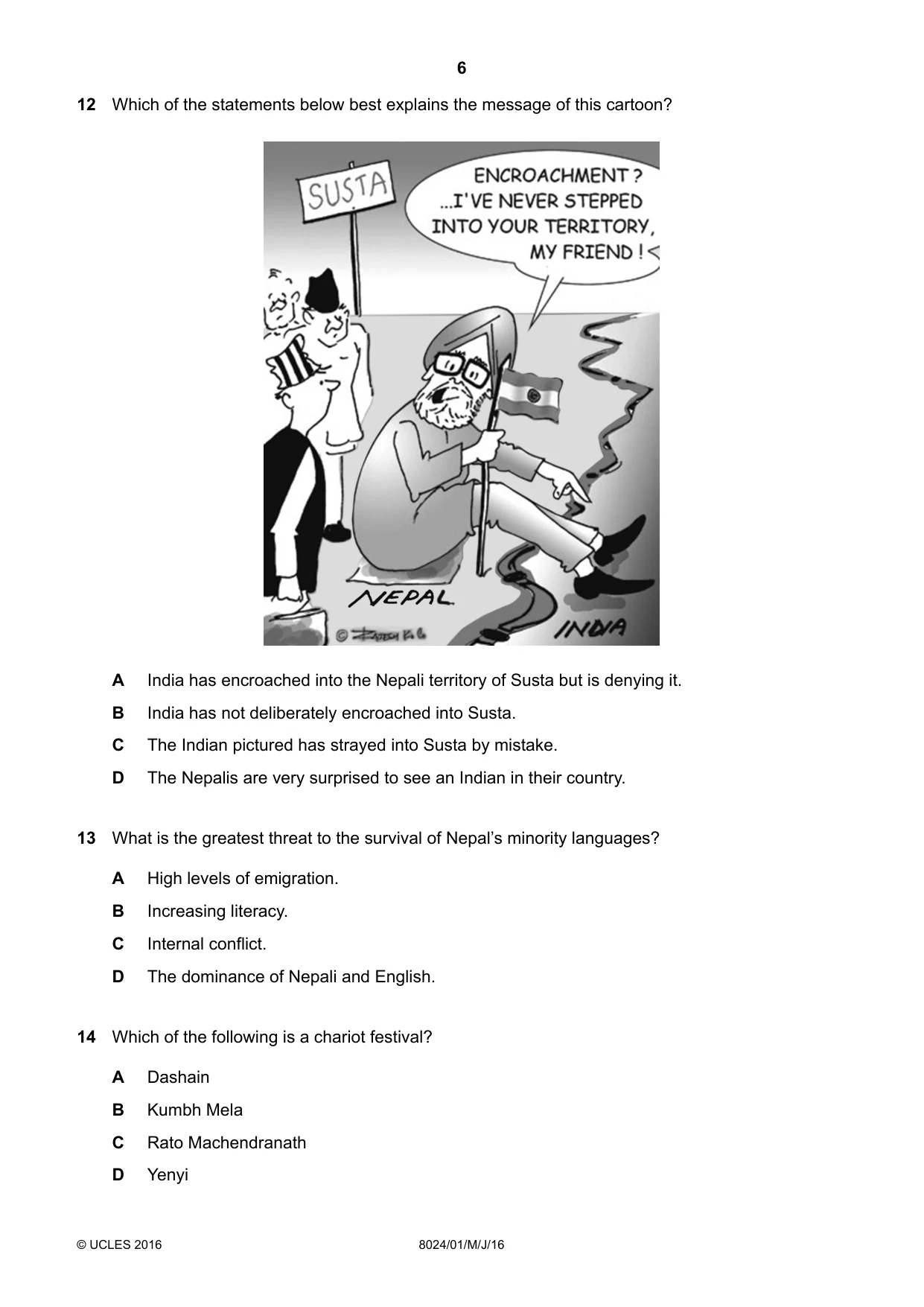
6 8024/01/M/J/16 © UCLES 2016 12 Which of the statements below best explains the message of this cartoon? A India has encroached into the Nepali territory of Susta but is denying it. B India has not deliberately encroached into Susta. C The Indian pictured has strayed into Susta by mistake. D The Nepalis are very surprised to see an Indian in their country. 13 What is the greatest threat to the survival of Nepal’s minority languages? A High levels of emigration. B Increasing literacy. C Internal conflict. D The dominance of Nepali and English. 14 Which of the following is a chariot festival? A Dashain B Kumbh Mela C Rato Machendranath D Yenyi
Question paper, page 7
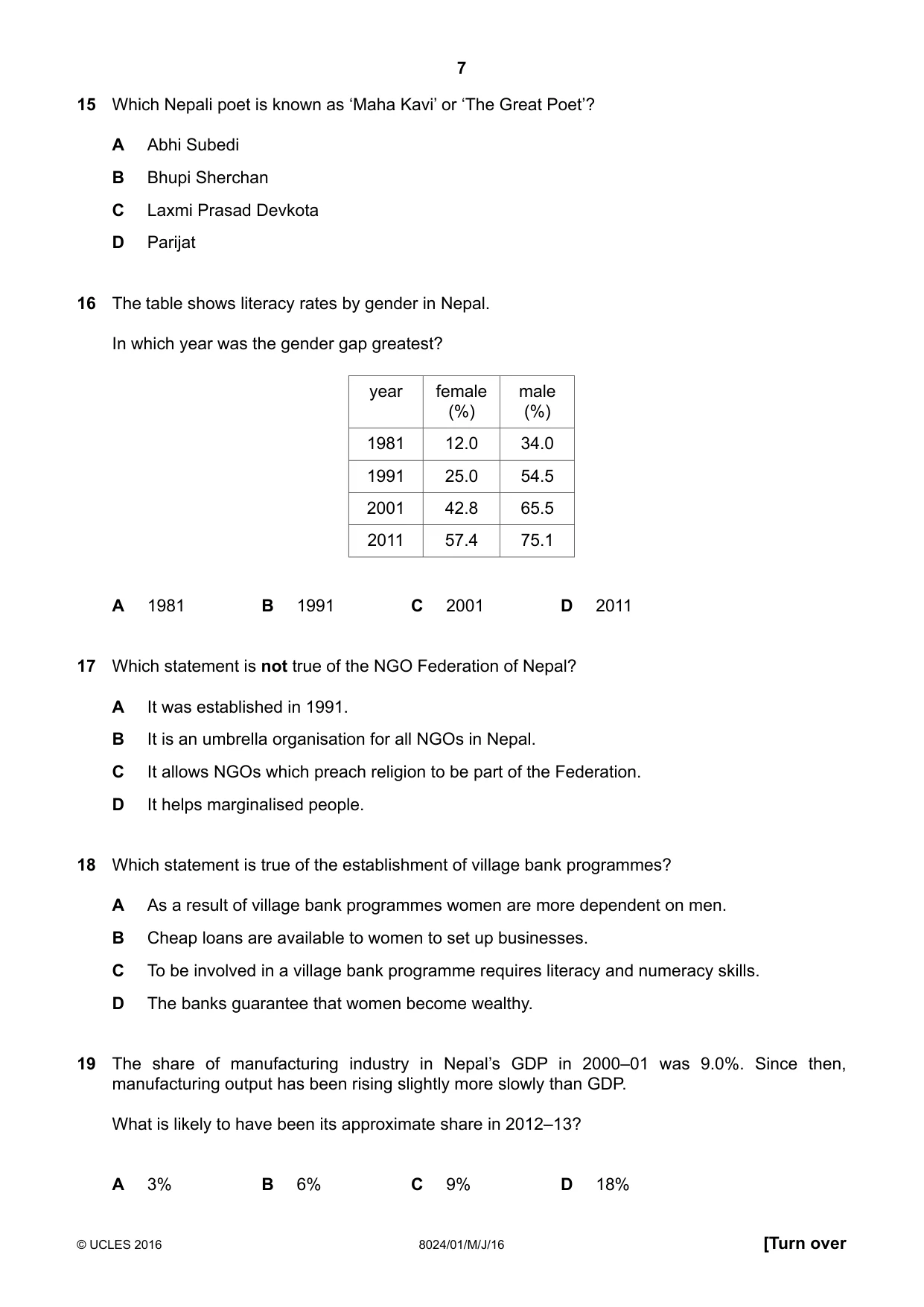
7 8024/01/M/J/16 © UCLES 2016 [Turn over 15 Which Nepali poet is known as ‘Maha Kavi’ or ‘The Great Poet’? A Abhi Subedi B Bhupi Sherchan C Laxmi Prasad Devkota D Parijat 16 The table shows literacy rates by gender in Nepal. In which year was the gender gap greatest? year female (%) male (%) 1981 12.0 34.0 1991 25.0 54.5 2001 42.8 65.5 2011 57.4 75.1 A 1981 B 1991 C 2001 D 2011 17 Which statement is not true of the NGO Federation of Nepal? A It was established in 1991. B It is an umbrella organisation for all NGOs in Nepal. C It allows NGOs which preach religion to be part of the Federation. D It helps marginalised people. 18 Which statement is true of the establishment of village bank programmes? A As a result of village bank programmes women are more dependent on men. B Cheap loans are available to women to set up businesses. C To be involved in a village bank programme requires literacy and numeracy skills. D The banks guarantee that women become wealthy. 19 The share of manufacturing industry in Nepal’s GDP in 2000–01 was 9.0%. Since then, manufacturing output has been rising slightly more slowly than GDP. What is likely to have been its approximate share in 2012–13? A 3% B 6% C 9% D 18%
Question paper, page 8
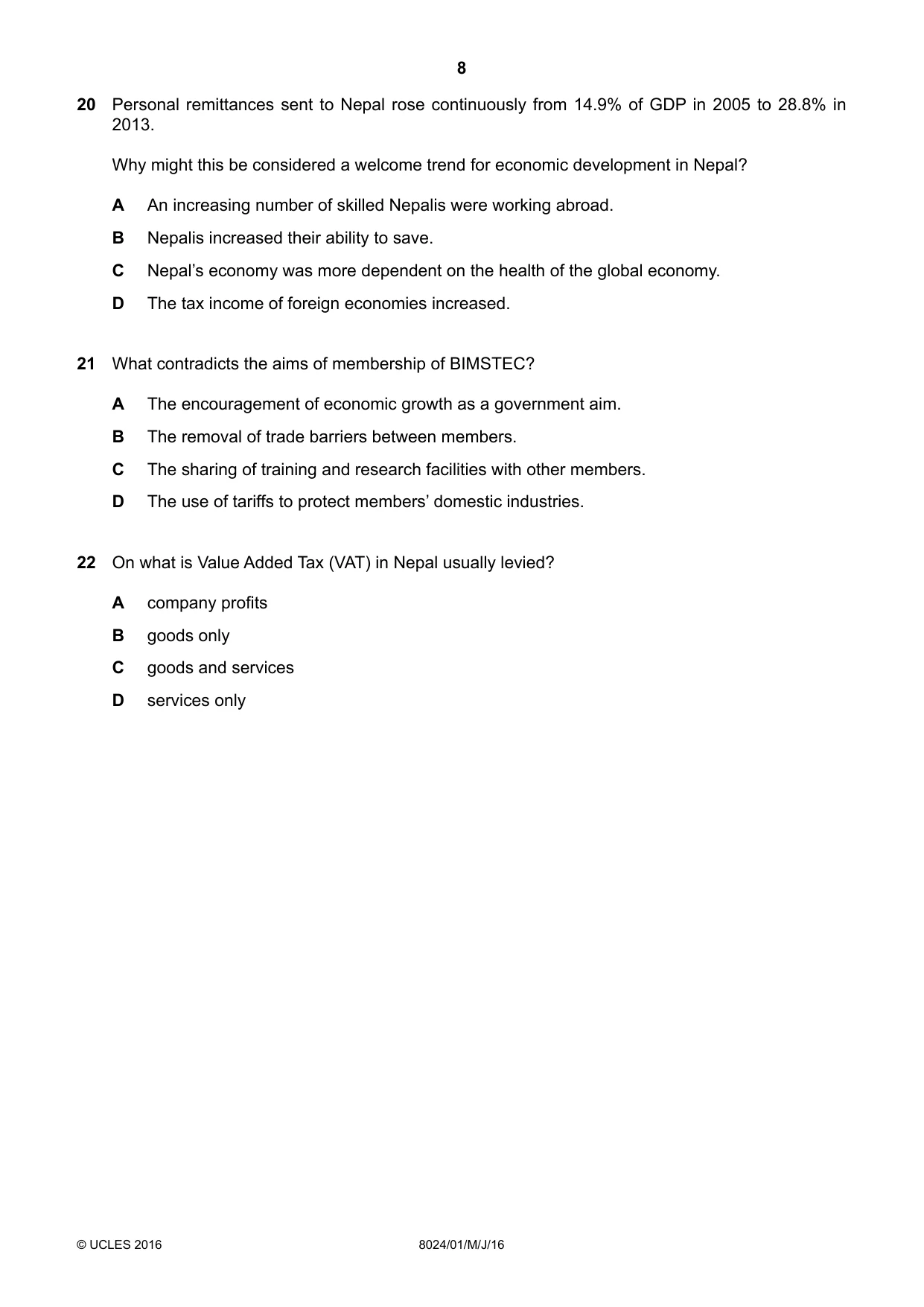
8 8024/01/M/J/16 © UCLES 2016 20 Personal remittances sent to Nepal rose continuously from 14.9% of GDP in 2005 to 28.8% in 2013. Why might this be considered a welcome trend for economic development in Nepal? A An increasing number of skilled Nepalis were working abroad. B Nepalis increased their ability to save. C Nepal’s economy was more dependent on the health of the global economy. D The tax income of foreign economies increased. 21 What contradicts the aims of membership of BIMSTEC? A The encouragement of economic growth as a government aim. B The removal of trade barriers between members. C The sharing of training and research facilities with other members. D The use of tariffs to protect members’ domestic industries. 22 On what is Value Added Tax (VAT) in Nepal usually levied? A company profits B goods only C goods and services D services only
Question paper, page 9
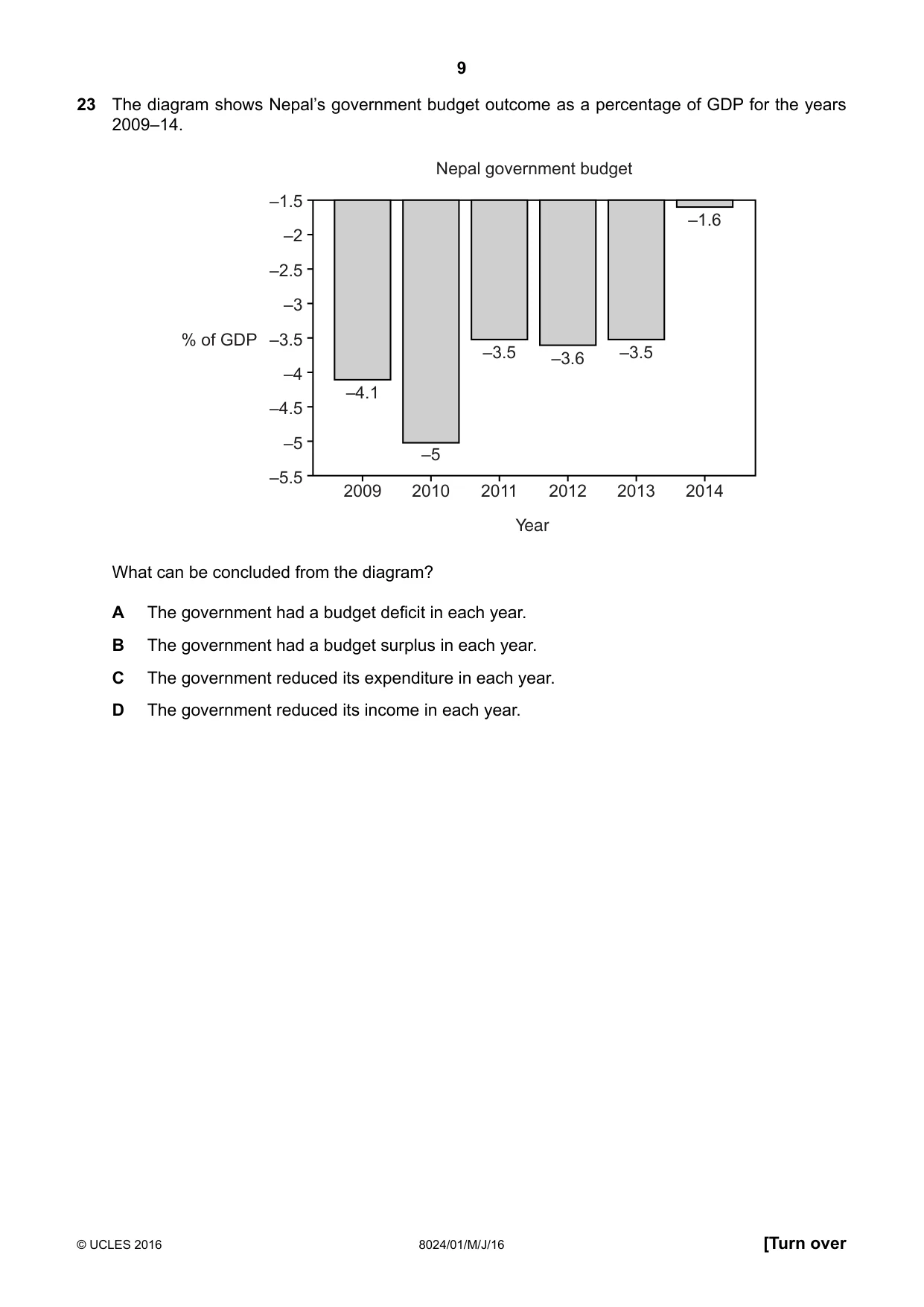
9 8024/01/M/J/16 © UCLES 2016 [Turn over 23 The diagram shows Nepal’s government budget outcome as a percentage of GDP for the years 2009 –14. –1.5 –2 –2.5 –3 –3.5 –4 –4.5 –5 –5.5 –4.1 –5 –3.5 –3.5 –1.6 –3.6 2009 2010 2011 2012 2013 2014 % of GDP Nepal government budget Year What can be concluded from the diagram? A The government had a budget deficit in each year. B The government had a budget surplus in each year. C The government reduced its expenditure in each year. D The government reduced its income in each year.
Question paper, page 10
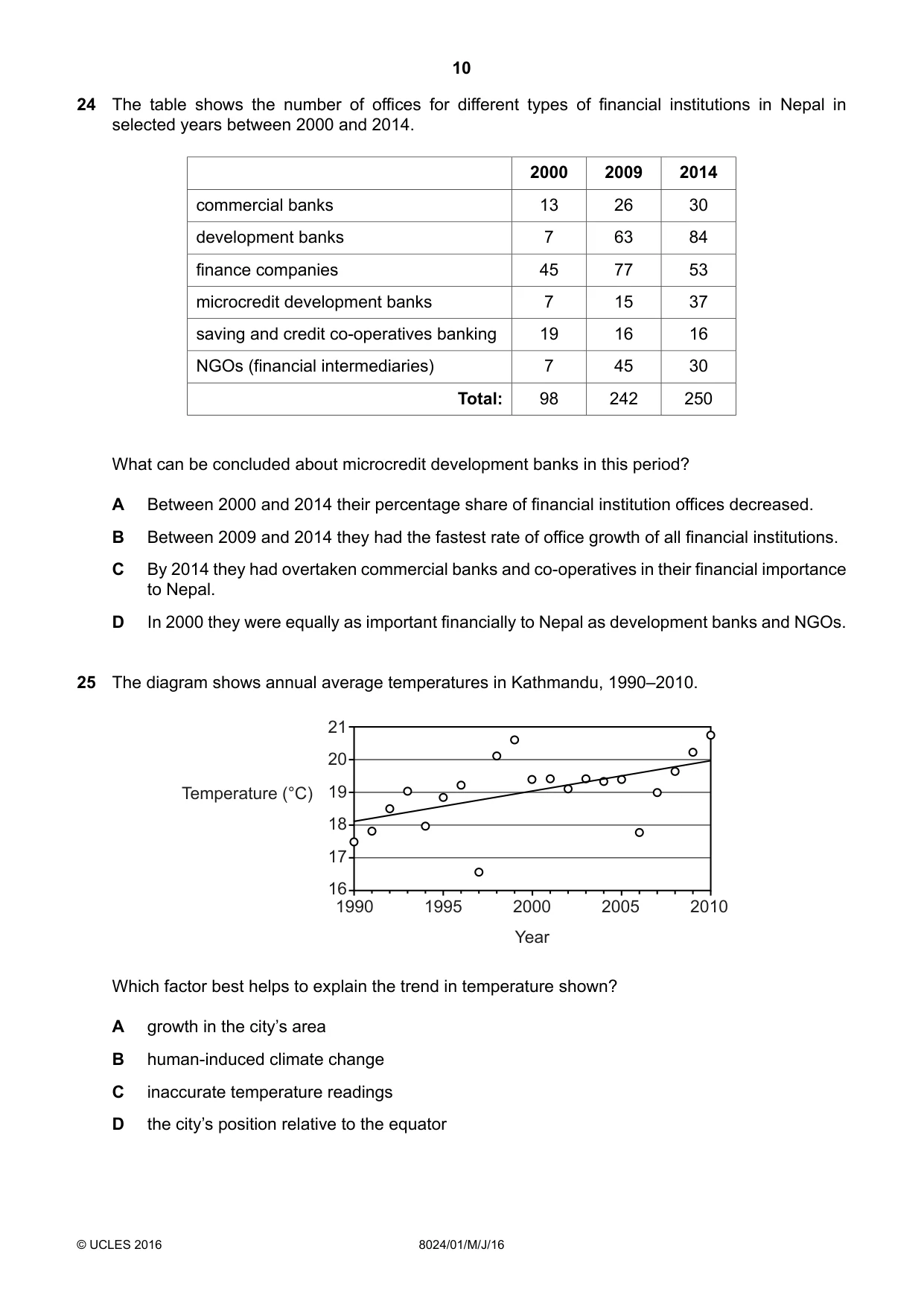
10 8024/01/M/J/16 © UCLES 2016 24 The table shows the number of offices for different types of financial institutions in Nepal in selected years between 2000 and 2014. 2000 2009 2014 commercial banks 13 26 30 development banks 7 63 84 finance companies 45 77 53 microcredit development banks 7 15 37 saving and credit co-operatives banking 19 16 16 NGOs (financial intermediaries) 7 45 30 Total: 98 242 250 What can be concluded about microcredit development banks in this period? A Between 2000 and 2014 their percentage share of financial institution offices decreased. B Between 2009 and 2014 they had the fastest rate of office growth of all financial institutions. C By 2014 they had overtaken commercial banks and co-operatives in their financial importance to Nepal. D In 2000 they were equally as important financially to Nepal as development banks and NGOs. 25 The diagram shows annual average temperatures in Kathmandu, 1990–2010. Temperature (°C) 21 20 19 18 17 16 1990 1995 2000 2005 2010 Year Which factor best helps to explain the trend in temperature shown? A growth in the city’s area B human-induced climate change C inaccurate temperature readings D the city’s position relative to the equator
Question paper, page 11
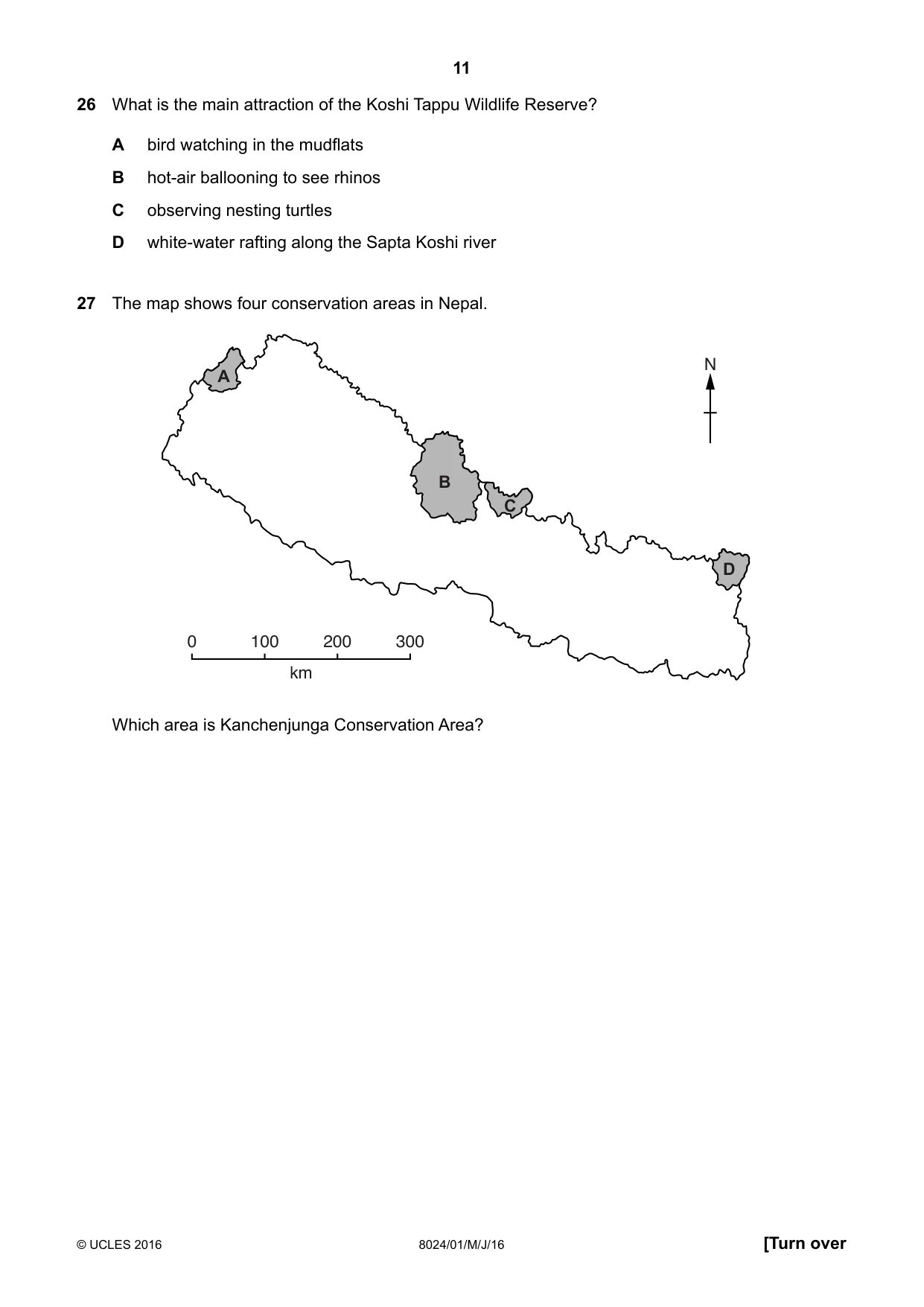
11 8024/01/M/J/16 © UCLES 2016 [Turn over 26 What is the main attraction of the Koshi Tappu Wildlife Reserve? A bird watching in the mudflats B hot-air ballooning to see rhinos C observing nesting turtles D white-water rafting along the Sapta Koshi river 27 The map shows four conservation areas in Nepal. A B C D km 0 100 200 300 N Which area is Kanchenjunga Conservation Area?
Question paper, page 12
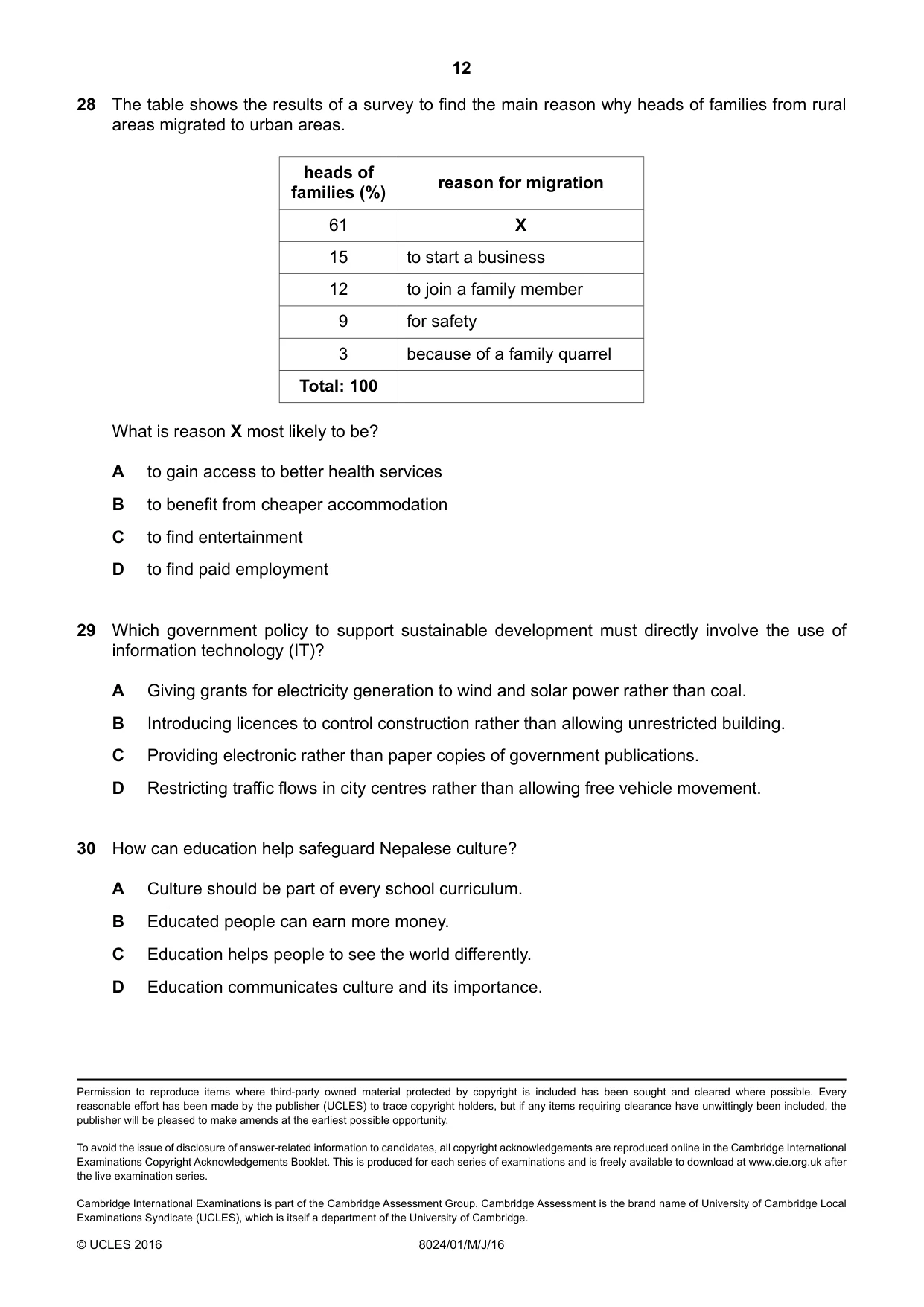
12 8024/01/M/J/16 © UCLES 2016 28 The table shows the results of a survey to find the main reason why heads of families from rural areas migrated to urban areas. heads of families (%) reason for migration 61 X 15 to start a business 12 to join a family member 9 for safety 3 because of a family quarrel Total: 100 What is reason X most likely to be? A to gain access to better health services B to benefit from cheaper accommodation C to find entertainment D to find paid employment 29 Which government policy to support sustainable development must directly involve the use of information technology (IT)? A Giving grants for electricity generation to wind and solar power rather than coal. B Introducing licences to control construction rather than allowing unrestricted building. C Providing electronic rather than paper copies of government publications. D Restricting traffic flows in city centres rather than allowing free vehicle movement. 30 How can education help safeguard Nepalese culture? A Culture should be part of every school curriculum. B Educated people can earn more money. C Education helps people to see the world differently. D Education communicates culture and its importance. Permission to reproduce items where third-party owned material protected by copyright is included has been sought and cleared where possible. Every reasonable effort has been made by the publisher (UCLES) to trace copyright holders, but if any items requiring clearance have unwittingly been included, the publisher will be pleased to make amends at the earliest possible opportunity. To avoid the issue of disclosure of answer-related information to candidates, all copyright acknowledgements are reproduced online in the Cambridge International Examinations Copyright Acknowledgements Booklet. This is produced for each series of examinations and is freely available to download at www.cie.org.uk after the live examination series. Cambridge International Examinations is part of the Cambridge Assessment Group. Cambridge Assessment is the brand name of University of Cambridge Local Examinations Syndicate (UCLES), which is itself a department of the University of Cambridge.