Cambridge A Level Music (AS Level only) 8663 — 2009 Oct/Nov Paper 1 · Variant 1
8663/11/O/N/09 · 100 marks · ≈113 min
The question paper and its mark scheme, free to read here and free to download. This is Cambridge’s own paper, exactly as it was sat.
Question paper2 pages
Mark scheme4 pages
Answers below. Sit the paper first if you are practising.
Paper as text
Question paper, page 1
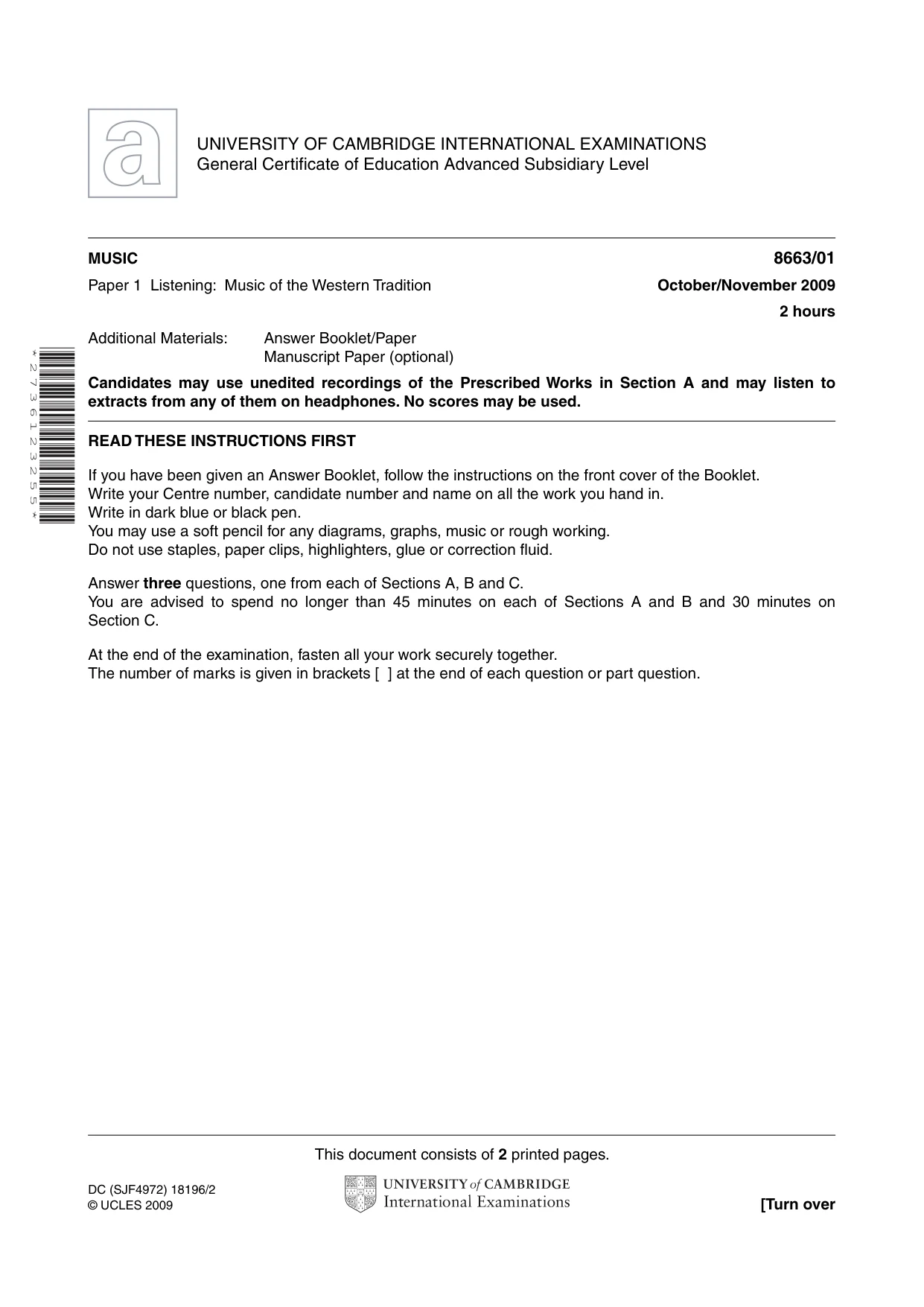
This document consists of 2 printed pages. DC (SJF4972) 18196/2 © UCLES 2009 [Turn over UNIVERSITY OF CAMBRIDGE INTERNATIONAL EXAMINATIONS General Certificate of Education Advanced Subsidiary Level READ THESE INSTRUCTIONS FIRST If you have been given an Answer Booklet, follow the instructions on the front cover of the Booklet. Write your Centre number, candidate number and name on all the work you hand in. Write in dark blue or black pen. You may use a soft pencil for any diagrams, graphs, music or rough working. Do not use staples, paper clips, highlighters, glue or correction fluid. Answer three questions, one from each of Sections A, B and C. You are advised to spend no longer than 45 minutes on each of Sections A and B and 30 minutes on Section C. At the end of the examination, fasten all your work securely together. The number of marks is given in brackets [ ] at the end of each question or part question. * 2 7 3 6 1 2 3 2 5 5 * MUSIC 8663/01 Paper 1 Listening: Music of the Western Tradition October/November 2009 2 hours Additional Materials: Answer Booklet/Paper Manuscript Paper (optional) Candidates may use unedited recordings of the Prescribed Works in Section A and may listen to extracts from any of them on headphones. No scores may be used.
Question paper, page 2
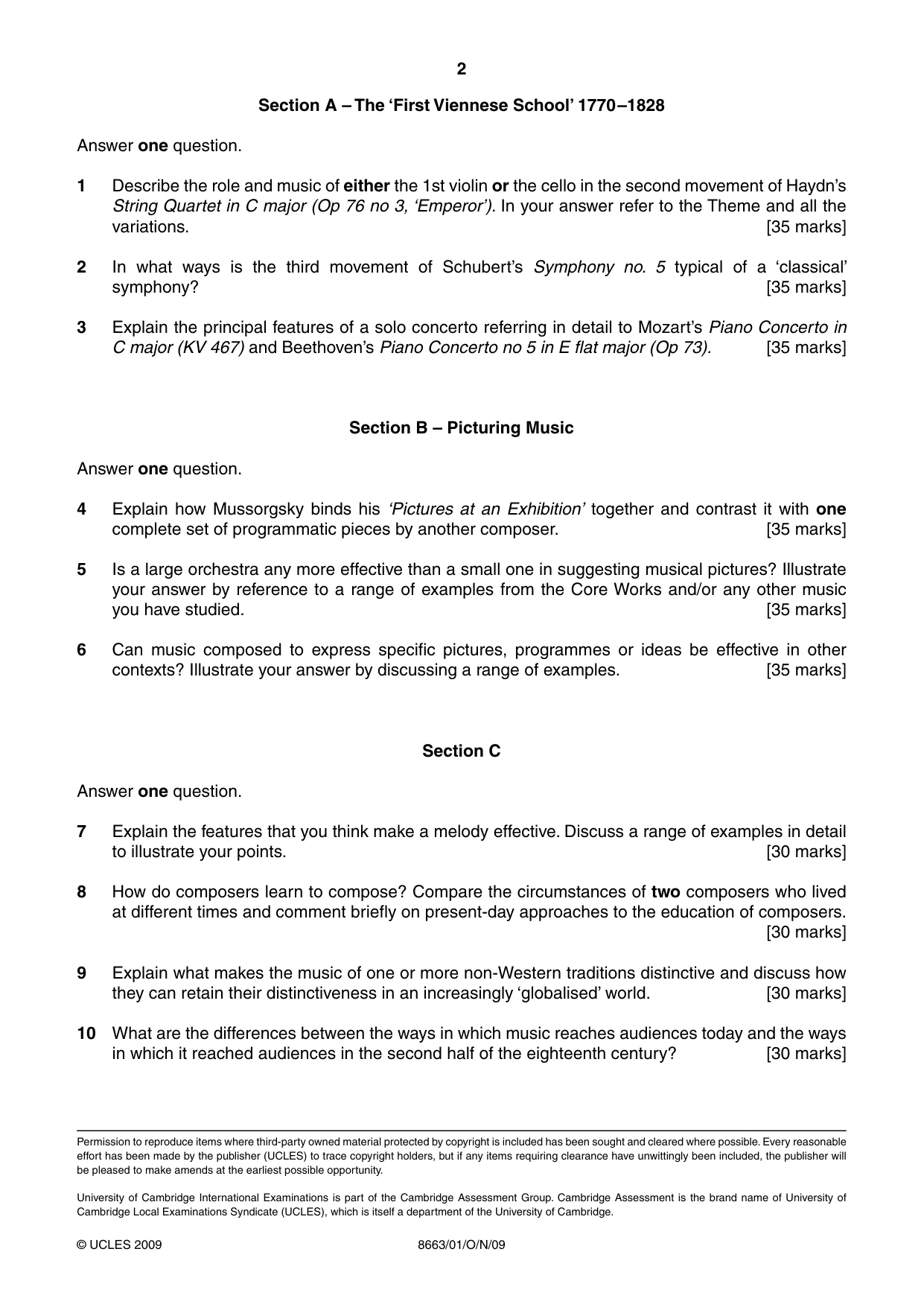
2 8663/01/O/N/09 © UCLES 2009 Section A – The ‘First Viennese School’ 1770–1828 Answer one question. 1 Describe the role and music of either the 1st violin or the cello in the second movement of Haydn’s String Quartet in C major (Op 76 no 3, ‘Emperor’). In your answer refer to the Theme and all the variations. [35 marks] 2 In what ways is the third movement of Schubert’s Symphony no. 5 typical of a ‘classical’ symphony? [35 marks] 3 Explain the principal features of a solo concerto referring in detail to Mozart’s Piano Concerto in C major (KV 467) and Beethoven’s Piano Concerto no 5 in E flat major (Op 73). [35 marks] Section B – Picturing Music Answer one question. 4 Explain how Mussorgsky binds his ‘Pictures at an Exhibition’ together and contrast it with one complete set of programmatic pieces by another composer. [35 marks] 5 Is a large orchestra any more effective than a small one in suggesting musical pictures? Illustrate your answer by reference to a range of examples from the Core Works and/or any other music you have studied. [35 marks] 6 Can music composed to express specific pictures, programmes or ideas be effective in other contexts? Illustrate your answer by discussing a range of examples. [35 marks] Section C Answer one question. 7 Explain the features that you think make a melody effective. Discuss a range of examples in detail to illustrate your points. [30 marks] 8 How do composers learn to compose? Compare the circumstances of two composers who lived at different times and comment briefly on present-day approaches to the education of composers. [30 marks] 9 Explain what makes the music of one or more non-Western traditions distinctive and discuss how they can retain their distinctiveness in an increasingly ‘globalised’ world. [30 marks] 10 What are the differences between the ways in which music reaches audiences today and the ways in which it reached audiences in the second half of the eighteenth century? [30 marks] Permission to reproduce items where third-party owned material protected by copyright is included has been sought and cleared where possible. Every reasonable effort has been made by the publisher (UCLES) to trace copyright holders, but if any items requiring clearance have unwittingly been included, the publisher will be pleased to make amends at the earliest possible opportunity. University of Cambridge International Examinations is part of the Cambridge Assessment Group. Cambridge Assessment is the brand name of University of Cambridge Local Examinations Syndicate (UCLES), which is itself a department of the University of Cambridge.
Mark scheme, page 1
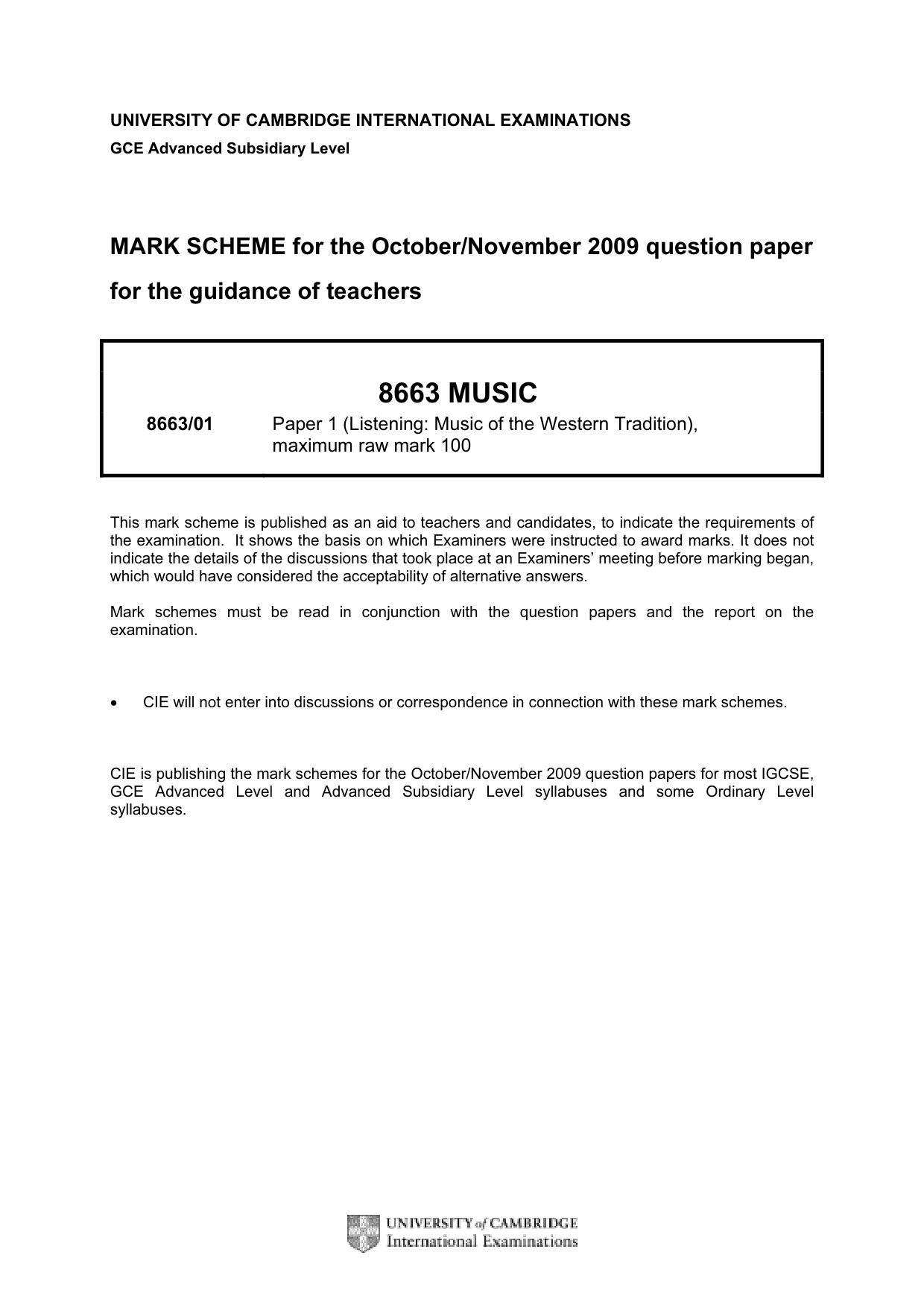
UNIVERSITY OF CAMBRIDGE INTERNATIONAL EXAMINATIONS GCE Advanced Subsidiary Level MARK SCHEME for the October/November 2009 question paper for the guidance of teachers 8663 MUSIC 8663/01 Paper 1 (Listening: Music of the Western Tradition), maximum raw mark 100 This mark scheme is published as an aid to teachers and candidates, to indicate the requirements of the examination. It shows the basis on which Examiners were instructed to award marks. It does not indicate the details of the discussions that took place at an Examiners’ meeting before marking began, which would have considered the acceptability of alternative answers. Mark schemes must be read in conjunction with the question papers and the report on the examination. • CIE will not enter into discussions or correspondence in connection with these mark schemes. CIE is publishing the mark schemes for the October/November 2009 question papers for most IGCSE, GCE Advanced Level and Advanced Subsidiary Level syllabuses and some Ordinary Level syllabuses.
Mark scheme, page 2
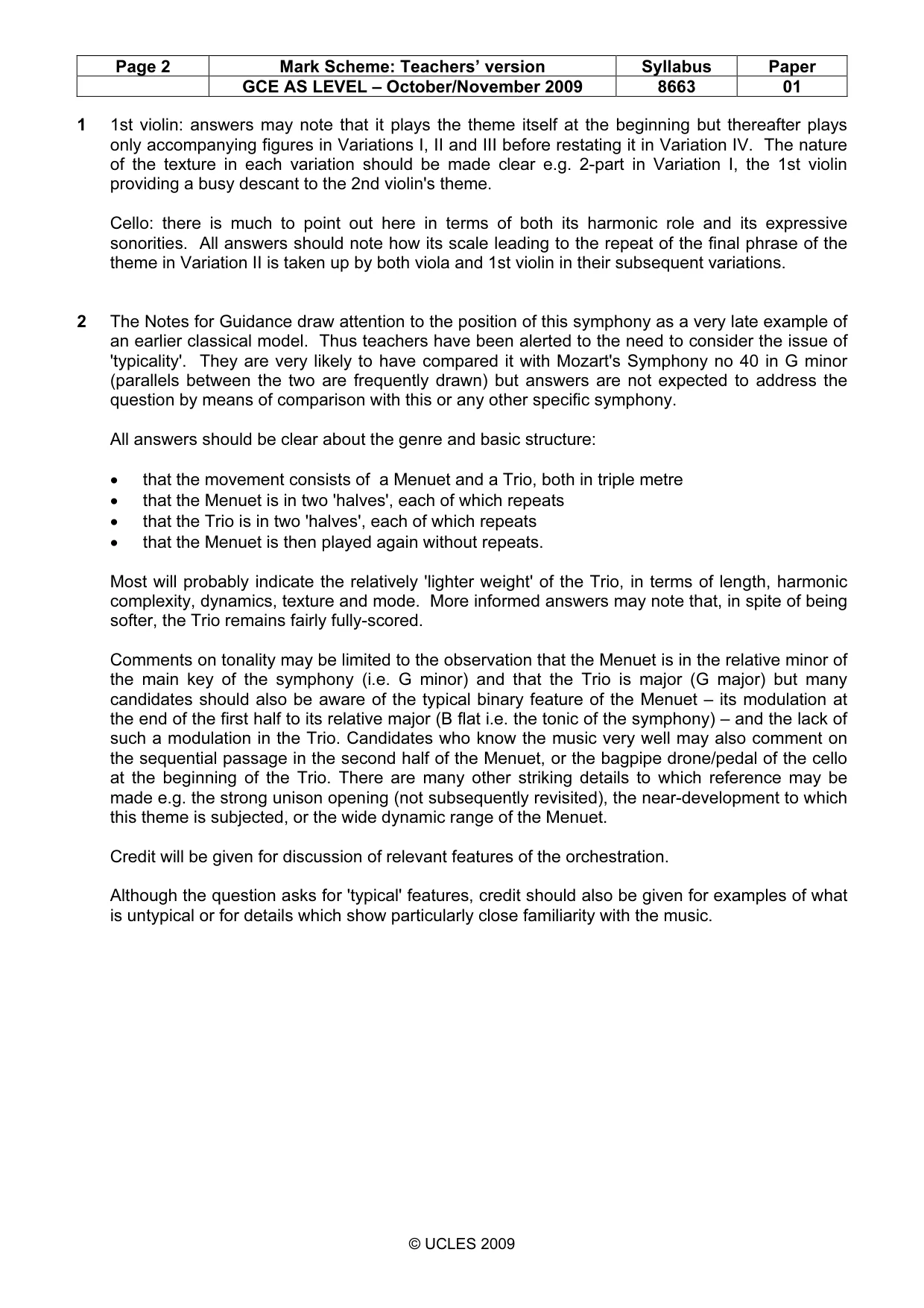
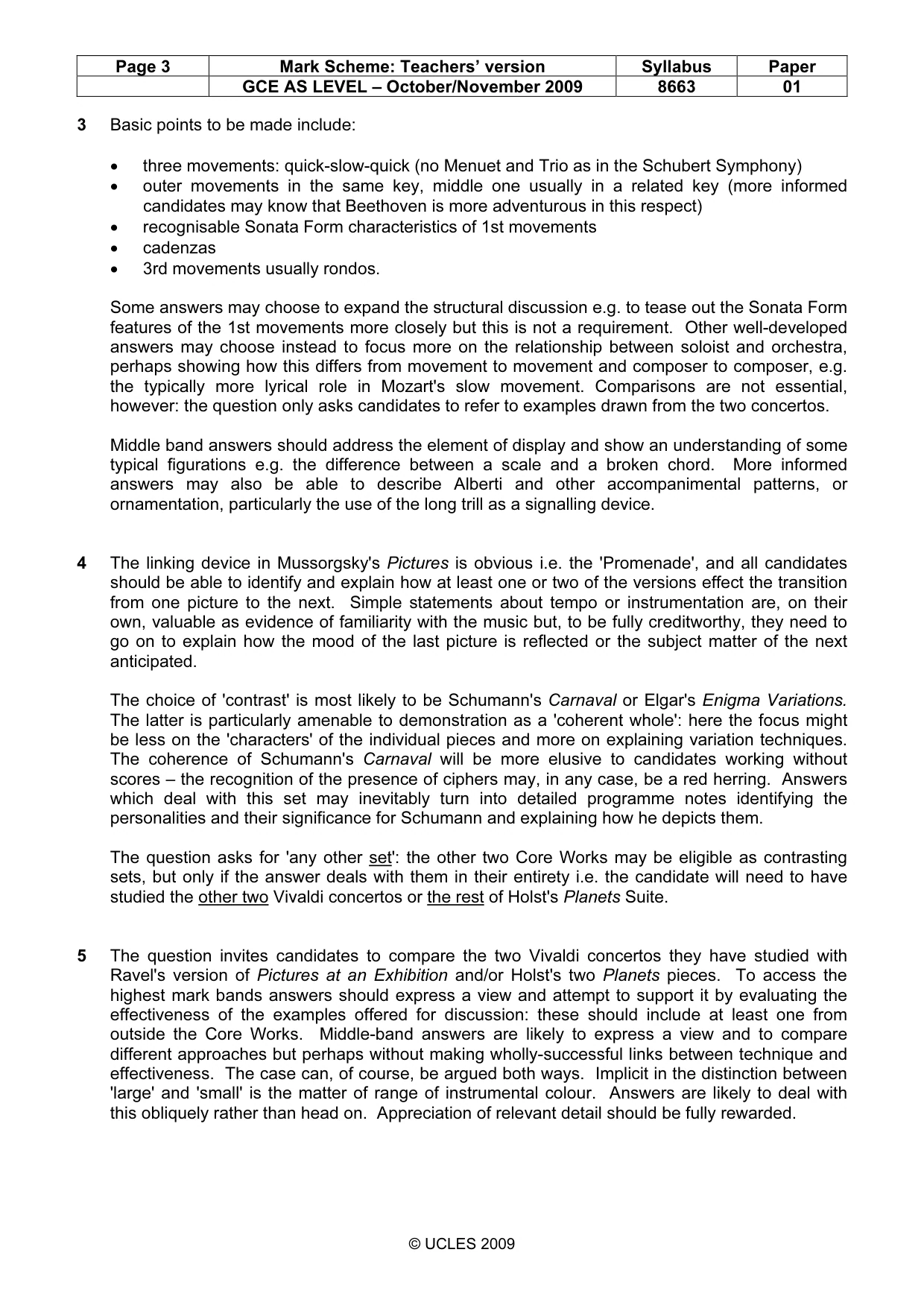
Page 2 Mark Scheme: Teachers’ version Syllabus Paper GCE AS LEVEL – October/November 2009 8663 01 © UCLES 2009 1 1st violin: answers may note that it plays the theme itself at the beginning but thereafter plays only accompanying figures in Variations I, II and III before restating it in Variation IV. The nature of the texture in each variation should be made clear e.g. 2-part in Variation I, the 1st violin providing a busy descant to the 2nd violin's theme. Cello: there is much to point out here in terms of both its harmonic role and its expressive sonorities. All answers should note how its scale leading to the repeat of the final phrase of the theme in Variation II is taken up by both viola and 1st violin in their subsequent variations. 2 The Notes for Guidance draw attention to the position of this symphony as a very late example of an earlier classical model. Thus teachers have been alerted to the need to consider the issue of 'typicality'. They are very likely to have compared it with Mozart's Symphony no 40 in G minor (parallels between the two are frequently drawn) but answers are not expected to address the question by means of comparison with this or any other specific symphony. All answers should be clear about the genre and basic structure: • that the movement consists of a Menuet and a Trio, both in triple metre • that the Menuet is in two 'halves', each of which repeats • that the Trio is in two 'halves', each of which repeats • that the Menuet is then played again without repeats. Most will probably indicate the relatively 'lighter weight' of the Trio, in terms of length, harmonic complexity, dynamics, texture and mode. More informed answers may note that, in spite of being softer, the Trio remains fairly fully-scored. Comments on tonality may be limited to the observation that the Menuet is in the relative minor of the main key of the symphony (i.e. G minor) and that the Trio is major (G major) but many candidates should also be aware of the typical binary feature of the Menuet – its modulation at the end of the first half to its relative major (B flat i.e. the tonic of the symphony) – and the lack of such a modulation in the Trio. Candidates who know the music very well may also comment on the sequential passage in the second half of the Menuet, or the bagpipe drone/pedal of the cello at the beginning of the Trio. There are many other striking details to which reference may be made e.g. the strong unison opening (not subsequently revisited), the near-development to which this theme is subjected, or the wide dynamic range of the Menuet. Credit will be given for discussion of relevant features of the orchestration. Although the question asks for 'typical' features, credit should also be given for examples of what is untypical or for details which show particularly close familiarity with the music.
Mark scheme, page 3
Page 3 Mark Scheme: Teachers’ version Syllabus Paper GCE AS LEVEL – October/November 2009 8663 01 © UCLES 2009 3 Basic points to be made include: • three movements: quick-slow-quick (no Menuet and Trio as in the Schubert Symphony) • outer movements in the same key, middle one usually in a related key (more informed candidates may know that Beethoven is more adventurous in this respect) • recognisable Sonata Form characteristics of 1st movements • cadenzas • 3rd movements usually rondos. Some answers may choose to expand the structural discussion e.g. to tease out the Sonata Form features of the 1st movements more closely but this is not a requirement. Other well-developed answers may choose instead to focus more on the relationship between soloist and orchestra, perhaps showing how this differs from movement to movement and composer to composer, e.g. the typically more lyrical role in Mozart's slow movement. Comparisons are not essential, however: the question only asks candidates to refer to examples drawn from the two concertos. Middle band answers should address the element of display and show an understanding of some typical figurations e.g. the difference between a scale and a broken chord. More informed answers may also be able to describe Alberti and other accompanimental patterns, or ornamentation, particularly the use of the long trill as a signalling device. 4 The linking device in Mussorgsky's Pictures is obvious i.e. the 'Promenade', and all candidates should be able to identify and explain how at least one or two of the versions effect the transition from one picture to the next. Simple statements about tempo or instrumentation are, on their own, valuable as evidence of familiarity with the music but, to be fully creditworthy, they need to go on to explain how the mood of the last picture is reflected or the subject matter of the next anticipated. The choice of 'contrast' is most likely to be Schumann's Carnaval or Elgar's Enigma Variations. The latter is particularly amenable to demonstration as a 'coherent whole': here the focus might be less on the 'characters' of the individual pieces and more on explaining variation techniques. The coherence of Schumann's Carnaval will be more elusive to candidates working without scores – the recognition of the presence of ciphers may, in any case, be a red herring. Answers which deal with this set may inevitably turn into detailed programme notes identifying the personalities and their significance for Schumann and explaining how he depicts them. The question asks for 'any other set': the other two Core Works may be eligible as contrasting sets, but only if the answer deals with them in their entirety i.e. the candidate will need to have studied the other two Vivaldi concertos or the rest of Holst's Planets Suite. 5 The question invites candidates to compare the two Vivaldi concertos they have studied with Ravel's version of Pictures at an Exhibition and/or Holst's two Planets pieces. To access the highest mark bands answers should express a view and attempt to support it by evaluating the effectiveness of the examples offered for discussion: these should include at least one from outside the Core Works. Middle-band answers are likely to express a view and to compare different approaches but perhaps without making wholly-successful links between technique and effectiveness. The case can, of course, be argued both ways. Implicit in the distinction between 'large' and 'small' is the matter of range of instrumental colour. Answers are likely to deal with this obliquely rather than head on. Appreciation of relevant detail should be fully rewarded.
Mark scheme, page 4
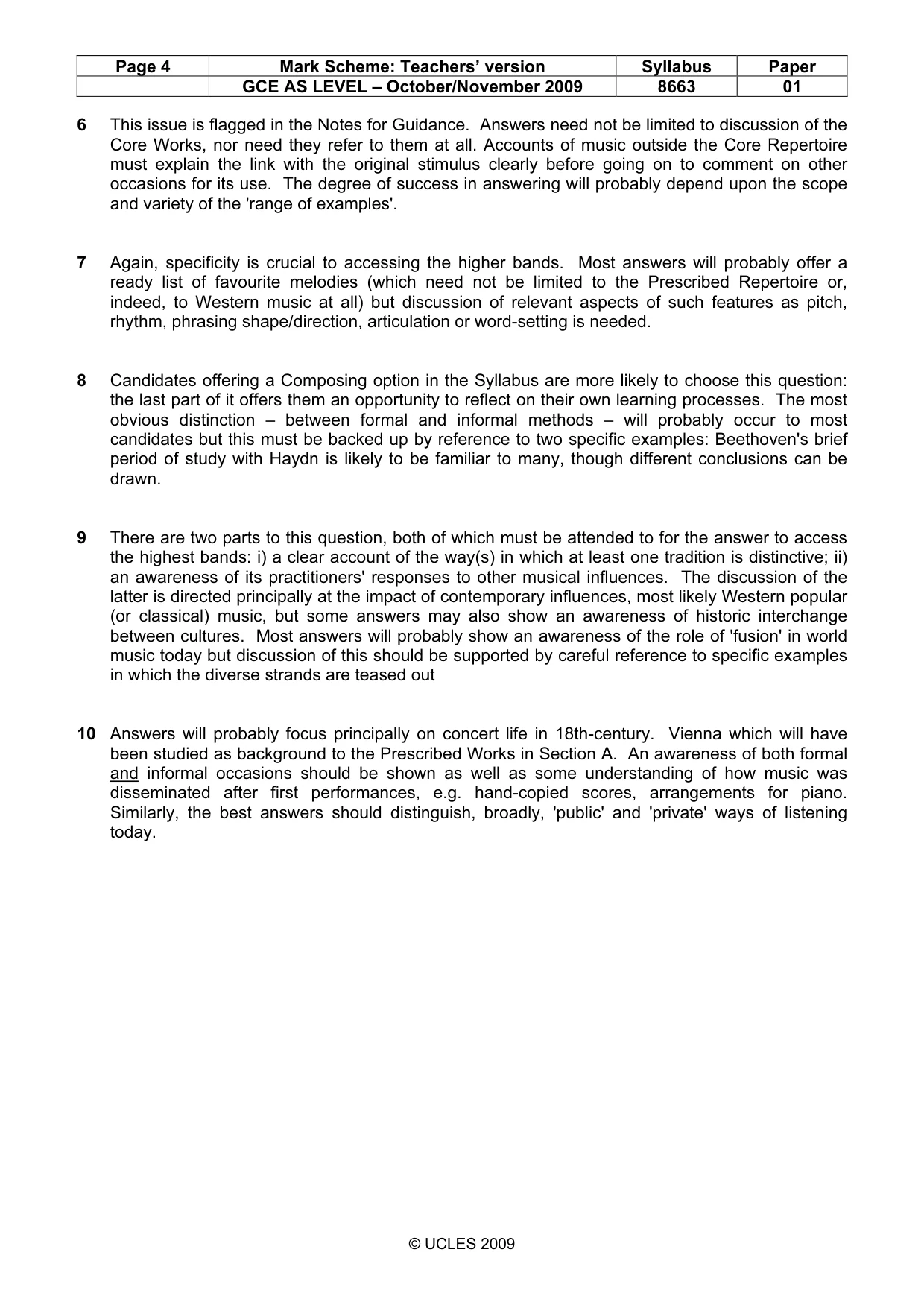
Page 4 Mark Scheme: Teachers’ version Syllabus Paper GCE AS LEVEL – October/November 2009 8663 01 © UCLES 2009 6 This issue is flagged in the Notes for Guidance. Answers need not be limited to discussion of the Core Works, nor need they refer to them at all. Accounts of music outside the Core Repertoire must explain the link with the original stimulus clearly before going on to comment on other occasions for its use. The degree of success in answering will probably depend upon the scope and variety of the 'range of examples'. 7 Again, specificity is crucial to accessing the higher bands. Most answers will probably offer a ready list of favourite melodies (which need not be limited to the Prescribed Repertoire or, indeed, to Western music at all) but discussion of relevant aspects of such features as pitch, rhythm, phrasing shape/direction, articulation or word-setting is needed. 8 Candidates offering a Composing option in the Syllabus are more likely to choose this question: the last part of it offers them an opportunity to reflect on their own learning processes. The most obvious distinction – between formal and informal methods – will probably occur to most candidates but this must be backed up by reference to two specific examples: Beethoven's brief period of study with Haydn is likely to be familiar to many, though different conclusions can be drawn. 9 There are two parts to this question, both of which must be attended to for the answer to access the highest bands: i) a clear account of the way(s) in which at least one tradition is distinctive; ii) an awareness of its practitioners' responses to other musical influences. The discussion of the latter is directed principally at the impact of contemporary influences, most likely Western popular (or classical) music, but some answers may also show an awareness of historic interchange between cultures. Most answers will probably show an awareness of the role of 'fusion' in world music today but discussion of this should be supported by careful reference to specific examples in which the diverse strands are teased out 10 Answers will probably focus principally on concert life in 18th-century. Vienna which will have been studied as background to the Prescribed Works in Section A. An awareness of both formal and informal occasions should be shown as well as some understanding of how music was disseminated after first performances, e.g. hand-copied scores, arrangements for piano. Similarly, the best answers should distinguish, broadly, 'public' and 'private' ways of listening today.
What you needed in this session
Cambridge’s own grade thresholds for 2009 Oct/Nov, Paper 1 · Variant 1. A higher threshold means an easier paper — the bar moves with how the cohort did.