Cambridge A Level Music 9703 — 2017 May/June Paper 1 · Variant 3
9703/13/M/J/17 · 100 marks · ≈113 min
The question paper and its mark scheme, free to read here and free to download. This is Cambridge’s own paper, exactly as it was sat.
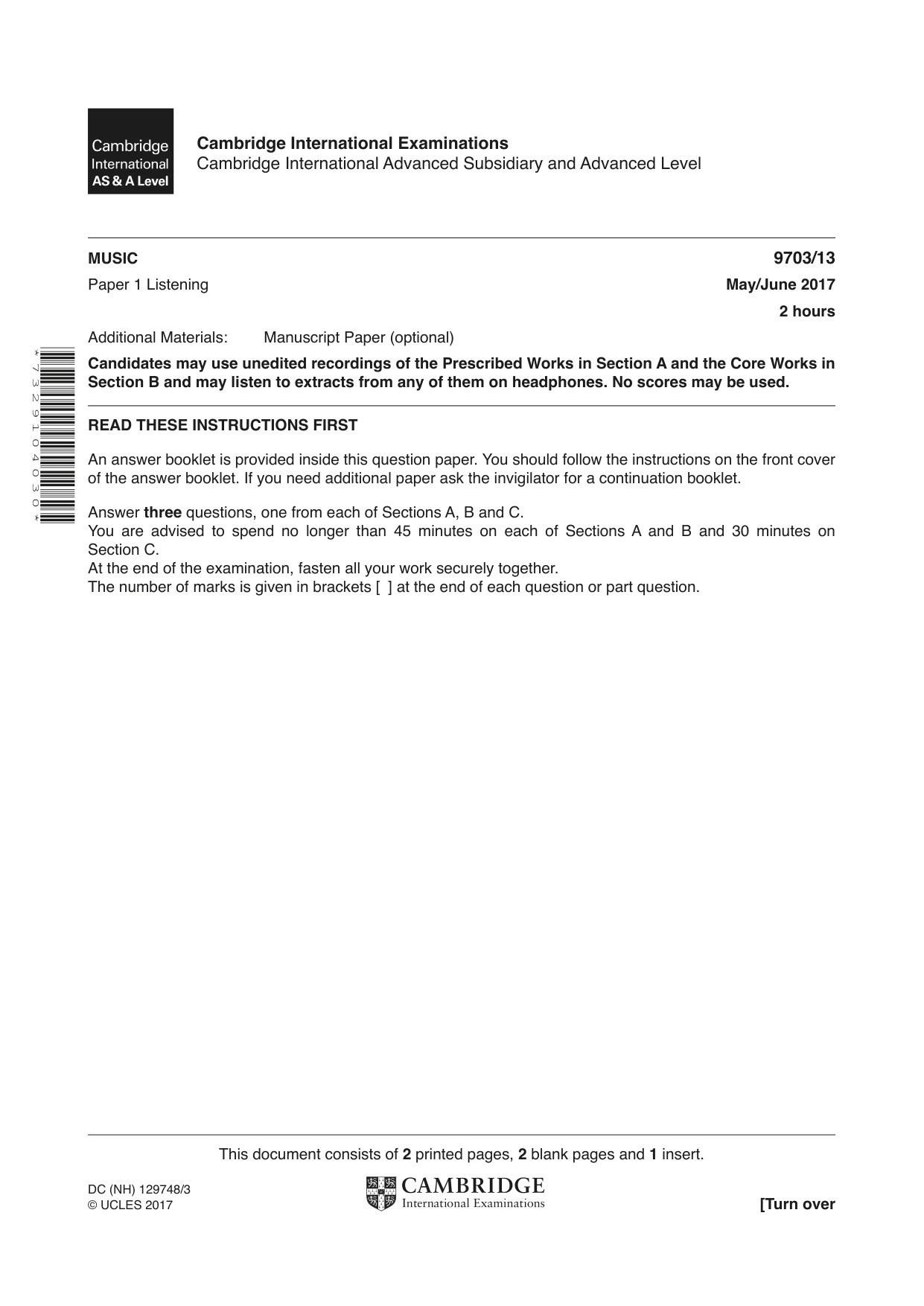
Question paper4 pages


Mark scheme9 pages
Answers below. Sit the paper first if you are practising.
Paper as text
Question paper, page 1
This document consists of 2 printed pages, 2 blank pages and 1 insert. DC (NH) 129748/3 © UCLES 2017 [Turn over * 7 3 2 9 1 0 4 0 3 0 * MUSIC 9703/13 Paper 1 Listening May/June 2017 2 hours Additional Materials: Manuscript Paper (optional) Candidates may use unedited recordings of the Prescribed Works in Section A and the Core Works in Section B and may listen to extracts from any of them on headphones. No scores may be used. READ THESE INSTRUCTIONS FIRST An answer booklet is provided inside this question paper. You should follow the instructions on the front cover of the answer booklet. If you need additional paper ask the invigilator for a continuation booklet. Answer three questions, one from each of Sections A, B and C. You are advised to spend no longer than 45 minutes on each of Sections A and B and 30 minutes on Section C. At the end of the examination, fasten all your work securely together. The number of marks is given in brackets [ ] at the end of each question or part question. Cambridge International Examinations Cambridge International Advanced Subsidiary and Advanced Level
Question paper, page 2
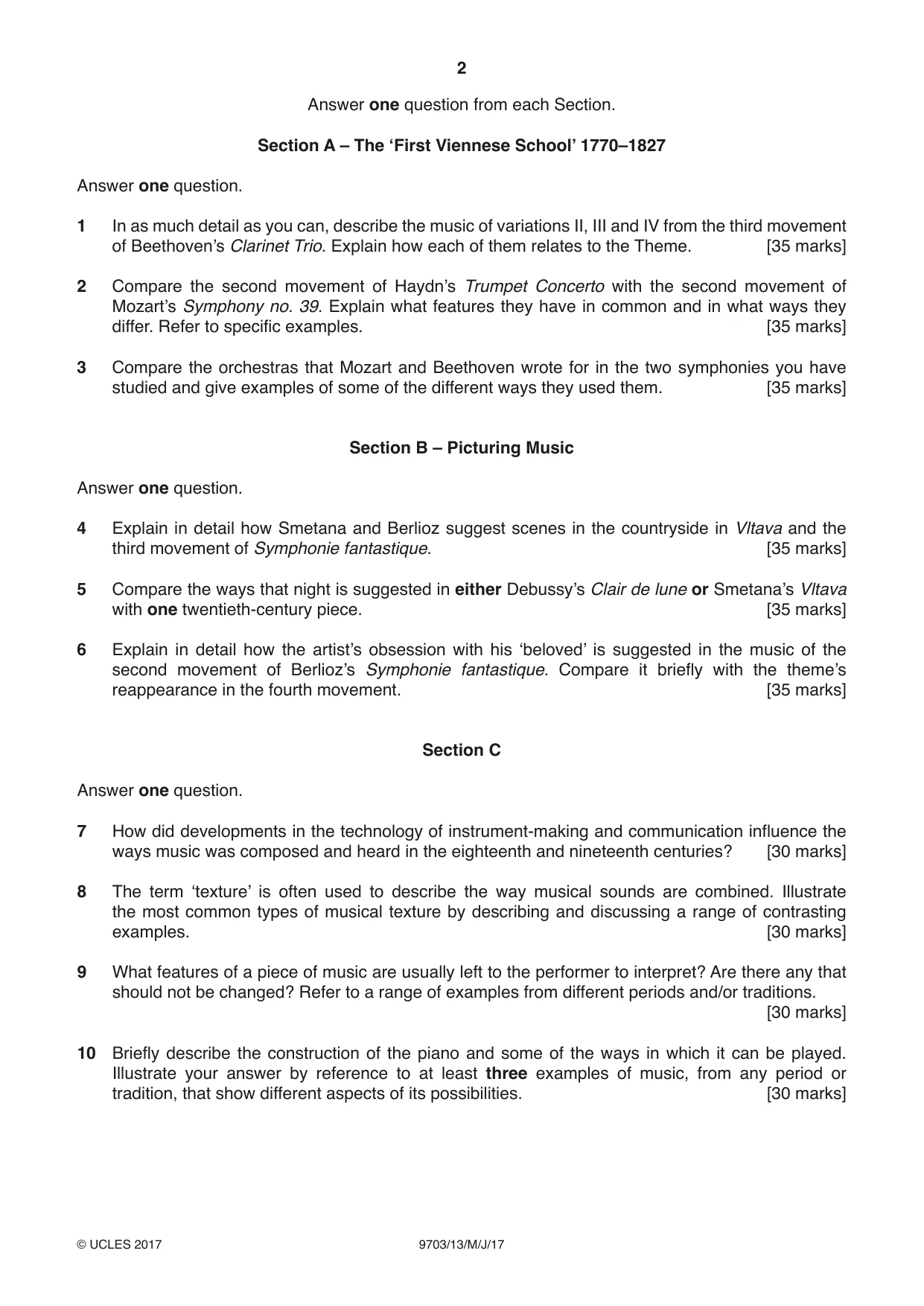
2 9703/13/M/J/17 © UCLES 2017 Answer one question from each Section. Section A – The ‘First Viennese School’ 1770–1827 Answer one question. 1 In as much detail as you can, describe the music of variations II, III and IV from the third movement of Beethoven’s Clarinet Trio. Explain how each of them relates to the Theme. [35 marks] 2 Compare the second movement of Haydn’s Trumpet Concerto with the second movement of Mozart’s Symphony no. 39. Explain what features they have in common and in what ways they differ. Refer to specific examples. [35 marks] 3 Compare the orchestras that Mozart and Beethoven wrote for in the two symphonies you have studied and give examples of some of the different ways they used them. [35 marks] Section B – Picturing Music Answer one question. 4 Explain in detail how Smetana and Berlioz suggest scenes in the countryside in Vltava and the third movement of Symphonie fantastique. [35 marks] 5 Compare the ways that night is suggested in either Debussy’s Clair de lune or Smetana’s Vltava with one twentieth-century piece. [35 marks] 6 Explain in detail how the artist’s obsession with his ‘beloved’ is suggested in the music of the second movement of Berlioz’s Symphonie fantastique. Compare it briefly with the theme’s reappearance in the fourth movement. [35 marks] Section C Answer one question. 7 How did developments in the technology of instrument-making and communication influence the ways music was composed and heard in the eighteenth and nineteenth centuries? [30 marks] 8 The term ‘texture’ is often used to describe the way musical sounds are combined. Illustrate the most common types of musical texture by describing and discussing a range of contrasting examples. [30 marks] 9 What features of a piece of music are usually left to the performer to interpret? Are there any that should not be changed? Refer to a range of examples from different periods and/or traditions. [30 marks] 10 Briefly describe the construction of the piano and some of the ways in which it can be played. Illustrate your answer by reference to at least three examples of music, from any period or tradition, that show different aspects of its possibilities. [30 marks]
Question paper, page 3
3 9703/13/M/J/17 © UCLES 2017 BLANK PAGE
Question paper, page 4
4 9703/13/M/J/17 © UCLES 2017 Permission to reproduce items where third-party owned material protected by copyright is included has been sought and cleared where possible. Every reasonable effort has been made by the publisher (UCLES) to trace copyright holders, but if any items requiring clearance have unwittingly been included, the publisher will be pleased to make amends at the earliest possible opportunity. To avoid the issue of disclosure of answer-related information to candidates, all copyright acknowledgements are reproduced online in the Cambridge International Examinations Copyright Acknowledgements Booklet. This is produced for each series of examinations and is freely available to download at www.cie.org.uk after the live examination series. Cambridge International Examinations is part of the Cambridge Assessment Group. Cambridge Assessment is the brand name of University of Cambridge Local Examinations Syndicate (UCLES), which is itself a department of the University of Cambridge. BLANK PAGE
Mark scheme, page 1
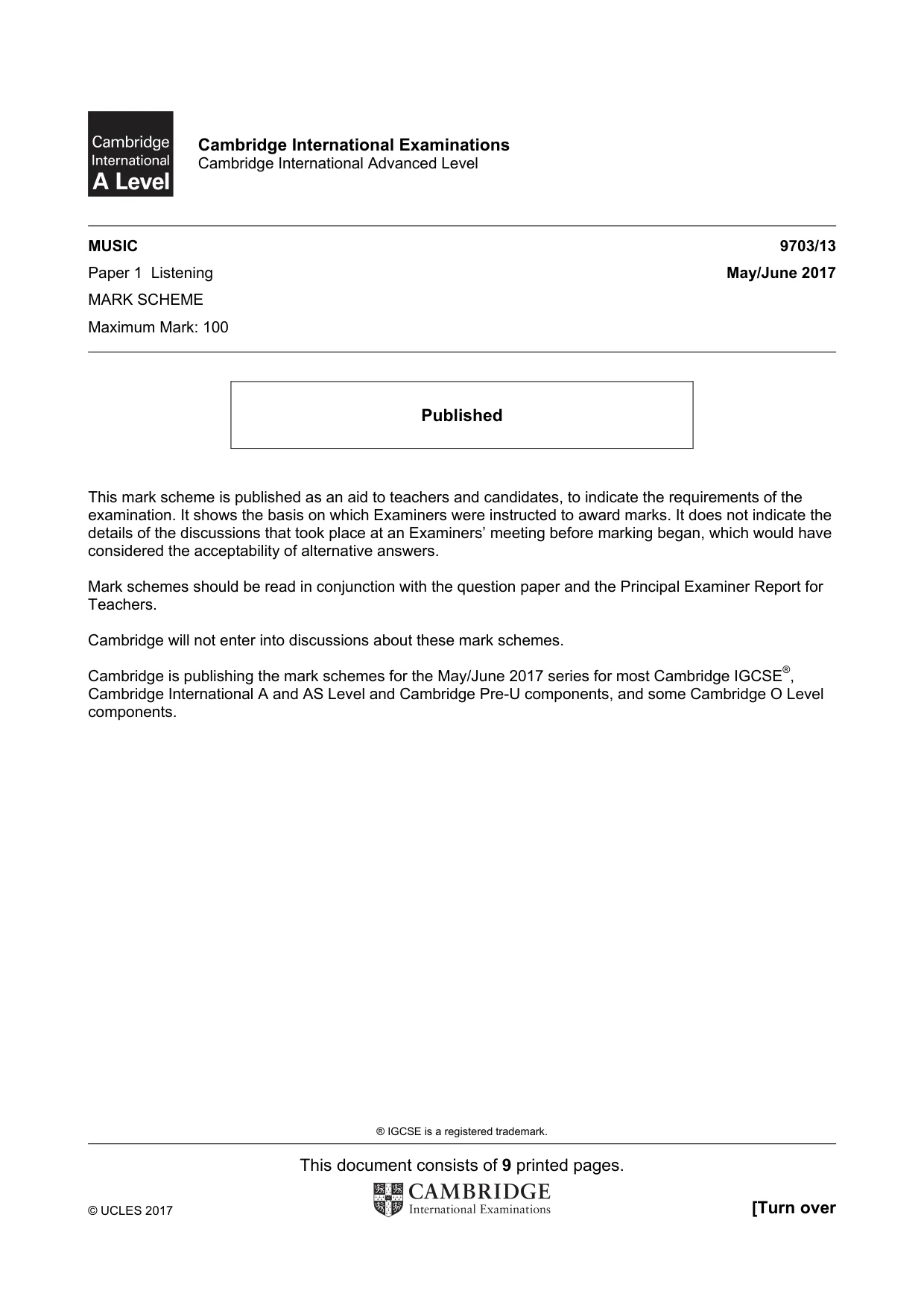
® IGCSE is a registered trademark. This document consists of 9 printed pages. © UCLES 2017 [Turn over Cambridge International Examinations Cambridge International Advanced Level MUSIC 9703/13 Paper 1 Listening May/June 2017 MARK SCHEME Maximum Mark: 100 Published This mark scheme is published as an aid to teachers and candidates, to indicate the requirements of the examination. It shows the basis on which Examiners were instructed to award marks. It does not indicate the details of the discussions that took place at an Examiners’ meeting before marking began, which would have considered the acceptability of alternative answers. Mark schemes should be read in conjunction with the question paper and the Principal Examiner Report for Teachers. Cambridge will not enter into discussions about these mark schemes. Cambridge is publishing the mark schemes for the May/June 2017 series for most Cambridge IGCSE®, Cambridge International A and AS Level and Cambridge Pre-U components, and some Cambridge O Level components.
Mark scheme, page 2
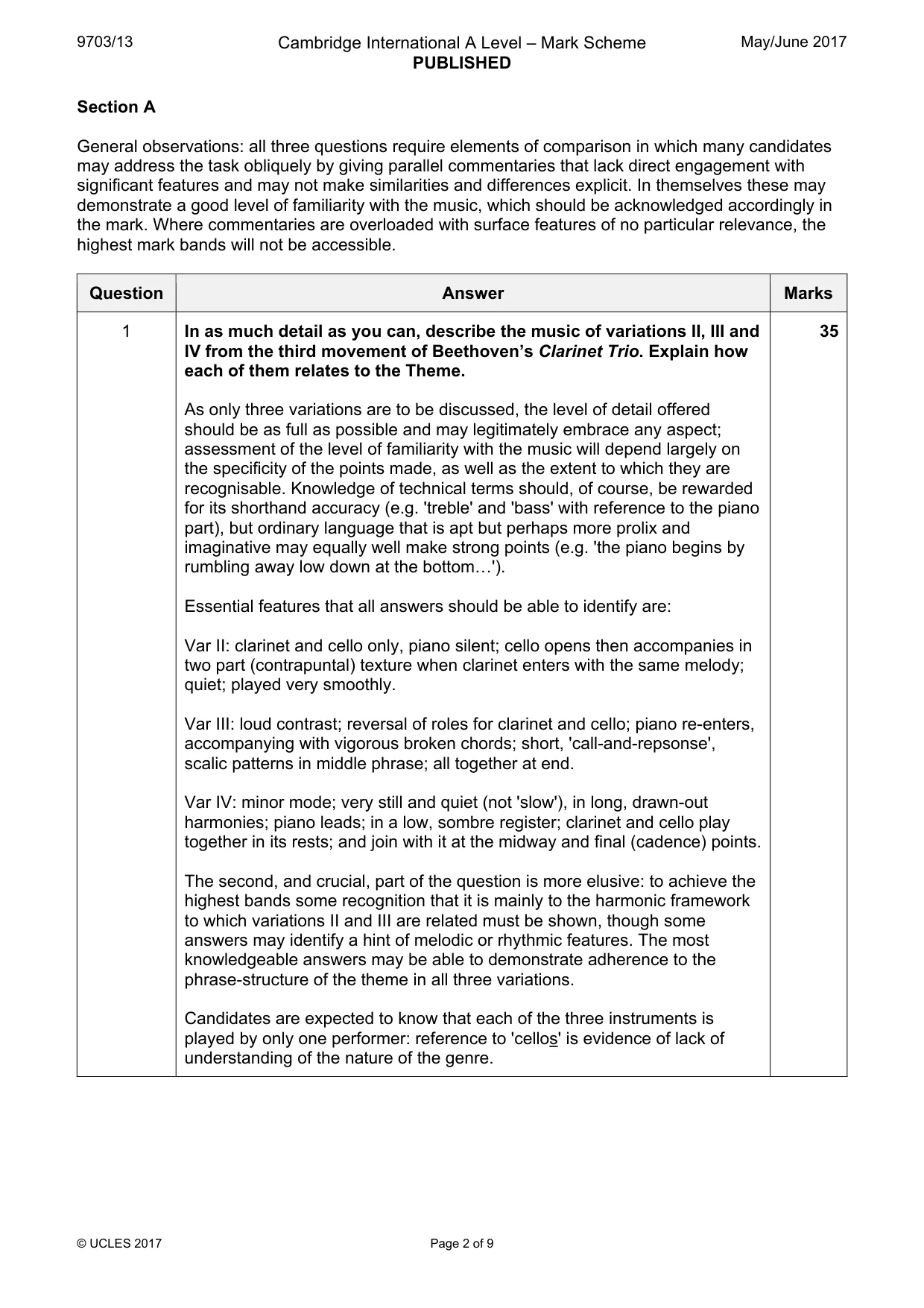
9703/13 Cambridge International A Level – Mark Scheme PUBLISHED May/June 2017 © UCLES 2017 Page 2 of 9 Section A General observations: all three questions require elements of comparison in which many candidates may address the task obliquely by giving parallel commentaries that lack direct engagement with significant features and may not make similarities and differences explicit. In themselves these may demonstrate a good level of familiarity with the music, which should be acknowledged accordingly in the mark. Where commentaries are overloaded with surface features of no particular relevance, the highest mark bands will not be accessible. Question Answer Marks 1 In as much detail as you can, describe the music of variations II, III and IV from the third movement of Beethoven’s Clarinet Trio. Explain how each of them relates to the Theme. As only three variations are to be discussed, the level of detail offered should be as full as possible and may legitimately embrace any aspect; assessment of the level of familiarity with the music will depend largely on the specificity of the points made, as well as the extent to which they are recognisable. Knowledge of technical terms should, of course, be rewarded for its shorthand accuracy (e.g. 'treble' and 'bass' with reference to the piano part), but ordinary language that is apt but perhaps more prolix and imaginative may equally well make strong points (e.g. 'the piano begins by rumbling away low down at the bottom«'). Essential features that all answers should be able to identify are: Var II: clarinet and cello only, piano silent; cello opens then accompanies in two part (contrapuntal) texture when clarinet enters with the same melody; quiet; played very smoothly. Var III: loud contrast; reversal of roles for clarinet and cello; piano re-enters, accompanying with vigorous broken chords; short, 'call-and-repsonse', scalic patterns in middle phrase; all together at end. Var IV: minor mode; very still and quiet (not 'slow'), in long, drawn-out harmonies; piano leads; in a low, sombre register; clarinet and cello play together in its rests; and join with it at the midway and final (cadence) points. The second, and crucial, part of the question is more elusive: to achieve the highest bands some recognition that it is mainly to the harmonic framework to which variations II and III are related must be shown, though some answers may identify a hint of melodic or rhythmic features. The most knowledgeable answers may be able to demonstrate adherence to the phrase-structure of the theme in all three variations. Candidates are expected to know that each of the three instruments is played by only one performer: reference to 'cellos' is evidence of lack of understanding of the nature of the genre. 35
Mark scheme, page 3
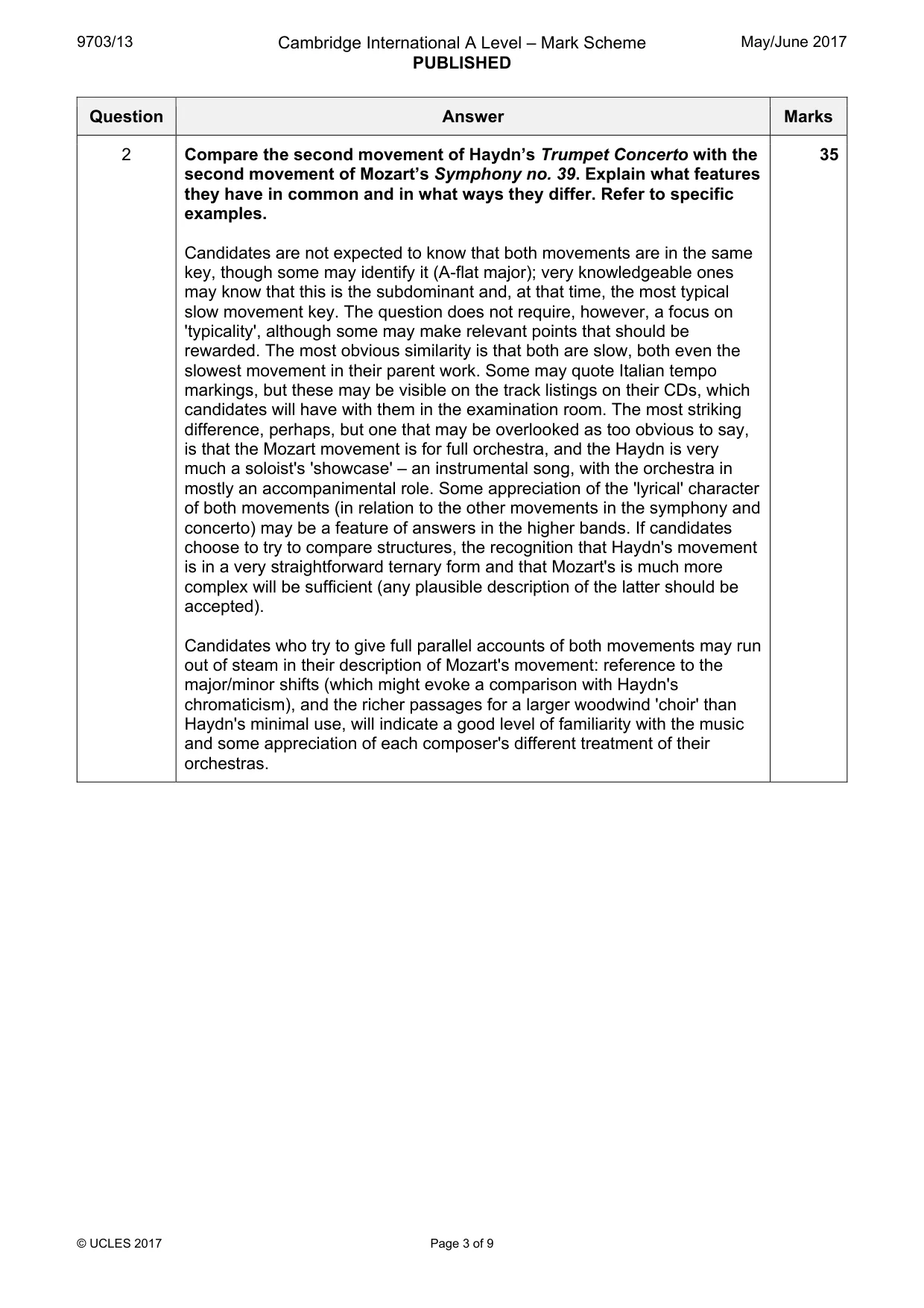
9703/13 Cambridge International A Level – Mark Scheme PUBLISHED May/June 2017 © UCLES 2017 Page 3 of 9 Question Answer Marks 2 Compare the second movement of Haydn’s Trumpet Concerto with the second movement of Mozart’s Symphony no. 39. Explain what features they have in common and in what ways they differ. Refer to specific examples. Candidates are not expected to know that both movements are in the same key, though some may identify it (A-flat major); very knowledgeable ones may know that this is the subdominant and, at that time, the most typical slow movement key. The question does not require, however, a focus on 'typicality', although some may make relevant points that should be rewarded. The most obvious similarity is that both are slow, both even the slowest movement in their parent work. Some may quote Italian tempo markings, but these may be visible on the track listings on their CDs, which candidates will have with them in the examination room. The most striking difference, perhaps, but one that may be overlooked as too obvious to say, is that the Mozart movement is for full orchestra, and the Haydn is very much a soloist's 'showcase' – an instrumental song, with the orchestra in mostly an accompanimental role. Some appreciation of the 'lyrical' character of both movements (in relation to the other movements in the symphony and concerto) may be a feature of answers in the higher bands. If candidates choose to try to compare structures, the recognition that Haydn's movement is in a very straightforward ternary form and that Mozart's is much more complex will be sufficient (any plausible description of the latter should be accepted). Candidates who try to give full parallel accounts of both movements may run out of steam in their description of Mozart's movement: reference to the major/minor shifts (which might evoke a comparison with Haydn's chromaticism), and the richer passages for a larger woodwind 'choir' than Haydn's minimal use, will indicate a good level of familiarity with the music and some appreciation of each composer's different treatment of their orchestras. 35
Mark scheme, page 4
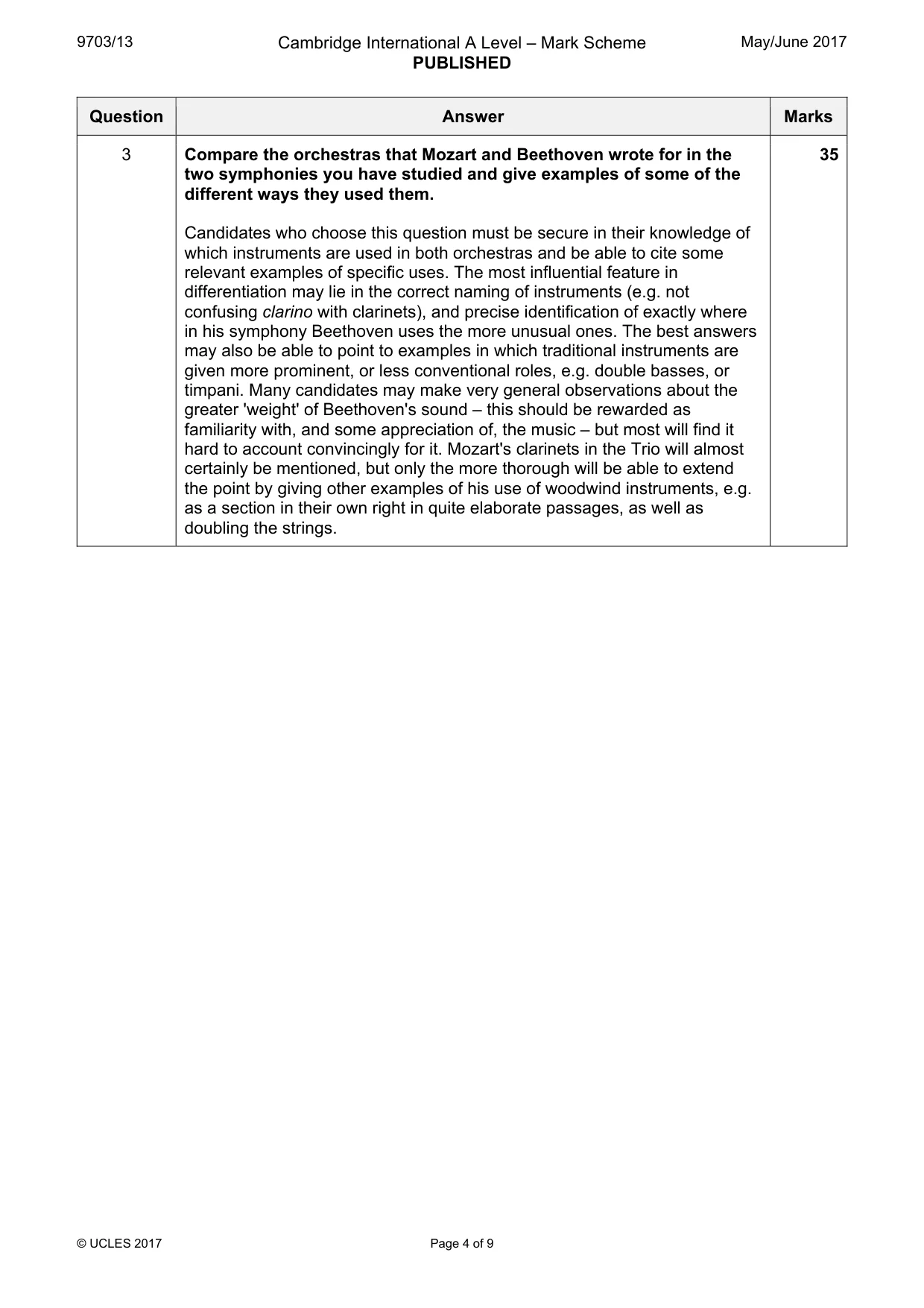
9703/13 Cambridge International A Level – Mark Scheme PUBLISHED May/June 2017 © UCLES 2017 Page 4 of 9 Question Answer Marks 3 Compare the orchestras that Mozart and Beethoven wrote for in the two symphonies you have studied and give examples of some of the different ways they used them. Candidates who choose this question must be secure in their knowledge of which instruments are used in both orchestras and be able to cite some relevant examples of specific uses. The most influential feature in differentiation may lie in the correct naming of instruments (e.g. not confusing clarino with clarinets), and precise identification of exactly where in his symphony Beethoven uses the more unusual ones. The best answers may also be able to point to examples in which traditional instruments are given more prominent, or less conventional roles, e.g. double basses, or timpani. Many candidates may make very general observations about the greater 'weight' of Beethoven's sound – this should be rewarded as familiarity with, and some appreciation of, the music – but most will find it hard to account convincingly for it. Mozart's clarinets in the Trio will almost certainly be mentioned, but only the more thorough will be able to extend the point by giving other examples of his use of woodwind instruments, e.g. as a section in their own right in quite elaborate passages, as well as doubling the strings. 35
Mark scheme, page 5
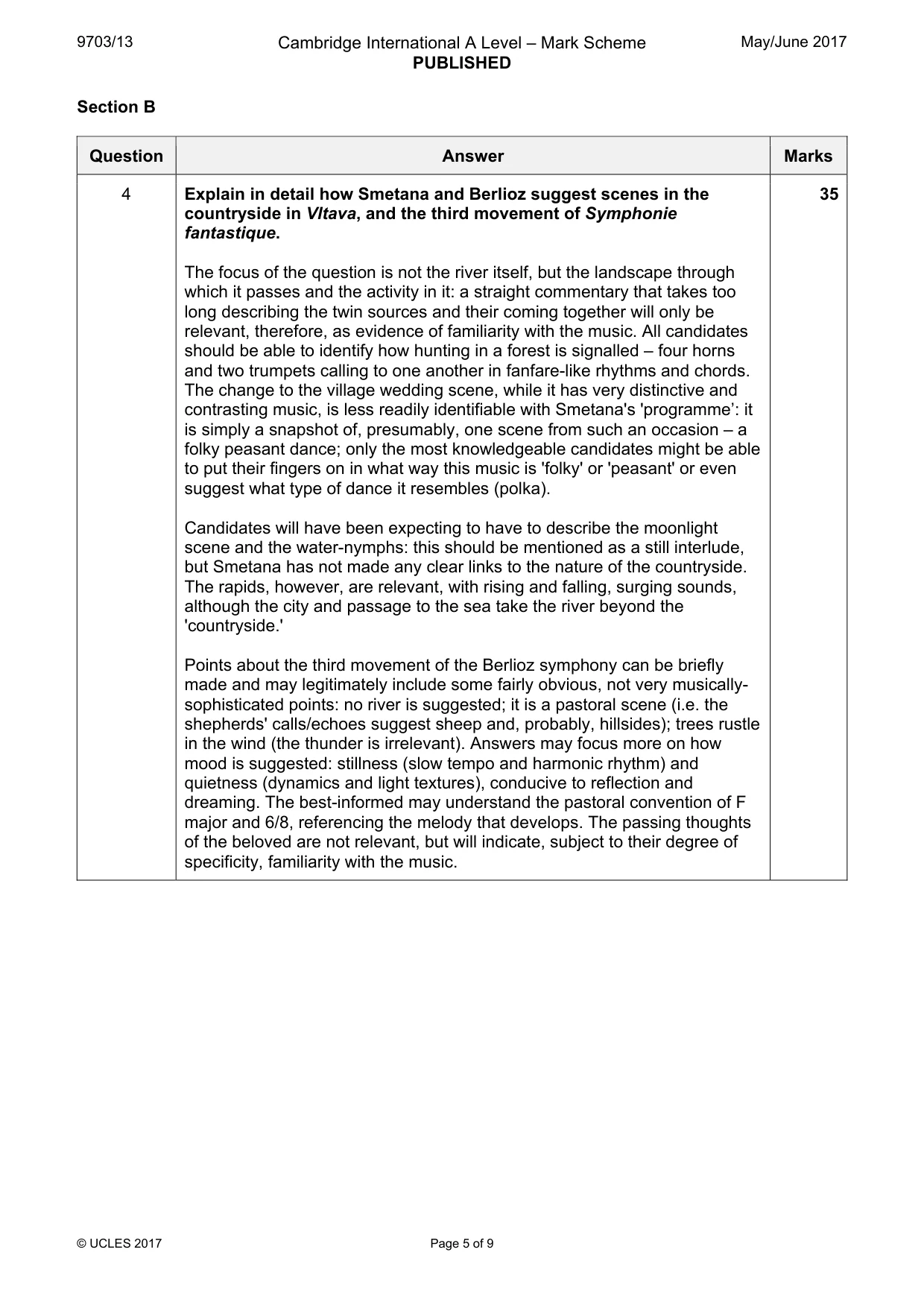
9703/13 Cambridge International A Level – Mark Scheme PUBLISHED May/June 2017 © UCLES 2017 Page 5 of 9 Section B Question Answer Marks 4 Explain in detail how Smetana and Berlioz suggest scenes in the countryside in Vltava, and the third movement of Symphonie fantastique. The focus of the question is not the river itself, but the landscape through which it passes and the activity in it: a straight commentary that takes too long describing the twin sources and their coming together will only be relevant, therefore, as evidence of familiarity with the music. All candidates should be able to identify how hunting in a forest is signalled – four horns and two trumpets calling to one another in fanfare-like rhythms and chords. The change to the village wedding scene, while it has very distinctive and contrasting music, is less readily identifiable with Smetana's 'programme’: it is simply a snapshot of, presumably, one scene from such an occasion – a folky peasant dance; only the most knowledgeable candidates might be able to put their fingers on in what way this music is 'folky' or 'peasant' or even suggest what type of dance it resembles (polka). Candidates will have been expecting to have to describe the moonlight scene and the water-nymphs: this should be mentioned as a still interlude, but Smetana has not made any clear links to the nature of the countryside. The rapids, however, are relevant, with rising and falling, surging sounds, although the city and passage to the sea take the river beyond the 'countryside.' Points about the third movement of the Berlioz symphony can be briefly made and may legitimately include some fairly obvious, not very musically- sophisticated points: no river is suggested; it is a pastoral scene (i.e. the shepherds' calls/echoes suggest sheep and, probably, hillsides); trees rustle in the wind (the thunder is irrelevant). Answers may focus more on how mood is suggested: stillness (slow tempo and harmonic rhythm) and quietness (dynamics and light textures), conducive to reflection and dreaming. The best-informed may understand the pastoral convention of F major and 6/8, referencing the melody that develops. The passing thoughts of the beloved are not relevant, but will indicate, subject to their degree of specificity, familiarity with the music. 35
Mark scheme, page 6
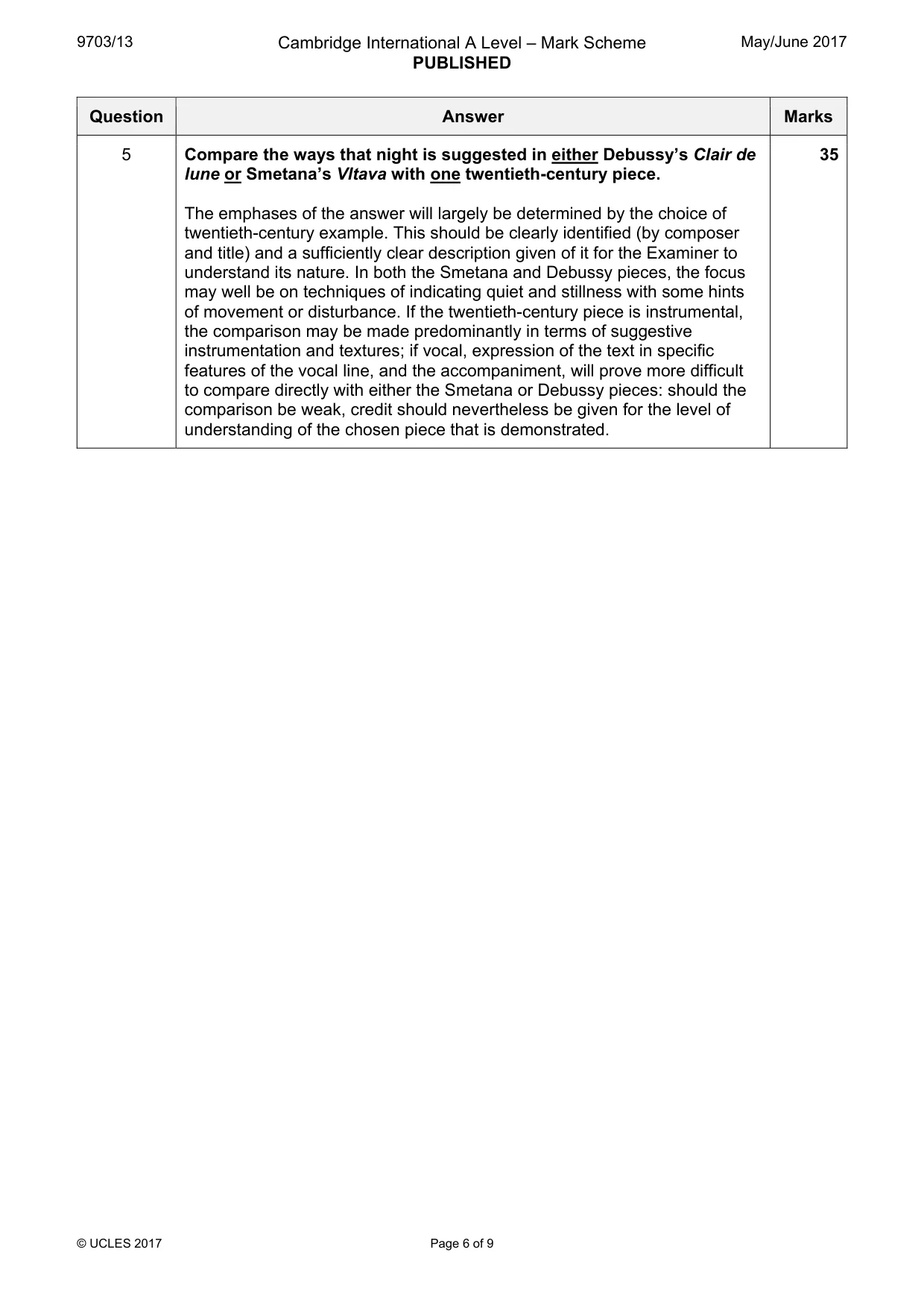
9703/13 Cambridge International A Level – Mark Scheme PUBLISHED May/June 2017 © UCLES 2017 Page 6 of 9 Question Answer Marks 5 Compare the ways that night is suggested in either Debussy’s Clair de lune or Smetana’s Vltava with one twentieth-century piece. The emphases of the answer will largely be determined by the choice of twentieth-century example. This should be clearly identified (by composer and title) and a sufficiently clear description given of it for the Examiner to understand its nature. In both the Smetana and Debussy pieces, the focus may well be on techniques of indicating quiet and stillness with some hints of movement or disturbance. If the twentieth-century piece is instrumental, the comparison may be made predominantly in terms of suggestive instrumentation and textures; if vocal, expression of the text in specific features of the vocal line, and the accompaniment, will prove more difficult to compare directly with either the Smetana or Debussy pieces: should the comparison be weak, credit should nevertheless be given for the level of understanding of the chosen piece that is demonstrated. 35
Mark scheme, page 7
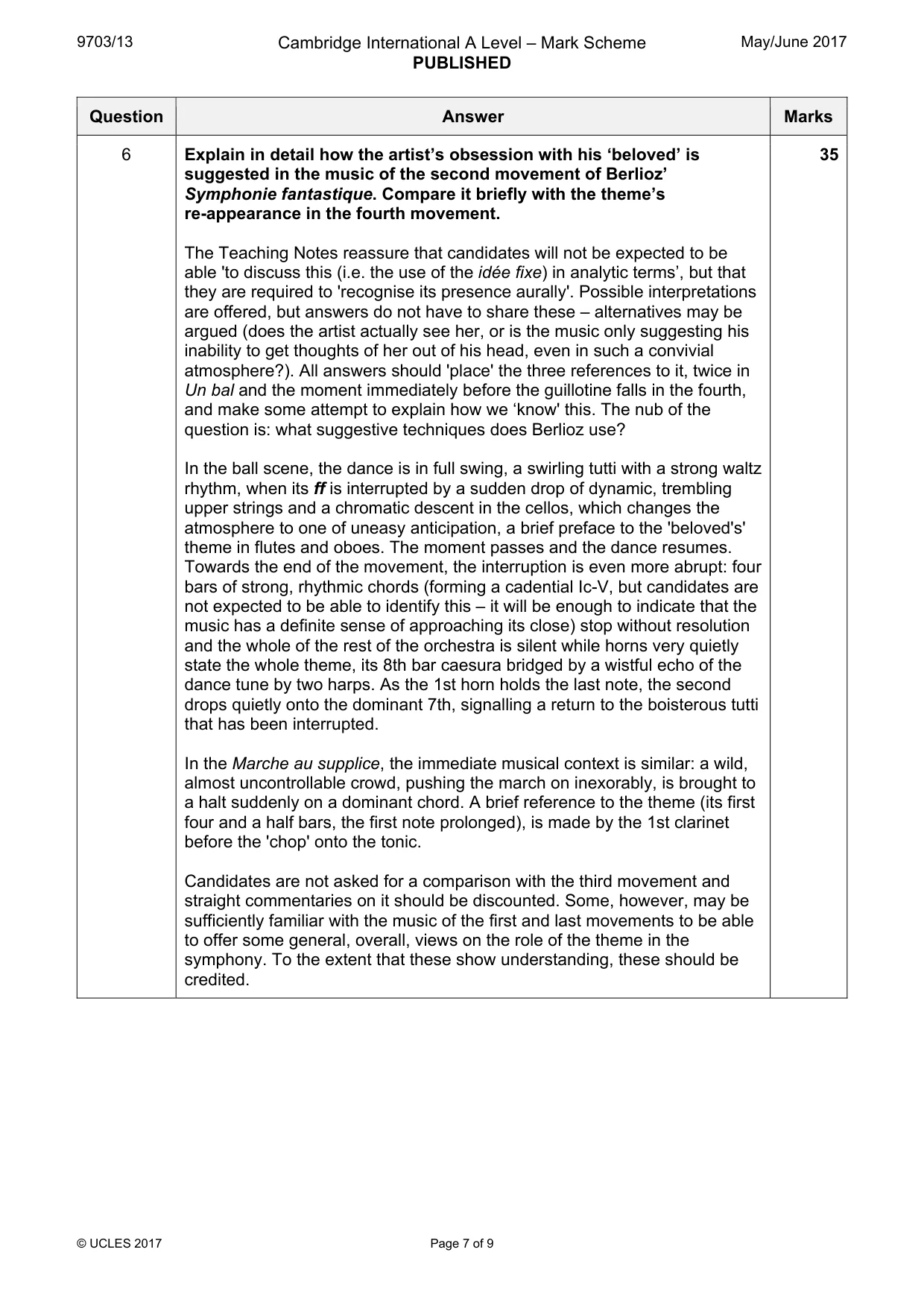
9703/13 Cambridge International A Level – Mark Scheme PUBLISHED May/June 2017 © UCLES 2017 Page 7 of 9 Question Answer Marks 6 Explain in detail how the artist’s obsession with his ‘beloved’ is suggested in the music of the second movement of Berlioz’ Symphonie fantastique. Compare it briefly with the theme’s re-appearance in the fourth movement. The Teaching Notes reassure that candidates will not be expected to be able 'to discuss this (i.e. the use of the idée fixe) in analytic terms’, but that they are required to 'recognise its presence aurally'. Possible interpretations are offered, but answers do not have to share these – alternatives may be argued (does the artist actually see her, or is the music only suggesting his inability to get thoughts of her out of his head, even in such a convivial atmosphere?). All answers should 'place' the three references to it, twice in Un bal and the moment immediately before the guillotine falls in the fourth, and make some attempt to explain how we ‘know' this. The nub of the question is: what suggestive techniques does Berlioz use? In the ball scene, the dance is in full swing, a swirling tutti with a strong waltz rhythm, when its ff is interrupted by a sudden drop of dynamic, trembling upper strings and a chromatic descent in the cellos, which changes the atmosphere to one of uneasy anticipation, a brief preface to the 'beloved's' theme in flutes and oboes. The moment passes and the dance resumes. Towards the end of the movement, the interruption is even more abrupt: four bars of strong, rhythmic chords (forming a cadential Ic-V, but candidates are not expected to be able to identify this – it will be enough to indicate that the music has a definite sense of approaching its close) stop without resolution and the whole of the rest of the orchestra is silent while horns very quietly state the whole theme, its 8th bar caesura bridged by a wistful echo of the dance tune by two harps. As the 1st horn holds the last note, the second drops quietly onto the dominant 7th, signalling a return to the boisterous tutti that has been interrupted. In the Marche au supplice, the immediate musical context is similar: a wild, almost uncontrollable crowd, pushing the march on inexorably, is brought to a halt suddenly on a dominant chord. A brief reference to the theme (its first four and a half bars, the first note prolonged), is made by the 1st clarinet before the 'chop' onto the tonic. Candidates are not asked for a comparison with the third movement and straight commentaries on it should be discounted. Some, however, may be sufficiently familiar with the music of the first and last movements to be able to offer some general, overall, views on the role of the theme in the symphony. To the extent that these show understanding, these should be credited. 35
Mark scheme, page 8
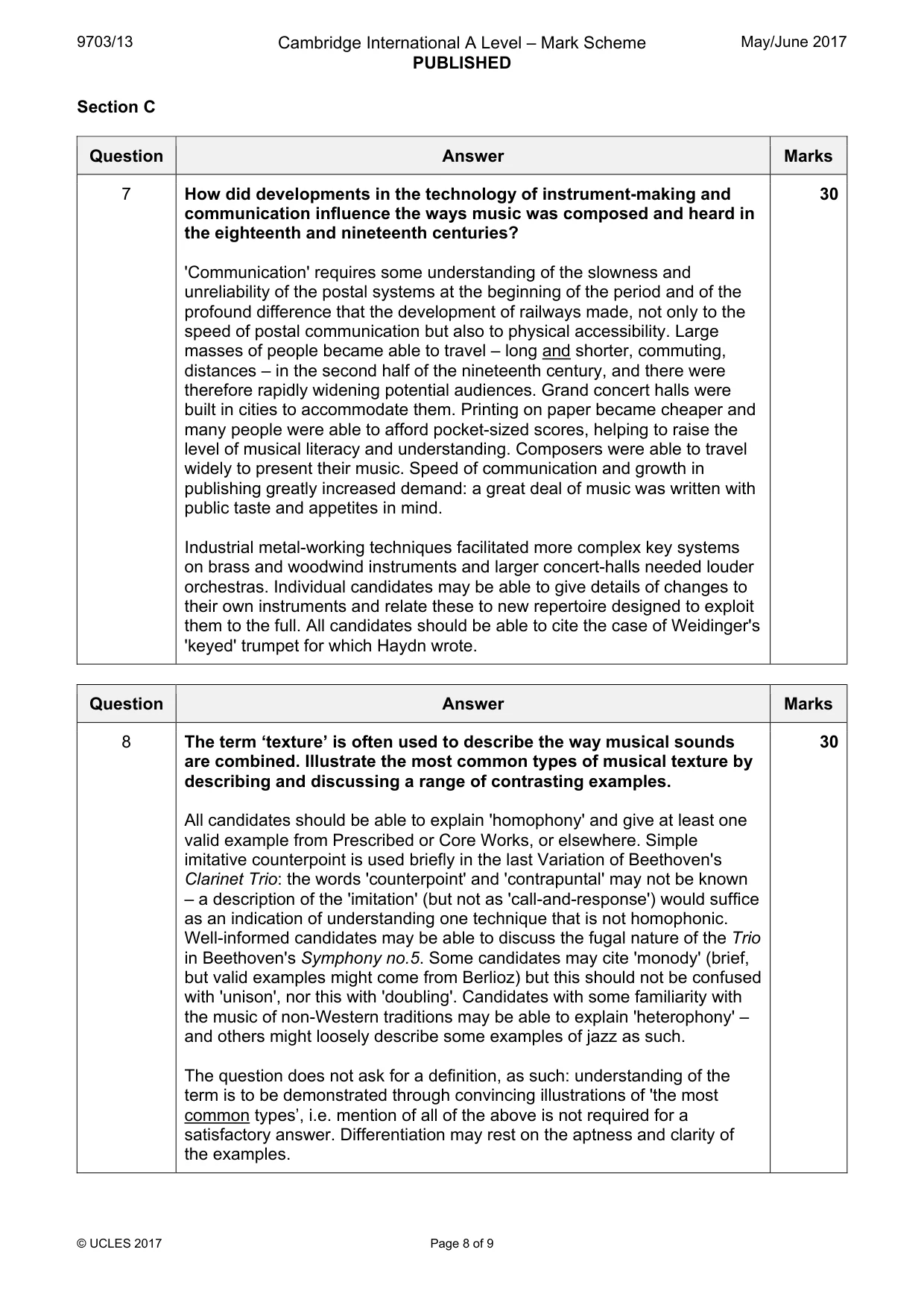
9703/13 Cambridge International A Level – Mark Scheme PUBLISHED May/June 2017 © UCLES 2017 Page 8 of 9 Section C Question Answer Marks 7 How did developments in the technology of instrument-making and communication influence the ways music was composed and heard in the eighteenth and nineteenth centuries? 'Communication' requires some understanding of the slowness and unreliability of the postal systems at the beginning of the period and of the profound difference that the development of railways made, not only to the speed of postal communication but also to physical accessibility. Large masses of people became able to travel – long and shorter, commuting, distances – in the second half of the nineteenth century, and there were therefore rapidly widening potential audiences. Grand concert halls were built in cities to accommodate them. Printing on paper became cheaper and many people were able to afford pocket-sized scores, helping to raise the level of musical literacy and understanding. Composers were able to travel widely to present their music. Speed of communication and growth in publishing greatly increased demand: a great deal of music was written with public taste and appetites in mind. Industrial metal-working techniques facilitated more complex key systems on brass and woodwind instruments and larger concert-halls needed louder orchestras. Individual candidates may be able to give details of changes to their own instruments and relate these to new repertoire designed to exploit them to the full. All candidates should be able to cite the case of Weidinger's 'keyed' trumpet for which Haydn wrote. 30 Question Answer Marks 8 The term ‘texture’ is often used to describe the way musical sounds are combined. Illustrate the most common types of musical texture by describing and discussing a range of contrasting examples. All candidates should be able to explain 'homophony' and give at least one valid example from Prescribed or Core Works, or elsewhere. Simple imitative counterpoint is used briefly in the last Variation of Beethoven's Clarinet Trio: the words 'counterpoint' and 'contrapuntal' may not be known – a description of the 'imitation' (but not as 'call-and-response') would suffice as an indication of understanding one technique that is not homophonic. Well-informed candidates may be able to discuss the fugal nature of the Trio in Beethoven's Symphony no.5. Some candidates may cite 'monody' (brief, but valid examples might come from Berlioz) but this should not be confused with 'unison', nor this with 'doubling'. Candidates with some familiarity with the music of non-Western traditions may be able to explain 'heterophony' – and others might loosely describe some examples of jazz as such. The question does not ask for a definition, as such: understanding of the term is to be demonstrated through convincing illustrations of 'the most common types’, i.e. mention of all of the above is not required for a satisfactory answer. Differentiation may rest on the aptness and clarity of the examples. 30
Mark scheme, page 9
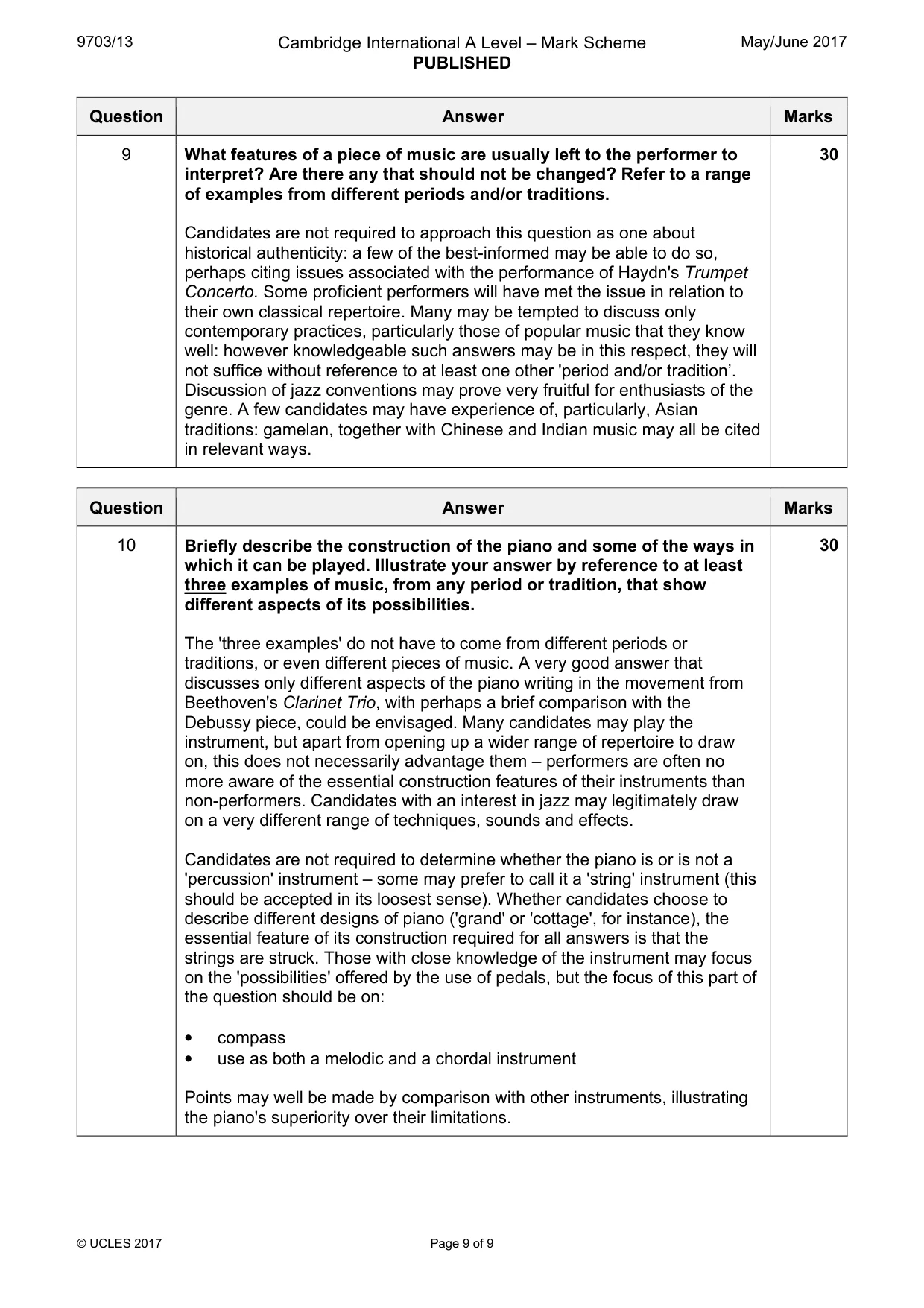
9703/13 Cambridge International A Level – Mark Scheme PUBLISHED May/June 2017 © UCLES 2017 Page 9 of 9 Question Answer Marks 9 What features of a piece of music are usually left to the performer to interpret? Are there any that should not be changed? Refer to a range of examples from different periods and/or traditions. Candidates are not required to approach this question as one about historical authenticity: a few of the best-informed may be able to do so, perhaps citing issues associated with the performance of Haydn's Trumpet Concerto. Some proficient performers will have met the issue in relation to their own classical repertoire. Many may be tempted to discuss only contemporary practices, particularly those of popular music that they know well: however knowledgeable such answers may be in this respect, they will not suffice without reference to at least one other 'period and/or tradition’. Discussion of jazz conventions may prove very fruitful for enthusiasts of the genre. A few candidates may have experience of, particularly, Asian traditions: gamelan, together with Chinese and Indian music may all be cited in relevant ways. 30 Question Answer Marks 10 Briefly describe the construction of the piano and some of the ways in which it can be played. Illustrate your answer by reference to at least three examples of music, from any period or tradition, that show different aspects of its possibilities. The 'three examples' do not have to come from different periods or traditions, or even different pieces of music. A very good answer that discusses only different aspects of the piano writing in the movement from Beethoven's Clarinet Trio, with perhaps a brief comparison with the Debussy piece, could be envisaged. Many candidates may play the instrument, but apart from opening up a wider range of repertoire to draw on, this does not necessarily advantage them – performers are often no more aware of the essential construction features of their instruments than non-performers. Candidates with an interest in jazz may legitimately draw on a very different range of techniques, sounds and effects. Candidates are not required to determine whether the piano is or is not a 'percussion' instrument – some may prefer to call it a 'string' instrument (this should be accepted in its loosest sense). Whether candidates choose to describe different designs of piano ('grand' or 'cottage', for instance), the essential feature of its construction required for all answers is that the strings are struck. Those with close knowledge of the instrument may focus on the 'possibilities' offered by the use of pedals, but the focus of this part of the question should be on: • compass • use as both a melodic and a chordal instrument Points may well be made by comparison with other instruments, illustrating the piano's superiority over their limitations. 30
What you needed in this session
Cambridge’s own grade thresholds for 2017 May/June, Paper 1 · Variant 3. A higher threshold means an easier paper — the bar moves with how the cohort did.