Cambridge A Level Music 9483 — 2022 May/June Paper 1 · Variant 3
9483/13/M/J/22 · 100 marks · ≈113 min
The question paper and its mark scheme, free to read here and free to download. This is Cambridge’s own paper, exactly as it was sat.
Question paper12 pages






Mark scheme18 pages
Answers below. Sit the paper first if you are practising.
Paper as text
Question paper, page 1
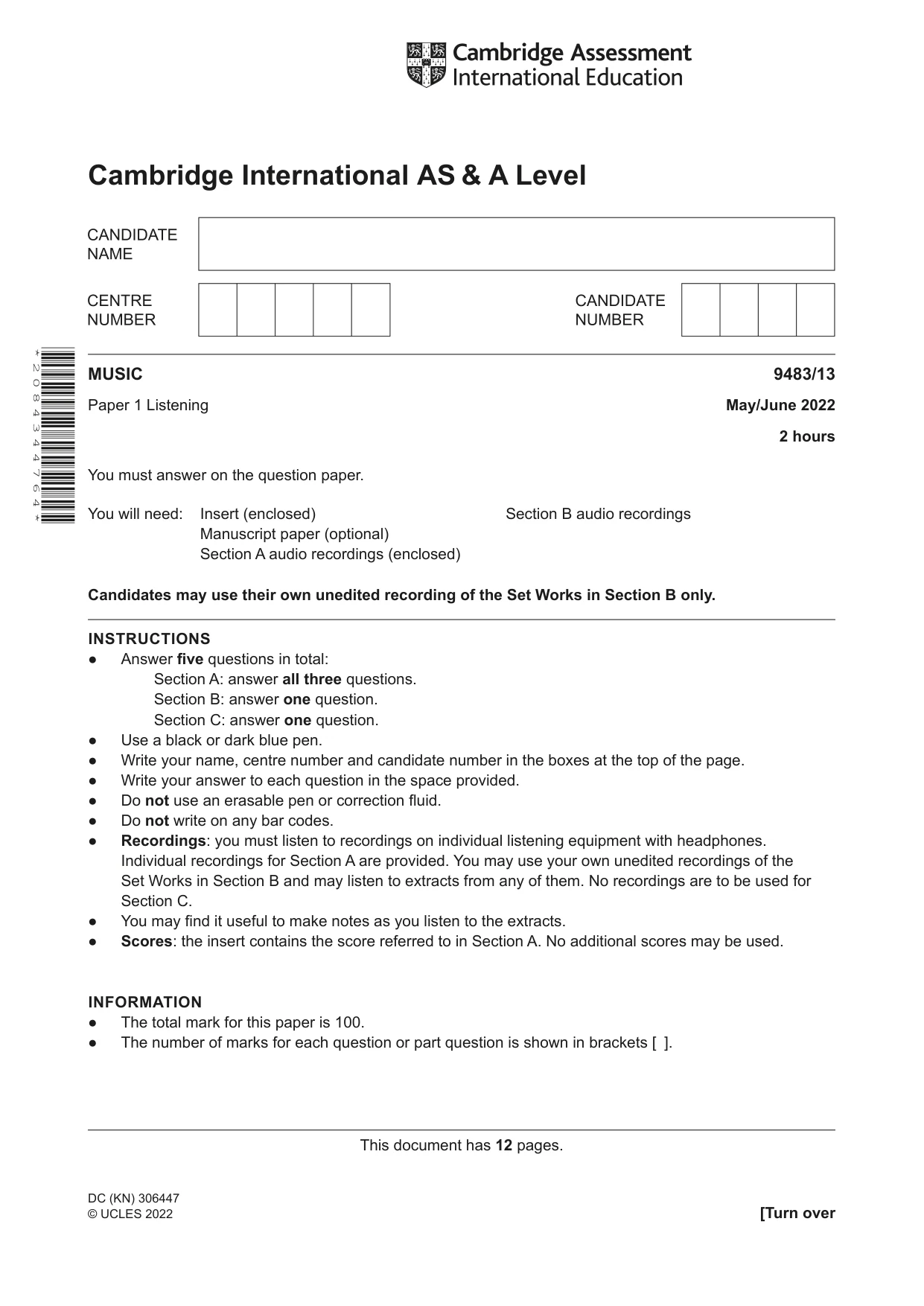
This document has 12 pages. [Turn over Cambridge International AS & A Level DC (KN) 306447 © UCLES 2022 * 2 0 8 4 3 4 4 7 6 4 * MUSIC 9483/13 Paper 1 Listening May/June 2022 2 hours You must answer on the question paper. You will need: Insert (enclosed) Section B audio recordings Manuscript paper (optional) Section A audio recordings (enclosed) Candidates may use their own unedited recording of the Set Works in Section B only. INSTRUCTIONS ● Answer five questions in total: Section A: answer all three questions. Section B: answer one question. Section C: answer one question. ● Use a black or dark blue pen. ● Write your name, centre number and candidate number in the boxes at the top of the page. ● Write your answer to each question in the space provided. ● Do not use an erasable pen or correction fluid. ● Do not write on any bar codes. ● Recordings: you must listen to recordings on individual listening equipment with headphones. Individual recordings for Section A are provided. You may use your own unedited recordings of the Set Works in Section B and may listen to extracts from any of them. No recordings are to be used for Section C. ● You may find it useful to make notes as you listen to the extracts. ● Scores: the insert contains the score referred to in Section A. No additional scores may be used. INFORMATION ● The total mark for this paper is 100. ● The number of marks for each question or part question is shown in brackets [ ].
Question paper, page 2
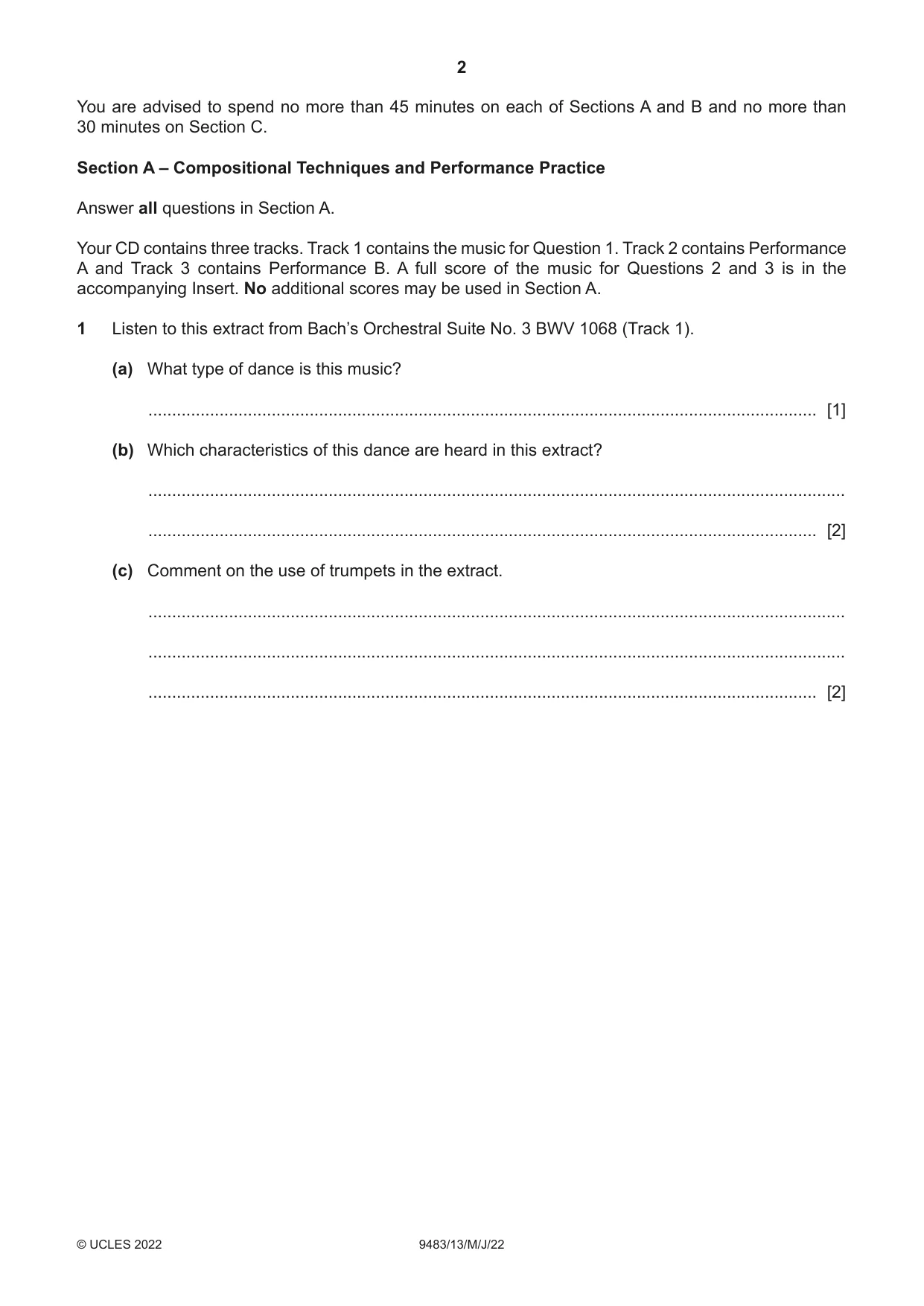
2 9483/13/M/J/22 © UCLES 2022 You are advised to spend no more than 45 minutes on each of Sections A and B and no more than 30 minutes on Section C. Section A – Compositional Techniques and Performance Practice Answer all questions in Section A. Your CD contains three tracks. Track 1 contains the music for Question 1. Track 2 contains Performance A and Track 3 contains Performance B. A full score of the music for Questions 2 and 3 is in the accompanying Insert. No additional scores may be used in Section A. 1 Listen to this extract from Bach’s Orchestral Suite No. 3 BWV 1068 (Track 1). (a) What type of dance is this music? … [1] (b) Which characteristics of this dance are heard in this extract? … … [2] (c) Comment on the use of trumpets in the extract. … … … [2]
Question paper, page 3
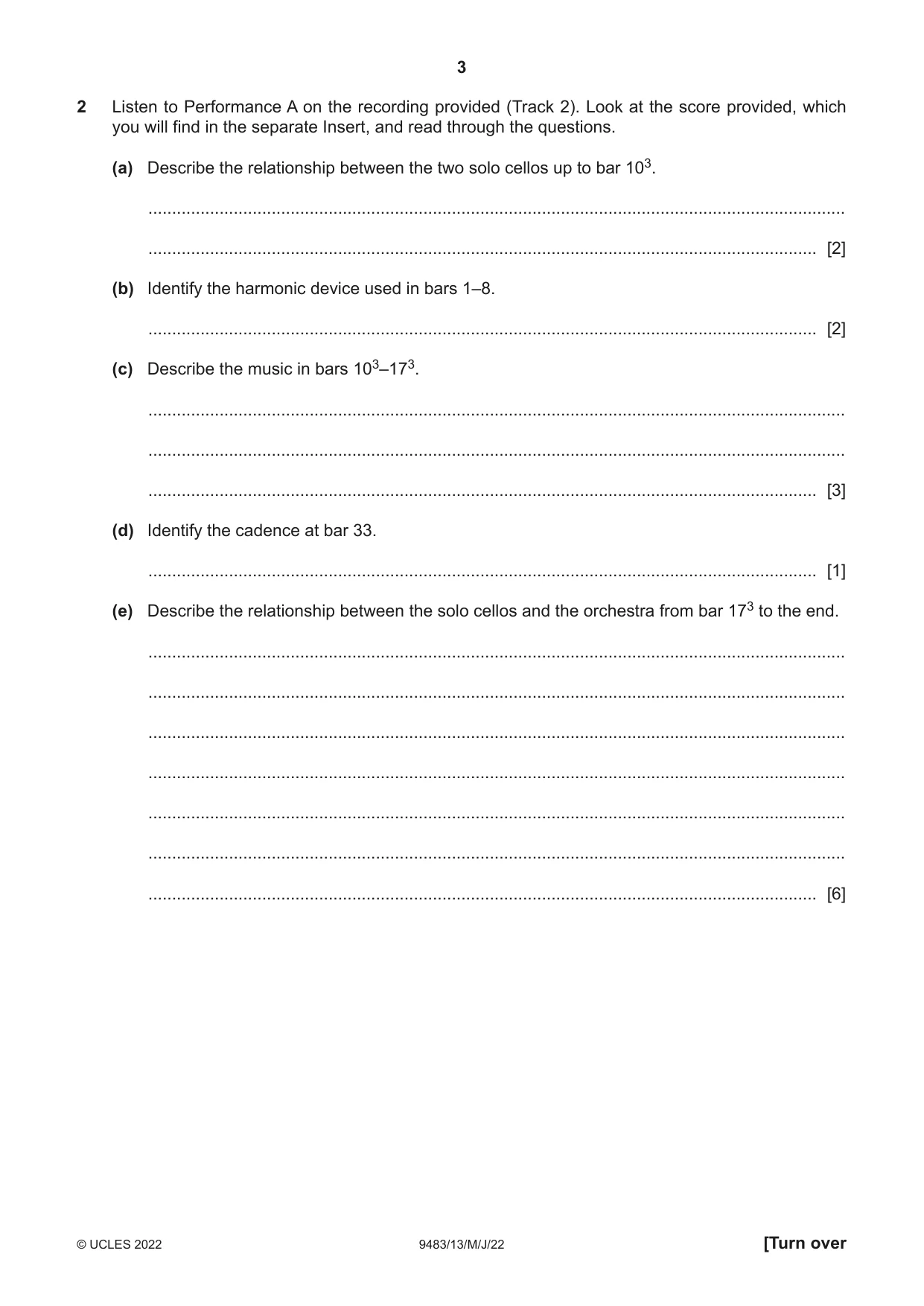
3 9483/13/M/J/22 © UCLES 2022 [Turn over 2 Listen to Performance A on the recording provided (Track 2). Look at the score provided, which you will find in the separate Insert, and read through the questions. (a) Describe the relationship between the two solo cellos up to bar 103. … … [2] (b) Identify the harmonic device used in bars 1–8. … [2] (c) Describe the music in bars 103–173. … … … [3] (d) Identify the cadence at bar 33. … [1] (e) Describe the relationship between the solo cellos and the orchestra from bar 173 to the end. … … … … … … … [6]
Question paper, page 4
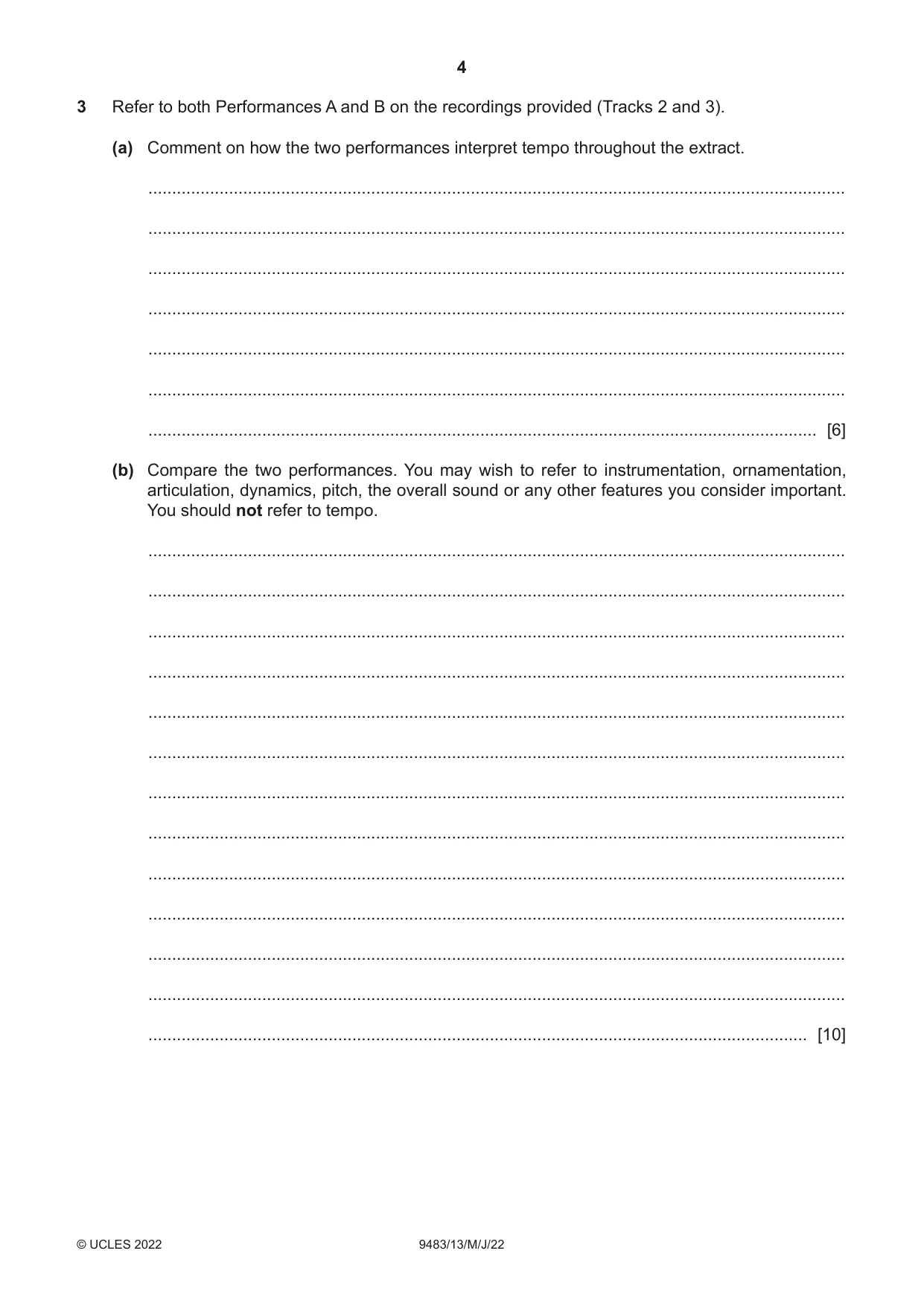
4 9483/13/M/J/22 © UCLES 2022 3 Refer to both Performances A and B on the recordings provided (Tracks 2 and 3). (a) Comment on how the two performances interpret tempo throughout the extract. … … … … … … … [6] (b) Compare the two performances. You may wish to refer to instrumentation, ornamentation, articulation, dynamics, pitch, the overall sound or any other features you consider important. You should not refer to tempo. … … … … … … … … … … … … … [10]
Question paper, page 5
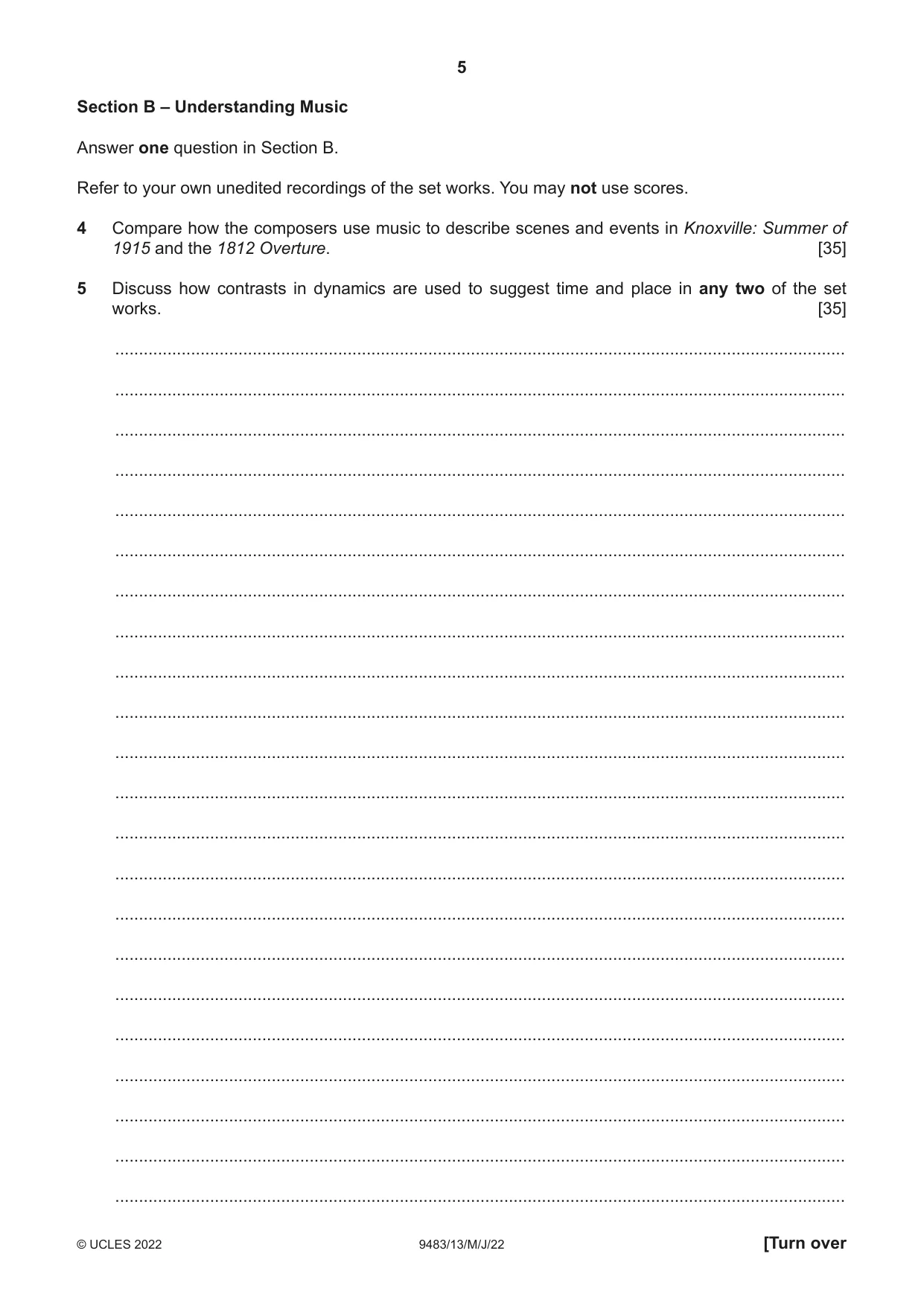
5 9483/13/M/J/22 © UCLES 2022 [Turn over Section B – Understanding Music Answer one question in Section B. Refer to your own unedited recordings of the set works. You may not use scores. 4 Compare how the composers use music to describe scenes and events in Knoxville: Summer of 1915 and the 1812 Overture. [35] 5 Discuss how contrasts in dynamics are used to suggest time and place in any two of the set works. [35] … … … … … … … … … … … … … … … … … … … … … …
Question paper, page 6
6 9483/13/M/J/22 © UCLES 2022 … … … … … … … … … … … … … … … … … … … … … … … … … … … …
Question paper, page 7
7 9483/13/M/J/22 © UCLES 2022 [Turn over … … … … … … … … … … … … … … … … … … … … … … … … … … … …
Question paper, page 8
8 9483/13/M/J/22 © UCLES 2022 … … … … … … … … … … … … … … … … … … … … … … … … … … … …
Question paper, page 9
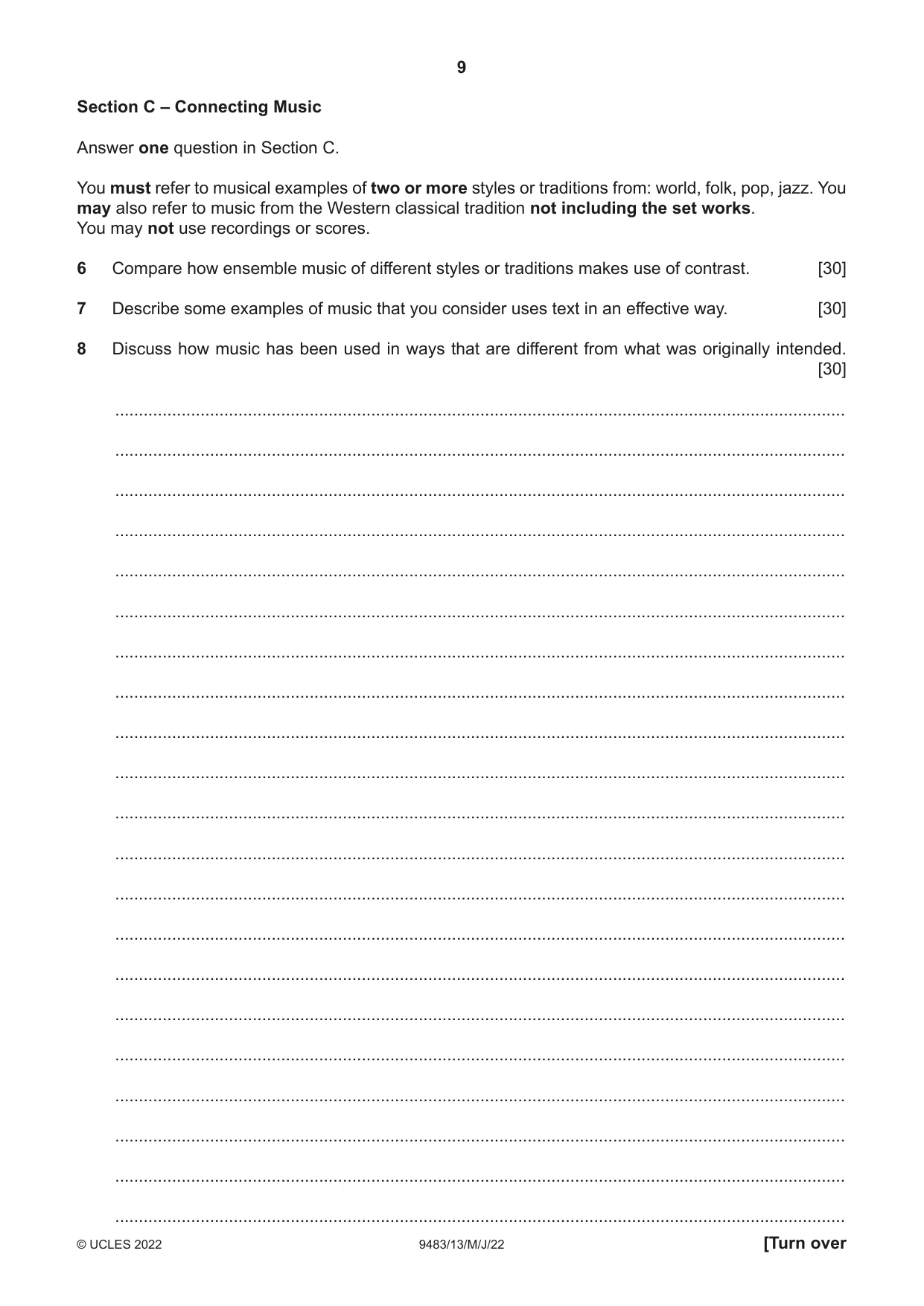
9 9483/13/M/J/22 © UCLES 2022 [Turn over Section C – Connecting Music Answer one question in Section C. You must refer to musical examples of two or more styles or traditions from: world, folk, pop, jazz. You may also refer to music from the Western classical tradition not including the set works. You may not use recordings or scores. 6 Compare how ensemble music of different styles or traditions makes use of contrast. [30] 7 Describe some examples of music that you consider uses text in an effective way. [30] 8 Discuss how music has been used in ways that are different from what was originally intended. [30] … … … … … … … … … … … … … … … … … … … … …
Question paper, page 10
10 9483/13/M/J/22 © UCLES 2022 … … … … … … … … … … … … … … … … … … … … … … … … … … … …
Question paper, page 11
11 9483/13/M/J/22 © UCLES 2022 [Turn over … … … … … … … … … … … … … … … … … … … … … … … … … … … …
Question paper, page 12
12 9483/13/M/J/22 © UCLES 2022 Permission to reproduce items where third-party owned material protected by copyright is included has been sought and cleared where possible. Every reasonable effort has been made by the publisher (UCLES) to trace copyright holders, but if any items requiring clearance have unwittingly been included, the publisher will be pleased to make amends at the earliest possible opportunity. To avoid the issue of disclosure of answer-related information to candidates, all copyright acknowledgements are reproduced online in the Cambridge Assessment International Education Copyright Acknowledgements Booklet. This is produced for each series of examinations and is freely available to download at www.cambridgeinternational.org after the live examination series. Cambridge Assessment International Education is part of Cambridge Assessment. Cambridge Assessment is the brand name of the University of Cambridge Local Examinations Syndicate (UCLES), which is a department of the University of Cambridge. … … … … … … … … … … … … … … … … … … … … … … … …
Mark scheme, page 1
This document consists of 18 printed pages. © UCLES 2022 [Turn over Cambridge International AS & A Level MUSIC 9483/13 Paper 1 Listening May/June 2022 MARK SCHEME Maximum Mark: 100 Published This mark scheme is published as an aid to teachers and candidates, to indicate the requirements of the examination. It shows the basis on which Examiners were instructed to award marks. It does not indicate the details of the discussions that took place at an Examiners’ meeting before marking began, which would have considered the acceptability of alternative answers. Mark schemes should be read in conjunction with the question paper and the Principal Examiner Report for Teachers. Cambridge International will not enter into discussions about these mark schemes. Cambridge International is publishing the mark schemes for the May/June 2022 series for most Cambridge IGCSE, Cambridge International A and AS Level and Cambridge Pre-U components, and some Cambridge O Level components.
Mark scheme, page 2
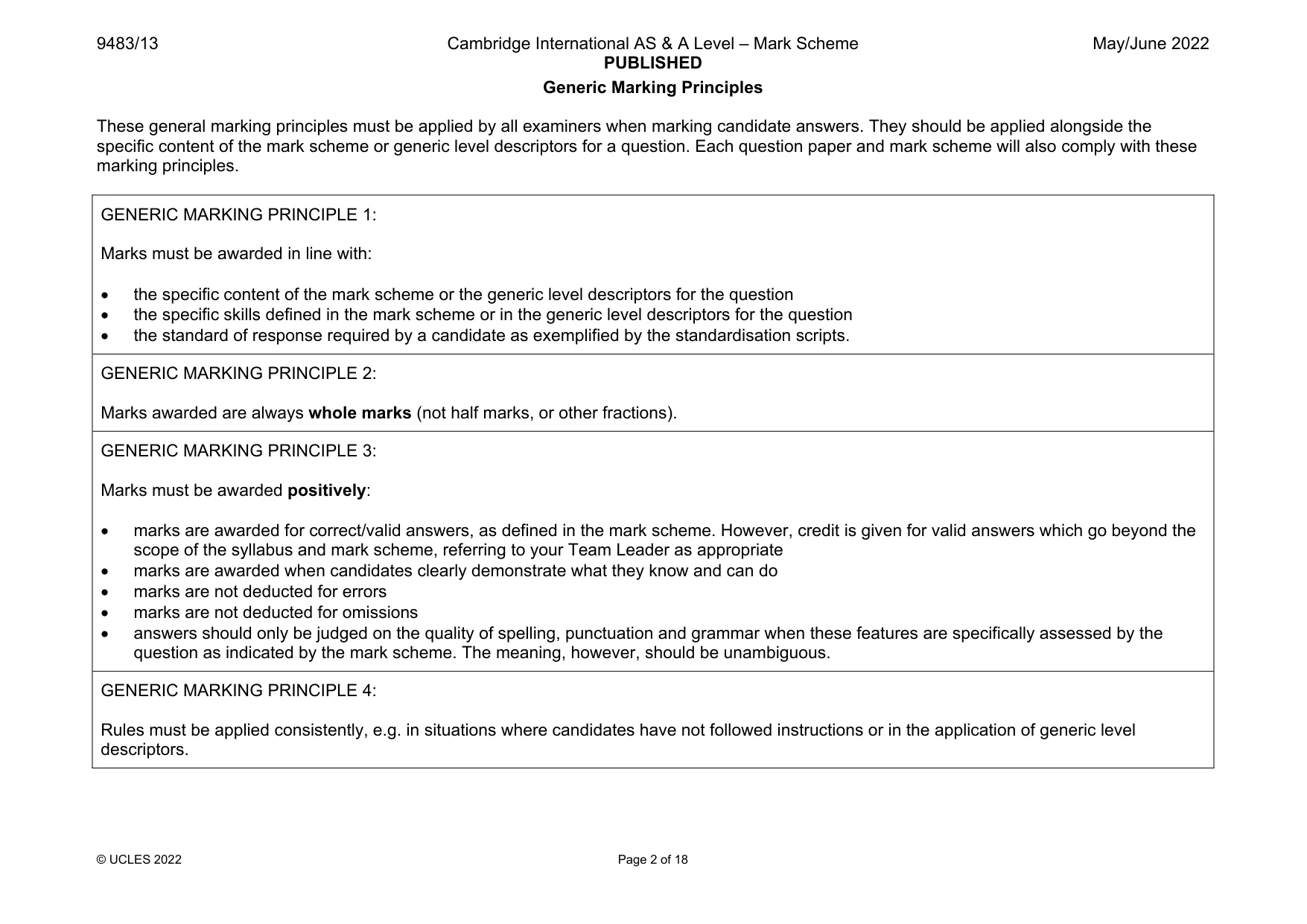
9483/13 Cambridge International AS & A Level – Mark Scheme PUBLISHED May/June 2022 © UCLES 2022 Page 2 of 18 Generic Marking Principles These general marking principles must be applied by all examiners when marking candidate answers. They should be applied alongside the specific content of the mark scheme or generic level descriptors for a question. Each question paper and mark scheme will also comply with these marking principles. GENERIC MARKING PRINCIPLE 1: Marks must be awarded in line with: the specific content of the mark scheme or the generic level descriptors for the question the specific skills defined in the mark scheme or in the generic level descriptors for the question the standard of response required by a candidate as exemplified by the standardisation scripts. GENERIC MARKING PRINCIPLE 2: Marks awarded are always whole marks (not half marks, or other fractions). GENERIC MARKING PRINCIPLE 3: Marks must be awarded positively: marks are awarded for correct/valid answers, as defined in the mark scheme. However, credit is given for valid answers which go beyond the scope of the syllabus and mark scheme, referring to your Team Leader as appropriate marks are awarded when candidates clearly demonstrate what they know and can do marks are not deducted for errors marks are not deducted for omissions answers should only be judged on the quality of spelling, punctuation and grammar when these features are specifically assessed by the question as indicated by the mark scheme. The meaning, however, should be unambiguous. GENERIC MARKING PRINCIPLE 4: Rules must be applied consistently, e.g. in situations where candidates have not followed instructions or in the application of generic level descriptors.
Mark scheme, page 3
9483/13 Cambridge International AS & A Level – Mark Scheme PUBLISHED May/June 2022 © UCLES 2022 Page 3 of 18 GENERIC MARKING PRINCIPLE 5: Marks should be awarded using the full range of marks defined in the mark scheme for the question (however; the use of the full mark range may be limited according to the quality of the candidate responses seen). GENERIC MARKING PRINCIPLE 6: Marks awarded are based solely on the requirements as defined in the mark scheme. Marks should not be awarded with grade thresholds or grade descriptors in mind.
Mark scheme, page 4
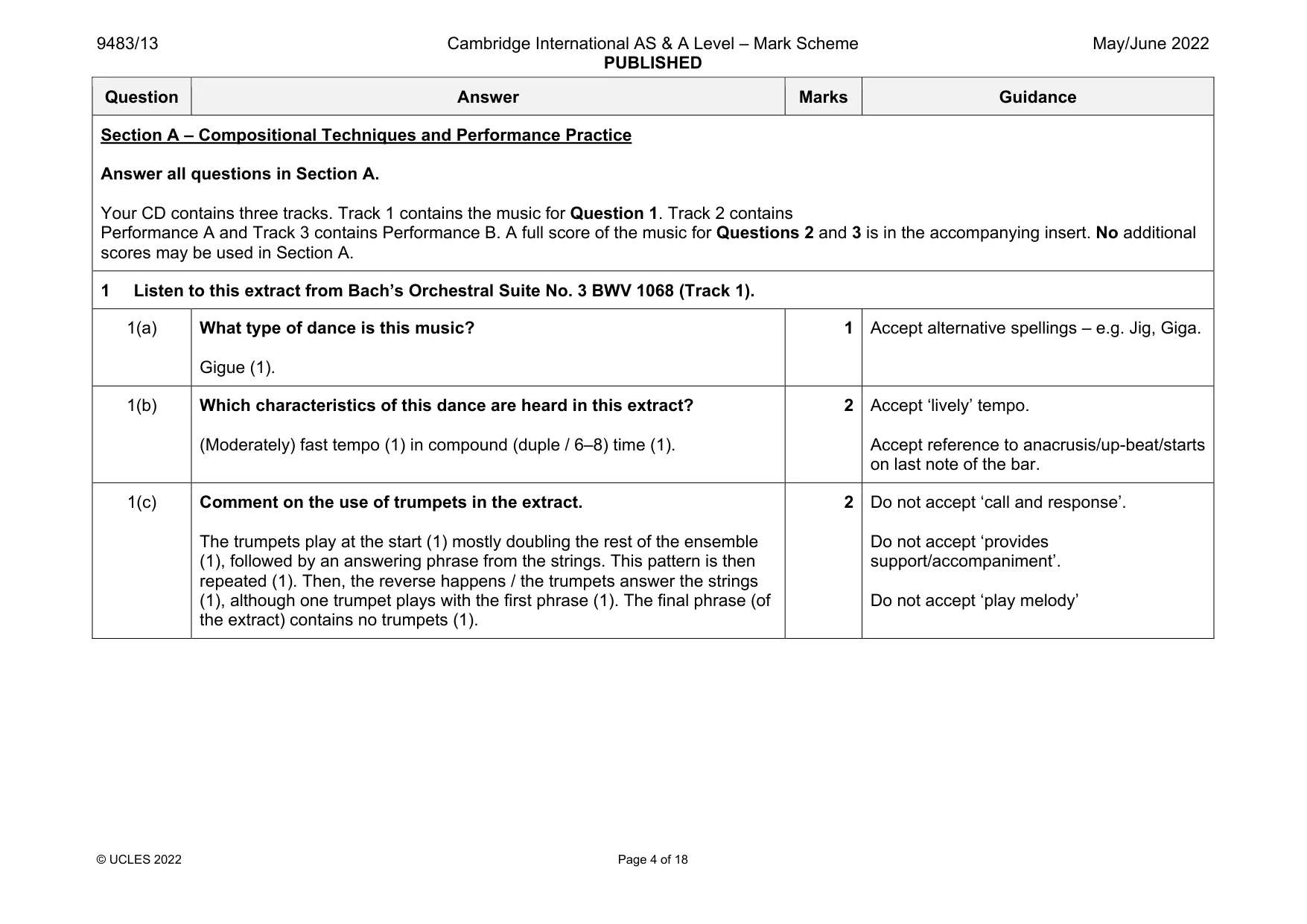
9483/13 Cambridge International AS & A Level – Mark Scheme PUBLISHED May/June 2022 © UCLES 2022 Page 4 of 18 Question Answer Marks Guidance Section A – Compositional Techniques and Performance Practice Answer all questions in Section A. Your CD contains three tracks. Track 1 contains the music for Question 1. Track 2 contains Performance A and Track 3 contains Performance B. A full score of the music for Questions 2 and 3 is in the accompanying insert. No additional scores may be used in Section A. 1 Listen to this extract from Bach’s Orchestral Suite No. 3 BWV 1068 (Track 1). 1(a) What type of dance is this music? Gigue (1). 1 Accept alternative spellings – e.g. Jig, Giga. 1(b) Which characteristics of this dance are heard in this extract? (Moderately) fast tempo (1) in compound (duple / 6–8) time (1). 2 Accept ‘lively’ tempo. Accept reference to anacrusis/up-beat/starts on last note of the bar. 1(c) Comment on the use of trumpets in the extract. The trumpets play at the start (1) mostly doubling the rest of the ensemble (1), followed by an answering phrase from the strings. This pattern is then repeated (1). Then, the reverse happens / the trumpets answer the strings (1), although one trumpet plays with the first phrase (1). The final phrase (of the extract) contains no trumpets (1). 2 Do not accept ‘call and response’. Do not accept ‘provides support/accompaniment’. Do not accept ‘play melody’
Mark scheme, page 5
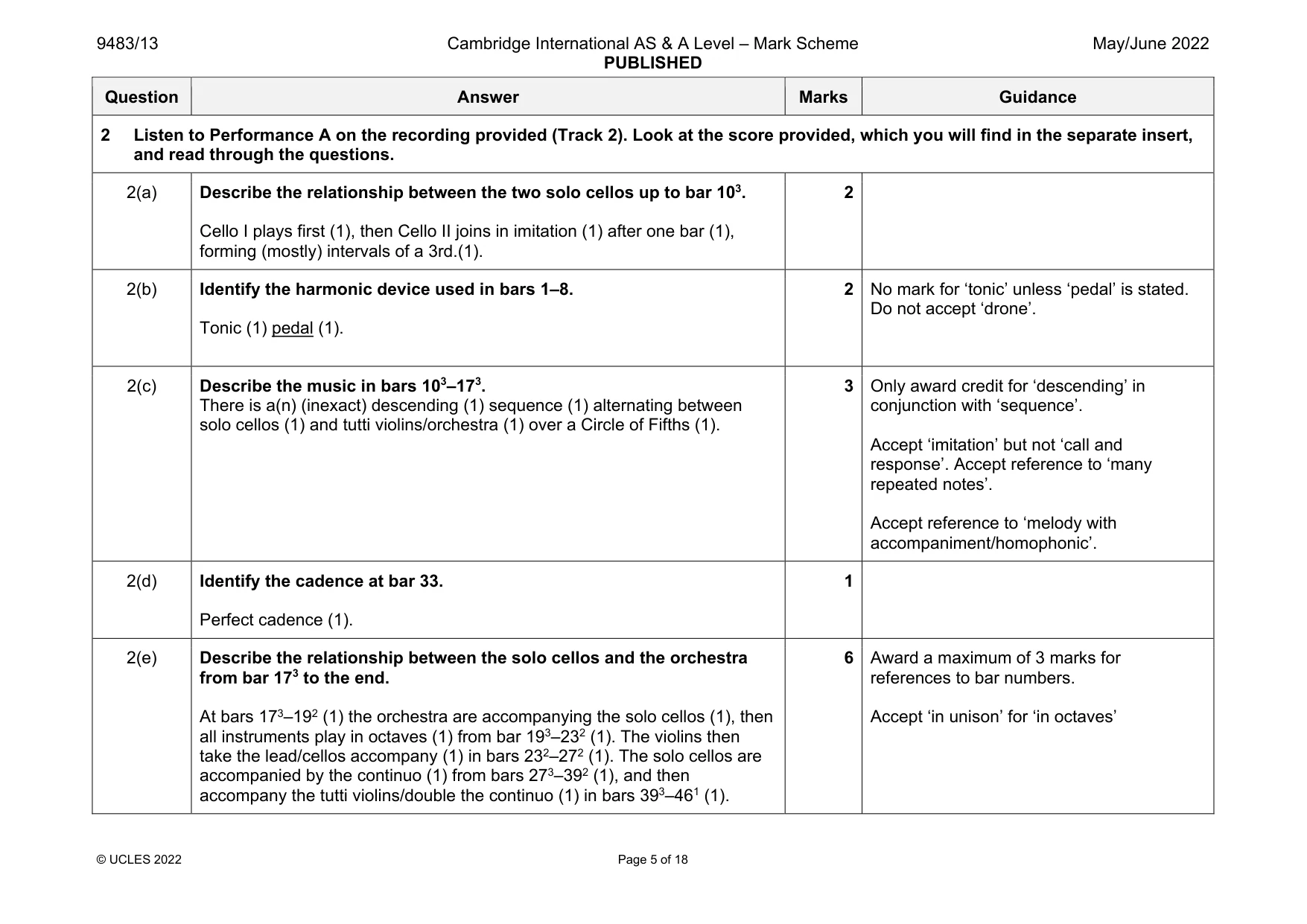
9483/13 Cambridge International AS & A Level – Mark Scheme PUBLISHED May/June 2022 © UCLES 2022 Page 5 of 18 Question Answer Marks Guidance 2 Listen to Performance A on the recording provided (Track 2). Look at the score provided, which you will find in the separate insert, and read through the questions. 2(a) Describe the relationship between the two solo cellos up to bar 103. Cello I plays first (1), then Cello II joins in imitation (1) after one bar (1), forming (mostly) intervals of a 3rd.(1). 2 2(b) Identify the harmonic device used in bars 1–8. Tonic (1) pedal (1). 2 No mark for ‘tonic’ unless ‘pedal’ is stated. Do not accept ‘drone’. 2(c) Describe the music in bars 103–173. There is a(n) (inexact) descending (1) sequence (1) alternating between solo cellos (1) and tutti violins/orchestra (1) over a Circle of Fifths (1). 3 Only award credit for ‘descending’ in conjunction with ‘sequence’. Accept ‘imitation’ but not ‘call and response’. Accept reference to ‘many repeated notes’. Accept reference to ‘melody with accompaniment/homophonic’. 2(d) Identify the cadence at bar 33. Perfect cadence (1). 1 2(e) Describe the relationship between the solo cellos and the orchestra from bar 173 to the end. At bars 173–192 (1) the orchestra are accompanying the solo cellos (1), then all instruments play in octaves (1) from bar 193–232 (1). The violins then take the lead/cellos accompany (1) in bars 232–272 (1). The solo cellos are accompanied by the continuo (1) from bars 273–392 (1), and then accompany the tutti violins/double the continuo (1) in bars 393–461 (1). 6 Award a maximum of 3 marks for references to bar numbers. Accept ‘in unison’ for ‘in octaves’
Mark scheme, page 6
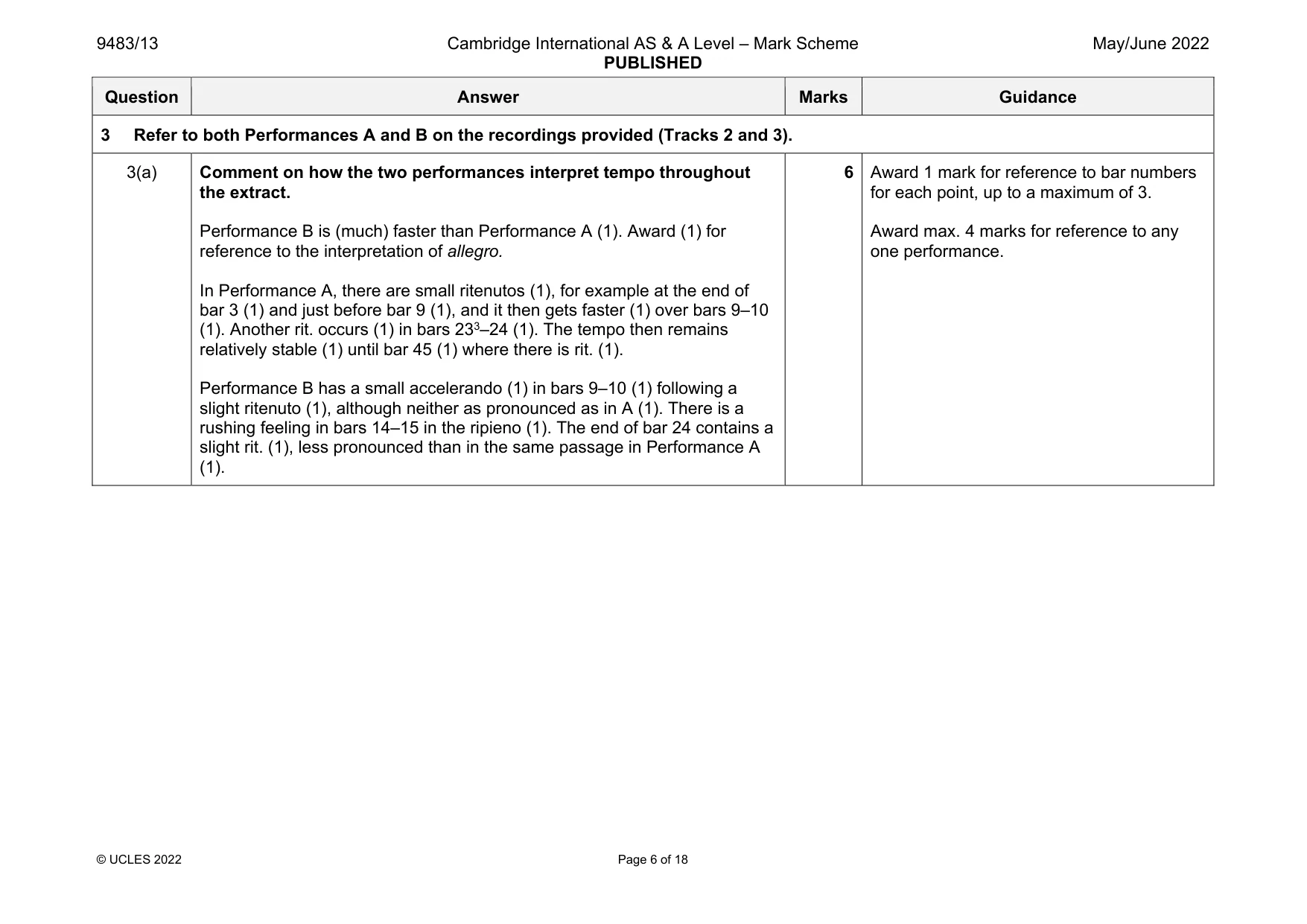
9483/13 Cambridge International AS & A Level – Mark Scheme PUBLISHED May/June 2022 © UCLES 2022 Page 6 of 18 Question Answer Marks Guidance 3 Refer to both Performances A and B on the recordings provided (Tracks 2 and 3). 3(a) Comment on how the two performances interpret tempo throughout the extract. Performance B is (much) faster than Performance A (1). Award (1) for reference to the interpretation of allegro. In Performance A, there are small ritenutos (1), for example at the end of bar 3 (1) and just before bar 9 (1), and it then gets faster (1) over bars 9–10 (1). Another rit. occurs (1) in bars 233–24 (1). The tempo then remains relatively stable (1) until bar 45 (1) where there is rit. (1). Performance B has a small accelerando (1) in bars 9–10 (1) following a slight ritenuto (1), although neither as pronounced as in A (1). There is a rushing feeling in bars 14–15 in the ripieno (1). The end of bar 24 contains a slight rit. (1), less pronounced than in the same passage in Performance A (1). 6 Award 1 mark for reference to bar numbers for each point, up to a maximum of 3. Award max. 4 marks for reference to any one performance.
Mark scheme, page 7
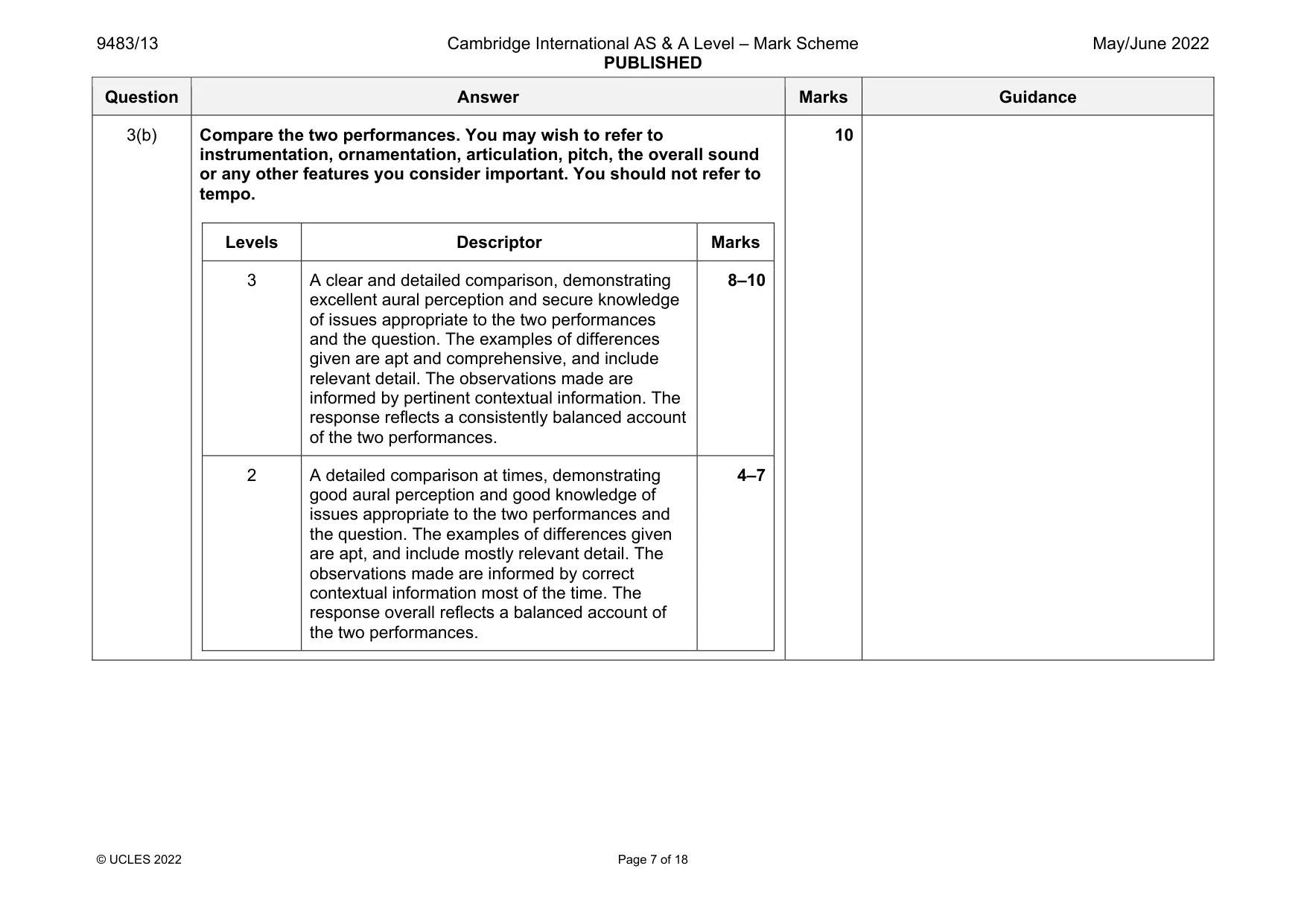
9483/13 Cambridge International AS & A Level – Mark Scheme PUBLISHED May/June 2022 © UCLES 2022 Page 7 of 18 Question Answer Marks Guidance 3(b) Compare the two performances. You may wish to refer to instrumentation, ornamentation, articulation, pitch, the overall sound or any other features you consider important. You should not refer to tempo. Levels Descriptor Marks 3 A clear and detailed comparison, demonstrating excellent aural perception and secure knowledge of issues appropriate to the two performances and the question. The examples of differences given are apt and comprehensive, and include relevant detail. The observations made are informed by pertinent contextual information. The response reflects a consistently balanced account of the two performances. 8–10 2 A detailed comparison at times, demonstrating good aural perception and good knowledge of issues appropriate to the two performances and the question. The examples of differences given are apt, and include mostly relevant detail. The observations made are informed by correct contextual information most of the time. The response overall reflects a balanced account of the two performances. 4–7 10
Mark scheme, page 8
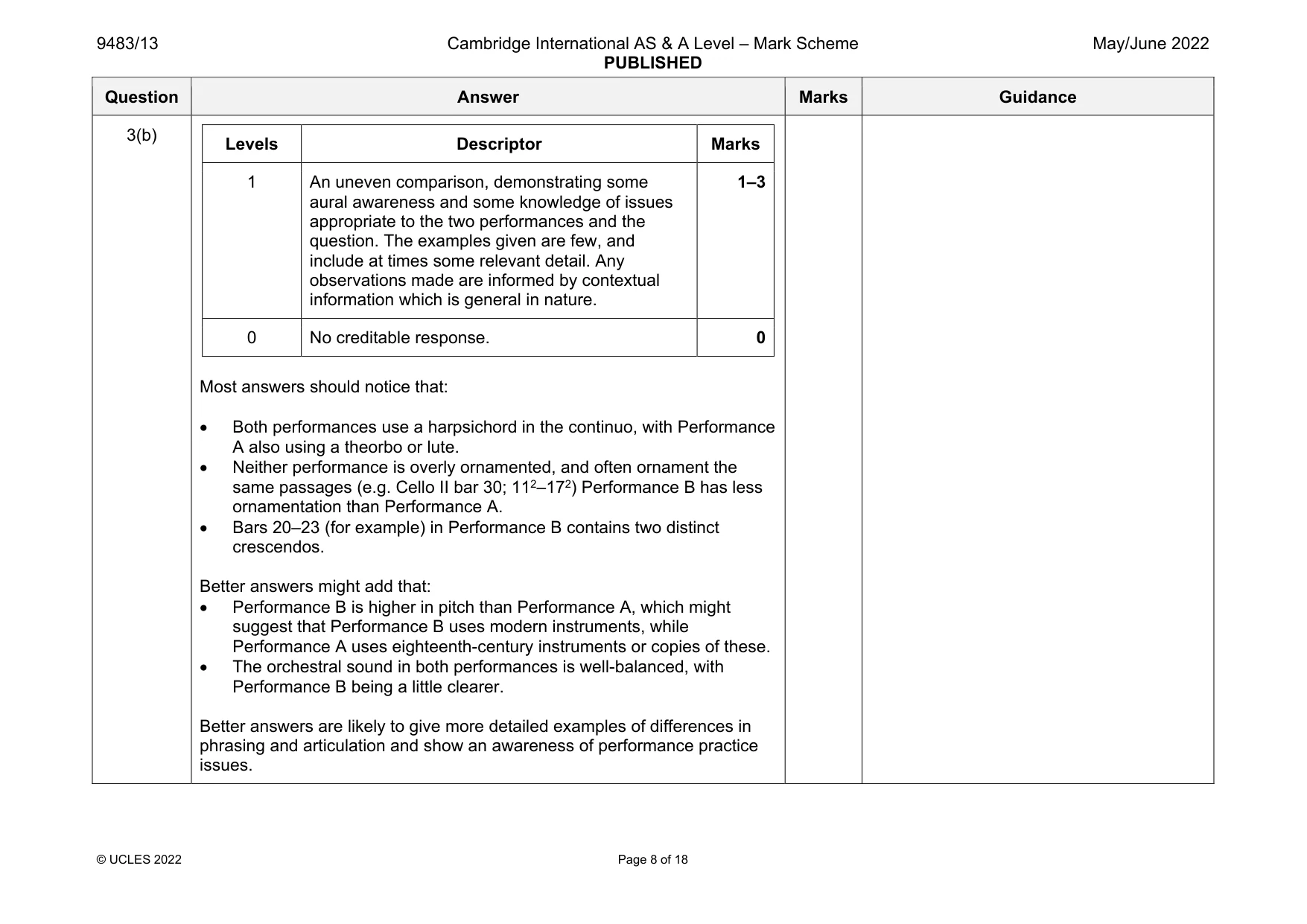
9483/13 Cambridge International AS & A Level – Mark Scheme PUBLISHED May/June 2022 © UCLES 2022 Page 8 of 18 Question Answer Marks Guidance 3(b) Levels Descriptor Marks 1 An uneven comparison, demonstrating some aural awareness and some knowledge of issues appropriate to the two performances and the question. The examples given are few, and include at times some relevant detail. Any observations made are informed by contextual information which is general in nature. 1–3 0 No creditable response. 0 Most answers should notice that: Both performances use a harpsichord in the continuo, with Performance A also using a theorbo or lute. Neither performance is overly ornamented, and often ornament the same passages (e.g. Cello II bar 30; 112–172) Performance B has less ornamentation than Performance A. Bars 20–23 (for example) in Performance B contains two distinct crescendos. Better answers might add that: Performance B is higher in pitch than Performance A, which might suggest that Performance B uses modern instruments, while Performance A uses eighteenth-century instruments or copies of these. The orchestral sound in both performances is well-balanced, with Performance B being a little clearer. Better answers are likely to give more detailed examples of differences in phrasing and articulation and show an awareness of performance practice issues.
Mark scheme, page 9
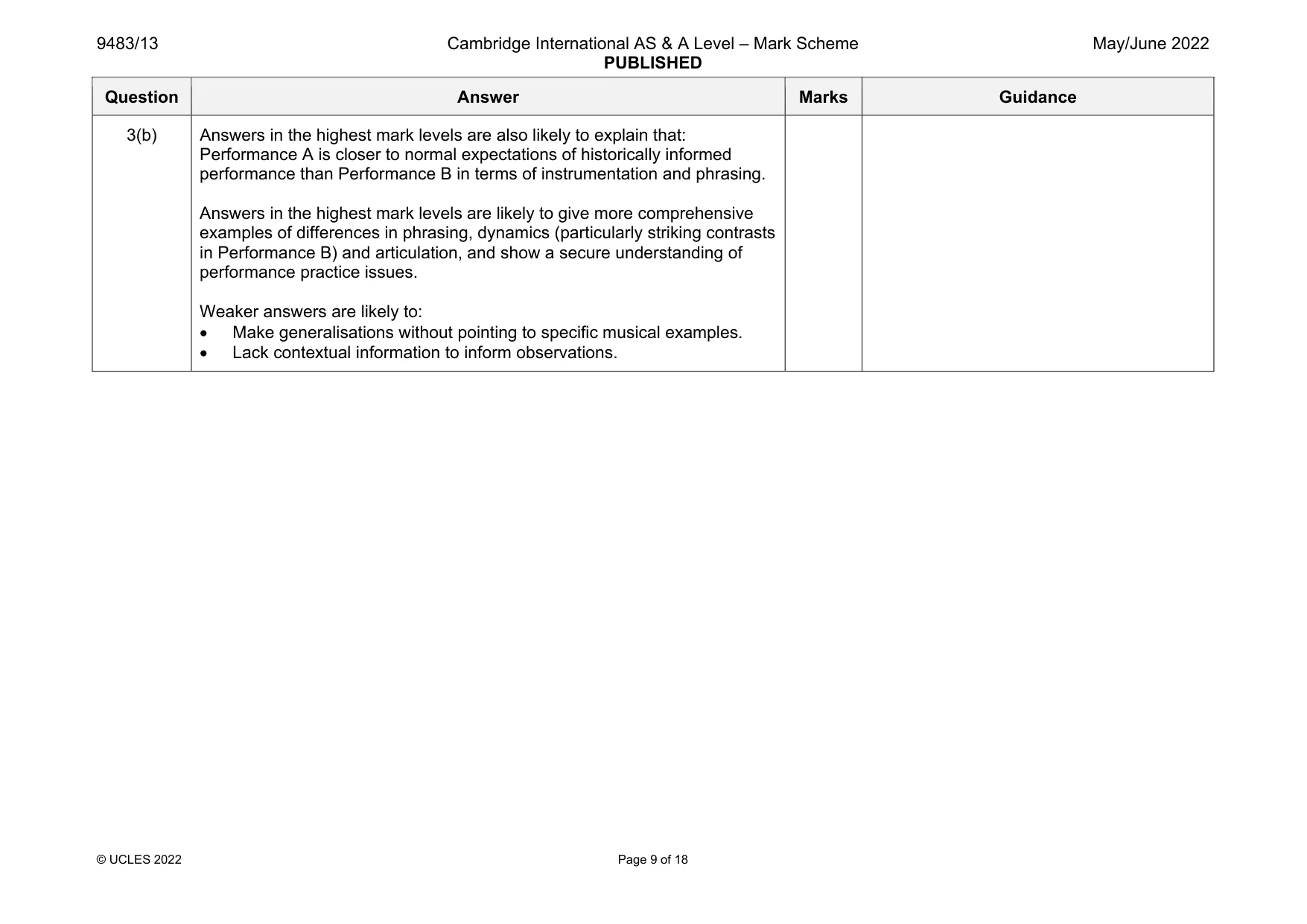
9483/13 Cambridge International AS & A Level – Mark Scheme PUBLISHED May/June 2022 © UCLES 2022 Page 9 of 18 Question Answer Marks Guidance 3(b) Answers in the highest mark levels are also likely to explain that: Performance A is closer to normal expectations of historically informed performance than Performance B in terms of instrumentation and phrasing. Answers in the highest mark levels are likely to give more comprehensive examples of differences in phrasing, dynamics (particularly striking contrasts in Performance B) and articulation, and show a secure understanding of performance practice issues. Weaker answers are likely to: Make generalisations without pointing to specific musical examples. Lack contextual information to inform observations.
Mark scheme, page 10
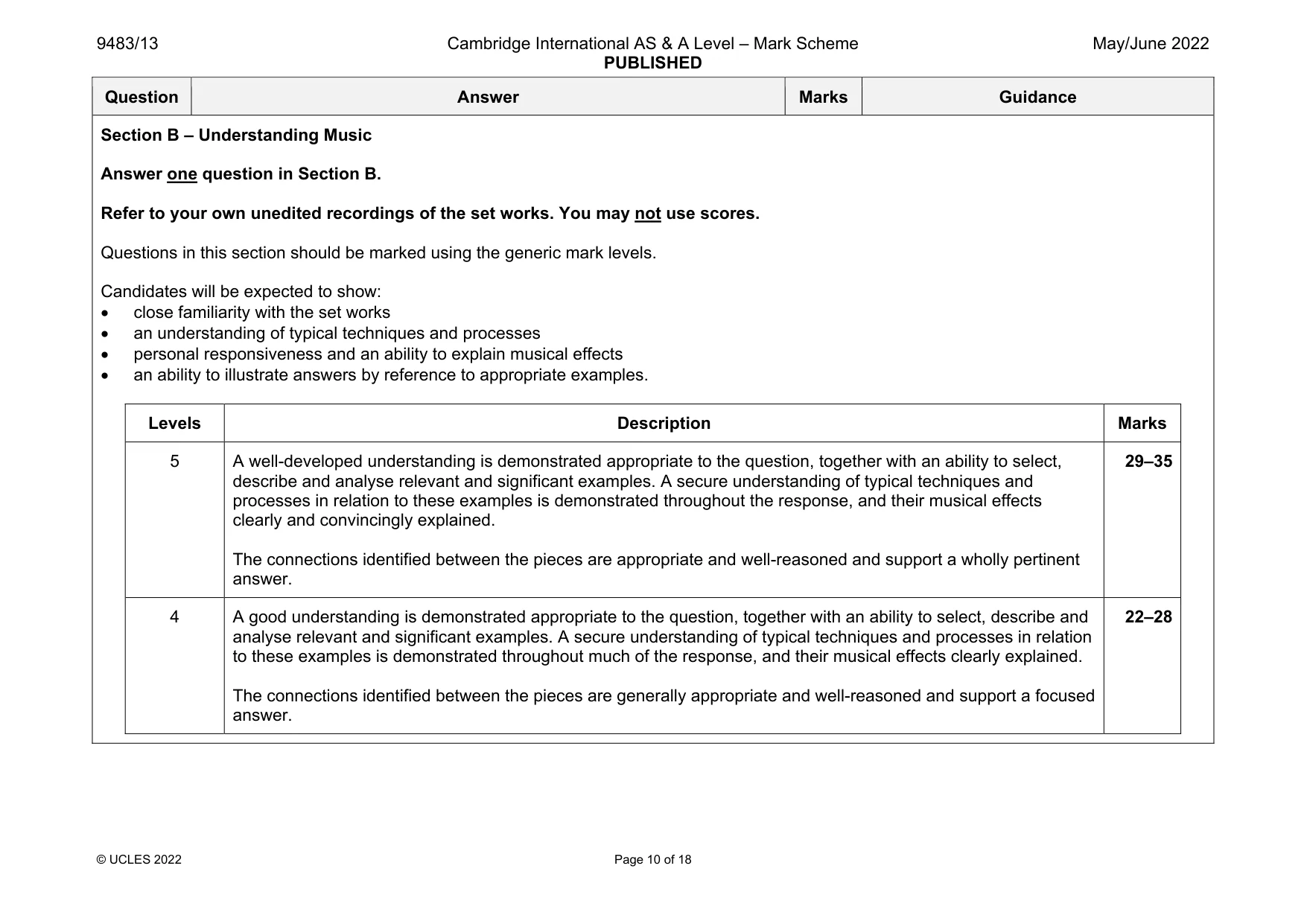
9483/13 Cambridge International AS & A Level – Mark Scheme PUBLISHED May/June 2022 © UCLES 2022 Page 10 of 18 Question Answer Marks Guidance Section B – Understanding Music Answer one question in Section B. Refer to your own unedited recordings of the set works. You may not use scores. Questions in this section should be marked using the generic mark levels. Candidates will be expected to show: close familiarity with the set works an understanding of typical techniques and processes personal responsiveness and an ability to explain musical effects an ability to illustrate answers by reference to appropriate examples. Levels Description Marks 5 A well-developed understanding is demonstrated appropriate to the question, together with an ability to select, describe and analyse relevant and significant examples. A secure understanding of typical techniques and processes in relation to these examples is demonstrated throughout the response, and their musical effects clearly and convincingly explained. The connections identified between the pieces are appropriate and well-reasoned and support a wholly pertinent answer. 29–35 4 A good understanding is demonstrated appropriate to the question, together with an ability to select, describe and analyse relevant and significant examples. A secure understanding of typical techniques and processes in relation to these examples is demonstrated throughout much of the response, and their musical effects clearly explained. The connections identified between the pieces are generally appropriate and well-reasoned and support a focused answer. 22–28
Mark scheme, page 11
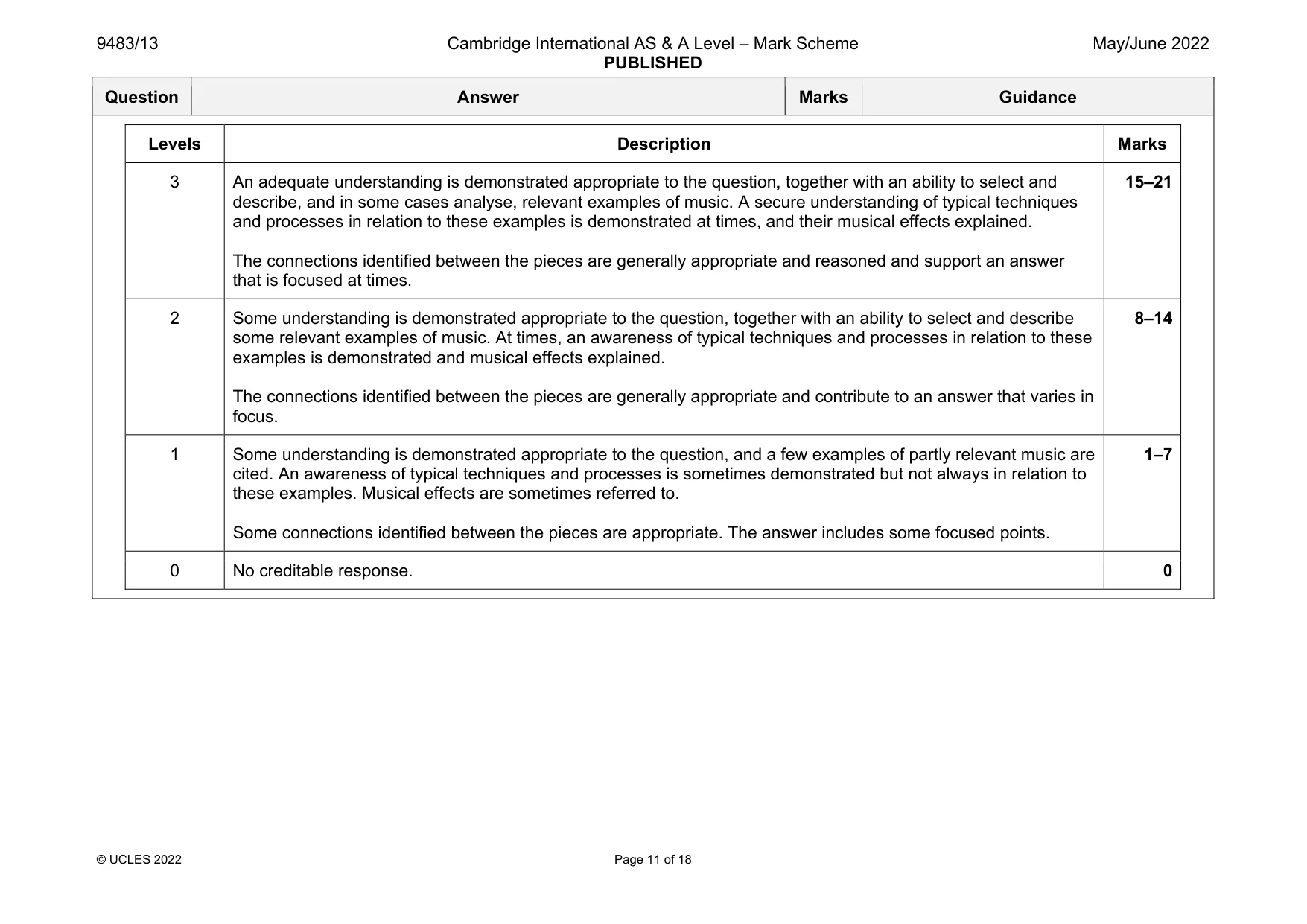
9483/13 Cambridge International AS & A Level – Mark Scheme PUBLISHED May/June 2022 © UCLES 2022 Page 11 of 18 Question Answer Marks Guidance Levels Description Marks 3 An adequate understanding is demonstrated appropriate to the question, together with an ability to select and describe, and in some cases analyse, relevant examples of music. A secure understanding of typical techniques and processes in relation to these examples is demonstrated at times, and their musical effects explained. The connections identified between the pieces are generally appropriate and reasoned and support an answer that is focused at times. 15–21 2 Some understanding is demonstrated appropriate to the question, together with an ability to select and describe some relevant examples of music. At times, an awareness of typical techniques and processes in relation to these examples is demonstrated and musical effects explained. The connections identified between the pieces are generally appropriate and contribute to an answer that varies in focus. 8–14 1 Some understanding is demonstrated appropriate to the question, and a few examples of partly relevant music are cited. An awareness of typical techniques and processes is sometimes demonstrated but not always in relation to these examples. Musical effects are sometimes referred to. Some connections identified between the pieces are appropriate. The answer includes some focused points. 1–7 0 No creditable response. 0
Mark scheme, page 12
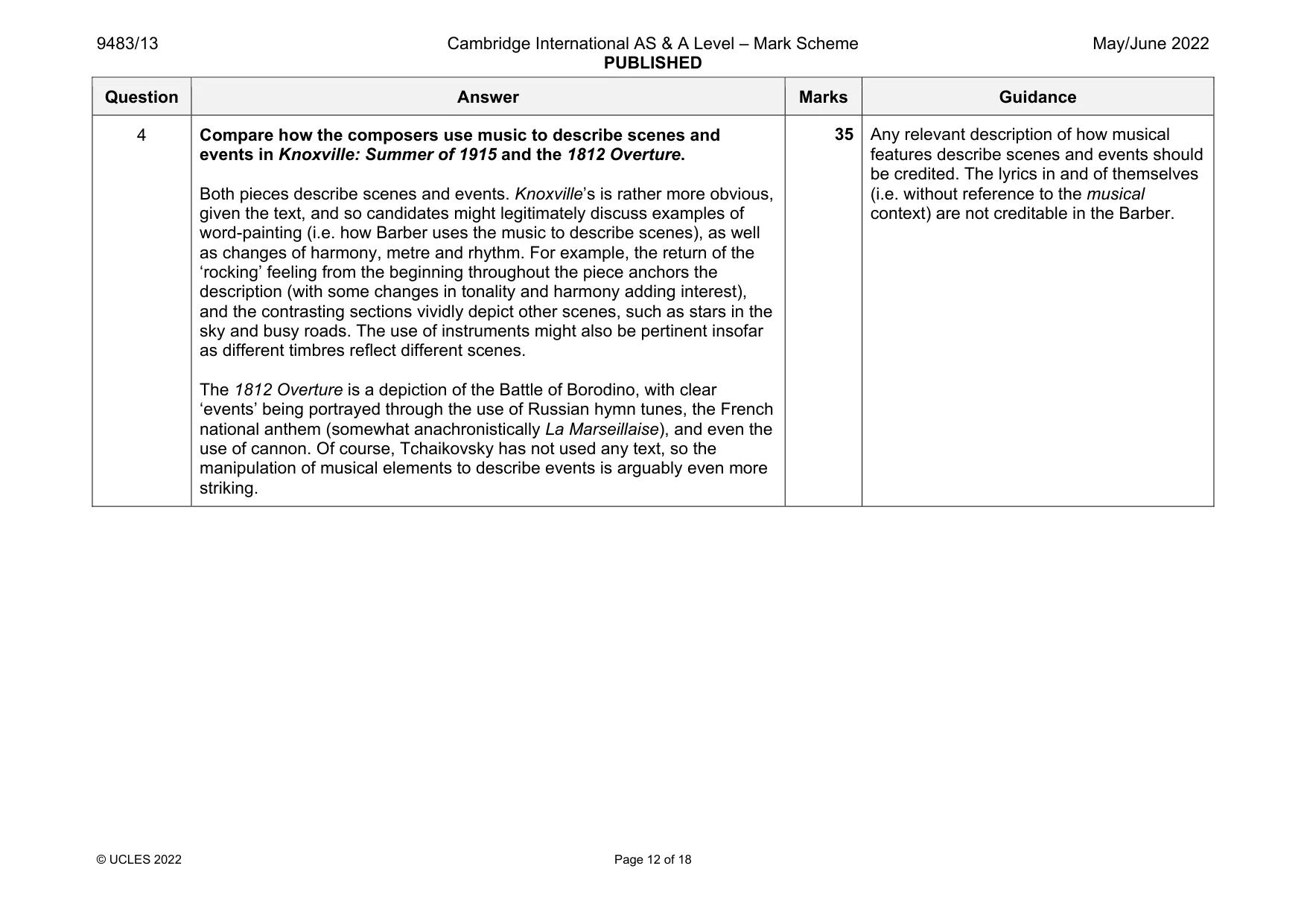
9483/13 Cambridge International AS & A Level – Mark Scheme PUBLISHED May/June 2022 © UCLES 2022 Page 12 of 18 Question Answer Marks Guidance 4 Compare how the composers use music to describe scenes and events in Knoxville: Summer of 1915 and the 1812 Overture. Both pieces describe scenes and events. Knoxville’s is rather more obvious, given the text, and so candidates might legitimately discuss examples of word-painting (i.e. how Barber uses the music to describe scenes), as well as changes of harmony, metre and rhythm. For example, the return of the ‘rocking’ feeling from the beginning throughout the piece anchors the description (with some changes in tonality and harmony adding interest), and the contrasting sections vividly depict other scenes, such as stars in the sky and busy roads. The use of instruments might also be pertinent insofar as different timbres reflect different scenes. The 1812 Overture is a depiction of the Battle of Borodino, with clear ‘events’ being portrayed through the use of Russian hymn tunes, the French national anthem (somewhat anachronistically La Marseillaise), and even the use of cannon. Of course, Tchaikovsky has not used any text, so the manipulation of musical elements to describe events is arguably even more striking. 35 Any relevant description of how musical features describe scenes and events should be credited. The lyrics in and of themselves (i.e. without reference to the musical context) are not creditable in the Barber.
Mark scheme, page 13
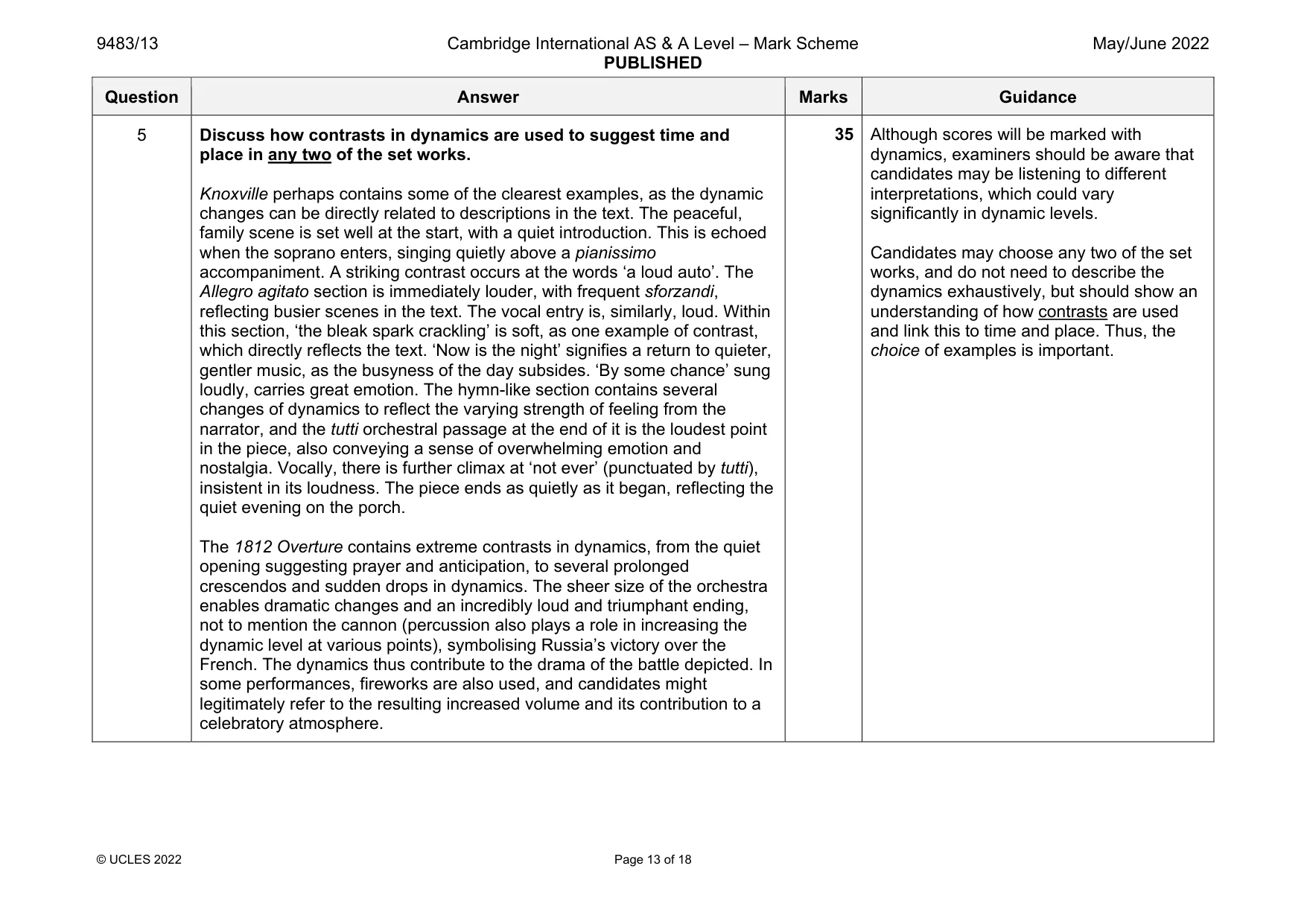
9483/13 Cambridge International AS & A Level – Mark Scheme PUBLISHED May/June 2022 © UCLES 2022 Page 13 of 18 Question Answer Marks Guidance 5 Discuss how contrasts in dynamics are used to suggest time and place in any two of the set works. Knoxville perhaps contains some of the clearest examples, as the dynamic changes can be directly related to descriptions in the text. The peaceful, family scene is set well at the start, with a quiet introduction. This is echoed when the soprano enters, singing quietly above a pianissimo accompaniment. A striking contrast occurs at the words ‘a loud auto’. The Allegro agitato section is immediately louder, with frequent sforzandi, reflecting busier scenes in the text. The vocal entry is, similarly, loud. Within this section, ‘the bleak spark crackling’ is soft, as one example of contrast, which directly reflects the text. ‘Now is the night’ signifies a return to quieter, gentler music, as the busyness of the day subsides. ‘By some chance’ sung loudly, carries great emotion. The hymn-like section contains several changes of dynamics to reflect the varying strength of feeling from the narrator, and the tutti orchestral passage at the end of it is the loudest point in the piece, also conveying a sense of overwhelming emotion and nostalgia. Vocally, there is further climax at ‘not ever’ (punctuated by tutti), insistent in its loudness. The piece ends as quietly as it began, reflecting the quiet evening on the porch. The 1812 Overture contains extreme contrasts in dynamics, from the quiet opening suggesting prayer and anticipation, to several prolonged crescendos and sudden drops in dynamics. The sheer size of the orchestra enables dramatic changes and an incredibly loud and triumphant ending, not to mention the cannon (percussion also plays a role in increasing the dynamic level at various points), symbolising Russia’s victory over the French. The dynamics thus contribute to the drama of the battle depicted. In some performances, fireworks are also used, and candidates might legitimately refer to the resulting increased volume and its contribution to a celebratory atmosphere. 35 Although scores will be marked with dynamics, examiners should be aware that candidates may be listening to different interpretations, which could vary significantly in dynamic levels. Candidates may choose any two of the set works, and do not need to describe the dynamics exhaustively, but should show an understanding of how contrasts are used and link this to time and place. Thus, the choice of examples is important.
Mark scheme, page 14
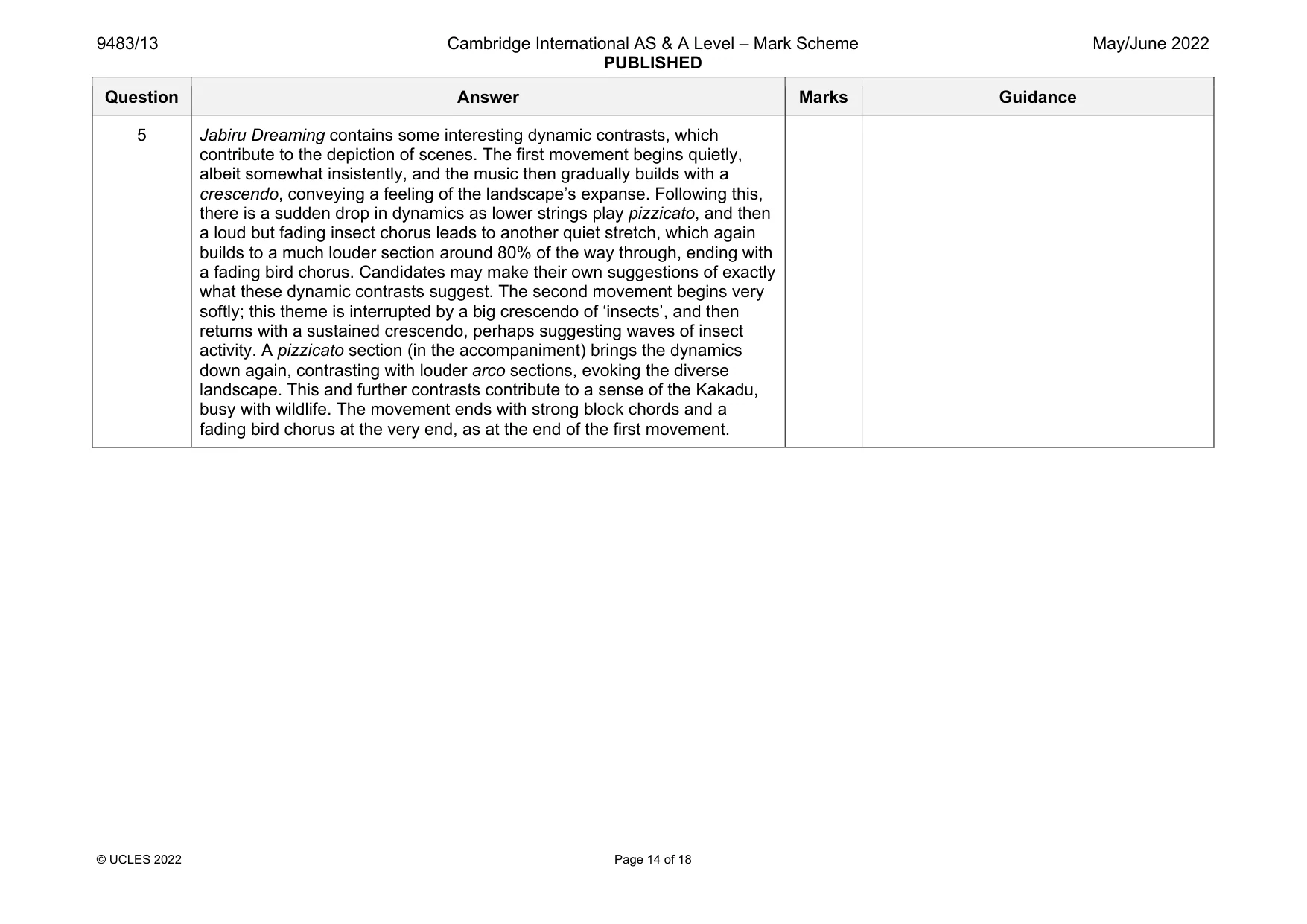
9483/13 Cambridge International AS & A Level – Mark Scheme PUBLISHED May/June 2022 © UCLES 2022 Page 14 of 18 Question Answer Marks Guidance 5 Jabiru Dreaming contains some interesting dynamic contrasts, which contribute to the depiction of scenes. The first movement begins quietly, albeit somewhat insistently, and the music then gradually builds with a crescendo, conveying a feeling of the landscape’s expanse. Following this, there is a sudden drop in dynamics as lower strings play pizzicato, and then a loud but fading insect chorus leads to another quiet stretch, which again builds to a much louder section around 80% of the way through, ending with a fading bird chorus. Candidates may make their own suggestions of exactly what these dynamic contrasts suggest. The second movement begins very softly; this theme is interrupted by a big crescendo of ‘insects’, and then returns with a sustained crescendo, perhaps suggesting waves of insect activity. A pizzicato section (in the accompaniment) brings the dynamics down again, contrasting with louder arco sections, evoking the diverse landscape. This and further contrasts contribute to a sense of the Kakadu, busy with wildlife. The movement ends with strong block chords and a fading bird chorus at the very end, as at the end of the first movement.
Mark scheme, page 15
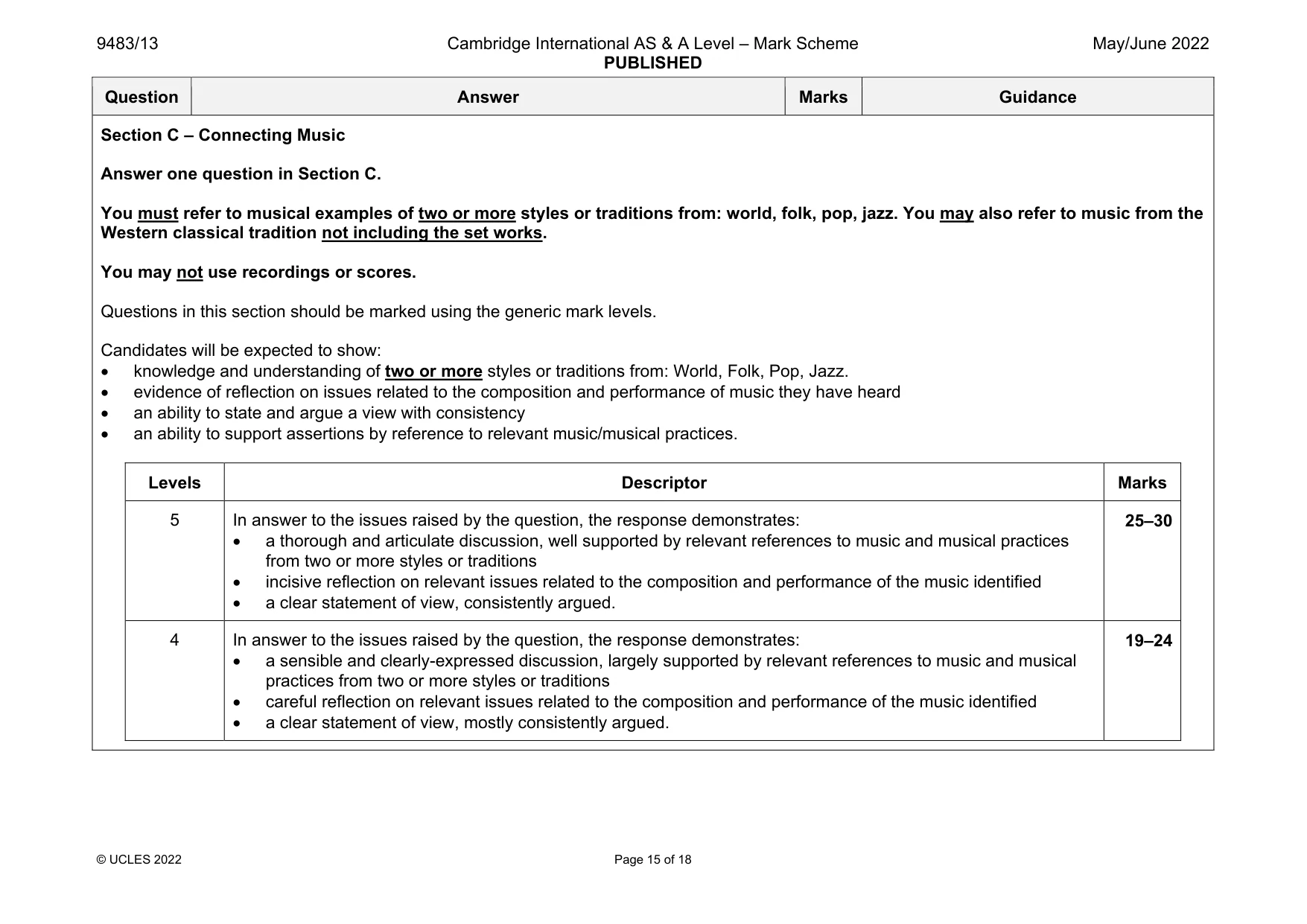
9483/13 Cambridge International AS & A Level – Mark Scheme PUBLISHED May/June 2022 © UCLES 2022 Page 15 of 18 Question Answer Marks Guidance Section C – Connecting Music Answer one question in Section C. You must refer to musical examples of two or more styles or traditions from: world, folk, pop, jazz. You may also refer to music from the Western classical tradition not including the set works. You may not use recordings or scores. Questions in this section should be marked using the generic mark levels. Candidates will be expected to show: knowledge and understanding of two or more styles or traditions from: World, Folk, Pop, Jazz. evidence of reflection on issues related to the composition and performance of music they have heard an ability to state and argue a view with consistency an ability to support assertions by reference to relevant music/musical practices. Levels Descriptor Marks 5 In answer to the issues raised by the question, the response demonstrates: a thorough and articulate discussion, well supported by relevant references to music and musical practices from two or more styles or traditions incisive reflection on relevant issues related to the composition and performance of the music identified a clear statement of view, consistently argued. 25–30 4 In answer to the issues raised by the question, the response demonstrates: a sensible and clearly-expressed discussion, largely supported by relevant references to music and musical practices from two or more styles or traditions careful reflection on relevant issues related to the composition and performance of the music identified a clear statement of view, mostly consistently argued. 19–24
Mark scheme, page 16
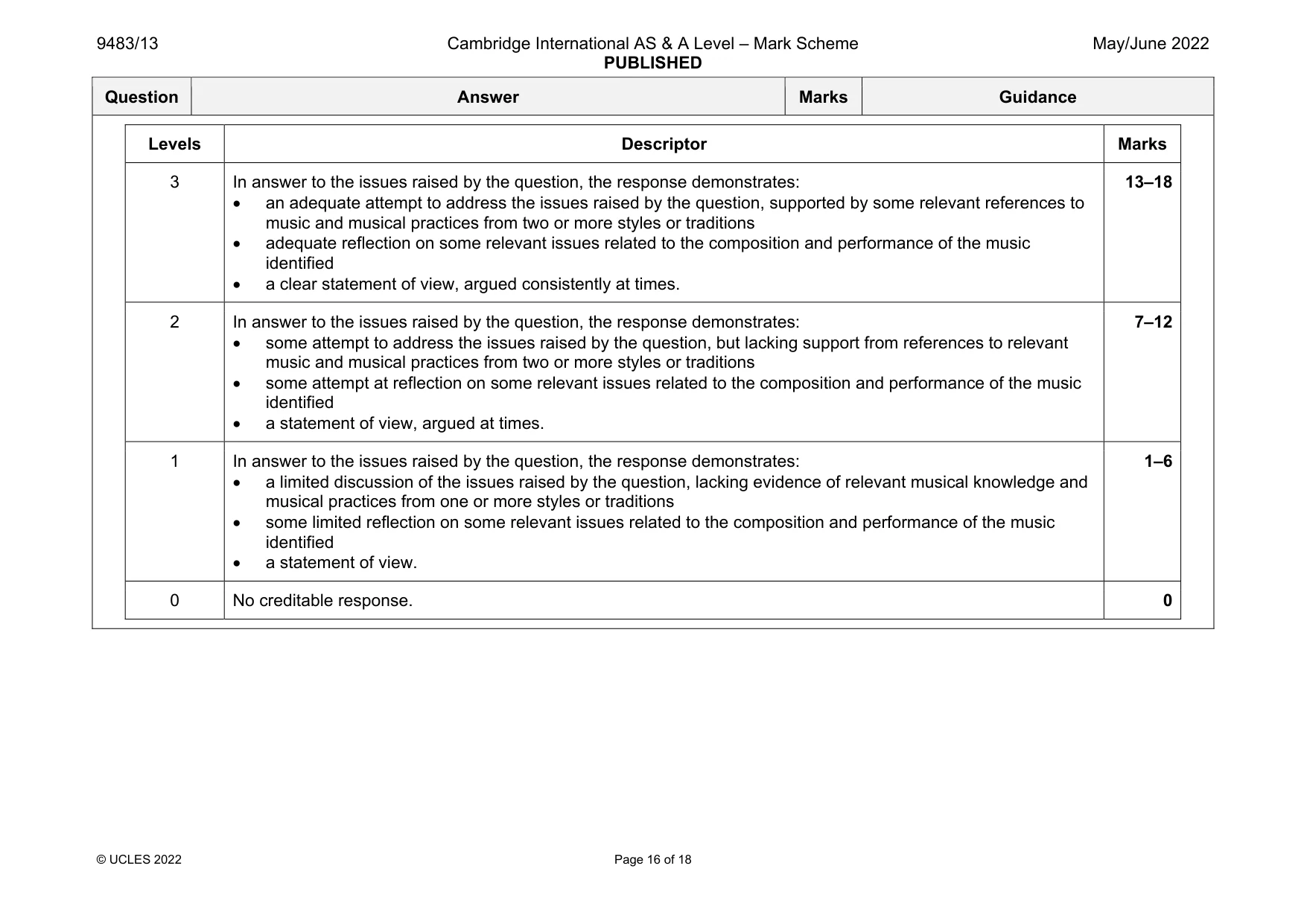
9483/13 Cambridge International AS & A Level – Mark Scheme PUBLISHED May/June 2022 © UCLES 2022 Page 16 of 18 Question Answer Marks Guidance Levels Descriptor Marks 3 In answer to the issues raised by the question, the response demonstrates: an adequate attempt to address the issues raised by the question, supported by some relevant references to music and musical practices from two or more styles or traditions adequate reflection on some relevant issues related to the composition and performance of the music identified a clear statement of view, argued consistently at times. 13–18 2 In answer to the issues raised by the question, the response demonstrates: some attempt to address the issues raised by the question, but lacking support from references to relevant music and musical practices from two or more styles or traditions some attempt at reflection on some relevant issues related to the composition and performance of the music identified a statement of view, argued at times. 7–12 1 In answer to the issues raised by the question, the response demonstrates: a limited discussion of the issues raised by the question, lacking evidence of relevant musical knowledge and musical practices from one or more styles or traditions some limited reflection on some relevant issues related to the composition and performance of the music identified a statement of view. 1–6 0 No creditable response. 0
Mark scheme, page 17
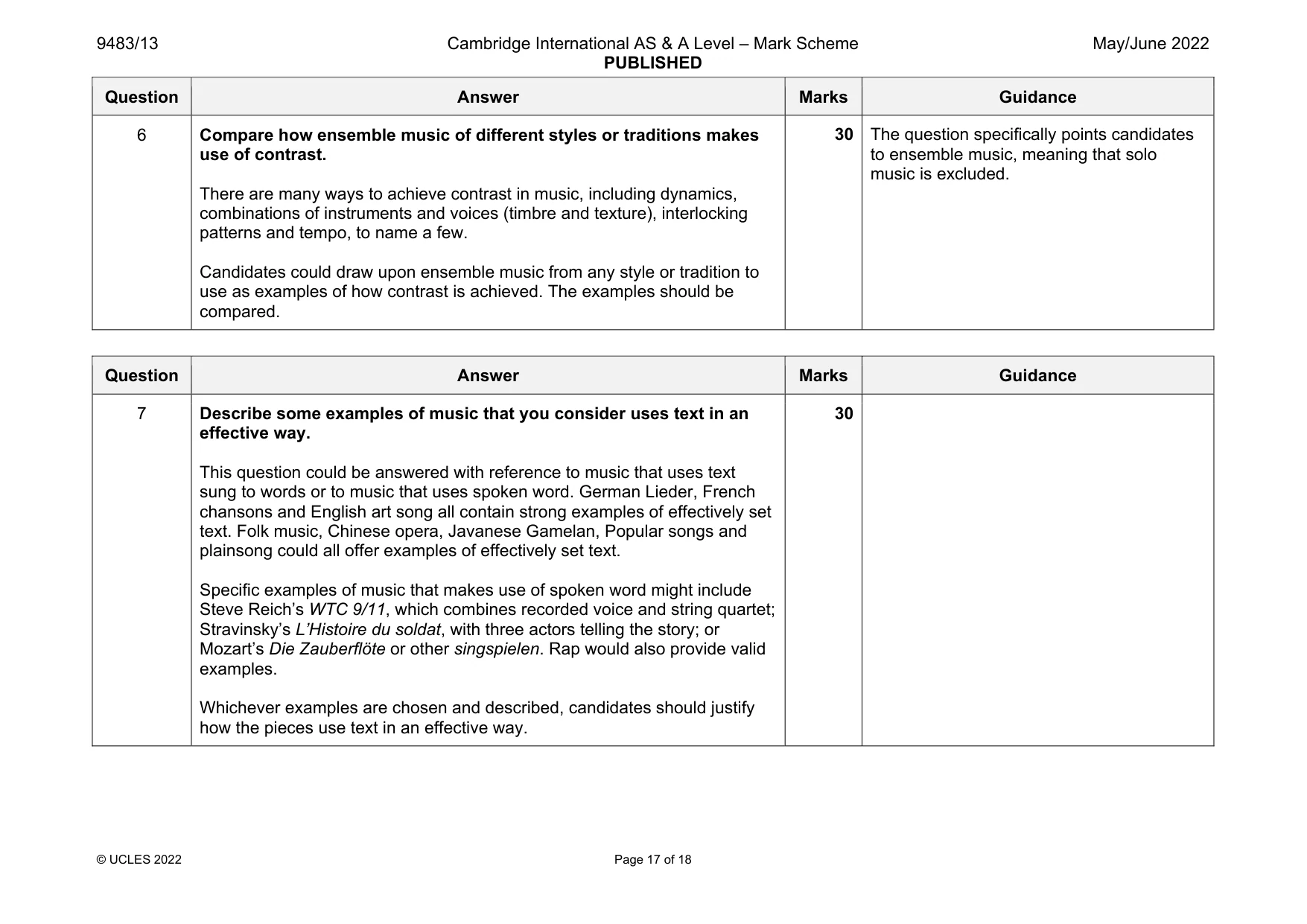
9483/13 Cambridge International AS & A Level – Mark Scheme PUBLISHED May/June 2022 © UCLES 2022 Page 17 of 18 Question Answer Marks Guidance 6 Compare how ensemble music of different styles or traditions makes use of contrast. There are many ways to achieve contrast in music, including dynamics, combinations of instruments and voices (timbre and texture), interlocking patterns and tempo, to name a few. Candidates could draw upon ensemble music from any style or tradition to use as examples of how contrast is achieved. The examples should be compared. 30 The question specifically points candidates to ensemble music, meaning that solo music is excluded. Question Answer Marks Guidance 7 Describe some examples of music that you consider uses text in an effective way. This question could be answered with reference to music that uses text sung to words or to music that uses spoken word. German Lieder, French chansons and English art song all contain strong examples of effectively set text. Folk music, Chinese opera, Javanese Gamelan, Popular songs and plainsong could all offer examples of effectively set text. Specific examples of music that makes use of spoken word might include Steve Reich’s WTC 9/11, which combines recorded voice and string quartet; Stravinsky’s L’Histoire du soldat, with three actors telling the story; or Mozart’s Die Zauberflöte or other singspielen. Rap would also provide valid examples. Whichever examples are chosen and described, candidates should justify how the pieces use text in an effective way. 30
Mark scheme, page 18
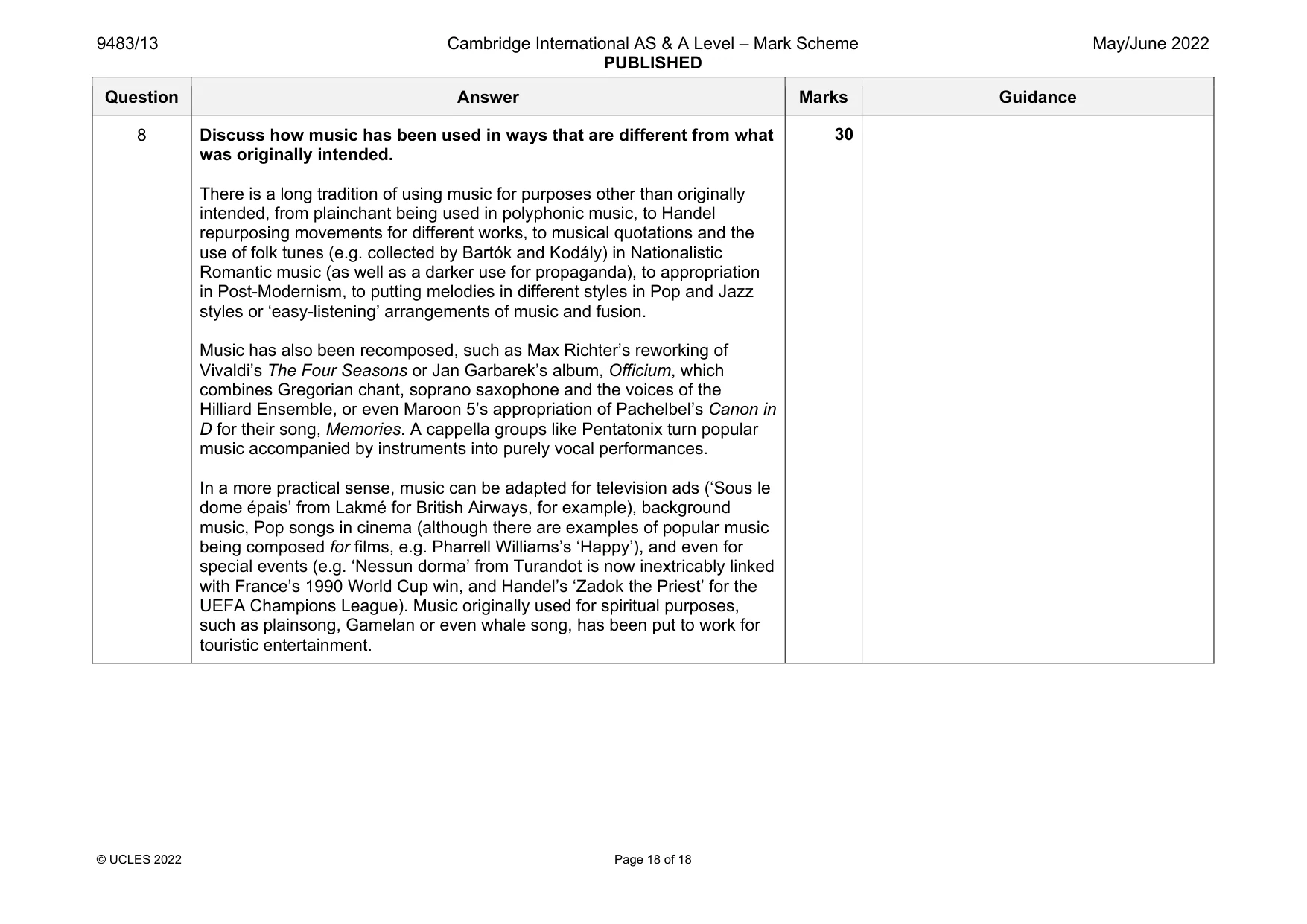
9483/13 Cambridge International AS & A Level – Mark Scheme PUBLISHED May/June 2022 © UCLES 2022 Page 18 of 18 Question Answer Marks Guidance 8 Discuss how music has been used in ways that are different from what was originally intended. There is a long tradition of using music for purposes other than originally intended, from plainchant being used in polyphonic music, to Handel repurposing movements for different works, to musical quotations and the use of folk tunes (e.g. collected by Bartók and Kodály) in Nationalistic Romantic music (as well as a darker use for propaganda), to appropriation in Post-Modernism, to putting melodies in different styles in Pop and Jazz styles or ‘easy-listening’ arrangements of music and fusion. Music has also been recomposed, such as Max Richter’s reworking of Vivaldi’s The Four Seasons or Jan Garbarek’s album, Officium, which combines Gregorian chant, soprano saxophone and the voices of the Hilliard Ensemble, or even Maroon 5’s appropriation of Pachelbel’s Canon in D for their song, Memories. A cappella groups like Pentatonix turn popular music accompanied by instruments into purely vocal performances. In a more practical sense, music can be adapted for television ads (‘Sous le dome épais’ from Lakmé for British Airways, for example), background music, Pop songs in cinema (although there are examples of popular music being composed for films, e.g. Pharrell Williams’s ‘Happy’), and even for special events (e.g. ‘Nessun dorma’ from Turandot is now inextricably linked with France’s 1990 World Cup win, and Handel’s ‘Zadok the Priest’ for the UEFA Champions League). Music originally used for spiritual purposes, such as plainsong, Gamelan or even whale song, has been put to work for touristic entertainment. 30
What you needed in this session
Cambridge’s own grade thresholds for 2022 May/June, Paper 1 · Variant 3. A higher threshold means an easier paper — the bar moves with how the cohort did.