Cambridge A Level Media Studies 9607 — 2020 Oct/Nov Paper 2 · Variant 0
9607/20/O/N/20
The question paper and its mark scheme, free to read here and free to download. This is Cambridge’s own paper, exactly as it was sat.
Question paper4 pages
Mark scheme
No mark scheme is in the library for this paper.
Paper as text
Question paper, page 1
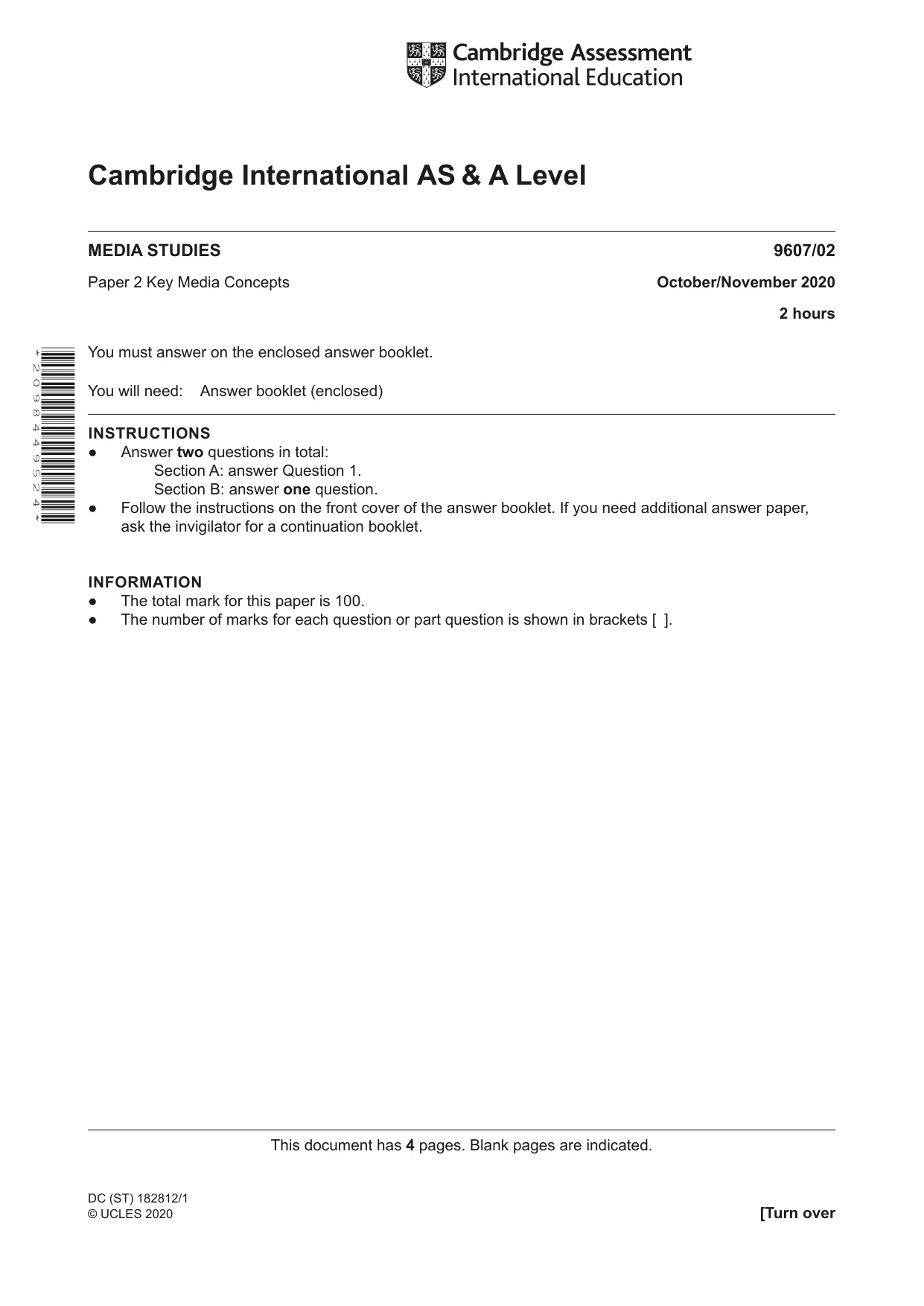
Cambridge International AS & A Level DC (ST) 182812/1 © UCLES 2020 [Turn over This document has 4 pages. Blank pages are indicated. MEDIA STUDIES 9607/02 Paper 2 Key Media Concepts October/November 2020 2 hours You must answer on the enclosed answer booklet. You will need: Answer booklet (enclosed) INSTRUCTIONS ● Answer two questions in total: Section A: answer Question 1. Section B: answer one question. ● Follow the instructions on the front cover of the answer booklet. If you need additional answer paper, ask the invigilator for a continuation booklet. INFORMATION ● The total mark for this paper is 100. ● The number of marks for each question or part question is shown in brackets [ ]. * 2 0 9 8 4 4 9 5 2 4 *
Question paper, page 2
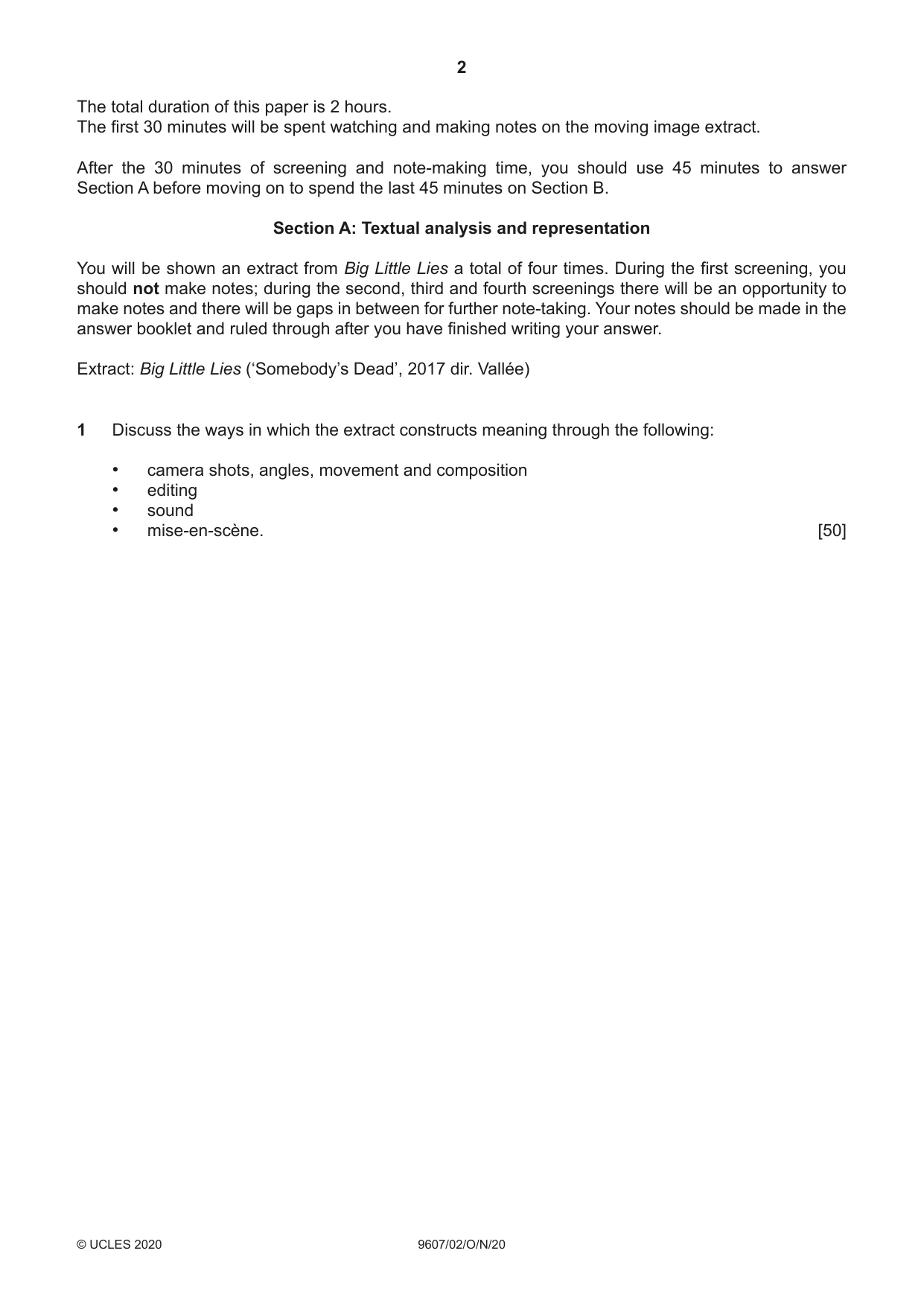
2 9607/02/O/N/20 © UCLES 2020 The total duration of this paper is 2 hours. The first 30 minutes will be spent watching and making notes on the moving image extract. After the 30 minutes of screening and note-making time, you should use 45 minutes to answer Section A before moving on to spend the last 45 minutes on Section B. Section A: Textual analysis and representation You will be shown an extract from Big Little Lies a total of four times. During the first screening, you should not make notes; during the second, third and fourth screenings there will be an opportunity to make notes and there will be gaps in between for further note-taking. Your notes should be made in the answer booklet and ruled through after you have finished writing your answer. Extract: Big Little Lies (‘Somebody’s Dead’, 2017 dir. Vallée) 1 Discuss the ways in which the extract constructs meaning through the following: • camera shots, angles, movement and composition • editing • sound • mise-en-scène. [50]
Question paper, page 3
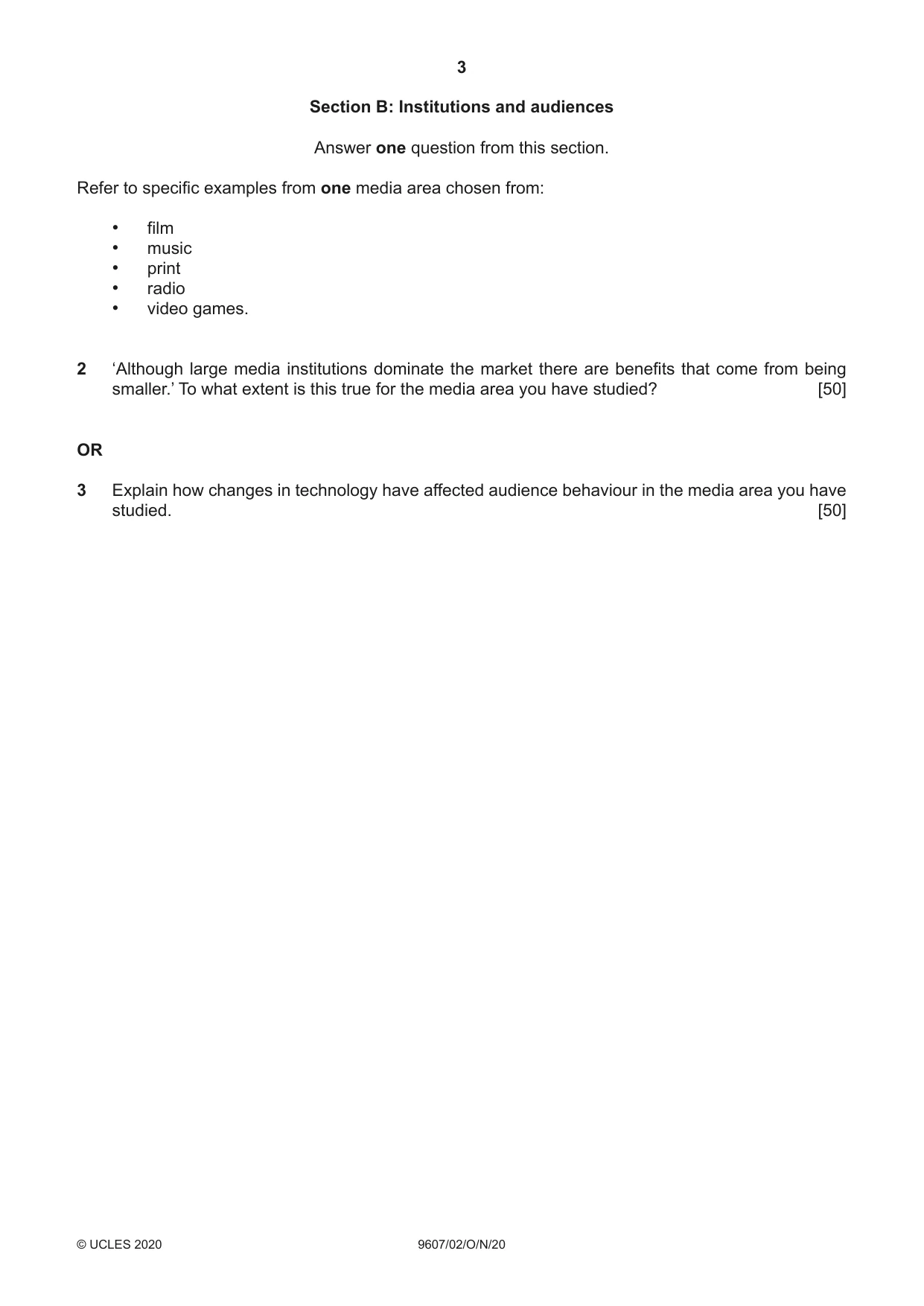
3 9607/02/O/N/20 © UCLES 2020 Section B: Institutions and audiences Answer one question from this section. Refer to specific examples from one media area chosen from: • film • music • print • radio • video games. 2 ‘Although large media institutions dominate the market there are benefits that come from being smaller.’ To what extent is this true for the media area you have studied? [50] OR 3 Explain how changes in technology have affected audience behaviour in the media area you have studied. [50]
Question paper, page 4
4 9607/02/O/N/20 © UCLES 2020 Permission to reproduce items where third-party owned material protected by copyright is included has been sought and cleared where possible. Every reasonable effort has been made by the publisher (UCLES) to trace copyright holders, but if any items requiring clearance have unwittingly been included, the publisher will be pleased to make amends at the earliest possible opportunity. To avoid the issue of disclosure of answer-related information to candidates, all copyright acknowledgements are reproduced online in the Cambridge Assessment International Education Copyright Acknowledgements Booklet. This is produced for each series of examinations and is freely available to download at www.cambridgeinternational.org after the live examination series. Cambridge Assessment International Education is part of the Cambridge Assessment Group. Cambridge Assessment is the brand name of the University of Cambridge Local Examinations Syndicate (UCLES), which itself is a department of the University of Cambridge. BLANK PAGE