Cambridge A Level Mathematics - Further 9231 — 2018 Oct/Nov Paper 2 · Variant 2
9231/22/O/N/18 · 100 marks · ≈113 min
The question paper and its mark scheme, free to read here and free to download. This is Cambridge’s own paper, exactly as it was sat.
Question paper24 pages











Mark scheme14 pages
Answers below. Sit the paper first if you are practising.
Paper as text
Question paper, page 1
*9415179200* Cambridge International Examinations Cambridge International Advanced Level CANDIDATE NAME CENTRE NUMBER CANDIDATE NUMBER FURTHER MATHEMATICS 9231/22 Paper 2 October/November 2018 3 hours Candidates answer on the Question Paper. Additional Materials: List of Formulae (MF10) READ THESE INSTRUCTIONS FIRST Write your Centre number, candidate number and name in the spaces at the top of this page. Write in dark blue or black pen. You may use an HB pencil for any diagrams or graphs. Do not use staples, paper clips, glue or correction fluid. DO NOT WRITE IN ANY BARCODES. Answer all the questions in the space provided. If additional space is required, you should use the lined page at the end of this booklet. The question number(s) must be clearly shown. Give non-exact numerical answers correct to 3 significant figures, or 1 decimal place in the case of angles in degrees, unless a different level of accuracy is specified in the question. Where a numerical value is necessary, take the acceleration due to gravity to be 10 m s−2. The use of a calculator is expected, where appropriate. Results obtained solely from a graphic calculator, without supporting working or reasoning, will not receive credit. You are reminded of the need for clear presentation in your answers. At the end of the examination, fasten all your work securely together. The number of marks is given in brackets [ ] at the end of each question or part question. This document consists of 22 printed pages and 2 blank pages. JC18 11_9231_22/RP © UCLES 2018 [Turn over
Question paper, page 2
2 1 The point O is on the fixed horizontal line l. Points A and B on l are such that OA = 0.1 m and OB = 0.5 m, with A between O and B. A particle P oscillates on l in simple harmonic motion with centre O. The kinetic energy of P when it is at A is twice its kinetic energy when it is at B. Find the amplitude of the motion. [3] … … … … … … … … … … … 2 Two uniform small smooth spheres A and B have equal radii and masses 2m and m respectively. Sphere A is moving with speed u on a smooth horizontal surface when it collides directly with sphere B which is at rest. The coefficient of restitution between the spheres is 2 3. (i) Find, in terms of u, the speeds of A and B after this collision. [4] … … … … … … … … … © UCLES 2018 9231/22/O/N/18
Question paper, page 3
3 Sphere B is initially at a distance d from a fixed smooth vertical wall which is perpendicular to the direction of motion of A. The coefficient of restitution between B and the wall is 1 2. (ii) Find, in terms of d and u, the time that elapses between the first and second collisions between A and B. [5] … … … … … … … … … … … … … … … … … … … … … … … © UCLES 2018 9231/22/O/N/18 [Turn over
Question paper, page 4
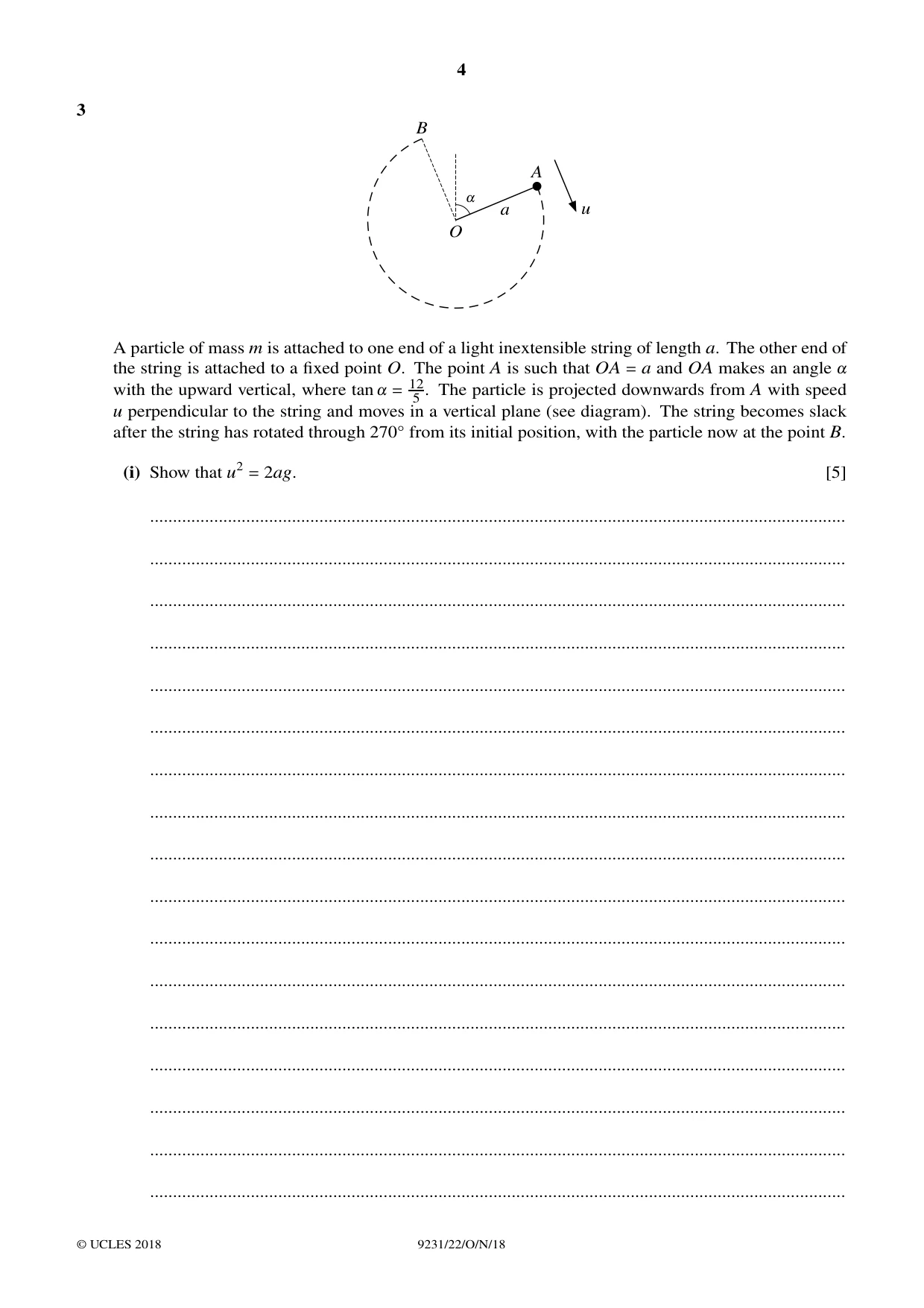
4 3 A B O a ! u A particle of mass m is attached to one end of a light inextensible string of length a. The other end of the string is attached to a fixed point O. The point A is such that OA = a and OA makes an angle ! with the upward vertical, where tan ! = 12 5 . The particle is projected downwards from A with speed u perpendicular to the string and moves in a vertical plane (see diagram). The string becomes slack after the string has rotated through 270Å from its initial position, with the particle now at the point B. (i) Show that u2 = 2ag. [5] … … … … … … … … … … … … … … … … … © UCLES 2018 9231/22/O/N/18
Question paper, page 5
5 (ii) Find the maximum tension in the string as the particle moves from A to B. [4] … … … … … … … … … … … … … … … … … … … … … … … … … © UCLES 2018 9231/22/O/N/18 [Turn over
Question paper, page 6
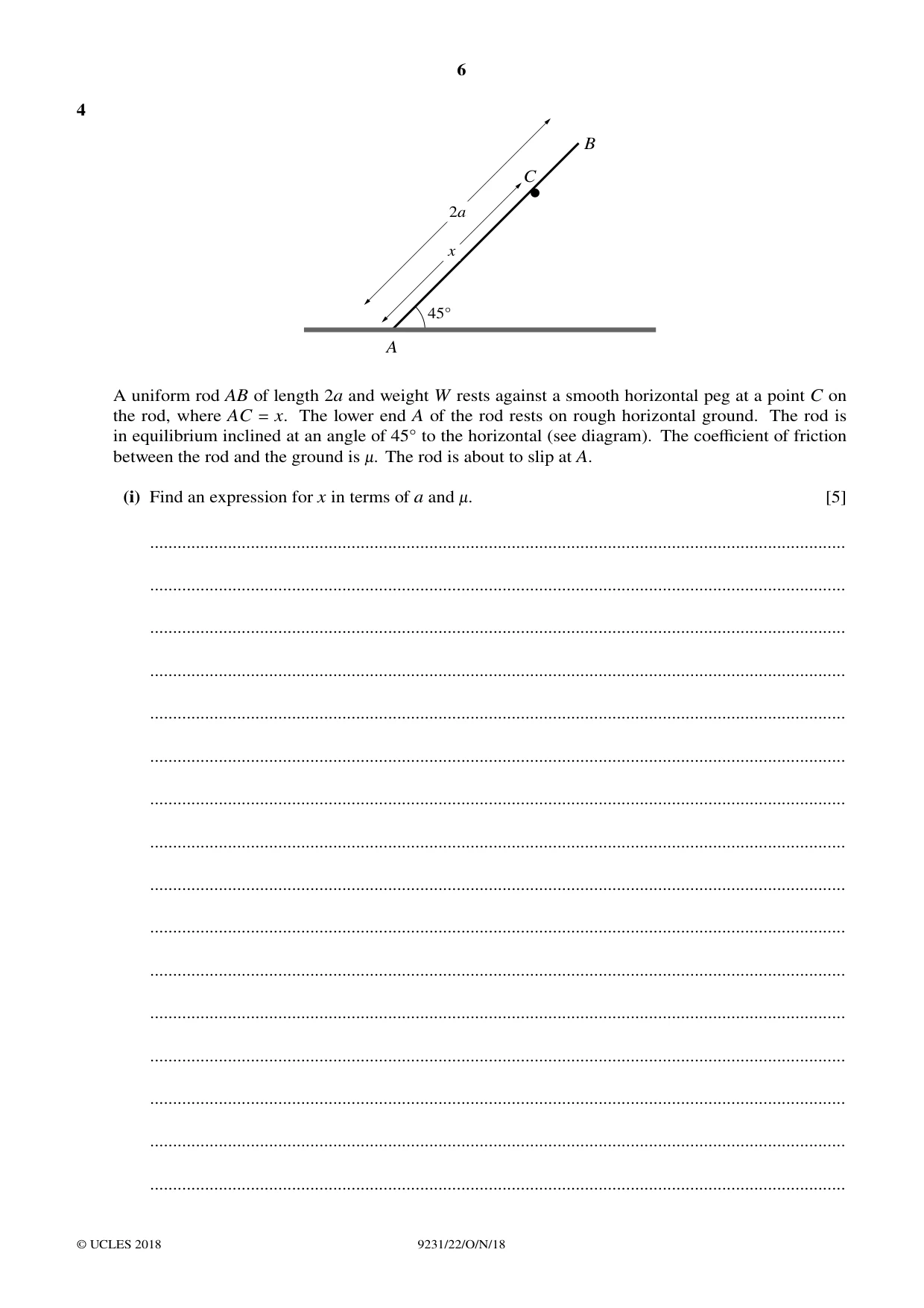
6 4 45Å A B C x 2a A uniform rod AB of length 2a and weight W rests against a smooth horizontal peg at a point C on the rod, where AC = x. The lower end A of the rod rests on rough horizontal ground. The rod is in equilibrium inclined at an angle of 45Å to the horizontal (see diagram). The coefficient of friction between the rod and the ground is -. The rod is about to slip at A. (i) Find an expression for x in terms of a and -. [5] … … … … … … … … … … … … … … … … © UCLES 2018 9231/22/O/N/18
Question paper, page 7
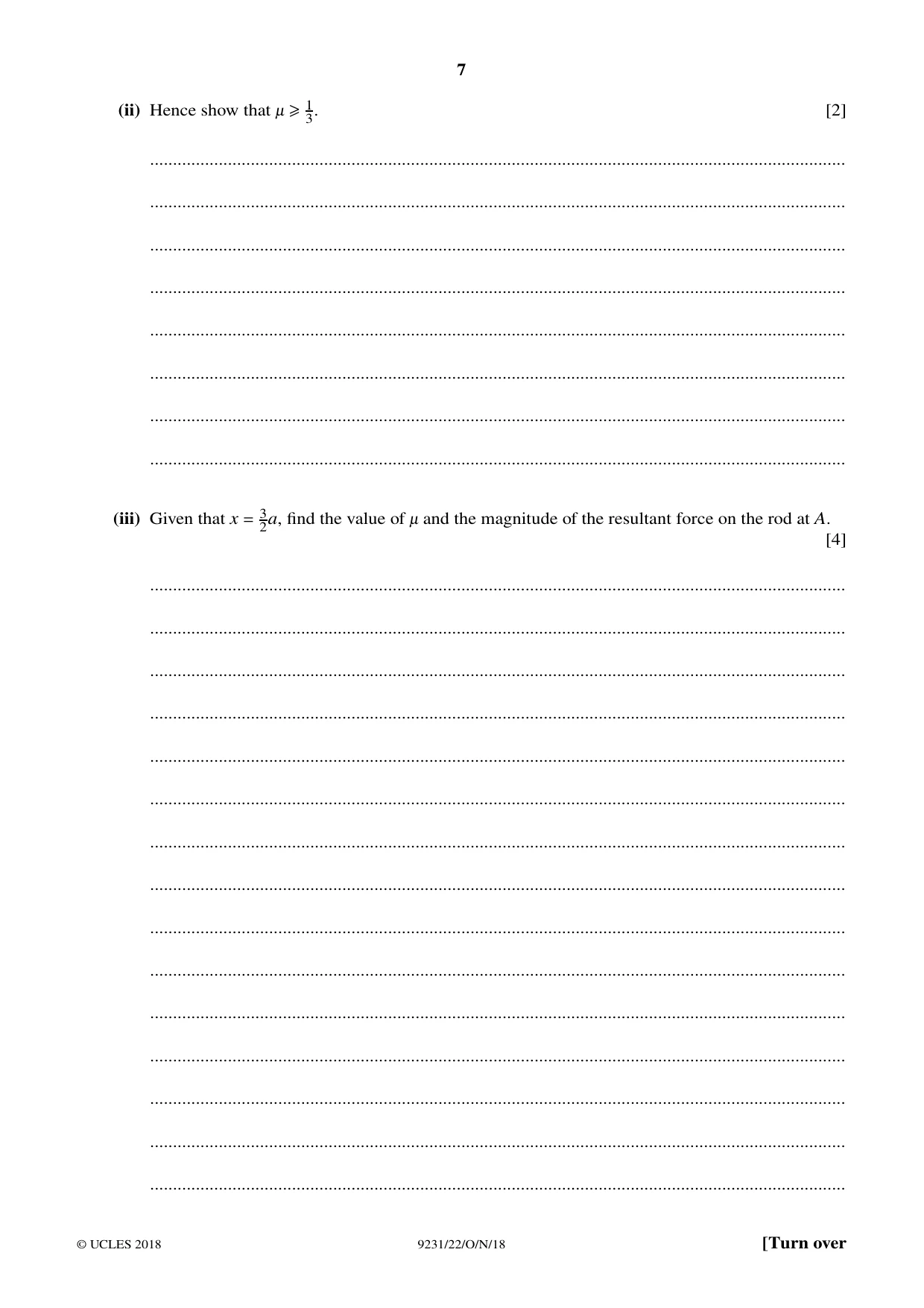
7 (ii) Hence show that - ≥1 3. [2] … … … … … … … … (iii) Given that x = 3 2a, find the value of - and the magnitude of the resultant force on the rod at A. [4] … … … … … … … … … … … … … … … © UCLES 2018 9231/22/O/N/18 [Turn over
Question paper, page 8
8 5 An object is formed from a uniform circular disc, of radius 2a and mass 3M, and a uniform rod AB, of length 3a and mass kM, where k is a constant. The centre of the disc is O. The end B of the rod is rigidly joined to a point on the circumference of the disc so that OBA is a straight line. The fixed horizontal axis l is in the plane of the object, passes through A and is perpendicular to AB. (i) Show that the moment of inertia of the object about the axis l is 3Ma226 + k. [5] … … … … … … … … … … … … … … … … … … … … … … … © UCLES 2018 9231/22/O/N/18
Question paper, page 9
9 The object is free to rotate about l. (ii) Show that small oscillations of the object about l are approximately simple harmonic. Given that the period of these oscillations is 40 O@a g A , find the value of k. [6] … … … … … … … … … … … … … … … … … … … … … … … © UCLES 2018 9231/22/O/N/18 [Turn over
Question paper, page 10
10 6 The heights, in metres, of a random sample of 8 trees of a particular type are as follows. 14.2 11.3 10.8 8.4 12.8 11.5 12.1 9.2 Assuming that heights of trees of this type are normally distributed, calculate a 95% confidence interval for the mean height of trees of this type. [6] … … … … … … … … … … … … … … … … … … … … … … … © UCLES 2018 9231/22/O/N/18
Question paper, page 11
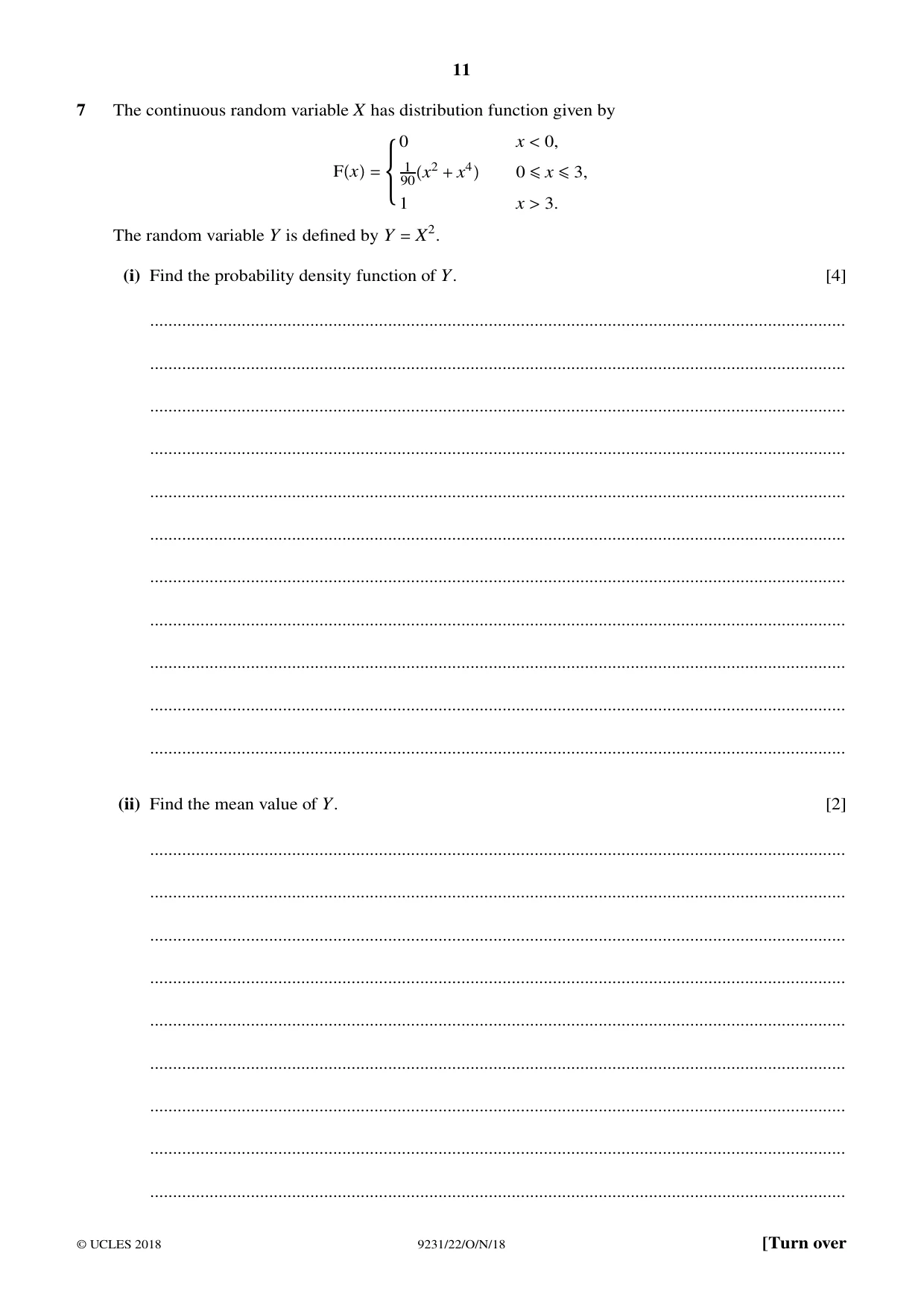
11 7 The continuous random variable X has distribution function given by Fx = t 0 x < 0, 1 90x2 + x4 0 ≤x ≤3, 1 x > 3. The random variable Y is defined by Y = X2. (i) Find the probability density function of Y. [4] … … … … … … … … … … … (ii) Find the mean value of Y. [2] … … … … … … … … … © UCLES 2018 9231/22/O/N/18 [Turn over
Question paper, page 12
12 8 Lan starts a new job on Monday. He will catch the bus to work every day from Monday to Friday inclusive. The probability that he will get a seat on the bus has the constant value p. The random variable X denotes the number of days that Lan will catch the bus until he is able to get a seat. The probability that Lan will not get a seat on the Monday, Tuesday, Wednesday or Thursday of his first week is 0.4096. (i) Show that p = 0.2. [2] … … … … … … … … … (ii) Find the probability that Lan first gets a seat on Monday of the second week in his new job. [2] … … … … … … … … … … … … © UCLES 2018 9231/22/O/N/18
Question paper, page 13
13 (iii) Find the least integer N such that PX ≤N > 0.9, and identify the day and the week that corresponds to this value of N. [4] … … … … … … … … … … … … … … … … … … … … … … … … … © UCLES 2018 9231/22/O/N/18 [Turn over
Question paper, page 14
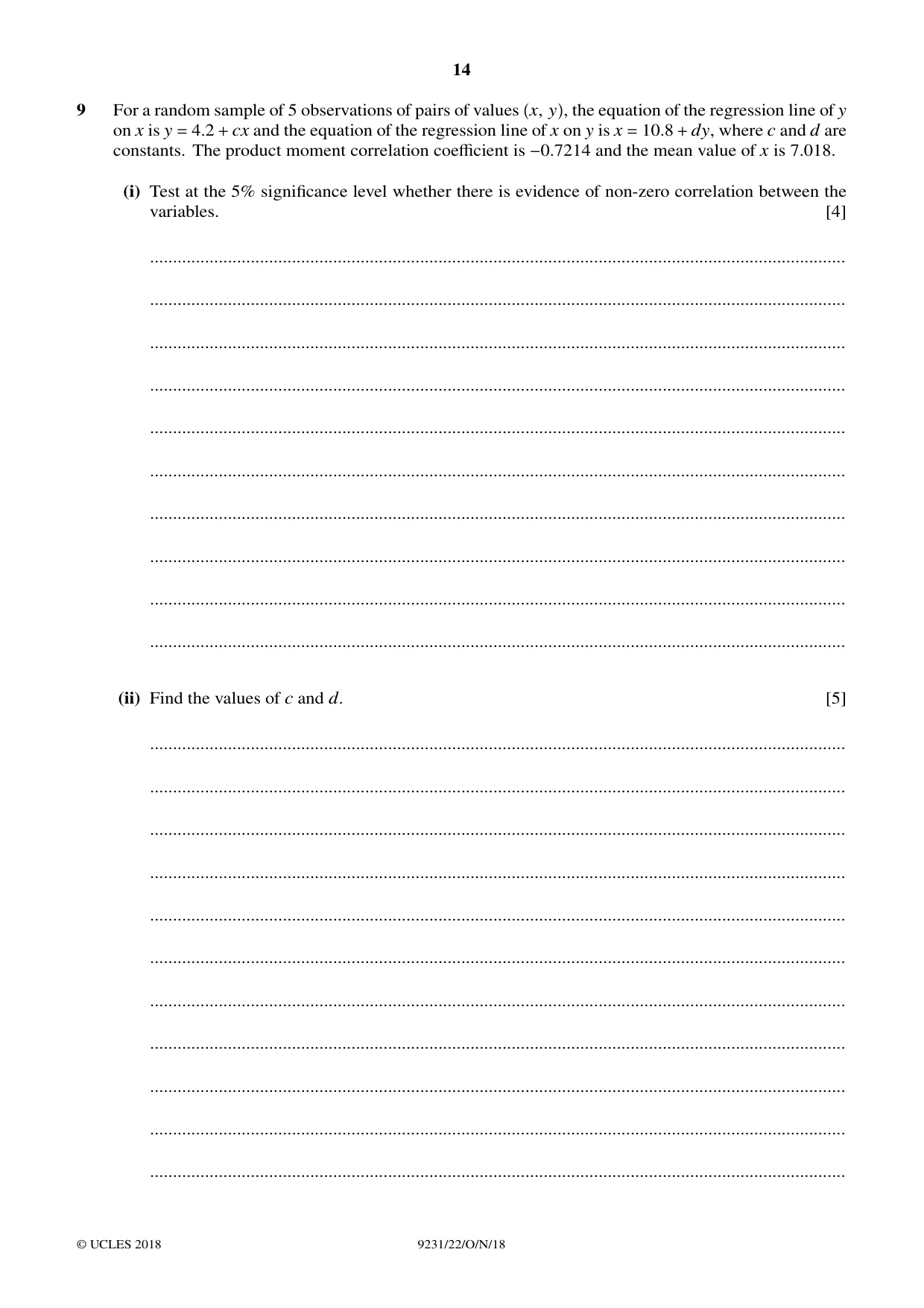
14 9 For a random sample of 5 observations of pairs of values x, y, the equation of the regression line of y on x is y = 4.2 + cx and the equation of the regression line of x on y is x = 10.8 + dy, where c and d are constants. The product moment correlation coefficient is −0.7214 and the mean value of x is 7.018. (i) Test at the 5% significance level whether there is evidence of non-zero correlation between the variables. [4] … … … … … … … … … … (ii) Find the values of c and d. [5] … … … … … … … … … … … © UCLES 2018 9231/22/O/N/18
Question paper, page 15
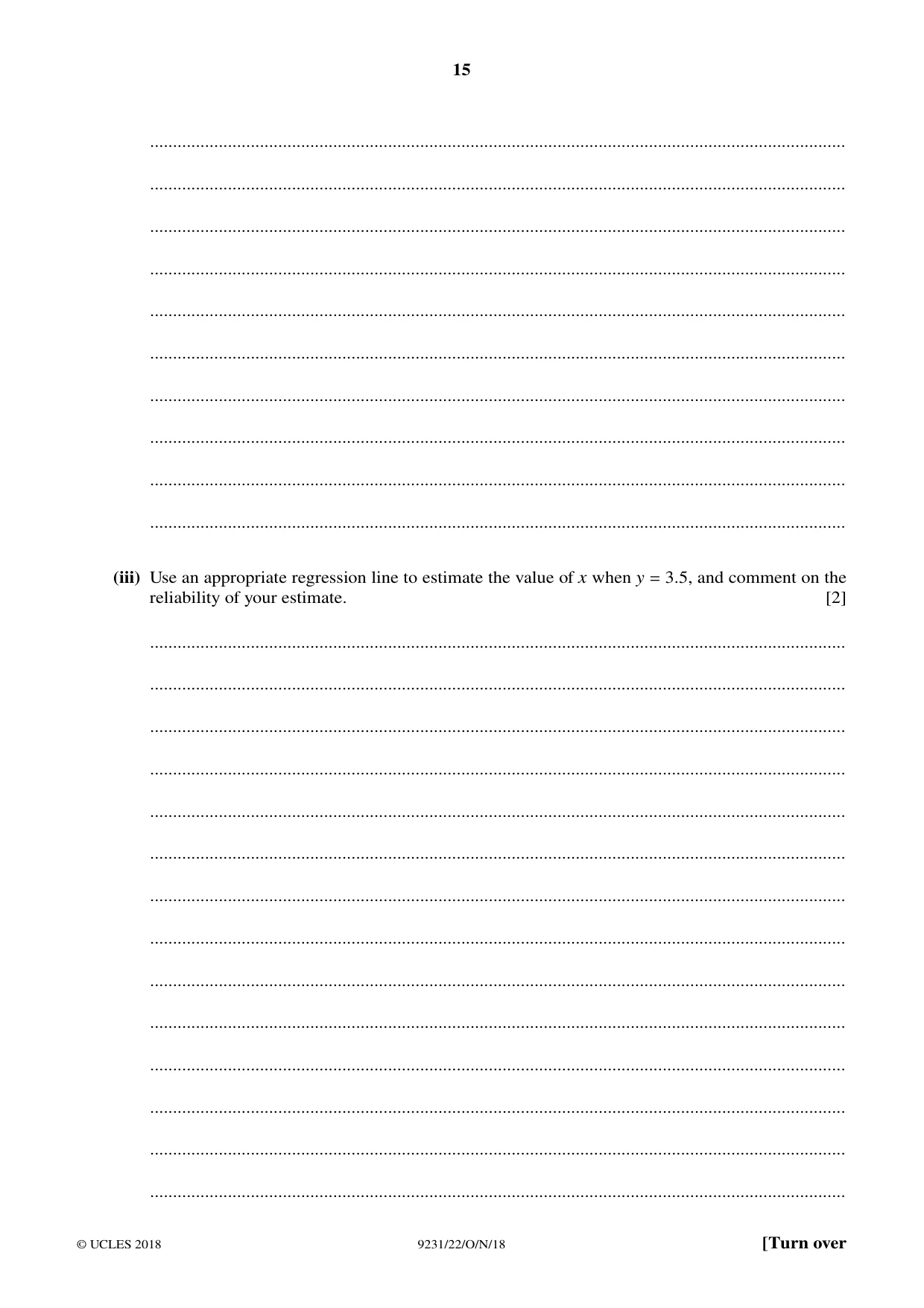
15 … … … … … … … … … … (iii) Use an appropriate regression line to estimate the value of x when y = 3.5, and comment on the reliability of your estimate. [2] … … … … … … … … … … … … … … © UCLES 2018 9231/22/O/N/18 [Turn over
Question paper, page 16
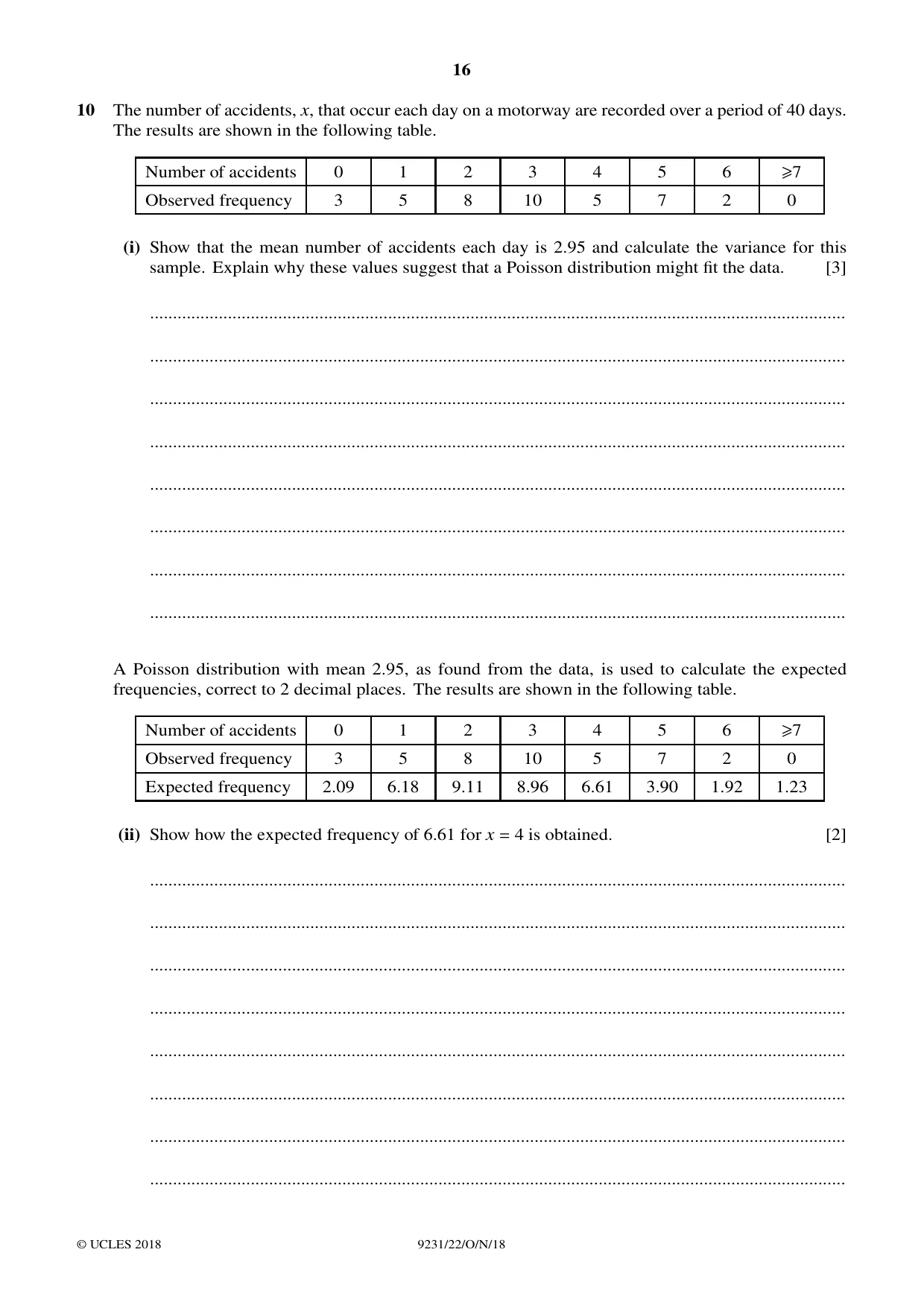
16 10 The number of accidents, x, that occur each day on a motorway are recorded over a period of 40 days. The results are shown in the following table. Number of accidents 0 1 2 3 4 5 6 ≥7 Observed frequency 3 5 8 10 5 7 2 0 (i) Show that the mean number of accidents each day is 2.95 and calculate the variance for this sample. Explain why these values suggest that a Poisson distribution might fit the data. [3] … … … … … … … … A Poisson distribution with mean 2.95, as found from the data, is used to calculate the expected frequencies, correct to 2 decimal places. The results are shown in the following table. Number of accidents 0 1 2 3 4 5 6 ≥7 Observed frequency 3 5 8 10 5 7 2 0 Expected frequency 2.09 6.18 9.11 8.96 6.61 3.90 1.92 1.23 (ii) Show how the expected frequency of 6.61 for x = 4 is obtained. [2] … … … … … … … … © UCLES 2018 9231/22/O/N/18
Question paper, page 17
17 (iii) Test at the 5% significance level the goodness of fit of this Poisson distribution to the data. [7] … … … … … … … … … … … … … … … … … … … … … … … … … © UCLES 2018 9231/22/O/N/18 [Turn over
Question paper, page 18
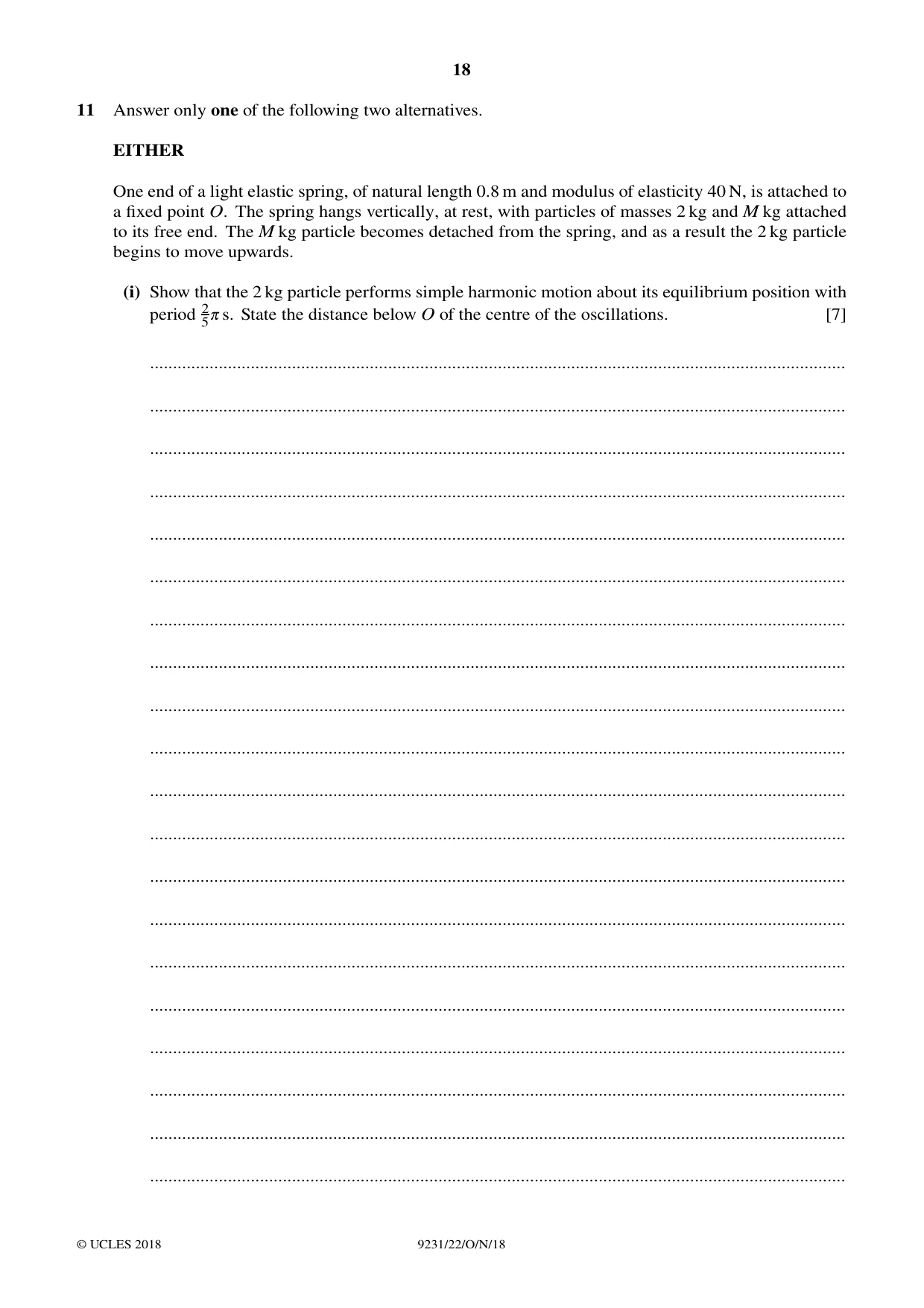
18 11 Answer only one of the following two alternatives. EITHER One end of a light elastic spring, of natural length 0.8 m and modulus of elasticity 40 N, is attached to a fixed point O. The spring hangs vertically, at rest, with particles of masses 2 kg and M kg attached to its free end. The M kg particle becomes detached from the spring, and as a result the 2 kg particle begins to move upwards. (i) Show that the 2 kg particle performs simple harmonic motion about its equilibrium position with period 2 50 s. State the distance below O of the centre of the oscillations. [7] … … … … … … … … … … … … … … … … … … … … © UCLES 2018 9231/22/O/N/18
Question paper, page 19
19 The speed of the 2 kg particle is 0.4 m s−1 when its displacement from the centre of oscillation is 0.06 m. (ii) Find the amplitude of the motion. [3] … … … … … … … … (iii) Deduce the value of M. [4] … … … … … … … … … … … … … … © UCLES 2018 9231/22/O/N/18 [Turn over
Question paper, page 20
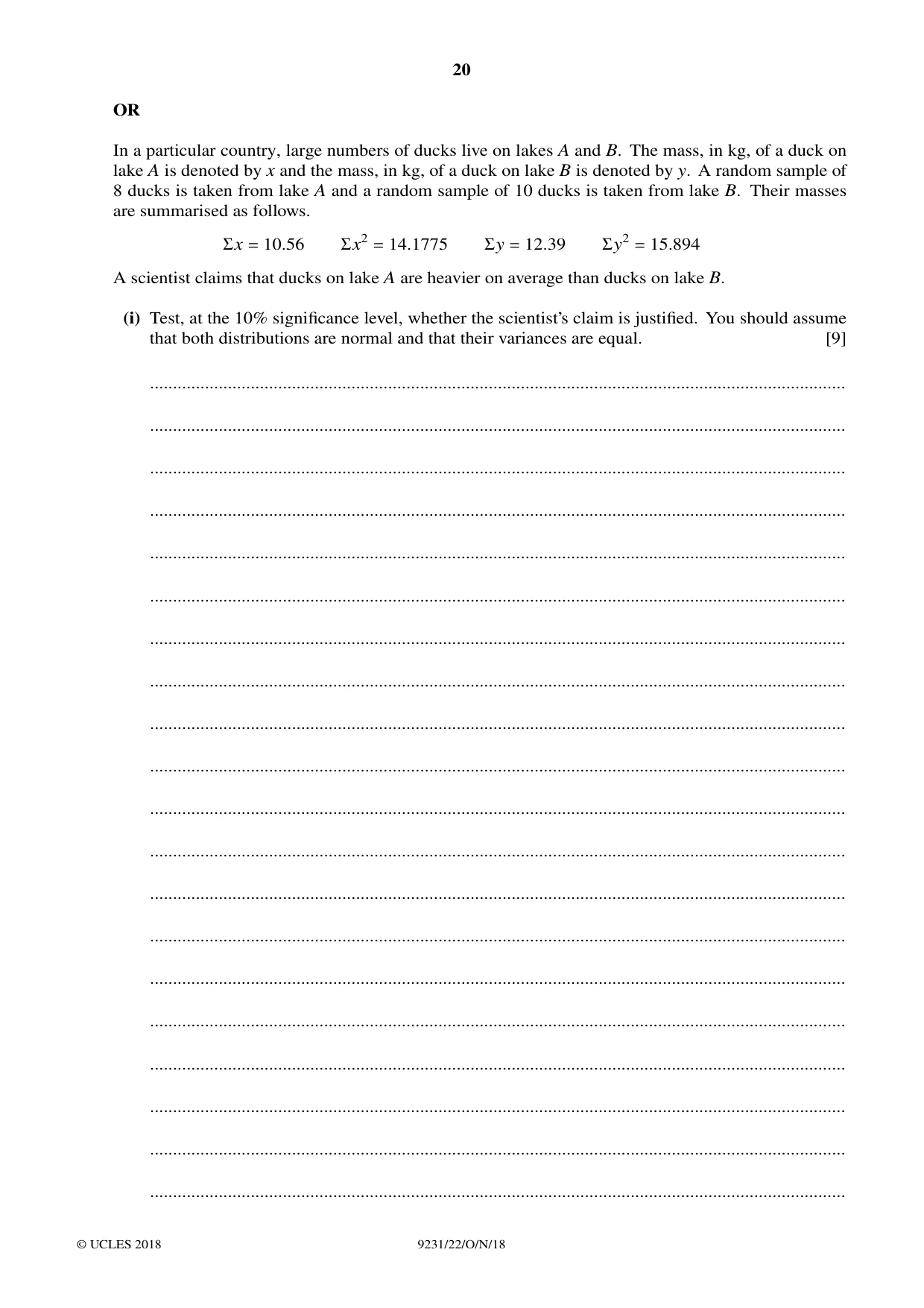
20 OR In a particular country, large numbers of ducks live on lakes A and B. The mass, in kg, of a duck on lake A is denoted by x and the mass, in kg, of a duck on lake B is denoted by y. A random sample of 8 ducks is taken from lake A and a random sample of 10 ducks is taken from lake B. Their masses are summarised as follows. Σx = 10.56 Σx2 = 14.1775 Σy = 12.39 Σy2 = 15.894 A scientist claims that ducks on lake A are heavier on average than ducks on lake B. (i) Test, at the 10% significance level, whether the scientist’s claim is justified. You should assume that both distributions are normal and that their variances are equal. [9] … … … … … … … … … … … … … … … … … … … … © UCLES 2018 9231/22/O/N/18
Question paper, page 21
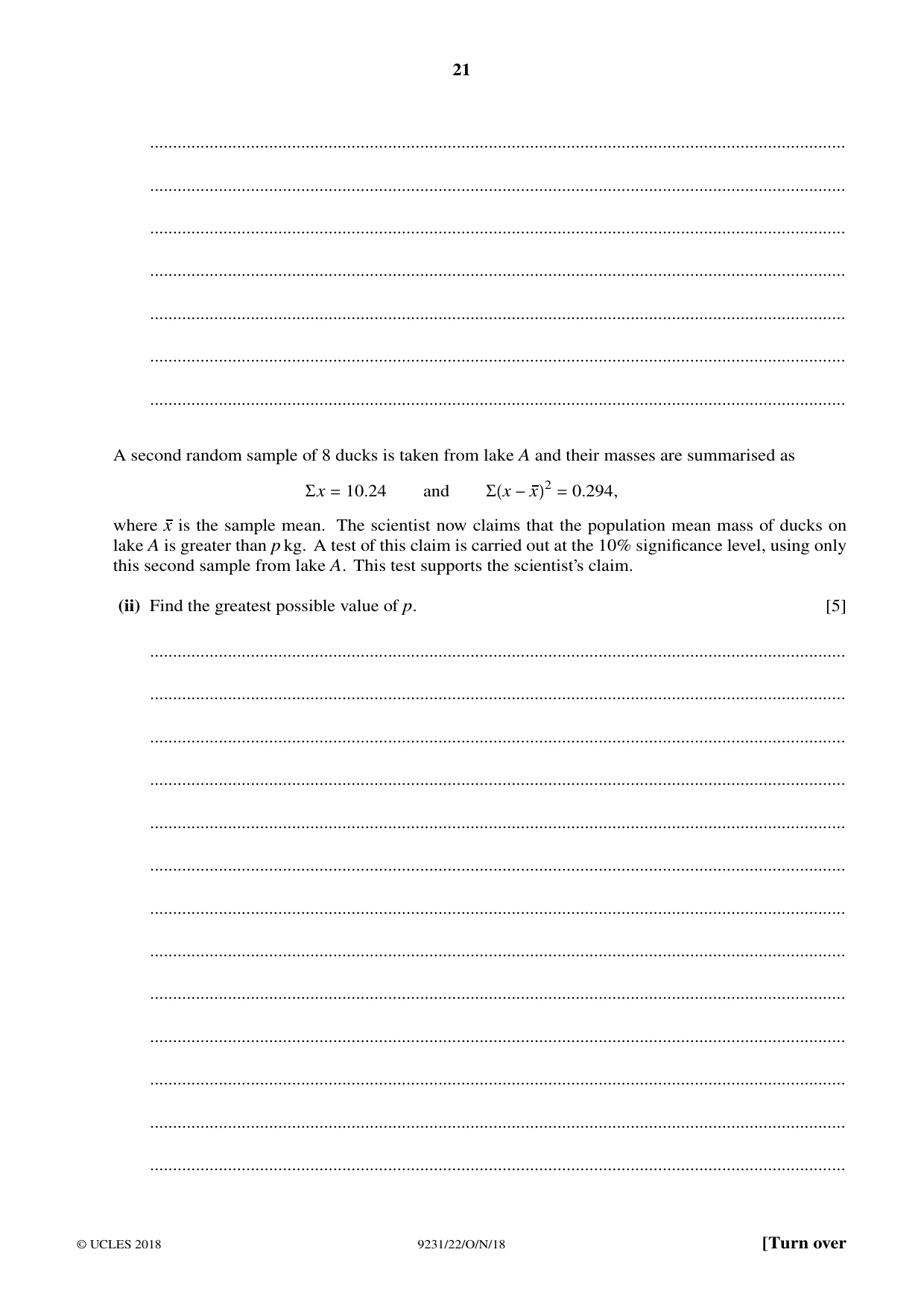
21 … … … … … … … A second random sample of 8 ducks is taken from lake A and their masses are summarised as Σx = 10.24 and Σx −x2 = 0.294, where x is the sample mean. The scientist now claims that the population mean mass of ducks on lake A is greater than p kg. A test of this claim is carried out at the 10% significance level, using only this second sample from lake A. This test supports the scientist’s claim. (ii) Find the greatest possible value of p. [5] … … … … … … … … … … … … … © UCLES 2018 9231/22/O/N/18 [Turn over
Question paper, page 22
22 Additional Page If you use the following lined page to complete the answer(s) to any question(s), the question number(s) must be clearly shown. … … … … … … … … … … … … … … … … … … … … … … … … © UCLES 2018 9231/22/O/N/18
Question paper, page 23
23 BLANK PAGE © UCLES 2018 9231/22/O/N/18
Question paper, page 24
24 BLANK PAGE Permission to reproduce items where third-party owned material protected by copyright is included has been sought and cleared where possible. Every reasonable effort has been made by the publisher (UCLES) to trace copyright holders, but if any items requiring clearance have unwittingly been included, the publisher will be pleased to make amends at the earliest possible opportunity. To avoid the issue of disclosure of answer-related information to candidates, all copyright acknowledgements are reproduced online in the Cambridge International Examinations Copyright Acknowledgements Booklet. This is produced for each series of examinations and is freely available to download at www.cie.org.uk after the live examination series. Cambridge International Examinations is part of the Cambridge Assessment Group. Cambridge Assessment is the brand name of University of Cambridge Local Examinations Syndicate (UCLES), which is itself a department of the University of Cambridge. © UCLES 2018 9231/22/O/N/18
Mark scheme, page 1
This document consists of 14 printed pages. © UCLES 2018 [Turn over Cambridge Assessment International Education Cambridge International Advanced Level FURTHER MATHEMATICS 9231/22 Paper 2 October/November 2018 MARK SCHEME Maximum Mark: 100 Published This mark scheme is published as an aid to teachers and candidates, to indicate the requirements of the examination. It shows the basis on which Examiners were instructed to award marks. It does not indicate the details of the discussions that took place at an Examiners’ meeting before marking began, which would have considered the acceptability of alternative answers. Mark schemes should be read in conjunction with the question paper and the Principal Examiner Report for Teachers. Cambridge International will not enter into discussions about these mark schemes. Cambridge International is publishing the mark schemes for the October/November 2018 series for most Cambridge IGCSE™, Cambridge International A and AS Level components and some Cambridge O Level components.
Mark scheme, page 2
9231/22 Cambridge International A Level – Mark Scheme PUBLISHED October/November 2018 © UCLES 2018 Page 2 of 14 Generic Marking Principles These general marking principles must be applied by all examiners when marking candidate answers. They should be applied alongside the specific content of the mark scheme or generic level descriptors for a question. Each question paper and mark scheme will also comply with these marking principles. GENERIC MARKING PRINCIPLE 1: Marks must be awarded in line with: • the specific content of the mark scheme or the generic level descriptors for the question • the specific skills defined in the mark scheme or in the generic level descriptors for the question • the standard of response required by a candidate as exemplified by the standardisation scripts. GENERIC MARKING PRINCIPLE 2: Marks awarded are always whole marks (not half marks, or other fractions). GENERIC MARKING PRINCIPLE 3: Marks must be awarded positively: • marks are awarded for correct/valid answers, as defined in the mark scheme. However, credit is given for valid answers which go beyond the scope of the syllabus and mark scheme, referring to your Team Leader as appropriate • marks are awarded when candidates clearly demonstrate what they know and can do • marks are not deducted for errors • marks are not deducted for omissions • answers should only be judged on the quality of spelling, punctuation and grammar when these features are specifically assessed by the question as indicated by the mark scheme. The meaning, however, should be unambiguous. GENERIC MARKING PRINCIPLE 4: Rules must be applied consistently e.g. in situations where candidates have not followed instructions or in the application of generic level descriptors.
Mark scheme, page 3
9231/22 Cambridge International A Level – Mark Scheme PUBLISHED October/November 2018 © UCLES 2018 Page 3 of 14 GENERIC MARKING PRINCIPLE 5: Marks should be awarded using the full range of marks defined in the mark scheme for the question (however; the use of the full mark range may be limited according to the quality of the candidate responses seen). GENERIC MARKING PRINCIPLE 6: Marks awarded are based solely on the requirements as defined in the mark scheme. Marks should not be awarded with grade thresholds or grade descriptors in mind.
Mark scheme, page 4
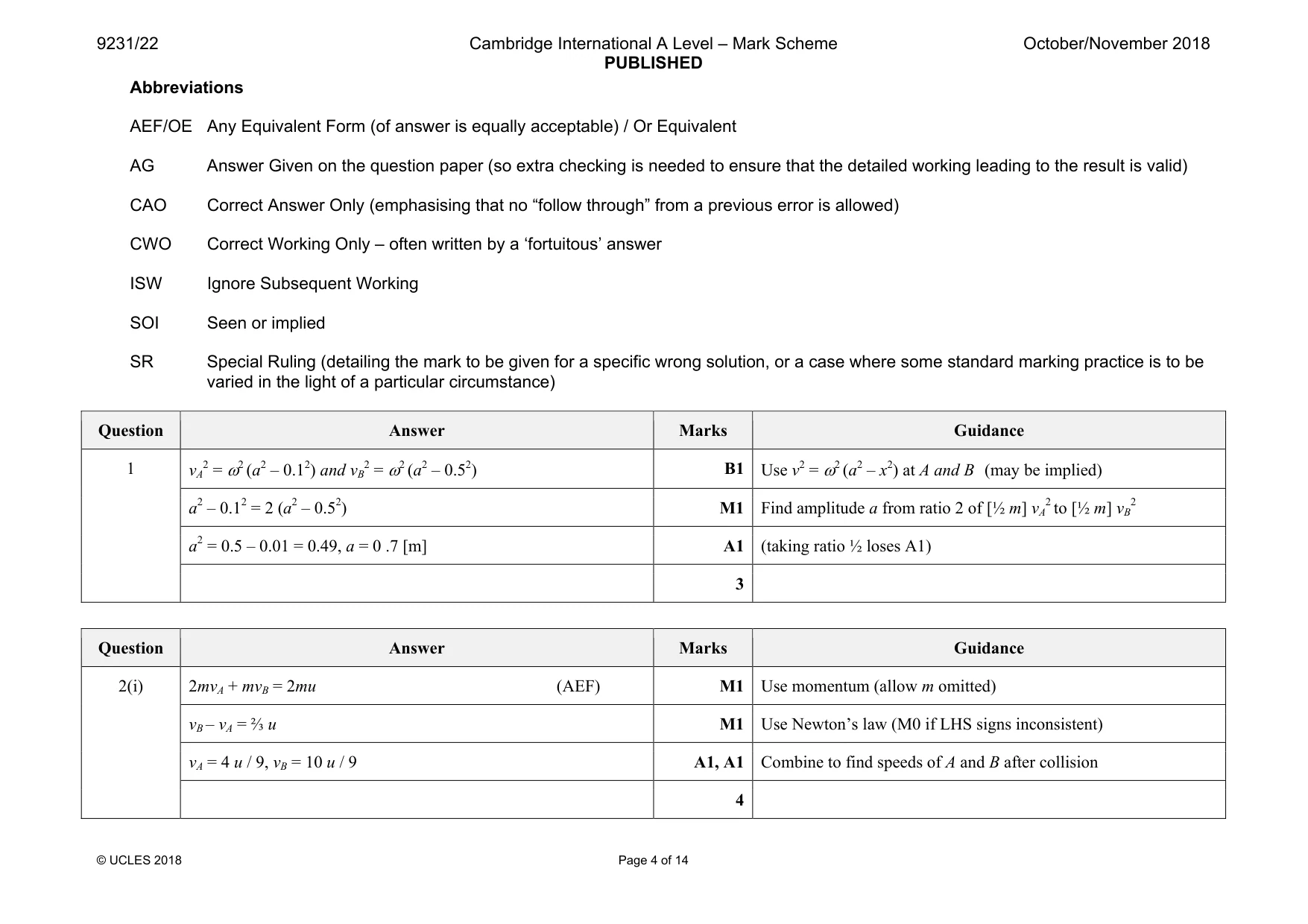
9231/22 Cambridge International A Level – Mark Scheme PUBLISHED October/November 2018 © UCLES 2018 Page 4 of 14 Abbreviations AEF/OE Any Equivalent Form (of answer is equally acceptable) / Or Equivalent AG Answer Given on the question paper (so extra checking is needed to ensure that the detailed working leading to the result is valid) CAO Correct Answer Only (emphasising that no “follow through” from a previous error is allowed) CWO Correct Working Only – often written by a ‘fortuitous’ answer ISW Ignore Subsequent Working SOI Seen or implied SR Special Ruling (detailing the mark to be given for a specific wrong solution, or a case where some standard marking practice is to be varied in the light of a particular circumstance) Question Answer Marks Guidance 1 vA 2 = ω2 (a2 – 0.12) and vB 2 = ω2 (a2 – 0.52) B1 Use v2 = ω2 (a2 – x2) at A and B (may be implied) a2 – 0.12 = 2 (a2 – 0.52) M1 Find amplitude a from ratio 2 of [½ m] vA 2 to [½ m] vB 2 a2 = 0.5 – 0.01 = 0.49, a = 0 .7 [m] A1 (taking ratio ½ loses A1) 3 Question Answer Marks Guidance 2(i) 2mvA + mvB = 2mu (AEF) M1 Use momentum (allow m omitted) vB – vA = ⅔ u M1 Use Newton’s law (M0 if LHS signs inconsistent) vA = 4 u / 9, vB = 10 u / 9 A1, A1 Combine to find speeds of A and B after collision 4
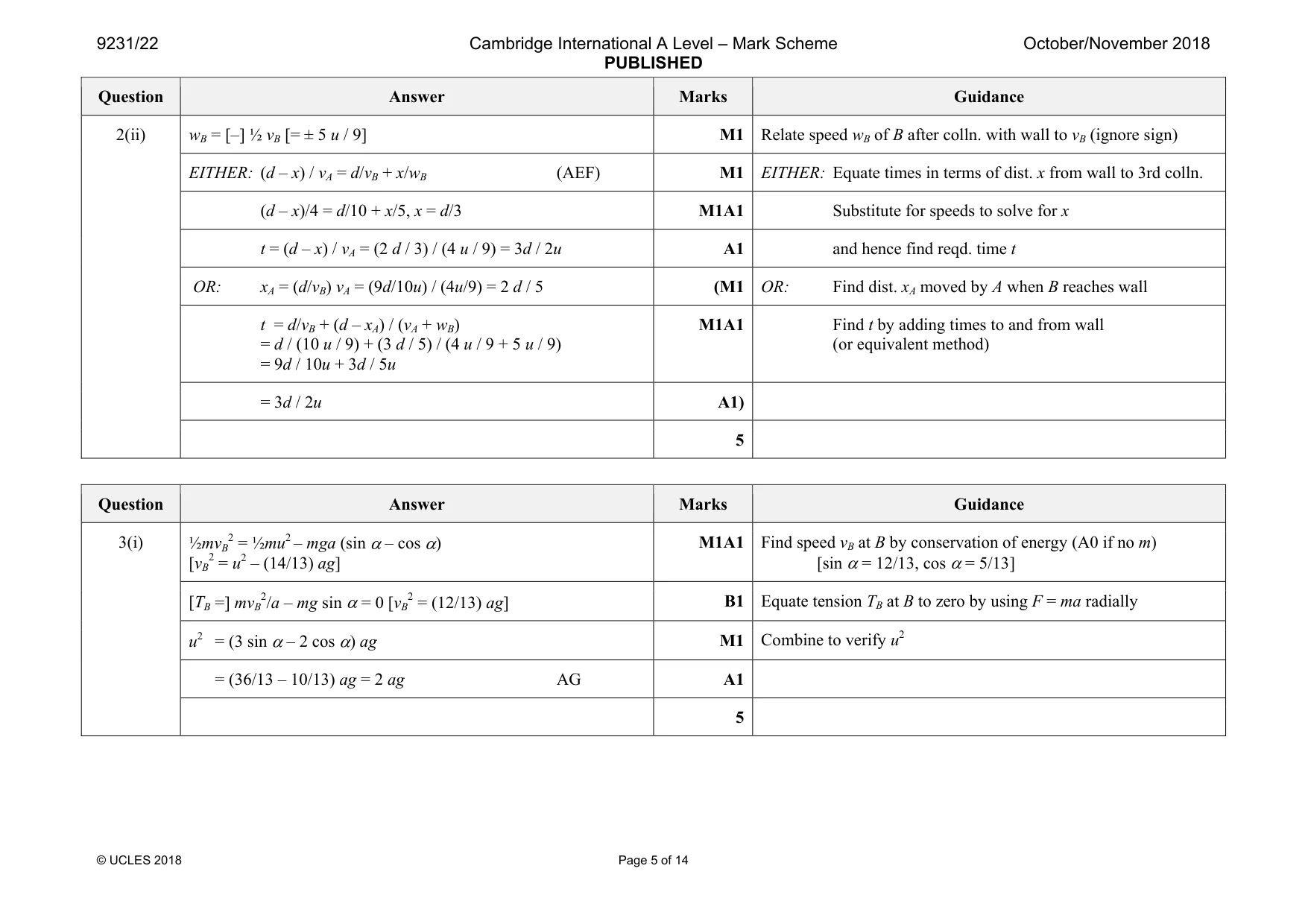
Mark scheme, page 5
9231/22 Cambridge International A Level – Mark Scheme PUBLISHED October/November 2018 © UCLES 2018 Page 5 of 14 Question Answer Marks Guidance 2(ii) wB = [–] ½ vB [= ± 5 u / 9] M1 Relate speed wB of B after colln. with wall to vB (ignore sign) EITHER: (d – x) / vA = d/vB + x/wB (AEF) M1 EITHER: Equate times in terms of dist. x from wall to 3rd colln. (d – x)/4 = d/10 + x/5, x = d/3 M1A1 Substitute for speeds to solve for x t = (d – x) / vA = (2 d / 3) / (4 u / 9) = 3d / 2u A1 and hence find reqd. time t OR: xA = (d/vB) vA = (9d/10u) / (4u/9) = 2 d / 5 (M1 OR: Find dist. xA moved by A when B reaches wall t = d/vB + (d – xA) / (vA + wB) = d / (10 u / 9) + (3 d / 5) / (4 u / 9 + 5 u / 9) = 9d / 10u + 3d / 5u M1A1 Find t by adding times to and from wall (or equivalent method) = 3d / 2u A1) 5 Question Answer Marks Guidance 3(i) ½mvB 2 = ½mu2 – mga (sin α – cos α) [vB 2 = u2 – (14/13) ag] M1A1 Find speed vB at B by conservation of energy (A0 if no m) [sin α = 12/13, cos α = 5/13] [TB =] mvB 2/a – mg sin α = 0 [vB 2 = (12/13) ag] B1 Equate tension TB at B to zero by using F = ma radially u2 = (3 sin α – 2 cos α) ag M1 Combine to verify u2 = (36/13 – 10/13) ag = 2 ag AG A1 5
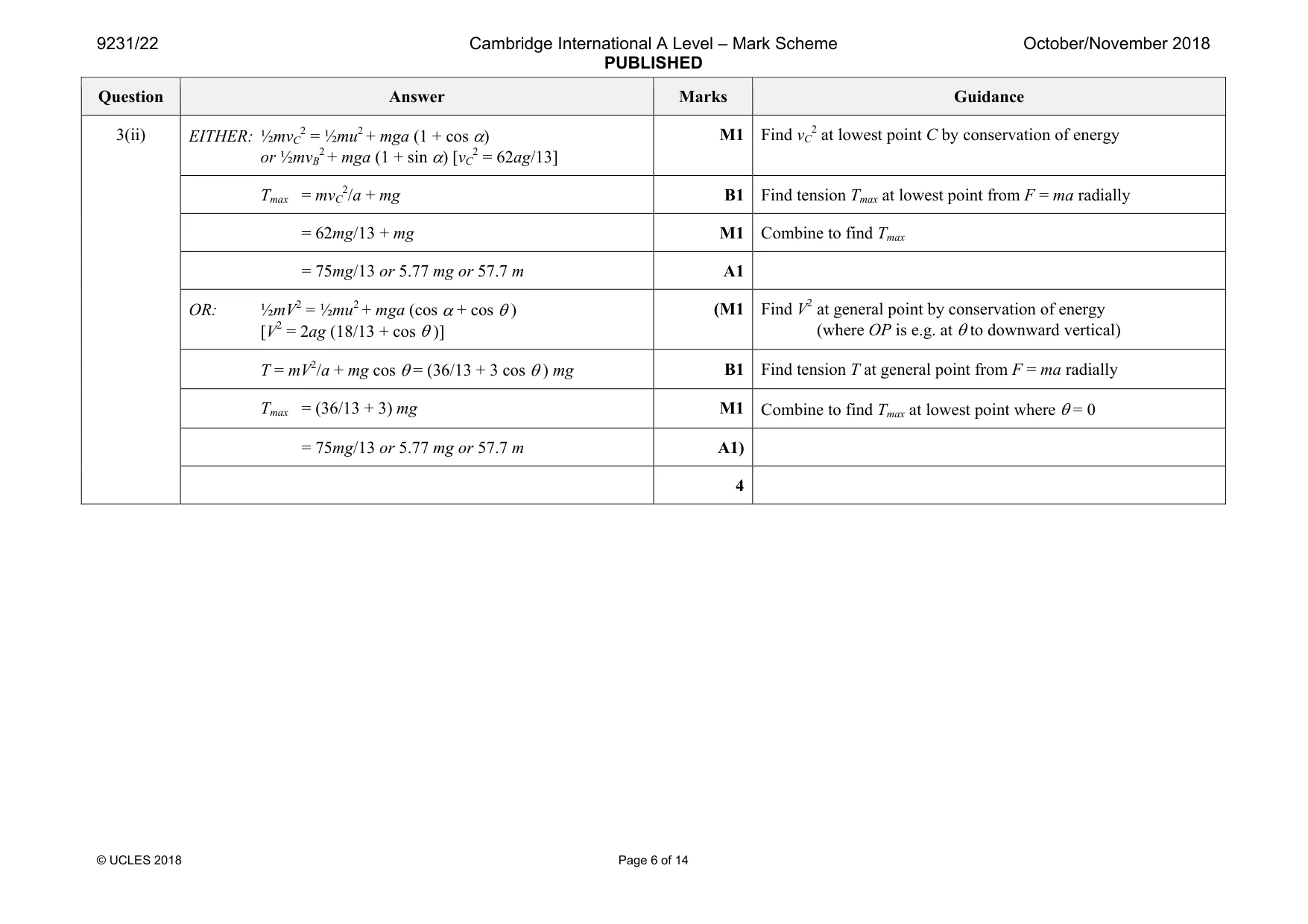
Mark scheme, page 6
9231/22 Cambridge International A Level – Mark Scheme PUBLISHED October/November 2018 © UCLES 2018 Page 6 of 14 Question Answer Marks Guidance 3(ii) EITHER: ½mvC 2 = ½mu2 + mga (1 + cos α) or ½mvB 2 + mga (1 + sin α) [vC 2 = 62ag/13] M1 Find vC 2 at lowest point C by conservation of energy Tmax = mvC 2/a + mg B1 Find tension Tmax at lowest point from F = ma radially = 62mg/13 + mg M1 Combine to find Tmax = 75mg/13 or 5.77 mg or 57.7 m A1 OR: ½mV2 = ½mu2 + mga (cos α + cos θ ) [V2 = 2ag (18/13 + cos θ )] (M1 Find V2 at general point by conservation of energy (where OP is e.g. at θ to downward vertical) T = mV2/a + mg cos θ = (36/13 + 3 cos θ ) mg B1 Find tension T at general point from F = ma radially Tmax = (36/13 + 3) mg M1 Combine to find Tmax at lowest point where θ = 0 = 75mg/13 or 5.77 mg or 57.7 m A1) 4
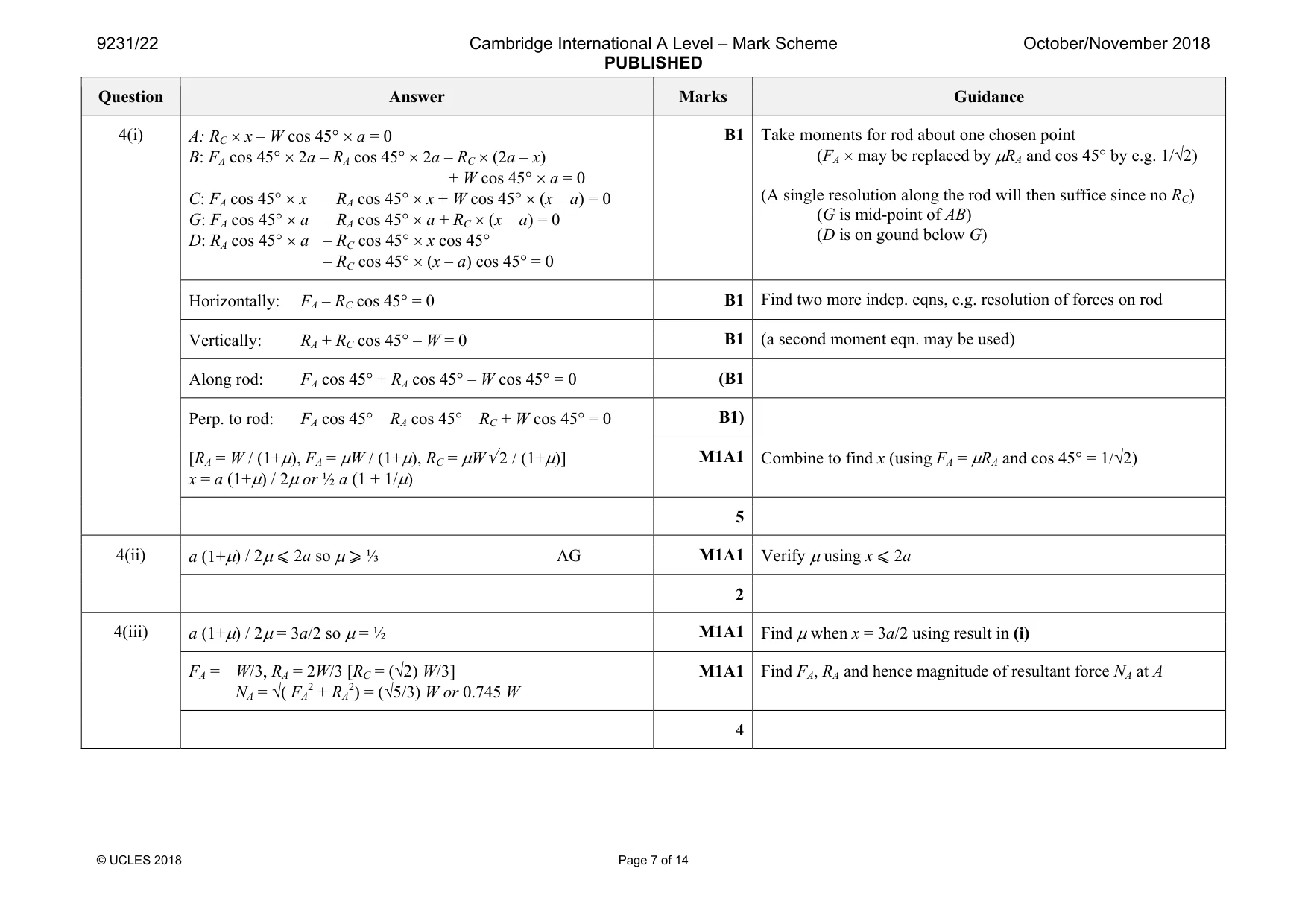
Mark scheme, page 7
9231/22 Cambridge International A Level – Mark Scheme PUBLISHED October/November 2018 © UCLES 2018 Page 7 of 14 Question Answer Marks Guidance 4(i) A: RC × x – W cos 45° × a = 0 B: FA cos 45° × 2a – RA cos 45° × 2a – RC × (2a – x) + W cos 45° × a = 0 C: FA cos 45° × x – RA cos 45° × x + W cos 45° × (x – a) = 0 G: FA cos 45° × a – RA cos 45° × a + RC × (x – a) = 0 D: RA cos 45° × a – RC cos 45° × x cos 45° – RC cos 45° × (x – a) cos 45° = 0 B1 Take moments for rod about one chosen point (FA × may be replaced by µRA and cos 45° by e.g. 1/√2) (A single resolution along the rod will then suffice since no RC) (G is mid-point of AB) (D is on gound below G) Horizontally: FA – RC cos 45° = 0 B1 Find two more indep. eqns, e.g. resolution of forces on rod Vertically: RA + RC cos 45° – W = 0 B1 (a second moment eqn. may be used) Along rod: FA cos 45° + RA cos 45° – W cos 45° = 0 (B1 Perp. to rod: FA cos 45° – RA cos 45° – RC + W cos 45° = 0 B1) [RA = W / (1+µ), FA = µW / (1+µ), RC = µW√ 2 / (1+µ)] x = a (1+µ) / 2µ or ½ a (1 + 1/µ) M1A1 Combine to find x (using FA = µRA and cos 45° = 1/√2) 5 4(ii) a (1+µ) / 2µ ⩽ 2a so µ ⩾ ⅓ AG M1A1 Verify µ using x ⩽ 2a 2 4(iii) a (1+µ) / 2µ = 3a/2 so µ = ½ M1A1 Find µ when x = 3a/2 using result in (i) FA = W/3, RA = 2W/3 [RC = (√2) W/3] NA = √( FA 2 + RA 2) = (√5/3) W or 0.745 W M1A1 Find FA, RA and hence magnitude of resultant force NA at A 4
Mark scheme, page 8
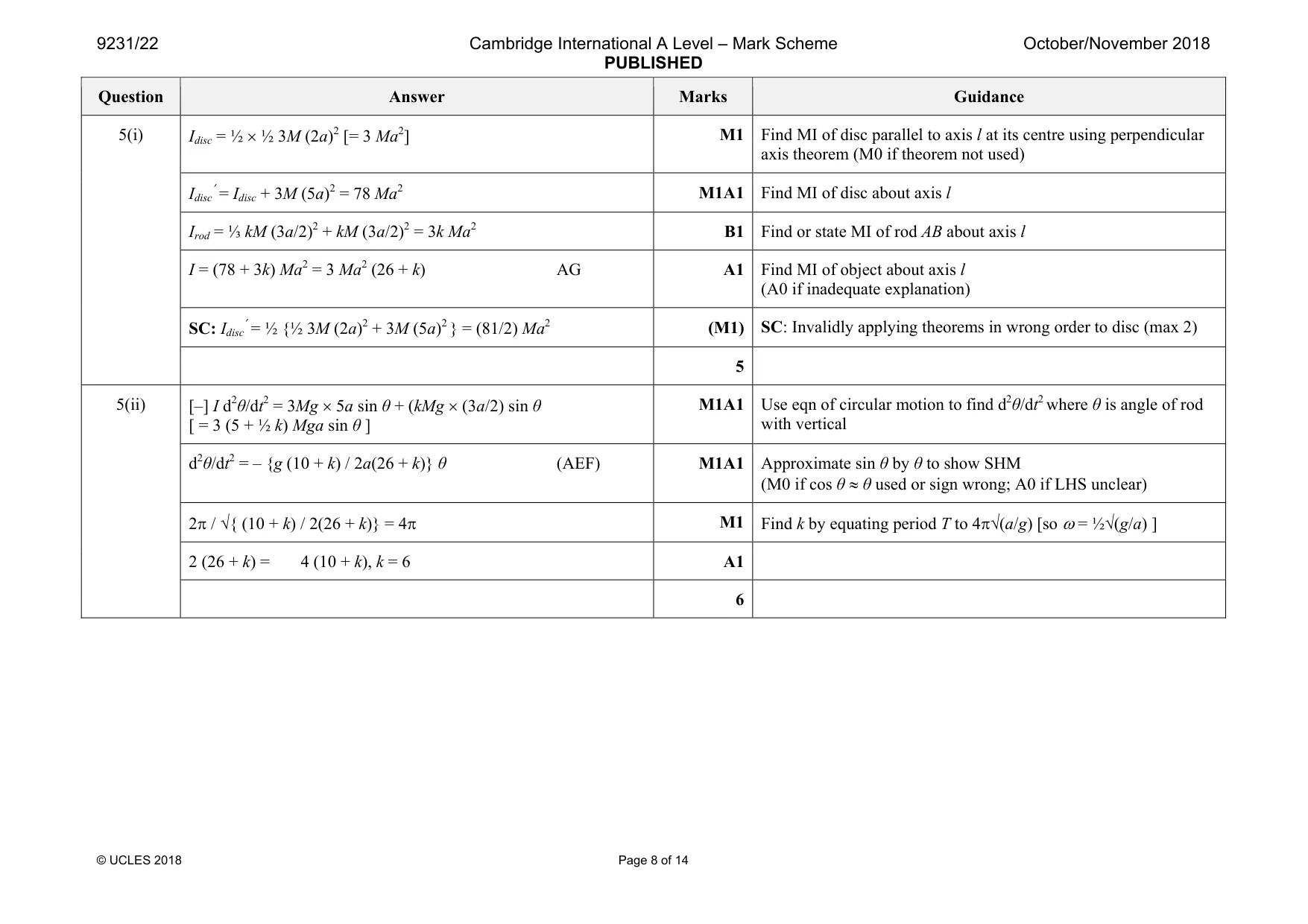
9231/22 Cambridge International A Level – Mark Scheme PUBLISHED October/November 2018 © UCLES 2018 Page 8 of 14 Question Answer Marks Guidance 5(i) Idisc = ½ × ½ 3M (2a)2 [= 3 Ma2] M1 Find MI of disc parallel to axis l at its centre using perpendicular axis theorem (M0 if theorem not used) Idisc ′ = Idisc + 3M (5a)2 = 78 Ma2 M1A1 Find MI of disc about axis l Irod = ⅓ kM (3a/2)2 + kM (3a/2)2 = 3k Ma2 B1 Find or state MI of rod AB about axis l I = (78 + 3k) Ma2 = 3 Ma2 (26 + k) AG A1 Find MI of object about axis l (A0 if inadequate explanation) SC: Idisc ′ = ½ {½ 3M (2a)2 + 3M (5a)2 } = (81/2) Ma2 (M1) SC: Invalidly applying theorems in wrong order to disc (max 2) 5 5(ii) [–] I d2θ/dt2 = 3Mg × 5a sin θ + (kMg × (3a/2) sin θ [ = 3 (5 + ½ k) Mga sin θ ] M1A1 Use eqn of circular motion to find d2θ/dt2 where θ is angle of rod with vertical d2θ/dt2 = – {g (10 + k) / 2a(26 + k)} θ (AEF) M1A1 Approximate sin θ by θ to show SHM (M0 if cos θ ≈ θ used or sign wrong; A0 if LHS unclear) 2π / √{ (10 + k) / 2(26 + k)} = 4π M1 Find k by equating period T to 4π√(a/g) [so ω = ½√(g/a) ] 2 (26 + k) = 4 (10 + k), k = 6 A1 6
Mark scheme, page 9
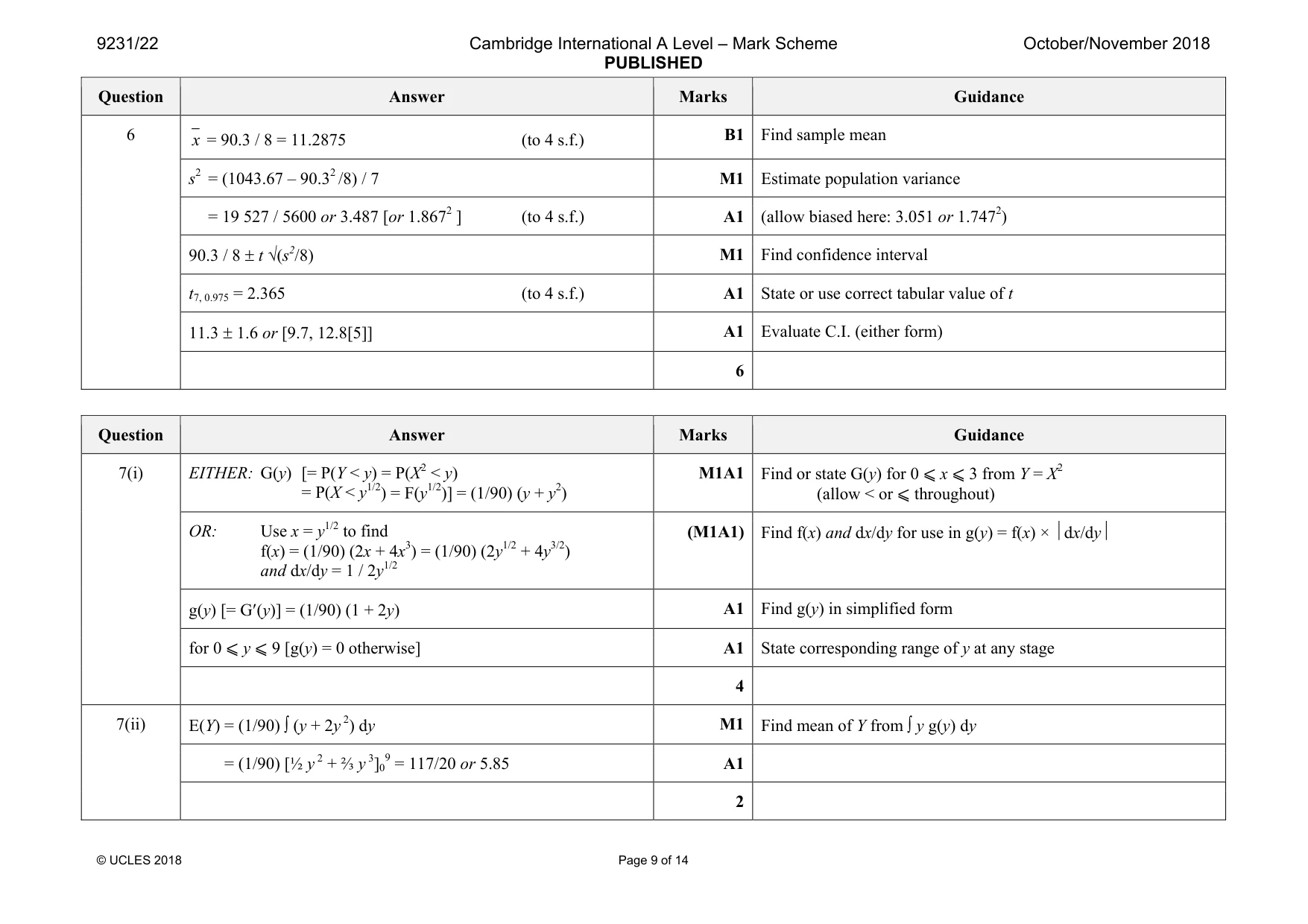
9231/22 Cambridge International A Level – Mark Scheme PUBLISHED October/November 2018 © UCLES 2018 Page 9 of 14 Question Answer Marks Guidance 6 x = 90.3 / 8 = 11.2875 (to 4 s.f.) B1 Find sample mean s2 = (1043.67 – 90.32 /8) / 7 M1 Estimate population variance = 19 527 / 5600 or 3.487 [or 1.8672 ] (to 4 s.f.) A1 (allow biased here: 3.051 or 1.7472) 90.3 / 8 ± t √(s2/8) M1 Find confidence interval t7, 0.975 = 2.365 (to 4 s.f.) A1 State or use correct tabular value of t 11.3 ± 1.6 or [9.7, 12.8[5]] A1 Evaluate C.I. (either form) 6 Question Answer Marks Guidance 7(i) EITHER: G(y) [= P(Y < y) = P(X2 < y) = P(X < y1/2) = F(y1/2)] = (1/90) (y + y2) M1A1 Find or state G(y) for 0 ⩽ x ⩽ 3 from Y = X2 (allow < or ⩽ throughout) OR: Use x = y1/2 to find f(x) = (1/90) (2x + 4x3) = (1/90) (2y1/2 + 4y3/2) and dx/dy = 1 / 2y1/2 (M1A1) Find f(x) and dx/dy for use in g(y) = f(x) × dx/dy g(y) [= G′(y)] = (1/90) (1 + 2y) A1 Find g(y) in simplified form for 0 ⩽ y ⩽ 9 [g(y) = 0 otherwise] A1 State corresponding range of y at any stage 4 7(ii) E(Y) = (1/90) ∫ (y + 2y 2) dy M1 Find mean of Y from ∫ y g(y) dy = (1/90) [½ y 2 + ⅔ y 3]0 9 = 117/20 or 5.85 A1 2
Mark scheme, page 10
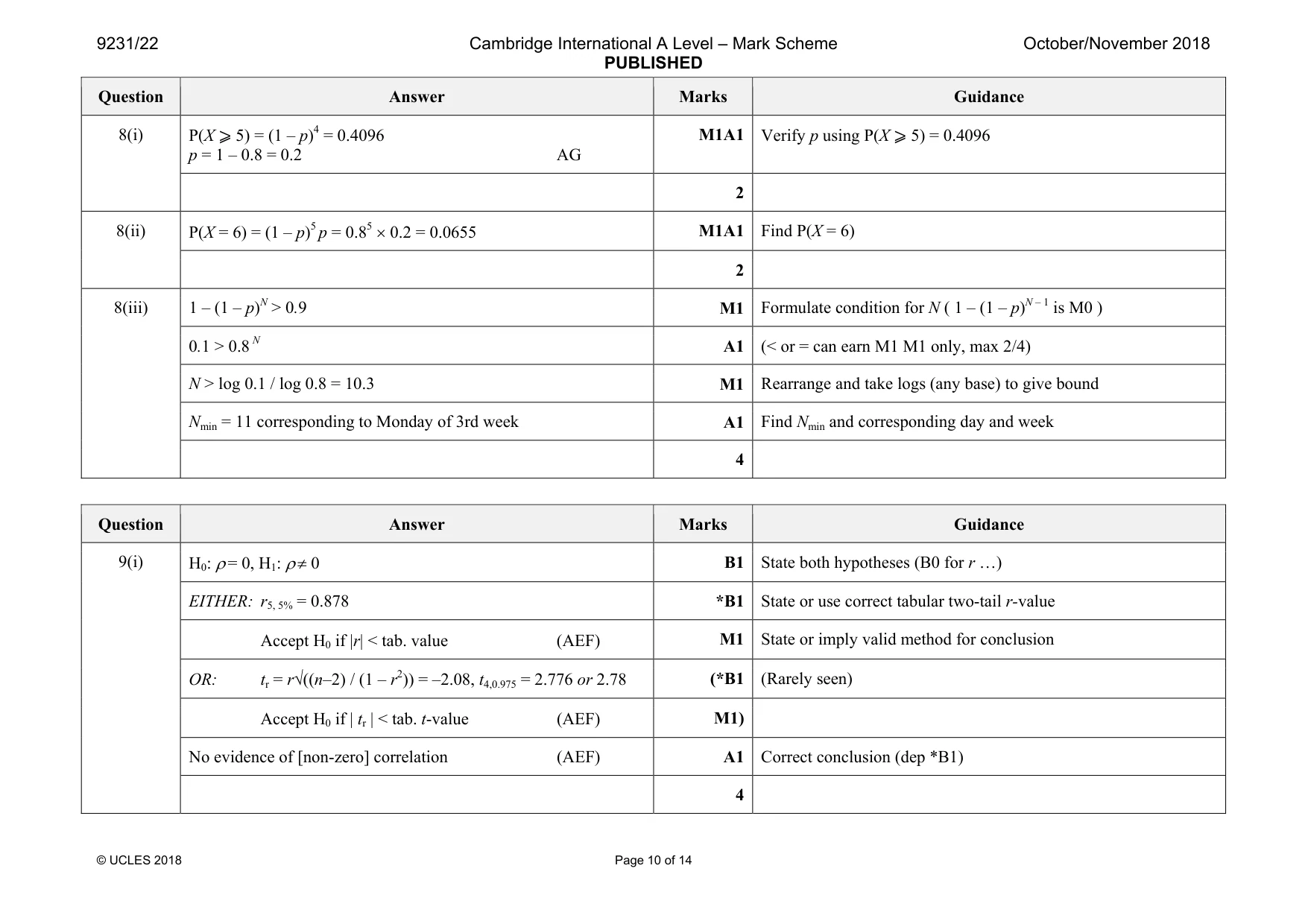
9231/22 Cambridge International A Level – Mark Scheme PUBLISHED October/November 2018 © UCLES 2018 Page 10 of 14 Question Answer Marks Guidance 8(i) P(X ⩾ 5) = (1 – p)4 = 0.4096 p = 1 – 0.8 = 0.2 AG M1A1 Verify p using P(X ⩾ 5) = 0.4096 2 8(ii) P(X = 6) = (1 – p)5 p = 0.85 × 0.2 = 0.0655 M1A1 Find P(X = 6) 2 8(iii) 1 – (1 – p)N > 0.9 M1 Formulate condition for N ( 1 – (1 – p)N – 1 is M0 ) 0.1 > 0.8 N A1 (< or = can earn M1 M1 only, max 2/4) N > log 0.1 / log 0.8 = 10.3 M1 Rearrange and take logs (any base) to give bound Nmin = 11 corresponding to Monday of 3rd week A1 Find Nmin and corresponding day and week 4 Question Answer Marks Guidance 9(i) H0: ρ = 0, H1: ρ ≠ 0 B1 State both hypotheses (B0 for r …) EITHER: r5, 5% = 0.878 *B1 State or use correct tabular two-tail r-value Accept H0 if |r| < tab. value (AEF) M1 State or imply valid method for conclusion OR: tr = r√((n–2) / (1 – r2)) = –2.08, t4,0.975 = 2.776 or 2.78 (*B1 (Rarely seen) Accept H0 if | tr | < tab. t-value (AEF) M1) No evidence of [non-zero] correlation (AEF) A1 Correct conclusion (dep *B1) 4
Mark scheme, page 11
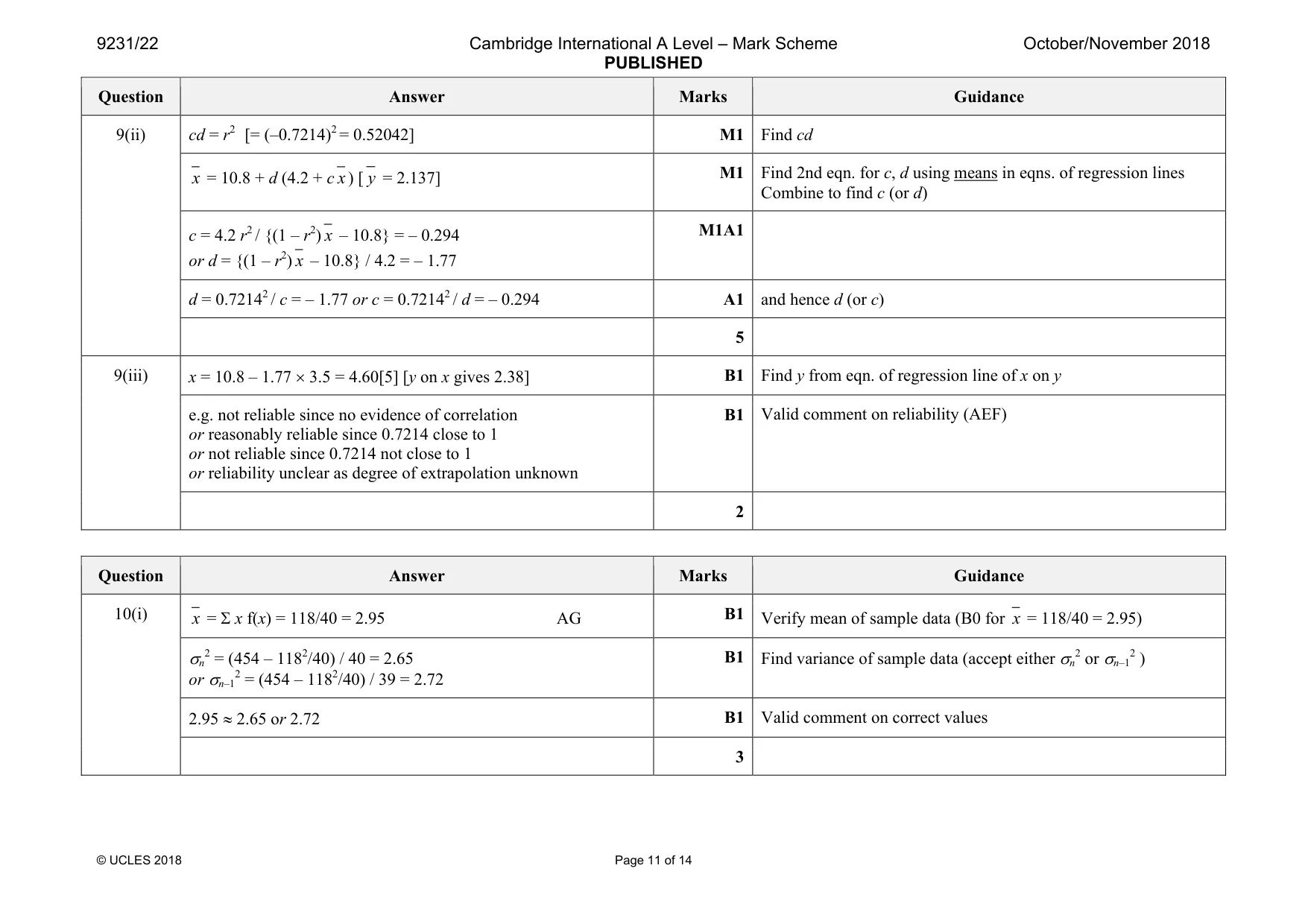
9231/22 Cambridge International A Level – Mark Scheme PUBLISHED October/November 2018 © UCLES 2018 Page 11 of 14 Question Answer Marks Guidance 9(ii) cd = r2 [= (–0.7214)2 = 0.52042] M1 Find cd x = 10.8 + d (4.2 + c x) [ y = 2.137] M1 Find 2nd eqn. for c, d using means in eqns. of regression lines Combine to find c (or d) c = 4.2 r2 / {(1 – r2) x – 10.8} = – 0.294 or d = {(1 – r2) x – 10.8} / 4.2 = – 1.77 M1A1 d = 0.72142 / c = – 1.77 or c = 0.72142 / d = – 0.294 A1 and hence d (or c) 5 9(iii) x = 10.8 – 1.77 × 3.5 = 4.60[5] [y on x gives 2.38] B1 Find y from eqn. of regression line of x on y e.g. not reliable since no evidence of correlation or reasonably reliable since 0.7214 close to 1 or not reliable since 0.7214 not close to 1 or reliability unclear as degree of extrapolation unknown B1 Valid comment on reliability (AEF) 2 Question Answer Marks Guidance 10(i) x = Σ x f(x) = 118/40 = 2.95 AG B1 Verify mean of sample data (B0 for x = 118/40 = 2.95) σn 2 = (454 – 1182/40) / 40 = 2.65 or σn–1 2 = (454 – 1182/40) / 39 = 2.72 B1 Find variance of sample data (accept either σn 2 or σn–1 2 ) 2.95 ≈ 2.65 or 2.72 B1 Valid comment on correct values 3
Mark scheme, page 12
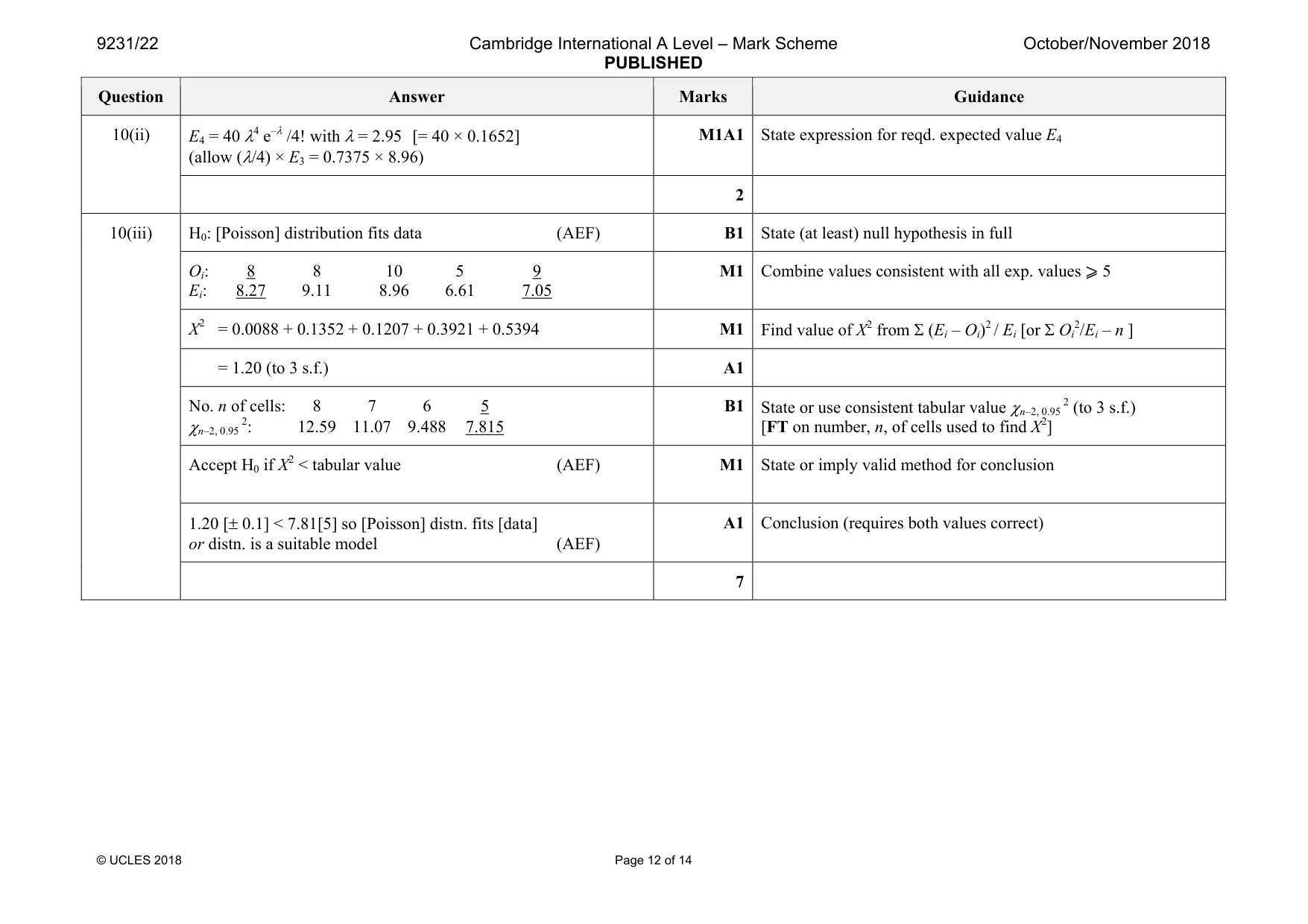
9231/22 Cambridge International A Level – Mark Scheme PUBLISHED October/November 2018 © UCLES 2018 Page 12 of 14 Question Answer Marks Guidance 10(ii) E4 = 40 λ4 e–λ /4! with λ = 2.95 [= 40 × 0.1652] (allow (λ/4) × E3 = 0.7375 × 8.96) M1A1 State expression for reqd. expected value E4 2 10(iii) H0: [Poisson] distribution fits data (AEF) B1 State (at least) null hypothesis in full Oi: 8 8 10 5 9 Ei: 8.27 9.11 8.96 6.61 7.05 M1 Combine values consistent with all exp. values ⩾ 5 X2 = 0.0088 + 0.1352 + 0.1207 + 0.3921 + 0.5394 M1 Find value of X2 from Σ (Ei – Oi)2 / Ei [or Σ Oi 2/Ei – n ] = 1.20 (to 3 s.f.) A1 No. n of cells: 8 7 6 5 χn–2, 0.95 2: 12.59 11.07 9.488 7.815 B1 State or use consistent tabular value χn–2, 0.95 2 (to 3 s.f.) [FT on number, n, of cells used to find X2] Accept H0 if X2 < tabular value (AEF) M1 State or imply valid method for conclusion 1.20 [± 0.1] < 7.81[5] so [Poisson] distn. fits [data] or distn. is a suitable model (AEF) A1 Conclusion (requires both values correct) 7
Mark scheme, page 13
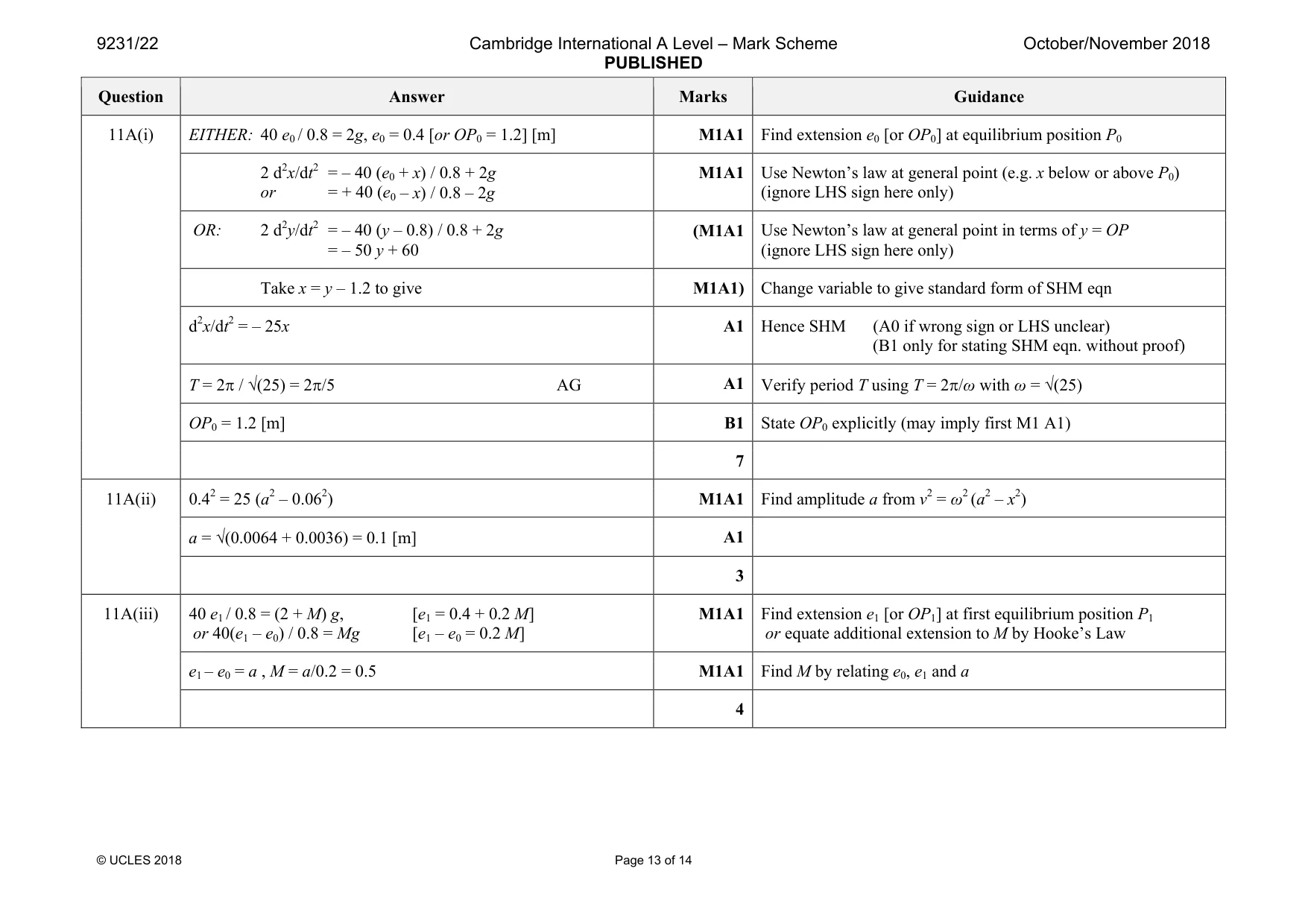
9231/22 Cambridge International A Level – Mark Scheme PUBLISHED October/November 2018 © UCLES 2018 Page 13 of 14 Question Answer Marks Guidance 11A(i) EITHER: 40 e0 / 0.8 = 2g, e0 = 0.4 [or OP0 = 1.2] [m] M1A1 Find extension e0 [or OP0] at equilibrium position P0 2 d2x/dt2 = – 40 (e0 + x) / 0.8 + 2g or = + 40 (e0 – x) / 0.8 – 2g M1A1 Use Newton’s law at general point (e.g. x below or above P0) (ignore LHS sign here only) OR: 2 d2y/dt2 = – 40 (y – 0.8) / 0.8 + 2g = – 50 y + 60 (M1A1 Use Newton’s law at general point in terms of y = OP (ignore LHS sign here only) Take x = y – 1.2 to give M1A1) Change variable to give standard form of SHM eqn d2x/dt2 = – 25x A1 Hence SHM (A0 if wrong sign or LHS unclear) (B1 only for stating SHM eqn. without proof) T = 2π / √(25) = 2π/5 AG A1 Verify period T using T = 2π/ω with ω = √(25) OP0 = 1.2 [m] B1 State OP0 explicitly (may imply first M1 A1) 7 11A(ii) 0.42 = 25 (a2 – 0.062) M1A1 Find amplitude a from v2 = ω2 (a2 – x2) a = √(0.0064 + 0.0036) = 0.1 [m] A1 3 11A(iii) 40 e1 / 0.8 = (2 + M) g, [e1 = 0.4 + 0.2 M] or 40(e1 – e0) / 0.8 = Mg [e1 – e0 = 0.2 M] M1A1 Find extension e1 [or OP1] at first equilibrium position P1 or equate additional extension to M by Hooke’s Law e1 – e0 = a , M = a/0.2 = 0.5 M1A1 Find M by relating e0, e1 and a 4
Mark scheme, page 14
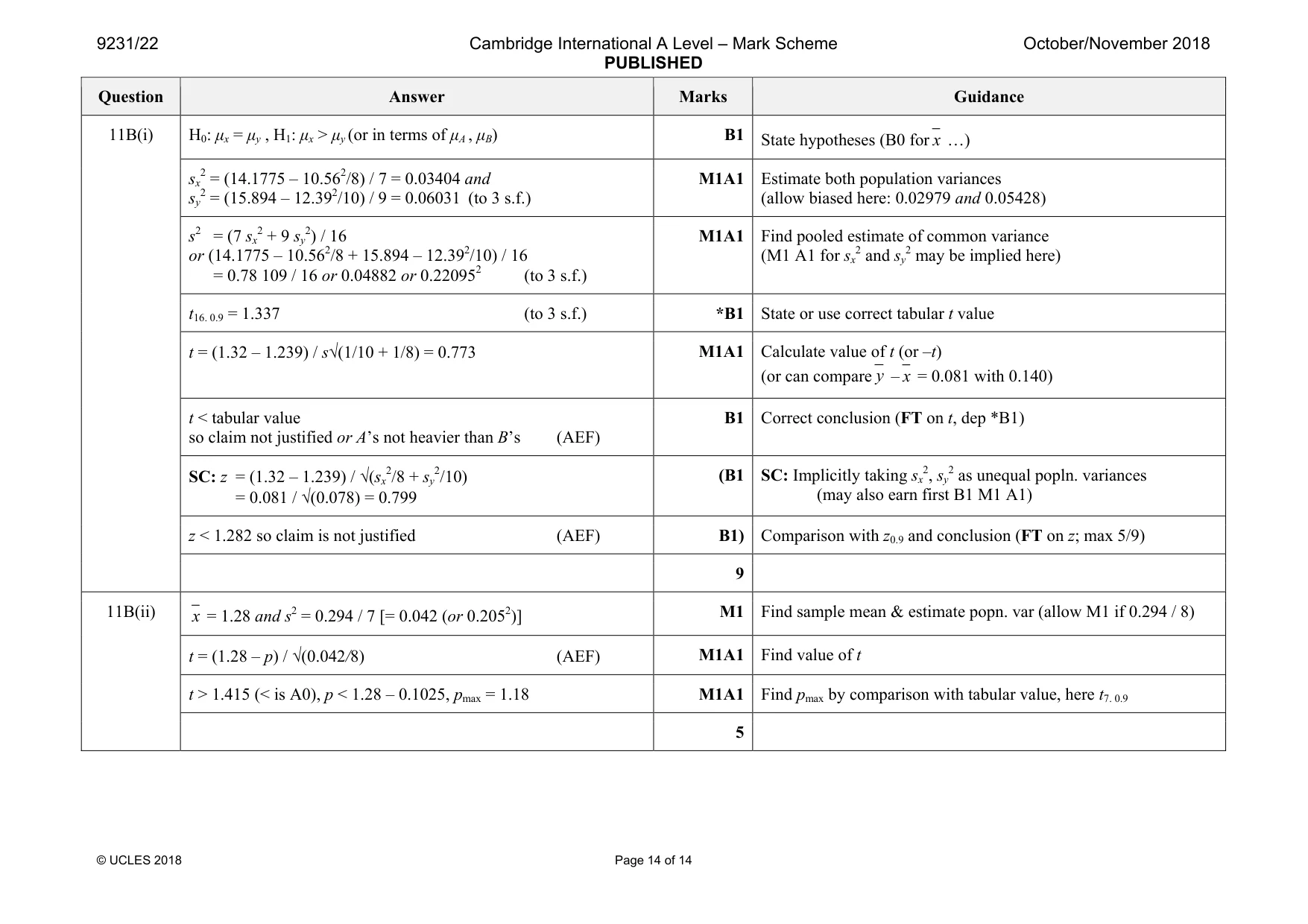
9231/22 Cambridge International A Level – Mark Scheme PUBLISHED October/November 2018 © UCLES 2018 Page 14 of 14 Question Answer Marks Guidance 11B(i) H0: µx = µy , H1: µx > µy (or in terms of µA , µB) B1 State hypotheses (B0 for x …) sx 2 = (14.1775 – 10.562/8) / 7 = 0.03404 and sy 2 = (15.894 – 12.392/10) / 9 = 0.06031 (to 3 s.f.) M1A1 Estimate both population variances (allow biased here: 0.02979 and 0.05428) s2 = (7 sx 2 + 9 sy 2) / 16 or (14.1775 – 10.562/8 + 15.894 – 12.392/10) / 16 = 0.78 109 / 16 or 0.04882 or 0.220952 (to 3 s.f.) M1A1 Find pooled estimate of common variance (M1 A1 for sx 2 and sy 2 may be implied here) t16. 0.9 = 1.337 (to 3 s.f.) *B1 State or use correct tabular t value t = (1.32 – 1.239) / s√(1/10 + 1/8) = 0.773 M1A1 Calculate value of t (or –t) (or can compare y – x = 0.081 with 0.140) t < tabular value so claim not justified or A’s not heavier than B’s (AEF) B1 Correct conclusion (FT on t, dep *B1) SC: z = (1.32 – 1.239) / √(sx 2/8 + sy 2/10) = 0.081 / √(0.078) = 0.799 (B1 SC: Implicitly taking sx 2, sy 2 as unequal popln. variances (may also earn first B1 M1 A1) z < 1.282 so claim is not justified (AEF) B1) Comparison with z0.9 and conclusion (FT on z; max 5/9) 9 11B(ii) x = 1.28 and s2 = 0.294 / 7 [= 0.042 (or 0.2052)] M1 Find sample mean & estimate popn. var (allow M1 if 0.294 / 8) t = (1.28 – p) / √(0.042/8) (AEF) M1A1 Find value of t t > 1.415 (< is A0), p < 1.28 – 0.1025, pmax = 1.18 M1A1 Find pmax by comparison with tabular value, here t7. 0.9 5
What you needed in this session
Cambridge’s own grade thresholds for 2018 Oct/Nov, Paper 2 · Variant 2. A higher threshold means an easier paper — the bar moves with how the cohort did.