Cambridge A Level Mathematics - Further 9231 — 2014 May/June Paper 2 · Variant 2
9231/22/M/J/14 · 100 marks · ≈113 min
The question paper and its mark scheme, free to read here and free to download. This is Cambridge’s own paper, exactly as it was sat.
Question paper8 pages


Mark scheme9 pages
Answers below. Sit the paper first if you are practising.
Paper as text
Question paper, page 1
*1292120751* Cambridge International Examinations Cambridge International Advanced Level FURTHER MATHEMATICS 9231/22 Paper 2 May/June 2014 3 hours Additional Materials: Answer Booklet/Paper Graph Paper List of Formulae (MF10) READ THESE INSTRUCTIONS FIRST If you have been given an Answer Booklet, follow the instructions on the front cover of the Booklet. Write your Centre number, candidate number and name on all the work you hand in. Write in dark blue or black pen. You may use an HB pencil for any diagrams or graphs. Do not use staples, paper clips, glue or correction fluid. DO NOT WRITE IN ANY BARCODES. Answer all the questions. Give non-exact numerical answers correct to 3 significant figures, or 1 decimal place in the case of angles in degrees, unless a different level of accuracy is specified in the question. Where a numerical value is necessary, take the acceleration due to gravity to be 10 m s−2. The use of a calculator is expected, where appropriate. Results obtained solely from a graphic calculator, without supporting working or reasoning, will not receive credit. You are reminded of the need for clear presentation in your answers. At the end of the examination, fasten all your work securely together. The number of marks is given in brackets [ ] at the end of each question or part question. This document consists of 5 printed pages and 3 blank pages. JC14 06_9231_22/FP © UCLES 2014 [Turn over
Question paper, page 2
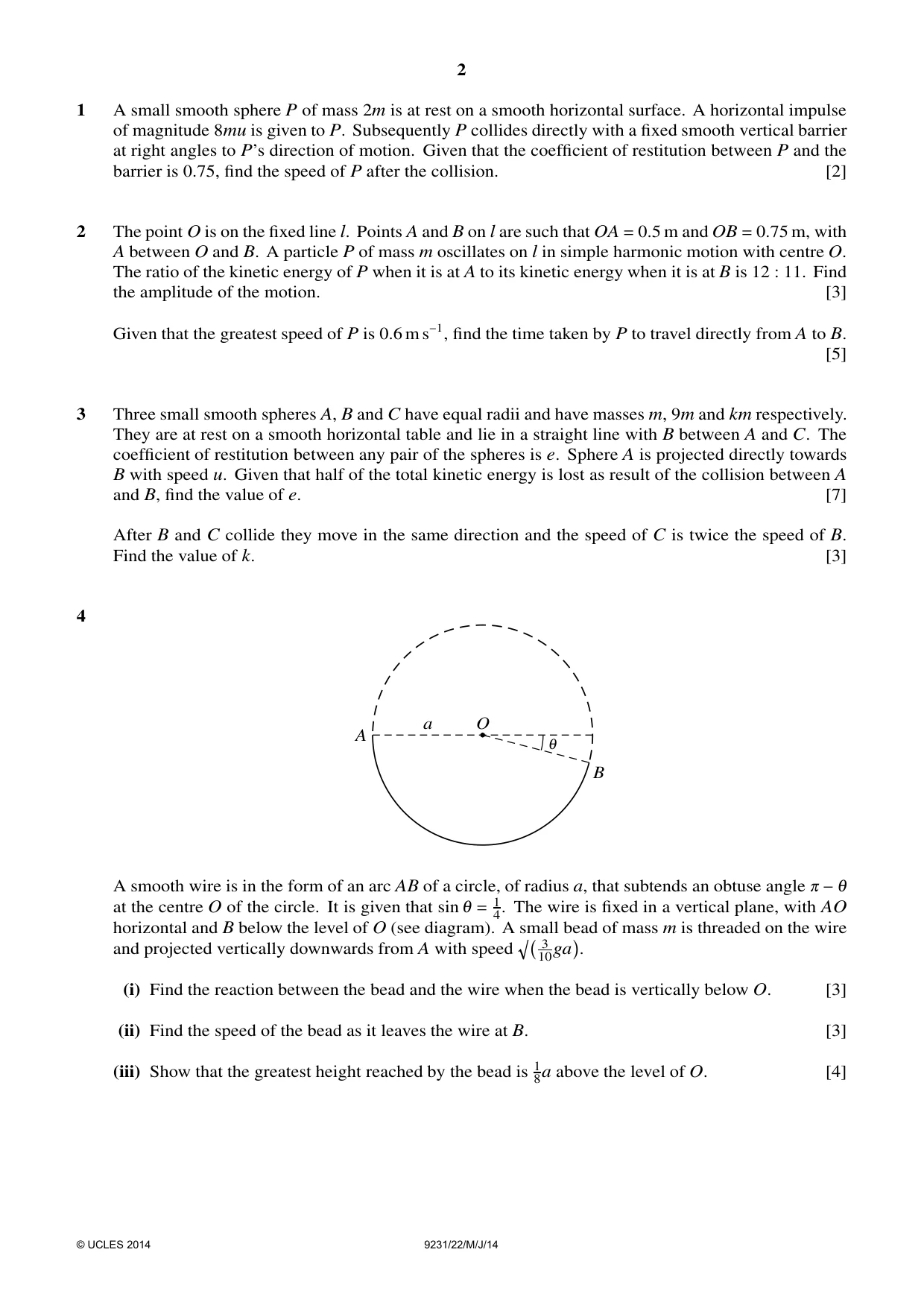
2 1 A small smooth sphere P of mass 2m is at rest on a smooth horizontal surface. A horizontal impulse of magnitude 8mu is given to P. Subsequently P collides directly with a fixed smooth vertical barrier at right angles to P’s direction of motion. Given that the coefficient of restitution between P and the barrier is 0.75, find the speed of P after the collision. [2] 2 The point O is on the fixed line l. Points A and B on l are such that OA = 0.5 m and OB = 0.75 m, with A between O and B. A particle P of mass m oscillates on l in simple harmonic motion with centre O. The ratio of the kinetic energy of P when it is at A to its kinetic energy when it is at B is 12 : 11. Find the amplitude of the motion. [3] Given that the greatest speed of P is 0.6 m s−1, find the time taken by P to travel directly from A to B. [5] 3 Three small smooth spheres A, B and C have equal radii and have masses m, 9m and km respectively. They are at rest on a smooth horizontal table and lie in a straight line with B between A and C. The coefficient of restitution between any pair of the spheres is e. Sphere A is projected directly towards B with speed u. Given that half of the total kinetic energy is lost as result of the collision between A and B, find the value of e. [7] After B and C collide they move in the same direction and the speed of C is twice the speed of B. Find the value of k. [3] 4 A B O a 1 A smooth wire is in the form of an arc AB of a circle, of radius a, that subtends an obtuse angle 0 −1 at the centre O of the circle. It is given that sin 1 = 1 4. The wire is fixed in a vertical plane, with AO horizontal and B below the level of O (see diagram). A small bead of mass m is threaded on the wire and projected vertically downwards from A with speed 3 10ga. (i) Find the reaction between the bead and the wire when the bead is vertically below O. [3] (ii) Find the speed of the bead as it leaves the wire at B. [3] (iii) Show that the greatest height reached by the bead is 1 8a above the level of O. [4] © UCLES 2014 9231/22/M/J/14
Question paper, page 3
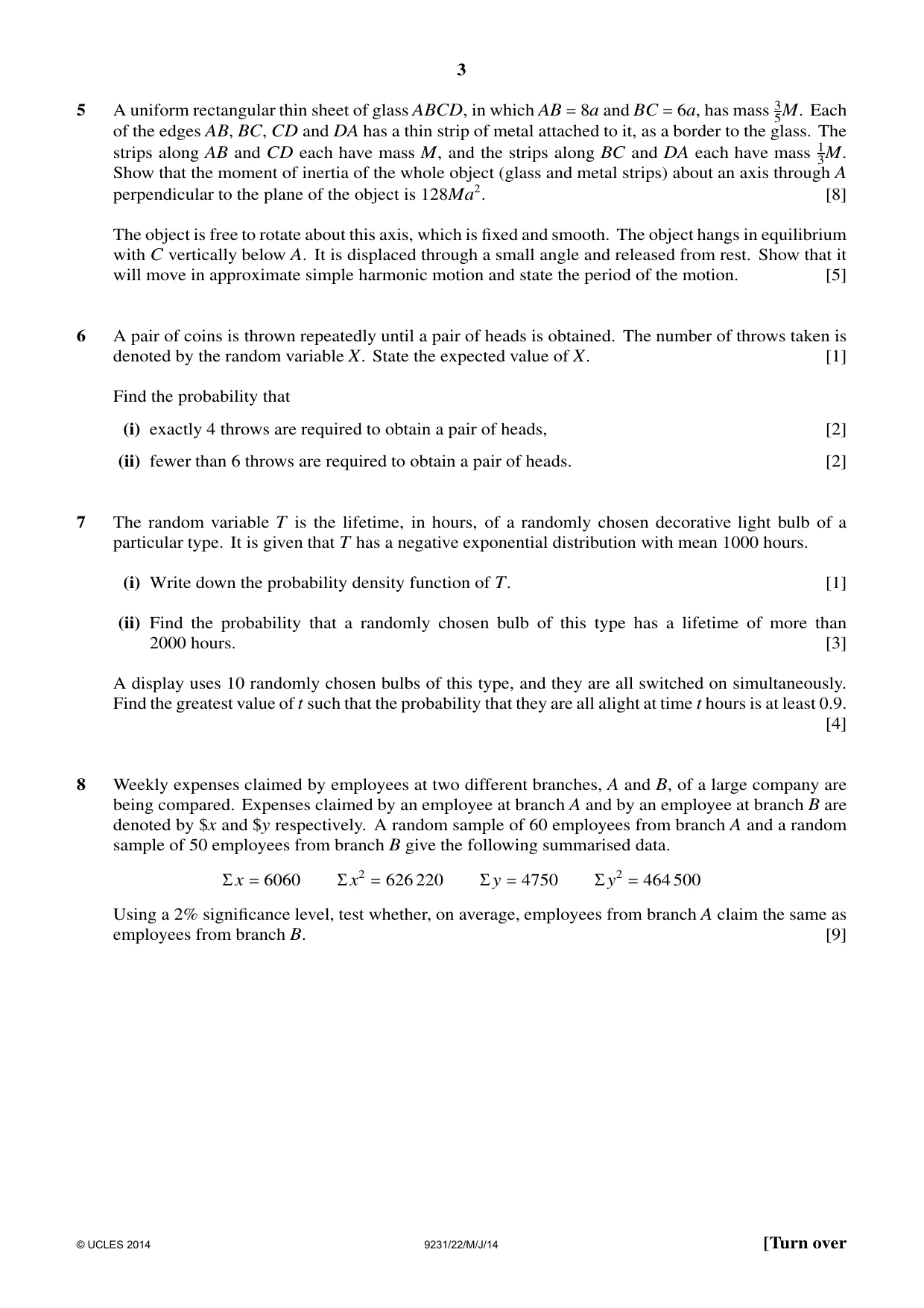
3 5 A uniform rectangular thin sheet of glass ABCD, in which AB = 8a and BC = 6a, has mass 3 5M. Each of the edges AB, BC, CD and DA has a thin strip of metal attached to it, as a border to the glass. The strips along AB and CD each have mass M, and the strips along BC and DA each have mass 1 3M. Show that the moment of inertia of the whole object (glass and metal strips) about an axis through A perpendicular to the plane of the object is 128Ma2. [8] The object is free to rotate about this axis, which is fixed and smooth. The object hangs in equilibrium with C vertically below A. It is displaced through a small angle and released from rest. Show that it will move in approximate simple harmonic motion and state the period of the motion. [5] 6 A pair of coins is thrown repeatedly until a pair of heads is obtained. The number of throws taken is denoted by the random variable X. State the expected value of X. [1] Find the probability that (i) exactly 4 throws are required to obtain a pair of heads, [2] (ii) fewer than 6 throws are required to obtain a pair of heads. [2] 7 The random variable T is the lifetime, in hours, of a randomly chosen decorative light bulb of a particular type. It is given that T has a negative exponential distribution with mean 1000 hours. (i) Write down the probability density function of T. [1] (ii) Find the probability that a randomly chosen bulb of this type has a lifetime of more than 2000 hours. [3] A display uses 10 randomly chosen bulbs of this type, and they are all switched on simultaneously. Find the greatest value of t such that the probability that they are all alight at time t hours is at least 0.9. [4] 8 Weekly expenses claimed by employees at two different branches, A and B, of a large company are being compared. Expenses claimed by an employee at branch A and by an employee at branch B are denoted by $x and $y respectively. A random sample of 60 employees from branch A and a random sample of 50 employees from branch B give the following summarised data. Σx = 6060 Σx2 = 626 220 Σy = 4750 Σy2 = 464 500 Using a 2% significance level, test whether, on average, employees from branch A claim the same as employees from branch B. [9] © UCLES 2014 9231/22/M/J/14 [Turn over
Question paper, page 4
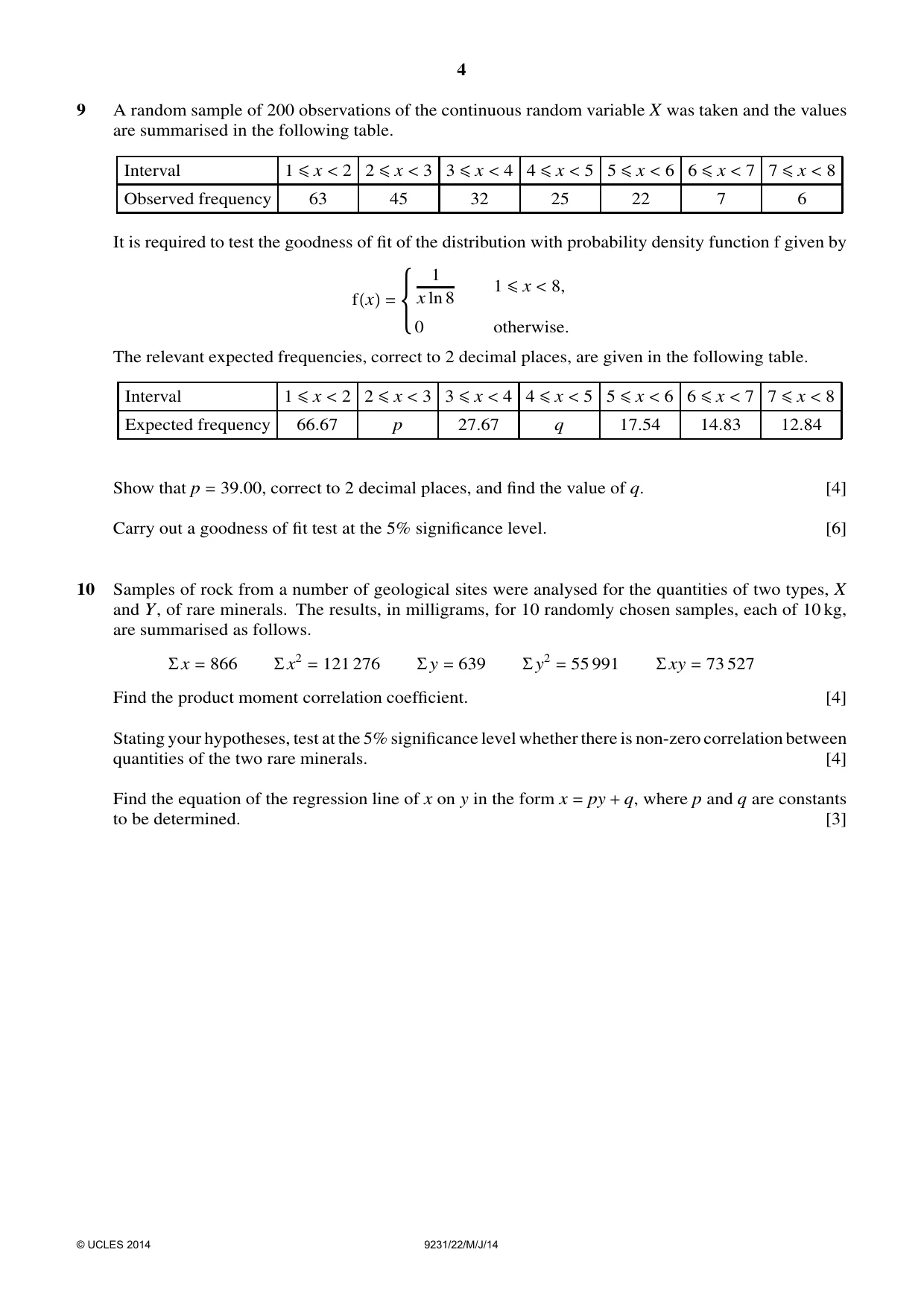
4 9 A random sample of 200 observations of the continuous random variable X was taken and the values are summarised in the following table. Interval 1 ≤x < 2 2 ≤x < 3 3 ≤x < 4 4 ≤x < 5 5 ≤x < 6 6 ≤x < 7 7 ≤x < 8 Observed frequency 63 45 32 25 22 7 6 It is required to test the goodness of fit of the distribution with probability density function f given by fx = t 1 x ln 8 1 ≤x < 8, 0 otherwise. The relevant expected frequencies, correct to 2 decimal places, are given in the following table. Interval 1 ≤x < 2 2 ≤x < 3 3 ≤x < 4 4 ≤x < 5 5 ≤x < 6 6 ≤x < 7 7 ≤x < 8 Expected frequency 66.67 p 27.67 q 17.54 14.83 12.84 Show that p = 39.00, correct to 2 decimal places, and find the value of q. [4] Carry out a goodness of fit test at the 5% significance level. [6] 10 Samples of rock from a number of geological sites were analysed for the quantities of two types, X and Y, of rare minerals. The results, in milligrams, for 10 randomly chosen samples, each of 10 kg, are summarised as follows. Σx = 866 Σx2 = 121 276 Σy = 639 Σy2 = 55 991 Σxy = 73 527 Find the product moment correlation coefficient. [4] Stating your hypotheses, test at the 5% significance level whether there is non-zero correlation between quantities of the two rare minerals. [4] Find the equation of the regression line of x on y in the form x = py + q, where p and q are constants to be determined. [3] © UCLES 2014 9231/22/M/J/14
Question paper, page 5
5 11 Answer only one of the following two alternatives. EITHER P Q R S 3a 6a 6a 4a 2 3a 30Å A B C D The points C and D are at a distance 2ï3a apart on a horizontal surface. A rough peg A is fixed at a vertical distance 6a above C and a smooth peg B is fixed at a vertical distance 4a above D. A uniform rectangular frame PQRS, with PQ = 3a and QR = 6a, is made of rigid thin wire and has weight W. It rests in equilibrium in a vertical plane with PS on A and SR on B, and with angle SAC = 30Å (see diagram). (i) Show that AB = 4a and that angle SAB = 30Å. [4] (ii) Show that the normal reaction at A is 1 2W. [3] (iii) Find the frictional force at A. [7] OR The time taken for a randomly chosen student at College P to complete a particular puzzle has a normal distribution with mean - minutes. The times, x minutes, are recorded for a random sample of 8 students chosen from the college. The results are summarised as follows. Σx = 42.8 Σx2 = 236.0 Find a 95% confidence interval for -. [4] A test is carried out on this sample data, at the 10% significance level. The test supports the claim that - > k. Find the greatest possible value of k. [3] A random sample, of size 12, is taken from the students at College Q. Their times to complete the puzzle give a sample mean of 4.60 minutes and an unbiased variance estimate of 1.962 minutes2. Use a 2-sample test at the 10% significance level to test whether the mean time for students at College Q to complete the puzzle is less than the mean time for students at College P to complete the puzzle. You should state any assumptions necessary for the test to be valid. [7] © UCLES 2014 9231/22/M/J/14
Question paper, page 6
6 BLANK PAGE © UCLES 2014 9231/22/M/J/14
Question paper, page 7
7 BLANK PAGE © UCLES 2014 9231/22/M/J/14
Question paper, page 8
8 BLANK PAGE Permission to reproduce items where third-party owned material protected by copyright is included has been sought and cleared where possible. Every reasonable effort has been made by the publisher (UCLES) to trace copyright holders, but if any items requiring clearance have unwittingly been included, the publisher will be pleased to make amends at the earliest possible opportunity. Cambridge International Examinations is part of the Cambridge Assessment Group. Cambridge Assessment is the brand name of University of Cambridge Local Examinations Syndicate (UCLES), which is itself a department of the University of Cambridge. © UCLES 2014 9231/22/M/J/14
Mark scheme, page 1
CAMBRIDGE INTERNATIONAL EXAMINATIONS GCE Advanced Level MARK SCHEME for the May/June 2014 series 9231 FURTHER MATHEMATICS 9231/22 Paper 2, maximum raw mark 100 This mark scheme is published as an aid to teachers and candidates, to indicate the requirements of the examination. It shows the basis on which Examiners were instructed to award marks. It does not indicate the details of the discussions that took place at an Examiners’ meeting before marking began, which would have considered the acceptability of alternative answers. Mark schemes should be read in conjunction with the question paper and the Principal Examiner Report for Teachers. Cambridge will not enter into discussions about these mark schemes. Cambridge is publishing the mark schemes for the May/June 2014 series for most IGCSE, GCE Advanced Level and Advanced Subsidiary Level components and some Ordinary Level components.
Mark scheme, page 2
Page 2 Mark Scheme Syllabus Paper GCE A LEVEL – May/June 2014 9231 22 © Cambridge International Examinations 2014 Question Number Mark Scheme Details Part Mark Total 1 Equate impulse to momentum to find initial speed v and Newton’s law of restitution to find new speed: v = 4u, v ′ = ev = [-] 3u M1 A1 2 2 2 Find v 2 at both A and B: Find amplitude a m from given K.E. ratio: Find ω from vmax = aω: Find time ( on a ) at A or at B, e.g.: Combine correctly to find time from A to B: Evaluate to 3 d.p.: vA 2 = ω 2 (a 2 – 0⋅5 2) and vB 2 = ω 2 (a 2 – 0⋅75 2) B1 ½ mvA 2 = (12 / 11) ½ mvB 2 11 (a 2 – 0⋅5 2) = 12 (a 2 – 0⋅75 2) a 2 = ¼ (27 – 11) = 4, a = 2 M1 A1 0⋅6 = 2ω, ω = 0⋅3 B1 ω -1 sin-1 (0⋅5 / 2) or ω -1 cos -1 (0⋅5 / 2) ω -1 sin-1 (0⋅75 / 2) or ω -1 cos -1 (0⋅75 / 2) M1 A1 ω -1 sin-1 (0⋅75 / 2) – ω -1 sin -1 (0⋅5 / 2) or ω -1 cos -1 (0⋅5 / 2) – ω -1 cos -1 (0⋅75 / 2) M1 = ω -1 (0⋅3844 – 0⋅2527) or ω -1 (1⋅318 – 1⋅186) = 1⋅2813 – 0⋅8423 4⋅3937 – 3⋅9547 = 0⋅439 [s] A1 3 5 8
Mark scheme, page 3
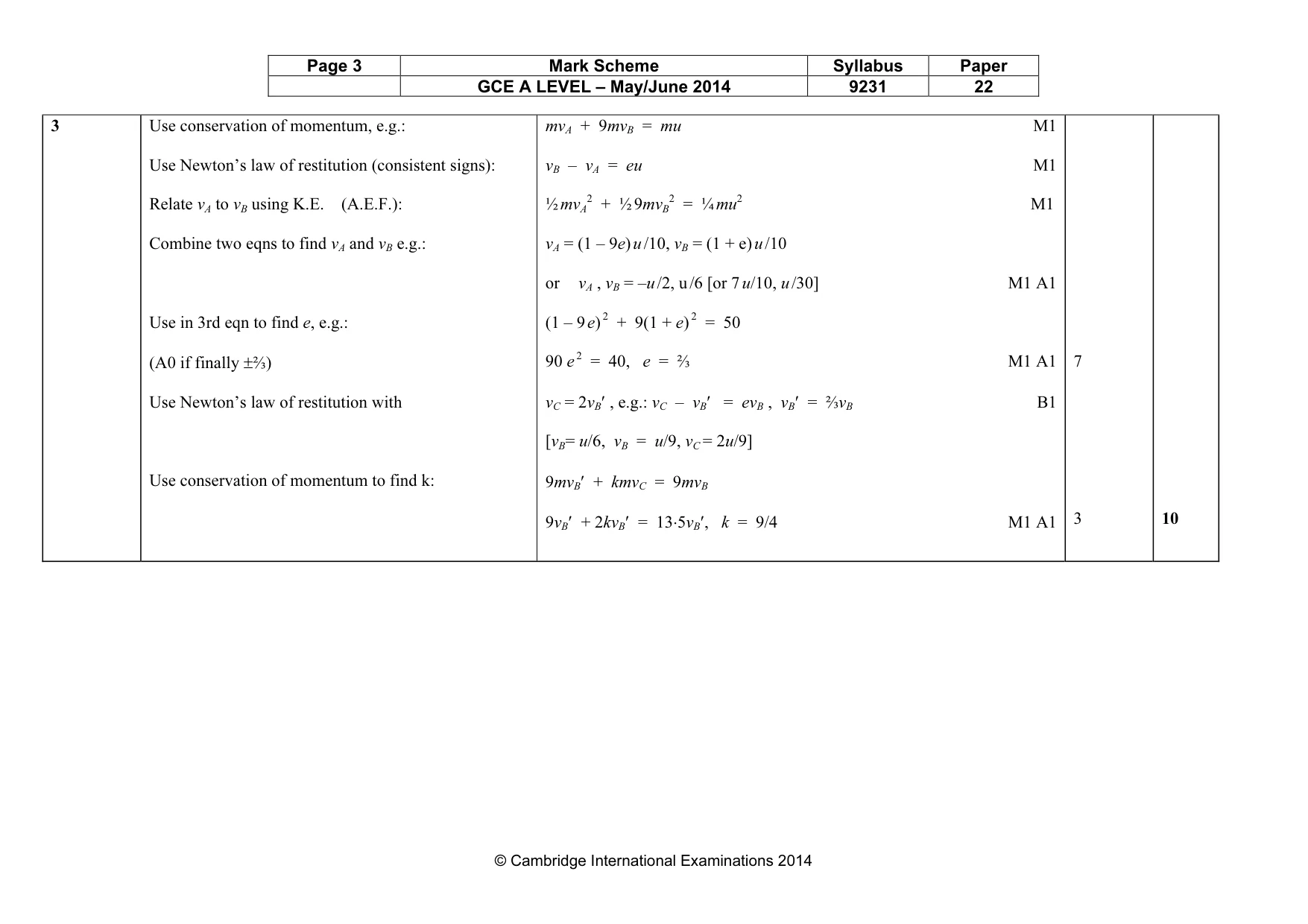
Page 3 Mark Scheme Syllabus Paper GCE A LEVEL – May/June 2014 9231 22 © Cambridge International Examinations 2014 3 Use conservation of momentum, e.g.: Use Newton’s law of restitution (consistent signs): Relate vA to vB using K.E. (A.E.F.): Combine two eqns to find vA and vB e.g.: Use in 3rd eqn to find e, e.g.: (A0 if finally ±⅔) Use Newton’s law of restitution with Use conservation of momentum to find k: mvA + 9mvB = mu M1 vB – vA = eu M1 ½ mvA 2 + ½ 9mvB 2 = ¼ mu2 M1 vA = (1 – 9e) u /10, vB = (1 + e) u /10 or vA , vB = –u /2, u /6 [or 7 u/10, u /30] M1 A1 (1 – 9 e) 2 + 9(1 + e) 2 = 50 90 e 2 = 40, e = ⅔ M1 A1 vC = 2vB′ , e.g.: vC – vB′ = evB , vB′ = ⅔vB B1 [vB= u/6, vB = u/9, vC = 2u/9] 9mvB′ + kmvC = 9mvB 9vB′ + 2kvB′ = 13⋅5vB′, k = 9/4 M1 A1 7 3 10
Mark scheme, page 4
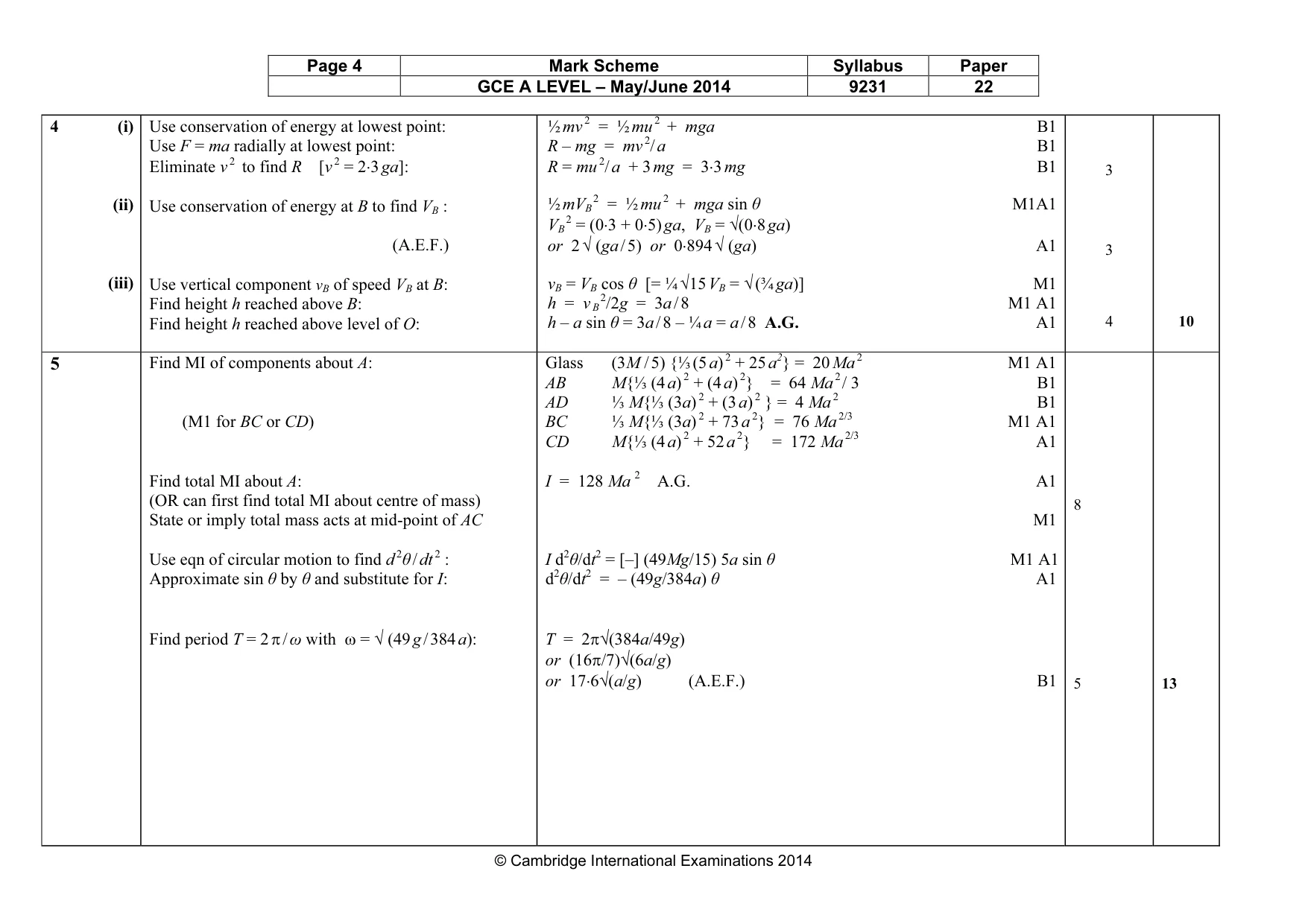
Page 4 Mark Scheme Syllabus Paper GCE A LEVEL – May/June 2014 9231 22 © Cambridge International Examinations 2014 4 (i) (ii) (iii) Use conservation of energy at lowest point: Use F = ma radially at lowest point: Eliminate v 2 to find R [v 2 = 2⋅3 ga]: Use conservation of energy at B to find VB : (A.E.F.) Use vertical component vB of speed VB at B: Find height h reached above B: Find height h reached above level of O: ½ mv 2 = ½ mu 2 + mga B1 R – mg = mv 2/ a B1 R = mu 2/ a + 3 mg = 3⋅3 mg B1 ½ mVB 2 = ½ mu 2 + mga sin θ M1A1 VB 2 = (0⋅3 + 0⋅5) ga, VB = √(0⋅8 ga) or 2 √ (ga / 5) or 0⋅894 √ (ga) A1 vB = VB cos θ [= ¼ √15 VB = √ (¾ ga)] M1 h = v B 2/2g = 3a / 8 M1 A1 h – a sin θ = 3a / 8 – ¼ a = a / 8 A.G. A1 3 3 4 10 5 Find MI of components about A: (M1 for BC or CD) Find total MI about A: (OR can first find total MI about centre of mass) State or imply total mass acts at mid-point of AC Use eqn of circular motion to find d 2θ / dt 2 : Approximate sin θ by θ and substitute for I: Find period T = 2 π / ω with ω = √ (49 g / 384 a): Glass (3M / 5) {⅓ (5 a) 2 + 25 a2} = 20 Ma 2 M1 A1 AB M{⅓ (4 a) 2 + (4 a) 2} = 64 Ma 2 / 3 B1 AD ⅓ M{⅓ (3a) 2 + (3 a) 2 } = 4 Ma 2 B1 BC ⅓ M{⅓ (3a) 2 + 73 a 2} = 76 Ma 2/3 M1 A1 CD M{⅓ (4 a) 2 + 52 a 2} = 172 Ma 2/3 A1 I = 128 Ma 2 A.G. A1 M1 I d2θ/dt2 = [–] (49Mg/15) 5a sin θ M1 A1 d2θ/dt2 = – (49g/384a) θ A1 T = 2π√(384a/49g) or (16π/7)√(6a/g) or 17⋅6√(a/g) (A.E.F.) B1 8 5 13
Mark scheme, page 5
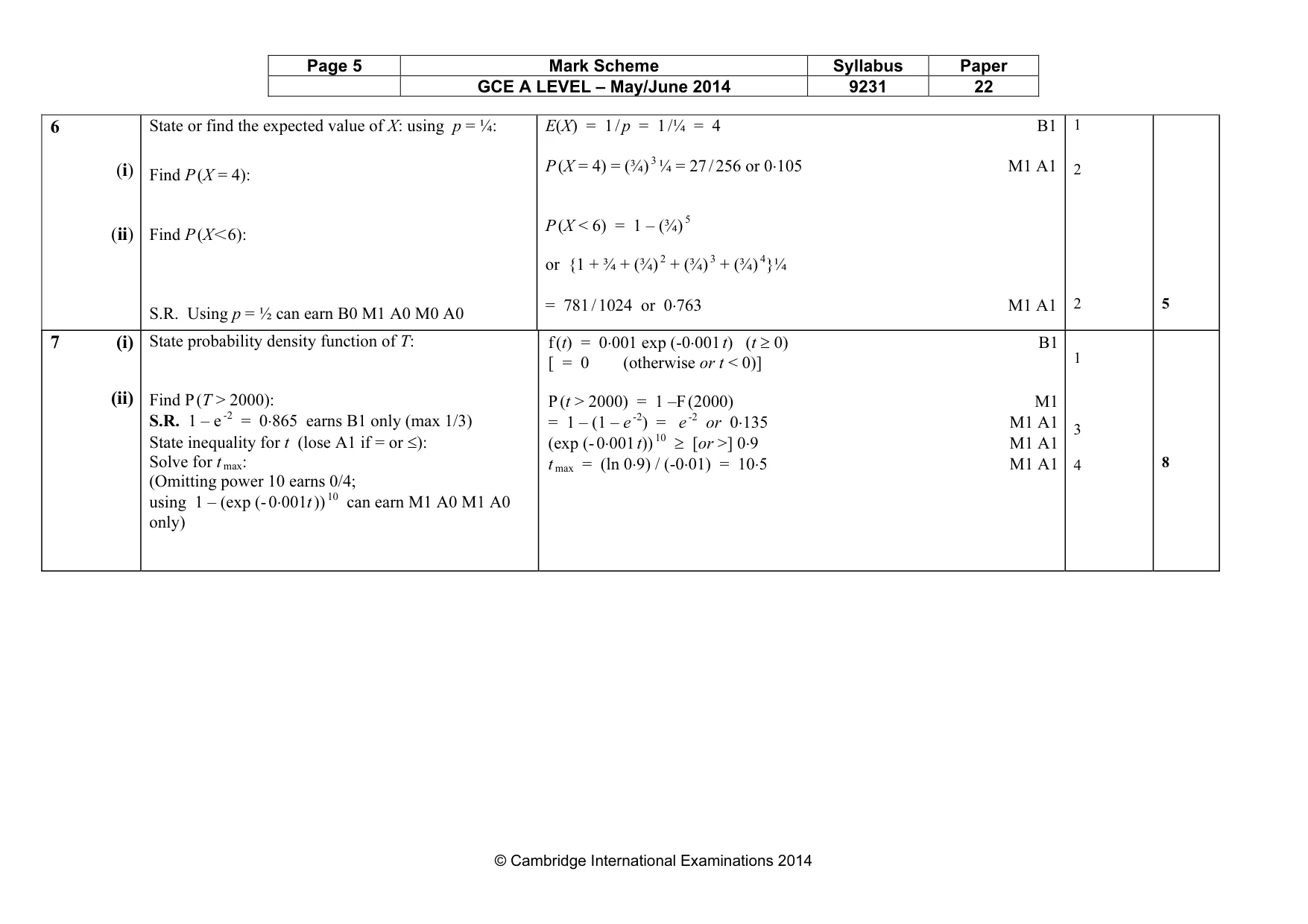
Page 5 Mark Scheme Syllabus Paper GCE A LEVEL – May/June 2014 9231 22 © Cambridge International Examinations 2014 6 (i) (ii) State or find the expected value of X: using p = ¼: Find P (X = 4): Find P (XI6): S.R. Using p = ½ can earn B0 M1 A0 M0 A0 E(X) = 1 / p = 1 /¼ = 4 B1 P (X = 4) = (¾) 3 ¼ = 27 / 256 or 0⋅105 M1 A1 P (X < 6) = 1 – (¾) 5 or {1 + ¾ + (¾) 2 + (¾) 3 + (¾) 4}¼ = 781 / 1024 or 0⋅763 M1 A1 1 2 2 5 7 (i) (ii) State probability density function of T: Find P (T > 2000): S.R. 1 – e -2 = 0⋅865 earns B1 only (max 1/3) State inequality for t (lose A1 if = or ≤): Solve for t max: (Omitting power 10 earns 0/4; using 1 – (exp (- 0⋅001t )) 10 can earn M1 A0 M1 A0 only) f (t) = 0⋅001 exp (-0⋅001 t) (t ≥ 0) B1 [ = 0 (otherwise or t < 0)] P (t > 2000) = 1 –F (2000) M1 = 1 – (1 – e -2) = e -2 or 0⋅135 M1 A1 (exp (- 0⋅001 t)) 10 ≥ [or >] 0⋅9 M1 A1 t max = (ln 0⋅9) / (-0⋅01) = 10⋅5 M1 A1 1 3 4 8
Mark scheme, page 6
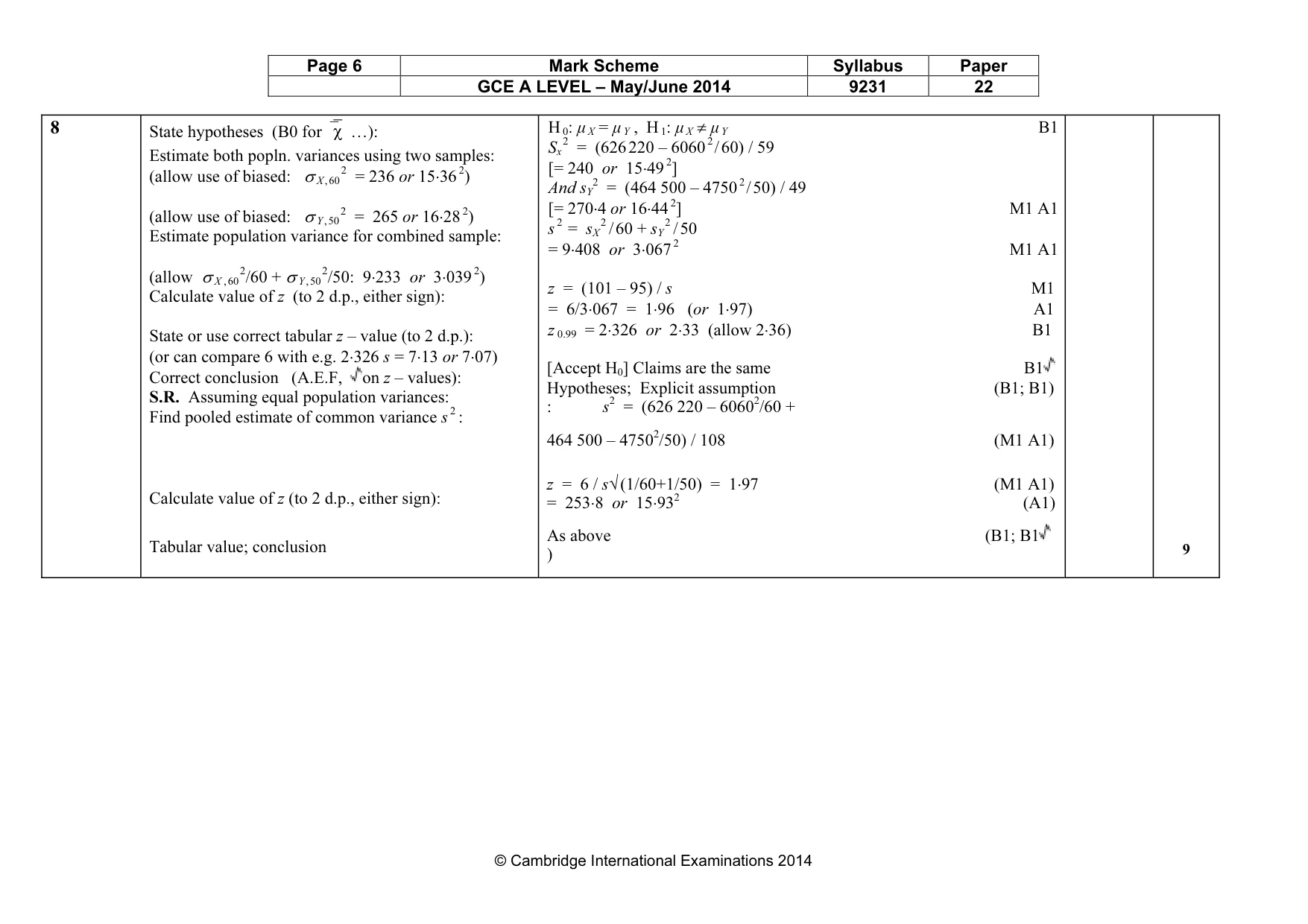
Page 6 Mark Scheme Syllabus Paper GCE A LEVEL – May/June 2014 9231 22 © Cambridge International Examinations 2014 8 State hypotheses (B0 forχ …): Estimate both popln. variances using two samples: (allow use of biased: σ X , 60 2 = 236 or 15⋅36 2) (allow use of biased: σ Y , 50 2 = 265 or 16⋅28 2) Estimate population variance for combined sample: (allow σ X , 60 2/60 + σ Y , 50 2/50: 9⋅233 or 3⋅039 2) Calculate value of z (to 2 d.p., either sign): State or use correct tabular z – value (to 2 d.p.): (or can compare 6 with e.g. 2⋅326 s = 7⋅13 or 7⋅07) Correct conclusion (A.E.F, on z – values): S.R. Assuming equal population variances: Find pooled estimate of common variance s 2 : Calculate value of z (to 2 d.p., either sign): Tabular value; conclusion H 0: µ X = µ Y , H 1: µ X ≠ µ Y B1 Sx 2 = (626 220 – 6060 2 / 60) / 59 [= 240 or 15⋅49 2] And sY 2 = (464 500 – 4750 2 / 50) / 49 [= 270⋅4 or 16⋅44 2] M1 A1 s 2 = sX 2 / 60 + sY 2 / 50 = 9⋅408 or 3⋅067 2 M1 A1 z = (101 – 95) / s M1 = 6/3⋅067 = 1⋅96 (or 1⋅97) A1 z 0.99 = 2⋅326 or 2⋅33 (allow 2⋅36) B1 [Accept H0] Claims are the same B1 Hypotheses; Explicit assumption (B1; B1) : s2 = (626 220 – 60602/60 + 464 500 – 47502/50) / 108 (M1 A1) z = 6 / s√ (1/60+1/50) = 1⋅97 (M1 A1) = 253⋅8 or 15⋅932 (A1) As above (B1; B1 ) 9
Mark scheme, page 7
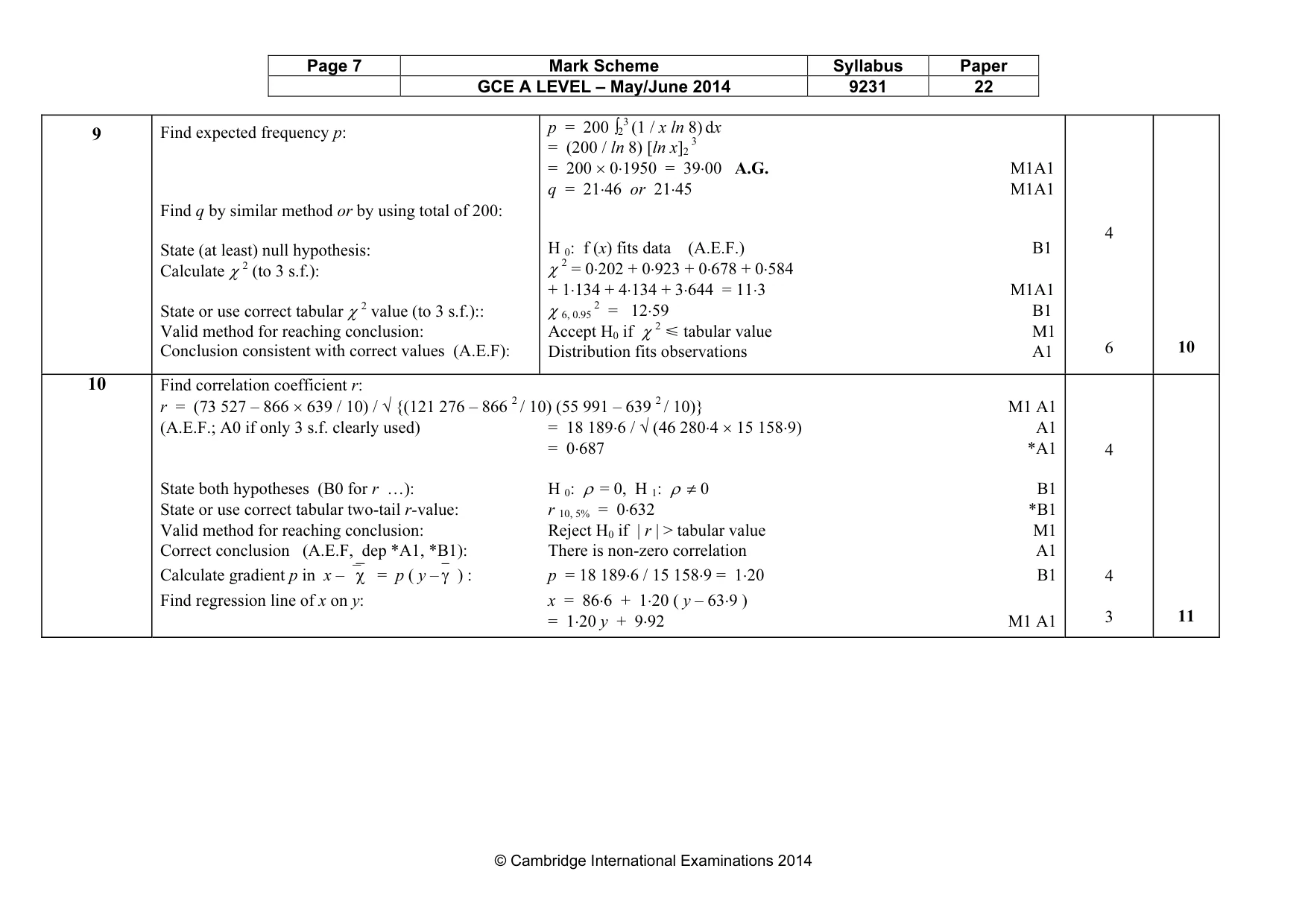
Page 7 Mark Scheme Syllabus Paper GCE A LEVEL – May/June 2014 9231 22 © Cambridge International Examinations 2014 9 Find expected frequency p: Find q by similar method or by using total of 200: State (at least) null hypothesis: Calculate χ 2 (to 3 s.f.): State or use correct tabular χ 2 value (to 3 s.f.):: Valid method for reaching conclusion: Conclusion consistent with correct values (A.E.F): p = 200 ∫2 3 (1 / x ln 8) dx = (200 / ln 8) [ln x]2 3 = 200 × 0⋅1950 = 39⋅00 A.G. M1A1 q = 21⋅46 or 21⋅45 M1A1 H 0: f (x) fits data (A.E.F.) B1 χ 2 = 0⋅202 + 0⋅923 + 0⋅678 + 0⋅584 + 1⋅134 + 4⋅134 + 3⋅644 = 11⋅3 M1A1 χ 6, 0.95 2 = 12⋅59 B1 Accept H0 if χ 2 Y tabular value M1 Distribution fits observations A1 4 6 10 10 Find correlation coefficient r: r = (73 527 – 866 × 639 / 10) / √ {(121 276 – 866 2 / 10) (55 991 – 639 2 / 10)} M1 A1 (A.E.F.; A0 if only 3 s.f. clearly used) = 18 189⋅6 / √ (46 280⋅4 × 15 158⋅9) A1 = 0⋅687 *A1 State both hypotheses (B0 for r …): H 0: ρ = 0, H 1: ρ ≠ 0 B1 State or use correct tabular two-tail r-value: r 10, 5% = 0⋅632 *B1 Valid method for reaching conclusion: Reject H0 if | r | > tabular value M1 Correct conclusion (A.E.F, dep *A1, *B1): There is non-zero correlation A1 Calculate gradient p in x –χ = p ( y – γ ) : p = 18 189⋅6 / 15 158⋅9 = 1⋅20 B1 Find regression line of x on y: x = 86⋅6 + 1⋅20 ( y – 63⋅9 ) = 1⋅20 y + 9⋅92 M1 A1 4 4 3 11
Mark scheme, page 8
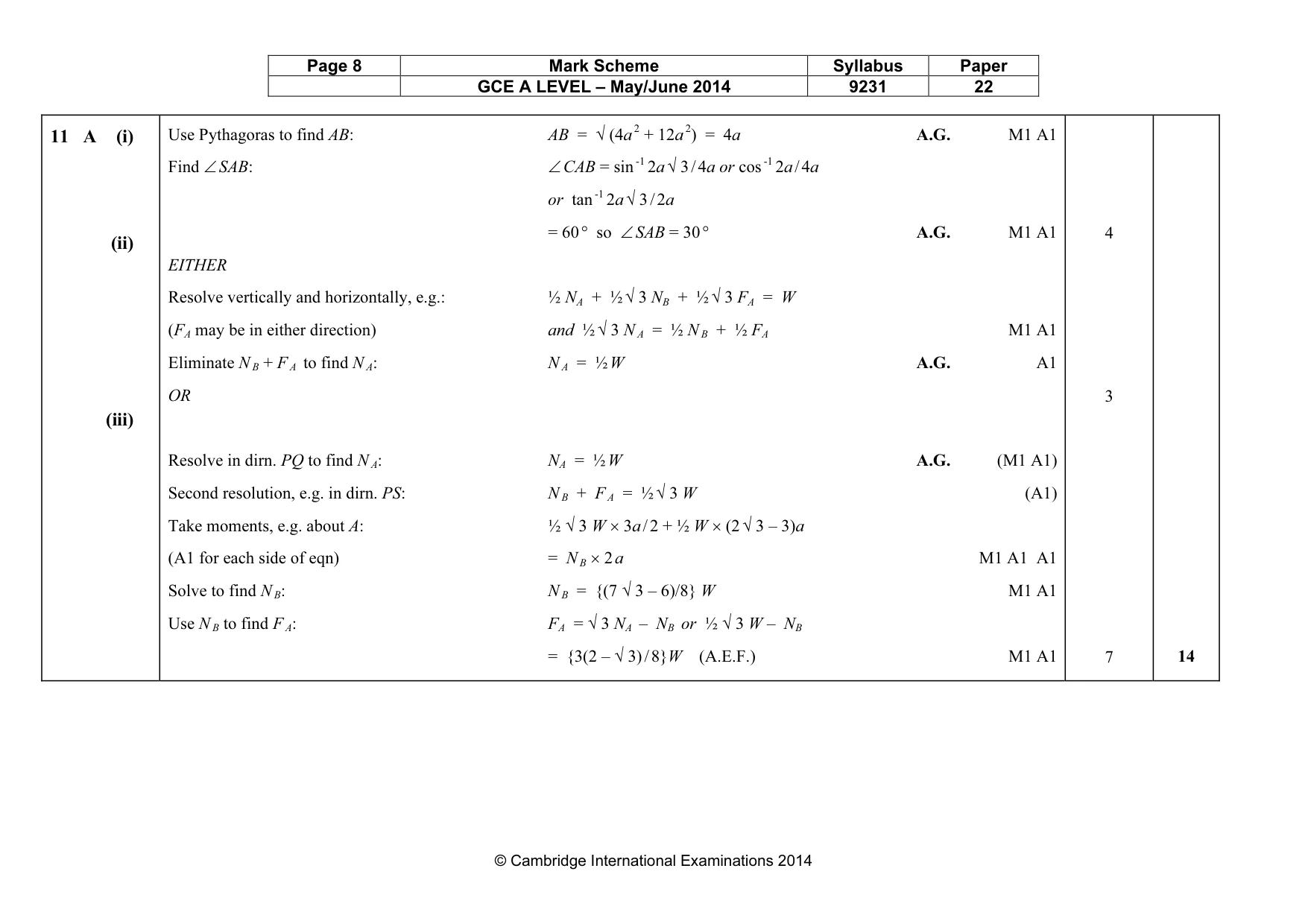
Page 8 Mark Scheme Syllabus Paper GCE A LEVEL – May/June 2014 9231 22 © Cambridge International Examinations 2014 11 A (i) (ii) (iii) Use Pythagoras to find AB: AB = √ (4a 2 + 12a 2) = 4a A.G. M1 A1 Find ∠ SAB: ∠ CAB = sin -1 2a √ 3 / 4a or cos -1 2a / 4a or tan -1 2a √ 3 / 2a = 60 ° so ∠ SAB = 30 ° A.G. M1 A1 EITHER Resolve vertically and horizontally, e.g.: ½ NA + ½ √ 3 NB + ½ √ 3 FA = W (FA may be in either direction) and ½ √ 3 N A = ½ N B + ½ FA M1 A1 Eliminate N B + F A to find N A: N A = ½ W A.G. A1 OR Resolve in dirn. PQ to find N A: NA = ½ W A.G. (M1 A1) Second resolution, e.g. in dirn. PS: N B + F A = ½ √ 3 W (A1) Take moments, e.g. about A: ½ √ 3 W × 3a / 2 + ½ W × (2 √ 3 – 3)a (A1 for each side of eqn) = N B × 2 a M1 A1 A1 Solve to find N B: N B = {(7 √ 3 – 6)/8} W M1 A1 Use N B to find F A: FA = √ 3 NA – NB or ½ √ 3 W – NB = {3(2 – √ 3) / 8}W (A.E.F.) M1 A1 4 3 7 14
Mark scheme, page 9
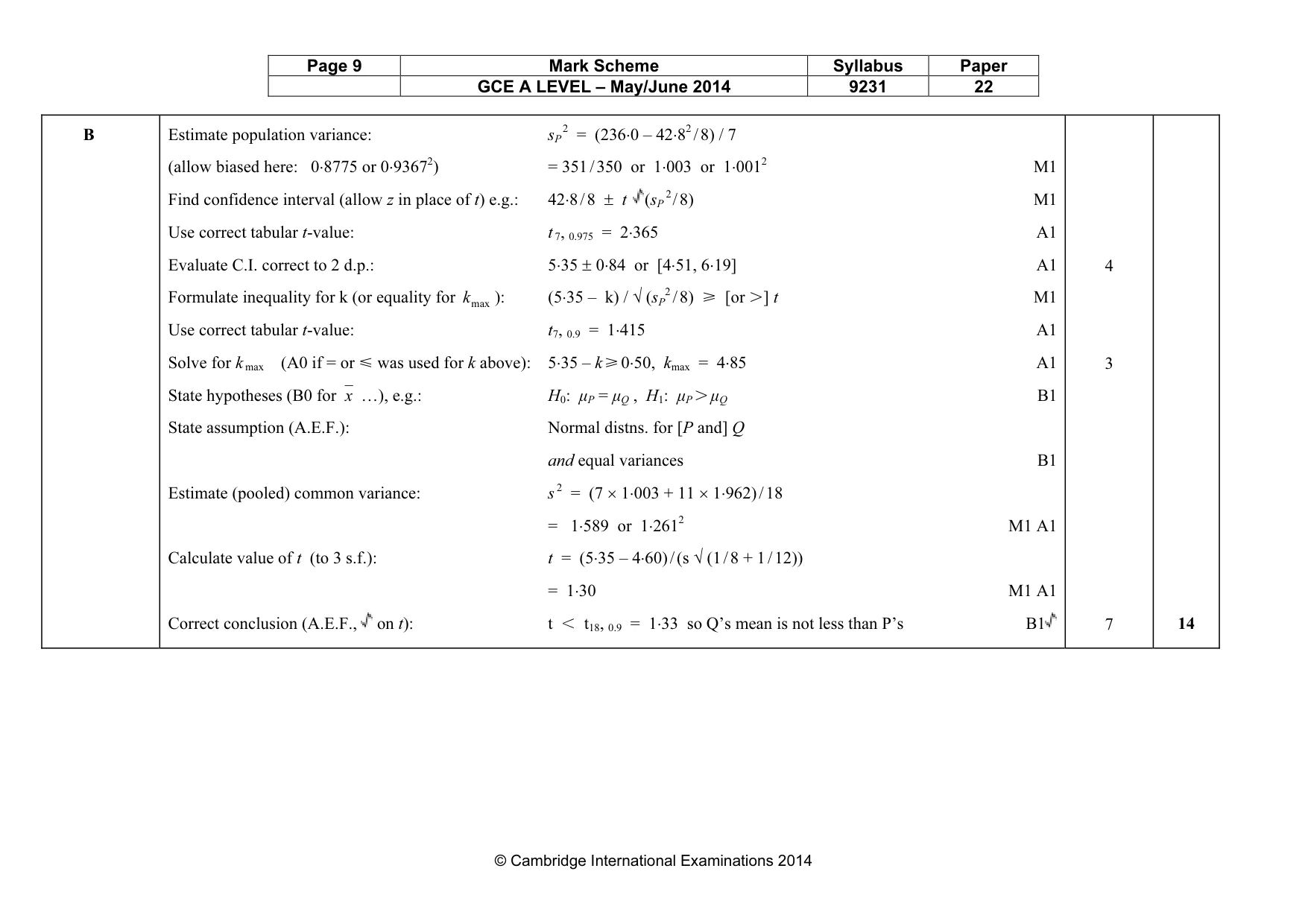
Page 9 Mark Scheme Syllabus Paper GCE A LEVEL – May/June 2014 9231 22 © Cambridge International Examinations 2014 B Estimate population variance: sP 2 = (236⋅0 – 42⋅82 / 8) / 7 (allow biased here: 0⋅8775 or 0⋅93672) = 351 / 350 or 1⋅003 or 1⋅0012 M1 Find confidence interval (allow z in place of t) e.g.: 42⋅8 / 8 ± t (sP 2 / 8) M1 Use correct tabular t-value: t 7, 0.975 = 2⋅365 A1 Evaluate C.I. correct to 2 d.p.: 5⋅35 ± 0⋅84 or [4⋅51, 6⋅19] A1 Formulate inequality for k (or equality for max k ): (5⋅35 – k) / √ (sP 2 / 8) [ [or K] t M1 Use correct tabular t-value: t7, 0.9 = 1⋅415 A1 Solve for k max (A0 if = or Y=was used for k above): 5⋅35 – k [ 0⋅50, kmax = 4⋅85 A1 State hypotheses (B0 forx …), e.g.: H0: µP = µQ , H1: µP K=µQ B1 State assumption (A.E.F.): Normal distns. for [P and] Q and equal variances B1 Estimate (pooled) common variance: s 2 = (7 × 1⋅003 + 11 × 1⋅962) / 18 = 1⋅589 or 1⋅2612 M1 A1 Calculate value of t (to 3 s.f.): t = (5⋅35 – 4⋅60) / (s √ (1 / 8 + 1 / 12)) = 1⋅30 M1 A1 Correct conclusion (A.E.F., on t): t I t18, 0.9 = 1⋅33 so Q’s mean is not less than P’s B1 4 3 7 14
What you needed in this session
Cambridge’s own grade thresholds for 2014 May/June, Paper 2 · Variant 2. A higher threshold means an easier paper — the bar moves with how the cohort did.