Cambridge A Level Mathematics - Further 9231 — 2014 May/June Paper 1 · Variant 3
9231/13/M/J/14 · 100 marks · ≈113 min
The question paper and its mark scheme, free to read here and free to download. This is Cambridge’s own paper, exactly as it was sat.
Question paper4 pages
Mark scheme12 pages
Answers below. Sit the paper first if you are practising.
Paper as text
Question paper, page 1
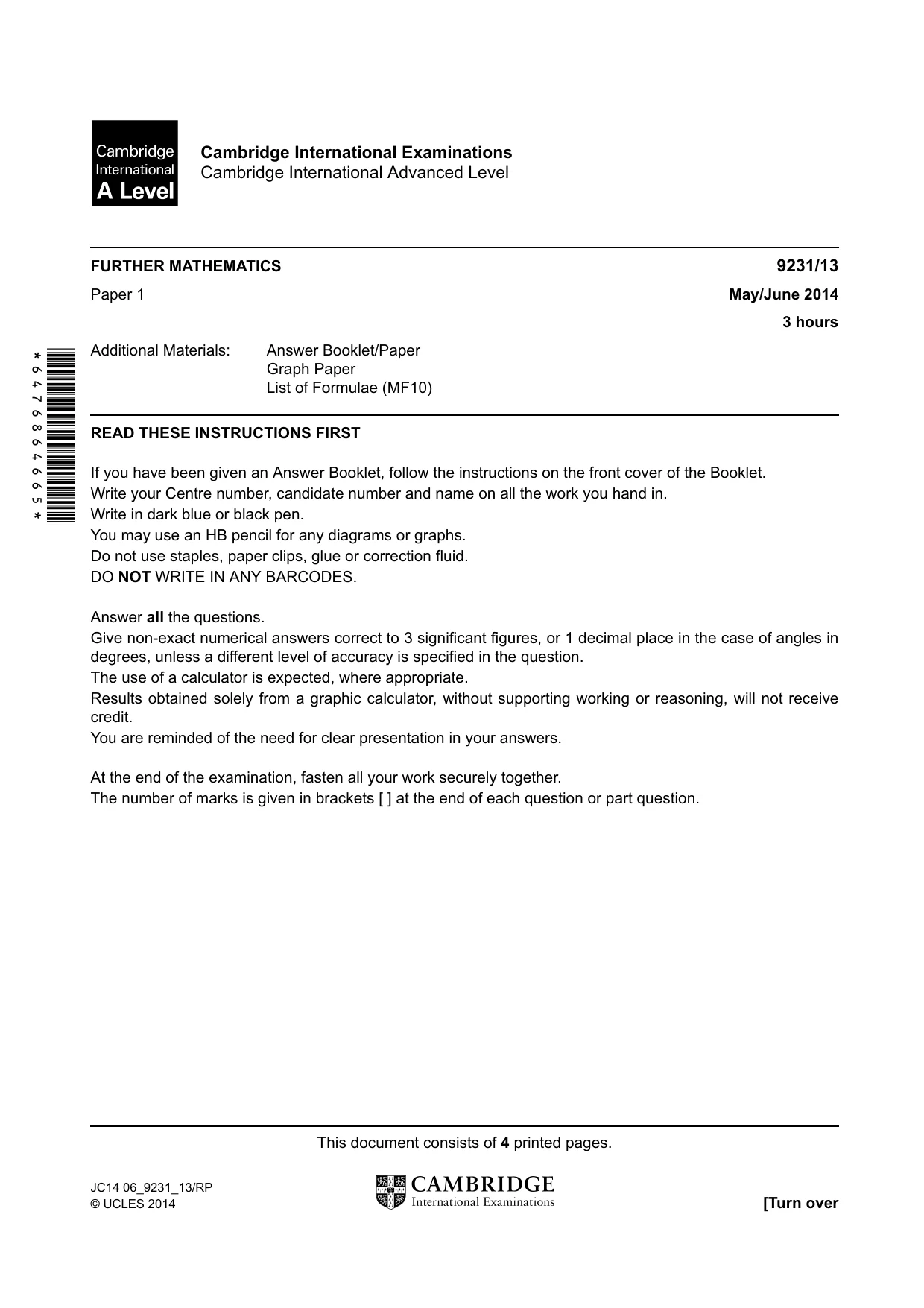
*6476864665* Cambridge International Examinations Cambridge International Advanced Level FURTHER MATHEMATICS 9231/13 Paper 1 May/June 2014 3 hours Additional Materials: Answer Booklet/Paper Graph Paper List of Formulae (MF10) READ THESE INSTRUCTIONS FIRST If you have been given an Answer Booklet, follow the instructions on the front cover of the Booklet. Write your Centre number, candidate number and name on all the work you hand in. Write in dark blue or black pen. You may use an HB pencil for any diagrams or graphs. Do not use staples, paper clips, glue or correction fluid. DO NOT WRITE IN ANY BARCODES. Answer all the questions. Give non-exact numerical answers correct to 3 significant figures, or 1 decimal place in the case of angles in degrees, unless a different level of accuracy is specified in the question. The use of a calculator is expected, where appropriate. Results obtained solely from a graphic calculator, without supporting working or reasoning, will not receive credit. You are reminded of the need for clear presentation in your answers. At the end of the examination, fasten all your work securely together. The number of marks is given in brackets [ ] at the end of each question or part question. This document consists of 4 printed pages. JC14 06_9231_13/RP © UCLES 2014 [Turn over
Question paper, page 2
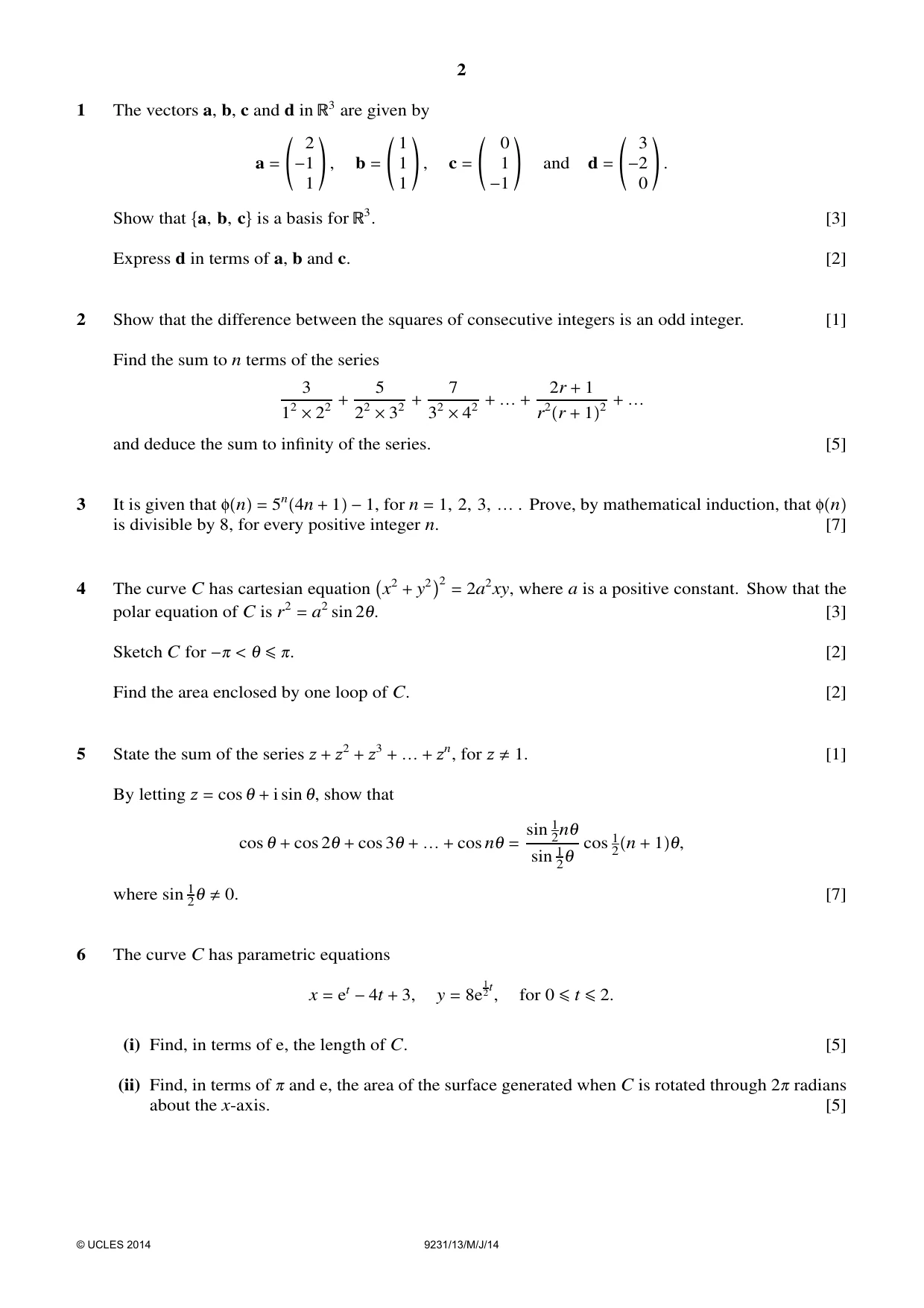
2 1 The vectors a, b, c and d in >3 are given by a = ` 2 −1 1 a , b = ` 1 1 1 a , c = ` 0 1 −1 a and d = ` 3 −2 0 a . Show that a, b, c is a basis for >3. [3] Express d in terms of a, b and c. [2] 2 Show that the difference between the squares of consecutive integers is an odd integer. [1] Find the sum to n terms of the series 3 12 × 22 + 5 22 × 32 + 7 32 × 42 + à + 2r + 1 r2r + 12 + à and deduce the sum to infinity of the series. [5] 3 It is given that φn = 5n4n + 1 −1, for n = 1, 2, 3, à . Prove, by mathematical induction, that φn is divisible by 8, for every positive integer n. [7] 4 The curve C has cartesian equation x2 + y22 = 2a2xy, where a is a positive constant. Show that the polar equation of C is r2 = a2 sin 21. [3] Sketch C for −0 < 1 ≤0. [2] Find the area enclosed by one loop of C. [2] 5 State the sum of the series Ï + Ï2 + Ï3 + à + Ïn, for Ï ≠1. [1] By letting Ï = cos 1 + i sin 1, show that cos 1 + cos 21 + cos 31 + à + cosn1 = sin 1 2n1 sin 1 21 cos 1 2n + 11, where sin 1 21 ≠0. [7] 6 The curve C has parametric equations x = et −4t + 3, y = 8e 1 2t, for 0 ≤t ≤2. (i) Find, in terms of e, the length of C. [5] (ii) Find, in terms of 0 and e, the area of the surface generated when C is rotated through 20 radians about the x-axis. [5] © UCLES 2014 9231/13/M/J/14
Question paper, page 3
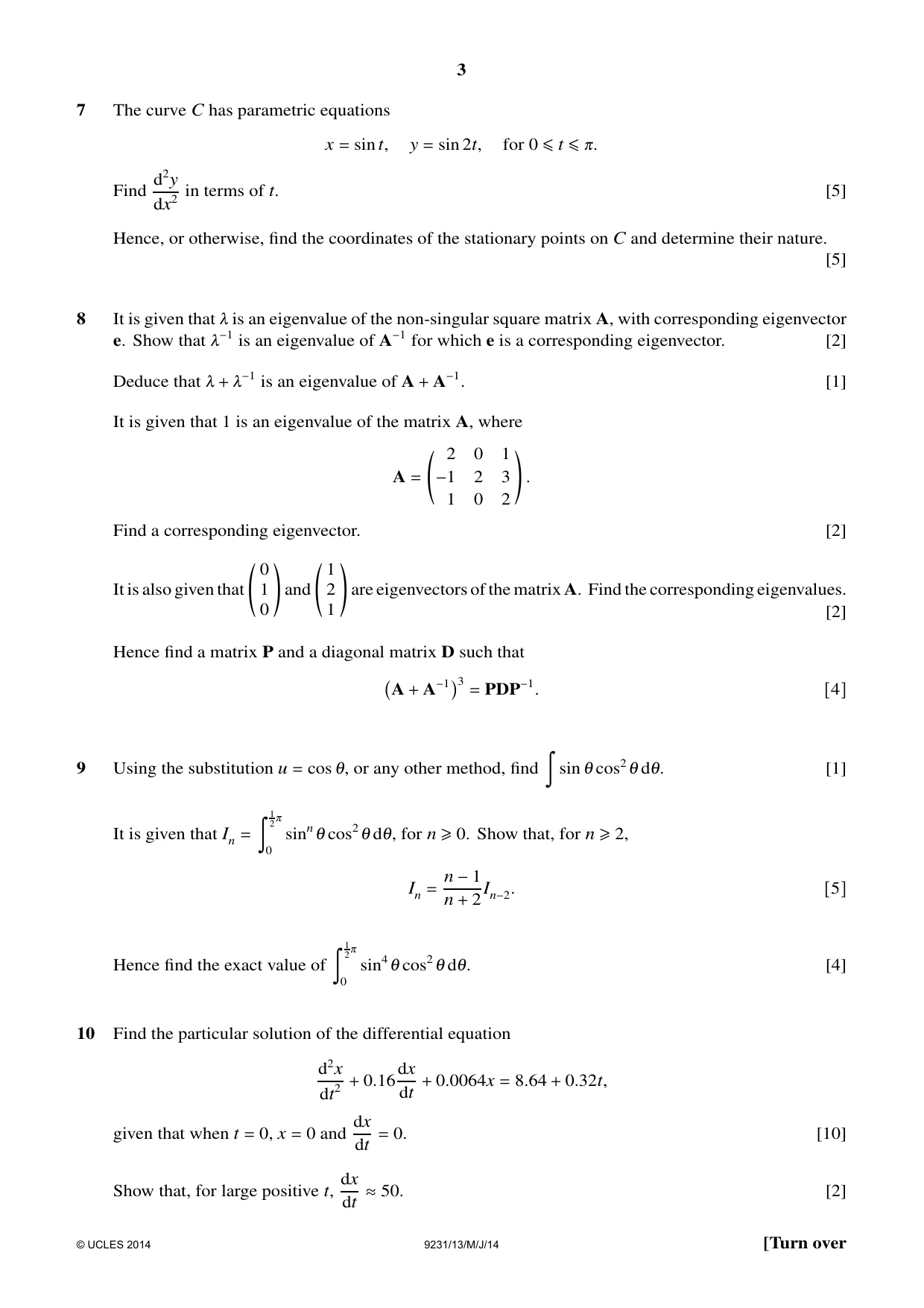
3 7 The curve C has parametric equations x = sin t, y = sin 2t, for 0 ≤t ≤0. Find d2y dx2 in terms of t. [5] Hence, or otherwise, find the coordinates of the stationary points on C and determine their nature. [5] 8 It is given that , is an eigenvalue of the non-singular square matrix A, with corresponding eigenvector e. Show that ,−1 is an eigenvalue of A−1 for which e is a corresponding eigenvector. [2] Deduce that , + ,−1 is an eigenvalue of A + A−1. [1] It is given that 1 is an eigenvalue of the matrix A, where A = ` 2 0 1 −1 2 3 1 0 2 a . Find a corresponding eigenvector. [2] It is also given that ` 0 1 0 a and ` 1 2 1 a are eigenvectors of the matrix A. Find the corresponding eigenvalues. [2] Hence find a matrix P and a diagonal matrix D such that A + A−13 = PDP−1. 4 9 Using the substitution u = cos 1, or any other method, find Ó sin 1 cos21 d1. [1] It is given that In = Ó 1 20 0 sinn1 cos21 d1, for n ≥0. Show that, for n ≥2, In = n −1 n + 2In−2. 5 Hence find the exact value of Ó 1 20 0 sin41 cos21 d1. [4] 10 Find the particular solution of the differential equation d2x dt2 + 0.16dx dt + 0.0064x = 8.64 + 0.32t, given that when t = 0, x = 0 and dx dt = 0. [10] Show that, for large positive t, dx dt ≈50. [2] © UCLES 2014 9231/13/M/J/14 [Turn over
Question paper, page 4
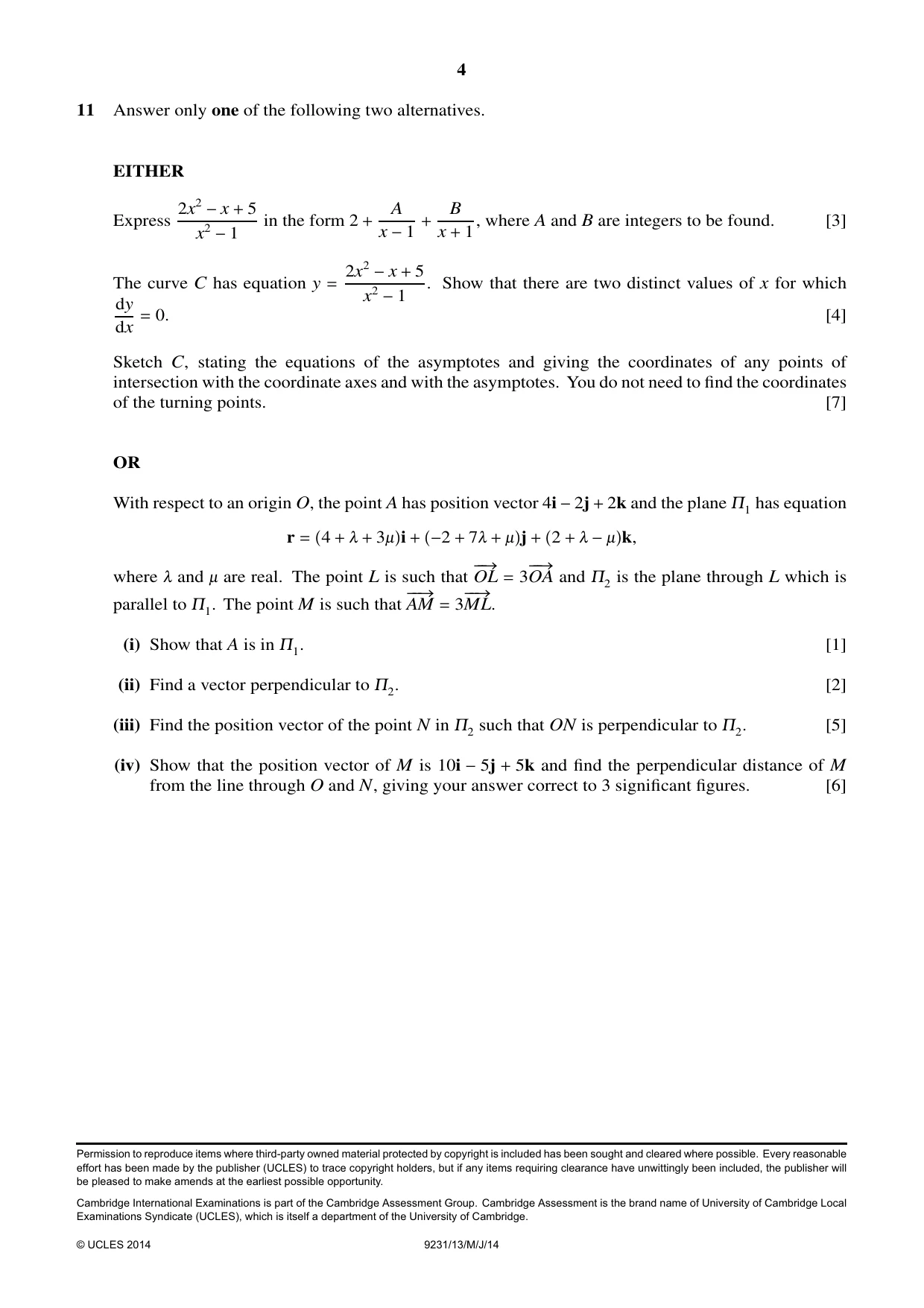
4 11 Answer only one of the following two alternatives. EITHER Express 2x2 −x + 5 x2 −1 in the form 2 + A x −1 + B x + 1, where A and B are integers to be found. [3] The curve C has equation y = 2x2 −x + 5 x2 −1 . Show that there are two distinct values of x for which dy dx = 0. [4] Sketch C, stating the equations of the asymptotes and giving the coordinates of any points of intersection with the coordinate axes and with the asymptotes. You do not need to find the coordinates of the turning points. [7] OR With respect to an origin O, the point A has position vector 4i −2j + 2k and the plane 1 has equation r = 4 + , + 3-i + −2 + 7, + -j + 2 + , −-k, where , and - are real. The point L is such that −−→ OL = 3−−→ OA and 2 is the plane through L which is parallel to 1. The point M is such that −−→ AM = 3−−→ ML. (i) Show that A is in 1. [1] (ii) Find a vector perpendicular to 2. [2] (iii) Find the position vector of the point N in 2 such that ON is perpendicular to 2. [5] (iv) Show that the position vector of M is 10i −5j + 5k and find the perpendicular distance of M from the line through O and N, giving your answer correct to 3 significant figures. [6] Permission to reproduce items where third-party owned material protected by copyright is included has been sought and cleared where possible. Every reasonable effort has been made by the publisher (UCLES) to trace copyright holders, but if any items requiring clearance have unwittingly been included, the publisher will be pleased to make amends at the earliest possible opportunity. Cambridge International Examinations is part of the Cambridge Assessment Group. Cambridge Assessment is the brand name of University of Cambridge Local Examinations Syndicate (UCLES), which is itself a department of the University of Cambridge. © UCLES 2014 9231/13/M/J/14
Mark scheme, page 1
CAMBRIDGE INTERNATIONAL EXAMINATIONS GCE Advanced Level MARK SCHEME for the May/June 2014 series 9231 FURTHER MATHEMATICS 9231/13 Paper 1, maximum raw mark 100 This mark scheme is published as an aid to teachers and candidates, to indicate the requirements of the examination. It shows the basis on which Examiners were instructed to award marks. It does not indicate the details of the discussions that took place at an Examiners’ meeting before marking began, which would have considered the acceptability of alternative answers. Mark schemes should be read in conjunction with the question paper and the Principal Examiner Report for Teachers. Cambridge will not enter into discussions about these mark schemes. Cambridge is publishing the mark schemes for the May/June 2014 series for most IGCSE, GCE Advanced Level and Advanced Subsidiary Level components and some Ordinary Level components.
Mark scheme, page 2
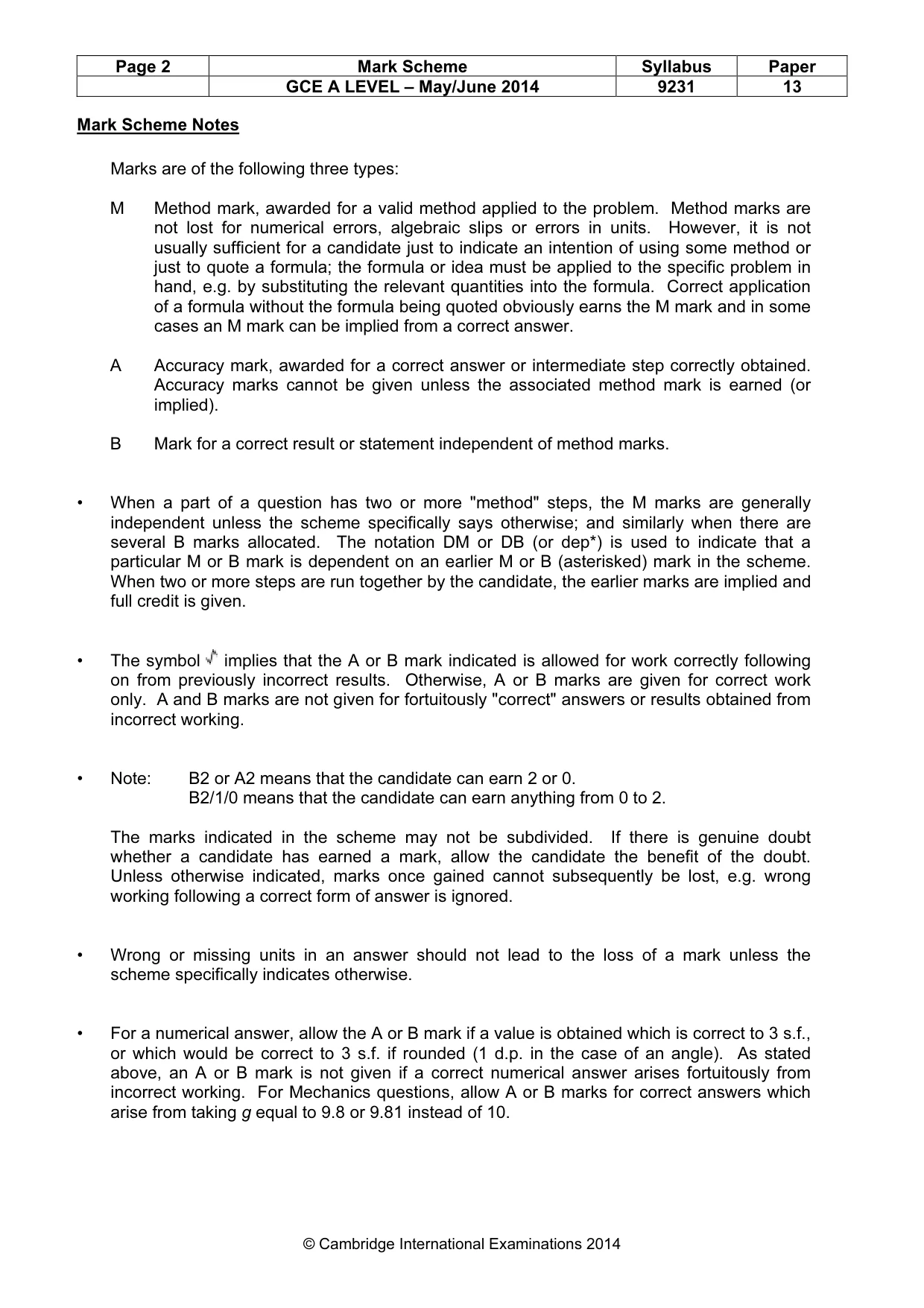
Page 2 Mark Scheme Syllabus Paper GCE A LEVEL – May/June 2014 9231 13 © Cambridge International Examinations 2014 Mark Scheme Notes Marks are of the following three types: M Method mark, awarded for a valid method applied to the problem. Method marks are not lost for numerical errors, algebraic slips or errors in units. However, it is not usually sufficient for a candidate just to indicate an intention of using some method or just to quote a formula; the formula or idea must be applied to the specific problem in hand, e.g. by substituting the relevant quantities into the formula. Correct application of a formula without the formula being quoted obviously earns the M mark and in some cases an M mark can be implied from a correct answer. A Accuracy mark, awarded for a correct answer or intermediate step correctly obtained. Accuracy marks cannot be given unless the associated method mark is earned (or implied). B Mark for a correct result or statement independent of method marks. • When a part of a question has two or more "method" steps, the M marks are generally independent unless the scheme specifically says otherwise; and similarly when there are several B marks allocated. The notation DM or DB (or dep*) is used to indicate that a particular M or B mark is dependent on an earlier M or B (asterisked) mark in the scheme. When two or more steps are run together by the candidate, the earlier marks are implied and full credit is given. • The symbol implies that the A or B mark indicated is allowed for work correctly following on from previously incorrect results. Otherwise, A or B marks are given for correct work only. A and B marks are not given for fortuitously "correct" answers or results obtained from incorrect working. • Note: B2 or A2 means that the candidate can earn 2 or 0. B2/1/0 means that the candidate can earn anything from 0 to 2. The marks indicated in the scheme may not be subdivided. If there is genuine doubt whether a candidate has earned a mark, allow the candidate the benefit of the doubt. Unless otherwise indicated, marks once gained cannot subsequently be lost, e.g. wrong working following a correct form of answer is ignored. • Wrong or missing units in an answer should not lead to the loss of a mark unless the scheme specifically indicates otherwise. • For a numerical answer, allow the A or B mark if a value is obtained which is correct to 3 s.f., or which would be correct to 3 s.f. if rounded (1 d.p. in the case of an angle). As stated above, an A or B mark is not given if a correct numerical answer arises fortuitously from incorrect working. For Mechanics questions, allow A or B marks for correct answers which arise from taking g equal to 9.8 or 9.81 instead of 10.
Mark scheme, page 3
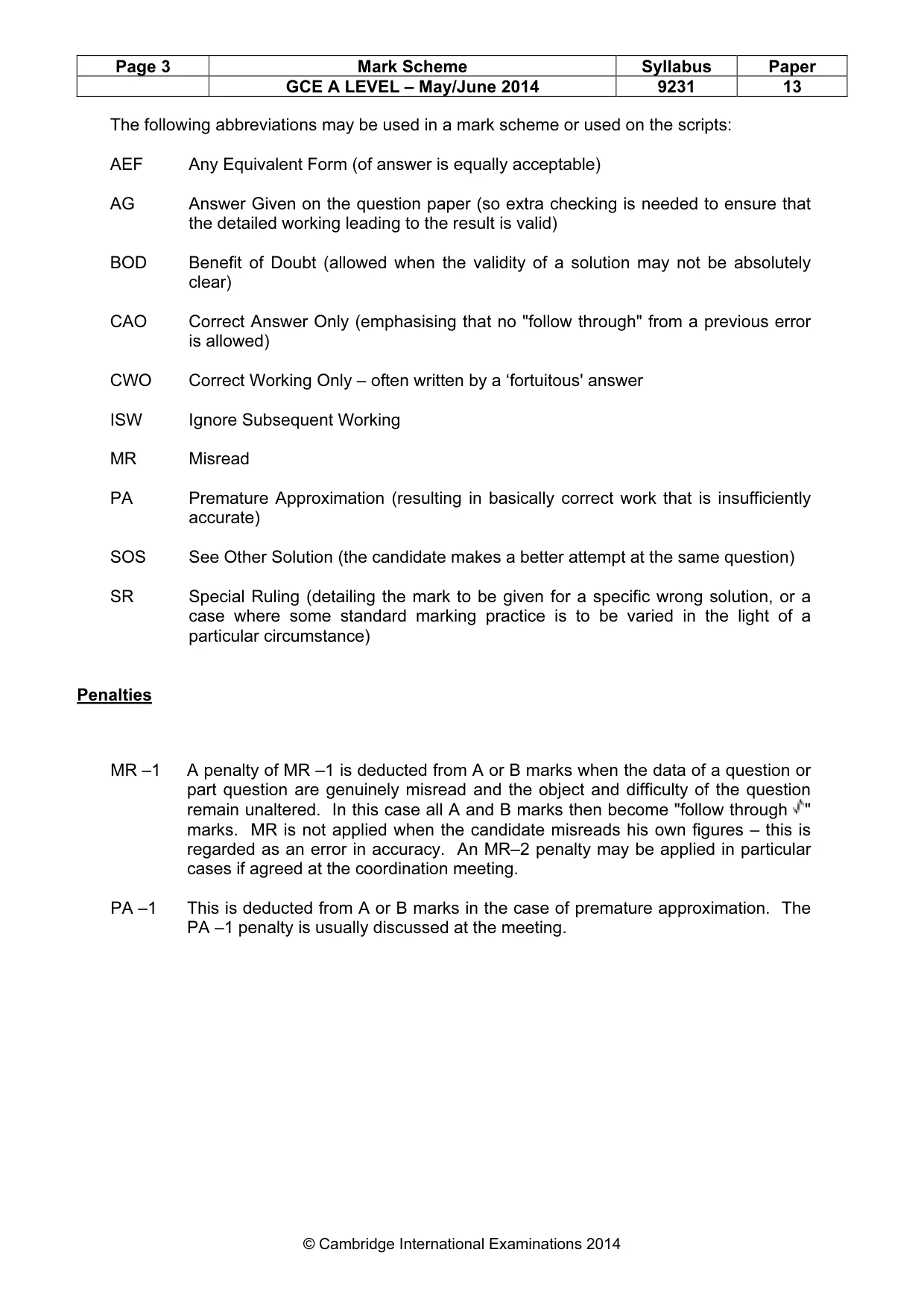
Page 3 Mark Scheme Syllabus Paper GCE A LEVEL – May/June 2014 9231 13 © Cambridge International Examinations 2014 The following abbreviations may be used in a mark scheme or used on the scripts: AEF Any Equivalent Form (of answer is equally acceptable) AG Answer Given on the question paper (so extra checking is needed to ensure that the detailed working leading to the result is valid) BOD Benefit of Doubt (allowed when the validity of a solution may not be absolutely clear) CAO Correct Answer Only (emphasising that no "follow through" from a previous error is allowed) CWO Correct Working Only – often written by a ‘fortuitous' answer ISW Ignore Subsequent Working MR Misread PA Premature Approximation (resulting in basically correct work that is insufficiently accurate) SOS See Other Solution (the candidate makes a better attempt at the same question) SR Special Ruling (detailing the mark to be given for a specific wrong solution, or a case where some standard marking practice is to be varied in the light of a particular circumstance) Penalties MR –1 A penalty of MR –1 is deducted from A or B marks when the data of a question or part question are genuinely misread and the object and difficulty of the question remain unaltered. In this case all A and B marks then become "follow through " marks. MR is not applied when the candidate misreads his own figures – this is regarded as an error in accuracy. An MR–2 penalty may be applied in particular cases if agreed at the coordination meeting. PA –1 This is deducted from A or B marks in the case of premature approximation. The PA –1 penalty is usually discussed at the meeting.
Mark scheme, page 4
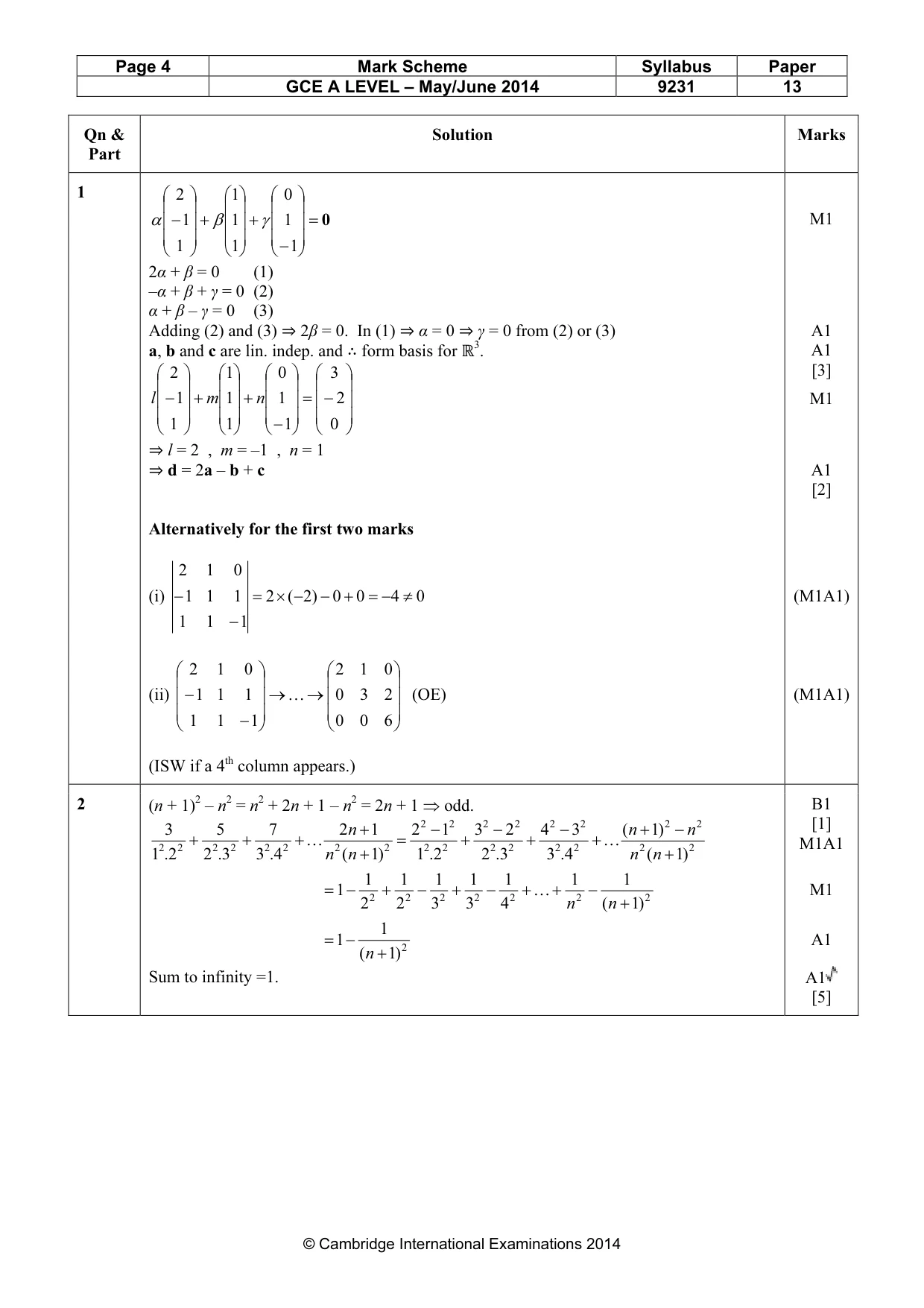
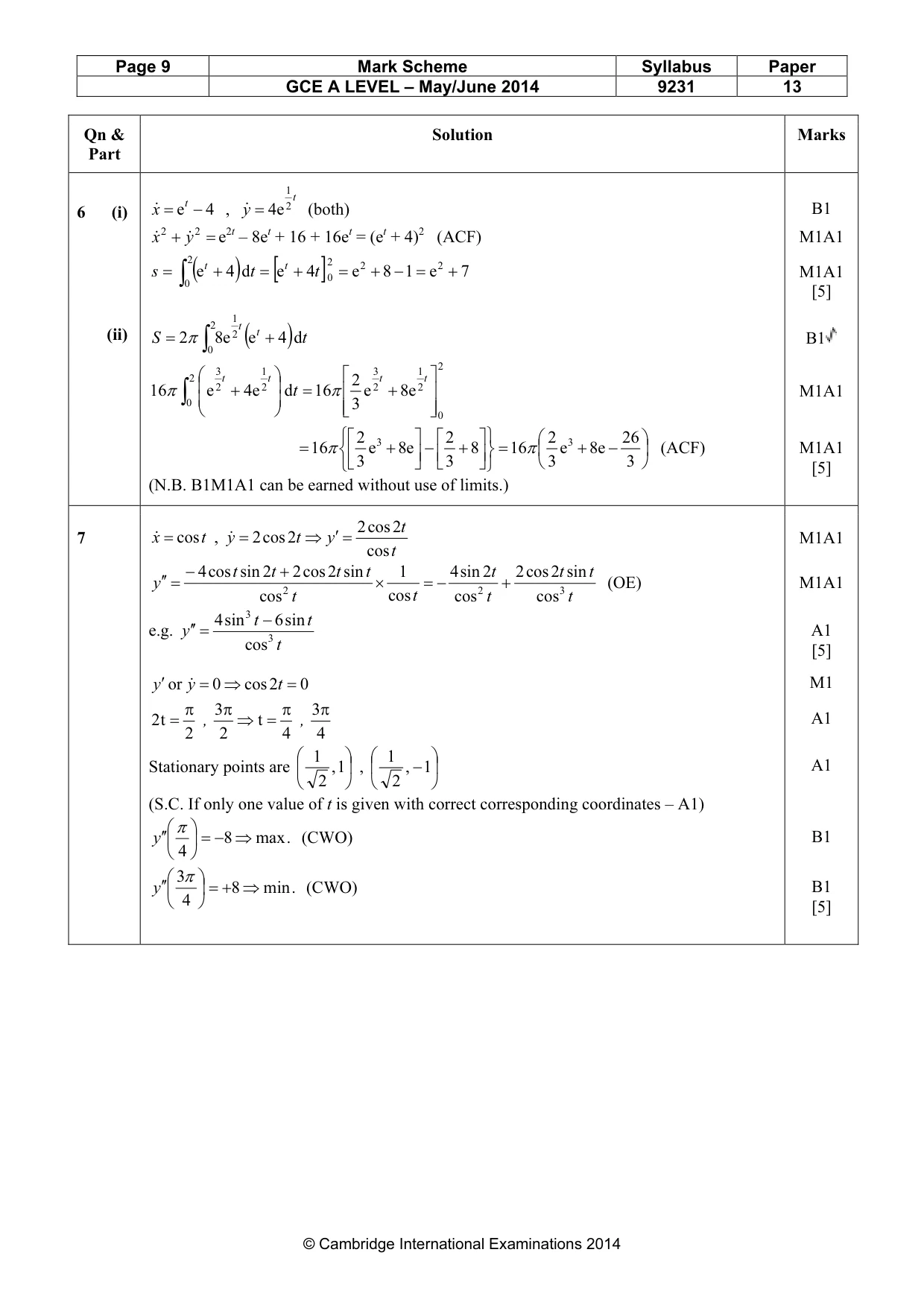
Page 4 Mark Scheme Syllabus Paper GCE A LEVEL – May/June 2014 9231 13 © Cambridge International Examinations 2014 Qn & Part Solution Marks 1 0 = − + + − 1 1 0 1 1 1 1 1 2 γ β α 2α + β = 0 (1) –α + β + γ = 0 (2) α + β – γ = 0 (3) Adding (2) and (3) ⇒ 2β = 0. In (1) ⇒ α = 0 ⇒ γ = 0 from (2) or (3) a, b and c are lin. indep. and ∴ form basis for ℝ3. − = − + + − 0 2 3 1 1 0 1 1 1 1 1 2 n m l ⇒ l = 2 , m = –1 , n = 1 ⇒ d = 2a – b + c Alternatively for the first two marks (i) 0 4 0 0 ) 2 ( 2 1 1 1 1 1 1 0 1 2 ≠ − = + − − × = − − (ii) → → − − 6 0 0 2 3 0 0 1 2 1 1 1 1 1 1 0 1 2 K (OE) (ISW if a 4th column appears.) M1 A1 A1 [3] M1 A1 [2] (M1A1) (M1A1) 2 (n + 1)2 – n2 = n2 + 2n + 1 – n2 = 2n + 1 ⇒ odd. 2 2 2 2 2 2 2 2 2 2 2 2 2 2 2 2 2 2 2 2 2 2 2 2 )1 ( )1 ( 4. 3 3 4 3. 2 2 3 2. 1 1 2 )1 ( 1 2 4. 3 7 3. 2 5 2. 1 3 + − + + − + − + − = + + + + + n n n n n n n K K 2 2 2 2 2 2 2 )1 ( 1 1 4 1 3 1 3 1 2 1 2 1 1 + − + + − + − + − = n n K 2)1 ( 1 1 + − = n Sum to infinity =1. B1 [1] M1A1 M1 A1 A1 [5]
Mark scheme, page 5
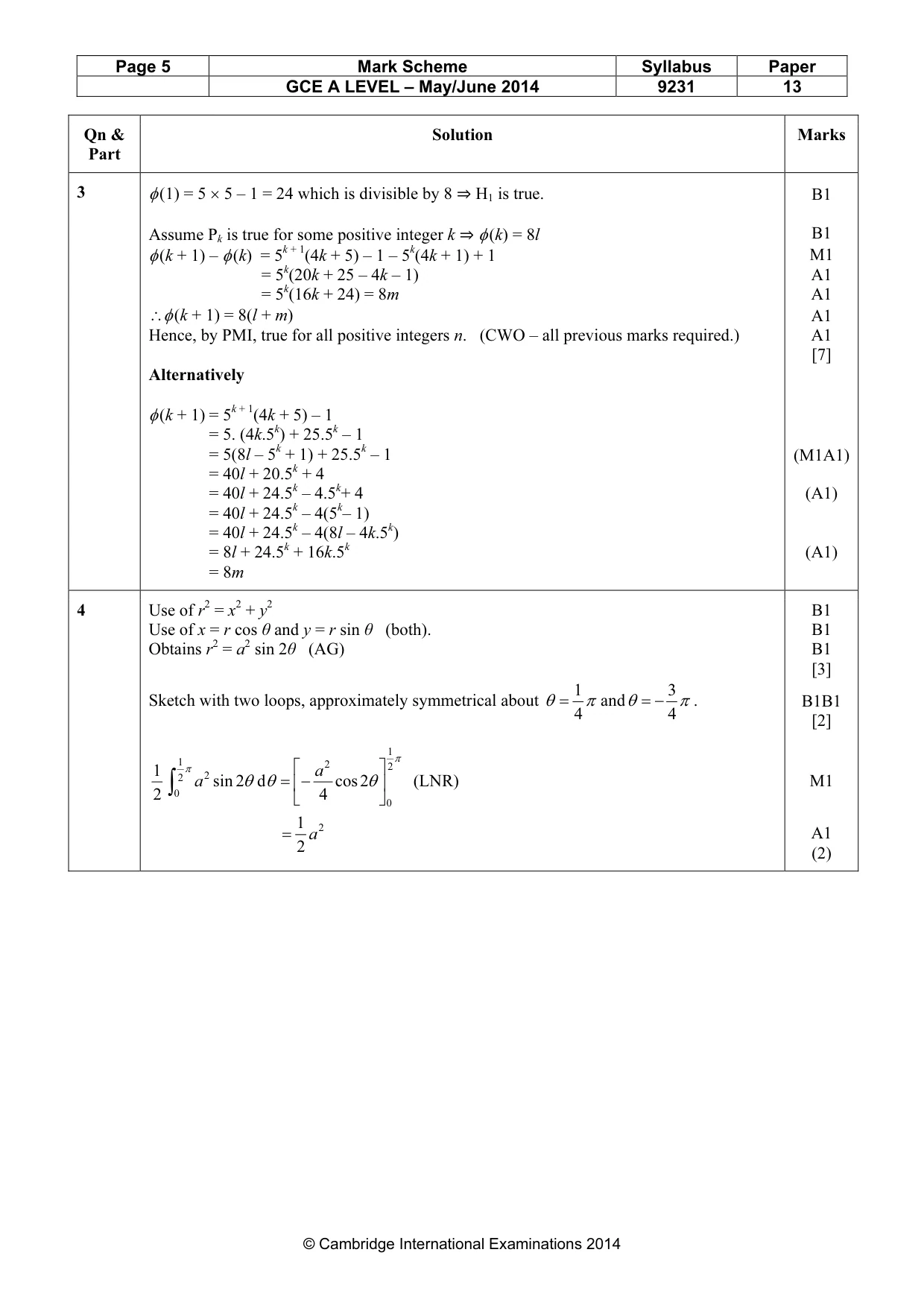
Page 5 Mark Scheme Syllabus Paper GCE A LEVEL – May/June 2014 9231 13 © Cambridge International Examinations 2014 Qn & Part Solution Marks 3 φ (1) = 5 × 5 – 1 = 24 which is divisible by 8 ⇒ H1 is true. Assume Pk is true for some positive integer k ⇒ φ (k) = 8l φ (k + 1) – φ (k) = 5k + 1(4k + 5) – 1 – 5k(4k + 1) + 1 = 5k(20k + 25 – 4k – 1) = 5k(16k + 24) = 8m ∴φ (k + 1) = 8(l + m) Hence, by PMI, true for all positive integers n. (CWO – all previous marks required.) Alternatively φ (k + 1) = 5k + 1(4k + 5) – 1 = 5. (4k.5k) + 25.5k – 1 = 5(8l – 5k + 1) + 25.5k – 1 = 40l + 20.5k + 4 = 40l + 24.5k – 4.5k+ 4 = 40l + 24.5k – 4(5k– 1) = 40l + 24.5k – 4(8l – 4k.5k) = 8l + 24.5k + 16k.5k = 8m B1 B1 M1 A1 A1 A1 A1 [7] (M1A1) (A1) (A1) 4 Use of r2 = x2 + y2 Use of x = r cos θ and y = r sin θ (both). Obtains r2 = a2 sin 2θ (AG) Sketch with two loops, approximately symmetrical about π θ 4 1 = and π θ 4 3 − = . π π θ θ θ 2 1 0 2 1 0 2 2 2 cos 4 d 2 sin 2 1∫ − = a a (LNR) 2 2 1 a = B1 B1 B1 [3] B1B1 [2] M1 A1 (2)
Mark scheme, page 6
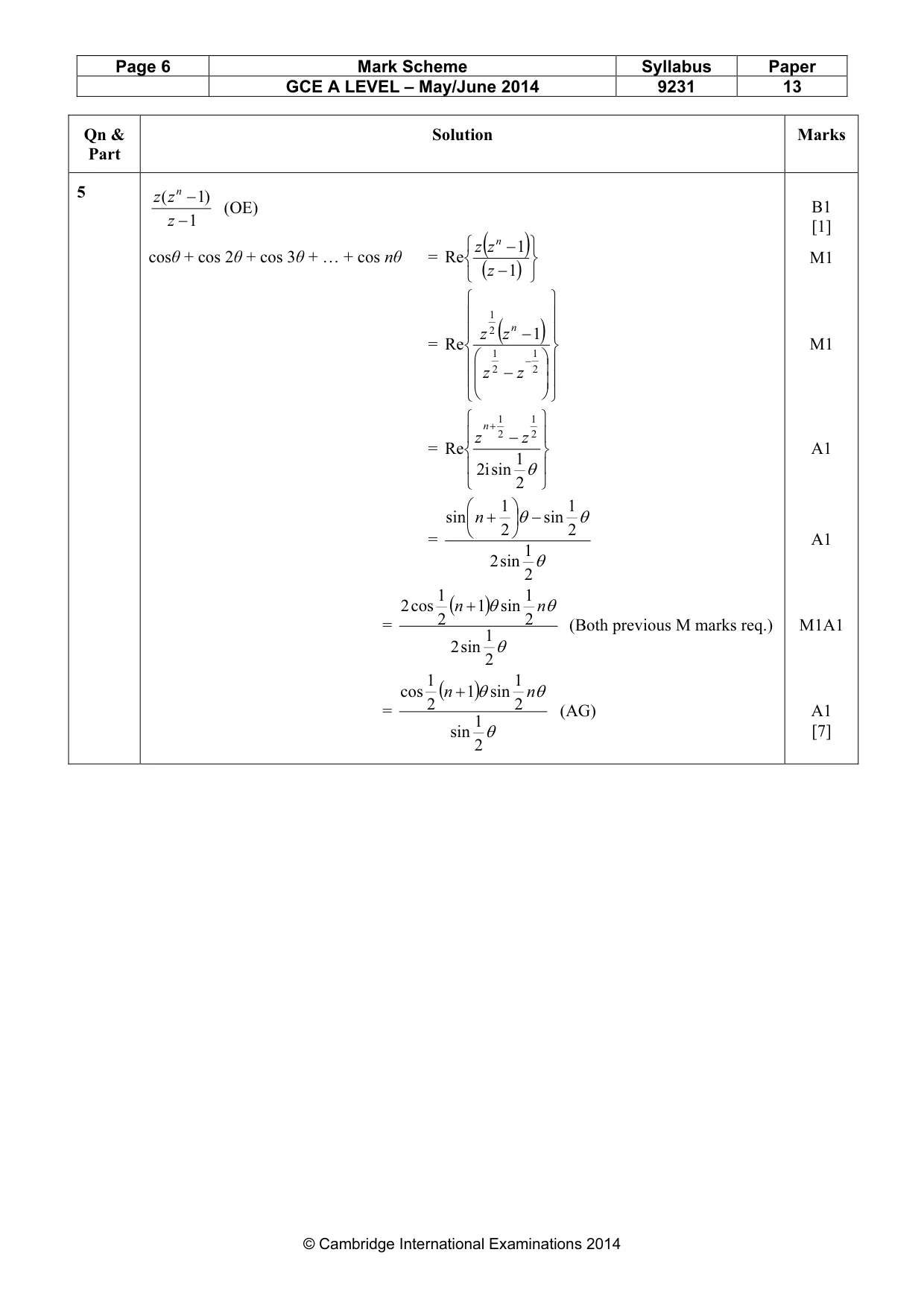
Page 6 Mark Scheme Syllabus Paper GCE A LEVEL – May/June 2014 9231 13 © Cambridge International Examinations 2014 Qn & Part Solution Marks 5 1 )1 ( − − z z z n (OE) cosθ + cos 2θ + cos 3θ + … + cos nθ = ( ) ( ) − − 1 1 Re z z z n = ( ) − − −2 1 2 1 2 1 1 Re z z z z n = − + θ 2 1 sin i2 Re 2 1 2 1 z z n = θ θ θ 2 1 sin 2 2 1 sin 2 1 sin − + n = ( ) θ θ θ 2 1 sin 2 2 1 sin 1 2 1 cos 2 n n + (Both previous M marks req.) = ( ) θ θ θ 2 1 sin 2 1 sin 1 2 1 cos n n + (AG) B1 [1] M1 M1 A1 A1 M1A1 A1 [7]
Mark scheme, page 7
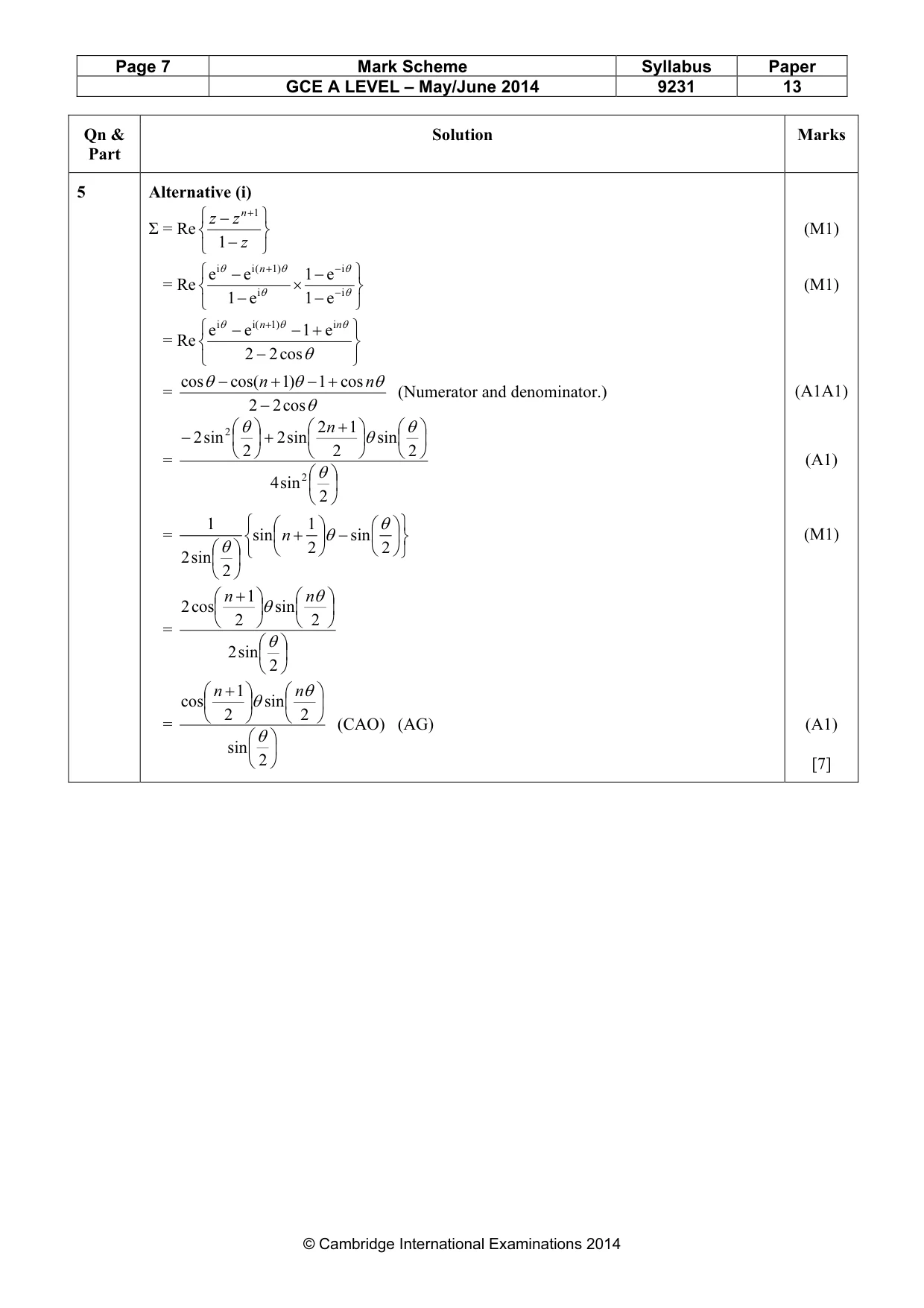
Page 7 Mark Scheme Syllabus Paper GCE A LEVEL – May/June 2014 9231 13 © Cambridge International Examinations 2014 Qn & Part Solution Marks 5 Alternative (i) Σ = Re − − + z z z n 1 1 = Re − − × − − − − + θ θ θ θ θ i i i ) 1 (i i e 1 e 1 e 1 e e n = Re − + − − + θ θ θ θ cos 2 2 e 1 e e i ) 1 i( i n n = θ θ θ θ cos 2 2 cos 1 )1 cos( cos − + − + − n n (Numerator and denominator.) = + + − 2 sin 4 2 sin 2 1 2 sin 2 2 sin 2 2 2 θ θ θ θ n = − + 2 sin 2 1 sin 2 sin 2 1 θ θ θ n = + 2 sin 2 2 sin 2 1 cos 2 θ θ θ n n = + 2 sin 2 sin 2 1 cos θ θ θ n n (CAO) (AG) (M1) (M1) (A1A1) (A1) (M1) (A1) [7]
Mark scheme, page 8
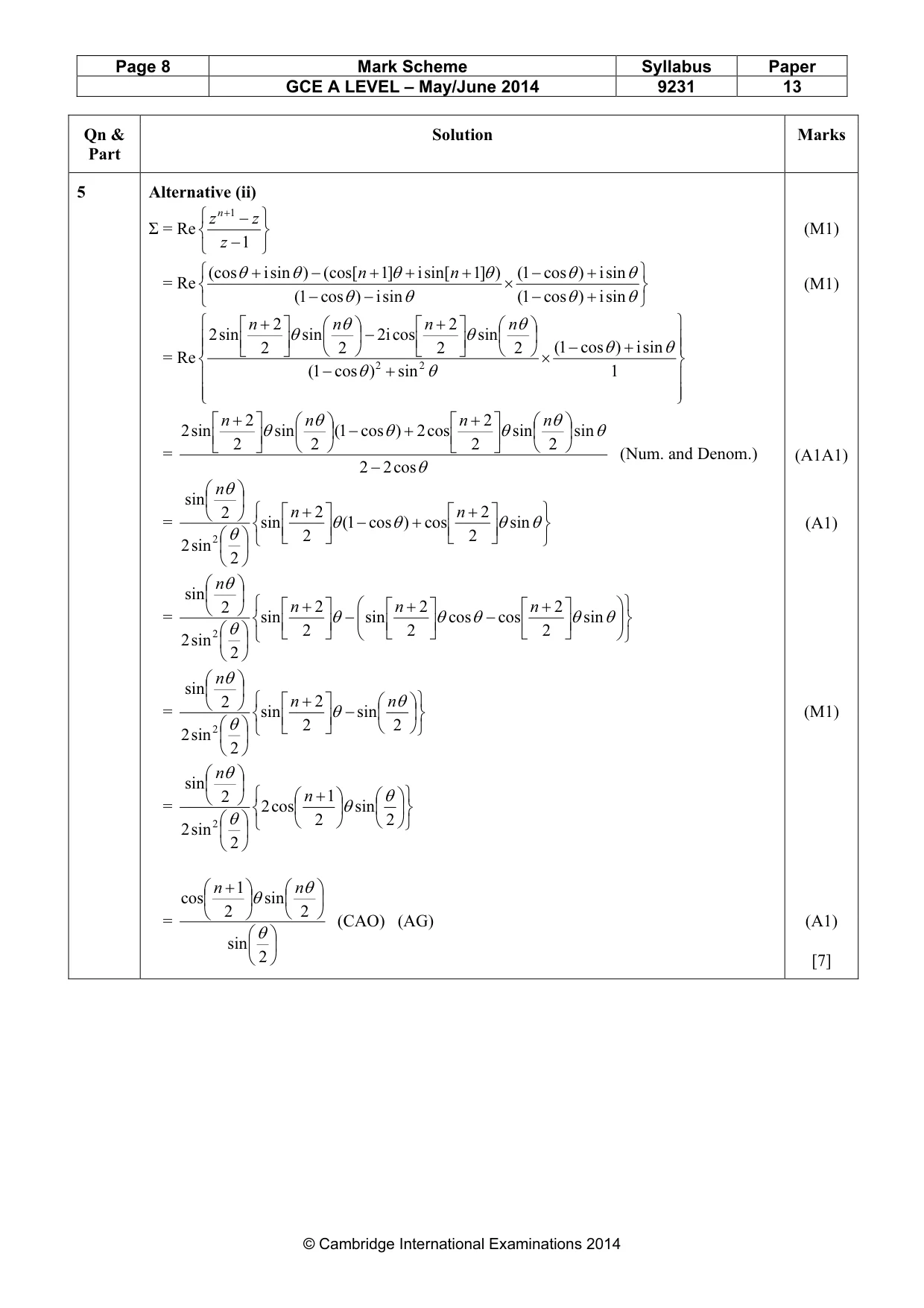
Page 8 Mark Scheme Syllabus Paper GCE A LEVEL – May/June 2014 9231 13 © Cambridge International Examinations 2014 Qn & Part Solution Marks 5 Alternative (ii) Σ = Re − − + 1 1 z z zn = Re + − + − × − − + + + − + θ θ θ θ θ θ θ θ θ θ sin i ) cos 1( sin i ) cos 1( sin i ) cos 1( ) ]1 sin[ i ]1 (cos[ ) sin i (cos n n = Re + − × + − + − + 1 sin i ) cos 1( sin ) cos 1( 2 sin 2 2 cos i2 2 sin 2 2 sin 2 2 2 θ θ θ θ θ θ θ θ n n n n = θ θ θ θ θ θ θ cos 2 2 sin 2 sin 2 2 cos 2 ) cos 1( 2 sin 2 2 sin 2 − + + − + n n n n (Num. and Denom.) = + + − + θ θ θ θ θ θ sin 2 2 cos ) cos 1( 2 2 sin 2 sin 2 2 sin 2 n n n = + − + − + θ θ θ θ θ θ θ sin 2 2 cos cos 2 2 sin 2 2 sin 2 sin 2 2 sin 2 n n n n = − + 2 sin 2 2 sin 2 sin 2 2 sin 2 θ θ θ θ n n n = + 2 sin 2 1 cos 2 2 sin 2 2 sin 2 θ θ θ θ n n = + 2 sin 2 sin 2 1 cos θ θ θ n n (CAO) (AG) (M1) (M1) (A1A1) (A1) (M1) (A1) [7]
Mark scheme, page 9
Page 9 Mark Scheme Syllabus Paper GCE A LEVEL – May/June 2014 9231 13 © Cambridge International Examinations 2014 Qn & Part Solution Marks 6 (i) (ii) t t y x 2 1 e 4 , 4 e = − = & & (both) = + 2 2 y x & & e2t – 8et + 16 + 16et = (et + 4)2 (ACF) ( ) [ ] 7 e 1 8 e 4 e d 4 e 2 2 2 0 2 0 + = − + = + = + = ∫ t t s t t ( ) ∫ + = 2 0 2 1 d 4 e e 8 2 t S t t π 2 0 2 1 2 3 2 0 2 1 2 3 e 8 e 3 2 16 d e 4 e 16 + = + ∫ t t t t t π π − + = + − + = 3 26 e 8 e 3 2 16 8 3 2 e 8 e 3 2 16 3 3 π π (ACF) (N.B. B1M1A1 can be earned without use of limits.) B1 M1A1 M1A1 [5] B1 M1A1 M1A1 [5] 7 t t y t y t x cos 2 cos 2 2 cos 2 , cos = ′ ⇒ = = & & t t t t t t t t t t t y 3 2 2 cos sin 2 cos 2 cos 2 sin 4 cos 1 cos sin 2 cos 2 2 sin cos 4 + − = × + − = ′′ (OE) e.g. t t t y 3 3 cos sin 6 sin 4 − = ′′ 0 2 cos 0 or = ⇒ = ′ t y y & 4 3 4 t 2 3 2 t 2 π π = ⇒ π π = , , Stationary points are − 1 , 2 1 , 1 , 2 1 (S.C. If only one value of t is given with correct corresponding coordinates – A1) . max 8 4 ⇒ − = ′′ π y (CWO) . min 8 4 3 ⇒ + = ′′ π y (CWO) M1A1 M1A1 A1 [5] M1 A1 A1 B1 B1 [5]
Mark scheme, page 10
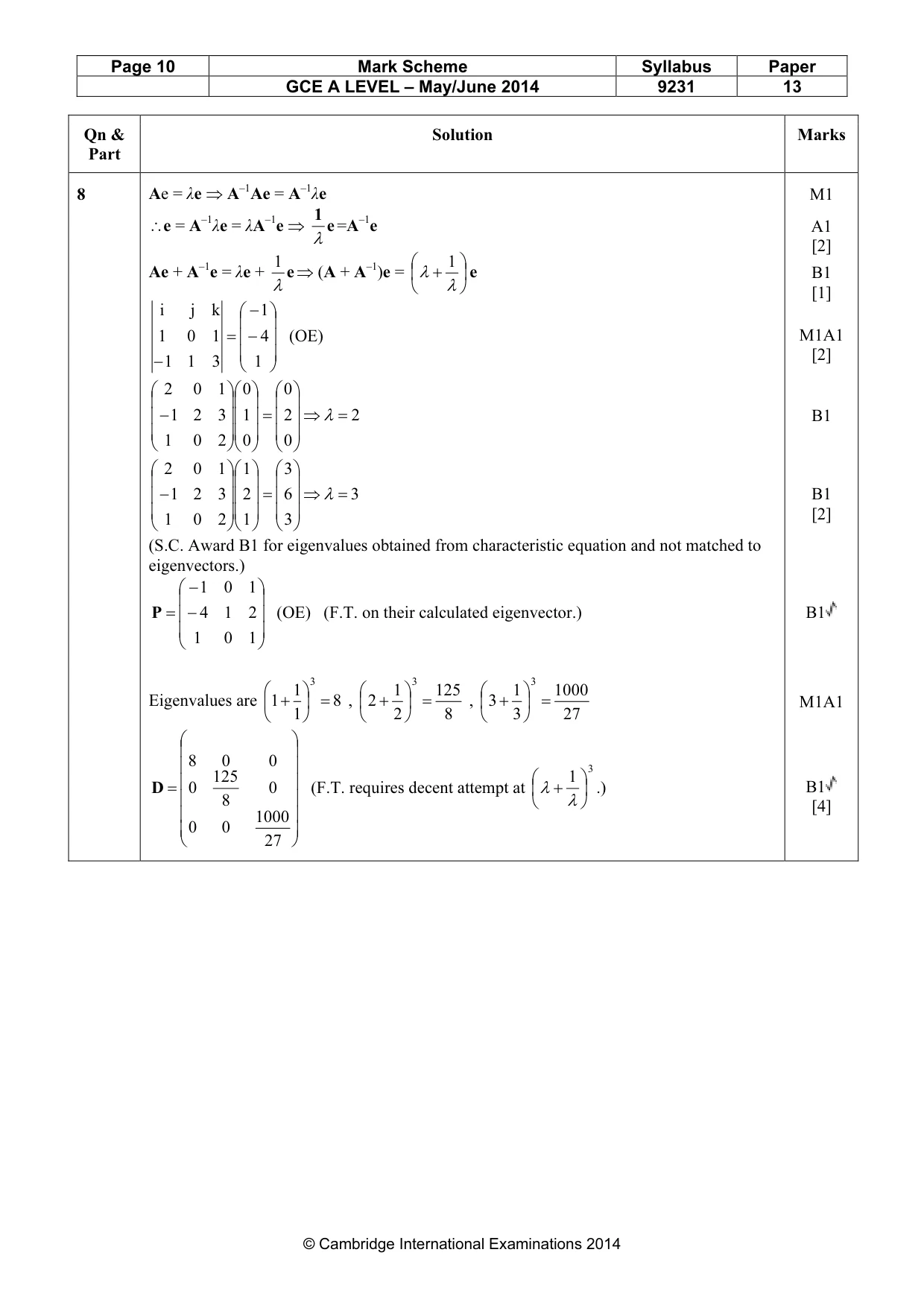
Page 10 Mark Scheme Syllabus Paper GCE A LEVEL – May/June 2014 9231 13 © Cambridge International Examinations 2014 Qn & Part Solution Marks 8 Ae = λe ⇒ A–1Ae = A–1λe ∴e = A–1λe = λA–1e ⇒ e 1 λ =A–1e Ae + A–1e = λe + e λ 1 ⇒ (A + A–1)e = e 1 + λ λ − − = − 1 4 1 3 1 1 1 0 1 k j i (OE) 2 0 2 0 0 1 0 2 0 1 3 2 1 1 0 2 = ⇒ = − λ 3 3 6 3 1 2 1 2 0 1 3 2 1 1 0 2 = ⇒ = − λ (S.C. Award B1 for eigenvalues obtained from characteristic equation and not matched to eigenvectors.) − − = 1 0 1 2 1 4 1 0 1 P (OE) (F.T. on their calculated eigenvector.) Eigenvalues are 27 1000 3 1 3 , 8 125 2 1 2 , 8 1 1 1 3 3 3 = + = + = + = 27 1000 0 0 0 8 125 0 0 0 8 D (F.T. requires decent attempt at 3 1 + λ λ .) M1 A1 [2] B1 [1] M1A1 [2] B1 B1 [2] B1 M1A1 B1 [4]
Mark scheme, page 11
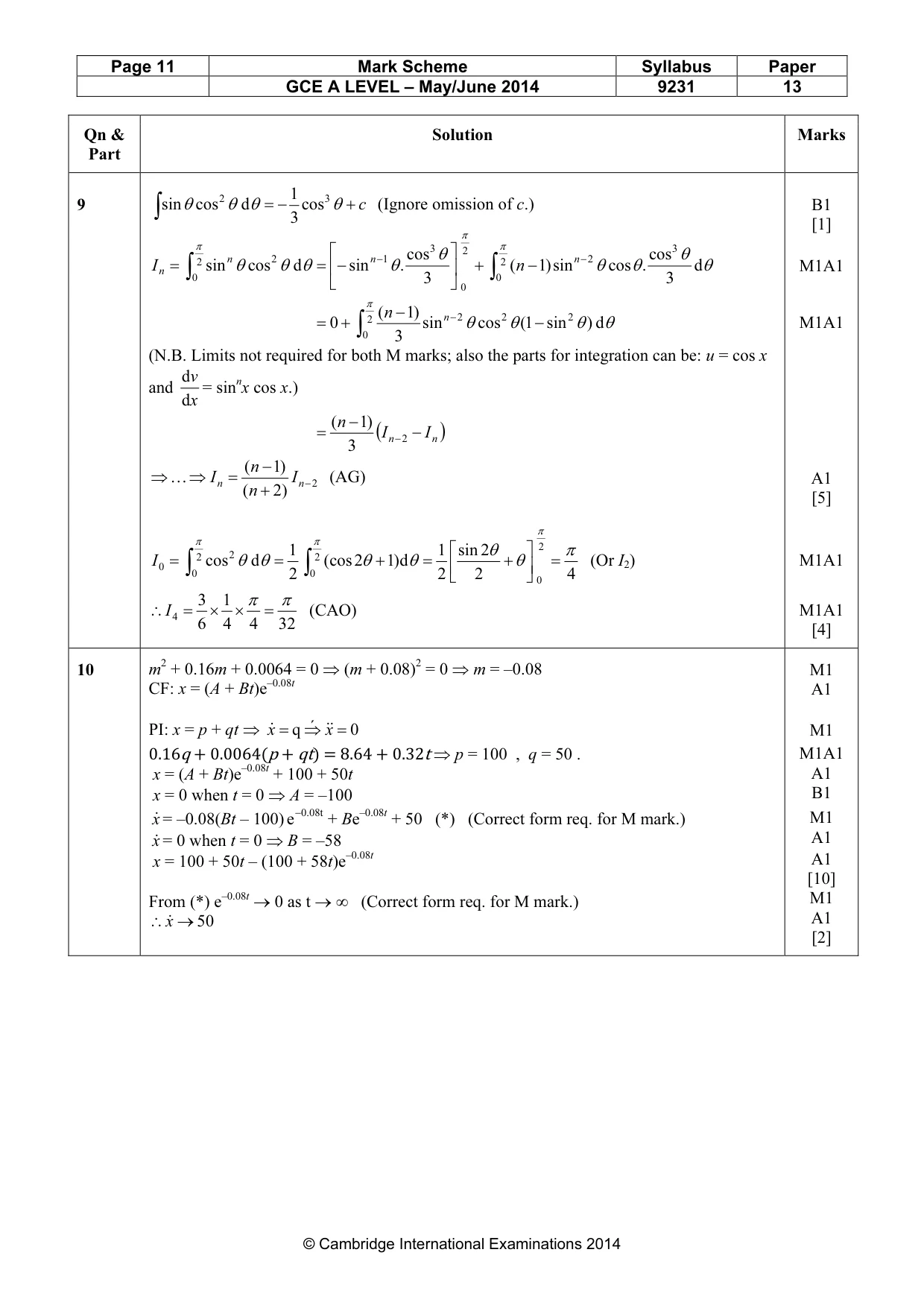
Page 11 Mark Scheme Syllabus Paper GCE A LEVEL – May/June 2014 9231 13 © Cambridge International Examinations 2014 Qn & Part Solution Marks 9 c + − = ∫ θ θ θ θ 3 2 cos 3 1 d cos sin (Ignore omission of c.) ∫ ∫ − − − + − = = 2 0 3 2 2 0 2 0 3 1 2 d 3 cos . cos sin )1 ( 3 cos . sin d cos sin π π π θ θ θ θ θ θ θ θ θ n n n n n I ∫ − − + = − 2 0 2 2 2 d ) sin 1( cos sin 3 )1 ( 0 π θ θ θ θ n n (N.B. Limits not required for both M marks; also the parts for integration can be: u = cos x and x v d d = sinnx cos x.) ( ) n n I I n − − = −2 3 )1 ( 2 ) 2 ( )1 ( − + − = ⇒ ⇒ n n I n n I K (AG) ∫ ∫ = + = + = = 2 0 2 0 2 0 2 0 4 2 2 sin 2 1 d )1 2 (cos 2 1 d cos π π π π θ θ θ θ θ θ I (Or I2) 32 4 4 1 6 3 4 π π = × × = ∴I (CAO) B1 [1] M1A1 M1A1 A1 [5] M1A1 M1A1 [4] 10 m2 + 0.16m + 0.0064 = 0 ⇒ (m + 0.08)2 = 0 ⇒ m = –0.08 CF: x = (A + Bt)e–0.08t PI: x = p + qt ⇒ 0 q = ⇒ = x x && & 0.16q + 0.0064(p + qt) = 8.64 + 0.32t ⇒ p = 100 , q = 50 . x = (A + Bt)e–0.08t + 100 + 50t x = 0 when t = 0 ⇒ A = –100 x& = –0.08(Bt – 100) 0.08t e− + Be–0.08t + 50 (*) (Correct form req. for M mark.) x& = 0 when t = 0 ⇒ B = –58 x = 100 + 50t – (100 + 58t)e–0.08t From (*) e–0.08t → 0 as t → ∞ (Correct form req. for M mark.) 50 → ∴x& M1 A1 M1 M1A1 A1 B1 M1 A1 A1 [10] M1 A1 [2] ΄
Mark scheme, page 12
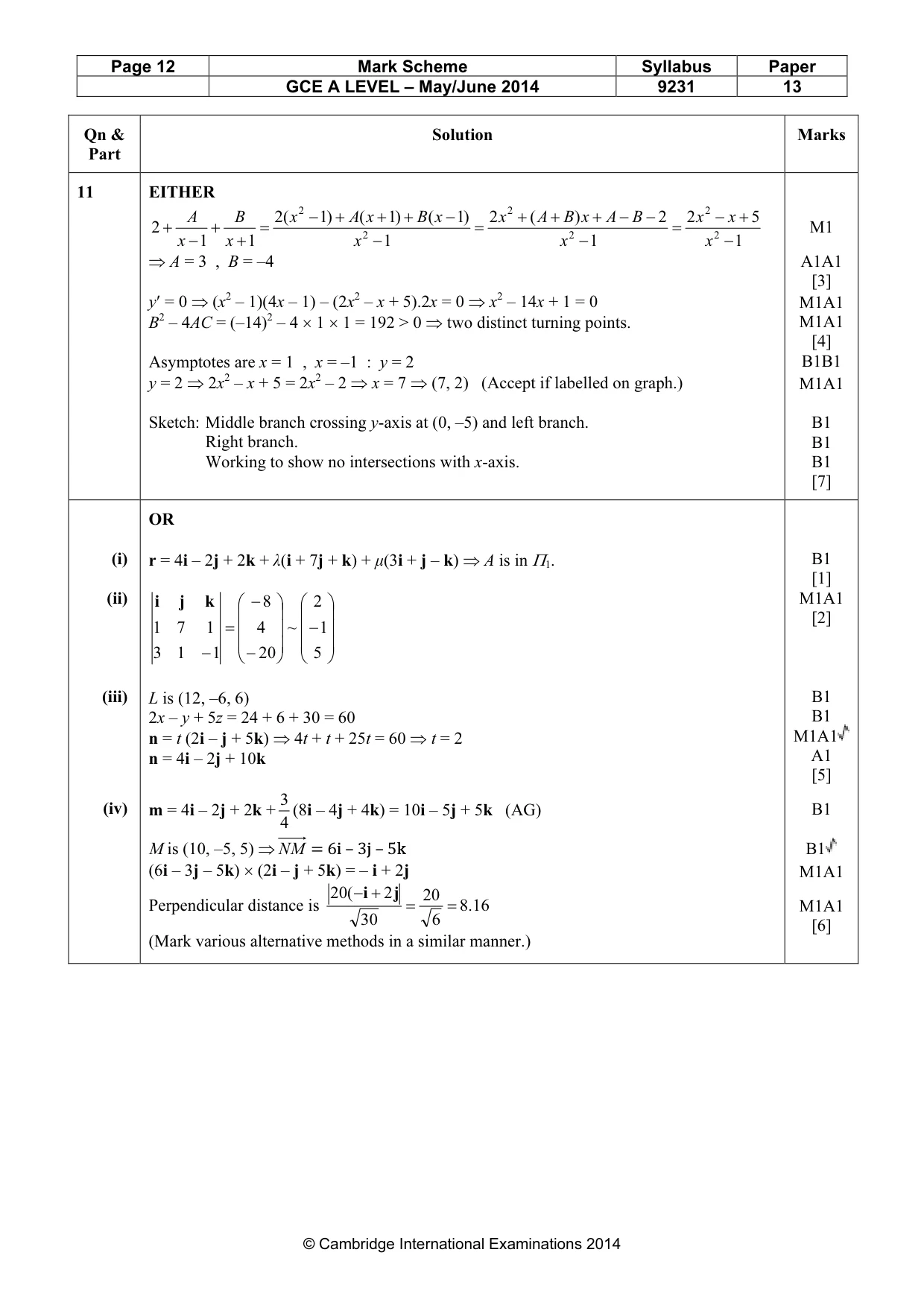
Page 12 Mark Scheme Syllabus Paper GCE A LEVEL – May/June 2014 9231 13 © Cambridge International Examinations 2014 Qn & Part Solution Marks 11 EITHER 1 5 2 1 2 ) ( 2 1 )1 ( )1 ( )1 ( 2 1 1 2 2 2 2 2 2 2 − + − = − − − + + + = − − + + + − = + + − + x x x x B A x B A x x x B x A x x B x A ⇒ A = 3 , B = –4 y′ = 0 ⇒ (x2 – 1)(4x – 1) – (2x2 – x + 5).2x = 0 ⇒ x2 – 14x + 1 = 0 B2 – 4AC = (–14)2 – 4 × 1 × 1 = 192 > 0 ⇒ two distinct turning points. Asymptotes are x = 1 , x = –1 : y = 2 y = 2 ⇒ 2x2 – x + 5 = 2x2 – 2 ⇒ x = 7 ⇒ (7, 2) (Accept if labelled on graph.) Sketch: Middle branch crossing y-axis at (0, –5) and left branch. Right branch. Working to show no intersections with x-axis. M1 A1A1 [3] M1A1 M1A1 [4] B1B1 M1A1 B1 B1 B1 [7] (i) (ii) (iii) (iv) OR r = 4i – 2j + 2k + λ(i + 7j + k) + µ(3i + j – k) ⇒ A is in Π1. − − − = − 5 1 2 ~ 20 4 8 1 1 3 1 7 1 k j i L is (12, –6, 6) 2x – y + 5z = 24 + 6 + 30 = 60 n = t (2i – j + 5k) ⇒ 4t + t + 25t = 60 ⇒ t = 2 n = 4i – 2j + 10k m = 4i – 2j + 2k + 4 3 (8i – 4j + 4k) = 10i – 5j + 5k (AG) M is (10, –5, 5) ⇒NM = 6i – 3j – 5k (6i – 3j – 5k) × (2i – j + 5k) = – i + 2j Perpendicular distance is 16 .8 6 20 30 2 ( 20 = = + − j i (Mark various alternative methods in a similar manner.) B1 [1] M1A1 [2] B1 B1 M1A1 A1 [5] B1 B1 M1A1 M1A1 [6]
What you needed in this session
Cambridge’s own grade thresholds for 2014 May/June, Paper 1 · Variant 3. A higher threshold means an easier paper — the bar moves with how the cohort did.