Cambridge A Level Mathematics - Further 9231 — 2012 Oct/Nov Paper 2 · Variant 2
9231/22/O/N/12 · 100 marks · ≈113 min
The question paper and its mark scheme, free to read here and free to download. This is Cambridge’s own paper, exactly as it was sat.
Question paper8 pages



Mark scheme7 pages
Answers below. Sit the paper first if you are practising.
Paper as text
Question paper, page 1
*7331040930* UNIVERSITY OF CAMBRIDGE INTERNATIONAL EXAMINATIONS General Certificate of Education Advanced Level FURTHER MATHEMATICS 9231/22 Paper 2 October/November 2012 3 hours Additional Materials: Answer Booklet/Paper Graph Paper List of Formulae (MF10) READ THESE INSTRUCTIONS FIRST If you have been given an Answer Booklet, follow the instructions on the front cover of the Booklet. Write your Centre number, candidate number and name on all the work you hand in. Write in dark blue or black pen. You may use a soft pencil for any diagrams or graphs. Do not use staples, paper clips, highlighters, glue or correction fluid. Answer all the questions. Give non-exact numerical answers correct to 3 significant figures, or 1 decimal place in the case of angles in degrees, unless a different level of accuracy is specified in the question. Where a numerical value is necessary, take the acceleration due to gravity to be 10 m s−2. The use of a calculator is expected, where appropriate. Results obtained solely from a graphic calculator, without supporting working or reasoning, will not receive credit. You are reminded of the need for clear presentation in your answers. At the end of the examination, fasten all your work securely together. The number of marks is given in brackets [ ] at the end of each question or part question. This document consists of 5 printed pages and 3 blank pages. JC12 11_9231_22/FP © UCLES 2012 [Turn over
Question paper, page 2
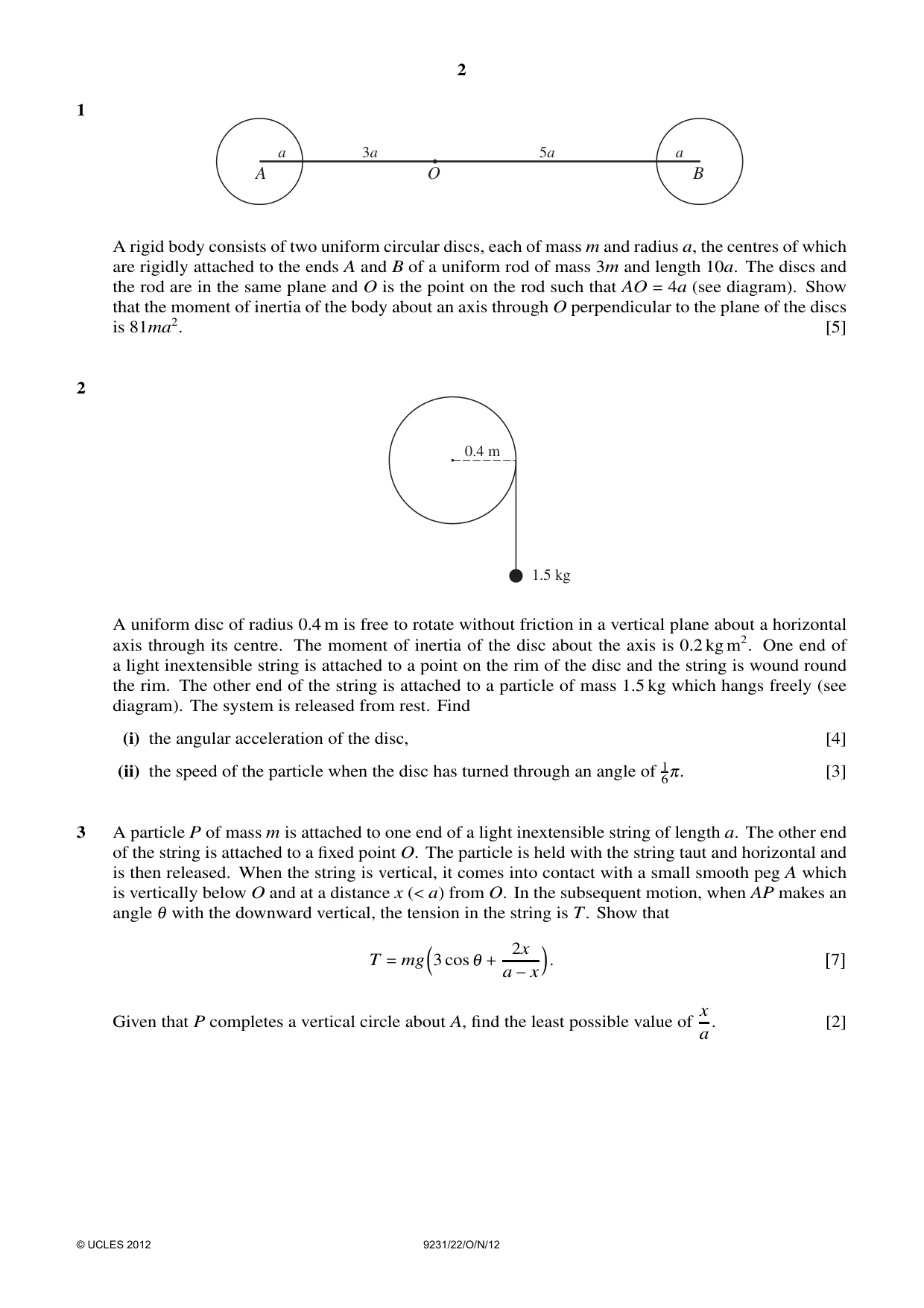
2 1 A O B a 3a 5a a A rigid body consists of two uniform circular discs, each of mass m and radius a, the centres of which are rigidly attached to the ends A and B of a uniform rod of mass 3m and length 10a. The discs and the rod are in the same plane and O is the point on the rod such that AO = 4a (see diagram). Show that the moment of inertia of the body about an axis through O perpendicular to the plane of the discs is 81ma2. [5] 2 0.4 m 1.5 kg A uniform disc of radius 0.4 m is free to rotate without friction in a vertical plane about a horizontal axis through its centre. The moment of inertia of the disc about the axis is 0.2 kg m2. One end of a light inextensible string is attached to a point on the rim of the disc and the string is wound round the rim. The other end of the string is attached to a particle of mass 1.5 kg which hangs freely (see diagram). The system is released from rest. Find (i) the angular acceleration of the disc, [4] (ii) the speed of the particle when the disc has turned through an angle of 1 6π. [3] 3 A particle P of mass m is attached to one end of a light inextensible string of length a. The other end of the string is attached to a fixed point O. The particle is held with the string taut and horizontal and is then released. When the string is vertical, it comes into contact with a small smooth peg A which is vertically below O and at a distance x (< a) from O. In the subsequent motion, when AP makes an angle θ with the downward vertical, the tension in the string is T. Show that T = mg3 cos θ + 2x a −x. [7] Given that P completes a vertical circle about A, find the least possible value of x a. [2] © UCLES 2012 9231/22/O/N/12
Question paper, page 3
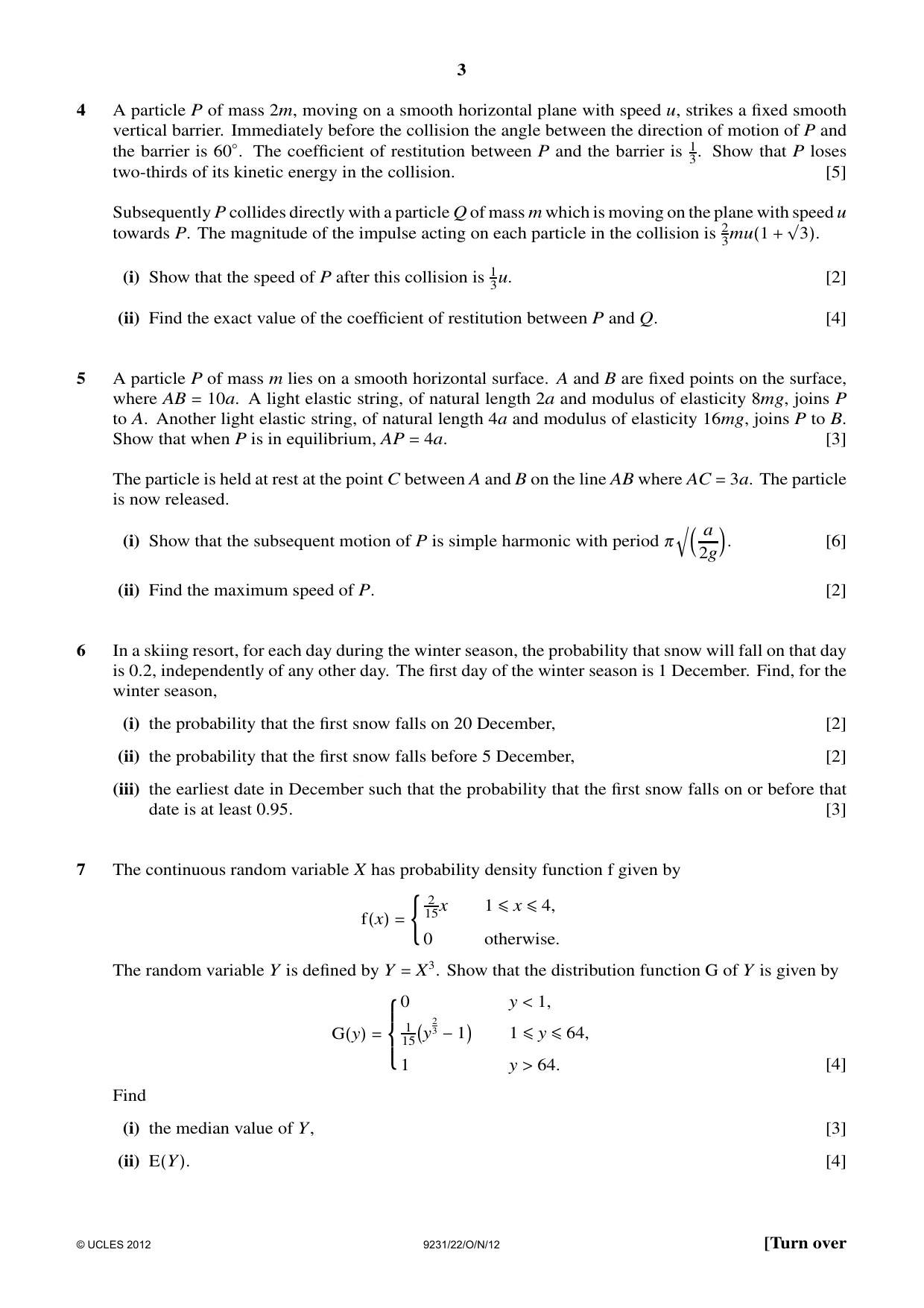
3 4 A particle P of mass 2m, moving on a smooth horizontal plane with speed u, strikes a fixed smooth vertical barrier. Immediately before the collision the angle between the direction of motion of P and the barrier is 60◦. The coefficient of restitution between P and the barrier is 1 3. Show that P loses two-thirds of its kinetic energy in the collision. [5] Subsequently P collides directly with a particle Q of mass m which is moving on the plane with speed u towards P. The magnitude of the impulse acting on each particle in the collision is 2 3mu(1 + √3). (i) Show that the speed of P after this collision is 1 3u. [2] (ii) Find the exact value of the coefficient of restitution between P and Q. [4] 5 A particle P of mass m lies on a smooth horizontal surface. A and B are fixed points on the surface, where AB = 10a. A light elastic string, of natural length 2a and modulus of elasticity 8mg, joins P to A. Another light elastic string, of natural length 4a and modulus of elasticity 16mg, joins P to B. Show that when P is in equilibrium, AP = 4a. [3] The particle is held at rest at the point C between A and B on the line AB where AC = 3a. The particle is now released. (i) Show that the subsequent motion of P is simple harmonic with period π q a 2g. [6] (ii) Find the maximum speed of P. [2] 6 In a skiing resort, for each day during the winter season, the probability that snow will fall on that day is 0.2, independently of any other day. The first day of the winter season is 1 December. Find, for the winter season, (i) the probability that the first snow falls on 20 December, [2] (ii) the probability that the first snow falls before 5 December, [2] (iii) the earliest date in December such that the probability that the first snow falls on or before that date is at least 0.95. [3] 7 The continuous random variable X has probability density function f given by f(x) = ( 2 15x 1 ≤x ≤4, 0 otherwise. The random variable Y is defined by Y = X3. Show that the distribution function G of Y is given by G(y) = 0 y < 1, 1 15y 2 3 −1 1 ≤y ≤64, 1 y > 64. [4] Find (i) the median value of Y, [3] (ii) E(Y). [4] © UCLES 2012 9231/22/O/N/12 [Turn over
Question paper, page 4
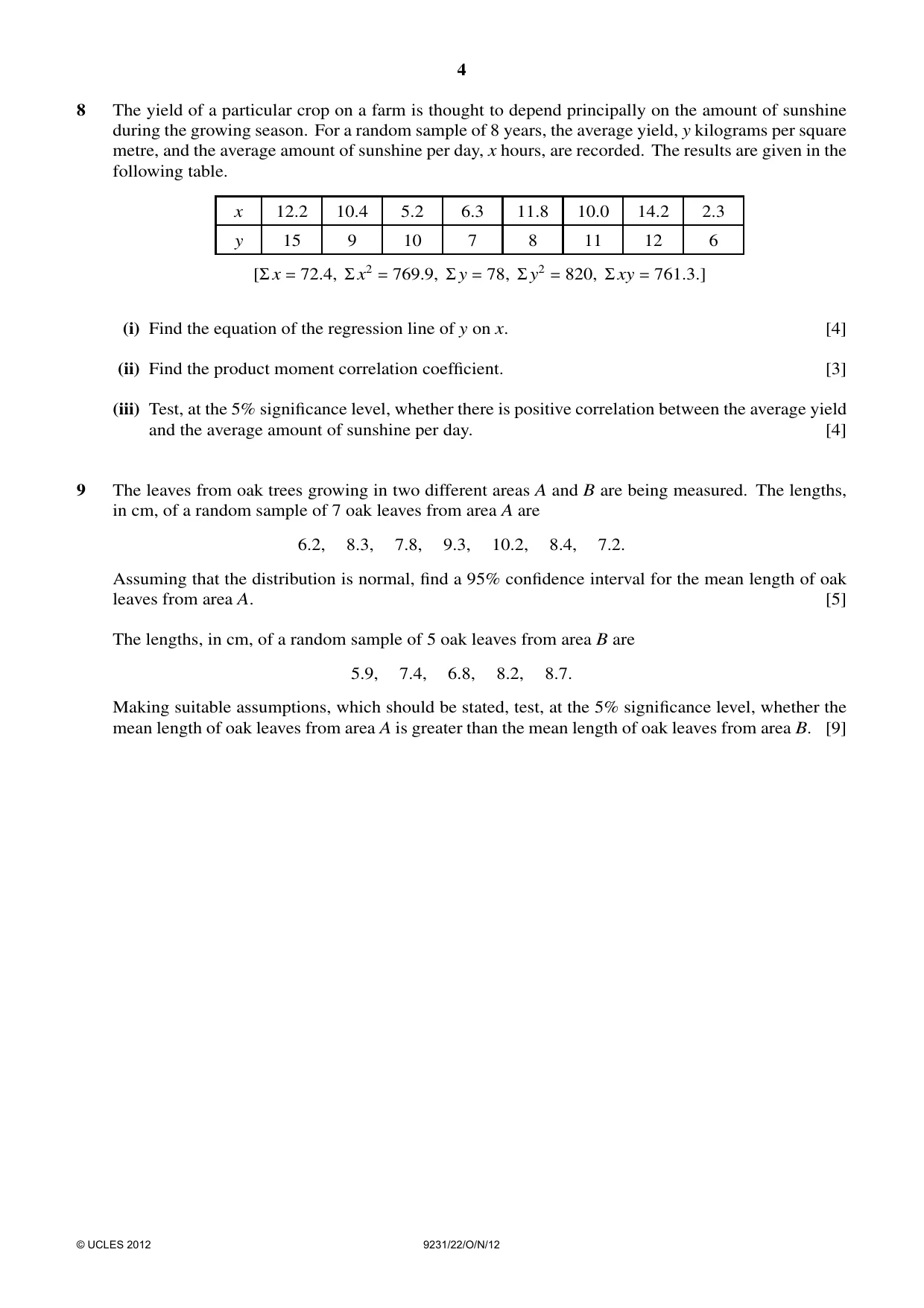
4 8 The yield of a particular crop on a farm is thought to depend principally on the amount of sunshine during the growing season. For a random sample of 8 years, the average yield, y kilograms per square metre, and the average amount of sunshine per day, x hours, are recorded. The results are given in the following table. x 12.2 10.4 5.2 6.3 11.8 10.0 14.2 2.3 y 15 9 10 7 8 11 12 6 [Σ x = 72.4, Σ x2 = 769.9, Σy = 78, Σy2 = 820, Σxy = 761.3.] (i) Find the equation of the regression line of y on x. [4] (ii) Find the product moment correlation coefficient. [3] (iii) Test, at the 5% significance level, whether there is positive correlation between the average yield and the average amount of sunshine per day. [4] 9 The leaves from oak trees growing in two different areas A and B are being measured. The lengths, in cm, of a random sample of 7 oak leaves from area A are 6.2, 8.3, 7.8, 9.3, 10.2, 8.4, 7.2. Assuming that the distribution is normal, find a 95% confidence interval for the mean length of oak leaves from area A. [5] The lengths, in cm, of a random sample of 5 oak leaves from area B are 5.9, 7.4, 6.8, 8.2, 8.7. Making suitable assumptions, which should be stated, test, at the 5% significance level, whether the mean length of oak leaves from area A is greater than the mean length of oak leaves from area B. [9] © UCLES 2012 9231/22/O/N/12
Question paper, page 5
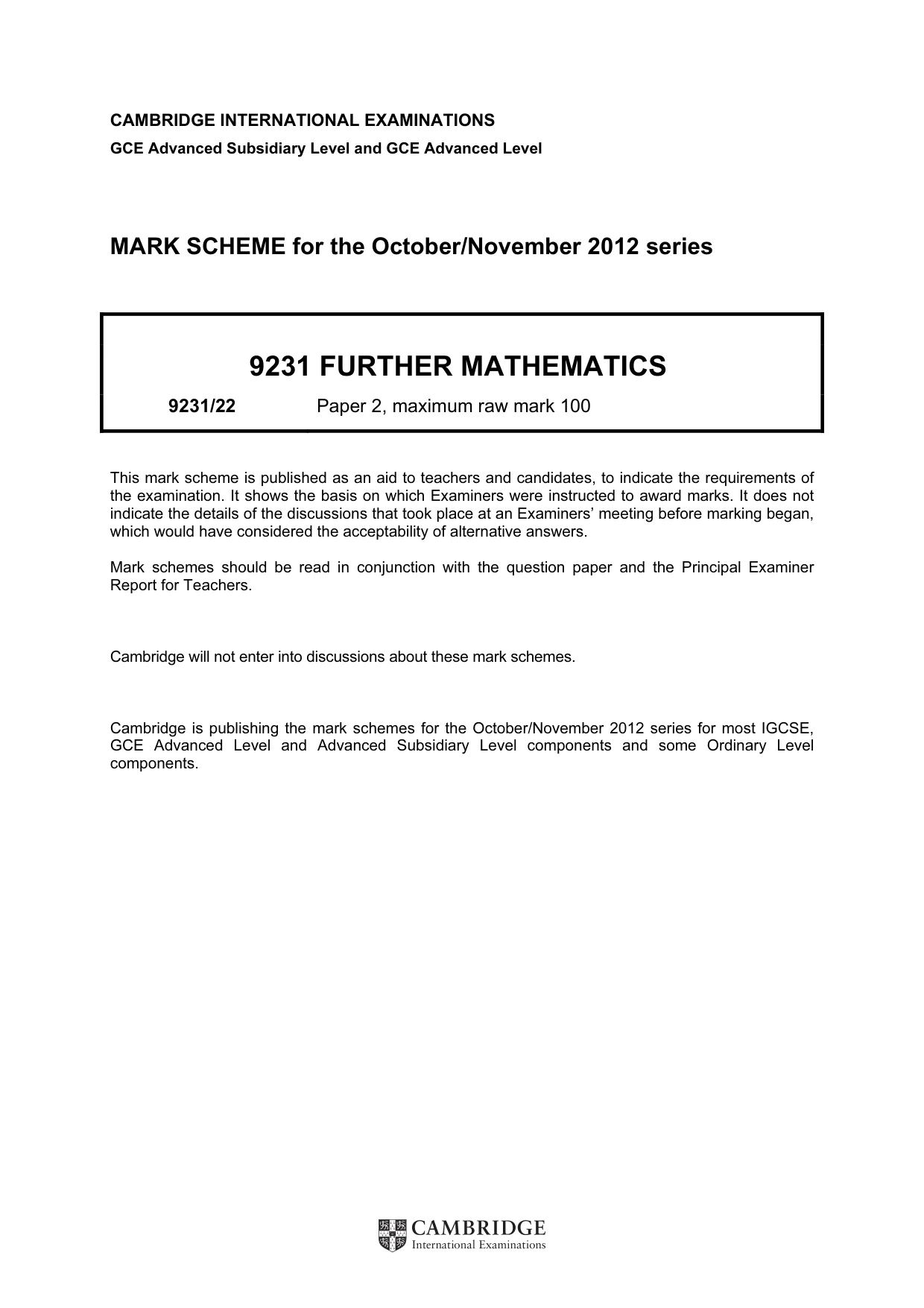
5 10 Answer only one of the following two alternatives. EITHER A B C q q Two identical uniform rough spheres A and B, each of weight W and radius a, are at rest on a rough horizontal plane, and are not in contact with each other. A third identical sphere C rests on A and B with its centre in the same vertical plane as the centres of A and B. The line joining the centres of A and C and the line joining the centres of B and C are each inclined at an angle θ to the vertical (see diagram). The coefficient of friction between each sphere and the plane is µ. The coefficient of friction between C and A, and between C and B, is µ′. The system remains in equilibrium. Show that µ ≥ sin θ 3(1 + cos θ) and µ′ ≥ sin θ 1 + cos θ . [14] OR A continuous random variable X is believed to have the probability density function f given by f(x) = ( 3 10(5x −x2 −4) 2 ≤x < 4, 0 otherwise. A random sample of 60 observations was taken and these values are summarised in the following grouped frequency table. Interval 2 ≤x < 2.4 2.4 ≤x < 2.8 2.8 ≤x < 3.2 3.2 ≤x < 3.6 3.6 ≤x < 4 Observed frequency 19 17 16 8 0 The estimated mean, based on the grouped data in the table above, is 2.69, correct to 2 decimal places. It is decided that a goodness of fit test will only be conducted if the mean predicted from the probability density function is within 10% of the estimated mean. Show that this condition is satisfied. [5] The relevant expected frequencies are as follows. Interval 2 ≤x < 2.4 2.4 ≤x < 2.8 2.8 ≤x < 3.2 3.2 ≤x < 3.6 3.6 ≤x < 4 Expected frequency 15.456 16.032 14.304 10.272 3.936 Show how the expected frequency for the interval 3.2 ≤x < 3.6 is obtained. [2] Carry out the goodness of fit test at the 10% significance level. [7] © UCLES 2012 9231/22/O/N/12
Question paper, page 8
8 BLANK PAGE Permission to reproduce items where third-party owned material protected by copyright is included has been sought and cleared where possible. Every reasonable effort has been made by the publisher (UCLES) to trace copyright holders, but if any items requiring clearance have unwittingly been included, the publisher will be pleased to make amends at the earliest possible opportunity. University of Cambridge International Examinations is part of the Cambridge Assessment Group. Cambridge Assessment is the brand name of University of Cambridge Local Examinations Syndicate (UCLES), which is itself a department of the University of Cambridge. 9231/22/O/N/12
Mark scheme, page 1
CAMBRIDGE INTERNATIONAL EXAMINATIONS GCE Advanced Subsidiary Level and GCE Advanced Level MARK SCHEME for the October/November 2012 series 9231 FURTHER MATHEMATICS 9231/22 Paper 2, maximum raw mark 100 This mark scheme is published as an aid to teachers and candidates, to indicate the requirements of the examination. It shows the basis on which Examiners were instructed to award marks. It does not indicate the details of the discussions that took place at an Examiners’ meeting before marking began, which would have considered the acceptability of alternative answers. Mark schemes should be read in conjunction with the question paper and the Principal Examiner Report for Teachers. Cambridge will not enter into discussions about these mark schemes. Cambridge is publishing the mark schemes for the October/November 2012 series for most IGCSE, GCE Advanced Level and Advanced Subsidiary Level components and some Ordinary Level components.
Mark scheme, page 2
Page 2 Mark Scheme Syllabus Paper GCE AS/A LEVEL – October/November 2012 9231 22 © Cambridge International Examinations 2012 Mark Scheme Notes Marks are of the following three types: M Method mark, awarded for a valid method applied to the problem. Method marks are not lost for numerical errors, algebraic slips or errors in units. However, it is not usually sufficient for a candidate just to indicate an intention of using some method or just to quote a formula; the formula or idea must be applied to the specific problem in hand, e.g. by substituting the relevant quantities into the formula. Correct application of a formula without the formula being quoted obviously earns the M mark and in some cases an M mark can be implied from a correct answer. A Accuracy mark, awarded for a correct answer or intermediate step correctly obtained. Accuracy marks cannot be given unless the associated method mark is earned (or implied). B Mark for a correct result or statement independent of method marks. • When a part of a question has two or more "method" steps, the M marks are generally independent unless the scheme specifically says otherwise; and similarly when there are several B marks allocated. The notation DM or DB (or dep*) is used to indicate that a particular M or B mark is dependent on an earlier M or B (asterisked) mark in the scheme. When two or more steps are run together by the candidate, the earlier marks are implied and full credit is given. • The symbol implies that the A or B mark indicated is allowed for work correctly following on from previously incorrect results. Otherwise, A or B marks are given for correct work only. A and B marks are not given for fortuitously "correct" answers or results obtained from incorrect working. • Note: B2 or A2 means that the candidate can earn 2 or 0. B2/1/0 means that the candidate can earn anything from 0 to 2. The marks indicated in the scheme may not be subdivided. If there is genuine doubt whether a candidate has earned a mark, allow the candidate the benefit of the doubt. Unless otherwise indicated, marks once gained cannot subsequently be lost, e.g. wrong working following a correct form of answer is ignored. • Wrong or missing units in an answer should not lead to the loss of a mark unless the scheme specifically indicates otherwise. • For a numerical answer, allow the A or B mark if a value is obtained which is correct to 3 s.f., or which would be correct to 3 s.f. if rounded (1 d.p. in the case of an angle). As stated above, an A or B mark is not given if a correct numerical answer arises fortuitously from incorrect working. For Mechanics questions, allow A or B marks for correct answers which arise from taking g equal to 9.8 or 9.81 instead of 10.
Mark scheme, page 3
Page 3 Mark Scheme Syllabus Paper GCE AS/A LEVEL – October/November 2012 9231 22 © Cambridge International Examinations 2012 The following abbreviations may be used in a mark scheme or used on the scripts: AEF Any Equivalent Form (of answer is equally acceptable) AG Answer Given on the question paper (so extra checking is needed to ensure that the detailed working leading to the result is valid) BOD Benefit of Doubt (allowed when the validity of a solution may not be absolutely clear) CAO Correct Answer Only (emphasising that no "follow through" from a previous error is allowed) CWO Correct Working Only – often written by a ‘fortuitous' answer ISW Ignore Subsequent Working MR Misread PA Premature Approximation (resulting in basically correct work that is insufficiently accurate) SOS See Other Solution (the candidate makes a better attempt at the same question) SR Special Ruling (detailing the mark to be given for a specific wrong solution, or a case where some standard marking practice is to be varied in the light of a particular circumstance) Penalties MR –1 A penalty of MR –1 is deducted from A or B marks when the data of a question or part question are genuinely misread and the object and difficulty of the question remain unaltered. In this case all A and B marks then become "follow through " marks. MR is not applied when the candidate misreads his own figures – this is regarded as an error in accuracy. An MR–2 penalty may be applied in particular cases if agreed at the coordination meeting. PA –1 This is deducted from A or B marks in the case of premature approximation. The PA –1 penalty is usually discussed at the meeting.
Mark scheme, page 4
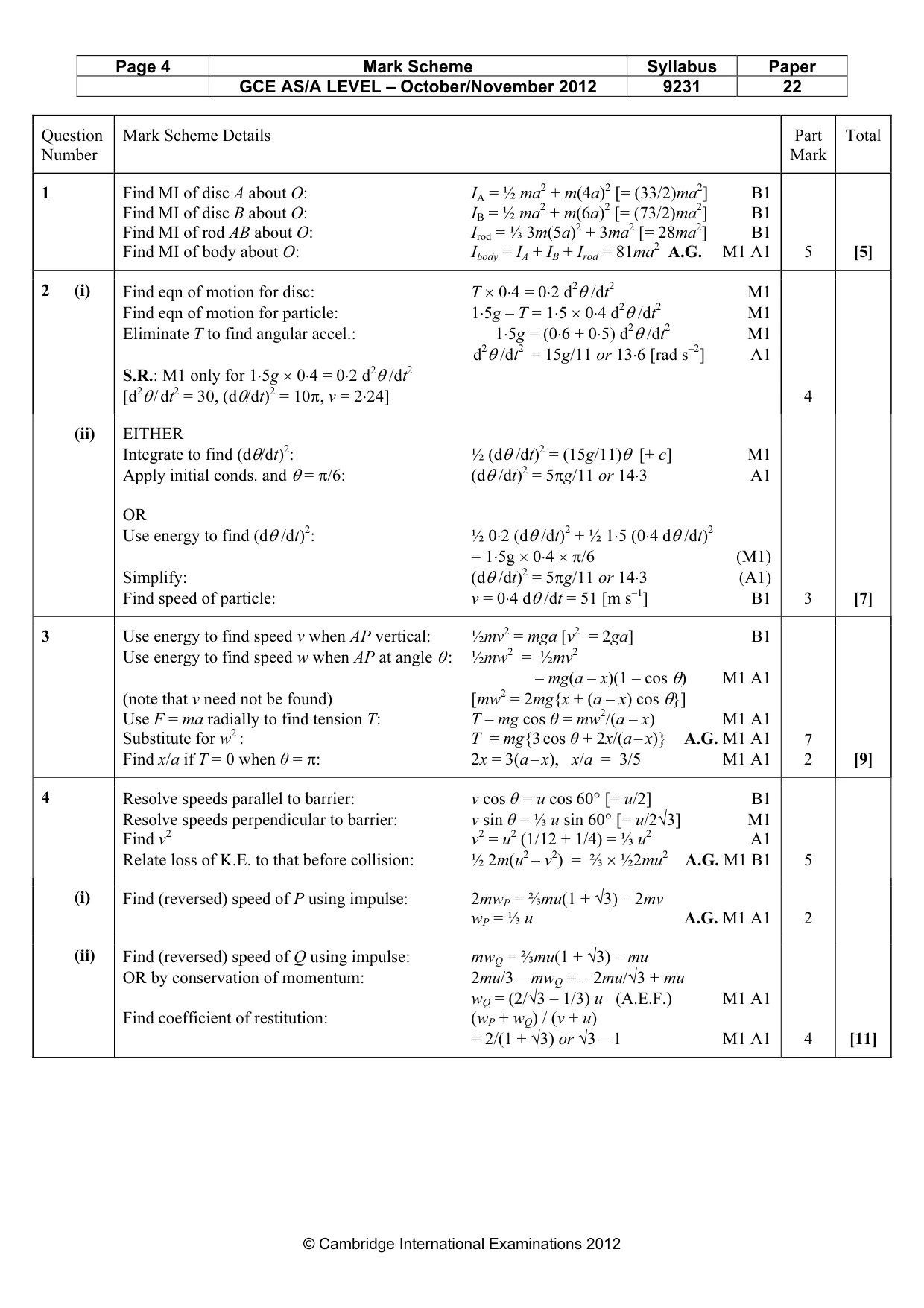
Page 4 Mark Scheme Syllabus Paper GCE AS/A LEVEL – October/November 2012 9231 22 © Cambridge International Examinations 2012 Question Number Mark Scheme Details Part Mark Total 1 Find MI of disc A about O: IA = ½ ma2 + m(4a)2 [= (33/2)ma2] B1 Find MI of disc B about O: IB = ½ ma2 + m(6a)2 [= (73/2)ma2] B1 Find MI of rod AB about O: Irod = ⅓ 3m(5a)2 + 3ma2 [= 28ma2] B1 Find MI of body about O: Ibody = IA + IB + Irod = 81ma2 A.G. M1 A1 5 [5] 2 (i) Find eqn of motion for disc: T × 0⋅4 = 0⋅2 d2θ /dt2 M1 Find eqn of motion for particle: 1⋅5g – T = 1⋅5 × 0⋅4 d2θ /dt2 M1 Eliminate T to find angular accel.: 1⋅5g = (0⋅6 + 0⋅5) d2θ /dt2 M1 d2θ /dt2 = 15g/11 or 13⋅6 [rad s–2] A1 S.R.: M1 only for 1⋅5g × 0⋅4 = 0⋅2 d2θ /dt2 [d2θ / dt2 = 30, (dθ/dt)2 = 10π, v = 2⋅24] 4 (ii) EITHER Integrate to find (dθ/dt)2: ½ (dθ /dt)2 = (15g/11)θ [+ c] M1 Apply initial conds. and θ = π/6: (dθ /dt)2 = 5πg/11 or 14⋅3 A1 OR Use energy to find (dθ /dt)2: ½ 0⋅2 (dθ /dt)2 + ½ 1⋅5 (0⋅4 dθ /dt)2 = 1⋅5g × 0⋅4 × π/6 (M1) Simplify: (dθ /dt)2 = 5πg/11 or 14⋅3 (A1) Find speed of particle: v = 0⋅4 dθ /dt = 51 [m s–1] B1 3 [7] 3 Use energy to find speed v when AP vertical: ½mv2 = mga [v2 = 2ga] B1 Use energy to find speed w when AP at angle θ : ½mw2 = ½mv2 – mg(a – x)(1 – cos θ) M1 A1 (note that v need not be found) [mw2 = 2mg{x + (a – x) cos θ}] Use F = ma radially to find tension T: T – mg cos θ = mw2/(a – x) M1 A1 Substitute for w2 : T = mg{3 cos θ + 2x/(a – x)} A.G. M1 A1 Find x/a if T = 0 when θ = π: 2x = 3(a – x), x/a = 3/5 M1 A1 7 2 [9] 4 Resolve speeds parallel to barrier: v cos θ = u cos 60° [= u/2] B1 Resolve speeds perpendicular to barrier: v sin θ = ⅓ u sin 60° [= u/2√3] M1 Find v2 v2 = u2 (1/12 + 1/4) = ⅓ u2 A1 Relate loss of K.E. to that before collision: ½ 2m(u2 – v2) = ⅔ × ½2mu2 A.G. M1 B1 5 (i) Find (reversed) speed of P using impulse: 2mwP = ⅔mu(1 + √3) – 2mv wP = ⅓ u A.G. M1 A1 2 (ii) Find (reversed) speed of Q using impulse: mwQ = ⅔mu(1 + √3) – mu OR by conservation of momentum: 2mu/3 – mwQ = – 2mu/√3 + mu wQ = (2/√3 – 1/3) u (A.E.F.) M1 A1 Find coefficient of restitution: (wP + wQ) / (v + u) = 2/(1 + √3) or √3 – 1 M1 A1 4 [11]
Mark scheme, page 5
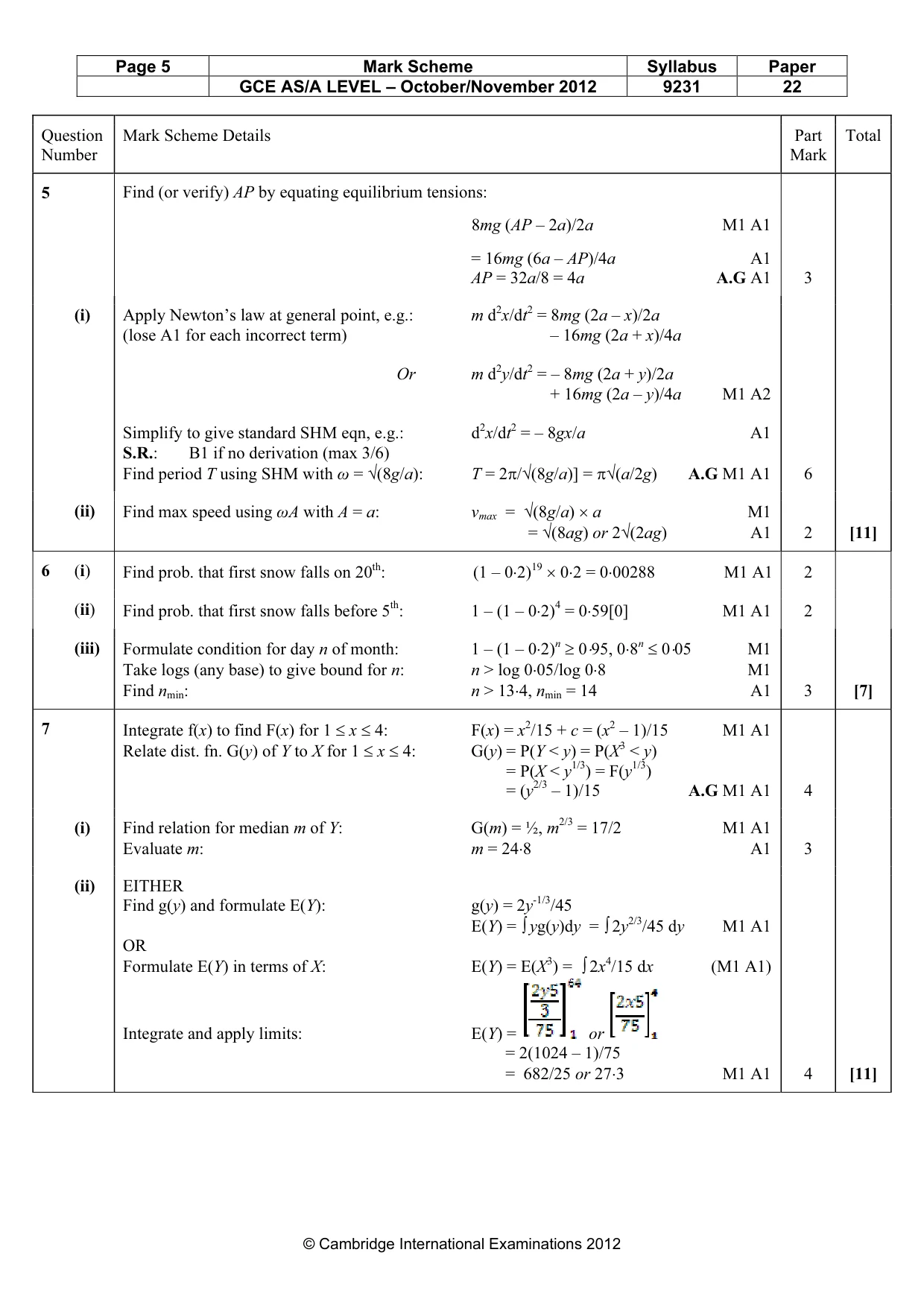
Page 5 Mark Scheme Syllabus Paper GCE AS/A LEVEL – October/November 2012 9231 22 © Cambridge International Examinations 2012 Question Number Mark Scheme Details Part Mark Total 5 Find (or verify) AP by equating equilibrium tensions: 8mg (AP – 2a)/2a M1 A1 = 16mg (6a – AP)/4a A1 AP = 32a/8 = 4a A.G A1 3 (i) Apply Newton’s law at general point, e.g.: m d2x/dt2 = 8mg (2a – x)/2a (lose A1 for each incorrect term) – 16mg (2a + x)/4a Or m d2y/dt2 = – 8mg (2a + y)/2a + 16mg (2a – y)/4a M1 A2 Simplify to give standard SHM eqn, e.g.: d2x/dt2 = – 8gx/a A1 S.R.: B1 if no derivation (max 3/6) Find period T using SHM with ω = √(8g/a): T = 2π/√(8g/a)] = π√(a/2g) A.G M1 A1 6 (ii) Find max speed using ωA with A = a: vmax = √(8g/a) × a M1 = √(8ag) or 2√(2ag) A1 2 [11] 6 (i) Find prob. that first snow falls on 20th: (1 – 0⋅2)19 × 0⋅2 = 0⋅00288 M1 A1 2 (ii) Find prob. that first snow falls before 5th: 1 – (1 – 0⋅2)4 = 0⋅59[0] M1 A1 2 (iii) Formulate condition for day n of month: 1 – (1 – 0⋅2)n ≥ 0⋅95, 0⋅8n ≤ 0⋅05 M1 Take logs (any base) to give bound for n: n > log 0⋅05/log 0⋅8 M1 Find nmin: n > 13⋅4, nmin = 14 A1 3 [7] 7 Integrate f(x) to find F(x) for 1 ≤ x ≤ 4: F(x) = x2/15 + c = (x2 – 1)/15 M1 A1 Relate dist. fn. G(y) of Y to X for 1 ≤ x ≤ 4: G(y) = P(Y < y) = P(X3 < y) = P(X < y1/3) = F(y1/3) = (y2/3 – 1)/15 A.G M1 A1 4 (i) Find relation for median m of Y: G(m) = ½, m2/3 = 17/2 M1 A1 Evaluate m: m = 24⋅8 A1 3 (ii) EITHER Find g(y) and formulate E(Y): g(y) = 2y-1/3/45 E(Y) = ∫ yg(y)dy = ∫ 2y2/3/45 dy M1 A1 OR Formulate E(Y) in terms of X: E(Y) = E(X3) = ∫ 2x4/15 dx (M1 A1) Integrate and apply limits: E(Y) = or = 2(1024 – 1)/75 = 682/25 or 27⋅3 M1 A1 4 [11]
Mark scheme, page 6
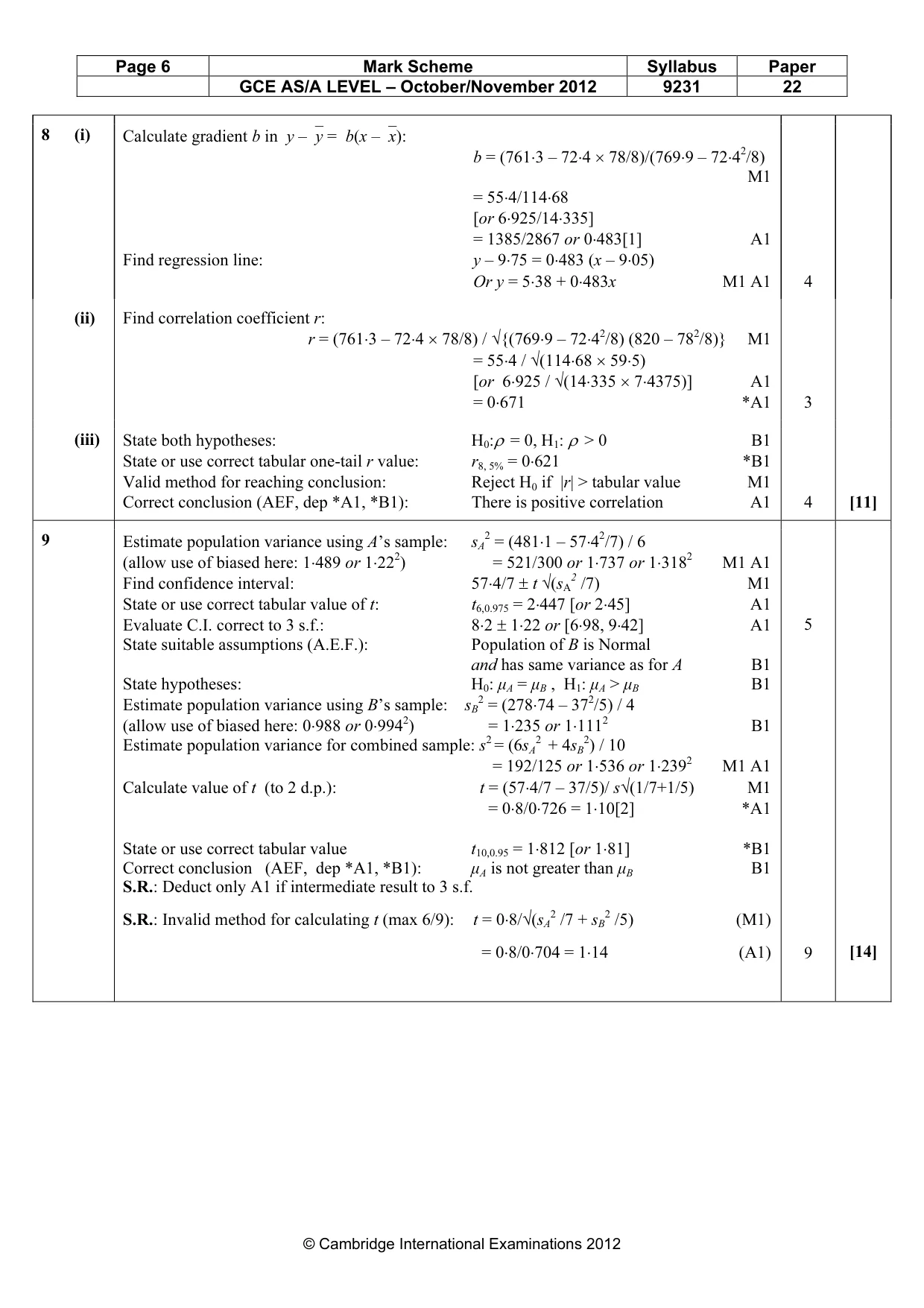
Page 6 Mark Scheme Syllabus Paper GCE AS/A LEVEL – October/November 2012 9231 22 © Cambridge International Examinations 2012 8 (i) Calculate gradient b in y –y = b(x –x): b = (761⋅3 – 72⋅4 × 78/8)/(769⋅9 – 72⋅42/8) M1 = 55⋅4/114⋅68 [or 6⋅925/14⋅335] = 1385/2867 or 0⋅483[1] A1 Find regression line: y – 9⋅75 = 0⋅483 (x – 9⋅05) Or y = 5⋅38 + 0⋅483x M1 A1 4 (ii) Find correlation coefficient r: r = (761⋅3 – 72⋅4 × 78/8) / √{(769⋅9 – 72⋅42/8) (820 – 782/8)} M1 = 55⋅4 / √(114⋅68 × 59⋅5) [or 6⋅925 / √(14⋅335 × 7⋅4375)] A1 = 0⋅671 *A1 3 (iii) State both hypotheses: H0:ρ = 0, H1: ρ > 0 B1 State or use correct tabular one-tail r value: r8, 5% = 0⋅621 *B1 Valid method for reaching conclusion: Reject H0 if |r| > tabular value M1 Correct conclusion (AEF, dep *A1, *B1): There is positive correlation A1 4 [11] 9 Estimate population variance using A’s sample: sA 2 = (481⋅1 – 57⋅42/7) / 6 (allow use of biased here: 1⋅489 or 1⋅222) = 521/300 or 1⋅737 or 1⋅3182 M1 A1 Find confidence interval: 57⋅4/7 ± t √(sA 2 /7) M1 State or use correct tabular value of t: t6,0.975 = 2⋅447 [or 2⋅45] A1 Evaluate C.I. correct to 3 s.f.: 8⋅2 ± 1⋅22 or [6⋅98, 9⋅42] A1 State suitable assumptions (A.E.F.): Population of B is Normal and has same variance as for A B1 State hypotheses: H0: µA = µB , H1: µA > µB B1 Estimate population variance using B’s sample: sB 2 = (278⋅74 – 372/5) / 4 (allow use of biased here: 0⋅988 or 0⋅9942) = 1⋅235 or 1⋅1112 B1 Estimate population variance for combined sample: s2 = (6sA 2 + 4sB 2) / 10 = 192/125 or 1⋅536 or 1⋅2392 M1 A1 Calculate value of t (to 2 d.p.): t = (57⋅4/7 – 37/5)/ s√(1/7+1/5) M1 = 0⋅8/0⋅726 = 1⋅10[2] *A1 State or use correct tabular value t10,0.95 = 1⋅812 [or 1⋅81] *B1 Correct conclusion (AEF, dep *A1, *B1): µA is not greater than µB B1 S.R.: Deduct only A1 if intermediate result to 3 s.f. S.R.: Invalid method for calculating t (max 6/9): t = 0⋅8/√(sA 2 /7 + sB 2 /5) (M1) = 0⋅8/0⋅704 = 1⋅14 (A1) 5 9 [14]
Mark scheme, page 7
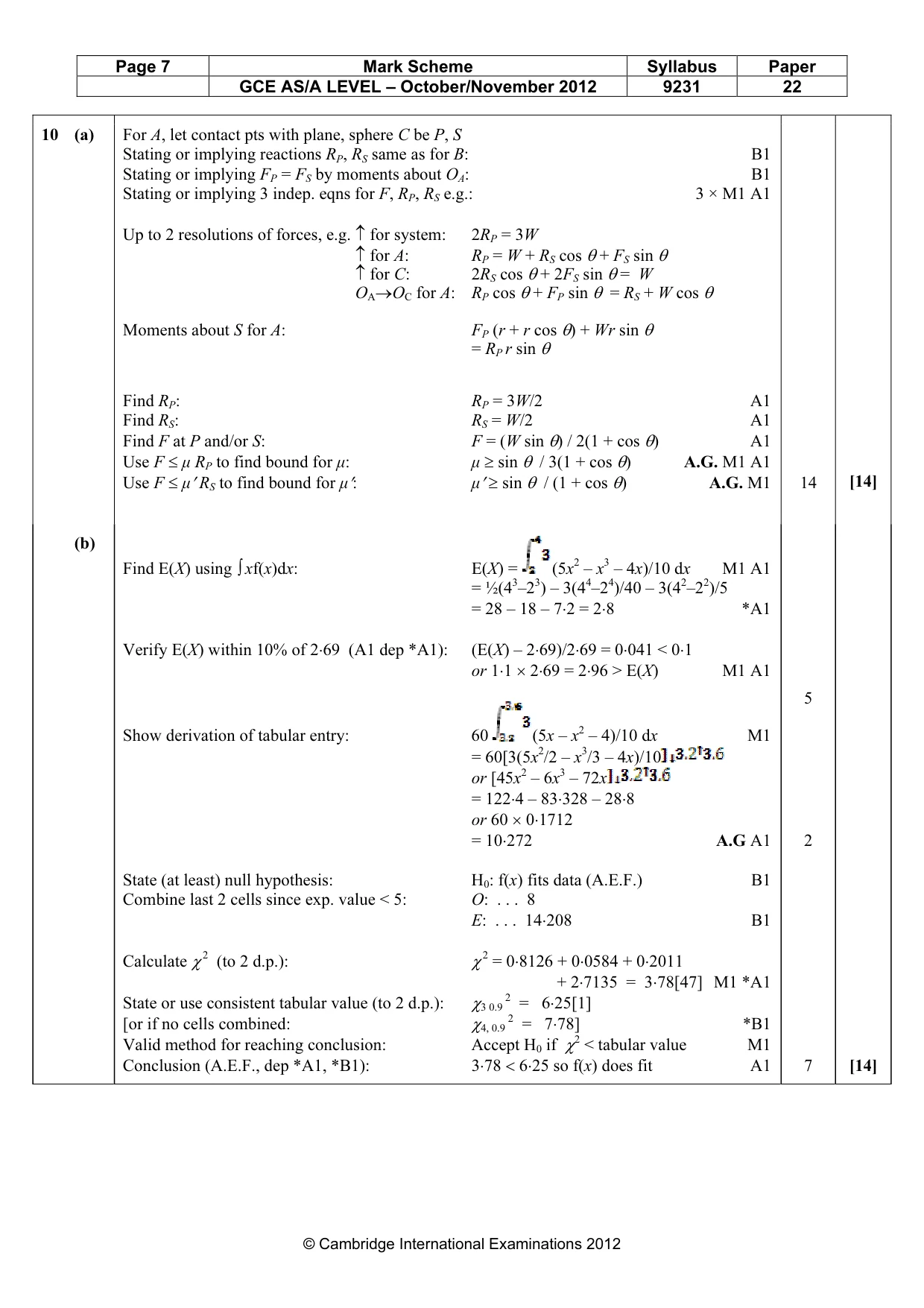
Page 7 Mark Scheme Syllabus Paper GCE AS/A LEVEL – October/November 2012 9231 22 © Cambridge International Examinations 2012 10 (a) For A, let contact pts with plane, sphere C be P, S Stating or implying reactions RP, RS same as for B: B1 Stating or implying FP = FS by moments about OA: B1 Stating or implying 3 indep. eqns for F, RP, RS e.g.: 3 × M1 A1 Up to 2 resolutions of forces, e.g. ↑ for system: 2RP = 3W ↑ for A: RP = W + RS cos θ + FS sin θ ↑ for C: 2RS cos θ + 2FS sin θ = W OA→OC for A: RP cos θ + FP sin θ = RS + W cos θ Moments about S for A: FP (r + r cos θ) + Wr sin θ = RP r sin θ Find RP: RP = 3W/2 A1 Find RS: RS = W/2 A1 Find F at P and/or S: F = (W sin θ) / 2(1 + cos θ) A1 Use F ≤ µ RP to find bound for µ: µ ≥ sin θ / 3(1 + cos θ) A.G. M1 A1 Use F ≤ µ′ RS to find bound for µ′: µ′ ≥ sin θ / (1 + cos θ) A.G. M1 14 [14] (b) Find E(X) using ∫ xf(x)dx: E(X) = (5x2 – x3 – 4x)/10 dx M1 A1 = ½(43–23) – 3(44–24)/40 – 3(42–22)/5 = 28 – 18 – 7⋅2 = 2⋅8 *A1 Verify E(X) within 10% of 2⋅69 (A1 dep *A1): (E(X) – 2⋅69)/2⋅69 = 0⋅041 < 0⋅1 or 1⋅1 × 2⋅69 = 2⋅96 > E(X) M1 A1 Show derivation of tabular entry: 60 (5x – x2 – 4)/10 dx M1 = 60[3(5x2/2 – x3/3 – 4x)/10 or [45x2 – 6x3 – 72x = 122⋅4 – 83⋅328 – 28⋅8 or 60 × 0⋅1712 = 10⋅272 A.G A1 State (at least) null hypothesis: H0: f(x) fits data (A.E.F.) B1 Combine last 2 cells since exp. value < 5: O: . . . 8 E: . . . 14⋅208 B1 Calculate χ 2 (to 2 d.p.): χ 2 = 0⋅8126 + 0⋅0584 + 0⋅2011 + 2⋅7135 = 3⋅78[47] M1 *A1 State or use consistent tabular value (to 2 d.p.): χ3 0.9 2 = 6⋅25[1] [or if no cells combined: χ4, 0.9 2 = 7⋅78] *B1 Valid method for reaching conclusion: Accept H0 if χ2 < tabular value M1 Conclusion (A.E.F., dep *A1, *B1): 3⋅78 < 6⋅25 so f(x) does fit A1 5 2 7 [14]
What you needed in this session
Cambridge’s own grade thresholds for 2012 Oct/Nov, Paper 2 · Variant 2. A higher threshold means an easier paper — the bar moves with how the cohort did.