Cambridge A Level Mathematics - Further 9231 — 2009 Oct/Nov Paper 2 · Variant 1
9231/21/O/N/09 · 100 marks · ≈113 min
The question paper and its mark scheme, free to read here and free to download. This is Cambridge’s own paper, exactly as it was sat.
Question paper8 pages


Mark scheme9 pages
Answers below. Sit the paper first if you are practising.
Paper as text
Question paper, page 1
UNIVERSITY OF CAMBRIDGE INTERNATIONAL EXAMINATIONS General Certificate of Education Advanced Level FURTHER MATHEMATICS 9231/02 Paper 2 October/November 2009 3 hours Additional Materials: Answer Booklet/Paper Graph Paper List of Formulae (MF10) READ THESE INSTRUCTIONS FIRST If you have been given an Answer Booklet, follow the instructions on the front cover of the Booklet. Write your Centre number, candidate number and name on all the work you hand in. Write in dark blue or black pen. You may use a soft pencil for any diagrams or graphs. Do not use staples, paper clips, highlighters, glue or correction fluid. Answer all the questions. Give non-exact numerical answers correct to 3 significant figures, or 1 decimal place in the case of angles in degrees, unless a different level of accuracy is specified in the question. Where a numerical value is necessary, take the acceleration due to gravity to be 10 ms−2. The use of a calculator is expected, where appropriate. Results obtained solely from a graphic calculator, without supporting working or reasoning, will not receive credit. You are reminded of the need for clear presentation in your answers. At the end of the examination, fasten all your work securely together. The number of marks is given in brackets [ ] at the end of each question or part question. This document consists of 5 printed pages and 3 blank pages. © UCLES 2009 [Turn over *5840741268*
Question paper, page 2
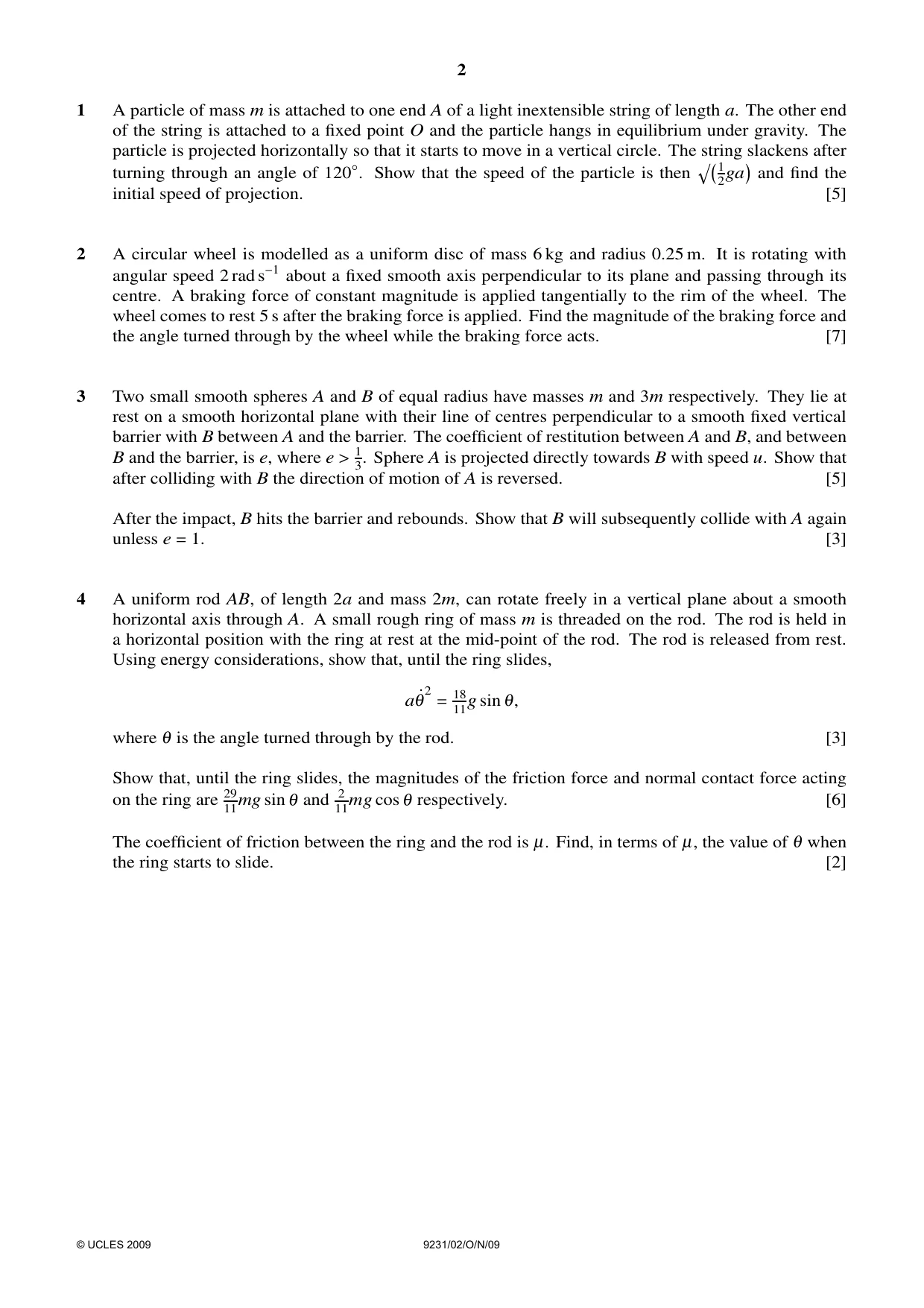
2 1 A particle of mass m is attached to one end A of a light inextensible string of length a. The other end of the string is attached to a fixed point O and the particle hangs in equilibrium under gravity. The particle is projected horizontally so that it starts to move in a vertical circle. The string slackens after turning through an angle of 120◦. Show that the speed of the particle is then p1 2ga and find the initial speed of projection. [5] 2 A circular wheel is modelled as a uniform disc of mass 6 kg and radius 0.25 m. It is rotating with angular speed 2 rad s−1 about a fixed smooth axis perpendicular to its plane and passing through its centre. A braking force of constant magnitude is applied tangentially to the rim of the wheel. The wheel comes to rest 5 s after the braking force is applied. Find the magnitude of the braking force and the angle turned through by the wheel while the braking force acts. [7] 3 Two small smooth spheres A and B of equal radius have masses m and 3m respectively. They lie at rest on a smooth horizontal plane with their line of centres perpendicular to a smooth fixed vertical barrier with B between A and the barrier. The coefficient of restitution between A and B, and between B and the barrier, is e, where e > 1 3. Sphere A is projected directly towards B with speed u. Show that after colliding with B the direction of motion of A is reversed. [5] After the impact, B hits the barrier and rebounds. Show that B will subsequently collide with A again unless e = 1. [3] 4 A uniform rod AB, of length 2a and mass 2m, can rotate freely in a vertical plane about a smooth horizontal axis through A. A small rough ring of mass m is threaded on the rod. The rod is held in a horizontal position with the ring at rest at the mid-point of the rod. The rod is released from rest. Using energy considerations, show that, until the ring slides, a˙θ 2 = 18 11g sin θ, where θ is the angle turned through by the rod. [3] Show that, until the ring slides, the magnitudes of the friction force and normal contact force acting on the ring are 29 11mg sin θ and 2 11mg cos θ respectively. [6] The coefficient of friction between the ring and the rod is µ. Find, in terms of µ, the value of θ when the ring starts to slide. [2] © UCLES 2009 9231/02/O/N/09
Question paper, page 3
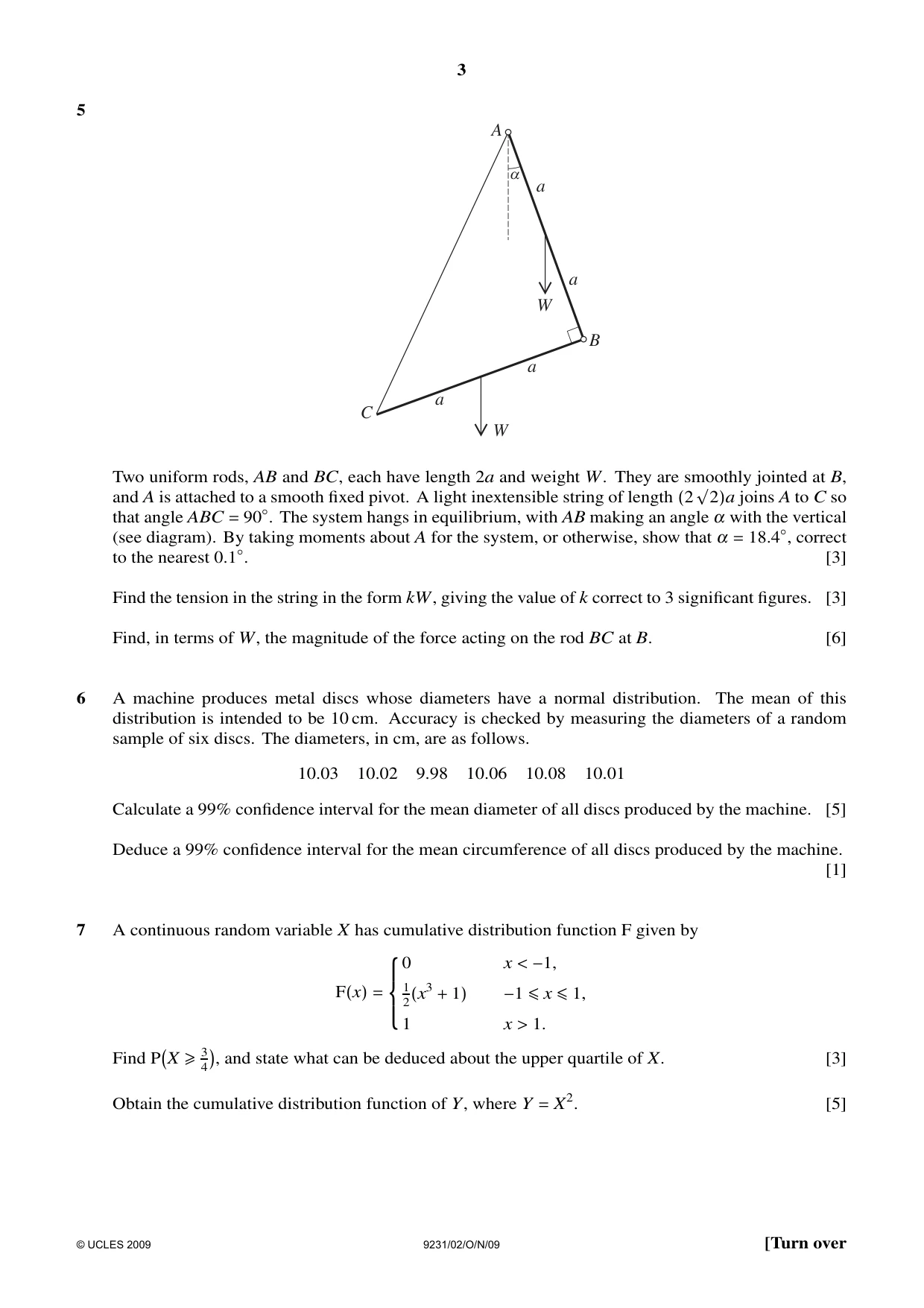
3 5 A B C W W a a a a a Two uniform rods, AB and BC, each have length 2a and weight W. They are smoothly jointed at B, and A is attached to a smooth fixed pivot. A light inextensible string of length (2 √2)a joins A to C so that angle ABC = 90◦. The system hangs in equilibrium, with AB making an angle α with the vertical (see diagram). By taking moments about A for the system, or otherwise, show that α = 18.4◦, correct to the nearest 0.1◦. [3] Find the tension in the string in the form kW, giving the value of k correct to 3 significant figures. [3] Find, in terms of W, the magnitude of the force acting on the rod BC at B. [6] 6 A machine produces metal discs whose diameters have a normal distribution. The mean of this distribution is intended to be 10 cm. Accuracy is checked by measuring the diameters of a random sample of six discs. The diameters, in cm, are as follows. 10.03 10.02 9.98 10.06 10.08 10.01 Calculate a 99% confidence interval for the mean diameter of all discs produced by the machine. [5] Deduce a 99% confidence interval for the mean circumference of all discs produced by the machine. [1] 7 A continuous random variable X has cumulative distribution function F given by F(x) = 0 x < −1, 1 2(x3 + 1) −1 ≤x ≤1, 1 x > 1. Find PX ≥3 4, and state what can be deduced about the upper quartile of X. [3] Obtain the cumulative distribution function of Y, where Y = X2. [5] © UCLES 2009 9231/02/O/N/09 [Turn over
Question paper, page 4
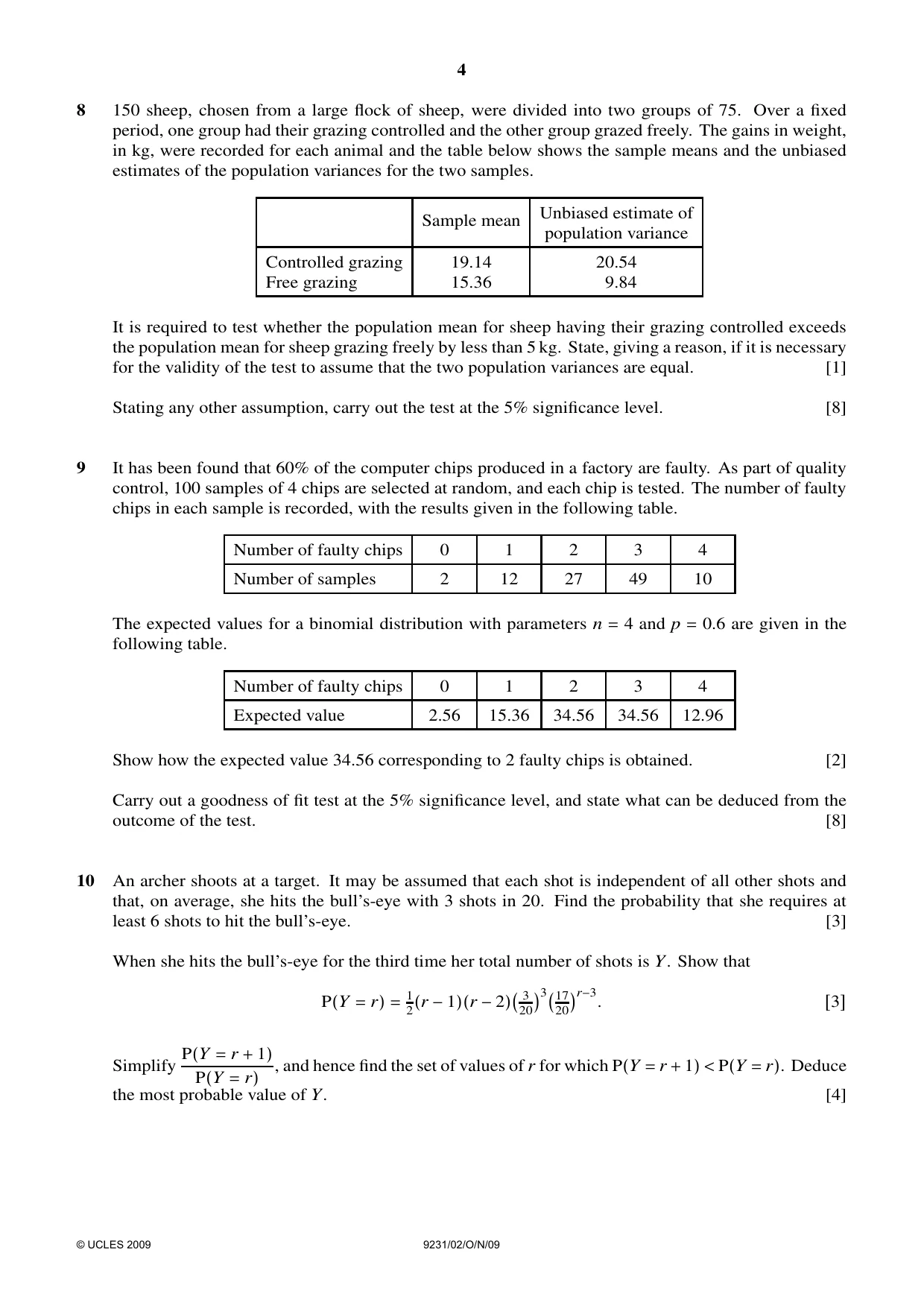
4 8 150 sheep, chosen from a large flock of sheep, were divided into two groups of 75. Over a fixed period, one group had their grazing controlled and the other group grazed freely. The gains in weight, in kg, were recorded for each animal and the table below shows the sample means and the unbiased estimates of the population variances for the two samples. Sample mean Unbiased estimate of population variance Controlled grazing 19.14 20.54 Free grazing 15.36 9.84 It is required to test whether the population mean for sheep having their grazing controlled exceeds the population mean for sheep grazing freely by less than 5 kg. State, giving a reason, if it is necessary for the validity of the test to assume that the two population variances are equal. [1] Stating any other assumption, carry out the test at the 5% significance level. [8] 9 It has been found that 60% of the computer chips produced in a factory are faulty. As part of quality control, 100 samples of 4 chips are selected at random, and each chip is tested. The number of faulty chips in each sample is recorded, with the results given in the following table. Number of faulty chips 0 1 2 3 4 Number of samples 2 12 27 49 10 The expected values for a binomial distribution with parameters n = 4 and p = 0.6 are given in the following table. Number of faulty chips 0 1 2 3 4 Expected value 2.56 15.36 34.56 34.56 12.96 Show how the expected value 34.56 corresponding to 2 faulty chips is obtained. [2] Carry out a goodness of fit test at the 5% significance level, and state what can be deduced from the outcome of the test. [8] 10 An archer shoots at a target. It may be assumed that each shot is independent of all other shots and that, on average, she hits the bull’s-eye with 3 shots in 20. Find the probability that she requires at least 6 shots to hit the bull’s-eye. [3] When she hits the bull’s-eye for the third time her total number of shots is Y. Show that P(Y = r) = 1 2(r −1)(r −2) 3 20 317 20r−3. [3] Simplify P(Y = r + 1) P(Y = r) , and hence find the set of values of r for which P(Y = r + 1) < P(Y = r). Deduce the most probable value of Y. [4] © UCLES 2009 9231/02/O/N/09
Question paper, page 5
5 11 Answer only one of the following two alternatives. EITHER A light elastic string, of natural length l and modulus of elasticity 4mg, is attached at one end to a fixed point and has a particle P of mass m attached to the other end. When P is hanging in equilibrium under gravity it is given a velocity √(gl) vertically downwards. At time t the downward displacement of P from its equilibrium position is x. Show that, while the string is taut, ¨x = −4g l x. [4] Find the speed of P when the length of the string is l. [4] Show that the time taken for P to move from the lowest point to the highest point of its motion is π 3 + √3 2 q l g. [6] OR x y + + + + + The scatter diagram shows a sample of size 5 of bivariate data, together with the regression line of y on x. State what is minimised in obtaining this regression line, illustrating your answer on a copy of this diagram. [2] State, giving a reason, whether, for the data shown, the regression line of y on x is the same as the regression line of x on y. [1] A car is travelling along a stretch of road with speed v km h−1 when the brakes are applied. The car comes to rest after travelling a further distance of ß m. The values of ß (and √ß) for 8 different values of v are given in the table, correct to 2 decimal places. v 25 30 35 40 45 50 55 60 ß 2.83 4.63 4.84 5.29 9.73 10.30 14.82 15.21 √ß 1.68 2.15 2.20 2.30 3.12 3.21 3.85 3.90 [Σv = 340, Σv2 = 15 500, Σ √ß = 22.41, Σß = 67.65, Σv√ß = 1022.15.] (i) Calculate the product moment correlation coefficient between v and √ß. What does this indicate about the scatter diagram of the points (v, √ß)? [4] (ii) Given that the product moment correlation coefficient between v and ß is 0.965, correct to 3 decimal places, state why the regression line of √ß on v is more suitable than the regression line of ß on v, and find the equation of the regression line of √ß on v. [5] (iii) Comment, in the context of the question, on the value of the constant term in the equation of the regression line of √ß on v. [2] © UCLES 2009 9231/02/O/N/09
Question paper, page 8
8 BLANK PAGE Permission to reproduce items where third-party owned material protected by copyright is included has been sought and cleared where possible. Every reasonable effort has been made by the publisher (UCLES) to trace copyright holders, but if any items requiring clearance have unwittingly been included, the publisher will be pleased to make amends at the earliest possible opportunity. University of Cambridge International Examinations is part of the Cambridge Assessment Group. Cambridge Assessment is the brand name of University of Cambridge Local Examinations Syndicate (UCLES), which is itself a department of the University of Cambridge. 9231/02/O/N/09
Mark scheme, page 1
UNIVERSITY OF CAMBRIDGE INTERNATIONAL EXAMINATIONS GCE Advanced Level MARK SCHEME for the October/November 2009 question paper for the guidance of teachers 9231 FURTHER MATHEMATICS 9231/02 Paper 2, maximum raw mark 100 This mark scheme is published as an aid to teachers and candidates, to indicate the requirements of the examination. It shows the basis on which Examiners were instructed to award marks. It does not indicate the details of the discussions that took place at an Examiners’ meeting before marking began, which would have considered the acceptability of alternative answers. Mark schemes must be read in conjunction with the question papers and the report on the examination. • CIE will not enter into discussions or correspondence in connection with these mark schemes. CIE is publishing the mark schemes for the October/November 2009 question papers for most IGCSE, GCE Advanced Level and Advanced Subsidiary Level syllabuses and some Ordinary Level syllabuses.
Mark scheme, page 2
Page 2 Mark Scheme: Teachers’ version Syllabus Paper GCE A LEVEL – October/November 2009 9231 02 © UCLES 2009 Mark Scheme Notes Marks are of the following three types: M Method mark, awarded for a valid method applied to the problem. Method marks are not lost for numerical errors, algebraic slips or errors in units. However, it is not usually sufficient for a candidate just to indicate an intention of using some method or just to quote a formula; the formula or idea must be applied to the specific problem in hand, e.g. by substituting the relevant quantities into the formula. Correct application of a formula without the formula being quoted obviously earns the M mark and in some cases an M mark can be implied from a correct answer. A Accuracy mark, awarded for a correct answer or intermediate step correctly obtained. Accuracy marks cannot be given unless the associated method mark is earned (or implied). B Mark for a correct result or statement independent of method marks. • When a part of a question has two or more "method" steps, the M marks are generally independent unless the scheme specifically says otherwise; and similarly when there are several B marks allocated. The notation DM or DB (or dep*) is used to indicate that a particular M or B mark is dependent on an earlier M or B (asterisked) mark in the scheme. When two or more steps are run together by the candidate, the earlier marks are implied and full credit is given. • The symbol √ implies that the A or B mark indicated is allowed for work correctly following on from previously incorrect results. Otherwise, A or B marks are given for correct work only. A and B marks are not given for fortuitously "correct" answers or results obtained from incorrect working. • Note: B2 or A2 means that the candidate can earn 2 or 0. B2/1/0 means that the candidate can earn anything from 0 to 2. The marks indicated in the scheme may not be subdivided. If there is genuine doubt whether a candidate has earned a mark, allow the candidate the benefit of the doubt. Unless otherwise indicated, marks once gained cannot subsequently be lost, e.g. wrong working following a correct form of answer is ignored. • Wrong or missing units in an answer should not lead to the loss of a mark unless the scheme specifically indicates otherwise. • For a numerical answer, allow the A or B mark if a value is obtained which is correct to 3 s.f., or which would be correct to 3 s.f. if rounded (1 d.p. in the case of an angle). As stated above, an A or B mark is not given if a correct numerical answer arises fortuitously from incorrect working. For Mechanics questions, allow A or B marks for correct answers which arise from taking g equal to 9.8 or 9.81 instead of 10.
Mark scheme, page 3
Page 3 Mark Scheme: Teachers’ version Syllabus Paper GCE A LEVEL – October/November 2009 9231 02 © UCLES 2009 The following abbreviations may be used in a mark scheme or used on the scripts: AEF Any Equivalent Form (of answer is equally acceptable) AG Answer Given on the question paper (so extra checking is needed to ensure that the detailed working leading to the result is valid) BOD Benefit of Doubt (allowed when the validity of a solution may not be absolutely clear) CAO Correct Answer Only (emphasising that no "follow through" from a previous error is allowed) CWO Correct Working Only – often written by a ‘fortuitous' answer ISW Ignore Subsequent Working MR Misread PA Premature Approximation (resulting in basically correct work that is insufficiently accurate) SOS See Other Solution (the candidate makes a better attempt at the same question) SR Special Ruling (detailing the mark to be given for a specific wrong solution, or a case where some standard marking practice is to be varied in the light of a particular circumstance) Penalties MR –1 A penalty of MR –1 is deducted from A or B marks when the data of a question or part question are genuinely misread and the object and difficulty of the question remain unaltered. In this case all A and B marks then become "follow through √" marks. MR is not applied when the candidate misreads his own figures – this is regarded as an error in accuracy. An MR–2 penalty may be applied in particular cases if agreed at the coordination meeting. PA –1 This is deducted from A or B marks in the case of premature approximation. The PA –1 penalty is usually discussed at the meeting.
Mark scheme, page 4
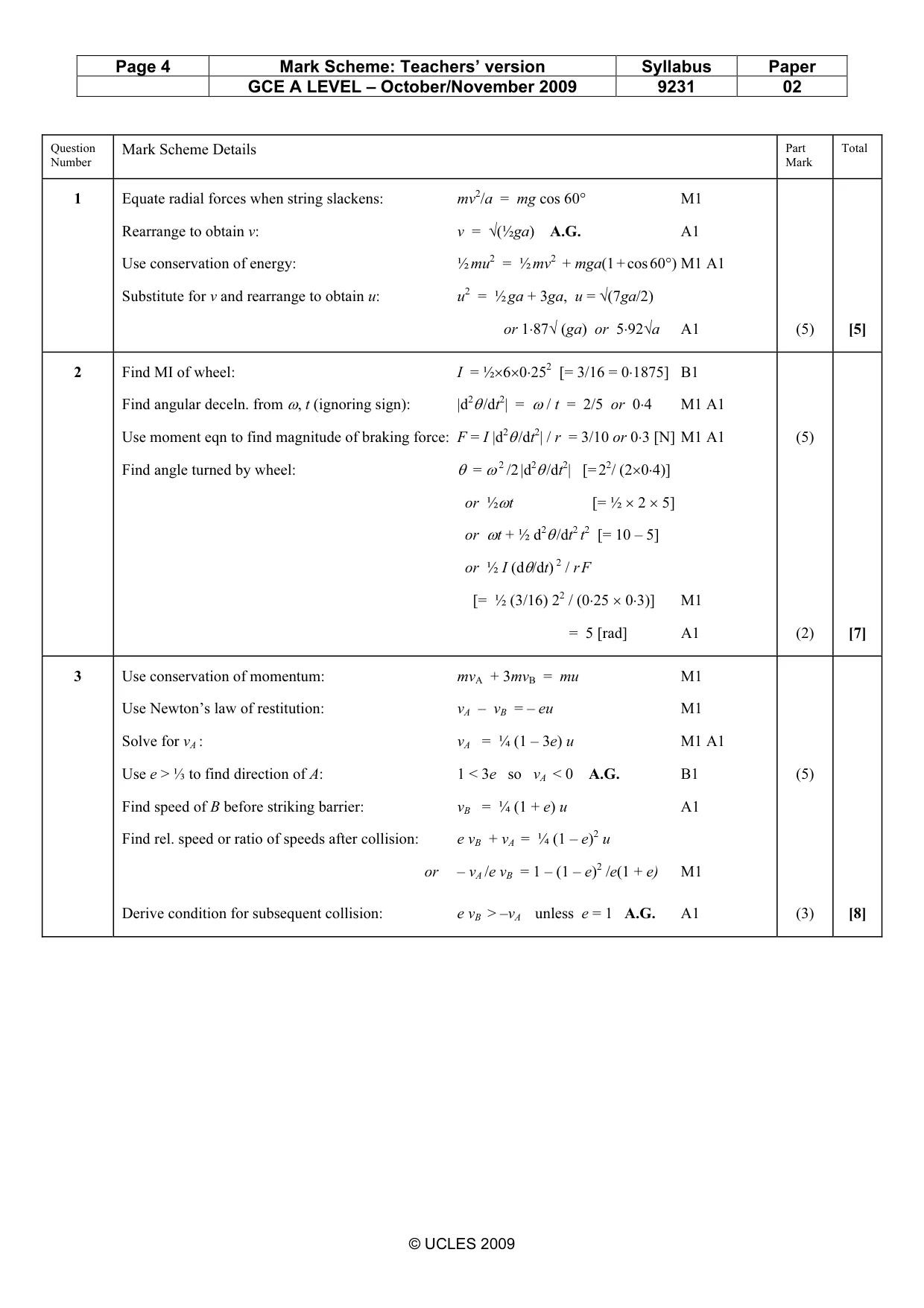
Page 4 Mark Scheme: Teachers’ version Syllabus Paper GCE A LEVEL – October/November 2009 9231 02 © UCLES 2009 Question Number Mark Scheme Details Part Mark Total 1 Equate radial forces when string slackens: mv2/a = mg cos 60° M1 Rearrange to obtain v: v = √(½ga) A.G. A1 Use conservation of energy: ½ mu2 = ½ mv2 + mga(1 + cos 60°) M1 A1 Substitute for v and rearrange to obtain u: u2 = ½ ga + 3ga, u = √(7ga/2) or 1⋅87√ (ga) or 5⋅92√a A1 (5) [5] 2 Find MI of wheel: I = ½×6×0⋅252 [= 3/16 = 0⋅1875] B1 Find angular deceln. from ω, t (ignoring sign): |d2θ /dt2| = ω / t = 2/5 or 0⋅4 M1 A1 Use moment eqn to find magnitude of braking force: F = I |d2θ /dt2| / r = 3/10 or 0⋅3 [N] M1 A1 Find angle turned by wheel: θ = ω 2 /2 |d2θ /dt2| [= 22/ (2×0⋅4)] or ½ωt [= ½ × 2 × 5] or ωt + ½ d2θ /dt2 t2 [= 10 – 5] or ½ I (dθ/dt) 2 / r F [= ½ (3/16) 22 / (0⋅25 × 0⋅3)] M1 = 5 [rad] A1 (5) (2) [7] 3 Use conservation of momentum: mvA + 3mvB = mu M1 Use Newton’s law of restitution: vA – vB = – eu M1 Solve for vA : vA = ¼ (1 – 3e) u M1 A1 Use e > ⅓ to find direction of A: 1 < 3e so vA < 0 A.G. B1 Find speed of B before striking barrier: vB = ¼ (1 + e) u A1 Find rel. speed or ratio of speeds after collision: e vB + vA = ¼ (1 – e)2 u or – vA /e vB = 1 – (1 – e)2 /e(1 + e) M1 Derive condition for subsequent collision: e vB > –vA unless e = 1 A.G. A1 (5) (3) [8]
Mark scheme, page 5
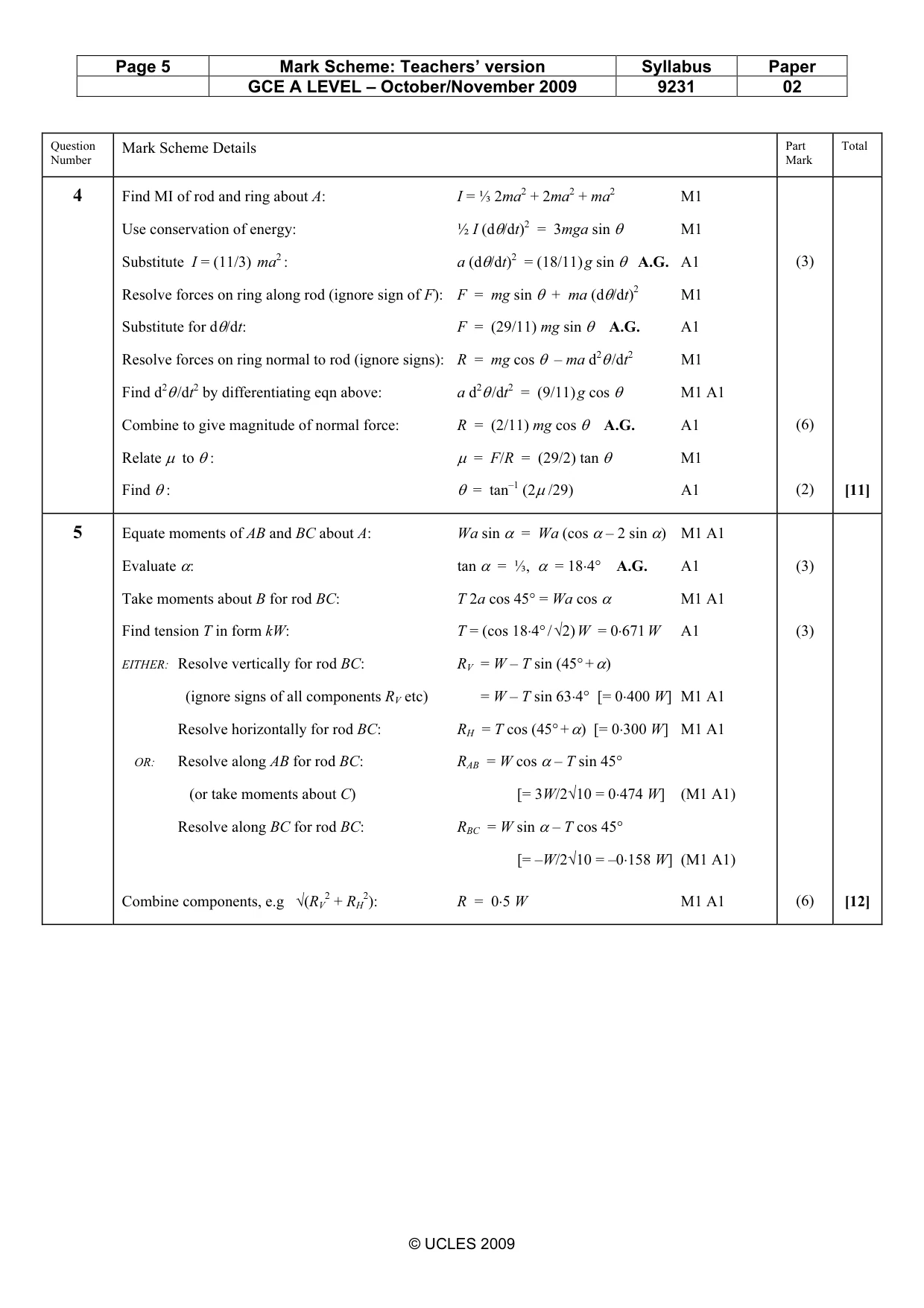
Page 5 Mark Scheme: Teachers’ version Syllabus Paper GCE A LEVEL – October/November 2009 9231 02 © UCLES 2009 Question Number Mark Scheme Details Part Mark Total 4 Find MI of rod and ring about A: I = ⅓ 2ma2 + 2ma2 + ma2 M1 Use conservation of energy: ½ I (dθ/dt)2 = 3mga sin θ M1 Substitute I = (11/3) ma2 : a (dθ/dt)2 = (18/11) g sin θ A.G. A1 Resolve forces on ring along rod (ignore sign of F): F = mg sin θ + ma (dθ/dt)2 M1 Substitute for dθ/dt: F = (29/11) mg sin θ A.G. A1 Resolve forces on ring normal to rod (ignore signs): R = mg cos θ – ma d2θ /dt2 M1 Find d2θ /dt2 by differentiating eqn above: a d2θ /dt2 = (9/11) g cos θ M1 A1 Combine to give magnitude of normal force: R = (2/11) mg cos θ A.G. A1 Relate µ to θ : µ = F/R = (29/2) tan θ M1 Find θ : θ = tan–1 (2µ /29) A1 (3) (6) (2) [11] 5 Equate moments of AB and BC about A: Wa sin α = Wa (cos α – 2 sin α) M1 A1 Evaluate α: tan α = ⅓, α = 18⋅4° A.G. A1 Take moments about B for rod BC: T 2a cos 45° = Wa cos α M1 A1 Find tension T in form kW: T = (cos 18⋅4° / √2) W = 0⋅671 W A1 EITHER: Resolve vertically for rod BC: RV = W – T sin (45° + α) (ignore signs of all components RV etc) = W – T sin 63⋅4° [= 0⋅400 W] M1 A1 Resolve horizontally for rod BC: RH = T cos (45° + α) [= 0⋅300 W] M1 A1 OR: Resolve along AB for rod BC: RAB = W cos α – T sin 45° (or take moments about C) [= 3W/2√10 = 0⋅474 W] (M1 A1) Resolve along BC for rod BC: RBC = W sin α – T cos 45° [= –W/2√10 = –0⋅158 W] (M1 A1) Combine components, e.g √(RV 2 + RH 2): R = 0⋅5 W M1 A1 (3) (3) (6) [12]
Mark scheme, page 6
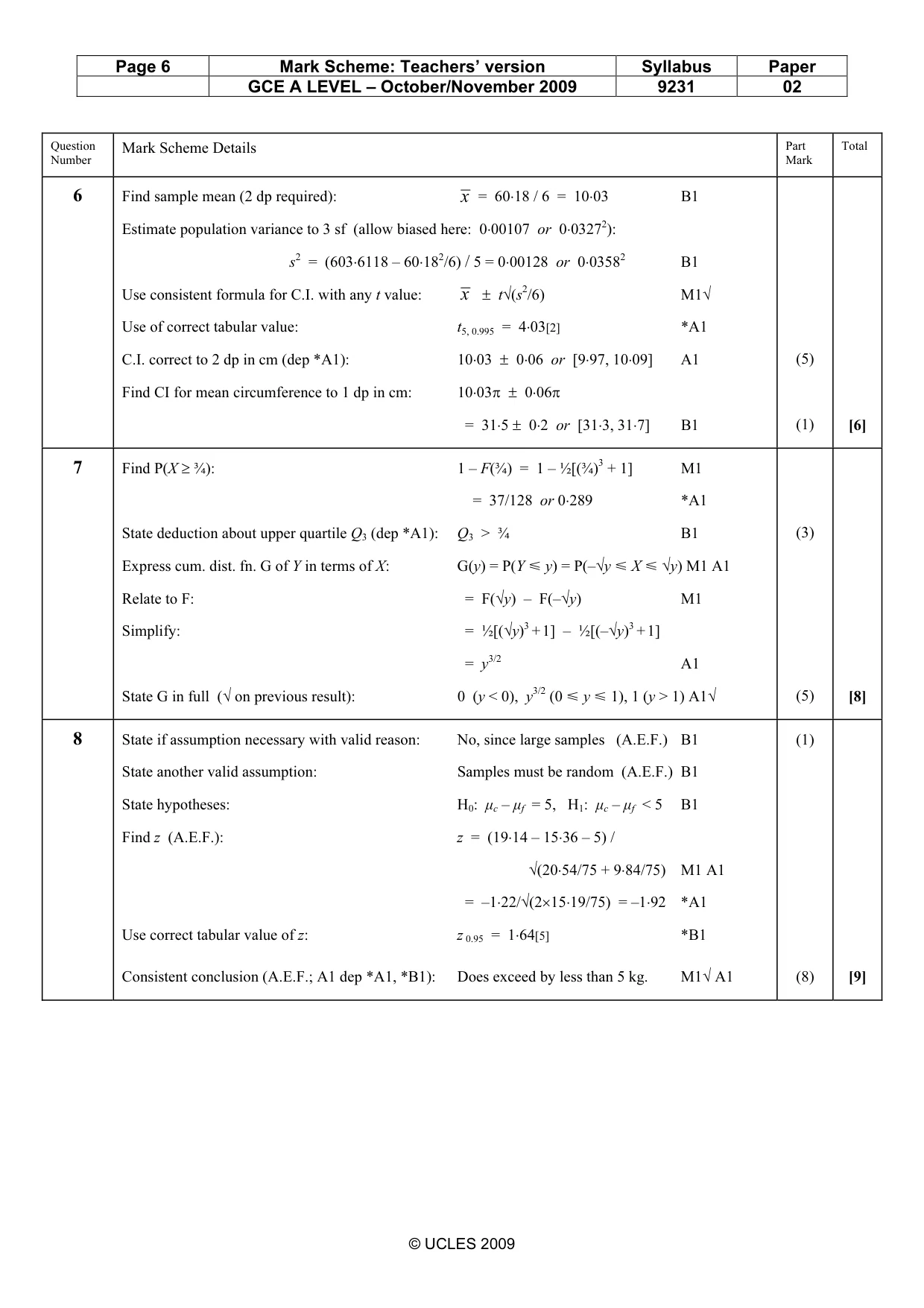
Page 6 Mark Scheme: Teachers’ version Syllabus Paper GCE A LEVEL – October/November 2009 9231 02 © UCLES 2009 Question Number Mark Scheme Details Part Mark Total 6 Find sample mean (2 dp required): x = 60⋅18 / 6 = 10⋅03 B1 Estimate population variance to 3 sf (allow biased here: 0⋅00107 or 0⋅03272): s2 = (603⋅6118 – 60⋅182/6) / 5 = 0⋅00128 or 0⋅03582 B1 Use consistent formula for C.I. with any t value: x ± t√(s2/6) M1√ Use of correct tabular value: t5, 0.995 = 4⋅03[2] *A1 C.I. correct to 2 dp in cm (dep *A1): 10⋅03 ± 0⋅06 or [9⋅97, 10⋅09] A1 Find CI for mean circumference to 1 dp in cm: 10⋅03π ± 0⋅06π = 31⋅5 ± 0⋅2 or [31⋅3, 31⋅7] B1 (5) (1) [6] 7 Find P(X ≥ ¾): 1 – F(¾) = 1 – ½[(¾)3 + 1] M1 = 37/128 or 0⋅289 *A1 State deduction about upper quartile Q3 (dep *A1): Q3 > ¾ B1 Express cum. dist. fn. G of Y in terms of X: G(y) = P(Y Y y) = P(–√y Y X Y √y) M1 A1 Relate to F: = F(√y) – F(–√y) M1 Simplify: = ½[(√y)3 + 1] – ½[(–√y)3 + 1] = y3/2 A1 State G in full (√ on previous result): 0 (y < 0), y3/2 (0 Y y Y 1), 1 (y > 1) A1√ (3) (5) [8] 8 State if assumption necessary with valid reason: No, since large samples (A.E.F.) B1 State another valid assumption: Samples must be random (A.E.F.) B1 State hypotheses: H0: µc – µf = 5, H1: µc – µf < 5 B1 Find z (A.E.F.): z = (19⋅14 – 15⋅36 – 5) / √(20⋅54/75 + 9⋅84/75) M1 A1 = –1⋅22/√(2×15⋅19/75) = –1⋅92 *A1 Use correct tabular value of z: z 0.95 = 1⋅64[5] *B1 Consistent conclusion (A.E.F.; A1 dep *A1, *B1): Does exceed by less than 5 kg. M1√ A1 (1) (8) [9]
Mark scheme, page 7
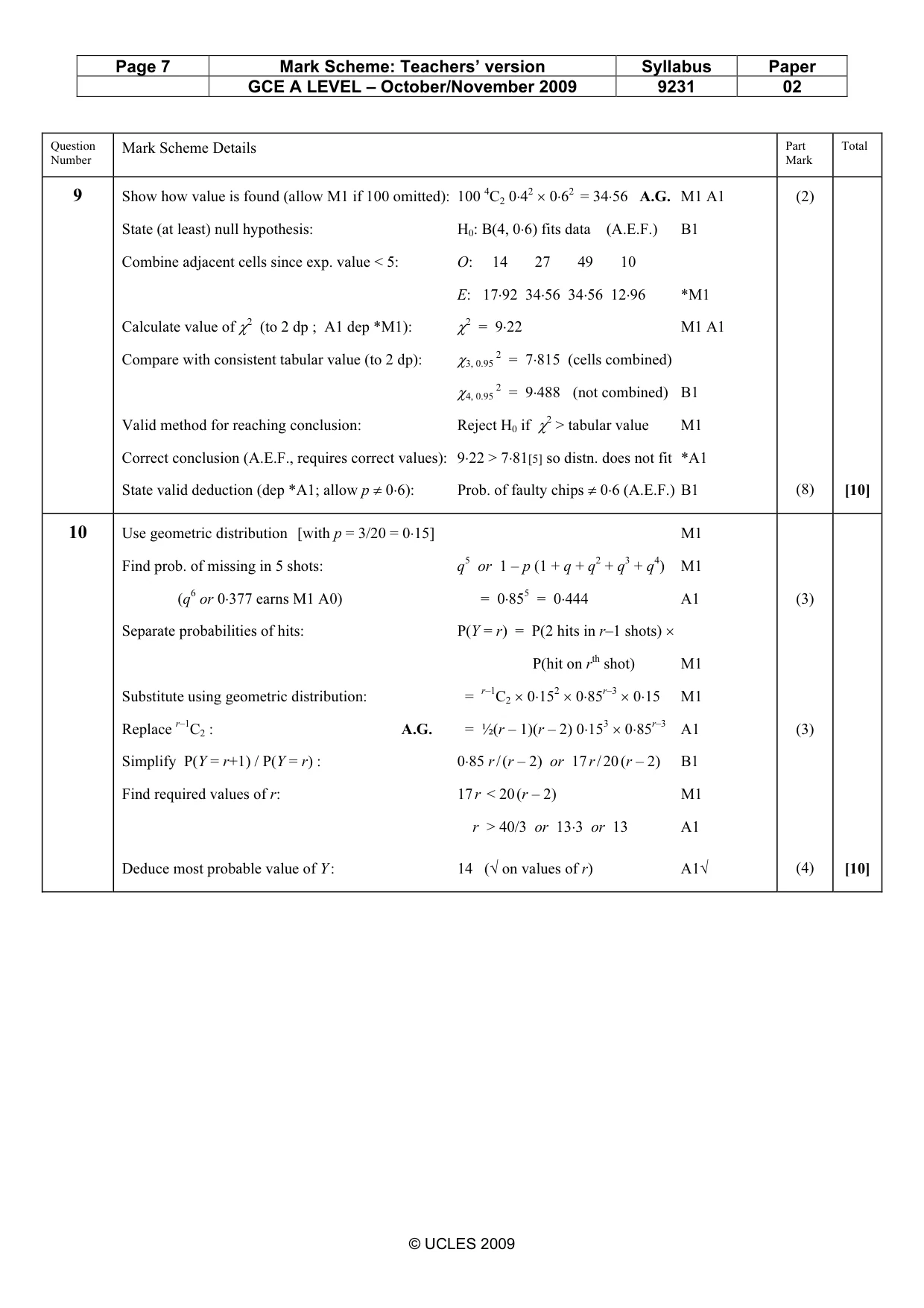
Page 7 Mark Scheme: Teachers’ version Syllabus Paper GCE A LEVEL – October/November 2009 9231 02 © UCLES 2009 Question Number Mark Scheme Details Part Mark Total 9 Show how value is found (allow M1 if 100 omitted): 100 4C2 0⋅42 × 0⋅62 = 34⋅56 A.G. M1 A1 State (at least) null hypothesis: H0: B(4, 0⋅6) fits data (A.E.F.) B1 Combine adjacent cells since exp. value < 5: O: 14 27 49 10 E: 17⋅92 34⋅56 34⋅56 12⋅96 *M1 Calculate value of χ2 (to 2 dp ; A1 dep *M1): χ2 = 9⋅22 M1 A1 Compare with consistent tabular value (to 2 dp): χ3, 0.95 2 = 7⋅815 (cells combined) χ4, 0.95 2 = 9⋅488 (not combined) B1 Valid method for reaching conclusion: Reject H0 if χ2 > tabular value M1 Correct conclusion (A.E.F., requires correct values): 9⋅22 > 7⋅81[5] so distn. does not fit *A1 State valid deduction (dep *A1; allow p ≠ 0⋅6): Prob. of faulty chips ≠ 0⋅6 (A.E.F.) B1 (2) (8) [10] 10 Use geometric distribution [with p = 3/20 = 0⋅15] M1 Find prob. of missing in 5 shots: q5 or 1 – p (1 + q + q2 + q3 + q4) M1 (q6 or 0⋅377 earns M1 A0) = 0⋅855 = 0⋅444 A1 Separate probabilities of hits: P(Y = r) = P(2 hits in r–1 shots) × P(hit on rth shot) M1 Substitute using geometric distribution: = r–1C2 × 0⋅152 × 0⋅85r–3 × 0⋅15 M1 Replace r–1C2 : A.G. = ½(r – 1)(r – 2) 0⋅153 × 0⋅85r–3 A1 Simplify P(Y = r+1) / P(Y = r) : 0⋅85 r / (r – 2) or 17 r / 20 (r – 2) B1 Find required values of r: 17 r < 20 (r – 2) M1 r > 40/3 or 13⋅3 or 13 A1 Deduce most probable value of Y : 14 (√ on values of r) A1√ (3) (3) (4) [10]
Mark scheme, page 8
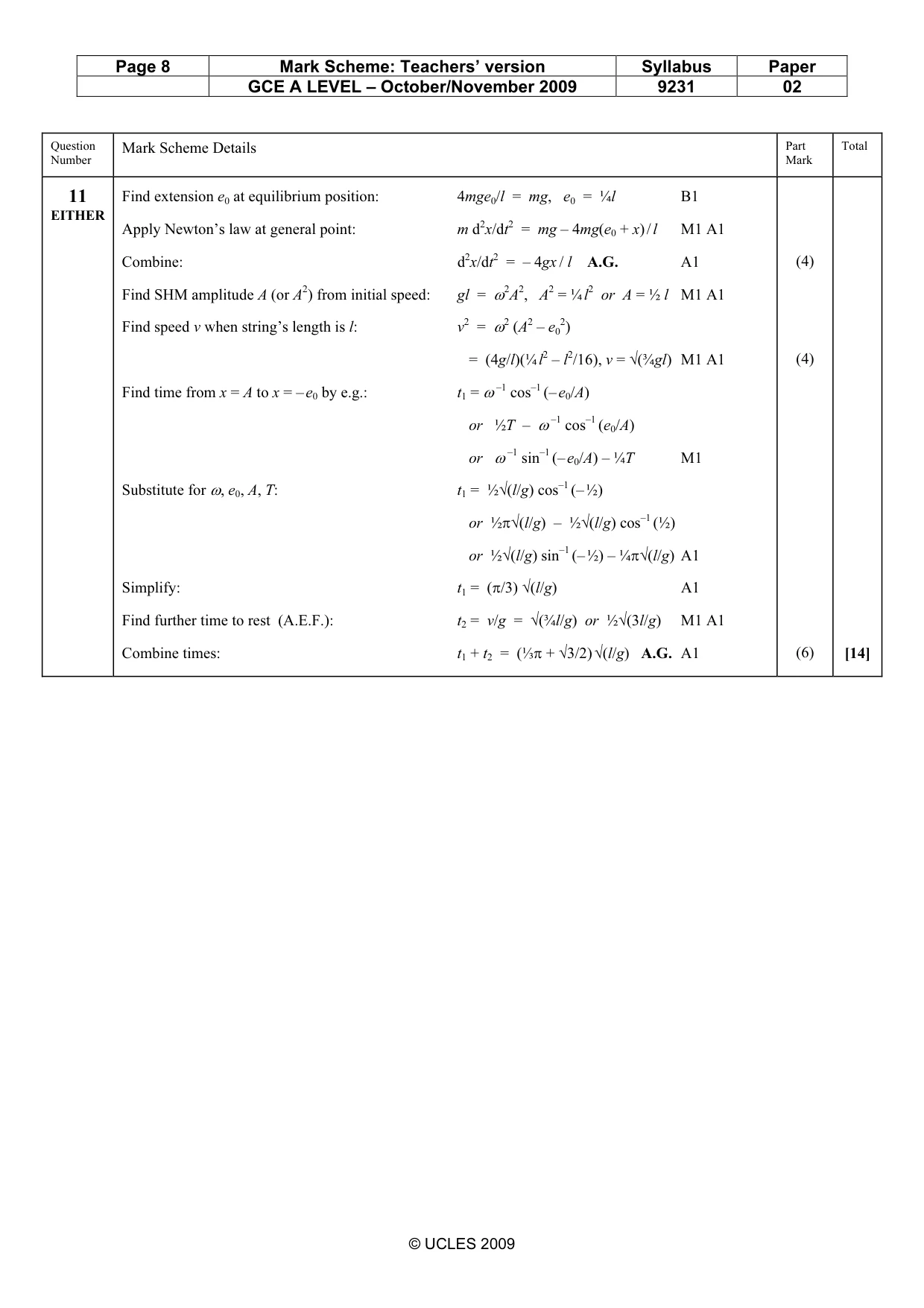
Page 8 Mark Scheme: Teachers’ version Syllabus Paper GCE A LEVEL – October/November 2009 9231 02 © UCLES 2009 Question Number Mark Scheme Details Part Mark Total 11 EITHER Find extension e0 at equilibrium position: 4mge0/l = mg, e0 = ¼l B1 Apply Newton’s law at general point: m d2x/dt2 = mg – 4mg(e0 + x) / l M1 A1 Combine: d2x/dt2 = – 4gx / l A.G. A1 Find SHM amplitude A (or A2) from initial speed: gl = ω2A2, A2 = ¼ l2 or A = ½ l M1 A1 Find speed v when string’s length is l: v2 = ω2 (A2 – e0 2) = (4g/l)(¼ l2 – l2/16), v = √(¾gl) M1 A1 Find time from x = A to x = – e0 by e.g.: t1 = ω –1 cos–1 (– e0/A) or ½T – ω –1 cos–1 (e0/A) or ω –1 sin–1 (– e0/A) – ¼T M1 Substitute for ω, e0, A, T: t1 = ½√(l/g) cos–1 (– ½) or ½π√(l/g) – ½√(l/g) cos–1 (½) or ½√(l/g) sin–1 (– ½) – ¼π√(l/g) A1 Simplify: t1 = (π/3) √(l/g) A1 Find further time to rest (A.E.F.): t2 = v/g = √(¾l/g) or ½√(3l/g) M1 A1 Combine times: t1 + t2 = (⅓π + √3/2) √(l/g) A.G. A1 (4) (4) (6) [14]
Mark scheme, page 9
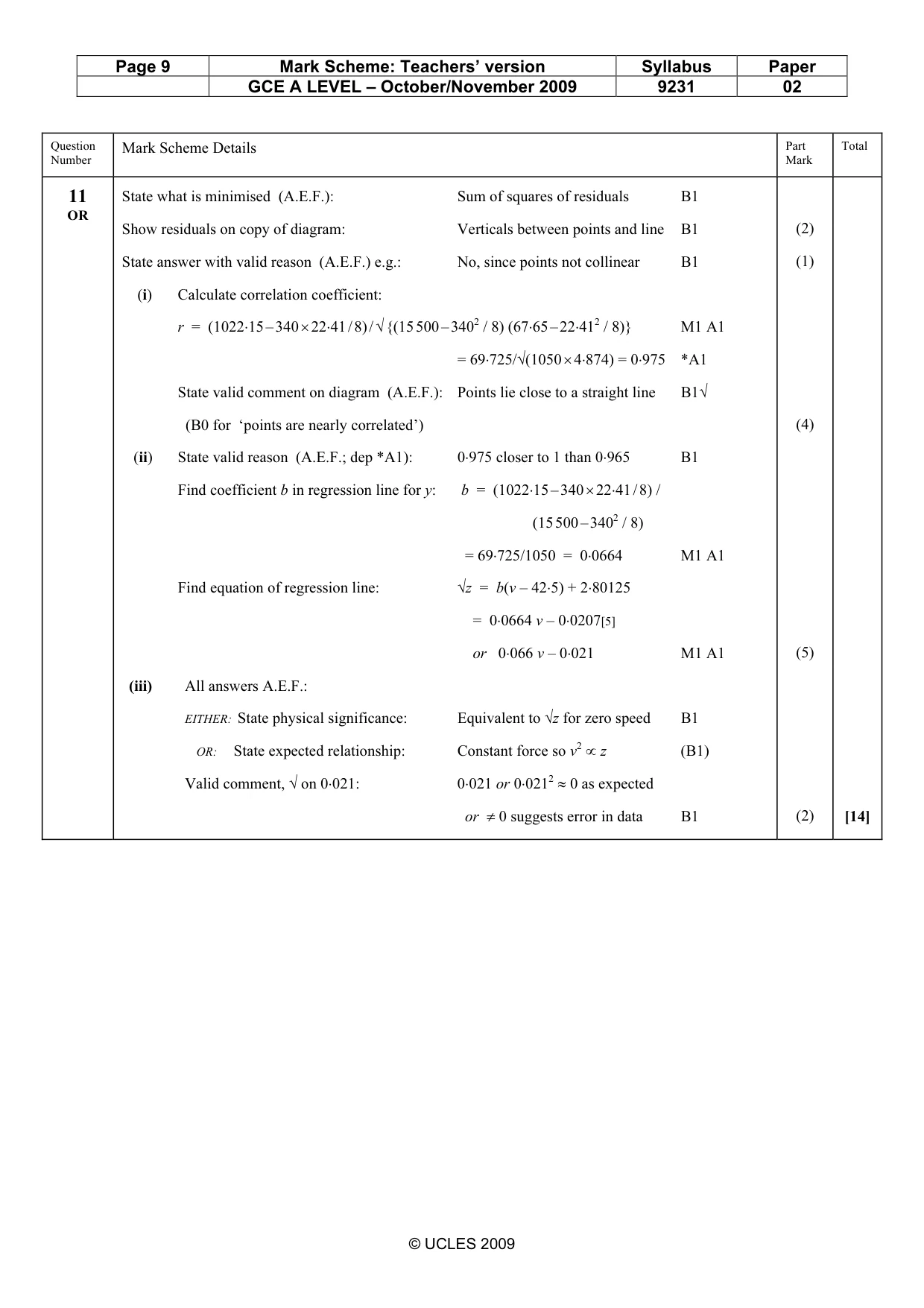
Page 9 Mark Scheme: Teachers’ version Syllabus Paper GCE A LEVEL – October/November 2009 9231 02 © UCLES 2009 Question Number Mark Scheme Details Part Mark Total 11 OR State what is minimised (A.E.F.): Sum of squares of residuals B1 Show residuals on copy of diagram: Verticals between points and line B1 State answer with valid reason (A.E.F.) e.g.: No, since points not collinear B1 (i) Calculate correlation coefficient: r = (1022⋅15 – 340 × 22⋅41 / 8) / √ {(15 500 – 3402 / 8) (67⋅65 – 22⋅412 / 8)} M1 A1 = 69⋅725/√(1050 × 4⋅874) = 0⋅975 *A1 State valid comment on diagram (A.E.F.): Points lie close to a straight line B1√ (B0 for ‘points are nearly correlated’) (ii) State valid reason (A.E.F.; dep *A1): 0⋅975 closer to 1 than 0⋅965 B1 Find coefficient b in regression line for y: b = (1022⋅15 – 340 × 22⋅41 / 8) / (15 500 – 3402 / 8) = 69⋅725/1050 = 0⋅0664 M1 A1 Find equation of regression line: √z = b(v – 42⋅5) + 2⋅80125 = 0⋅0664 v – 0⋅0207[5] or 0⋅066 v – 0⋅021 M1 A1 (iii) All answers A.E.F.: EITHER: State physical significance: Equivalent to √z for zero speed B1 OR: State expected relationship: Constant force so v2 ∝ z (B1) Valid comment, √ on 0⋅021: 0⋅021 or 0⋅0212 ≈ 0 as expected or ≠ 0 suggests error in data B1 (2) (1) (4) (5) (2) [14]
What you needed in this session
Cambridge’s own grade thresholds for 2009 Oct/Nov, Paper 2 · Variant 1. A higher threshold means an easier paper — the bar moves with how the cohort did.