Cambridge A Level Mathematics 9709 — 2022 May/June Paper 5 · Variant 3
9709/53/M/J/22 · 5 questions · 50 marks · ≈56 min
The question paper and its mark scheme, free to read here and free to download. This is Cambridge’s own paper, exactly as it was sat.
Question paper12 pages

Mark scheme14 pages
Answers below. Sit the paper first if you are practising.
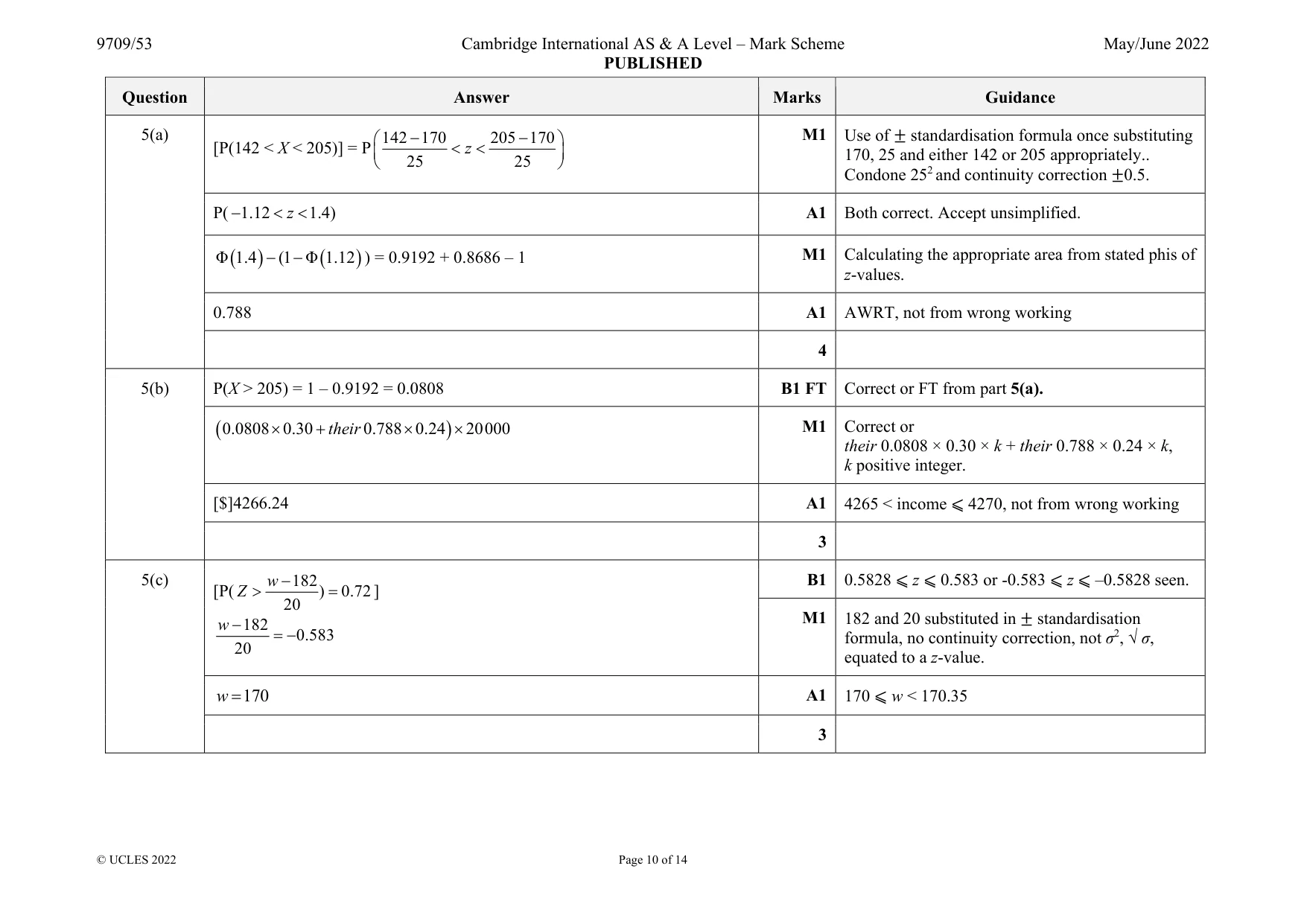
Questions as text
Q1 · The time taken, t minutes, to complete a puzzle was recorded for each of 150 students
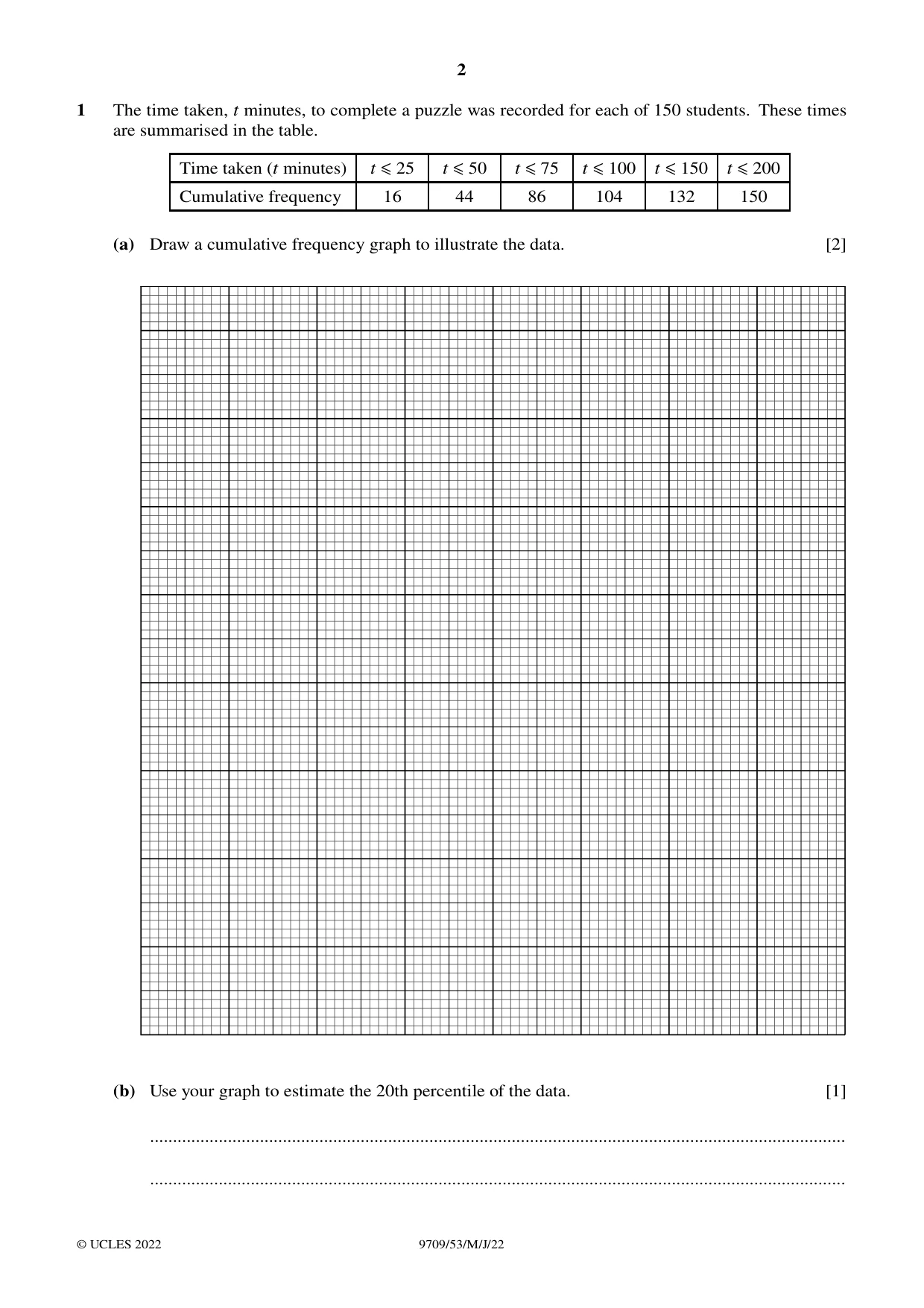
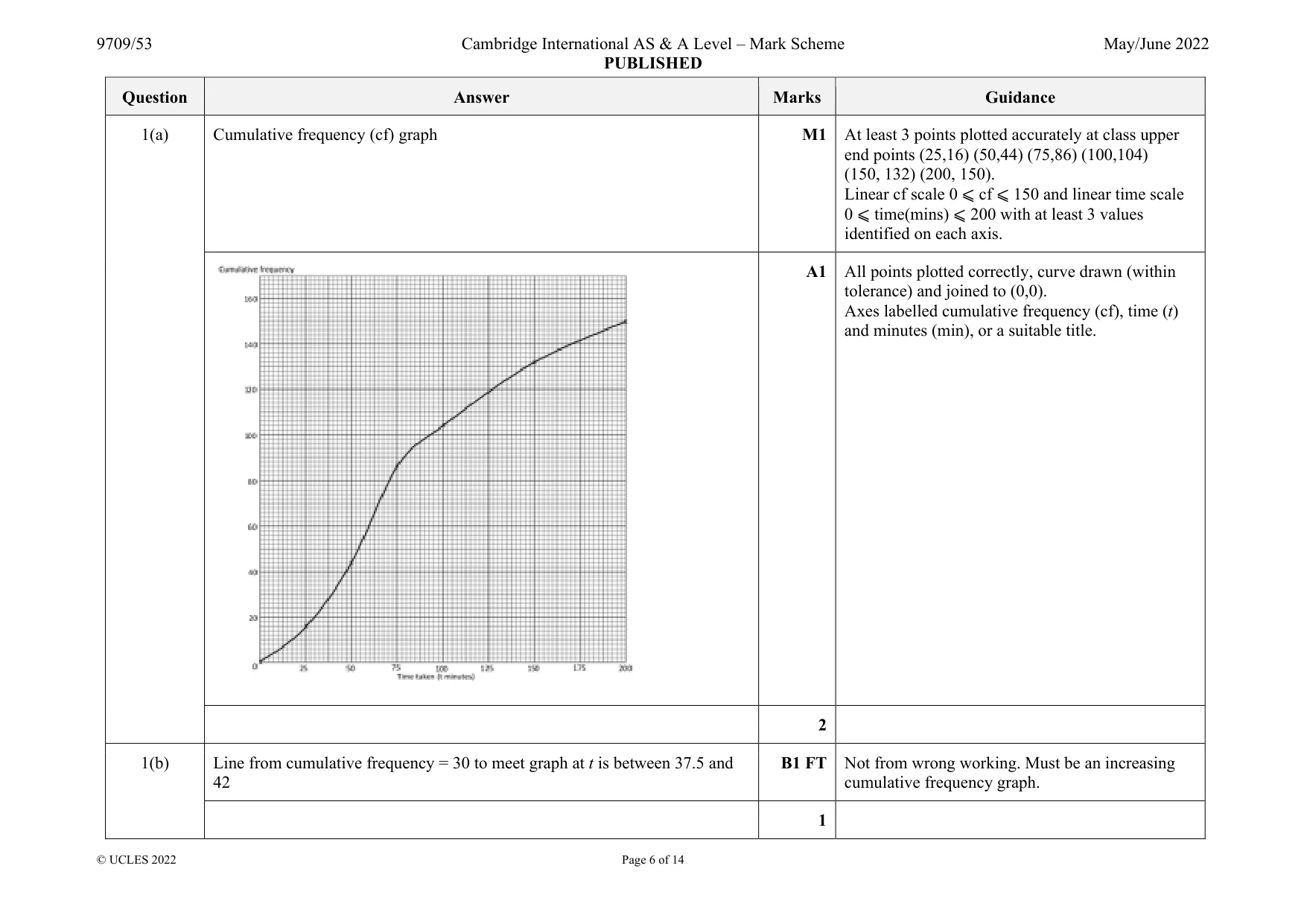
1 The time taken, t minutes, to complete a puzzle was recorded for each of 150 students. These times are summarised in the table. Time taken (t minutes) t ≤25 t ≤50 t ≤75 t ≤100 t ≤150 t ≤200 Cumulative frequency 16 44 86 104 132 150 (a) Draw a cumulative frequency graph to illustrate the data. [2] (b) Use your graph to estimate the 20th percentile of the data. [1] ........................................................................................................................................................ ........................................................................................................................................................
Mark scheme: 1(a) Cumulative frequency (cf) graph M1 At least 3 points plotted accurately at class upper end points (25,16) (50,44) (75,86) (100,104) (150, 132) (200, 150). Linear cf scale 0 ⩽ cf ⩽ 150 and linear time scale 0 ⩽ time(mins) ⩽ 200 with at least 3 values identified on each axis. A1 All points plotted correctly, curve drawn (within tolerance) and joined to (0,0). Axes labelled cumulative frequency (cf), time (t) and minutes (min), or a suitable title. 2 1(b) Line from cumulative frequency = 30 to meet graph at t is between 37.5 and 42 B1 FT Not from wrong working. Must be an increasing cumulative frequency graph. 1
Q2 · Twenty children were asked to estimate the height of a particular tree
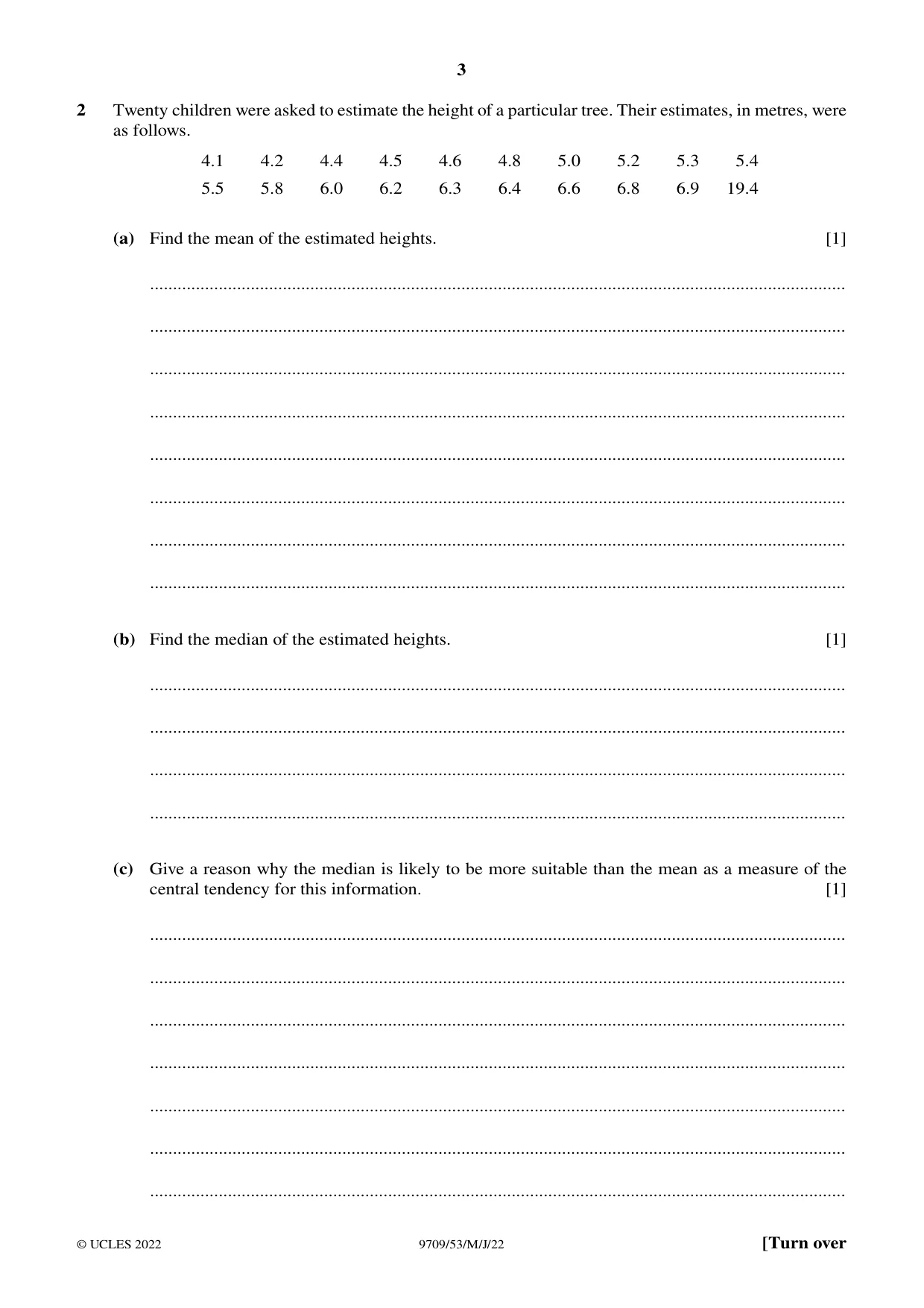
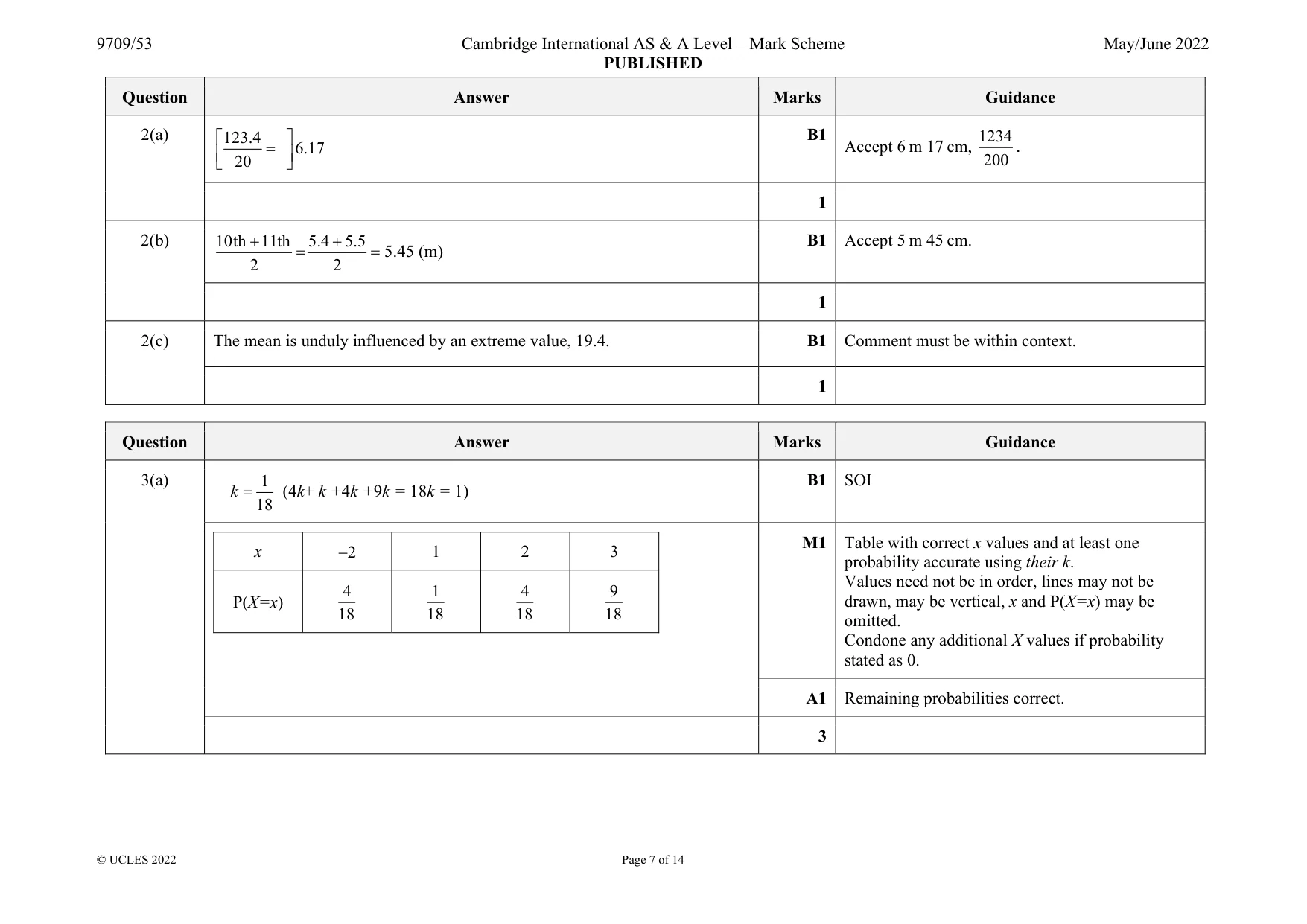
2 Twenty children were asked to estimate the height of a particular tree. Their estimates, in metres, were as follows. 4.1 4.2 4.4 4.5 4.6 4.8 5.0 5.2 5.3 5.4 5.5 5.8 6.0 6.2 6.3 6.4 6.6 6.8 6.9 19.4 (a) Find the mean of the estimated heights. [1] ........................................................................................................................................................ ........................................................................................................................................................ ........................................................................................................................................................ ........................................................................................................................................................ ........................................................................................................................................................ ........................................................................................................................................................ ........................................................................................................................................................ ........................................................................................................................................................ (b) Find the median of the estimated heights. [1] ........................................................................................................................................................ ........................................................................................................................................................ ........................................................................................................................................................ ........................................................................................................................................................ (c) Give a reason why the median is likely to be more suitable than the mean as a measure of the central tendency for this information. [1] ........................................................................................................................................................ ........................................................................................................................................................ ........................................................................................................................................................ ........................................................................................................................................................ ........................................................................................................................................................ ........................................................................................................................................................ ........................................................................................................................................................
Mark scheme: 2(a) 123.4 6.17 20 200 . 1 2(b) 10th 11th 5.4 5.5 2 2 5.45 (m) B1 Accept 5 m 45 cm. 1 2(c) The mean is unduly influenced by an extreme value, 19.4. B1 Comment must be within context. 1
Q4 · Ramesh throws an ordinary fair 6-sided die
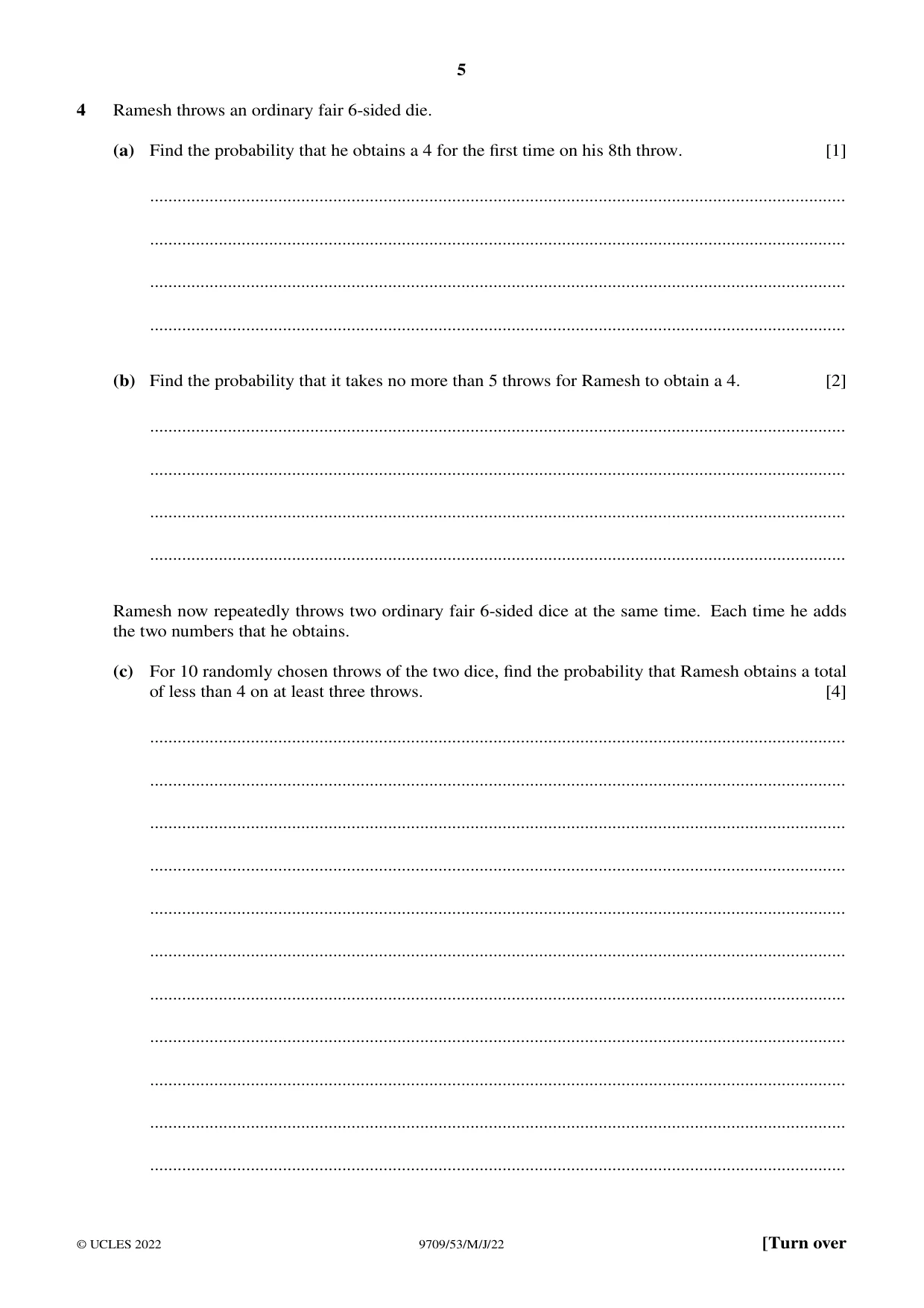
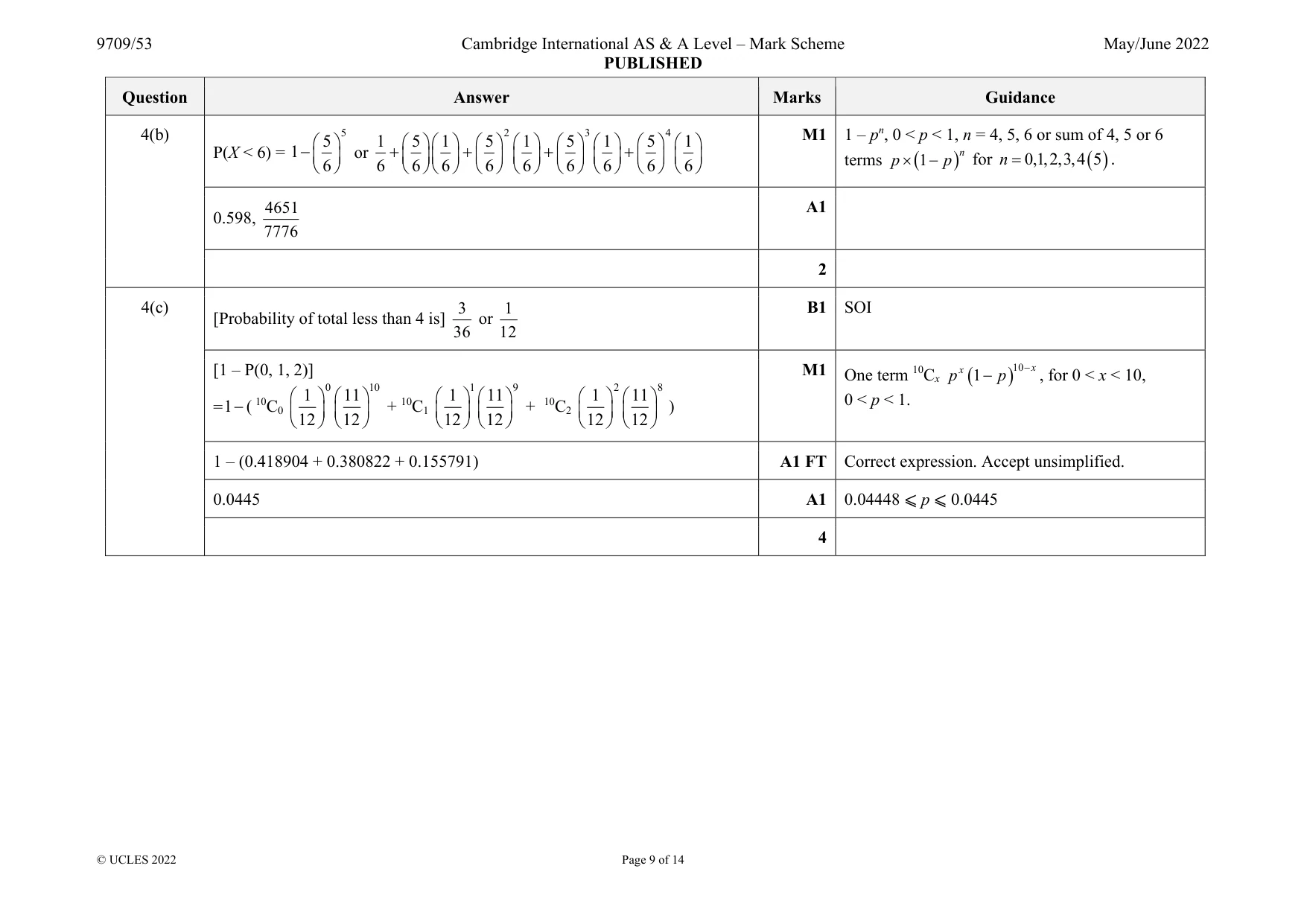
4 Ramesh throws an ordinary fair 6-sided die. (a) Find the probability that he obtains a 4 for the first time on his 8th throw. [1] ........................................................................................................................................................ ........................................................................................................................................................ ........................................................................................................................................................ ........................................................................................................................................................ (b) Find the probability that it takes no more than 5 throws for Ramesh to obtain a 4. [2] ........................................................................................................................................................ ........................................................................................................................................................ ........................................................................................................................................................ ........................................................................................................................................................ Ramesh now repeatedly throws two ordinary fair 6-sided dice at the same time. Each time he adds the two numbers that he obtains. (c) For 10 randomly chosen throws of the two dice, find the probability that Ramesh obtains a total of less than 4 on at least three throws. [4] ........................................................................................................................................................ ........................................................................................................................................................ ........................................................................................................................................................ ........................................................................................................................................................ ........................................................................................................................................................ ........................................................................................................................................................ ........................................................................................................................................................ ........................................................................................................................................................ ........................................................................................................................................................ ........................................................................................................................................................ ........................................................................................................................................................
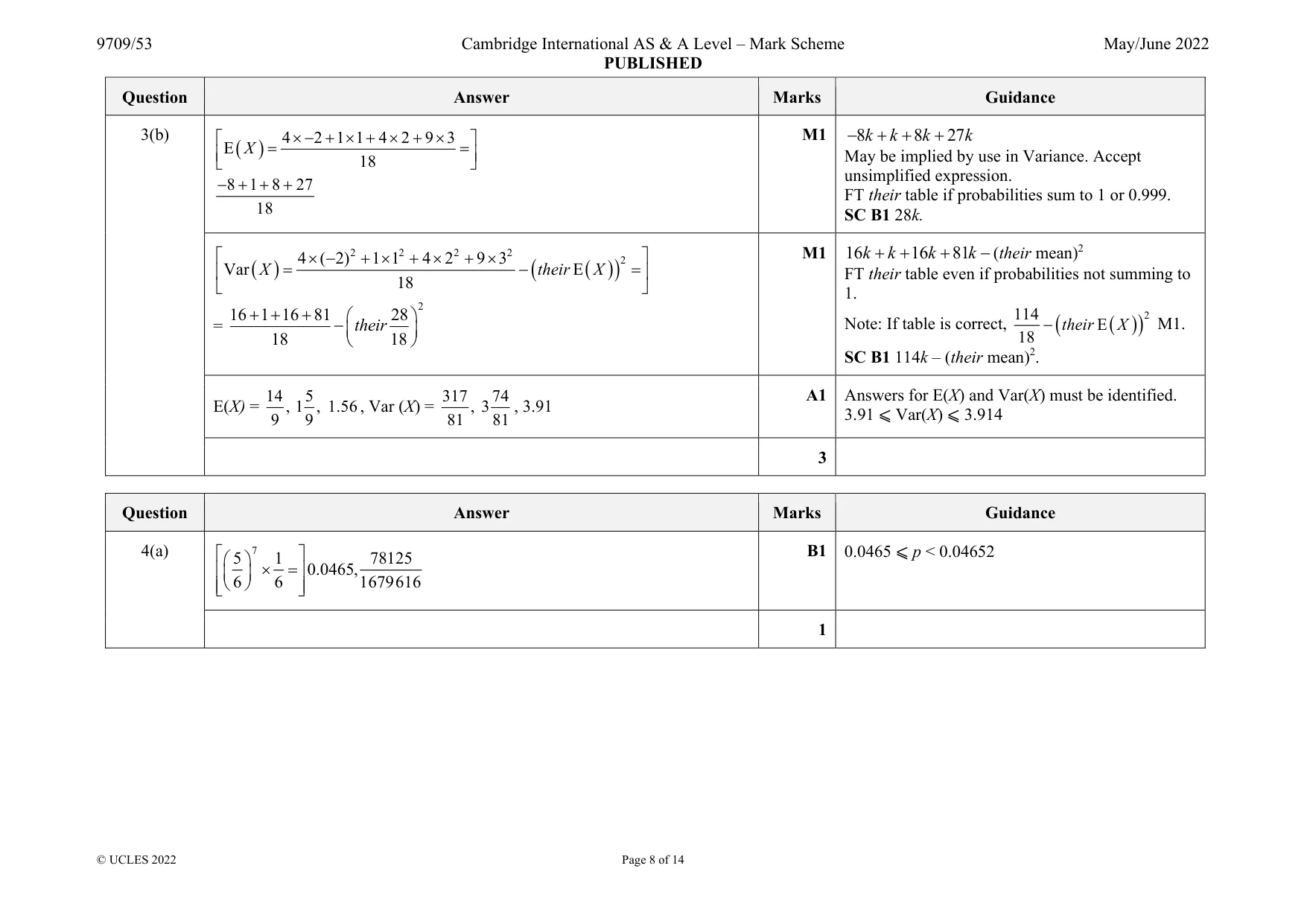
Mark scheme: 4(a) 7 5 1 78125 0.0465, 6 6 1679616 1 Question Answer Marks Guidance 4(b) P(X < 6) = 5 5 1 6 or 2 3 4 1 5 1 5 1 5 1 5 1 6 6 6 6 6 6 6 6 6 M1 1 – pn, 0 < p < 1, n = 4, 5, 6 or sum of 4, 5 or 6 terms 1 n p p for 0,1 ,2,3,4 5 n . 0.598, 4651 7776 A1 2 4(c) [Probability of total less than 4 is] 3 1 or 36 12 B1 SOI [1 – P(0, 1, 2)] =1 ( 10C0 0 10 1 11 12 12 + 10C1 1 9 1 11 12 12 + 10C2 2 8 1 11 12 12 ) M1 One term 10Cx 10 1 x x p p , for 0 < x < 10, 0 < p < 1. 1 – (0.418904 + 0.380822 + 0.155791) A1 FT Correct expression. Accept unsimplified. 0.0445 A1 0.04448 ⩽ p ⩽ 0.0445 4
Q6 · Sajid is practising for a long jump competition
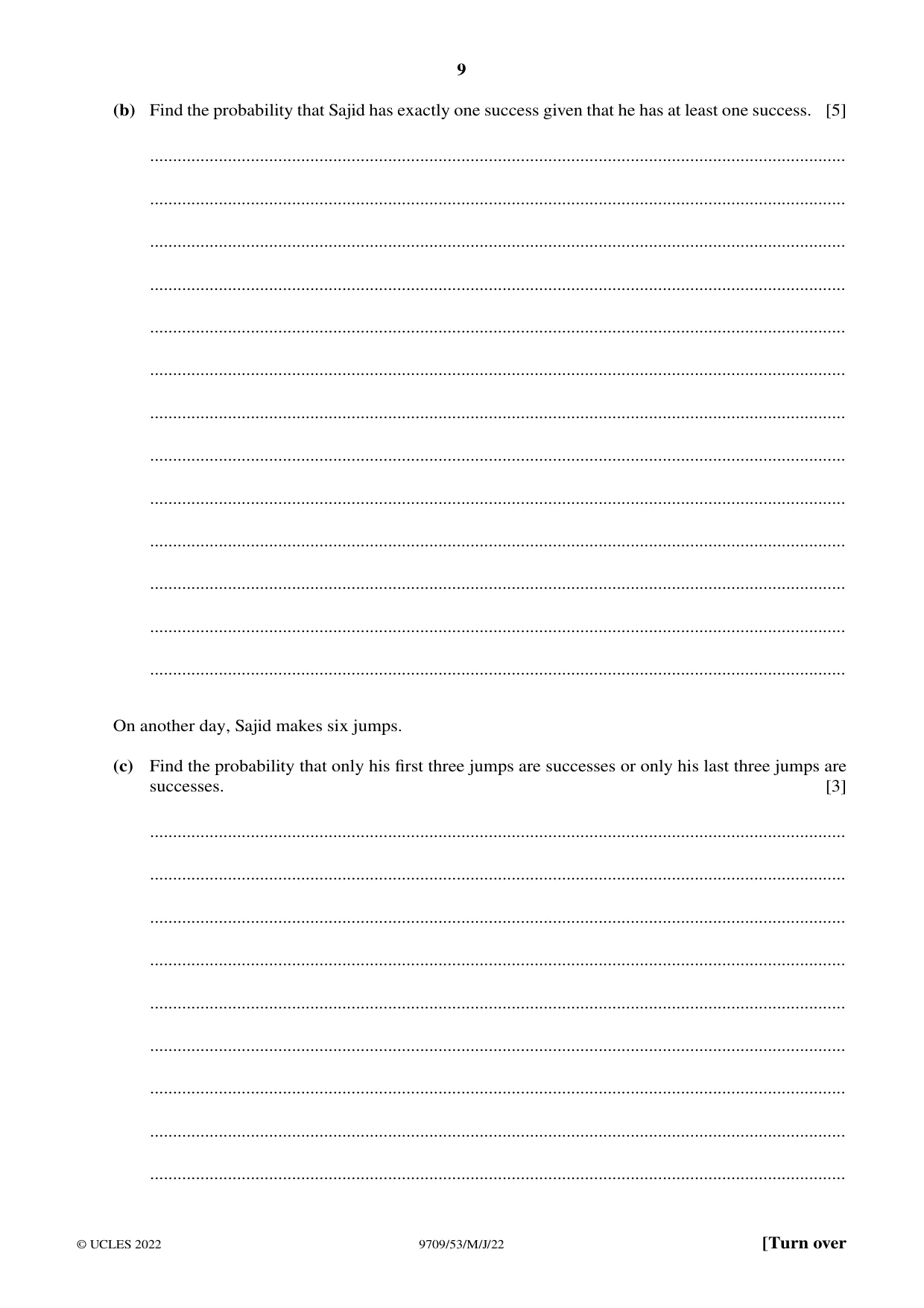
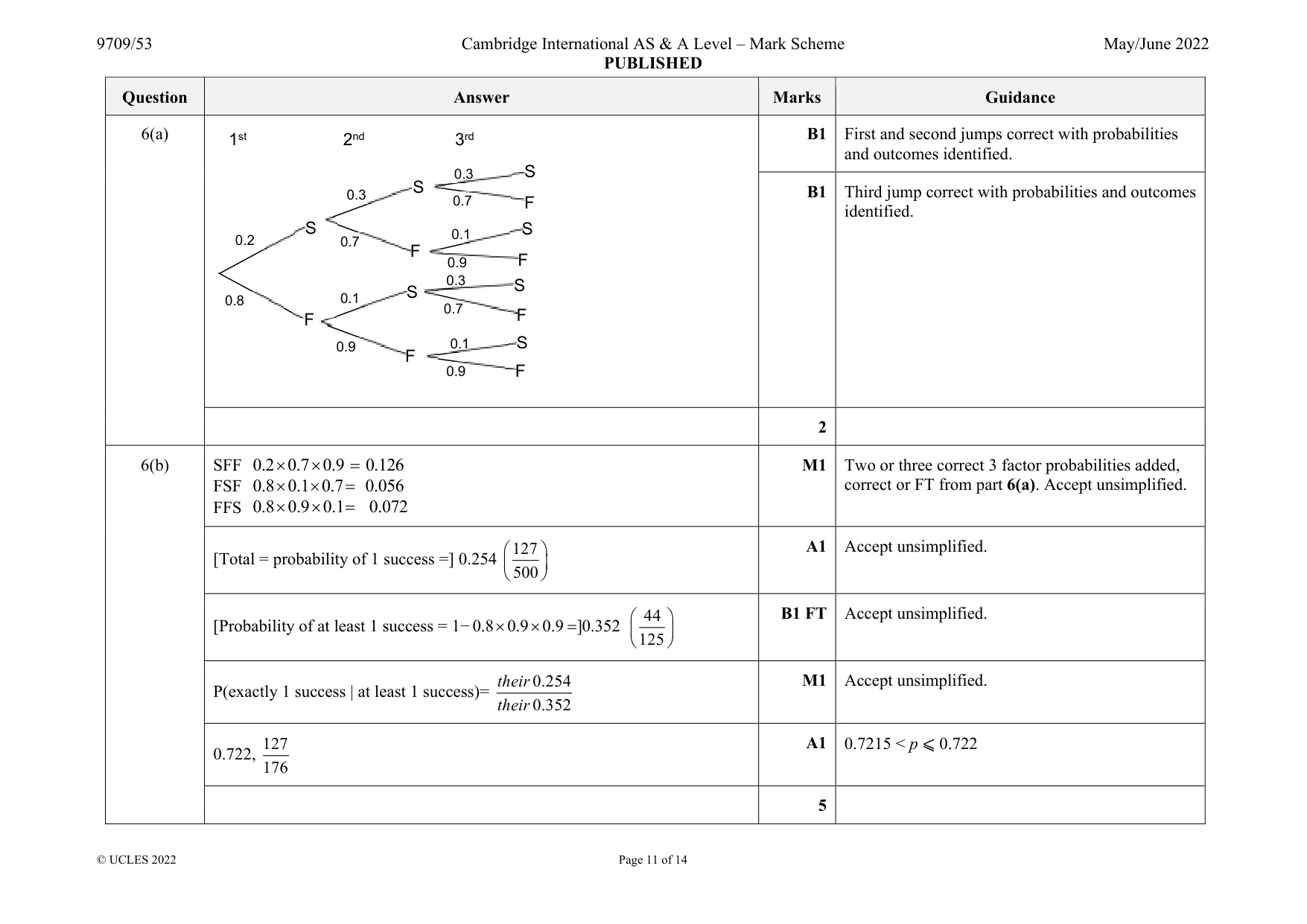
6 Sajid is practising for a long jump competition. He counts any jump that is longer than 6m as a success. On any day, the probability that he has a success with his first jump is 0.2. For any subsequent jump, the probability of a success is 0.3 if the previous jump was a success and 0.1 otherwise. Sajid makes three jumps. (a) Draw a tree diagram to illustrate this information, showing all the probabilities. [2] (b) Find the probability that Sajid has exactly one success given that he has at least one success. [5] ........................................................................................................................................................ ........................................................................................................................................................ ........................................................................................................................................................ ........................................................................................................................................................ ........................................................................................................................................................ ........................................................................................................................................................ ........................................................................................................................................................ ........................................................................................................................................................ ........................................................................................................................................................ ........................................................................................................................................................ ........................................................................................................................................................ ........................................................................................................................................................ ........................................................................................................................................................ On another day, Sajid makes six jumps. (c) Find the probability that only his first three jumps are successes or only his last three jumps are successes. [3] ........................................................................................................................................................ ........................................................................................................................................................ ........................................................................................................................................................ ........................................................................................................................................................ ........................................................................................................................................................ ........................................................................................................................................................ ........................................................................................................................................................ ........................................................................................................................................................ ........................................................................................................................................................
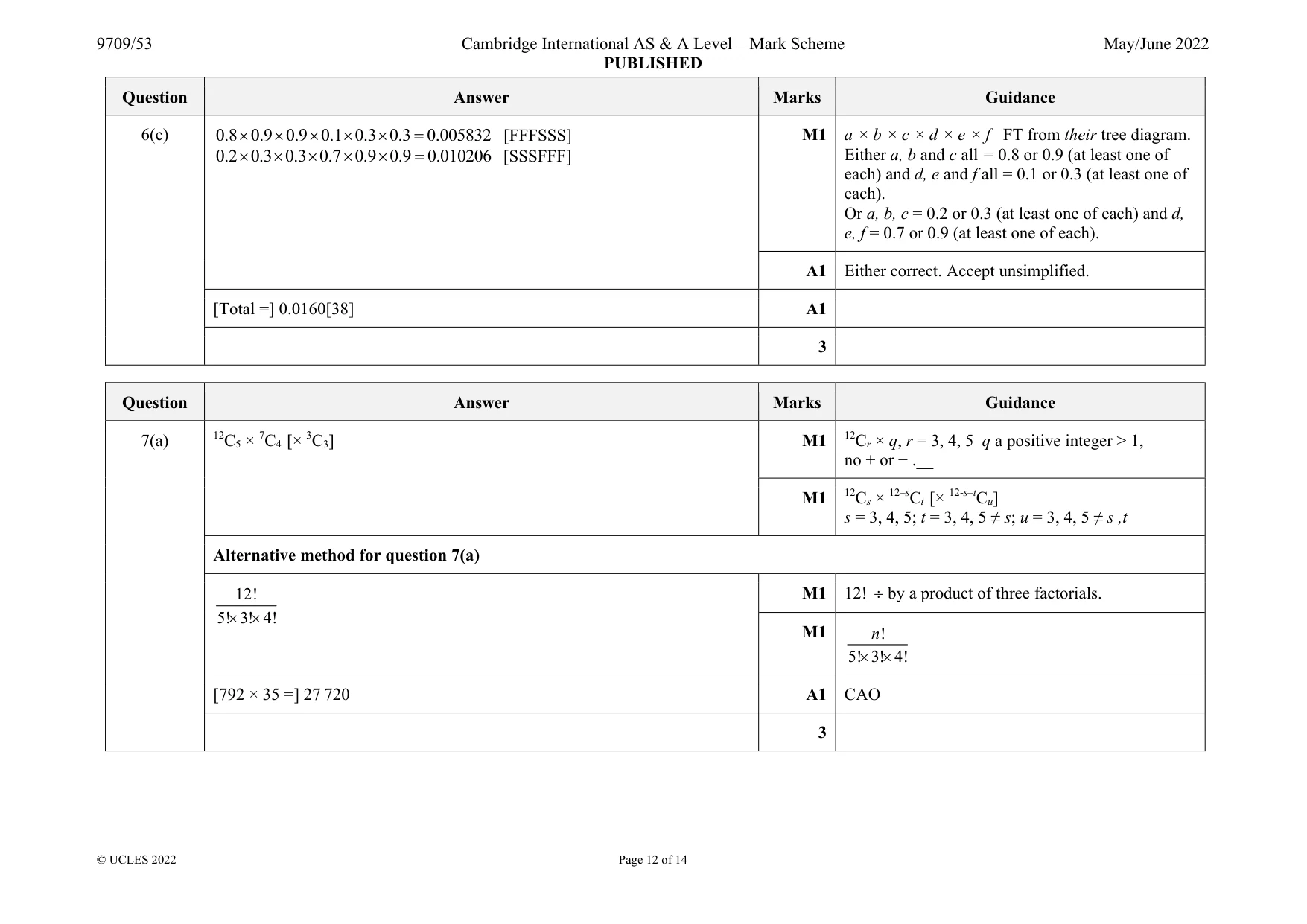
Mark scheme: 6(a) and outcomes identified. B1 Third jump correct with probabilities and outcomes identified. 2 6(b) SFF 0.2 0.7 0.9 0.126 FSF 0.8 0.1 0.7 0.056 FFS 0.8 0.9 0.1 0.072 M1 Two or three correct 3 factor probabilities added, correct or FT from part 6(a). Accept unsimplified. [Total = probability of 1 success =] 0.254 127 500 A1 Accept unsimplified. [Probability of at least 1 success = 1−0.8 0.9 0.9 ]0.352 44 125 B1 FT Accept unsimplified. P(exactly 1 success | at least 1 success)= 0.254 0.352 their their M1 Accept unsimplified. 0.722, 127 176 A1 0.7215 < p ⩽ 0.722 5 S S F S F F S F S S S F F F 0.2 0.8 0.1 0.9 0.1 0.9 0.3 0.7 0.3 0.7 0.3 0.7 0.1 0.9 1st 2nd 3rd Question Answer Marks Guidance 6(c) 0.8 0.9 0.9 0.1 0.3 0.3 0.005832 [FFFSSS] 0.2 0.3 0.3 0.7 0.9 0.9 0.010206 [SSSFFF] M1 a × b × c × d × e × f FT from their tree diagram. Either a, b and c all = 0.8 or 0.9 (at least one of each) and d, e and f all = 0.1 or 0.3 (at least one of each). Or a, b, c = 0.2 or 0.3 (at least one of each) and d, e, f = 0.7 or 0.9 (at least one of each). A1 Either correct. Accept unsimplified. [Total =] 0.0160[38] A1 3
Q7 · A group of 15 friends visit an adventure park
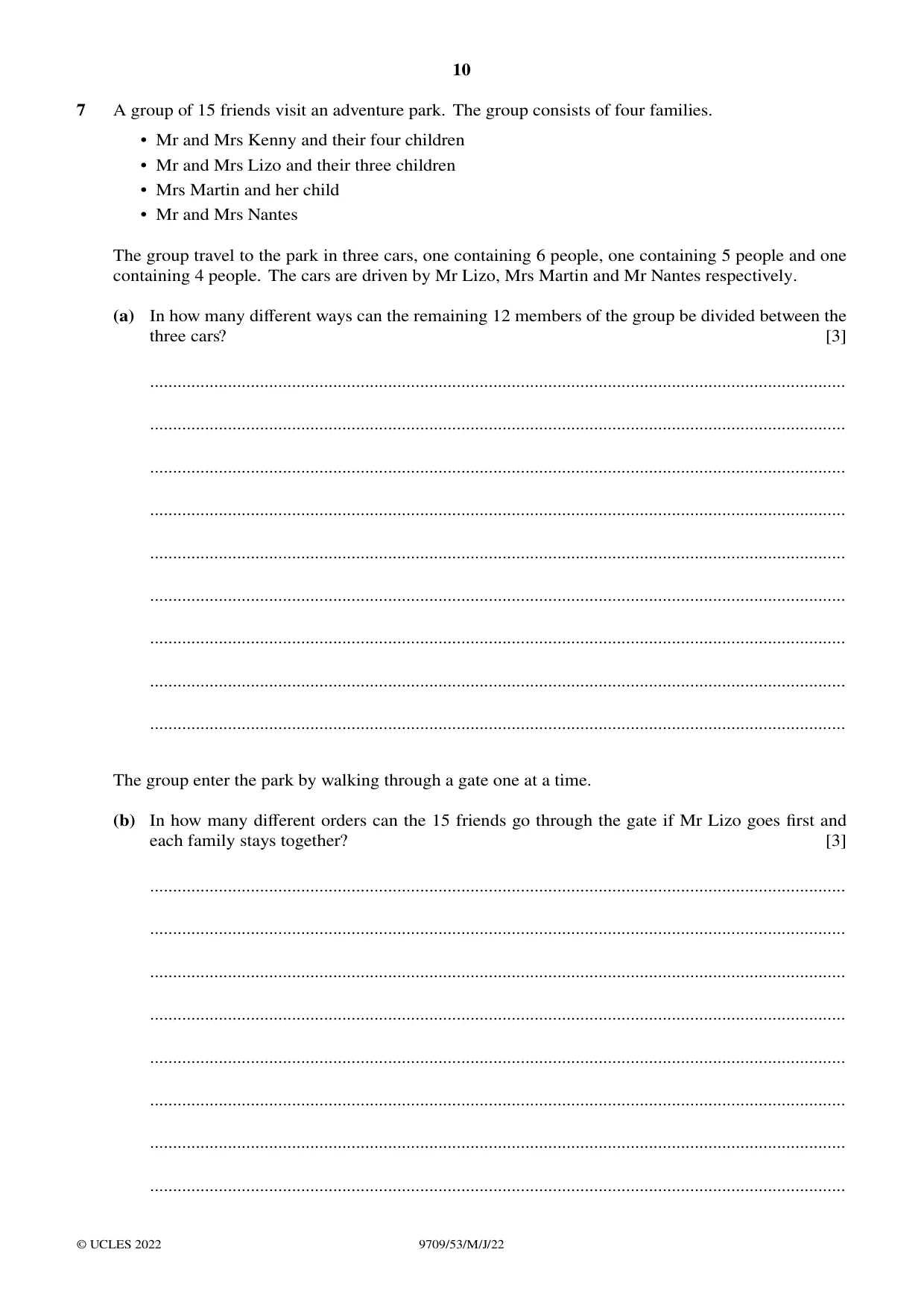
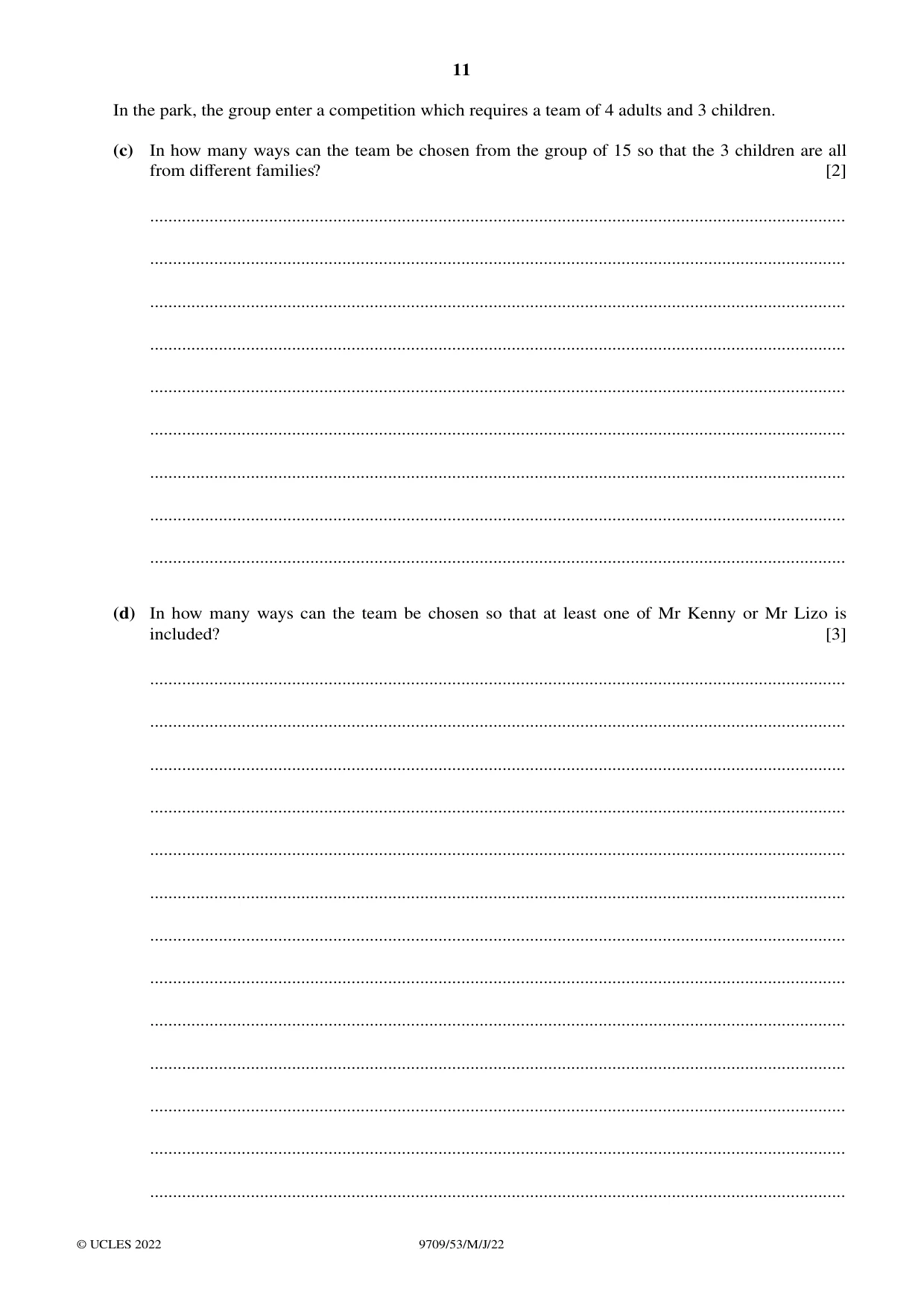
7 A group of 15 friends visit an adventure park. The group consists of four families. • Mr and Mrs Kenny and their four children • Mr and Mrs Lizo and their three children • Mrs Martin and her child • Mr and Mrs Nantes The group travel to the park in three cars, one containing 6 people, one containing 5 people and one containing 4 people. The cars are driven by Mr Lizo, Mrs Martin and Mr Nantes respectively. (a) In how many different ways can the remaining 12 members of the group be divided between the three cars? [3] ........................................................................................................................................................ ........................................................................................................................................................ ........................................................................................................................................................ ........................................................................................................................................................ ........................................................................................................................................................ ........................................................................................................................................................ ........................................................................................................................................................ ........................................................................................................................................................ ........................................................................................................................................................ The group enter the park by walking through a gate one at a time. (b) In how many different orders can the 15 friends go through the gate if Mr Lizo goes first and each family stays together? [3] ........................................................................................................................................................ ........................................................................................................................................................ ........................................................................................................................................................ ........................................................................................................................................................ ........................................................................................................................................................ ........................................................................................................................................................ ........................................................................................................................................................ ........................................................................................................................................................ In the park, the group enter a competition which requires a team of 4 adults and 3 children. (c) In how many ways can the team be chosen from the group of 15 so that the 3 children are all from different families? [2] ........................................................................................................................................................ ........................................................................................................................................................ ........................................................................................................................................................ ........................................................................................................................................................ ........................................................................................................................................................ ........................................................................................................................................................ ........................................................................................................................................................ ........................................................................................................................................................ ........................................................................................................................................................ (d) In how many ways can the team be chosen so that at least one of Mr Kenny or Mr Lizo is included? [3] ........................................................................................................................................................ ........................................................................................................................................................ ........................................................................................................................................................ ........................................................................................................................................................ ........................................................................................................................................................ ........................................................................................................................................................ ........................................................................................................................................................ ........................................................................................................................................................ ........................................................................................................................................................ ........................................................................................................................................................ ........................................................................................................................................................ ........................................................................................................................................................ ........................................................................................................................................................
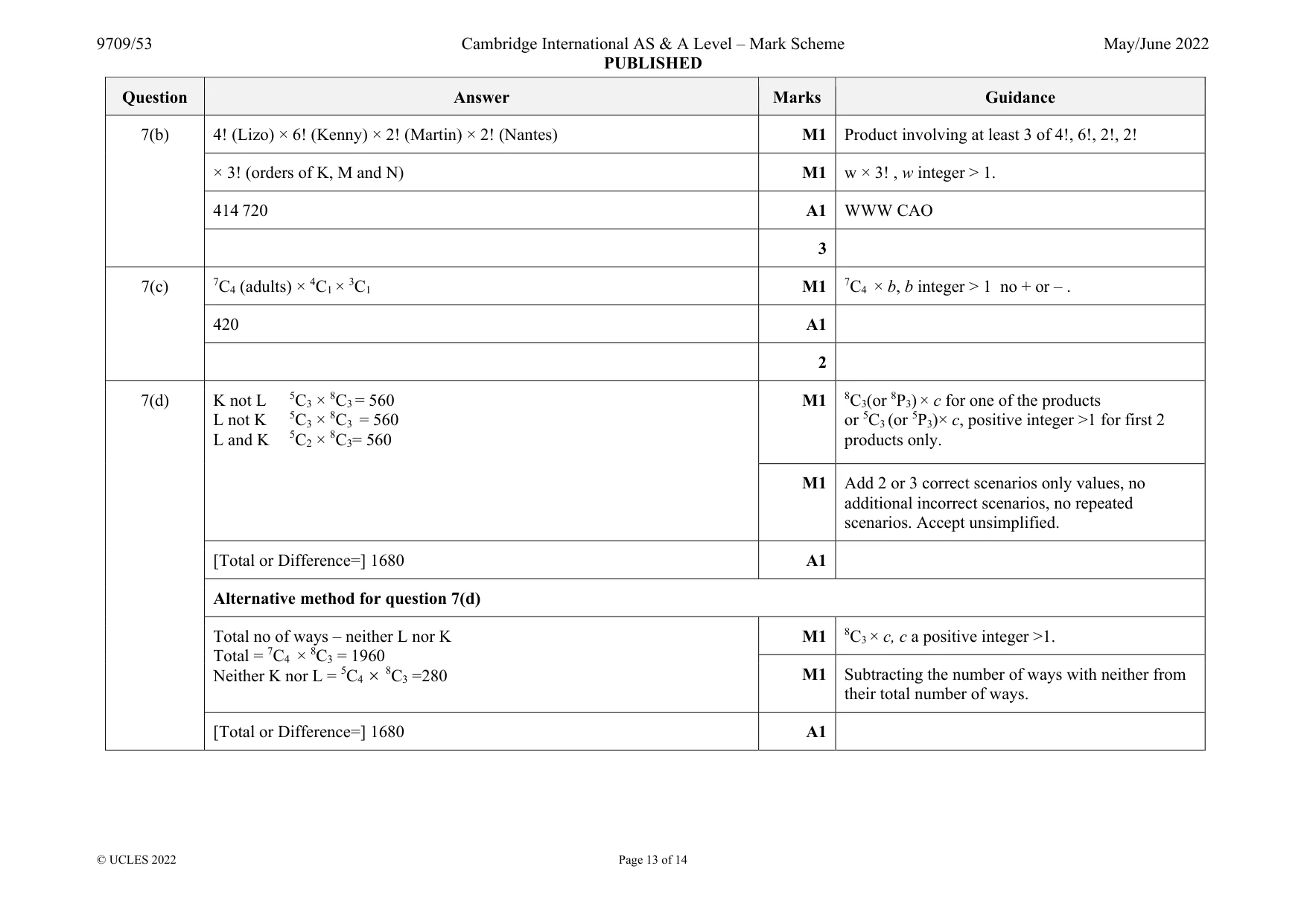
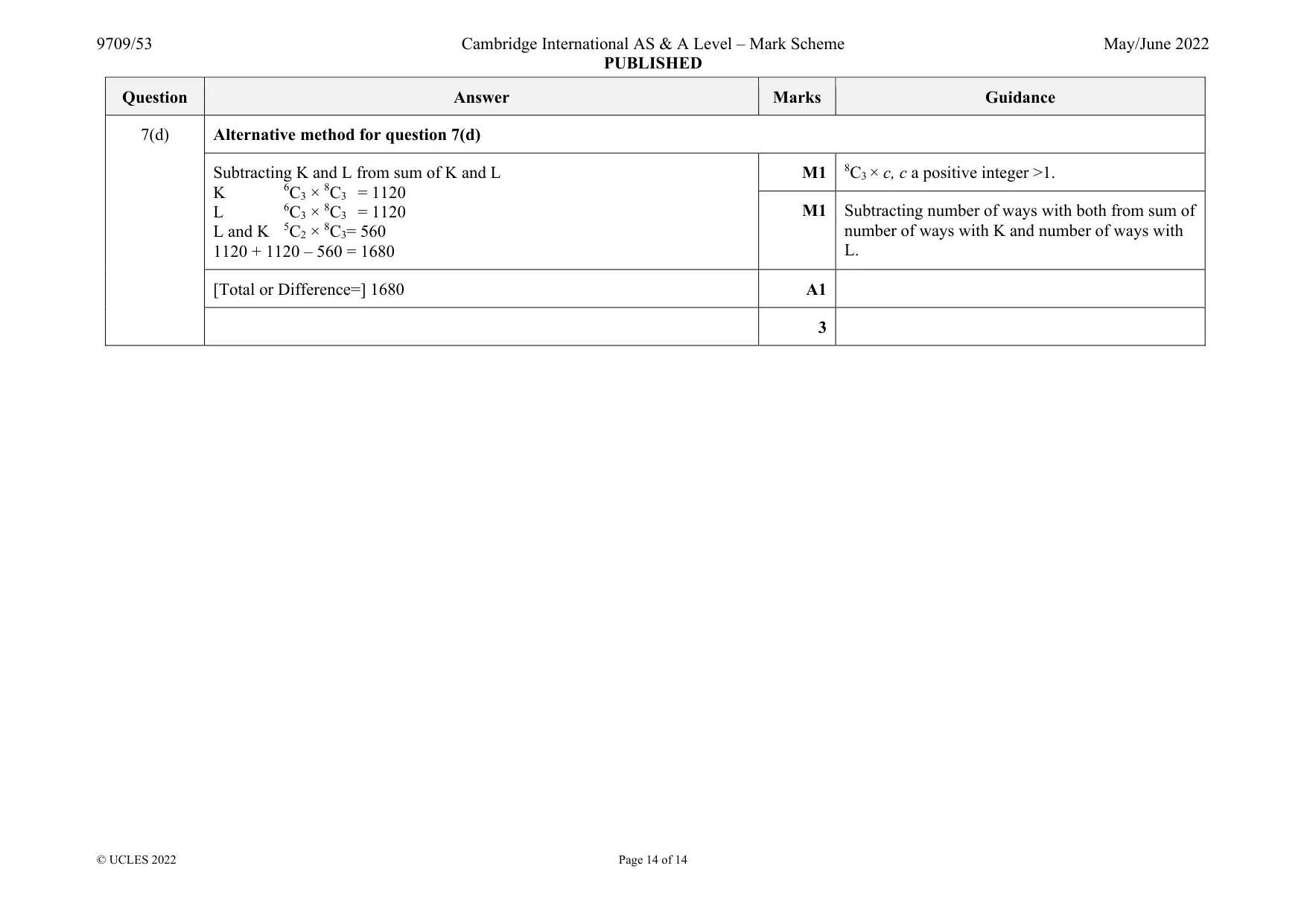
Mark scheme: 7(a) M1 no + or − .__ M1 12Cs × 12–sCt [× 12-s–tCu] s = 3, 4, 5; t = 3, 4, 5 ≠ s; u = 3, 4, 5 ≠ s ,t Alternative method for question 7(a) 12! 5! 3! 4! M1 12! by a product of three factorials. M1 ! 5! 3! 4! n [792 × 35 =] 27 720 A1 CAO 3 Question Answer Marks Guidance 7(b) 4! (Lizo) × 6! (Kenny) × 2! (Martin) × 2! (Nantes) M1 Product involving at least 3 of 4!, 6!, 2!, 2! × 3! (orders of K, M and N) M1 w × 3! , w integer > 1. 414 720 A1 WWW CAO 3 7(c) 7C4 (adults) × 4C1 × 3C1 M1 7C4 × b, b integer > 1 no + or – . 420 A1 2 7(d) K not L 5C3 × 8C3 = 560 L not K 5C3 × 8C3 = 560 L and K 5C2 × 8C3= 560 M1 8C3(or 8P3) × c for one of the products or 5C3 (or 5P3)× c, positive integer >1 for first 2 products only. M1 Add 2 or 3 correct scenarios only values, no additional incorrect scenarios, no repeated scenarios. Accept unsimplified. [Total or Difference=] 1680 A1 Alternative method for question 7(d) Total no of ways – neither L nor K Total = 7C4 × 8C3 = 1960 Neither K nor L = 5C4 8C3 =280 M1 8C3 × c, c a positive integer >1. M1 Subtracting the number of ways with neither from their total number of ways. [Total or Difference=] 1680 A1 Question Answer Marks Guidance 7(d) Alternative method for question 7(d) Subtracting K and L from sum of K and L K 6C3 × 8C3 = 1120 L 6C3 × 8C3 = 1120 L and K 5C2 × 8C3= 560 1120 + 1120 – 560 = 1680 M1 8C3 × c, c a positive integer >1. M1 Subtracting number of ways with both from sum of number of ways with K and number of ways with L. [Total or Difference=] 1680 A1 3
What was in this paper
The subtopics covered by these 5 questions, and how many questions each got. Open one in a new tab to see every Cambridge question on it.
What you needed in this session
Cambridge’s own grade thresholds for 2022 May/June, Paper 5 · Variant 3. A higher threshold means an easier paper — the bar moves with how the cohort did.