Cambridge A Level Mathematics 9709 — 2016 Oct/Nov Paper 5 · Variant 2
9709/52/O/N/16 · 7 questions · 50 marks · ≈56 min
The question paper and its mark scheme, free to read here and free to download. This is Cambridge’s own paper, exactly as it was sat.
Question paper4 pages
Mark scheme6 pages
Answers below. Sit the paper first if you are practising.
Questions as text
Q1 · A stone S is thrown horizontally from the top T of a high tower
1 A stone S is thrown horizontally from the top T of a high tower. At the instant 1.6 s after S is thrown, the line ST makes an angle of 30Å below the horizontal. Find the speed with which S is thrown. [3]
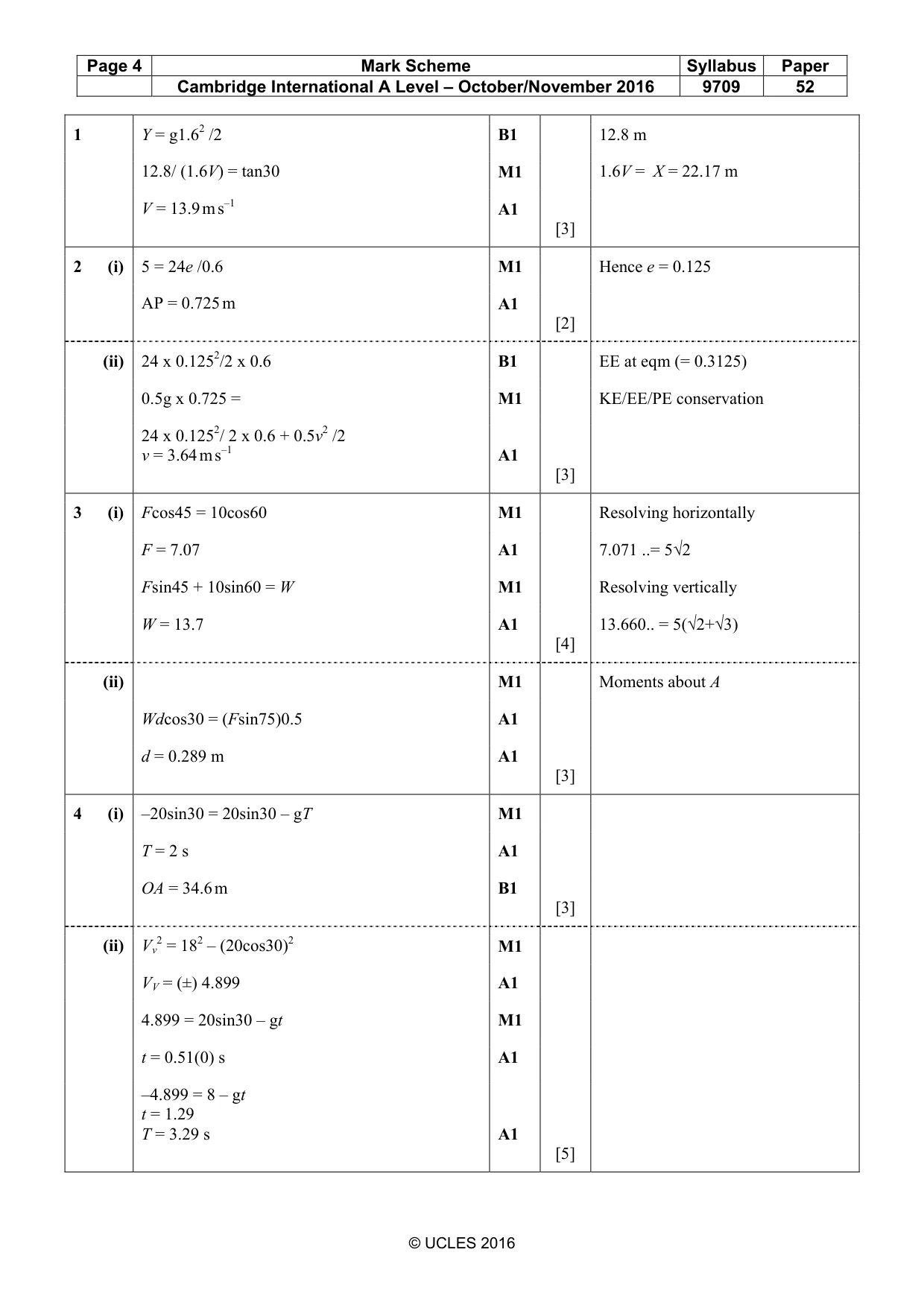
Mark scheme: 1 Y = g1.62 /2 B1 12.8 m 12.8/ (1.6V) = tan30 M1 1.6V = X = 22.17 m V = 13.9 m s–1 A1 [3]
Q2 · A particle P of mass 0.5 kg is attached to one end of a light elastic string with modulus…
2 A particle P of mass 0.5 kg is attached to one end of a light elastic string with modulus of elasticity 24 N and natural length 0.6 m. The other end of the string is attached to a fixed point A. The particle P hangs in equilibrium vertically below A. (i) Find the distance AP. [2] The particle P is raised to A and released from rest. (ii) Calculate the greatest speed of P in the subsequent motion. [3]
Mark scheme: 2 (i) 5 = 24e /0.6 M1 Hence e = 0.125 AP = 0.725 m A1 [2] (ii) 24 x 0.1252/2 x 0.6 B1 EE at eqm (= 0.3125) 0.5g x 0.725 = M1 KE/EE/PE conservation 24 x 0.1252/ 2 x 0.6 + 0.5v2 /2 v = 3.64 m s–1 A1 [3]
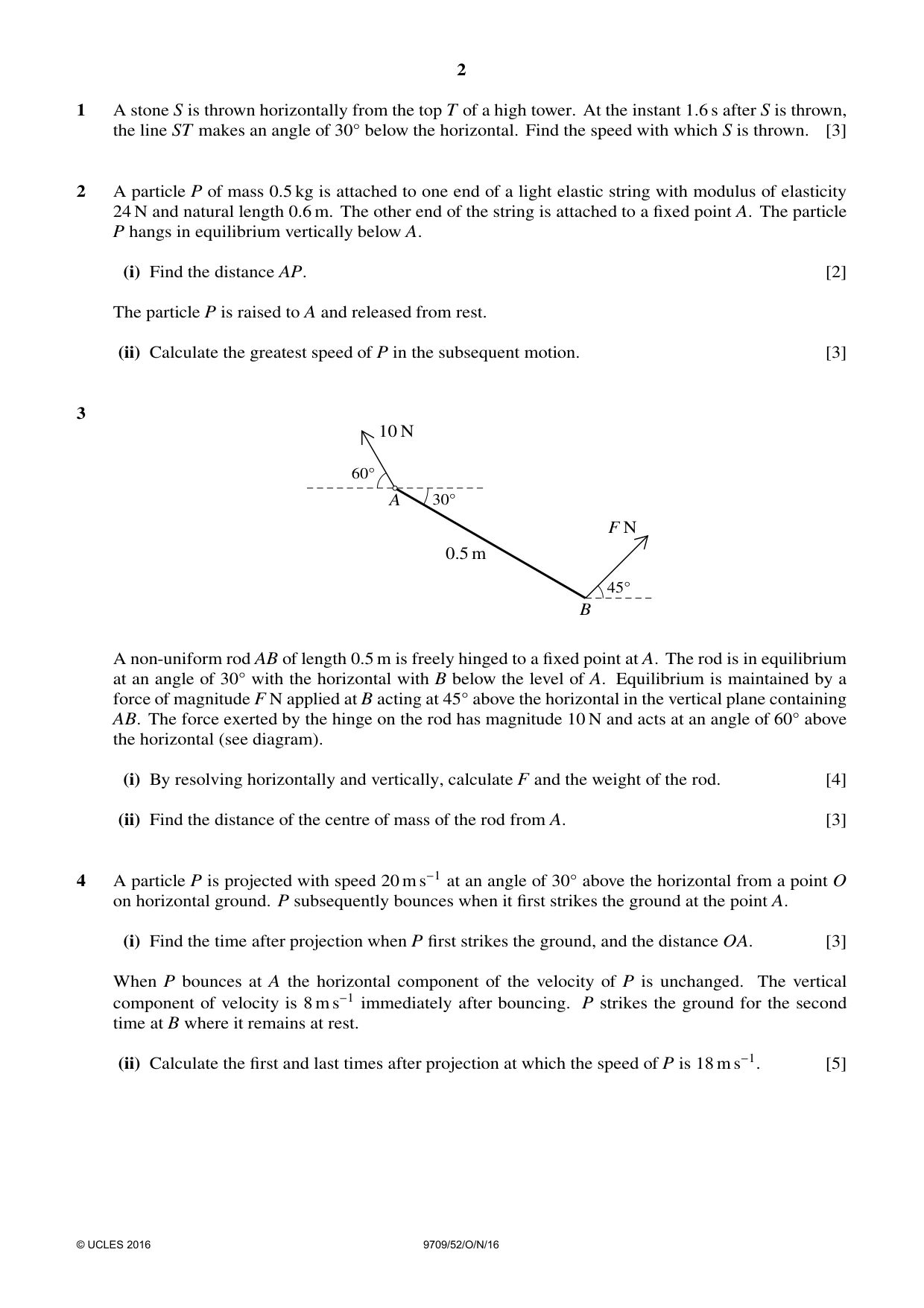
Q3 · 10 N 60Å A 30Å F N 0.5 m 45Å B A non-uniform rod AB of length 0.5 m is freely hinged to a…
3 10 N 60Å A 30Å F N 0.5 m 45Å B A non-uniform rod AB of length 0.5 m is freely hinged to a fixed point at A. The rod is in equilibrium at an angle of 30Å with the horizontal with B below the level of A. Equilibrium is maintained by a force of magnitude F N applied at B acting at 45Å above the horizontal in the vertical plane containing AB. The force exerted by the hinge on the rod has magnitude 10 N and acts at an angle of 60Å above the horizontal (see diagram). (i) By resolving horizontally and vertically, calculate F and the weight of the rod. [4] (ii) Find the distance of the centre of mass of the rod from A. [3]
Mark scheme: 3 (i) Fcos45 = 10cos60 M1 Resolving horizontally F = 7.07 A1 7.071 ..= 5√2 Fsin45 + 10sin60 = W M1 Resolving vertically W = 13.7 A1 13.660.. = 5(√2+√3) [4] (ii) M1 Moments about A Wdcos30 = (Fsin75)0.5 A1 d = 0.289 m A1 [3]
Q4 · A particle P is projected with speed 20 m s−1 at an angle of 30Å above the horizontal…
4 A particle P is projected with speed 20 m s−1 at an angle of 30Å above the horizontal from a point O on horizontal ground. P subsequently bounces when it first strikes the ground at the point A. (i) Find the time after projection when P first strikes the ground, and the distance OA. [3] When P bounces at A the horizontal component of the velocity of P is unchanged. The vertical component of velocity is 8 m s−1 immediately after bouncing. P strikes the ground for the second time at B where it remains at rest. (ii) Calculate the first and last times after projection at which the speed of P is 18 m s−1. [5]
Mark scheme: 4 (i) –20sin30 = 20sin30 – gT M1 T = 2 s A1 OA = 34.6 m B1 [3] (ii) Vv 2 = 182 – (20cos30)2 M1 VV = (±) 4.899 A1 4.899 = 20sin30 – gt M1 t = 0.51(0) s A1 –4.899 = 8 – gt t = 1.29 T = 3.29 s A1 [5]
Q5 · A particle P of mass 0.4 kg is released from rest at a point O on a smooth plane inclined…
5 A particle P of mass 0.4 kg is released from rest at a point O on a smooth plane inclined at 30Å to the horizontal. A force of magnitude 3e−t N directed up a line of greatest slope acts on P, where t s is the time after release. dv (i) Show that = 7.5e−t −5, where v m s−1 is the velocity of P up the plane at time t s. [2] dt (ii) Express v in terms of t. [3] (iii) Find the distance of P from O when v has its maximum value. [3]
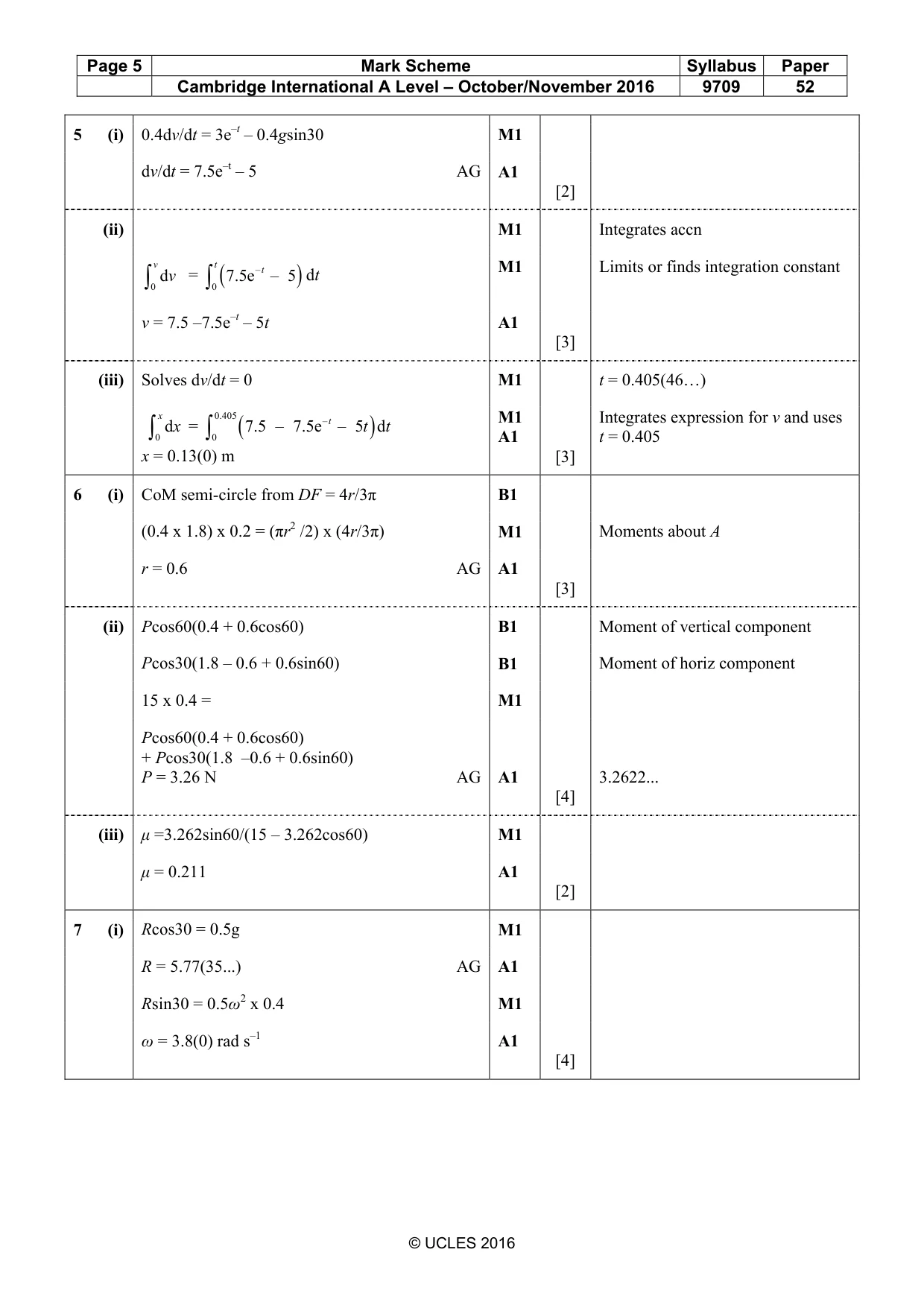
Mark scheme: 5 (i) 0.4dv/dt = 3e–t – 0.4gsin30 M1 dv/dt = 7.5e–t – 5 AG A1 [2] (ii) M1 Integrates accn v t – t M1 Limits or finds integration constant 7.5e – 5 ) dt ∫0 d v = ∫0 ( v = 7.5 –7.5e–t – 5t A1 [3] (iii) Solves dv/dt = 0 M1 t = 0.405(46…) x 0.405 7.5 – 7.5e – 5t ) d t ∫0 – t M1 Integrates expression for v and uses d x = ∫0 ( A1 t = 0.405 x = 0.13(0) m [3]
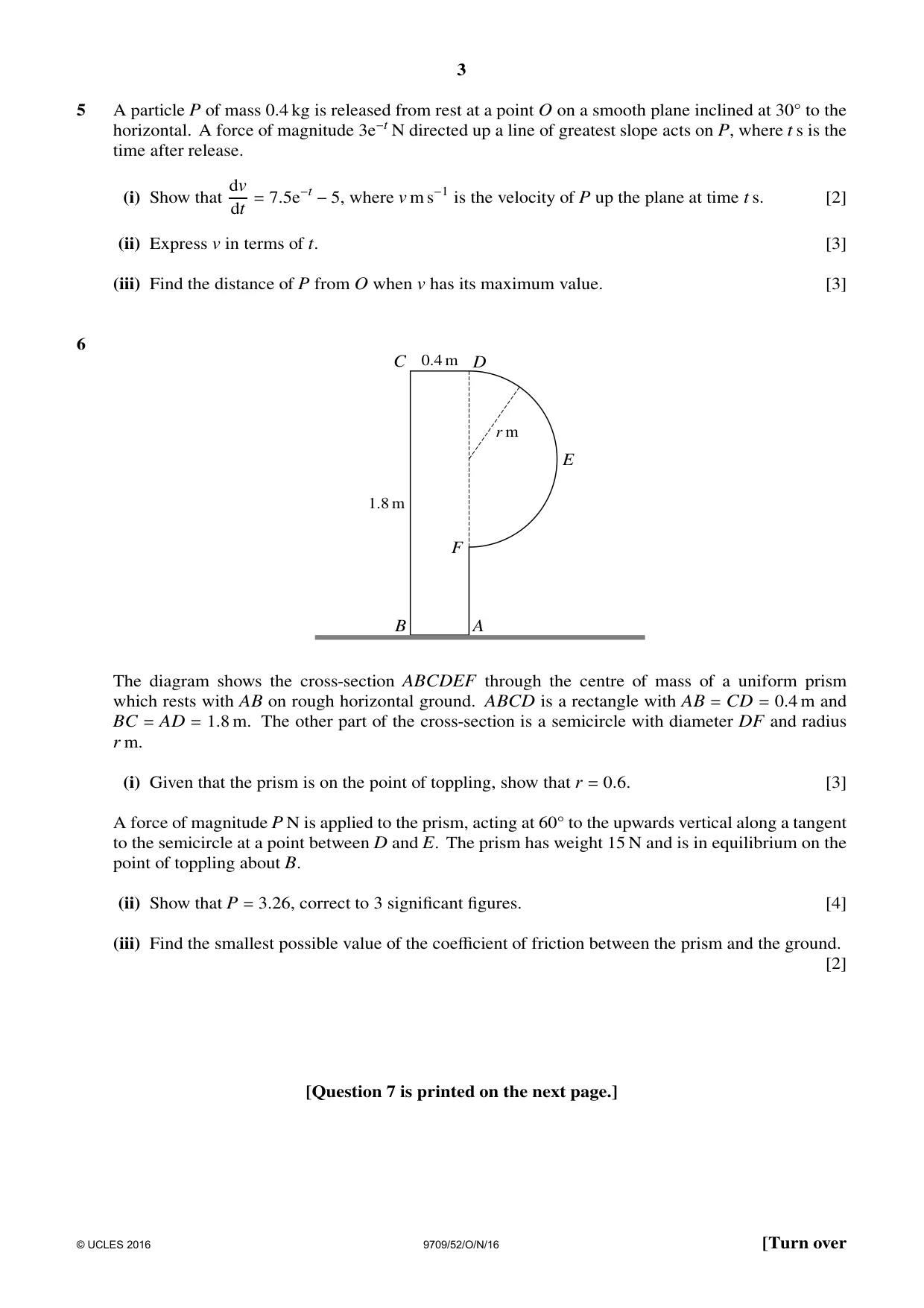
Q6 · C 0.4 m D r m E 1.8 m F B A The diagram shows the cross-section ABCDEF through the centre…
6 C 0.4 m D r m E 1.8 m F B A The diagram shows the cross-section ABCDEF through the centre of mass of a uniform prism which rests with AB on rough horizontal ground. ABCD is a rectangle with AB = CD = 0.4 m and BC = AD = 1.8 m. The other part of the cross-section is a semicircle with diameter DF and radius r m. (i) Given that the prism is on the point of toppling, show that r = 0.6. [3] A force of magnitude P N is applied to the prism, acting at 60Å to the upwards vertical along a tangent to the semicircle at a point between D and E. The prism has weight 15 N and is in equilibrium on the point of toppling about B. (ii) Show that P = 3.26, correct to 3 significant figures. [4] (iii) Find the smallest possible value of the coefficient of friction between the prism and the ground. [2] [Question 7 is printed on the next page.]
Mark scheme: 6 (i) CoM semi-circle from DF = 4r/3π B1 (0.4 x 1.8) x 0.2 = (πr2 /2) x (4r/3π) M1 Moments about A r = 0.6 AG A1 [3] (ii) Pcos60(0.4 + 0.6cos60) B1 Moment of vertical component Pcos30(1.8 – 0.6 + 0.6sin60) B1 Moment of horiz component 15 x 0.4 = M1 Pcos60(0.4 + 0.6cos60) + Pcos30(1.8 –0.6 + 0.6sin60) P = 3.26 N AG A1 3.2622... [4] (iii) µ =3.262sin60/(15 – 3.262cos60) M1 µ = 0.211 A1 [2]
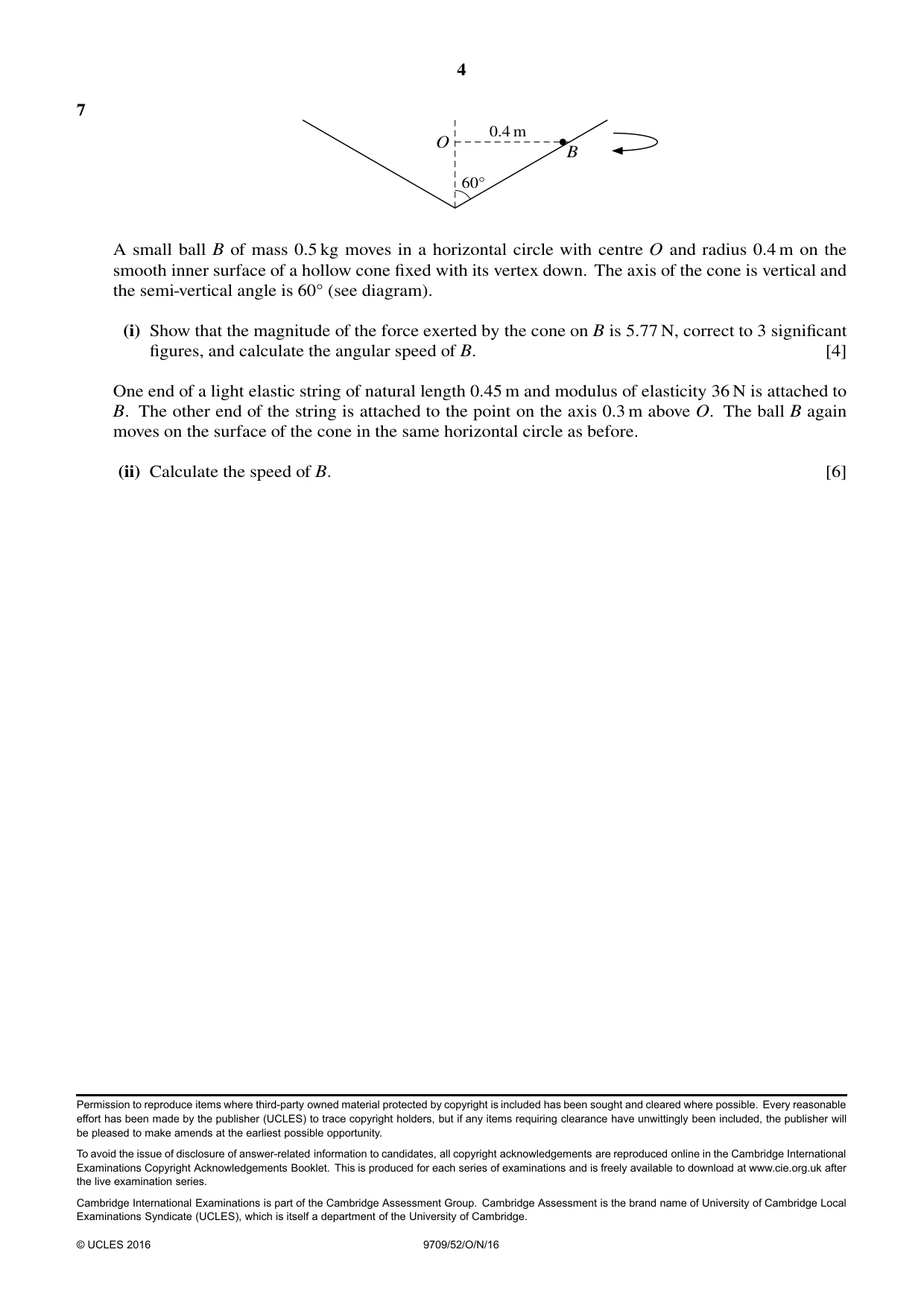
Q7 · 0.4 m O B 60Å A small ball B of mass 0.5 kg moves in a horizontal circle with centre O…
7 0.4 m O B 60Å A small ball B of mass 0.5 kg moves in a horizontal circle with centre O and radius 0.4 m on the smooth inner surface of a hollow cone fixed with its vertex down. The axis of the cone is vertical and the semi-vertical angle is 60Å (see diagram). (i) Show that the magnitude of the force exerted by the cone on B is 5.77 N, correct to 3 significant figures, and calculate the angular speed of B. [4] One end of a light elastic string of natural length 0.45 m and modulus of elasticity 36 N is attached to B. The other end of the string is attached to the point on the axis 0.3 m above O. The ball B again moves on the surface of the cone in the same horizontal circle as before. (ii) Calculate the speed of B. [6]
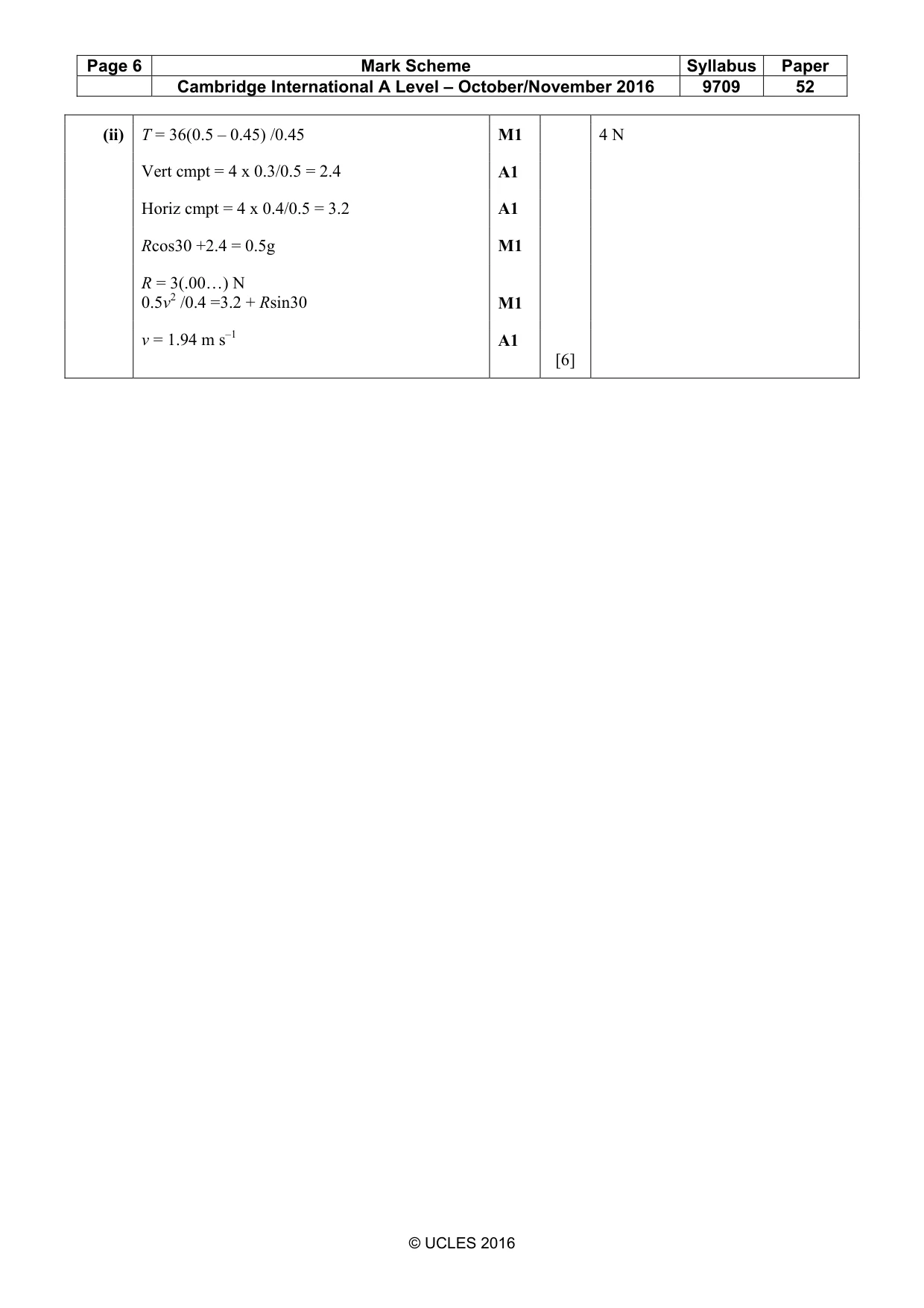
Mark scheme: 7 (i) Rcos30 = 0.5g M1 R = 5.77(35...) AG A1 Rsin30 = 0.5ω2 x 0.4 M1 ω = 3.8(0) rad s–1 A1 [4] (ii) T = 36(0.5 – 0.45) /0.45 M1 4 N Vert cmpt = 4 x 0.3/0.5 = 2.4 A1 Horiz cmpt = 4 x 0.4/0.5 = 3.2 A1 Rcos30 +2.4 = 0.5g M1 R = 3(.00…) N 0.5v2 /0.4 =3.2 + Rsin30 M1 v = 1.94 m s–1 A1 [6]
What was in this paper
The subtopics covered by these 7 questions, and how many questions each got. Open one in a new tab to see every Cambridge question on it.
What you needed in this session
Cambridge’s own grade thresholds for 2016 Oct/Nov, Paper 5 · Variant 2. A higher threshold means an easier paper — the bar moves with how the cohort did.