Cambridge A Level Mathematics 9709 — 2016 Feb/March Paper 7 · Variant 2
9709/72/F/M/16 · 5 questions · 50 marks · ≈56 min
The question paper and its mark scheme, free to read here and free to download. This is Cambridge’s own paper, exactly as it was sat.
Question paper4 pages
Mark scheme5 pages
Answers below. Sit the paper first if you are practising.
Questions as text
Q1 · A fair six-sided die is thrown 20 times and the number of sixes, X, is recorded
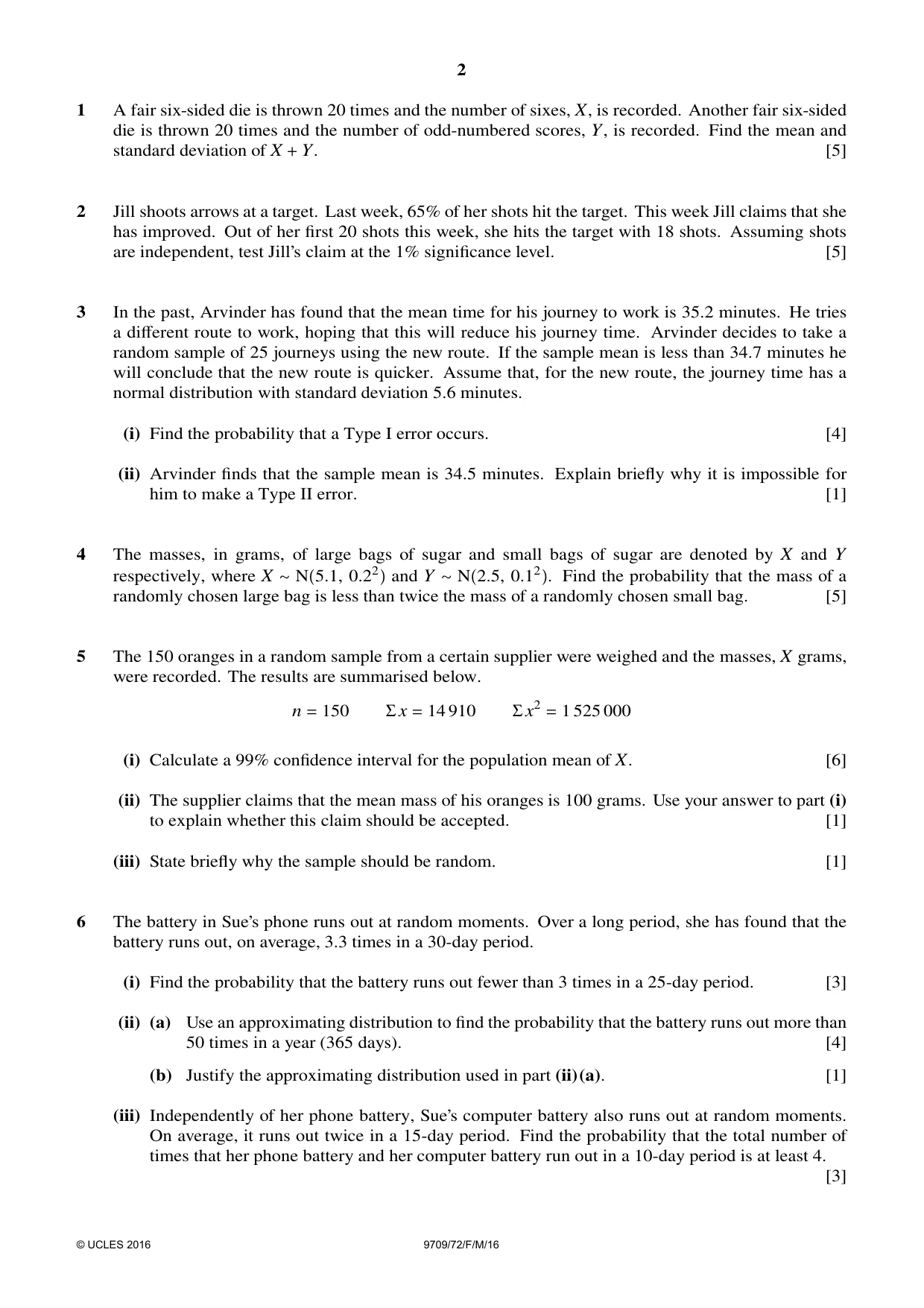
1 A fair six-sided die is thrown 20 times and the number of sixes, X, is recorded. Another fair six-sided die is thrown 20 times and the number of odd-numbered scores, Y, is recorded. Find the mean and standard deviation of X + Y. [5]
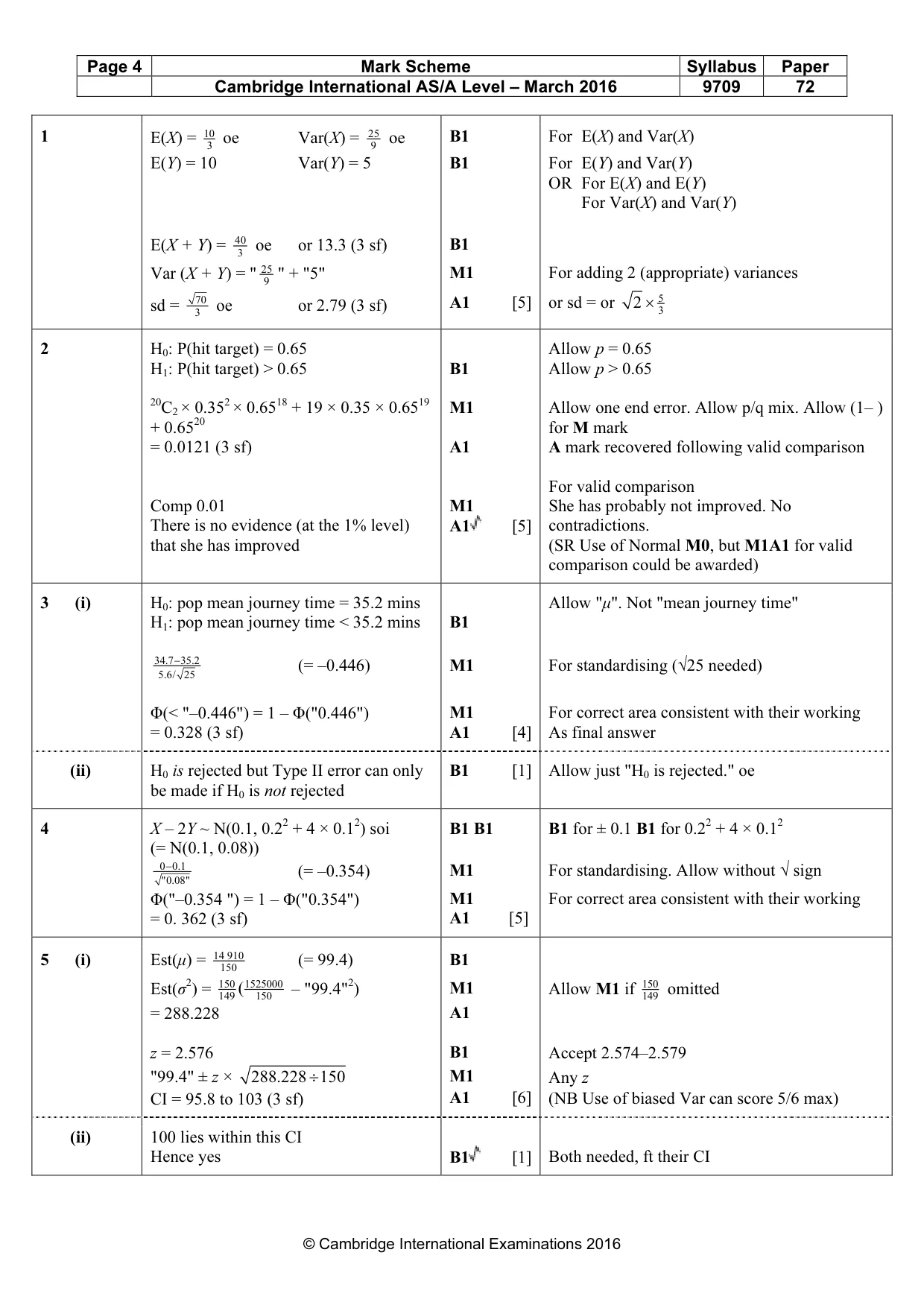
Mark scheme: 1 E(X) = 103 oe Var(X) = 259 oe B1 For E(X) and Var(X) E(Y) = 10 Var(Y) = 5 B1 For E(Y) and Var(Y) OR For E(X) and E(Y) For Var(X) and Var(Y) E(X + Y) = 403 oe or 13.3 (3 sf) B1 Var (X + Y) = " 259 " + "5" M1 For adding 2 (appropriate) variances sd = 370 oe or 2.79 (3 sf) A1 [5] or sd = or 2 × 53
Q2 · Jill shoots arrows at a target
2 Jill shoots arrows at a target. Last week, 65% of her shots hit the target. This week Jill claims that she has improved. Out of her first 20 shots this week, she hits the target with 18 shots. Assuming shots are independent, test Jill’s claim at the 1% significance level. [5]
Mark scheme: 2 H0: P(hit target) = 0.65 Allow p = 0.65 H1: P(hit target) > 0.65 B1 Allow p > 0.65 20C2 × 0.352 × 0.6518 + 19 × 0.35 × 0.6519 M1 Allow one end error. Allow p/q mix. Allow (1– ) + 0.6520 for M mark = 0.0121 (3 sf) A1 A mark recovered following valid comparison For valid comparison Comp 0.01 M1 She has probably not improved. No There is no evidence (at the 1% level) A1 [5] contradictions. that she has improved (SR Use of Normal M0, but M1A1 for valid comparison could be awarded)
Q3 · In the past, Arvinder has found that the mean time for his journey to work is 35.2 minutes
3 In the past, Arvinder has found that the mean time for his journey to work is 35.2 minutes. He tries a different route to work, hoping that this will reduce his journey time. Arvinder decides to take a random sample of 25 journeys using the new route. If the sample mean is less than 34.7 minutes he will conclude that the new route is quicker. Assume that, for the new route, the journey time has a normal distribution with standard deviation 5.6 minutes. (i) Find the probability that a Type I error occurs. [4] (ii) Arvinder finds that the sample mean is 34.5 minutes. Explain briefly why it is impossible for him to make a Type II error. [1]
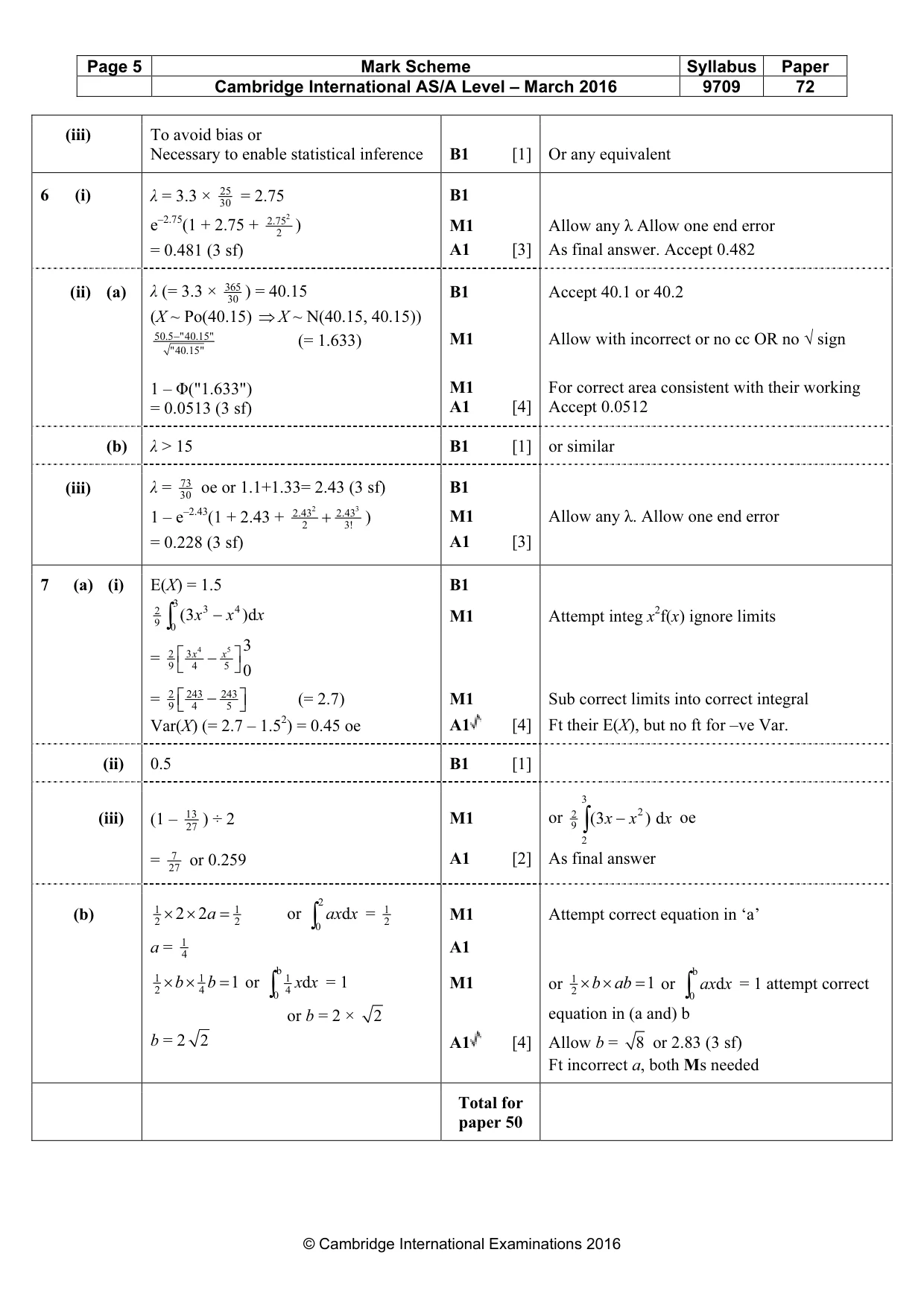
Mark scheme: 3 (i) H0: pop mean journey time = 35.2 mins Allow "µ". Not "mean journey time" H1: pop mean journey time < 35.2 mins B1 34.7 − 35.2 (= –0.446) M1 For standardising (√25 needed) 5.6/ 25 Φ(< "–0.446") = 1 – Φ("0.446") M1 For correct area consistent with their working = 0.328 (3 sf) A1 [4] As final answer (ii) H0 is rejected but Type II error can only B1 [1] Allow just "H0 is rejected." oe be made if H0 is not rejected 2 2 2 2
Q5 · The 150 oranges in a random sample from a certain supplier were weighed and the masses, X…
5 The 150 oranges in a random sample from a certain supplier were weighed and the masses, X grams, were recorded. The results are summarised below. n = 150 Σx = 14 910 Σx2 = 1 525 000 (i) Calculate a 99% confidence interval for the population mean of X. [6] (ii) The supplier claims that the mean mass of his oranges is 100 grams. Use your answer to part (i) to explain whether this claim should be accepted. [1] (iii) State briefly why the sample should be random. [1]
Mark scheme: 5 (i) Est(µ) = 14150910 (= 99.4) B1 Est(σ2) = 150149 ( 1525000150 – "99.4"2) M1 Allow M1 if 150149 omitted = 288.228 A1 z = 2.576 B1 Accept 2.574–2.579 "99.4" ± z × 288.228 ÷ 150 M1 Any z CI = 95.8 to 103 (3 sf) A1 [6] (NB Use of biased Var can score 5/6 max) (ii) 100 lies within this CI Hence yes B1 [1] Both needed, ft their CI (iii) To avoid bias or Necessary to enable statistical inference B1 [1] Or any equivalent
Q6 · The battery in Sue’s phone runs out at random moments
6 The battery in Sue’s phone runs out at random moments. Over a long period, she has found that the battery runs out, on average, 3.3 times in a 30-day period. (i) Find the probability that the battery runs out fewer than 3 times in a 25-day period. [3] (ii) (a) Use an approximating distribution to find the probability that the battery runs out more than 50 times in a year (365 days). [4] (b) Justify the approximating distribution used in part (ii)(a). [1] (iii) Independently of her phone battery, Sue’s computer battery also runs out at random moments. On average, it runs out twice in a 15-day period. Find the probability that the total number of times that her phone battery and her computer battery run out in a 10-day period is at least 4. [3]
Mark scheme: 6 (i) λ = 3.3 × 3025 = 2.75 B1 e–2.75(1 + 2.75 + 2.752 2 ) M1 Allow any λ Allow one end error = 0.481 (3 sf) A1 [3] As final answer. Accept 0.482 (ii) (a) λ (= 3.3 × 36530 ) = 40.15 B1 Accept 40.1 or 40.2 (X ~ Po(40.15) ⇒X ~ N(40.15, 40.15)) 50.5 −"40.15" (= 1.633) M1 Allow with incorrect or no cc OR no √ sign "40.15" 1 – Φ("1.633") M1 For correct area consistent with their working = 0.0513 (3 sf) A1 [4] Accept 0.0512 (b) λ > 15 B1 [1] or similar (iii) λ = 3073 oe or 1.1+1.33= 2.43 (3 sf) B1 1 – e–2.43(1 + 2.43 + 2.432 2 + 2.433! 3 ) M1 Allow any λ. Allow one end error = 0.228 (3 sf) A1 [3]
What was in this paper
The subtopics covered by these 5 questions, and how many questions each got. Open one in a new tab to see every Cambridge question on it.
What you needed in this session
Cambridge’s own grade thresholds for 2016 Feb/March, Paper 7 · Variant 2. A higher threshold means an easier paper — the bar moves with how the cohort did.