Cambridge A Level Mathematics 9709 — 2016 Feb/March Paper 6 · Variant 2
9709/62/F/M/16 · 6 questions · 50 marks · ≈56 min
The question paper and its mark scheme, free to read here and free to download. This is Cambridge’s own paper, exactly as it was sat.
Question paper4 pages
Mark scheme6 pages
Answers below. Sit the paper first if you are practising.
Questions as text
Q1 · For 10 values of x the mean is 86.2 and Σ x −a = 362
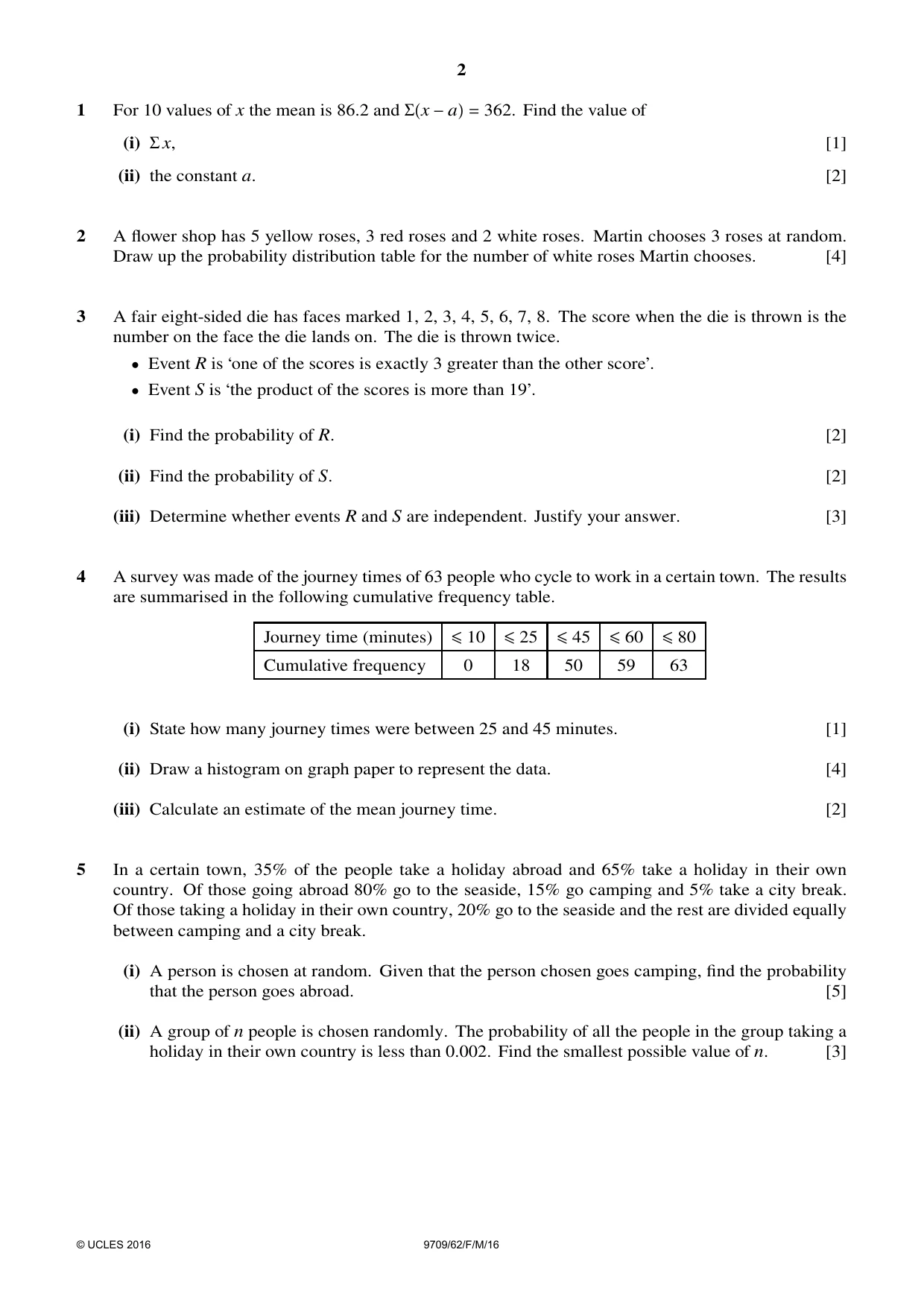
1 For 10 values of x the mean is 86.2 and Σ x −a = 362. Find the value of (i) Σx, [1] (ii) the constant a. [2]
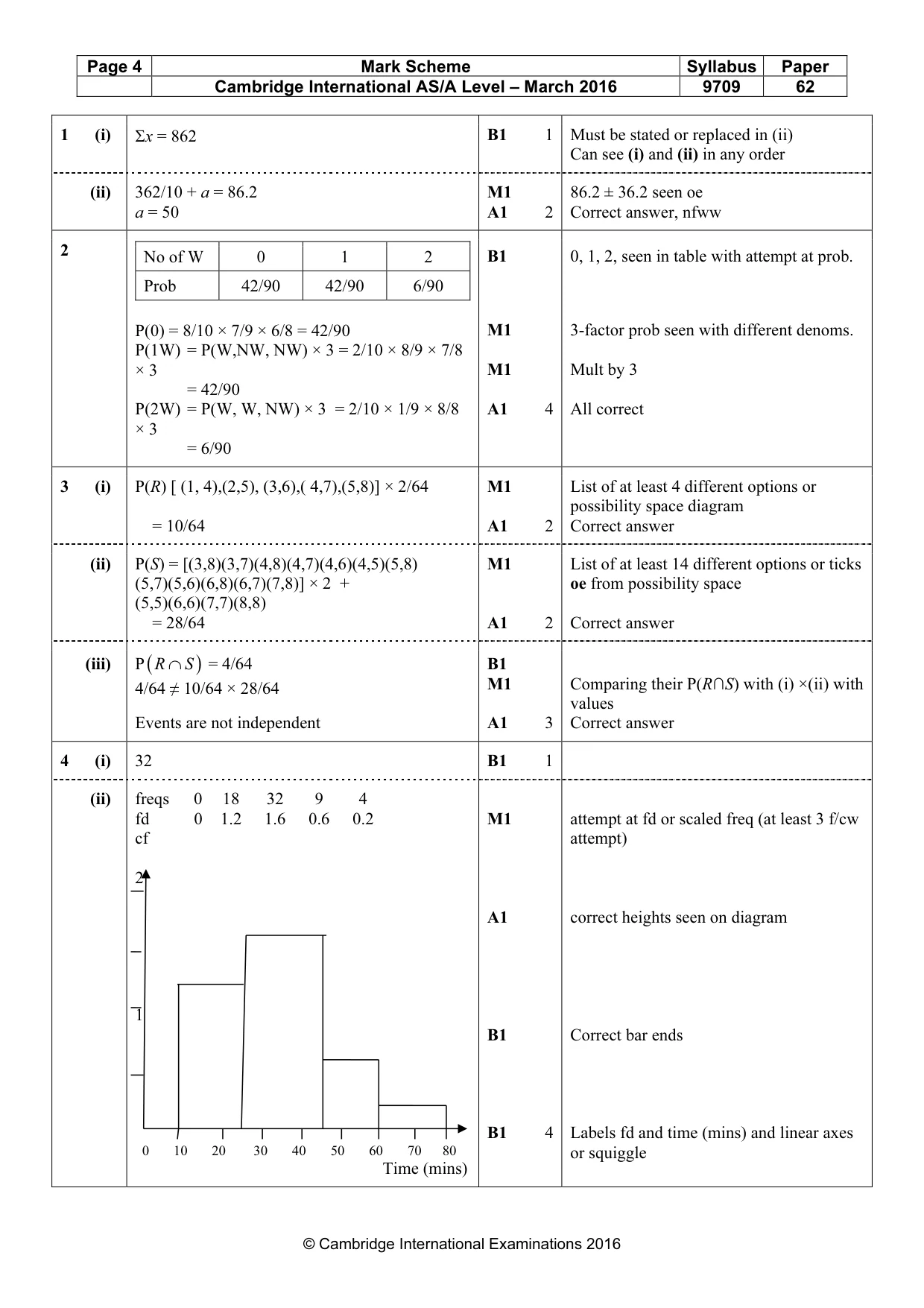
Mark scheme: 1 (i) Σx = 862 B1 1 Must be stated or replaced in (ii) Can see (i) and (ii) in any order (ii) 362/10 + a = 86.2 M1 86.2 ± 36.2 seen oe a = 50 A1 2 Correct answer, nfww
Q2 · A flower shop has 5 yellow roses, 3 red roses and 2 white roses
2 A flower shop has 5 yellow roses, 3 red roses and 2 white roses. Martin chooses 3 roses at random. Draw up the probability distribution table for the number of white roses Martin chooses. [4]
Mark scheme: 2 No of W 0 1 2 B1 0, 1, 2, seen in table with attempt at prob. Prob 42/90 42/90 6/90 P(0) = 8/10 × 7/9 × 6/8 = 42/90 M1 3-factor prob seen with different denoms. P(1W) = P(W,NW, NW) × 3 = 2/10 × 8/9 × 7/8 × 3 M1 Mult by 3 = 42/90 P(2W) = P(W, W, NW) × 3 = 2/10 × 1/9 × 8/8 A1 4 All correct × 3 = 6/90
Q3 · A fair eight-sided die has faces marked 1, 2, 3, 4, 5, 6, 7, 8
3 A fair eight-sided die has faces marked 1, 2, 3, 4, 5, 6, 7, 8. The score when the die is thrown is the number on the face the die lands on. The die is thrown twice. ³ Event R is ‘one of the scores is exactly 3 greater than the other score’. ³ Event S is ‘the product of the scores is more than 19’. (i) Find the probability of R. [2] (ii) Find the probability of S. [2] (iii) Determine whether events R and S are independent. Justify your answer. [3]
Mark scheme: 3 (i) P(R) [ (1, 4),(2,5), (3,6),( 4,7),(5,8)] × 2/64 M1 List of at least 4 different options or possibility space diagram = 10/64 A1 2 Correct answer (ii) P(S) = [(3,8)(3,7)(4,8)(4,7)(4,6)(4,5)(5,8) M1 List of at least 14 different options or ticks (5,7)(5,6)(6,8)(6,7)(7,8)] × 2 + oe from possibility space (5,5)(6,6)(7,7)(8,8) = 28/64 A1 2 Correct answer (iii) P( R ∩ S ) = 4/64 B1 M1 Comparing their P(R∩S) with (i) ×(ii) with 4/64 ≠ 10/64 × 28/64 values Events are not independent A1 3 Correct answer
Q4 · A survey was made of the journey times of 63 people who cycle to work in a certain town
4 A survey was made of the journey times of 63 people who cycle to work in a certain town. The results are summarised in the following cumulative frequency table. Journey time (minutes) ≤10 ≤25 ≤45 ≤60 ≤80 Cumulative frequency 0 18 50 59 63 (i) State how many journey times were between 25 and 45 minutes. [1] (ii) Draw a histogram on graph paper to represent the data. [4] (iii) Calculate an estimate of the mean journey time. [2]
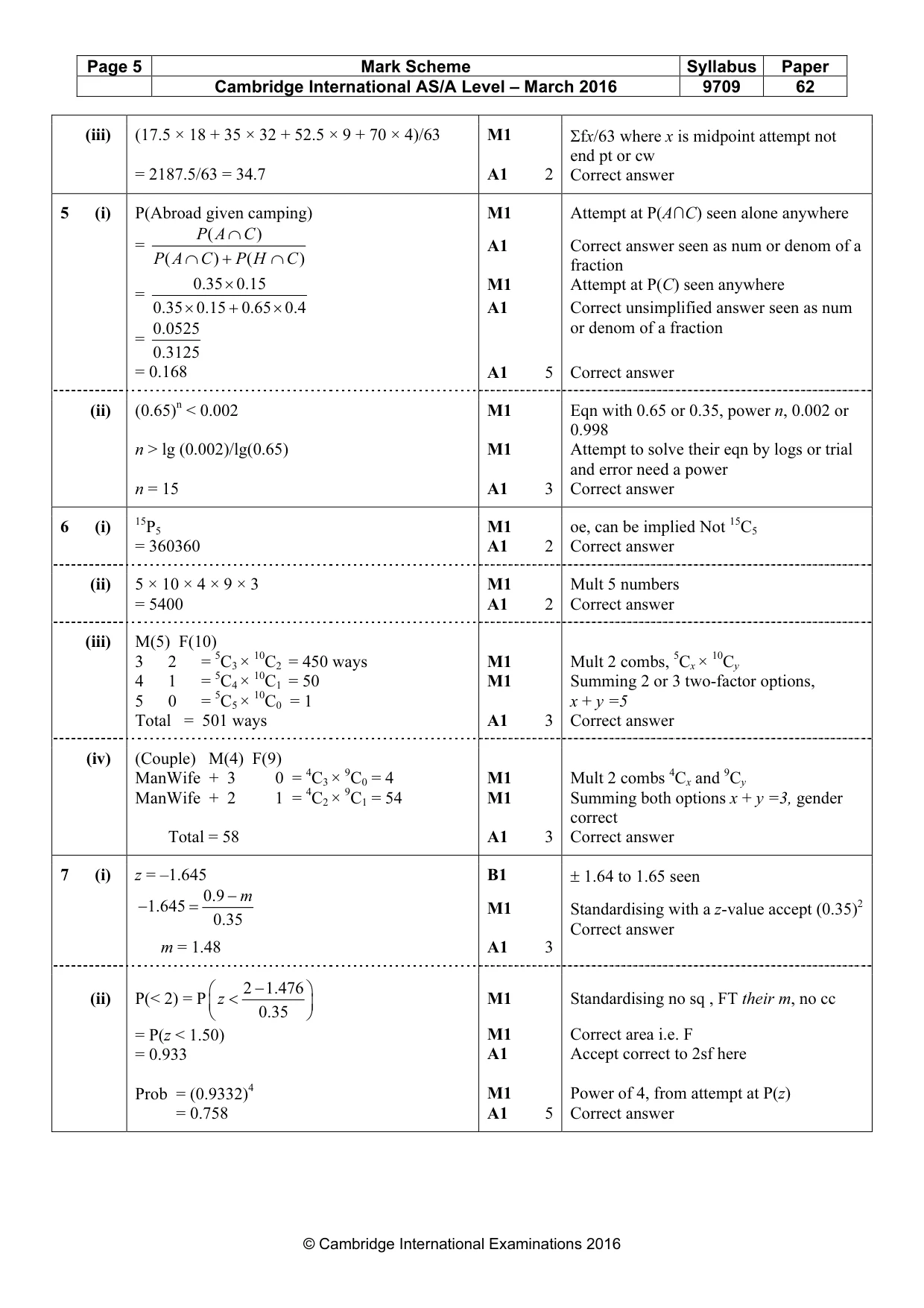
Mark scheme: 4 (i) 32 B1 1 (ii) freqs 0 18 32 9 4 fd 0 1.2 1.6 0.6 0.2 M1 attempt at fd or scaled freq (at least 3 f/cw cf attempt) 2 A1 correct heights seen on diagram 1 B1 Correct bar ends B1 4 Labels fd and time (mins) and linear axes 0 10 20 30 40 50 60 70 80 or squiggle Time (mins) (iii) (17.5 × 18 + 35 × 32 + 52.5 × 9 + 70 × 4)/63 M1 Σfx/63 where x is midpoint attempt not end pt or cw = 2187.5/63 = 34.7 A1 2 Correct answer
Q5 · In a certain town, 35% of the people take a holiday abroad and 65% take a holiday in…
5 In a certain town, 35% of the people take a holiday abroad and 65% take a holiday in their own country. Of those going abroad 80% go to the seaside, 15% go camping and 5% take a city break. Of those taking a holiday in their own country, 20% go to the seaside and the rest are divided equally between camping and a city break. (i) A person is chosen at random. Given that the person chosen goes camping, find the probability that the person goes abroad. [5] (ii) A group of n people is chosen randomly. The probability of all the people in the group taking a holiday in their own country is less than 0.002. Find the smallest possible value of n. [3]
Mark scheme: 5 (i) P(Abroad given camping) M1 Attempt at P(A∩C) seen alone anywhere P ( A ∩ C ) = A1 Correct answer seen as num or denom of a P ( A ∩ C ) + P ( H ∩ C ) fraction 0.35 × 0.15 M1 Attempt at P(C) seen anywhere = 0.35 × 0.15 + 0.65 × 0.4 A1 Correct unsimplified answer seen as num 0.0525 or denom of a fraction = 0.3125 = 0.168 A1 5 Correct answer (ii) (0.65)n < 0.002 M1 Eqn with 0.65 or 0.35, power n, 0.002 or 0.998 n > lg (0.002)/lg(0.65) M1 Attempt to solve their eqn by logs or trial and error need a power n = 15 A1 3 Correct answer 15 15
Q6 · Hannah chooses 5 singers from 15 applicants to appear in a concert
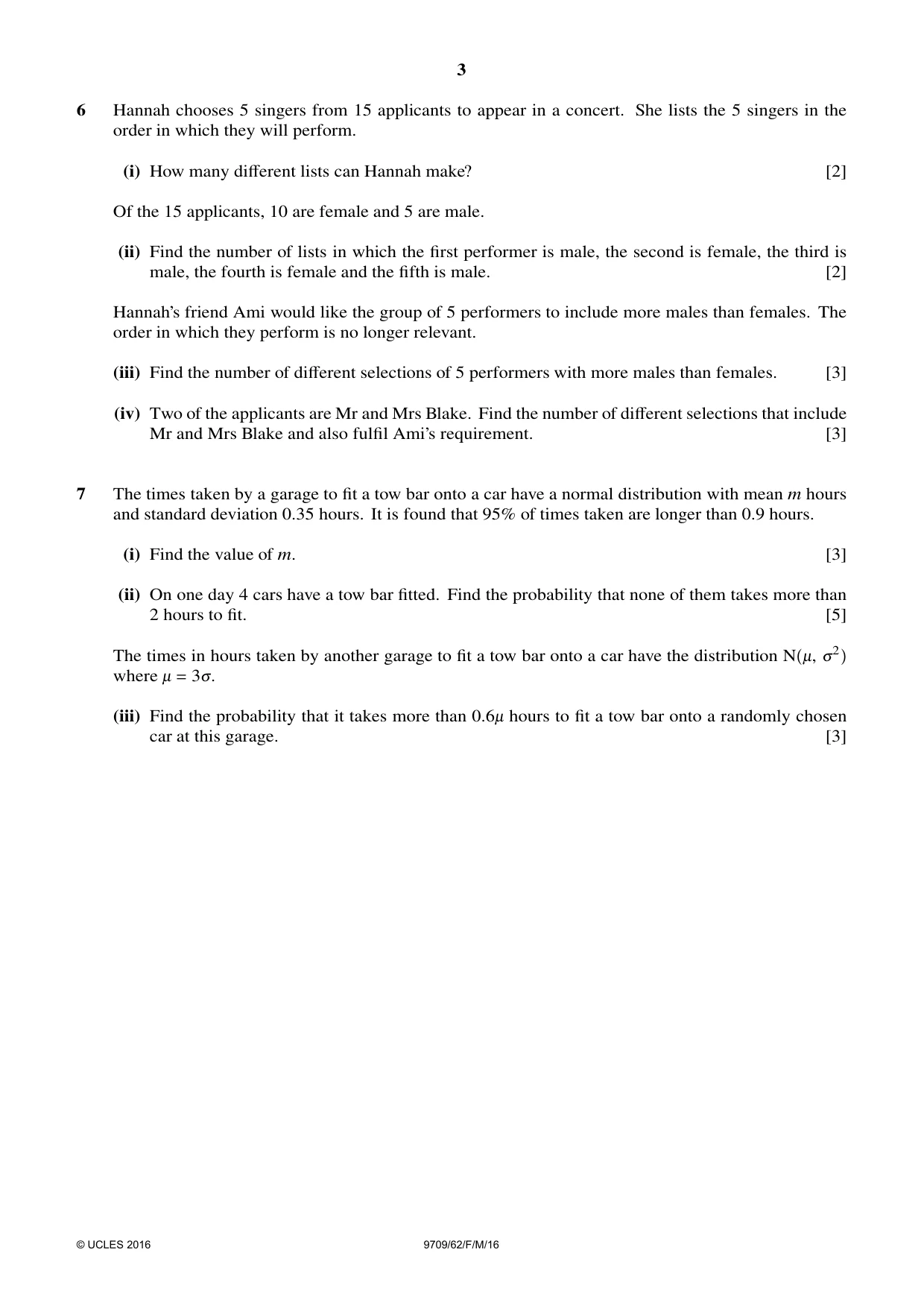
6 Hannah chooses 5 singers from 15 applicants to appear in a concert. She lists the 5 singers in the order in which they will perform. (i) How many different lists can Hannah make? [2] Of the 15 applicants, 10 are female and 5 are male. (ii) Find the number of lists in which the first performer is male, the second is female, the third is male, the fourth is female and the fifth is male. [2] Hannah’s friend Ami would like the group of 5 performers to include more males than females. The order in which they perform is no longer relevant. (iii) Find the number of different selections of 5 performers with more males than females. [3] (iv) Two of the applicants are Mr and Mrs Blake. Find the number of different selections that include Mr and Mrs Blake and also fulfil Ami’s requirement. [3]
Mark scheme: 6 (i) 15P5 M1 oe, can be implied Not 15C5 = 360360 A1 2 Correct answer (ii) 5 × 10 × 4 × 9 × 3 M1 Mult 5 numbers = 5400 A1 2 Correct answer (iii) M(5) F(10) 3 2 = 5C3 × 10C2 = 450 ways M1 Mult 2 combs, 5Cx × 10Cy 4 1 = 5C4 × 10C1 = 50 M1 Summing 2 or 3 two-factor options, 5 0 = 5C5 × 10C0 = 1 x + y =5 Total = 501 ways A1 3 Correct answer (iv) (Couple) M(4) F(9) ManWife + 3 0 = 4C3 × 9C0 = 4 M1 Mult 2 combs 4Cx and 9Cy ManWife + 2 1 = 4C2 × 9C1 = 54 M1 Summing both options x + y =3, gender correct Total = 58 A1 3 Correct answer
What was in this paper
The subtopics covered by these 6 questions, and how many questions each got. Open one in a new tab to see every Cambridge question on it.
What you needed in this session
Cambridge’s own grade thresholds for 2016 Feb/March, Paper 6 · Variant 2. A higher threshold means an easier paper — the bar moves with how the cohort did.