Cambridge A Level Mathematics 9709 — 2016 Feb/March Paper 5 · Variant 2
9709/52/F/M/16 · 5 questions · 50 marks · ≈56 min
The question paper and its mark scheme, free to read here and free to download. This is Cambridge’s own paper, exactly as it was sat.
Question paper4 pages
Mark scheme5 pages
Answers below. Sit the paper first if you are practising.
Questions as text
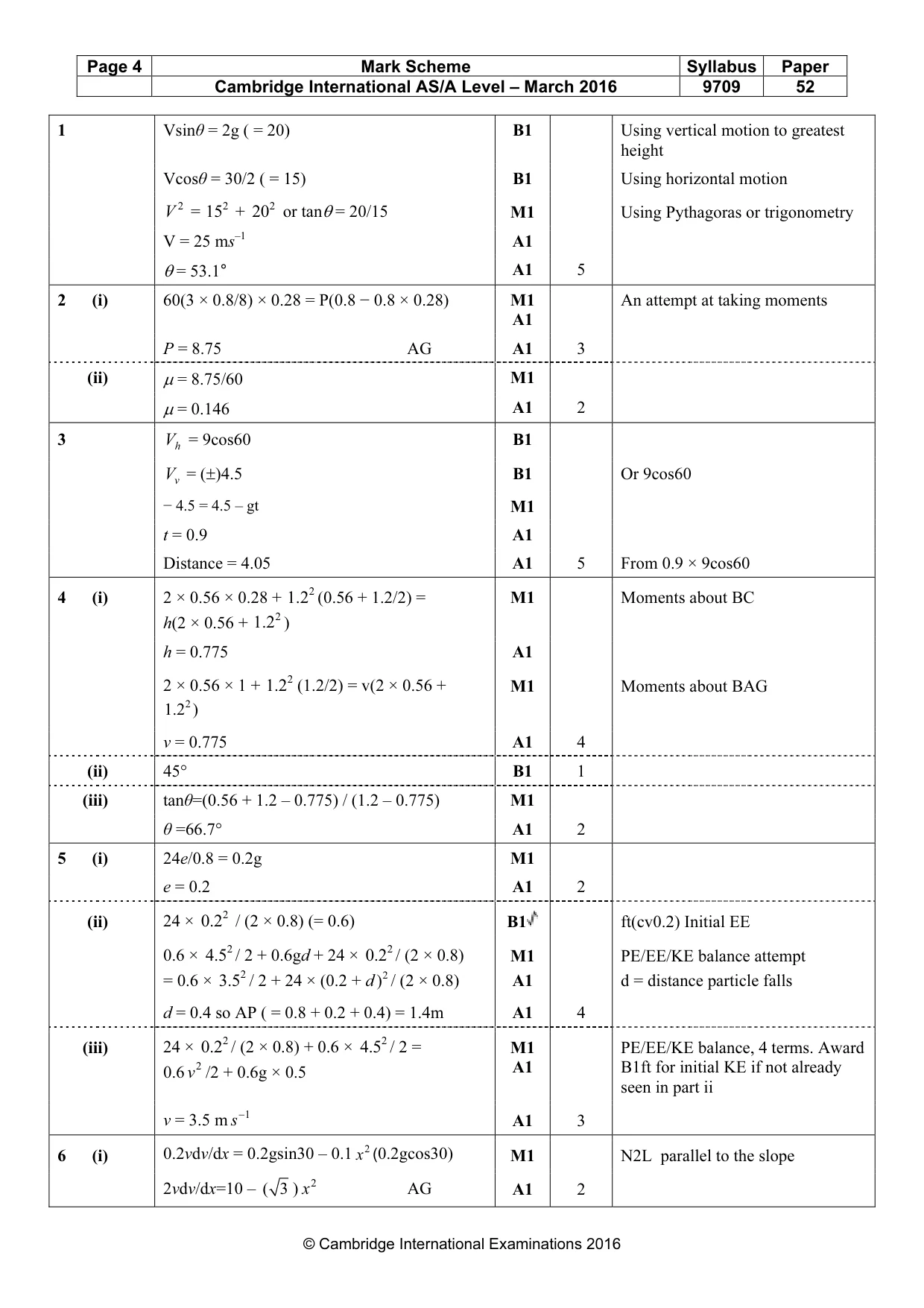
Q1 · A particle is projected from a point on horizontal ground
1 A particle is projected from a point on horizontal ground. At the instant 2 s after projection, the particle has travelled a horizontal distance of 30 m and is at its greatest height above the ground. Find the initial speed and the angle of projection of the particle. [5]
Mark scheme: 1 Vsinθ = 2g ( = 20) B1 Using vertical motion to greatest height Vcosθ = 30/2 ( = 15) B1 Using horizontal motion V 2 = 152 + 20 2 or tanθ = 20/15 M1 Using Pythagoras or trigonometry V = 25 ms–1 A1 θ = 53.1° A1 5
Q2 · 0.8 m P N 1 A uniform solid hemisphere of weight 60 N and radius 0.8 m rests in limiting…
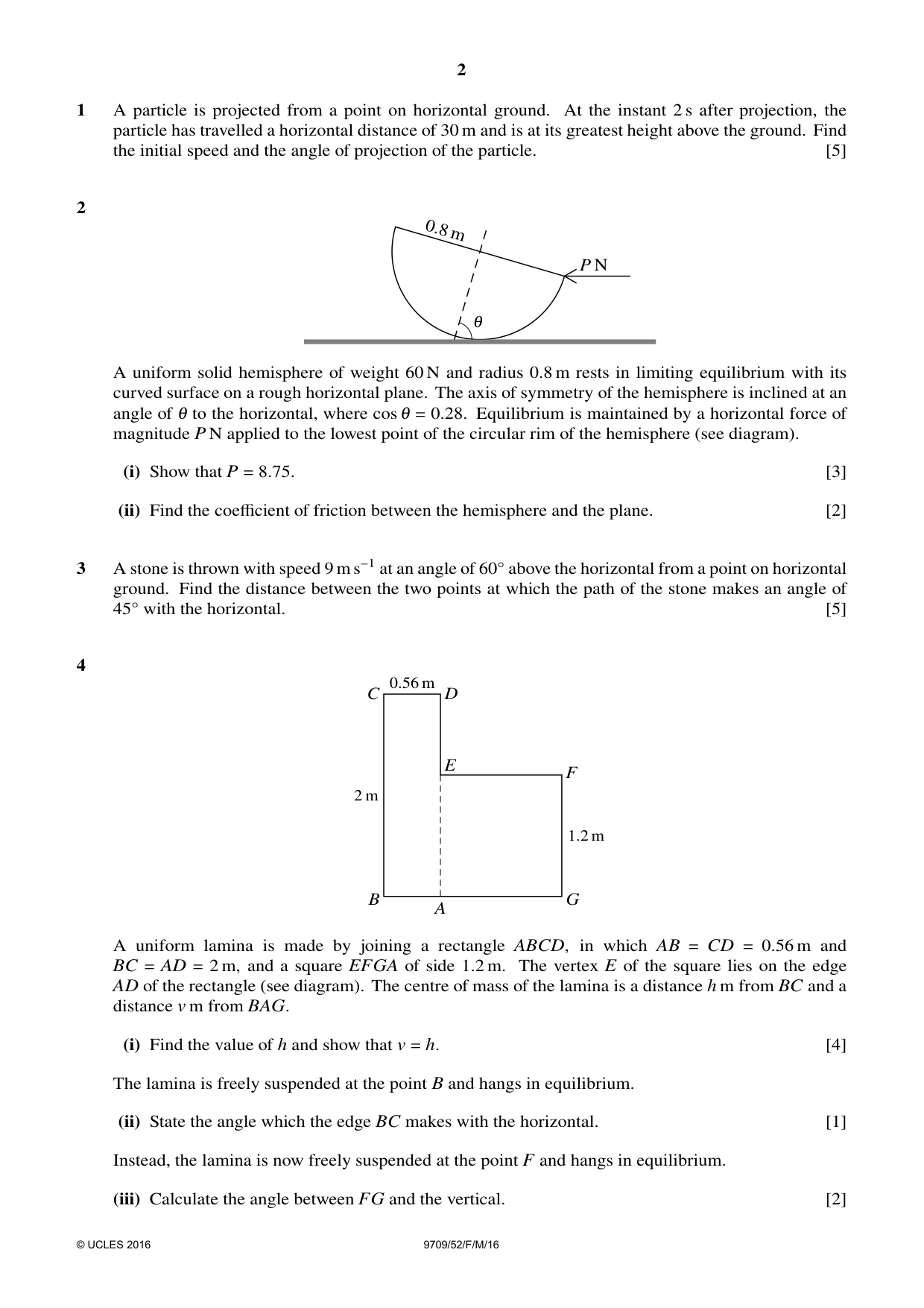
2 0.8 m P N 1 A uniform solid hemisphere of weight 60 N and radius 0.8 m rests in limiting equilibrium with its curved surface on a rough horizontal plane. The axis of symmetry of the hemisphere is inclined at an angle of 1 to the horizontal, where cos 1 = 0.28. Equilibrium is maintained by a horizontal force of magnitude P N applied to the lowest point of the circular rim of the hemisphere (see diagram). (i) Show that P = 8.75. [3] (ii) Find the coefficient of friction between the hemisphere and the plane. [2]
Mark scheme: 2 (i) 60(3 × 0.8/8) × 0.28 = P(0.8 − 0.8 × 0.28) M1 An attempt at taking moments A1 P = 8.75 AG A1 3 (ii) µ = 8.75/60 M1 µ = 0.146 A1 2
Q3 · A stone is thrown with speed 9 m s−1 at an angle of 60Å above the horizontal from a point…
3 A stone is thrown with speed 9 m s−1 at an angle of 60Å above the horizontal from a point on horizontal ground. Find the distance between the two points at which the path of the stone makes an angle of 45Å with the horizontal. [5]
Mark scheme: 3 Vh = 9cos60 B1 Vv = (±)4.5 B1 Or 9cos60 − 4.5 = 4.5 – gt M1 t = 0.9 A1 Distance = 4.05 A1 5 From 0.9 × 9cos60
Q4 · 0.56 m C D E F 2 m 1.2 m B G A A uniform lamina is made by joining a rectangle ABCD, in…
4 0.56 m C D E F 2 m 1.2 m B G A A uniform lamina is made by joining a rectangle ABCD, in which AB = CD = 0.56 m and BC = AD = 2 m, and a square EFGA of side 1.2 m. The vertex E of the square lies on the edge AD of the rectangle (see diagram). The centre of mass of the lamina is a distance h m from BC and a distance v m from BAG. (i) Find the value of h and show that v = h. [4] The lamina is freely suspended at the point B and hangs in equilibrium. (ii) State the angle which the edge BC makes with the horizontal. [1] Instead, the lamina is now freely suspended at the point F and hangs in equilibrium. (iii) Calculate the angle between FG and the vertical. [2]
Mark scheme: 4 (i) 2 × 0.56 × 0.28 + 1.2 2 (0.56 + 1.2/2) = M1 Moments about BC h(2 × 0.56 + 1.2 2 ) h = 0.775 A1 2 × 0.56 × 1 + 1.2 2 (1.2/2) = v(2 × 0.56 + M1 Moments about BAG 1.2 2 ) v = 0.775 A1 4 (ii) 45° B1 1 (iii) tanθ=(0.56 + 1.2 – 0.775) / (1.2 – 0.775) M1 θ =66.7° A1 2
Q5 · A particle P of mass 0.6 kg is attached to one end of a light elastic string of natural…
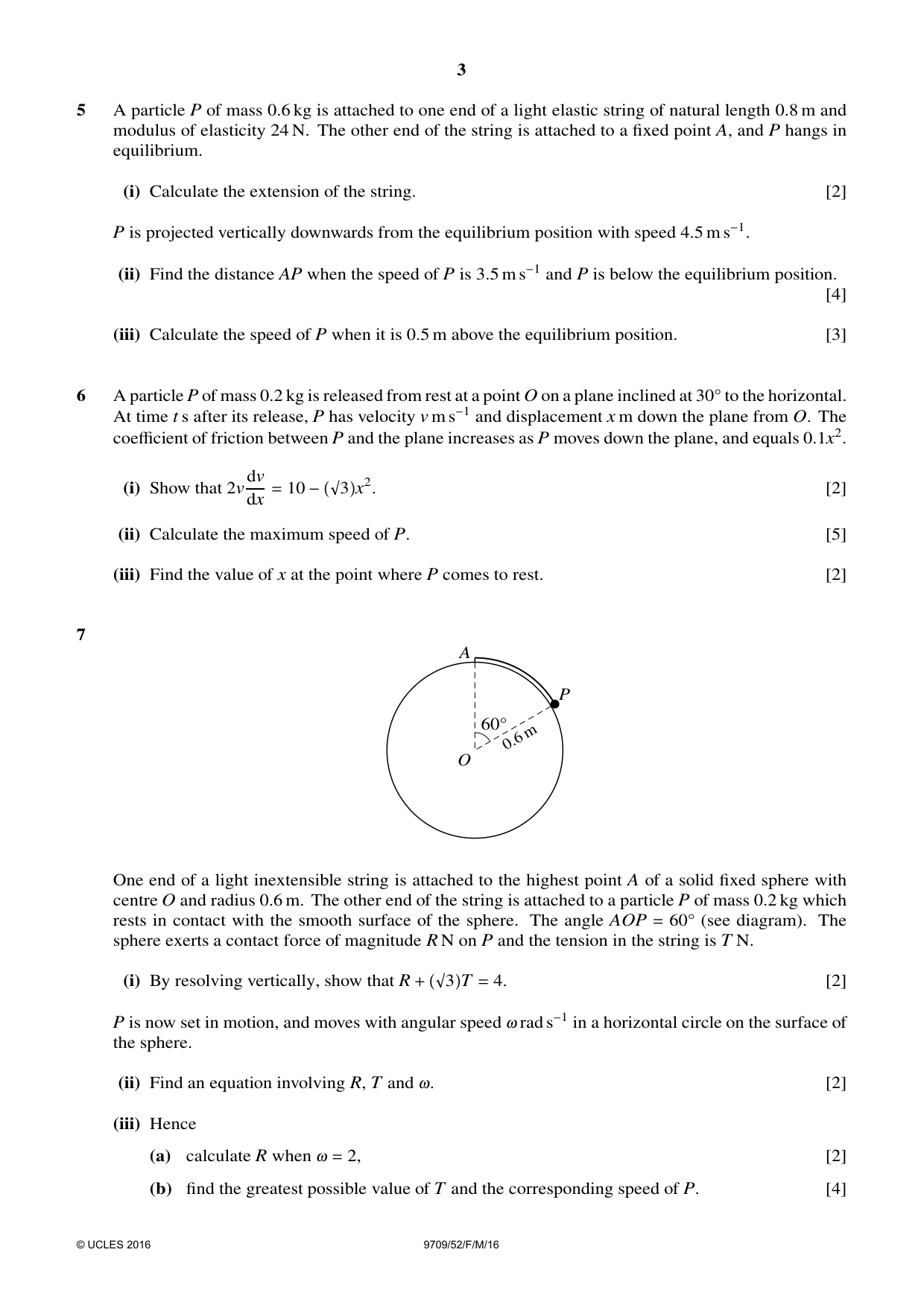
5 A particle P of mass 0.6 kg is attached to one end of a light elastic string of natural length 0.8 m and modulus of elasticity 24 N. The other end of the string is attached to a fixed point A, and P hangs in equilibrium. (i) Calculate the extension of the string. [2] P is projected vertically downwards from the equilibrium position with speed 4.5 m s−1. (ii) Find the distance AP when the speed of P is 3.5 m s−1 and P is below the equilibrium position. [4] (iii) Calculate the speed of P when it is 0.5 m above the equilibrium position. [3]
Mark scheme: 5 (i) 24e/0.8 = 0.2g M1 e = 0.2 A1 2 (ii) 24 × 0.2 2 / (2 × 0.8) (= 0.6) B1 ft(cv0.2) Initial EE 0.6 × 4.5 2 / 2 + 0.6gd + 24 × 0.2 2 / (2 × 0.8) M1 PE/EE/KE balance attempt = 0.6 × 3.5 2 / 2 + 24 × (0.2 + d 2) / (2 × 0.8) A1 d = distance particle falls d = 0.4 so AP ( = 0.8 + 0.2 + 0.4) = 1.4m A1 4 (iii) 24 × 0.2 2 / (2 × 0.8) + 0.6 × 4.5 2 / 2 = M1 PE/EE/KE balance, 4 terms. Award A1 B1ft for initial KE if not already 0.6 v 2 /2 + 0.6g × 0.5 seen in part ii v = 3.5 m −s1 A1 3
What was in this paper
The subtopics covered by these 5 questions, and how many questions each got. Open one in a new tab to see every Cambridge question on it.
What you needed in this session
Cambridge’s own grade thresholds for 2016 Feb/March, Paper 5 · Variant 2. A higher threshold means an easier paper — the bar moves with how the cohort did.