Cambridge A Level Mathematics 9709 — 2015 Oct/Nov Paper 2 · Variant 1
9709/21/O/N/15 · 5 questions · 50 marks · ≈56 min
The question paper and its mark scheme, free to read here and free to download. This is Cambridge’s own paper, exactly as it was sat.
Question paper4 pages
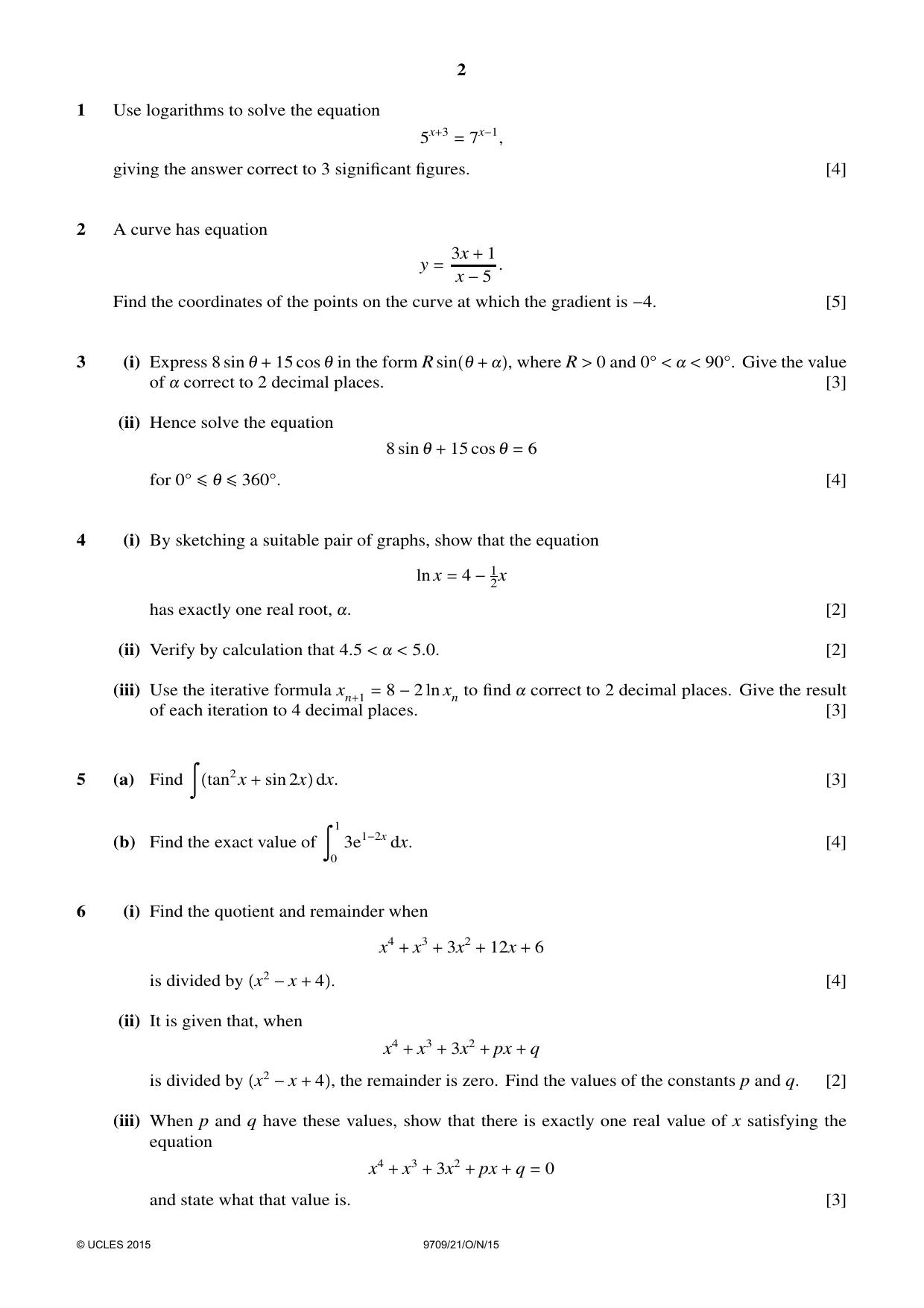
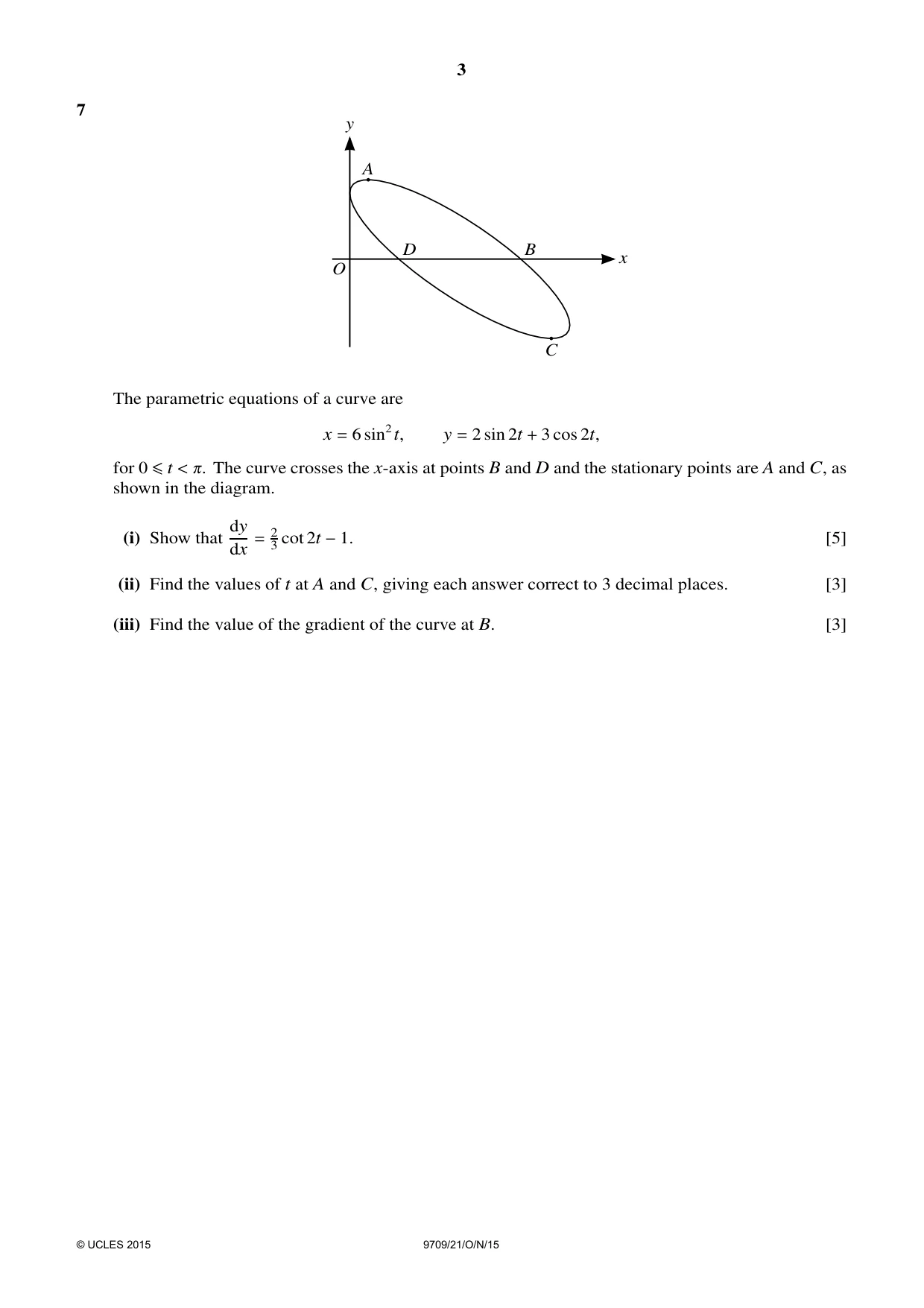
Mark scheme5 pages
Answers below. Sit the paper first if you are practising.
Questions as text
Q1 · Use logarithms to solve the equation 5x+3 = 7x−1, giving the answer correct to 3…
1 Use logarithms to solve the equation 5x+3 = 7x−1, giving the answer correct to 3 significant figures. [4]
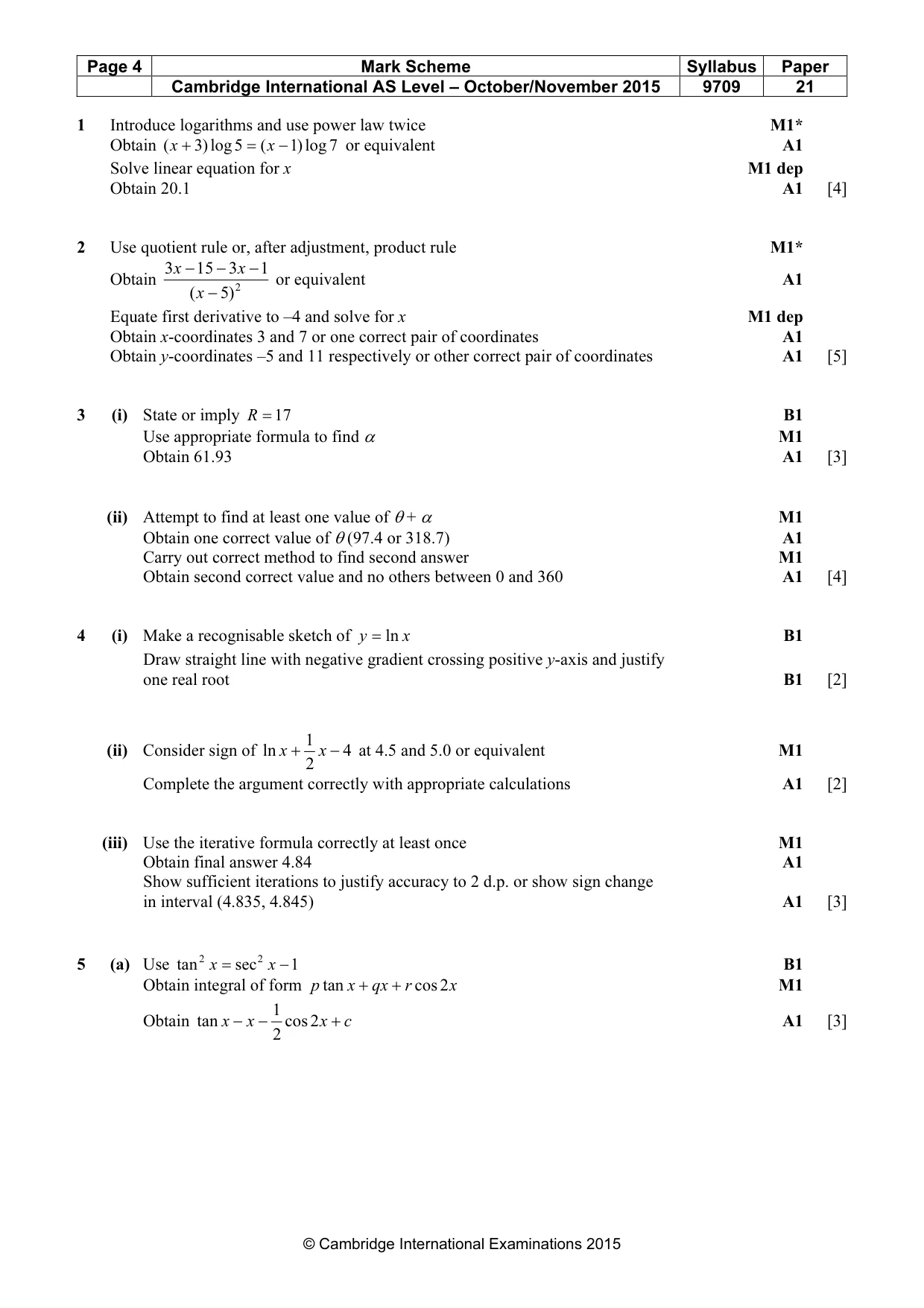
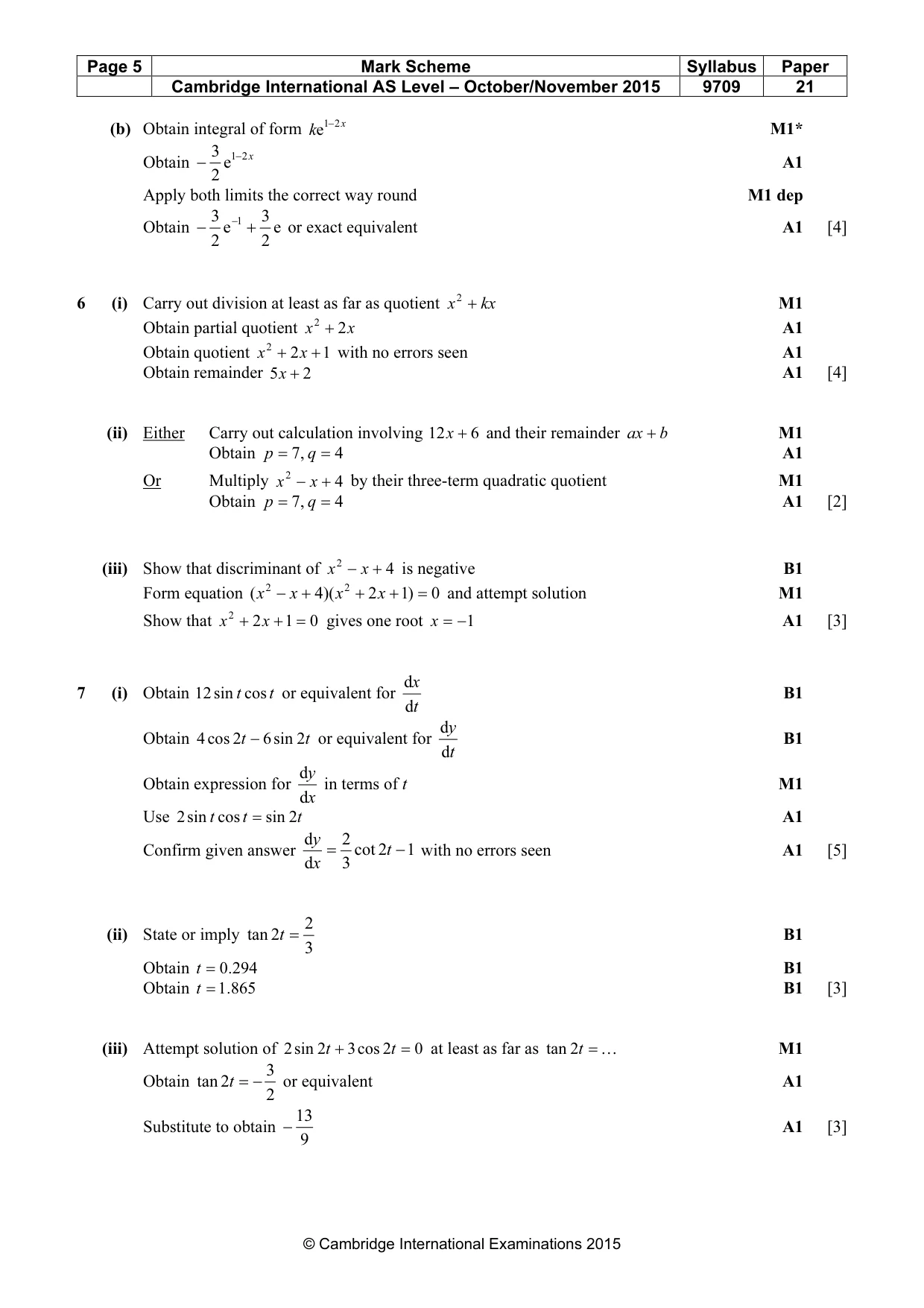
Mark scheme: 1 Introduce logarithms and use power law twice M1* Obtain ( x + 3) log 5 = ( x − )1 log 7 or equivalent A1 Solve linear equation for x M1 dep Obtain 20.1 A1 [4]
Q2 · A curve has equation 3x 1 y +
2 A curve has equation 3x 1 y + . = x −5 Find the coordinates of the points on the curve at which the gradient is [5] −4.
Mark scheme: 2 Use quotient rule or, after adjustment, product rule M1* 3 x − 15 − 3 x − 1 Obtain or equivalent A1 ( x − 52) Equate first derivative to –4 and solve for x M1 dep Obtain x-coordinates 3 and 7 or one correct pair of coordinates A1 Obtain y-coordinates –5 and 11 respectively or other correct pair of coordinates A1 [5]
Q4 · By sketching a suitable pair of graphs, show that the equation 4 ln x = −12x has exactly…
4 (i) By sketching a suitable pair of graphs, show that the equation 4 ln x = −12x has exactly one real root, [2] !. (ii) Verify by calculation that 4.5 5.0. [2] < ! < (iii) Use the iterative formula xn+1 = 8 −2 ln xn to find ! correct to 2 decimal places. Give the result of each iteration to 4 decimal places. [3]
Mark scheme: 4 (i) Make a recognisable sketch of y = ln x B1 Draw straight line with negative gradient crossing positive y-axis and justify one real root B1 [2] 1 (ii) Consider sign of ln x + x − 4 at 4.5 and 5.0 or equivalent M1 2 Complete the argument correctly with appropriate calculations A1 [2] (iii) Use the iterative formula correctly at least once M1 Obtain final answer 4.84 A1 Show sufficient iterations to justify accuracy to 2 d.p. or show sign change in interval (4.835, 4.845) A1 [3]
Q5 · Find tan2x sin 2x dx
5 (a) Find tan2x sin 2x dx. [3] Ó + 1 (b) Find the exact value of dx. [4] Ó 0 3e1−2x
Mark scheme: 5 (a) Use tan 2 x = sec 2 x − 1 B1 Obtain integral of form p tan x + qx + r cos 2 x M1 1 Obtain tan x − x − cos 2 x + c A1 [3] 2 (b) Obtain integral of form k1e− 2 x M1* 3 − 2 x Obtain − 1e A1 2 Apply both limits the correct way round M1 dep 3 −1 3 Obtain − e + e or exact equivalent A1 [4] 2 2
Q7 · Y A D B x O C The parametric equations of a curve are x 6 sin2t, y 2 sin 2t 3 cos 2t, = =…
7 y A D B x O C The parametric equations of a curve are x 6 sin2t, y 2 sin 2t 3 cos 2t, = = + for 0 The curve crosses the x-axis at points B and D and the stationary points are A and C, as ≤t < 0. shown in the diagram. dy 2 (i) Show that cot 2t [5] 3 −1. dx = (ii) Find the values of t at A and C, giving each answer correct to 3 decimal places. [3] (iii) Find the value of the gradient of the curve at B. [3]
Mark scheme: dx 7 (i) Obtain 12 sin t cos t or equivalent for B1 dt dy Obtain 4 cos 2t − 6 sin 2t or equivalent for B1 dt dy Obtain expression for in terms of t M1 dx Use 2 sin t cos t = sin 2t A1 dy 2 Confirm given answer = cot 2t − 1 with no errors seen A1 [5] dx 3 2 (ii) State or imply tan 2t = B1 3 Obtain t = .0 294 B1 Obtain t = .1 865 B1 [3] (iii) Attempt solution of 2 sin 2t + 3 cos 2t = 0 at least as far as tan t2 = K M1 3 Obtain tan 2t = − or equivalent A1 2 13 Substitute to obtain − A1 [3] 9
What was in this paper
The subtopics covered by these 5 questions, and how many questions each got. Open one in a new tab to see every Cambridge question on it.
What you needed in this session
Cambridge’s own grade thresholds for 2015 Oct/Nov, Paper 2 · Variant 1. A higher threshold means an easier paper — the bar moves with how the cohort did.