Cambridge A Level Mathematics 9709 — 2014 May/June Paper 5 · Variant 2
9709/52/M/J/14 · 6 questions · 50 marks · ≈56 min
The question paper and its mark scheme, free to read here and free to download. This is Cambridge’s own paper, exactly as it was sat.
Question paper4 pages
Mark scheme6 pages
Answers below. Sit the paper first if you are practising.
Questions as text
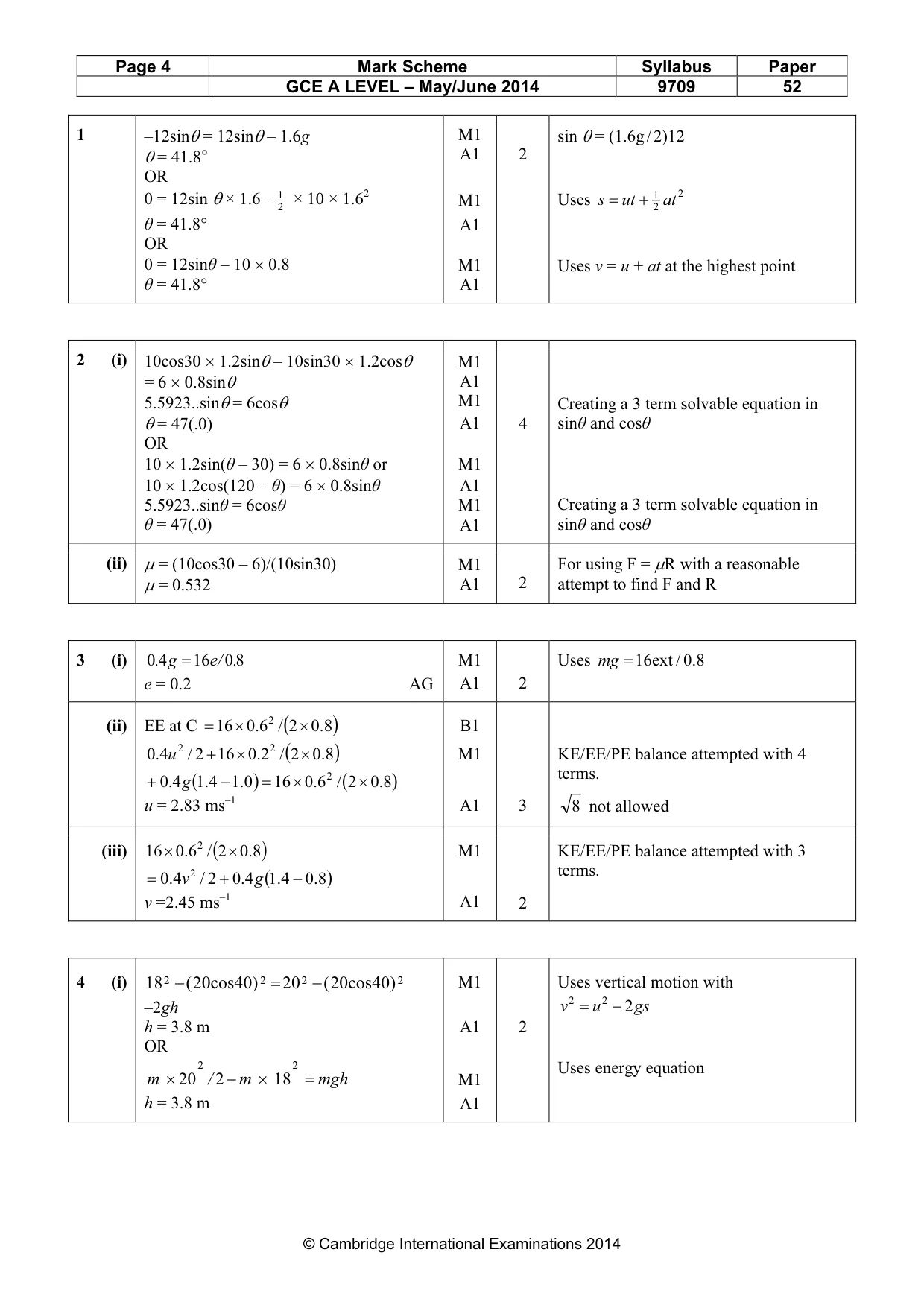
Q1 · A particle is projected with speed 12 m s−1 from a point on horizontal ground
1 A particle is projected with speed 12 m s−1 from a point on horizontal ground. The particle strikes the ground 1.6 s after the instant of projection. Calculate the angle of projection. [2]
Mark scheme: 1 –12sinθ = 12sinθ – 1.6g M1 sin θ = (1.6g / 2)12 θ = 41.8° A1 2 OR 0 = 12sin θ × 1.6 – 12 × 10 × 1.62 M1 Uses s = ut + 12 at 2 θ = 41.8° A1 OR 0 = 12sinθ – 10 × 0.8 M1 Uses v = u + at at the highest point θ = 41.8° A1
Q2 · 10 N A 0.8 m 30 0.4 m B 6 N A non-uniform rod AB of weight 6 N rests in limiting…
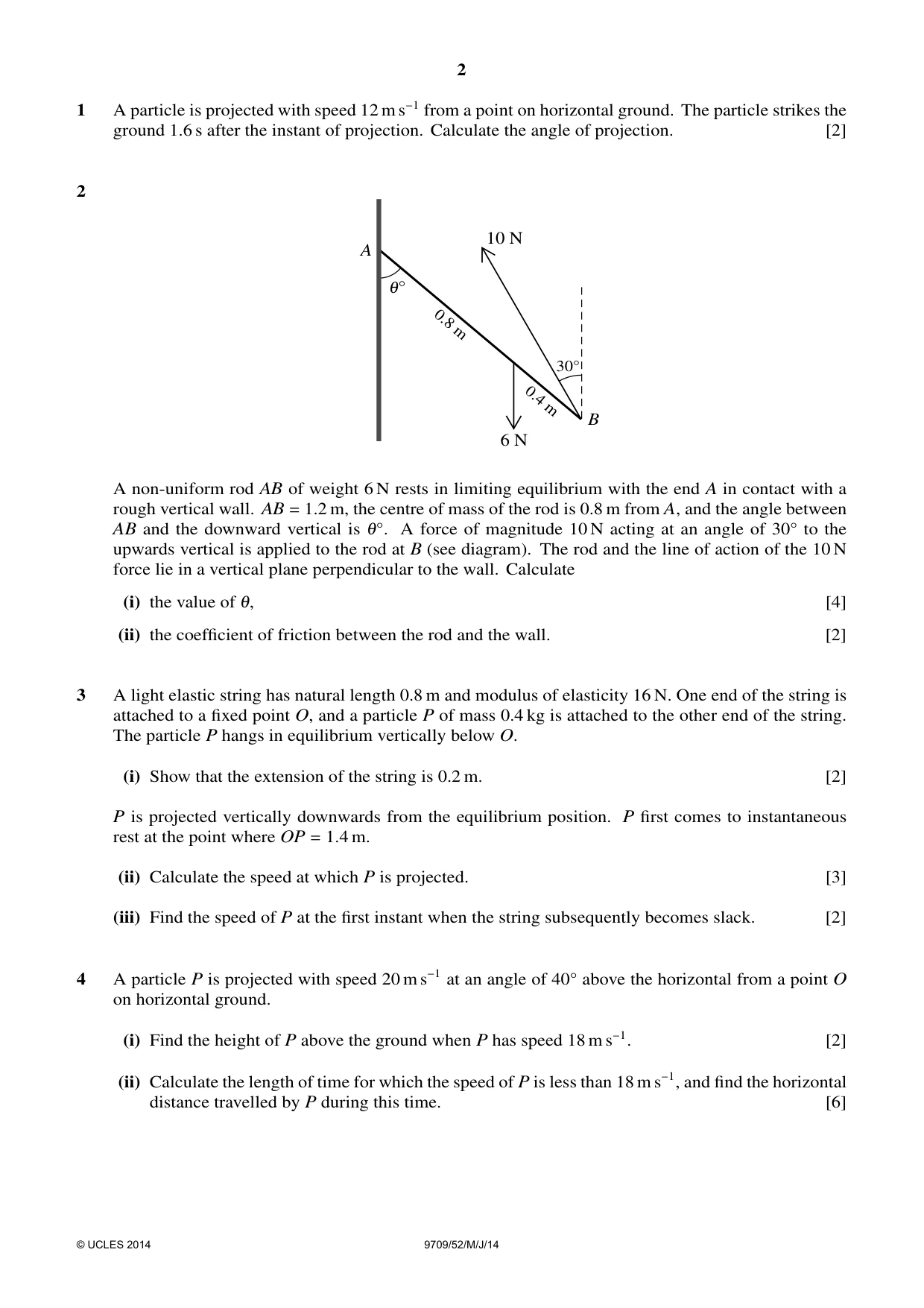
2 10 N A 0.8 m 30 0.4 m B 6 N A non-uniform rod AB of weight 6 N rests in limiting equilibrium with the end A in contact with a rough vertical wall. AB = 1.2 m, the centre of mass of the rod is 0.8 m from A, and the angle between AB and the downward vertical is . A force of magnitude 10 N acting at an angle of 30 to the upwards vertical is applied to the rod at B (see diagram). The rod and the line of action of the 10 N force lie in a vertical plane perpendicular to the wall. Calculate (i) the value of , [4] (ii) the coefficient of friction between the rod and the wall. [2]
Mark scheme: 2 (i) 10cos30 × 1.2sinθ – 10sin30 × 1.2cosθ M1 = 6 × 0.8sinθ A1 5.5923..sinθ = 6cosθ M1 Creating a 3 term solvable equation in θ = 47(.0) A1 4 sinθ and cosθ OR 10 × 1.2sin(θ – 30) = 6 × 0.8sinθ or M1 10 × 1.2cos(120 – θ) = 6 × 0.8sinθ A1 5.5923..sinθ = 6cosθ M1 Creating a 3 term solvable equation in θ = 47(.0) A1 sinθ and cosθ (ii) µ = (10cos30 – 6)/(10sin30) M1 For using F = µR with a reasonable µ = 0.532 A1 2 attempt to find F and R
Q3 · A light elastic string has natural length 0.8 m and modulus of elasticity 16 N
3 A light elastic string has natural length 0.8 m and modulus of elasticity 16 N. One end of the string is attached to a fixed point O, and a particle P of mass 0.4 kg is attached to the other end of the string. The particle P hangs in equilibrium vertically below O. (i) Show that the extension of the string is 0.2 m. [2] P is projected vertically downwards from the equilibrium position. P first comes to instantaneous rest at the point where OP = 1.4 m. (ii) Calculate the speed at which P is projected. [3] (iii) Find the speed of P at the first instant when the string subsequently becomes slack. [2]
Mark scheme: 3 (i) 0 .4 g = 16 e/ 0 .8 M1 Uses mg = 16 ext / 8.0 e = 0.2 AG A1 2 (ii) EE at C = 16 × 6.0 2 / (2 × 8.0 ) B1 4.0u 2 / 2 + 16 × 2.0 2 / (2 × 8.0 ) M1 KE/EE/PE balance attempted with 4 2 terms. + 4.0 g (4.1 − 0.1 ) = 16 × 6.0 / ( 2 × 8.0 ) u = 2.83 ms–1 A1 3 8 not allowed (iii) 16 × 6.0 2 / (2 × 8.0 ) M1 KE/EE/PE balance attempted with 3 2 terms. = 4.0v / 2 + 4.0 g (4.1 − 8.0 ) v =2.45 ms–1 A1 2
Q4 · A particle P is projected with speed 20 m s−1 at an angle of 40 above the horizontal from…
4 A particle P is projected with speed 20 m s−1 at an angle of 40 above the horizontal from a point O on horizontal ground. (i) Find the height of P above the ground when P has speed 18 m s−1. [2] (ii) Calculate the length of time for which the speed of P is less than 18 m s−1, and find the horizontal distance travelled by P during this time. [6]
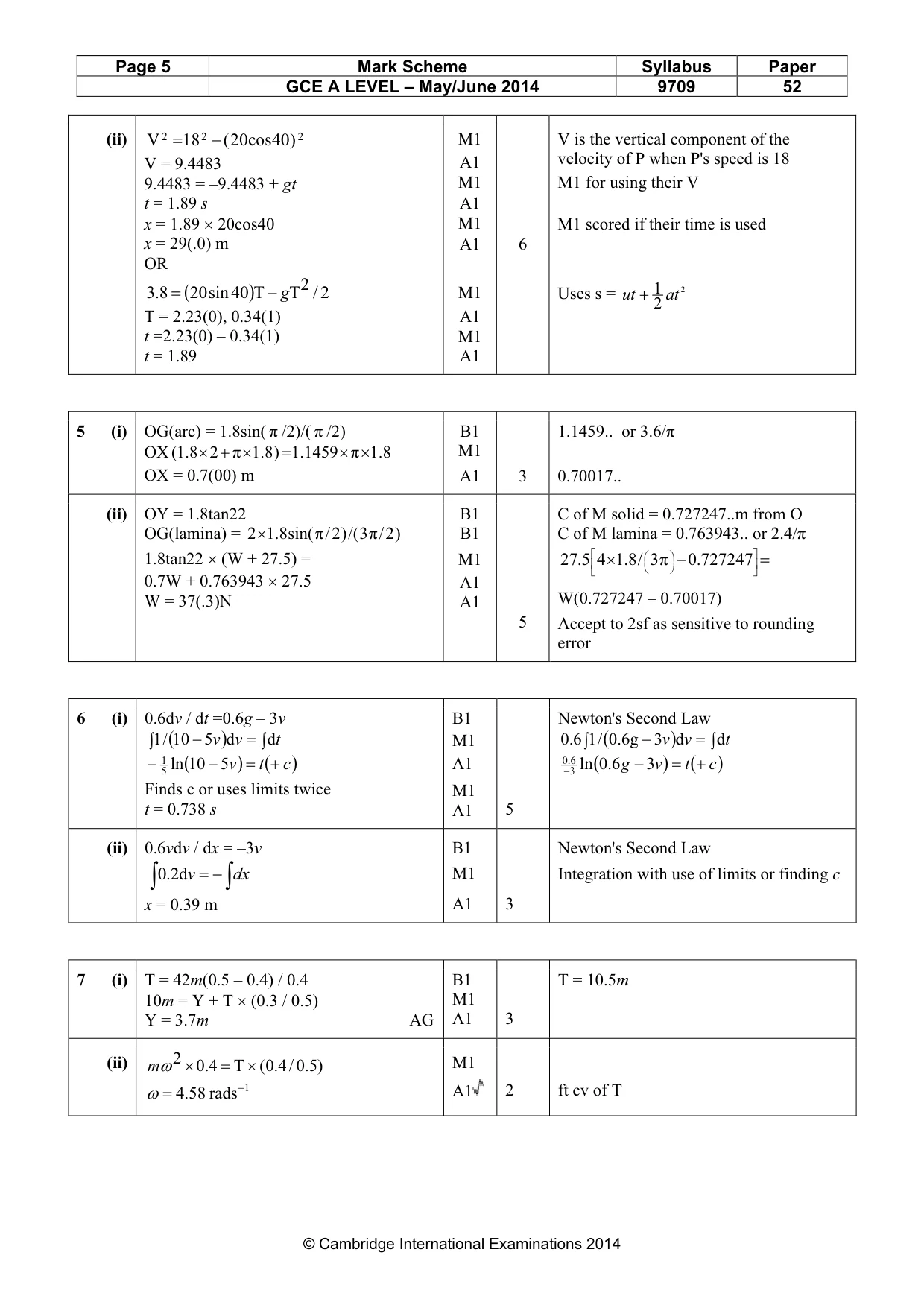
Mark scheme: 4 (i) 18 2 − ( 20 cos 40 ) 2 = 20 2 − ( 20 cos 40 ) 2 M1 Uses vertical motion with –2gh v 2 = u 2 − 2 gs h = 3.8 m A1 2 OR 2 2 Uses energy equation m × 20 / 2 − m × 18 = mgh M1 h = 3.8 m A1 GCE A LEVEL – May/June 2014 9709 52 (ii) V 2 = 18 2 − ( 20 cos 40 ) 2 M1 V is the vertical component of the V = 9.4483 A1 velocity of P when P's speed is 18 9.4483 = –9.4483 + gt M1 M1 for using their V t = 1.89 s A1 x = 1.89 × 20cos40 M1 M1 scored if their time is used x = 29(.0) m A1 6 OR 2 1 2 8.3 = ( 20 sin 40 )T − gT / 2 M1 Uses s = ut + at 2 T = 2.23(0), 0.34(1) A1 t =2.23(0) – 0.34(1) M1 t = 1.89 A1
Q5 · B A 1.8 m O 1.8 m C A uniform metal frame OABC is made from a semicircular arc ABC of…
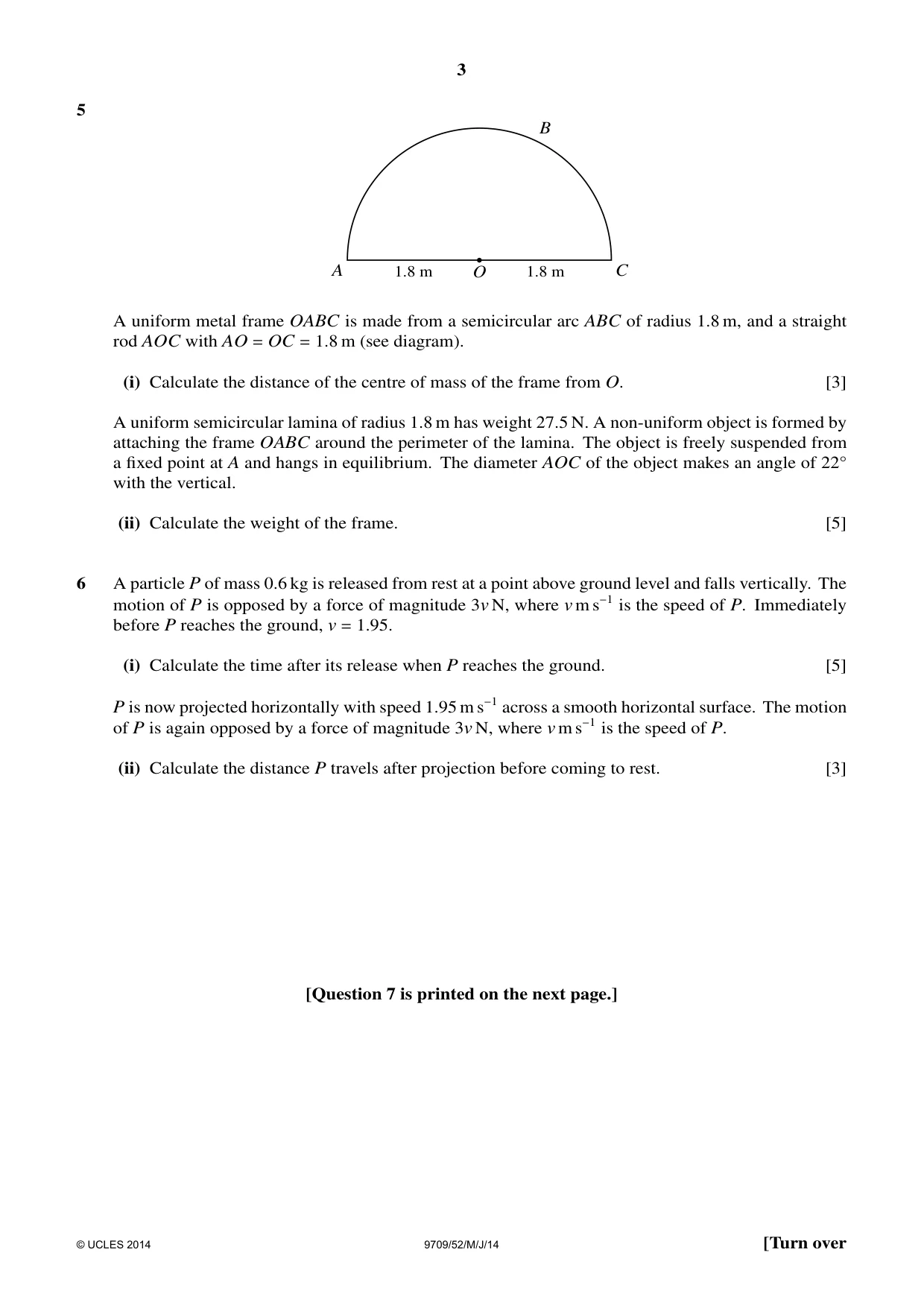
5 B A 1.8 m O 1.8 m C A uniform metal frame OABC is made from a semicircular arc ABC of radius 1.8 m, and a straight rod AOC with AO = OC = 1.8 m (see diagram). (i) Calculate the distance of the centre of mass of the frame from O. [3] A uniform semicircular lamina of radius 1.8 m has weight 27.5 N. A non-uniform object is formed by attaching the frame OABC around the perimeter of the lamina. The object is freely suspended from a fixed point at A and hangs in equilibrium. The diameter AOC of the object makes an angle of 22 with the vertical. (ii) Calculate the weight of the frame. [5]
Mark scheme: 5 (i) OG(arc) = 1.8sin( π /2)/( π /2) B1 1.1459.. or 3.6/π OX 8.1( × 2 + π ×8.1 ) = .11459 × π ×8.1 M1 OX = 0.7(00) m A1 3 0.70017.. (ii) OY = 1.8tan22 B1 C of M solid = 0.727247..m from O OG(lamina) = 2×8.1 sin( π / 2 ) /( 3 π / 2 ) B1 C of M lamina = 0.763943.. or 2.4/π 1.8tan22 × (W + 27.5) = M1 275. 4 ×8.1 / 3 π − .0727247 = 0.7W + 0.763943 × 27.5 A1 W = 37(.3)N A1 W(0.727247 – 0.70017) 5 Accept to 2sf as sensitive to rounding error
Q6 · A particle P of mass 0.6 kg is released from rest at a point above ground level and falls…
6 A particle P of mass 0.6 kg is released from rest at a point above ground level and falls vertically. The motion of P is opposed by a force of magnitude 3v N, where v m s−1 is the speed of P. Immediately before P reaches the ground, v = 1.95. (i) Calculate the time after its release when P reaches the ground. [5] P is now projected horizontally with speed 1.95 m s−1 across a smooth horizontal surface. The motion of P is again opposed by a force of magnitude 3v N, where v m s−1 is the speed of P. (ii) Calculate the distance P travels after projection before coming to rest. [3] [Question 7 is printed on the next page.]
Mark scheme: 6 (i) 0.6dv / dt =0.6g – 3v B1 Newton's Second Law ∫ 1 / (10 − 5v )d v = ∫ d t M1 6.0 ∫ 1 / (6.0g − 3v )dv = ∫ d t − 15 ln (10 − 5v ) = t ( + c ) A1 6.0−3 ln (6.0 g − 3v ) = t ( + c ) Finds c or uses limits twice M1 t = 0.738 s A1 5 (ii) 0.6vdv / dx = –3v B1 Newton's Second Law ∫ 2.0dv = − ∫ dx M1 Integration with use of limits or finding c x = 0.39 m A1 3
What was in this paper
The subtopics covered by these 6 questions, and how many questions each got. Open one in a new tab to see every Cambridge question on it.
What you needed in this session
Cambridge’s own grade thresholds for 2014 May/June, Paper 5 · Variant 2. A higher threshold means an easier paper — the bar moves with how the cohort did.