Cambridge A Level Mathematics 9709 — 2013 Oct/Nov Paper 2 · Variant 3
9709/23/O/N/13 · 4 questions · 50 marks · ≈56 min
The question paper and its mark scheme, free to read here and free to download. This is Cambridge’s own paper, exactly as it was sat.
Question paper4 pages
Mark scheme5 pages
Answers below. Sit the paper first if you are practising.
Questions as text
Q1 · Solve the inequality x 1 3x 5
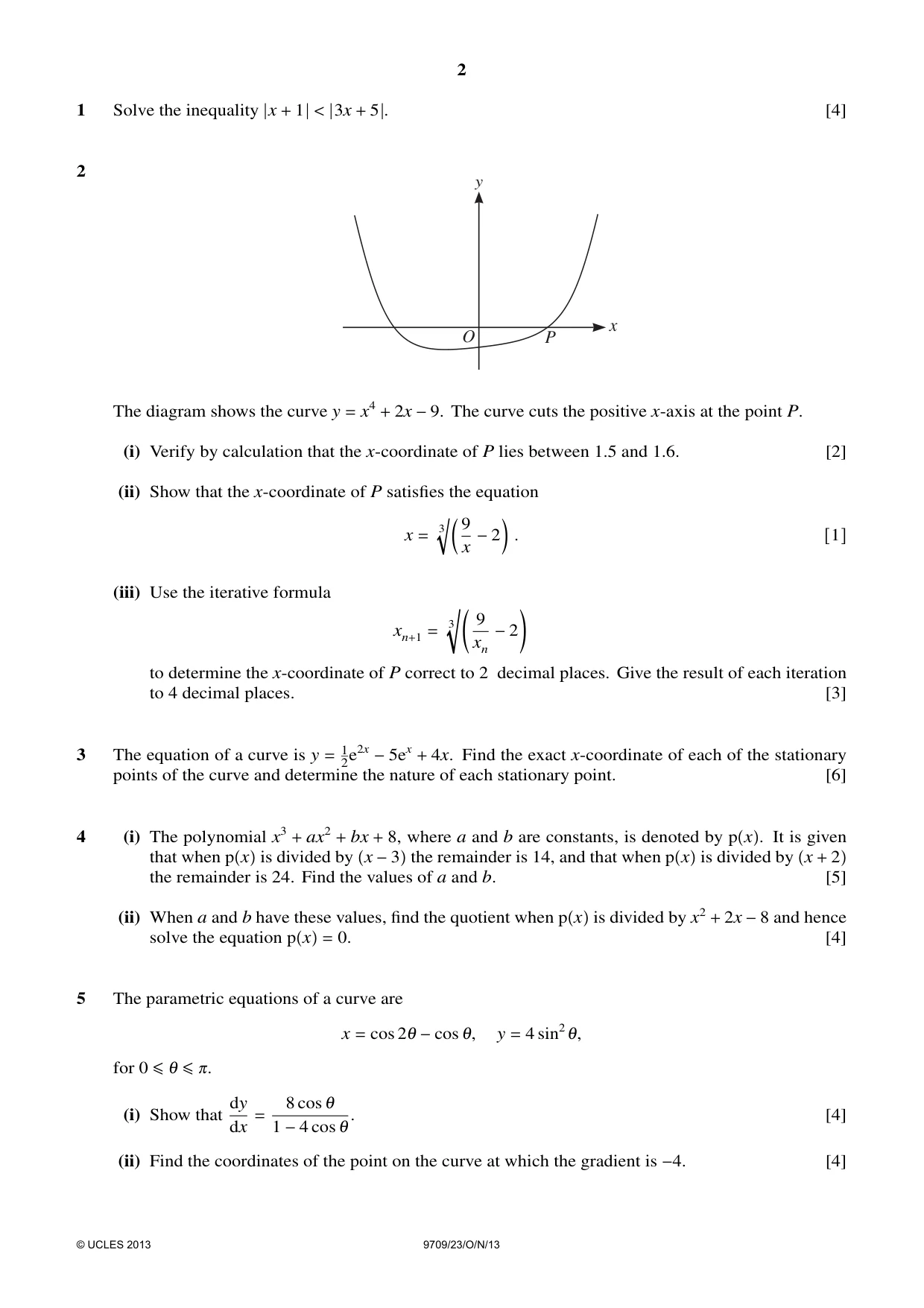
1 Solve the inequality x 1 3x 5 . [4] + < +
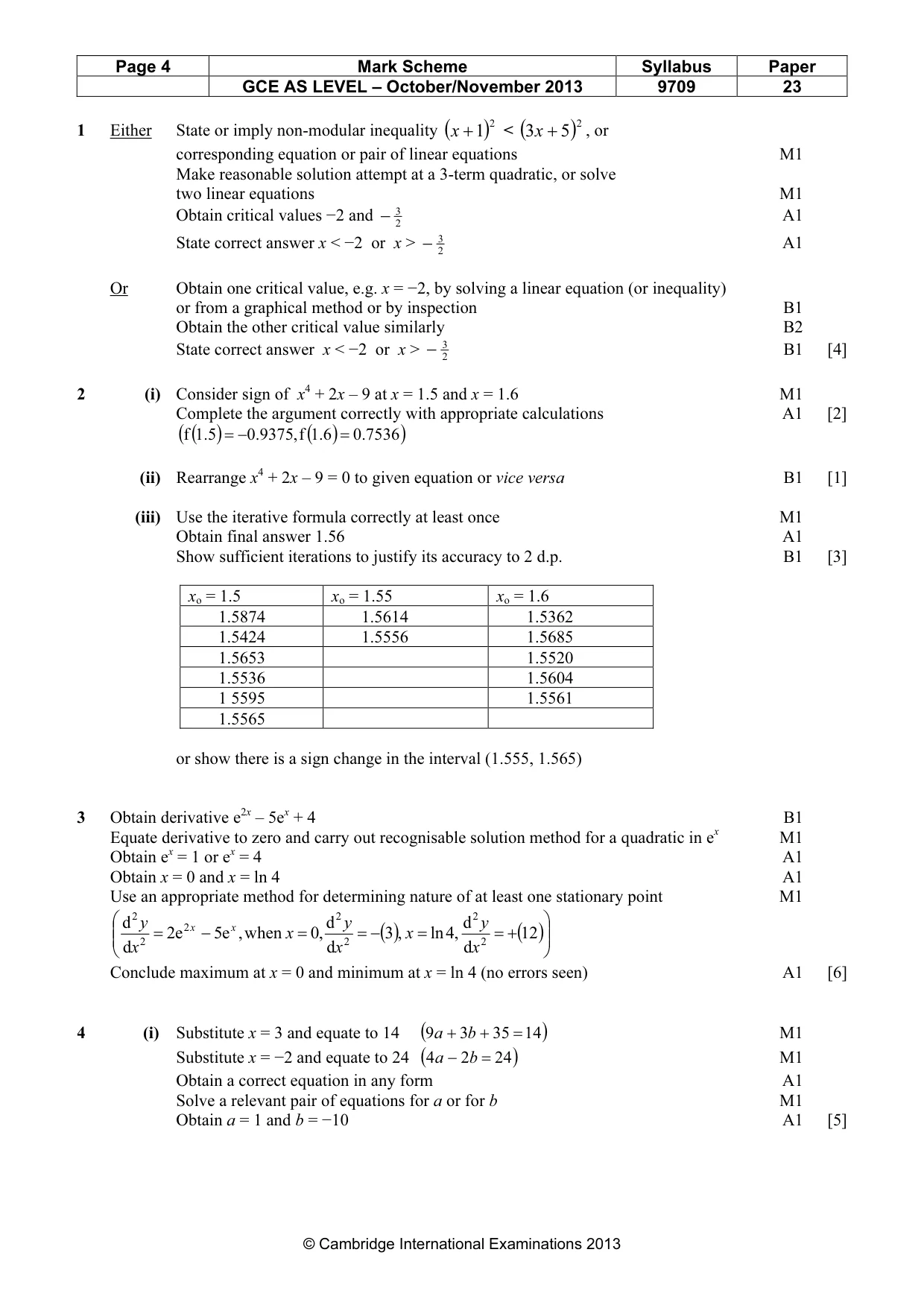
Mark scheme: 1 Either State or imply non-modular inequality ( x + 1) 2 < (3 x + 5 ) 2 , or corresponding equation or pair of linear equations M1 Make reasonable solution attempt at a 3-term quadratic, or solve two linear equations M1 Obtain critical values −2 and − 32 A1 State correct answer x < −2 or x > − 32 A1 Or Obtain one critical value, e.g. x = −2, by solving a linear equation (or inequality) or from a graphical method or by inspection B1 Obtain the other critical value similarly B2 State correct answer x < −2 or x > − 32 B1 [4] 4
Q2 · Y x O P The diagram shows the curve y x4 2x The curve cuts the positive x-axis at the…
2 y x O P The diagram shows the curve y x4 2x The curve cuts the positive x-axis at the point P. = + −9. (i) Verify by calculation that the x-coordinate of P lies between 1.5 and 1.6. [2] (ii) Show that the x-coordinate of P satisfies the equation 3O@9 A x . x = −2 (iii) Use the iterative formula _P Q 3 9 xn+1 = xn −2 to determine the x-coordinate of P correct to 2 decimal places. Give the result of each iteration to 4 decimal places. [3]
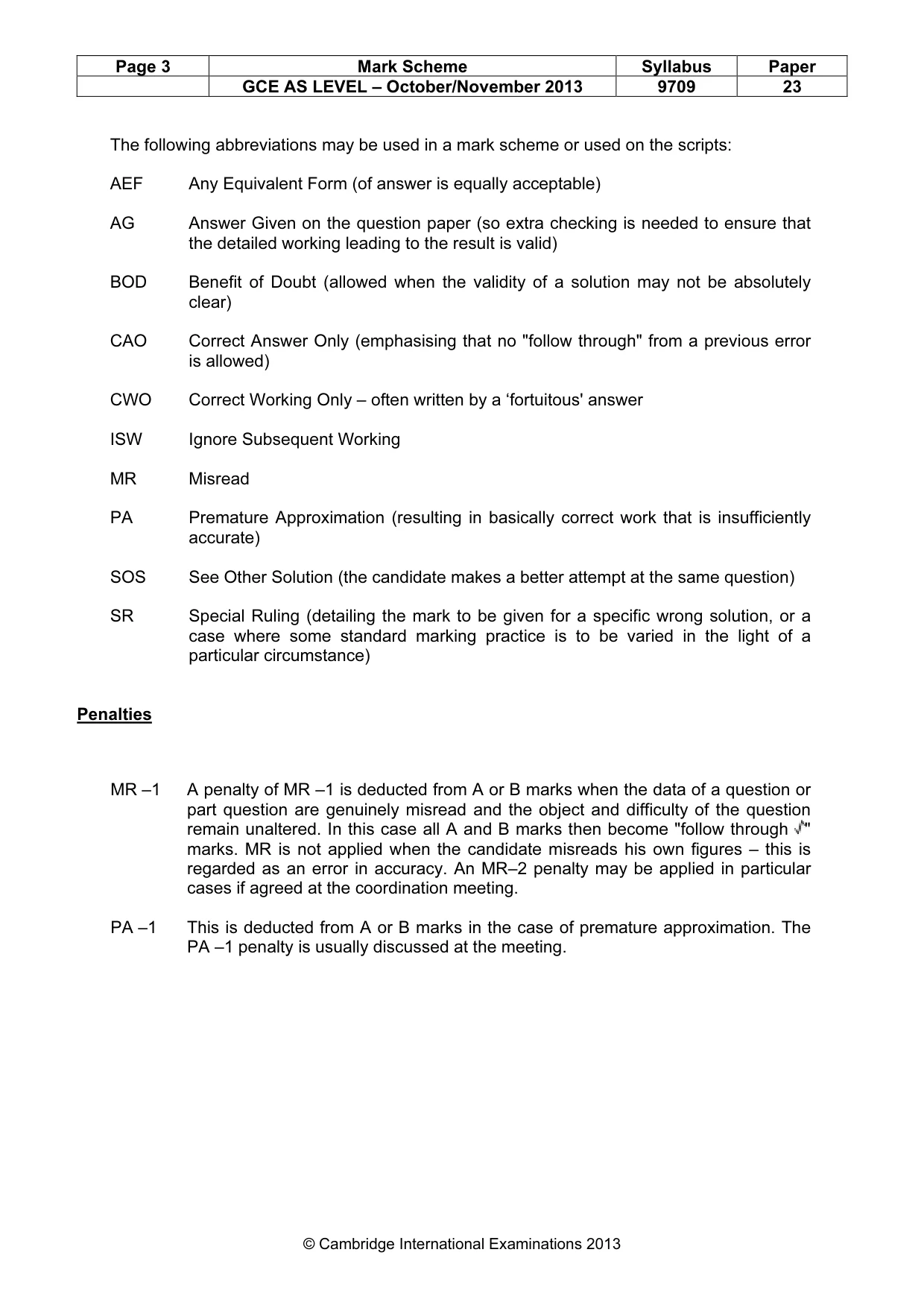
Mark scheme: 2 (i) Consider sign of x4 + 2x – 9 at x = 1.5 and x = 1.6 M1 Complete the argument correctly with appropriate calculations A1 [2] (f (1.5 ) = −.0 9375f, (1.6 ) = .0 7536 ) (ii) Rearrange x4 + 2x – 9 = 0 to given equation or vice versa B1 [1] (iii) Use the iterative formula correctly at least once M1 Obtain final answer 1.56 A1 Show sufficient iterations to justify its accuracy to 2 d.p. B1 [3] xo = 1.5 xo = 1.55 xo = 1.6 1.5874 1.5614 1.5362 1.5424 1.5556 1.5685 1.5653 1.5520 1.5536 1.5604 1 5595 1.5561 1.5565 or show there is a sign change in the interval (1.555, 1.565) 2
Q3 · The equation of a curve is y 12e2x 4x
3 The equation of a curve is y 12e2x 4x. Find the exact x-coordinate of each of the stationary points of the curve and determine= the−5exnature+ of each stationary point. [6]
Mark scheme: 3 Obtain derivative e2x – 5ex + 4 B1 Equate derivative to zero and carry out recognisable solution method for a quadratic in ex M1 Obtain ex = 1 or ex = 4 A1 Obtain x = 0 and x = ln 4 A1 Use an appropriate method for determining nature of at least one stationary point M1 d 2 y 2 x x d 2 y d 2 y = 2e − 5e , when x = ,0 = − (3), x = ln ,4 = + (12 ) dx 2 dx 2 dx 2 Conclude maximum at x = 0 and minimum at x = ln 4 (no errors seen) A1 [6] ( )
Q5 · The parametric equations of a curve are x cos y 4 = 21 −cos 1, = sin21, for 0 ≤1 ≤0
5 The parametric equations of a curve are x cos y 4 = 21 −cos 1, = sin21, for 0 ≤1 ≤0. dy 8 cos (i) Show that [4] 1 dx 1 cos = −4 1. (ii) Find the coordinates of the point on the curve at which the gradient is [4] −4.
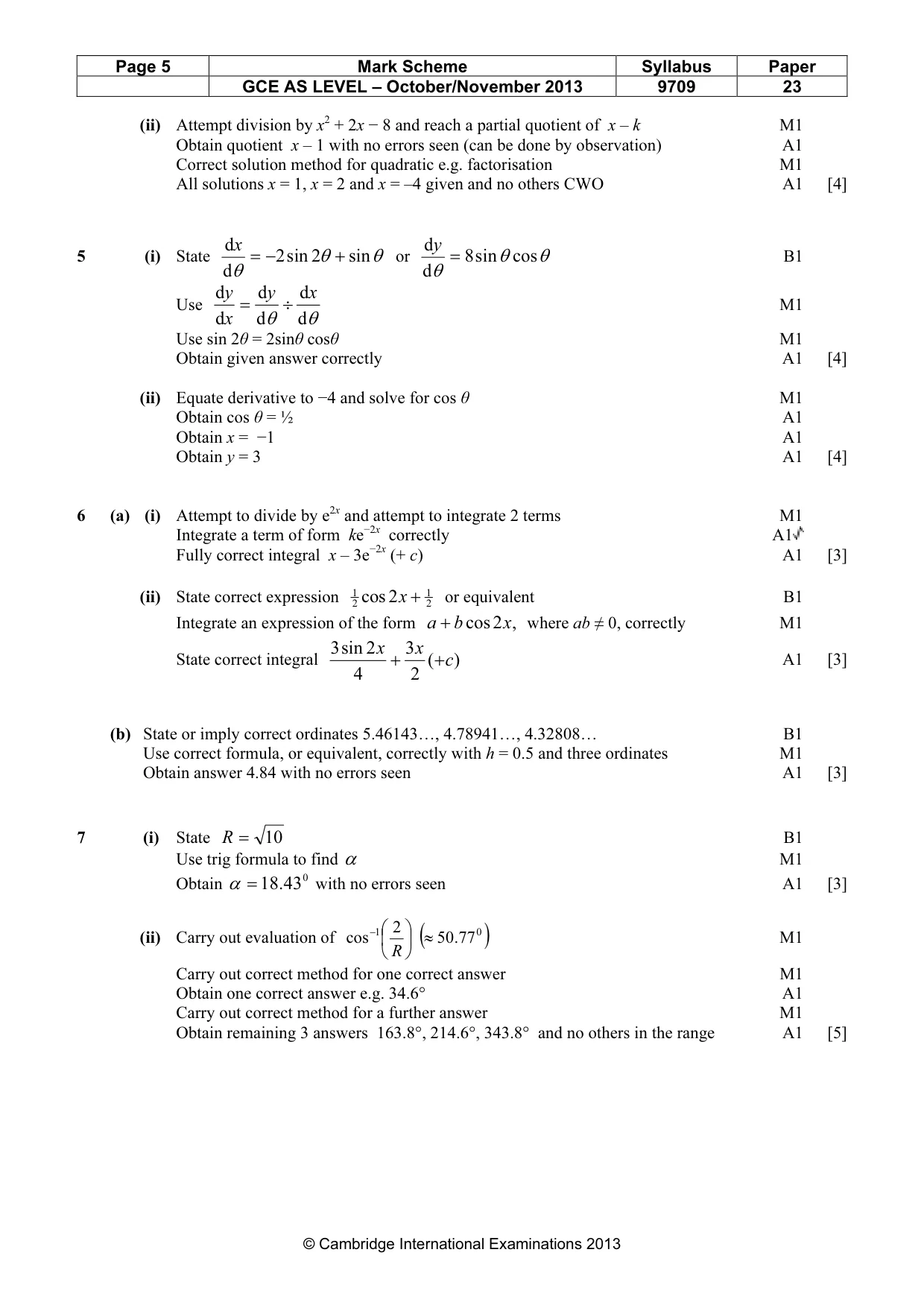
Mark scheme: dx dy 5 (i) State = −2 sin 2θ + sin θ or = 8 sin θ cos θ B1 d θ d θ dy d y d x Use = ÷ M1 d x d θ dθ Use sin 2θ = 2sinθ cosθ M1 Obtain given answer correctly A1 [4] (ii) Equate derivative to −4 and solve for cos θ M1 Obtain cos θ = ½ A1 Obtain x = −1 A1 Obtain y = 3 A1 [4] 2
What was in this paper
The subtopics covered by these 4 questions, and how many questions each got. Open one in a new tab to see every Cambridge question on it.
What you needed in this session
Cambridge’s own grade thresholds for 2013 Oct/Nov, Paper 2 · Variant 3. A higher threshold means an easier paper — the bar moves with how the cohort did.