Cambridge A Level Mathematics 9709 — 2012 Oct/Nov Paper 6 · Variant 2
9709/62/O/N/12 · 6 questions · 50 marks · ≈56 min
The question paper and its mark scheme, free to read here and free to download. This is Cambridge’s own paper, exactly as it was sat.
Question paper4 pages
Mark scheme6 pages
Answers below. Sit the paper first if you are practising.
Questions as text
Q1 · Fabio drinks coffee each morning
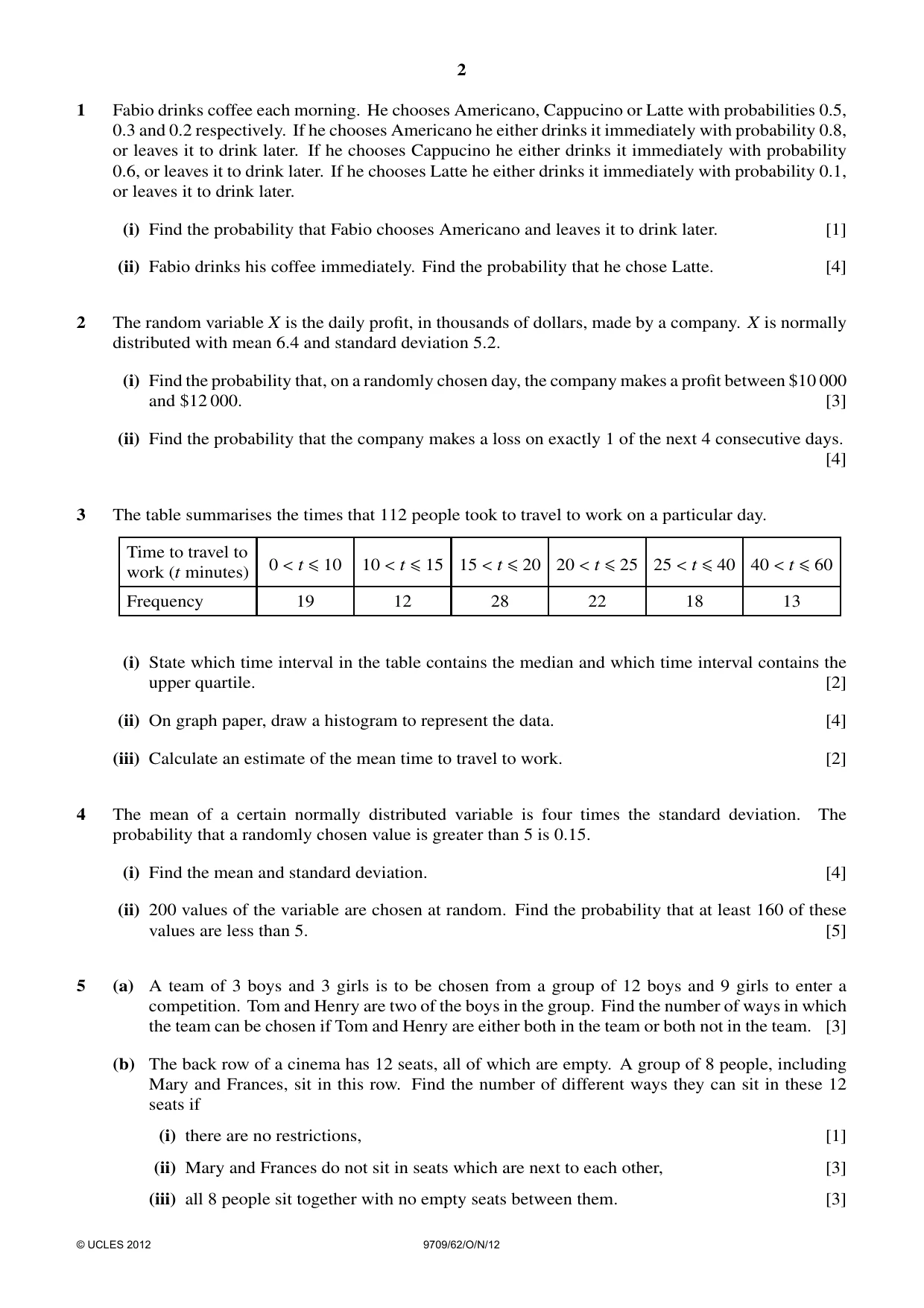
1 Fabio drinks coffee each morning. He chooses Americano, Cappucino or Latte with probabilities 0.5, 0.3 and 0.2 respectively. If he chooses Americano he either drinks it immediately with probability 0.8, or leaves it to drink later. If he chooses Cappucino he either drinks it immediately with probability 0.6, or leaves it to drink later. If he chooses Latte he either drinks it immediately with probability 0.1, or leaves it to drink later. (i) Find the probability that Fabio chooses Americano and leaves it to drink later. [1] (ii) Fabio drinks his coffee immediately. Find the probability that he chose Latte. [4]
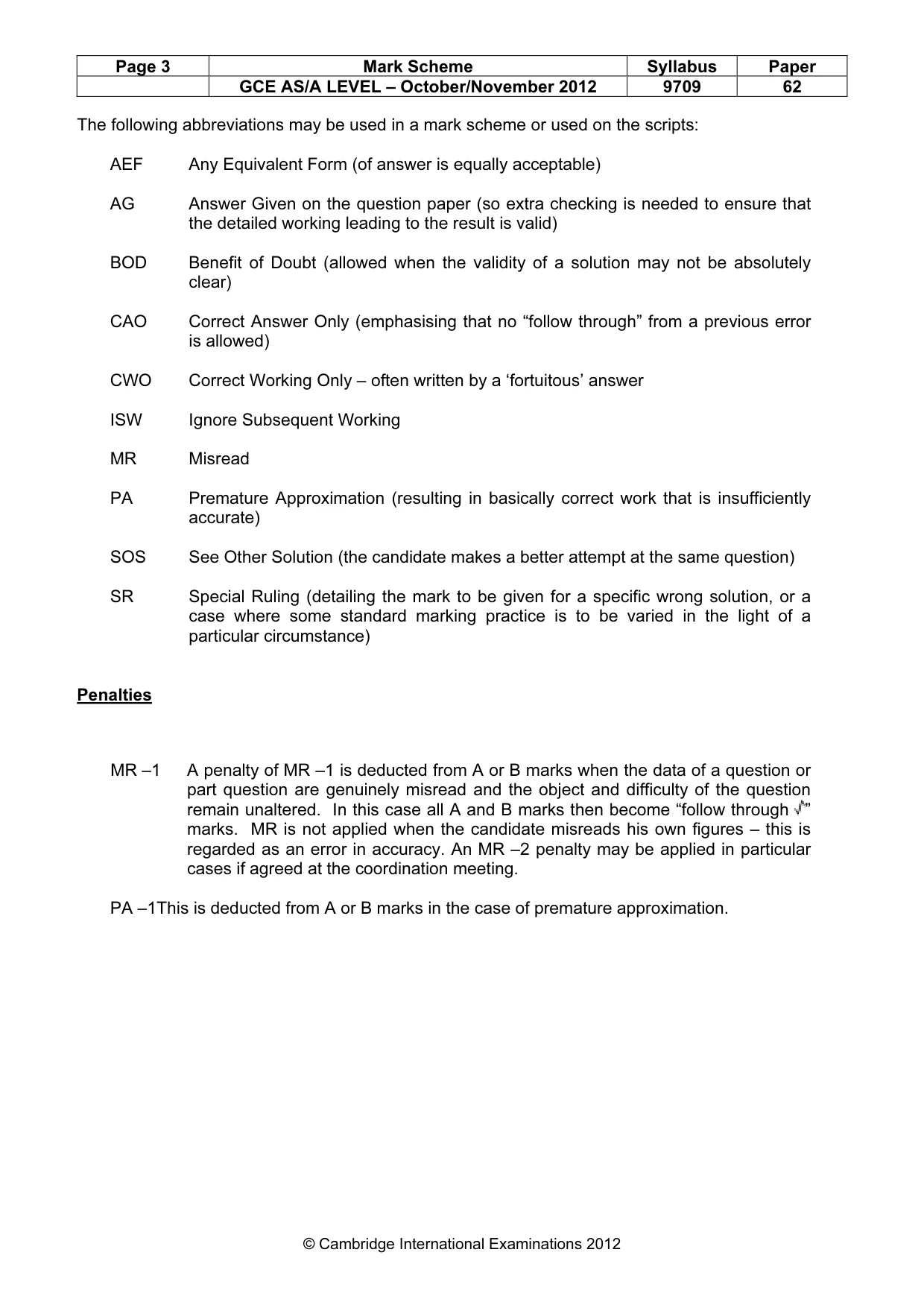
Mark scheme: 1 (i) P (A Later) = 0.5 × 0.2 = 0.1 B1 [1] (ii) P(L given I) = (0.2 × 0.1) / (0.5 × 0.8 + 0.3 × B1 0.2 × 0.1 seen on its own as num or 0.6 + 0.2 × 0.1) denom of a fraction M1 Attempt at P(I) summing 2 or 3 2- factor prods, seen anywhere = 0.02 / 0.6 A1 Correct unsimplified P(I) as num or denom of a fraction = 0.0333 (1 / 30) A1 [4] Correct answer accept 0.033 12 6 4
Q2 · The random variable X is the daily profit, in thousands of dollars, made by a company
2 The random variable X is the daily profit, in thousands of dollars, made by a company. X is normally distributed with mean 6.4 and standard deviation 5.2. (i) Find the probability that, on a randomly chosen day, the company makes a profit between $10 000 and $12 000. [3] (ii) Find the probability that the company makes a loss on exactly 1 of the next 4 consecutive days. [4]
Mark scheme: − 4.62 (i) z1 = 12 = .1 077 M1 Standardising, can be all in thousands, 2.5 no mix, no cc no sq rt no sq 10 − 4.6 z 2 = = .0 692 M1 Φ 2 – Φ 1, Φ 2 must be > Φ 1 2.5 Φ(z1) – Φ (z2) = 0.8593 – 0.7556 A1 [3] Correct answer = 0.104 (ii) P(loss) = P( z < 0 − 4.6 ) = P(z < –1.231) M1 2.5 Standardising using x = 0, accept = 1 – 0.8909 5.0 − 4.6 2.5 = 0.109 A1 Correct prob P(1) = (0.1091)1(0.8909)3 × 4C1 M1 Binomial term 4Cxpx(1–p)4-x any p x ≠ 0 = 0.309 or 0.308 A1 [4] Correct answer
Q3 · The table summarises the times that 112 people took to travel to work on a particular day
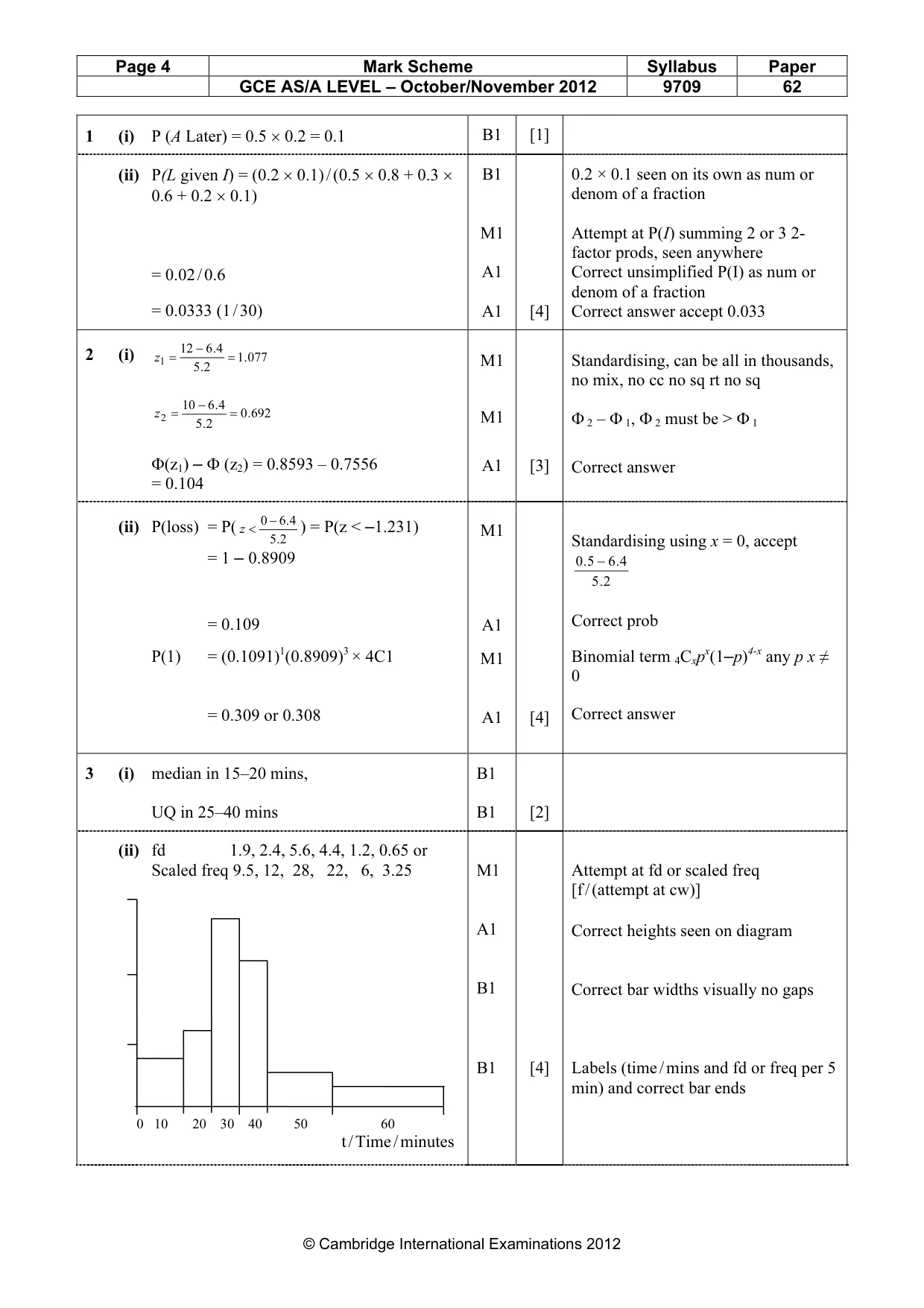
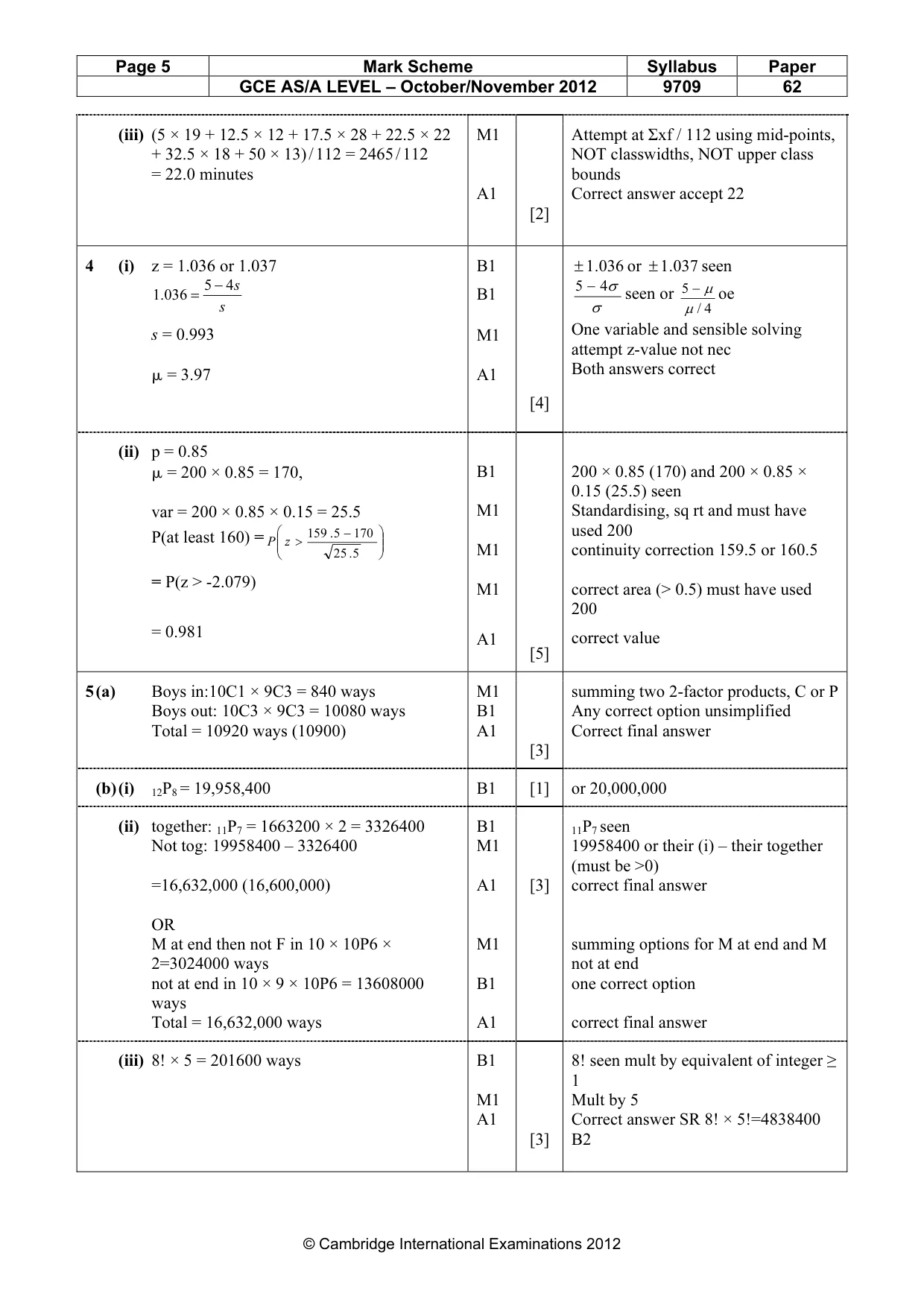
3 The table summarises the times that 112 people took to travel to work on a particular day. Time to travel to 0 < t ≤10 10 < t ≤15 15 < t ≤20 20 < t ≤25 25 < t ≤40 40 < t ≤60 work (t minutes) Frequency 19 12 28 22 18 13 (i) State which time interval in the table contains the median and which time interval contains the upper quartile. [2] (ii) On graph paper, draw a histogram to represent the data. [4] (iii) Calculate an estimate of the mean time to travel to work. [2]
Mark scheme: 3 (i) median in 15–20 mins, B1 UQ in 25–40 mins B1 [2] (ii) fd 1.9, 2.4, 5.6, 4.4, 1.2, 0.65 or Scaled freq 9.5, 12, 28, 22, 6, 3.25 M1 Attempt at fd or scaled freq [f / (attempt at cw)] A1 Correct heights seen on diagram B1 Correct bar widths visually no gaps B1 [4] Labels (time / mins and fd or freq per 5 min) and correct bar ends
Q4 · The mean of a certain normally distributed variable is four times the standard deviation
4 The mean of a certain normally distributed variable is four times the standard deviation. The probability that a randomly chosen value is greater than 5 is 0.15. (i) Find the mean and standard deviation. [4] (ii) 200 values of the variable are chosen at random. Find the probability that at least 160 of these values are less than 5. [5]
Mark scheme: 4 (i) z = 1.036 or 1.037 B1 ± .1 036 or ± .1 037 seen 5 − 4 s 5 − 4σ 5 − µ .1 036 = B1 seen or oe s σ µ / 4 s = 0.993 M1 One variable and sensible solving attempt z-value not nec Both answers correct ã = 3.97 A1 [4] (ii) p = 0.85 ã = 200 × 0.85 = 170, B1 200 × 0.85 (170) and 200 × 0.85 × 0.15 (25.5) seen var = 200 × 0.85 × 0.15 = 25.5 M1 Standardising, sq rt and must have 159 5. − 170 used 200 P(at least 160) = P z > 25 5. M1 continuity correction 159.5 or 160.5 = P(z > -2.079) M1 correct area (> 0.5) must have used 200 = 0.981 A1 correct value [5]
Q5 · A team of 3 boys and 3 girls is to be chosen from a group of 12 boys and 9 girls to enter…
5 (a) A team of 3 boys and 3 girls is to be chosen from a group of 12 boys and 9 girls to enter a competition. Tom and Henry are two of the boys in the group. Find the number of ways in which the team can be chosen if Tom and Henry are either both in the team or both not in the team. [3] (b) The back row of a cinema has 12 seats, all of which are empty. A group of 8 people, including Mary and Frances, sit in this row. Find the number of different ways they can sit in these 12 seats if (i) there are no restrictions, [1] (ii) Mary and Frances do not sit in seats which are next to each other, [3] (iii) all 8 people sit together with no empty seats between them. [3]
Mark scheme: 5 (a) Boys in:10C1 × 9C3 = 840 ways M1 summing two 2-factor products, C or P Boys out: 10C3 × 9C3 = 10080 ways B1 Any correct option unsimplified Total = 10920 ways (10900) A1 Correct final answer [3] (b) (i) 12P8 = 19,958,400 B1 [1] or 20,000,000 (ii) together: 11P7 = 1663200 × 2 = 3326400 B1 11P7 seen Not tog: 19958400 – 3326400 M1 19958400 or their (i) – their together (must be >0) =16,632,000 (16,600,000) A1 [3] correct final answer OR M at end then not F in 10 × 10P6 × M1 summing options for M at end and M 2=3024000 ways not at end not at end in 10 × 9 × 10P6 = 13608000 B1 one correct option ways Total = 16,632,000 ways A1 correct final answer (iii) 8! × 5 = 201600 ways B1 8! seen mult by equivalent of integer ≥ 1 M1 Mult by 5 A1 Correct answer SR 8! × 5!=4838400 [3] B2 GCE AS/A LEVEL – October/November 2012 9709 62
Q6 · A fair tetrahedral die has four triangular faces, numbered 1, 2, 3 and 4
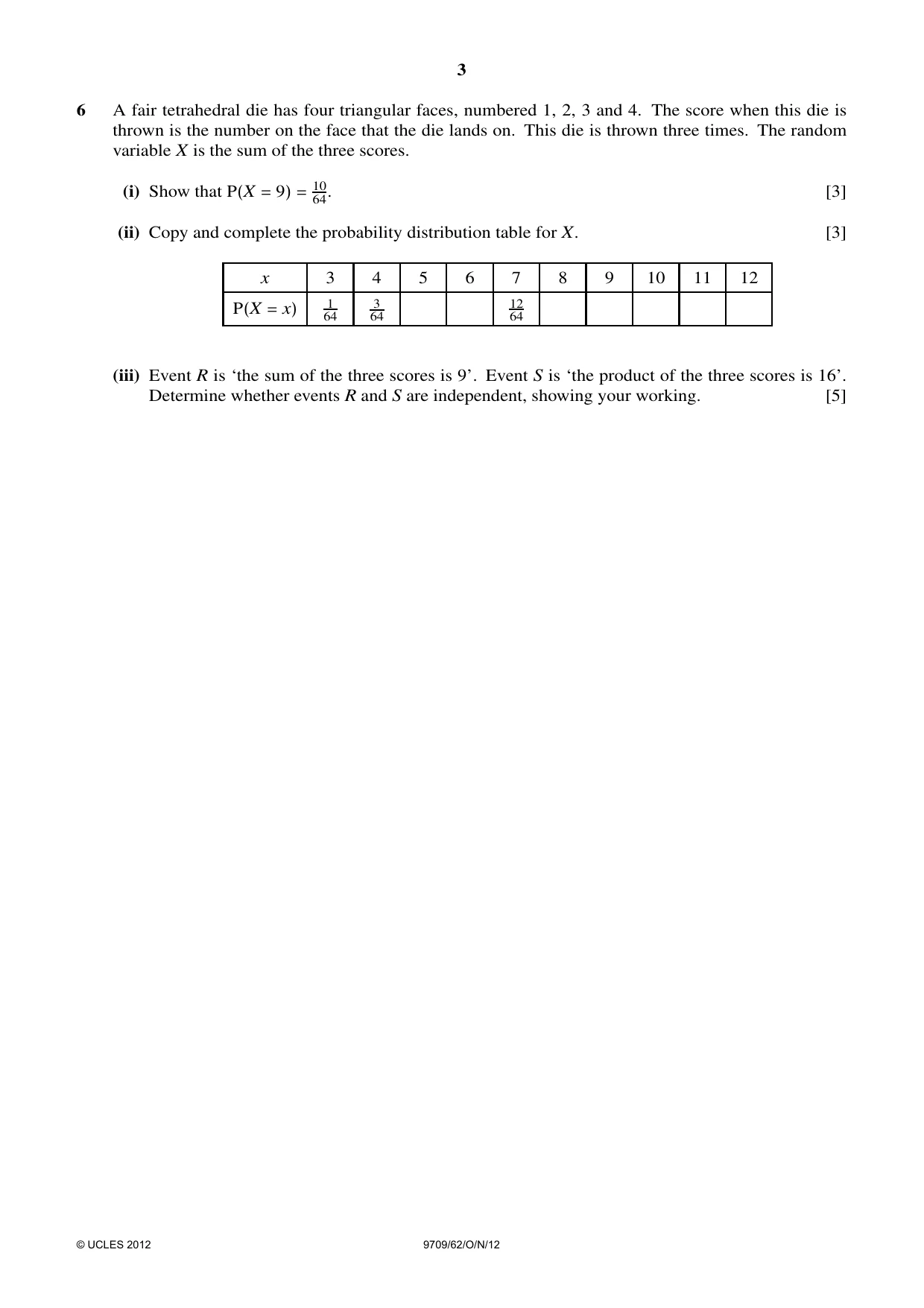
6 A fair tetrahedral die has four triangular faces, numbered 1, 2, 3 and 4. The score when this die is thrown is the number on the face that the die lands on. This die is thrown three times. The random variable X is the sum of the three scores. (i) Show that P(X = 9) = 1064. [3] (ii) Copy and complete the probability distribution table for X. [3] x 3 4 5 6 7 8 9 10 11 12 P(X = x) 1 3 12 64 64 64 (iii) Event R is ‘the sum of the three scores is 9’. Event S is ‘the product of the three scores is 16’. Determine whether events R and S are independent, showing your working. [5]
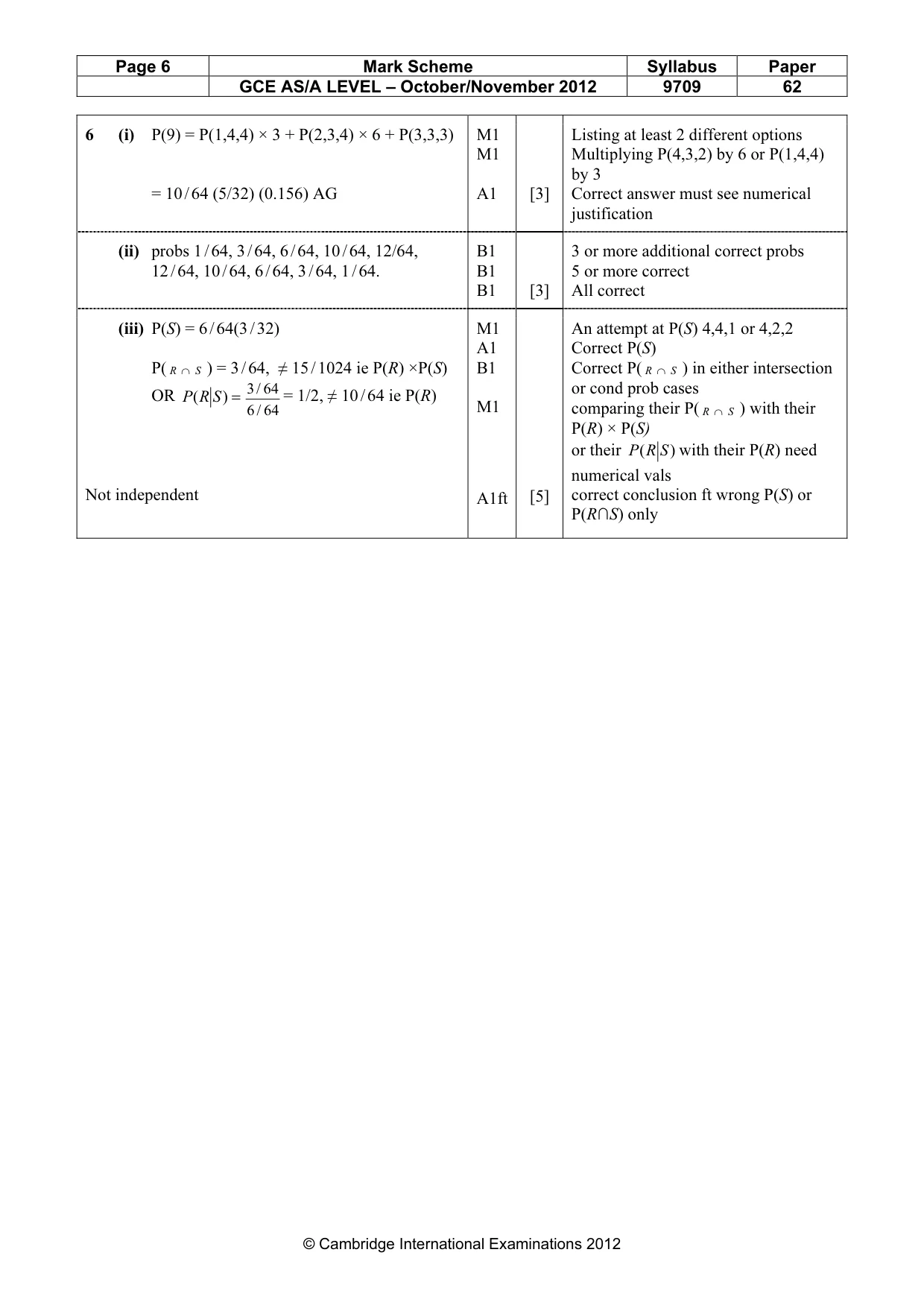
Mark scheme: 6 (i) P(9) = P(1,4,4) × 3 + P(2,3,4) × 6 + P(3,3,3) M1 Listing at least 2 different options M1 Multiplying P(4,3,2) by 6 or P(1,4,4) by 3 = 10 / 64 (5/32) (0.156) AG A1 [3] Correct answer must see numerical justification (ii) probs 1 / 64, 3 / 64, 6 / 64, 10 / 64, 12/64, B1 3 or more additional correct probs 12 / 64, 10 / 64, 6 / 64, 3 / 64, 1 / 64. B1 5 or more correct B1 [3] All correct (iii) P(S) = 6 / 64(3 / 32) M1 An attempt at P(S) 4,4,1 or 4,2,2 A1 Correct P(S) P( R ∩ S ) = 3 / 64, ≠ 15 / 1024 ie P(R) ×P(S) B1 Correct P( R ∩ S ) in either intersection 3 / 64 or cond prob cases OR P ( R S ) = = 1/2, ≠ 10 / 64 ie P(R) 6 / 64 M1 comparing their P( R ∩ S ) with their P(R) × P(S) or their P ( R S ) with their P(R) need numerical vals Not independent A1ft [5] correct conclusion ft wrong P(S) or P(R∩S) only
What was in this paper
The subtopics covered by these 6 questions, and how many questions each got. Open one in a new tab to see every Cambridge question on it.
What you needed in this session
Cambridge’s own grade thresholds for 2012 Oct/Nov, Paper 6 · Variant 2. A higher threshold means an easier paper — the bar moves with how the cohort did.