Cambridge A Level Mathematics 9709 — 2012 May/June Paper 5 · Variant 1
9709/51/M/J/12 · 7 questions · 50 marks · ≈56 min
The question paper and its mark scheme, free to read here and free to download. This is Cambridge’s own paper, exactly as it was sat.
Question paper4 pages
Mark scheme6 pages
Answers below. Sit the paper first if you are practising.
Questions as text
Q1 · The end A of a rod AB of length 1.2 m is freely pivoted at a fixed point
1 The end A of a rod AB of length 1.2 m is freely pivoted at a fixed point. The rod rotates about A in a vertical plane. Calculate the angular speed of the rod at an instant when B has speed 0.6 m s−1. [2]
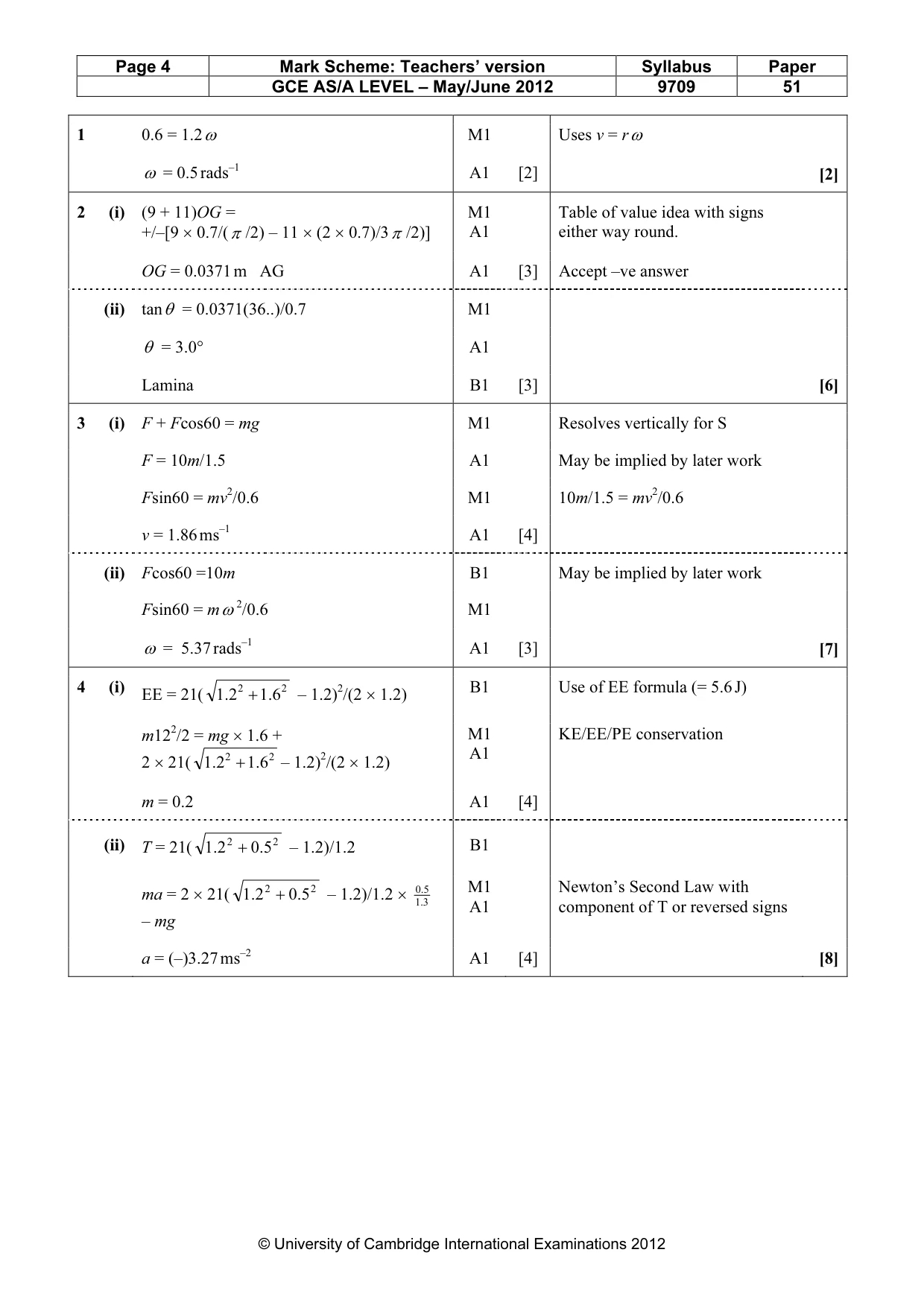
Mark scheme: 1 0.6 = 1.2ω M1 Uses v = rω ω = 0.5 rads–1 A1 [2] [2]
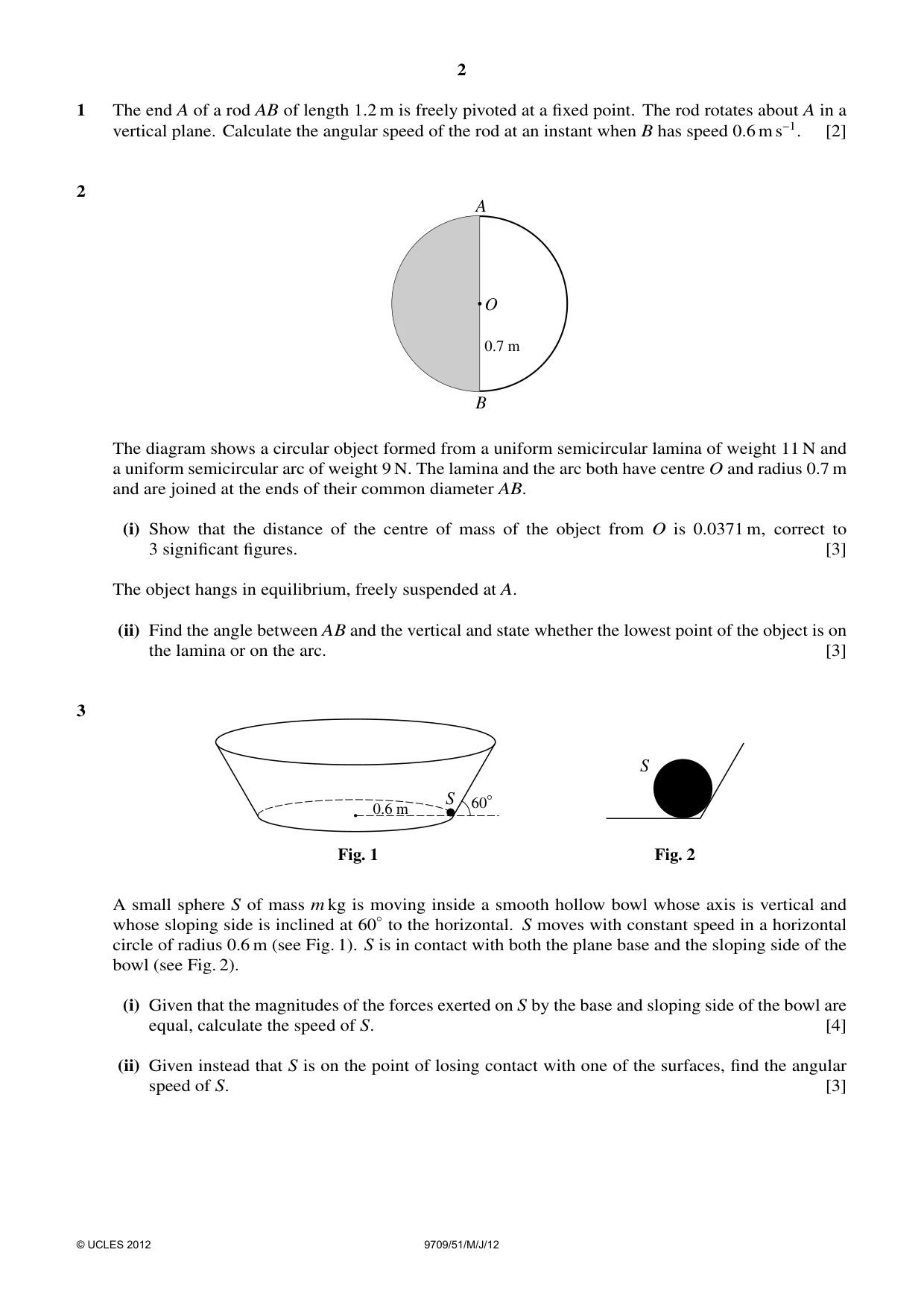
Q2 · A O 0.7 m B The diagram shows a circular object formed from a uniform semicircular lamina…
2 A O 0.7 m B The diagram shows a circular object formed from a uniform semicircular lamina of weight 11 N and a uniform semicircular arc of weight 9 N. The lamina and the arc both have centre O and radius 0.7 m and are joined at the ends of their common diameter AB. (i) Show that the distance of the centre of mass of the object from O is 0.0371 m, correct to 3 significant figures. [3] The object hangs in equilibrium, freely suspended at A. (ii) Find the angle between AB and the vertical and state whether the lowest point of the object is on the lamina or on the arc. [3]
Mark scheme: 2 (i) (9 + 11)OG = M1 Table of value idea with signs +/–[9 × 0.7/(π /2) – 11 × (2 × 0.7)/3π /2)] A1 either way round. OG = 0.0371 m AG A1 [3] Accept –ve answer (ii) tanθ = 0.0371(36..)/0.7 M1 θ = 3.0° A1 Lamina B1 [3] [6]
Q3 · S S 60° 0.6 m Fig
3 S S 60° 0.6 m Fig. 1 Fig. 2 A small sphere S of mass m kg is moving inside a smooth hollow bowl whose axis is vertical and whose sloping side is inclined at 60◦to the horizontal. S moves with constant speed in a horizontal circle of radius 0.6 m (see Fig. 1). S is in contact with both the plane base and the sloping side of the bowl (see Fig. 2). (i) Given that the magnitudes of the forces exerted on S by the base and sloping side of the bowl are equal, calculate the speed of S. [4] (ii) Given instead that S is on the point of losing contact with one of the surfaces, find the angular speed of S. [3]
Mark scheme: 3 (i) F + Fcos60 = mg M1 Resolves vertically for S F = 10m/1.5 A1 May be implied by later work Fsin60 = mv2/0.6 M1 10m/1.5 = mv2/0.6 v = 1.86 ms–1 A1 [4] (ii) Fcos60 =10m B1 May be implied by later work Fsin60 = mω 2/0.6 M1 ω = 5.37 rads–1 A1 [3] [7]
Q4 · A light elastic string has natural length 2.4 m and modulus of elasticity 21 N
4 A light elastic string has natural length 2.4 m and modulus of elasticity 21 N. A particle P of mass m kg is attached to the mid-point of the string. The ends of the string are attached to fixed points A and B which are 2.4 m apart at the same horizontal level. P is projected vertically upwards with velocity 12 m s−1 from the mid-point of AB. In the subsequent motion P is at instantaneous rest at a point 1.6 m above AB. (i) Find m. [4] (ii) Calculate the acceleration of P when it first passes through a point 0.5 m below AB. [4]
Mark scheme: 4 (i) 2 2 B1 Use of EE formula (= 5.6 J) EE = 21( 1.2 + 1.6 – 1.2)2/(2 × 1.2) m122/2 = mg × 1.6 + M1 KE/EE/PE conservation 2 2 A1 2 × 21( 1.2 + 1.6 – 1.2)2/(2 × 1.2) m = 0.2 A1 [4] (ii) T = 21( 1.2 2 + 0.5 2 – 1.2)/1.2 B1 2 2 5.0 M1 Newton’s Second Law with ma = 2 × 21( 1.2 + 0.5 – 1.2)/1.2 × 3.1 A1 component of T or reversed signs – mg a = (–)3.27 ms–2 A1 [4] [8] GCE AS/A LEVEL – May/June 2012 9709 51
Q5 · A particle P of mass 0.4 kg is released from rest at the top of a smooth plane inclined…
5 A particle P of mass 0.4 kg is released from rest at the top of a smooth plane inclined at 30◦to the horizontal. The motion of P down the slope is opposed by a force of magnitude 0.6x N, where x m is the distance P has travelled down the slope. P comes to rest before reaching the foot of the slope. Calculate (i) the greatest speed of P during its motion, [7] (ii) the distance travelled by P during its motion. [2]
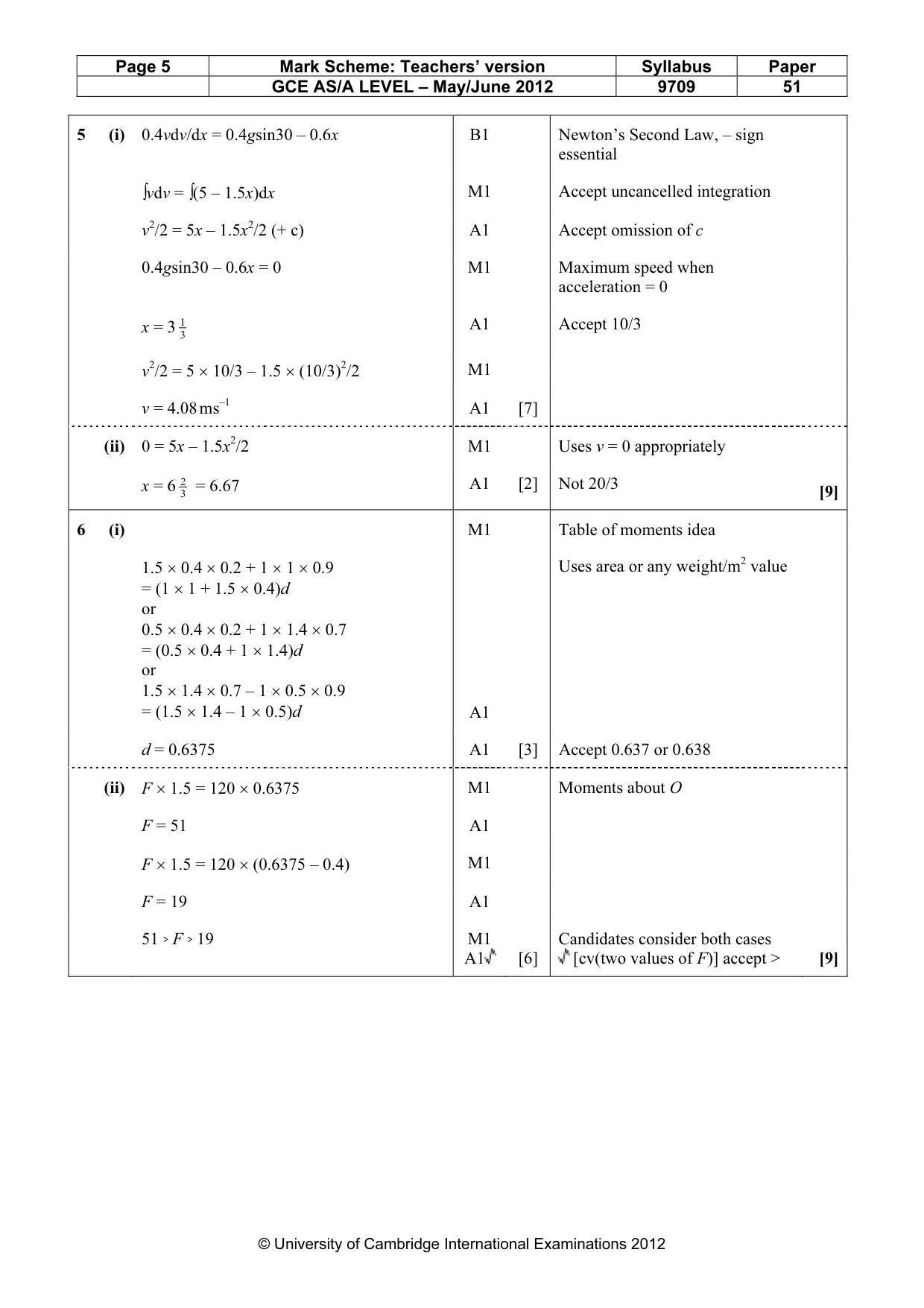
Mark scheme: 5 (i) 0.4vdv/dx = 0.4gsin30 – 0.6x B1 Newton’s Second Law, – sign essential ∫vdv = ∫(5 – 1.5x)dx M1 Accept uncancelled integration v2/2 = 5x – 1.5x2/2 (+ c) A1 Accept omission of c 0.4gsin30 – 0.6x = 0 M1 Maximum speed when acceleration = 0 x = 3 13 A1 Accept 10/3 v2/2 = 5 × 10/3 – 1.5 × (10/3)2/2 M1 v = 4.08 ms–1 A1 [7] (ii) 0 = 5x – 1.5x2/2 M1 Uses v = 0 appropriately x = 6 23 = 6.67 A1 [2] Not 20/3 [9]
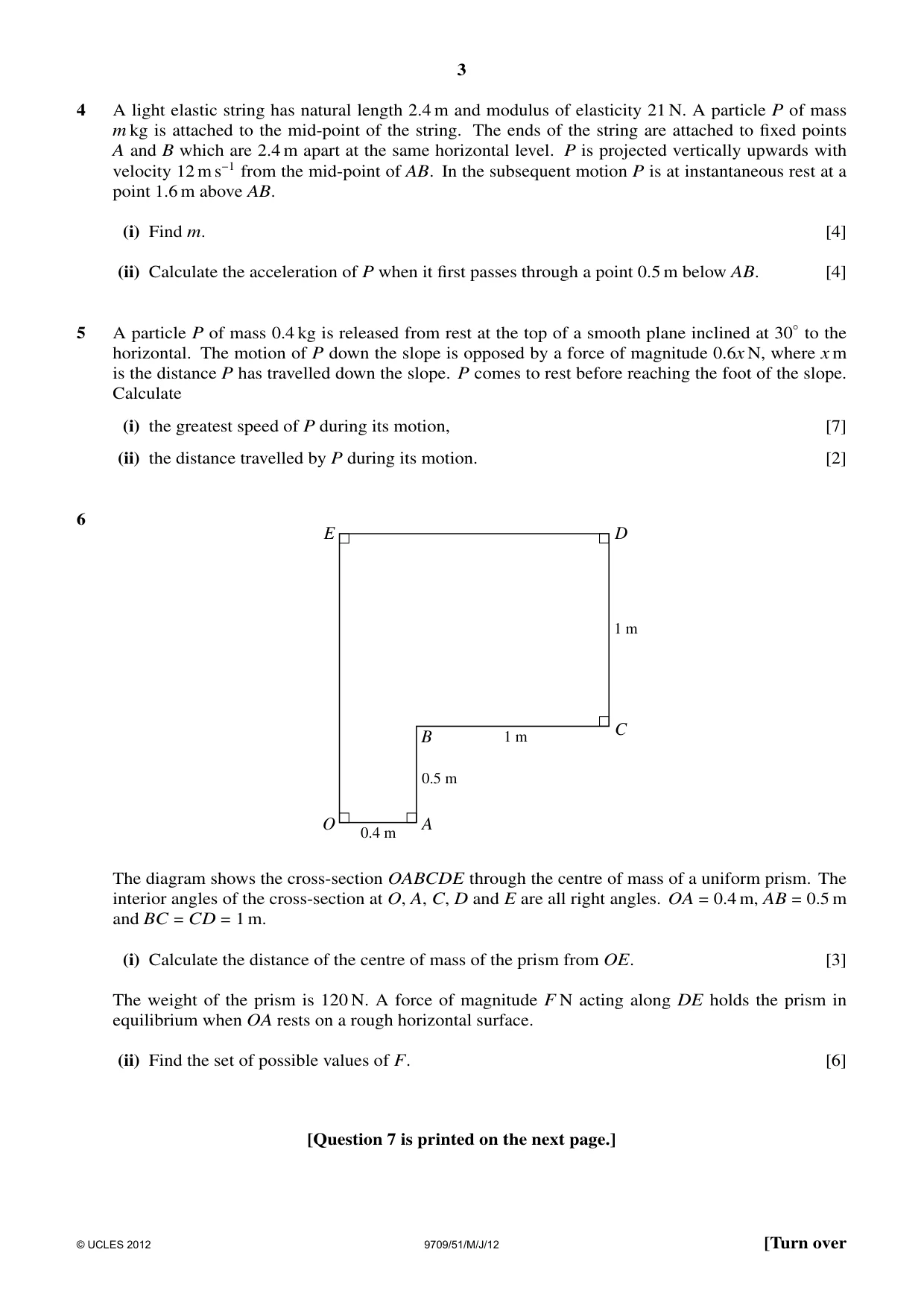
Q6 · E D 1 m C B 1 m 0.5 m O A 0.4 m The diagram shows the cross-section OABCDE through the…
6 E D 1 m C B 1 m 0.5 m O A 0.4 m The diagram shows the cross-section OABCDE through the centre of mass of a uniform prism. The interior angles of the cross-section at O, A, C, D and E are all right angles. OA = 0.4 m, AB = 0.5 m and BC = CD = 1 m. (i) Calculate the distance of the centre of mass of the prism from OE. [3] The weight of the prism is 120 N. A force of magnitude F N acting along DE holds the prism in equilibrium when OA rests on a rough horizontal surface. (ii) Find the set of possible values of F. [6] [Question 7 is printed on the next page.]
Mark scheme: 6 (i) M1 Table of moments idea 1.5 × 0.4 × 0.2 + 1 × 1 × 0.9 Uses area or any weight/m2 value = (1 × 1 + 1.5 × 0.4)d or 0.5 × 0.4 × 0.2 + 1 × 1.4 × 0.7 = (0.5 × 0.4 + 1 × 1.4)d or 1.5 × 1.4 × 0.7 – 1 × 0.5 × 0.9 = (1.5 × 1.4 – 1 × 0.5)d A1 d = 0.6375 A1 [3] Accept 0.637 or 0.638 (ii) F × 1.5 = 120 × 0.6375 M1 Moments about O F = 51 A1 F × 1.5 = 120 × (0.6375 – 0.4) M1 F = 19 A1 51 > F > 19 M1 Candidates consider both cases A1 [6] [cv(two values of F)] accept > [9] GCE AS/A LEVEL – May/June 2012 9709 51
Q7 · A small ball B is projected with speed 15 m s−1 at an angle of 41◦above the horizontal…
7 A small ball B is projected with speed 15 m s−1 at an angle of 41◦above the horizontal from a point O which is 1.6 m above horizontal ground. At time t s after projection the horizontal and vertically upward displacements of B from O are x m and y m respectively. (i) Express x and y in terms of t and hence show that the equation of the trajectory of B is y = 0.869x −0.0390x2, where the coefficients are correct to 3 significant figures. [4] A vertical fence is 1.5 m from O and perpendicular to the plane in which B moves. B just passes over the fence and subsequently strikes the ground at the point A. (ii) Calculate the height of the fence, and the distance from the fence to A. [5]
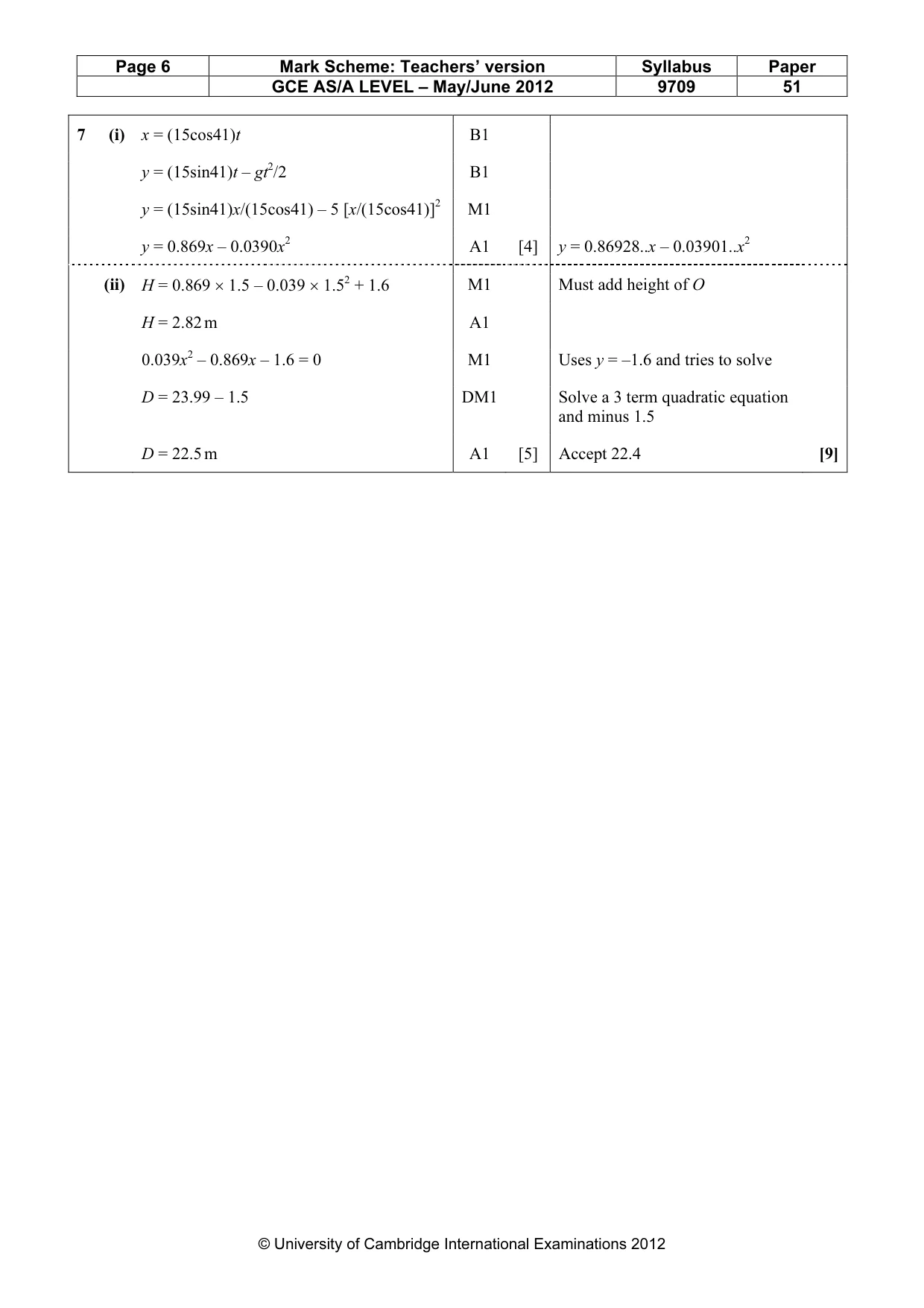
Mark scheme: 7 (i) x = (15cos41)t B1 y = (15sin41)t – gt2/2 B1 y = (15sin41)x/(15cos41) – 5 [x/(15cos41)]2 M1 y = 0.869x – 0.0390x2 A1 [4] y = 0.86928..x – 0.03901..x2 (ii) H = 0.869 × 1.5 – 0.039 × 1.52 + 1.6 M1 Must add height of O H = 2.82 m A1 0.039x2 – 0.869x – 1.6 = 0 M1 Uses y = –1.6 and tries to solve D = 23.99 – 1.5 DM1 Solve a 3 term quadratic equation and minus 1.5 D = 22.5 m A1 [5] Accept 22.4 [9]
What was in this paper
The subtopics covered by these 7 questions, and how many questions each got. Open one in a new tab to see every Cambridge question on it.
What you needed in this session
Cambridge’s own grade thresholds for 2012 May/June, Paper 5 · Variant 1. A higher threshold means an easier paper — the bar moves with how the cohort did.