Cambridge A Level Mathematics 9709 — 2009 May/June Paper 2 · Variant 1
9709/21/M/J/09 · 8 questions · 50 marks · ≈56 min
The question paper and its mark scheme, free to read here and free to download. This is Cambridge’s own paper, exactly as it was sat.
Question paper4 pages

Mark scheme5 pages
Answers below. Sit the paper first if you are practising.
Questions as text
Q1 · X 1 Given that use logarithms to find the value of correct to 3 significant figures
x 1 Given that use logarithms to find the value of correct to 3 significant figures. [3] y (1.25)x = (2.5)y,
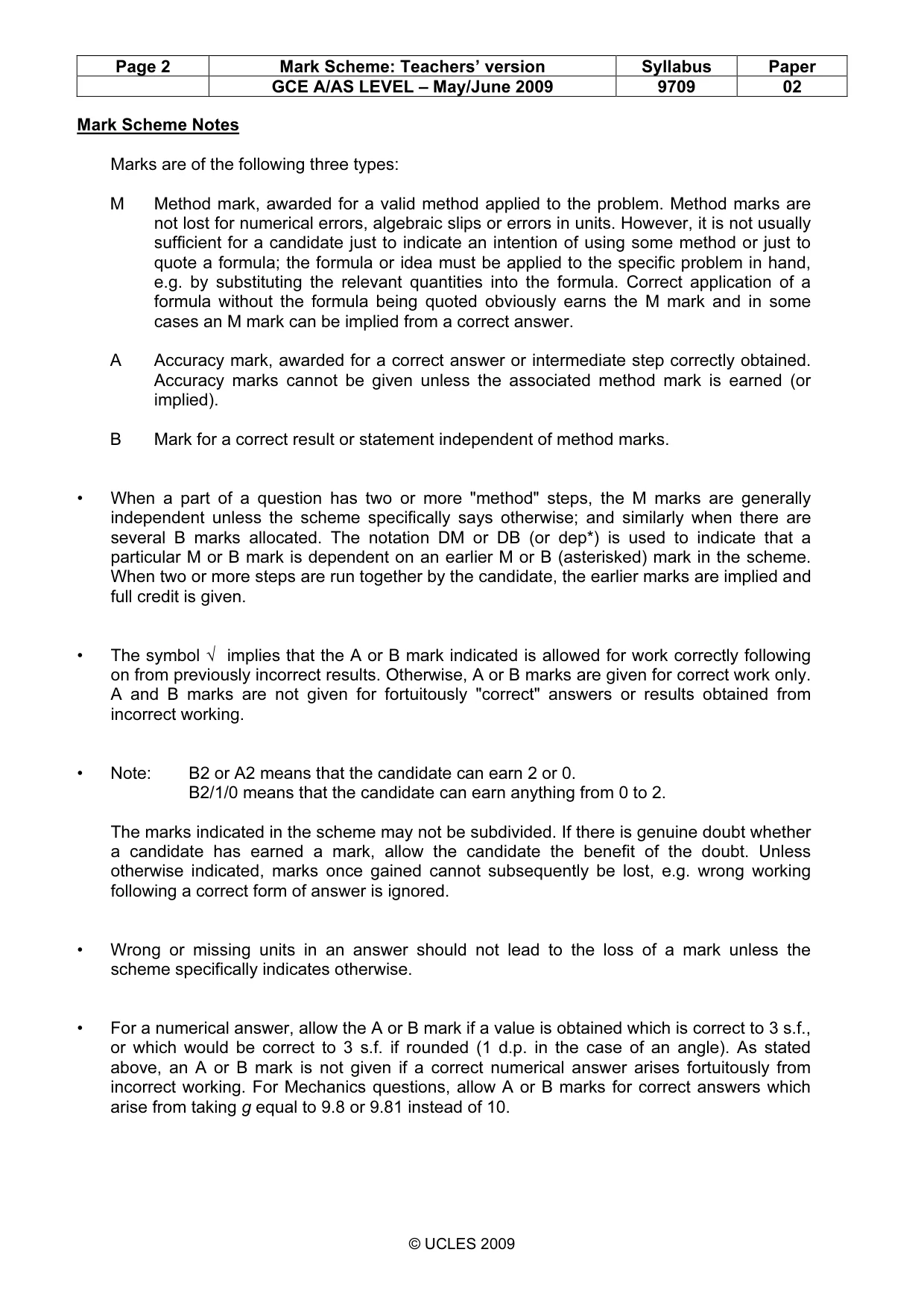
Mark scheme: 1 Use logarithms to linearise an equation M1 x ln 5.2 Obtain = , or equivalent A1 y ln .125 Obtain answer 4.11 A1√ [3] 2 2
Q2 · Solve the inequality [4] |3x + 2| < |x|
2 Solve the inequality [4] |3x + 2| < |x|.
Mark scheme: 2 EITHER: State or imply non-modular inequality (3x + 2)2 < x2, or corresponding quadratic equation, or pair of linear equations 3x + 2 = ± x M1 Make reasonable solution attempt at a 3-term quadratic, or solve two linear equations M1 Obtain critical values x = –1 and x = – 1 A1 2 State answer –1 < x < – 1 A1 2 OR: Obtain the critical value x = –1 from a graphical method or by inspection, or by solving a linear equation or inequality B1 Obtain the critical value x = – 1 similarly B2 2 State answer –1 < x < – 1 B1 [4] 2
Q3 · Y 1 x O 1 2 1 The diagram shows the curve y for values of x from 0 to 2
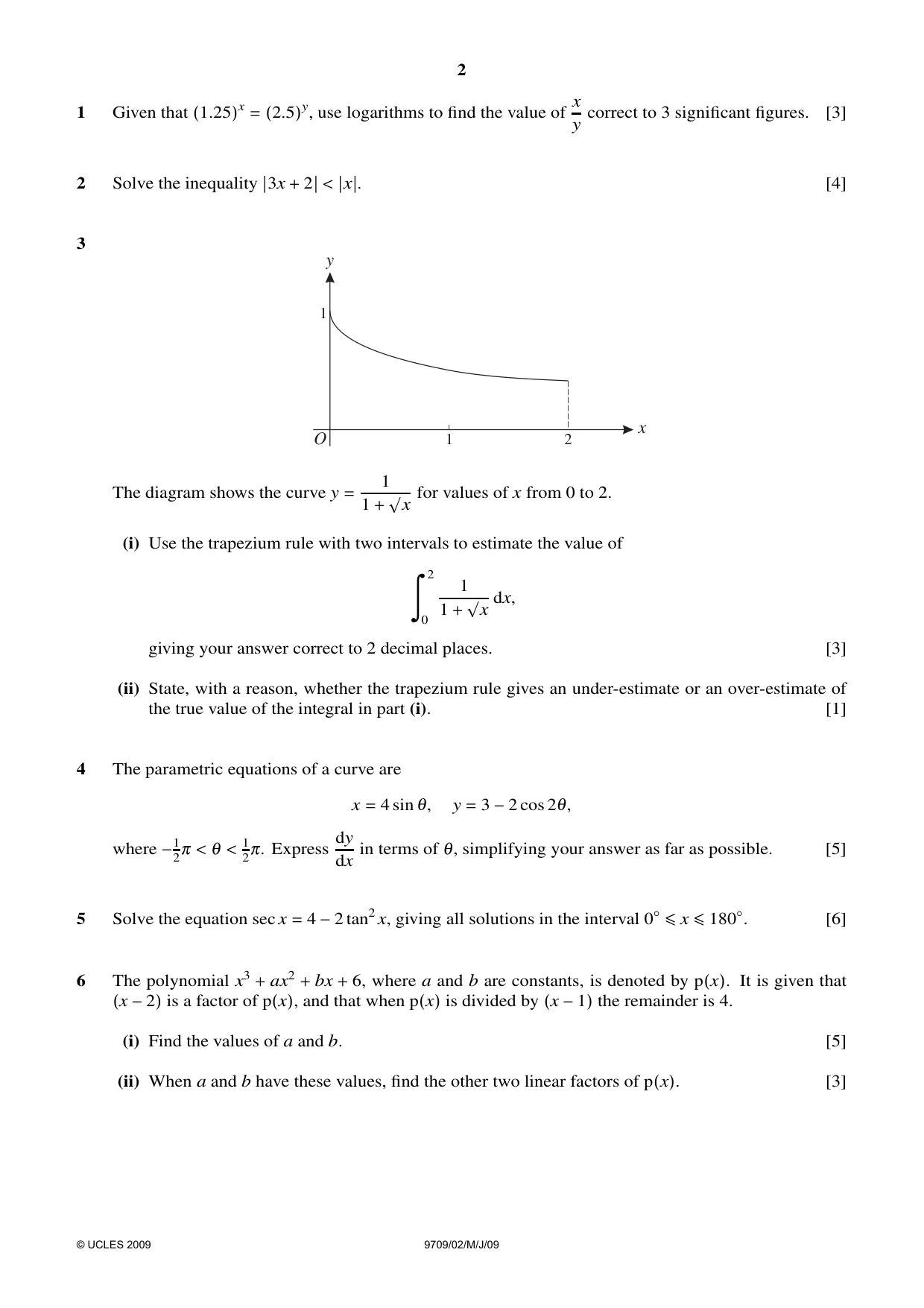
3 y 1 x O 1 2 1 The diagram shows the curve y for values of x from 0 to 2. 1 = √x + (i) Use the trapezium rule with two intervals to estimate the value of 2 1 dx, 1 √x ä 0 + giving your answer correct to 2 decimal places. [3] (ii) State, with a reason, whether the trapezium rule gives an under-estimate or an over-estimate of the true value of the integral in part (i). [1]
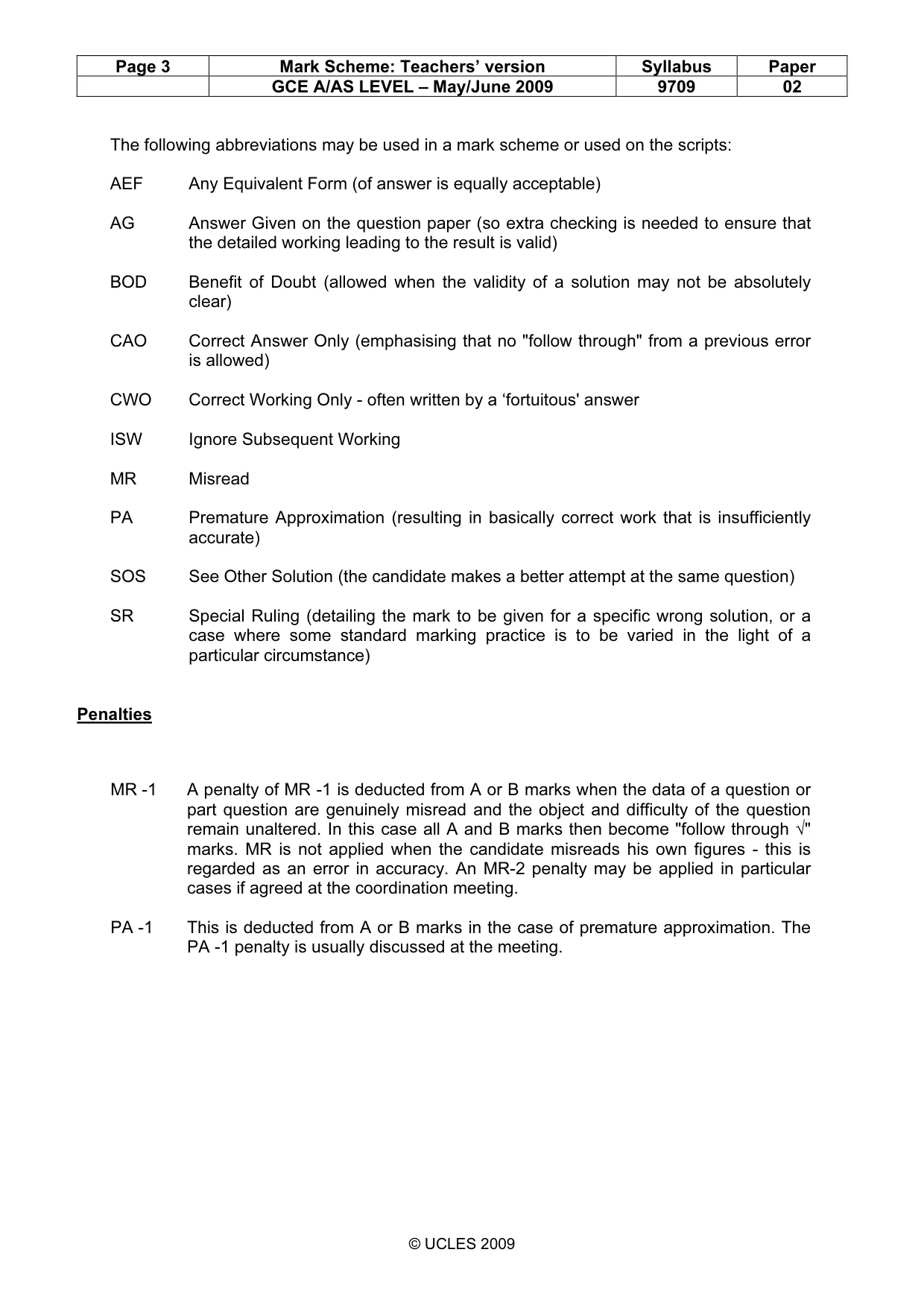
Mark scheme: 3 (i) Show or imply correct ordinates 1, 0.5, 0.414213 ... B1 Use correct formula, or equivalent, with h = 1 and three ordinates M1 Obtain answer 1.21 with no errors seen A1 [3] (ii) Justify the statement that the rule gives an over-estimate B1 [1] dx
Q4 · The parametric equations of a curve are x 4 sin θ, y 3 cos 2θ, = = −2 1 dy where 2π θ 2π
4 The parametric equations of a curve are x 4 sin θ, y 3 cos 2θ, = = −2 1 dy where 2π θ 2π. Express in terms of θ, simplifying your answer as far as possible. [5] dx −1 < <
Mark scheme: dx 4 State = 4 cos θ B1 dθ dy State = 4 sin 2θ , or equivalent B1 dθ dy dy dx Use = ÷ M1 dx dθ dθ dy sin 2θ Obtain in any correct form, e.g. A1 dx cos θ Simplify and obtain answer 2 sinθ A1√ [5] [The f.t. is on gradients of the form k sin 2θ / cos θ, or equivalent.] 2 2 2 2
Q5 · Solve the equation sec x 4 tan2x, giving all solutions in the interval [6] = −2 0◦≤x ≤180◦
5 Solve the equation sec x 4 tan2x, giving all solutions in the interval [6] = −2 0◦≤x ≤180◦.
Mark scheme: 5 Use tan2 x = sec2 x –1 or sin2 x = 1 – cos2 x M1 Obtain 3-term quadratic in sec x or cos x, e.g. 2sec2 x + sec x – 6 = 0 A1 Make reasonable solution attempt at a 3-term quadratic M1 Obtain sec x = 3 and sec x = –2, or equivalent A1 2 [or 6cos2 x – cos x – 2 = 0 cos x = 2 3 , −1 2 ] Obtain answer x = 48.2° A1 Obtain answer x = 120° and no others in the range A1 [6] [Ignore answers outside the given range.] GCE A/AS LEVEL – May/June 2009 9709 02
Q6 · The polynomial x3 ax2 bx 6, where a and b are constants, is denoted by It is given that…
6 The polynomial x3 ax2 bx 6, where a and b are constants, is denoted by It is given that is a factor of+ +and that+ when is divided by the remainderp(x).is 4. (x −2) p(x), p(x) (x −1) (i) Find the values of a and b. [5] (ii) When a and b have these values, find the other two linear factors of [3] p(x).
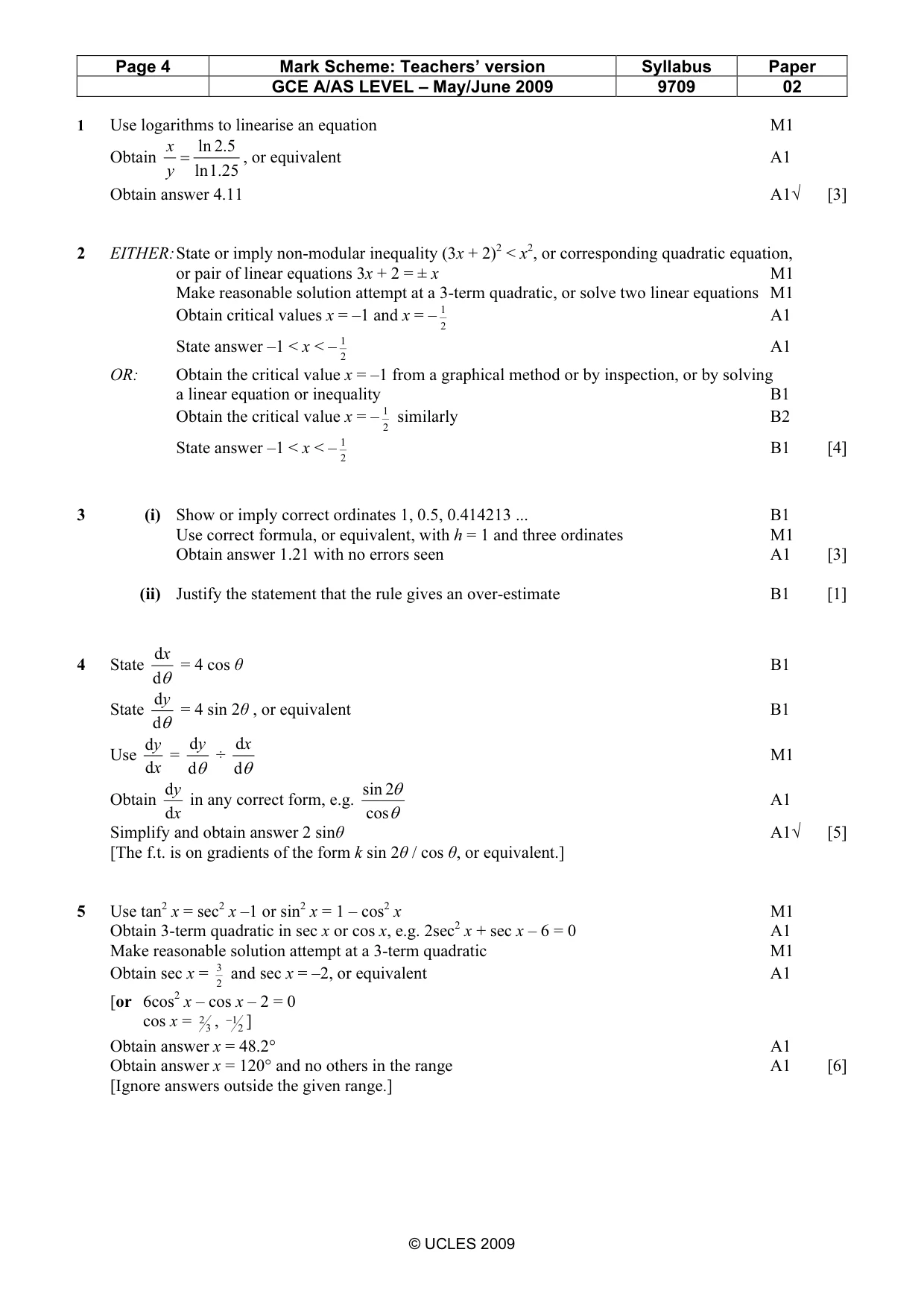
Mark scheme: 6 (i) Substitute x = 2, equate to zero and state a correct equation, e.g. 8 + 4a + 2b + 6 = 0 B1 Substitute x = 1 and equate to 4 M1 Obtain a correct equation. e.g. 1 + a + b + 6 = 4 A1 Solve for a or for b M1 Obtain a = –4 and b = 1 A1 [5] (ii) EITHER: Attempt division by x –2 reaching a partial quotient of x2 + kx M1 Obtain remainder quadratic factor x2 – 2x – 3 A1 State linear factors (x –3) and (x + 1) A1 OR: Obtain linear factor (x + 1) by inspection B1 Obtain factor (x –3) similarly B2 [3]
Q7 · Y x O M The diagram shows the curve y xe2x and its minimum point M
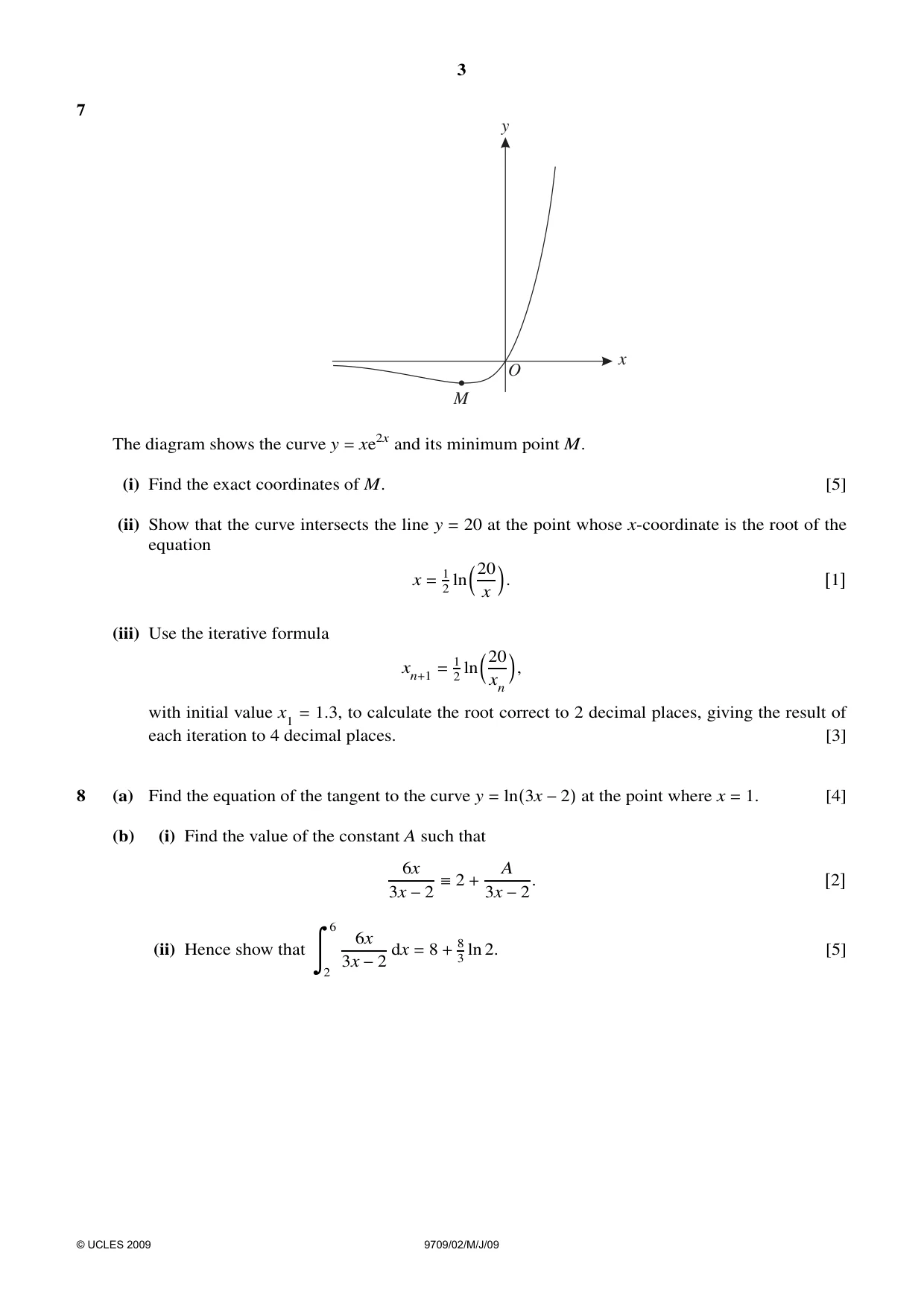
7 y x O M The diagram shows the curve y xe2x and its minimum point M. = (i) Find the exact coordinates of M. [5] (ii) Show that the curve intersects the line y 20 at the point whose x-coordinate is the root of the equation = 1 20 x ln . 2 x = [1] (iii) Use the iterative formula 1 20 2 xn xn+1 = ln , with initial value x1 1.3, to calculate the root correct to 2 decimal places, giving the result of = each iteration to 4 decimal places. [3]
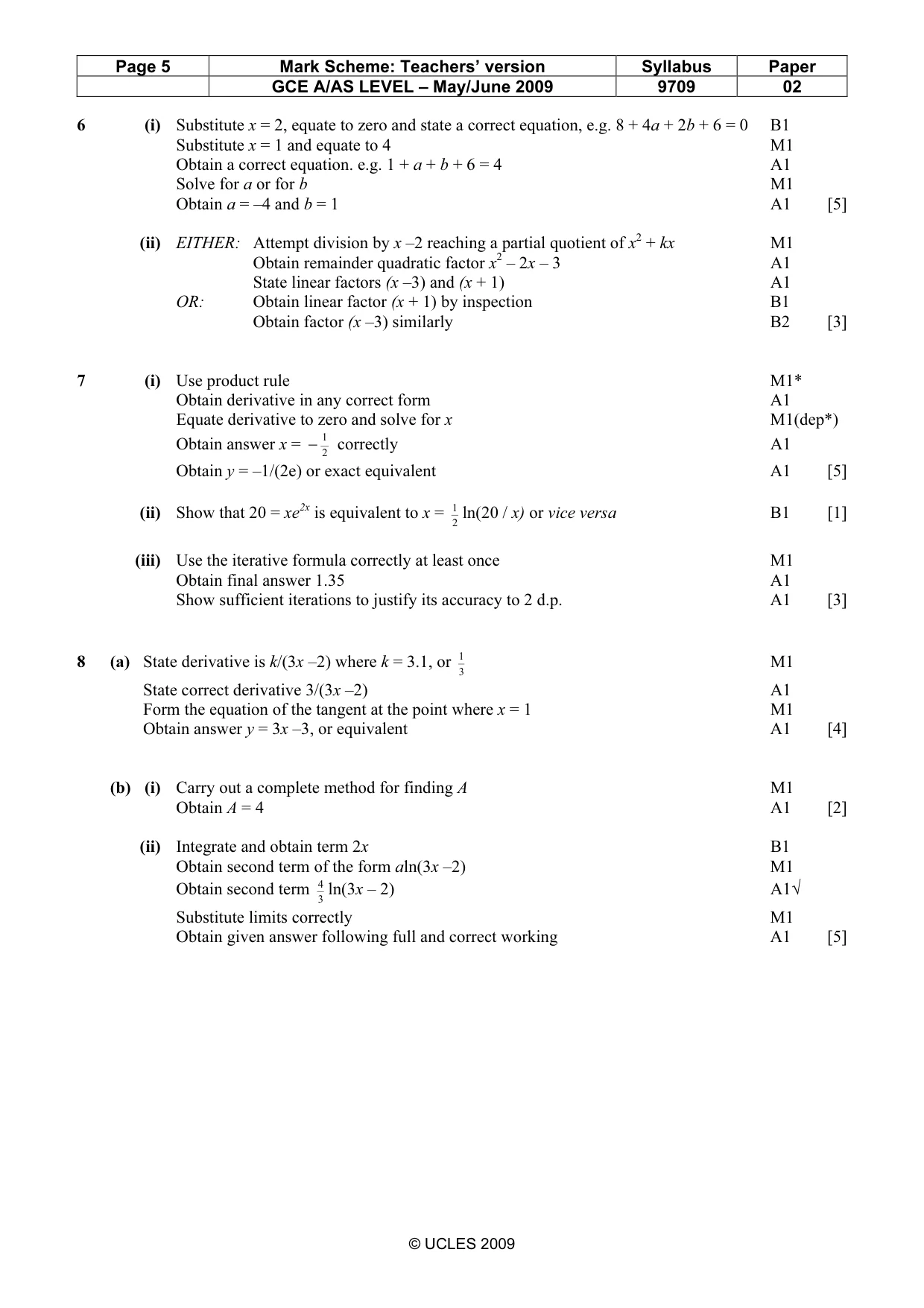
Mark scheme: 7 (i) Use product rule M1* Obtain derivative in any correct form A1 Equate derivative to zero and solve for x M1(dep*) Obtain answer x = − 1 correctly A1 2 Obtain y = –1/(2e) or exact equivalent A1 [5] (ii) Show that 20 = xe2x is equivalent to x = 1 ln(20 / x) or vice versa B1 [1] 2 (iii) Use the iterative formula correctly at least once M1 Obtain final answer 1.35 A1 Show sufficient iterations to justify its accuracy to 2 d.p. A1 [3] 1
Q8 · Find the equation of the tangent to the curve y at the point where x 1
8 (a) Find the equation of the tangent to the curve y at the point where x 1. [4] = ln(3x −2) = (b) (i) Find the value of the constant A such that 6x A 3x 3x ≡2 + [2] −2 −2. 6 6x 8 (ii) Hence show that dx 8 ln 2. [5] 3 3x ä = + 2 −2
Mark scheme: 8 (a) State derivative is k/(3x –2) where k = 3.1, or 1 M1 3 State correct derivative 3/(3x –2) A1 Form the equation of the tangent at the point where x = 1 M1 Obtain answer y = 3x –3, or equivalent A1 [4] (b) (i) Carry out a complete method for finding A M1 Obtain A = 4 A1 [2] (ii) Integrate and obtain term 2x B1 Obtain second term of the form aln(3x –2) M1 Obtain second term 4 ln(3x – 2) A1√ 3 Substitute limits correctly M1 Obtain given answer following full and correct working A1 [5]
What was in this paper
The subtopics covered by these 8 questions, and how many questions each got. Open one in a new tab to see every Cambridge question on it.
What you needed in this session
Cambridge’s own grade thresholds for 2009 May/June, Paper 2 · Variant 1. A higher threshold means an easier paper — the bar moves with how the cohort did.