Cambridge A Level Mathematics 9709 — 2008 Oct/Nov Paper 5 · Variant 1
9709/51/O/N/08 · 7 questions · 50 marks · ≈56 min
The question paper and its mark scheme, free to read here and free to download. This is Cambridge’s own paper, exactly as it was sat.
Question paper4 pages
Mark scheme6 pages
Answers below. Sit the paper first if you are practising.
Questions as text
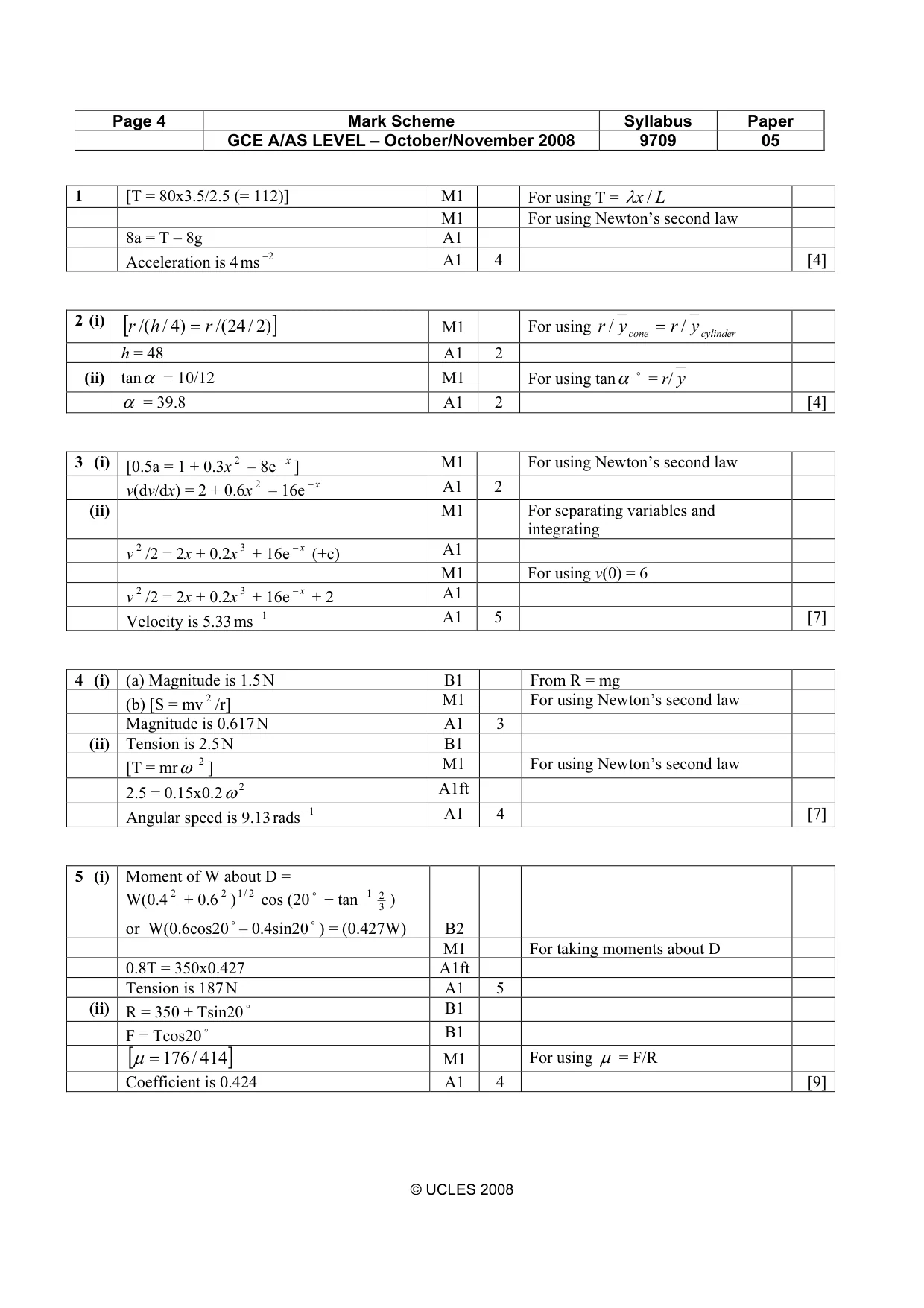
Q1 · One end of a light elastic rope of natural length 2.5 m and modulus of elasticity 80 N is…
1 One end of a light elastic rope of natural length 2.5 m and modulus of elasticity 80 N is attached to a fixed point A. A stone S of mass 8 kg is attached to the other end of the rope. S is held at a point 6 m vertically below A and then released. Find the initial acceleration of S. [4]
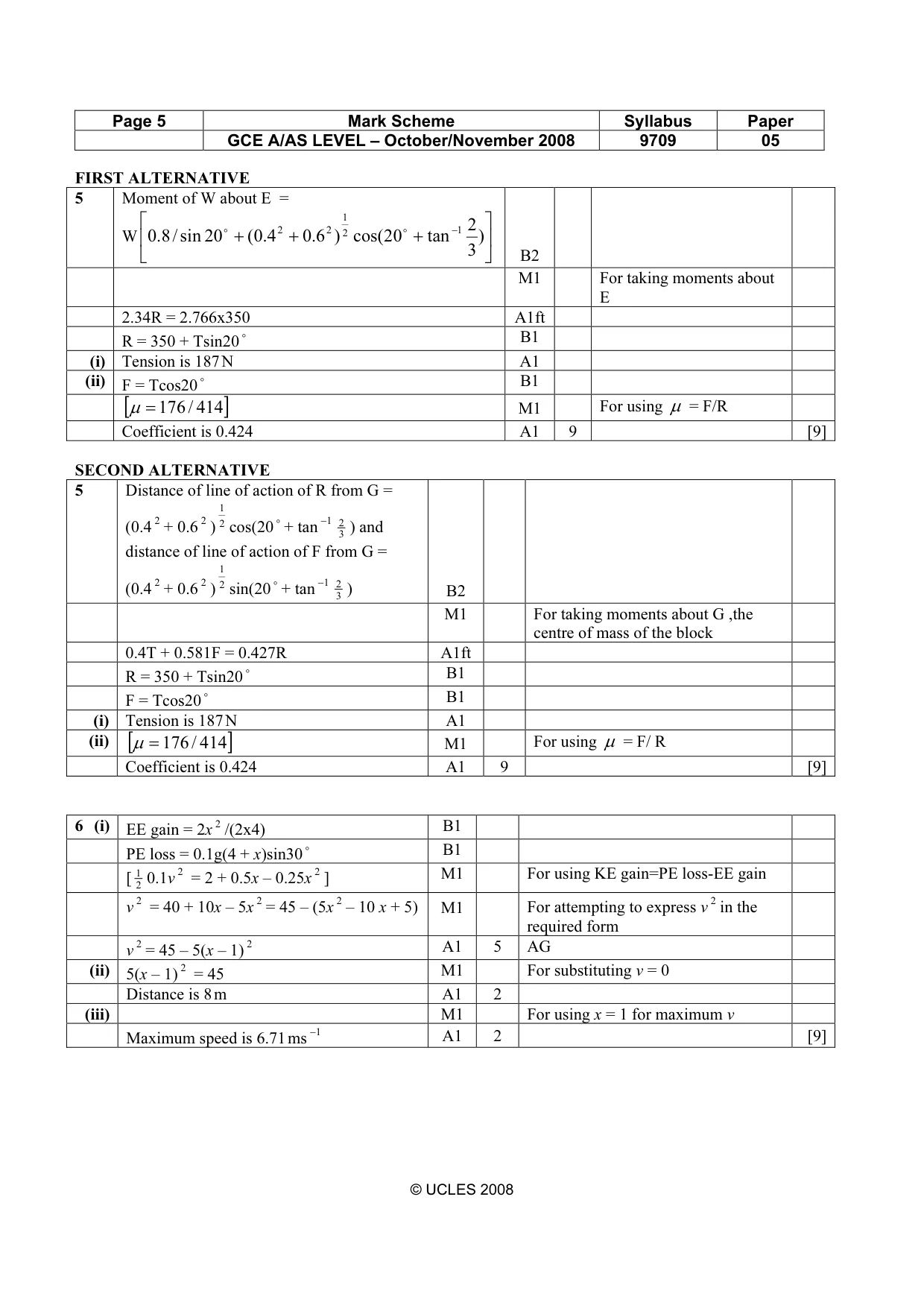
Mark scheme: 1 [T = 80x3.5/2.5 (= 112)] M1 For using T = λ x / L M1 For using Newton’s second law 8a = T – 8g A1 Acceleration is 4 ms −2 A1 4 [4]
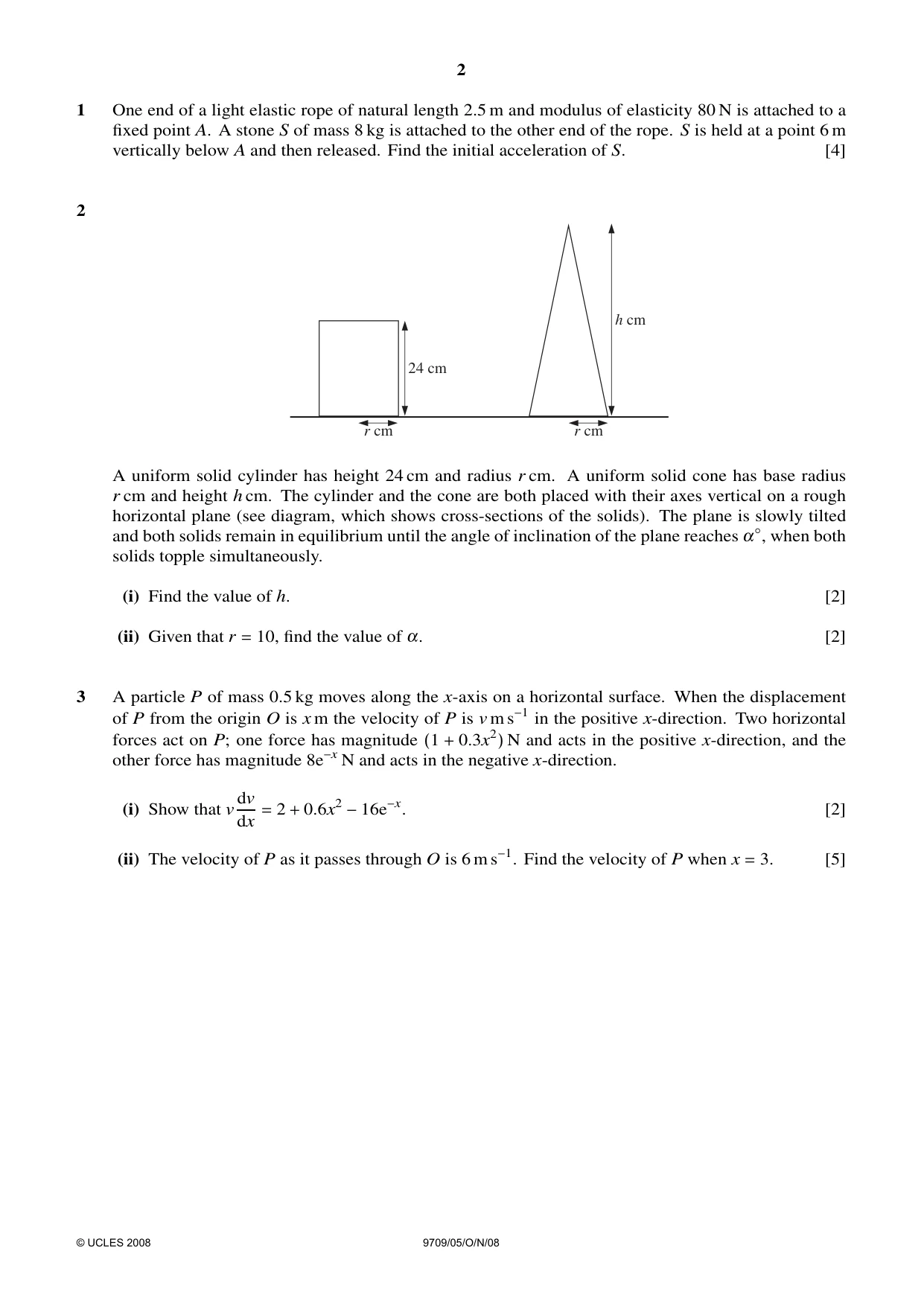
Q2 · H cm 24 cm r cm r cm A uniform solid cylinder has height 24 cm and radius r cm
2 h cm 24 cm r cm r cm A uniform solid cylinder has height 24 cm and radius r cm. A uniform solid cone has base radius r cm and height h cm. The cylinder and the cone are both placed with their axes vertical on a rough horizontal plane (see diagram, which shows cross-sections of the solids). The plane is slowly tilted and both solids remain in equilibrium until the angle of inclination of the plane reaches α◦, when both solids topple simultaneously. (i) Find the value of h. [2] (ii) Given that r = 10, find the value of α. [2]
Mark scheme: 2 (i) [r /( h / 4) = r /( 24 / 2]) M1 For using r / y cone = r / y cylinder h = 48 A1 2 (ii) tanα = 10/12 M1 For using tanα o = r/ y α = 39.8 A1 2 [4]
Q3 · A particle P of mass 0.5 kg moves along the x-axis on a horizontal surface
3 A particle P of mass 0.5 kg moves along the x-axis on a horizontal surface. When the displacement of P from the origin O is x m the velocity of P is v m s−1 in the positive x-direction. Two horizontal forces act on P; one force has magnitude (1 + 0.3x2) N and acts in the positive x-direction, and the other force has magnitude 8e−x N and acts in the negative x-direction. dv (i) Show that v = 2 + 0.6x2 −16e−x. [2] dx (ii) The velocity of P as it passes through O is 6 m s−1. Find the velocity of P when x = 3. [5]
Mark scheme: 3 (i) [0.5a = 1 + 0.3x 2 – 8e −]x M1 For using Newton’s second law v(dv/dx) = 2 + 0.6x 2 – 16e − x A1 2 (ii) M1 For separating variables and integrating v 2 /2 = 2x + 0.2x 3 + 16e − x (+c) A1 M1 For using v(0) = 6 v 2 /2 = 2x + 0.2x 3 + 16e − x + 2 A1 Velocity is 5.33 ms −1 A1 5 [7]
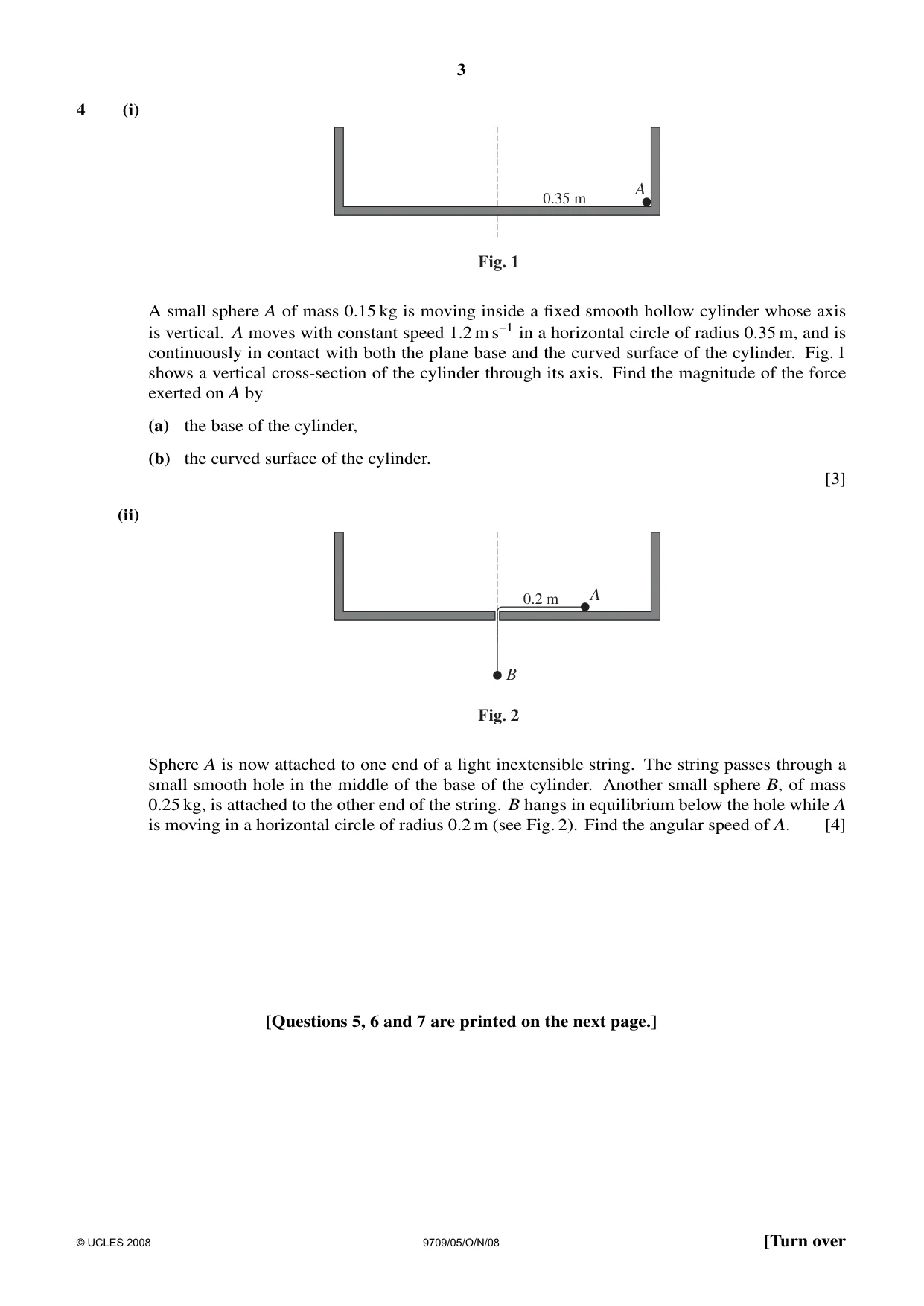
Q4 · A 0.35 m Fig
4 (i) A 0.35 m Fig. 1 A small sphere A of mass 0.15 kg is moving inside a fixed smooth hollow cylinder whose axis is vertical. A moves with constant speed 1.2 m s−1 in a horizontal circle of radius 0.35 m, and is continuously in contact with both the plane base and the curved surface of the cylinder. Fig. 1 shows a vertical cross-section of the cylinder through its axis. Find the magnitude of the force exerted on A by (a) the base of the cylinder, (b) the curved surface of the cylinder. [3] (ii) 0.2 m A B Fig. 2 Sphere A is now attached to one end of a light inextensible string. The string passes through a small smooth hole in the middle of the base of the cylinder. Another small sphere B, of mass 0.25 kg, is attached to the other end of the string. B hangs in equilibrium below the hole while A is moving in a horizontal circle of radius 0.2 m (see Fig. 2). Find the angular speed of A. [4] [Questions 5, 6 and 7 are printed on the next page.]
Mark scheme: 4 (i) (a) Magnitude is 1.5 N B1 From R = mg (b) [S = mv 2 /r] M1 For using Newton’s second law Magnitude is 0.617 N A1 3 (ii) Tension is 2.5 N B1 [T = mrω 2 ] M1 For using Newton’s second law 2.5 = 0.15x0.2 ω 2 A1ft Angular speed is 9.13 rads −1 A1 4 [7]
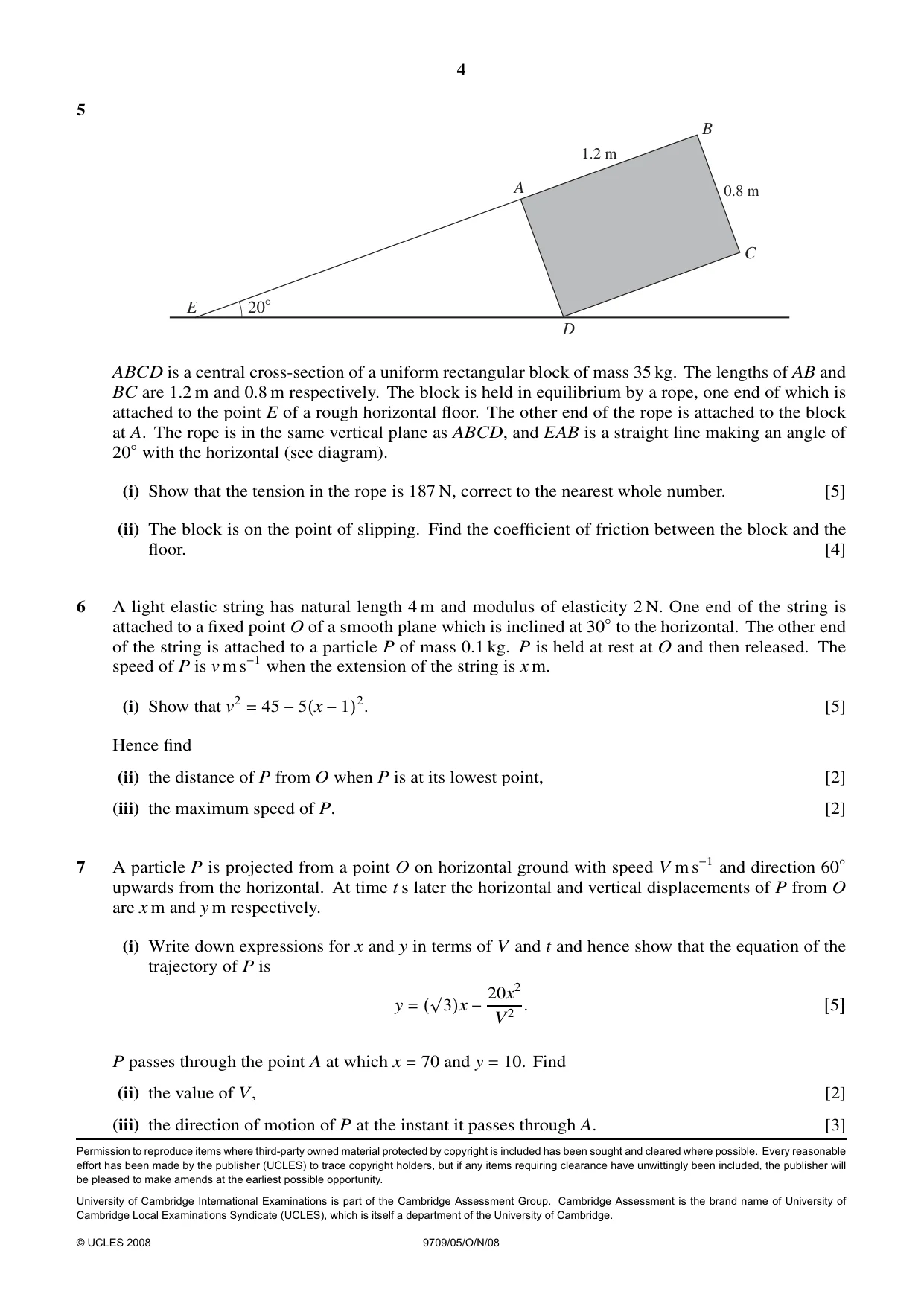
Q5 · B 1.2 m A 0.8 m C E 20° D ABCD is a central cross-section of a uniform rectangular block…
5 B 1.2 m A 0.8 m C E 20° D ABCD is a central cross-section of a uniform rectangular block of mass 35 kg. The lengths of AB and BC are 1.2 m and 0.8 m respectively. The block is held in equilibrium by a rope, one end of which is attached to the point E of a rough horizontal floor. The other end of the rope is attached to the block at A. The rope is in the same vertical plane as ABCD, and EAB is a straight line making an angle of 20◦with the horizontal (see diagram). (i) Show that the tension in the rope is 187 N, correct to the nearest whole number. [5] (ii) The block is on the point of slipping. Find the coefficient of friction between the block and the floor. [4]
Mark scheme: 5 (i) Moment of W about D = W(0.4 2 + 0.6 2 ) 1 / 2 cos (20 o + tan −1 23 ) or W(0.6cos20 o – 0.4sin20 o ) = (0.427W) B2 M1 For taking moments about D 0.8T = 350x0.427 A1ft Tension is 187 N A1 5 (ii) R = 350 + Tsin20 o B1 F = Tcos20 o B1 [µ = 176 / 414 ] M1 For using µ = F/R Coefficient is 0.424 A1 4 [9] GCE A/AS LEVEL – October/November 2008 9709 05 FIRST ALTERNATIVE 5 Moment of W about E = o 2 2 12 o −1 2 W 8.0 / sin 20 + ( 4.0 + 6.0 ) cos( 20 + tan ) 3 B2 M1 For taking moments about E 2.34R = 2.766x350 A1ft R = 350 + Tsin20 o B1 (i) Tension is 187 N A1 (ii) F = Tcos20 o B1 [µ = 176 / 414 ] M1 For using µ = F/R Coefficient is 0.424 A1 9 [9] SECOND ALTERNATIVE 5 Distance of line of action of R from G = 1 (0.4 2 + 0.6 2 ) 2 cos(20 o + tan −1 23 ) and distance of line of action of F from G = 1 (0.4 2 + 0.6 2 ) 2 sin(20 o + tan −1 23 ) B2 M1 For taking moments about G ,the centre of mass of the block 0.4T + 0.581F = 0.427R A1ft R = 350 + Tsin20 o B1 F = Tcos20 o B1 (i) Tension is 187 N A1 (ii) [µ = 176 / 414 ] M1 For using µ = F/ R Coefficient is 0.424 A1 9 [9]
Q6 · A light elastic string has natural length 4 m and modulus of elasticity 2 N
6 A light elastic string has natural length 4 m and modulus of elasticity 2 N. One end of the string is attached to a fixed point O of a smooth plane which is inclined at 30◦to the horizontal. The other end of the string is attached to a particle P of mass 0.1 kg. P is held at rest at O and then released. The speed of P is v m s−1 when the extension of the string is x m. (i) Show that v2 = 45 −5(x −1)2. [5] Hence find (ii) the distance of P from O when P is at its lowest point, [2] (iii) the maximum speed of P. [2]
Mark scheme: 6 (i) EE gain = 2x 2 /(2x4) B1 PE loss = 0.1g(4 + x)sin30 o B1 [ 12 0.1v 2 = 2 + 0.5x – 0.25x 2 ] M1 For using KE gain=PE loss-EE gain v 2 = 40 + 10x – 5x 2 = 45 – (5x 2 – 10 x + 5) M1 For attempting to express v 2 in the required form v 2 = 45 – 5(x – 1) 2 A1 5 AG (ii) 5(x – 1) 2 = 45 M1 For substituting v = 0 Distance is 8 m A1 2 (iii) M1 For using x = 1 for maximum v Maximum speed is 6.71 ms −1 A1 2 [9] GCE A/AS LEVEL – October/November 2008 9709 05
Q7 · A particle P is projected from a point O on horizontal ground with speed V m s−1 and…
7 A particle P is projected from a point O on horizontal ground with speed V m s−1 and direction 60◦ upwards from the horizontal. At time t s later the horizontal and vertical displacements of P from O are x m and y m respectively. (i) Write down expressions for x and y in terms of V and t and hence show that the equation of the trajectory of P is y = (√3)x −20x2 . [5] V2 P passes through the point A at which x = 70 and y = 10. Find (ii) the value of V, [2] (iii) the direction of motion of P at the instant it passes through A. [3]
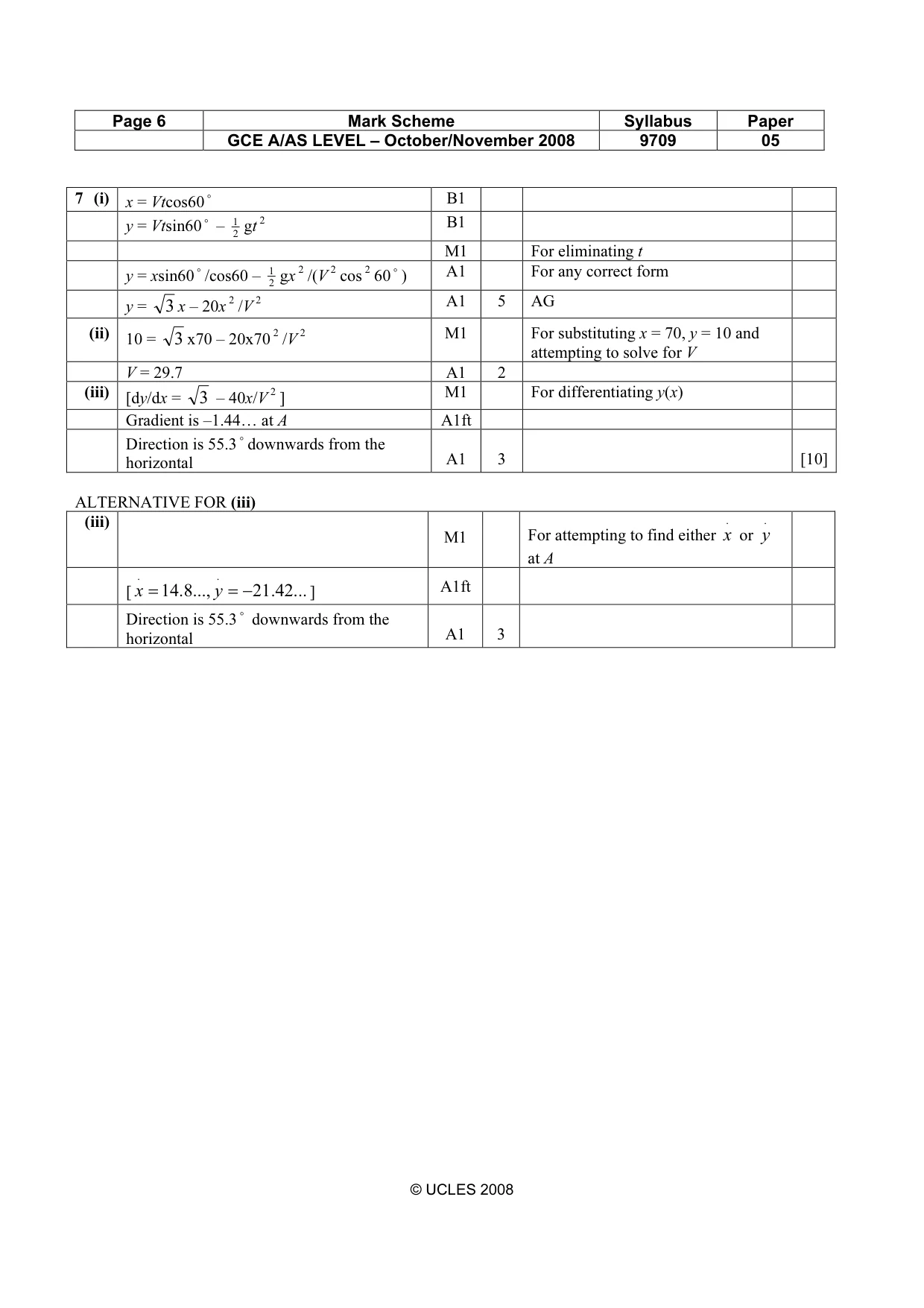
Mark scheme: 7 (i) x = Vtcos60 o B1 y = Vtsin60 o – 12 gt 2 B1 M1 For eliminating t y = xsin60 o /cos60 – 12 gx 2 /(V 2 cos 2 60 o ) A1 For any correct form 2 2 A1 5 AG y = 3 x – 20x /V (ii) 10 = 3 x70 – 20x70 2 /V 2 M1 For substituting x = 70, y = 10 and attempting to solve for V V = 29.7 A1 2 (iii) [dy/dx = 3 – 40x/V 2 ] M1 For differentiating y(x) Gradient is –1.44… at A A1ft Direction is 55.3 o downwards from the horizontal A1 3 [10] ALTERNATIVE FOR (iii) (iii) . . M1 For attempting to find either x or y at A . . [ x = 148...., y = −21.42... ] A1ft Direction is 55.3 o downwards from the horizontal A1 3
What was in this paper
The subtopics covered by these 7 questions, and how many questions each got. Open one in a new tab to see every Cambridge question on it.
What you needed in this session
Cambridge’s own grade thresholds for 2008 Oct/Nov, Paper 5 · Variant 1. A higher threshold means an easier paper — the bar moves with how the cohort did.