Cambridge A Level Mathematics 9709 — 2008 May/June Paper 1 · Variant 1
9709/11/M/J/08 · 3 questions · 75 marks · ≈84 min
The question paper and its mark scheme, free to read here and free to download. This is Cambridge’s own paper, exactly as it was sat.
Question paper4 pages
Mark scheme7 pages
Answers below. Sit the paper first if you are practising.
Questions as text
Q1 · In the triangle ABC, AB = 12 cm, angle BAC = 60◦and angle ACB = 45◦
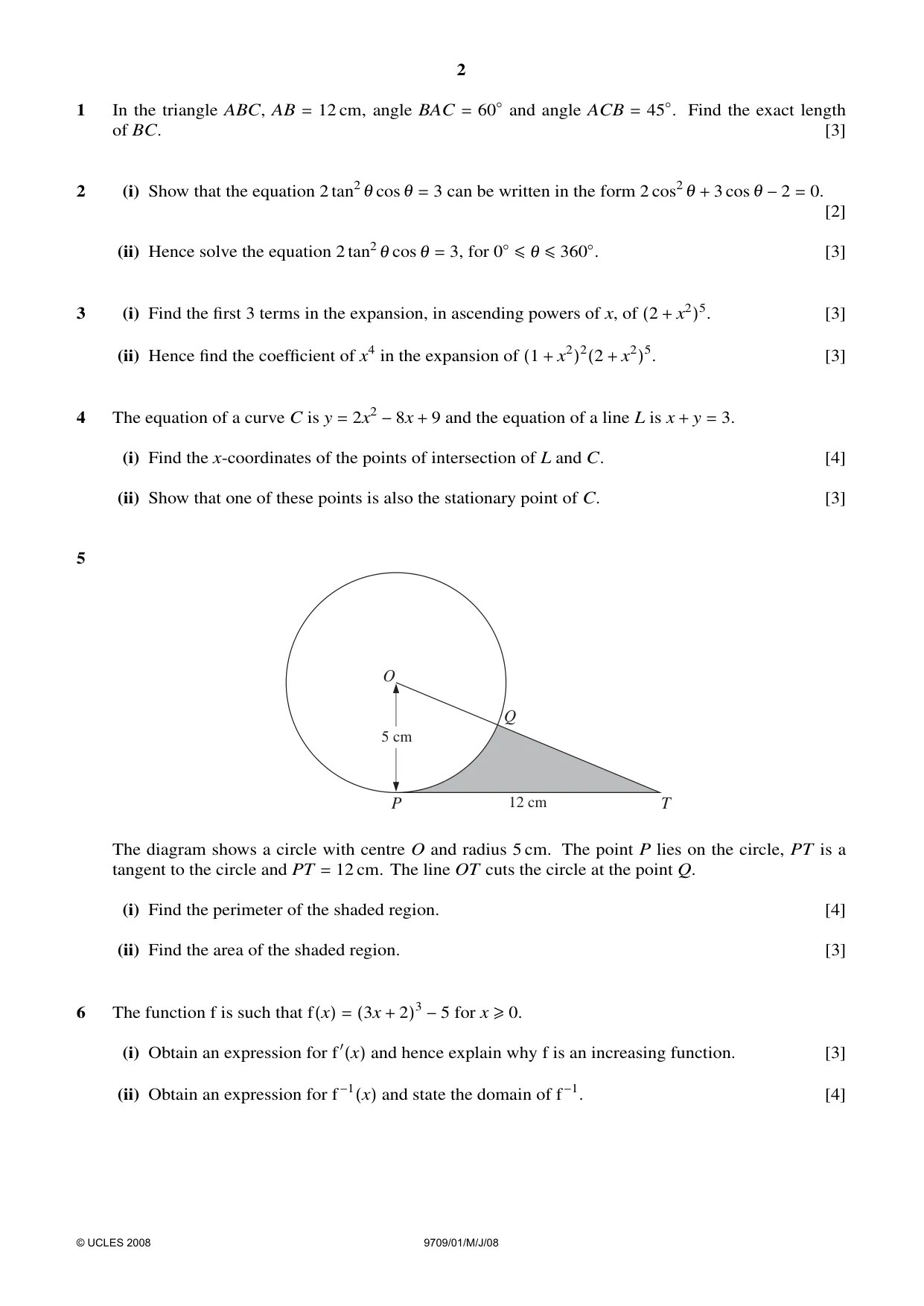
1 In the triangle ABC, AB = 12 cm, angle BAC = 60◦and angle ACB = 45◦. Find the exact length of BC. [3]
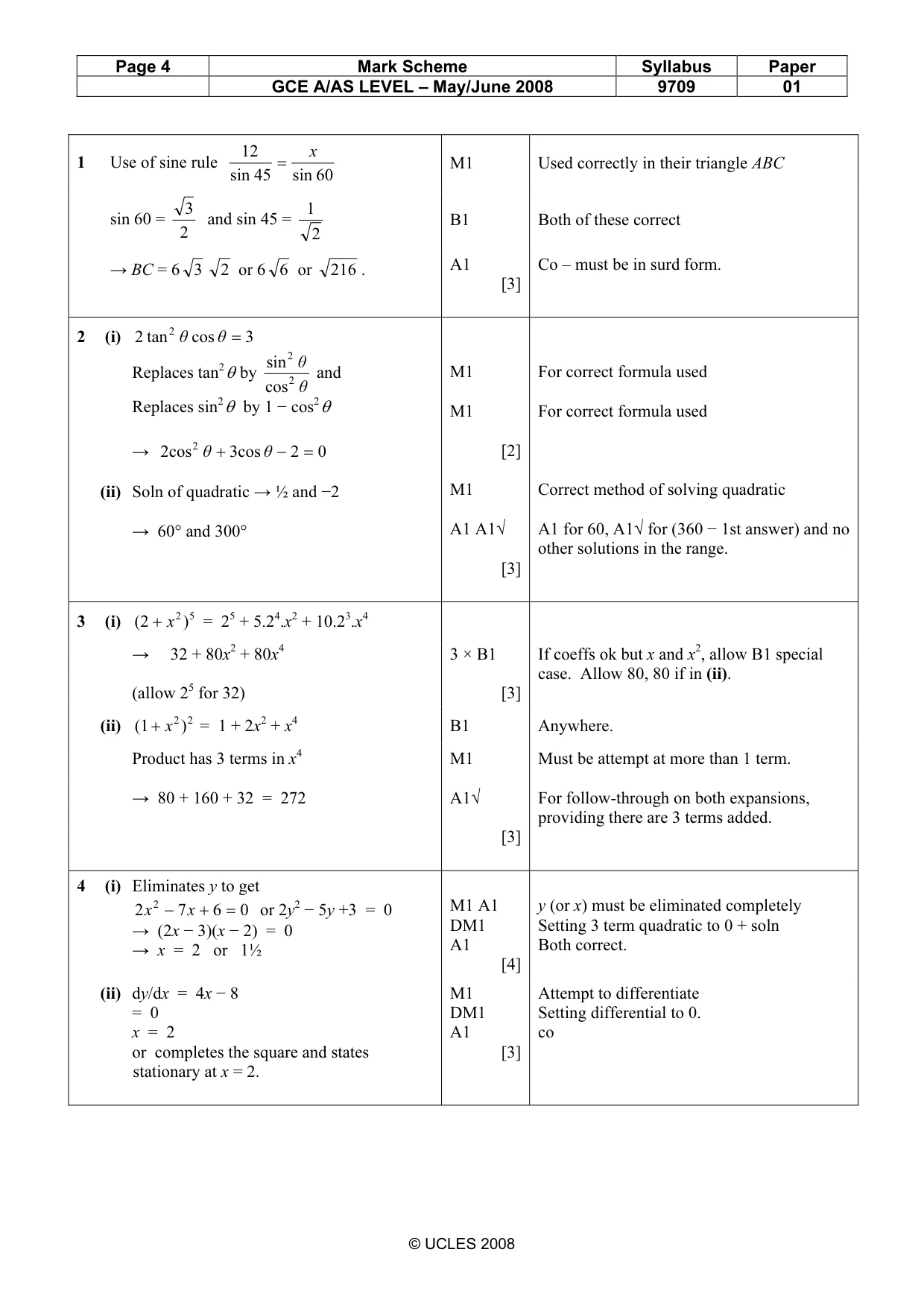
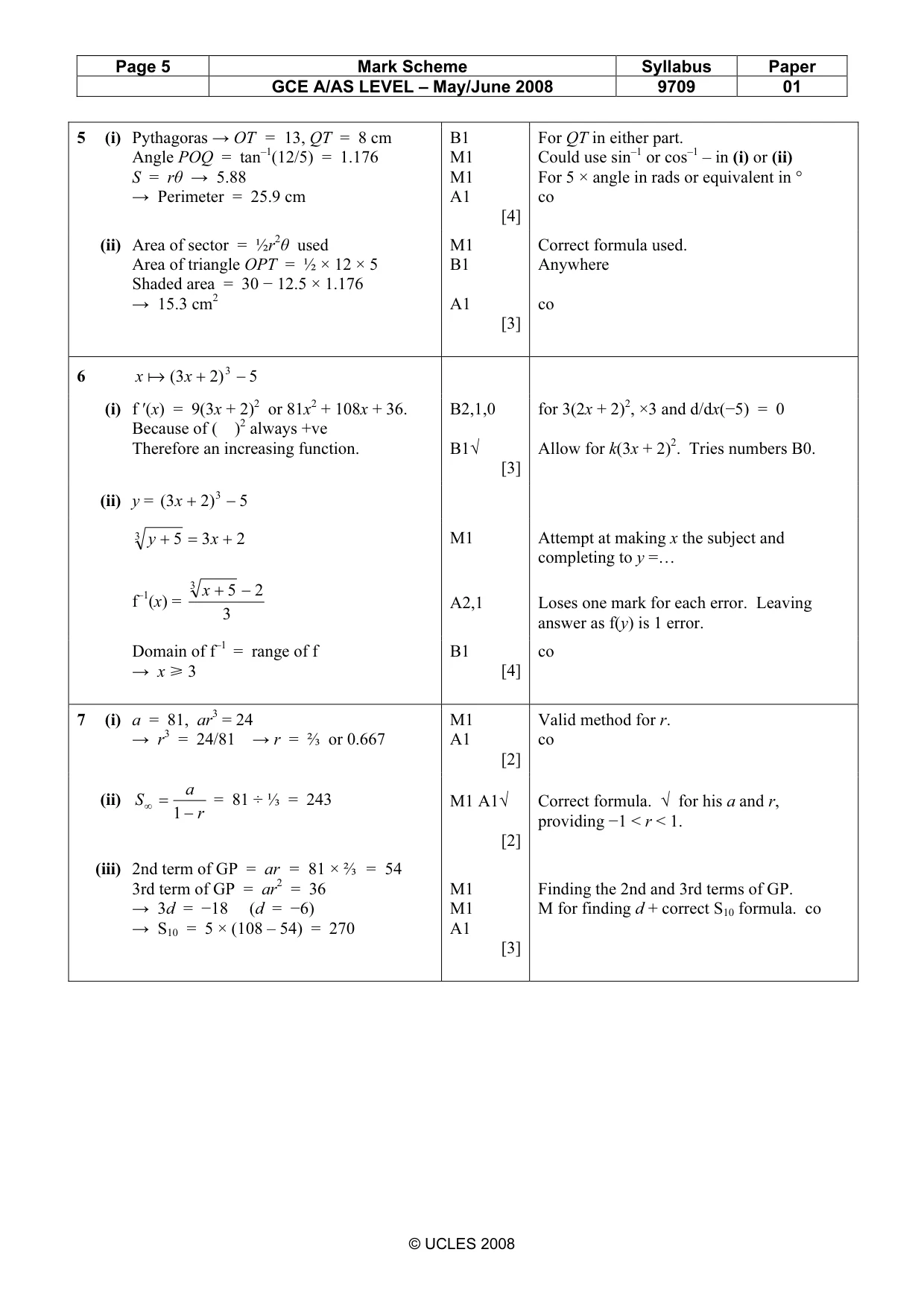
Mark scheme: 3 1 sin 60 = and sin 45 = B1 Both of these correct
Q2 · Show that the equation 2 tan2 θ cos θ = 3 can be written in the form 2 cos2 θ + 3 cos θ…
2 (i) Show that the equation 2 tan2 θ cos θ = 3 can be written in the form 2 cos2 θ + 3 cos θ −2 = 0. [2] (ii) Hence solve the equation 2 tan2 θ cos θ = 3, for 0◦≤θ ≤360◦. [3]
Mark scheme: 2 2 A1 Co m st be in s rd form
Q8 · Functions f and g are defined by f : x →4x −2k for x ∈ , where k is a constant, 9 g : x →…
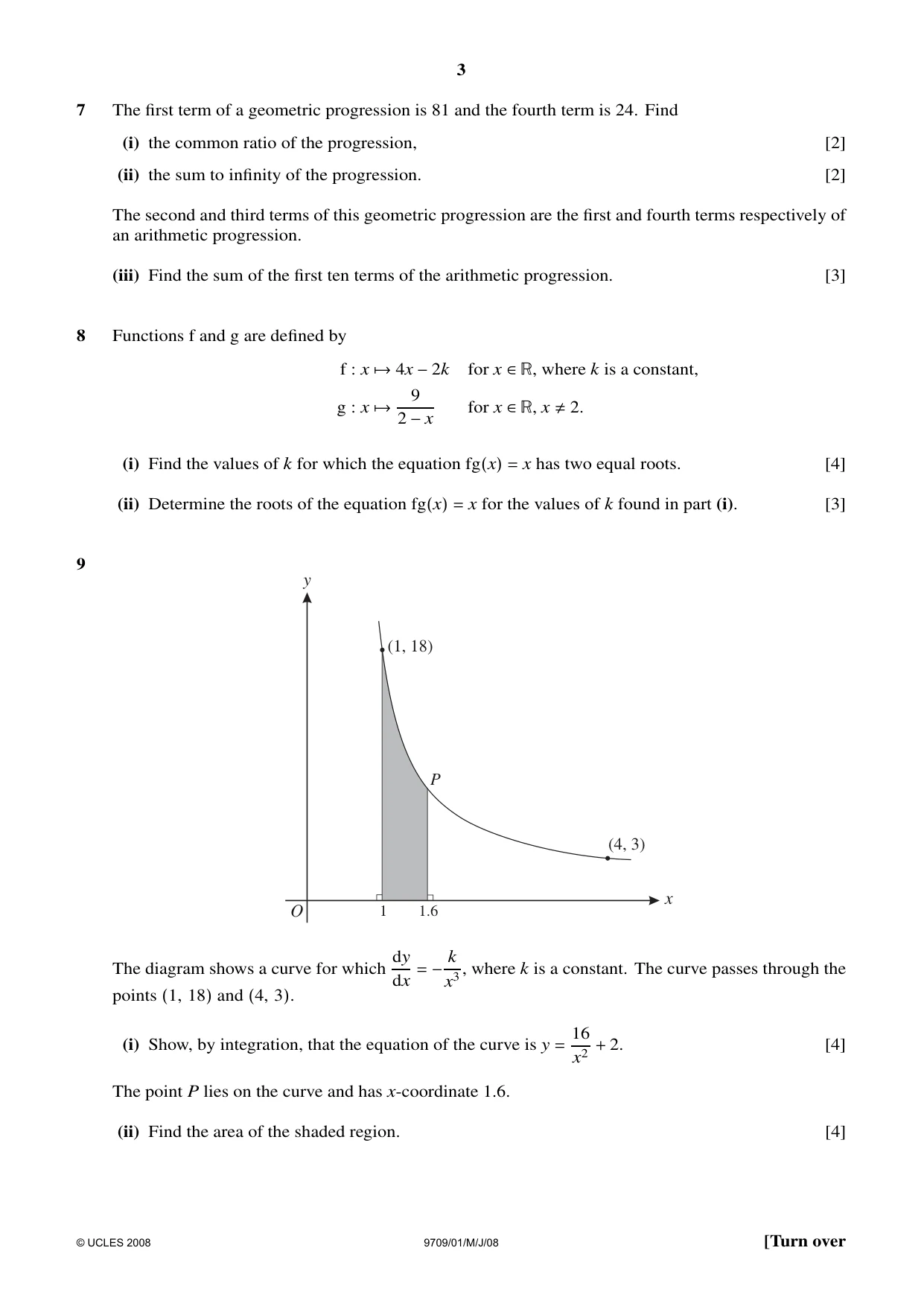
8 Functions f and g are defined by f : x →4x −2k for x ∈ , where k is a constant, 9 g : x → for x ∈ , x ≠2. 2 −x (i) Find the values of k for which the equation fg(x) = x has two equal roots. [4] (ii) Determine the roots of the equation fg(x) = x for the values of k found in part (i). [3]
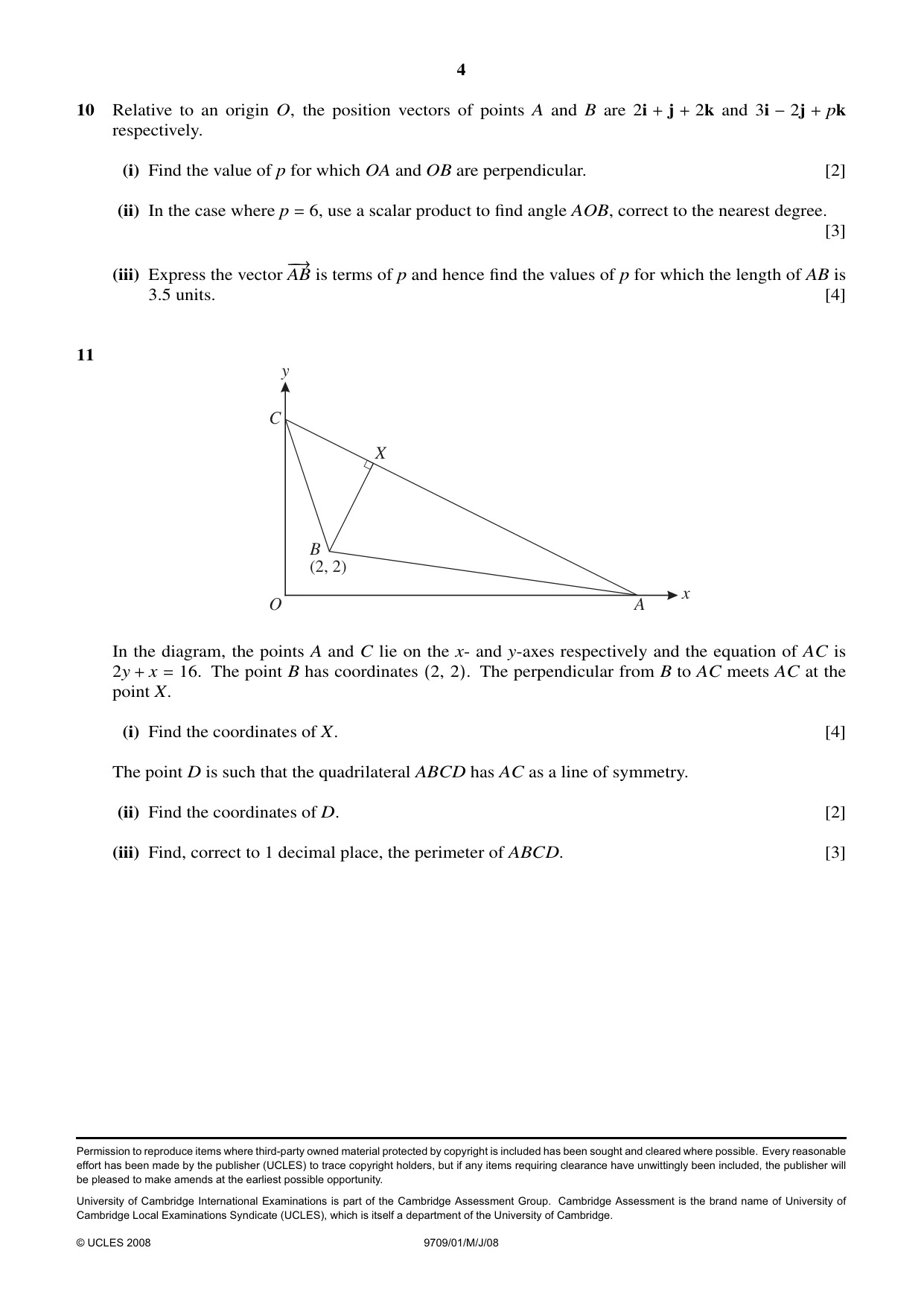
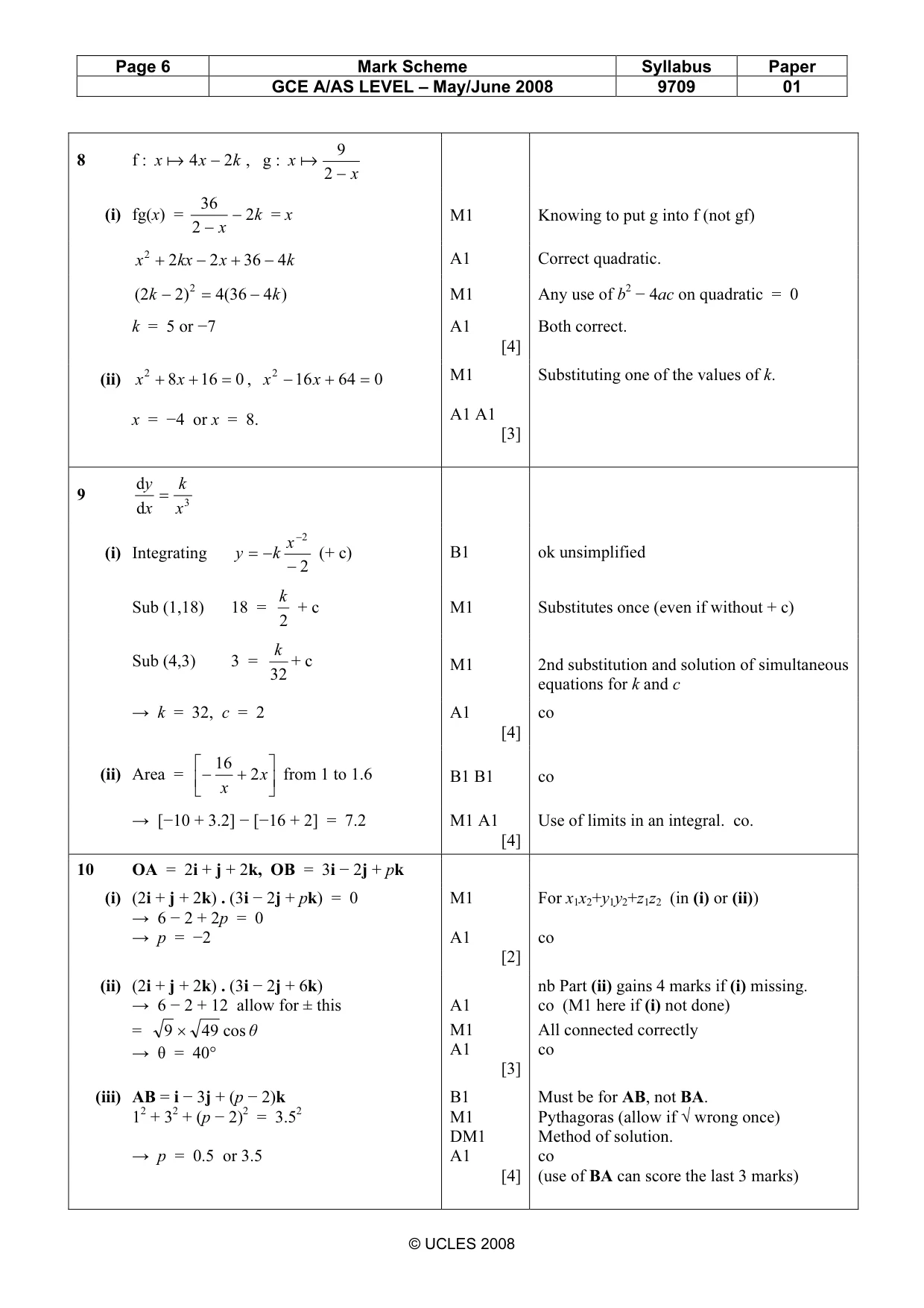
Mark scheme: (ii) x 2 + 8 x + 16 = 0 , x 2 − 16 x + 64 = 0 M1 Substituting one of the values of k. x = −4 or x = 8. A1 A1 [3] d y k 9 = d x x 3 x −2 (i) Integrating y = − k (+ c) B1 ok unsimplified − 2 k Sub (1,18) 18 = + c M1 Substitutes once (even if without + c) 2 k Sub (4,3) 3 = + c M1 2nd substitution and solution of simultaneous 32 equations for k and c → k = 32, c = 2 A1 co [4] 16 (ii) Area = − + 2 x from 1 to 1.6 B1 B1 co x → [−10 + 3.2] − [−16 + 2] = 7.2 M1 A1 Use of limits in an integral. co. [4] 10 OA = 2i + j + 2k, OB = 3i − 2j + pk (i) (2i + j + 2k) . (3i − 2j + pk) = 0 M1 For x1x2+y1y2+z1z2 (in (i) or (ii)) → 6 − 2 + 2p = 0 → p = −2 A1 co [2] (ii) (2i + j + 2k) . (3i − 2j + 6k) nb Part (ii) gains 4 marks if (i) missing. → 6 − 2 + 12 allow for ± this A1 co (M1 here if (i) not done)
What was in this paper
The subtopics covered by these 3 questions, and how many questions each got. Open one in a new tab to see every Cambridge question on it.
What you needed in this session
Cambridge’s own grade thresholds for 2008 May/June, Paper 1 · Variant 1. A higher threshold means an easier paper — the bar moves with how the cohort did.