Cambridge A Level Mathematics 9709 — 2005 Oct/Nov Paper 5 · Variant 1
9709/51/O/N/05 · 7 questions · 50 marks · ≈56 min
The question paper and its mark scheme, free to read here and free to download. This is Cambridge’s own paper, exactly as it was sat.
Question paper4 pages
Mark scheme6 pages
Answers below. Sit the paper first if you are practising.
Questions as text
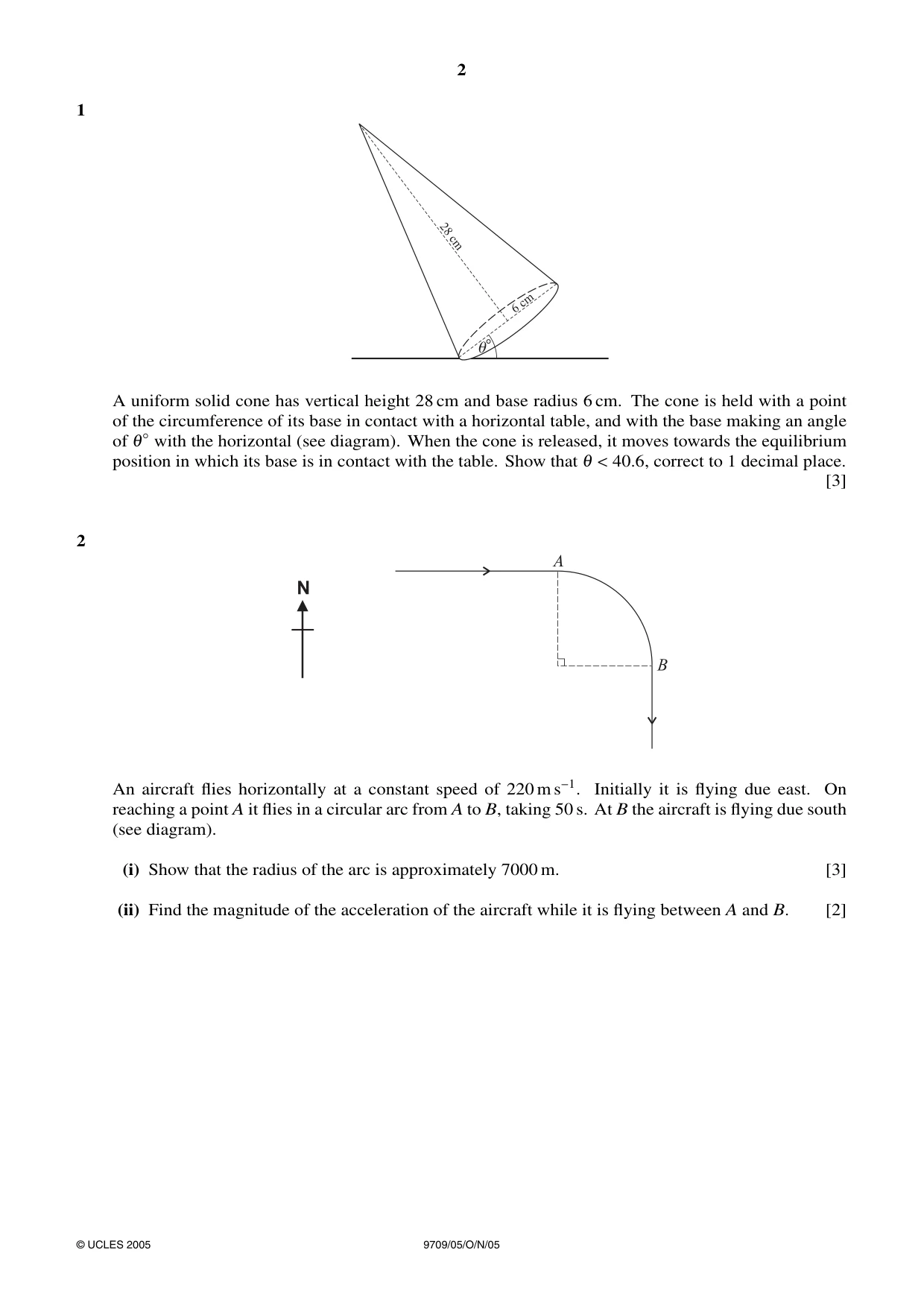
Q1 · A uniform solid cone has vertical height 28 cm and base radius 6 cm
1 A uniform solid cone has vertical height 28 cm and base radius 6 cm. The cone is held with a point of the circumference of its base in contact with a horizontal table, and with the base making an angle of θ◦with the horizontal (see diagram). When the cone is released, it moves towards the equilibrium position in which its base is in contact with the table. Show that θ < 40.6, correct to 1 decimal place. [3]
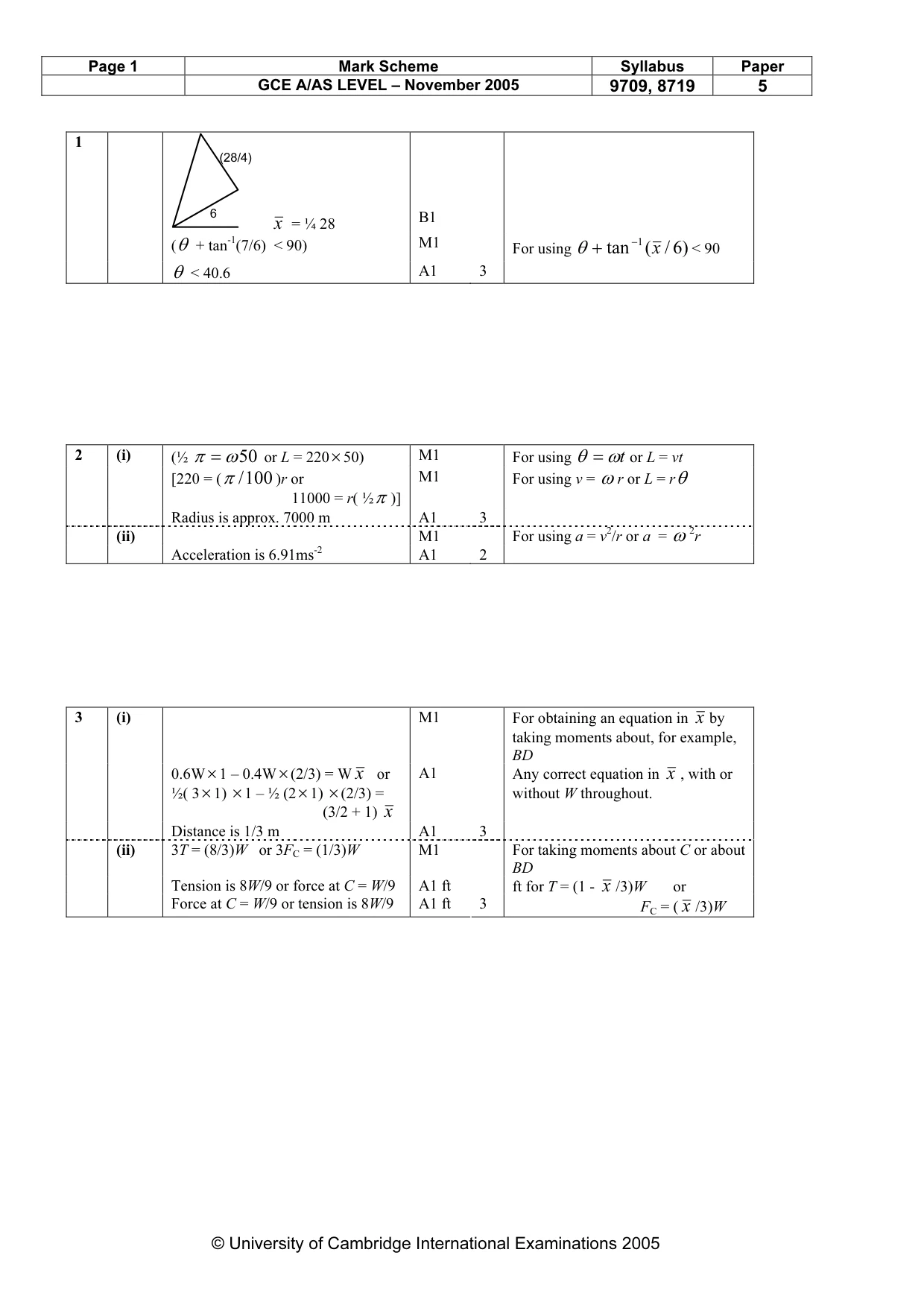
Mark scheme: 1 (28/4) 6 B1 x = ¼ 28 (θ + tan-1(7/6) < 90) M1 For using θ + tan −1 ( x / 6) < 90 θ < 40.6 A1 3
Q2 · An aircraft flies horizontally at a constant speed of 220 m s−1
2 An aircraft flies horizontally at a constant speed of 220 m s−1. Initially it is flying due east. On reaching a point A it flies in a circular arc from A to B, taking 50 s. At B the aircraft is flying due south (see diagram). (i) Show that the radius of the arc is approximately 7000 m. [3] (ii) Find the magnitude of the acceleration of the aircraft while it is flying between A and B. [2]
Mark scheme: 2 (i) (½ π = ω 50 or L = 220×50) M1 For using θ = ω t or L = vt [220 = ( π / 100 )r or M1 For using v = ω r or L = rθ 11000 = r( ½π )] Radius is approx. 7000 m A1 3 (ii) M1 For using a = v2/r or a = ω 2r Acceleration is 6.91ms-2 A1 2
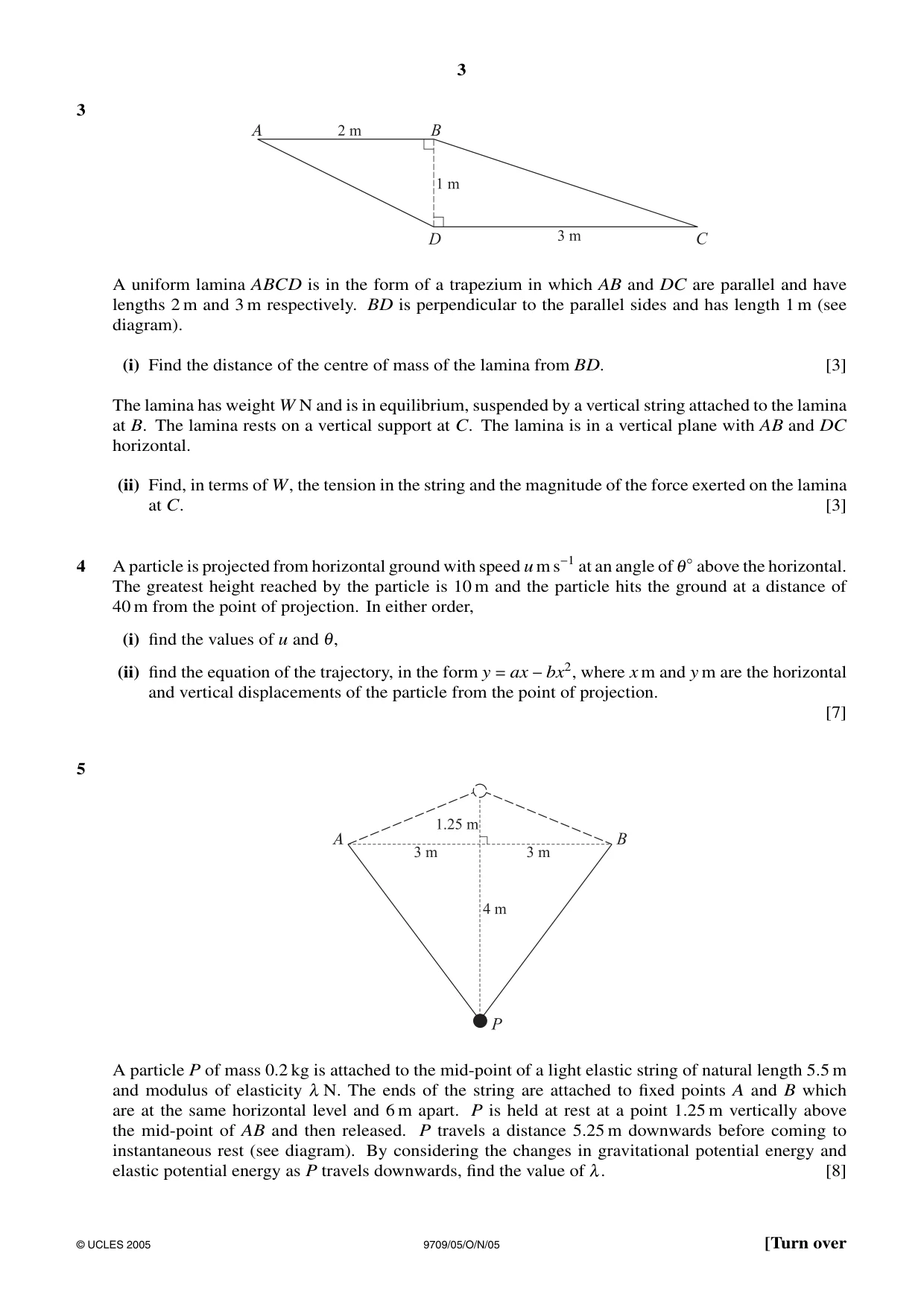
Q3 · A uniform lamina ABCD is in the form of a trapezium in which AB and DC are parallel and…
3 A uniform lamina ABCD is in the form of a trapezium in which AB and DC are parallel and have lengths 2 m and 3 m respectively. BD is perpendicular to the parallel sides and has length 1 m (see diagram). (i) Find the distance of the centre of mass of the lamina from BD. [3] The lamina has weight W N and is in equilibrium, suspended by a vertical string attached to the lamina at B. The lamina rests on a vertical support at C. The lamina is in a vertical plane with AB and DC horizontal. (ii) Find, in terms of W, the tension in the string and the magnitude of the force exerted on the lamina at C. [3]
Mark scheme: 3 (i) M1 For obtaining an equation in x by taking moments about, for example, BD 0.6W×1 – 0.4W×(2/3) = W x or A1 Any correct equation in x , with or ½( 3×1) ×1 – ½ (2×1) ×(2/3) = without W throughout. (3/2 + 1) x Distance is 1/3 m A1 3 (ii) 3T = (8/3)W or 3FC = (1/3)W M1 For taking moments about C or about BD Tension is 8W/9 or force at C = W/9 A1 ft ft for T = (1 - x /3)W or Force at C = W/9 or tension is 8W/9 A1 ft 3 FC = ( x /3)W GCE A/AS LEVEL – November 2005 9709, 8719 5
Q4 · A particle is projected from horizontal ground with speed u m s−1 at an angle of θ◦above…
4 A particle is projected from horizontal ground with speed u m s−1 at an angle of θ◦above the horizontal. The greatest height reached by the particle is 10 m and the particle hits the ground at a distance of 40 m from the point of projection. In either order, (i) find the values of u and θ, (ii) find the equation of the trajectory, in the form y = ax −bx2, where x m and y m are the horizontal and vertical displacements of the particle from the point of projection. [7]
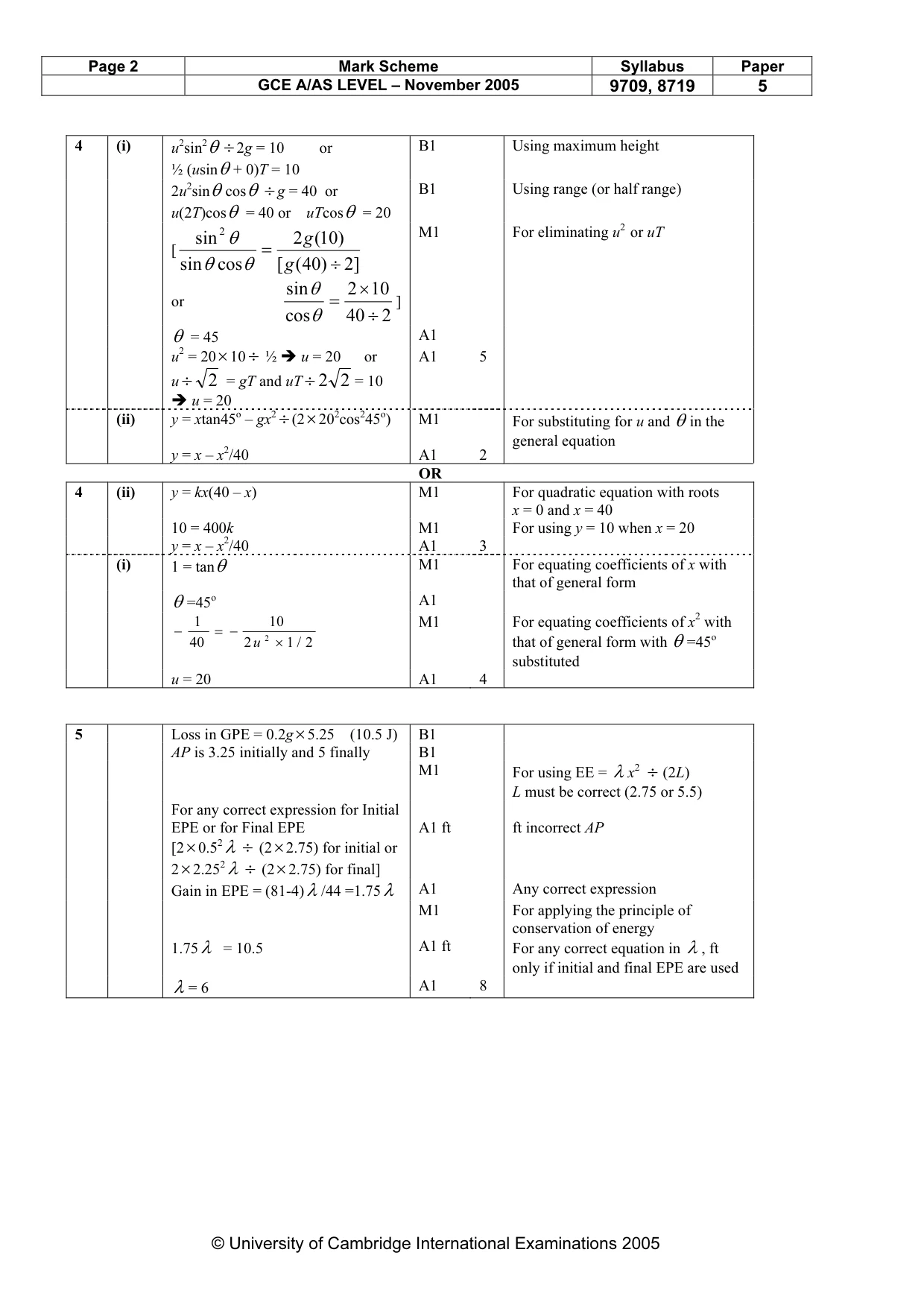
Mark scheme: 4 (i) u2sin2 θ ÷ 2g = 10 or B1 Using maximum height ½ (usinθ + 0)T = 10 2u2sinθ cosθ ÷ g = 40 or B1 Using range (or half range) u(2T)cosθ = 40 or uTcosθ = 20 2 M1 For eliminating u2 or uT sin θ 2 g (10) [ = sin θ cos θ [ g ( 40) ÷ 2] sin θ 2 × 10 or = ] cos θ 40 ÷ 2 θ = 45 A1 u2 = 20×10÷ ½ u = 20 or A1 5 u ÷ 2 = gT and uT ÷ 2 2 = 10 u = 20 (ii) y = xtan45o – gx2÷ (2×202cos245o) M1 For substituting for u and θ in the general equation y = x – x2/40 A1 2 OR 4 (ii) y = kx(40 – x) M1 For quadratic equation with roots x = 0 and x = 40 10 = 400k M1 For using y = 10 when x = 20 y = x – x2/40 A1 3 (i) 1 = tanθ M1 For equating coefficients of x with that of general form θ =45o A1 1 10 M1 For equating coefficients of x2 with − = − 2 40 2 u × 1 / 2 that of general form with θ =45o substituted u = 20 A1 4
Q5 · A particle P of mass 0.2 kg is attached to the mid-point of a light elastic string of…
5 A particle P of mass 0.2 kg is attached to the mid-point of a light elastic string of natural length 5.5 m and modulus of elasticity λ N. The ends of the string are attached to fixed points A and B which are at the same horizontal level and 6 m apart. P is held at rest at a point 1.25 m vertically above the mid-point of AB and then released. P travels a distance 5.25 m downwards before coming to instantaneous rest (see diagram). By considering the changes in gravitational potential energy and elastic potential energy as P travels downwards, find the value of λ. [8]
Mark scheme: 5 Loss in GPE = 0.2g×5.25 (10.5 J) B1 AP is 3.25 initially and 5 finally B1 M1 For using EE = λ x2 ÷ (2L) L must be correct (2.75 or 5.5) For any correct expression for Initial EPE or for Final EPE A1 ft ft incorrect AP [2×0.52λ ÷ (2×2.75) for initial or 2×2.252λ ÷ (2×2.75) for final] Gain in EPE = (81-4)λ /44 =1.75λ A1 Any correct expression M1 For applying the principle of conservation of energy 1.75λ = 10.5 A1 ft For any correct equation in λ , ft only if initial and final EPE are used λ = 6 A1 8 GCE A/AS LEVEL – November 2005 9709, 8719 5
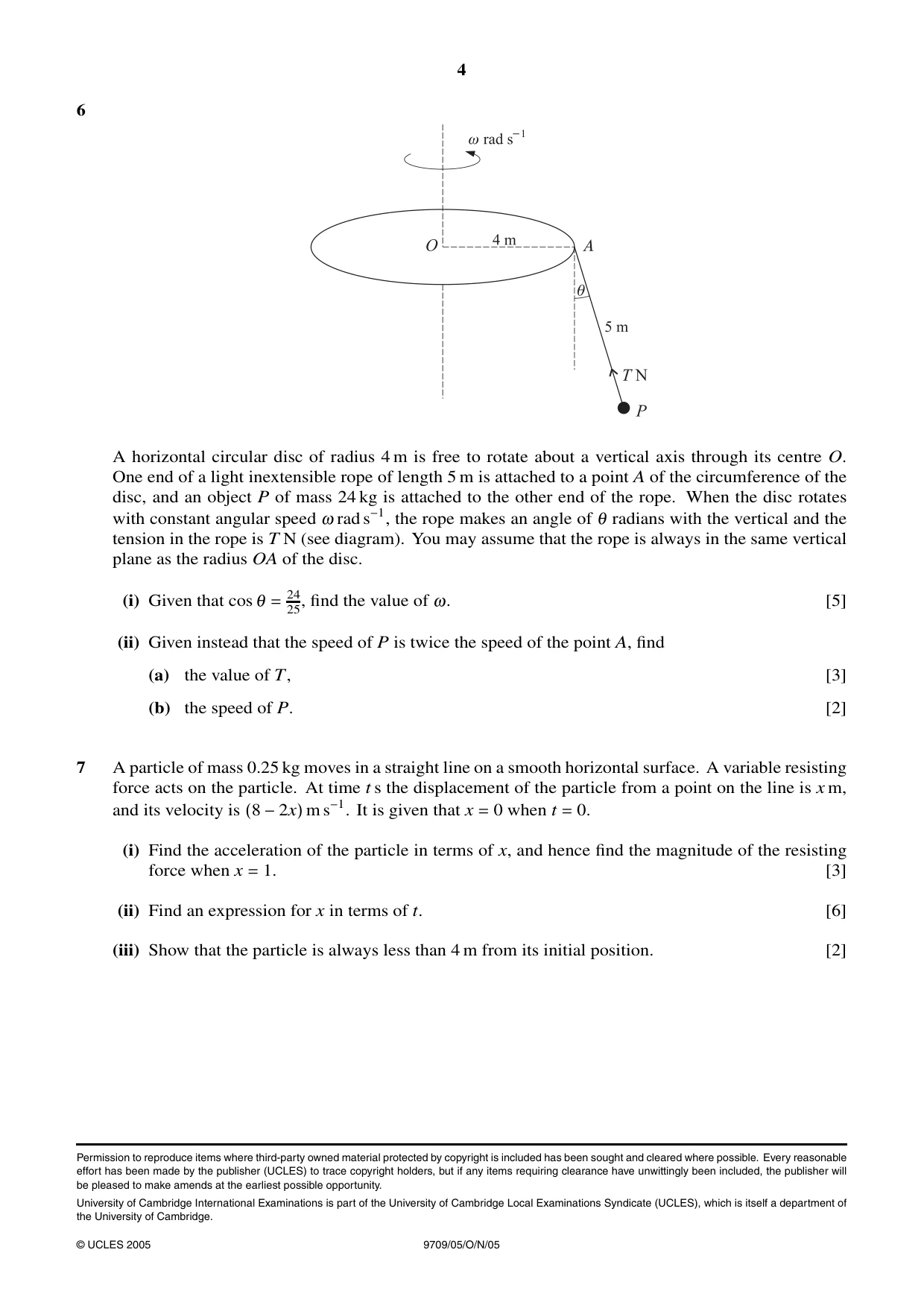
Q6 · A horizontal circular disc of radius 4 m is free to rotate about a vertical axis through…
6 A horizontal circular disc of radius 4 m is free to rotate about a vertical axis through its centre O. One end of a light inextensible rope of length 5 m is attached to a point A of the circumference of the disc, and an object P of mass 24 kg is attached to the other end of the rope. When the disc rotates with constant angular speed ω rad s−1, the rope makes an angle of θ radians with the vertical and the tension in the rope is T N (see diagram). You may assume that the rope is always in the same vertical plane as the radius OA of the disc. (i) Given that cos θ = 2425, find the value of ω. [5] (ii) Given instead that the speed of P is twice the speed of the point A, find (a) the value of T, [3] (b) the speed of P. [2]
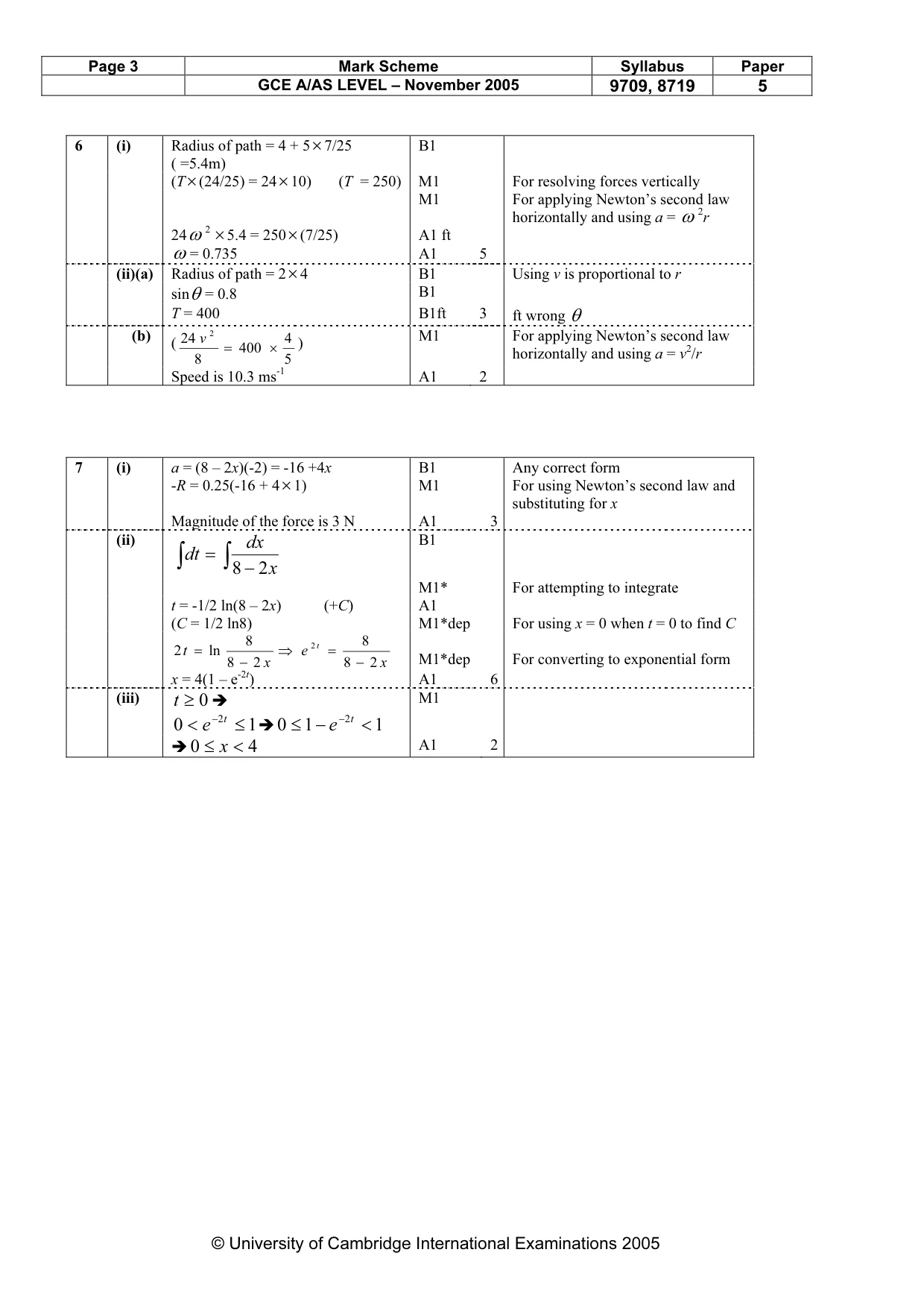
Mark scheme: 6 (i) Radius of path = 4 + 5×7/25 B1 ( =5.4m) (T×(24/25) = 24×10) (T = 250) M1 For resolving forces vertically M1 For applying Newton’s second law horizontally and using a = ω 2r 24ω 2 ×5.4 = 250×(7/25) A1 ft ω = 0.735 A1 5 (ii)(a) Radius of path = 2×4 B1 Using v is proportional to r sinθ = 0.8 B1 T = 400 B1ft 3 ft wrong θ (b) 24 v 2 4 M1 For applying Newton’s second law ( = 400 × ) 8 5 horizontally and using a = v2/r Speed is 10.3 ms-1 A1 2
Q7 · A particle of mass 0.25 kg moves in a straight line on a smooth horizontal surface
7 A particle of mass 0.25 kg moves in a straight line on a smooth horizontal surface. A variable resisting force acts on the particle. At time t s the displacement of the particle from a point on the line is x m, and its velocity is (8 −2x) m s−1. It is given that x = 0 when t = 0. (i) Find the acceleration of the particle in terms of x, and hence find the magnitude of the resisting force when x = 1. [3] (ii) Find an expression for x in terms of t. [6] (iii) Show that the particle is always less than 4 m from its initial position. [2]
Mark scheme: 7 (i) a = (8 – 2x)(-2) = -16 +4x B1 Any correct form -R = 0.25(-16 + 4×1) M1 For using Newton’s second law and substituting for x Magnitude of the force is 3 N A1 3 (ii) dx B1 ∫ dt = ∫ 8 − 2 x M1* For attempting to integrate t = -1/2 ln(8 – 2x) (+C) A1 (C = 1/2 ln8) M1*dep For using x = 0 when t = 0 to find C 8 2 t 8 2 t = ln ⇒ e = 8 − 2 x 8 − 2 x M1*dep For converting to exponential form x = 4(1 – e-2t) A1 6 (iii) t ≥ 0 M1 0 < e −t2 ≤ 1 0 ≤ 1 − e −t2 < 1 0 ≤x < 4 A1 2
What was in this paper
The subtopics covered by these 7 questions, and how many questions each got. Open one in a new tab to see every Cambridge question on it.