Cambridge A Level Mathematics 9709 — 2002 Oct/Nov Paper 3 · Variant 1
9709/31/O/N/02
The question paper and its mark scheme, free to read here and free to download. This is Cambridge’s own paper, exactly as it was sat.
Question paper4 pages
Mark scheme6 pages
Answers below. Sit the paper first if you are practising.
Paper as text
Question paper, page 1
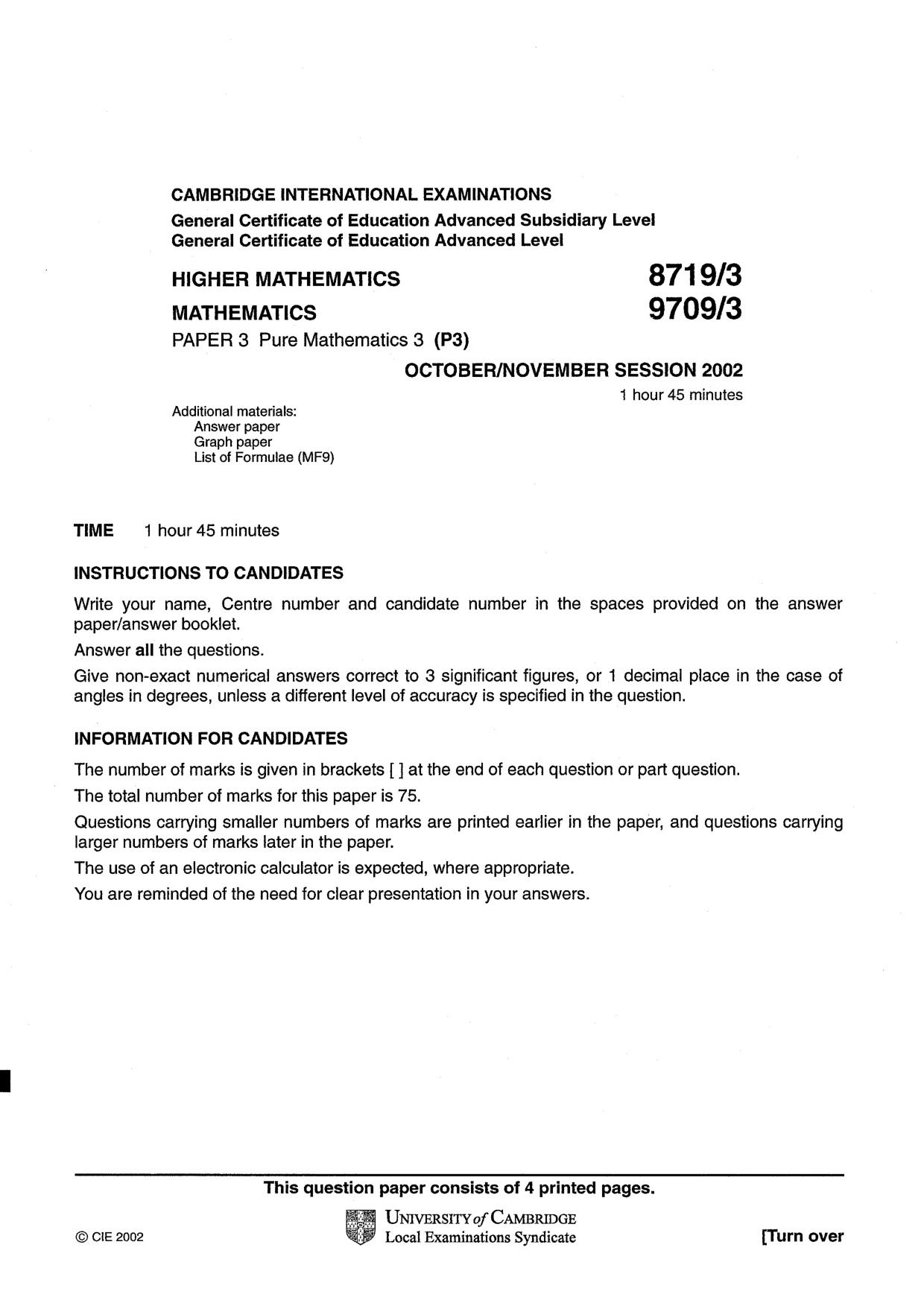
CAMBRIDGE INTERNATIONAL EXAMINATIONS General Certificate of Education Advanced Subsidiary Level General Certificate of Education Advanced Level HIGHER MATHEMATICS 8719/3 MATHEMATICS 9709/3 PAPER 3 Pure Mathematics 3 (P3) OCTOBER/NOVEMBER SESSION 2002 1 hour 45 minutes Additional materials: Answer paper Graph paper List of Formulae (MF9) TIME = 1 hour 45 minutes INSTRUCTIONS TO CANDIDATES Write your name, Centre number and candidate number in the spaces provided on the answer paper/answer booklet. Answer all the questions. Give non-exact numerical answers correct to 3 significant figures, or 1 decimal place in the case of angles in degrees, unless a different level of accuracy is specified in the question. INFORMATION FOR CANDIDATES The number of marks is given in brackets [ ] at the end of each question or part question. The total number of marks for this paper is 75. Questions carrying smaller numbers of marks are printed earlier in the paper, and questions carrying larger numbers of marks later in the paper. The use of an electronic calculator is expected, where appropriate. You are reminded of the need for clear presentation in your answers. This question paper consists of 4 printed pages. UNIVERSITY of CAMBRIDGE Local Examinations Syndicate [Turn over © CIE 2002
Question paper, page 2
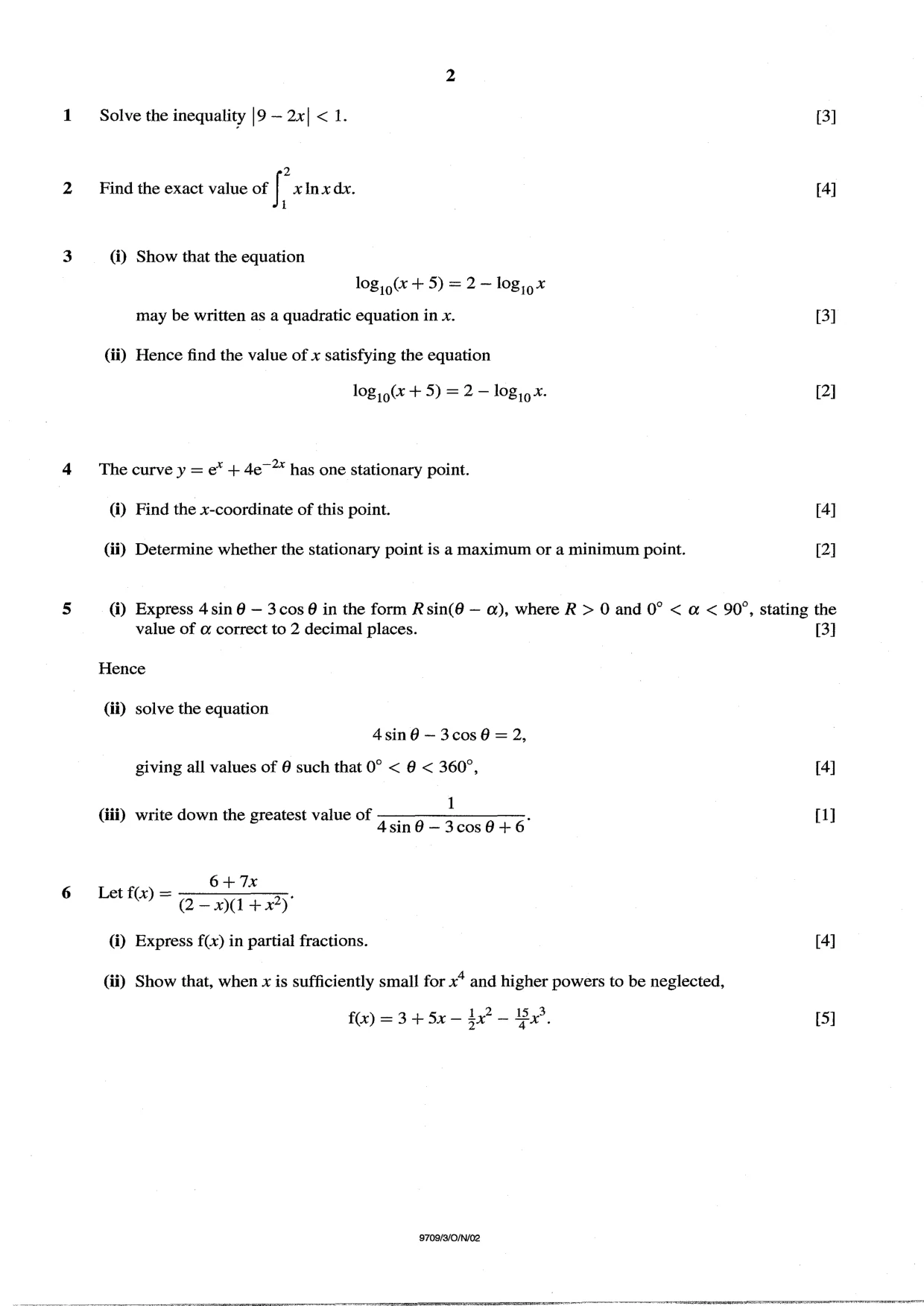
1 Solve the inequality |9-2x| <1. [3] 2 2 Find the exact value of J xInxdx. (4) i 3 (i) Show that the equation log,9(« + 5) = 2 — log,) x may be written as a quadratic equation in x. [3] (ii) Hence find the value of x satisfying the equation log; 9(* + 5) = 2 — log, gx. [2] 4 The curve y = e* + 4e~”* has one stationary point. (@ Find the x-coordinate of this point. [4] (ii) Determine whether the stationary point is a maximum or a minimum point. [2] 5 (i) Express 4 sin 6 — 3cos @ in the form Rsin(@ — a), where R > 0 and 0° < a < 90°, stating the value of o correct to 2 decimal places. [3] Hence (ii) solve the equation 4sin @ — 3cos@ =2, giving all values of 6 such that 0° < @ < 360°, [4] (iii) write down the greatest value of Ime (1) 6+7x 6 Let f«) = ——__—_.. = pate) (i) Express f(x) in partial fractions. [4] (ii) Show that, when x is sufficiently small for x* and higher powers to be neglected, f(x) = 3 + 5x — 4x? - 132°. [5] 9709/3/0/NI02
Question paper, page 3
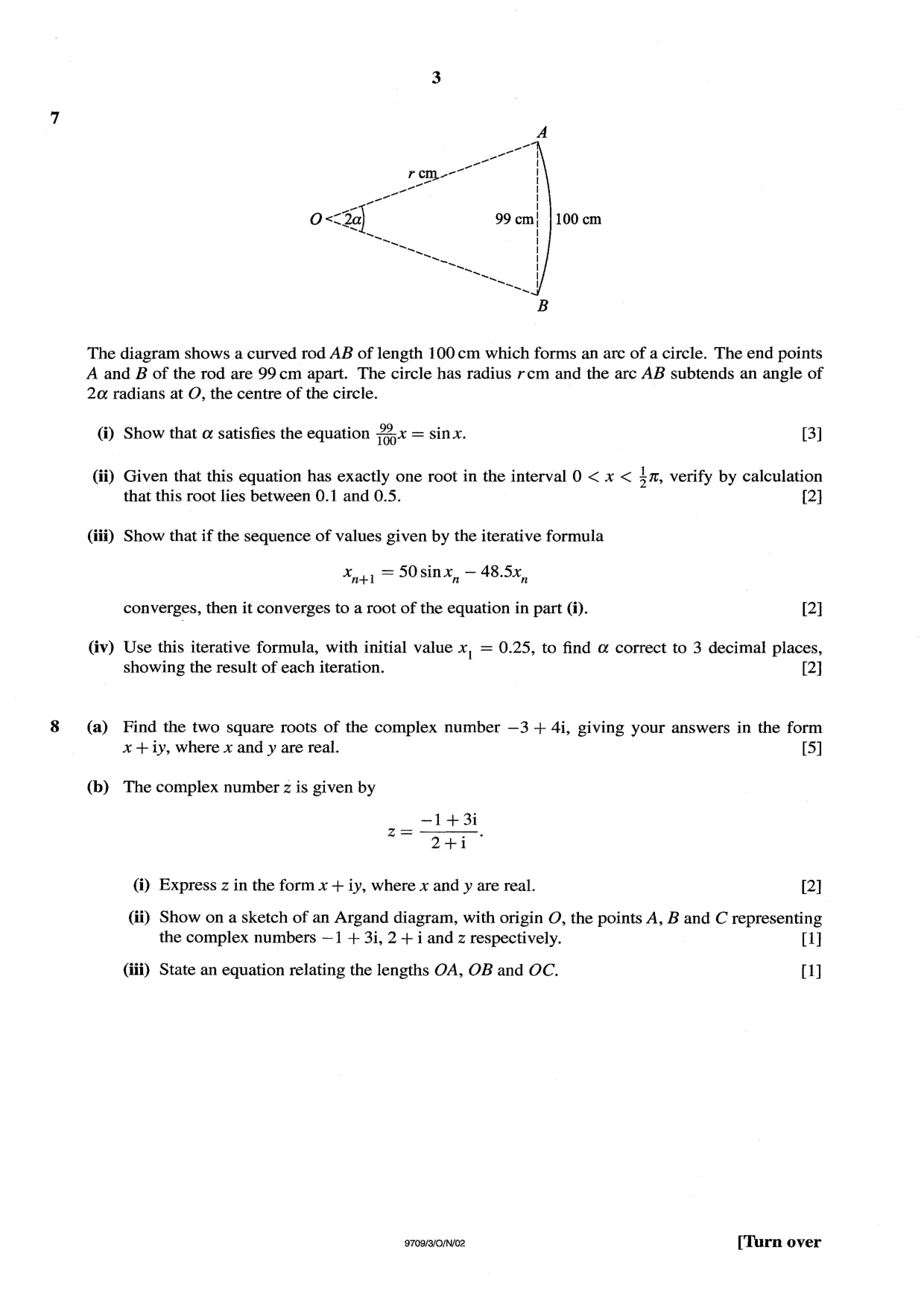
100 cm The diagram shows a curved rod AB of length 100 cm which forms an arc of a circle. The end points A and B of the rod are 99cm apart. The circle has radius rem and the arc AB subtends an angle of 2a radians at O, the centre of the circle. (i) Show that @ satisfies the equation x = sinx. [3] (ii) Given that this equation has exactly one root in the interval 0 < x < 32, verify by calculation that this root lies between 0.1 and 0.5. {2] (iii) Show that if the sequence of values given by the iterative formula Xn, = 50sinx, — 48.5x,, converges, then it converges to a root of the equation in part (i). [2] (iv) Use this iterative formula, with initial value x= 0.25, to find @ correct to 3 decimal places, showing the result of each iteration. [2] (a) Find the two square roots of the complex number —3 + 4i, giving your answers in the form x-+ iy, where x and y are real. [5] (b) The complex number z is given by zea -1+3i ~ 24i 7 (i) Express z in the form x + iy, where x and y are real. [2] (ii) Show on a sketch of an Argand diagram, with origin O, the points A, B and C representing the complex numbers —1 + 3i, 2 + i and z respectively. [1] (iii) State an equation relating the lengths OA, OB and OC. 1] ‘9709/S/O/N/O2 [Turn over
Question paper, page 4
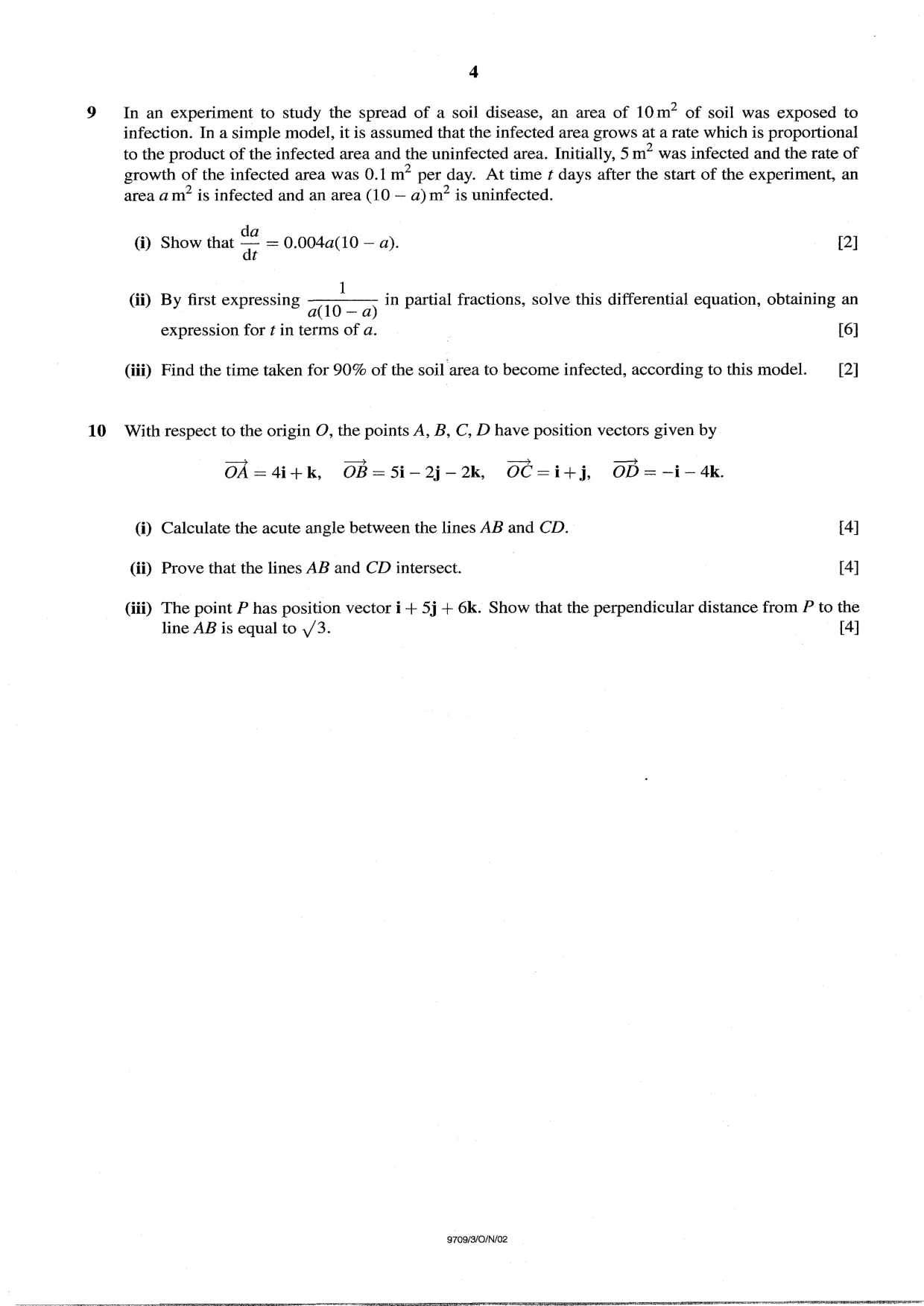
10 4 In an experiment to study the spread of a soil disease, an area of 10m? of soil was exposed to infection. In a simple model, it is assumed that the infected area grows at a rate which is proportional to the product of the infected area and the uninfected area. Initially, 5 m? was infected and the rate of growth of the infected area was 0.1 m? per day. At time ¢ days after the start of the experiment, an area am/ is infected and an area (10 — a) m? is uninfected. (i) Show that e = 0.004a(10 — a). [2] 1 (ii) By first expressing a0 a) in partial fractions, solve this differential equation, obtaining an expression for f in terms of a. [6] (iii) Find the time taken for 90% of the soil area to become infected, according to this model. [2] With respect to the origin O, the points A, B, C, D have position vectors given by OA =4i+k, OB=5i-2j-2k, OC=i+j, OD=-i-4k. (i) Calculate the acute angle between the lines AB and CD. [4] (ii) Prove that the lines AB and CD intersect. [4] (iii) The point P has position vector i + 5j + 6k. Show that the perpendicular distance from P to the line AB is equal to \/3. [4] 9709/S/0/NIO2
Mark scheme, page 1
CAMBRIDGE INTERNATIONAL EXAMINATIONS NOVEMBER 2002 GCE Advanced Level GCE Advanced Subsidiary Level UNIVERSITY of CAMBRIDGE Local Examinations Syndicate
Mark scheme, page 2
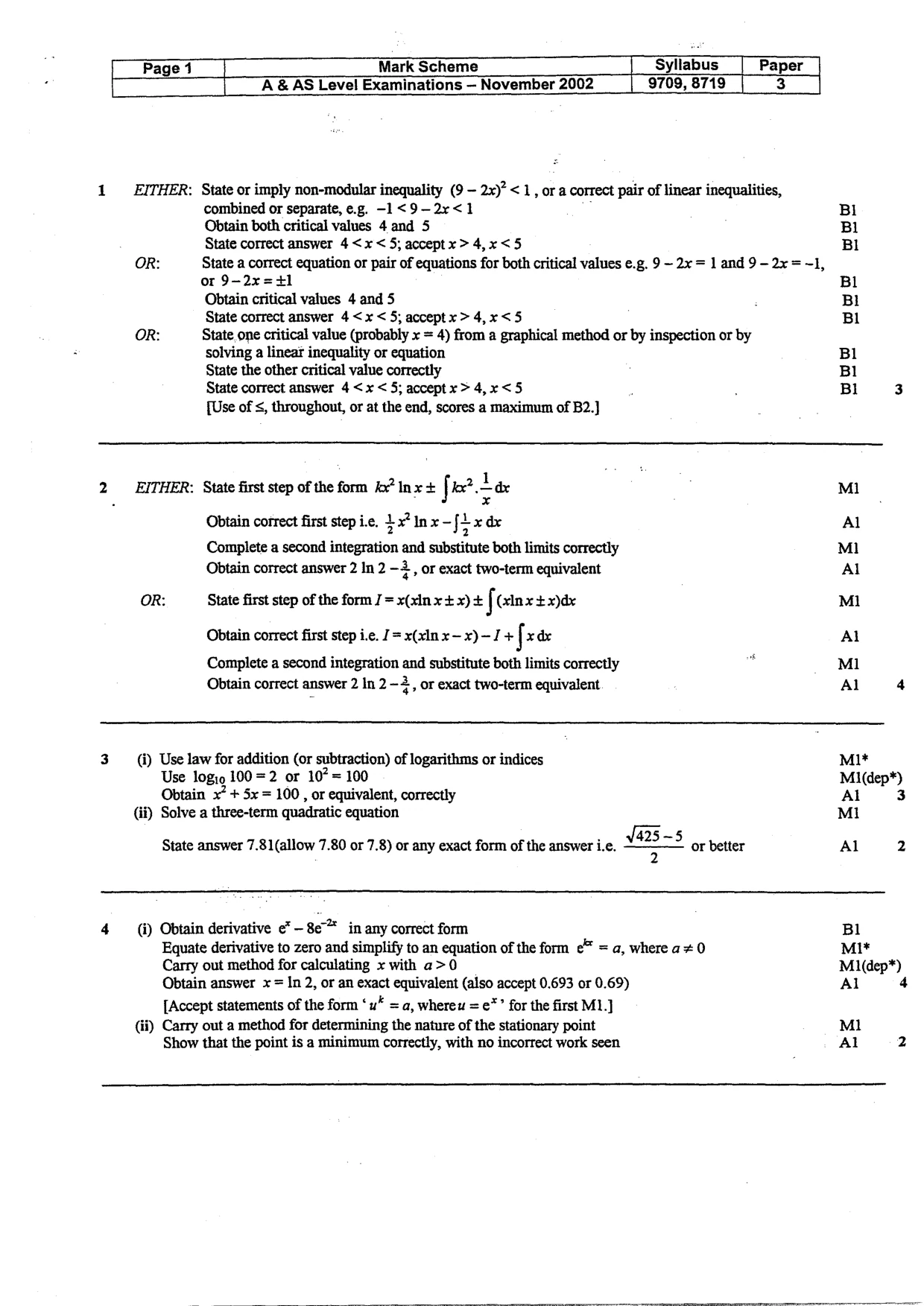
Page 14 Mark Scheme Syllabus Paper | A&AS Level Examinations — November 2002 [_ 9709, 8719 EITHER: State or imply non-modular inequality (9 - 2x) < 1, or a correct pair of linear inequalities, combined or separate, e.g. -1<9-2x<1 Bl Obtain both critical values 4 and 5 Bl State correct answer 4<x <5; acceptx > 4,x<5 BL OR: State a correct equation or pair of equations for both critical values e.g. 9 ~ 2x = 1 and 9- 2x =~1, or 9-2x=+1 Bl Obtain critical values 4 and 5 Bl State correct answer 4 <x <5; acceptx>4,x<5 BL OR: State one critical value (probably x = 4) from a graphical method or by inspection or by solving a linear inequality or equation Bl State the other critical value correctly Bl State correct answer 4 <x <5; acceptx>4,x<5 Bl 3 [Use of <, throughout, or at the end, scores a maximum of B2.] al 2 EITHER: State first step of the form fx? nx [kx Se Mi Obtain correct first step i.e, $8 Inx— fox de Al Complete a second integration and substitute both limits correctly Mi Obtain correct answer 2 In 2 -3, or exact two-term equivalent Al OR: State first step of the form J = x(xinx:t x) ( (xinxx)dx Mi Obtain correct first step ie. = x(zinx—x)-1+[xér Al Complete a second integration and substitute both limits correctly M1 Obtain correct answer 2 In 2-3, or exact two-term equivalent Al 4 3° (i) - Use law for addition (or subtraction) of logarithms or indices Mi* Use logio 100=2 or 107= 100 Mi(dep*) Obtain x’ + 5x = 100 , or equivalent, correctly Al 3 (ii) Solve a three-term quadratic equation Mi State answer 7.81 (allow 7.80 or 7.8) or any exact form of the answer i.e. or better Al 2 4 (@) Obtain derivative e*- 8e* in any correct form Bl Equate derivative to zero and simplify to an equation of the form e* = a, where a+ 0 MI* Carry out method for calculating x with a>0 Mi (dep*) Obtain answer x = In 2, or an exact equivalent (also accept 0.693 or 0.69) Al 4 [Accept statements of the form ‘u" = a, wherew = e*’ for the first M1.] (ii) Carry out a method for determining the nature of the stationary point Mil Show that the point is a minimum correctly, with no incorrect work seen Al 2
Mark scheme, page 3
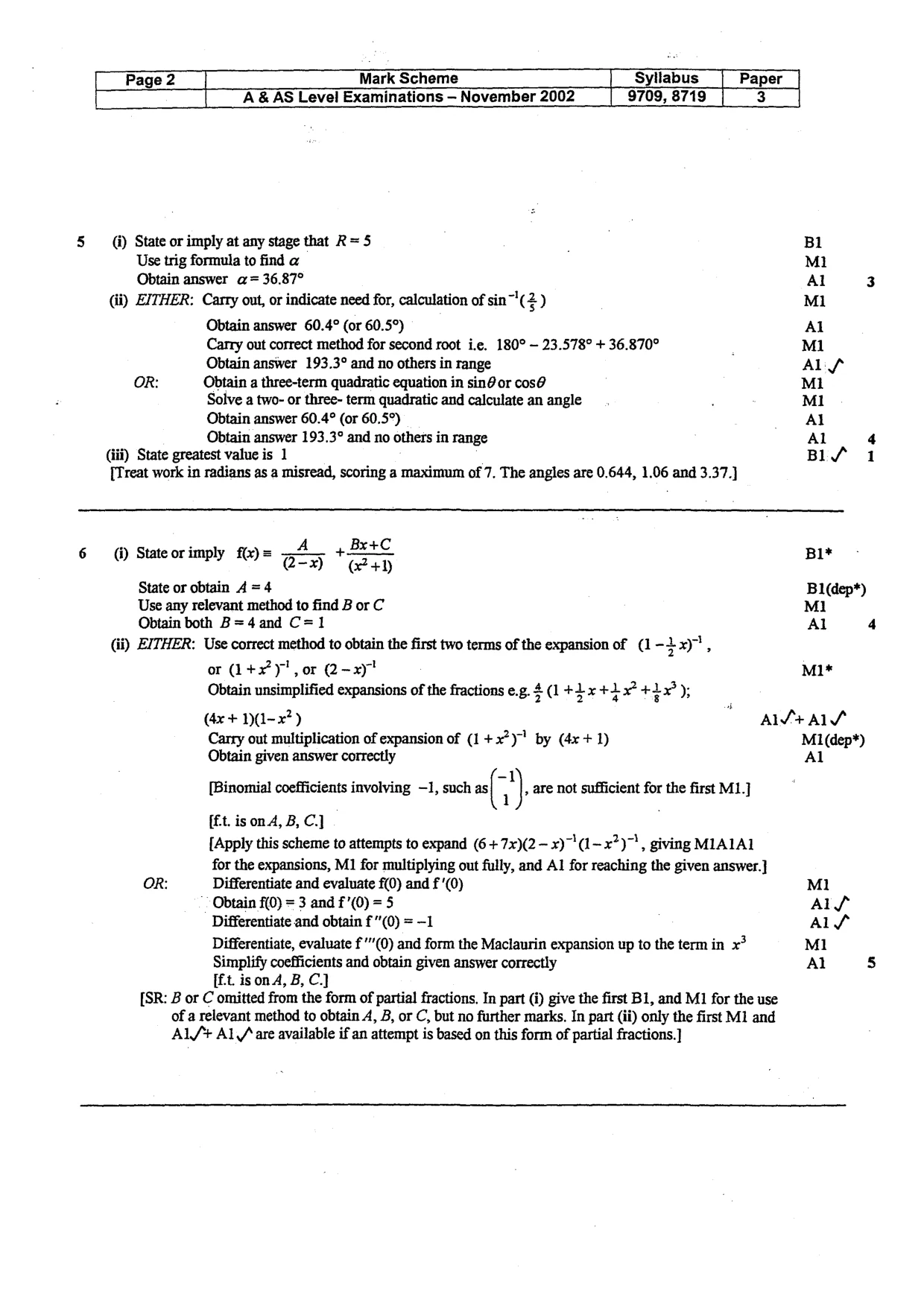
Page 2 Mark Scheme Syllabus Paper A&AS Level Examinations — November 2002 9709, 8719 3 5 @) State or imply at any stage that R=5 Bl Use trig formula to find a Mil Obtain answer a = 36.87° Al 3 (ii) EITHER: Carry out, or indicate need for, calculation of sin=!( 2) Mi Obtain answer 60.4° (or 60.5°) Al Carry out correct method for second root i.e. 180° - 23.578° + 36.870° . M1 Obtain answer 193.3° and no others in range Al Sf OR: Obtain a three-term quadratic equation in sin@ or cos ML Solve a two- or three- term quadratic and calculate an angle . M1 Obtain answer 60.4° (or 60.5°) Al Obtain answer 193.3° and no others in range Al 4 (iii) State greatest value is 1 BlY 1 [Treat work in radians as a misread, scoring a maximum of 7. The angles are 0.644, 1.06 and 3.37.] . A Bx+C 6 (i) State Ny = af + Bt 0) orimply x)= GIy G4) State or obtain A = 4 Bl(dep*) Use any relevant method to find B or C M1 Obtain both B= 4 and C=1 Al 4 (i) EITHER: Use correct method to obtain the first two terms of the expansion of (1-1x)", or +27)", or Q-2y" MI* Obtain unsimplified expansions of the fractions e.g. # (1 +1x tix tix ); (4+ D0-x*) "a+ Aly Carry out multiplication of expansion of (1 +x”)! by (4x + 1) MI (dep*) Obtain given answer correctly Al -1 [Binomial coefficients involving —1, such a( 1 }: are not sufficient for the first M1.] [£t. is on.A, B, C.] [Apply this scheme to attempts to expand (6 +7x)(2—x)"'(1- x”), giving MIA1A1 for the expansions, M1 for multiplying out fully, and Al for reaching the given answer.] OR: Differentiate and evaluate f(0) and f '(0) Mi Obtain f(0) = 3 and £'(0) = 5 Als Differentiate and obtain f"(0) = -1 Als Differentiate, evaluate f (0) and form the Maclaurin expansion up to the term in x? M1 Simplify coefficients and obtain given answer correctly Al 5 [ft. is on A, B, C.] [SR: B or C omitted from the form of partial fractions. In part (i) give the first B1, and M1 for the use of a relevant method to obtain A, B, or C, but no further marks. In part (ii) only the first M1 and Al/*+ Al J/ are available if an attempt is based on this form of partial fractions.]
Mark scheme, page 4
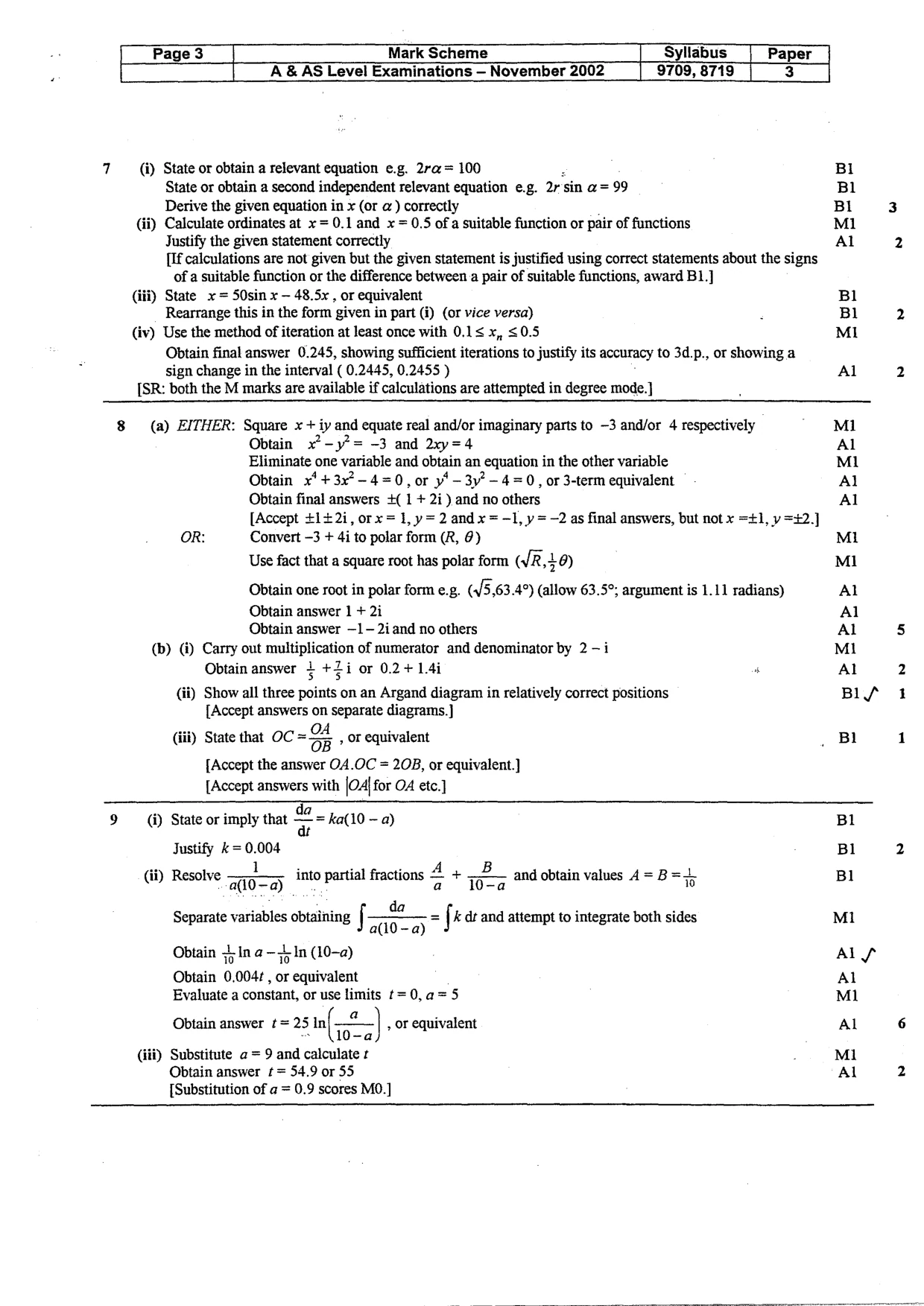
7 [Page 3 Mark Scheme Syllabus | Paper [ A&AS Level Examinations — November 2002 9709, 8719 | 3 (i) State or obtain a relevant equation e.g. 2ra= 100 State or obtain a second independent relevant equation e.g. ae sin a=99 Derive the given equation in x (or a) correctly (ii) Calculate ordinates at x = 0.1 and x = 0.5 of a suitable function or pair of functions Justify the given statement correctly [If calculations are not given but the given statement is justified using correct statements about the signs of a suitable function or the difference between a pair of suitable functions, award B1.] (iii) State x = 50sin x — 48.5x , or equivalent Rearrange this in the form given in part (i) (or vice versa) (iv) Use the method of iteration at least once with 0.1< x, <0.5 Obtain final answer 0.245, showing sufficient iterations to justify its accuracy to 3d.p., or showing a sign change in the interval ( 0.2445, 0.2455 ) [SR: both the M marks are available if calculations are attempted in degree mode.] Bl Bl BL Mi Al Bl Bl MIL Al 8 (a) EITHER: Square x + iy and equate real and/or imaginary parts to —3 and/or 4 respectively Obtain x°-y = -3 and 2xy= Eliminate one variable and obtain an equation in the other variable Obtain x‘+3x?-4=0, or »4-3y*- 4=0, or 3-term equivalent Obtain final answers +( 1 + 2i ) and no others [Accept £1+2i, or x= 1, y= 2 and x =-1, y=—2 as final answers, but not x =+1, y =42.] OR: Convert -3 + 4i to polar form (R, 6) Use fact that a square root has polar form (WR,40) Obtain one root in polar form e.g. (/5,63.4°) (allow 63.5°; argument is 1.11 radians) Obtain answer 1 + 2i Obtain answer —1—2i and no others (b) (i) Carry out multiplication of numerator and denominator by 2 -i Obtain answer 4 +2i or 0.2+1-4i (ii) Show all three points on an Argand diagram in relatively correct positions [Accept answers a n Separate diagrams. ] (iii) State that OC = oA Bot equivalent {Accept the answer OA.OC = 20B, or equivalent.] [Accept answers with |Q4| for OA etc.] 9 — @ State or imply that 4 = ka(10 - a) Justify k= 0.004 (ii) Resolve A alo=ay 2+ ao= into partial fractions a S te variables obtainin; eparate vari: ig i xl0-a) Obtain pina -$ In (10-a) Obtain .004¢ , OF equivalent Evaluate a constant, or use limits t= 0,a=5 Obtain answer t= 25 (2 } , or equivalent (iii) Substitute a = 9 and calculate t Obtain answer f= 54.9 or 55 [Substitution of a = 0.9 scores MO.] 5 _ and obtain values A = B= 10-a = fe dt and attempt to integrate both sides Mi Al ML Al ML MI Al Al AL Mi Al BlY Bl Bl Bl Bl Mi Aly Al Al M1 Al
Mark scheme, page 5
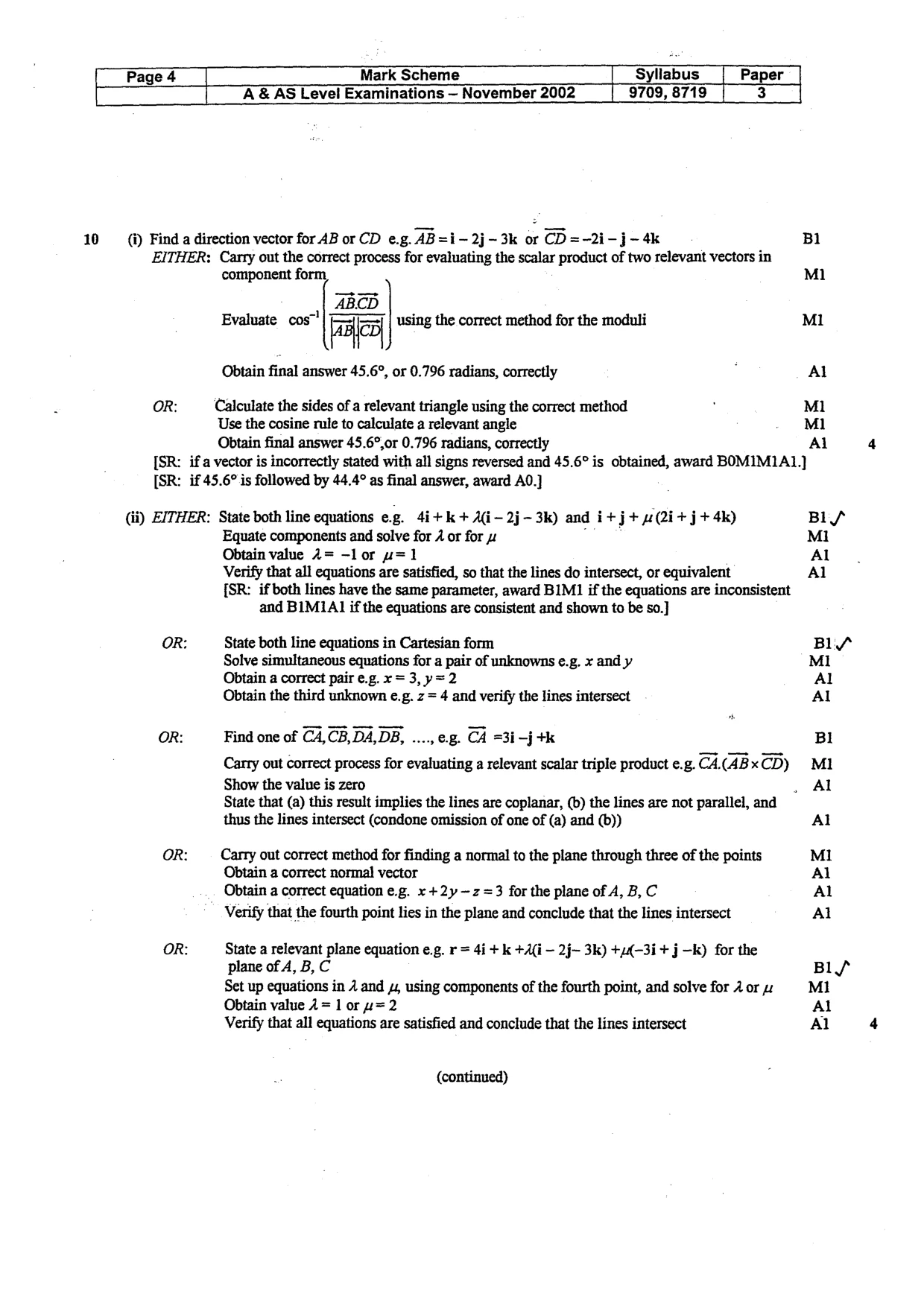
Page 4 Mark Scheme Syllabus Paper | A& AS Level Examinations — November 2002 9709, 8719 10 (i) Find a direction vector for AB or CD e.g. AB =i-2j-3k or CD=-2i-j-4k EITHER: Carry out the correct process for evaluating the scalar product of two relevant vectors in OR: component foi ABCD Evaluate cos” instar using the correct method for the moduli Obtain final answer 45.6°, or 0.796 radians, correctly Calculate the sides of a relevant triangle using the correct method Use the cosine rule to calculate a relevant angle Obtain final answer 45.6°,or 0.796 radians, correctly Bl Ml MI Al Mi Ml Al 4 [SR: ifa vector is incorrectly stated with all signs reversed and 45.6° is obtained, award BOMIM1A1.] [SR: if 45.6° is followed by 44.4° as final answer, award A0.] (ii) EITHER: State both line equations e.g. 4i+k + A(i-2j-3k) and it+j+u(Qi+j+4k) OR: OR: OR: OR: Equate components and solve for A or for Obtain value 2= -lor w=1 Verify that all equations are satisfied, so that the lines do intersect, or equivalent {SR: if both lines have the same parameter, award B1M1 if the equations are inconsistent and B1M1AI if the equations are consistent and shown to be so.] State both line equations in Cartesian form Solve simultaneous equations for a pair of unknowns e.g. x and y Obtain a correct pair e.g. x = 3, y=2 Obtain the third unknown e.g. z = 4 and verify the lines intersect Find one of CA,CB, DA, DB, seey CB. CA =3i -j+k Carry out correct process for evaluating a relevant scalar triple product e.g. CA(4Bx CD) Show the value is zero State that (a) this result implies the lines are coplanar, (b) the lines are not parallel, and thus the lines intersect (condone omission of one of (a) and (b)) Carry out correct method for finding a normal to the plane through three of the points Obtain a correct normal vector Obtain a correct equation e.g. x +2y—z=3 for the plane of A, B, C Verify that the fourth point lies in the plane and conclude that the lines intersect State a relevant plane equation e.g. r = 4i + k +A(i - 2j- 3k) +,4-3i+ j -k) for the plane of A, B,C Set up equations in 4 and 44, using components of the fourth point, and solve for 2 or Obtain value A= 1 or p= 2 Verify that all equations are satisfied and conclude that the lines (continued) intersect BlY/ MI Al Al BlY/ MI Al BI MI Al Al MI Al Al Al Bly Mi Al Al 4
Mark scheme, page 6
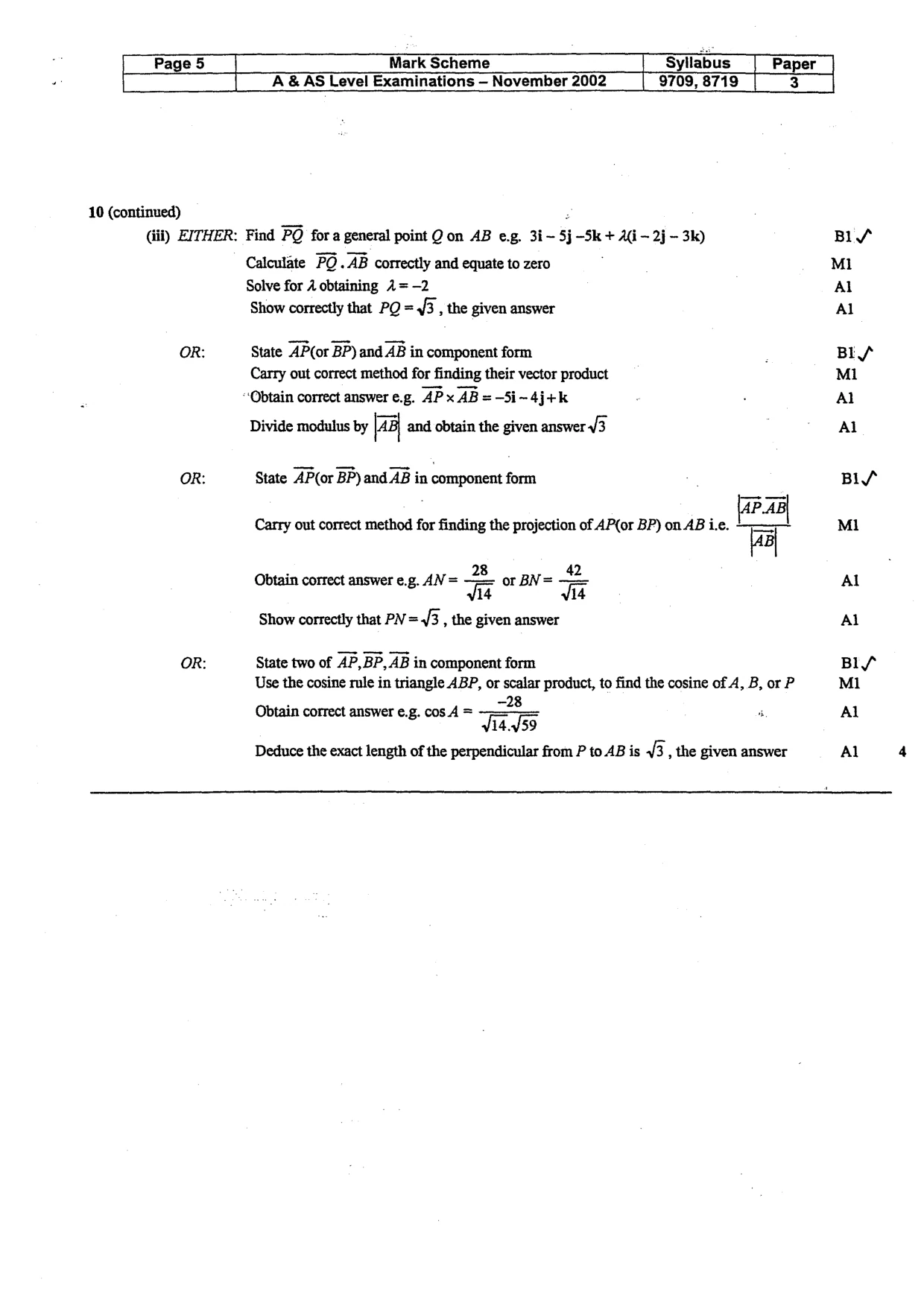
Page 5 I Mark Scheme Syllabus Paper 3 A& AS Level Examinations — November 2002 9709, 8719 10 (continued) (iii) EITHER: Find PQ for a general point Q on AB e.g. 3i-5j-Sk + A(i-2j - 3k) OR: OR: OR: Calculate PO. AB correctly and equate to zero Solve for A obtaining 2 =-2 Show correctly that PQ = 43, the given answer State AP(or BP) and AB in component form Carry out correct method for finding their vector product ‘Obtain correct answer e.g. AP x AB = -5i~4j+k Divide modulus by [a and obtain the given answer /3 State ‘AP(or BP) and AB in component form Carry out correct method for finding the projection of AP(or BP) on AB i.e. Obtain correct answer e.g. AN = 28 or BN= a Via Via Show correctly that PY = 3 , the given answer State two of AP, BP, AB in component form Use the cosine rule in triangle ABP, or scalar product, to find the cosine of A, B, or P Obtain correct answer e.g. cos.A = 28 V14.V59 . Deduce the exact length of the perpendicular from P to AB is 43, the given answer BY MI Al Al Bly Mi Al Al BY MI Al Al BlY Al Al