Cambridge A Level Mathematics 9709 — 2002 May/June Paper 5 · Variant 1
9709/51/M/J/02
The question paper and its mark scheme, free to read here and free to download. This is Cambridge’s own paper, exactly as it was sat.
Question paper4 pages
Mark scheme4 pages
Answers below. Sit the paper first if you are practising.
Paper as text
Question paper, page 1
CAMBRIDGE INTERNATIONAL EXAMINATIONS General Certificate of Education Advanced Subsidiary Level General Certificate of Education Advanced Level HIGHER MATHEMATICS MATHEMATICS 8719/5 9709/5 PAPER 5 Mechanics 2 (M2) MAY/JUNE SESSION 2002 1 hour 15 minutes Additional materials: Answer paper Graph paper List of Formulae (MF9) TIME 1 hour 15 minutes INSTRUCTIONS TO CANDIDATES Write your name, Centre number and candidate number in the spaces provided on the answer paper/answer booklet. Answer all the questions. Give non-exact numerical answers correct to 3 significant figures, or 1 decimal place in the case of angles in degrees, unless a different level of accuracy is specified in the question. Where a numerical value for the acceleration due to gravity is needed, use 10 m s 2. INFORMATION FOR CANDIDATES The number of marks is given in brackets [ ] at the end of each question or part question. The total number of marks for this paper is 50. Questions carrying smaller numbers of marks are printed earlier in the paper, and questions carrying larger numbers of marks later in the paper. The use of an electronic calculator is expected, where appropriate. You are reminded of the need for clear presentation in your answers. This question paper consists of 4 printed pages. CIE 2002 Local Examinations Syndicate U C NIVERSITY AMBRIDGE of [Turn over
Question paper, page 2
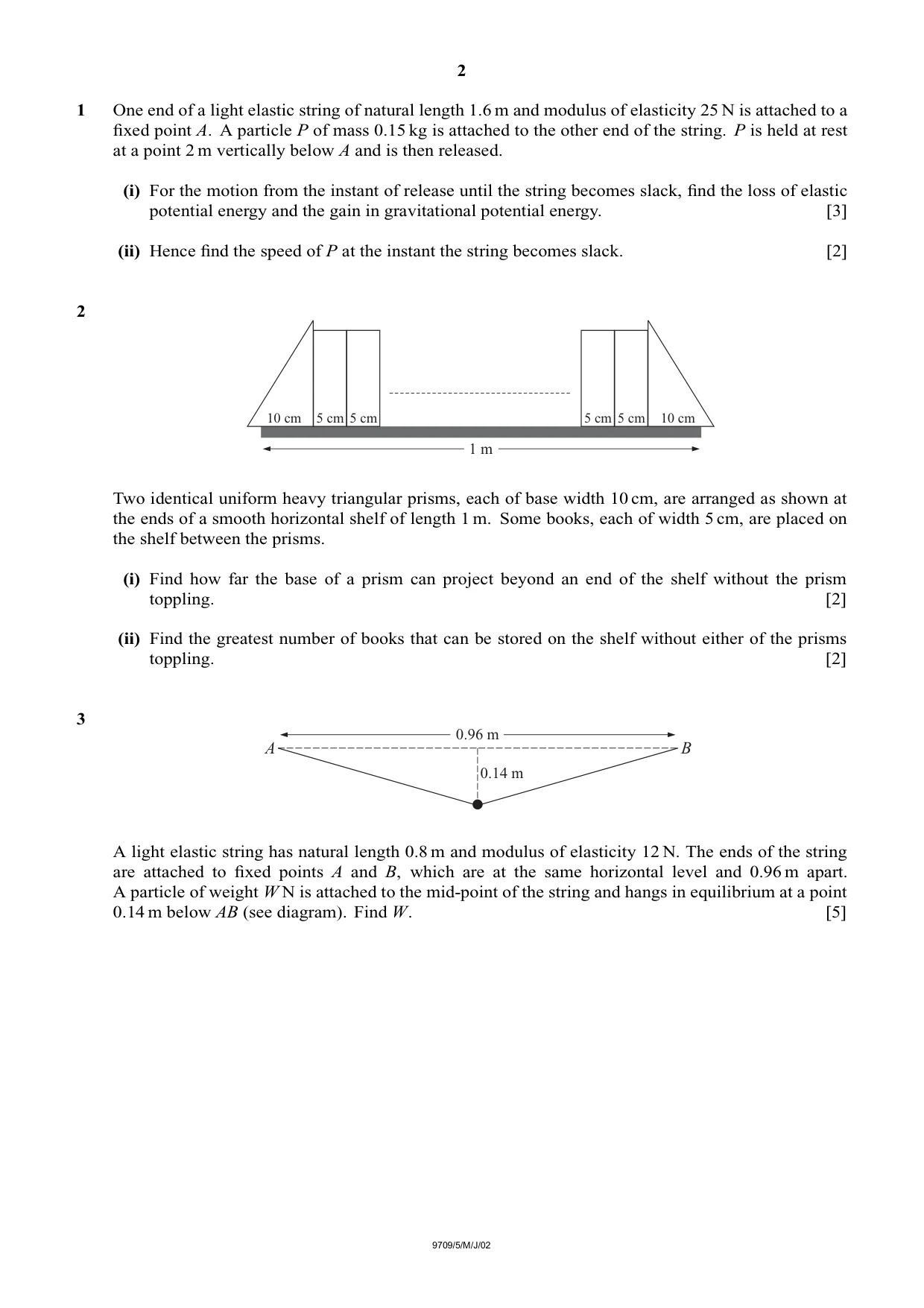
2 1 One end of a light elastic string of natural length 1.6 m and modulus of elasticity 25 N is attached to a fixed point A. A particle P of mass 0.15 kg is attached to the other end of the string. P is held at rest at a point 2 m vertically below A and is then released. (i) For the motion from the instant of release until the string becomes slack, find the loss of elastic potential energy and the gain in gravitational potential energy. [3] (ii) Hence find the speed of P at the instant the string becomes slack. [2] 2 5 cm 5 cm 5 cm 5 cm 10 cm 10 cm 1 m Two identical uniform heavy triangular prisms, each of base width 10 cm, are arranged as shown at the ends of a smooth horizontal shelf of length 1 m. Some books, each of width 5 cm, are placed on the shelf between the prisms. (i) Find how far the base of a prism can project beyond an end of the shelf without the prism toppling. [2] (ii) Find the greatest number of books that can be stored on the shelf without either of the prisms toppling. [2] 3 A B 0.14 m 0.96 m A light elastic string has natural length 0.8 m and modulus of elasticity 12 N. The ends of the string are attached to fixed points A and B, which are at the same horizontal level and 0.96 m apart. A particle of weight W N is attached to the mid-point of the string and hangs in equilibrium at a point 0.14 m below AB (see diagram). Find W. [5] 9709/5/M/J/02
Question paper, page 3
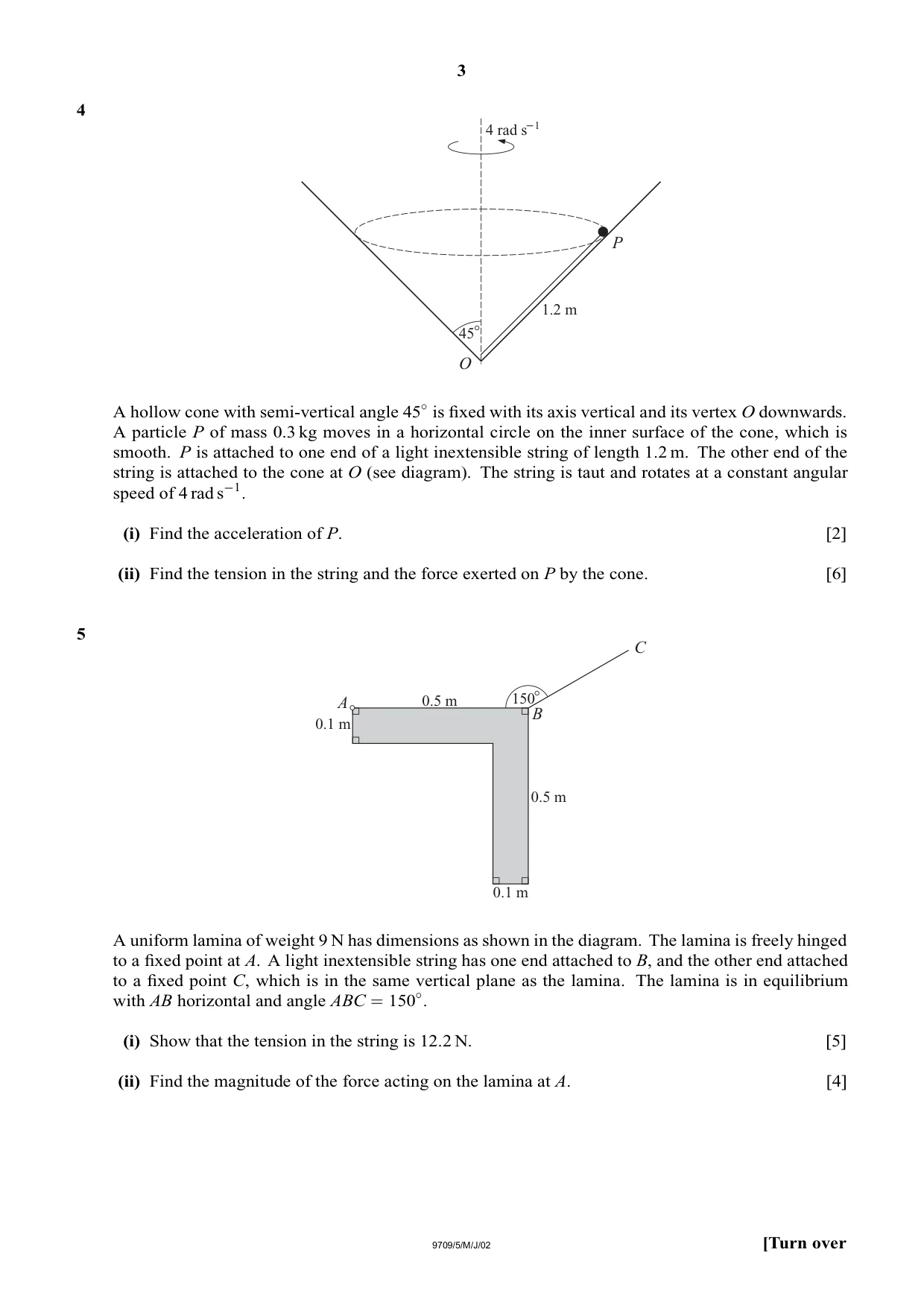
3 4 45° 1.2 m P O 4 rad s 1 A hollow cone with semi-vertical angle 45 Æ is fixed with its axis vertical and its vertex O downwards. A particle P of mass 0.3 kg moves in a horizontal circle on the inner surface of the cone, which is smooth. P is attached to one end of a light inextensible string of length 1.2 m. The other end of the string is attached to the cone at O (see diagram). The string is taut and rotates at a constant angular speed of 4 rad s 1. (i) Find the acceleration of P. [2] (ii) Find the tension in the string and the force exerted on P by the cone. [6] 5 A B C 0.5 m 0.1 m 0.1 m 0.5 m 150° A uniform lamina of weight 9 N has dimensions as shown in the diagram. The lamina is freely hinged to a fixed point at A. A light inextensible string has one end attached to B, and the other end attached to a fixed point C, which is in the same vertical plane as the lamina. The lamina is in equilibrium with AB horizontal and angle ABC 150 Æ. (i) Show that the tension in the string is 12.2 N. [5] (ii) Find the magnitude of the force acting on the lamina at A. [4] 9709/5/M/J/02 [Turn over
Question paper, page 4
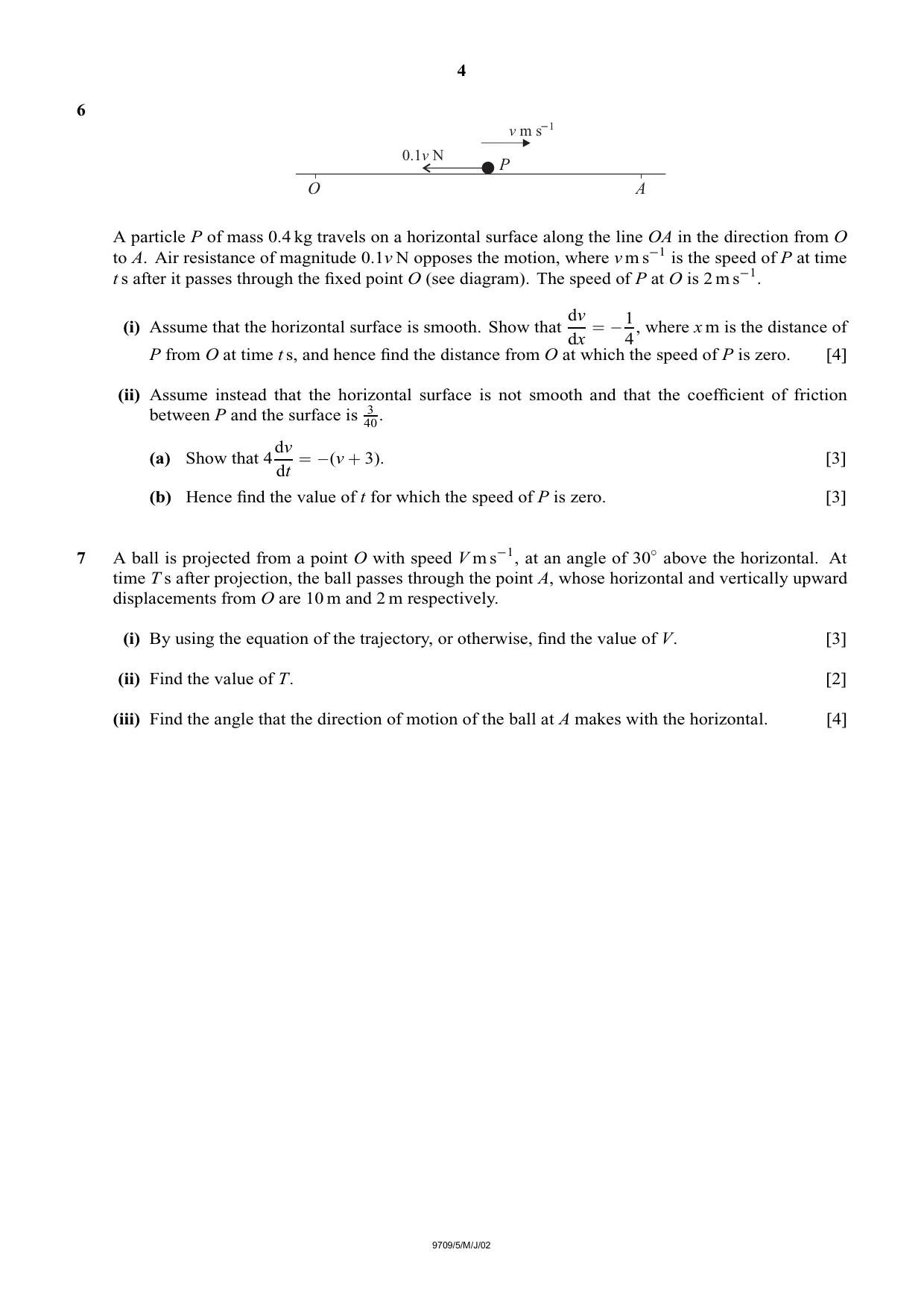
4 6 O A P 0.1 N v v m s 1 A particle P of mass 0.4 kg travels on a horizontal surface along the line OA in the direction from O to A. Air resistance of magnitude 0.1v N opposes the motion, where v m s 1 is the speed of P at time t s after it passes through the fixed point O (see diagram). The speed of P at O is 2 m s 1. (i) Assume that the horizontal surface is smooth. Show that dv dx 1 4, where x m is the distance of P from O at time t s, and hence find the distance from O at which the speed of P is zero. [4] (ii) Assume instead that the horizontal surface is not smooth and that the coefficient of friction between P and the surface is 3 40. (a) Show that 4dv dt (v 3). [3] (b) Hence find the value of t for which the speed of P is zero. [3] 7 A ball is projected from a point O with speed V m s 1, at an angle of 30 Æ above the horizontal. At time T s after projection, the ball passes through the point A, whose horizontal and vertically upward displacements from O are 10 m and 2 m respectively. (i) By using the equation of the trajectory, or otherwise, find the value of V. [3] (ii) Find the value of T. [2] (iii) Find the angle that the direction of motion of the ball at A makes with the horizontal. [4] 9709/5/M/J/02
Mark scheme, page 1
CAMBRIDGE INTERNATIONAL EXAMINATIONS JUNE 2002 GCE Advanced Level GCE Advanced Subsidiary Level MARK SCHEME MAXIMUM MARK : 50 SYLLABUS/COMPONENT :9709 /5, 8719 /5 MATHEMATICS (Mechanics 2) §§ UNIVERSITY of CAMBRIDGE 3” Local Examinations Syndicate
Mark scheme, page 2
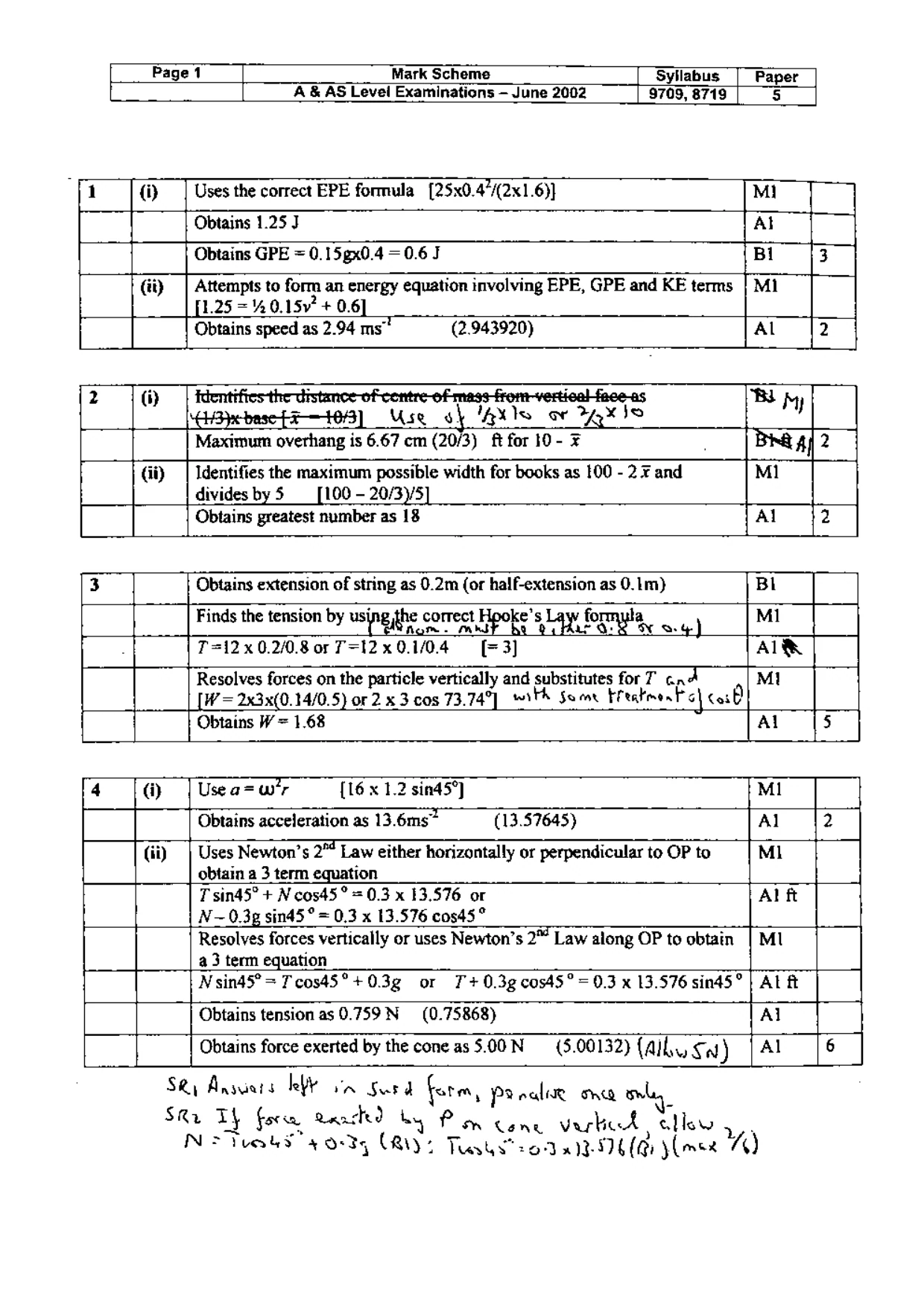
Page 1 I Mark Scheme [| Syilabus Paper | [ A& AS Levei Examinations — June 2002 [_9709, 8719 5 | i) Uses the correct EPE formula [25x0.47/(2x1.6)] Obtains 1.25 J |_| Obtains GPE = 0.15gx0.4 = 0.6 I Attempts to form an energy equation involving EPE, GPE and KE terms 1.25 = % 0.15v? + 0.6] Maximum overhang is 6.67 cm (20/3) ft for 10- ¥ Identifies the maximum possible width for books as [00 - 2X and divides by 5 100 - 20/35] Obtains greatest number as 18 Gi) Obtains extension of string as 0.2m (or half-extension as 0.1m) Finds the tension by using the correct Fpoke s Lay formula wo) 7=12x 0.20.8 05 T=12x0.104 [=3] Resolves forces on the particle vertically and substitutes for 7 an¢ W=2x3x(0.24/0.5) of 2 x 3 cos 73.749] with Secor freatmen Fol coil) Obtains W = 1.68 sea=Wr @ |U 7 {16 x 1.2 sin45°] Obtains acceieration as 13.6ms™ (13.57645) Uses Newton’ s 2™ Law either horizontally or perpendicular to OP to obtain a 3 term equation Tsin45° + N cos45° = 0.3 x 13.576 or Al ft N~0.3g sin45 ° = 0.3 x 13.576 cos45° Resolves forces vertically or uses Newton’s 2™ Law along OP to obtain a 3 term equation Nsin45°= Tcos45°+0.3g or 1+ 0.3gc0s4S°=0.3 x 13.576 sin45° Obtains tension as 0.759'N (0.75868) Obtains force exerted by the cone as $.00N (5.00132) {Aihy, Sa) Al 6 SRy Aysusts leby Vn Sura (ore, pe nalAe ona ool SRr Ty fore, aeadd by Pan cone varticd cllew 4, IN Yee 65" 4 0535 CRY Tests? 09 I RITE(Gi Slee ZA)
Mark scheme, page 3
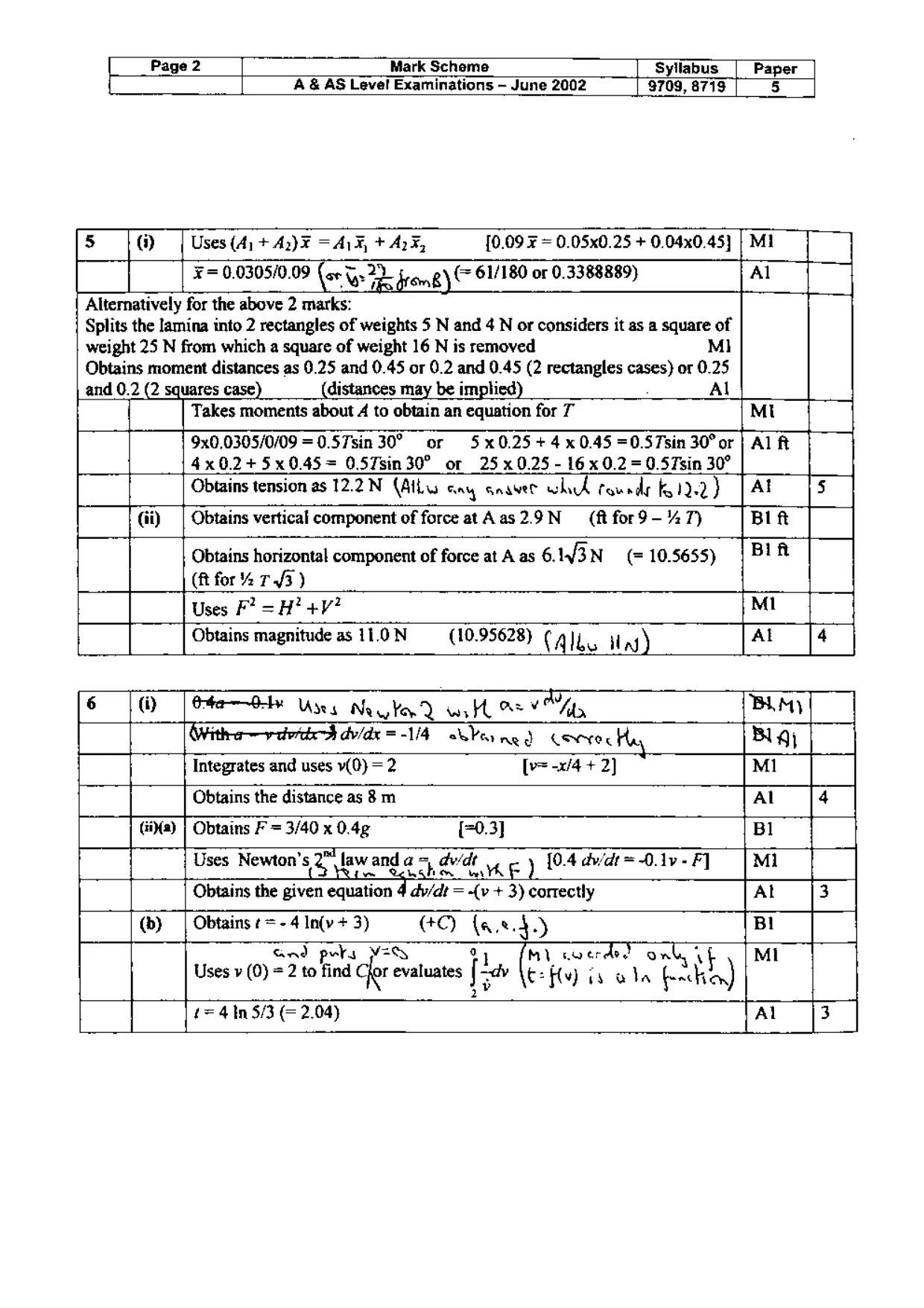
[ Page 2 | Mark Scheme | Syllabus Paper { I A & AS Level Examinations — June 2002 [ 9709, 8779 5 Uses (4) + A2)X = A,X, + 4px, {0.09 x = 0.05x0.25 + 0.04x0.45} | Mi ¥ = 0.0305/0.09 or yr from (= 61/180 or 0.3388889) Al Alternatively for the above 2 marks: Splits the lamina into 2 rectangles of weights 5 N and 4 N or considers it as a square of weight 25 N from which a square of weight 16 N is removed Mi Obtains moment distances as 0.25 and 0.45 or 0.2 and 0.45 (2 rectangles cases) or 0.25 and 0.2 (2 squares case) _(distances may be implied) : Al Takes moments about 4 to obtain an equation for 7 9x0,0305/0/09 = 0.57sin30° or 5x0.25+4x0.45 =0.57sin 30° or | Al ft 4x0.2+5x0.45 = 0.57sin 30° or 25 x 0.25 - 16x 0.2 = 0.57sin 30° Obtains tension as 12.2.N (Atha cay anaver wh tourde fe 12-2) Obtains vertical component of force atAas2.9N (ft for9-% 7) Obtains horizontal component of force at A as 6. 1V¥3N (= 10.5655) (ft for % Tf) Uses F? =H? +¥? Obtains magnitude as 11.0 N (10.95628) (4 lbs i J) a Oha—-O Ayes Navkad wilt 2 * Ab i iA dvdr = 1/4 Verne) Carrer Ha Integrates and uses v(0) = 2 [v= -x/4 + 2] Obtains the distance as 8 m Obtains F = 3/40 x 0.4g {=0.3] 7. pa = Vat = : Uses Newton’s 2 Jaw and as, dude vg e) {0.4 dvdr = 0.1v- F] Obtains the given equation 4 dv/dt = -(v + 3) correctly Obtains ¢ = - 4 In(v + 3) GC) {as 4 +) Gnd pels ¥ My wuerded on Uses v (0) = 2 to find fers evaluates [in te Hyj is ala iki) t= 4 1n 5/3 = 2.04)
Mark scheme, page 4
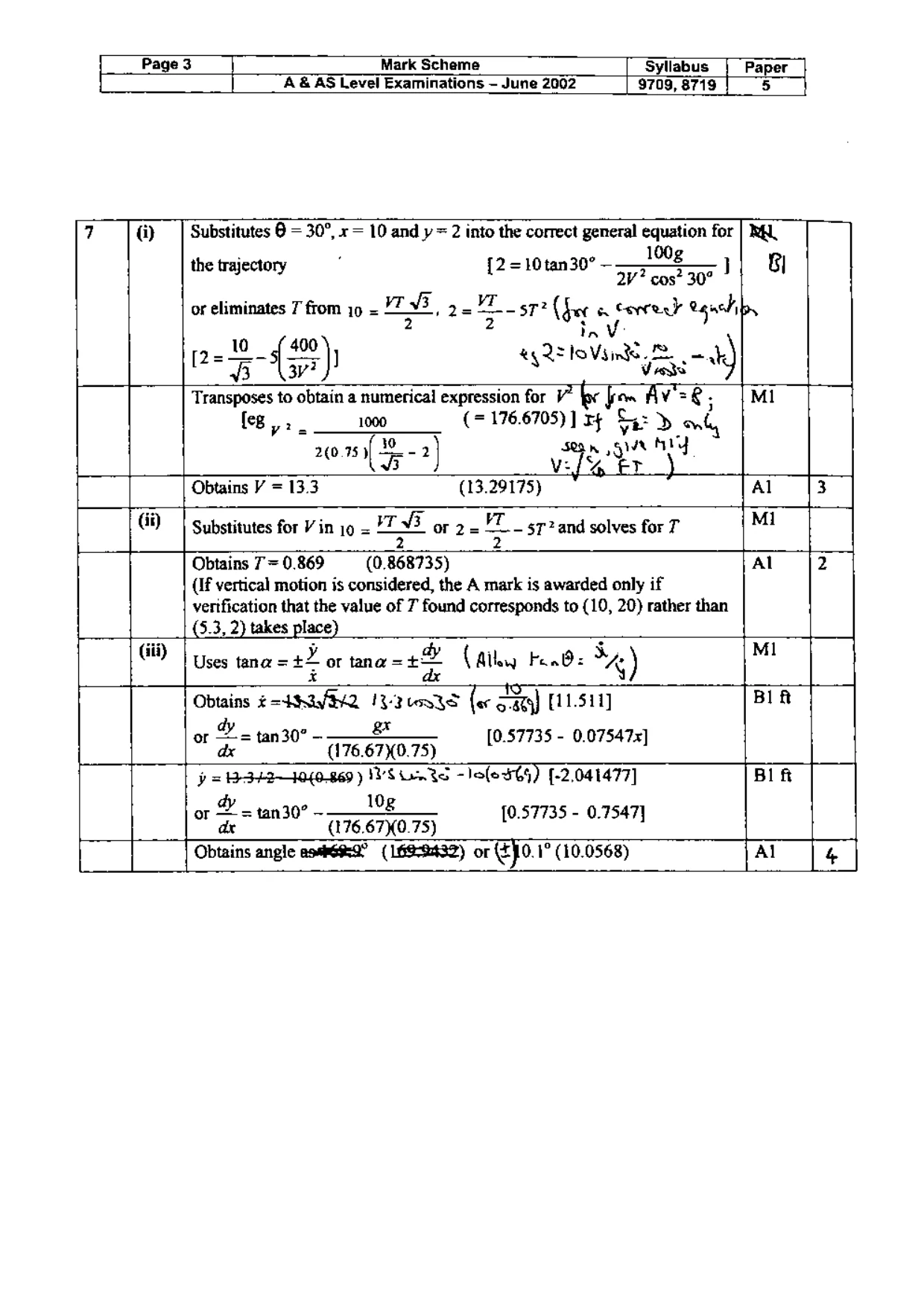
Page 3 1 Mark Scheme Syllabus | Paper | A&AS Level Examinations — June 2002 9709, 8719 5 Substitutes 6 = 30°, x = 10 and y= 2 into the correct general equation for the trajectory ‘ {2=10tan30° - 100g — cos or eliminates 7 from 19 = wii, 2 oT? (Sec a Correrk eaach In . 10 400 : on 2=—-35 Ry Vz lOViine ,) [ 3 al S " Wass ak ML Transposes to obtain a numerical expression for be fon Av=e ; {ee 2. 1000 (= 176.6705) ] 4 Sz > ow 7 3 {ge Aly ee) IS Obtains V = 13.3 (13.29175) Mi Substitutes for Vin 19 = vs or 2= ae $T?and solves for T Obtains 7 = 0.869 (0.868735) (If vertical motion is considered, the A mark is awarded only if verification that the value of 7 found corresponds to (10, 20) rather than (5.3, 2) takes place) (iii) Uses tana = +> or tana = £5 (Ally Fea: “%) Obtains #=ARIWVHL 12 ve (eo Sa) [151] or & = tan30° -___&*_ [0.57735 - 0.07547x] de (176.67\0.75) j = 19342 —40(0-$69) PSUa Ro —leleseh) [2.041477] or & = tan39? -__08 [0.57735 - 0.7547] Bl ft de (176,670.75) Obtains angle asaeGe2? (168-8432) or eo. 1° (10.0568)