Cambridge A Level Mathematics 9709 — 2002 May/June Paper 2 · Variant 1
9709/21/M/J/02
The question paper and its mark scheme, free to read here and free to download. This is Cambridge’s own paper, exactly as it was sat.
Question paper4 pages
Mark scheme3 pages
Answers below. Sit the paper first if you are practising.
Paper as text
Question paper, page 1
CAMBRIDGE INTERNATIONAL EXAMINATIONS General Certificate of Education Advanced Subsidiary Level MATHEMATICS 9709/2 PAPER 2 Pure Mathematics 2 (P2) MAY/JUNE SESSION 2002 1 hour 15 minutes Additional materials: Answer paper Graph paper List of Formulae (MF9) TIME = 1 hour 15 minutes INSTRUCTIONS TO CANDIDATES Write your name, Centre number and candidate number in the spaces provided on the answer paper/answer bookfet. Answer all the questions. Give non-exact numerical answers correct to 3 significant figures, or 1 decimal place in the case of angles in degrees, unless a different level of accuracy is specified in the question. INFORMATION FOR CANDIDATES The number of marks is given in brackets [] at the end of each question or part question. The total number of marks for this paper is 50. Questions carrying smaller numbers of marks are printed earlier in the paper, and questions carrying larger numbers of marks later in the paper. The use of an electronic calculator is expected, where appropriate. You are reminded of the need for clear presentation in your answers. This question paper consists of 3 printed pages and 1 blank page. UNtversiTy of CAMBRIDGE © CIE 2002 Local Examinations Syndicate [Turn over
Question paper, page 2
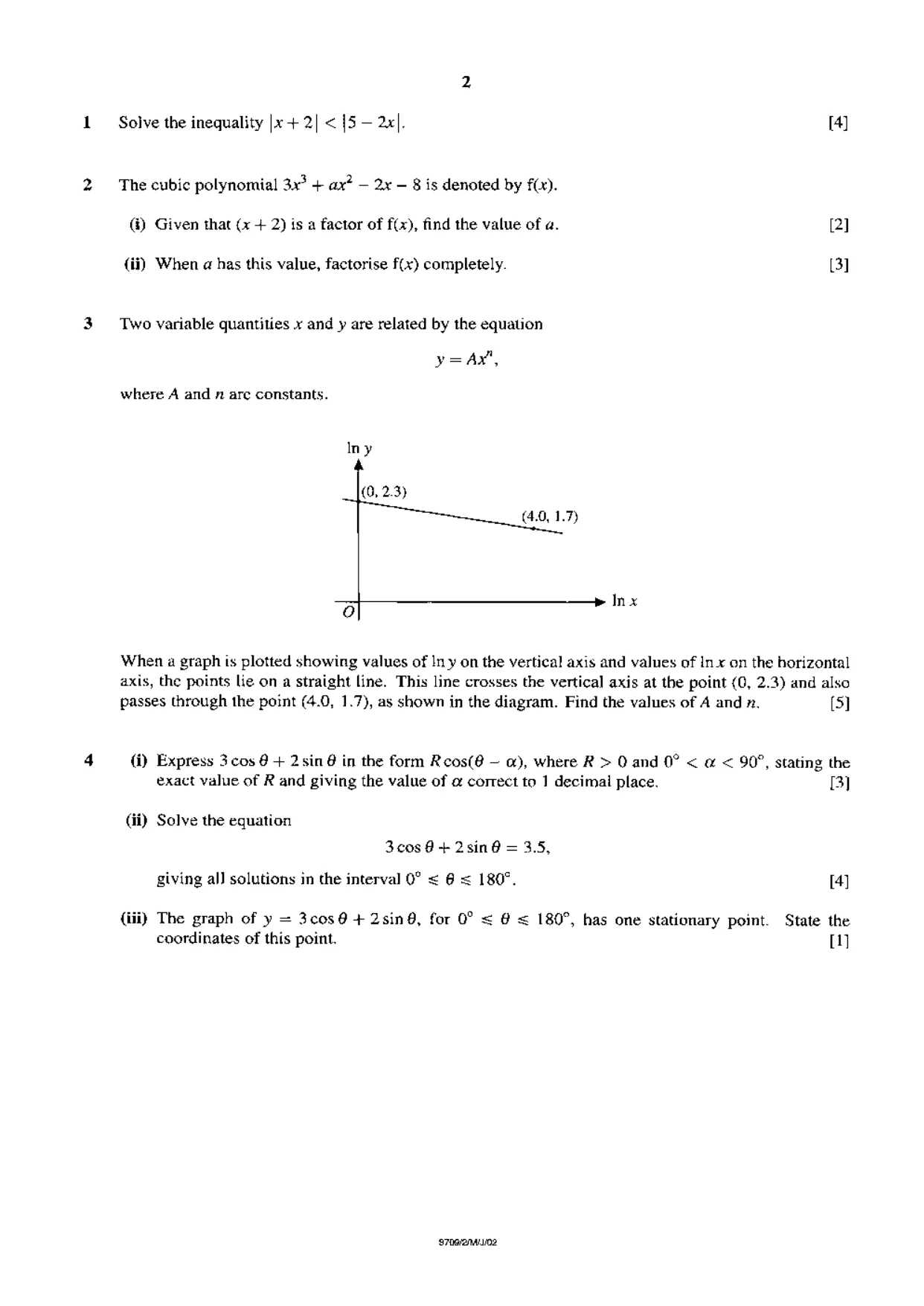
Solve the inequality |x + 2| < |5— 2x]. [4] The cubic polynomial 3x3 + ax? — 2x - 8 is denoted by f(x). @ Given that (x + 2) is a factor of f(x), find the value of a. (2] {ii) When a has this value, factorise f(x) completely. (3] Two variable quantities x and y are related by the equation = Ax’, where A and n are constants. Iny » Inx When a graph is plotted showing values of In y on the vertical axis and values of Inx on the horizontal axis, the points lie on a straight line. This line crosses the vertical axis at the point (0, 2.3) and also passes through the point (4.0, 1.7), as shown in the diagram. Find the values of A and 7. (s (i) Express 3cos @ + 2sin 6 in the form Rcos(@ — a), where R > 0 and 0° < @& < 90°, stating the exact value of R and giving the value of a correct to 1 decimal place. [3 Gi) Solve the equation 3cos @ + 2sin @ = 3.5, giving al] solutions in the interval 0° < 6 < 180°. [4 (iii) The graph of y = 3cos@ +4 2sin@, for 0° < @ < 180°, has one stationary point. State the coordinates of this point. {1 s70gr2nW.I02
Question paper, page 3
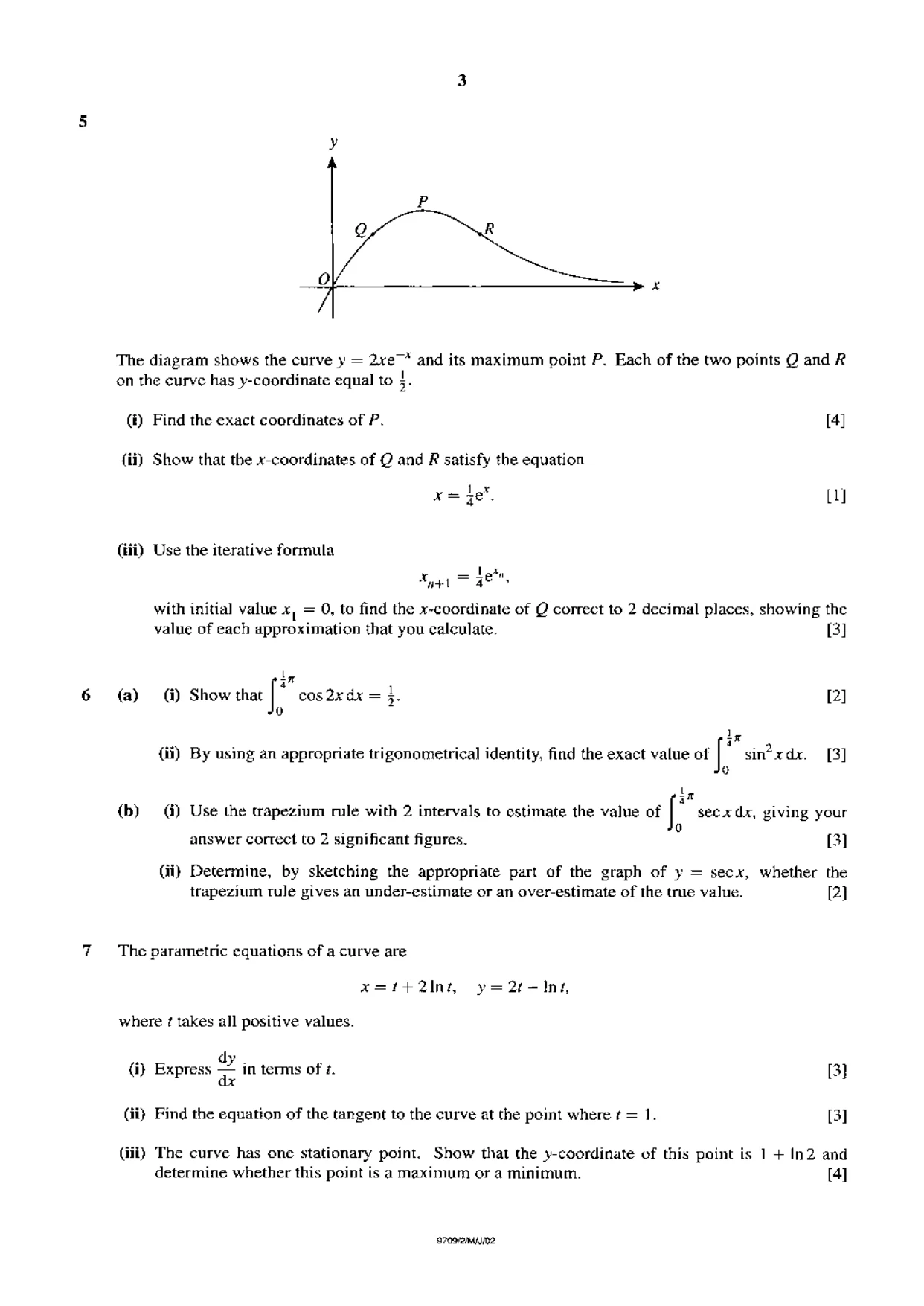
The diagram shows the curve » = 2xe™ and its maximum point P. Each of the two points Q and R ‘on the curve has y-coordinate equal to 4. (®) Find the exact coordinates of P. [4] {ii) Show that the x-coordinates of Q and R satisfy the equation 1] (iii) Use the iterative formula with initial value x= 0, to find the x-coordinate of Q@ correct to 2 decimal places, showing the value of each approximation that you calculate. 13] L (a) @ Show that i , cos 2x dx = }. [2] 0 1 a ® (ii) By using an appropriate trigonometrical identity, find the exact value ot | sintxdx. [3] oO dn (b) (i) Use the trapezium rule with 2 intervals to estimate the value of [; secxdx, giving your 0 answer correct to 2 significant figures. (3] Gi) Determine, by sketching the appropriate part of the graph of » = sec.x, whether the trapezium rule gives an under-estimate or an over-estimate of the tue value. (2) The parametric equations of a curve are x=14+2Inz, y=21-Ins, where ¢ takes all positive values. {i} Express > in terms of ¢. (3) (ii) Find the equation of the tangent to the curve at the point where ¢ = 1. [3] Gii) The curve has one stationary point. Show that the y-coordinate of this point is 1 + In2 and determine whether this point is a maximum or a minimum. [4] ‘S70RamNYJIOD
Mark scheme, page 1
CAMBRIDGE INTERNATIONAL EXAMINATIONS JUNE 2002 GCE Advanced Subsidiary Level MAXIMUM:MARK ::50. SYLLABUS/COMPONENT :9709 /2 MATHEMATICS (Pure 2) f§ UNIversiry of CAMBRIDGE EF” Local Examinations Syndicate
Mark scheme, page 2
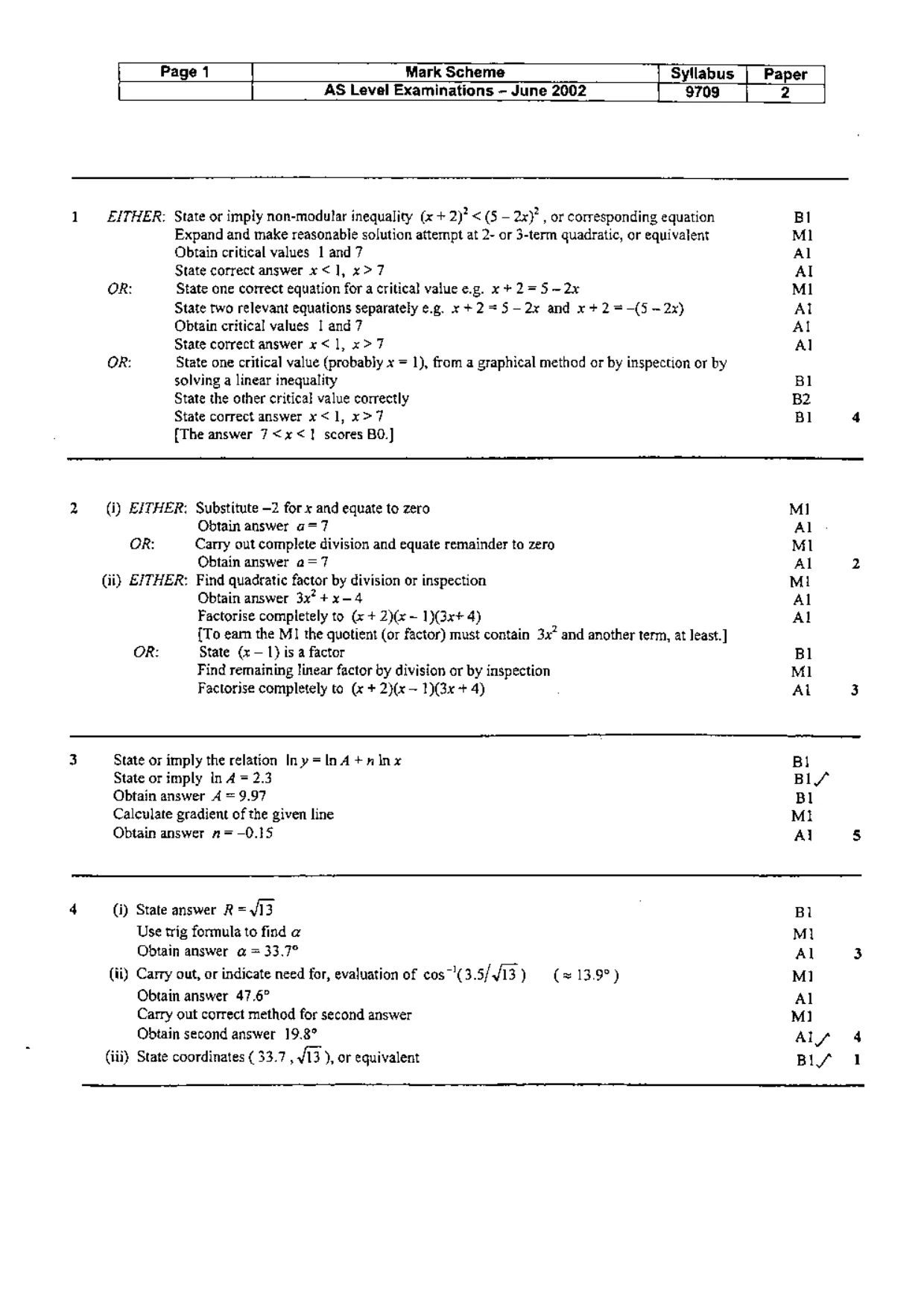
aper AS Level Examinations - June 2002 $709 Page 1 Mark Scheme Syllabus 2 1 2 EITHER: State ot imply non-modular inequality (x + 2)? < (5 — 2x)’ , or corresponding equation Expand and make reasonable solution attempt at 2- or 3-term quadratic, or equivalent Obtain critical values 1 and 7 State correct answer x< 1, x>7 OR: State one correct equation for a critical value e.g. x +2=5~2x State two relevant equations separately e.g. x +2=5-2x and x+2=-(5 -2x) Obtain critical values 1 and 7 State correct answer x <1, x>7 OR: State one critical value (probably x = 1), from a graphical method or by inspection or by solving a linear inequality State the other critical value correctly State correct answer x <1, x>7 (The answer 7<x <1 scores BO.) (i) EITHER: Substitute -2 for x and equate to zero Obtain answer a=7 OR: Carry out complete division and equate remainder to zero Obtain answer a=7 (ii) E7THER: Find quadratic factor by division or inspection Obtain answer 3x7 +x—4 Factorise completely to (x + 2)(x ~ 1)(3x+ 4) {To eam the MI the quotient (or factor) must contain 3x” and another term, at least.] OR: State (x — 1) is a factor Find remaining linear factor by division or by inspection Factorise completely to (x + 2}(x ~ 1)(3x + 4) State or imply the relation Iny =InA+ninx State or imply in 4 = 2.3 Obtain answer A = 9.97 Calculate gradient of the given line Obtain answer n= -0.15 (i) State answer R= VB Use trig formula to find @ Obtain answer @ = 33,7° (ii) Carry out, or indicate need for, evaluation of cos” ( 3.5/¥13 ) (= 13.9°) Obtain answer 47.6° Carry out correct method for second answer Obtain second answer 19.8° (iii) State coordinates ( 33.7 , ¥13 ), or equivalent Bl Ml Al M1 Al Mi aly Bis
Mark scheme, page 3
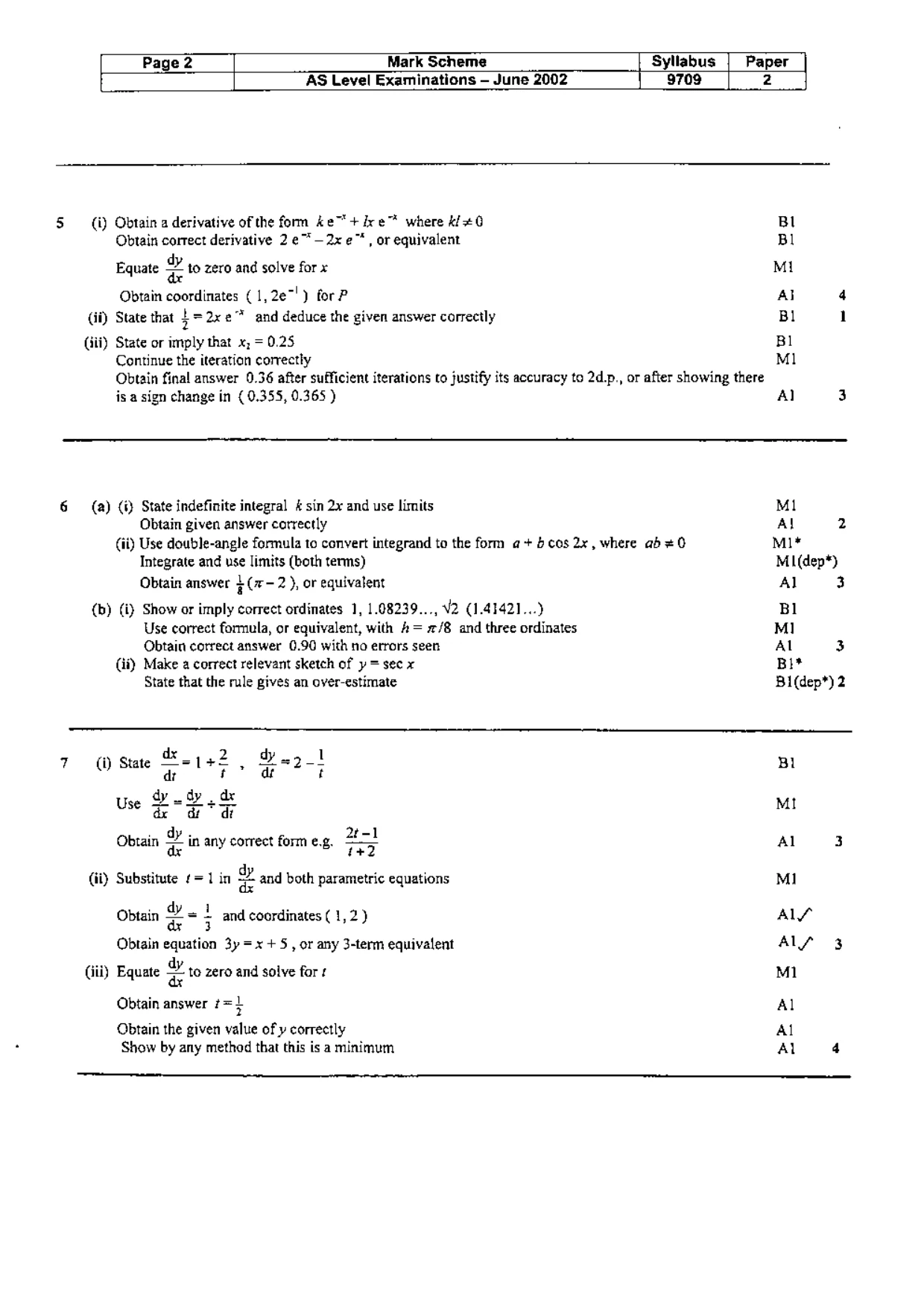
| Page 2 [ Mark Scheme Paper f I AS Level Examinations — June 2002 2 5 (i) Obtain a derivative of the form ke + ire™ where kf#0 BI Obtain correct derivative 2 e“—2x e™, or equivalent Bl Equate ® to zero and solve for x Mi Obtain coordinates ( 1,2e7!) for P Al 4 (ii) State that $ =2xe™ and deduce the given answer correctly Bl 1 (ii) State or imply that x; = 0.25 Bl Continue the iteration correctly Mil Obtain final answer 0.36 after sufficient iterations to justify its accuracy to 2d.p., or after showing there is a sign change in { 0.355, 0.365 ) Al 3 6 (a) (@) State indefinite integral & sin 2x and use limits Ml Obtain given answer correctly Al 2 (ii) Use double-angle formula to convert integrand to the form a+ bcos 2x, where ab #0 MI* Integrate and use limits (both terms) MI (dep*) Obtain answer PGi 2), or equivalent Al 3 {b) (i} Show or imply correct ordinates 1, 1.08239..., V2 (1.41421...) Bl Use correct formula, or equivalent, with A= 2/8 and three ordinates MI Obtain correct answer 0.90 with no errors seen Al 3 ii) Make a correct relevant sketch of y = sec x Bit State that the rule gives an over-estimate Bi(dep*) 2 . de ),2 dy ly 1 7 ( State I+ > a 2 7 Bl gy oy de Use a aie MI . dy. 2-1 Obtain ae in any correct form e.g. Tz Al 3 (ii) Substitute ¢=1 in ® and both parametric equations Mi Obtain # = + and coordinates (1,2) ALY Obtain equation 3y = x + 5, or any 3-term equivalent Al/ 3 Gii) Equate & to zero and solve for s Mi Obtain answer t= t Al Obtain the given value of y correctly Al Show by any method that this is a minimum Al 4