Cambridge A Level Mathematics 9709 — 2002 May/June Paper 1 · Variant 1
9709/11/M/J/02
The question paper and its mark scheme, free to read here and free to download. This is Cambridge’s own paper, exactly as it was sat.
Question paper8 pages


Mark scheme6 pages
Answers below. Sit the paper first if you are practising.
Paper as text
Question paper, page 1
CAMBRIDGE INTERNATIONAL EXAMINATIONS General Certificate of Education Advanced Subsidiary Level General Certificate of Education Advanced Level MATHEMATICS 9709/1 PAPER 1 Pure Mathematics 1 (P1) MAY/JUNE SESSION 2002 1 hour 45 minutes Additional materials: Answer paper Graph paper List of Formulae (MF9) TIME 1 hour 45 minutes INSTRUCTIONS TO CANDIDATES Write your name, Centre number and candidate number in the spaces provided on the answer paper/answer booklet. Answer all the questions. Give non-exact numerical answers correct to 3 significant figures, or 1 decimal place in the case of angles in degrees, unless a different level of accuracy is specified in the question. INFORMATION FOR CANDIDATES The number of marks is given in brackets [ ] at the end of each question or part question. The total number of marks for this paper is 75. Questions carrying smaller numbers of marks are printed earlier in the paper, and questions carrying larger numbers of marks later in the paper. The use of an electronic calculator is expected, where appropriate. You are reminded of the need for clear presentation in your answers. This question paper consists of 5 printed pages and 3 blank pages. CIE 2002 Local Examinations Syndicate U C NIVERSITY AMBRIDGE of [Turn over
Question paper, page 2
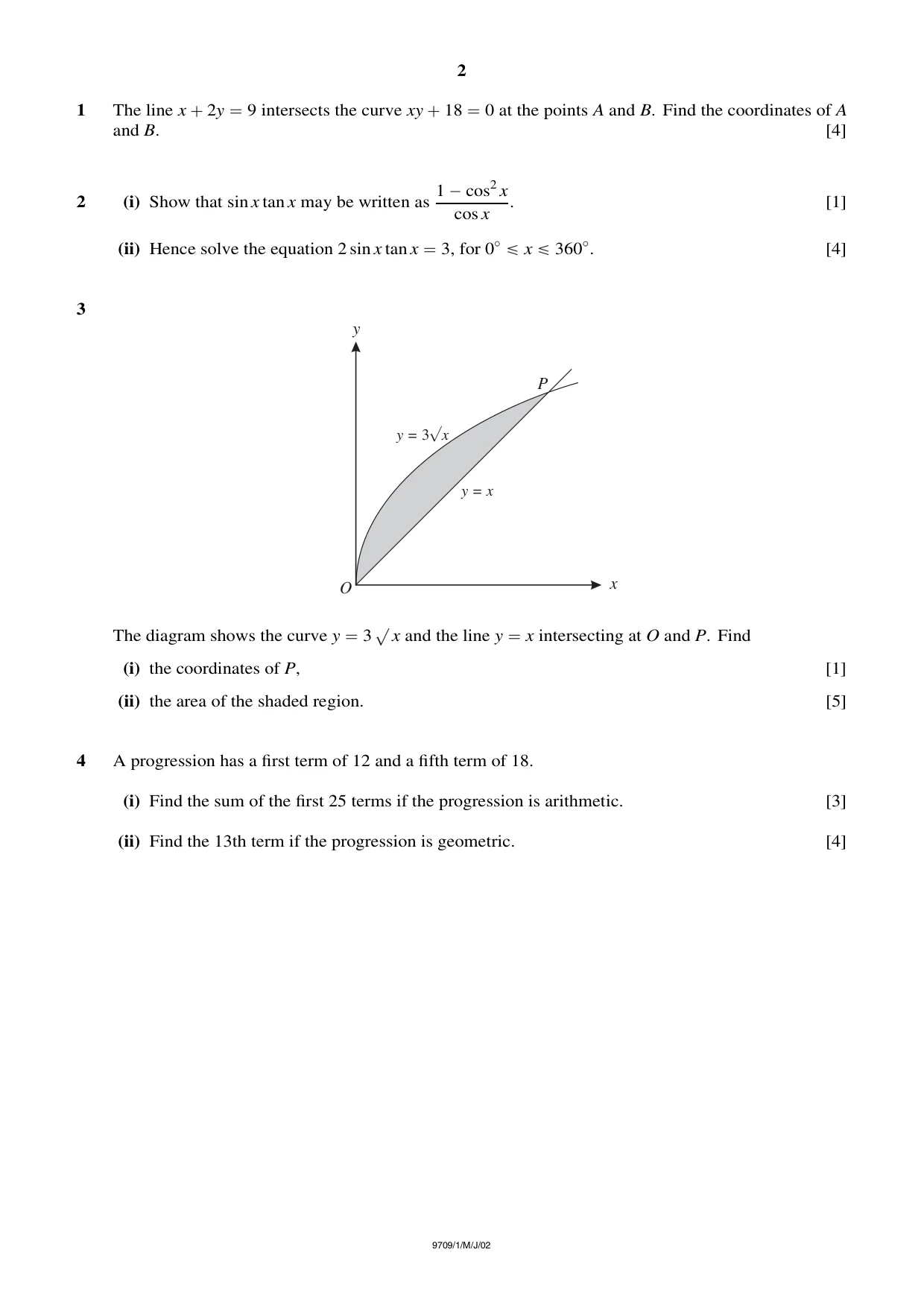
2 1 The line x 2y 9 intersects the curve xy 18 0 at the points A and B. Find the coordinates of A and B. [4] 2 (i) Show that sin x tan x may be written as 1 cos2 x cos x . [1] (ii) Hence solve the equation 2 sin x tan x 3, for 0 Æ x 360 Æ. [4] 3 O y x P y = x y = x 3 The diagram shows the curve y 3 x and the line y x intersecting at O and P. Find (i) the coordinates of P, [1] (ii) the area of the shaded region. [5] 4 A progression has a first term of 12 and a fifth term of 18. (i) Find the sum of the first 25 terms if the progression is arithmetic. [3] (ii) Find the 13th term if the progression is geometric. [4] 9709/1/M/J/02
Question paper, page 3
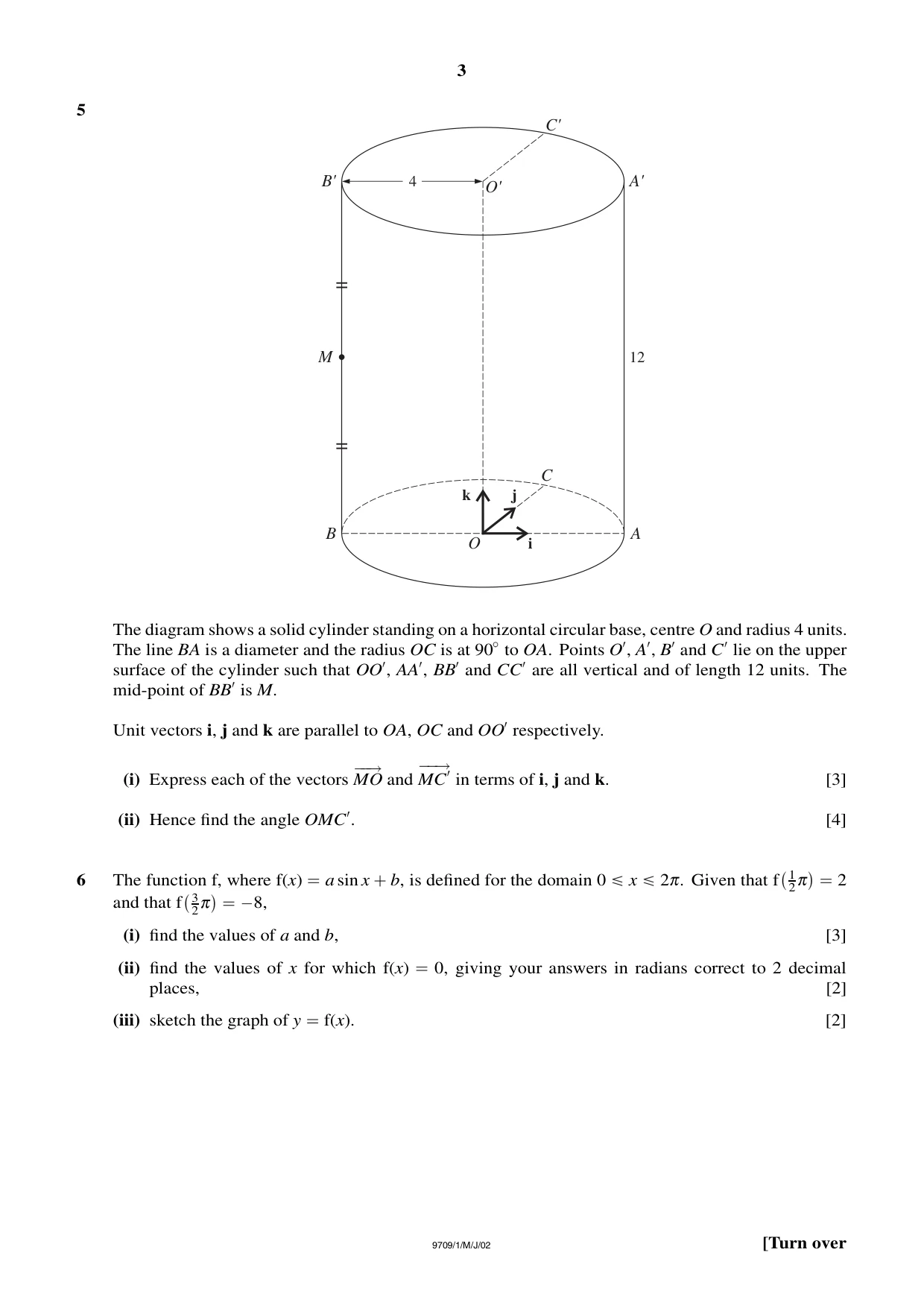
3 5 4 B' O' A' C' M B C A 12 O i j k = = The diagram shows a solid cylinder standing on a horizontal circular base, centre O and radius 4 units. The line BA is a diameter and the radius OC is at 90 Æ to OA. Points O , A , B and C lie on the upper surface of the cylinder such that OO , AA , BB and CC are all vertical and of length 12 units. The mid-point of BB is M. Unit vectors i, j and k are parallel to OA, OC and OO respectively. (i) Express each of the vectors MO and MC in terms of i, j and k. [3] (ii) Hence find the angle OMC . [4] 6 The function f, where f(x) a sin x b, is defined for the domain 0 x 2π. Given that f 1 2π 2 and that f 3 2π 8, (i) find the values of a and b, [3] (ii) find the values of x for which f(x) 0, giving your answers in radians correct to 2 decimal places, [2] (iii) sketch the graph of y f(x). [2] 9709/1/M/J/02 [Turn over
Question paper, page 4
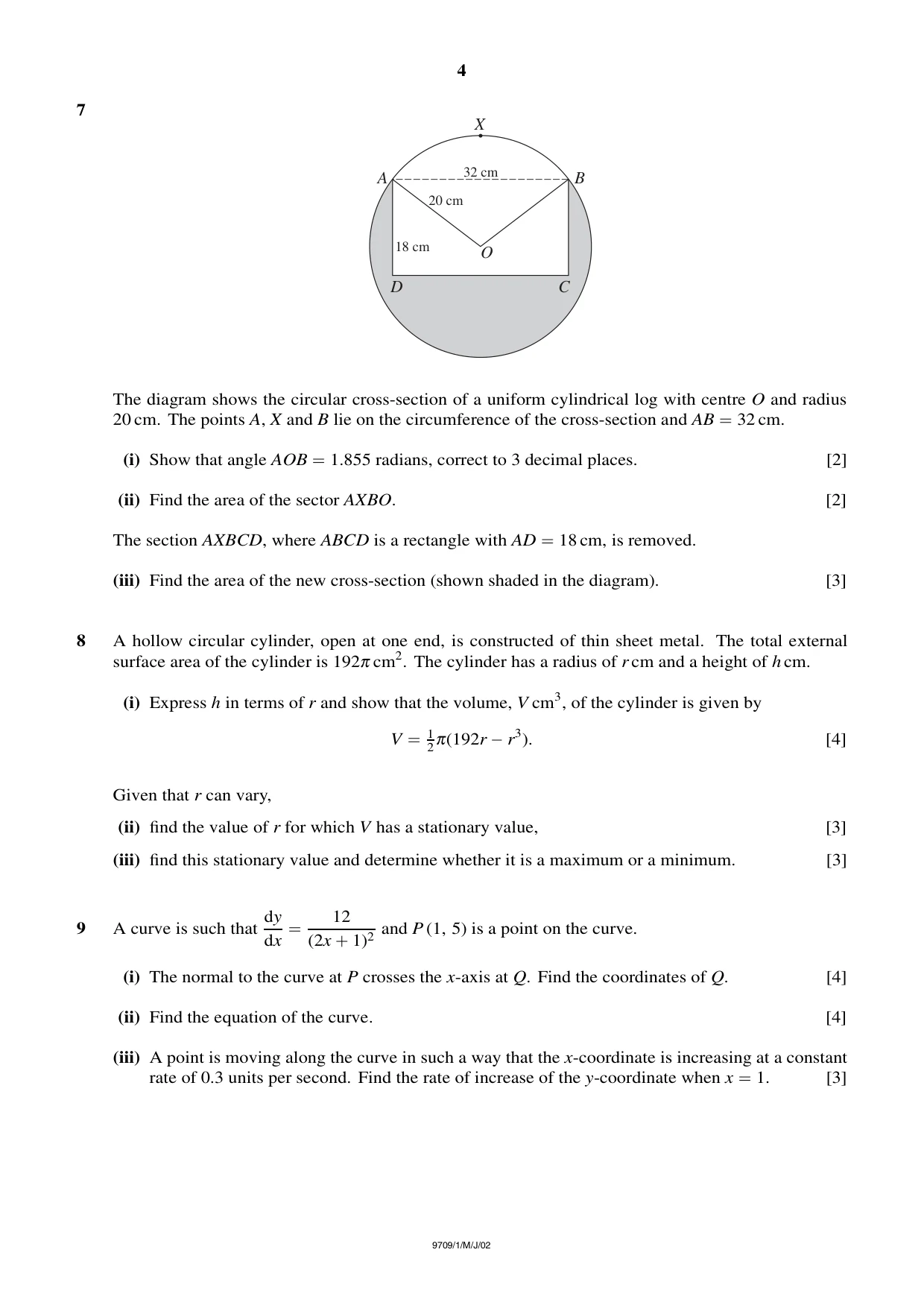
4 7 A X B O D C 18 cm 20 cm 32 cm The diagram shows the circular cross-section of a uniform cylindrical log with centre O and radius 20 cm. The points A, X and B lie on the circumference of the cross-section and AB 32 cm. (i) Show that angle AOB 1.855 radians, correct to 3 decimal places. [2] (ii) Find the area of the sector AXBO. [2] The section AXBCD, where ABCD is a rectangle with AD 18 cm, is removed. (iii) Find the area of the new cross-section (shown shaded in the diagram). [3] 8 A hollow circular cylinder, open at one end, is constructed of thin sheet metal. The total external surface area of the cylinder is 192π cm2. The cylinder has a radius of r cm and a height of h cm. (i) Express h in terms of r and show that the volume, V cm3, of the cylinder is given by V 1 2π(192r r3). [4] Given that r can vary, (ii) find the value of r for which V has a stationary value, [3] (iii) find this stationary value and determine whether it is a maximum or a minimum. [3] 9 A curve is such that dy dx 12 (2x 1)2 and P (1, 5) is a point on the curve. (i) The normal to the curve at P crosses the x-axis at Q. Find the coordinates of Q. [4] (ii) Find the equation of the curve. [4] (iii) A point is moving along the curve in such a way that the x-coordinate is increasing at a constant rate of 0.3 units per second. Find the rate of increase of the y-coordinate when x 1. [3] 9709/1/M/J/02
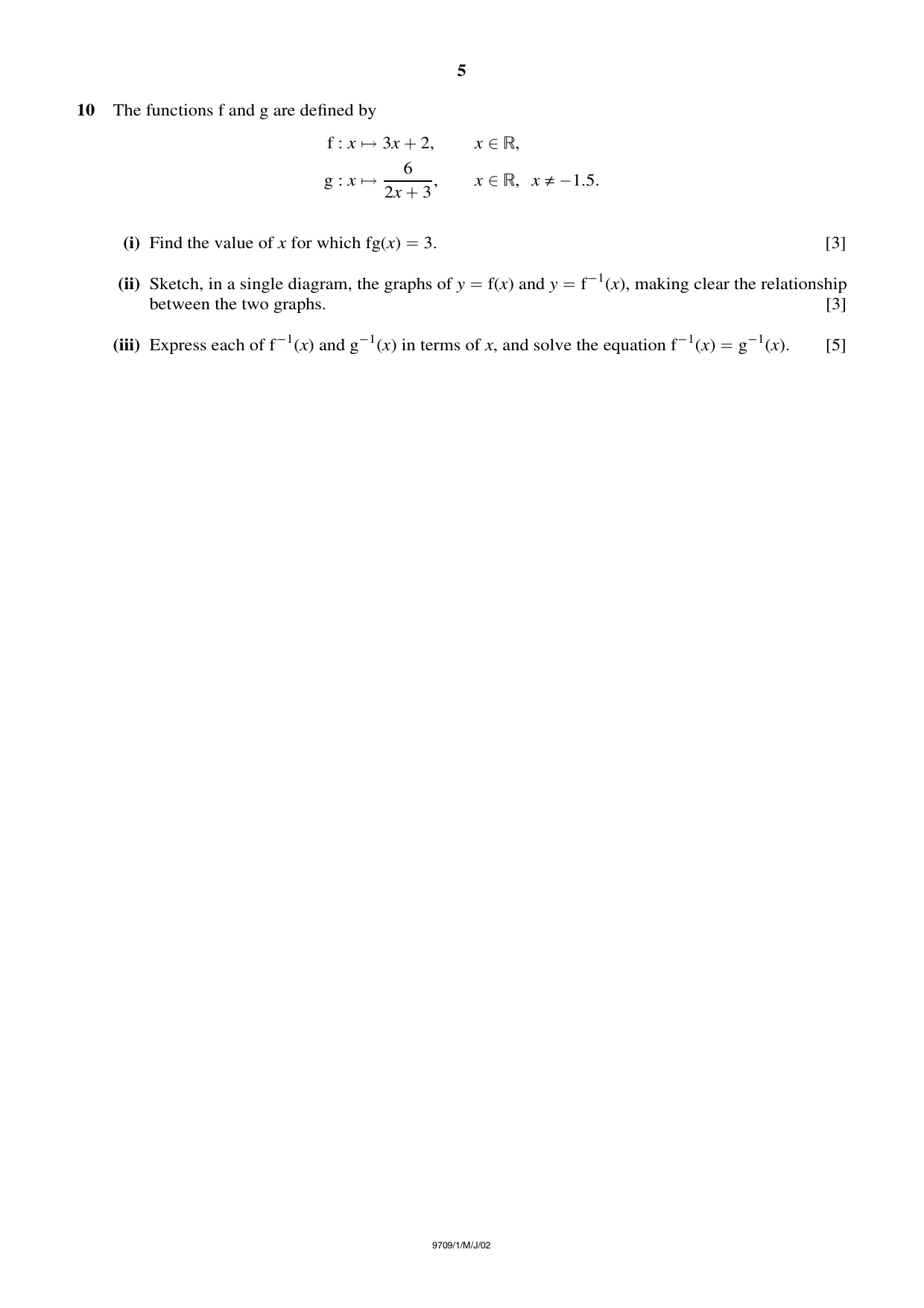
Question paper, page 5
5 10 The functions f and g are defined by f : x 3x 2, x , g : x 6 2x 3, x , x ≠ 1.5. (i) Find the value of x for which fg(x) 3. [3] (ii) Sketch, in a single diagram, the graphs of y f(x) and y f 1(x), making clear the relationship between the two graphs. [3] (iii) Express each of f 1(x) and g 1(x) in terms of x, and solve the equation f 1(x) g 1(x). [5] 9709/1/M/J/02
Mark scheme, page 1
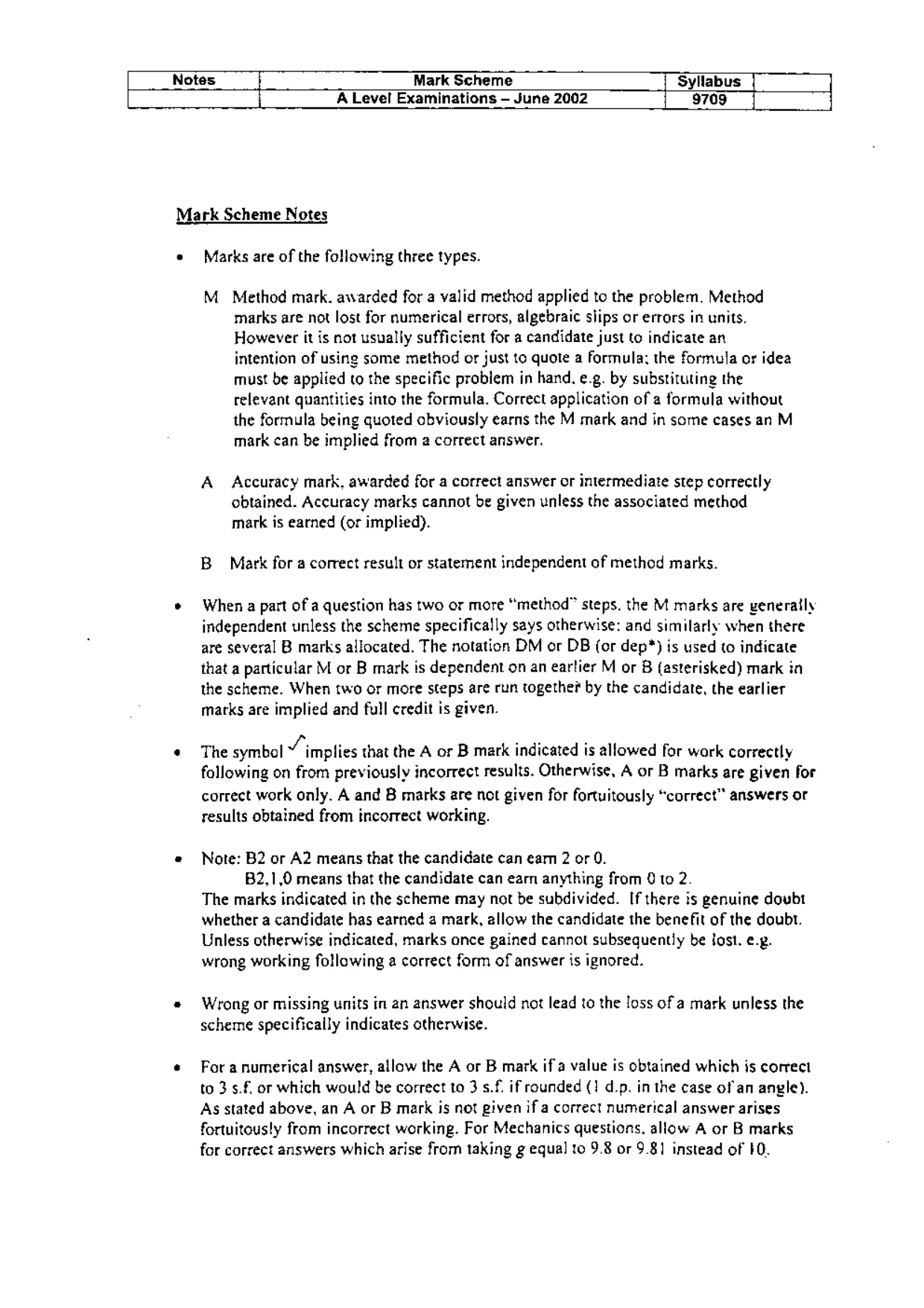
Notes i Mark Scheme | Syllabus i A Level Examinations — June 2002 {9709 Mark Scheme Notes * Marks are of the following three types. M_ Method mark. awarded for a valid method applied to the problem. Method marks are not lost for numerical errors, algebraic slips or errors in units. However it is not usually sufficient for a candidate just to indicate an intention of using some method or just to quote a formula: the formula or idea must be applied to the specific problem in hand. e.g. by substituting the relevant quantities into the formula. Correct application of a formula without the formula being quoted obviously earns the M mark and in some cases an M mark can be implied from a correct answer. A Accuracy mark, awarded for a correct answer or intermediate step correctly obtained. Accuracy marks cannot be given unless the associated method mark is earned (or implied). B_ Mark for a correct result or statement independent of method marks. ¢ Whena part of a question has two or more “method” steps. the M marks are generally independent unless the scheme specifically says otherwise: and similarly when there are several B marks allocated. The notation DM or DB (or dep*) is used to indicate that a particular M or B mark is dependent on an eartier M or B (asterisked) mark in the scheme. When two or more steps are run togethe# by the candidate, the earlier marks are implied and full credit is given. ¢ The symbol Y implies that the A or B mark indicated is allowed for work correctly following on from previously incorrect results. Otherwise, A or B marks are given for correct work only. A and B marks are not given for fortuitously “correct” answers or results obtained from incorrect working. « Note: B2 or A2 means that the candidate can earn 2 or 0. B2,1,0 means that the candidate can earn anything from 0 to 2. The marks indicated in the scheme may not be subdivided. If there is genuine doubt whether a candidate has earned a mark, allow the candidate the benefit of the doubt. Unless otherwise indicated, marks once gained cannot subsequently be lost. e.g. wrong working following a correct form of answer is ignored. « Wrong or missing units in an answer should not lead to the loss of a mark unless the scheme specificaily indicates otherwise. ¢ Foranumerical answer, allow the A or B mark if a value is obtained which is correct to 3 s.f. or which would be correct to 3 s.f. if rounded (1 d.p. in the case of an angle). As stated above, an A or B mark is not given if a correct numerical answer arises fortuitously from incorrect working. For Mechanics questions. allow A or B marks for correct answers which arise from taking g equal to 9.8 or 9.8] instead of FO.
Mark scheme, page 2
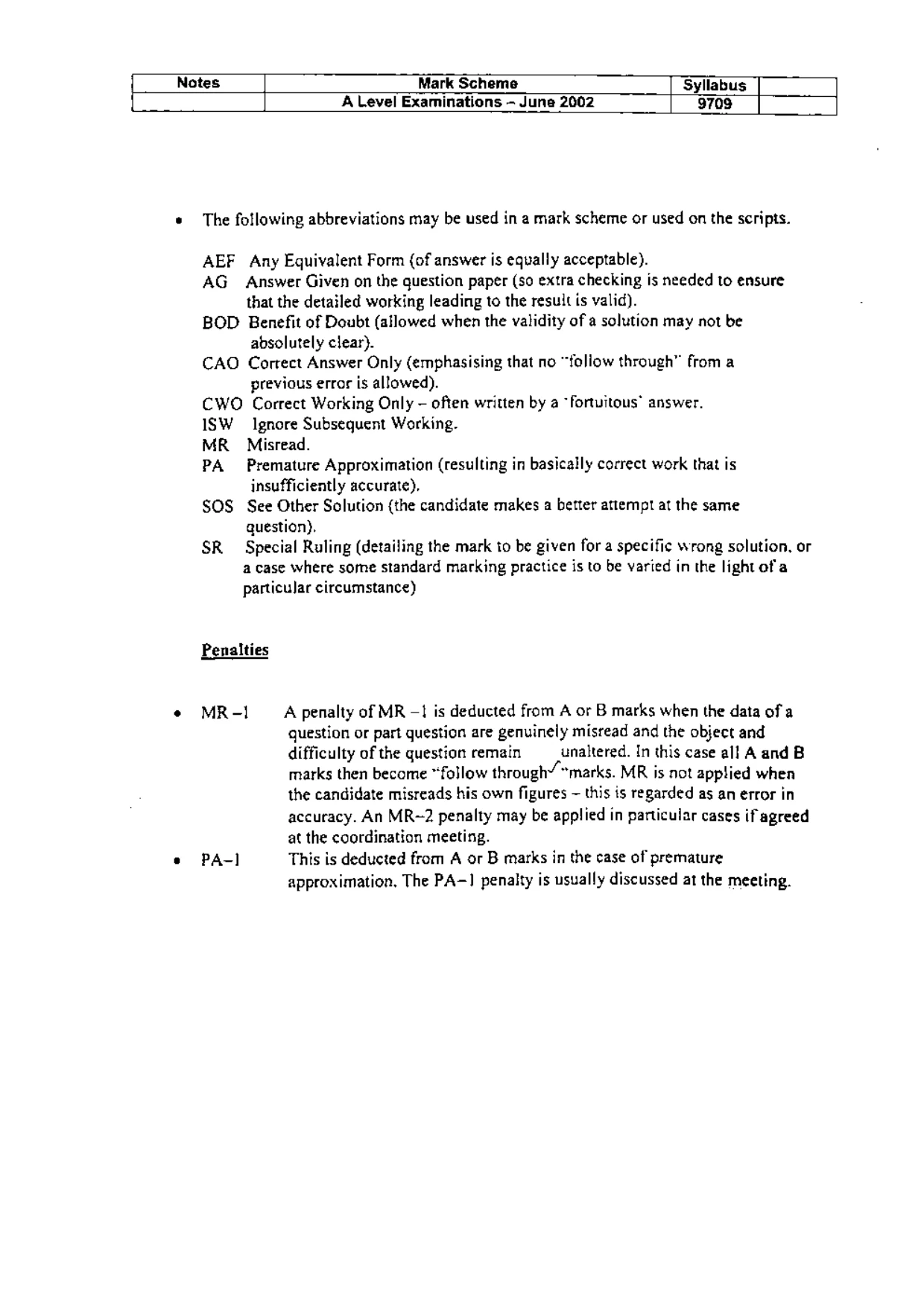
Notes Mark Scheme Syllabus A Level Examinations - June 2002 9709 The following abbreviations may be used in a mark scheme or used on the scripts. AEF Any Equivalent Form {of answer is equally acceptable). AG Answer Given on the question paper (so extra checking is needed to ensure that the detailed working leading to the result is valid). BOD Benefit of Doubt (allowed when the validity of a solution may not be absolutely clear). CAO Correct Answer Only (emphasising that no “foliow through” from a previous error is allowed). CWO Correct Working Only — often written by a “fortuitous” answer. 1SW_ Ignore Subsequent Working. MR Misread. PA Premature Approximation (resulting in basically correct work that is insufficiently accurate), SOS See Other Solution {the candidate makes a better attempt at the same question), SR Special Ruling (detailing the mark to be given for a specific wrong solution, or acase where some standard marking practice is to be varied in the light of a particular circumstance) Penalties MR -1 A penalty of MR -1 is deducted from A or B marks when the data of a question or part question are genuinely misread and the object and difficulty of the question remain unaltered. In this case all A and B marks then become “follow throughY*marks. MR is not applied when the candidate misreads his own figures ~ this is regarded as an error in accuracy. An MR~2 penalty may be applied in particular cases if agreed at the coordination meeting. PA-1] This is deducted from A or B marks in the case of premature approximation, The PA-1 penalty is usually discussed at the meeting.
Mark scheme, page 3
CAMBRIDGE INTERNATIONAL EXAMINATIONS JUNE 2002 GCE Advanced Subsidiary Level MARK SCHEME SYLLABUS/COMPONENT :9709 /1 MATHEMATICS (Pure 1) PM UNIVERSITY of CAMBRIDGE Local Examinations Syndicate
Mark scheme, page 4
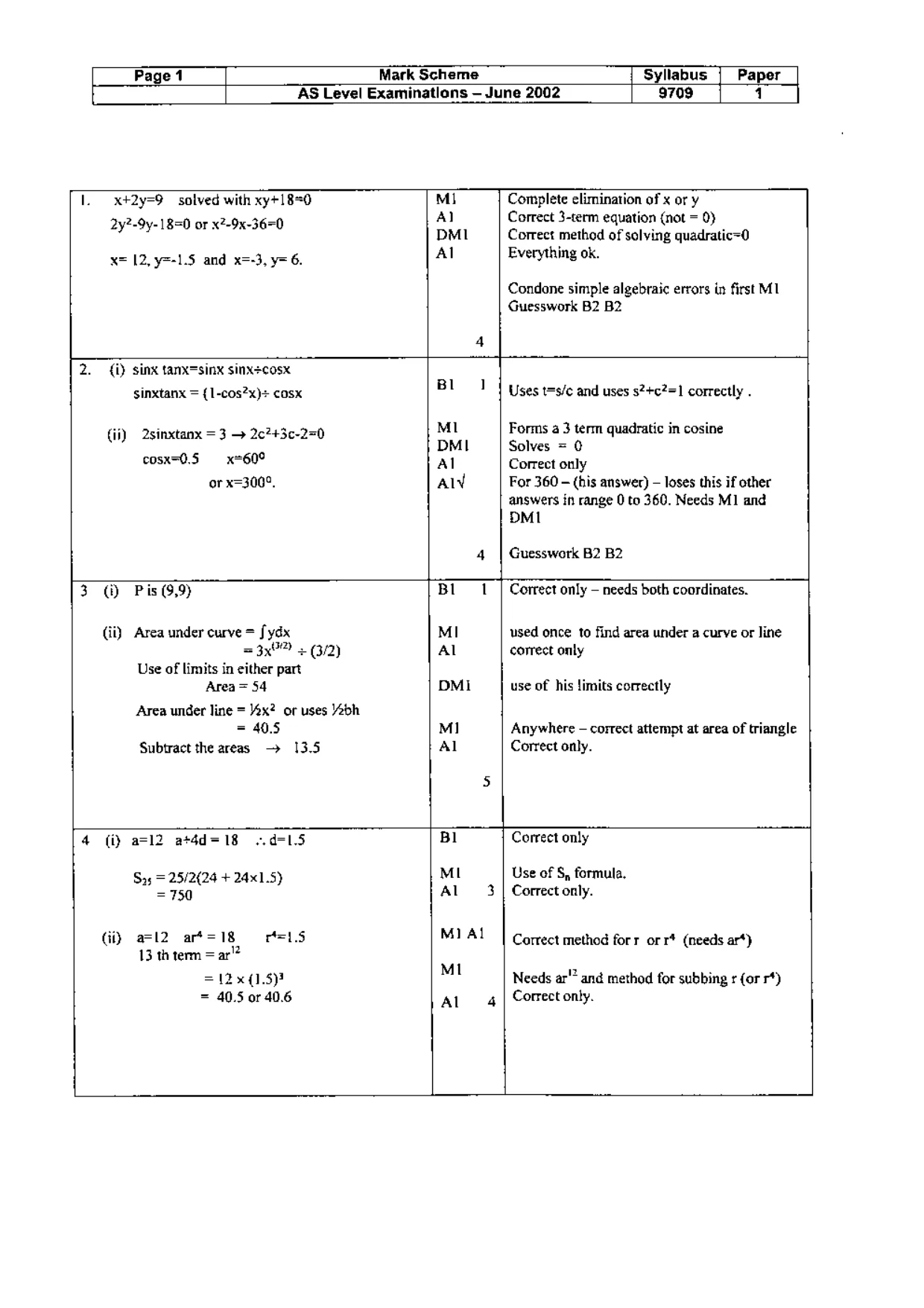
Page 1 Mark Scheme Syllabus AS Level Examinations — June 2002 Paper 4 9709 lL. x#2y=9 solved with xy+18°0 Mi Complete elimination of x or y 2.9.) B= 2.0x-36=1 Al Correct 3-term equation {not = 0) 2y?-Sy- 1820 oF x2-9%-36°0 DMI Correct method of solving quadratic=0 N= 12, y=-1.5 and x=-3, y= 6. Al Everything ok. Condone simple algebraic errors in first M1 Guesswork B2 B2 4 2. (i) sinx tanx=sinx sinx+cosx sinxtanx = (1-cos?x)+ cosx Bl 1 { Uses t=s/e and uses s?+c2=1 correctly . (ii) 2sinxtanx = 3 + 2c?+3c-2=0 MI Forms a 3 term quadratic in cosine ‘ DMI Solves = 0 cosx=0.5 x=60 Al Correct only or x=300°, Alv For 360 — (his answer) — loses this if other answers in range 0 to 360. Needs M1 and DMI 4 | Guesswork B2 B2 3 (i) Pis (9,9) BIL _| Correct only — needs both coordinates. Gi) Area under curve = fydx MI used once to find area under a curve or line = 3x8) 3/2) Al correct only Use of limits in either part Area = 54 DMi use of his limits correctly Area under line = 4x? or uses Yebh = 40.5 MI Anywhere — correct attempt at area of triangle Subtract the areas —> 13.5 Al Correct only. 5 4 (i) a=l2 at4d=18 3.d=1.5 Bl Correct only Sos = 25/2(24 + 241.5) MI Use of S, formula. = 750 Al 3 | Correct only. Gi) a=12 art=18 — t=L.5 MIA! | Correct method forr or r* (needs art) 13 th term = ar”? = 12x (1.5)! MI Needs ar” and method for subbing r (or r*) = 40.5 or 40.6 Correct only. Al 4
Mark scheme, page 5
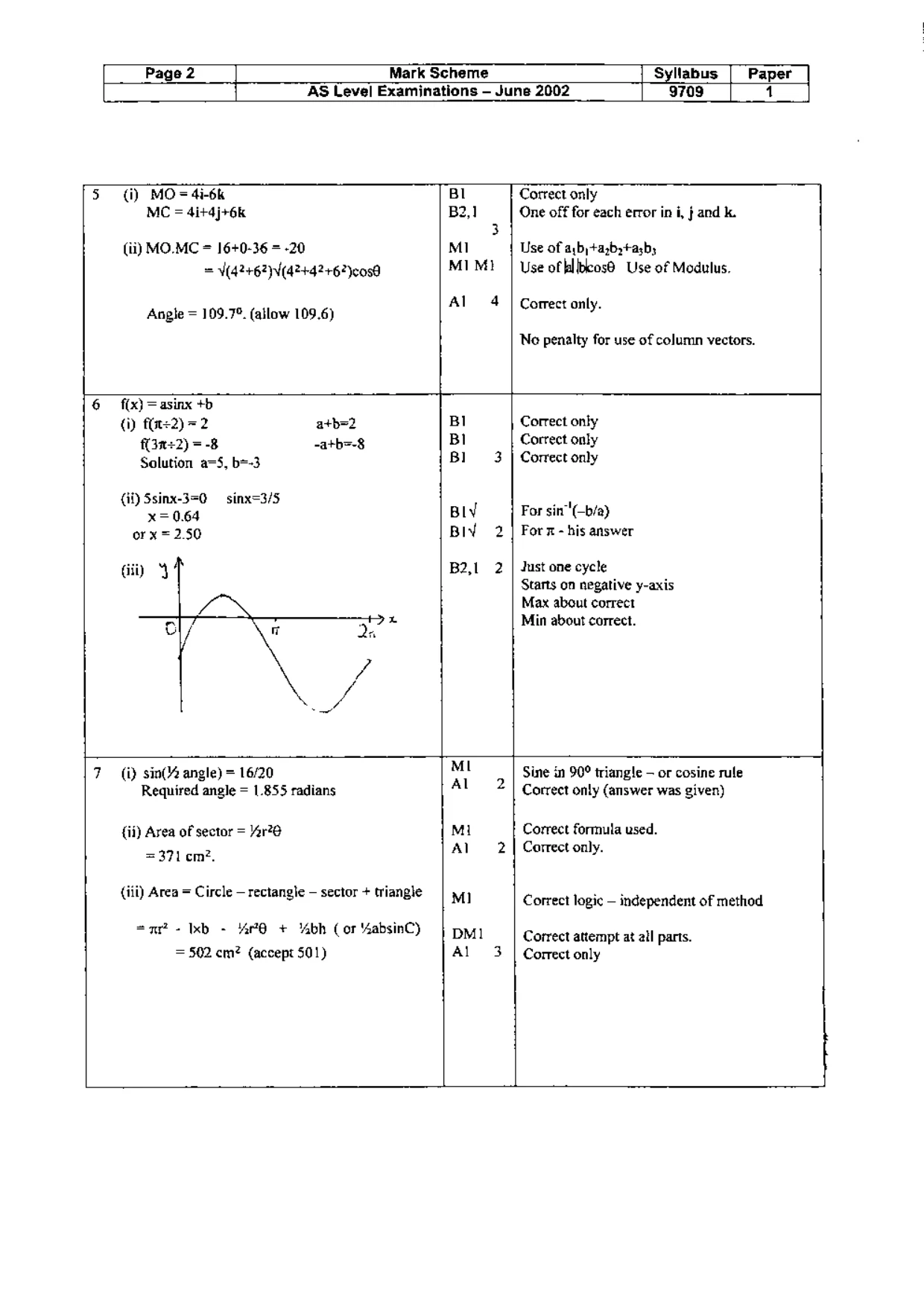
5 Page 2 Mark Scheme AS Level Examinations — June 2002 () MO=4i-6k MC = 4i+4j+6k (ii) MO.MC = 16+0-36 = -20 = V(42+62)V(42+42+6?)c090 Angie = 109.7°. (allow 109.6) Correct only ‘One off for each error in i, j and k. Use of ayb,+a;by+asby Use of bibcos® Use of Modulus. Correct only. No penalty for use of column vectors. Syllabus | Paper | 9709, | 1d 6 f(x) =asinx +b (i) f(t+2) =2 atb=2 Bl Correct only (3x2) = -8 -atb=-8 Bl Correct only Solution a-5, b~-3 Bl 3 | Correct only (ii) Ssinx-3=0 — sinx=3/5 at x= 0.64 BY For sin'(-b/a) or x = 2.50 BIN 2 | Forx-his answer B2,1 2 | Just one cycle Starts on negative y-axis Max about correct Min about correct. 7 (i) sin(% angle) = 16/20 Ml Sine in 90° triangle — or cosine rule Required angle = 1.855 radians al 2 | Correct only (answer was given) {ii) Area of sector = rr? Mi Correct formula used. =371cm2 Al 2 | Correct only. (iii) Area = Circle — rectangle — sector + triangle | a4) Correct logic — independent of method ane - xb - 48 + ‘bh Cor 4absinC) | pei Correct attempt at all parts. = 502 cm? (accept 501) Al 3 Correct only
Mark scheme, page 6
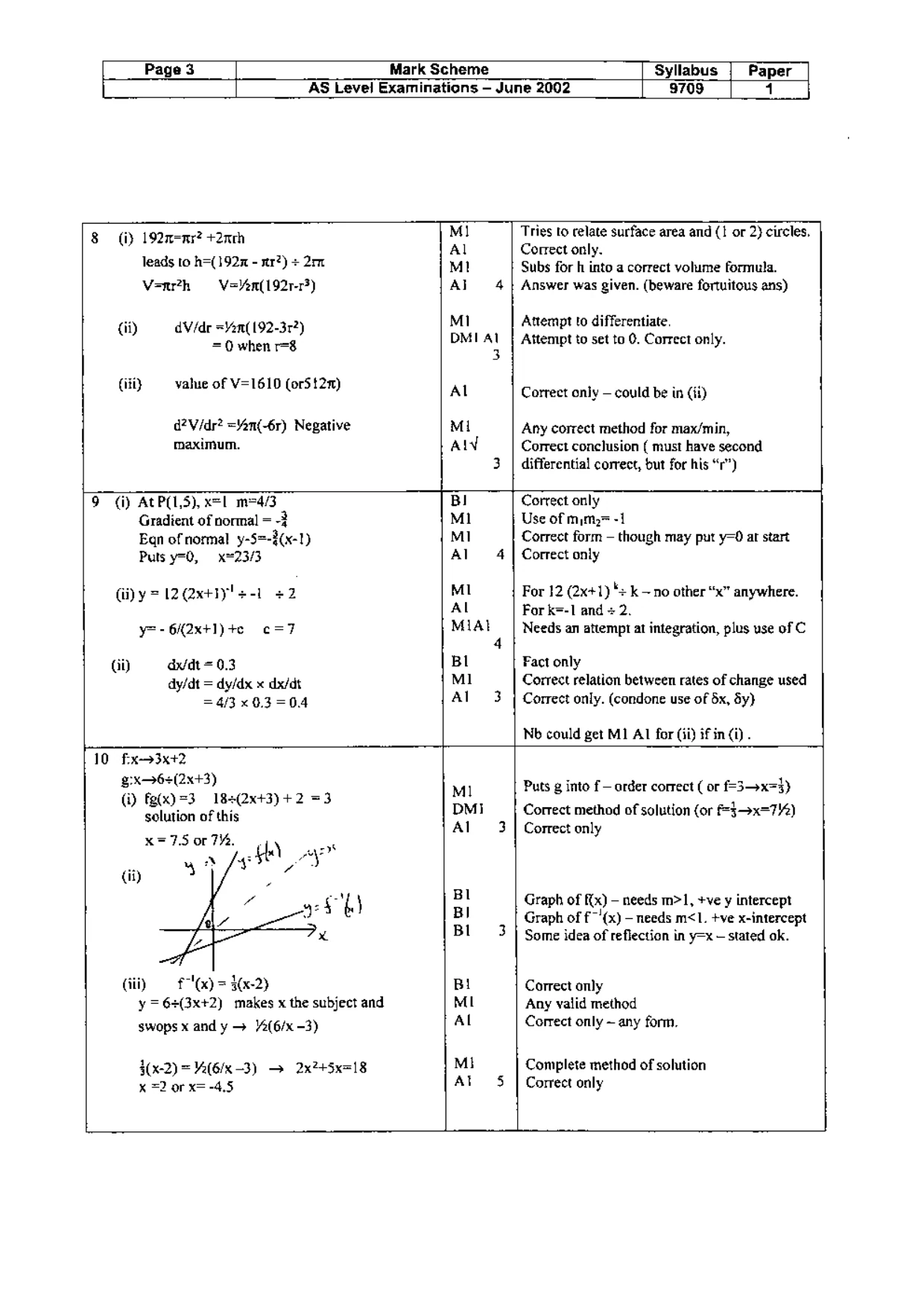
Page 3 Mark Scheme [ Syllabus | Paper | AS Level Examinations — June 2002 | 9709 | 4 8 (i) 192m=nr? +20th leads to h=(192x - wr?) + 2m Tries to relate surface area and (1 or 2} circles, Correct only. Subs for h into a correct volume formula. Venrh = -V=Ven(192r-r3) Al 4 | Answer was given. (beware fortuitous ans) ii aVéde <¥on( 192-322 Ml Attempt to differentiate. “ = antl 3 DMI Al | Attempt to set to 0. Correct only. 3 (ii) value of V=1610 (orSt2m) Al Correct only — could be in (ii) d?V/dr? =Yan(-6r) Negative Mi Any correct method for max/min, maximum. Aly Correct conclusion ( must have second 3 | differential correct, but for his “r’) 9 (i) AtP(L,5), x=1 m=4/3 Bl Correct only Gradient of normal = -2 Ml Use of mum,= -1 Eqn of normal y-5=-3(x-1) Mi Correct form — though may put y=0 ar start Puts y=O, x*23/3 Al 4 | Correct only Gi) y = 12 @xtiyls-1 +2 MI For $2 (2x+1) *+ k~no other “x” anywhere. Al For k=-1 and + 2. y=-GK2x+]) +0 C=7 MIAI | Needs an attempt at integration, plus use of C 4 Gi) dx/dt = 0.3 BI Fact only dy/dt = dy/dx x dx/dt MI Correct relation between rates of change used = 4/3 x0.3=04 Al 3 | Correct only. (condone use of 5x, Sy} Nb could get M1 AL for (ii) if in (i) . 10 fx-—93x+2 8:x96+(2x43) MI Puts g into f — order correct ( or f=3->x=3) (i) fe(x) =3 184(2x43) +2 =3 . 1 solution of this DMI Correct method of solution (or f=3->x=72) Al 3 | Correct only Bl Graph of x) - needs m>1, +ve y intercept BI Graph of f~'(x) - needs m<1. +ve x-intercept Bl 3 | Some idea of reflection in y=x — stated ok. Gil) £"G) = (x-2) Bi Correct only y =6+(3x+2) makes x the subject and ML Any valid method swops x and y + 4(6/x -3) Al Correct only ~ any form, 4(x%-2) = Va(G/x-3) > 2x245x=18 Mi Complete method of solution x =2 or x= -4.5 At 5 | Correct only