Cambridge A Level Law 9084 — 2018 Oct/Nov Paper 4 · Variant 3
9084/43/O/N/18 · 75 marks · ≈84 min
The question paper and its mark scheme, free to read here and free to download. This is Cambridge’s own paper, exactly as it was sat.
Question paper4 pages

Mark scheme10 pages
Answers below. Sit the paper first if you are practising.
Paper as text
Question paper, page 1
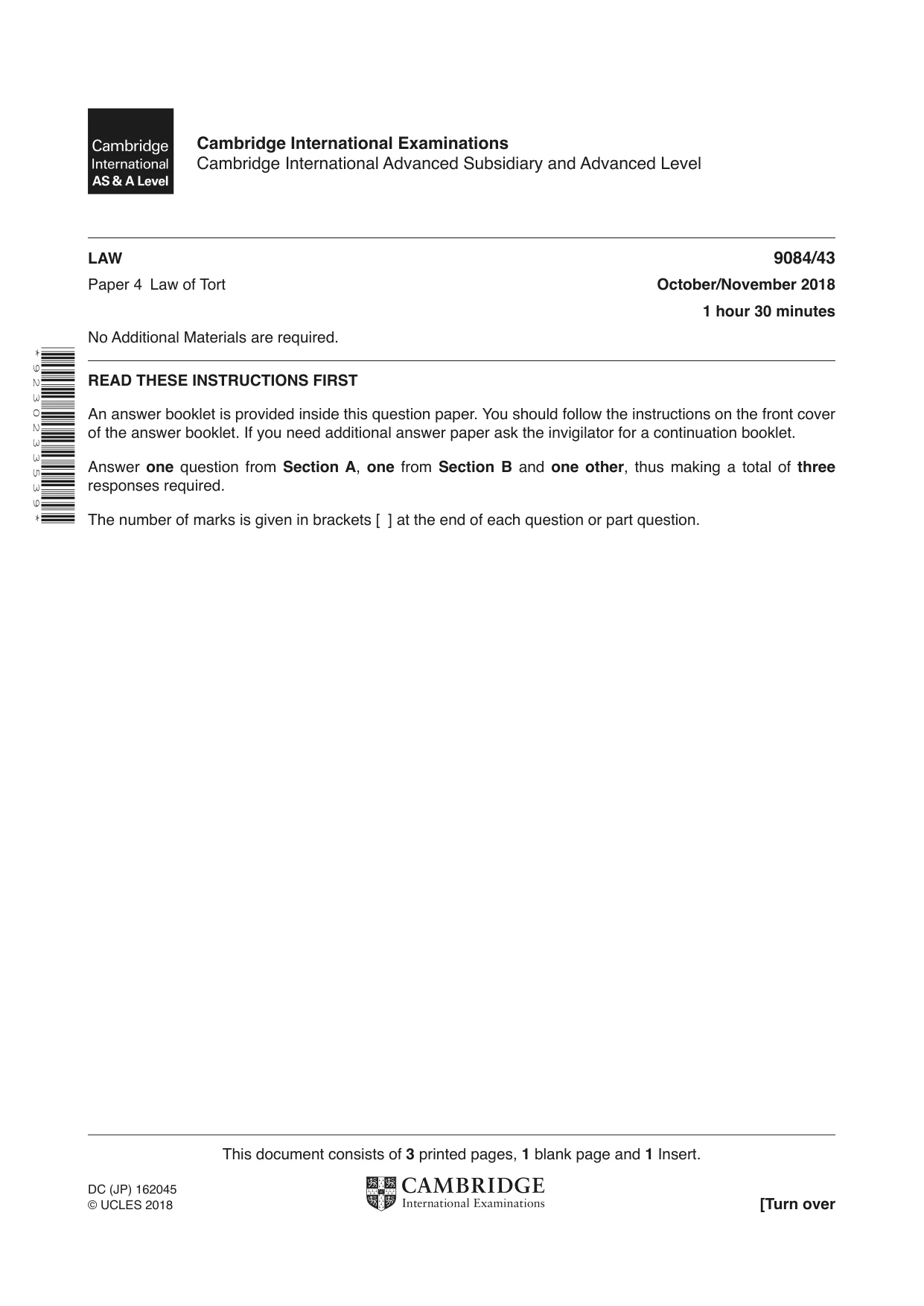
* 9 2 3 0 2 3 3 5 3 9 * This document consists of 3 printed pages, 1 blank page and 1 Insert. DC (JP) 162045 © UCLES 2018 [Turn over Cambridge International Examinations Cambridge International Advanced Subsidiary and Advanced Level LAW 9084/43 Paper 4 Law of Tort October/November 2018 1 hour 30 minutes No Additional Materials are required. READ THESE INSTRUCTIONS FIRST An answer booklet is provided inside this question paper. You should follow the instructions on the front cover of the answer booklet. If you need additional answer paper ask the invigilator for a continuation booklet. Answer one question from Section A, one from Section B and one other, thus making a total of three responses required. The number of marks is given in brackets [ ] at the end of each question or part question.
Question paper, page 2
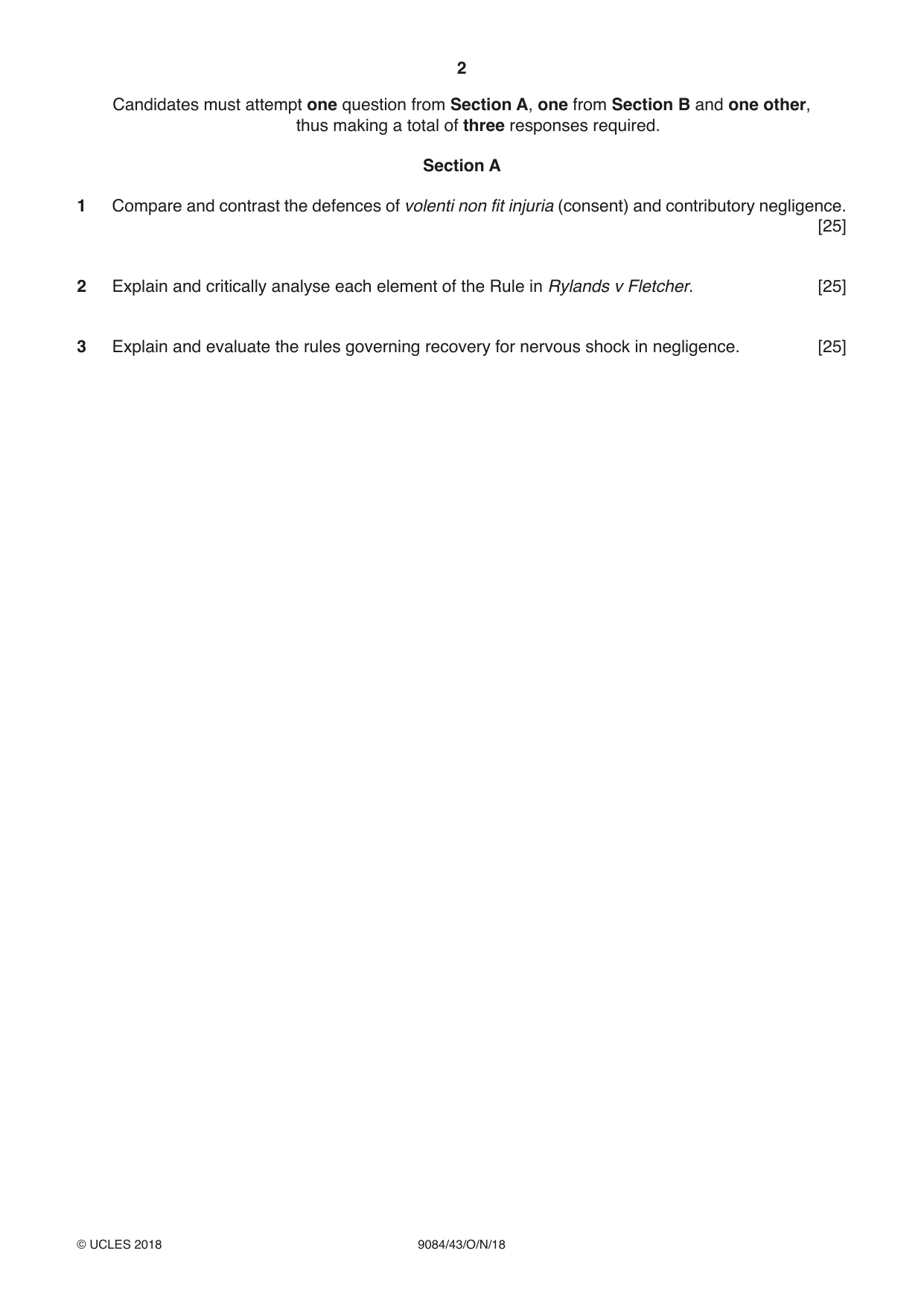
2 9084/43/O/N/18 © UCLES 2018 Candidates must attempt one question from Section A, one from Section B and one other, thus making a total of three responses required. Section A 1 Compare and contrast the defences of volenti non fit injuria (consent) and contributory negligence. [25] 2 Explain and critically analyse each element of the Rule in Rylands v Fletcher. [25] 3 Explain and evaluate the rules governing recovery for nervous shock in negligence. [25]
Question paper, page 3
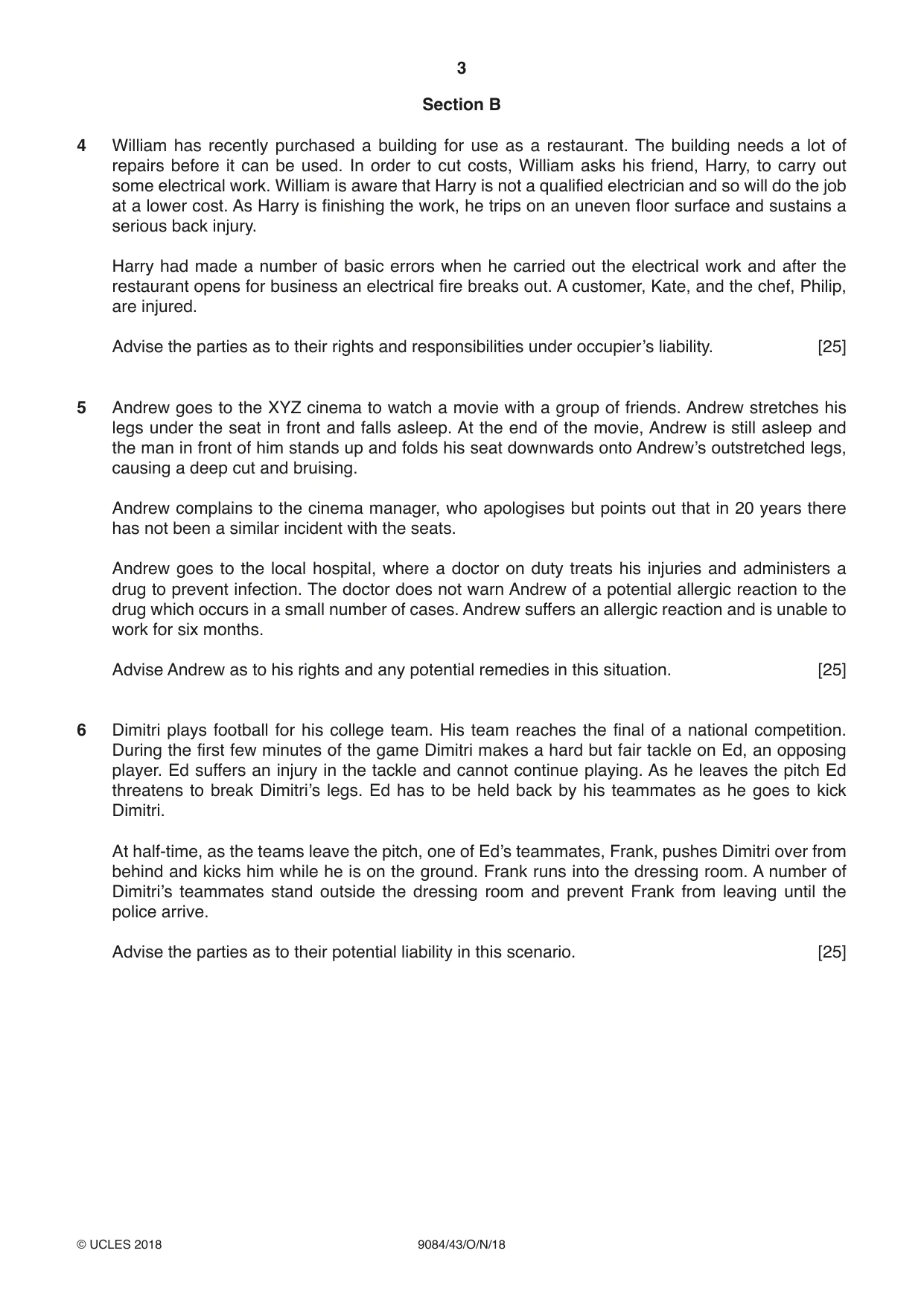
3 9084/43/O/N/18 © UCLES 2018 Section B 4 William has recently purchased a building for use as a restaurant. The building needs a lot of repairs before it can be used. In order to cut costs, William asks his friend, Harry, to carry out some electrical work. William is aware that Harry is not a qualified electrician and so will do the job at a lower cost. As Harry is finishing the work, he trips on an uneven floor surface and sustains a serious back injury. Harry had made a number of basic errors when he carried out the electrical work and after the restaurant opens for business an electrical fire breaks out. A customer, Kate, and the chef, Philip, are injured. Advise the parties as to their rights and responsibilities under occupier’s liability. [25] 5 Andrew goes to the XYZ cinema to watch a movie with a group of friends. Andrew stretches his legs under the seat in front and falls asleep. At the end of the movie, Andrew is still asleep and the man in front of him stands up and folds his seat downwards onto Andrew’s outstretched legs, causing a deep cut and bruising. Andrew complains to the cinema manager, who apologises but points out that in 20 years there has not been a similar incident with the seats. Andrew goes to the local hospital, where a doctor on duty treats his injuries and administers a drug to prevent infection. The doctor does not warn Andrew of a potential allergic reaction to the drug which occurs in a small number of cases. Andrew suffers an allergic reaction and is unable to work for six months. Advise Andrew as to his rights and any potential remedies in this situation. [25] 6 Dimitri plays football for his college team. His team reaches the final of a national competition. During the first few minutes of the game Dimitri makes a hard but fair tackle on Ed, an opposing player. Ed suffers an injury in the tackle and cannot continue playing. As he leaves the pitch Ed threatens to break Dimitri’s legs. Ed has to be held back by his teammates as he goes to kick Dimitri. At half-time, as the teams leave the pitch, one of Ed’s teammates, Frank, pushes Dimitri over from behind and kicks him while he is on the ground. Frank runs into the dressing room. A number of Dimitri’s teammates stand outside the dressing room and prevent Frank from leaving until the police arrive. Advise the parties as to their potential liability in this scenario. [25]
Question paper, page 4
4 9084/43/O/N/18 © UCLES 2018 BLANK PAGE Permission to reproduce items where third-party owned material protected by copyright is included has been sought and cleared where possible. Every reasonable effort has been made by the publisher (UCLES) to trace copyright holders, but if any items requiring clearance have unwittingly been included, the publisher will be pleased to make amends at the earliest possible opportunity. To avoid the issue of disclosure of answer-related information to candidates, all copyright acknowledgements are reproduced online in the Cambridge International Examinations Copyright Acknowledgements Booklet. This is produced for each series of examinations and is freely available to download at www.cie.org.uk after the live examination series. Cambridge International Examinations is part of the Cambridge Assessment Group. Cambridge Assessment is the brand name of University of Cambridge Local Examinations Syndicate (UCLES), which is itself a department of the University of Cambridge.
Mark scheme, page 1
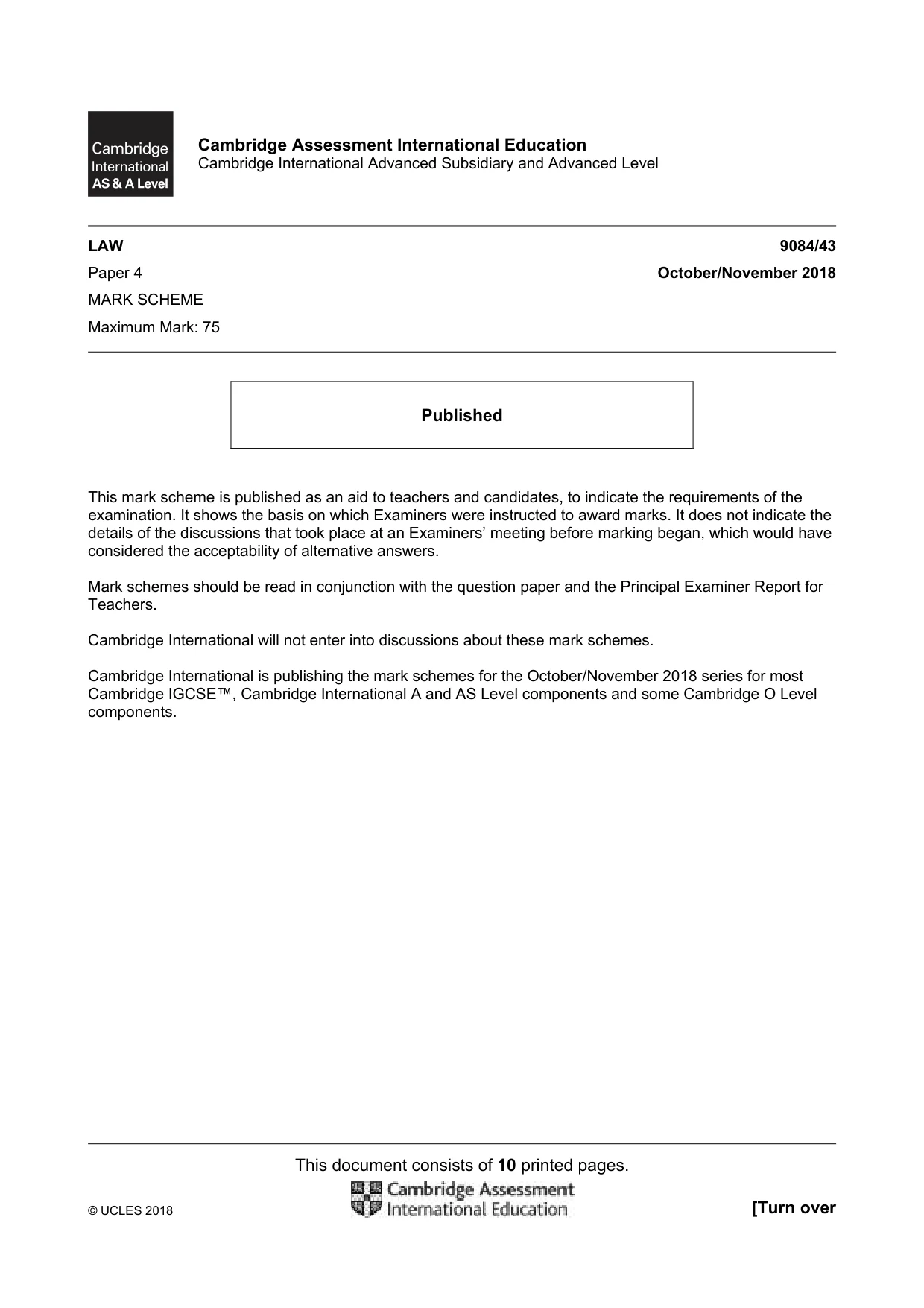
This document consists of 10 printed pages. © UCLES 2018 [Turn over Cambridge Assessment International Education Cambridge International Advanced Subsidiary and Advanced Level LAW 9084/43 Paper 4 October/November 2018 MARK SCHEME Maximum Mark: 75 Published This mark scheme is published as an aid to teachers and candidates, to indicate the requirements of the examination. It shows the basis on which Examiners were instructed to award marks. It does not indicate the details of the discussions that took place at an Examiners’ meeting before marking began, which would have considered the acceptability of alternative answers. Mark schemes should be read in conjunction with the question paper and the Principal Examiner Report for Teachers. Cambridge International will not enter into discussions about these mark schemes. Cambridge International is publishing the mark schemes for the October/November 2018 series for most Cambridge IGCSE™, Cambridge International A and AS Level components and some Cambridge O Level components.
Mark scheme, page 2
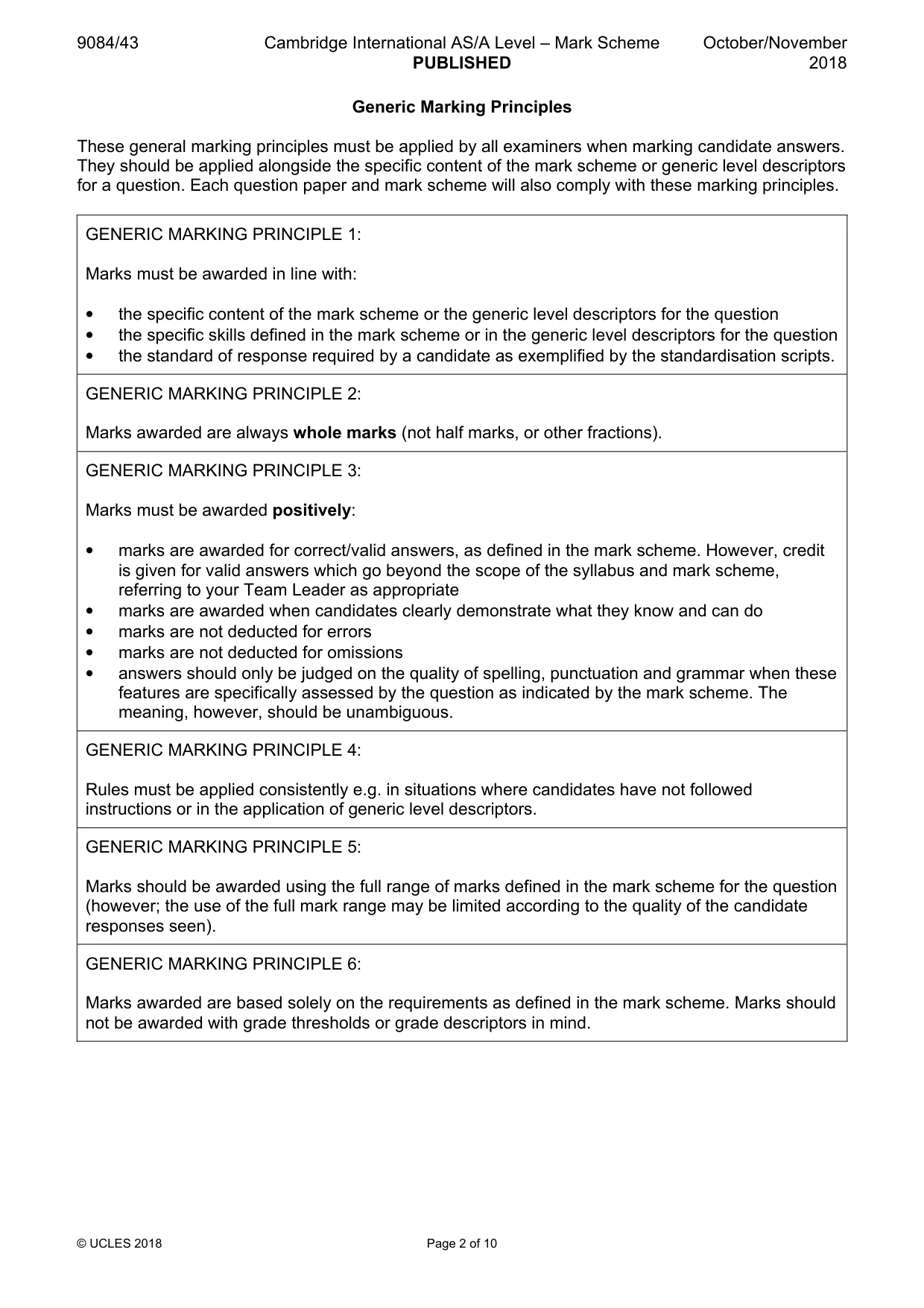
9084/43 Cambridge International AS/A Level – Mark Scheme PUBLISHED October/November 2018 © UCLES 2018 Page 2 of 10 Generic Marking Principles These general marking principles must be applied by all examiners when marking candidate answers. They should be applied alongside the specific content of the mark scheme or generic level descriptors for a question. Each question paper and mark scheme will also comply with these marking principles. GENERIC MARKING PRINCIPLE 1: Marks must be awarded in line with: • the specific content of the mark scheme or the generic level descriptors for the question • the specific skills defined in the mark scheme or in the generic level descriptors for the question • the standard of response required by a candidate as exemplified by the standardisation scripts. GENERIC MARKING PRINCIPLE 2: Marks awarded are always whole marks (not half marks, or other fractions). GENERIC MARKING PRINCIPLE 3: Marks must be awarded positively: • marks are awarded for correct/valid answers, as defined in the mark scheme. However, credit is given for valid answers which go beyond the scope of the syllabus and mark scheme, referring to your Team Leader as appropriate • marks are awarded when candidates clearly demonstrate what they know and can do • marks are not deducted for errors • marks are not deducted for omissions • answers should only be judged on the quality of spelling, punctuation and grammar when these features are specifically assessed by the question as indicated by the mark scheme. The meaning, however, should be unambiguous. GENERIC MARKING PRINCIPLE 4: Rules must be applied consistently e.g. in situations where candidates have not followed instructions or in the application of generic level descriptors. GENERIC MARKING PRINCIPLE 5: Marks should be awarded using the full range of marks defined in the mark scheme for the question (however; the use of the full mark range may be limited according to the quality of the candidate responses seen). GENERIC MARKING PRINCIPLE 6: Marks awarded are based solely on the requirements as defined in the mark scheme. Marks should not be awarded with grade thresholds or grade descriptors in mind.
Mark scheme, page 3
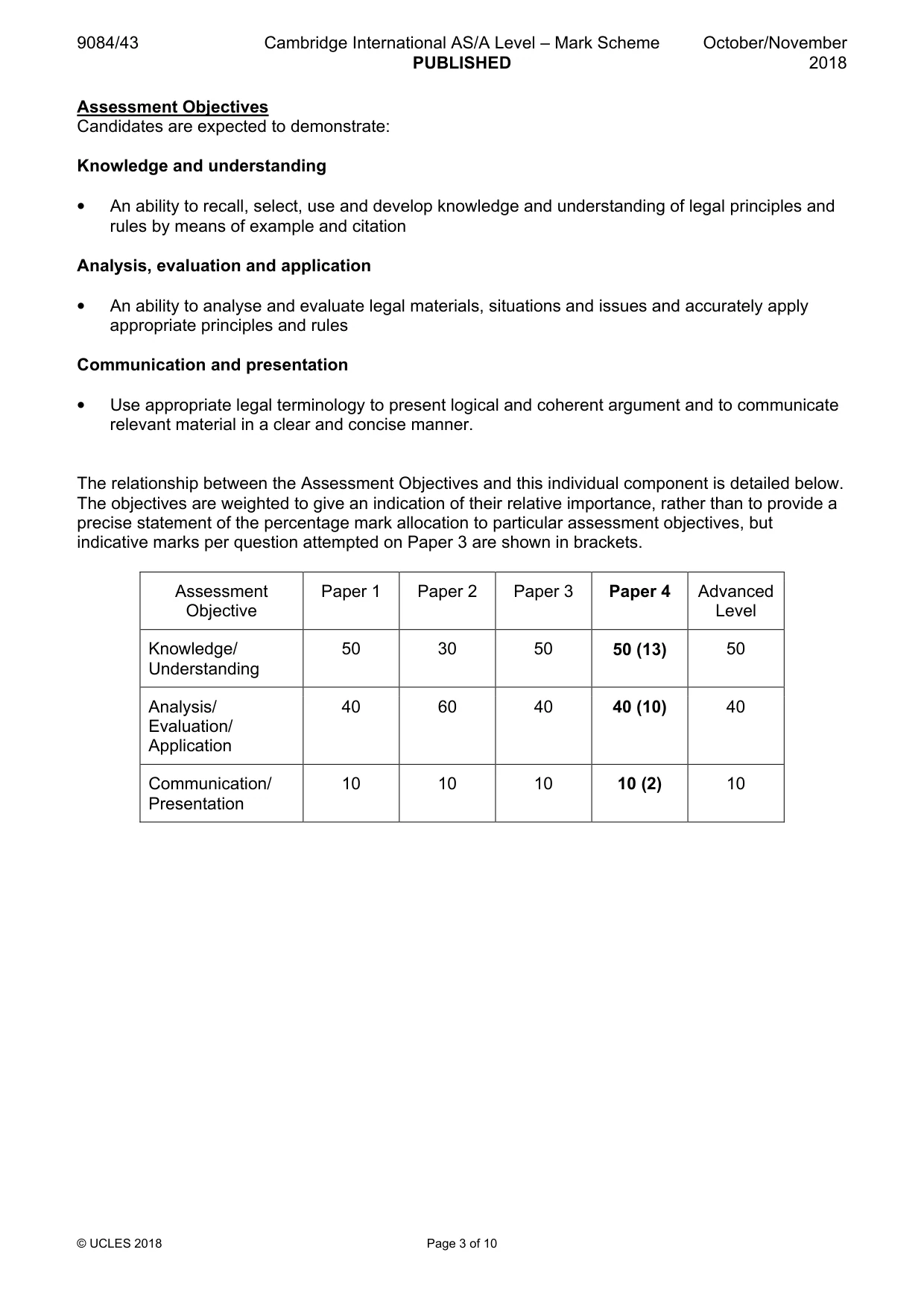
9084/43 Cambridge International AS/A Level – Mark Scheme PUBLISHED October/November 2018 © UCLES 2018 Page 3 of 10 Assessment Objectives Candidates are expected to demonstrate: Knowledge and understanding • An ability to recall, select, use and develop knowledge and understanding of legal principles and rules by means of example and citation Analysis, evaluation and application • An ability to analyse and evaluate legal materials, situations and issues and accurately apply appropriate principles and rules Communication and presentation • Use appropriate legal terminology to present logical and coherent argument and to communicate relevant material in a clear and concise manner. The relationship between the Assessment Objectives and this individual component is detailed below. The objectives are weighted to give an indication of their relative importance, rather than to provide a precise statement of the percentage mark allocation to particular assessment objectives, but indicative marks per question attempted on Paper 3 are shown in brackets. Assessment Objective Paper 1 Paper 2 Paper 3 Paper 4 Advanced Level Knowledge/ Understanding 50 30 50 50 (13) 50 Analysis/ Evaluation/ Application 40 60 40 40 (10) 40 Communication/ Presentation 10 10 10 10 (2) 10
Mark scheme, page 4
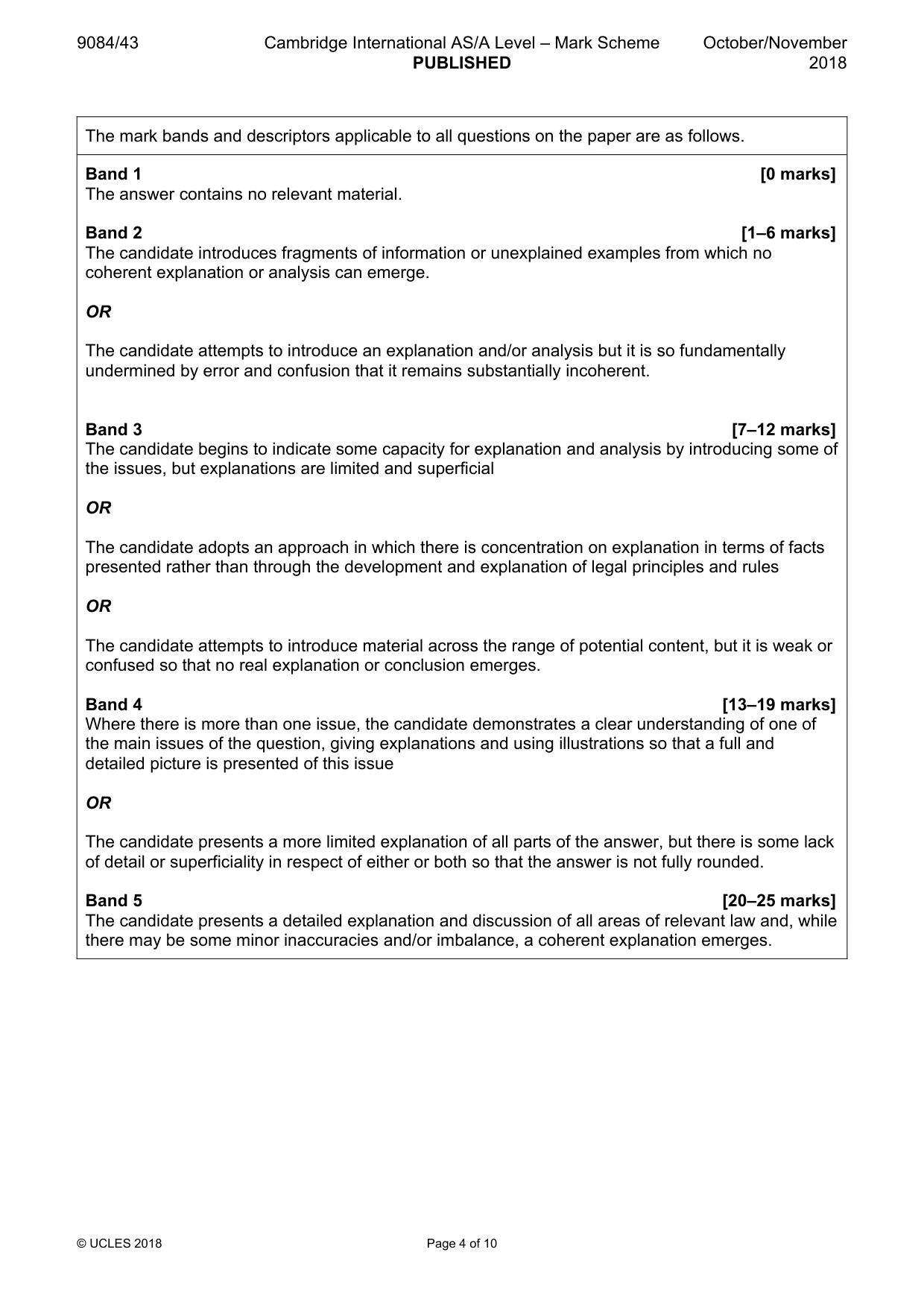
9084/43 Cambridge International AS/A Level – Mark Scheme PUBLISHED October/November 2018 © UCLES 2018 Page 4 of 10 The mark bands and descriptors applicable to all questions on the paper are as follows. Band 1 [0 marks] The answer contains no relevant material. Band 2 [1–6 marks] The candidate introduces fragments of information or unexplained examples from which no coherent explanation or analysis can emerge. OR The candidate attempts to introduce an explanation and/or analysis but it is so fundamentally undermined by error and confusion that it remains substantially incoherent. Band 3 [7–12 marks] The candidate begins to indicate some capacity for explanation and analysis by introducing some of the issues, but explanations are limited and superficial OR The candidate adopts an approach in which there is concentration on explanation in terms of facts presented rather than through the development and explanation of legal principles and rules OR The candidate attempts to introduce material across the range of potential content, but it is weak or confused so that no real explanation or conclusion emerges. Band 4 [13–19 marks] Where there is more than one issue, the candidate demonstrates a clear understanding of one of the main issues of the question, giving explanations and using illustrations so that a full and detailed picture is presented of this issue OR The candidate presents a more limited explanation of all parts of the answer, but there is some lack of detail or superficiality in respect of either or both so that the answer is not fully rounded. Band 5 [20–25 marks] The candidate presents a detailed explanation and discussion of all areas of relevant law and, while there may be some minor inaccuracies and/or imbalance, a coherent explanation emerges.
Mark scheme, page 5
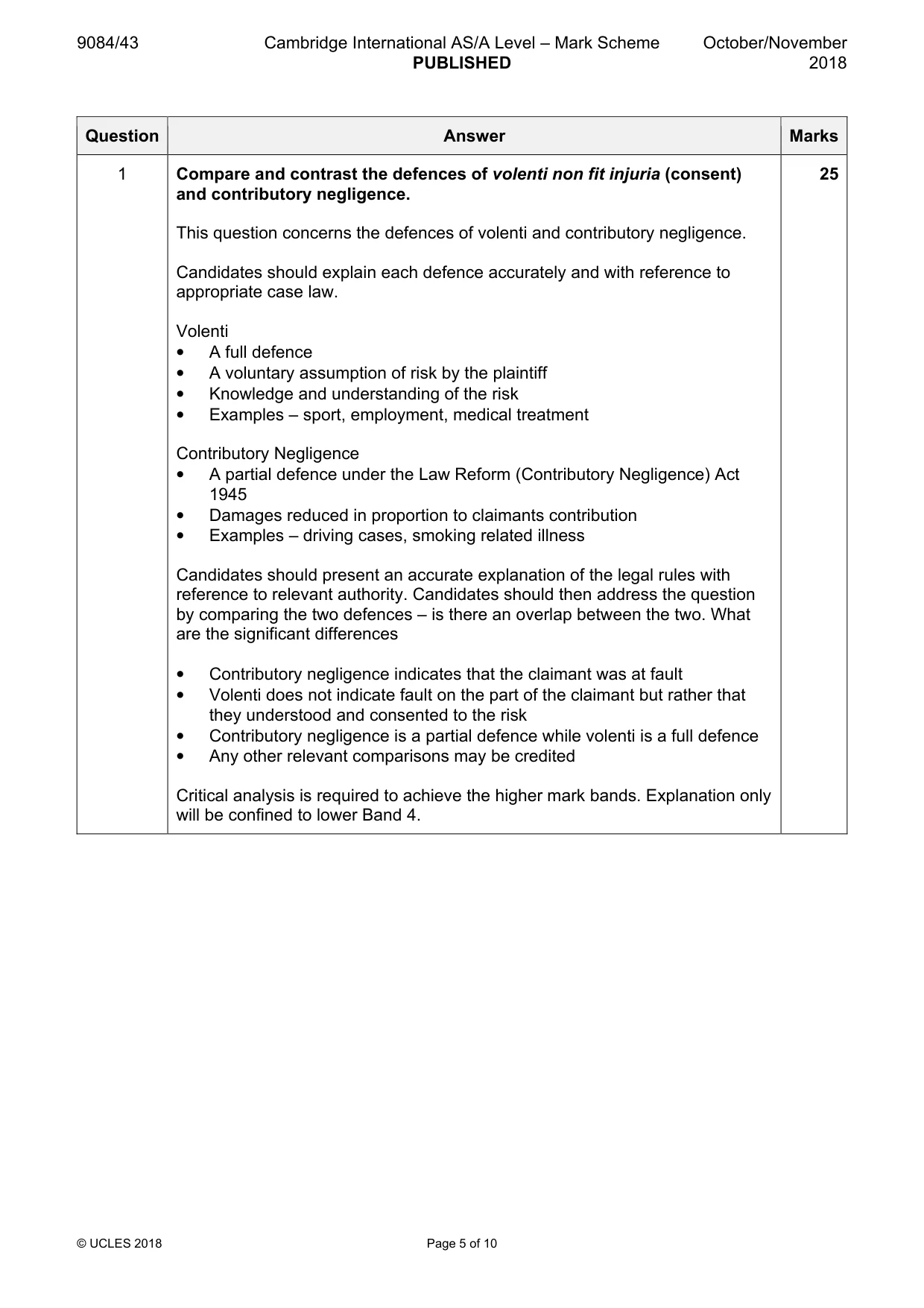
9084/43 Cambridge International AS/A Level – Mark Scheme PUBLISHED October/November 2018 © UCLES 2018 Page 5 of 10 Question Answer Marks 1 Compare and contrast the defences of volenti non fit injuria (consent) and contributory negligence. This question concerns the defences of volenti and contributory negligence. Candidates should explain each defence accurately and with reference to appropriate case law. Volenti • A full defence • A voluntary assumption of risk by the plaintiff • Knowledge and understanding of the risk • Examples – sport, employment, medical treatment Contributory Negligence • A partial defence under the Law Reform (Contributory Negligence) Act 1945 • Damages reduced in proportion to claimants contribution • Examples – driving cases, smoking related illness Candidates should present an accurate explanation of the legal rules with reference to relevant authority. Candidates should then address the question by comparing the two defences – is there an overlap between the two. What are the significant differences • Contributory negligence indicates that the claimant was at fault • Volenti does not indicate fault on the part of the claimant but rather that they understood and consented to the risk • Contributory negligence is a partial defence while volenti is a full defence • Any other relevant comparisons may be credited Critical analysis is required to achieve the higher mark bands. Explanation only will be confined to lower Band 4. 25
Mark scheme, page 6
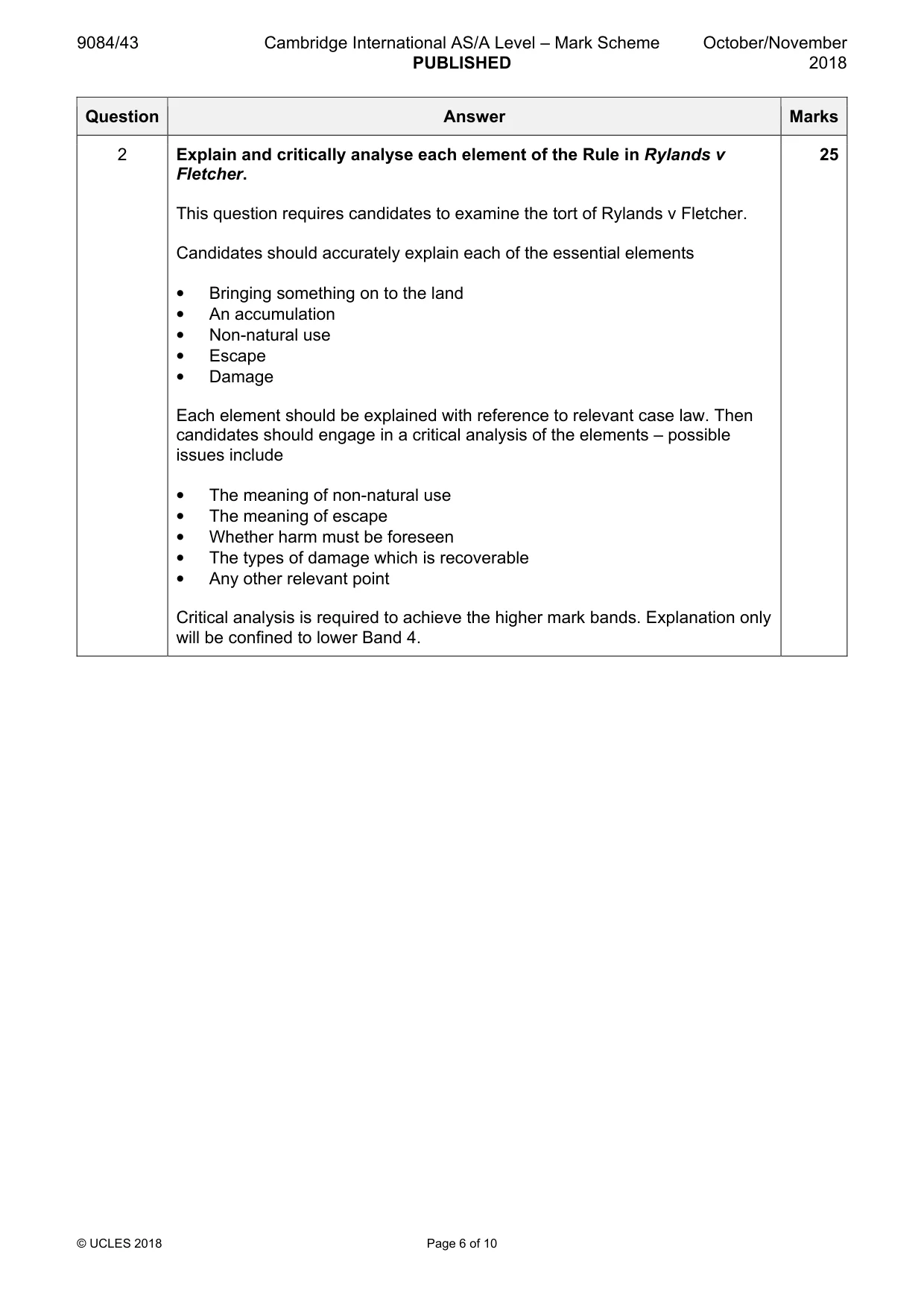
9084/43 Cambridge International AS/A Level – Mark Scheme PUBLISHED October/November 2018 © UCLES 2018 Page 6 of 10 Question Answer Marks 2 Explain and critically analyse each element of the Rule in Rylands v Fletcher. This question requires candidates to examine the tort of Rylands v Fletcher. Candidates should accurately explain each of the essential elements • Bringing something on to the land • An accumulation • Non-natural use • Escape • Damage Each element should be explained with reference to relevant case law. Then candidates should engage in a critical analysis of the elements – possible issues include • The meaning of non-natural use • The meaning of escape • Whether harm must be foreseen • The types of damage which is recoverable • Any other relevant point Critical analysis is required to achieve the higher mark bands. Explanation only will be confined to lower Band 4. 25
Mark scheme, page 7
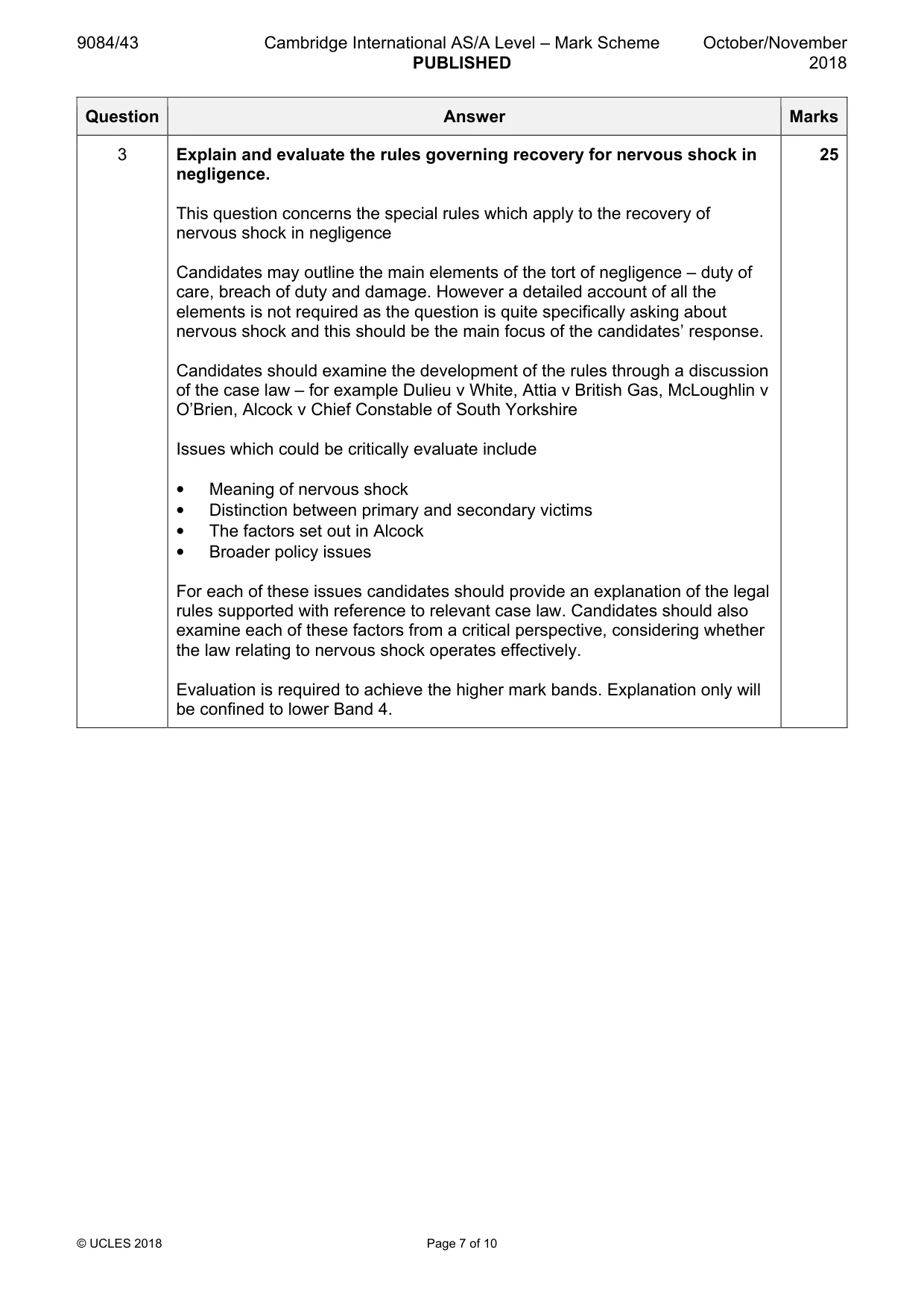
9084/43 Cambridge International AS/A Level – Mark Scheme PUBLISHED October/November 2018 © UCLES 2018 Page 7 of 10 Question Answer Marks 3 Explain and evaluate the rules governing recovery for nervous shock in negligence. This question concerns the special rules which apply to the recovery of nervous shock in negligence Candidates may outline the main elements of the tort of negligence – duty of care, breach of duty and damage. However a detailed account of all the elements is not required as the question is quite specifically asking about nervous shock and this should be the main focus of the candidates’ response. Candidates should examine the development of the rules through a discussion of the case law – for example Dulieu v White, Attia v British Gas, McLoughlin v O’Brien, Alcock v Chief Constable of South Yorkshire Issues which could be critically evaluate include • Meaning of nervous shock • Distinction between primary and secondary victims • The factors set out in Alcock • Broader policy issues For each of these issues candidates should provide an explanation of the legal rules supported with reference to relevant case law. Candidates should also examine each of these factors from a critical perspective, considering whether the law relating to nervous shock operates effectively. Evaluation is required to achieve the higher mark bands. Explanation only will be confined to lower Band 4. 25
Mark scheme, page 8
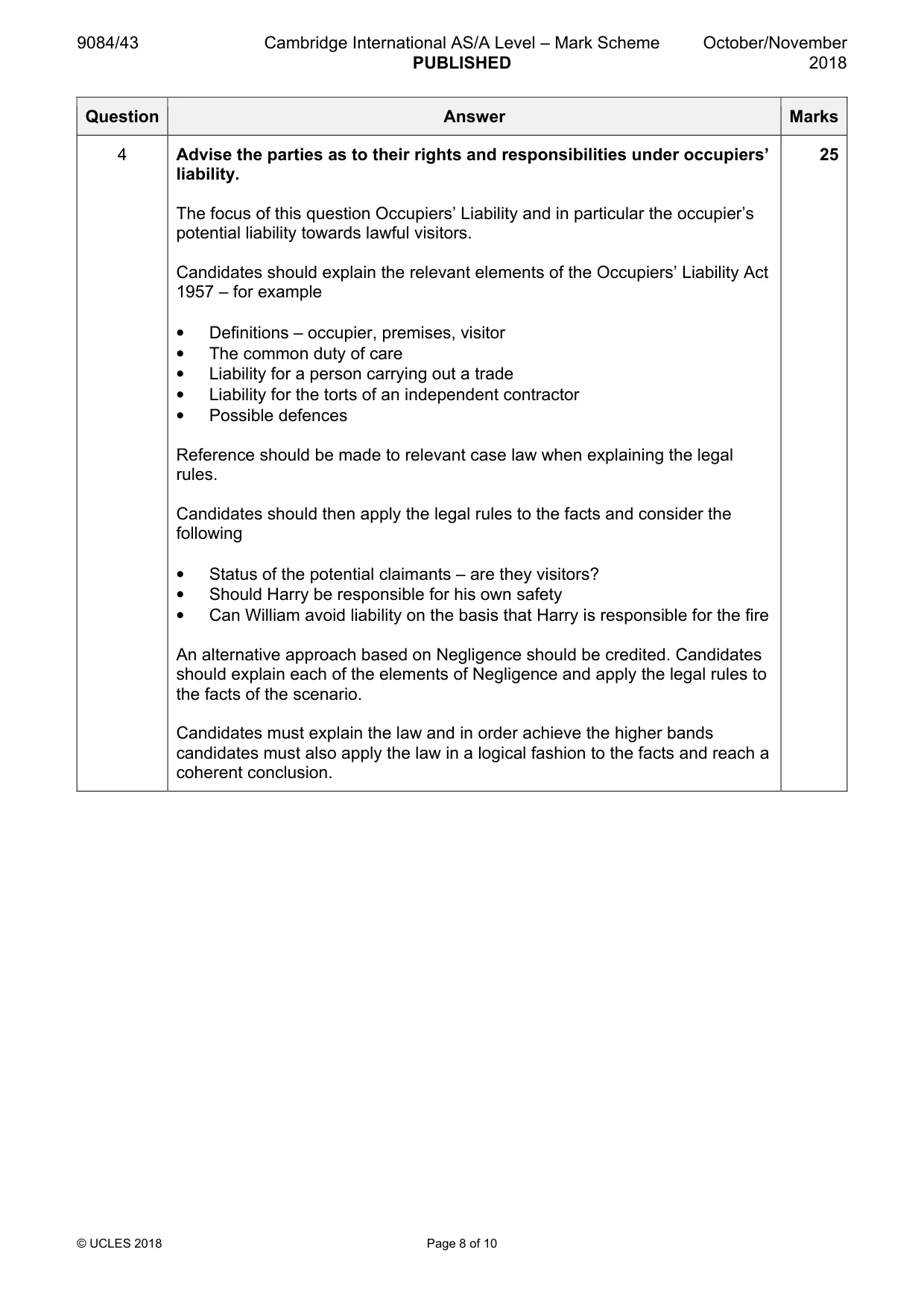
9084/43 Cambridge International AS/A Level – Mark Scheme PUBLISHED October/November 2018 © UCLES 2018 Page 8 of 10 Question Answer Marks 4 Advise the parties as to their rights and responsibilities under occupiers’ liability. The focus of this question Occupiers’ Liability and in particular the occupier’s potential liability towards lawful visitors. Candidates should explain the relevant elements of the Occupiers’ Liability Act 1957 – for example • Definitions – occupier, premises, visitor • The common duty of care • Liability for a person carrying out a trade • Liability for the torts of an independent contractor • Possible defences Reference should be made to relevant case law when explaining the legal rules. Candidates should then apply the legal rules to the facts and consider the following • Status of the potential claimants – are they visitors? • Should Harry be responsible for his own safety • Can William avoid liability on the basis that Harry is responsible for the fire An alternative approach based on Negligence should be credited. Candidates should explain each of the elements of Negligence and apply the legal rules to the facts of the scenario. Candidates must explain the law and in order achieve the higher bands candidates must also apply the law in a logical fashion to the facts and reach a coherent conclusion. 25
Mark scheme, page 9
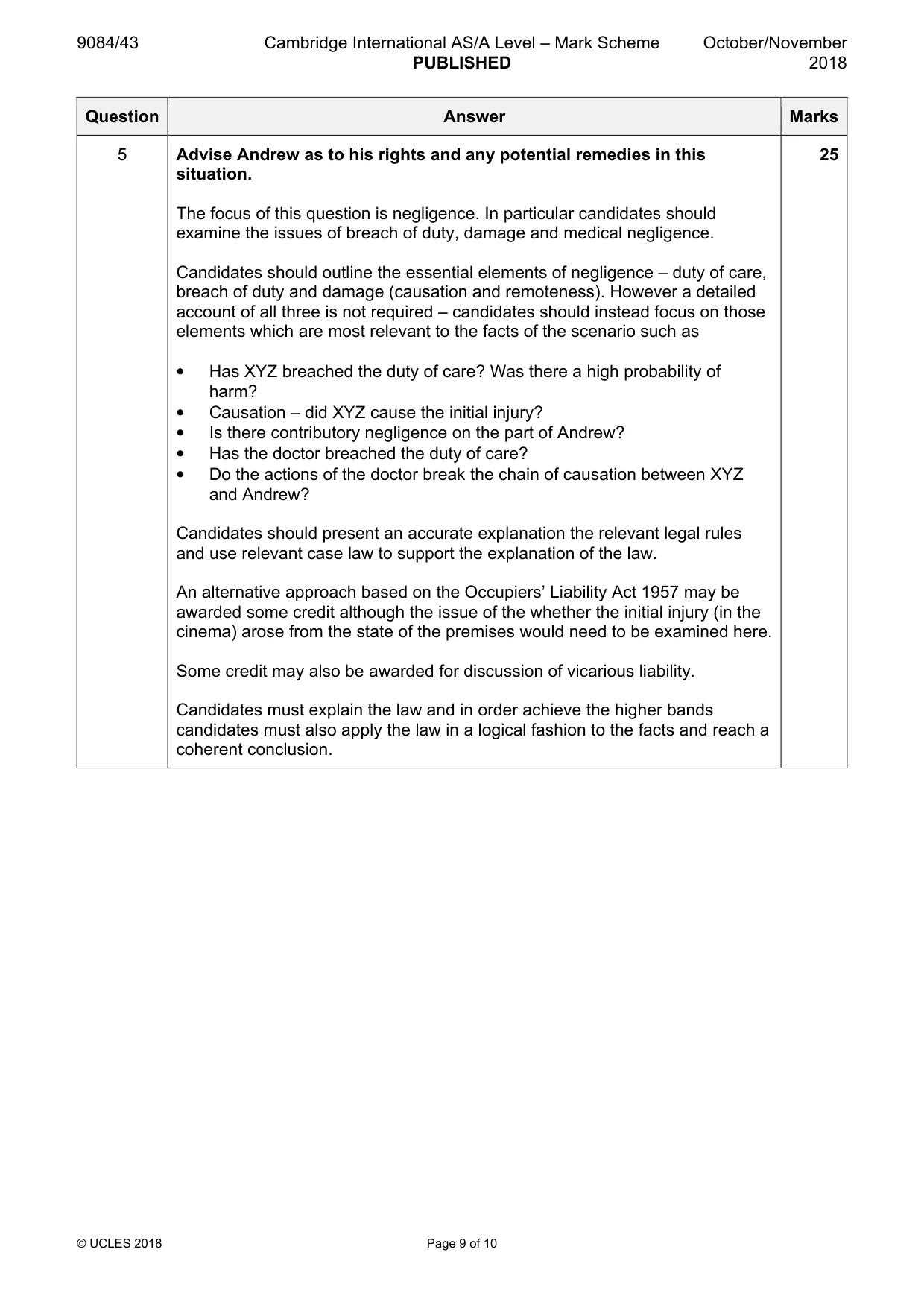
9084/43 Cambridge International AS/A Level – Mark Scheme PUBLISHED October/November 2018 © UCLES 2018 Page 9 of 10 Question Answer Marks 5 Advise Andrew as to his rights and any potential remedies in this situation. The focus of this question is negligence. In particular candidates should examine the issues of breach of duty, damage and medical negligence. Candidates should outline the essential elements of negligence – duty of care, breach of duty and damage (causation and remoteness). However a detailed account of all three is not required – candidates should instead focus on those elements which are most relevant to the facts of the scenario such as • Has XYZ breached the duty of care? Was there a high probability of harm? • Causation – did XYZ cause the initial injury? • Is there contributory negligence on the part of Andrew? • Has the doctor breached the duty of care? • Do the actions of the doctor break the chain of causation between XYZ and Andrew? Candidates should present an accurate explanation the relevant legal rules and use relevant case law to support the explanation of the law. An alternative approach based on the Occupiers’ Liability Act 1957 may be awarded some credit although the issue of the whether the initial injury (in the cinema) arose from the state of the premises would need to be examined here. Some credit may also be awarded for discussion of vicarious liability. Candidates must explain the law and in order achieve the higher bands candidates must also apply the law in a logical fashion to the facts and reach a coherent conclusion. 25
Mark scheme, page 10
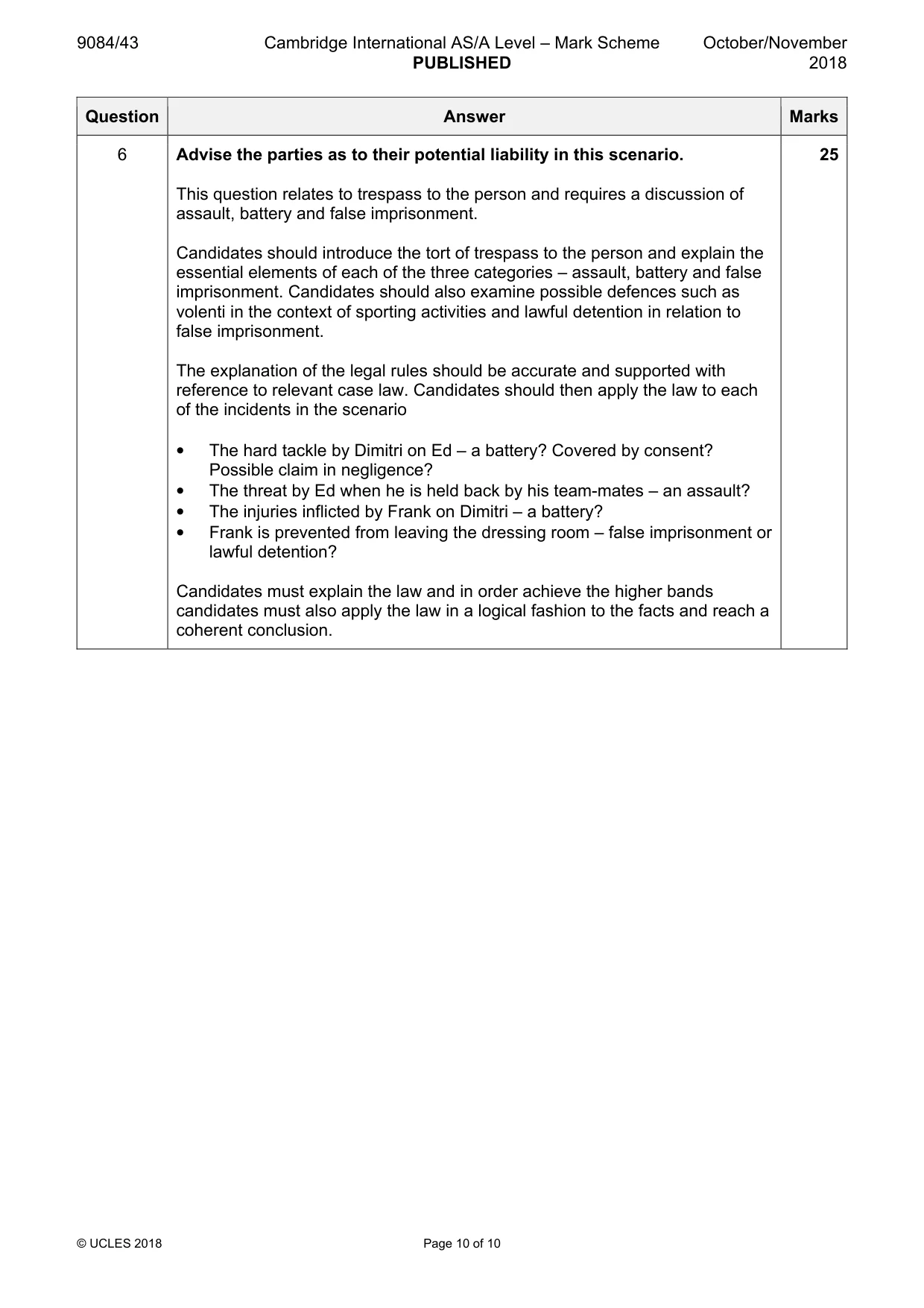
9084/43 Cambridge International AS/A Level – Mark Scheme PUBLISHED October/November 2018 © UCLES 2018 Page 10 of 10 Question Answer Marks 6 Advise the parties as to their potential liability in this scenario. This question relates to trespass to the person and requires a discussion of assault, battery and false imprisonment. Candidates should introduce the tort of trespass to the person and explain the essential elements of each of the three categories – assault, battery and false imprisonment. Candidates should also examine possible defences such as volenti in the context of sporting activities and lawful detention in relation to false imprisonment. The explanation of the legal rules should be accurate and supported with reference to relevant case law. Candidates should then apply the law to each of the incidents in the scenario • The hard tackle by Dimitri on Ed – a battery? Covered by consent? Possible claim in negligence? • The threat by Ed when he is held back by his team-mates – an assault? • The injuries inflicted by Frank on Dimitri – a battery? • Frank is prevented from leaving the dressing room – false imprisonment or lawful detention? Candidates must explain the law and in order achieve the higher bands candidates must also apply the law in a logical fashion to the facts and reach a coherent conclusion. 25
What you needed in this session
Cambridge’s own grade thresholds for 2018 Oct/Nov, Paper 4 · Variant 3. A higher threshold means an easier paper — the bar moves with how the cohort did.