Cambridge A Level Law 9084 — 2016 Oct/Nov Paper 4 · Variant 3
9084/43/O/N/16
The question paper and its mark scheme, free to read here and free to download. This is Cambridge’s own paper, exactly as it was sat.
Question paper4 pages

Mark scheme5 pages
Answers below. Sit the paper first if you are practising.
Paper as text
Question paper, page 1
This document consists of 3 printed pages, 1 blank page and 1 insert. DC (ST) 126187 © UCLES 2016 [Turn over Cambridge International Examinations Cambridge International Advanced Subsidiary and Advanced Level * 6 3 1 1 6 7 1 3 0 9 * LAW 9084/43 Paper 4 Law of Tort October/November 2016 1 hour 30 minutes No Additional Materials are required. READ THESE INSTRUCTIONS FIRST An answer booklet is provided inside this question paper. You should follow the instructions on the front cover of the answer booklet. If you need additional answer paper ask the invigilator for a continuation booklet. Answer one question from Section A, one from Section B and one other, thus making a total of three responses required. The number of marks is given in brackets [ ] at the end of each question or part question.
Question paper, page 2
2 9084/43/O/N/16 © UCLES 2016 Candidates must attempt one question from Section A, one from Section B and one other, thus making a total of three responses required. Section A 1 The rule in Rylands v Fletcher [1868] is no longer necessary as an action is generally possible in private nuisance. Assess the validity of this statement. [25] 2 The distinction between claims for physical damage and for pure economic loss in the tort of negligence is an artificial one which causes unjust results for claimants. Critically analyse this statement, with reference to case law. [25] 3 The defence of volenti non fit injuria (consent) requires both knowledge and a full understanding of the nature of the risk of harm. With reference to decided cases, evaluate this statement. [25]
Question paper, page 3
3 9084/43/O/N/16 © UCLES 2016 Section B 4 Samir attends a local college and usually drives his friend Talvin there each day. On one journey Talvin opens the car window, shouts and throws an empty bottle at a group of students waiting for a bus. The bottle shatters on the road and a piece of glass hits a passer-by, Maureen, in the face. Maureen is taken to hospital where a piece of glass is found lodged very close to her right eye. The glass is surgically removed by an inexperienced doctor, Joanne. It is the first operation of this type that she has ever performed and results in the loss of sight in Maureen’s eye. Advise Maureen as to the potential liability of Samir, Talvin and Joanne. [25] 5 Pierre is walking from his office to an important meeting unaware that a large protest march is taking place in the city that day. When he is about to cross a bridge, a police officer tells him that he must find a different route to his destination. Pierre realises that he will be late for his meeting so he starts to run. In his hurry he collides with Yvonne who suffers a broken arm when she falls to the ground. Yvonne’s husband Giles confronts Pierre and tells him that he is calling the police and that if he moves he will hit him. Pierre attempts to get past Giles who punches him, breaking his nose. Advise Pierre as to his rights and responsibilities arising from this event. [25] 6 Quickbuild is in the process of constructing a number of houses. The site is located adjacent to existing houses in which a lot of young families live. Quickbuild has erected a large fence around the site and put signs up stating ‘Danger – Keep Out!’ However gaps have appeared in the fence and on a number of occasions children have been observed entering the site. The fence is always repaired although it often takes a few days. Quickbuild has also sent a letter to every house near the construction site asking parents to ensure that their children do not enter the site. Delowar, aged 12, has been told not to go to the site by his parents. However while his parents are at work he enters through a gap in the fence with a group of his friends. While playing they see the site manager approach. They run, but Delowar trips and falls into a deep hole in the ground suffering a serious injury. Jamil, an adult, is also injured when he enters the site at night, looking for wood to use for building a garden shed. He trips over some tools which have been left on the ground, breaking his ankle and ripping his expensive leather jacket. Advise Delowar and Jamil as to their potential claims against Quickbuild. [25]
Question paper, page 4
4 9084/43/O/N/16 © UCLES 2016 BLANK PAGE Permission to reproduce items where third-party owned material protected by copyright is included has been sought and cleared where possible. Every reasonable effort has been made by the publisher (UCLES) to trace copyright holders, but if any items requiring clearance have unwittingly been included, the publisher will be pleased to make amends at the earliest possible opportunity. To avoid the issue of disclosure of answer-related information to candidates, all copyright acknowledgements are reproduced online in the Cambridge International Examinations Copyright Acknowledgements Booklet. This is produced for each series of examinations and is freely available to download at www.cie.org.uk after the live examination series. Cambridge International Examinations is part of the Cambridge Assessment Group. Cambridge Assessment is the brand name of University of Cambridge Local Examinations Syndicate (UCLES), which is itself a department of the University of Cambridge.
Mark scheme, page 1
® IGCSE is the registered trademark of Cambridge International Examinations. This document consists of 5 printed pages. © UCLES 2016 [Turn over Cambridge International Examinations Cambridge International Advanced Subsidiary and Advanced Level LAW 9084/43 Paper 4 October/November 2016 MARK SCHEME Maximum Mark: 75 Published This mark scheme is published as an aid to teachers and candidates, to indicate the requirements of the examination. It shows the basis on which Examiners were instructed to award marks. It does not indicate the details of the discussions that took place at an Examiners’ meeting before marking began, which would have considered the acceptability of alternative answers. Mark schemes should be read in conjunction with the question paper and the Principal Examiner Report for Teachers. Cambridge will not enter into discussions about these mark schemes. Cambridge is publishing the mark schemes for the October/November 2016 series for most Cambridge IGCSE®, Cambridge International A and AS Level components and some Cambridge O Level components.
Mark scheme, page 2
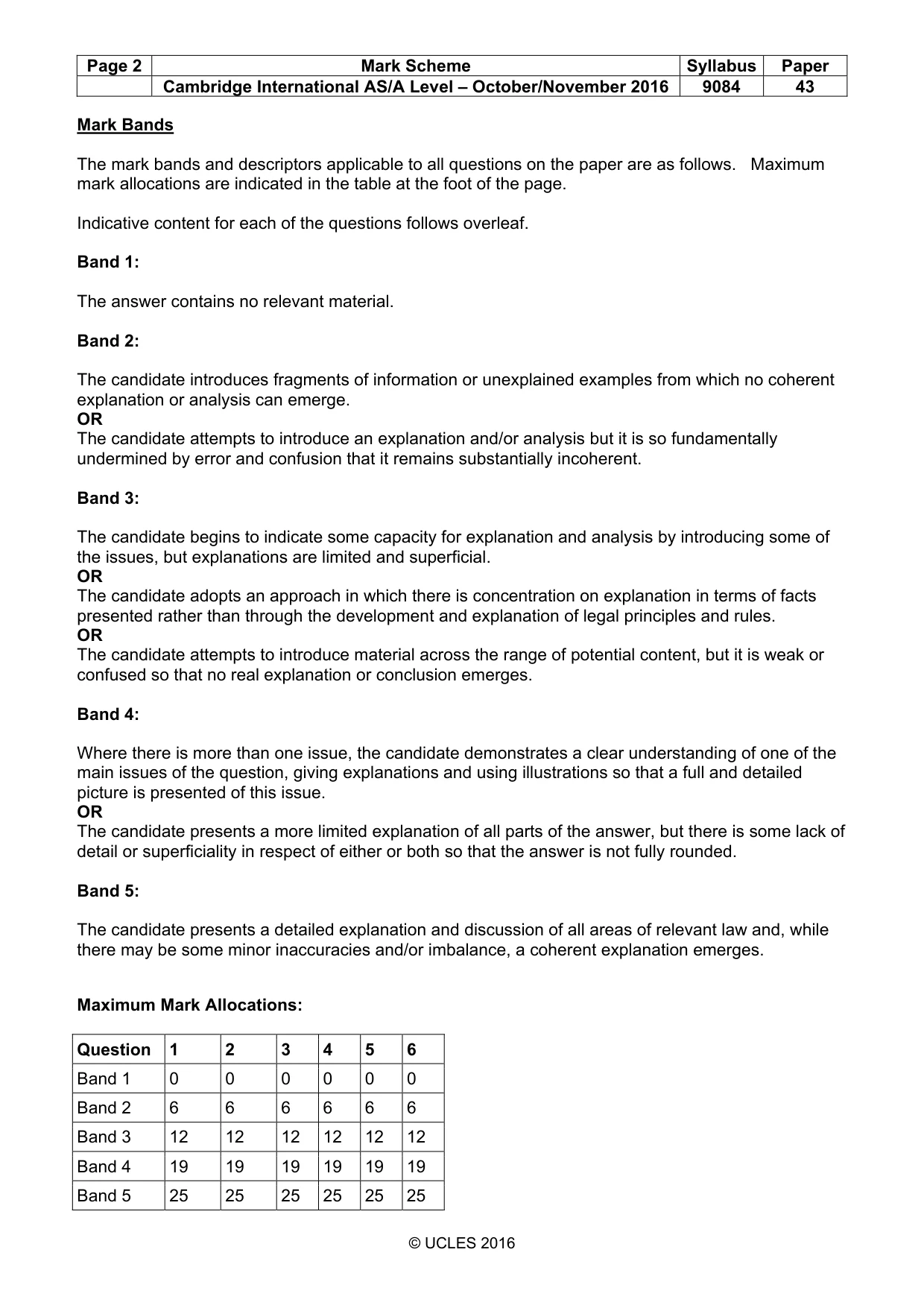
Page 2 Mark Scheme Syllabus Paper Cambridge International AS/A Level – October/November 2016 9084 43 © UCLES 2016 Mark Bands The mark bands and descriptors applicable to all questions on the paper are as follows. Maximum mark allocations are indicated in the table at the foot of the page. Indicative content for each of the questions follows overleaf. Band 1: The answer contains no relevant material. Band 2: The candidate introduces fragments of information or unexplained examples from which no coherent explanation or analysis can emerge. OR The candidate attempts to introduce an explanation and/or analysis but it is so fundamentally undermined by error and confusion that it remains substantially incoherent. Band 3: The candidate begins to indicate some capacity for explanation and analysis by introducing some of the issues, but explanations are limited and superficial. OR The candidate adopts an approach in which there is concentration on explanation in terms of facts presented rather than through the development and explanation of legal principles and rules. OR The candidate attempts to introduce material across the range of potential content, but it is weak or confused so that no real explanation or conclusion emerges. Band 4: Where there is more than one issue, the candidate demonstrates a clear understanding of one of the main issues of the question, giving explanations and using illustrations so that a full and detailed picture is presented of this issue. OR The candidate presents a more limited explanation of all parts of the answer, but there is some lack of detail or superficiality in respect of either or both so that the answer is not fully rounded. Band 5: The candidate presents a detailed explanation and discussion of all areas of relevant law and, while there may be some minor inaccuracies and/or imbalance, a coherent explanation emerges. Maximum Mark Allocations: Question 1 2 3 4 5 6 Band 1 0 0 0 0 0 0 Band 2 6 6 6 6 6 6 Band 3 12 12 12 12 12 12 Band 4 19 19 19 19 19 19 Band 5 25 25 25 25 25 25
Mark scheme, page 3
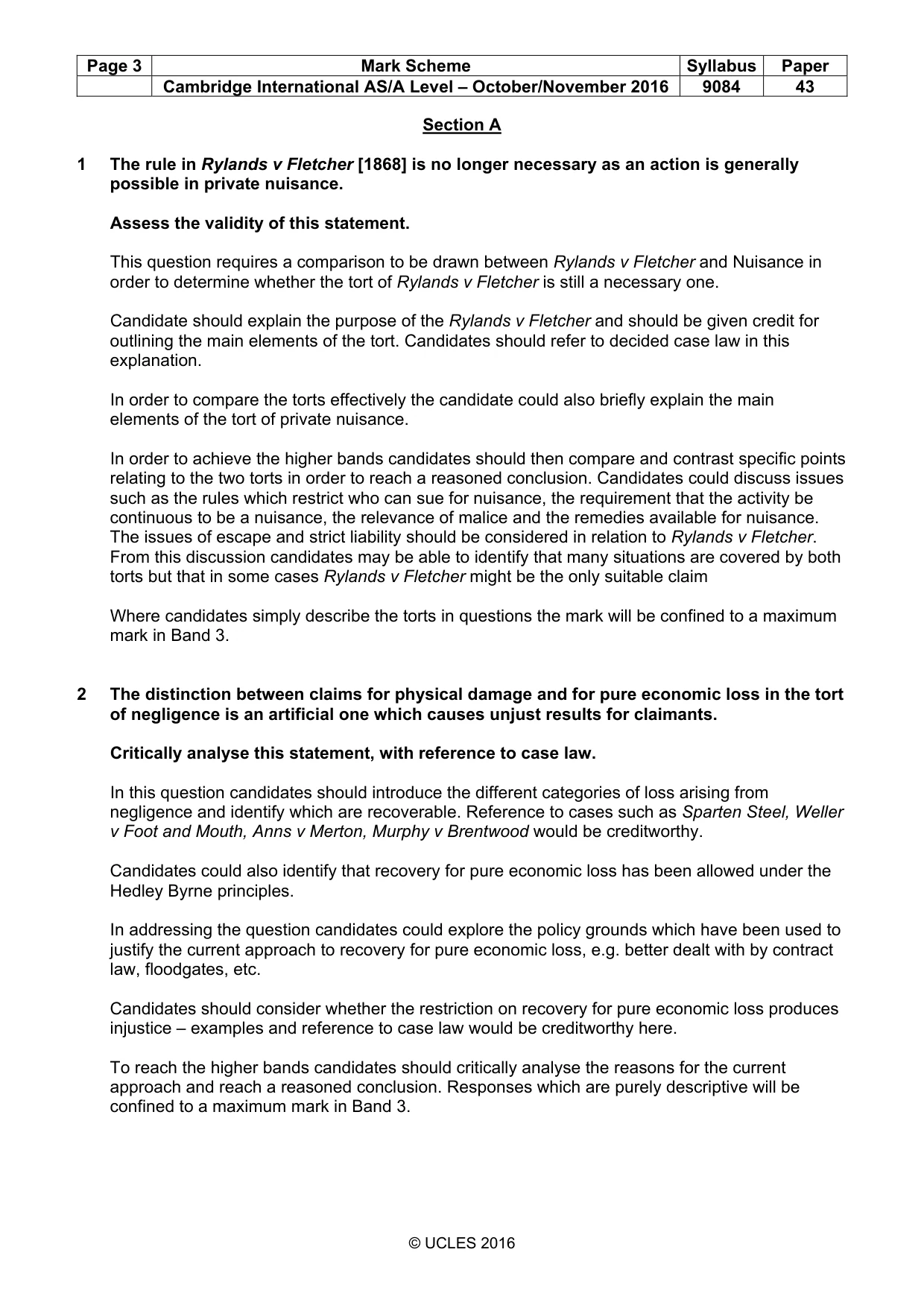
Page 3 Mark Scheme Syllabus Paper Cambridge International AS/A Level – October/November 2016 9084 43 © UCLES 2016 Section A 1 The rule in Rylands v Fletcher [1868] is no longer necessary as an action is generally possible in private nuisance. Assess the validity of this statement. This question requires a comparison to be drawn between Rylands v Fletcher and Nuisance in order to determine whether the tort of Rylands v Fletcher is still a necessary one. Candidate should explain the purpose of the Rylands v Fletcher and should be given credit for outlining the main elements of the tort. Candidates should refer to decided case law in this explanation. In order to compare the torts effectively the candidate could also briefly explain the main elements of the tort of private nuisance. In order to achieve the higher bands candidates should then compare and contrast specific points relating to the two torts in order to reach a reasoned conclusion. Candidates could discuss issues such as the rules which restrict who can sue for nuisance, the requirement that the activity be continuous to be a nuisance, the relevance of malice and the remedies available for nuisance. The issues of escape and strict liability should be considered in relation to Rylands v Fletcher. From this discussion candidates may be able to identify that many situations are covered by both torts but that in some cases Rylands v Fletcher might be the only suitable claim Where candidates simply describe the torts in questions the mark will be confined to a maximum mark in Band 3. 2 The distinction between claims for physical damage and for pure economic loss in the tort of negligence is an artificial one which causes unjust results for claimants. Critically analyse this statement, with reference to case law. In this question candidates should introduce the different categories of loss arising from negligence and identify which are recoverable. Reference to cases such as Sparten Steel, Weller v Foot and Mouth, Anns v Merton, Murphy v Brentwood would be creditworthy. Candidates could also identify that recovery for pure economic loss has been allowed under the Hedley Byrne principles. In addressing the question candidates could explore the policy grounds which have been used to justify the current approach to recovery for pure economic loss, e.g. better dealt with by contract law, floodgates, etc. Candidates should consider whether the restriction on recovery for pure economic loss produces injustice – examples and reference to case law would be creditworthy here. To reach the higher bands candidates should critically analyse the reasons for the current approach and reach a reasoned conclusion. Responses which are purely descriptive will be confined to a maximum mark in Band 3.
Mark scheme, page 4
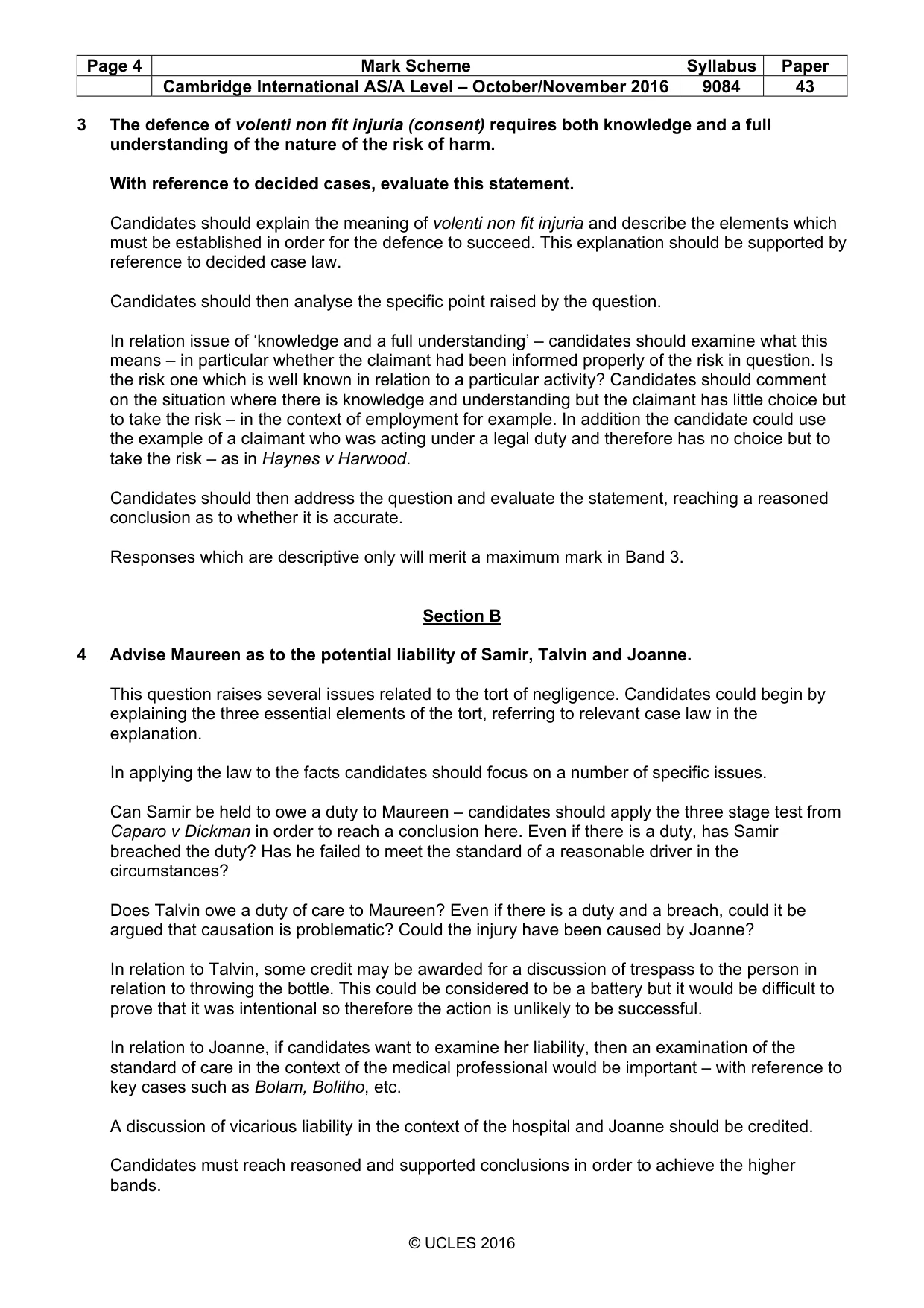
Page 4 Mark Scheme Syllabus Paper Cambridge International AS/A Level – October/November 2016 9084 43 © UCLES 2016 3 The defence of volenti non fit injuria (consent) requires both knowledge and a full understanding of the nature of the risk of harm. With reference to decided cases, evaluate this statement. Candidates should explain the meaning of volenti non fit injuria and describe the elements which must be established in order for the defence to succeed. This explanation should be supported by reference to decided case law. Candidates should then analyse the specific point raised by the question. In relation issue of ‘knowledge and a full understanding’ – candidates should examine what this means – in particular whether the claimant had been informed properly of the risk in question. Is the risk one which is well known in relation to a particular activity? Candidates should comment on the situation where there is knowledge and understanding but the claimant has little choice but to take the risk – in the context of employment for example. In addition the candidate could use the example of a claimant who was acting under a legal duty and therefore has no choice but to take the risk – as in Haynes v Harwood. Candidates should then address the question and evaluate the statement, reaching a reasoned conclusion as to whether it is accurate. Responses which are descriptive only will merit a maximum mark in Band 3. Section B 4 Advise Maureen as to the potential liability of Samir, Talvin and Joanne. This question raises several issues related to the tort of negligence. Candidates could begin by explaining the three essential elements of the tort, referring to relevant case law in the explanation. In applying the law to the facts candidates should focus on a number of specific issues. Can Samir be held to owe a duty to Maureen – candidates should apply the three stage test from Caparo v Dickman in order to reach a conclusion here. Even if there is a duty, has Samir breached the duty? Has he failed to meet the standard of a reasonable driver in the circumstances? Does Talvin owe a duty of care to Maureen? Even if there is a duty and a breach, could it be argued that causation is problematic? Could the injury have been caused by Joanne? In relation to Talvin, some credit may be awarded for a discussion of trespass to the person in relation to throwing the bottle. This could be considered to be a battery but it would be difficult to prove that it was intentional so therefore the action is unlikely to be successful. In relation to Joanne, if candidates want to examine her liability, then an examination of the standard of care in the context of the medical professional would be important – with reference to key cases such as Bolam, Bolitho, etc. A discussion of vicarious liability in the context of the hospital and Joanne should be credited. Candidates must reach reasoned and supported conclusions in order to achieve the higher bands.
Mark scheme, page 5
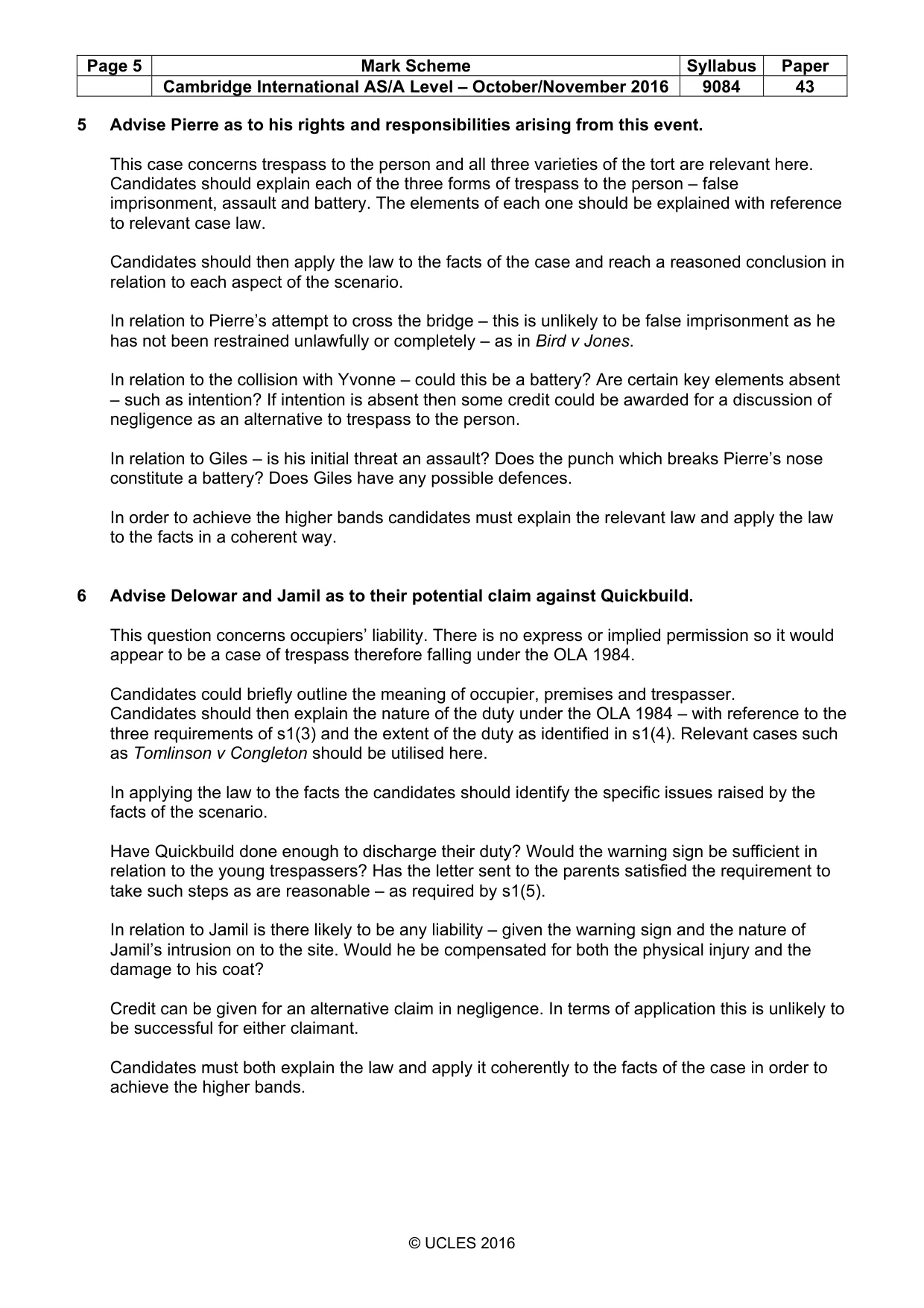
Page 5 Mark Scheme Syllabus Paper Cambridge International AS/A Level – October/November 2016 9084 43 © UCLES 2016 5 Advise Pierre as to his rights and responsibilities arising from this event. This case concerns trespass to the person and all three varieties of the tort are relevant here. Candidates should explain each of the three forms of trespass to the person – false imprisonment, assault and battery. The elements of each one should be explained with reference to relevant case law. Candidates should then apply the law to the facts of the case and reach a reasoned conclusion in relation to each aspect of the scenario. In relation to Pierre’s attempt to cross the bridge – this is unlikely to be false imprisonment as he has not been restrained unlawfully or completely – as in Bird v Jones. In relation to the collision with Yvonne – could this be a battery? Are certain key elements absent – such as intention? If intention is absent then some credit could be awarded for a discussion of negligence as an alternative to trespass to the person. In relation to Giles – is his initial threat an assault? Does the punch which breaks Pierre’s nose constitute a battery? Does Giles have any possible defences. In order to achieve the higher bands candidates must explain the relevant law and apply the law to the facts in a coherent way. 6 Advise Delowar and Jamil as to their potential claim against Quickbuild. This question concerns occupiers’ liability. There is no express or implied permission so it would appear to be a case of trespass therefore falling under the OLA 1984. Candidates could briefly outline the meaning of occupier, premises and trespasser. Candidates should then explain the nature of the duty under the OLA 1984 – with reference to the three requirements of s1(3) and the extent of the duty as identified in s1(4). Relevant cases such as Tomlinson v Congleton should be utilised here. In applying the law to the facts the candidates should identify the specific issues raised by the facts of the scenario. Have Quickbuild done enough to discharge their duty? Would the warning sign be sufficient in relation to the young trespassers? Has the letter sent to the parents satisfied the requirement to take such steps as are reasonable – as required by s1(5). In relation to Jamil is there likely to be any liability – given the warning sign and the nature of Jamil’s intrusion on to the site. Would he be compensated for both the physical injury and the damage to his coat? Credit can be given for an alternative claim in negligence. In terms of application this is unlikely to be successful for either claimant. Candidates must both explain the law and apply it coherently to the facts of the case in order to achieve the higher bands.