Cambridge A Level Law 9084 — 2013 Oct/Nov Paper 4 · Variant 3
9084/43/O/N/13 · 75 marks · ≈84 min
The question paper and its mark scheme, free to read here and free to download. This is Cambridge’s own paper, exactly as it was sat.
Question paper4 pages

Mark scheme7 pages
Answers below. Sit the paper first if you are practising.
Paper as text
Question paper, page 1
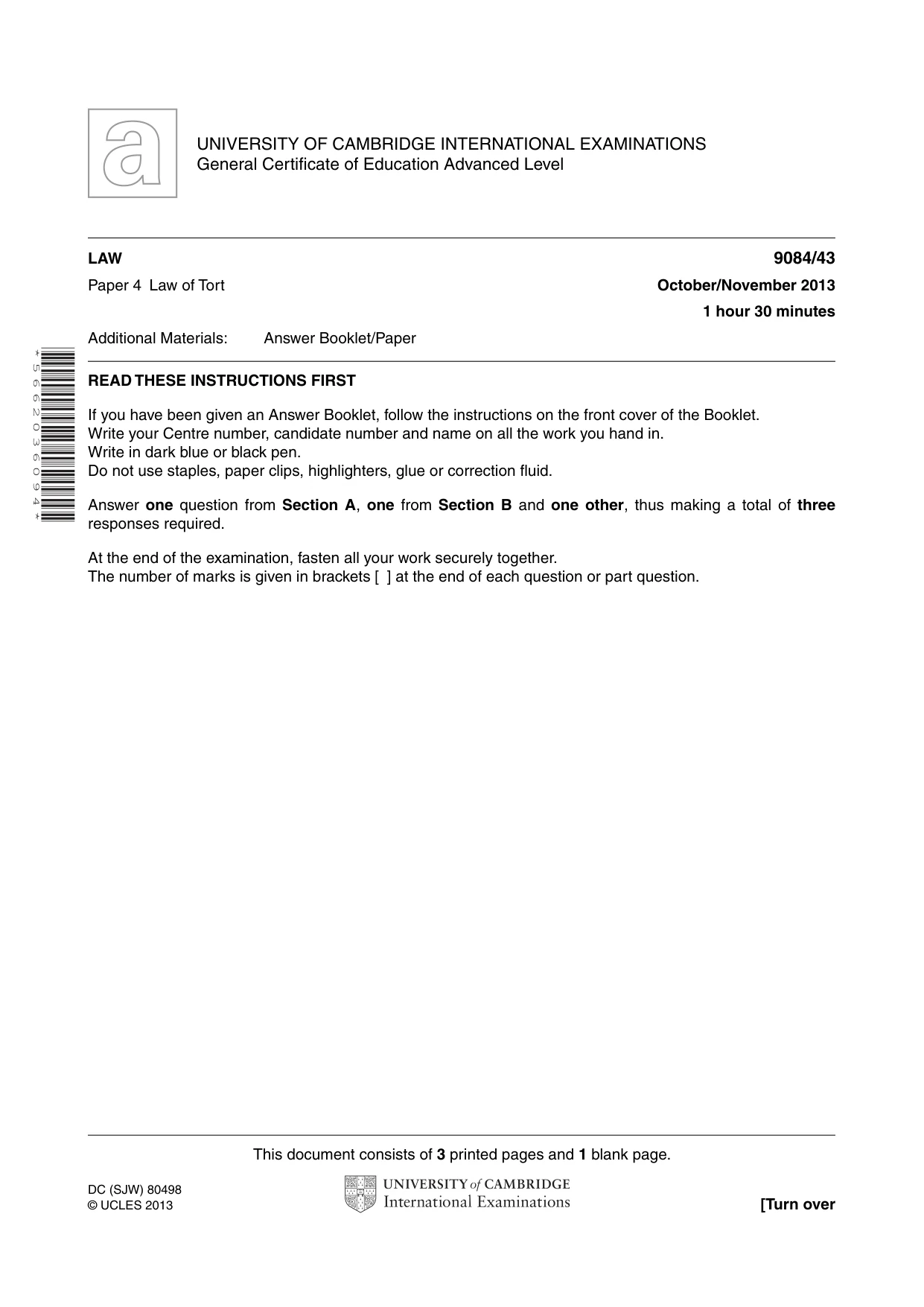
This document consists of 3 printed pages and 1 blank page. DC (SJW) 80498 © UCLES 2013 [Turn over UNIVERSITY OF CAMBRIDGE INTERNATIONAL EXAMINATIONS General Certificate of Education Advanced Level * 5 6 6 2 0 3 6 0 9 4 * LAW 9084/43 Paper 4 Law of Tort October/November 2013 1 hour 30 minutes Additional Materials: Answer Booklet/Paper READ THESE INSTRUCTIONS FIRST If you have been given an Answer Booklet, follow the instructions on the front cover of the Booklet. Write your Centre number, candidate number and name on all the work you hand in. Write in dark blue or black pen. Do not use staples, paper clips, highlighters, glue or correction fluid. Answer one question from Section A, one from Section B and one other, thus making a total of three responses required. At the end of the examination, fasten all your work securely together. The number of marks is given in brackets [ ] at the end of each question or part question.
Question paper, page 2
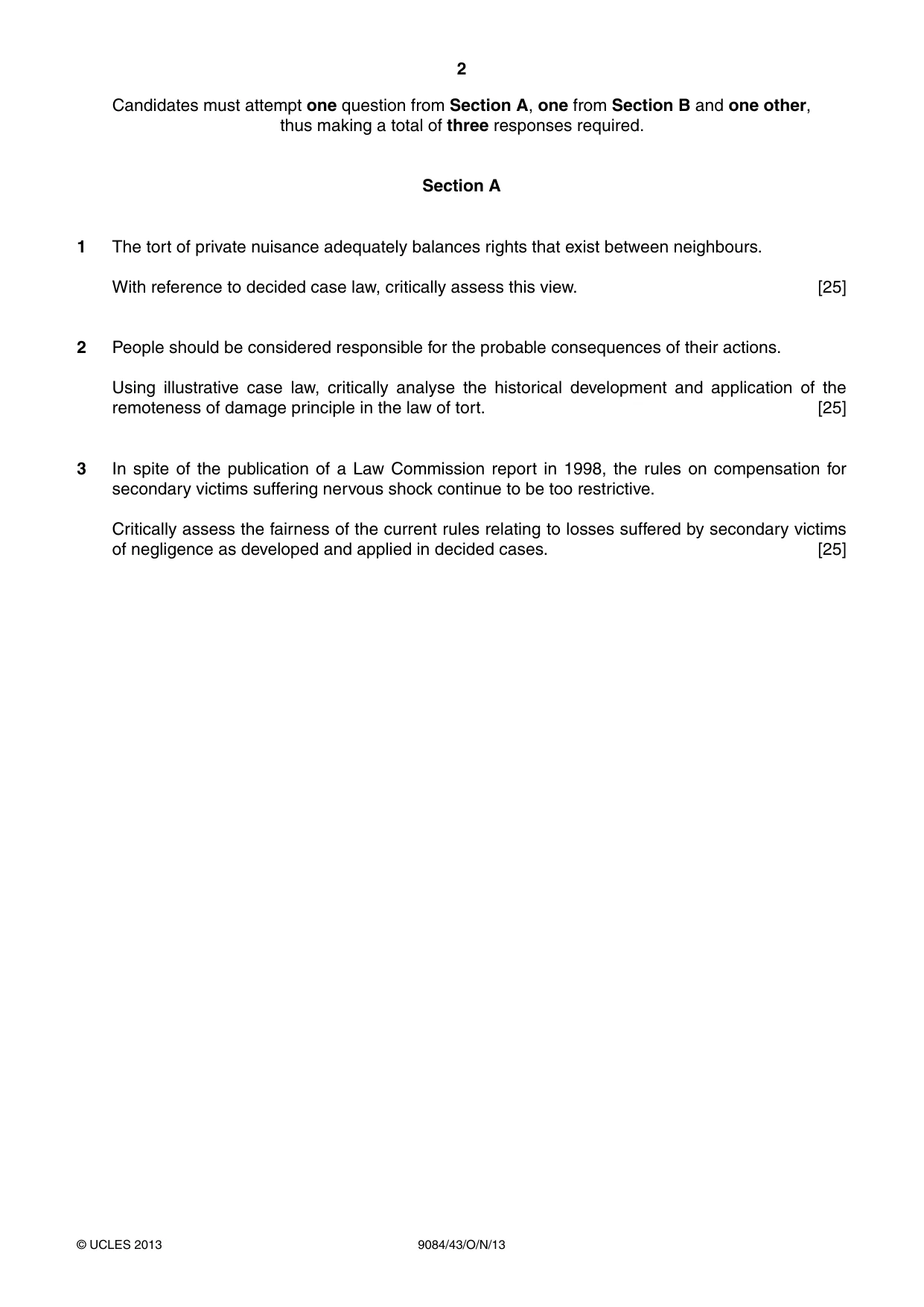
2 9084/43/O/N/13 © UCLES 2013 Candidates must attempt one question from Section A, one from Section B and one other, thus making a total of three responses required. Section A 1 The tort of private nuisance adequately balances rights that exist between neighbours. With reference to decided case law, critically assess this view. [25] 2 People should be considered responsible for the probable consequences of their actions. Using illustrative case law, critically analyse the historical development and application of the remoteness of damage principle in the law of tort. [25] 3 In spite of the publication of a Law Commission report in 1998, the rules on compensation for secondary victims suffering nervous shock continue to be too restrictive. Critically assess the fairness of the current rules relating to losses suffered by secondary victims of negligence as developed and applied in decided cases. [25]
Question paper, page 3
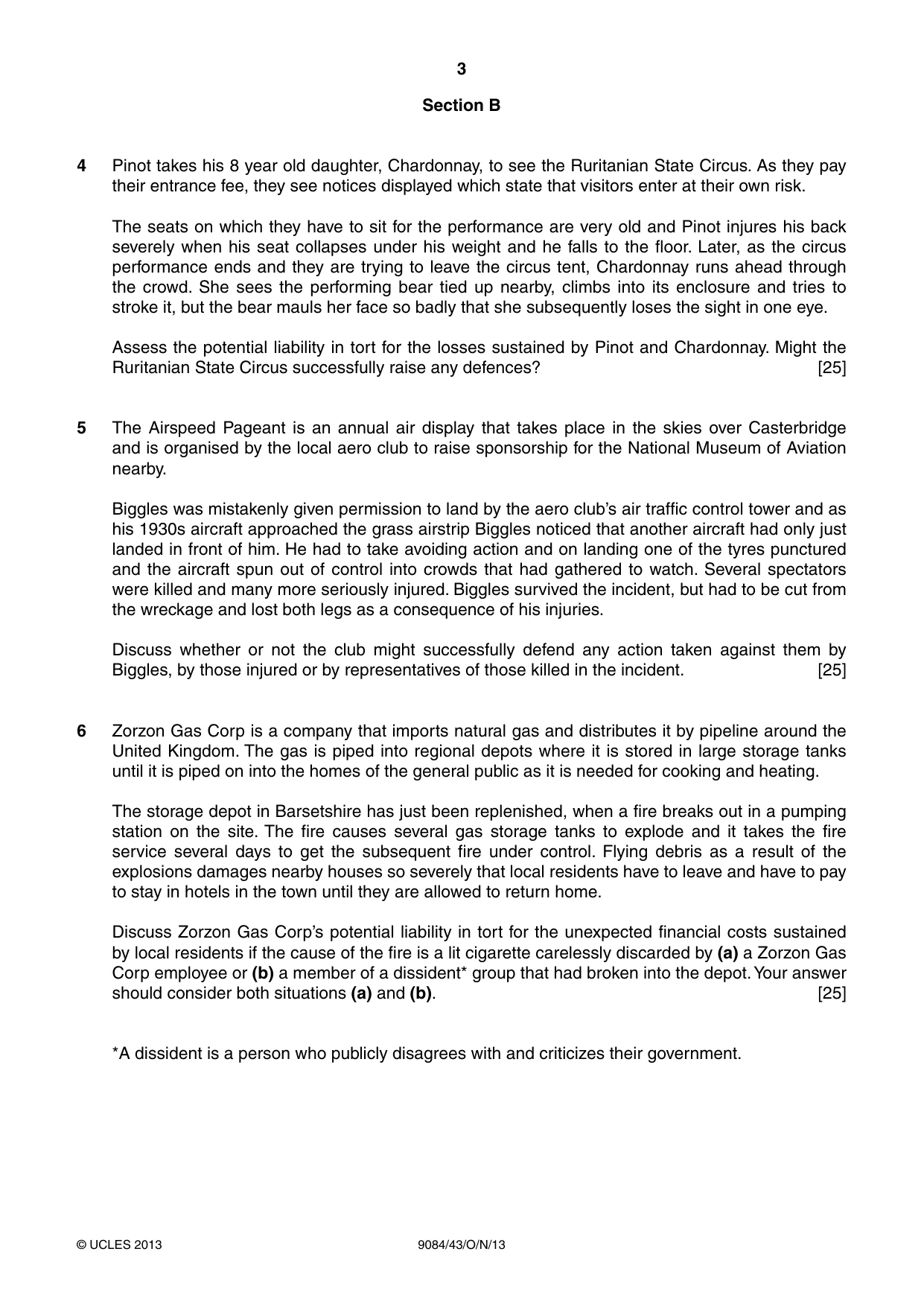
3 9084/43/O/N/13 © UCLES 2013 Section B 4 Pinot takes his 8 year old daughter, Chardonnay, to see the Ruritanian State Circus. As they pay their entrance fee, they see notices displayed which state that visitors enter at their own risk. The seats on which they have to sit for the performance are very old and Pinot injures his back severely when his seat collapses under his weight and he falls to the floor. Later, as the circus performance ends and they are trying to leave the circus tent, Chardonnay runs ahead through the crowd. She sees the performing bear tied up nearby, climbs into its enclosure and tries to stroke it, but the bear mauls her face so badly that she subsequently loses the sight in one eye. Assess the potential liability in tort for the losses sustained by Pinot and Chardonnay. Might the Ruritanian State Circus successfully raise any defences? [25] 5 The Airspeed Pageant is an annual air display that takes place in the skies over Casterbridge and is organised by the local aero club to raise sponsorship for the National Museum of Aviation nearby. Biggles was mistakenly given permission to land by the aero club’s air traffic control tower and as his 1930s aircraft approached the grass airstrip Biggles noticed that another aircraft had only just landed in front of him. He had to take avoiding action and on landing one of the tyres punctured and the aircraft spun out of control into crowds that had gathered to watch. Several spectators were killed and many more seriously injured. Biggles survived the incident, but had to be cut from the wreckage and lost both legs as a consequence of his injuries. Discuss whether or not the club might successfully defend any action taken against them by Biggles, by those injured or by representatives of those killed in the incident. [25] 6 Zorzon Gas Corp is a company that imports natural gas and distributes it by pipeline around the United Kingdom. The gas is piped into regional depots where it is stored in large storage tanks until it is piped on into the homes of the general public as it is needed for cooking and heating. The storage depot in Barsetshire has just been replenished, when a fire breaks out in a pumping station on the site. The fire causes several gas storage tanks to explode and it takes the fire service several days to get the subsequent fire under control. Flying debris as a result of the explosions damages nearby houses so severely that local residents have to leave and have to pay to stay in hotels in the town until they are allowed to return home. Discuss Zorzon Gas Corp’s potential liability in tort for the unexpected financial costs sustained by local residents if the cause of the fire is a lit cigarette carelessly discarded by (a) a Zorzon Gas Corp employee or (b) a member of a dissident* group that had broken into the depot. Your answer should consider both situations (a) and (b). [25] *A dissident is a person who publicly disagrees with and criticizes their government.
Question paper, page 4
4 9084/43/O/N/13 © UCLES 2013 Permission to reproduce items where third-party owned material protected by copyright is included has been sought and cleared where possible. Every reasonable effort has been made by the publisher (UCLES) to trace copyright holders, but if any items requiring clearance have unwittingly been included, the publisher will be pleased to make amends at the earliest possible opportunity. University of Cambridge International Examinations is part of the Cambridge Assessment Group. Cambridge Assessment is the brand name of University of Cambridge Local Examinations Syndicate (UCLES), which is itself a department of the University of Cambridge. BLANK PAGE
Mark scheme, page 1
CAMBRIDGE INTERNATIONAL EXAMINATIONS GCE Advanced Level MARK SCHEME for the October/November 2013 series 9084 LAW 9084/43 Paper 4, maximum raw mark 75 This mark scheme is published as an aid to teachers and candidates, to indicate the requirements of the examination. It shows the basis on which Examiners were instructed to award marks. It does not indicate the details of the discussions that took place at an Examiners’ meeting before marking began, which would have considered the acceptability of alternative answers. Mark schemes should be read in conjunction with the question paper and the Principal Examiner Report for Teachers. Cambridge will not enter into discussions about these mark schemes. Cambridge is publishing the mark schemes for the October/November 2013 series for most IGCSE, GCE Advanced Level and Advanced Subsidiary Level components and some Ordinary Level components.
Mark scheme, page 2
Page 2 Mark Scheme Syllabus Paper GCE A LEVEL – October/November 2013 9084 43 © Cambridge International Examinations 2013 Assessment Objectives Candidates are expected to demonstrate: Knowledge and Understanding − recall, select, use and develop knowledge and understanding of legal principles and rules by means of example and citation Analysis, Evaluation and Application − analyse and evaluate legal materials, situations and issues and accurately apply appropriate principles and rules Communication and Presentation − use appropriate legal terminology to present logical and coherent argument and to communicate relevant material in a clear and concise manner. Specification Grid The relationship between the Assessment Objectives and this individual component is detailed below. The objectives are weighted to give an indication of their relative importance, rather than to provide a precise statement of the percentage mark allocation to particular assessment objectives. Assessment Objective Paper 1 Paper 2 Paper 3 Paper 4 Advanced Level Knowledge/ Understanding 50 50 50 50 50 Analysis/Evaluation/ Application 40 40 40 40 40 Communication/ Presentation 10 10 10 10 10
Mark scheme, page 3
Page 3 Mark Scheme Syllabus Paper GCE A LEVEL – October/November 2013 9084 43 © Cambridge International Examinations 2013 Mark Bands The mark bands and descriptors applicable to all questions on the paper are as follows. Maximum mark allocations are indicated in the table at the foot of the page. Indicative content for each of the questions follows overleaf. Band 1: The answer contains no relevant material. Band 2: The candidate introduces fragments of information or unexplained examples from which no coherent explanation or analysis can emerge. OR The candidate attempts to introduce an explanation and/or analysis but it is so fundamentally undermined by error and confusion that it remains substantially incoherent. Band 3: The candidate begins to indicate some capacity for explanation and analysis by introducing some of the issues, but explanations are limited and superficial. OR The candidate adopts an approach in which there is concentration on explanation in terms of facts presented rather than through the development and explanation of legal principles and rules. OR The candidate attempts to introduce material across the range of potential content, but it is weak or confused so that no real explanation or conclusion emerges. Band 4: Where there is more than one issue, the candidate demonstrates a clear understanding of one of the main issues of the question, giving explanations and using illustrations so that a full and detailed picture is presented of this issue. OR The candidate presents a more limited explanation of all parts of the answer, but there is some lack of detail or superficiality in respect of either or both so that the answer is not fully rounded. Band 5: The candidate presents a detailed explanation and discussion of all areas of relevant law and, while there may be some minor inaccuracies and/or imbalance, a coherent explanation emerges. Maximum Mark Allocations: Question 1 2 3 4 5 6 Band 1 0 0 0 0 0 0 Band 2 6 6 6 6 6 6 Band 3 12 12 12 12 12 12 Band 4 19 19 19 19 19 19 Band 5 25 25 25 25 25 25
Mark scheme, page 4
Page 4 Mark Scheme Syllabus Paper GCE A LEVEL – October/November 2013 9084 43 © Cambridge International Examinations 2013 Section A 1 The tort of private nuisance adequately balances rights that exist between neighbours. With reference to decided case law, critically assess this view. [25] The tort of private nuisance arises from the fact that wherever we live, work or play, we have neighbours and the way that we behave on our land may affect them when using theirs and vice versa. Candidates are expected to analyse the elements of the tort, namely indirect interference, reasonableness of actions and the extent to which interests are balanced by taking into account the complainant’s sensitivity, locality and duration of the alleged tort, and the extent to which some sort of damage needs to be caused. Candidates might also consider the extent to which available defences (such as prescription and consent) and remedies (such as damages, injunction and abatement) enable the aim of balance to be achieved. Candidate responses that are limited to factual recall, however detailed, will be restricted to band 3 marks. 2 People should be considered responsible for the probable consequences of their actions. Using illustrative case law, critically analyse the historical development and application of the remoteness of damage principle in the law of tort. [25] Candidates are expected to trace the development of the principle that has become known as remoteness of damage through cases mainly related to the tort of negligence, but candidates will be given credit for pulling examples from any other area of the law of tort. The statement underlines the fact that although there will undoubtedly be circumstances where someone will cause damage or loss, but the law will not require that person to pay compensation for it. The difficulty has always been in determining what those circumstances are. Candidates are expected to explain that the first test of remoteness was laid down in the case of re Polemis (1921) and that, in essence, liability was imposed for all direct physical consequences (direct consequence test). The harsh line adopted in re Polemis was subsequently softened by the Privy Council in the case of The Wagon Mound No. 1. The new test for remoteness became that of whether the loss suffered was as a reasonably foreseeable consequence of the person’s actions. Was the damage or loss of a type that was reasonably foreseeable at the time that the tort was committed? Cases such as Doughty v Turner Manufacturing Co, Hughes v Lord Advocate, Page v Smith and Margerson v JW Roberts might be explored to indicate how the courts approach with regard to the type of loss or damage suffered as a consequence of negligent acts has become less narrow as time has progressed. Candidates should also explore the application of the rule to extent of loss (eggshell – skull cases) and risk of damage. The only sensible overall conclusion can be that the more recent cases seem to take a more generous line.
Mark scheme, page 5
Page 5 Mark Scheme Syllabus Paper GCE A LEVEL – October/November 2013 9084 43 © Cambridge International Examinations 2013 3 In spite of the publication of a Law Commission report in 1998, the rules on compensation for secondary victims suffering nervous shock continue to be too restrictive. Critically assess the fairness of the current rules relating to losses suffered by secondary victims of negligence as developed and applied in decided cases. [25] The Law Commission considers it justified that there should be a close tie between primary and secondary victim and that this should remain. However, the belief of the Commission is that this should suffice and that the proximity in time, space and method of perception requirements be abolished. Candidates should express their views on this matter. Candidates should define and explain the meaning of key terminology: nervous shock, primary and secondary victims, etc. The generally accepted requirements for liability to exist should be detailed and explored: reasonable foresight, nature of psychiatric injury, relationship with primary victim and proximity. Each test should be explored, analysing decided cases in each area and drawing conclusions. Key cases such as White and Others, Alcock v Chief Constable of Yorkshire Police, McLoughlin v O’Brian, Chadwick v British Railways Board, Sion v Hampstead Health Authority should all be analysed. This question could be approached from various angles and appropriate credit should be awarded whichever angle it is tackled from. Would ordinarily expect emphasis placed on problems relating to the position of rescuers, closeness of relationship, proximity and or sudden shock requirements.
Mark scheme, page 6
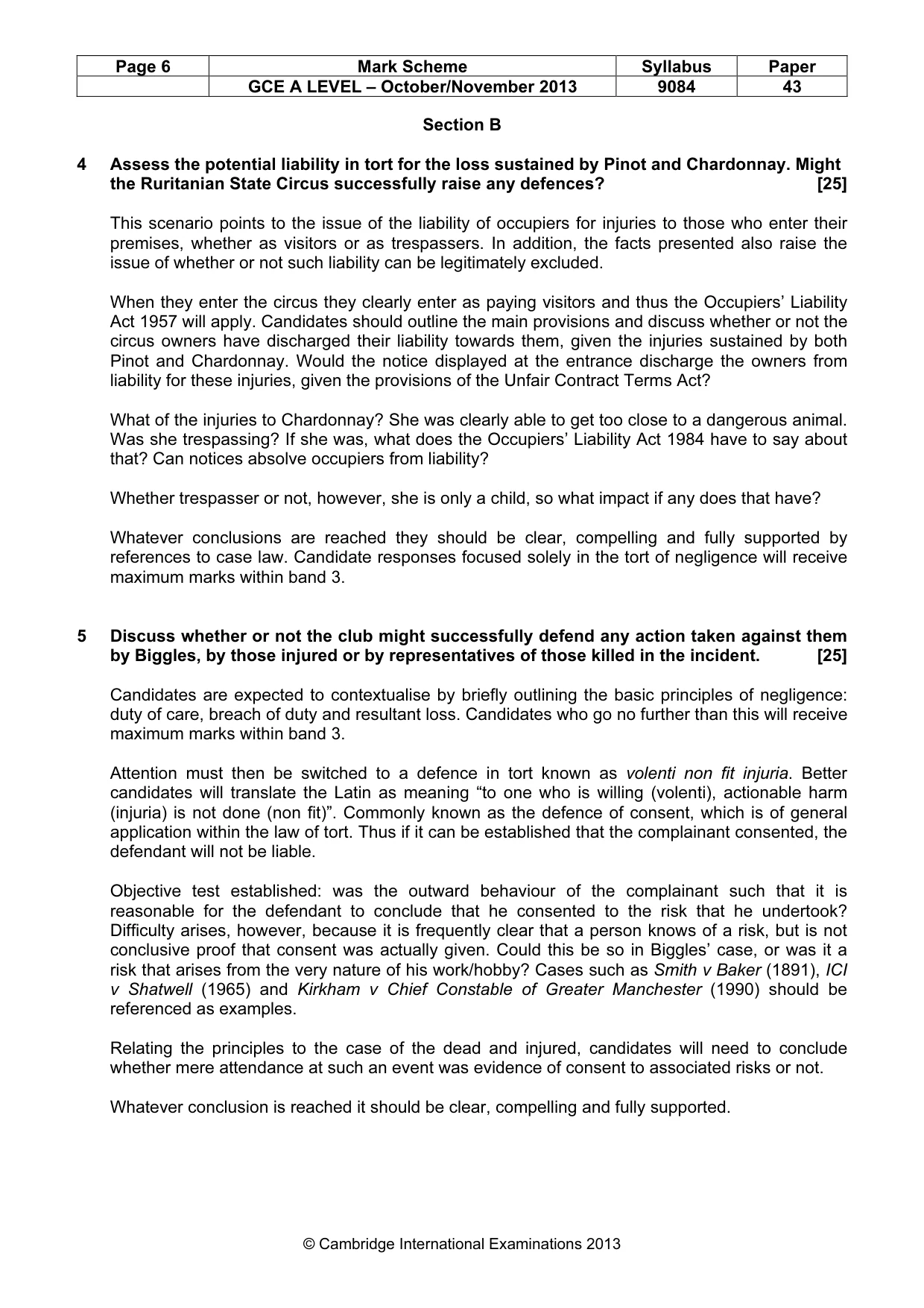
Page 6 Mark Scheme Syllabus Paper GCE A LEVEL – October/November 2013 9084 43 © Cambridge International Examinations 2013 Section B 4 Assess the potential liability in tort for the loss sustained by Pinot and Chardonnay. Might the Ruritanian State Circus successfully raise any defences? [25] This scenario points to the issue of the liability of occupiers for injuries to those who enter their premises, whether as visitors or as trespassers. In addition, the facts presented also raise the issue of whether or not such liability can be legitimately excluded. When they enter the circus they clearly enter as paying visitors and thus the Occupiers’ Liability Act 1957 will apply. Candidates should outline the main provisions and discuss whether or not the circus owners have discharged their liability towards them, given the injuries sustained by both Pinot and Chardonnay. Would the notice displayed at the entrance discharge the owners from liability for these injuries, given the provisions of the Unfair Contract Terms Act? What of the injuries to Chardonnay? She was clearly able to get too close to a dangerous animal. Was she trespassing? If she was, what does the Occupiers’ Liability Act 1984 have to say about that? Can notices absolve occupiers from liability? Whether trespasser or not, however, she is only a child, so what impact if any does that have? Whatever conclusions are reached they should be clear, compelling and fully supported by references to case law. Candidate responses focused solely in the tort of negligence will receive maximum marks within band 3. 5 Discuss whether or not the club might successfully defend any action taken against them by Biggles, by those injured or by representatives of those killed in the incident. [25] Candidates are expected to contextualise by briefly outlining the basic principles of negligence: duty of care, breach of duty and resultant loss. Candidates who go no further than this will receive maximum marks within band 3. Attention must then be switched to a defence in tort known as volenti non fit injuria. Better candidates will translate the Latin as meaning “to one who is willing (volenti), actionable harm (injuria) is not done (non fit)”. Commonly known as the defence of consent, which is of general application within the law of tort. Thus if it can be established that the complainant consented, the defendant will not be liable. Objective test established: was the outward behaviour of the complainant such that it is reasonable for the defendant to conclude that he consented to the risk that he undertook? Difficulty arises, however, because it is frequently clear that a person knows of a risk, but is not conclusive proof that consent was actually given. Could this be so in Biggles’ case, or was it a risk that arises from the very nature of his work/hobby? Cases such as Smith v Baker (1891), ICI v Shatwell (1965) and Kirkham v Chief Constable of Greater Manchester (1990) should be referenced as examples. Relating the principles to the case of the dead and injured, candidates will need to conclude whether mere attendance at such an event was evidence of consent to associated risks or not. Whatever conclusion is reached it should be clear, compelling and fully supported.
Mark scheme, page 7
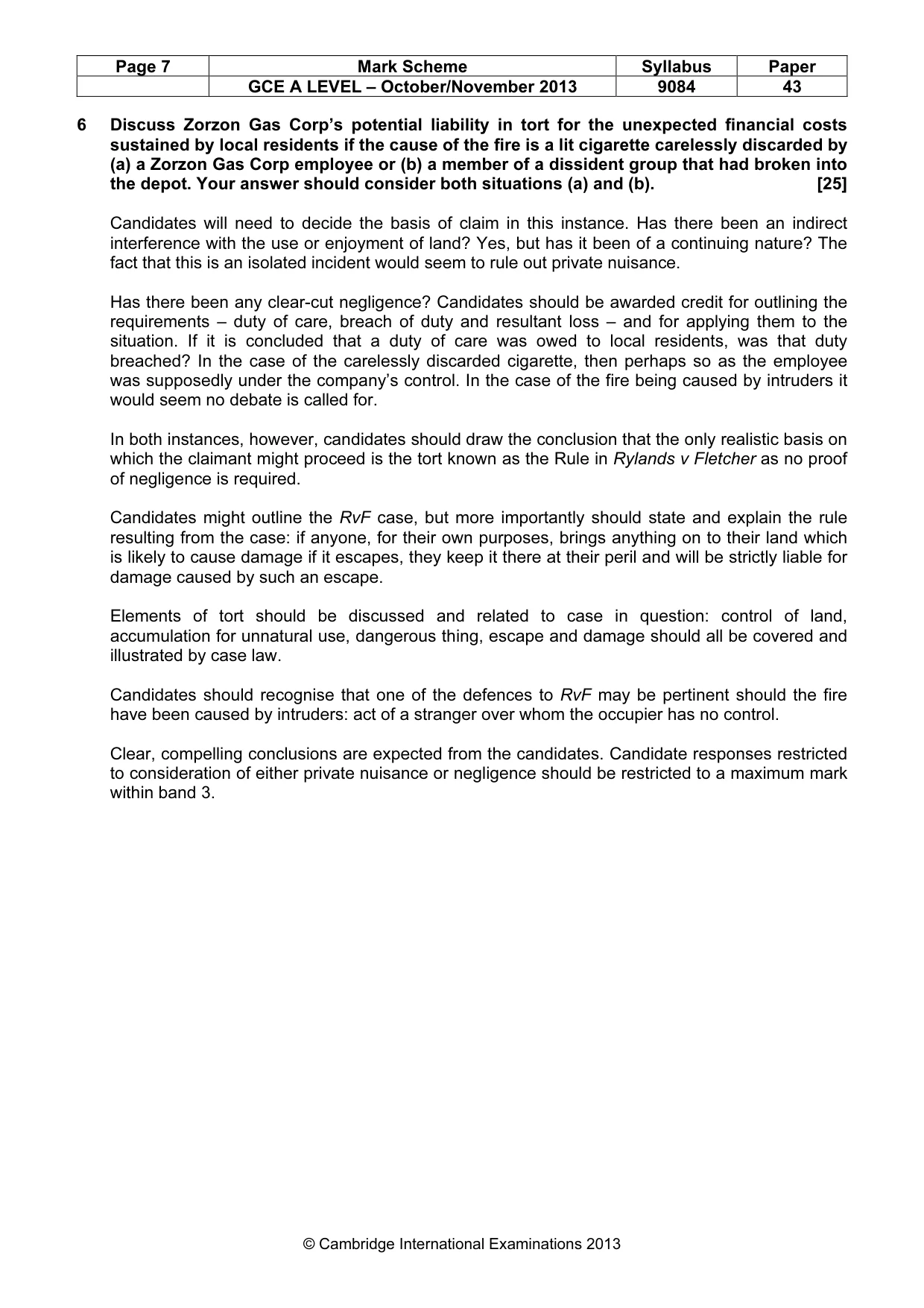
Page 7 Mark Scheme Syllabus Paper GCE A LEVEL – October/November 2013 9084 43 © Cambridge International Examinations 2013 6 Discuss Zorzon Gas Corp’s potential liability in tort for the unexpected financial costs sustained by local residents if the cause of the fire is a lit cigarette carelessly discarded by (a) a Zorzon Gas Corp employee or (b) a member of a dissident group that had broken into the depot. Your answer should consider both situations (a) and (b). [25] Candidates will need to decide the basis of claim in this instance. Has there been an indirect interference with the use or enjoyment of land? Yes, but has it been of a continuing nature? The fact that this is an isolated incident would seem to rule out private nuisance. Has there been any clear-cut negligence? Candidates should be awarded credit for outlining the requirements – duty of care, breach of duty and resultant loss – and for applying them to the situation. If it is concluded that a duty of care was owed to local residents, was that duty breached? In the case of the carelessly discarded cigarette, then perhaps so as the employee was supposedly under the company’s control. In the case of the fire being caused by intruders it would seem no debate is called for. In both instances, however, candidates should draw the conclusion that the only realistic basis on which the claimant might proceed is the tort known as the Rule in Rylands v Fletcher as no proof of negligence is required. Candidates might outline the RvF case, but more importantly should state and explain the rule resulting from the case: if anyone, for their own purposes, brings anything on to their land which is likely to cause damage if it escapes, they keep it there at their peril and will be strictly liable for damage caused by such an escape. Elements of tort should be discussed and related to case in question: control of land, accumulation for unnatural use, dangerous thing, escape and damage should all be covered and illustrated by case law. Candidates should recognise that one of the defences to RvF may be pertinent should the fire have been caused by intruders: act of a stranger over whom the occupier has no control. Clear, compelling conclusions are expected from the candidates. Candidate responses restricted to consideration of either private nuisance or negligence should be restricted to a maximum mark within band 3.
What you needed in this session
Cambridge’s own grade thresholds for 2013 Oct/Nov, Paper 4 · Variant 3. A higher threshold means an easier paper — the bar moves with how the cohort did.