Cambridge A Level Law 9084 — 2013 Oct/Nov Paper 1 · Variant 1
9084/11/O/N/13 · 75 marks · ≈84 min
The question paper and its mark scheme, free to read here and free to download. This is Cambridge’s own paper, exactly as it was sat.
Question paper2 pages
Mark scheme7 pages
Answers below. Sit the paper first if you are practising.
Paper as text
Question paper, page 1
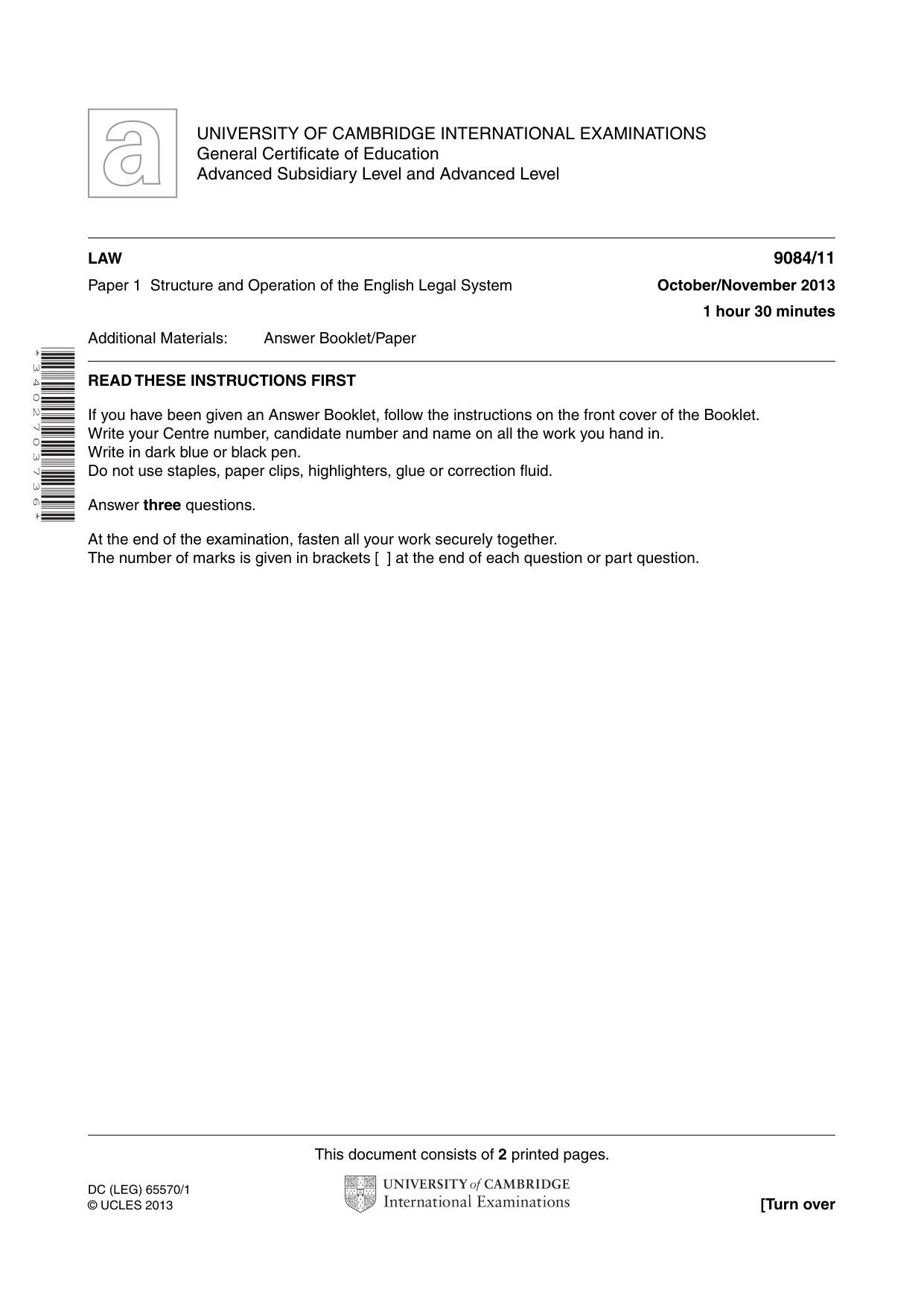
This document consists of 2 printed pages. DC (LEG) 65570/1 © UCLES 2013 [Turn over UNIVERSITY OF CAMBRIDGE INTERNATIONAL EXAMINATIONS General Certificate of Education Advanced Subsidiary Level and Advanced Level * 3 4 0 2 7 0 3 7 3 6 * LAW 9084/11 Paper 1 Structure and Operation of the English Legal System October/November 2013 1 hour 30 minutes Additional Materials: Answer Booklet/Paper READ THESE INSTRUCTIONS FIRST If you have been given an Answer Booklet, follow the instructions on the front cover of the Booklet. Write your Centre number, candidate number and name on all the work you hand in. Write in dark blue or black pen. Do not use staples, paper clips, highlighters, glue or correction fluid. Answer three questions. At the end of the examination, fasten all your work securely together. The number of marks is given in brackets [ ] at the end of each question or part question.
Question paper, page 2
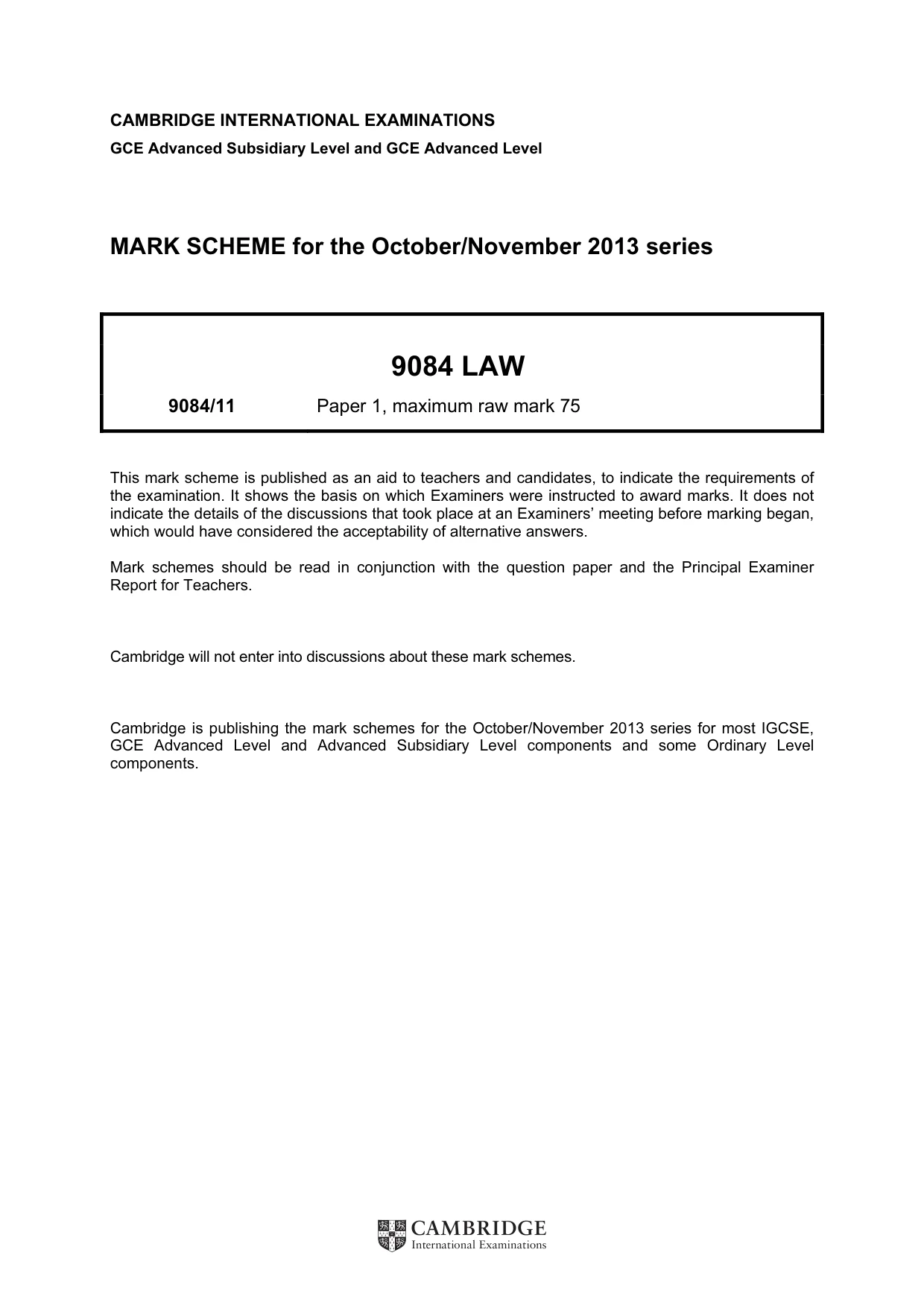
2 9084/11/O/N/13 © UCLES 2013 Permission to reproduce items where third-party owned material protected by copyright is included has been sought and cleared where possible. Every reasonable effort has been made by the publisher (UCLES) to trace copyright holders, but if any items requiring clearance have unwittingly been included, the publisher will be pleased to make amends at the earliest possible opportunity. University of Cambridge International Examinations is part of the Cambridge Assessment Group. Cambridge Assessment is the brand name of University of Cambridge Local Examinations Syndicate (UCLES), which is itself a department of the University of Cambridge. Answer three questions. 1 ‘The prisons are overcrowded so it would be far better to impose community sentences.’ Critically discuss this statement and examine the circumstances in which a court might choose to impose a community sentence. [25] 2 There are many alternatives to a formal court hearing in civil cases. Describe these alternatives and assess their effectiveness compared to that of the courts. [25] 3 ‘Certainty in relation to substantive law is usually to be preferred to correctness since this at least enables the public to order their affairs with confidence’ – Lord Donaldson MR in Rickards v Rickards [1989]. Consider critically this view of judicial precedent. [25] 4 Evaluate the protection given under the Police and Criminal Evidence Act 1984 and the Codes of Practice where a defendant is arrested by the police. To what extent do you think this protection is adequate? [25] 5 ‘The passage of the Human Rights Act 1998 was an important step in the development of the rights of individuals.’ Consider the validity of this statement using appropriate examples. [25] 6 Critically assess the extent to which untrained and unqualified members of the public are used in decision making in the criminal courts. [25]
Mark scheme, page 1
CAMBRIDGE INTERNATIONAL EXAMINATIONS GCE Advanced Subsidiary Level and GCE Advanced Level MARK SCHEME for the October/November 2013 series 9084 LAW 9084/11 Paper 1, maximum raw mark 75 This mark scheme is published as an aid to teachers and candidates, to indicate the requirements of the examination. It shows the basis on which Examiners were instructed to award marks. It does not indicate the details of the discussions that took place at an Examiners’ meeting before marking began, which would have considered the acceptability of alternative answers. Mark schemes should be read in conjunction with the question paper and the Principal Examiner Report for Teachers. Cambridge will not enter into discussions about these mark schemes. Cambridge is publishing the mark schemes for the October/November 2013 series for most IGCSE, GCE Advanced Level and Advanced Subsidiary Level components and some Ordinary Level components.
Mark scheme, page 2
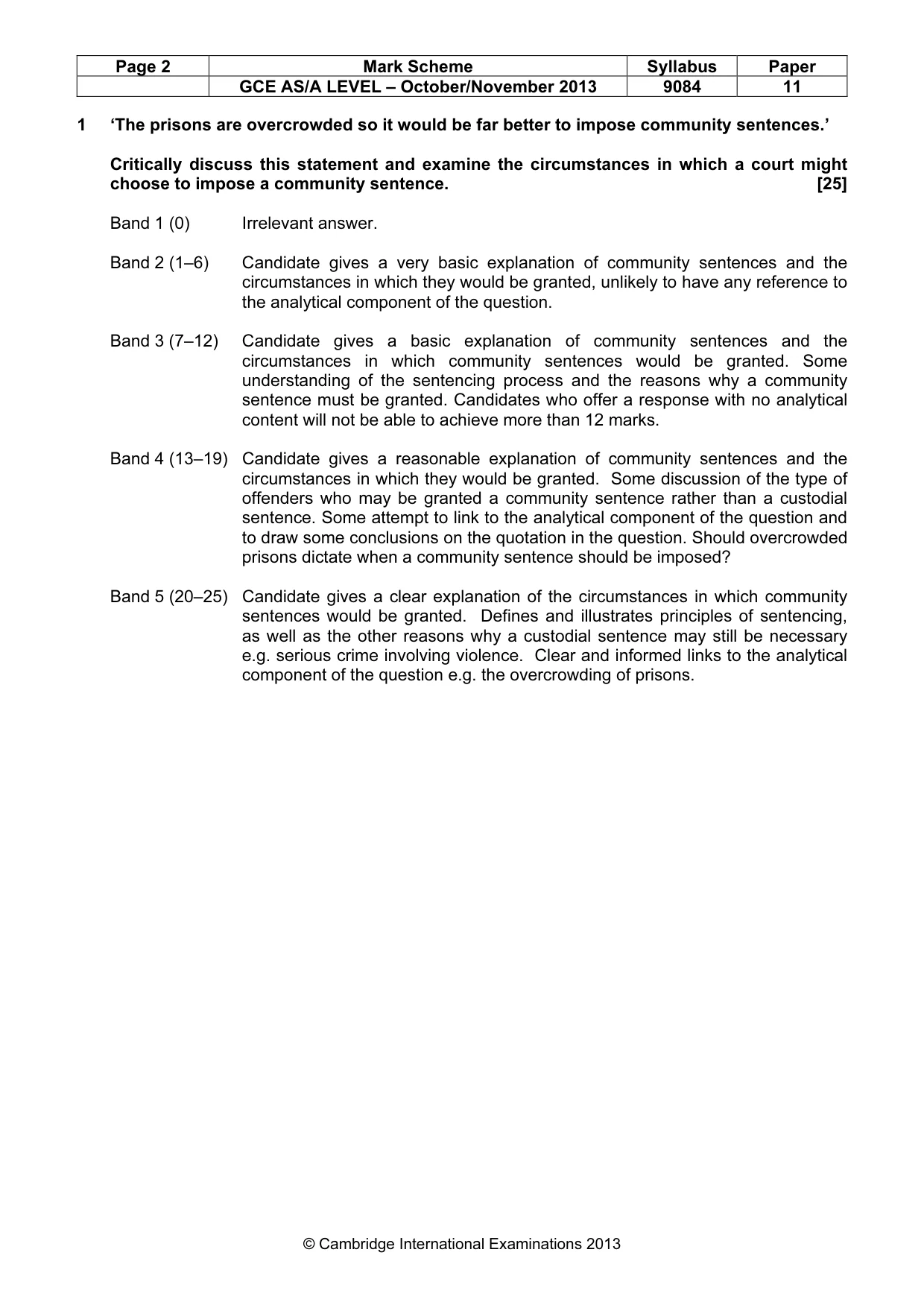
Page 2 Mark Scheme Syllabus Paper GCE AS/A LEVEL – October/November 2013 9084 11 © Cambridge International Examinations 2013 1 ‘The prisons are overcrowded so it would be far better to impose community sentences.’ Critically discuss this statement and examine the circumstances in which a court might choose to impose a community sentence. [25] Band 1 (0) Irrelevant answer. Band 2 (1–6) Candidate gives a very basic explanation of community sentences and the circumstances in which they would be granted, unlikely to have any reference to the analytical component of the question. Band 3 (7–12) Candidate gives a basic explanation of community sentences and the circumstances in which community sentences would be granted. Some understanding of the sentencing process and the reasons why a community sentence must be granted. Candidates who offer a response with no analytical content will not be able to achieve more than 12 marks. Band 4 (13–19) Candidate gives a reasonable explanation of community sentences and the circumstances in which they would be granted. Some discussion of the type of offenders who may be granted a community sentence rather than a custodial sentence. Some attempt to link to the analytical component of the question and to draw some conclusions on the quotation in the question. Should overcrowded prisons dictate when a community sentence should be imposed? Band 5 (20–25) Candidate gives a clear explanation of the circumstances in which community sentences would be granted. Defines and illustrates principles of sentencing, as well as the other reasons why a custodial sentence may still be necessary e.g. serious crime involving violence. Clear and informed links to the analytical component of the question e.g. the overcrowding of prisons.
Mark scheme, page 3
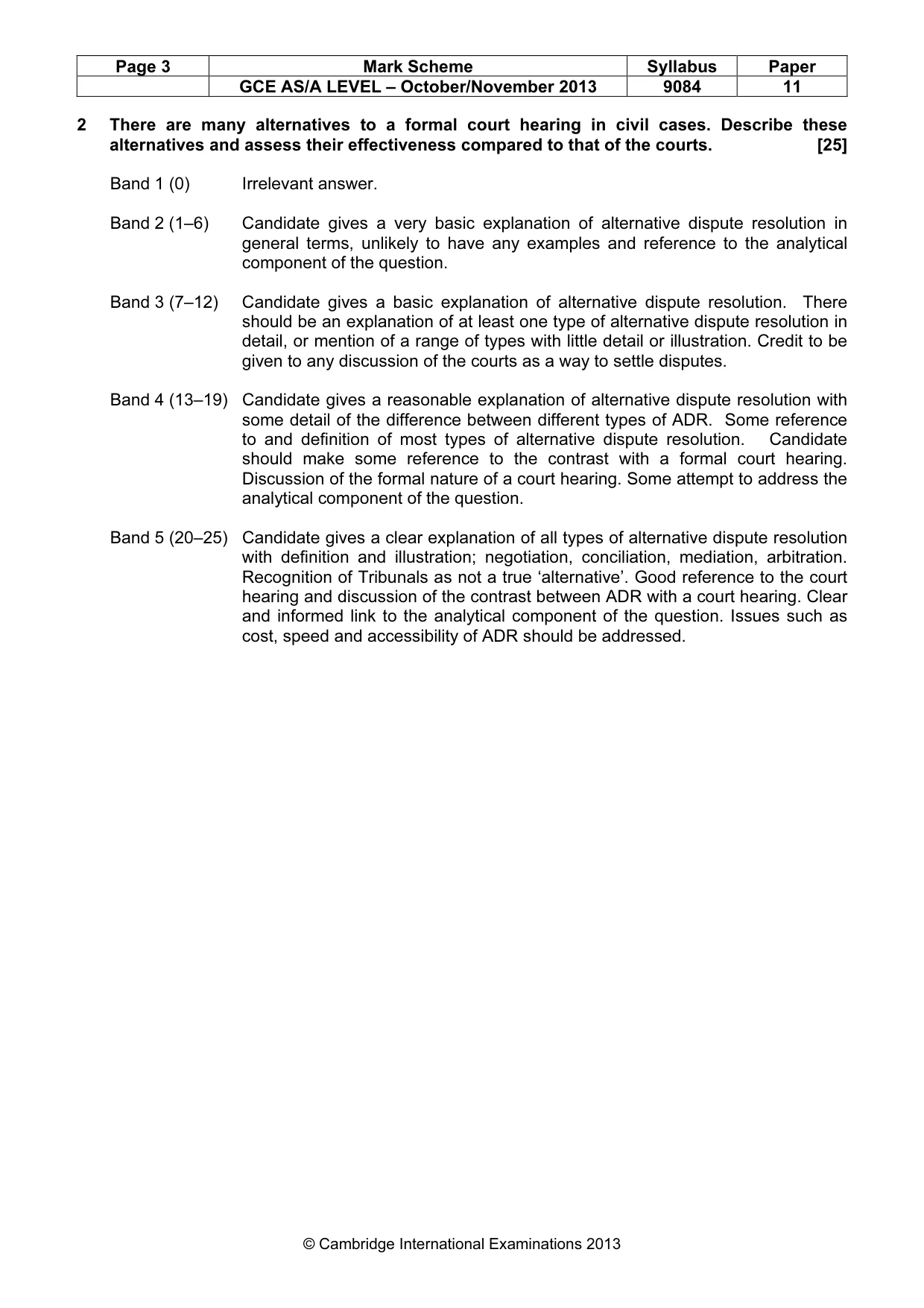
Page 3 Mark Scheme Syllabus Paper GCE AS/A LEVEL – October/November 2013 9084 11 © Cambridge International Examinations 2013 2 There are many alternatives to a formal court hearing in civil cases. Describe these alternatives and assess their effectiveness compared to that of the courts. [25] Band 1 (0) Irrelevant answer. Band 2 (1–6) Candidate gives a very basic explanation of alternative dispute resolution in general terms, unlikely to have any examples and reference to the analytical component of the question. Band 3 (7–12) Candidate gives a basic explanation of alternative dispute resolution. There should be an explanation of at least one type of alternative dispute resolution in detail, or mention of a range of types with little detail or illustration. Credit to be given to any discussion of the courts as a way to settle disputes. Band 4 (13–19) Candidate gives a reasonable explanation of alternative dispute resolution with some detail of the difference between different types of ADR. Some reference to and definition of most types of alternative dispute resolution. Candidate should make some reference to the contrast with a formal court hearing. Discussion of the formal nature of a court hearing. Some attempt to address the analytical component of the question. Band 5 (20–25) Candidate gives a clear explanation of all types of alternative dispute resolution with definition and illustration; negotiation, conciliation, mediation, arbitration. Recognition of Tribunals as not a true ‘alternative’. Good reference to the court hearing and discussion of the contrast between ADR with a court hearing. Clear and informed link to the analytical component of the question. Issues such as cost, speed and accessibility of ADR should be addressed.
Mark scheme, page 4
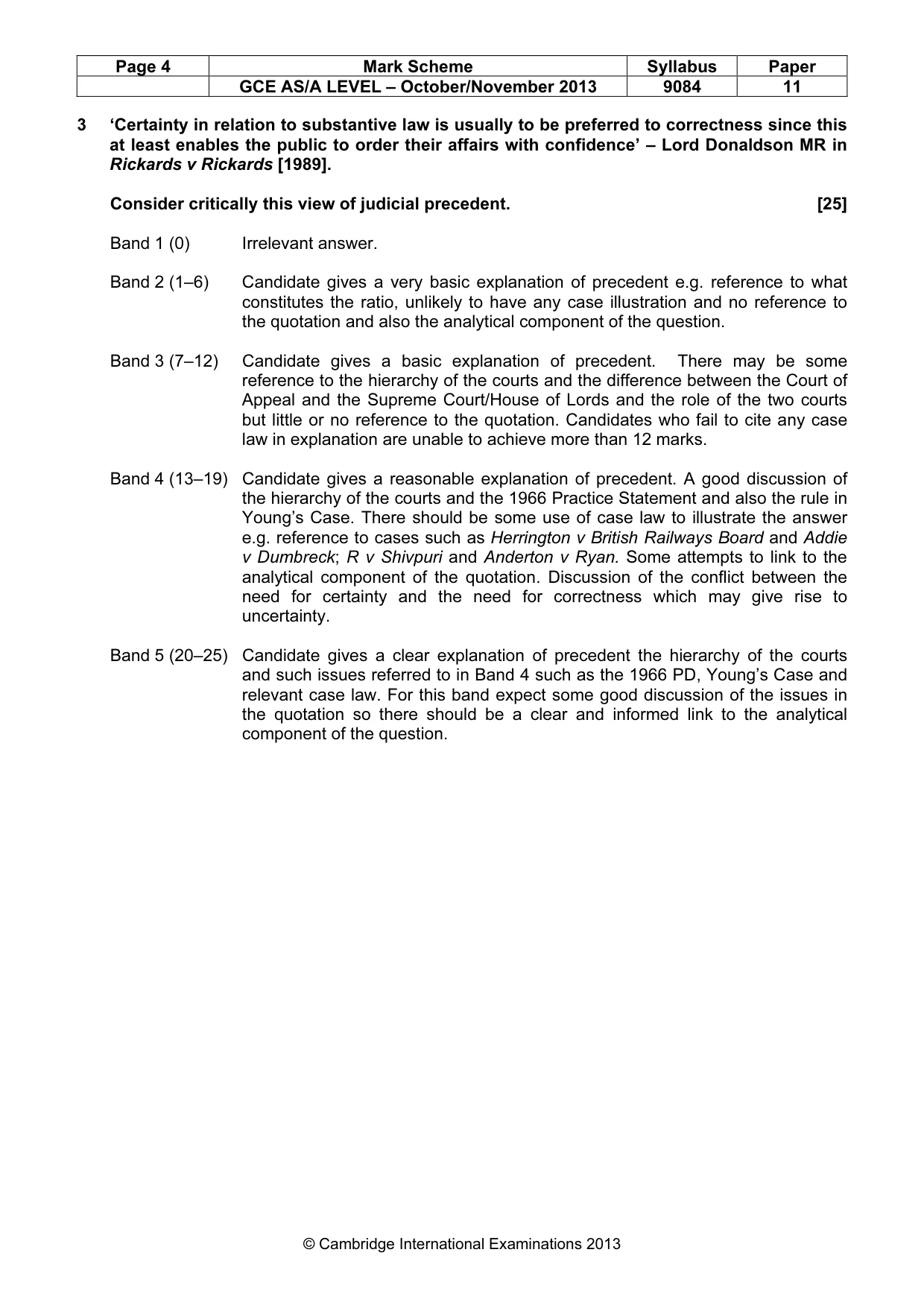
Page 4 Mark Scheme Syllabus Paper GCE AS/A LEVEL – October/November 2013 9084 11 © Cambridge International Examinations 2013 3 ‘Certainty in relation to substantive law is usually to be preferred to correctness since this at least enables the public to order their affairs with confidence’ – Lord Donaldson MR in Rickards v Rickards [1989]. Consider critically this view of judicial precedent. [25] Band 1 (0) Irrelevant answer. Band 2 (1–6) Candidate gives a very basic explanation of precedent e.g. reference to what constitutes the ratio, unlikely to have any case illustration and no reference to the quotation and also the analytical component of the question. Band 3 (7–12) Candidate gives a basic explanation of precedent. There may be some reference to the hierarchy of the courts and the difference between the Court of Appeal and the Supreme Court/House of Lords and the role of the two courts but little or no reference to the quotation. Candidates who fail to cite any case law in explanation are unable to achieve more than 12 marks. Band 4 (13–19) Candidate gives a reasonable explanation of precedent. A good discussion of the hierarchy of the courts and the 1966 Practice Statement and also the rule in Young’s Case. There should be some use of case law to illustrate the answer e.g. reference to cases such as Herrington v British Railways Board and Addie v Dumbreck; R v Shivpuri and Anderton v Ryan. Some attempts to link to the analytical component of the quotation. Discussion of the conflict between the need for certainty and the need for correctness which may give rise to uncertainty. Band 5 (20–25) Candidate gives a clear explanation of precedent the hierarchy of the courts and such issues referred to in Band 4 such as the 1966 PD, Young’s Case and relevant case law. For this band expect some good discussion of the issues in the quotation so there should be a clear and informed link to the analytical component of the question.
Mark scheme, page 5
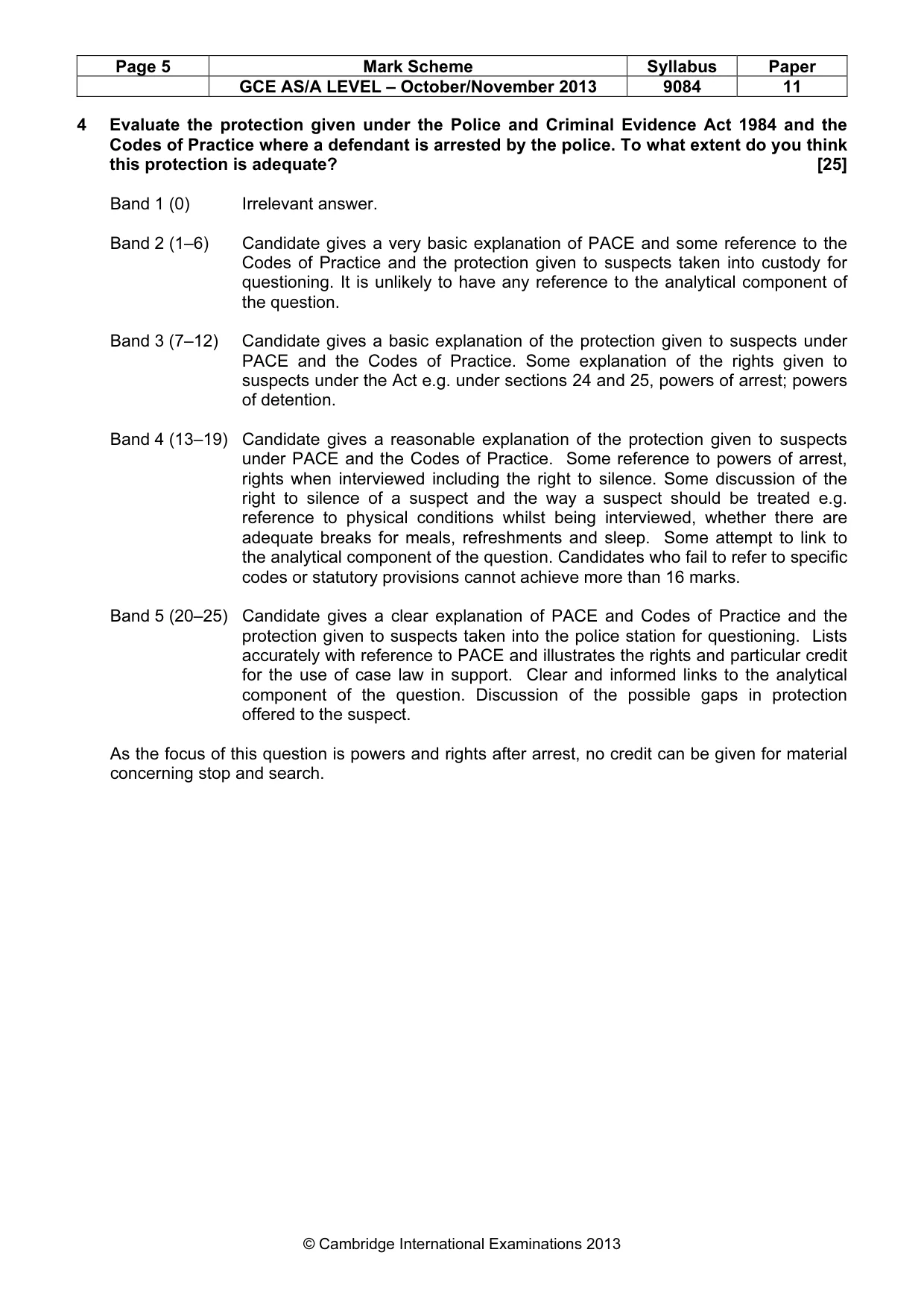
Page 5 Mark Scheme Syllabus Paper GCE AS/A LEVEL – October/November 2013 9084 11 © Cambridge International Examinations 2013 4 Evaluate the protection given under the Police and Criminal Evidence Act 1984 and the Codes of Practice where a defendant is arrested by the police. To what extent do you think this protection is adequate? [25] Band 1 (0) Irrelevant answer. Band 2 (1–6) Candidate gives a very basic explanation of PACE and some reference to the Codes of Practice and the protection given to suspects taken into custody for questioning. It is unlikely to have any reference to the analytical component of the question. Band 3 (7–12) Candidate gives a basic explanation of the protection given to suspects under PACE and the Codes of Practice. Some explanation of the rights given to suspects under the Act e.g. under sections 24 and 25, powers of arrest; powers of detention. Band 4 (13–19) Candidate gives a reasonable explanation of the protection given to suspects under PACE and the Codes of Practice. Some reference to powers of arrest, rights when interviewed including the right to silence. Some discussion of the right to silence of a suspect and the way a suspect should be treated e.g. reference to physical conditions whilst being interviewed, whether there are adequate breaks for meals, refreshments and sleep. Some attempt to link to the analytical component of the question. Candidates who fail to refer to specific codes or statutory provisions cannot achieve more than 16 marks. Band 5 (20–25) Candidate gives a clear explanation of PACE and Codes of Practice and the protection given to suspects taken into the police station for questioning. Lists accurately with reference to PACE and illustrates the rights and particular credit for the use of case law in support. Clear and informed links to the analytical component of the question. Discussion of the possible gaps in protection offered to the suspect. As the focus of this question is powers and rights after arrest, no credit can be given for material concerning stop and search.
Mark scheme, page 6
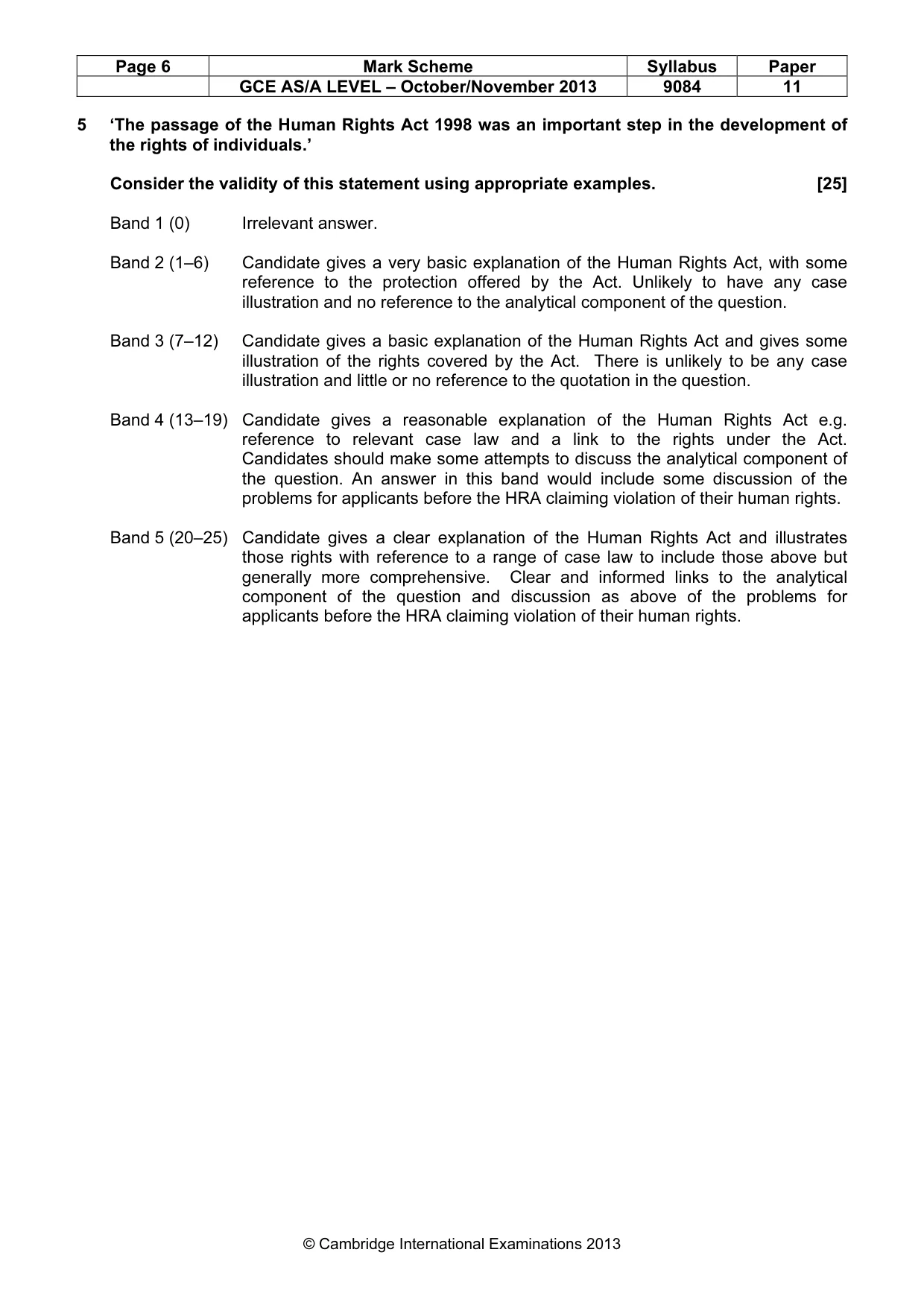
Page 6 Mark Scheme Syllabus Paper GCE AS/A LEVEL – October/November 2013 9084 11 © Cambridge International Examinations 2013 5 ‘The passage of the Human Rights Act 1998 was an important step in the development of the rights of individuals.’ Consider the validity of this statement using appropriate examples. [25] Band 1 (0) Irrelevant answer. Band 2 (1–6) Candidate gives a very basic explanation of the Human Rights Act, with some reference to the protection offered by the Act. Unlikely to have any case illustration and no reference to the analytical component of the question. Band 3 (7–12) Candidate gives a basic explanation of the Human Rights Act and gives some illustration of the rights covered by the Act. There is unlikely to be any case illustration and little or no reference to the quotation in the question. Band 4 (13–19) Candidate gives a reasonable explanation of the Human Rights Act e.g. reference to relevant case law and a link to the rights under the Act. Candidates should make some attempts to discuss the analytical component of the question. An answer in this band would include some discussion of the problems for applicants before the HRA claiming violation of their human rights. Band 5 (20–25) Candidate gives a clear explanation of the Human Rights Act and illustrates those rights with reference to a range of case law to include those above but generally more comprehensive. Clear and informed links to the analytical component of the question and discussion as above of the problems for applicants before the HRA claiming violation of their human rights.
Mark scheme, page 7
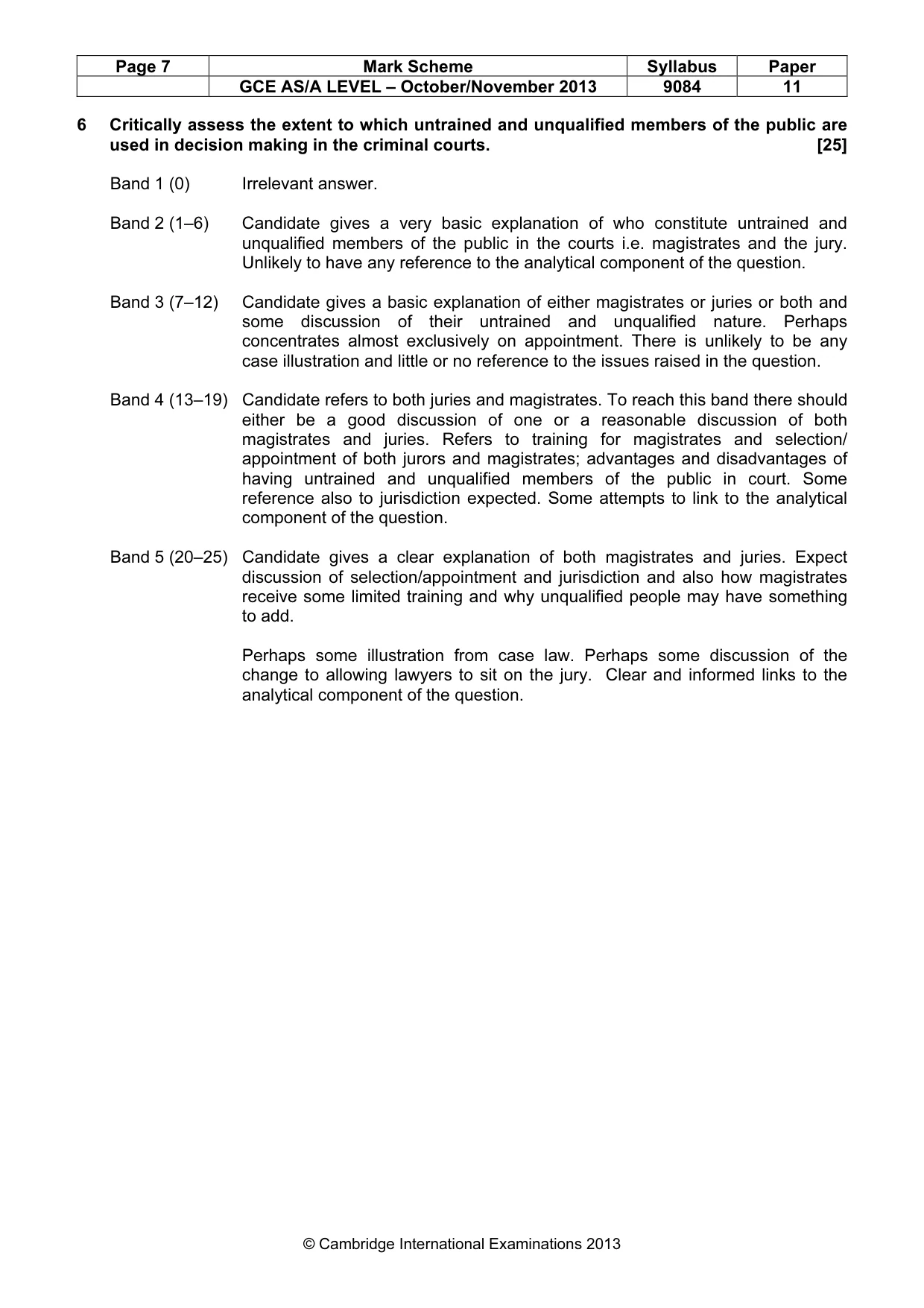
Page 7 Mark Scheme Syllabus Paper GCE AS/A LEVEL – October/November 2013 9084 11 © Cambridge International Examinations 2013 6 Critically assess the extent to which untrained and unqualified members of the public are used in decision making in the criminal courts. [25] Band 1 (0) Irrelevant answer. Band 2 (1–6) Candidate gives a very basic explanation of who constitute untrained and unqualified members of the public in the courts i.e. magistrates and the jury. Unlikely to have any reference to the analytical component of the question. Band 3 (7–12) Candidate gives a basic explanation of either magistrates or juries or both and some discussion of their untrained and unqualified nature. Perhaps concentrates almost exclusively on appointment. There is unlikely to be any case illustration and little or no reference to the issues raised in the question. Band 4 (13–19) Candidate refers to both juries and magistrates. To reach this band there should either be a good discussion of one or a reasonable discussion of both magistrates and juries. Refers to training for magistrates and selection/ appointment of both jurors and magistrates; advantages and disadvantages of having untrained and unqualified members of the public in court. Some reference also to jurisdiction expected. Some attempts to link to the analytical component of the question. Band 5 (20–25) Candidate gives a clear explanation of both magistrates and juries. Expect discussion of selection/appointment and jurisdiction and also how magistrates receive some limited training and why unqualified people may have something to add. Perhaps some illustration from case law. Perhaps some discussion of the change to allowing lawyers to sit on the jury. Clear and informed links to the analytical component of the question.
What you needed in this session
Cambridge’s own grade thresholds for 2013 Oct/Nov, Paper 1 · Variant 1. A higher threshold means an easier paper — the bar moves with how the cohort did.