Cambridge A Level Law 9084 — 2013 May/June Paper 1 · Variant 1
9084/11/M/J/13 · 75 marks · ≈84 min
The question paper and its mark scheme, free to read here and free to download. This is Cambridge’s own paper, exactly as it was sat.
Question paper2 pages
Mark scheme7 pages
Answers below. Sit the paper first if you are practising.
Paper as text
Question paper, page 1
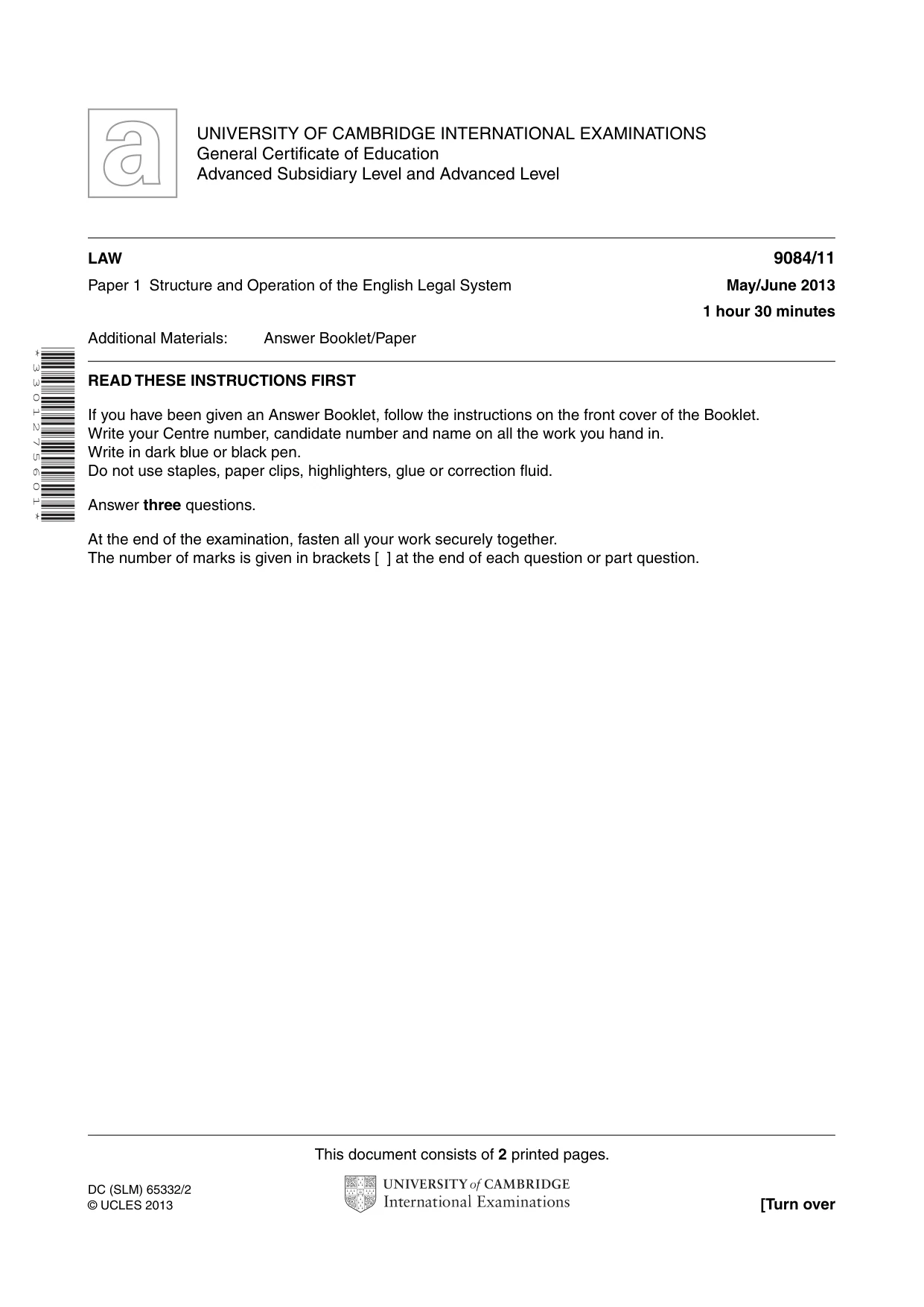
This document consists of 2 printed pages. DC (SLM) 65332/2 © UCLES 2013 [Turn over UNIVERSITY OF CAMBRIDGE INTERNATIONAL EXAMINATIONS General Certificate of Education Advanced Subsidiary Level and Advanced Level * 3 3 0 1 2 7 5 6 0 1 * LAW 9084/11 Paper 1 Structure and Operation of the English Legal System May/June 2013 1 hour 30 minutes Additional Materials: Answer Booklet/Paper READ THESE INSTRUCTIONS FIRST If you have been given an Answer Booklet, follow the instructions on the front cover of the Booklet. Write your Centre number, candidate number and name on all the work you hand in. Write in dark blue or black pen. Do not use staples, paper clips, highlighters, glue or correction fluid. Answer three questions. At the end of the examination, fasten all your work securely together. The number of marks is given in brackets [ ] at the end of each question or part question.
Question paper, page 2
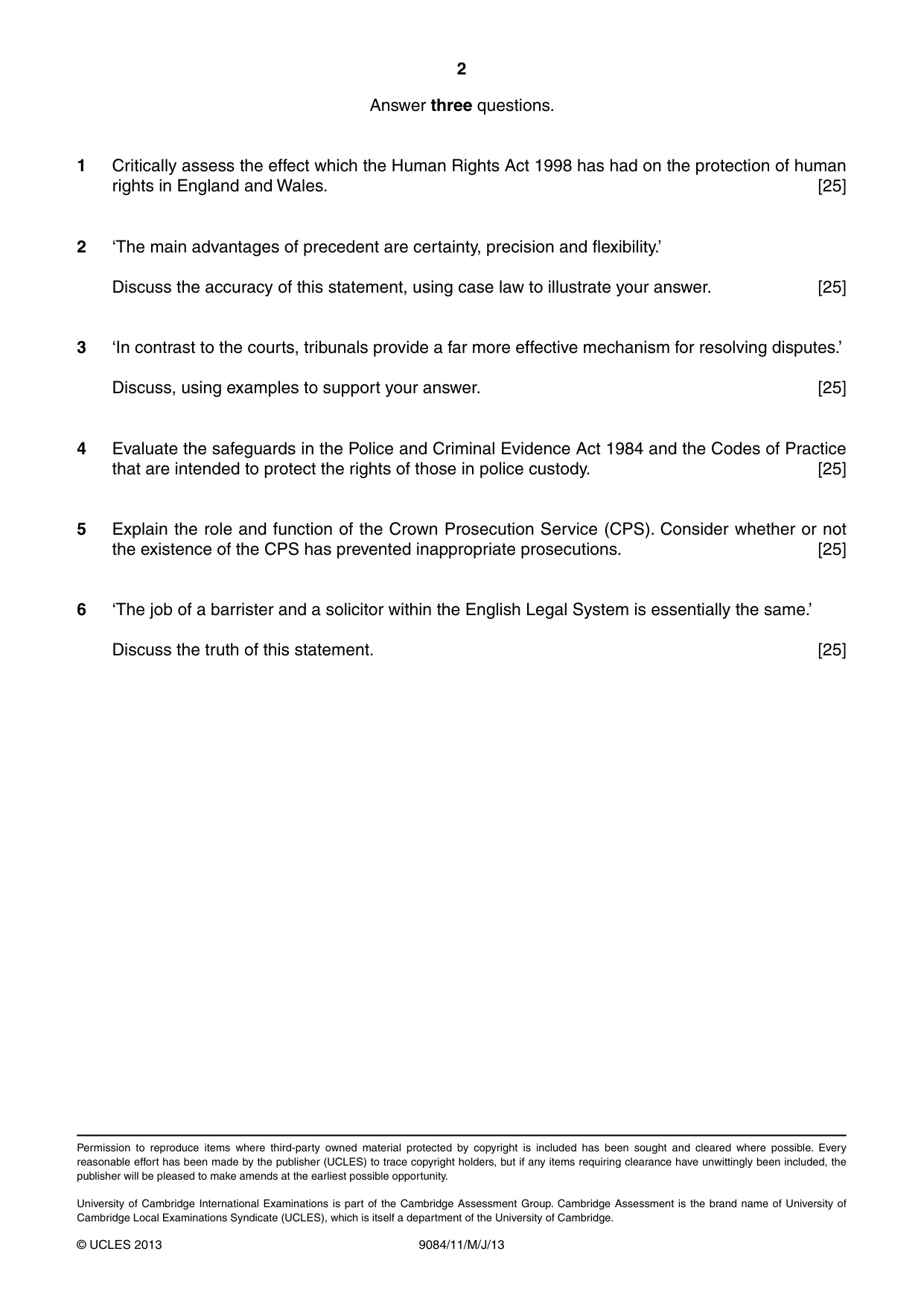
2 9084/11/M/J/13 © UCLES 2013 Permission to reproduce items where third-party owned material protected by copyright is included has been sought and cleared where possible. Every reasonable effort has been made by the publisher (UCLES) to trace copyright holders, but if any items requiring clearance have unwittingly been included, the publisher will be pleased to make amends at the earliest possible opportunity. University of Cambridge International Examinations is part of the Cambridge Assessment Group. Cambridge Assessment is the brand name of University of Cambridge Local Examinations Syndicate (UCLES), which is itself a department of the University of Cambridge. Answer three questions. 1 Critically assess the effect which the Human Rights Act 1998 has had on the protection of human rights in England and Wales. [25] 2 ‘The main advantages of precedent are certainty, precision and flexibility.’ Discuss the accuracy of this statement, using case law to illustrate your answer. [25] 3 ‘In contrast to the courts, tribunals provide a far more effective mechanism for resolving disputes.’ Discuss, using examples to support your answer. [25] 4 Evaluate the safeguards in the Police and Criminal Evidence Act 1984 and the Codes of Practice that are intended to protect the rights of those in police custody. [25] 5 Explain the role and function of the Crown Prosecution Service (CPS). Consider whether or not the existence of the CPS has prevented inappropriate prosecutions. [25] 6 ‘The job of a barrister and a solicitor within the English Legal System is essentially the same.’ Discuss the truth of this statement. [25]
Mark scheme, page 1
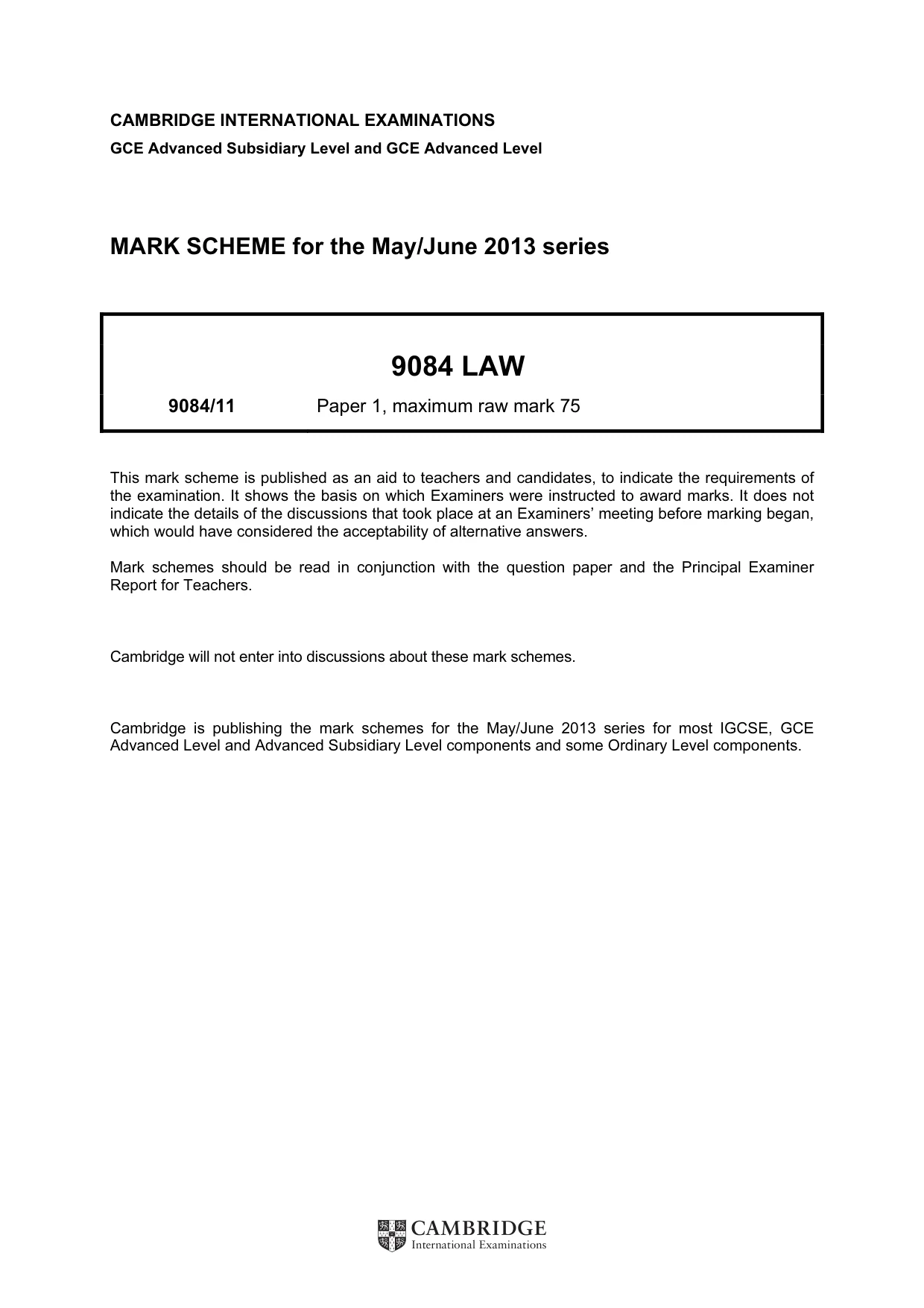
CAMBRIDGE INTERNATIONAL EXAMINATIONS GCE Advanced Subsidiary Level and GCE Advanced Level MARK SCHEME for the May/June 2013 series 9084 LAW 9084/11 Paper 1, maximum raw mark 75 This mark scheme is published as an aid to teachers and candidates, to indicate the requirements of the examination. It shows the basis on which Examiners were instructed to award marks. It does not indicate the details of the discussions that took place at an Examiners’ meeting before marking began, which would have considered the acceptability of alternative answers. Mark schemes should be read in conjunction with the question paper and the Principal Examiner Report for Teachers. Cambridge will not enter into discussions about these mark schemes. Cambridge is publishing the mark schemes for the May/June 2013 series for most IGCSE, GCE Advanced Level and Advanced Subsidiary Level components and some Ordinary Level components.
Mark scheme, page 2
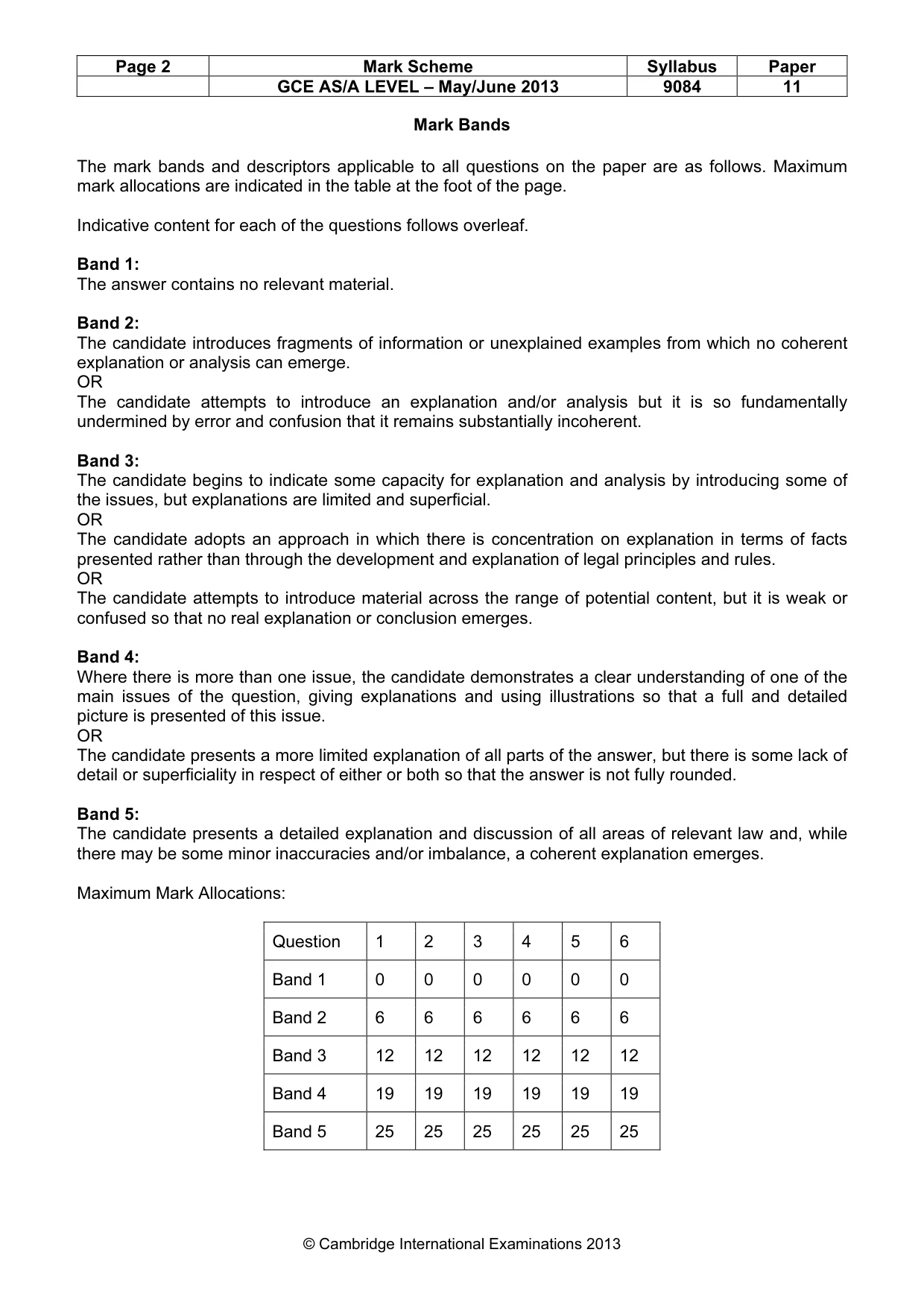
Page 2 Mark Scheme Syllabus Paper GCE AS/A LEVEL – May/June 2013 9084 11 © Cambridge International Examinations 2013 Mark Bands The mark bands and descriptors applicable to all questions on the paper are as follows. Maximum mark allocations are indicated in the table at the foot of the page. Indicative content for each of the questions follows overleaf. Band 1: The answer contains no relevant material. Band 2: The candidate introduces fragments of information or unexplained examples from which no coherent explanation or analysis can emerge. OR The candidate attempts to introduce an explanation and/or analysis but it is so fundamentally undermined by error and confusion that it remains substantially incoherent. Band 3: The candidate begins to indicate some capacity for explanation and analysis by introducing some of the issues, but explanations are limited and superficial. OR The candidate adopts an approach in which there is concentration on explanation in terms of facts presented rather than through the development and explanation of legal principles and rules. OR The candidate attempts to introduce material across the range of potential content, but it is weak or confused so that no real explanation or conclusion emerges. Band 4: Where there is more than one issue, the candidate demonstrates a clear understanding of one of the main issues of the question, giving explanations and using illustrations so that a full and detailed picture is presented of this issue. OR The candidate presents a more limited explanation of all parts of the answer, but there is some lack of detail or superficiality in respect of either or both so that the answer is not fully rounded. Band 5: The candidate presents a detailed explanation and discussion of all areas of relevant law and, while there may be some minor inaccuracies and/or imbalance, a coherent explanation emerges. Maximum Mark Allocations: Question 1 2 3 4 5 6 Band 1 0 0 0 0 0 0 Band 2 6 6 6 6 6 6 Band 3 12 12 12 12 12 12 Band 4 19 19 19 19 19 19 Band 5 25 25 25 25 25 25
Mark scheme, page 3
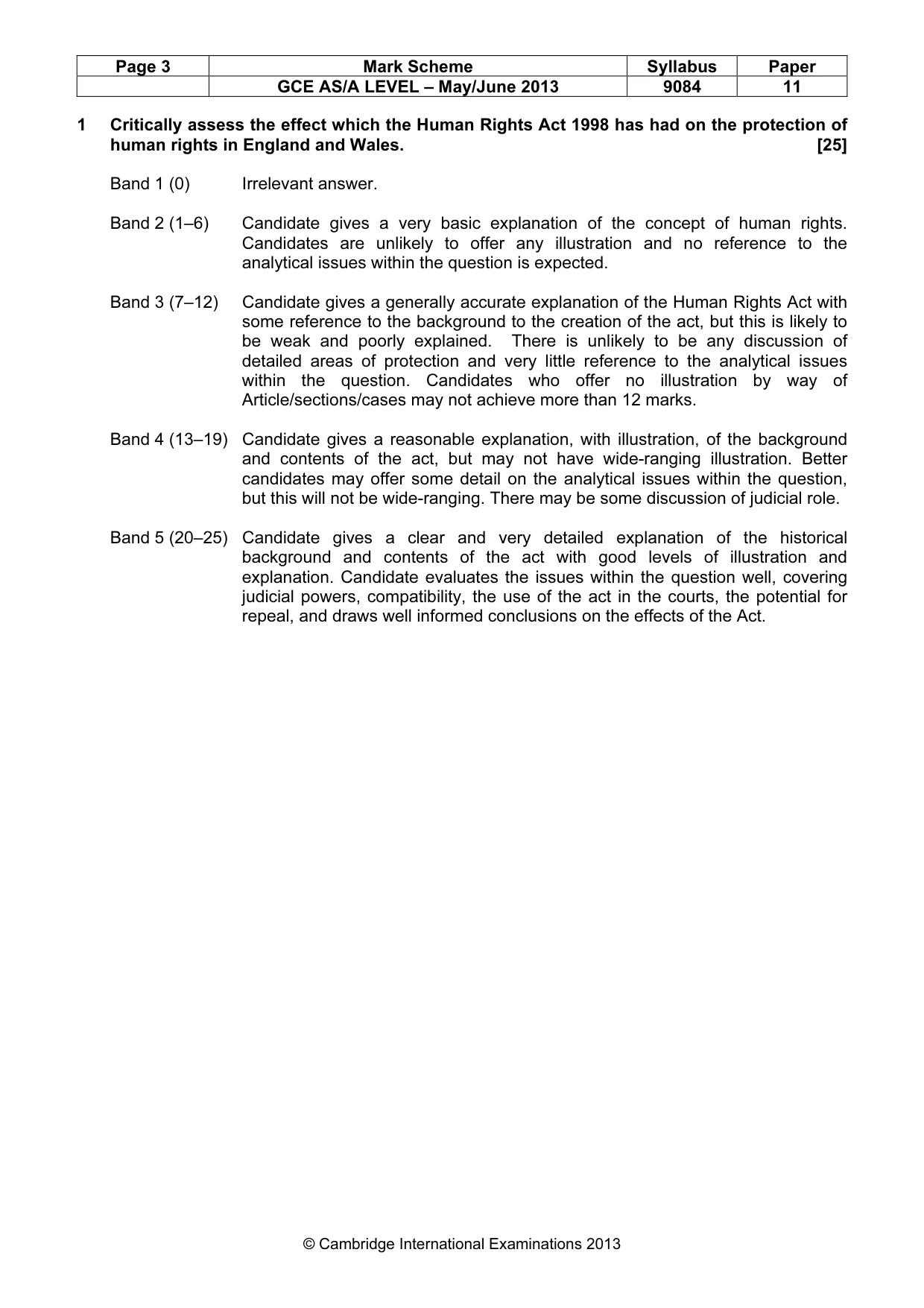
Page 3 Mark Scheme Syllabus Paper GCE AS/A LEVEL – May/June 2013 9084 11 © Cambridge International Examinations 2013 1 Critically assess the effect which the Human Rights Act 1998 has had on the protection of human rights in England and Wales. [25] Band 1 (0) Irrelevant answer. Band 2 (1–6) Candidate gives a very basic explanation of the concept of human rights. Candidates are unlikely to offer any illustration and no reference to the analytical issues within the question is expected. Band 3 (7–12) Candidate gives a generally accurate explanation of the Human Rights Act with some reference to the background to the creation of the act, but this is likely to be weak and poorly explained. There is unlikely to be any discussion of detailed areas of protection and very little reference to the analytical issues within the question. Candidates who offer no illustration by way of Article/sections/cases may not achieve more than 12 marks. Band 4 (13–19) Candidate gives a reasonable explanation, with illustration, of the background and contents of the act, but may not have wide-ranging illustration. Better candidates may offer some detail on the analytical issues within the question, but this will not be wide-ranging. There may be some discussion of judicial role. Band 5 (20–25) Candidate gives a clear and very detailed explanation of the historical background and contents of the act with good levels of illustration and explanation. Candidate evaluates the issues within the question well, covering judicial powers, compatibility, the use of the act in the courts, the potential for repeal, and draws well informed conclusions on the effects of the Act.
Mark scheme, page 4
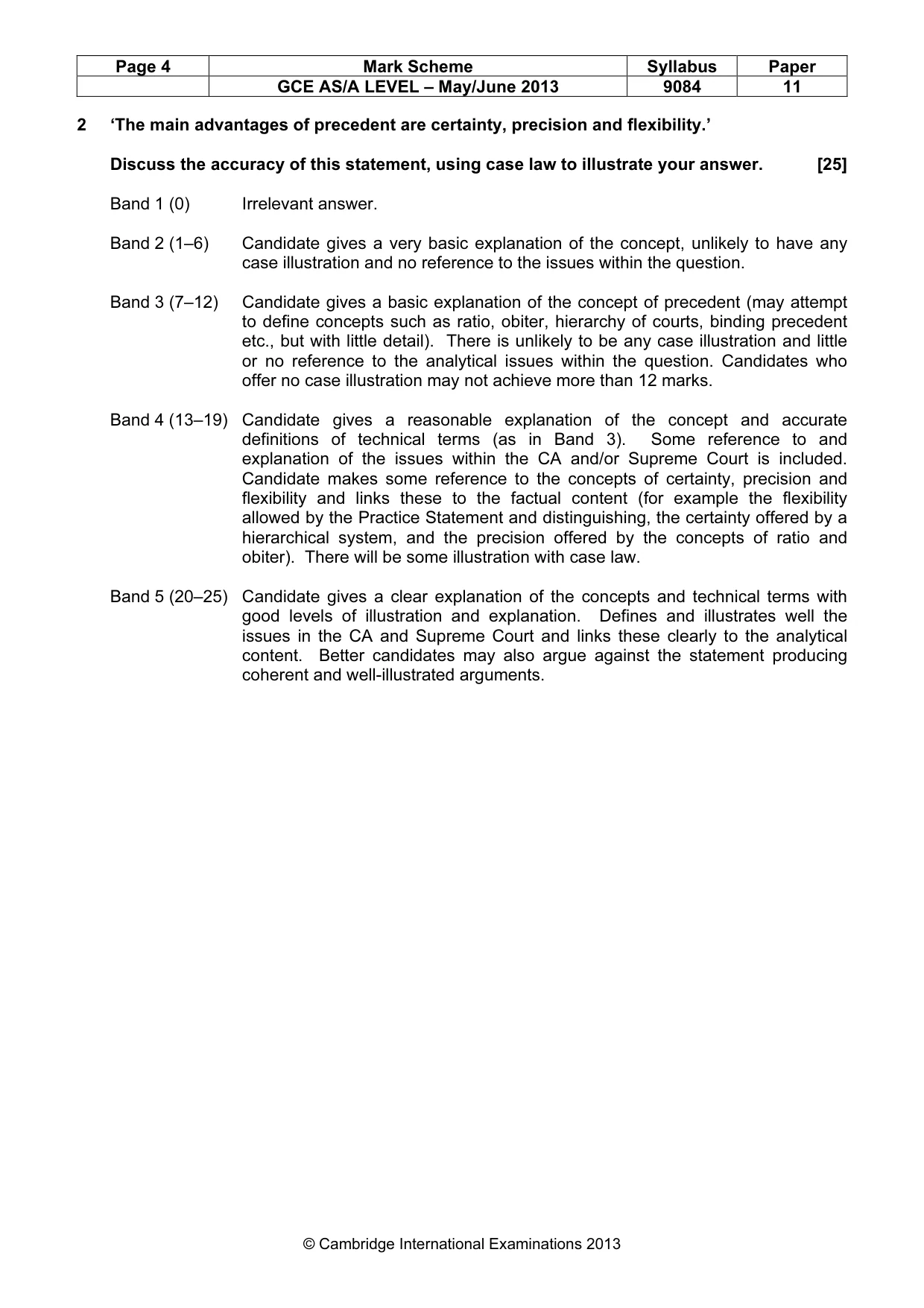
Page 4 Mark Scheme Syllabus Paper GCE AS/A LEVEL – May/June 2013 9084 11 © Cambridge International Examinations 2013 2 ‘The main advantages of precedent are certainty, precision and flexibility.’ Discuss the accuracy of this statement, using case law to illustrate your answer. [25] Band 1 (0) Irrelevant answer. Band 2 (1–6) Candidate gives a very basic explanation of the concept, unlikely to have any case illustration and no reference to the issues within the question. Band 3 (7–12) Candidate gives a basic explanation of the concept of precedent (may attempt to define concepts such as ratio, obiter, hierarchy of courts, binding precedent etc., but with little detail). There is unlikely to be any case illustration and little or no reference to the analytical issues within the question. Candidates who offer no case illustration may not achieve more than 12 marks. Band 4 (13–19) Candidate gives a reasonable explanation of the concept and accurate definitions of technical terms (as in Band 3). Some reference to and explanation of the issues within the CA and/or Supreme Court is included. Candidate makes some reference to the concepts of certainty, precision and flexibility and links these to the factual content (for example the flexibility allowed by the Practice Statement and distinguishing, the certainty offered by a hierarchical system, and the precision offered by the concepts of ratio and obiter). There will be some illustration with case law. Band 5 (20–25) Candidate gives a clear explanation of the concepts and technical terms with good levels of illustration and explanation. Defines and illustrates well the issues in the CA and Supreme Court and links these clearly to the analytical content. Better candidates may also argue against the statement producing coherent and well-illustrated arguments.
Mark scheme, page 5
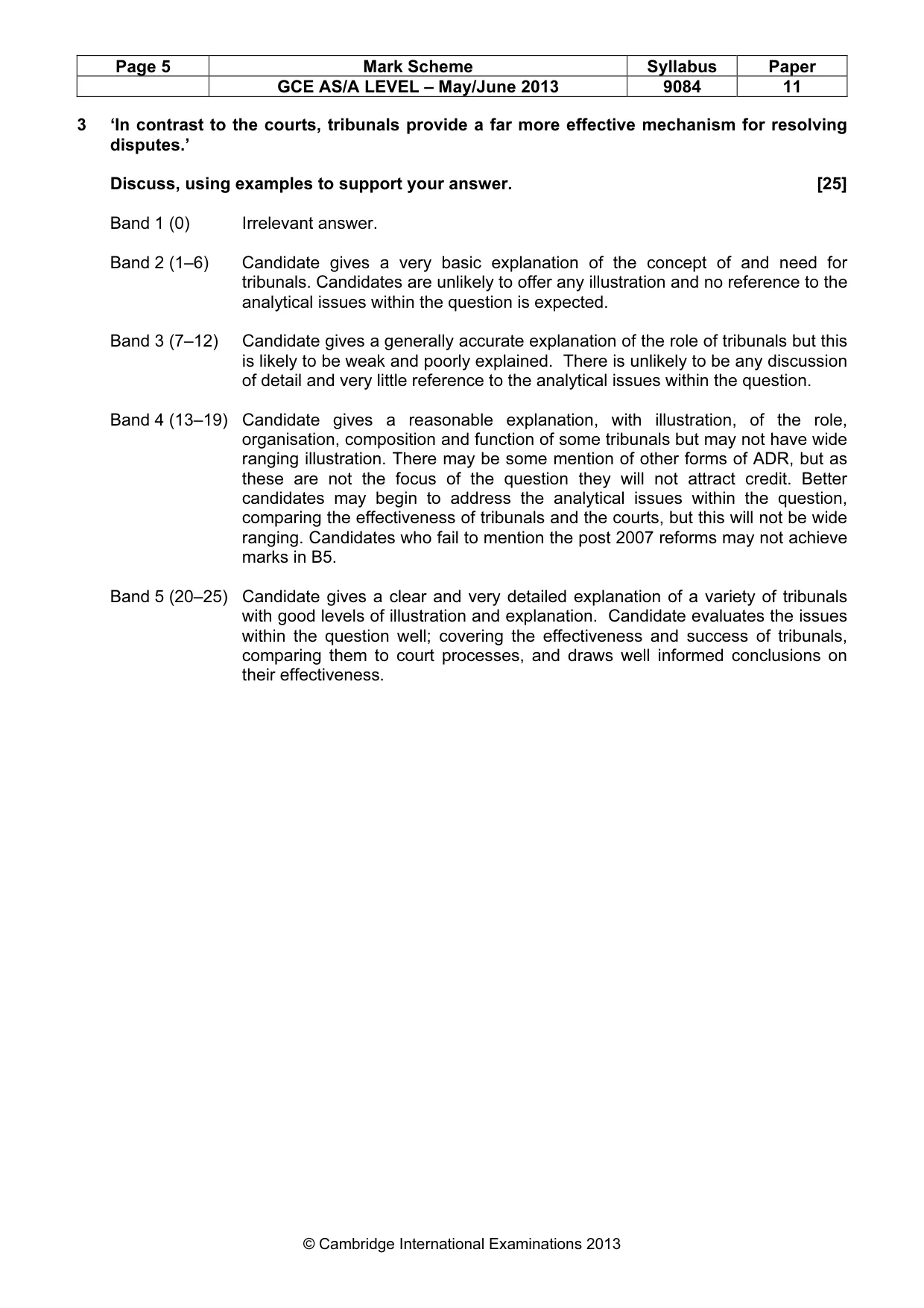
Page 5 Mark Scheme Syllabus Paper GCE AS/A LEVEL – May/June 2013 9084 11 © Cambridge International Examinations 2013 3 ‘In contrast to the courts, tribunals provide a far more effective mechanism for resolving disputes.’ Discuss, using examples to support your answer. [25] Band 1 (0) Irrelevant answer. Band 2 (1–6) Candidate gives a very basic explanation of the concept of and need for tribunals. Candidates are unlikely to offer any illustration and no reference to the analytical issues within the question is expected. Band 3 (7–12) Candidate gives a generally accurate explanation of the role of tribunals but this is likely to be weak and poorly explained. There is unlikely to be any discussion of detail and very little reference to the analytical issues within the question. Band 4 (13–19) Candidate gives a reasonable explanation, with illustration, of the role, organisation, composition and function of some tribunals but may not have wide ranging illustration. There may be some mention of other forms of ADR, but as these are not the focus of the question they will not attract credit. Better candidates may begin to address the analytical issues within the question, comparing the effectiveness of tribunals and the courts, but this will not be wide ranging. Candidates who fail to mention the post 2007 reforms may not achieve marks in B5. Band 5 (20–25) Candidate gives a clear and very detailed explanation of a variety of tribunals with good levels of illustration and explanation. Candidate evaluates the issues within the question well; covering the effectiveness and success of tribunals, comparing them to court processes, and draws well informed conclusions on their effectiveness.
Mark scheme, page 6
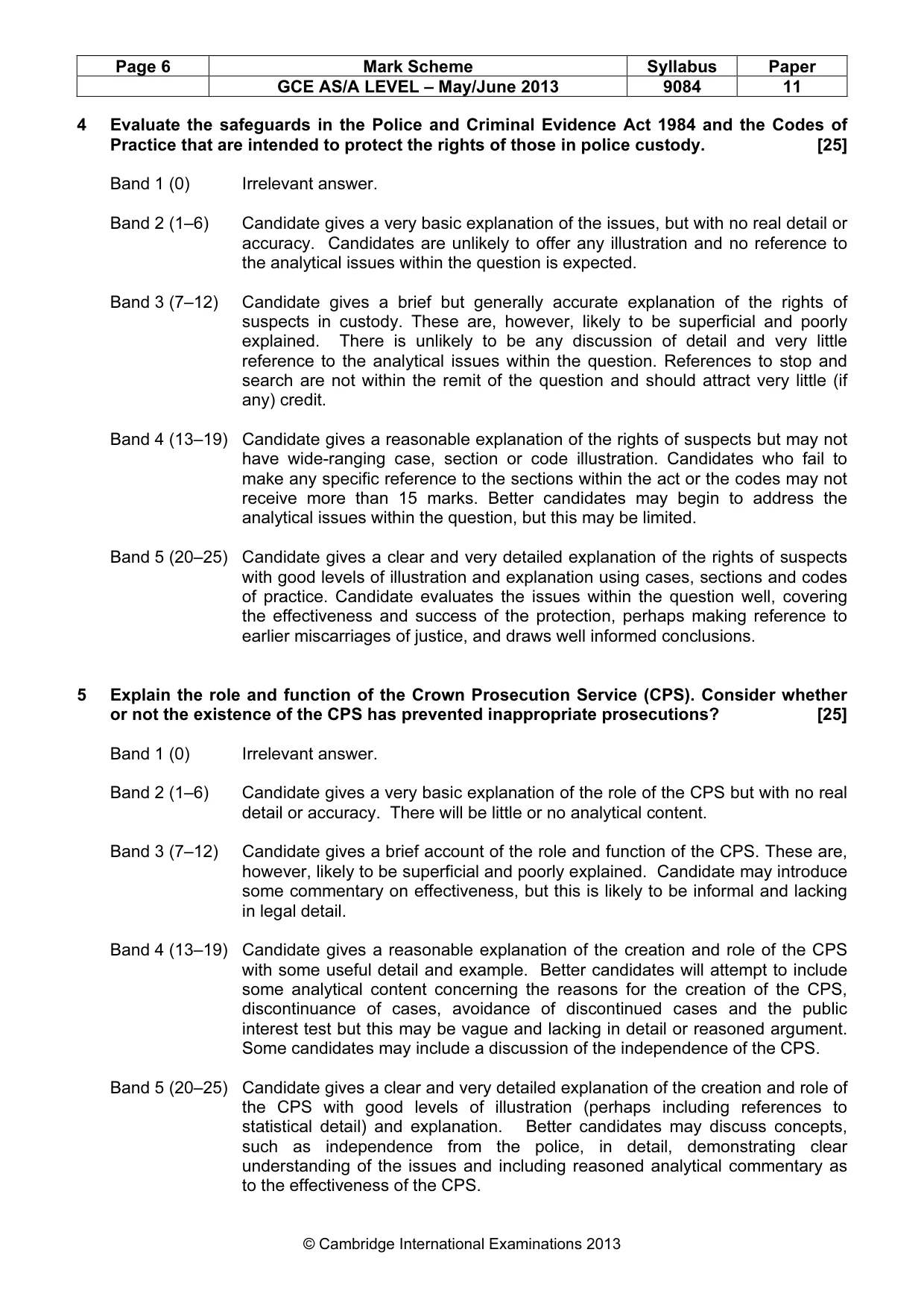
Page 6 Mark Scheme Syllabus Paper GCE AS/A LEVEL – May/June 2013 9084 11 © Cambridge International Examinations 2013 4 Evaluate the safeguards in the Police and Criminal Evidence Act 1984 and the Codes of Practice that are intended to protect the rights of those in police custody. [25] Band 1 (0) Irrelevant answer. Band 2 (1–6) Candidate gives a very basic explanation of the issues, but with no real detail or accuracy. Candidates are unlikely to offer any illustration and no reference to the analytical issues within the question is expected. Band 3 (7–12) Candidate gives a brief but generally accurate explanation of the rights of suspects in custody. These are, however, likely to be superficial and poorly explained. There is unlikely to be any discussion of detail and very little reference to the analytical issues within the question. References to stop and search are not within the remit of the question and should attract very little (if any) credit. Band 4 (13–19) Candidate gives a reasonable explanation of the rights of suspects but may not have wide-ranging case, section or code illustration. Candidates who fail to make any specific reference to the sections within the act or the codes may not receive more than 15 marks. Better candidates may begin to address the analytical issues within the question, but this may be limited. Band 5 (20–25) Candidate gives a clear and very detailed explanation of the rights of suspects with good levels of illustration and explanation using cases, sections and codes of practice. Candidate evaluates the issues within the question well, covering the effectiveness and success of the protection, perhaps making reference to earlier miscarriages of justice, and draws well informed conclusions. 5 Explain the role and function of the Crown Prosecution Service (CPS). Consider whether or not the existence of the CPS has prevented inappropriate prosecutions? [25] Band 1 (0) Irrelevant answer. Band 2 (1–6) Candidate gives a very basic explanation of the role of the CPS but with no real detail or accuracy. There will be little or no analytical content. Band 3 (7–12) Candidate gives a brief account of the role and function of the CPS. These are, however, likely to be superficial and poorly explained. Candidate may introduce some commentary on effectiveness, but this is likely to be informal and lacking in legal detail. Band 4 (13–19) Candidate gives a reasonable explanation of the creation and role of the CPS with some useful detail and example. Better candidates will attempt to include some analytical content concerning the reasons for the creation of the CPS, discontinuance of cases, avoidance of discontinued cases and the public interest test but this may be vague and lacking in detail or reasoned argument. Some candidates may include a discussion of the independence of the CPS. Band 5 (20–25) Candidate gives a clear and very detailed explanation of the creation and role of the CPS with good levels of illustration (perhaps including references to statistical detail) and explanation. Better candidates may discuss concepts, such as independence from the police, in detail, demonstrating clear understanding of the issues and including reasoned analytical commentary as to the effectiveness of the CPS.
Mark scheme, page 7
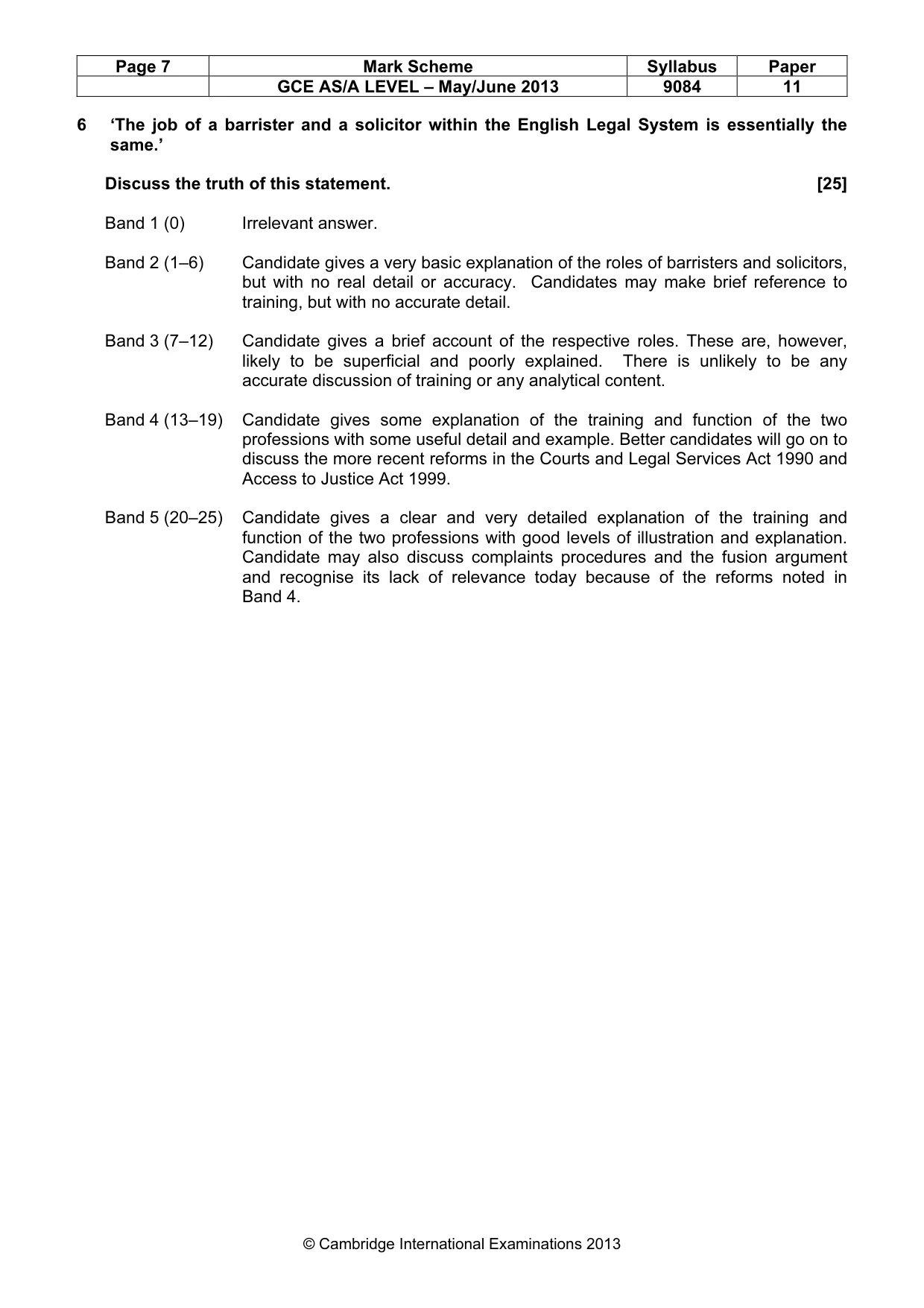
Page 7 Mark Scheme Syllabus Paper GCE AS/A LEVEL – May/June 2013 9084 11 © Cambridge International Examinations 2013 6 ‘The job of a barrister and a solicitor within the English Legal System is essentially the same.’ Discuss the truth of this statement. [25] Band 1 (0) Irrelevant answer. Band 2 (1–6) Candidate gives a very basic explanation of the roles of barristers and solicitors, but with no real detail or accuracy. Candidates may make brief reference to training, but with no accurate detail. Band 3 (7–12) Candidate gives a brief account of the respective roles. These are, however, likely to be superficial and poorly explained. There is unlikely to be any accurate discussion of training or any analytical content. Band 4 (13–19) Candidate gives some explanation of the training and function of the two professions with some useful detail and example. Better candidates will go on to discuss the more recent reforms in the Courts and Legal Services Act 1990 and Access to Justice Act 1999. Band 5 (20–25) Candidate gives a clear and very detailed explanation of the training and function of the two professions with good levels of illustration and explanation. Candidate may also discuss complaints procedures and the fusion argument and recognise its lack of relevance today because of the reforms noted in Band 4.
What you needed in this session
Cambridge’s own grade thresholds for 2013 May/June, Paper 1 · Variant 1. A higher threshold means an easier paper — the bar moves with how the cohort did.