Cambridge A Level Law 9084 — 2010 Oct/Nov Paper 1 · Variant 1
9084/11/O/N/10 · 75 marks · ≈84 min
The question paper and its mark scheme, free to read here and free to download. This is Cambridge’s own paper, exactly as it was sat.
Question paper2 pages
Mark scheme4 pages
Answers below. Sit the paper first if you are practising.

Paper as text
Question paper, page 1
This document consists of 2 printed pages. DC (CB (SD)) 23677/2 © UCLES 2010 [Turn over UNIVERSITY OF CAMBRIDGE INTERNATIONAL EXAMINATIONS General Certificate of Education Advanced Subsidiary Level and Advanced Level * 8 4 2 3 4 6 7 9 6 1 * LAW 9084/01 Paper 1 Essay Questions October/November 2010 1 hour 30 minutes Additional Materials: Answer Booklet/Paper READ THESE INSTRUCTIONS FIRST If you have been given an Answer Booklet, follow the instructions on the front cover of the Booklet. Write your Centre number, candidate number and name on all the work you hand in. Write in dark blue or black pen. Do not use staples, paper clips, highlighters, glue or correction fluid. Answer three questions. At the end of the examination, fasten all your work securely together. The number of marks is given in brackets [ ] at the end of each question or part question.
Question paper, page 2
2 9084/01/O/N/10 © UCLES 2010 Permission to reproduce items where third-party owned material protected by copyright is included has been sought and cleared where possible. Every reasonable effort has been made by the publisher (UCLES) to trace copyright holders, but if any items requiring clearance have unwittingly been included, the publisher will be pleased to make amends at the earliest possible opportunity. University of Cambridge International Examinations is part of the Cambridge Assessment Group. Cambridge Assessment is the brand name of University of Cambridge Local Examinations Syndicate (UCLES), which is itself a department of the University of Cambridge. Answer three questions. 1 ‘There are many drawbacks to jury service. The time has long come for it to be abolished and replaced with something more efficient.’ Discuss the extent to which you agree with this statement. [25] 2 Agatha Runcible has pleaded not guilty to careless driving at the Brideshead Magistrates’ Court. Consider critically the process which will now follow and the roles of those involved in her trial. [25] 3 Analyse critically the main ways in which delegated legislation comes into force in England and Wales. [25] 4 ‘The courts are still widely regarded as an elite and alien world, remote from the experience and interests of the ordinary man and woman.’ Discuss critically the role of those who work in the courts, their training and the day-to-day operation of justice in England and Wales, indicating how far you would agree with the above statement. [25] 5 ‘Equitable maxims and equitable remedies have been vital tools in the development of justice.’ Identifying and illustrating both maxims and remedies, discuss how far you would agree with the above statement. Your answer should refer to decided cases. [25] 6 ‘The problem with a system of precedent is that it makes the law stand still; it cannot move with the times.’ How far would you agree with this criticism? [25]
Mark scheme, page 1
UNIVERSITY OF CAMBRIDGE INTERNATIONAL EXAMINATIONS GCE Advanced Subsidiary Level and GCE Advanced Level MARK SCHEME for the October/November 2010 question paper for the guidance of teachers 9084 LAW 9084/01 Paper 1, maximum raw mark 75 This mark scheme is published as an aid to teachers and candidates, to indicate the requirements of the examination. It shows the basis on which Examiners were instructed to award marks. It does not indicate the details of the discussions that took place at an Examiners’ meeting before marking began, which would have considered the acceptability of alternative answers. Mark schemes must be read in conjunction with the question papers and the report on the examination. • CIE will not enter into discussions or correspondence in connection with these mark schemes. CIE is publishing the mark schemes for the October/November 2010 question papers for most IGCSE, GCE Advanced Level and Advanced Subsidiary Level syllabuses and some Ordinary Level syllabuses.
Mark scheme, page 2
Page 2 Mark Scheme: Teachers’ version Syllabus Paper GCE A/AS LEVEL – October/November 2010 9084 01 © UCLES 2010 Mark Bands The mark bands and descriptors applicable to all questions on the paper are as follows. Maximum mark allocations are indicated in the table on the next page. Indicative content for each of the questions follows. Band 1: The answer contains no relevant material. Band 2: The candidate introduces fragments of information or unexplained examples from which no coherent explanation or analysis can emerge. OR The candidate attempts to introduce an explanation and/or analysis but it is so fundamentally undermined by error and confusion that it remains substantially incoherent. Band 3: The candidate begins to indicate some capacity for explanation and analysis by introducing some of the issues, but explanations are limited and superficial. OR The candidate adopts an approach in which there is concentration on explanation in terms of facts presented rather than through the development and explanation of legal principles and rules. OR The candidate attempts to introduce material across the range of potential content, but it is weak or confused so that no real explanation or conclusion emerges. Band 4: Where there is more than one issue, the candidate demonstrates a clear understanding of one of the main issues of the question, giving explanations and using illustrations so that a full and detailed picture is presented of this issue. OR The candidate presents a more limited explanation of all parts of the answer, but there is some lack of detail or superficiality in respect of either or both so that the answer is not fully rounded. Band 5: The candidate presents a detailed explanation and discussion of all areas of relevant law and, while there may be some minor inaccuracies and/or imbalance, a coherent explanation emerges.
Mark scheme, page 3
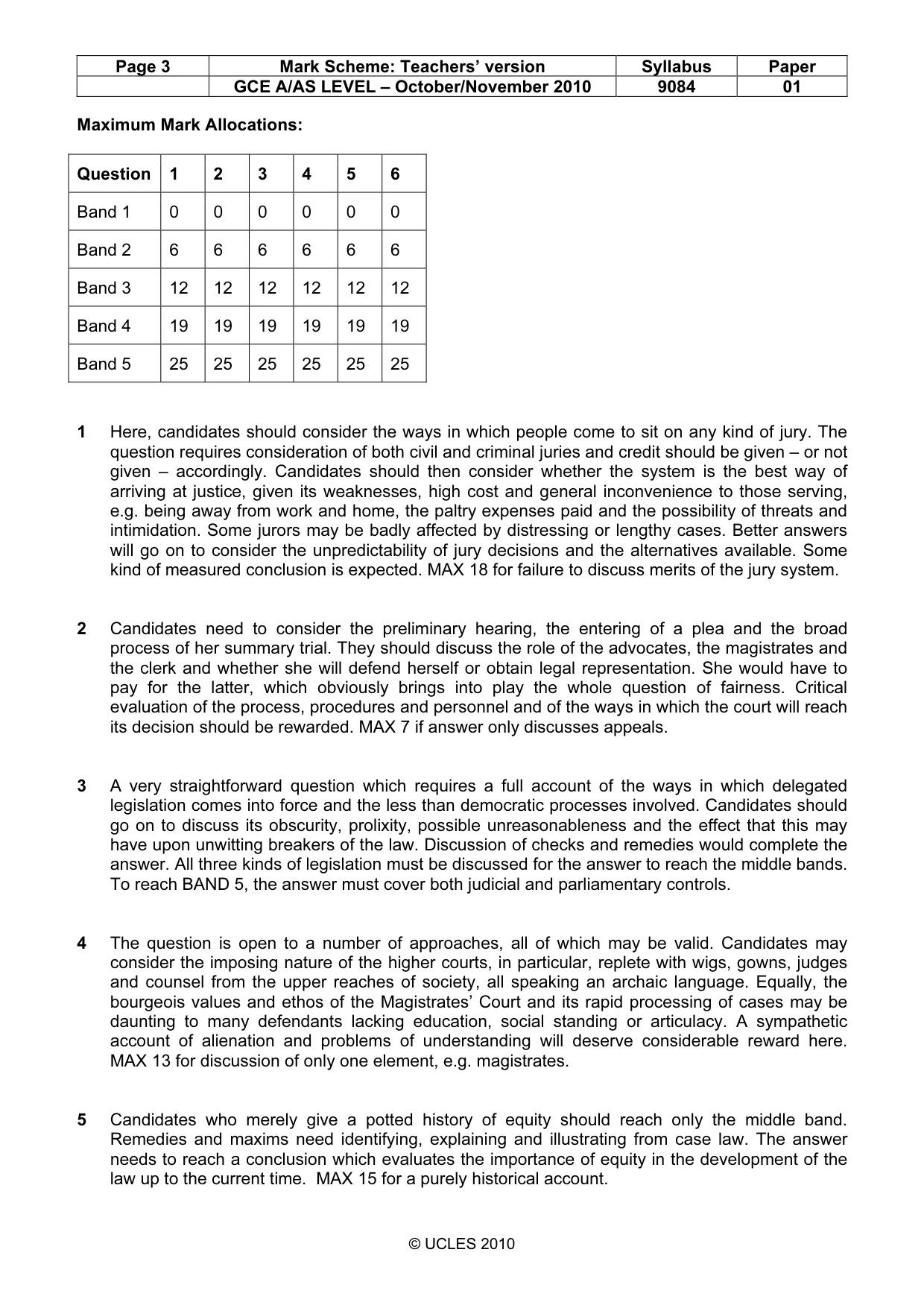
Page 3 Mark Scheme: Teachers’ version Syllabus Paper GCE A/AS LEVEL – October/November 2010 9084 01 © UCLES 2010 Maximum Mark Allocations: Question 1 2 3 4 5 6 Band 1 0 0 0 0 0 0 Band 2 6 6 6 6 6 6 Band 3 12 12 12 12 12 12 Band 4 19 19 19 19 19 19 Band 5 25 25 25 25 25 25 1 Here, candidates should consider the ways in which people come to sit on any kind of jury. The question requires consideration of both civil and criminal juries and credit should be given – or not given – accordingly. Candidates should then consider whether the system is the best way of arriving at justice, given its weaknesses, high cost and general inconvenience to those serving, e.g. being away from work and home, the paltry expenses paid and the possibility of threats and intimidation. Some jurors may be badly affected by distressing or lengthy cases. Better answers will go on to consider the unpredictability of jury decisions and the alternatives available. Some kind of measured conclusion is expected. MAX 18 for failure to discuss merits of the jury system. 2 Candidates need to consider the preliminary hearing, the entering of a plea and the broad process of her summary trial. They should discuss the role of the advocates, the magistrates and the clerk and whether she will defend herself or obtain legal representation. She would have to pay for the latter, which obviously brings into play the whole question of fairness. Critical evaluation of the process, procedures and personnel and of the ways in which the court will reach its decision should be rewarded. MAX 7 if answer only discusses appeals. 3 A very straightforward question which requires a full account of the ways in which delegated legislation comes into force and the less than democratic processes involved. Candidates should go on to discuss its obscurity, prolixity, possible unreasonableness and the effect that this may have upon unwitting breakers of the law. Discussion of checks and remedies would complete the answer. All three kinds of legislation must be discussed for the answer to reach the middle bands. To reach BAND 5, the answer must cover both judicial and parliamentary controls. 4 The question is open to a number of approaches, all of which may be valid. Candidates may consider the imposing nature of the higher courts, in particular, replete with wigs, gowns, judges and counsel from the upper reaches of society, all speaking an archaic language. Equally, the bourgeois values and ethos of the Magistrates’ Court and its rapid processing of cases may be daunting to many defendants lacking education, social standing or articulacy. A sympathetic account of alienation and problems of understanding will deserve considerable reward here. MAX 13 for discussion of only one element, e.g. magistrates. 5 Candidates who merely give a potted history of equity should reach only the middle band. Remedies and maxims need identifying, explaining and illustrating from case law. The answer needs to reach a conclusion which evaluates the importance of equity in the development of the law up to the current time. MAX 15 for a purely historical account.
Mark scheme, page 4
Page 4 Mark Scheme: Teachers’ version Syllabus Paper GCE A/AS LEVEL – October/November 2010 9084 01 © UCLES 2010 6 The system itself needs explaining, through the hierarchy of the courts. Candidates should offer a critical evaluation by way of significant decided cases and reach a conclusion accordingly. MAX 18 for simple discussion of the court structure without any reference to case law.
What you needed in this session
Cambridge’s own grade thresholds for 2010 Oct/Nov, Paper 1 · Variant 1. A higher threshold means an easier paper — the bar moves with how the cohort did.