Cambridge A Level Islamic Studies 9013 — 2011 Oct/Nov Paper 1 · Variant 1
9013/11/O/N/11 · 100 marks · ≈113 min
The question paper and its mark scheme, free to read here and free to download. This is Cambridge’s own paper, exactly as it was sat.
Question paper4 pages
Mark scheme8 pages
Answers below. Sit the paper first if you are practising.
Paper as text
Question paper, page 1
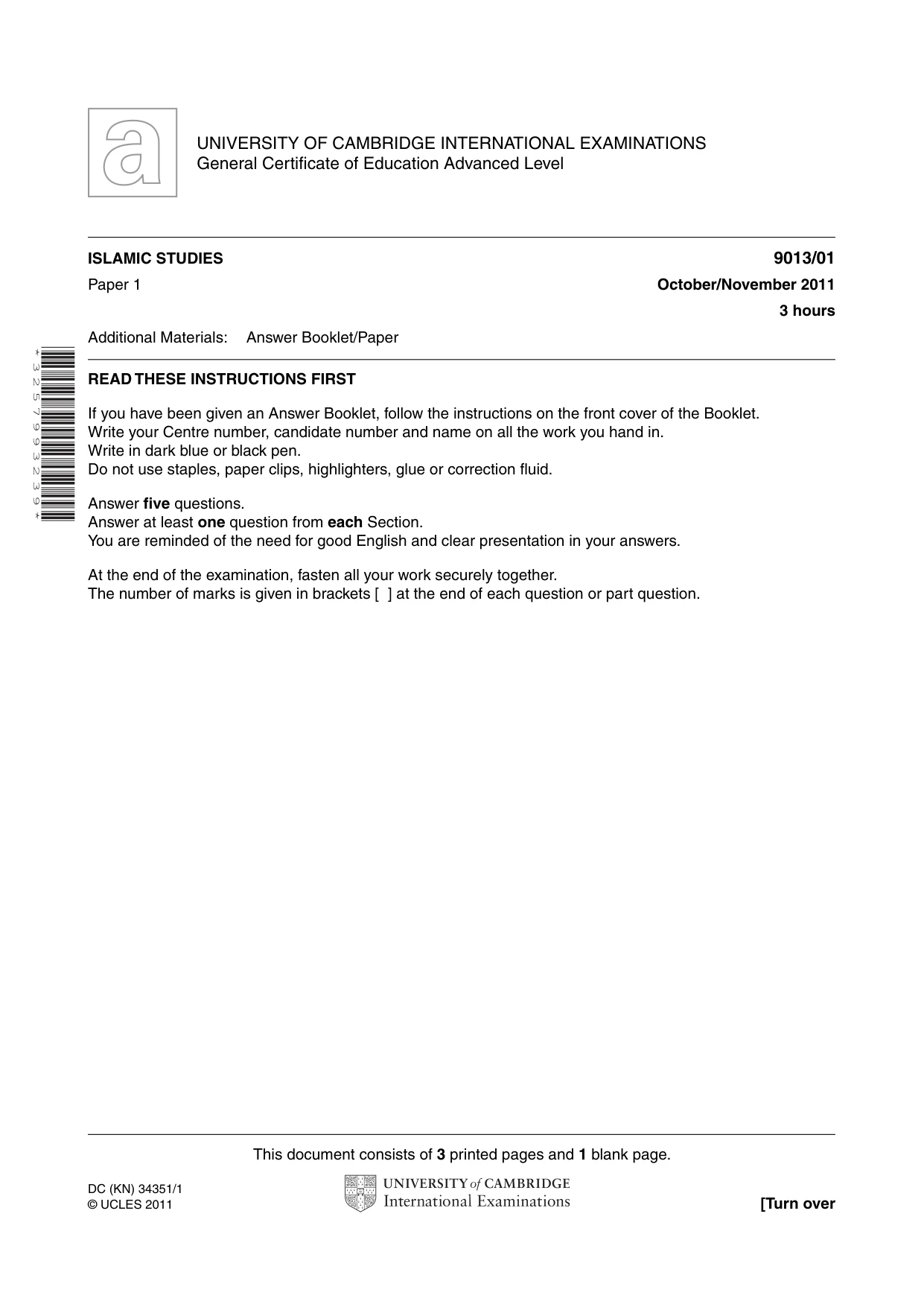
This document consists of 3 printed pages and 1 blank page. DC (KN) 34351/1 © UCLES 2011 [Turn over UNIVERSITY OF CAMBRIDGE INTERNATIONAL EXAMINATIONS General Certificate of Education Advanced Level READ THESE INSTRUCTIONS FIRST If you have been given an Answer Booklet, follow the instructions on the front cover of the Booklet. Write your Centre number, candidate number and name on all the work you hand in. Write in dark blue or black pen. Do not use staples, paper clips, highlighters, glue or correction fluid. Answer five questions. Answer at least one question from each Section. You are reminded of the need for good English and clear presentation in your answers. At the end of the examination, fasten all your work securely together. The number of marks is given in brackets [ ] at the end of each question or part question. * 3 2 5 7 9 9 3 2 3 9 * ISLAMIC STUDIES 9013/01 Paper 1 October/November 2011 3 hours Additional Materials: Answer Booklet/Paper
Question paper, page 2
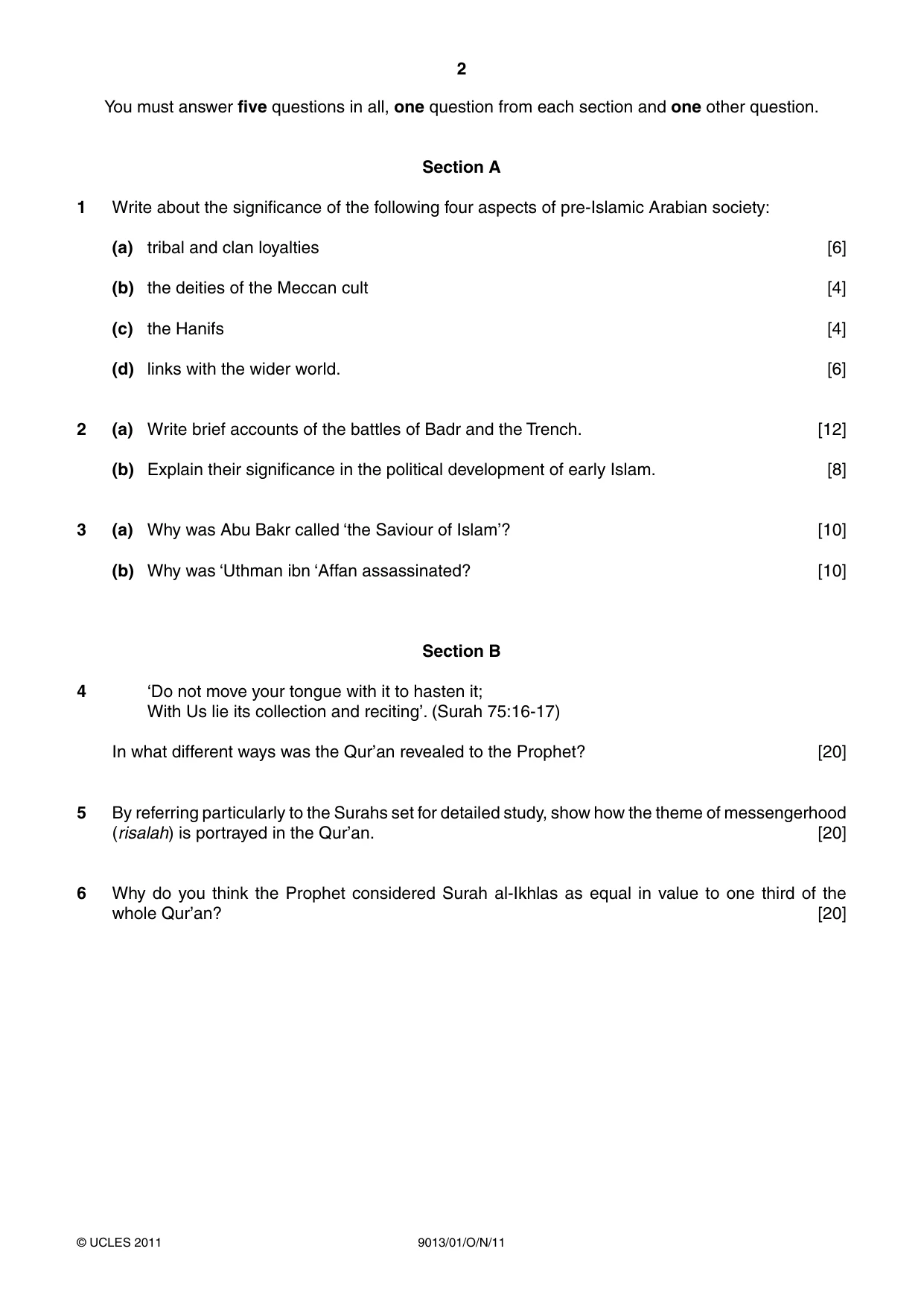
2 9013/01/O/N/11 © UCLES 2011 You must answer five questions in all, one question from each section and one other question. Section A 1 Write about the significance of the following four aspects of pre-Islamic Arabian society: (a) tribal and clan loyalties [6] (b) the deities of the Meccan cult [4] (c) the Hanifs [4] (d) links with the wider world. [6] 2 (a) Write brief accounts of the battles of Badr and the Trench. [12] (b) Explain their significance in the political development of early Islam. [8] 3 (a) Why was Abu Bakr called ‘the Saviour of Islam’? [10] (b) Why was ‘Uthman ibn ‘Affan assassinated? [10] Section B 4 ‘Do not move your tongue with it to hasten it; With Us lie its collection and reciting’. (Surah 75:16-17) In what different ways was the Qur’an revealed to the Prophet? [20] 5 By referring particularly to the Surahs set for detailed study, show how the theme of messengerhood (risalah) is portrayed in the Qur’an. [20] 6 Why do you think the Prophet considered Surah al-Ikhlas as equal in value to one third of the whole Qur’an? [20]
Question paper, page 3
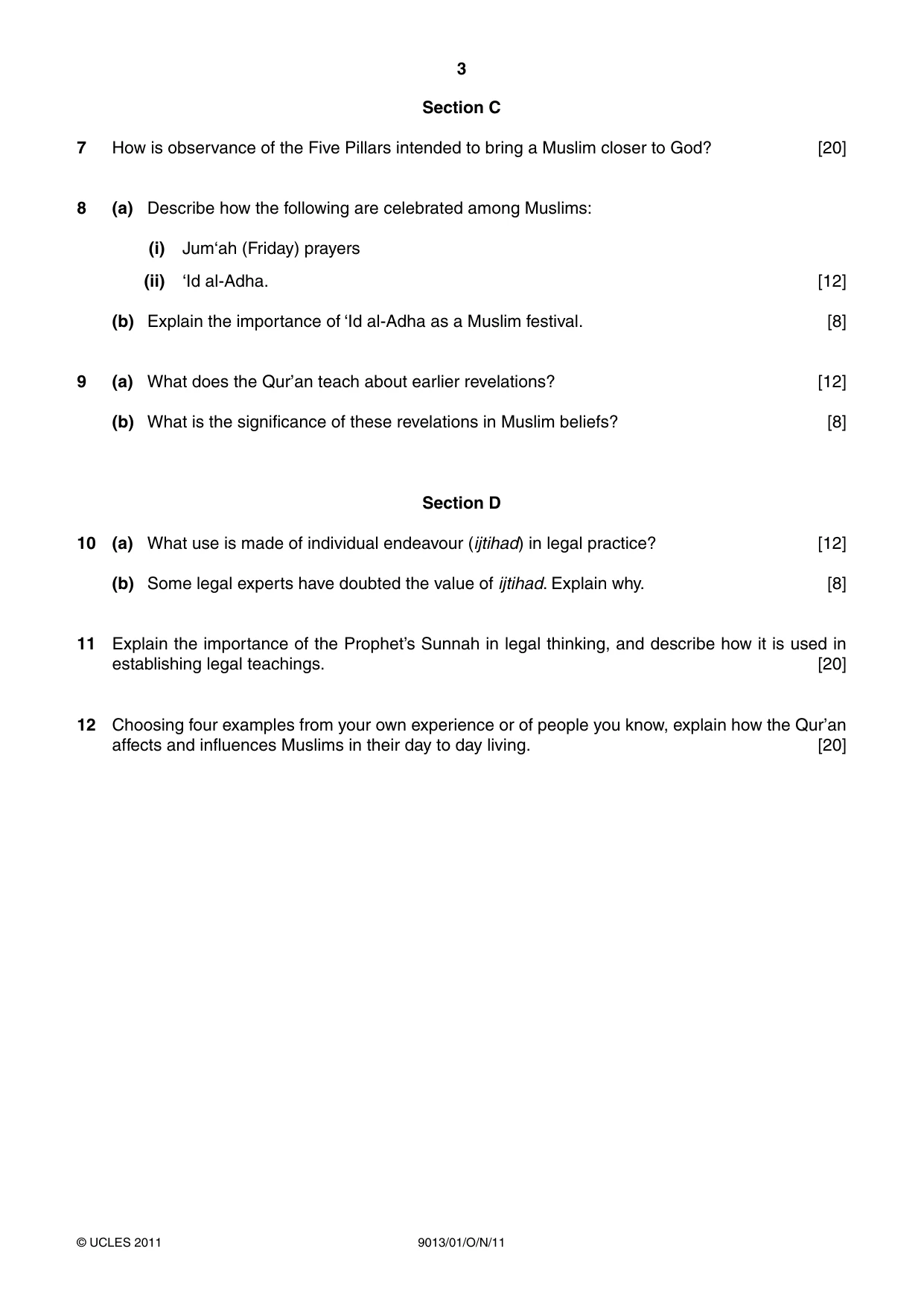
3 9013/01/O/N/11 © UCLES 2011 Section C 7 How is observance of the Five Pillars intended to bring a Muslim closer to God? [20] 8 (a) Describe how the following are celebrated among Muslims: (i) Jum‘ah (Friday) prayers (ii) ‘Id al-Adha. [12] (b) Explain the importance of ‘Id al-Adha as a Muslim festival. [8] 9 (a) What does the Qur’an teach about earlier revelations? [12] (b) What is the significance of these revelations in Muslim beliefs? [8] Section D 10 (a) What use is made of individual endeavour (ijtihad) in legal practice? [12] (b) Some legal experts have doubted the value of ijtihad. Explain why. [8] 11 Explain the importance of the Prophet’s Sunnah in legal thinking, and describe how it is used in establishing legal teachings. [20] 12 Choosing four examples from your own experience or of people you know, explain how the Qur’an affects and influences Muslims in their day to day living. [20]
Question paper, page 4
4 9013/01/O/N/11 © UCLES 2011 BLANK PAGE Permission to reproduce items where third-party owned material protected by copyright is included has been sought and cleared where possible. Every reasonable effort has been made by the publisher (UCLES) to trace copyright holders, but if any items requiring clearance have unwittingly been included, the publisher will be pleased to make amends at the earliest possible opportunity. University of Cambridge International Examinations is part of the Cambridge Assessment Group. Cambridge Assessment is the brand name of University of Cambridge Local Examinations Syndicate (UCLES), which is itself a department of the University of Cambridge.
Mark scheme, page 1
UNIVERSITY OF CAMBRIDGE INTERNATIONAL EXAMINATIONS GCE Advanced Level MARK SCHEME for the October/November 2011 question paper for the guidance of teachers 9013 ISLAMIC STUDIES 9013/01 Paper 1, maximum raw mark 100 This mark scheme is published as an aid to teachers and candidates, to indicate the requirements of the examination. It shows the basis on which Examiners were instructed to award marks. It does not indicate the details of the discussions that took place at an Examiners’ meeting before marking began, which would have considered the acceptability of alternative answers. Mark schemes must be read in conjunction with the question papers and the report on the examination. • Cambridge will not enter into discussions or correspondence in connection with these mark schemes. Cambridge is publishing the mark schemes for the October/November 2011 question papers for most IGCSE, GCE Advanced Level and Advanced Subsidiary Level syllabuses and some Ordinary Level syllabuses.
Mark scheme, page 2
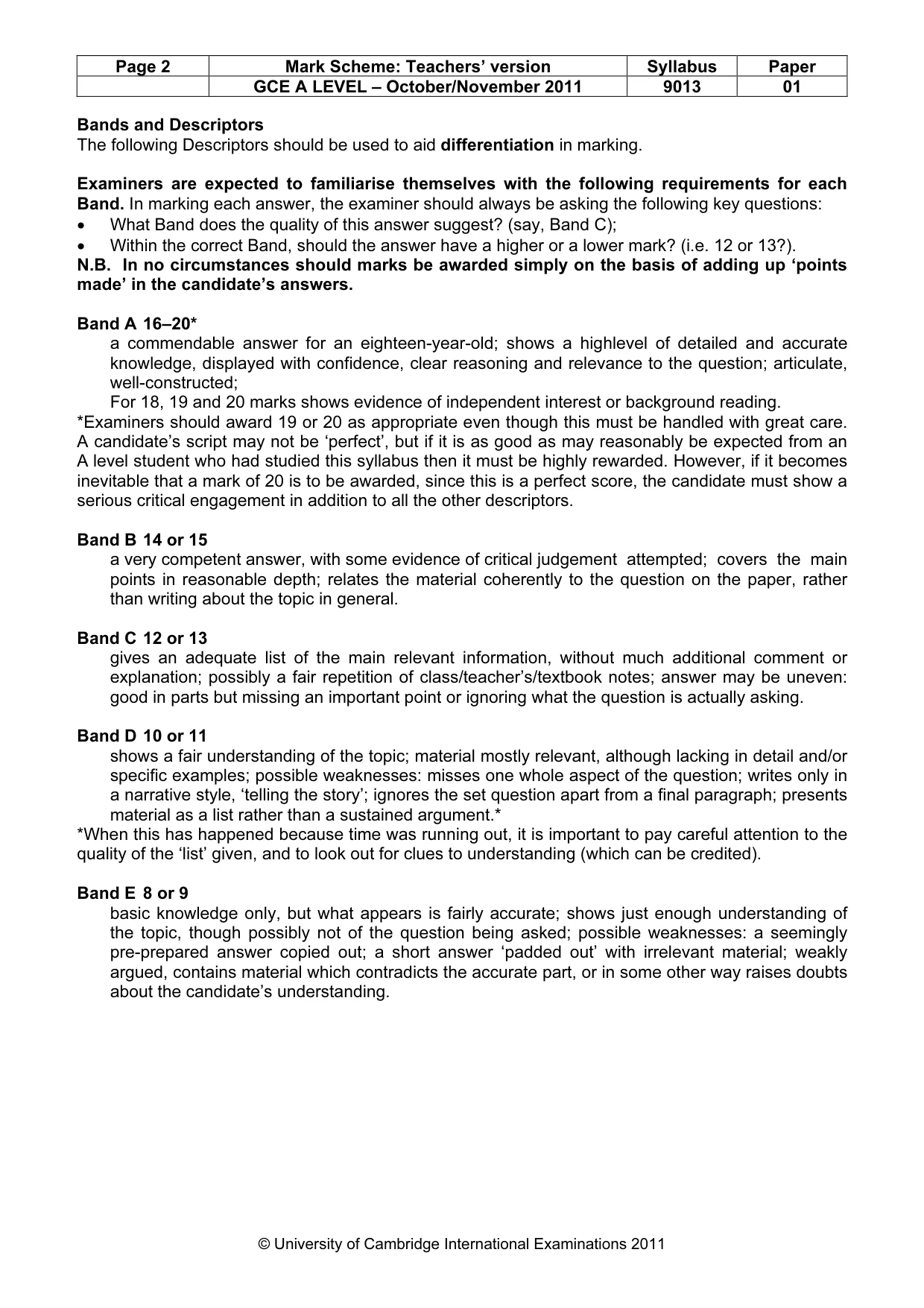
Page 2 Mark Scheme: Teachers’ version Syllabus Paper GCE A LEVEL – October/November 2011 9013 01 © University of Cambridge International Examinations 2011 Bands and Descriptors The following Descriptors should be used to aid differentiation in marking. Examiners are expected to familiarise themselves with the following requirements for each Band. In marking each answer, the examiner should always be asking the following key questions: • What Band does the quality of this answer suggest? (say, Band C); • Within the correct Band, should the answer have a higher or a lower mark? (i.e. 12 or 13?). N.B. In no circumstances should marks be awarded simply on the basis of adding up ‘points made’ in the candidate’s answers. Band A 16–20* a commendable answer for an eighteen-year-old; shows a highlevel of detailed and accurate knowledge, displayed with confidence, clear reasoning and relevance to the question; articulate, well-constructed; For 18, 19 and 20 marks shows evidence of independent interest or background reading. *Examiners should award 19 or 20 as appropriate even though this must be handled with great care. A candidate’s script may not be ‘perfect’, but if it is as good as may reasonably be expected from an A level student who had studied this syllabus then it must be highly rewarded. However, if it becomes inevitable that a mark of 20 is to be awarded, since this is a perfect score, the candidate must show a serious critical engagement in addition to all the other descriptors. Band B 14 or 15 a very competent answer, with some evidence of critical judgement attempted; covers the main points in reasonable depth; relates the material coherently to the question on the paper, rather than writing about the topic in general. Band C 12 or 13 gives an adequate list of the main relevant information, without much additional comment or explanation; possibly a fair repetition of class/teacher’s/textbook notes; answer may be uneven: good in parts but missing an important point or ignoring what the question is actually asking. Band D 10 or 11 shows a fair understanding of the topic; material mostly relevant, although lacking in detail and/or specific examples; possible weaknesses: misses one whole aspect of the question; writes only in a narrative style, ‘telling the story’; ignores the set question apart from a final paragraph; presents material as a list rather than a sustained argument.* *When this has happened because time was running out, it is important to pay careful attention to the quality of the ‘list’ given, and to look out for clues to understanding (which can be credited). Band E 8 or 9 basic knowledge only, but what appears is fairly accurate; shows just enough understanding of the topic, though possibly not of the question being asked; possible weaknesses: a seemingly pre-prepared answer copied out; a short answer ‘padded out’ with irrelevant material; weakly argued, contains material which contradicts the accurate part, or in some other way raises doubts about the candidate’s understanding.
Mark scheme, page 3
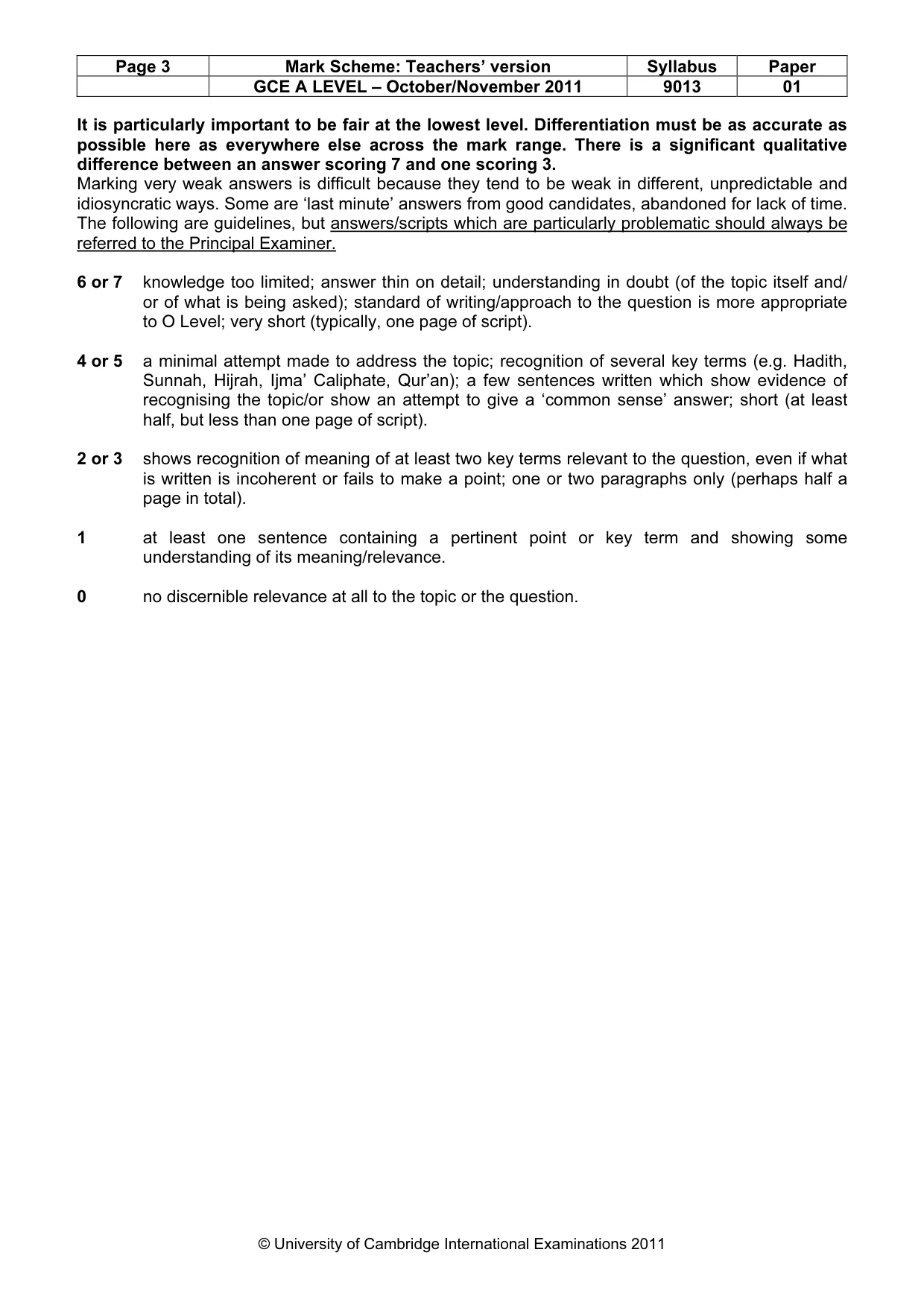
Page 3 Mark Scheme: Teachers’ version Syllabus Paper GCE A LEVEL – October/November 2011 9013 01 © University of Cambridge International Examinations 2011 It is particularly important to be fair at the lowest level. Differentiation must be as accurate as possible here as everywhere else across the mark range. There is a significant qualitative difference between an answer scoring 7 and one scoring 3. Marking very weak answers is difficult because they tend to be weak in different, unpredictable and idiosyncratic ways. Some are ‘last minute’ answers from good candidates, abandoned for lack of time. The following are guidelines, but answers/scripts which are particularly problematic should always be referred to the Principal Examiner. 6 or 7 knowledge too limited; answer thin on detail; understanding in doubt (of the topic itself and/ or of what is being asked); standard of writing/approach to the question is more appropriate to O Level; very short (typically, one page of script). 4 or 5 a minimal attempt made to address the topic; recognition of several key terms (e.g. Hadith, Sunnah, Hijrah, Ijma’ Caliphate, Qur’an); a few sentences written which show evidence of recognising the topic/or show an attempt to give a ‘common sense’ answer; short (at least half, but less than one page of script). 2 or 3 shows recognition of meaning of at least two key terms relevant to the question, even if what is written is incoherent or fails to make a point; one or two paragraphs only (perhaps half a page in total). 1 at least one sentence containing a pertinent point or key term and showing some understanding of its meaning/relevance. 0 no discernible relevance at all to the topic or the question.
Mark scheme, page 4
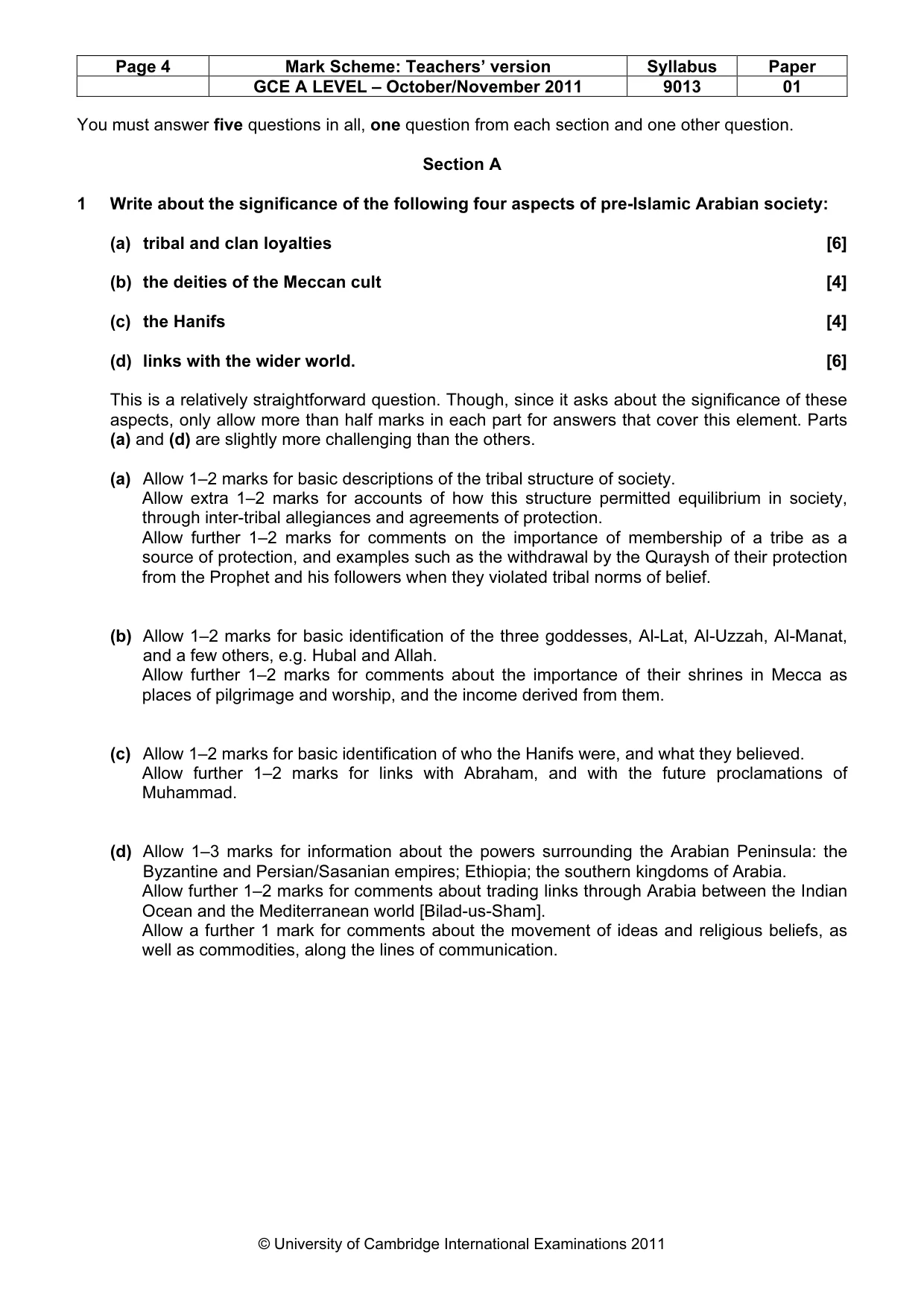
Page 4 Mark Scheme: Teachers’ version Syllabus Paper GCE A LEVEL – October/November 2011 9013 01 © University of Cambridge International Examinations 2011 You must answer five questions in all, one question from each section and one other question. Section A 1 Write about the significance of the following four aspects of pre-Islamic Arabian society: (a) tribal and clan loyalties [6] (b) the deities of the Meccan cult [4] (c) the Hanifs [4] (d) links with the wider world. [6] This is a relatively straightforward question. Though, since it asks about the significance of these aspects, only allow more than half marks in each part for answers that cover this element. Parts (a) and (d) are slightly more challenging than the others. (a) Allow 1–2 marks for basic descriptions of the tribal structure of society. Allow extra 1–2 marks for accounts of how this structure permitted equilibrium in society, through inter-tribal allegiances and agreements of protection. Allow further 1–2 marks for comments on the importance of membership of a tribe as a source of protection, and examples such as the withdrawal by the Quraysh of their protection from the Prophet and his followers when they violated tribal norms of belief. (b) Allow 1–2 marks for basic identification of the three goddesses, Al-Lat, Al-Uzzah, Al-Manat, and a few others, e.g. Hubal and Allah. Allow further 1–2 marks for comments about the importance of their shrines in Mecca as places of pilgrimage and worship, and the income derived from them. (c) Allow 1–2 marks for basic identification of who the Hanifs were, and what they believed. Allow further 1–2 marks for links with Abraham, and with the future proclamations of Muhammad. (d) Allow 1–3 marks for information about the powers surrounding the Arabian Peninsula: the Byzantine and Persian/Sasanian empires; Ethiopia; the southern kingdoms of Arabia. Allow further 1–2 marks for comments about trading links through Arabia between the Indian Ocean and the Mediterranean world [Bilad-us-Sham]. Allow a further 1 mark for comments about the movement of ideas and religious beliefs, as well as commodities, along the lines of communication.
Mark scheme, page 5
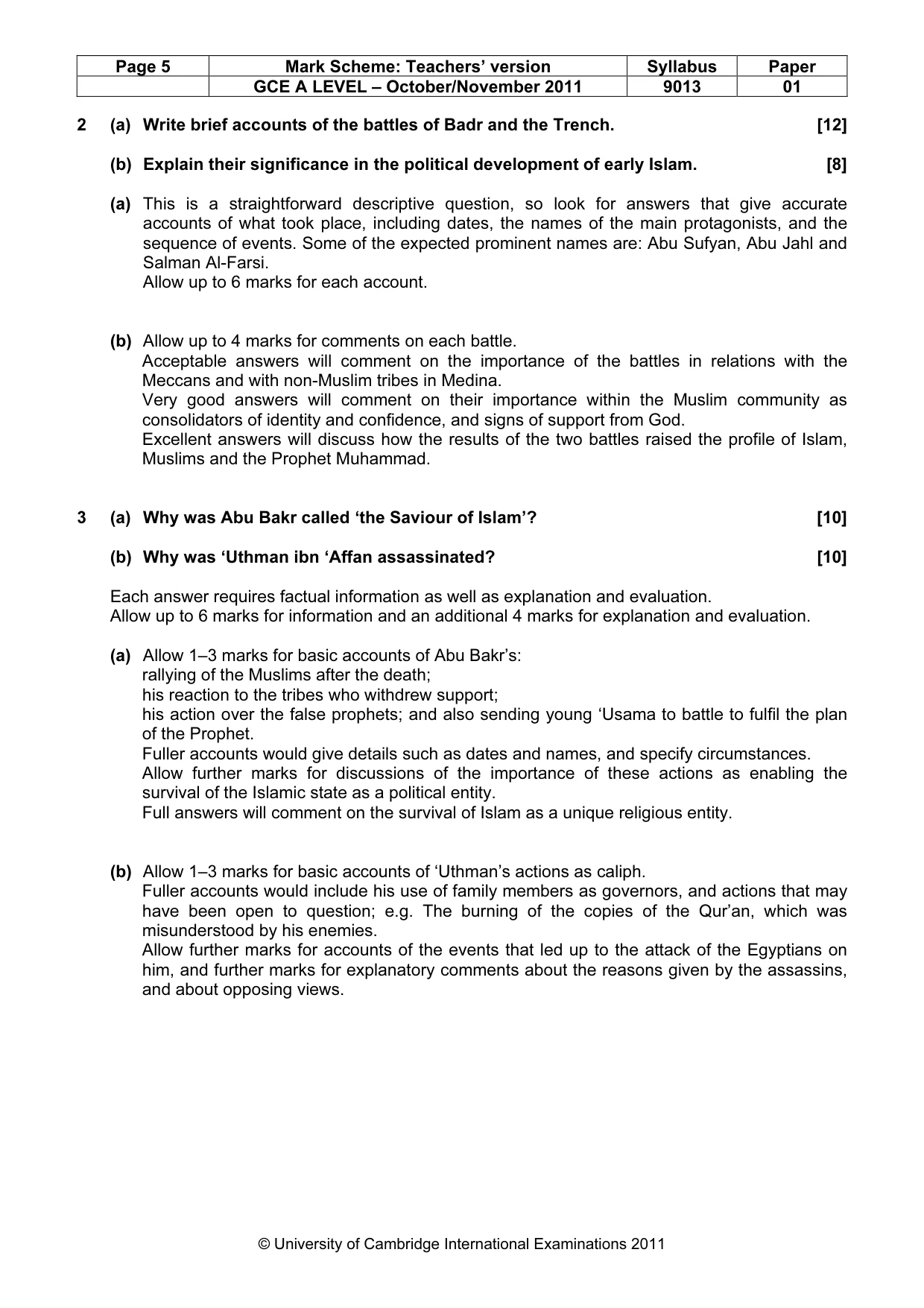
Page 5 Mark Scheme: Teachers’ version Syllabus Paper GCE A LEVEL – October/November 2011 9013 01 © University of Cambridge International Examinations 2011 2 (a) Write brief accounts of the battles of Badr and the Trench. [12] (b) Explain their significance in the political development of early Islam. [8] (a) This is a straightforward descriptive question, so look for answers that give accurate accounts of what took place, including dates, the names of the main protagonists, and the sequence of events. Some of the expected prominent names are: Abu Sufyan, Abu Jahl and Salman Al-Farsi. Allow up to 6 marks for each account. (b) Allow up to 4 marks for comments on each battle. Acceptable answers will comment on the importance of the battles in relations with the Meccans and with non-Muslim tribes in Medina. Very good answers will comment on their importance within the Muslim community as consolidators of identity and confidence, and signs of support from God. Excellent answers will discuss how the results of the two battles raised the profile of Islam, Muslims and the Prophet Muhammad. 3 (a) Why was Abu Bakr called ‘the Saviour of Islam’? [10] (b) Why was ‘Uthman ibn ‘Affan assassinated? [10] Each answer requires factual information as well as explanation and evaluation. Allow up to 6 marks for information and an additional 4 marks for explanation and evaluation. (a) Allow 1–3 marks for basic accounts of Abu Bakr’s: rallying of the Muslims after the death; his reaction to the tribes who withdrew support; his action over the false prophets; and also sending young ‘Usama to battle to fulfil the plan of the Prophet. Fuller accounts would give details such as dates and names, and specify circumstances. Allow further marks for discussions of the importance of these actions as enabling the survival of the Islamic state as a political entity. Full answers will comment on the survival of Islam as a unique religious entity. (b) Allow 1–3 marks for basic accounts of ‘Uthman’s actions as caliph. Fuller accounts would include his use of family members as governors, and actions that may have been open to question; e.g. The burning of the copies of the Qur’an, which was misunderstood by his enemies. Allow further marks for accounts of the events that led up to the attack of the Egyptians on him, and further marks for explanatory comments about the reasons given by the assassins, and about opposing views.
Mark scheme, page 6
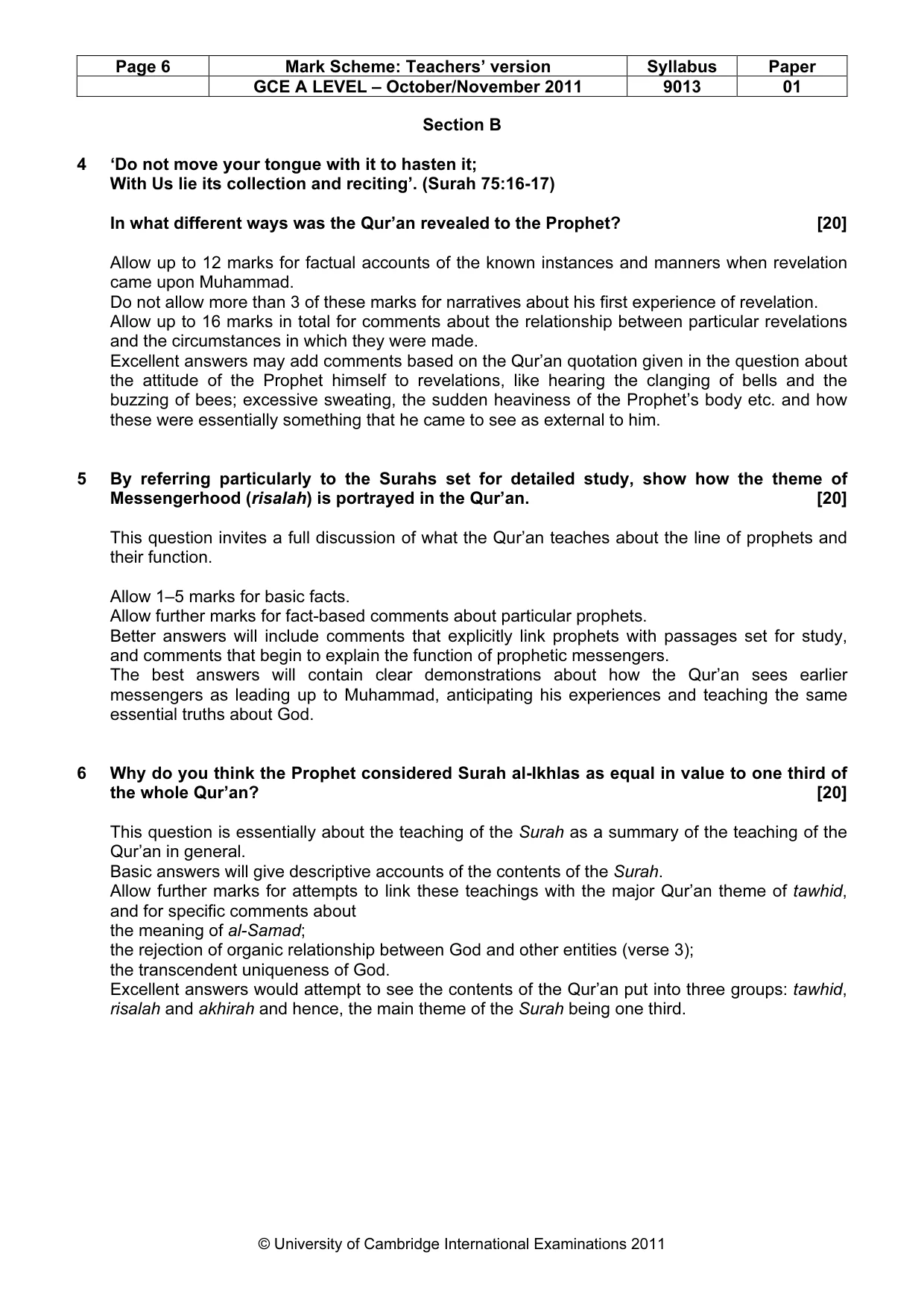
Page 6 Mark Scheme: Teachers’ version Syllabus Paper GCE A LEVEL – October/November 2011 9013 01 © University of Cambridge International Examinations 2011 Section B 4 ‘Do not move your tongue with it to hasten it; With Us lie its collection and reciting’. (Surah 75:16-17) In what different ways was the Qur’an revealed to the Prophet? [20] Allow up to 12 marks for factual accounts of the known instances and manners when revelation came upon Muhammad. Do not allow more than 3 of these marks for narratives about his first experience of revelation. Allow up to 16 marks in total for comments about the relationship between particular revelations and the circumstances in which they were made. Excellent answers may add comments based on the Qur’an quotation given in the question about the attitude of the Prophet himself to revelations, like hearing the clanging of bells and the buzzing of bees; excessive sweating, the sudden heaviness of the Prophet’s body etc. and how these were essentially something that he came to see as external to him. 5 By referring particularly to the Surahs set for detailed study, show how the theme of Messengerhood (risalah) is portrayed in the Qur’an. [20] This question invites a full discussion of what the Qur’an teaches about the line of prophets and their function. Allow 1–5 marks for basic facts. Allow further marks for fact-based comments about particular prophets. Better answers will include comments that explicitly link prophets with passages set for study, and comments that begin to explain the function of prophetic messengers. The best answers will contain clear demonstrations about how the Qur’an sees earlier messengers as leading up to Muhammad, anticipating his experiences and teaching the same essential truths about God. 6 Why do you think the Prophet considered Surah al-Ikhlas as equal in value to one third of the whole Qur’an? [20] This question is essentially about the teaching of the Surah as a summary of the teaching of the Qur’an in general. Basic answers will give descriptive accounts of the contents of the Surah. Allow further marks for attempts to link these teachings with the major Qur’an theme of tawhid, and for specific comments about the meaning of al-Samad; the rejection of organic relationship between God and other entities (verse 3); the transcendent uniqueness of God. Excellent answers would attempt to see the contents of the Qur’an put into three groups: tawhid, risalah and akhirah and hence, the main theme of the Surah being one third.
Mark scheme, page 7
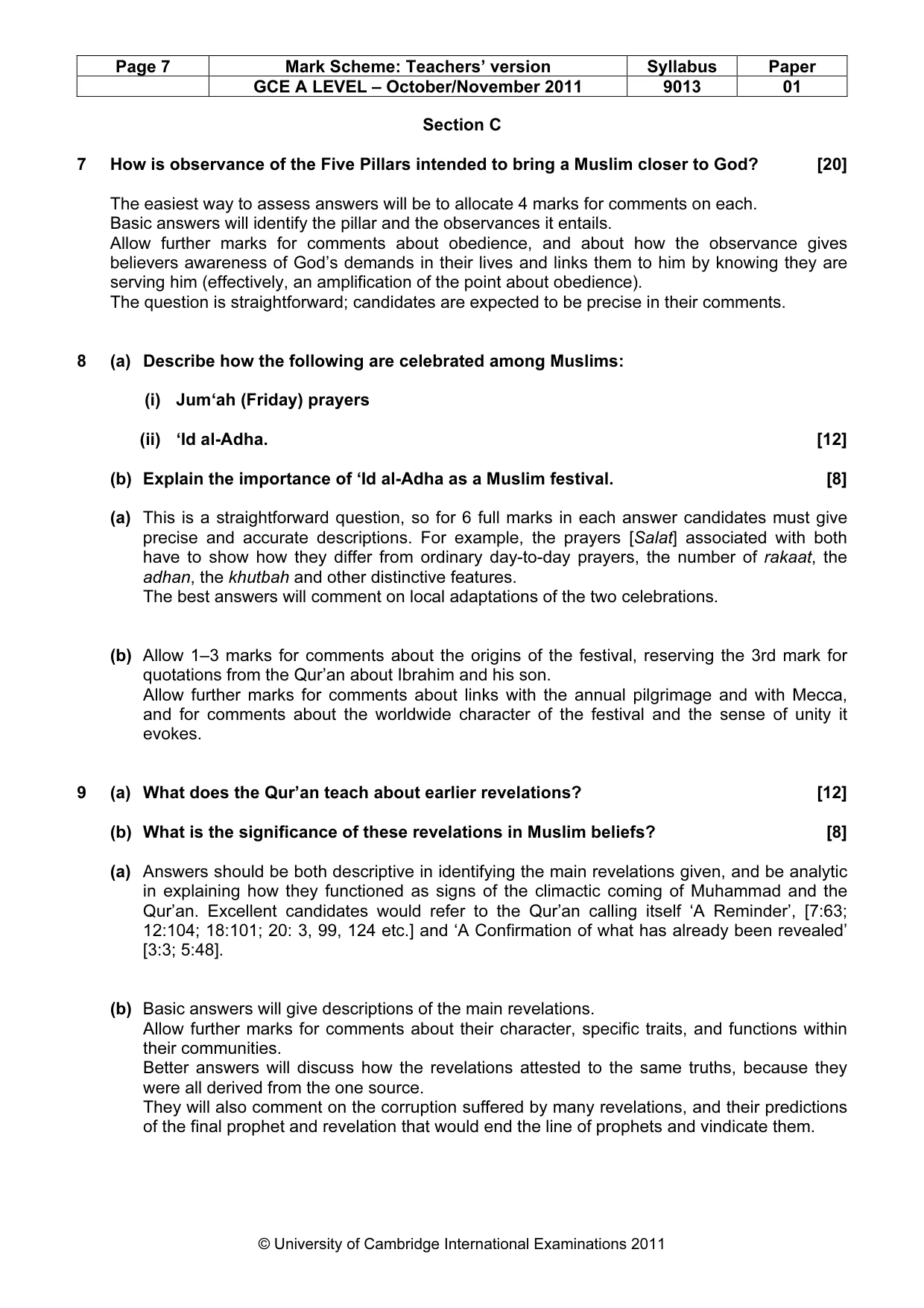
Page 7 Mark Scheme: Teachers’ version Syllabus Paper GCE A LEVEL – October/November 2011 9013 01 © University of Cambridge International Examinations 2011 Section C 7 How is observance of the Five Pillars intended to bring a Muslim closer to God? [20] The easiest way to assess answers will be to allocate 4 marks for comments on each. Basic answers will identify the pillar and the observances it entails. Allow further marks for comments about obedience, and about how the observance gives believers awareness of God’s demands in their lives and links them to him by knowing they are serving him (effectively, an amplification of the point about obedience). The question is straightforward; candidates are expected to be precise in their comments. 8 (a) Describe how the following are celebrated among Muslims: (i) Jum‘ah (Friday) prayers (ii) ‘Id al-Adha. [12] (b) Explain the importance of ‘Id al-Adha as a Muslim festival. [8] (a) This is a straightforward question, so for 6 full marks in each answer candidates must give precise and accurate descriptions. For example, the prayers [Salat] associated with both have to show how they differ from ordinary day-to-day prayers, the number of rakaat, the adhan, the khutbah and other distinctive features. The best answers will comment on local adaptations of the two celebrations. (b) Allow 1–3 marks for comments about the origins of the festival, reserving the 3rd mark for quotations from the Qur’an about Ibrahim and his son. Allow further marks for comments about links with the annual pilgrimage and with Mecca, and for comments about the worldwide character of the festival and the sense of unity it evokes. 9 (a) What does the Qur’an teach about earlier revelations? [12] (b) What is the significance of these revelations in Muslim beliefs? [8] (a) Answers should be both descriptive in identifying the main revelations given, and be analytic in explaining how they functioned as signs of the climactic coming of Muhammad and the Qur’an. Excellent candidates would refer to the Qur’an calling itself ‘A Reminder’, [7:63; 12:104; 18:101; 20: 3, 99, 124 etc.] and ‘A Confirmation of what has already been revealed’ [3:3; 5:48]. (b) Basic answers will give descriptions of the main revelations. Allow further marks for comments about their character, specific traits, and functions within their communities. Better answers will discuss how the revelations attested to the same truths, because they were all derived from the one source. They will also comment on the corruption suffered by many revelations, and their predictions of the final prophet and revelation that would end the line of prophets and vindicate them.
Mark scheme, page 8
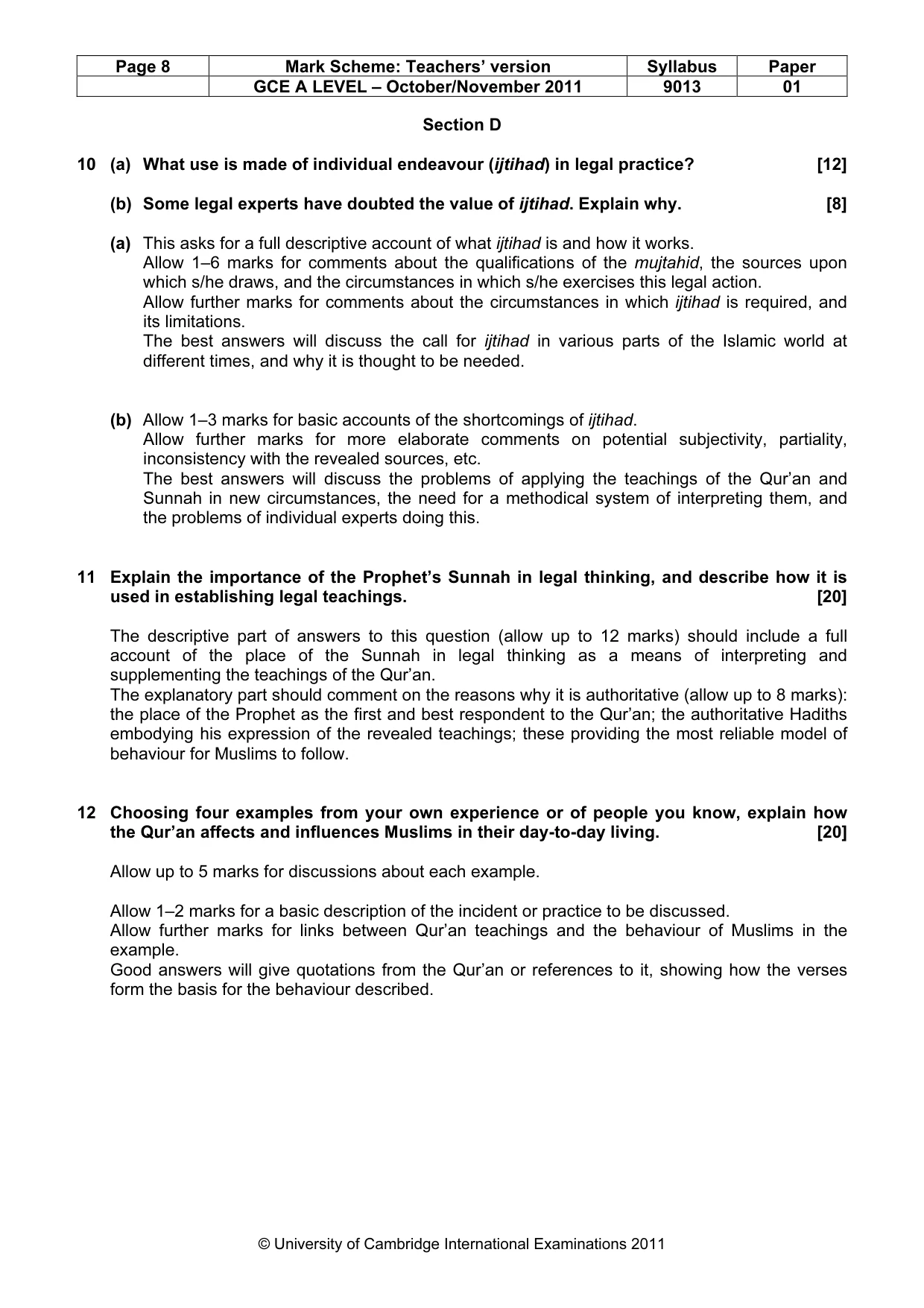
Page 8 Mark Scheme: Teachers’ version Syllabus Paper GCE A LEVEL – October/November 2011 9013 01 © University of Cambridge International Examinations 2011 Section D 10 (a) What use is made of individual endeavour (ijtihad) in legal practice? [12] (b) Some legal experts have doubted the value of ijtihad. Explain why. [8] (a) This asks for a full descriptive account of what ijtihad is and how it works. Allow 1–6 marks for comments about the qualifications of the mujtahid, the sources upon which s/he draws, and the circumstances in which s/he exercises this legal action. Allow further marks for comments about the circumstances in which ijtihad is required, and its limitations. The best answers will discuss the call for ijtihad in various parts of the Islamic world at different times, and why it is thought to be needed. (b) Allow 1–3 marks for basic accounts of the shortcomings of ijtihad. Allow further marks for more elaborate comments on potential subjectivity, partiality, inconsistency with the revealed sources, etc. The best answers will discuss the problems of applying the teachings of the Qur’an and Sunnah in new circumstances, the need for a methodical system of interpreting them, and the problems of individual experts doing this. 11 Explain the importance of the Prophet’s Sunnah in legal thinking, and describe how it is used in establishing legal teachings. [20] The descriptive part of answers to this question (allow up to 12 marks) should include a full account of the place of the Sunnah in legal thinking as a means of interpreting and supplementing the teachings of the Qur’an. The explanatory part should comment on the reasons why it is authoritative (allow up to 8 marks): the place of the Prophet as the first and best respondent to the Qur’an; the authoritative Hadiths embodying his expression of the revealed teachings; these providing the most reliable model of behaviour for Muslims to follow. 12 Choosing four examples from your own experience or of people you know, explain how the Qur’an affects and influences Muslims in their day-to-day living. [20] Allow up to 5 marks for discussions about each example. Allow 1–2 marks for a basic description of the incident or practice to be discussed. Allow further marks for links between Qur’an teachings and the behaviour of Muslims in the example. Good answers will give quotations from the Qur’an or references to it, showing how the verses form the basis for the behaviour described.
What you needed in this session
Cambridge’s own grade thresholds for 2011 Oct/Nov, Paper 1 · Variant 1. A higher threshold means an easier paper — the bar moves with how the cohort did.