Cambridge A Level History (pre-2015) 9697 — 2014 Oct/Nov Paper 2 · Variant 1
9697/21/O/N/14 · 100 marks · ≈113 min
The question paper and its mark scheme, free to read here and free to download. This is Cambridge’s own paper, exactly as it was sat.
Question paper4 pages
Mark scheme8 pages
Answers below. Sit the paper first if you are practising.
Paper as text
Question paper, page 1
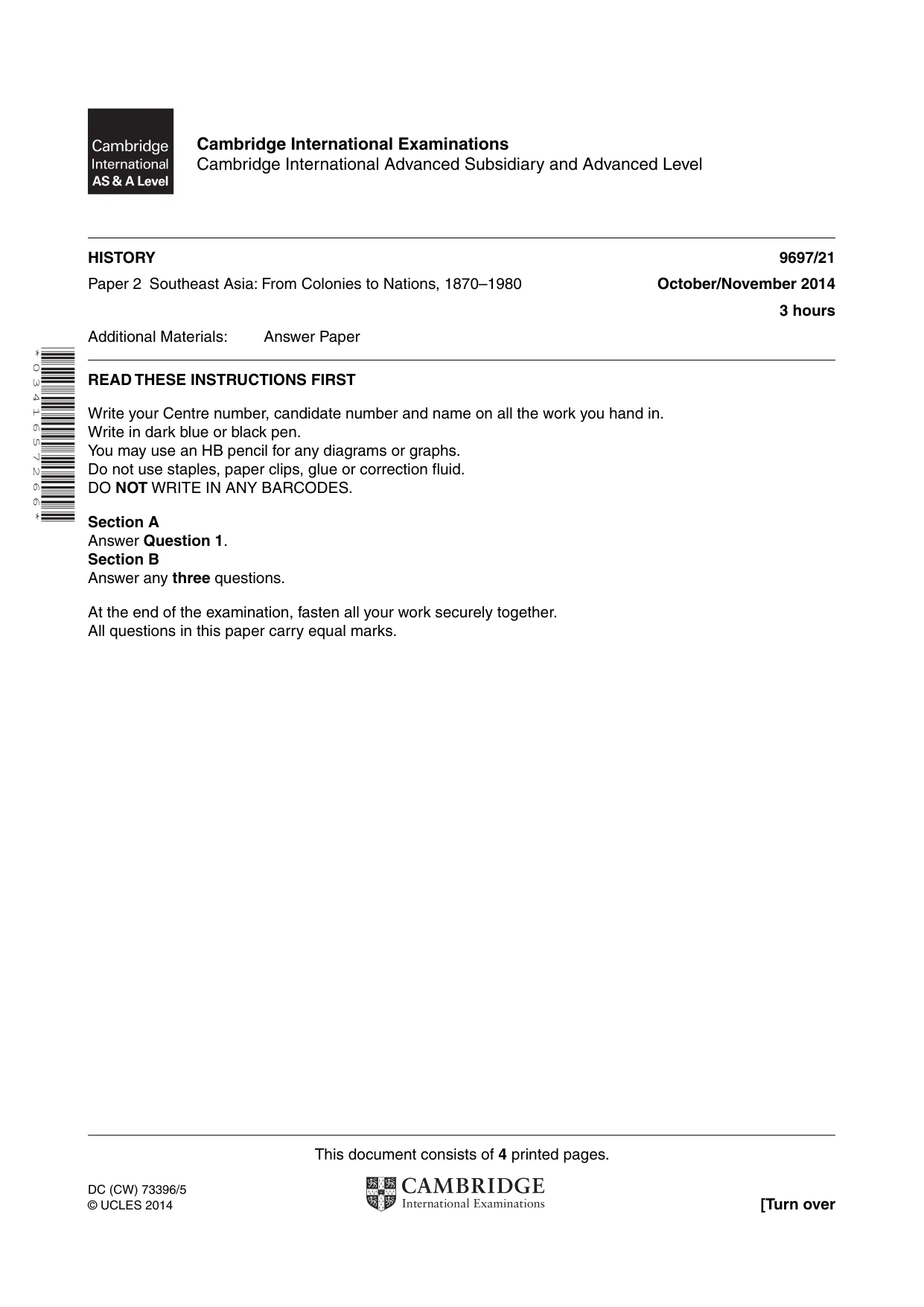
This document consists of 4 printed pages. DC (CW) 73396/5 © UCLES 2014 [Turn over * 0 3 4 1 6 5 7 2 6 6 * HISTORY 9697/21 Paper 2 Southeast Asia: From Colonies to Nations, 1870–1980 October/November 2014 3 hours Additional Materials: Answer Paper READ THESE INSTRUCTIONS FIRST Write your Centre number, candidate number and name on all the work you hand in. Write in dark blue or black pen. You may use an HB pencil for any diagrams or graphs. Do not use staples, paper clips, glue or correction fluid. DO NOT WRITE IN ANY BARCODES. Section A Answer Question 1. Section B Answer any three questions. At the end of the examination, fasten all your work securely together. All questions in this paper carry equal marks. Cambridge International Examinations Cambridge International Advanced Subsidiary and Advanced Level
Question paper, page 2
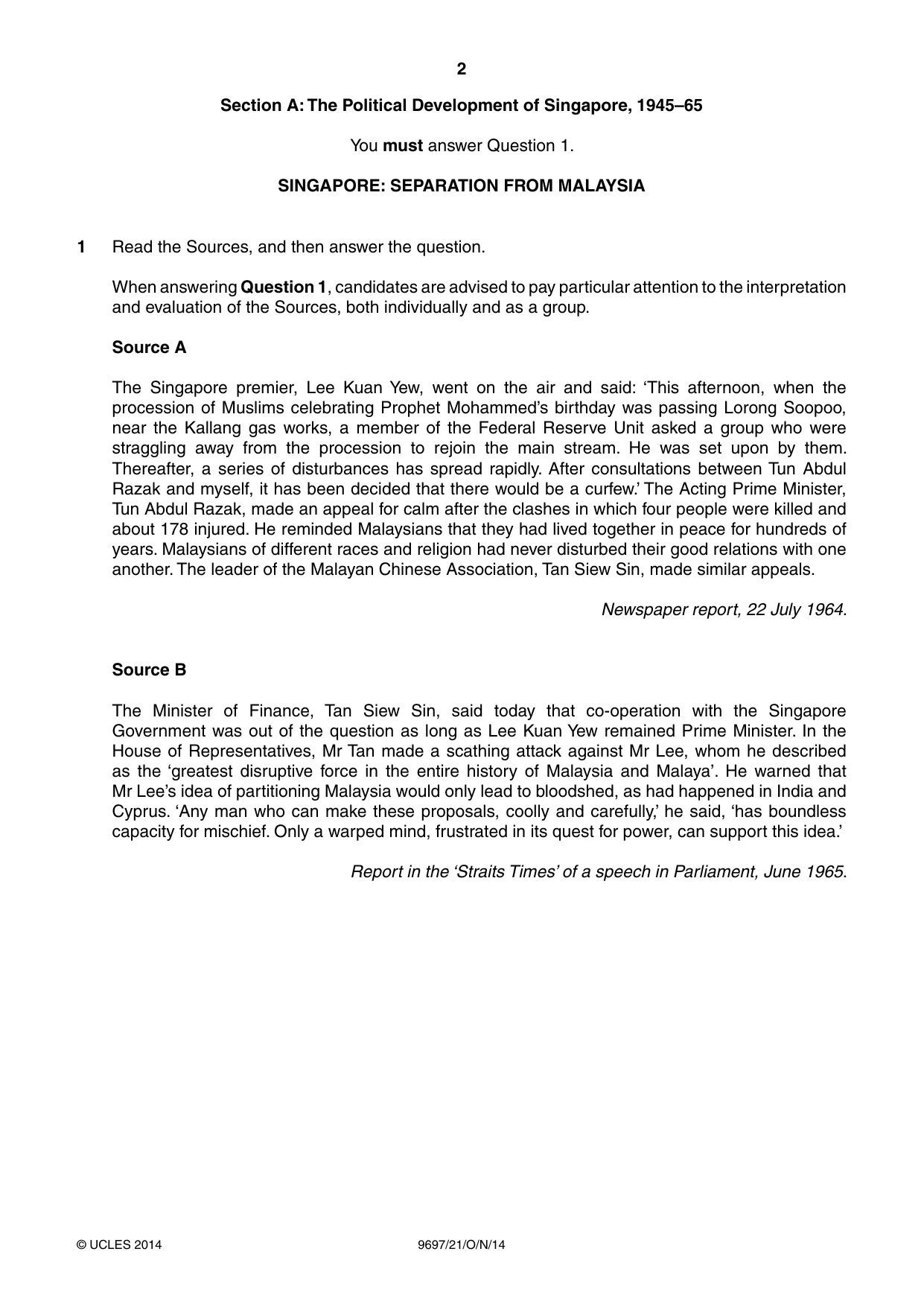
2 9697/21/O/N/14 © UCLES 2014 Section A: The Political Development of Singapore, 1945–65 You must answer Question 1. SINGAPORE: SEPARATION FROM MALAYSIA 1 Read the Sources, and then answer the question. When answering Question 1, candidates are advised to pay particular attention to the interpretation and evaluation of the Sources, both individually and as a group. Source A The Singapore premier, Lee Kuan Yew, went on the air and said: ‘This afternoon, when the procession of Muslims celebrating Prophet Mohammed’s birthday was passing Lorong Soopoo, near the Kallang gas works, a member of the Federal Reserve Unit asked a group who were straggling away from the procession to rejoin the main stream. He was set upon by them. Thereafter, a series of disturbances has spread rapidly. After consultations between Tun Abdul Razak and myself, it has been decided that there would be a curfew.’ The Acting Prime Minister, Tun Abdul Razak, made an appeal for calm after the clashes in which four people were killed and about 178 injured. He reminded Malaysians that they had lived together in peace for hundreds of years. Malaysians of different races and religion had never disturbed their good relations with one another. The leader of the Malayan Chinese Association, Tan Siew Sin, made similar appeals. Newspaper report, 22 July 1964. Source B The Minister of Finance, Tan Siew Sin, said today that co-operation with the Singapore Government was out of the question as long as Lee Kuan Yew remained Prime Minister. In the House of Representatives, Mr Tan made a scathing attack against Mr Lee, whom he described as the ‘greatest disruptive force in the entire history of Malaysia and Malaya’. He warned that Mr Lee’s idea of partitioning Malaysia would only lead to bloodshed, as had happened in India and Cyprus. ‘Any man who can make these proposals, coolly and carefully,’ he said, ‘has boundless capacity for mischief. Only a warped mind, frustrated in its quest for power, can support this idea.’ Report in the ‘Straits Times’ of a speech in Parliament, June 1965.
Question paper, page 3
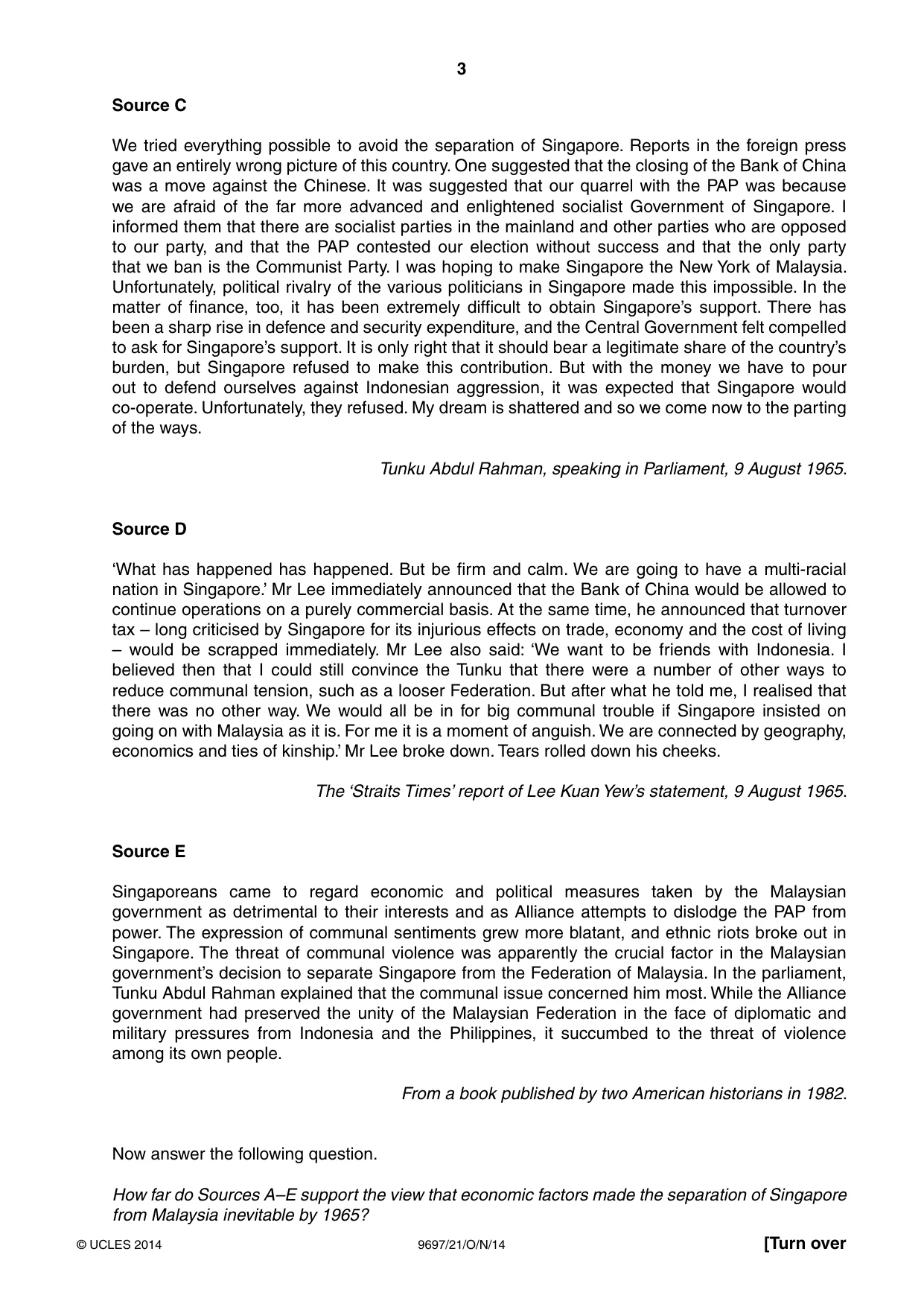
3 9697/21/O/N/14 © UCLES 2014 [Turn over Source C We tried everything possible to avoid the separation of Singapore. Reports in the foreign press gave an entirely wrong picture of this country. One suggested that the closing of the Bank of China was a move against the Chinese. It was suggested that our quarrel with the PAP was because we are afraid of the far more advanced and enlightened socialist Government of Singapore. I informed them that there are socialist parties in the mainland and other parties who are opposed to our party, and that the PAP contested our election without success and that the only party that we ban is the Communist Party. I was hoping to make Singapore the New York of Malaysia. Unfortunately, political rivalry of the various politicians in Singapore made this impossible. In the matter of finance, too, it has been extremely difficult to obtain Singapore’s support. There has been a sharp rise in defence and security expenditure, and the Central Government felt compelled to ask for Singapore’s support. It is only right that it should bear a legitimate share of the country’s burden, but Singapore refused to make this contribution. But with the money we have to pour out to defend ourselves against Indonesian aggression, it was expected that Singapore would co-operate. Unfortunately, they refused. My dream is shattered and so we come now to the parting of the ways. Tunku Abdul Rahman, speaking in Parliament, 9 August 1965. Source D ‘What has happened has happened. But be firm and calm. We are going to have a multi-racial nation in Singapore.’ Mr Lee immediately announced that the Bank of China would be allowed to continue operations on a purely commercial basis. At the same time, he announced that turnover tax – long criticised by Singapore for its injurious effects on trade, economy and the cost of living – would be scrapped immediately. Mr Lee also said: ‘We want to be friends with Indonesia. I believed then that I could still convince the Tunku that there were a number of other ways to reduce communal tension, such as a looser Federation. But after what he told me, I realised that there was no other way. We would all be in for big communal trouble if Singapore insisted on going on with Malaysia as it is. For me it is a moment of anguish. We are connected by geography, economics and ties of kinship.’ Mr Lee broke down. Tears rolled down his cheeks. The ‘Straits Times’ report of Lee Kuan Yew’s statement, 9 August 1965. Source E Singaporeans came to regard economic and political measures taken by the Malaysian government as detrimental to their interests and as Alliance attempts to dislodge the PAP from power. The expression of communal sentiments grew more blatant, and ethnic riots broke out in Singapore. The threat of communal violence was apparently the crucial factor in the Malaysian government’s decision to separate Singapore from the Federation of Malaysia. In the parliament, Tunku Abdul Rahman explained that the communal issue concerned him most. While the Alliance government had preserved the unity of the Malaysian Federation in the face of diplomatic and military pressures from Indonesia and the Philippines, it succumbed to the threat of violence among its own people. From a book published by two American historians in 1982. Now answer the following question. How far do Sources A–E support the view that economic factors made the separation of Singapore from Malaysia inevitable by 1965?
Question paper, page 4
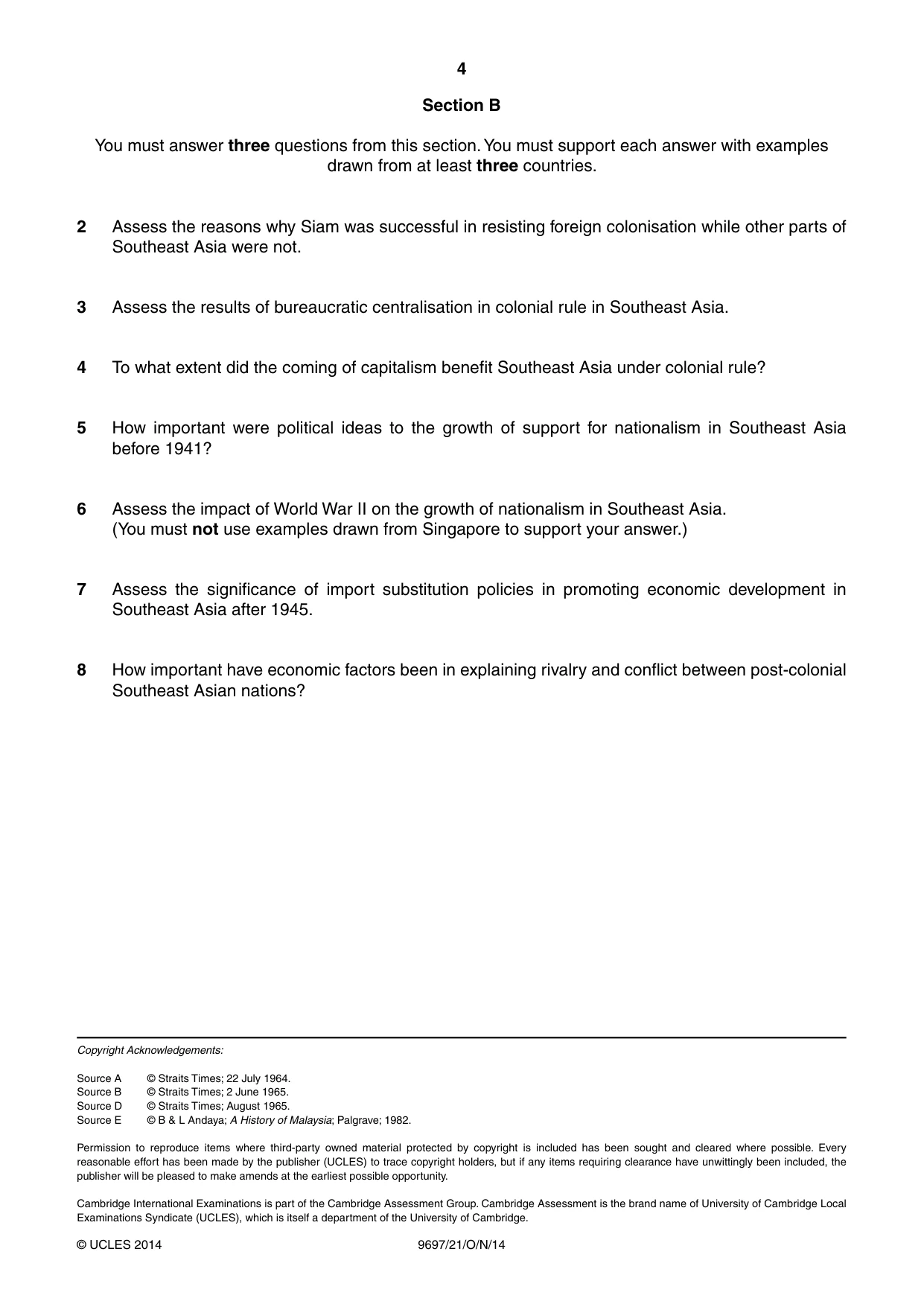
4 9697/21/O/N/14 © UCLES 2014 Section B You must answer three questions from this section. You must support each answer with examples drawn from at least three countries. 2 Assess the reasons why Siam was successful in resisting foreign colonisation while other parts of Southeast Asia were not. 3 Assess the results of bureaucratic centralisation in colonial rule in Southeast Asia. 4 To what extent did the coming of capitalism benefit Southeast Asia under colonial rule? 5 How important were political ideas to the growth of support for nationalism in Southeast Asia before 1941? 6 Assess the impact of World War II on the growth of nationalism in Southeast Asia. (You must not use examples drawn from Singapore to support your answer.) 7 Assess the significance of import substitution policies in promoting economic development in Southeast Asia after 1945. 8 How important have economic factors been in explaining rivalry and conflict between post-colonial Southeast Asian nations? Copyright Acknowledgements: Source A © Straits Times; 22 July 1964. Source B © Straits Times; 2 June 1965. Source D © Straits Times; August 1965. Source E © B & L Andaya; A History of Malaysia; Palgrave; 1982. Permission to reproduce items where third-party owned material protected by copyright is included has been sought and cleared where possible. Every reasonable effort has been made by the publisher (UCLES) to trace copyright holders, but if any items requiring clearance have unwittingly been included, the publisher will be pleased to make amends at the earliest possible opportunity. Cambridge International Examinations is part of the Cambridge Assessment Group. Cambridge Assessment is the brand name of University of Cambridge Local Examinations Syndicate (UCLES), which is itself a department of the University of Cambridge.
Mark scheme, page 1
® IGCSE is the registered trademark of Cambridge International Examinations. CAMBRIDGE INTERNATIONAL EXAMINATIONS Cambridge International Advanced Subsidiary and Advanced Level MARK SCHEME for the October/November 2014 series 9697 HISTORY 9697/21 Paper 2, maximum raw mark 100 This mark scheme is published as an aid to teachers and candidates, to indicate the requirements of the examination. It shows the basis on which Examiners were instructed to award marks. It does not indicate the details of the discussions that took place at an Examiners’ meeting before marking began, which would have considered the acceptability of alternative answers. Mark schemes should be read in conjunction with the question paper and the Principal Examiner Report for Teachers. Cambridge will not enter into discussions about these mark schemes. Cambridge is publishing the mark schemes for the October/November 2014 series for most Cambridge IGCSE®, Cambridge International A and AS Level components and some Cambridge O Level components.
Mark scheme, page 2
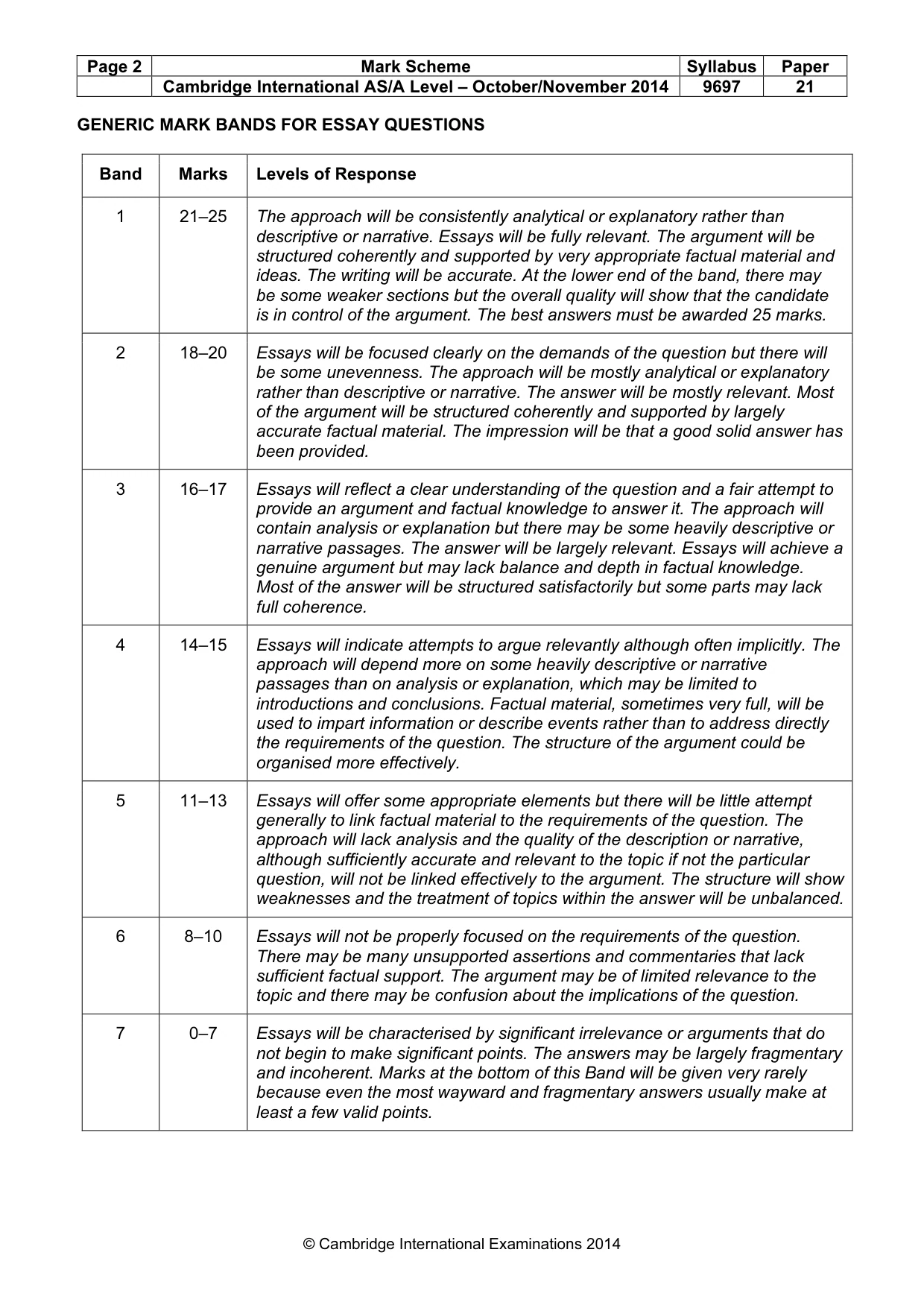
Page 2 Mark Scheme Syllabus Paper Cambridge International AS/A Level – October/November 2014 9697 21 © Cambridge International Examinations 2014 GENERIC MARK BANDS FOR ESSAY QUESTIONS Band Marks Levels of Response 1 21–25 The approach will be consistently analytical or explanatory rather than descriptive or narrative. Essays will be fully relevant. The argument will be structured coherently and supported by very appropriate factual material and ideas. The writing will be accurate. At the lower end of the band, there may be some weaker sections but the overall quality will show that the candidate is in control of the argument. The best answers must be awarded 25 marks. 2 18–20 Essays will be focused clearly on the demands of the question but there will be some unevenness. The approach will be mostly analytical or explanatory rather than descriptive or narrative. The answer will be mostly relevant. Most of the argument will be structured coherently and supported by largely accurate factual material. The impression will be that a good solid answer has been provided. 3 16–17 Essays will reflect a clear understanding of the question and a fair attempt to provide an argument and factual knowledge to answer it. The approach will contain analysis or explanation but there may be some heavily descriptive or narrative passages. The answer will be largely relevant. Essays will achieve a genuine argument but may lack balance and depth in factual knowledge. Most of the answer will be structured satisfactorily but some parts may lack full coherence. 4 14–15 Essays will indicate attempts to argue relevantly although often implicitly. The approach will depend more on some heavily descriptive or narrative passages than on analysis or explanation, which may be limited to introductions and conclusions. Factual material, sometimes very full, will be used to impart information or describe events rather than to address directly the requirements of the question. The structure of the argument could be organised more effectively. 5 11–13 Essays will offer some appropriate elements but there will be little attempt generally to link factual material to the requirements of the question. The approach will lack analysis and the quality of the description or narrative, although sufficiently accurate and relevant to the topic if not the particular question, will not be linked effectively to the argument. The structure will show weaknesses and the treatment of topics within the answer will be unbalanced. 6 8–10 Essays will not be properly focused on the requirements of the question. There may be many unsupported assertions and commentaries that lack sufficient factual support. The argument may be of limited relevance to the topic and there may be confusion about the implications of the question. 7 0–7 Essays will be characterised by significant irrelevance or arguments that do not begin to make significant points. The answers may be largely fragmentary and incoherent. Marks at the bottom of this Band will be given very rarely because even the most wayward and fragmentary answers usually make at least a few valid points.
Mark scheme, page 3
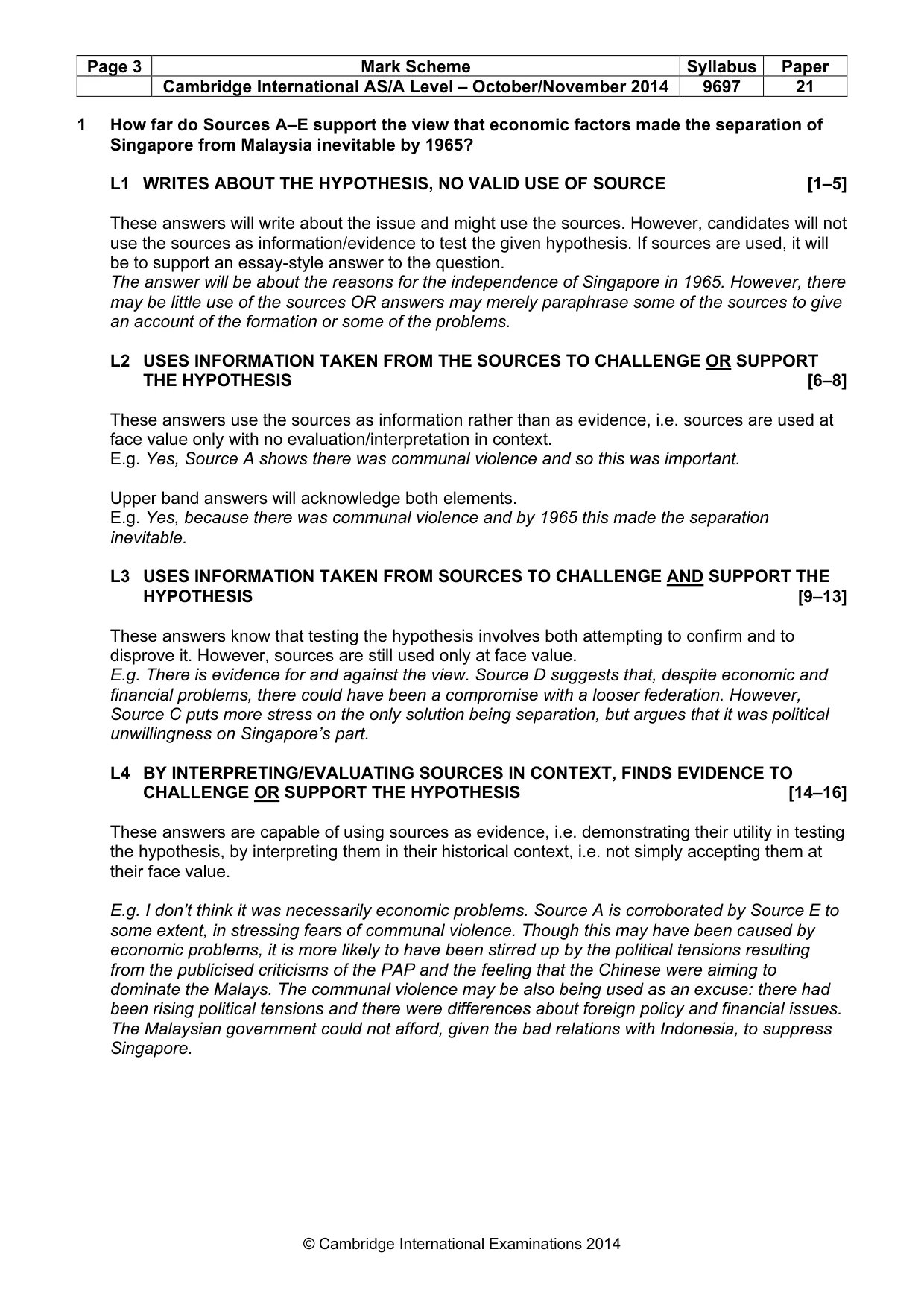
Page 3 Mark Scheme Syllabus Paper Cambridge International AS/A Level – October/November 2014 9697 21 © Cambridge International Examinations 2014 1 How far do Sources A–E support the view that economic factors made the separation of Singapore from Malaysia inevitable by 1965? L1 WRITES ABOUT THE HYPOTHESIS, NO VALID USE OF SOURCE [1–5] These answers will write about the issue and might use the sources. However, candidates will not use the sources as information/evidence to test the given hypothesis. If sources are used, it will be to support an essay-style answer to the question. The answer will be about the reasons for the independence of Singapore in 1965. However, there may be little use of the sources OR answers may merely paraphrase some of the sources to give an account of the formation or some of the problems. L2 USES INFORMATION TAKEN FROM THE SOURCES TO CHALLENGE OR SUPPORT THE HYPOTHESIS [6–8] These answers use the sources as information rather than as evidence, i.e. sources are used at face value only with no evaluation/interpretation in context. E.g. Yes, Source A shows there was communal violence and so this was important. Upper band answers will acknowledge both elements. E.g. Yes, because there was communal violence and by 1965 this made the separation inevitable. L3 USES INFORMATION TAKEN FROM SOURCES TO CHALLENGE AND SUPPORT THE HYPOTHESIS [9–13] These answers know that testing the hypothesis involves both attempting to confirm and to disprove it. However, sources are still used only at face value. E.g. There is evidence for and against the view. Source D suggests that, despite economic and financial problems, there could have been a compromise with a looser federation. However, Source C puts more stress on the only solution being separation, but argues that it was political unwillingness on Singapore’s part. L4 BY INTERPRETING/EVALUATING SOURCES IN CONTEXT, FINDS EVIDENCE TO CHALLENGE OR SUPPORT THE HYPOTHESIS [14–16] These answers are capable of using sources as evidence, i.e. demonstrating their utility in testing the hypothesis, by interpreting them in their historical context, i.e. not simply accepting them at their face value. E.g. I don’t think it was necessarily economic problems. Source A is corroborated by Source E to some extent, in stressing fears of communal violence. Though this may have been caused by economic problems, it is more likely to have been stirred up by the political tensions resulting from the publicised criticisms of the PAP and the feeling that the Chinese were aiming to dominate the Malays. The communal violence may be also being used as an excuse: there had been rising political tensions and there were differences about foreign policy and financial issues. The Malaysian government could not afford, given the bad relations with Indonesia, to suppress Singapore.
Mark scheme, page 4
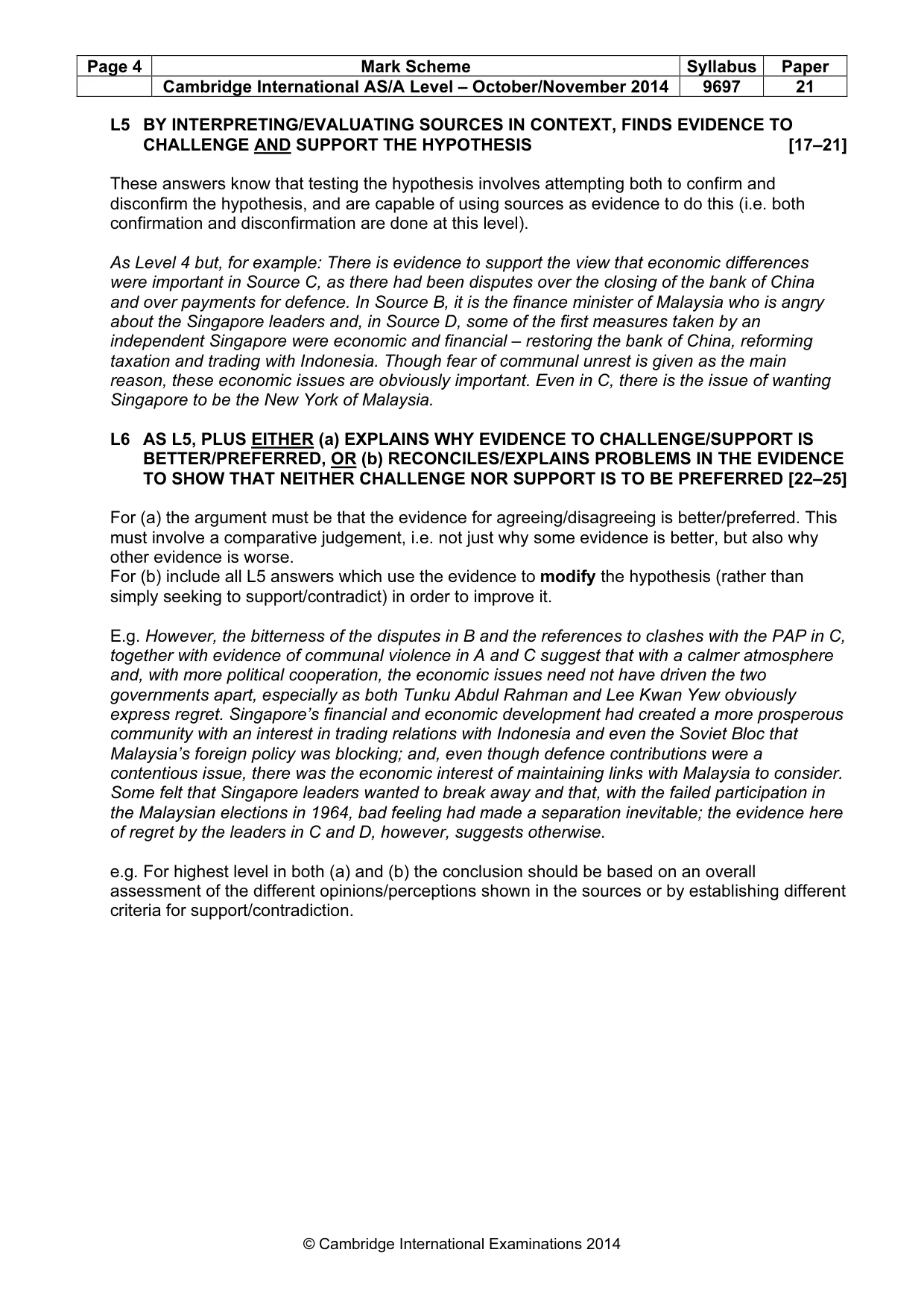
Page 4 Mark Scheme Syllabus Paper Cambridge International AS/A Level – October/November 2014 9697 21 © Cambridge International Examinations 2014 L5 BY INTERPRETING/EVALUATING SOURCES IN CONTEXT, FINDS EVIDENCE TO CHALLENGE AND SUPPORT THE HYPOTHESIS [17–21] These answers know that testing the hypothesis involves attempting both to confirm and disconfirm the hypothesis, and are capable of using sources as evidence to do this (i.e. both confirmation and disconfirmation are done at this level). As Level 4 but, for example: There is evidence to support the view that economic differences were important in Source C, as there had been disputes over the closing of the bank of China and over payments for defence. In Source B, it is the finance minister of Malaysia who is angry about the Singapore leaders and, in Source D, some of the first measures taken by an independent Singapore were economic and financial – restoring the bank of China, reforming taxation and trading with Indonesia. Though fear of communal unrest is given as the main reason, these economic issues are obviously important. Even in C, there is the issue of wanting Singapore to be the New York of Malaysia. L6 AS L5, PLUS EITHER (a) EXPLAINS WHY EVIDENCE TO CHALLENGE/SUPPORT IS BETTER/PREFERRED, OR (b) RECONCILES/EXPLAINS PROBLEMS IN THE EVIDENCE TO SHOW THAT NEITHER CHALLENGE NOR SUPPORT IS TO BE PREFERRED [22–25] For (a) the argument must be that the evidence for agreeing/disagreeing is better/preferred. This must involve a comparative judgement, i.e. not just why some evidence is better, but also why other evidence is worse. For (b) include all L5 answers which use the evidence to modify the hypothesis (rather than simply seeking to support/contradict) in order to improve it. E.g. However, the bitterness of the disputes in B and the references to clashes with the PAP in C, together with evidence of communal violence in A and C suggest that with a calmer atmosphere and, with more political cooperation, the economic issues need not have driven the two governments apart, especially as both Tunku Abdul Rahman and Lee Kwan Yew obviously express regret. Singapore’s financial and economic development had created a more prosperous community with an interest in trading relations with Indonesia and even the Soviet Bloc that Malaysia’s foreign policy was blocking; and, even though defence contributions were a contentious issue, there was the economic interest of maintaining links with Malaysia to consider. Some felt that Singapore leaders wanted to break away and that, with the failed participation in the Malaysian elections in 1964, bad feeling had made a separation inevitable; the evidence here of regret by the leaders in C and D, however, suggests otherwise. e.g. For highest level in both (a) and (b) the conclusion should be based on an overall assessment of the different opinions/perceptions shown in the sources or by establishing different criteria for support/contradiction.
Mark scheme, page 5
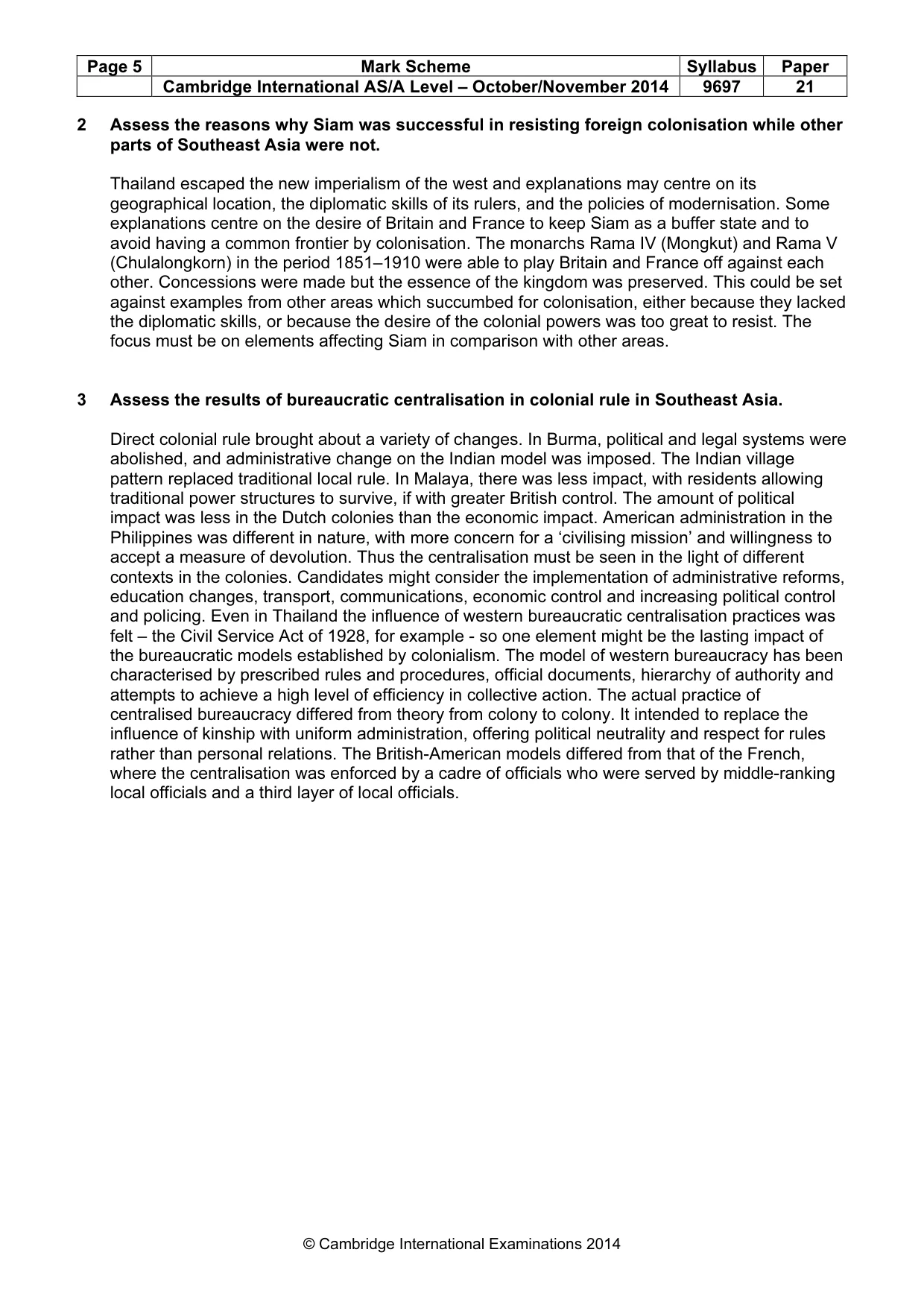
Page 5 Mark Scheme Syllabus Paper Cambridge International AS/A Level – October/November 2014 9697 21 © Cambridge International Examinations 2014 2 Assess the reasons why Siam was successful in resisting foreign colonisation while other parts of Southeast Asia were not. Thailand escaped the new imperialism of the west and explanations may centre on its geographical location, the diplomatic skills of its rulers, and the policies of modernisation. Some explanations centre on the desire of Britain and France to keep Siam as a buffer state and to avoid having a common frontier by colonisation. The monarchs Rama IV (Mongkut) and Rama V (Chulalongkorn) in the period 1851–1910 were able to play Britain and France off against each other. Concessions were made but the essence of the kingdom was preserved. This could be set against examples from other areas which succumbed for colonisation, either because they lacked the diplomatic skills, or because the desire of the colonial powers was too great to resist. The focus must be on elements affecting Siam in comparison with other areas. 3 Assess the results of bureaucratic centralisation in colonial rule in Southeast Asia. Direct colonial rule brought about a variety of changes. In Burma, political and legal systems were abolished, and administrative change on the Indian model was imposed. The Indian village pattern replaced traditional local rule. In Malaya, there was less impact, with residents allowing traditional power structures to survive, if with greater British control. The amount of political impact was less in the Dutch colonies than the economic impact. American administration in the Philippines was different in nature, with more concern for a ‘civilising mission’ and willingness to accept a measure of devolution. Thus the centralisation must be seen in the light of different contexts in the colonies. Candidates might consider the implementation of administrative reforms, education changes, transport, communications, economic control and increasing political control and policing. Even in Thailand the influence of western bureaucratic centralisation practices was felt – the Civil Service Act of 1928, for example - so one element might be the lasting impact of the bureaucratic models established by colonialism. The model of western bureaucracy has been characterised by prescribed rules and procedures, official documents, hierarchy of authority and attempts to achieve a high level of efficiency in collective action. The actual practice of centralised bureaucracy differed from theory from colony to colony. It intended to replace the influence of kinship with uniform administration, offering political neutrality and respect for rules rather than personal relations. The British-American models differed from that of the French, where the centralisation was enforced by a cadre of officials who were served by middle-ranking local officials and a third layer of local officials.
Mark scheme, page 6
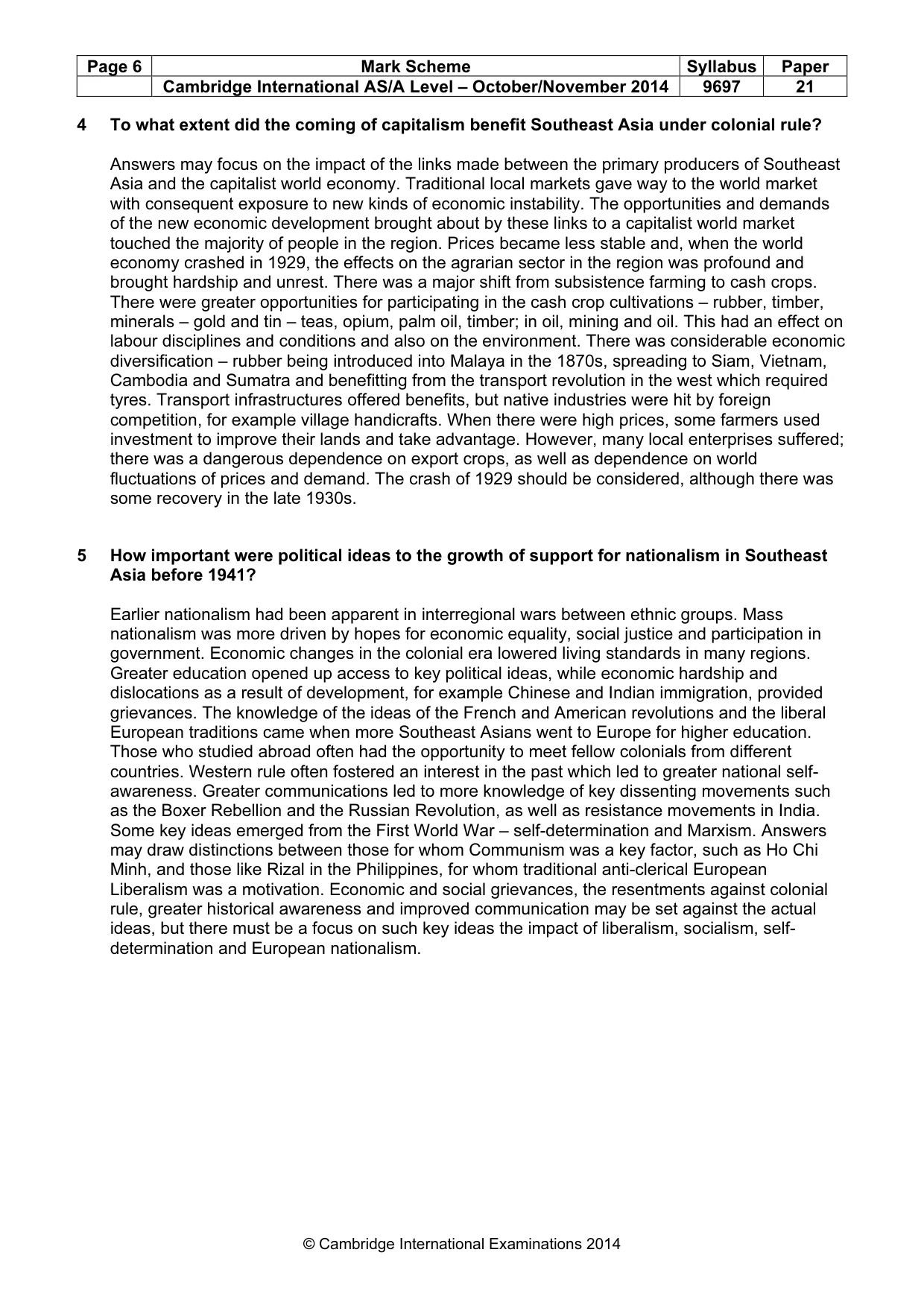
Page 6 Mark Scheme Syllabus Paper Cambridge International AS/A Level – October/November 2014 9697 21 © Cambridge International Examinations 2014 4 To what extent did the coming of capitalism benefit Southeast Asia under colonial rule? Answers may focus on the impact of the links made between the primary producers of Southeast Asia and the capitalist world economy. Traditional local markets gave way to the world market with consequent exposure to new kinds of economic instability. The opportunities and demands of the new economic development brought about by these links to a capitalist world market touched the majority of people in the region. Prices became less stable and, when the world economy crashed in 1929, the effects on the agrarian sector in the region was profound and brought hardship and unrest. There was a major shift from subsistence farming to cash crops. There were greater opportunities for participating in the cash crop cultivations – rubber, timber, minerals – gold and tin – teas, opium, palm oil, timber; in oil, mining and oil. This had an effect on labour disciplines and conditions and also on the environment. There was considerable economic diversification – rubber being introduced into Malaya in the 1870s, spreading to Siam, Vietnam, Cambodia and Sumatra and benefitting from the transport revolution in the west which required tyres. Transport infrastructures offered benefits, but native industries were hit by foreign competition, for example village handicrafts. When there were high prices, some farmers used investment to improve their lands and take advantage. However, many local enterprises suffered; there was a dangerous dependence on export crops, as well as dependence on world fluctuations of prices and demand. The crash of 1929 should be considered, although there was some recovery in the late 1930s. 5 How important were political ideas to the growth of support for nationalism in Southeast Asia before 1941? Earlier nationalism had been apparent in interregional wars between ethnic groups. Mass nationalism was more driven by hopes for economic equality, social justice and participation in government. Economic changes in the colonial era lowered living standards in many regions. Greater education opened up access to key political ideas, while economic hardship and dislocations as a result of development, for example Chinese and Indian immigration, provided grievances. The knowledge of the ideas of the French and American revolutions and the liberal European traditions came when more Southeast Asians went to Europe for higher education. Those who studied abroad often had the opportunity to meet fellow colonials from different countries. Western rule often fostered an interest in the past which led to greater national self- awareness. Greater communications led to more knowledge of key dissenting movements such as the Boxer Rebellion and the Russian Revolution, as well as resistance movements in India. Some key ideas emerged from the First World War – self-determination and Marxism. Answers may draw distinctions between those for whom Communism was a key factor, such as Ho Chi Minh, and those like Rizal in the Philippines, for whom traditional anti-clerical European Liberalism was a motivation. Economic and social grievances, the resentments against colonial rule, greater historical awareness and improved communication may be set against the actual ideas, but there must be a focus on such key ideas the impact of liberalism, socialism, self- determination and European nationalism.
Mark scheme, page 7
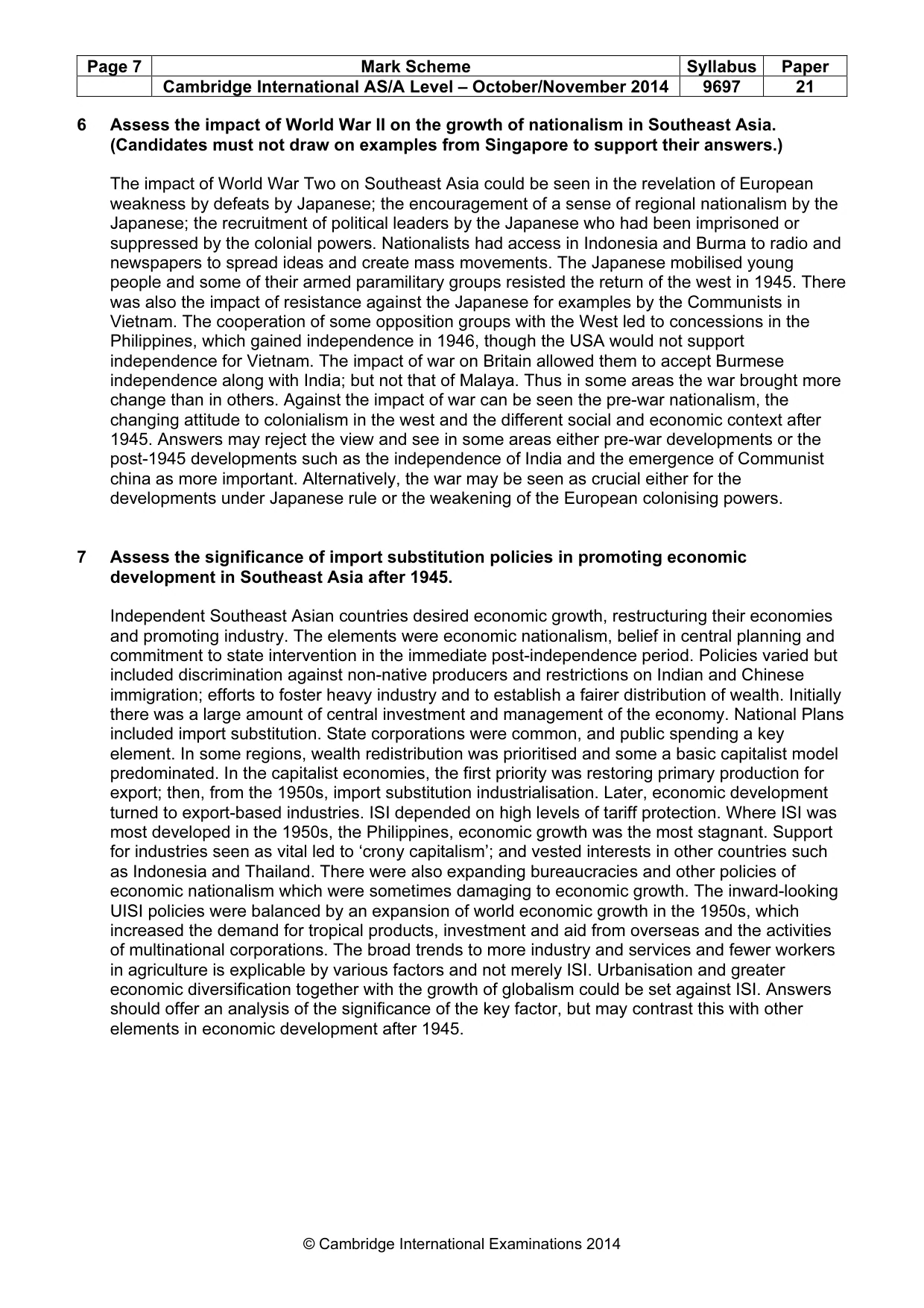
Page 7 Mark Scheme Syllabus Paper Cambridge International AS/A Level – October/November 2014 9697 21 © Cambridge International Examinations 2014 6 Assess the impact of World War II on the growth of nationalism in Southeast Asia. (Candidates must not draw on examples from Singapore to support their answers.) The impact of World War Two on Southeast Asia could be seen in the revelation of European weakness by defeats by Japanese; the encouragement of a sense of regional nationalism by the Japanese; the recruitment of political leaders by the Japanese who had been imprisoned or suppressed by the colonial powers. Nationalists had access in Indonesia and Burma to radio and newspapers to spread ideas and create mass movements. The Japanese mobilised young people and some of their armed paramilitary groups resisted the return of the west in 1945. There was also the impact of resistance against the Japanese for examples by the Communists in Vietnam. The cooperation of some opposition groups with the West led to concessions in the Philippines, which gained independence in 1946, though the USA would not support independence for Vietnam. The impact of war on Britain allowed them to accept Burmese independence along with India; but not that of Malaya. Thus in some areas the war brought more change than in others. Against the impact of war can be seen the pre-war nationalism, the changing attitude to colonialism in the west and the different social and economic context after 1945. Answers may reject the view and see in some areas either pre-war developments or the post-1945 developments such as the independence of India and the emergence of Communist china as more important. Alternatively, the war may be seen as crucial either for the developments under Japanese rule or the weakening of the European colonising powers. 7 Assess the significance of import substitution policies in promoting economic development in Southeast Asia after 1945. Independent Southeast Asian countries desired economic growth, restructuring their economies and promoting industry. The elements were economic nationalism, belief in central planning and commitment to state intervention in the immediate post-independence period. Policies varied but included discrimination against non-native producers and restrictions on Indian and Chinese immigration; efforts to foster heavy industry and to establish a fairer distribution of wealth. Initially there was a large amount of central investment and management of the economy. National Plans included import substitution. State corporations were common, and public spending a key element. In some regions, wealth redistribution was prioritised and some a basic capitalist model predominated. In the capitalist economies, the first priority was restoring primary production for export; then, from the 1950s, import substitution industrialisation. Later, economic development turned to export-based industries. ISI depended on high levels of tariff protection. Where ISI was most developed in the 1950s, the Philippines, economic growth was the most stagnant. Support for industries seen as vital led to ‘crony capitalism’; and vested interests in other countries such as Indonesia and Thailand. There were also expanding bureaucracies and other policies of economic nationalism which were sometimes damaging to economic growth. The inward-looking UISI policies were balanced by an expansion of world economic growth in the 1950s, which increased the demand for tropical products, investment and aid from overseas and the activities of multinational corporations. The broad trends to more industry and services and fewer workers in agriculture is explicable by various factors and not merely ISI. Urbanisation and greater economic diversification together with the growth of globalism could be set against ISI. Answers should offer an analysis of the significance of the key factor, but may contrast this with other elements in economic development after 1945.
Mark scheme, page 8
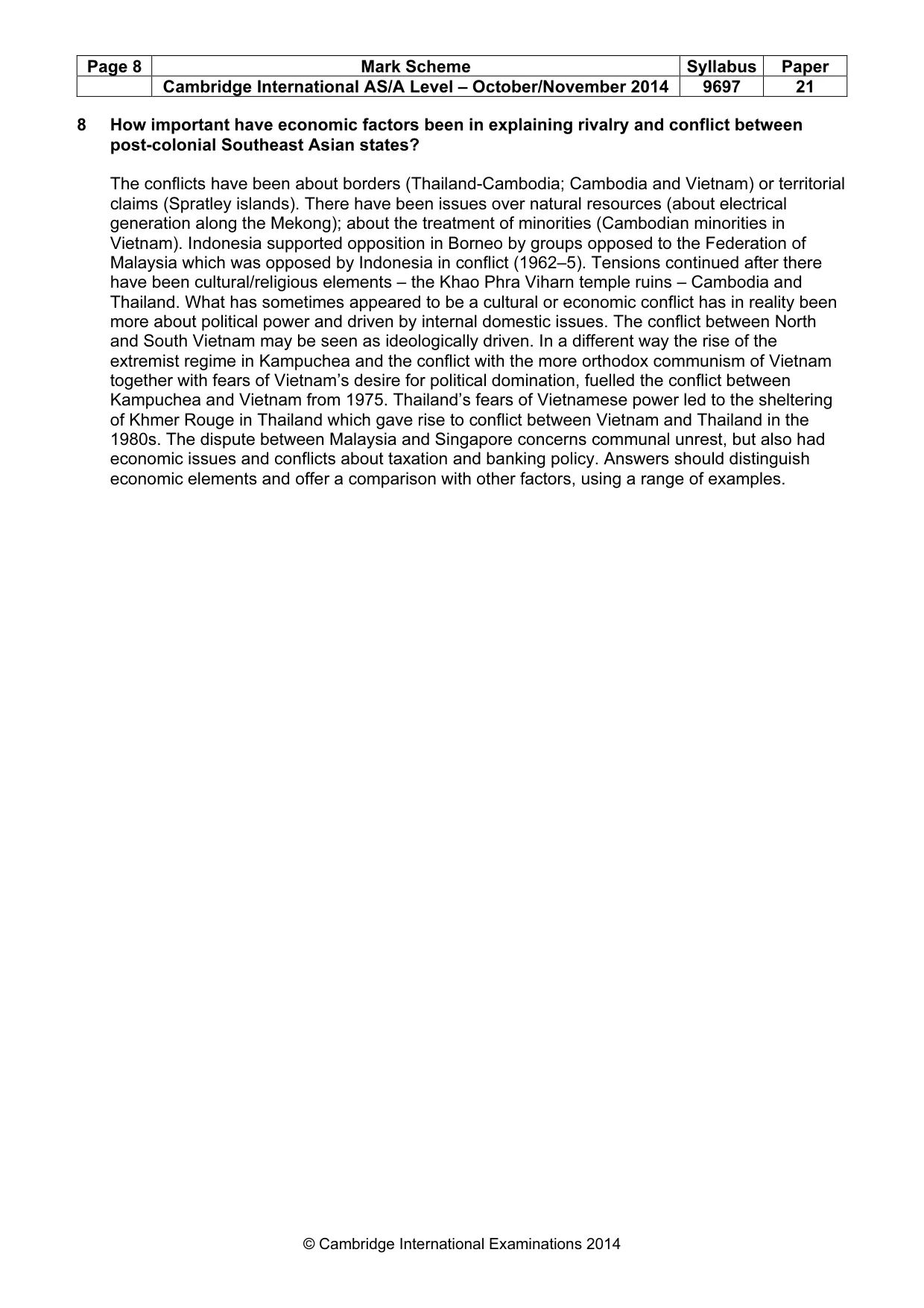
Page 8 Mark Scheme Syllabus Paper Cambridge International AS/A Level – October/November 2014 9697 21 © Cambridge International Examinations 2014 8 How important have economic factors been in explaining rivalry and conflict between post-colonial Southeast Asian states? The conflicts have been about borders (Thailand-Cambodia; Cambodia and Vietnam) or territorial claims (Spratley islands). There have been issues over natural resources (about electrical generation along the Mekong); about the treatment of minorities (Cambodian minorities in Vietnam). Indonesia supported opposition in Borneo by groups opposed to the Federation of Malaysia which was opposed by Indonesia in conflict (1962–5). Tensions continued after there have been cultural/religious elements – the Khao Phra Viharn temple ruins – Cambodia and Thailand. What has sometimes appeared to be a cultural or economic conflict has in reality been more about political power and driven by internal domestic issues. The conflict between North and South Vietnam may be seen as ideologically driven. In a different way the rise of the extremist regime in Kampuchea and the conflict with the more orthodox communism of Vietnam together with fears of Vietnam’s desire for political domination, fuelled the conflict between Kampuchea and Vietnam from 1975. Thailand’s fears of Vietnamese power led to the sheltering of Khmer Rouge in Thailand which gave rise to conflict between Vietnam and Thailand in the 1980s. The dispute between Malaysia and Singapore concerns communal unrest, but also had economic issues and conflicts about taxation and banking policy. Answers should distinguish economic elements and offer a comparison with other factors, using a range of examples.
What you needed in this session
Cambridge’s own grade thresholds for 2014 Oct/Nov, Paper 2 · Variant 1. A higher threshold means an easier paper — the bar moves with how the cohort did.