Cambridge A Level Hinduism 9487 — 2025 Oct/Nov Paper 1 · Variant 0
9487/10/O/N/25
The question paper and its mark scheme, free to read here and free to download. This is Cambridge’s own paper, exactly as it was sat.
Question paper4 pages
Mark scheme
No mark scheme is in the library for this paper.
Paper as text
Question paper, page 1
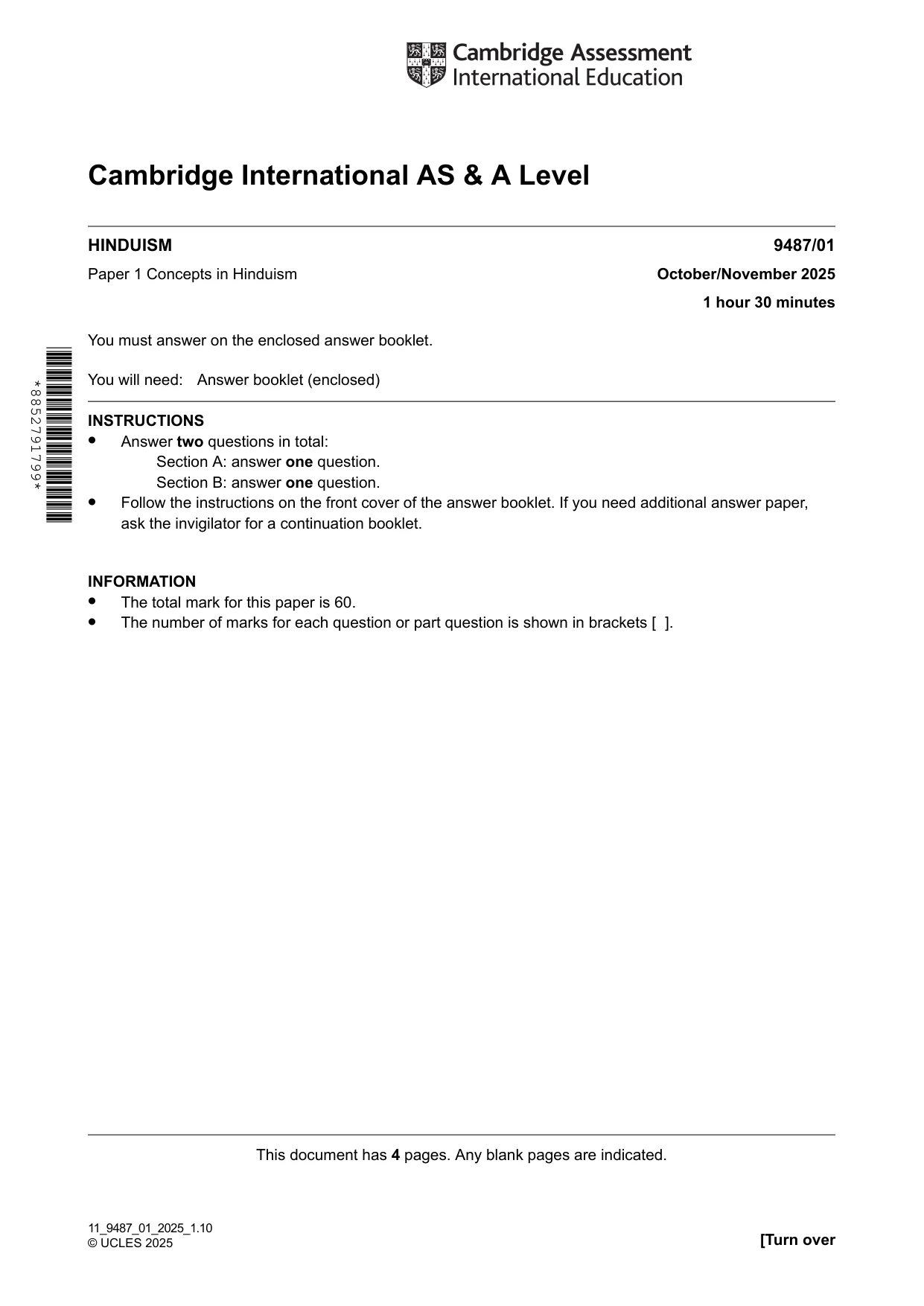
Cambridge International AS & A Level 9487/01 October/November 2025 1 hour 30 minutes HINDUISM Paper 1 Concepts in Hinduism You must answer on the enclosed answer booklet. You will need: Answer booklet (enclosed) INSTRUCTIONS • Answer two questions in total: Section A: answer one question. Section B: answer one question. • Follow the instructions on the front cover of the answer booklet. If you need additional answer paper, ask the invigilator for a continuation booklet. INFORMATION • The total mark for this paper is 60. • The number of marks for each question or part question is shown in brackets [ ]. This document has 4 pages. Any blank pages are indicated. [Turn over 11_9487_01_2025_1.10 © UCLES 2025 *8852791799*
Question paper, page 2
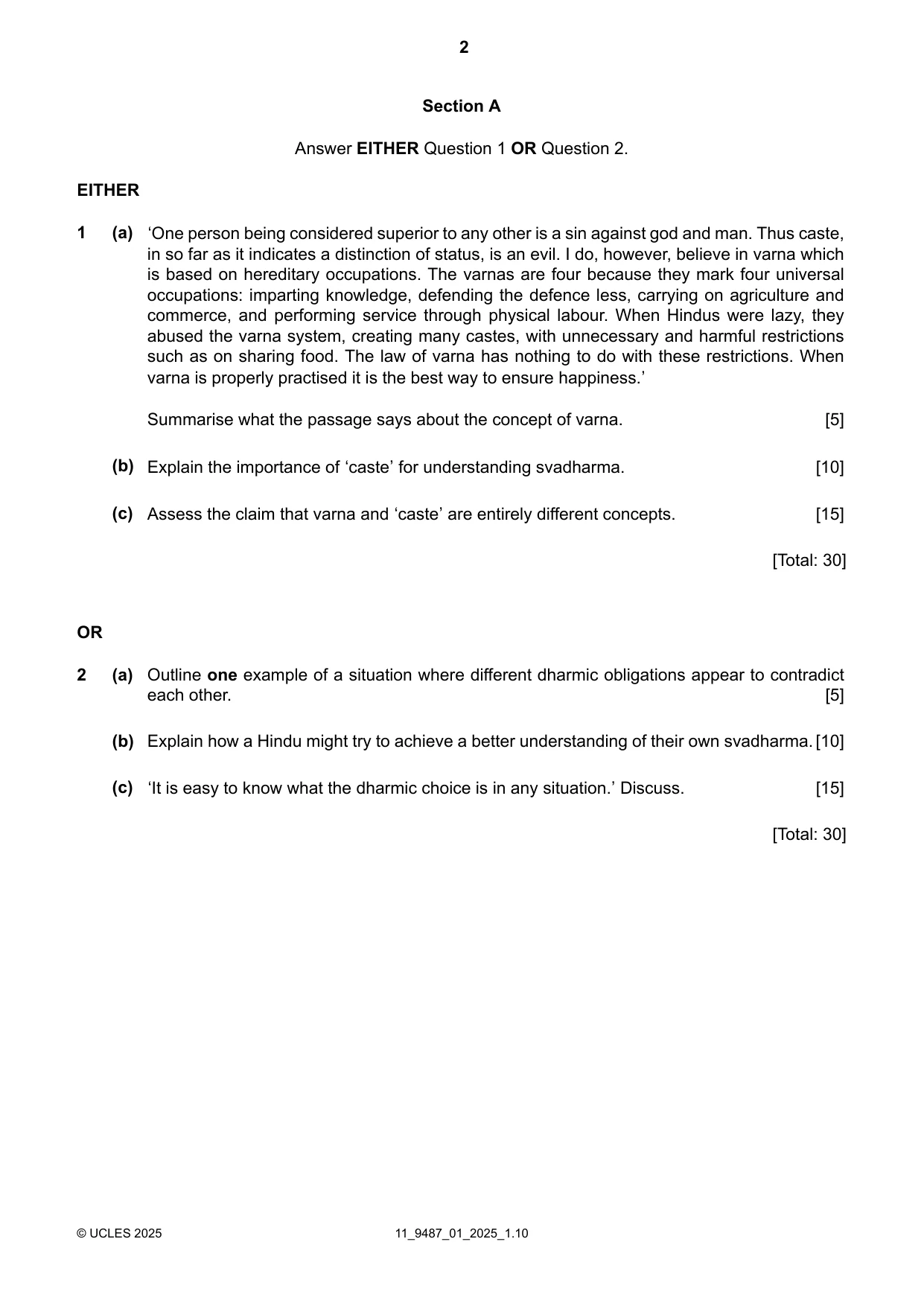
Section A Answer EITHER Question 1 OR Question 2. EITHER ‘One person being considered superior to any other is a sin against god and man. Thus caste, in so far as it indicates a distinction of status, is an evil. I do, however, believe in varna which (a) 1 is based on hereditary occupations. The varnas are four because they mark four universal occupations: imparting knowledge, defending the defence less, carrying on agriculture and commerce, and performing service through physical labour. When Hindus were lazy, they abused the varna system, creating many castes, with unnecessary and harmful restrictions such as on sharing food. The law of varna has nothing to do with these restrictions. When varna is properly practised it is the best way to ensure happiness.’ Summarise what the passage says about the concept of varna. [5] Explain the importance of ‘caste’ for understanding svadharma. [10] (b) Assess the claim that varna and ‘caste’ are entirely different concepts. [15] (c) [Total: 30] OR Outline one example of a situation where different dharmic obligations appear to contradict each other. [5] (a) 2 Explain how a Hindu might try to achieve a better understanding of their own svadharma.[10] (b) ‘It is easy to know what the dharmic choice is in any situation.’ Discuss. [15] (c) [Total: 30] 11_9487_01_2025_1.10 © UCLES 2025 2
Question paper, page 3
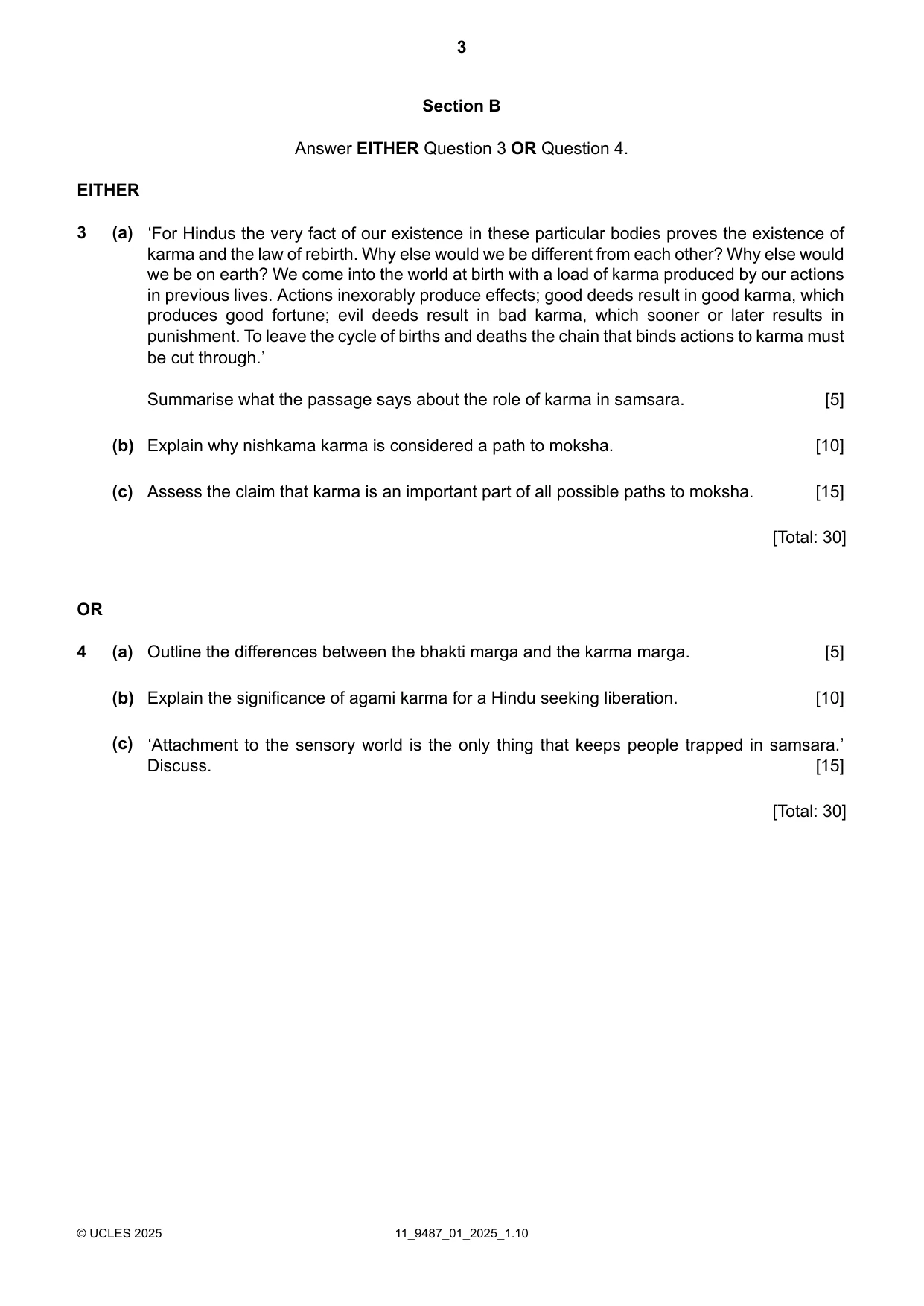
Section B Answer EITHER Question 3 OR Question 4. EITHER ‘For Hindus the very fact of our existence in these particular bodies proves the existence of karma and the law of rebirth. Why else would we be different from each other? Why else would (a) 3 we be on earth? We come into the world at birth with a load of karma produced by our actions in previous lives. Actions inexorably produce effects; good deeds result in good karma, which produces good fortune; evil deeds result in bad karma, which sooner or later results in punishment. To leave the cycle of births and deaths the chain that binds actions to karma must be cut through.’ Summarise what the passage says about the role of karma in samsara. [5] Explain why nishkama karma is considered a path to moksha. [10] (b) Assess the claim that karma is an important part of all possible paths to moksha. [15] (c) [Total: 30] OR Outline the differences between the bhakti marga and the karma marga. [5] (a) 4 Explain the significance of agami karma for a Hindu seeking liberation. [10] (b) ‘Attachment to the sensory world is the only thing that keeps people trapped in samsara.’ Discuss. [15] (c) [Total: 30] 11_9487_01_2025_1.10 © UCLES 2025 3
Question paper, page 4
BLANK PAGE Permission to reproduce items where third-party owned material protected by copyright is included has been sought and cleared where possible. Every reasonable effort has been made by the publisher (UCLES) to trace copyright holders, but if any items requiring clearance have unwittingly been included, the publisher will be pleased to make amends at the earliest possible opportunity. To avoid the issue of disclosure of answer-related information to candidates, all copyright acknowledgements are reproduced online in the Cambridge Assessment International Education Copyright Acknowledgements Booklet. This is produced for each series of examinations and is freely available to download at www.cambridgeinternational.org after the live examination series. Cambridge Assessment International Education is part of Cambridge Assessment. Cambridge Assessment is the brand name of the University of Cambridge Local Examinations Syndicate (UCLES), which is a department of the University of Cambridge. 11_9487_01_2025_1.10 © UCLES 2025 4