Cambridge A Level Hinduism 9014 — 2016 Oct/Nov Paper 1 · Variant 0
9014/10/O/N/16
The question paper and its mark scheme, free to read here and free to download. This is Cambridge’s own paper, exactly as it was sat.
Question paper4 pages
Mark scheme
No mark scheme is in the library for this paper.
Paper as text
Question paper, page 1
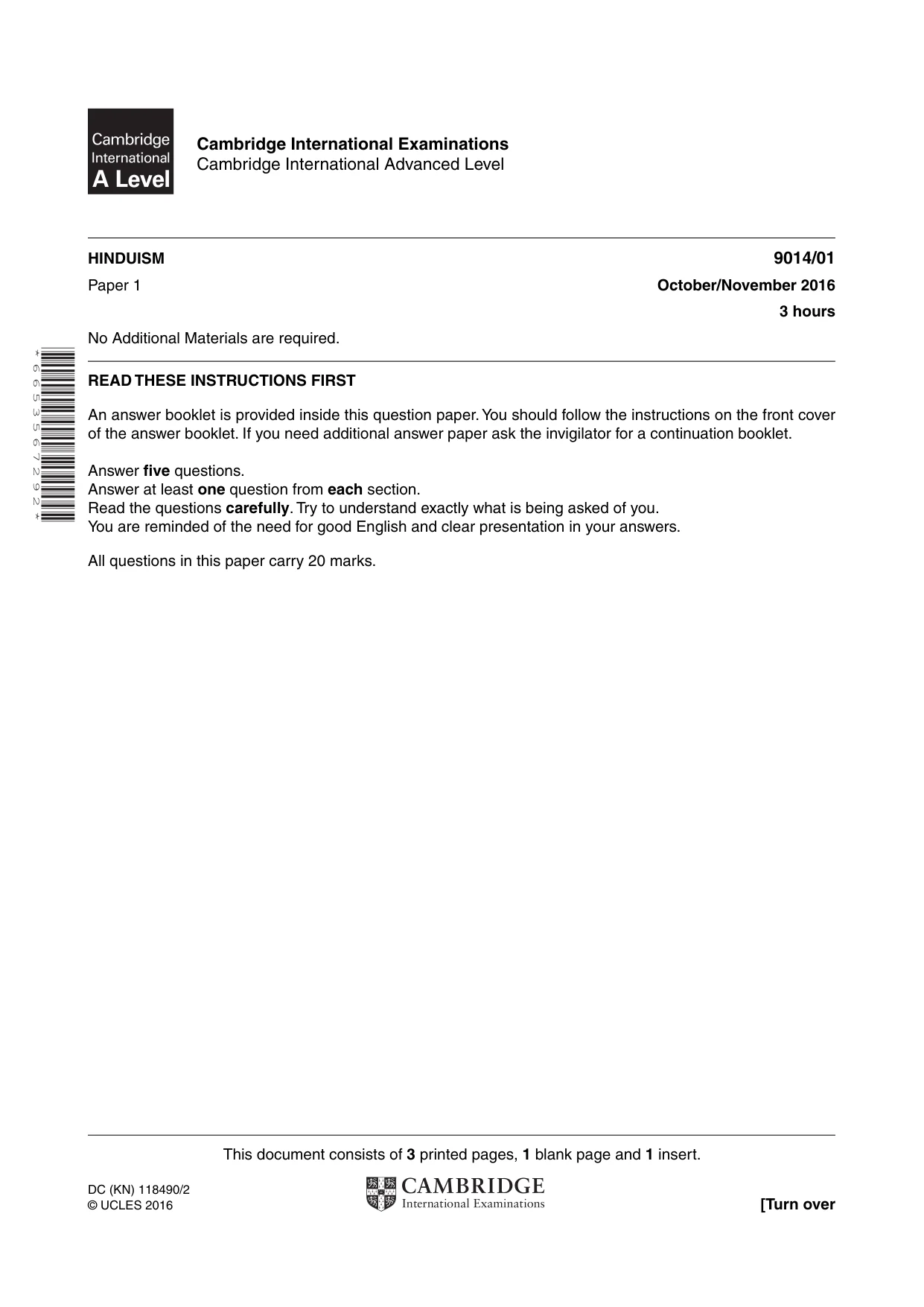
This document consists of 3 printed pages, 1 blank page and 1 insert. DC (KN) 118490/2 © UCLES 2016 [Turn over Cambridge International Examinations Cambridge International Advanced Level * 6 6 5 3 5 6 7 2 9 2 * HINDUISM 9014/01 Paper 1 October/November 2016 3 hours No Additional Materials are required. READ THESE INSTRUCTIONS FIRST An answer booklet is provided inside this question paper. You should follow the instructions on the front cover of the answer booklet. If you need additional answer paper ask the invigilator for a continuation booklet. Answer five questions. Answer at least one question from each section. Read the questions carefully. Try to understand exactly what is being asked of you. You are reminded of the need for good English and clear presentation in your answers. All questions in this paper carry 20 marks.
Question paper, page 2
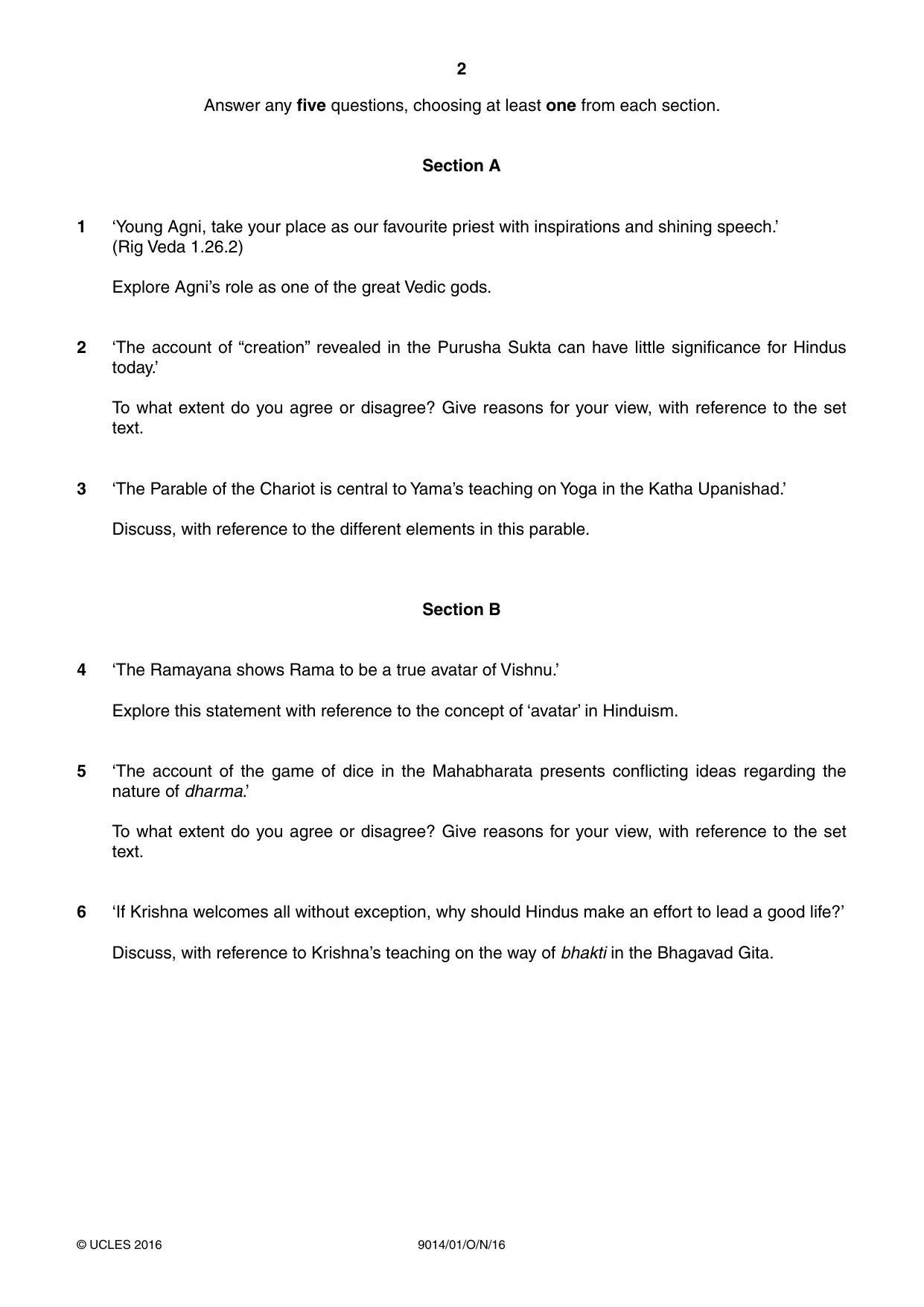
2 9014/01/O/N/16 © UCLES 2016 Answer any five questions, choosing at least one from each section. Section A 1 ‘Young Agni, take your place as our favourite priest with inspirations and shining speech.’ (Rig Veda 1.26.2) Explore Agni’s role as one of the great Vedic gods. 2 ‘The account of “creation” revealed in the Purusha Sukta can have little significance for Hindus today.’ To what extent do you agree or disagree? Give reasons for your view, with reference to the set text. 3 ‘The Parable of the Chariot is central to Yama’s teaching on Yoga in the Katha Upanishad.’ Discuss, with reference to the different elements in this parable. Section B 4 ‘The Ramayana shows Rama to be a true avatar of Vishnu.’ Explore this statement with reference to the concept of ‘avatar’ in Hinduism. 5 ‘The account of the game of dice in the Mahabharata presents conflicting ideas regarding the nature of dharma.’ To what extent do you agree or disagree? Give reasons for your view, with reference to the set text. 6 ‘If Krishna welcomes all without exception, why should Hindus make an effort to lead a good life?’ Discuss, with reference to Krishna’s teaching on the way of bhakti in the Bhagavad Gita.
Question paper, page 3
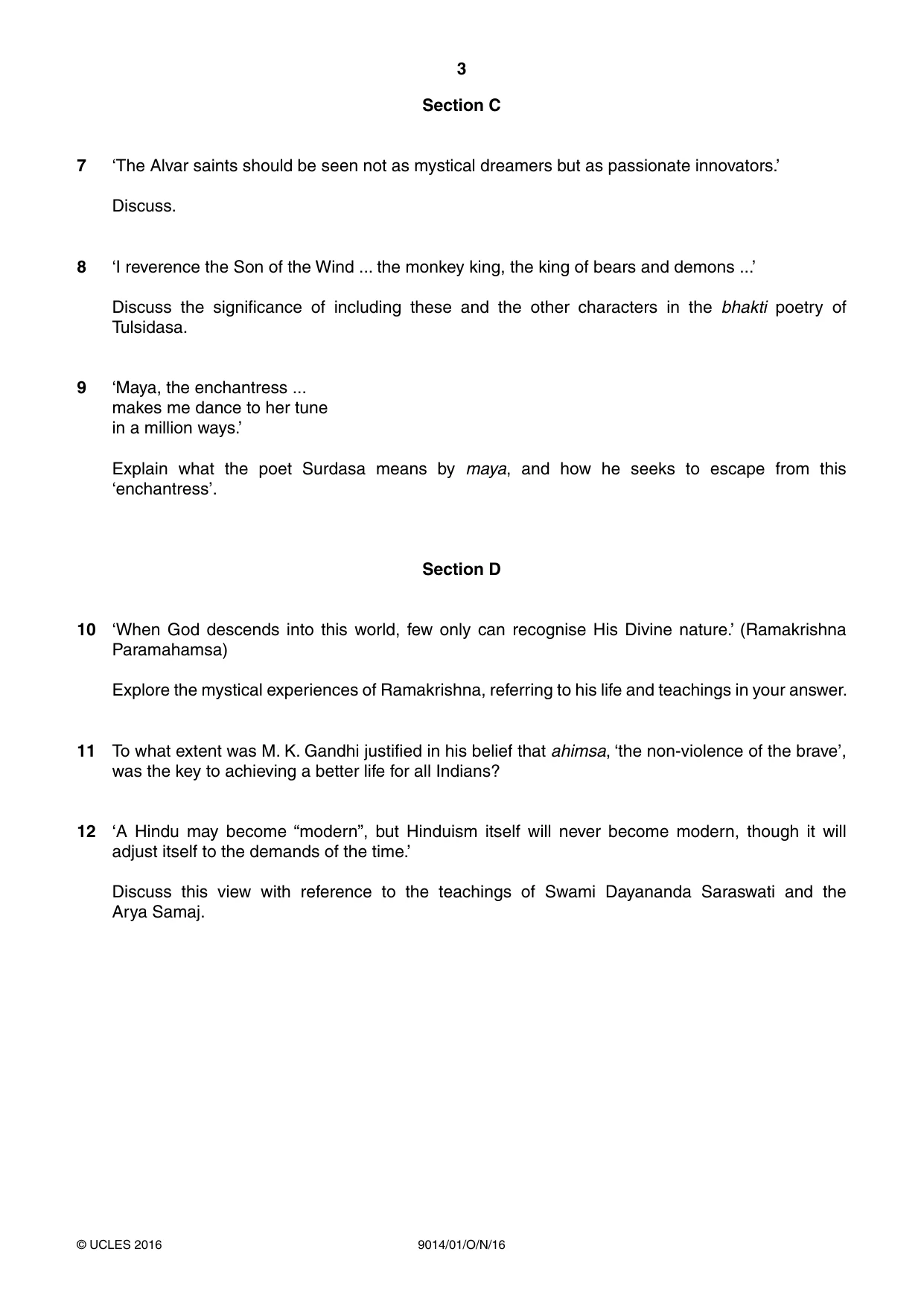
3 9014/01/O/N/16 © UCLES 2016 Section C 7 ‘The Alvar saints should be seen not as mystical dreamers but as passionate innovators.’ Discuss. 8 ‘I reverence the Son of the Wind ... the monkey king, the king of bears and demons ...’ Discuss the significance of including these and the other characters in the bhakti poetry of Tulsidasa. 9 ‘Maya, the enchantress ... makes me dance to her tune in a million ways.’ Explain what the poet Surdasa means by maya, and how he seeks to escape from this ‘enchantress’. Section D 10 ‘When God descends into this world, few only can recognise His Divine nature.’ (Ramakrishna Paramahamsa) Explore the mystical experiences of Ramakrishna, referring to his life and teachings in your answer. 11 To what extent was M. K. Gandhi justified in his belief that ahimsa, ‘the non-violence of the brave’, was the key to achieving a better life for all Indians? 12 ‘A Hindu may become “modern”, but Hinduism itself will never become modern, though it will adjust itself to the demands of the time.’ Discuss this view with reference to the teachings of Swami Dayananda Saraswati and the Arya Samaj.
Question paper, page 4
4 9014/01/O/N/16 © UCLES 2016 BLANK PAGE Permission to reproduce items where third-party owned material protected by copyright is included has been sought and cleared where possible. Every reasonable effort has been made by the publisher (UCLES) to trace copyright holders, but if any items requiring clearance have unwittingly been included, the publisher will be pleased to make amends at the earliest possible opportunity. To avoid the issue of disclosure of answer-related information to candidates, all copyright acknowledgements are reproduced online in the Cambridge International Examinations Copyright Acknowledgements Booklet. This is produced for each series of examinations and is freely available to download at www.cie.org.uk after the live examination series. Cambridge International Examinations is part of the Cambridge Assessment Group. Cambridge Assessment is the brand name of University of Cambridge Local Examinations Syndicate (UCLES), which is itself a department of the University of Cambridge.