Cambridge A Level Global Perspectives and Research 9239 — 2021 May/June Paper 1 · Variant 3
9239/13/M/J/21 · 30 marks · ≈34 min
The question paper and its mark scheme, free to read here and free to download. This is Cambridge’s own paper, exactly as it was sat.
Question paper4 pages


Mark scheme17 pages
Answers below. Sit the paper first if you are practising.
Paper as text
Question paper, page 1
This document has 4 pages. Any blank pages are indicated. Cambridge International AS & A Level * 3 4 0 8 0 3 4 1 1 3 * DC (MB) 200039/2 © UCLES 2021 [Turn over GLOBAL PERSPECTIVES & RESEARCH 9239/13 Paper 1 Written Examination May/June 2021 1 hour 30 minutes You must answer on the enclosed answer booklet. You will need: Answer booklet (enclosed) Insert (enclosed) INSTRUCTIONS ● Answer all questions. ● Follow the instructions on the front cover of the answer booklet. If you need additional answer paper, ask the invigilator for a continuation booklet. INFORMATION ● The total mark for this paper is 30. ● The number of marks for each question or part question is shown in brackets [ ]. ● The insert contains all the resources referred to in the questions.
Question paper, page 2
2 9239/13/M/J/21 © UCLES 2021 Read the documents in the accompanying insert and answer all the questions. Answers should be written in continuous prose. You should spend approximately 10 minutes reading the documents in the insert before attempting to answer the questions. This is allowed for within the time set for the examination. Medical priorities 1 Study Document 1. Doctors receive gifts from pharmaceutical companies. Identify and explain three negative effects this might have upon patients, as given by the authors of Document 1. You should give three different explanations. [6] 2 Study Document 1. Assess the strengths and weaknesses of the authors’ argument in Document 1. [12] 3 Study Documents 1 and 2. The authors of Documents 1 and 2 reach different conclusions about gifts from pharmaceutical companies to doctors. To what extent is the evidence the author uses to support the argument stronger in Document 2 than that in Document 1? [12]
Question paper, page 3
3 9239/13/M/J/21 © UCLES 2021 BLANK PAGE
Question paper, page 4
4 9239/13/M/J/21 © UCLES 2021 Permission to reproduce items where third-party owned material protected by copyright is included has been sought and cleared where possible. Every reasonable effort has been made by the publisher (UCLES) to trace copyright holders, but if any items requiring clearance have unwittingly been included, the publisher will be pleased to make amends at the earliest possible opportunity. To avoid the issue of disclosure of answer-related information to candidates, all copyright acknowledgements are reproduced online in the Cambridge Assessment International Education Copyright Acknowledgements Booklet. This is produced for each series of examinations and is freely available to download at www.cambridgeinternational.org after the live examination series. Cambridge Assessment International Education is part of the Cambridge Assessment Group. Cambridge Assessment is the brand name of the University of Cambridge Local Examinations Syndicate (UCLES), which itself is a department of the University of Cambridge. BLANK PAGE
Mark scheme, page 1
This document consists of 17 printed pages. © UCLES 2021 [Turn over Cambridge International AS & A Level GLOBAL PERSPECTIVES AND RESEARCH 9239/13 Paper 1 Written Examination May/June 2021 MARK SCHEME Maximum Mark: 30 Published This mark scheme is published as an aid to teachers and candidates, to indicate the requirements of the examination. It shows the basis on which Examiners were instructed to award marks. It does not indicate the details of the discussions that took place at an Examiners’ meeting before marking began, which would have considered the acceptability of alternative answers. Mark schemes should be read in conjunction with the question paper and the Principal Examiner Report for Teachers. Cambridge International will not enter into discussions about these mark schemes. Cambridge International is publishing the mark schemes for the May/June 2021 series for most Cambridge IGCSE™, Cambridge International A and AS Level components and some Cambridge O Level components.
Mark scheme, page 2
9239/13 Cambridge International AS & A Level – Mark Scheme PUBLISHED May/June 2021 © UCLES 2021 Page 2 of 17 Generic Marking Principles These general marking principles must be applied by all examiners when marking candidate answers. They should be applied alongside the specific content of the mark scheme or generic level descriptors for a question. Each question paper and mark scheme will also comply with these marking principles. GENERIC MARKING PRINCIPLE 1: Marks must be awarded in line with: • the specific content of the mark scheme or the generic level descriptors for the question • the specific skills defined in the mark scheme or in the generic level descriptors for the question • the standard of response required by a candidate as exemplified by the standardisation scripts. GENERIC MARKING PRINCIPLE 2: Marks awarded are always whole marks (not half marks, or other fractions). GENERIC MARKING PRINCIPLE 3: Marks must be awarded positively: • marks are awarded for correct/valid answers, as defined in the mark scheme. However, credit is given for valid answers which go beyond the scope of the syllabus and mark scheme, referring to your Team Leader as appropriate • marks are awarded when candidates clearly demonstrate what they know and can do • marks are not deducted for errors • marks are not deducted for omissions • answers should only be judged on the quality of spelling, punctuation and grammar when these features are specifically assessed by the question as indicated by the mark scheme. The meaning, however, should be unambiguous. GENERIC MARKING PRINCIPLE 4: Rules must be applied consistently, e.g. in situations where candidates have not followed instructions or in the application of generic level descriptors.
Mark scheme, page 3
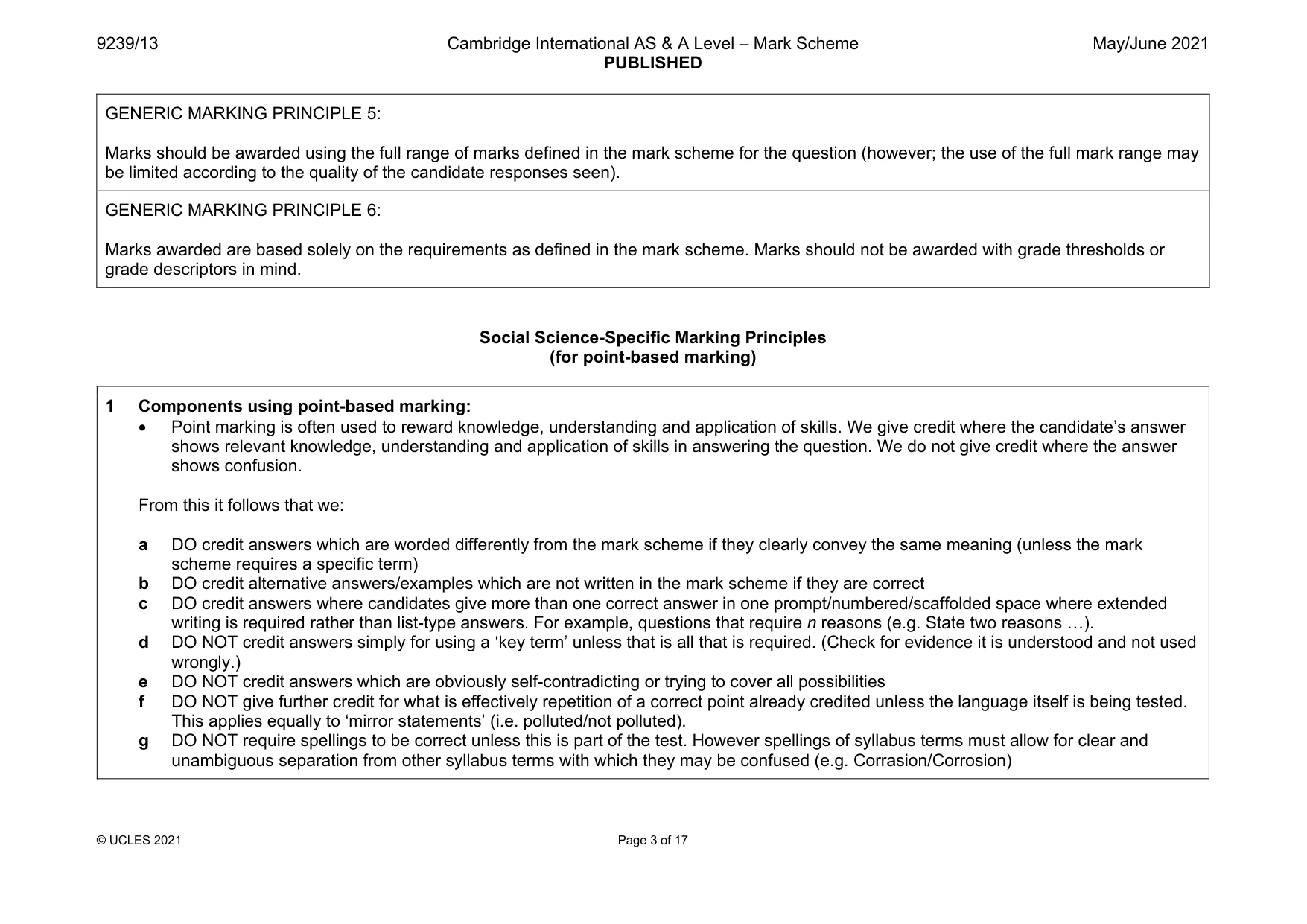
9239/13 Cambridge International AS & A Level – Mark Scheme PUBLISHED May/June 2021 © UCLES 2021 Page 3 of 17 GENERIC MARKING PRINCIPLE 5: Marks should be awarded using the full range of marks defined in the mark scheme for the question (however; the use of the full mark range may be limited according to the quality of the candidate responses seen). GENERIC MARKING PRINCIPLE 6: Marks awarded are based solely on the requirements as defined in the mark scheme. Marks should not be awarded with grade thresholds or grade descriptors in mind. Social Science-Specific Marking Principles (for point-based marking) 1 Components using point-based marking: • Point marking is often used to reward knowledge, understanding and application of skills. We give credit where the candidate’s answer shows relevant knowledge, understanding and application of skills in answering the question. We do not give credit where the answer shows confusion. From this it follows that we: a DO credit answers which are worded differently from the mark scheme if they clearly convey the same meaning (unless the mark scheme requires a specific term) b DO credit alternative answers/examples which are not written in the mark scheme if they are correct c DO credit answers where candidates give more than one correct answer in one prompt/numbered/scaffolded space where extended writing is required rather than list-type answers. For example, questions that require n reasons (e.g. State two reasons …). d DO NOT credit answers simply for using a ‘key term’ unless that is all that is required. (Check for evidence it is understood and not used wrongly.) e DO NOT credit answers which are obviously self-contradicting or trying to cover all possibilities f DO NOT give further credit for what is effectively repetition of a correct point already credited unless the language itself is being tested. This applies equally to ‘mirror statements’ (i.e. polluted/not polluted). g DO NOT require spellings to be correct unless this is part of the test. However spellings of syllabus terms must allow for clear and unambiguous separation from other syllabus terms with which they may be confused (e.g. Corrasion/Corrosion)
Mark scheme, page 4
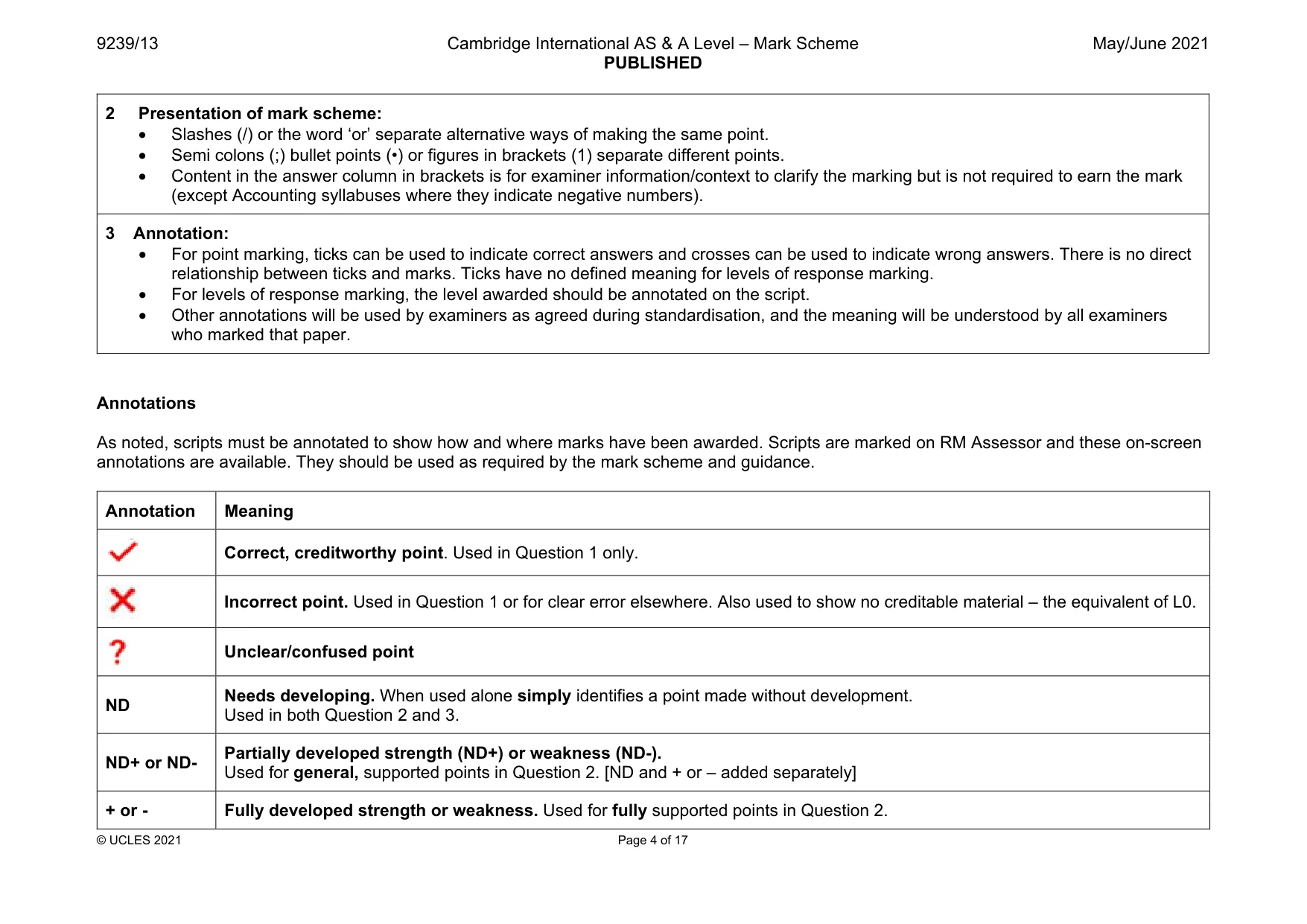
9239/13 Cambridge International AS & A Level – Mark Scheme PUBLISHED May/June 2021 © UCLES 2021 Page 4 of 17 2 Presentation of mark scheme: • Slashes (/) or the word ‘or’ separate alternative ways of making the same point. • Semi colons (;) bullet points (•) or figures in brackets (1) separate different points. • Content in the answer column in brackets is for examiner information/context to clarify the marking but is not required to earn the mark (except Accounting syllabuses where they indicate negative numbers). 3 Annotation: • For point marking, ticks can be used to indicate correct answers and crosses can be used to indicate wrong answers. There is no direct relationship between ticks and marks. Ticks have no defined meaning for levels of response marking. • For levels of response marking, the level awarded should be annotated on the script. • Other annotations will be used by examiners as agreed during standardisation, and the meaning will be understood by all examiners who marked that paper. Annotations As noted, scripts must be annotated to show how and where marks have been awarded. Scripts are marked on RM Assessor and these on-screen annotations are available. They should be used as required by the mark scheme and guidance. Annotation Meaning Correct, creditworthy point. Used in Question 1 only. Incorrect point. Used in Question 1 or for clear error elsewhere. Also used to show no creditable material – the equivalent of L0. Unclear/confused point ND Needs developing. When used alone simply identifies a point made without development. Used in both Question 2 and 3. ND+ or ND- Partially developed strength (ND+) or weakness (ND-). Used for general, supported points in Question 2. [ND and + or – added separately] + or - Fully developed strength or weakness. Used for fully supported points in Question 2.
Mark scheme, page 5
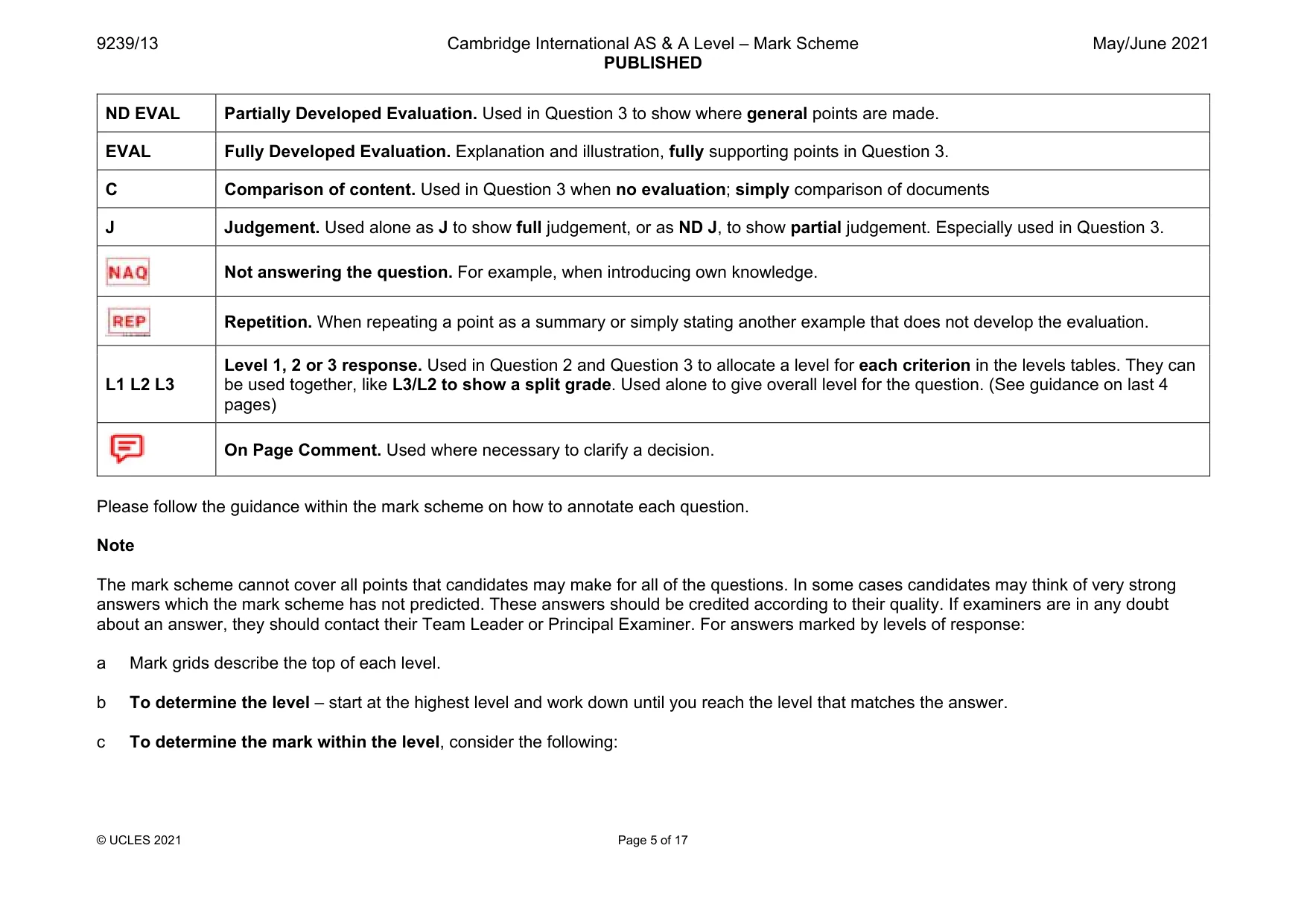
9239/13 Cambridge International AS & A Level – Mark Scheme PUBLISHED May/June 2021 © UCLES 2021 Page 5 of 17 ND EVAL Partially Developed Evaluation. Used in Question 3 to show where general points are made. EVAL Fully Developed Evaluation. Explanation and illustration, fully supporting points in Question 3. C Comparison of content. Used in Question 3 when no evaluation; simply comparison of documents J Judgement. Used alone as J to show full judgement, or as ND J, to show partial judgement. Especially used in Question 3. Not answering the question. For example, when introducing own knowledge. Repetition. When repeating a point as a summary or simply stating another example that does not develop the evaluation. L1 L2 L3 Level 1, 2 or 3 response. Used in Question 2 and Question 3 to allocate a level for each criterion in the levels tables. They can be used together, like L3/L2 to show a split grade. Used alone to give overall level for the question. (See guidance on last 4 pages) On Page Comment. Used where necessary to clarify a decision. Please follow the guidance within the mark scheme on how to annotate each question. Note The mark scheme cannot cover all points that candidates may make for all of the questions. In some cases candidates may think of very strong answers which the mark scheme has not predicted. These answers should be credited according to their quality. If examiners are in any doubt about an answer, they should contact their Team Leader or Principal Examiner. For answers marked by levels of response: a Mark grids describe the top of each level. b To determine the level – start at the highest level and work down until you reach the level that matches the answer. c To determine the mark within the level, consider the following:
Mark scheme, page 6
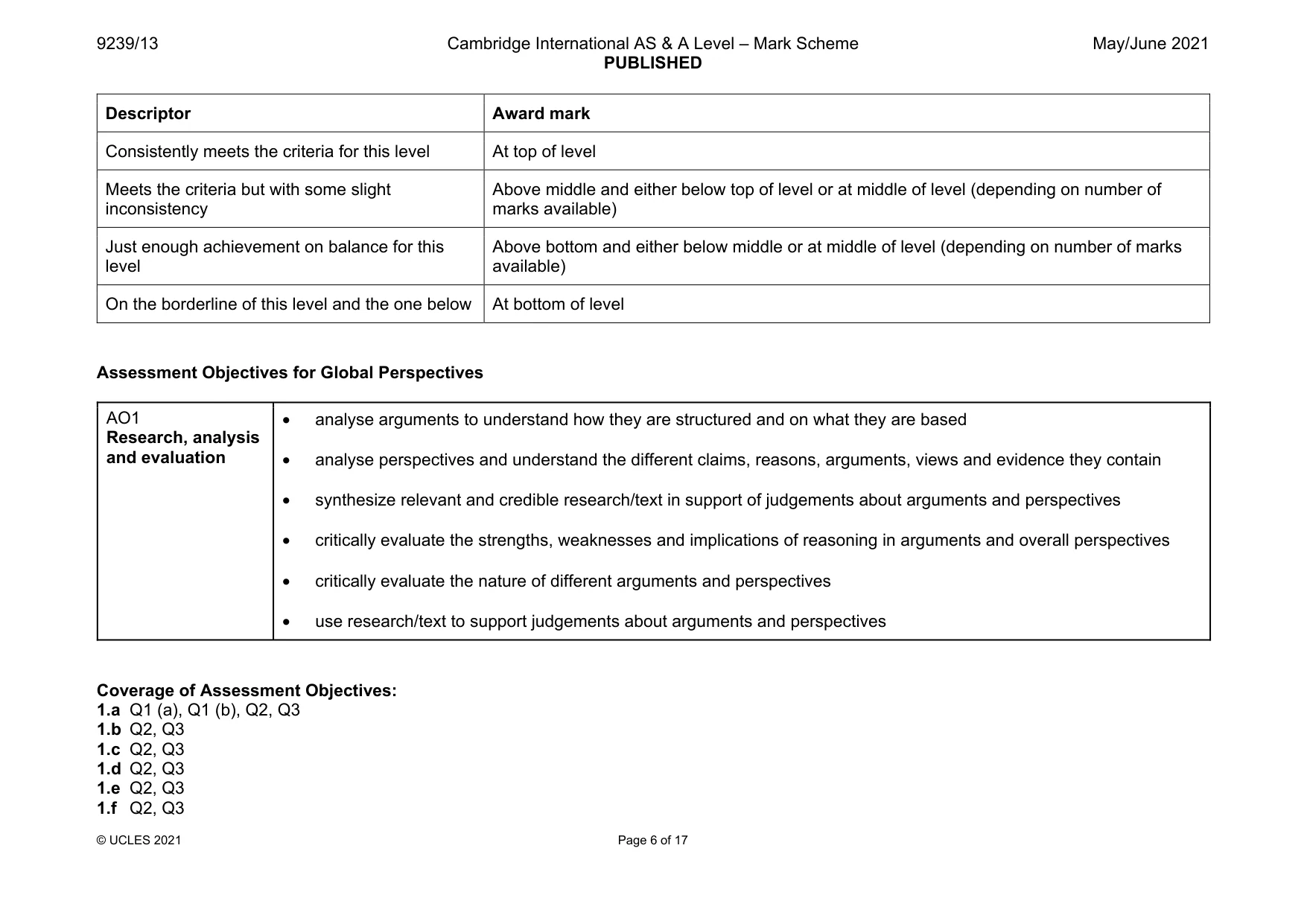
9239/13 Cambridge International AS & A Level – Mark Scheme PUBLISHED May/June 2021 © UCLES 2021 Page 6 of 17 Descriptor Award mark Consistently meets the criteria for this level At top of level Meets the criteria but with some slight inconsistency Above middle and either below top of level or at middle of level (depending on number of marks available) Just enough achievement on balance for this level Above bottom and either below middle or at middle of level (depending on number of marks available) On the borderline of this level and the one below At bottom of level Assessment Objectives for Global Perspectives AO1 Research, analysis and evaluation • analyse arguments to understand how they are structured and on what they are based • analyse perspectives and understand the different claims, reasons, arguments, views and evidence they contain • synthesize relevant and credible research/text in support of judgements about arguments and perspectives • critically evaluate the strengths, weaknesses and implications of reasoning in arguments and overall perspectives • critically evaluate the nature of different arguments and perspectives • use research/text to support judgements about arguments and perspectives Coverage of Assessment Objectives: 1.a Q1 (a), Q1 (b), Q2, Q3 1.b Q2, Q3 1.c Q2, Q3 1.d Q2, Q3 1.e Q2, Q3 1.f Q2, Q3
Mark scheme, page 7
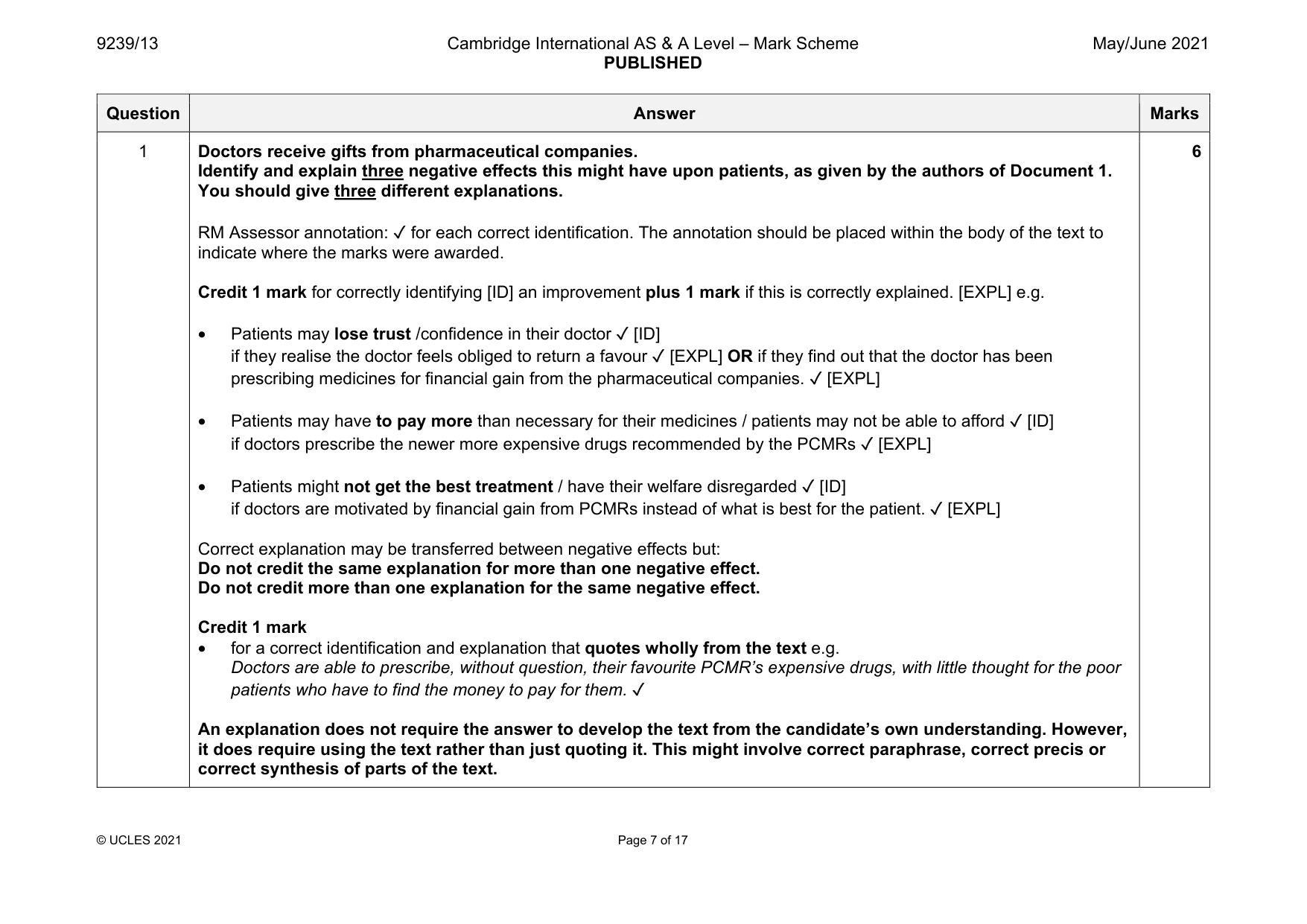
9239/13 Cambridge International AS & A Level – Mark Scheme PUBLISHED May/June 2021 © UCLES 2021 Page 7 of 17 Question Answer Marks 1 Doctors receive gifts from pharmaceutical companies. Identify and explain three negative effects this might have upon patients, as given by the authors of Document 1. You should give three different explanations. RM Assessor annotation: ✓ for each correct identification. The annotation should be placed within the body of the text to indicate where the marks were awarded. Credit 1 mark for correctly identifying [ID] an improvement plus 1 mark if this is correctly explained. [EXPL] e.g. • Patients may lose trust /confidence in their doctor ✓ [ID] if they realise the doctor feels obliged to return a favour ✓ [EXPL] OR if they find out that the doctor has been prescribing medicines for financial gain from the pharmaceutical companies. ✓ [EXPL] • Patients may have to pay more than necessary for their medicines / patients may not be able to afford ✓ [ID] if doctors prescribe the newer more expensive drugs recommended by the PCMRs ✓ [EXPL] • Patients might not get the best treatment / have their welfare disregarded ✓ [ID] if doctors are motivated by financial gain from PCMRs instead of what is best for the patient. ✓ [EXPL] Correct explanation may be transferred between negative effects but: Do not credit the same explanation for more than one negative effect. Do not credit more than one explanation for the same negative effect. Credit 1 mark • for a correct identification and explanation that quotes wholly from the text e.g. Doctors are able to prescribe, without question, their favourite PCMR’s expensive drugs, with little thought for the poor patients who have to find the money to pay for them. ✓ An explanation does not require the answer to develop the text from the candidate’s own understanding. However, it does require using the text rather than just quoting it. This might involve correct paraphrase, correct precis or correct synthesis of parts of the text. 6
Mark scheme, page 8
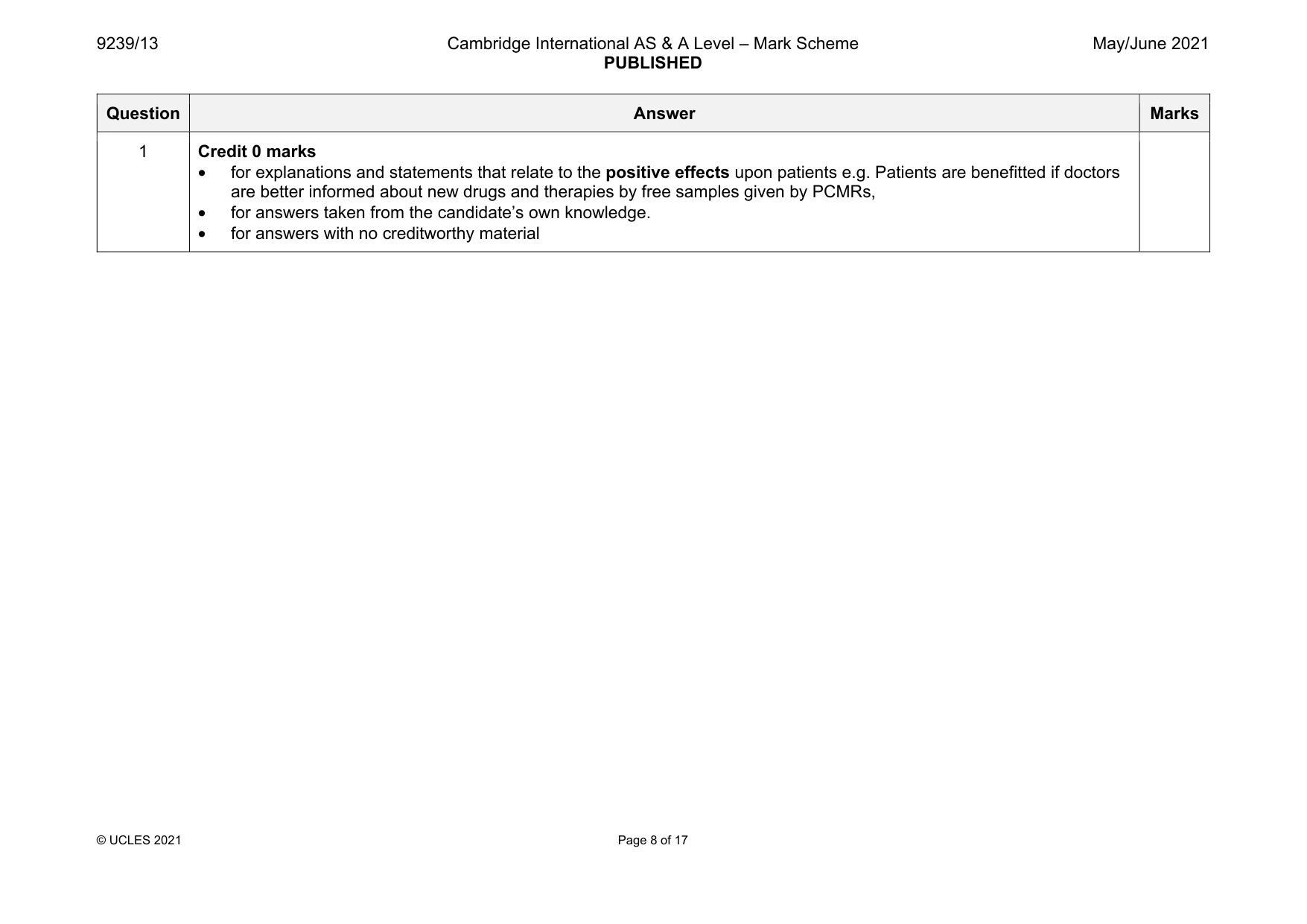
9239/13 Cambridge International AS & A Level – Mark Scheme PUBLISHED May/June 2021 © UCLES 2021 Page 8 of 17 Question Answer Marks 1 Credit 0 marks • for explanations and statements that relate to the positive effects upon patients e.g. Patients are benefitted if doctors are better informed about new drugs and therapies by free samples given by PCMRs, • for answers taken from the candidate’s own knowledge. • for answers with no creditworthy material
Mark scheme, page 9
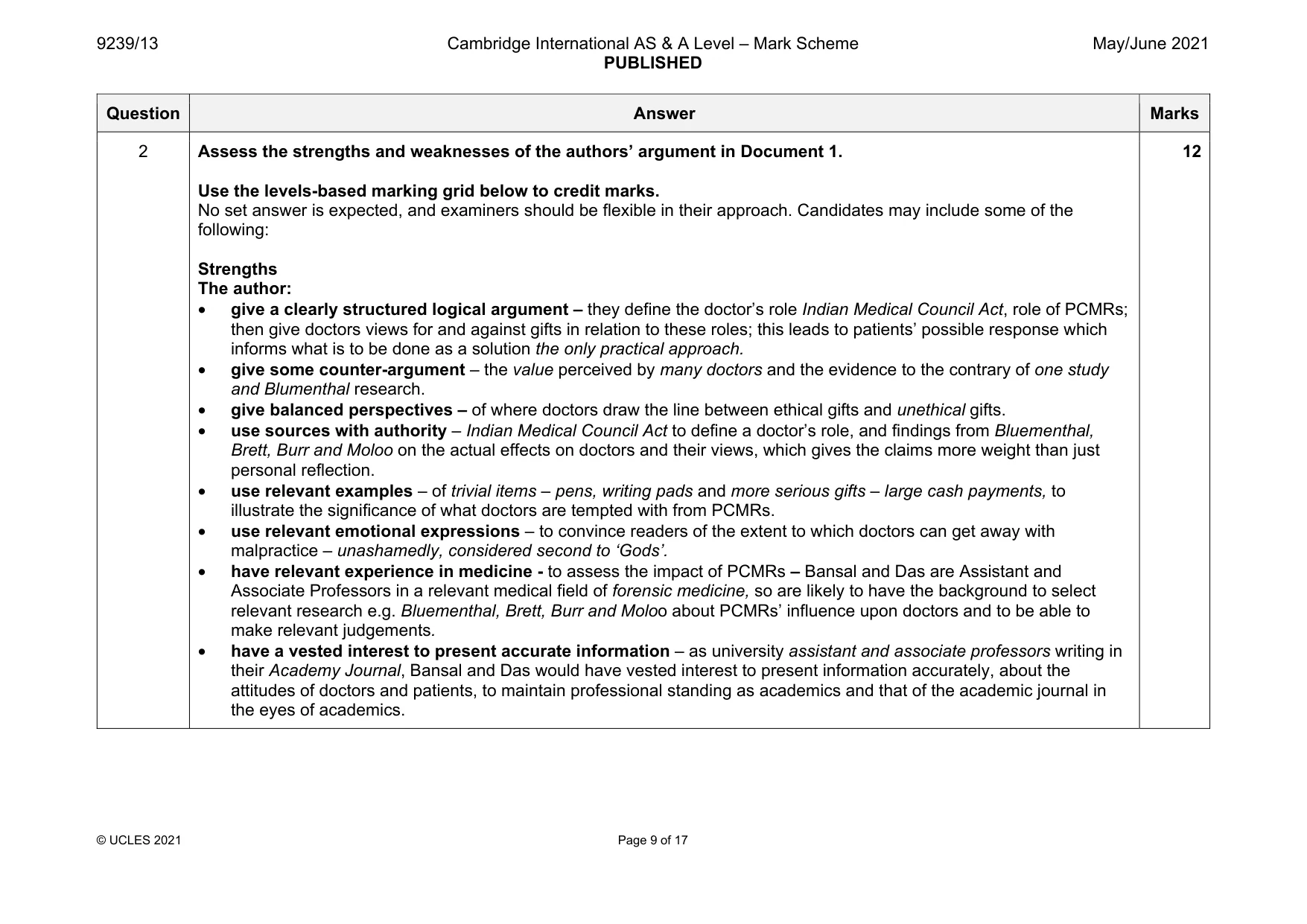
9239/13 Cambridge International AS & A Level – Mark Scheme PUBLISHED May/June 2021 © UCLES 2021 Page 9 of 17 Question Answer Marks 2 Assess the strengths and weaknesses of the authors’ argument in Document 1. Use the levels-based marking grid below to credit marks. No set answer is expected, and examiners should be flexible in their approach. Candidates may include some of the following: Strengths The author: • give a clearly structured logical argument – they define the doctor’s role Indian Medical Council Act, role of PCMRs; then give doctors views for and against gifts in relation to these roles; this leads to patients’ possible response which informs what is to be done as a solution the only practical approach. • give some counter-argument – the value perceived by many doctors and the evidence to the contrary of one study and Blumenthal research. • give balanced perspectives – of where doctors draw the line between ethical gifts and unethical gifts. • use sources with authority – Indian Medical Council Act to define a doctor’s role, and findings from Bluementhal, Brett, Burr and Moloo on the actual effects on doctors and their views, which gives the claims more weight than just personal reflection. • use relevant examples – of trivial items – pens, writing pads and more serious gifts – large cash payments, to illustrate the significance of what doctors are tempted with from PCMRs. • use relevant emotional expressions – to convince readers of the extent to which doctors can get away with malpractice – unashamedly, considered second to ‘Gods’. • have relevant experience in medicine - to assess the impact of PCMRs – Bansal and Das are Assistant and Associate Professors in a relevant medical field of forensic medicine, so are likely to have the background to select relevant research e.g. Bluementhal, Brett, Burr and Moloo about PCMRs’ influence upon doctors and to be able to make relevant judgements. • have a vested interest to present accurate information – as university assistant and associate professors writing in their Academy Journal, Bansal and Das would have vested interest to present information accurately, about the attitudes of doctors and patients, to maintain professional standing as academics and that of the academic journal in the eyes of academics. 12
Mark scheme, page 10
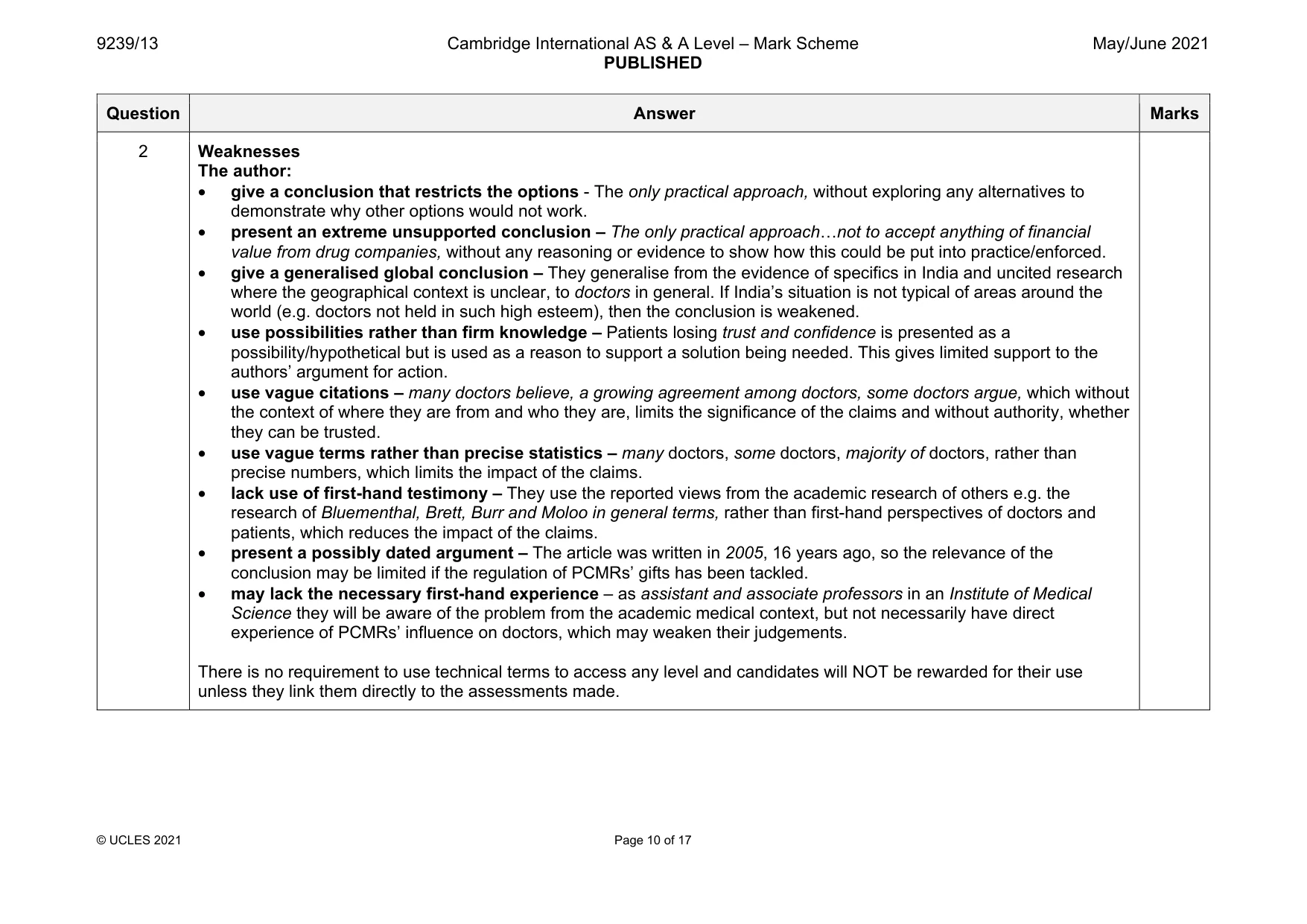
9239/13 Cambridge International AS & A Level – Mark Scheme PUBLISHED May/June 2021 © UCLES 2021 Page 10 of 17 Question Answer Marks 2 Weaknesses The author: • give a conclusion that restricts the options - The only practical approach, without exploring any alternatives to demonstrate why other options would not work. • present an extreme unsupported conclusion – The only practical approach…not to accept anything of financial value from drug companies, without any reasoning or evidence to show how this could be put into practice/enforced. • give a generalised global conclusion – They generalise from the evidence of specifics in India and uncited research where the geographical context is unclear, to doctors in general. If India’s situation is not typical of areas around the world (e.g. doctors not held in such high esteem), then the conclusion is weakened. • use possibilities rather than firm knowledge – Patients losing trust and confidence is presented as a possibility/hypothetical but is used as a reason to support a solution being needed. This gives limited support to the authors’ argument for action. • use vague citations – many doctors believe, a growing agreement among doctors, some doctors argue, which without the context of where they are from and who they are, limits the significance of the claims and without authority, whether they can be trusted. • use vague terms rather than precise statistics – many doctors, some doctors, majority of doctors, rather than precise numbers, which limits the impact of the claims. • lack use of first-hand testimony – They use the reported views from the academic research of others e.g. the research of Bluementhal, Brett, Burr and Moloo in general terms, rather than first-hand perspectives of doctors and patients, which reduces the impact of the claims. • present a possibly dated argument – The article was written in 2005, 16 years ago, so the relevance of the conclusion may be limited if the regulation of PCMRs’ gifts has been tackled. • may lack the necessary first-hand experience – as assistant and associate professors in an Institute of Medical Science they will be aware of the problem from the academic medical context, but not necessarily have direct experience of PCMRs’ influence on doctors, which may weaken their judgements. There is no requirement to use technical terms to access any level and candidates will NOT be rewarded for their use unless they link them directly to the assessments made.
Mark scheme, page 11
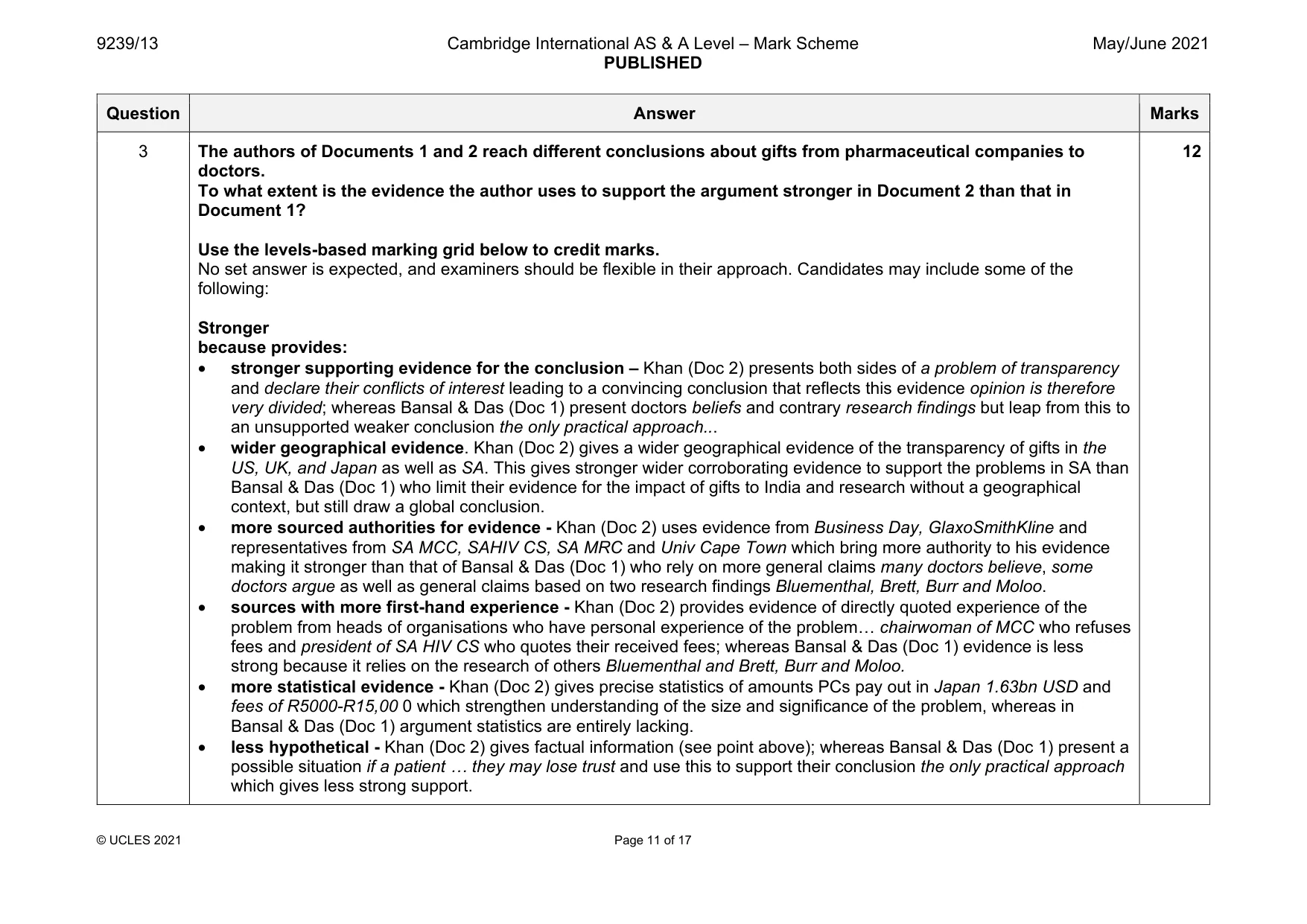
9239/13 Cambridge International AS & A Level – Mark Scheme PUBLISHED May/June 2021 © UCLES 2021 Page 11 of 17 Question Answer Marks 3 The authors of Documents 1 and 2 reach different conclusions about gifts from pharmaceutical companies to doctors. To what extent is the evidence the author uses to support the argument stronger in Document 2 than that in Document 1? Use the levels-based marking grid below to credit marks. No set answer is expected, and examiners should be flexible in their approach. Candidates may include some of the following: Stronger because provides: • stronger supporting evidence for the conclusion – Khan (Doc 2) presents both sides of a problem of transparency and declare their conflicts of interest leading to a convincing conclusion that reflects this evidence opinion is therefore very divided; whereas Bansal & Das (Doc 1) present doctors beliefs and contrary research findings but leap from this to an unsupported weaker conclusion the only practical approach... • wider geographical evidence. Khan (Doc 2) gives a wider geographical evidence of the transparency of gifts in the US, UK, and Japan as well as SA. This gives stronger wider corroborating evidence to support the problems in SA than Bansal & Das (Doc 1) who limit their evidence for the impact of gifts to India and research without a geographical context, but still draw a global conclusion. • more sourced authorities for evidence - Khan (Doc 2) uses evidence from Business Day, GlaxoSmithKline and representatives from SA MCC, SAHIV CS, SA MRC and Univ Cape Town which bring more authority to his evidence making it stronger than that of Bansal & Das (Doc 1) who rely on more general claims many doctors believe, some doctors argue as well as general claims based on two research findings Bluementhal, Brett, Burr and Moloo. • sources with more first-hand experience - Khan (Doc 2) provides evidence of directly quoted experience of the problem from heads of organisations who have personal experience of the problem… chairwoman of MCC who refuses fees and president of SA HIV CS who quotes their received fees; whereas Bansal & Das (Doc 1) evidence is less strong because it relies on the research of others Bluementhal and Brett, Burr and Moloo. • more statistical evidence - Khan (Doc 2) gives precise statistics of amounts PCs pay out in Japan 1.63bn USD and fees of R5000-R15,00 0 which strengthen understanding of the size and significance of the problem, whereas in Bansal & Das (Doc 1) argument statistics are entirely lacking. • less hypothetical - Khan (Doc 2) gives factual information (see point above); whereas Bansal & Das (Doc 1) present a possible situation if a patient … they may lose trust and use this to support their conclusion the only practical approach which gives less strong support. 12
Mark scheme, page 12
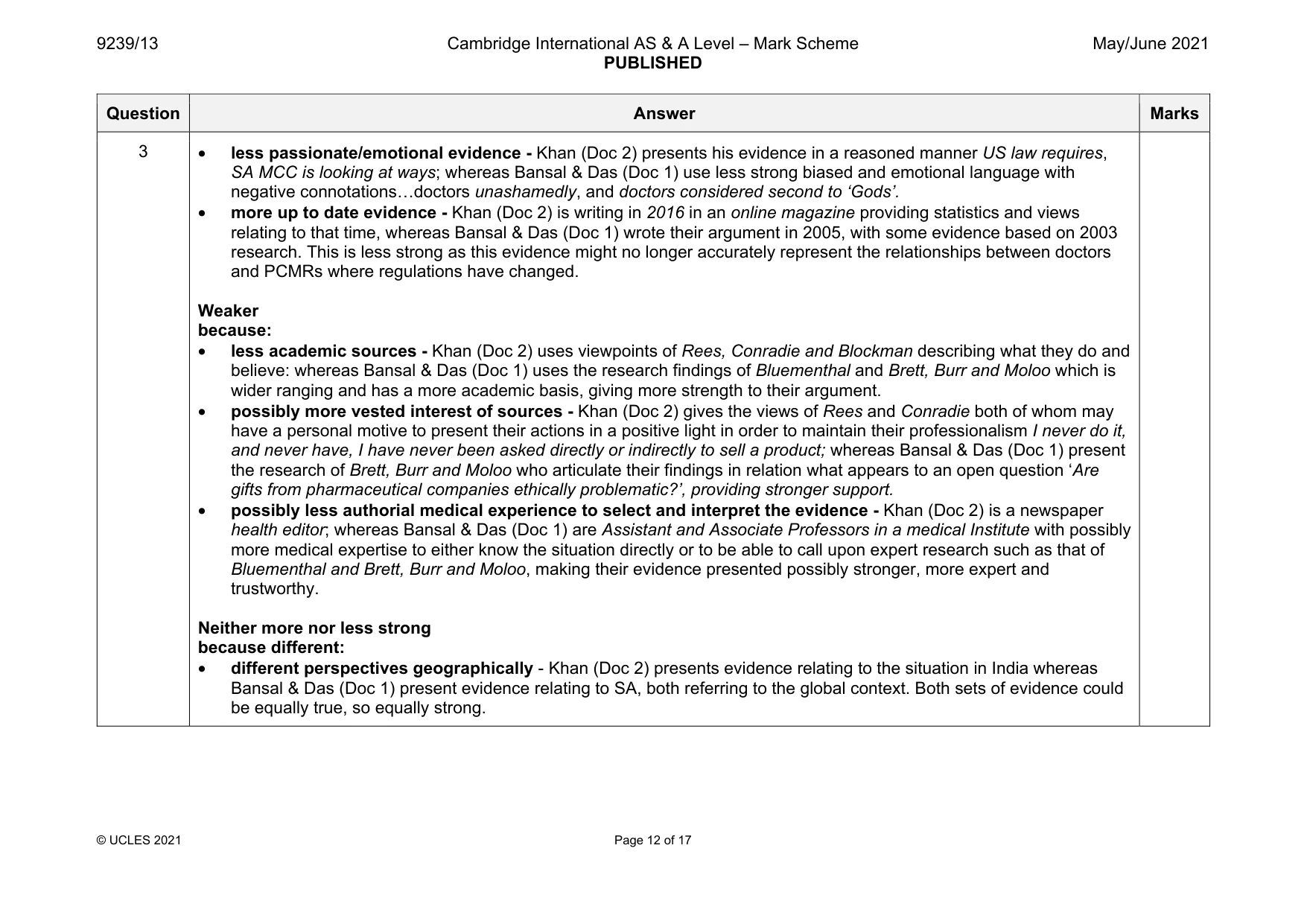
9239/13 Cambridge International AS & A Level – Mark Scheme PUBLISHED May/June 2021 © UCLES 2021 Page 12 of 17 Question Answer Marks 3 • less passionate/emotional evidence - Khan (Doc 2) presents his evidence in a reasoned manner US law requires, SA MCC is looking at ways; whereas Bansal & Das (Doc 1) use less strong biased and emotional language with negative connotations…doctors unashamedly, and doctors considered second to ‘Gods’. • more up to date evidence - Khan (Doc 2) is writing in 2016 in an online magazine providing statistics and views relating to that time, whereas Bansal & Das (Doc 1) wrote their argument in 2005, with some evidence based on 2003 research. This is less strong as this evidence might no longer accurately represent the relationships between doctors and PCMRs where regulations have changed. Weaker because: • less academic sources - Khan (Doc 2) uses viewpoints of Rees, Conradie and Blockman describing what they do and believe: whereas Bansal & Das (Doc 1) uses the research findings of Bluementhal and Brett, Burr and Moloo which is wider ranging and has a more academic basis, giving more strength to their argument. • possibly more vested interest of sources - Khan (Doc 2) gives the views of Rees and Conradie both of whom may have a personal motive to present their actions in a positive light in order to maintain their professionalism I never do it, and never have, I have never been asked directly or indirectly to sell a product; whereas Bansal & Das (Doc 1) present the research of Brett, Burr and Moloo who articulate their findings in relation what appears to an open question ‘Are gifts from pharmaceutical companies ethically problematic?’, providing stronger support. • possibly less authorial medical experience to select and interpret the evidence - Khan (Doc 2) is a newspaper health editor; whereas Bansal & Das (Doc 1) are Assistant and Associate Professors in a medical Institute with possibly more medical expertise to either know the situation directly or to be able to call upon expert research such as that of Bluementhal and Brett, Burr and Moloo, making their evidence presented possibly stronger, more expert and trustworthy. Neither more nor less strong because different: • different perspectives geographically - Khan (Doc 2) presents evidence relating to the situation in India whereas Bansal & Das (Doc 1) present evidence relating to SA, both referring to the global context. Both sets of evidence could be equally true, so equally strong.
Mark scheme, page 13
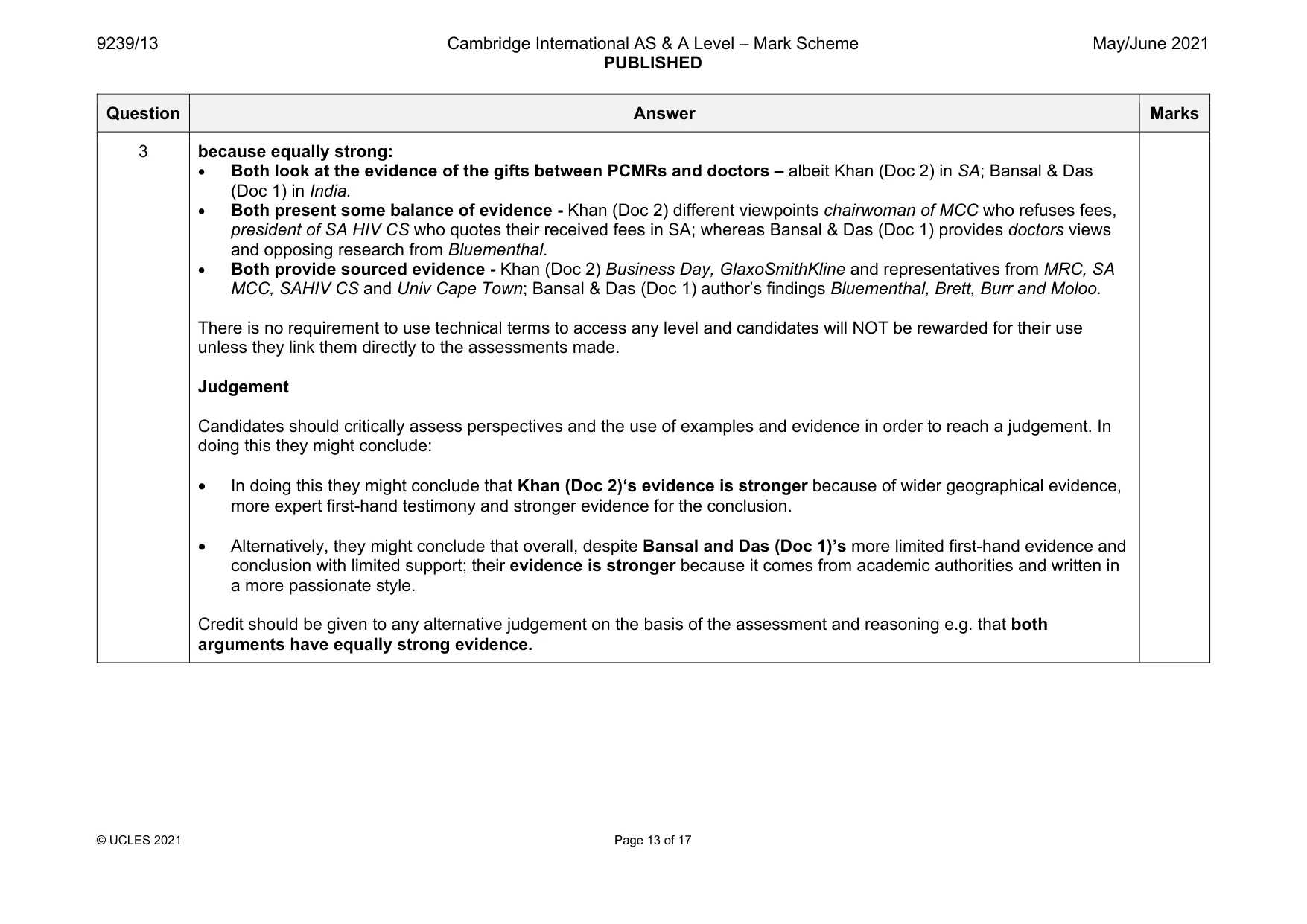
9239/13 Cambridge International AS & A Level – Mark Scheme PUBLISHED May/June 2021 © UCLES 2021 Page 13 of 17 Question Answer Marks 3 because equally strong: • Both look at the evidence of the gifts between PCMRs and doctors – albeit Khan (Doc 2) in SA; Bansal & Das (Doc 1) in India. • Both present some balance of evidence - Khan (Doc 2) different viewpoints chairwoman of MCC who refuses fees, president of SA HIV CS who quotes their received fees in SA; whereas Bansal & Das (Doc 1) provides doctors views and opposing research from Bluementhal. • Both provide sourced evidence - Khan (Doc 2) Business Day, GlaxoSmithKline and representatives from MRC, SA MCC, SAHIV CS and Univ Cape Town; Bansal & Das (Doc 1) author’s findings Bluementhal, Brett, Burr and Moloo. There is no requirement to use technical terms to access any level and candidates will NOT be rewarded for their use unless they link them directly to the assessments made. Judgement Candidates should critically assess perspectives and the use of examples and evidence in order to reach a judgement. In doing this they might conclude: • In doing this they might conclude that Khan (Doc 2)‘s evidence is stronger because of wider geographical evidence, more expert first-hand testimony and stronger evidence for the conclusion. • Alternatively, they might conclude that overall, despite Bansal and Das (Doc 1)’s more limited first-hand evidence and conclusion with limited support; their evidence is stronger because it comes from academic authorities and written in a more passionate style. Credit should be given to any alternative judgement on the basis of the assessment and reasoning e.g. that both arguments have equally strong evidence.
Mark scheme, page 14
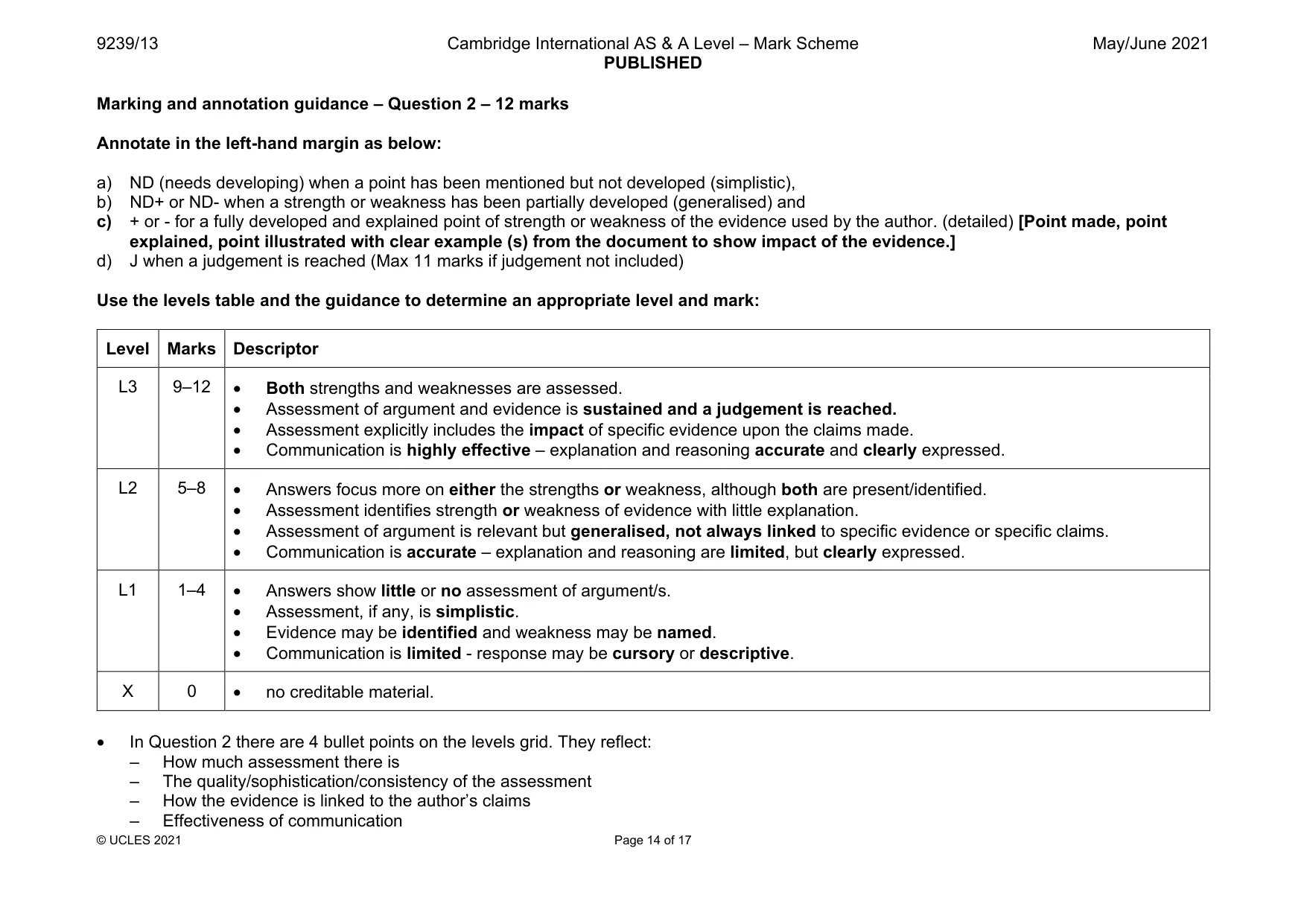
9239/13 Cambridge International AS & A Level – Mark Scheme PUBLISHED May/June 2021 © UCLES 2021 Page 14 of 17 Marking and annotation guidance – Question 2 – 12 marks Annotate in the left-hand margin as below: a) ND (needs developing) when a point has been mentioned but not developed (simplistic), b) ND+ or ND- when a strength or weakness has been partially developed (generalised) and c) + or - for a fully developed and explained point of strength or weakness of the evidence used by the author. (detailed) [Point made, point explained, point illustrated with clear example (s) from the document to show impact of the evidence.] d) J when a judgement is reached (Max 11 marks if judgement not included) Use the levels table and the guidance to determine an appropriate level and mark: Level Marks Descriptor L3 9–12 • Both strengths and weaknesses are assessed. • Assessment of argument and evidence is sustained and a judgement is reached. • Assessment explicitly includes the impact of specific evidence upon the claims made. • Communication is highly effective – explanation and reasoning accurate and clearly expressed. L2 5–8 • Answers focus more on either the strengths or weakness, although both are present/identified. • Assessment identifies strength or weakness of evidence with little explanation. • Assessment of argument is relevant but generalised, not always linked to specific evidence or specific claims. • Communication is accurate – explanation and reasoning are limited, but clearly expressed. L1 1–4 • Answers show little or no assessment of argument/s. • Assessment, if any, is simplistic. • Evidence may be identified and weakness may be named. • Communication is limited - response may be cursory or descriptive. X 0 • no creditable material. • In Question 2 there are 4 bullet points on the levels grid. They reflect: – How much assessment there is – The quality/sophistication/consistency of the assessment – How the evidence is linked to the author’s claims – Effectiveness of communication
Mark scheme, page 15
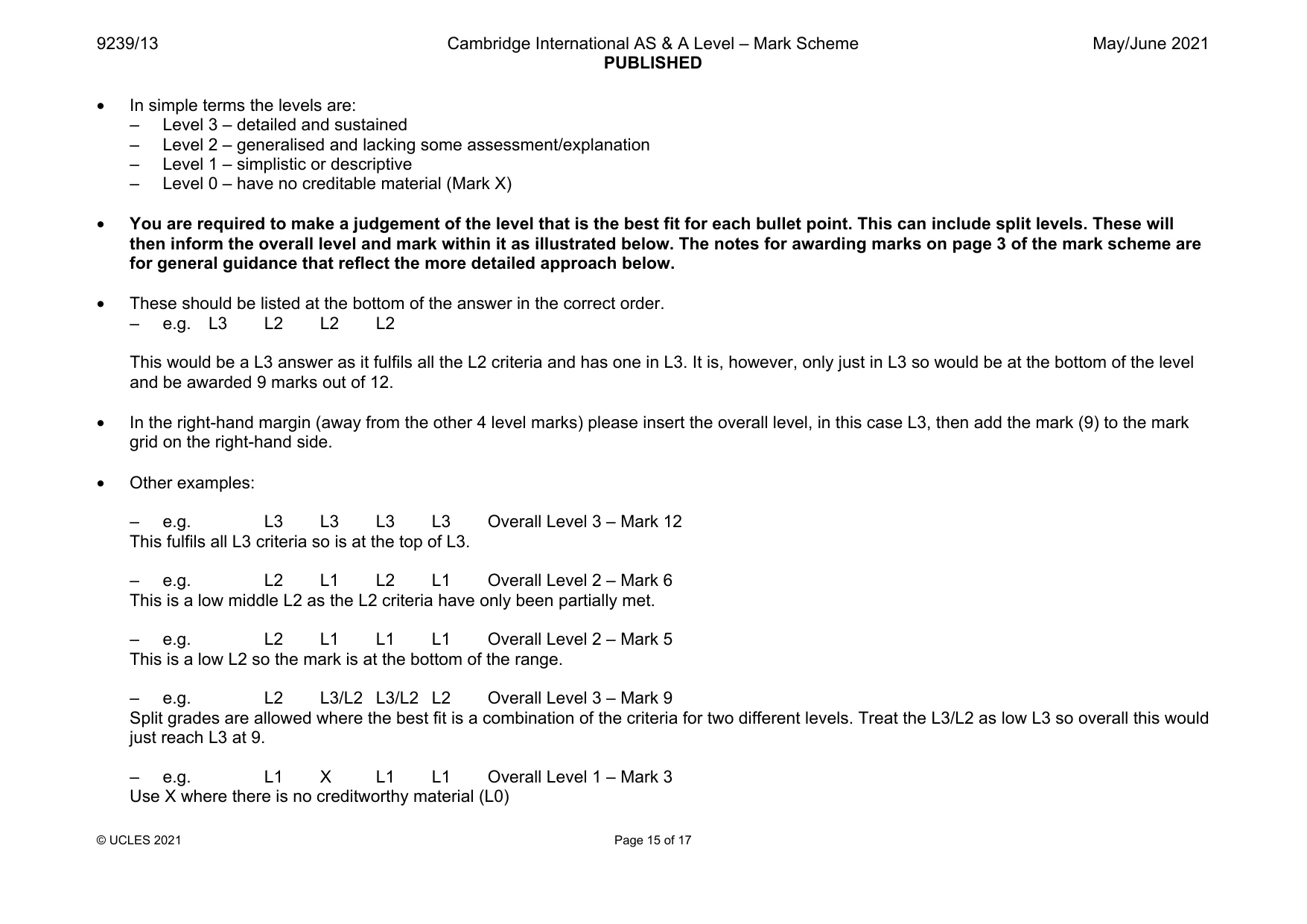
9239/13 Cambridge International AS & A Level – Mark Scheme PUBLISHED May/June 2021 © UCLES 2021 Page 15 of 17 • In simple terms the levels are: – Level 3 – detailed and sustained – Level 2 – generalised and lacking some assessment/explanation – Level 1 – simplistic or descriptive – Level 0 – have no creditable material (Mark X) • You are required to make a judgement of the level that is the best fit for each bullet point. This can include split levels. These will then inform the overall level and mark within it as illustrated below. The notes for awarding marks on page 3 of the mark scheme are for general guidance that reflect the more detailed approach below. • These should be listed at the bottom of the answer in the correct order. – e.g. L3 L2 L2 L2 This would be a L3 answer as it fulfils all the L2 criteria and has one in L3. It is, however, only just in L3 so would be at the bottom of the level and be awarded 9 marks out of 12. • In the right-hand margin (away from the other 4 level marks) please insert the overall level, in this case L3, then add the mark (9) to the mark grid on the right-hand side. • Other examples: – e.g. L3 L3 L3 L3 Overall Level 3 – Mark 12 This fulfils all L3 criteria so is at the top of L3. – e.g. L2 L1 L2 L1 Overall Level 2 – Mark 6 This is a low middle L2 as the L2 criteria have only been partially met. – e.g. L2 L1 L1 L1 Overall Level 2 – Mark 5 This is a low L2 so the mark is at the bottom of the range. – e.g. L2 L3/L2 L3/L2 L2 Overall Level 3 – Mark 9 Split grades are allowed where the best fit is a combination of the criteria for two different levels. Treat the L3/L2 as low L3 so overall this would just reach L3 at 9. – e.g. L1 X L1 L1 Overall Level 1 – Mark 3 Use X where there is no creditworthy material (L0)
Mark scheme, page 16
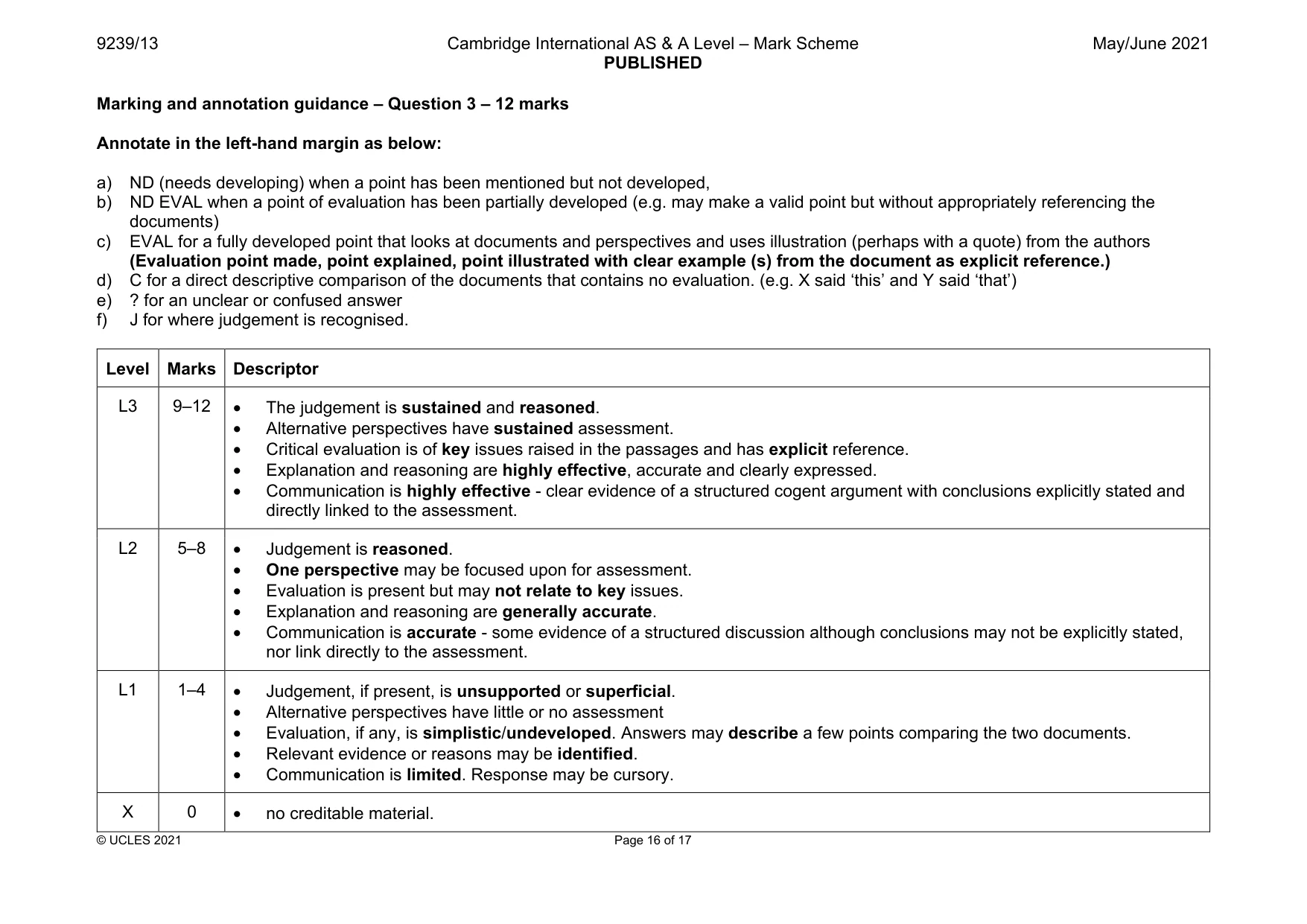
9239/13 Cambridge International AS & A Level – Mark Scheme PUBLISHED May/June 2021 © UCLES 2021 Page 16 of 17 Marking and annotation guidance – Question 3 – 12 marks Annotate in the left-hand margin as below: a) ND (needs developing) when a point has been mentioned but not developed, b) ND EVAL when a point of evaluation has been partially developed (e.g. may make a valid point but without appropriately referencing the documents) c) EVAL for a fully developed point that looks at documents and perspectives and uses illustration (perhaps with a quote) from the authors (Evaluation point made, point explained, point illustrated with clear example (s) from the document as explicit reference.) d) C for a direct descriptive comparison of the documents that contains no evaluation. (e.g. X said ‘this’ and Y said ‘that’) e) ? for an unclear or confused answer f) J for where judgement is recognised. Level Marks Descriptor L3 9–12 • The judgement is sustained and reasoned. • Alternative perspectives have sustained assessment. • Critical evaluation is of key issues raised in the passages and has explicit reference. • Explanation and reasoning are highly effective, accurate and clearly expressed. • Communication is highly effective - clear evidence of a structured cogent argument with conclusions explicitly stated and directly linked to the assessment. L2 5–8 • Judgement is reasoned. • One perspective may be focused upon for assessment. • Evaluation is present but may not relate to key issues. • Explanation and reasoning are generally accurate. • Communication is accurate - some evidence of a structured discussion although conclusions may not be explicitly stated, nor link directly to the assessment. L1 1–4 • Judgement, if present, is unsupported or superficial. • Alternative perspectives have little or no assessment • Evaluation, if any, is simplistic/undeveloped. Answers may describe a few points comparing the two documents. • Relevant evidence or reasons may be identified. • Communication is limited. Response may be cursory. X 0 • no creditable material.
Mark scheme, page 17
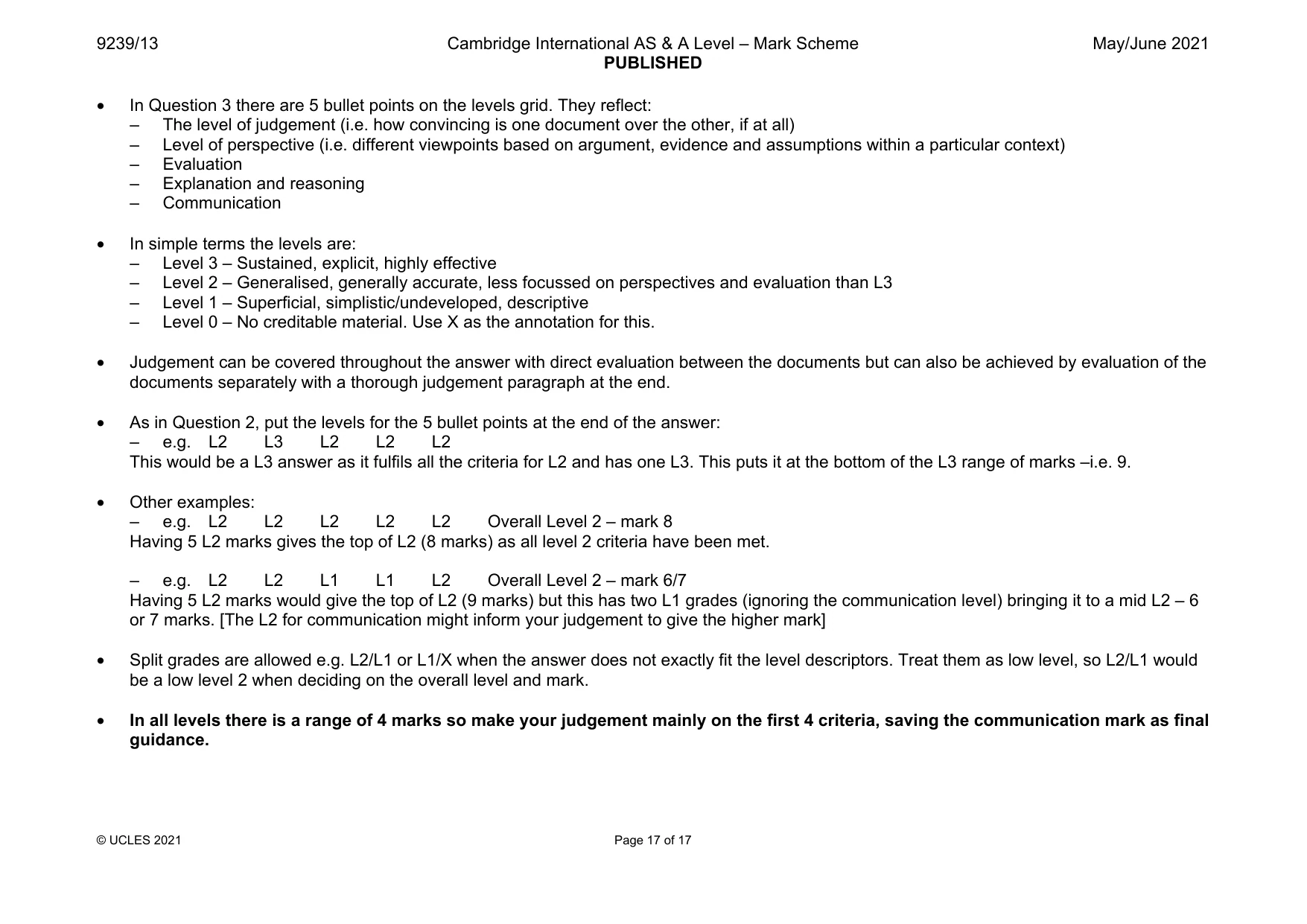
9239/13 Cambridge International AS & A Level – Mark Scheme PUBLISHED May/June 2021 © UCLES 2021 Page 17 of 17 • In Question 3 there are 5 bullet points on the levels grid. They reflect: – The level of judgement (i.e. how convincing is one document over the other, if at all) – Level of perspective (i.e. different viewpoints based on argument, evidence and assumptions within a particular context) – Evaluation – Explanation and reasoning – Communication • In simple terms the levels are: – Level 3 – Sustained, explicit, highly effective – Level 2 – Generalised, generally accurate, less focussed on perspectives and evaluation than L3 – Level 1 – Superficial, simplistic/undeveloped, descriptive – Level 0 – No creditable material. Use X as the annotation for this. • Judgement can be covered throughout the answer with direct evaluation between the documents but can also be achieved by evaluation of the documents separately with a thorough judgement paragraph at the end. • As in Question 2, put the levels for the 5 bullet points at the end of the answer: – e.g. L2 L3 L2 L2 L2 This would be a L3 answer as it fulfils all the criteria for L2 and has one L3. This puts it at the bottom of the L3 range of marks –i.e. 9. • Other examples: – e.g. L2 L2 L2 L2 L2 Overall Level 2 – mark 8 Having 5 L2 marks gives the top of L2 (8 marks) as all level 2 criteria have been met. – e.g. L2 L2 L1 L1 L2 Overall Level 2 – mark 6/7 Having 5 L2 marks would give the top of L2 (9 marks) but this has two L1 grades (ignoring the communication level) bringing it to a mid L2 – 6 or 7 marks. [The L2 for communication might inform your judgement to give the higher mark] • Split grades are allowed e.g. L2/L1 or L1/X when the answer does not exactly fit the level descriptors. Treat them as low level, so L2/L1 would be a low level 2 when deciding on the overall level and mark. • In all levels there is a range of 4 marks so make your judgement mainly on the first 4 criteria, saving the communication mark as final guidance.
What you needed in this session
Cambridge’s own grade thresholds for 2021 May/June, Paper 1 · Variant 3. A higher threshold means an easier paper — the bar moves with how the cohort did.