Cambridge A Level Global Perspectives and Research 9239 — 2019 Feb/March Paper 1 · Variant 2
9239/12/F/M/19 · 30 marks · ≈34 min
The question paper and its mark scheme, free to read here and free to download. This is Cambridge’s own paper, exactly as it was sat.
Question paper4 pages

Mark scheme11 pages
Answers below. Sit the paper first if you are practising.
Paper as text
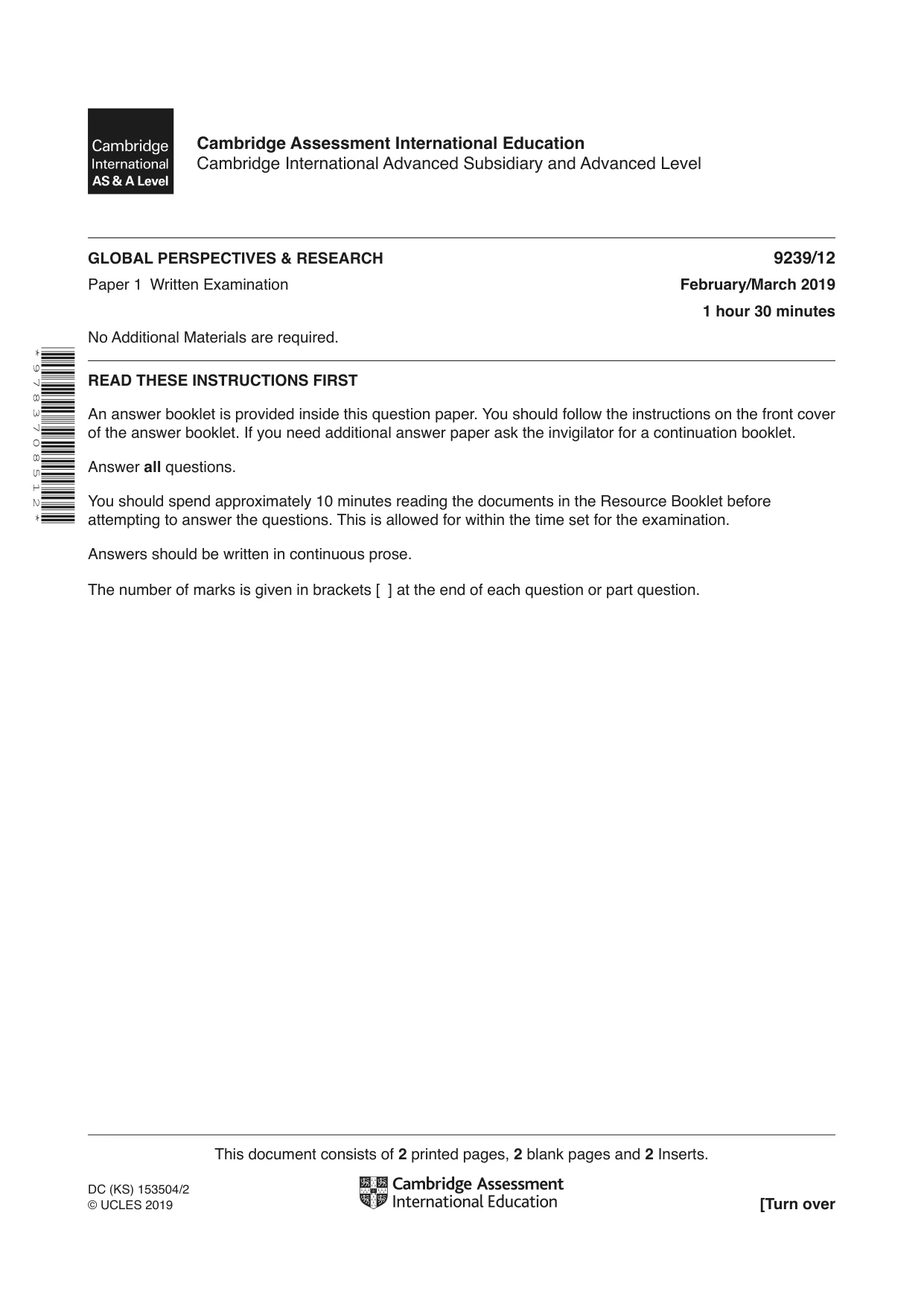
Question paper, page 1
* 9 7 8 3 7 0 8 5 1 2 * This document consists of 2 printed pages, 2 blank pages and 2 Inserts. DC (KS) 153504/2 © UCLES 2019 [Turn over Cambridge Assessment International Education Cambridge International Advanced Subsidiary and Advanced Level GLOBAL PERSPECTIVES & RESEARCH 9239/12 Paper 1 Written Examination February/March 2019 1 hour 30 minutes No Additional Materials are required. READ THESE INSTRUCTIONS FIRST An answer booklet is provided inside this question paper. You should follow the instructions on the front cover of the answer booklet. If you need additional answer paper ask the invigilator for a continuation booklet. Answer all questions. You should spend approximately 10 minutes reading the documents in the Resource Booklet before attempting to answer the questions. This is allowed for within the time set for the examination. Answers should be written in continuous prose. The number of marks is given in brackets [ ] at the end of each question or part question.
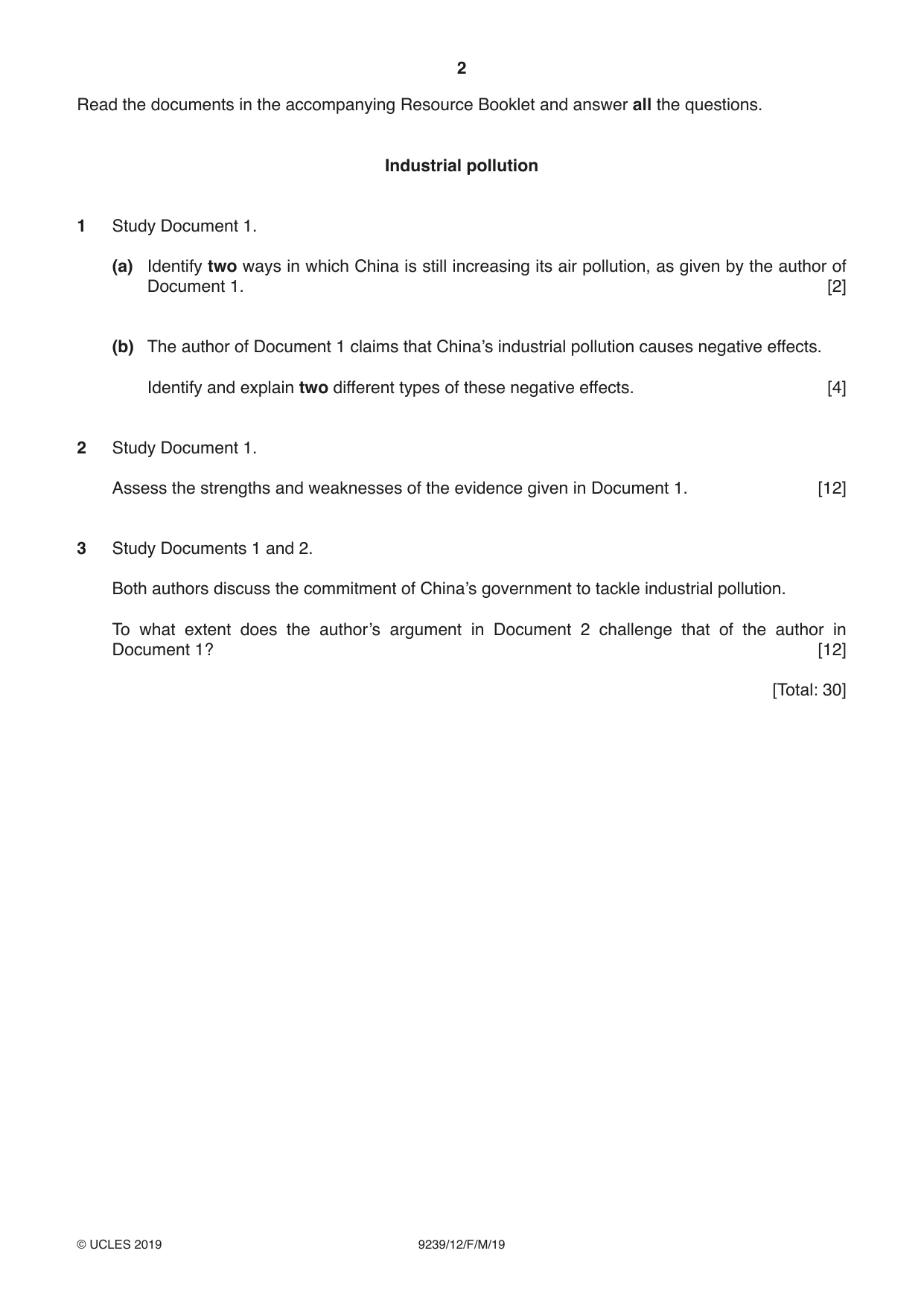
Question paper, page 2
2 9239/12/F/M/19 © UCLES 2019 Read the documents in the accompanying Resource Booklet and answer all the questions. Industrial pollution 1 Study Document 1. (a) Identify two ways in which China is still increasing its air pollution, as given by the author of Document 1. [2] (b) The author of Document 1 claims that China’s industrial pollution causes negative effects. Identify and explain two different types of these negative effects. [4] 2 Study Document 1. Assess the strengths and weaknesses of the evidence given in Document 1. [12] 3 Study Documents 1 and 2. Both authors discuss the commitment of China’s government to tackle industrial pollution. To what extent does the author’s argument in Document 2 challenge that of the author in Document 1? [12] [Total: 30]
Question paper, page 3
3 9239/12/F/M/19 © UCLES 2019 BLANK PAGE
Question paper, page 4
4 9239/12/F/M/19 © UCLES 2019 BLANK PAGE Permission to reproduce items where third-party owned material protected by copyright is included has been sought and cleared where possible. Every reasonable effort has been made by the publisher (UCLES) to trace copyright holders, but if any items requiring clearance have unwittingly been included, the publisher will be pleased to make amends at the earliest possible opportunity. To avoid the issue of disclosure of answer-related information to candidates, all copyright acknowledgements are reproduced online in the Cambridge Assessment International Education Copyright Acknowledgements Booklet. This is produced for each series of examinations and is freely available to download at www.cambridgeinternational.org after the live examination series. Cambridge Assessment International Education is part of the Cambridge Assessment Group. Cambridge Assessment is the brand name of the University of Cambridge Local Examinations Syndicate (UCLES), which itself is a department of the University of Cambridge.
Mark scheme, page 1
This document consists of 11 printed pages. © UCLES 2019 [Turn over Cambridge Assessment International Education Cambridge International Advanced Subsidiary and Advanced Level GLOBAL PERSPECTIVES & RESEARCH 9239/12 Paper 1 Written Exam March 2019 MARK SCHEME Maximum Mark: 30 Published This mark scheme is published as an aid to teachers and candidates, to indicate the requirements of the examination. It shows the basis on which Examiners were instructed to award marks. It does not indicate the details of the discussions that took place at an Examiners’ meeting before marking began, which would have considered the acceptability of alternative answers. Mark schemes should be read in conjunction with the question paper and the Principal Examiner Report for Teachers. Cambridge International will not enter into discussions about these mark schemes. Cambridge International is publishing the mark schemes for the March 2019 series for most Cambridge IGCSE™, Cambridge International A and AS Level components and some Cambridge O Level components.
Mark scheme, page 2
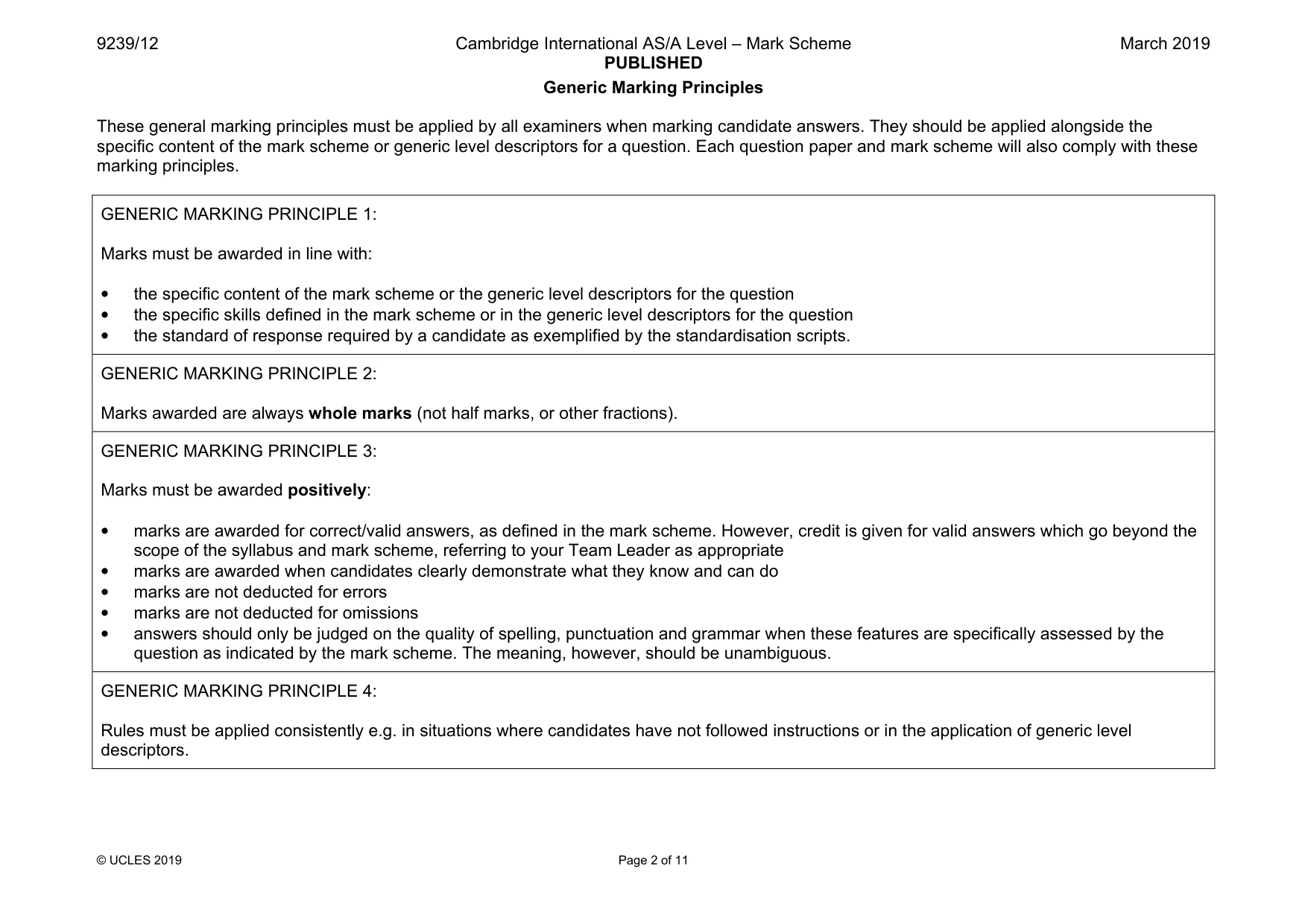
9239/12 Cambridge International AS/A Level – Mark Scheme PUBLISHED March 2019 © UCLES 2019 Page 2 of 11 Generic Marking Principles These general marking principles must be applied by all examiners when marking candidate answers. They should be applied alongside the specific content of the mark scheme or generic level descriptors for a question. Each question paper and mark scheme will also comply with these marking principles. GENERIC MARKING PRINCIPLE 1: Marks must be awarded in line with: • the specific content of the mark scheme or the generic level descriptors for the question • the specific skills defined in the mark scheme or in the generic level descriptors for the question • the standard of response required by a candidate as exemplified by the standardisation scripts. GENERIC MARKING PRINCIPLE 2: Marks awarded are always whole marks (not half marks, or other fractions). GENERIC MARKING PRINCIPLE 3: Marks must be awarded positively: • marks are awarded for correct/valid answers, as defined in the mark scheme. However, credit is given for valid answers which go beyond the scope of the syllabus and mark scheme, referring to your Team Leader as appropriate • marks are awarded when candidates clearly demonstrate what they know and can do • marks are not deducted for errors • marks are not deducted for omissions • answers should only be judged on the quality of spelling, punctuation and grammar when these features are specifically assessed by the question as indicated by the mark scheme. The meaning, however, should be unambiguous. GENERIC MARKING PRINCIPLE 4: Rules must be applied consistently e.g. in situations where candidates have not followed instructions or in the application of generic level descriptors.
Mark scheme, page 3
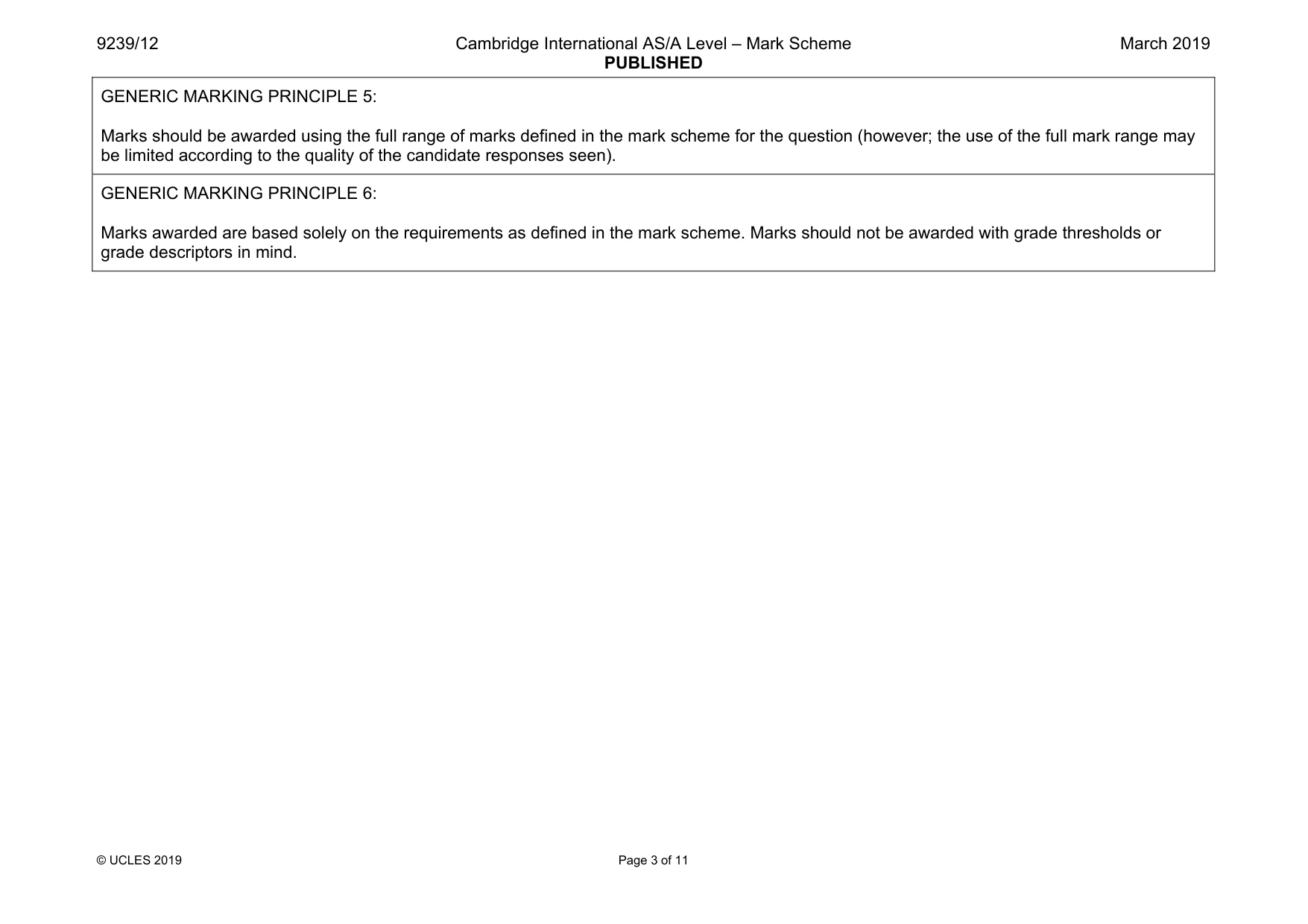
9239/12 Cambridge International AS/A Level – Mark Scheme PUBLISHED March 2019 © UCLES 2019 Page 3 of 11 GENERIC MARKING PRINCIPLE 5: Marks should be awarded using the full range of marks defined in the mark scheme for the question (however; the use of the full mark range may be limited according to the quality of the candidate responses seen). GENERIC MARKING PRINCIPLE 6: Marks awarded are based solely on the requirements as defined in the mark scheme. Marks should not be awarded with grade thresholds or grade descriptors in mind.
Mark scheme, page 4
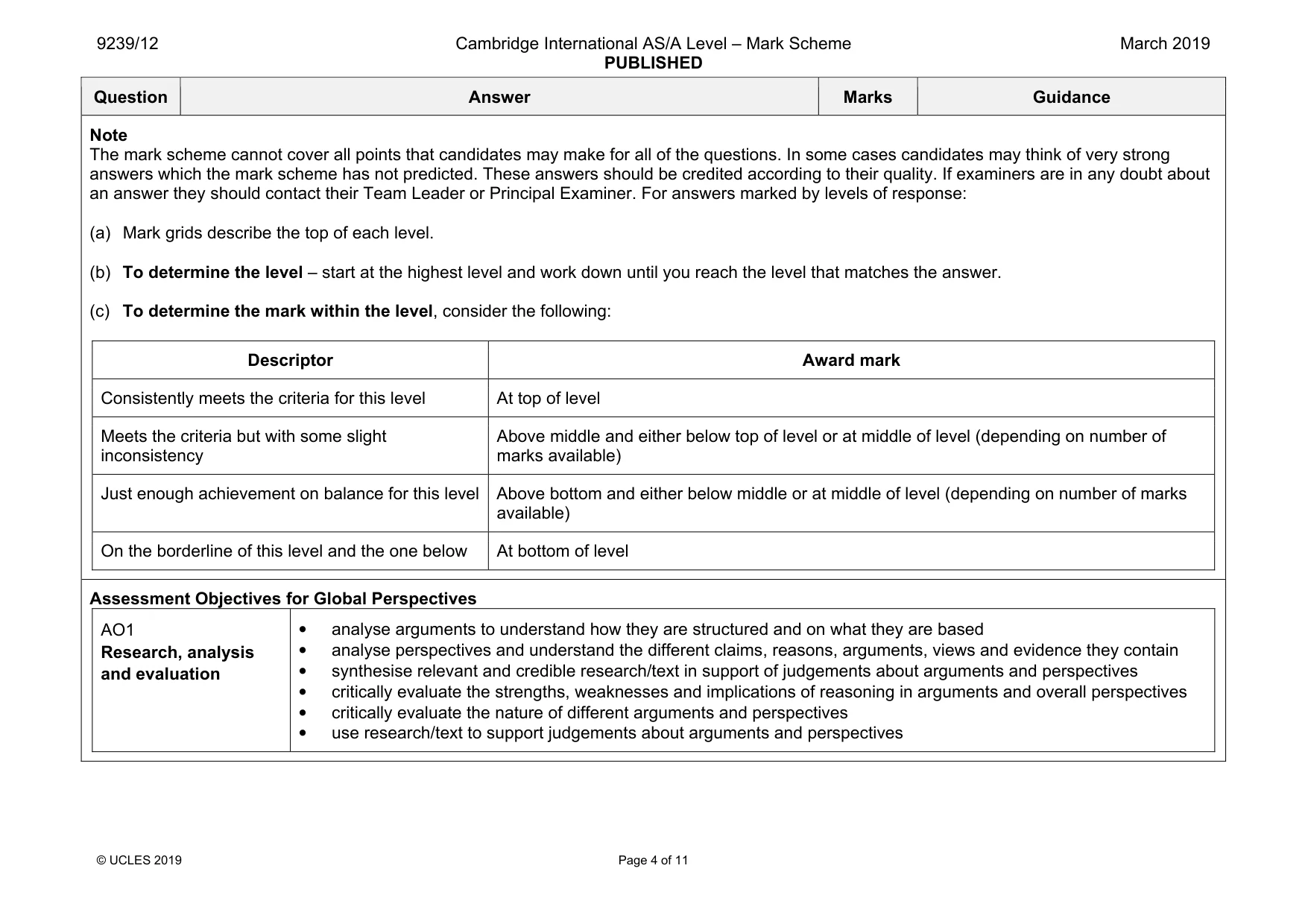
9239/12 Cambridge International AS/A Level – Mark Scheme PUBLISHED March 2019 © UCLES 2019 Page 4 of 11 Question Answer Marks Guidance Note The mark scheme cannot cover all points that candidates may make for all of the questions. In some cases candidates may think of very strong answers which the mark scheme has not predicted. These answers should be credited according to their quality. If examiners are in any doubt about an answer they should contact their Team Leader or Principal Examiner. For answers marked by levels of response: (a) Mark grids describe the top of each level. (b) To determine the level – start at the highest level and work down until you reach the level that matches the answer. (c) To determine the mark within the level, consider the following: Descriptor Award mark Consistently meets the criteria for this level At top of level Meets the criteria but with some slight inconsistency Above middle and either below top of level or at middle of level (depending on number of marks available) Just enough achievement on balance for this level Above bottom and either below middle or at middle of level (depending on number of marks available) On the borderline of this level and the one below At bottom of level Assessment Objectives for Global Perspectives AO1 Research, analysis and evaluation • analyse arguments to understand how they are structured and on what they are based • analyse perspectives and understand the different claims, reasons, arguments, views and evidence they contain • synthesise relevant and credible research/text in support of judgements about arguments and perspectives • critically evaluate the strengths, weaknesses and implications of reasoning in arguments and overall perspectives • critically evaluate the nature of different arguments and perspectives • use research/text to support judgements about arguments and perspectives
Mark scheme, page 5
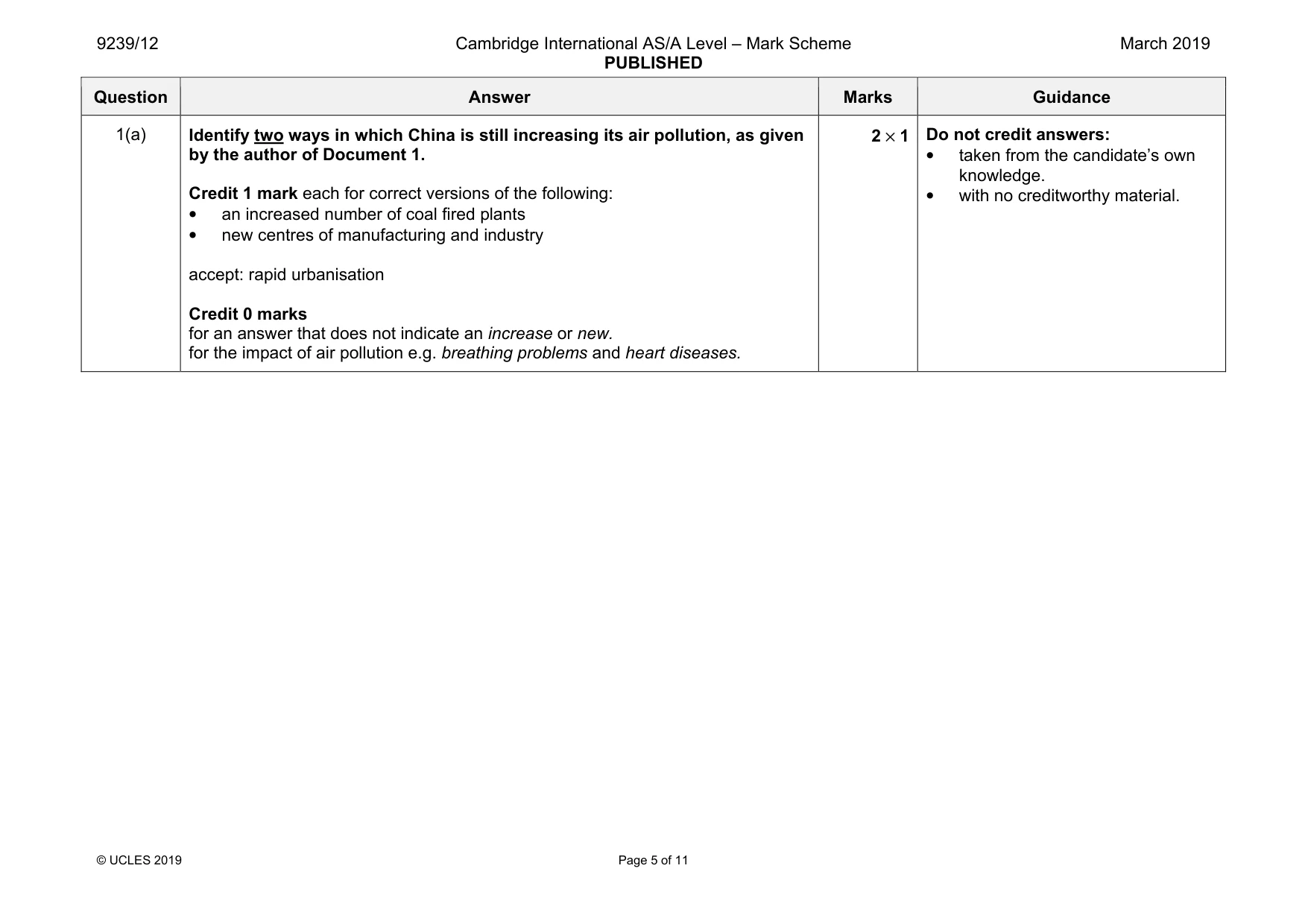
9239/12 Cambridge International AS/A Level – Mark Scheme PUBLISHED March 2019 © UCLES 2019 Page 5 of 11 Question Answer Marks Guidance 1(a) Identify two ways in which China is still increasing its air pollution, as given by the author of Document 1. Credit 1 mark each for correct versions of the following: • an increased number of coal fired plants • new centres of manufacturing and industry accept: rapid urbanisation Credit 0 marks for an answer that does not indicate an increase or new. for the impact of air pollution e.g. breathing problems and heart diseases. 2 × 1 Do not credit answers: • taken from the candidate’s own knowledge. • with no creditworthy material.
Mark scheme, page 6
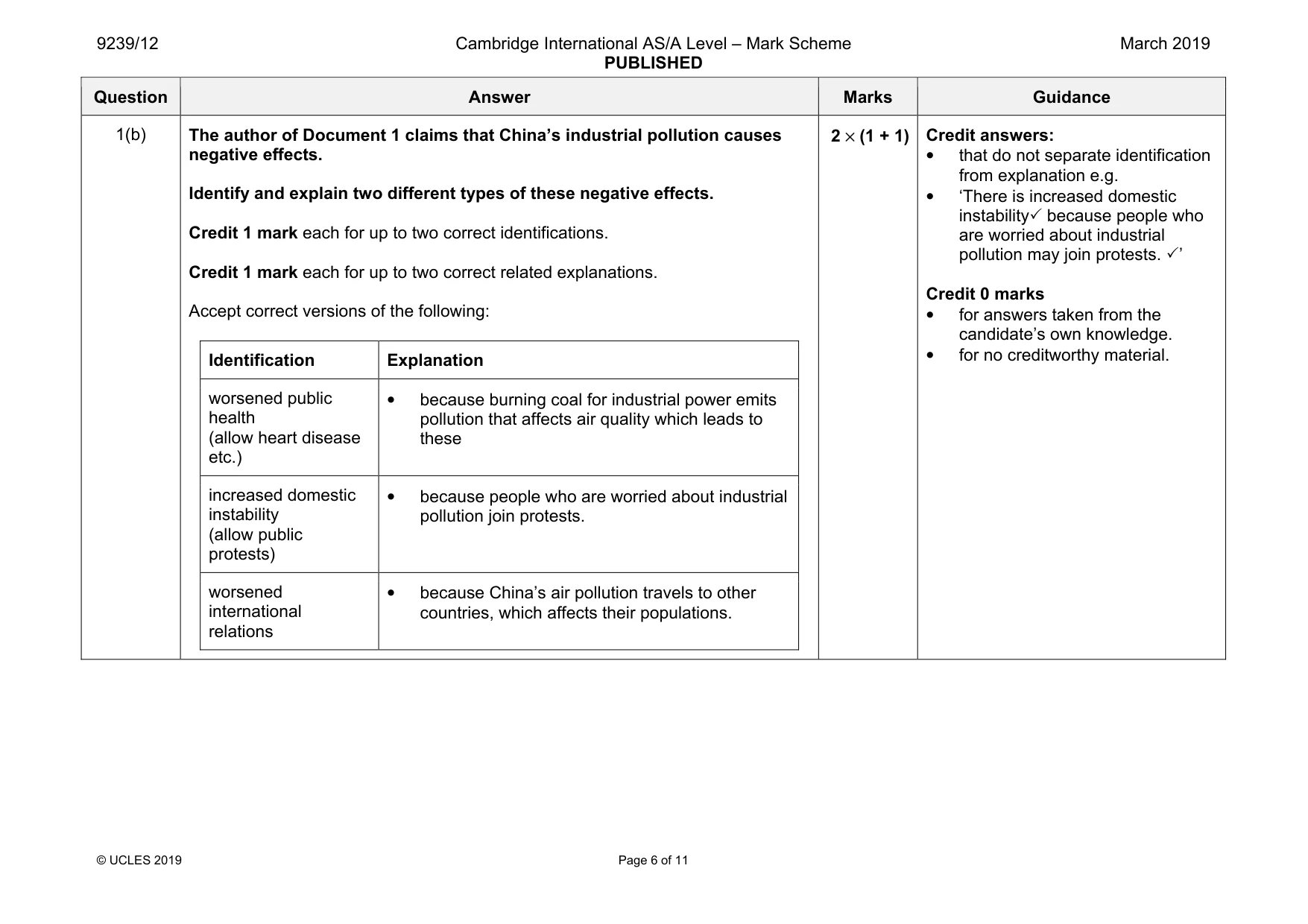
9239/12 Cambridge International AS/A Level – Mark Scheme PUBLISHED March 2019 © UCLES 2019 Page 6 of 11 Question Answer Marks Guidance 1(b) The author of Document 1 claims that China’s industrial pollution causes negative effects. Identify and explain two different types of these negative effects. Credit 1 mark each for up to two correct identifications. Credit 1 mark each for up to two correct related explanations. Accept correct versions of the following: Identification Explanation worsened public health (allow heart disease etc.) • because burning coal for industrial power emits pollution that affects air quality which leads to these increased domestic instability (allow public protests) • because people who are worried about industrial pollution join protests. worsened international relations • because China’s air pollution travels to other countries, which affects their populations. 2 × (1 + 1) Credit answers: • that do not separate identification from explanation e.g. • ‘There is increased domestic instability3 because people who are worried about industrial pollution may join protests. 3’ Credit 0 marks • for answers taken from the candidate’s own knowledge. • for no creditworthy material.
Mark scheme, page 7
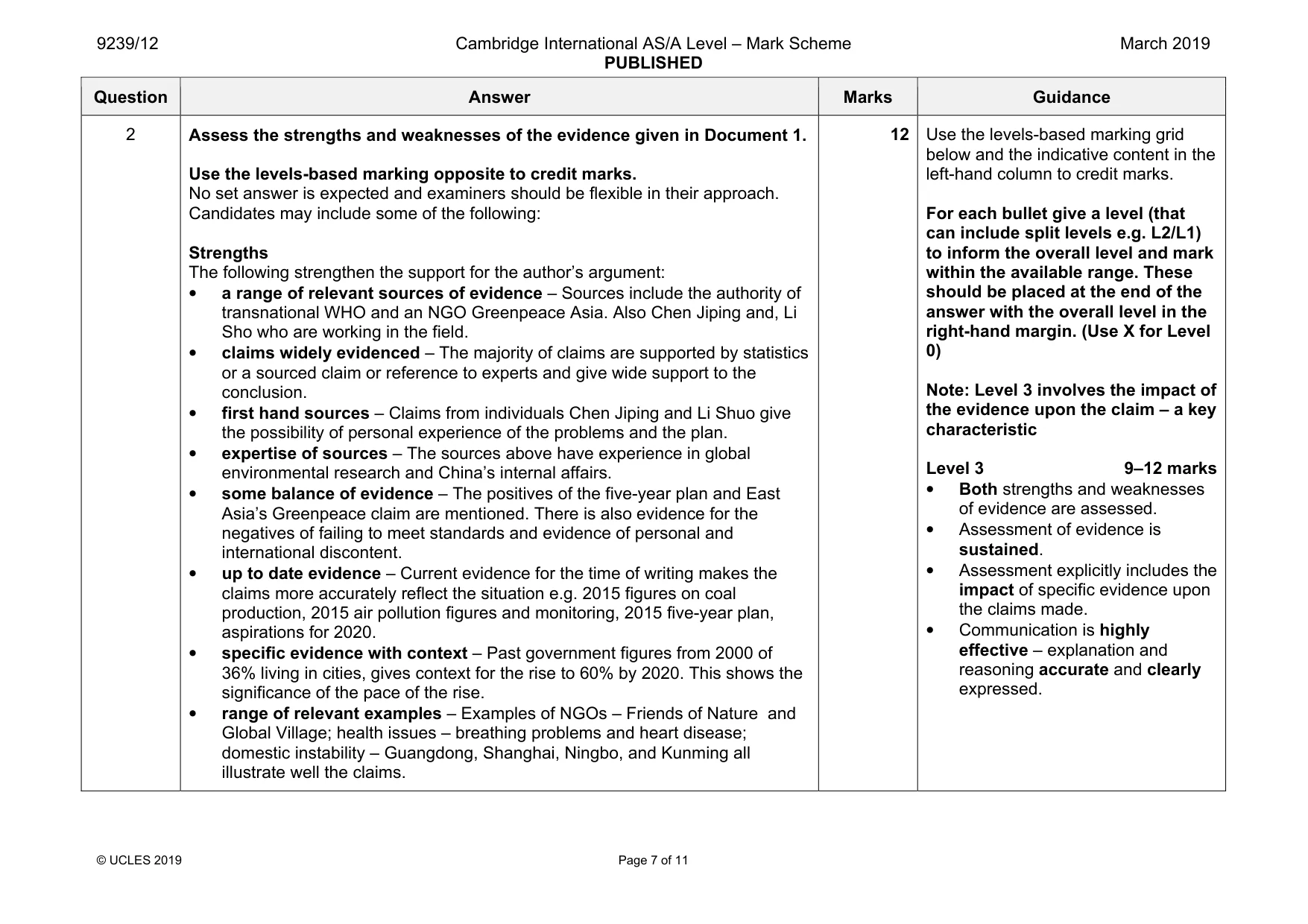
9239/12 Cambridge International AS/A Level – Mark Scheme PUBLISHED March 2019 © UCLES 2019 Page 7 of 11 Question Answer Marks Guidance 2 Assess the strengths and weaknesses of the evidence given in Document 1. Use the levels-based marking opposite to credit marks. No set answer is expected and examiners should be flexible in their approach. Candidates may include some of the following: Strengths The following strengthen the support for the author’s argument: • a range of relevant sources of evidence – Sources include the authority of transnational WHO and an NGO Greenpeace Asia. Also Chen Jiping and, Li Sho who are working in the field. • claims widely evidenced – The majority of claims are supported by statistics or a sourced claim or reference to experts and give wide support to the conclusion. • first hand sources – Claims from individuals Chen Jiping and Li Shuo give the possibility of personal experience of the problems and the plan. • expertise of sources – The sources above have experience in global environmental research and China’s internal affairs. • some balance of evidence – The positives of the five-year plan and East Asia’s Greenpeace claim are mentioned. There is also evidence for the negatives of failing to meet standards and evidence of personal and international discontent. • up to date evidence – Current evidence for the time of writing makes the claims more accurately reflect the situation e.g. 2015 figures on coal production, 2015 air pollution figures and monitoring, 2015 five-year plan, aspirations for 2020. • specific evidence with context – Past government figures from 2000 of 36% living in cities, gives context for the rise to 60% by 2020. This shows the significance of the pace of the rise. • range of relevant examples – Examples of NGOs – Friends of Nature and Global Village; health issues – breathing problems and heart disease; domestic instability – Guangdong, Shanghai, Ningbo, and Kunming all illustrate well the claims. 12 Use the levels-based marking grid below and the indicative content in the left-hand column to credit marks. For each bullet give a level (that can include split levels e.g. L2/L1) to inform the overall level and mark within the available range. These should be placed at the end of the answer with the overall level in the right-hand margin. (Use X for Level 0) Note: Level 3 involves the impact of the evidence upon the claim – a key characteristic Level 3 9–12 marks • Both strengths and weaknesses of evidence are assessed. • Assessment of evidence is sustained. • Assessment explicitly includes the impact of specific evidence upon the claims made. • Communication is highly effective – explanation and reasoning accurate and clearly expressed.
Mark scheme, page 8
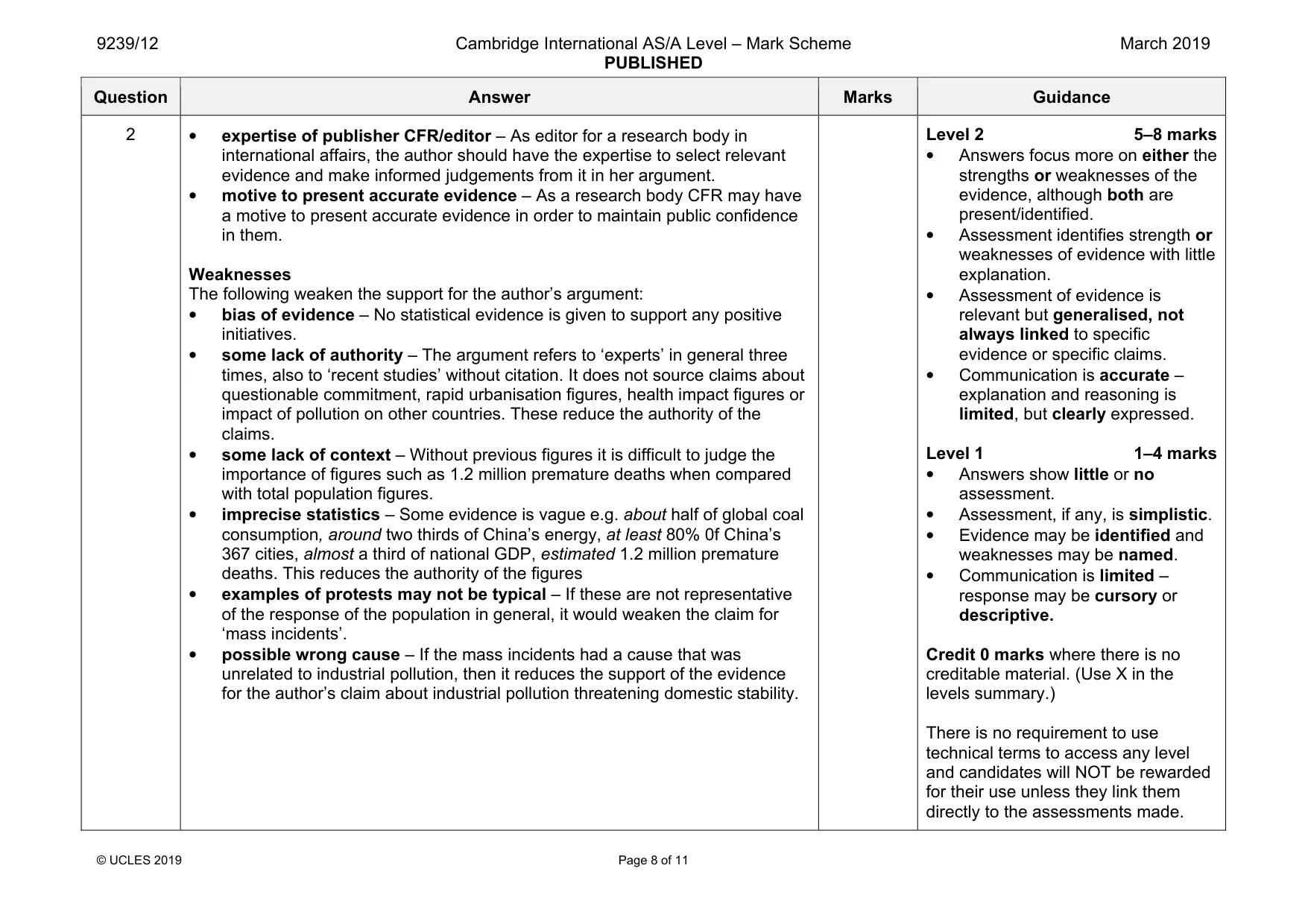
9239/12 Cambridge International AS/A Level – Mark Scheme PUBLISHED March 2019 © UCLES 2019 Page 8 of 11 Question Answer Marks Guidance 2 • expertise of publisher CFR/editor – As editor for a research body in international affairs, the author should have the expertise to select relevant evidence and make informed judgements from it in her argument. • motive to present accurate evidence – As a research body CFR may have a motive to present accurate evidence in order to maintain public confidence in them. Weaknesses The following weaken the support for the author’s argument: • bias of evidence – No statistical evidence is given to support any positive initiatives. • some lack of authority – The argument refers to ‘experts’ in general three times, also to ‘recent studies’ without citation. It does not source claims about questionable commitment, rapid urbanisation figures, health impact figures or impact of pollution on other countries. These reduce the authority of the claims. • some lack of context – Without previous figures it is difficult to judge the importance of figures such as 1.2 million premature deaths when compared with total population figures. • imprecise statistics – Some evidence is vague e.g. about half of global coal consumption, around two thirds of China’s energy, at least 80% 0f China’s 367 cities, almost a third of national GDP, estimated 1.2 million premature deaths. This reduces the authority of the figures • examples of protests may not be typical – If these are not representative of the response of the population in general, it would weaken the claim for ‘mass incidents’. • possible wrong cause – If the mass incidents had a cause that was unrelated to industrial pollution, then it reduces the support of the evidence for the author’s claim about industrial pollution threatening domestic stability. Level 2 5–8 marks • Answers focus more on either the strengths or weaknesses of the evidence, although both are present/identified. • Assessment identifies strength or weaknesses of evidence with little explanation. • Assessment of evidence is relevant but generalised, not always linked to specific evidence or specific claims. • Communication is accurate – explanation and reasoning is limited, but clearly expressed. Level 1 1–4 marks • Answers show little or no assessment. • Assessment, if any, is simplistic. • Evidence may be identified and weaknesses may be named. • Communication is limited – response may be cursory or descriptive. Credit 0 marks where there is no creditable material. (Use X in the levels summary.) There is no requirement to use technical terms to access any level and candidates will NOT be rewarded for their use unless they link them directly to the assessments made.
Mark scheme, page 9
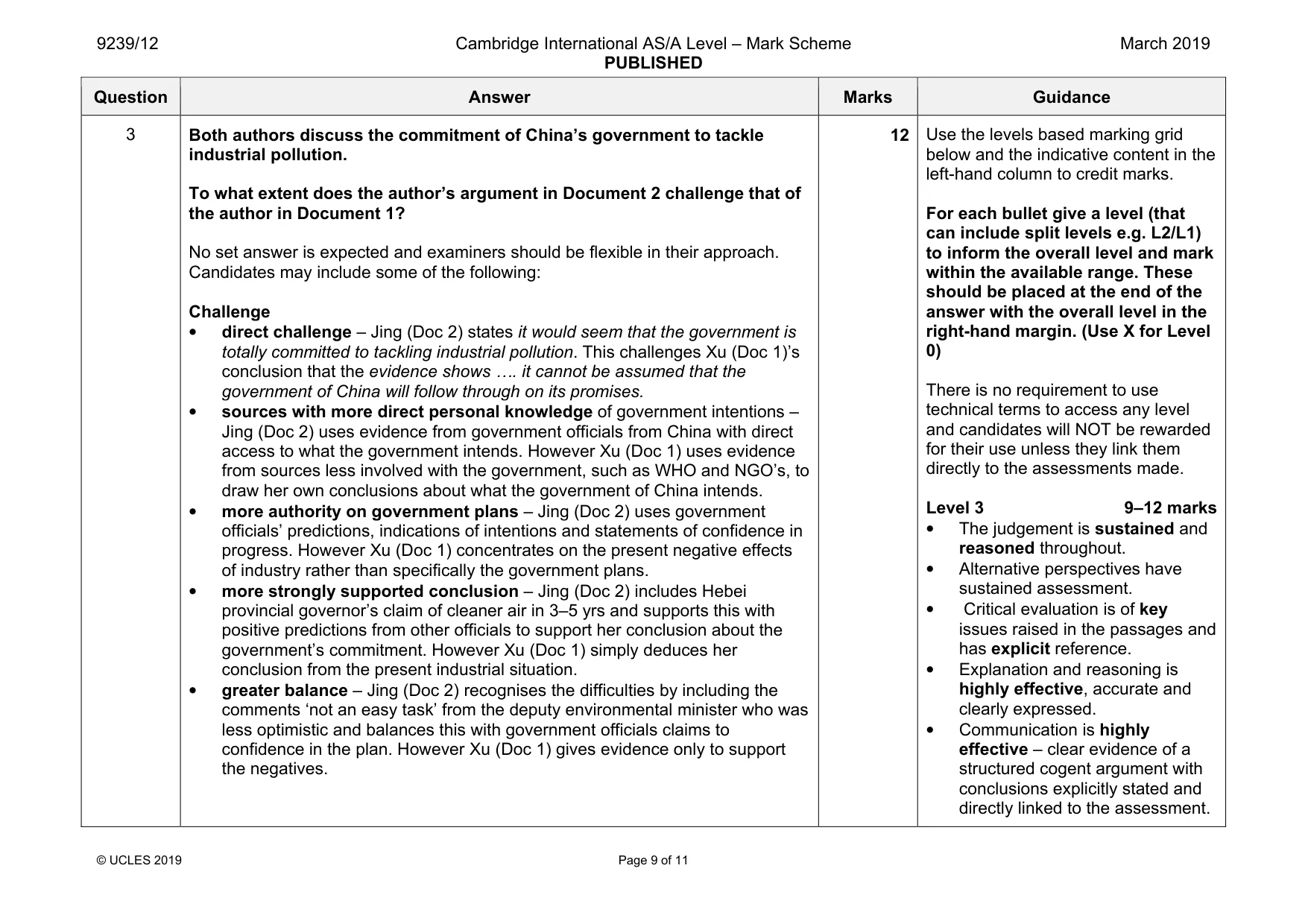
9239/12 Cambridge International AS/A Level – Mark Scheme PUBLISHED March 2019 © UCLES 2019 Page 9 of 11 Question Answer Marks Guidance 3 Both authors discuss the commitment of China’s government to tackle industrial pollution. To what extent does the author’s argument in Document 2 challenge that of the author in Document 1? No set answer is expected and examiners should be flexible in their approach. Candidates may include some of the following: Challenge • direct challenge – Jing (Doc 2) states it would seem that the government is totally committed to tackling industrial pollution. This challenges Xu (Doc 1)’s conclusion that the evidence shows «. it cannot be assumed that the government of China will follow through on its promises. • sources with more direct personal knowledge of government intentions – Jing (Doc 2) uses evidence from government officials from China with direct access to what the government intends. However Xu (Doc 1) uses evidence from sources less involved with the government, such as WHO and NGO’s, to draw her own conclusions about what the government of China intends. • more authority on government plans – Jing (Doc 2) uses government officials’ predictions, indications of intentions and statements of confidence in progress. However Xu (Doc 1) concentrates on the present negative effects of industry rather than specifically the government plans. • more strongly supported conclusion – Jing (Doc 2) includes Hebei provincial governor’s claim of cleaner air in 3–5 yrs and supports this with positive predictions from other officials to support her conclusion about the government’s commitment. However Xu (Doc 1) simply deduces her conclusion from the present industrial situation. • greater balance – Jing (Doc 2) recognises the difficulties by including the comments ‘not an easy task’ from the deputy environmental minister who was less optimistic and balances this with government officials claims to confidence in the plan. However Xu (Doc 1) gives evidence only to support the negatives. 12 Use the levels based marking grid below and the indicative content in the left-hand column to credit marks. For each bullet give a level (that can include split levels e.g. L2/L1) to inform the overall level and mark within the available range. These should be placed at the end of the answer with the overall level in the right-hand margin. (Use X for Level 0) There is no requirement to use technical terms to access any level and candidates will NOT be rewarded for their use unless they link them directly to the assessments made. Level 3 9–12 marks • The judgement is sustained and reasoned throughout. • Alternative perspectives have sustained assessment. • Critical evaluation is of key issues raised in the passages and has explicit reference. • Explanation and reasoning is highly effective, accurate and clearly expressed. • Communication is highly effective – clear evidence of a structured cogent argument with conclusions explicitly stated and directly linked to the assessment.
Mark scheme, page 10
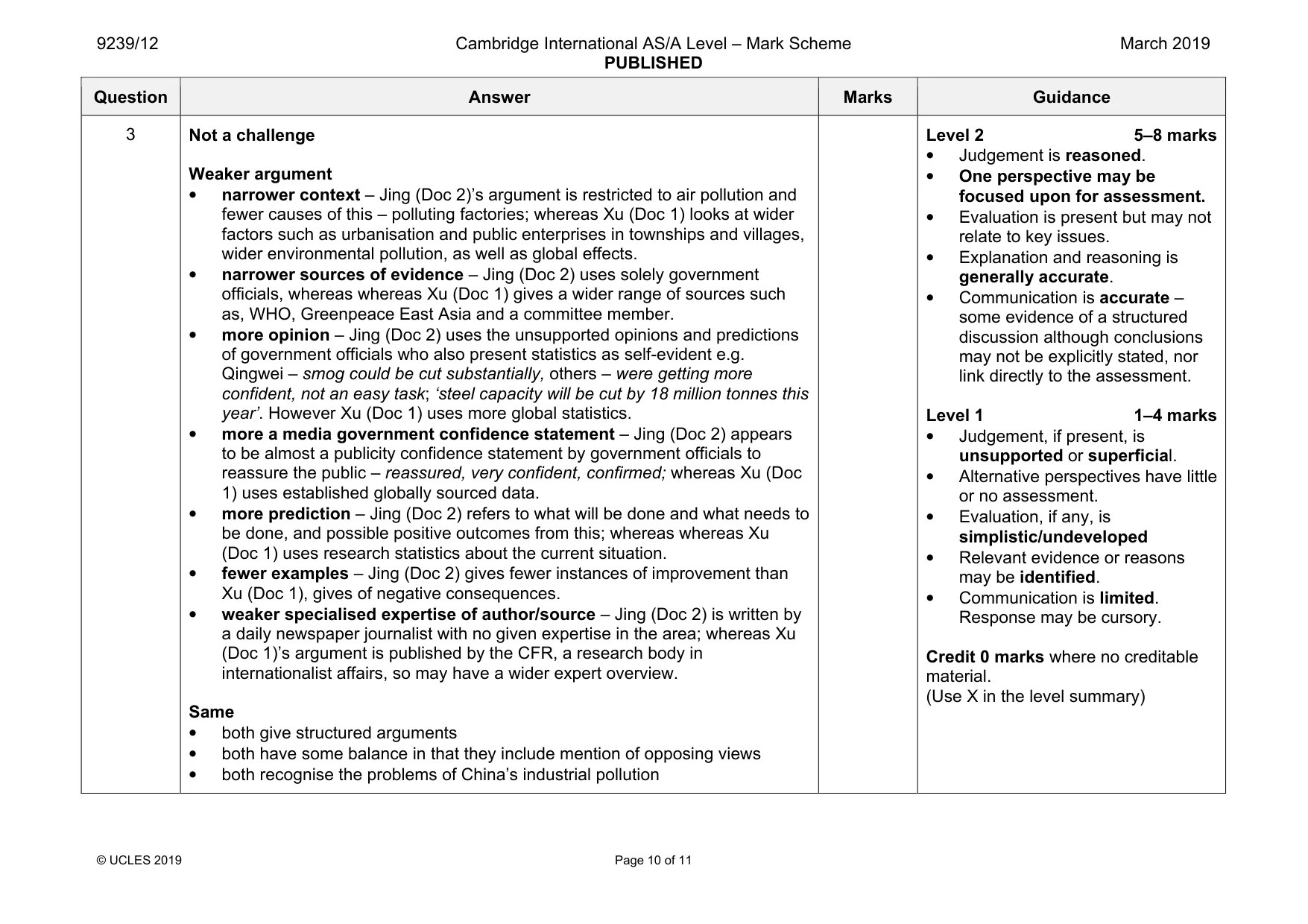
9239/12 Cambridge International AS/A Level – Mark Scheme PUBLISHED March 2019 © UCLES 2019 Page 10 of 11 Question Answer Marks Guidance 3 Not a challenge Weaker argument • narrower context – Jing (Doc 2)’s argument is restricted to air pollution and fewer causes of this – polluting factories; whereas Xu (Doc 1) looks at wider factors such as urbanisation and public enterprises in townships and villages, wider environmental pollution, as well as global effects. • narrower sources of evidence – Jing (Doc 2) uses solely government officials, whereas whereas Xu (Doc 1) gives a wider range of sources such as, WHO, Greenpeace East Asia and a committee member. • more opinion – Jing (Doc 2) uses the unsupported opinions and predictions of government officials who also present statistics as self-evident e.g. Qingwei – smog could be cut substantially, others – were getting more confident, not an easy task; ‘steel capacity will be cut by 18 million tonnes this year’. However Xu (Doc 1) uses more global statistics. • more a media government confidence statement – Jing (Doc 2) appears to be almost a publicity confidence statement by government officials to reassure the public – reassured, very confident, confirmed; whereas Xu (Doc 1) uses established globally sourced data. • more prediction – Jing (Doc 2) refers to what will be done and what needs to be done, and possible positive outcomes from this; whereas whereas Xu (Doc 1) uses research statistics about the current situation. • fewer examples – Jing (Doc 2) gives fewer instances of improvement than Xu (Doc 1), gives of negative consequences. • weaker specialised expertise of author/source – Jing (Doc 2) is written by a daily newspaper journalist with no given expertise in the area; whereas Xu (Doc 1)’s argument is published by the CFR, a research body in internationalist affairs, so may have a wider expert overview. Same • both give structured arguments • both have some balance in that they include mention of opposing views • both recognise the problems of China’s industrial pollution Level 2 5–8 marks • Judgement is reasoned. • One perspective may be focused upon for assessment. • Evaluation is present but may not relate to key issues. • Explanation and reasoning is generally accurate. • Communication is accurate – some evidence of a structured discussion although conclusions may not be explicitly stated, nor link directly to the assessment. Level 1 1–4 marks • Judgement, if present, is unsupported or superficial. • Alternative perspectives have little or no assessment. • Evaluation, if any, is simplistic/undeveloped • Relevant evidence or reasons may be identified. • Communication is limited. Response may be cursory. Credit 0 marks where no creditable material. (Use X in the level summary)
Mark scheme, page 11
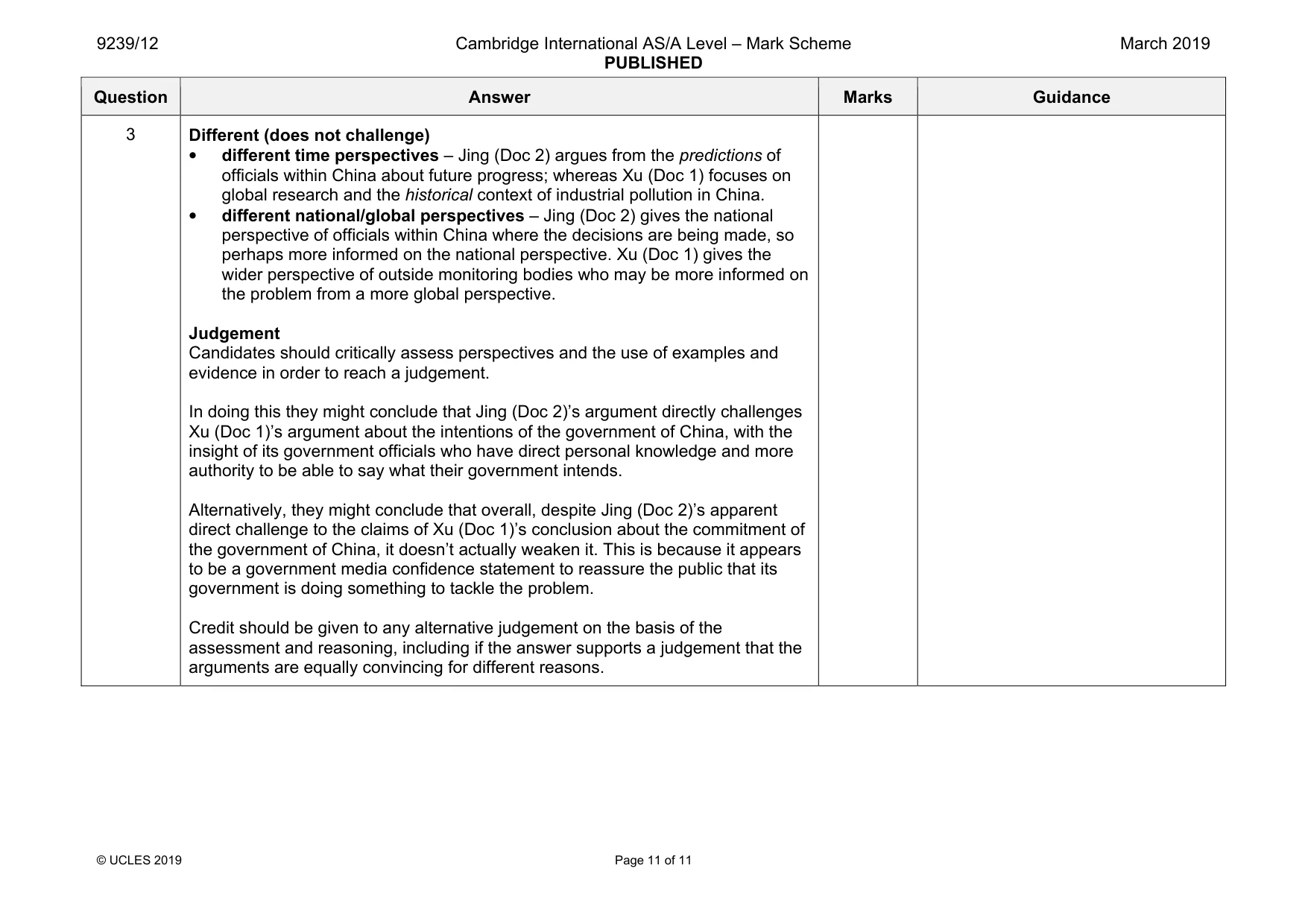
9239/12 Cambridge International AS/A Level – Mark Scheme PUBLISHED March 2019 © UCLES 2019 Page 11 of 11 Question Answer Marks Guidance 3 Different (does not challenge) • different time perspectives – Jing (Doc 2) argues from the predictions of officials within China about future progress; whereas Xu (Doc 1) focuses on global research and the historical context of industrial pollution in China. • different national/global perspectives – Jing (Doc 2) gives the national perspective of officials within China where the decisions are being made, so perhaps more informed on the national perspective. Xu (Doc 1) gives the wider perspective of outside monitoring bodies who may be more informed on the problem from a more global perspective. Judgement Candidates should critically assess perspectives and the use of examples and evidence in order to reach a judgement. In doing this they might conclude that Jing (Doc 2)’s argument directly challenges Xu (Doc 1)’s argument about the intentions of the government of China, with the insight of its government officials who have direct personal knowledge and more authority to be able to say what their government intends. Alternatively, they might conclude that overall, despite Jing (Doc 2)’s apparent direct challenge to the claims of Xu (Doc 1)’s conclusion about the commitment of the government of China, it doesn’t actually weaken it. This is because it appears to be a government media confidence statement to reassure the public that its government is doing something to tackle the problem. Credit should be given to any alternative judgement on the basis of the assessment and reasoning, including if the answer supports a judgement that the arguments are equally convincing for different reasons.
What you needed in this session
Cambridge’s own grade thresholds for 2019 Feb/March, Paper 1 · Variant 2. A higher threshold means an easier paper — the bar moves with how the cohort did.