Cambridge A Level Global Perspectives and Research 9239 — 2018 Oct/Nov Paper 1 · Variant 3
9239/13/O/N/18 · 30 marks · ≈34 min
The question paper and its mark scheme, free to read here and free to download. This is Cambridge’s own paper, exactly as it was sat.
Question paper4 pages


Mark scheme12 pages
Answers below. Sit the paper first if you are practising.
Paper as text
Question paper, page 1
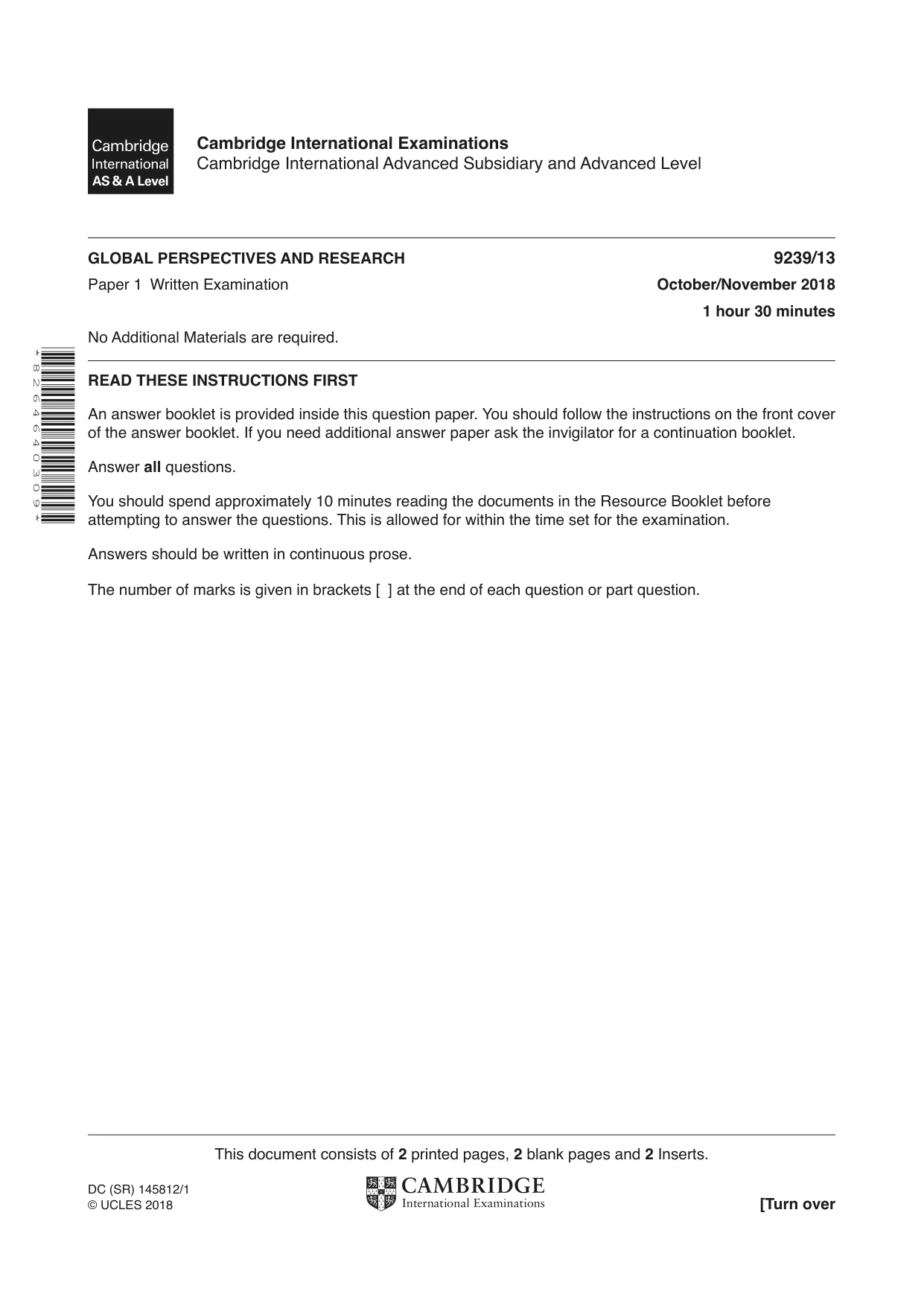
* 8 2 6 4 6 4 0 3 0 9 * This document consists of 2 printed pages, 2 blank pages and 2 Inserts. DC (SR) 145812/1 © UCLES 2018 [Turn over Cambridge International Examinations Cambridge International Advanced Subsidiary and Advanced Level GLOBAL PERSPECTIVES AND RESEARCH 9239/13 Paper 1 Written Examination October/November 2018 1 hour 30 minutes No Additional Materials are required. READ THESE INSTRUCTIONS FIRST An answer booklet is provided inside this question paper. You should follow the instructions on the front cover of the answer booklet. If you need additional answer paper ask the invigilator for a continuation booklet. Answer all questions. You should spend approximately 10 minutes reading the documents in the Resource Booklet before attempting to answer the questions. This is allowed for within the time set for the examination. Answers should be written in continuous prose. The number of marks is given in brackets [ ] at the end of each question or part question.
Question paper, page 2
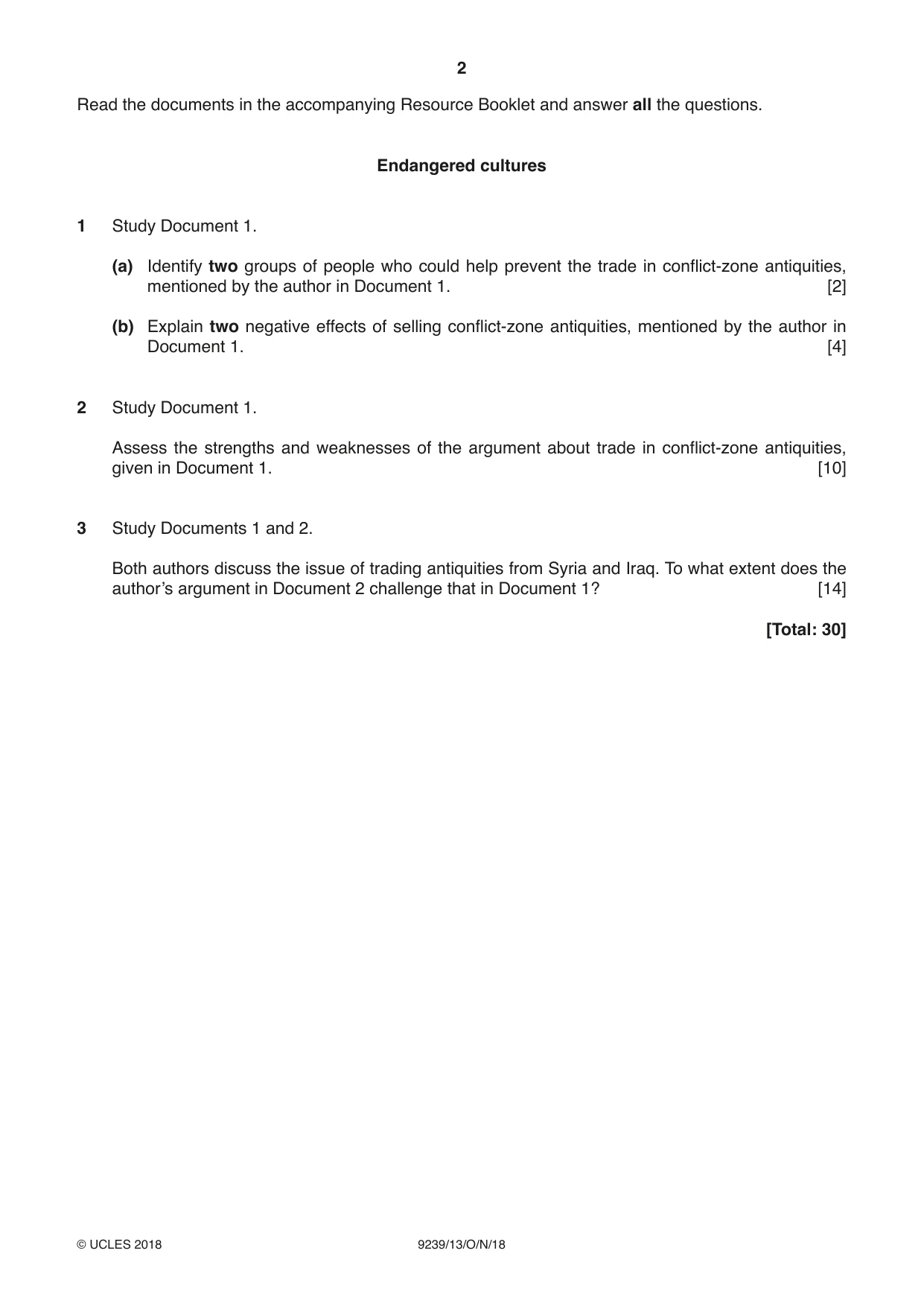
2 9239/13/O/N/18 © UCLES 2018 Read the documents in the accompanying Resource Booklet and answer all the questions. Endangered cultures 1 Study Document 1. (a) Identify two groups of people who could help prevent the trade in conflict-zone antiquities, mentioned by the author in Document 1. [2] (b) Explain two negative effects of selling conflict-zone antiquities, mentioned by the author in Document 1. [4] 2 Study Document 1. Assess the strengths and weaknesses of the argument about trade in conflict-zone antiquities, given in Document 1. [10] 3 Study Documents 1 and 2. Both authors discuss the issue of trading antiquities from Syria and Iraq. To what extent does the author’s argument in Document 2 challenge that in Document 1? [14] [Total: 30]
Question paper, page 3
3 9239/13/O/N/18 © UCLES 2018 BLANK PAGE
Question paper, page 4
4 9239/13/O/N/18 © UCLES 2018 BLANK PAGE Permission to reproduce items where third-party owned material protected by copyright is included has been sought and cleared where possible. Every reasonable effort has been made by the publisher (UCLES) to trace copyright holders, but if any items requiring clearance have unwittingly been included, the publisher will be pleased to make amends at the earliest possible opportunity. To avoid the issue of disclosure of answer-related information to candidates, all copyright acknowledgements are reproduced online in the Cambridge International Examinations Copyright Acknowledgements Booklet. This is produced for each series of examinations and is freely available to download at www.cie.org.uk after the live examination series. Cambridge International Examinations is part of the Cambridge Assessment Group. Cambridge Assessment is the brand name of University of Cambridge Local Examinations Syndicate (UCLES), which is itself a department of the University of Cambridge.
Mark scheme, page 1
This document consists of 12 printed pages. © UCLES 2018 [Turn over Cambridge Assessment International Education Cambridge International Advanced Subsidiary Level GLOBAL PERSPECTIVES & RESEARCH 9239/13 Paper 1 Written Exam October/November 2018 MARK SCHEME Maximum Mark: 30 Published This mark scheme is published as an aid to teachers and candidates, to indicate the requirements of the examination. It shows the basis on which Examiners were instructed to award marks. It does not indicate the details of the discussions that took place at an Examiners’ meeting before marking began, which would have considered the acceptability of alternative answers. Mark schemes should be read in conjunction with the question paper and the Principal Examiner Report for Teachers. Cambridge International will not enter into discussions about these mark schemes. Cambridge International is publishing the mark schemes for the October/November 2018 series for most Cambridge IGCSE™, Cambridge International A and AS Level components and some Cambridge O Level components.
Mark scheme, page 2
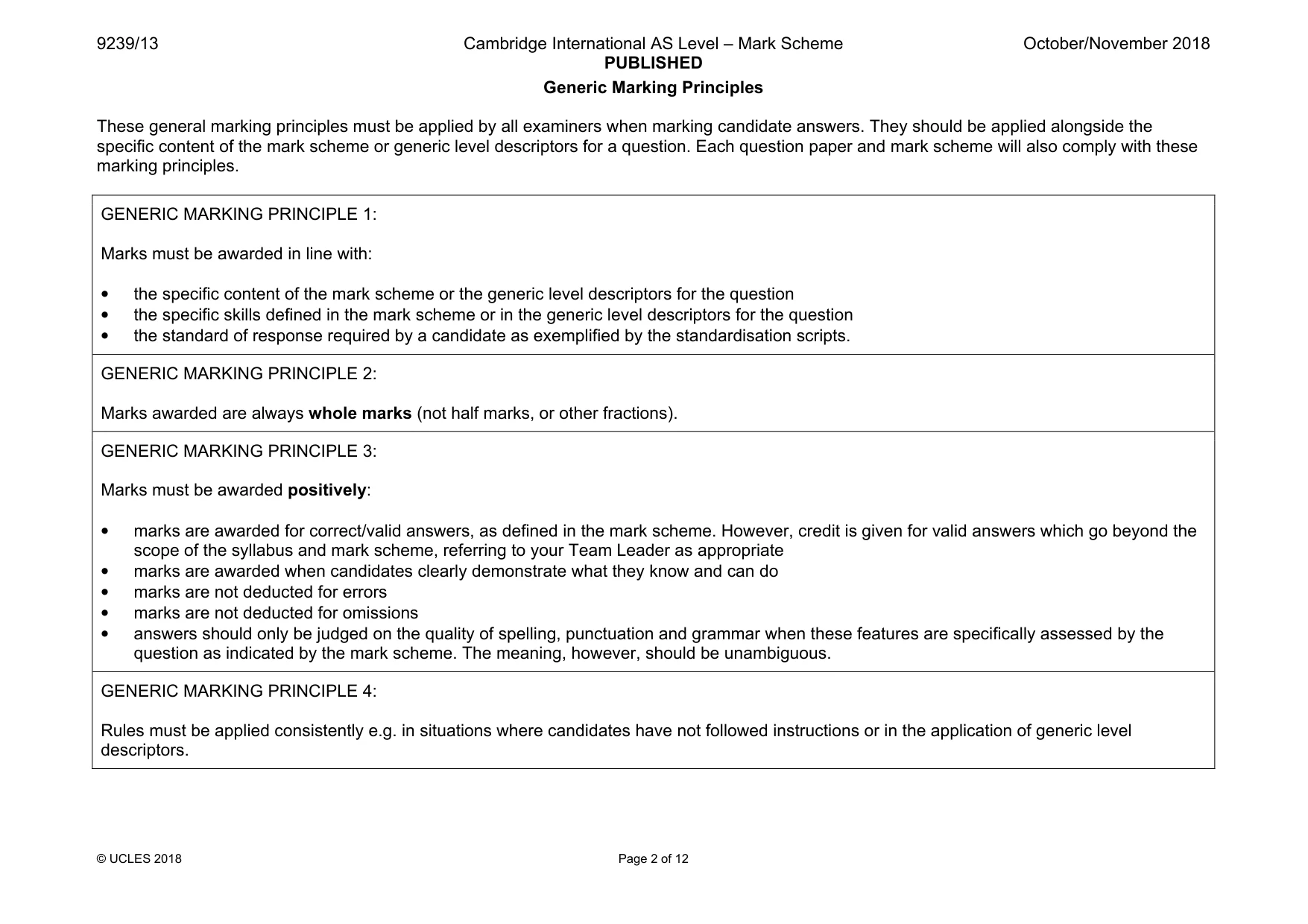
9239/13 Cambridge International AS Level – Mark Scheme PUBLISHED October/November 2018 © UCLES 2018 Page 2 of 12 Generic Marking Principles These general marking principles must be applied by all examiners when marking candidate answers. They should be applied alongside the specific content of the mark scheme or generic level descriptors for a question. Each question paper and mark scheme will also comply with these marking principles. GENERIC MARKING PRINCIPLE 1: Marks must be awarded in line with: • the specific content of the mark scheme or the generic level descriptors for the question • the specific skills defined in the mark scheme or in the generic level descriptors for the question • the standard of response required by a candidate as exemplified by the standardisation scripts. GENERIC MARKING PRINCIPLE 2: Marks awarded are always whole marks (not half marks, or other fractions). GENERIC MARKING PRINCIPLE 3: Marks must be awarded positively: • marks are awarded for correct/valid answers, as defined in the mark scheme. However, credit is given for valid answers which go beyond the scope of the syllabus and mark scheme, referring to your Team Leader as appropriate • marks are awarded when candidates clearly demonstrate what they know and can do • marks are not deducted for errors • marks are not deducted for omissions • answers should only be judged on the quality of spelling, punctuation and grammar when these features are specifically assessed by the question as indicated by the mark scheme. The meaning, however, should be unambiguous. GENERIC MARKING PRINCIPLE 4: Rules must be applied consistently e.g. in situations where candidates have not followed instructions or in the application of generic level descriptors.
Mark scheme, page 3
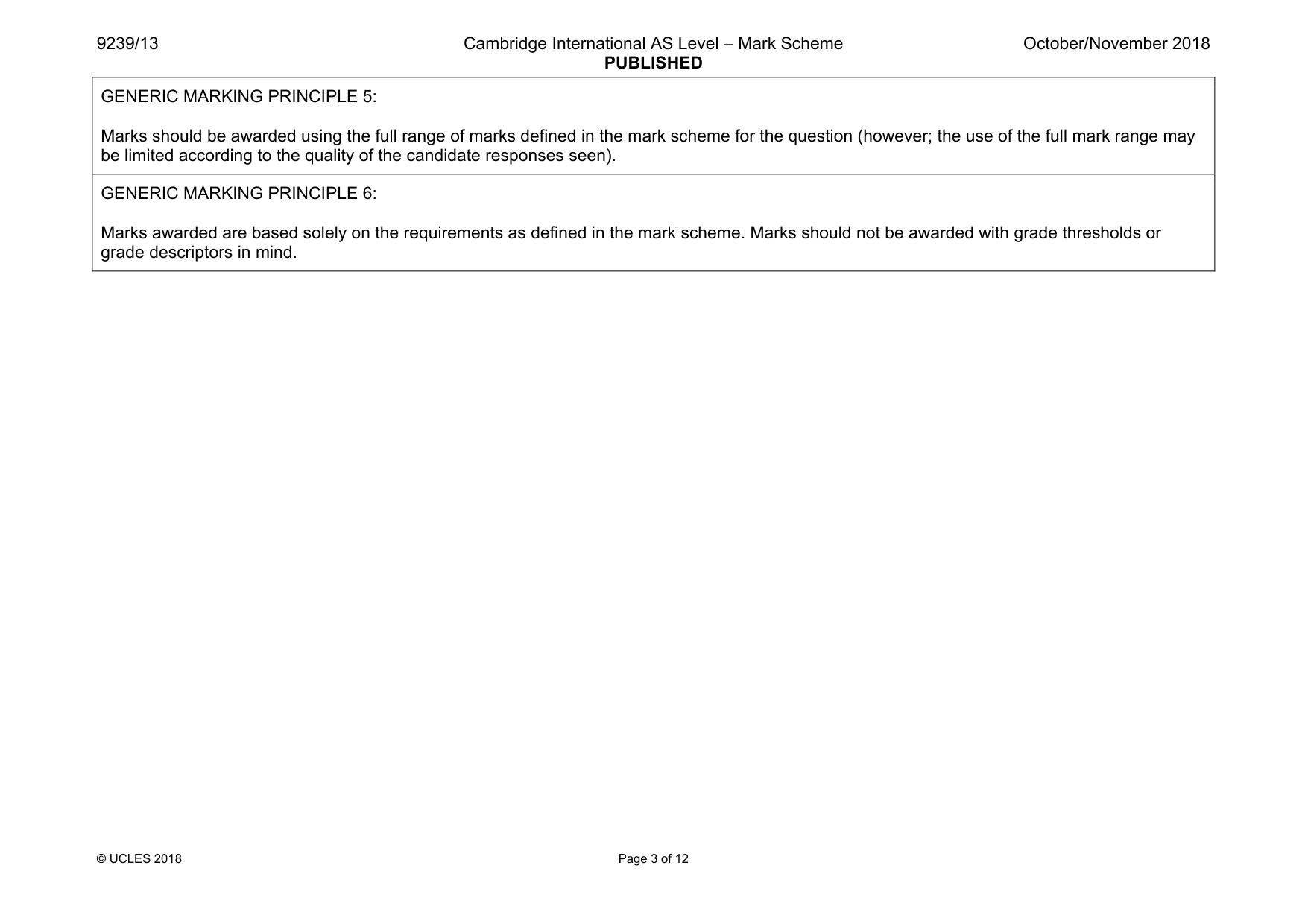
9239/13 Cambridge International AS Level – Mark Scheme PUBLISHED October/November 2018 © UCLES 2018 Page 3 of 12 GENERIC MARKING PRINCIPLE 5: Marks should be awarded using the full range of marks defined in the mark scheme for the question (however; the use of the full mark range may be limited according to the quality of the candidate responses seen). GENERIC MARKING PRINCIPLE 6: Marks awarded are based solely on the requirements as defined in the mark scheme. Marks should not be awarded with grade thresholds or grade descriptors in mind.
Mark scheme, page 4
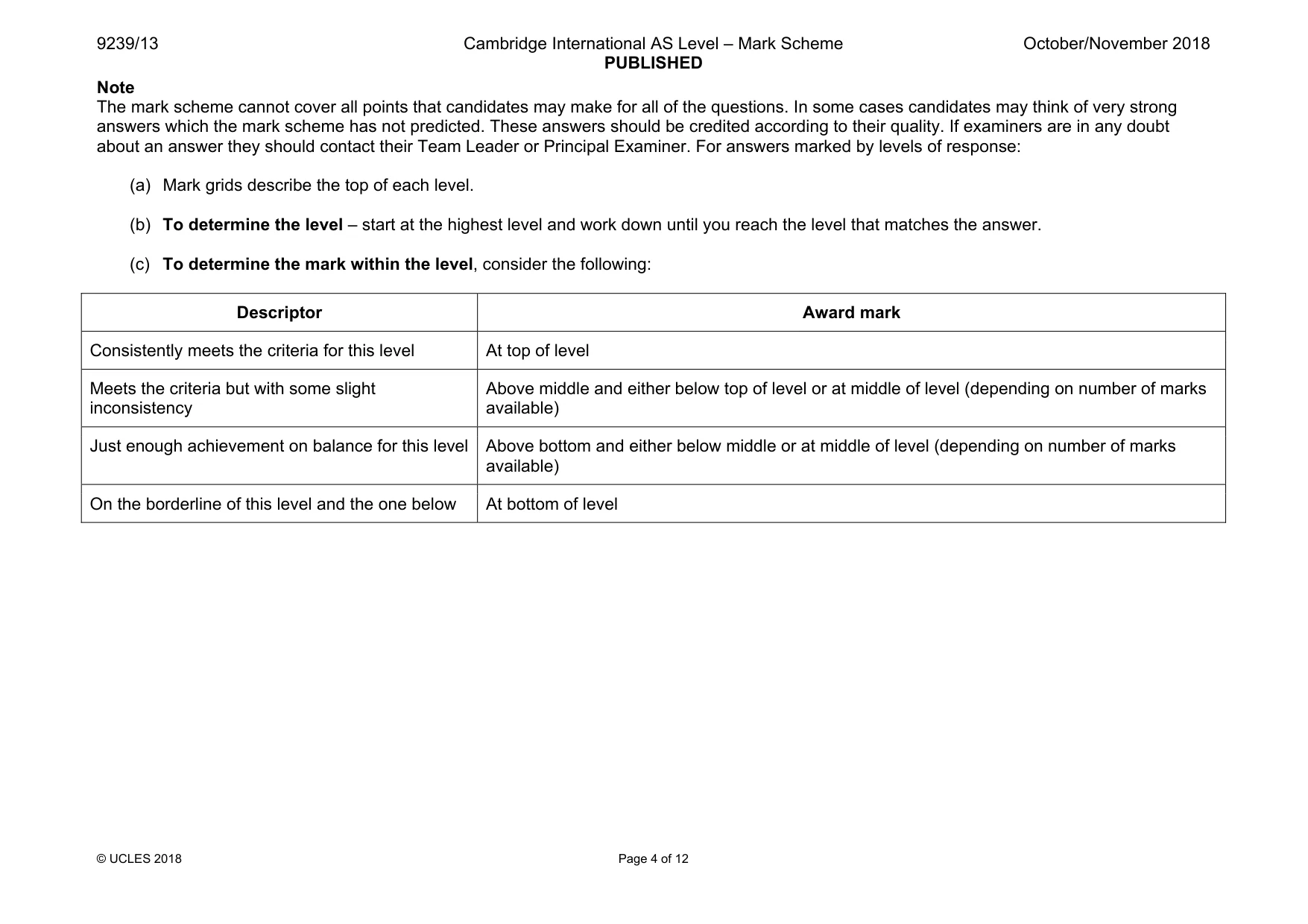
9239/13 Cambridge International AS Level – Mark Scheme PUBLISHED October/November 2018 © UCLES 2018 Page 4 of 12 Note The mark scheme cannot cover all points that candidates may make for all of the questions. In some cases candidates may think of very strong answers which the mark scheme has not predicted. These answers should be credited according to their quality. If examiners are in any doubt about an answer they should contact their Team Leader or Principal Examiner. For answers marked by levels of response: (a) Mark grids describe the top of each level. (b) To determine the level – start at the highest level and work down until you reach the level that matches the answer. (c) To determine the mark within the level, consider the following: Descriptor Award mark Consistently meets the criteria for this level At top of level Meets the criteria but with some slight inconsistency Above middle and either below top of level or at middle of level (depending on number of marks available) Just enough achievement on balance for this level Above bottom and either below middle or at middle of level (depending on number of marks available) On the borderline of this level and the one below At bottom of level
Mark scheme, page 5
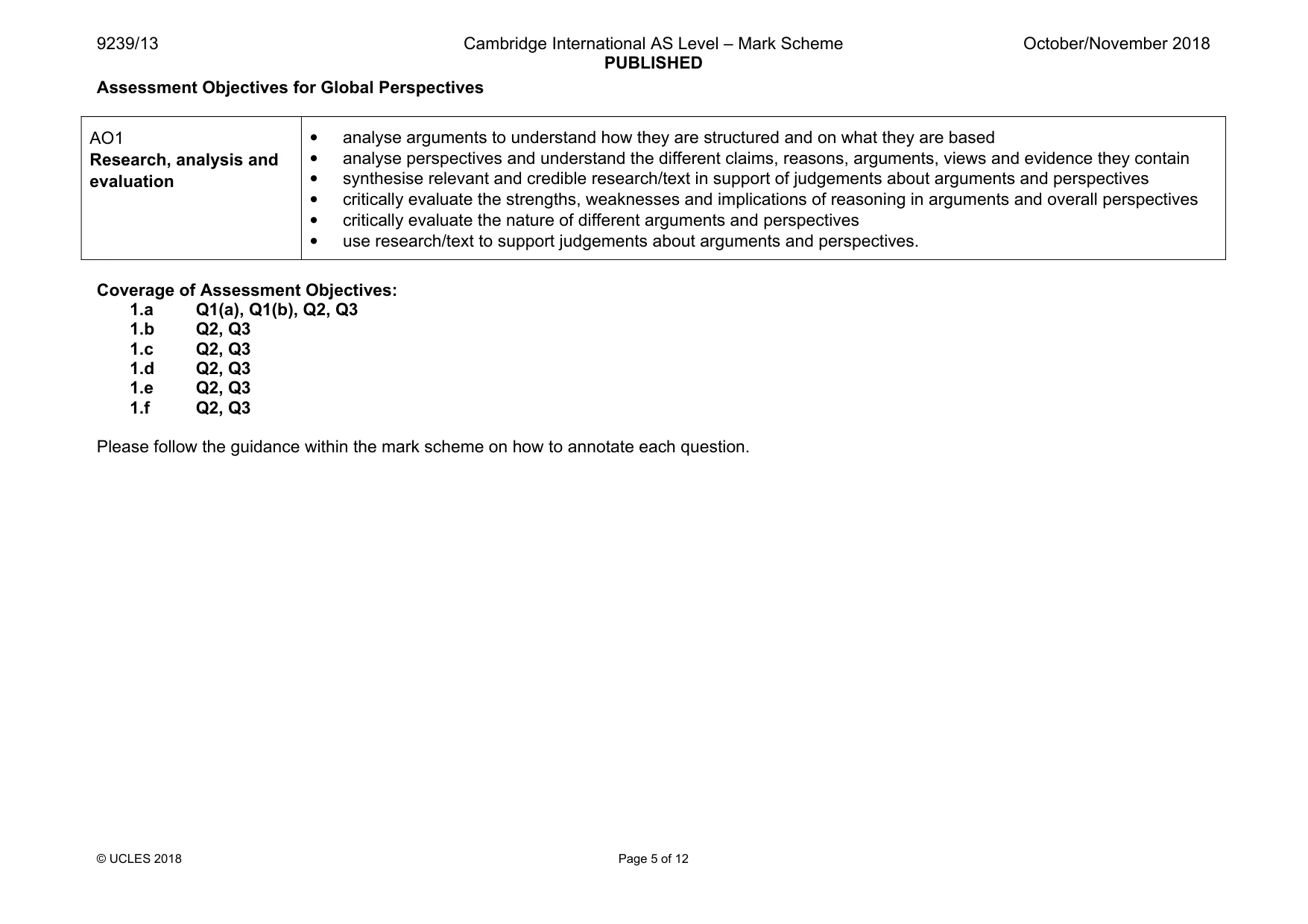
9239/13 Cambridge International AS Level – Mark Scheme PUBLISHED October/November 2018 © UCLES 2018 Page 5 of 12 Assessment Objectives for Global Perspectives AO1 Research, analysis and evaluation • analyse arguments to understand how they are structured and on what they are based • analyse perspectives and understand the different claims, reasons, arguments, views and evidence they contain • synthesise relevant and credible research/text in support of judgements about arguments and perspectives • critically evaluate the strengths, weaknesses and implications of reasoning in arguments and overall perspectives • critically evaluate the nature of different arguments and perspectives • use research/text to support judgements about arguments and perspectives. Coverage of Assessment Objectives: 1.a Q1(a), Q1(b), Q2, Q3 1.b Q2, Q3 1.c Q2, Q3 1.d Q2, Q3 1.e Q2, Q3 1.f Q2, Q3 Please follow the guidance within the mark scheme on how to annotate each question.
Mark scheme, page 6
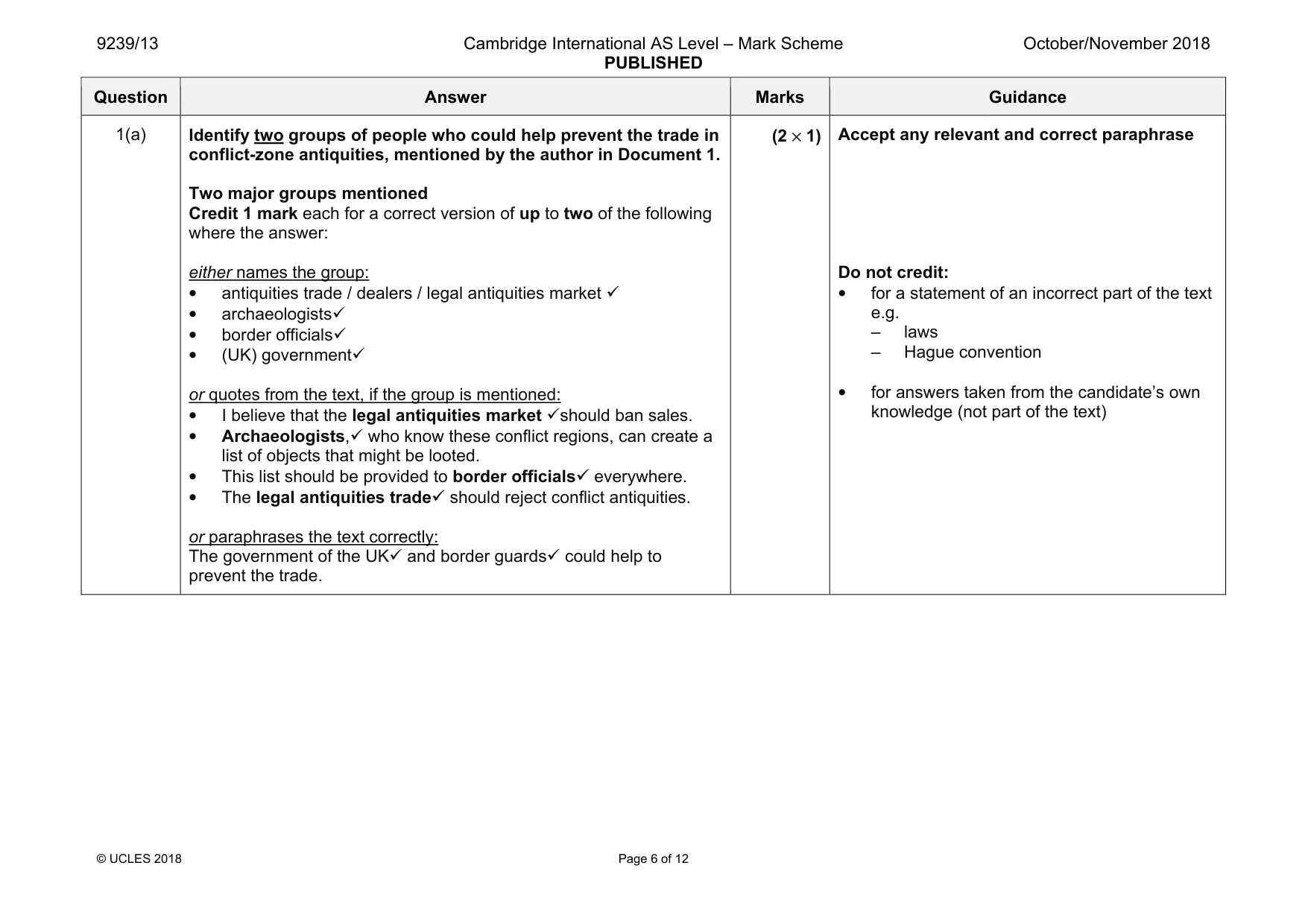
9239/13 Cambridge International AS Level – Mark Scheme PUBLISHED October/November 2018 © UCLES 2018 Page 6 of 12 Question Answer Marks Guidance 1(a) Identify two groups of people who could help prevent the trade in conflict-zone antiquities, mentioned by the author in Document 1. Two major groups mentioned Credit 1 mark each for a correct version of up to two of the following where the answer: either names the group: • antiquities trade / dealers / legal antiquities market 9 • archaeologists9 • border officials9 • (UK) government9 or quotes from the text, if the group is mentioned: • I believe that the legal antiquities market 9should ban sales. • Archaeologists,9 who know these conflict regions, can create a list of objects that might be looted. • This list should be provided to border officials9 everywhere. • The legal antiquities trade9 should reject conflict antiquities. or paraphrases the text correctly: The government of the UK9 and border guards9 could help to prevent the trade. (2 × 1) Accept any relevant and correct paraphrase Do not credit: • for a statement of an incorrect part of the text e.g. – laws – Hague convention • for answers taken from the candidate’s own knowledge (not part of the text)
Mark scheme, page 7
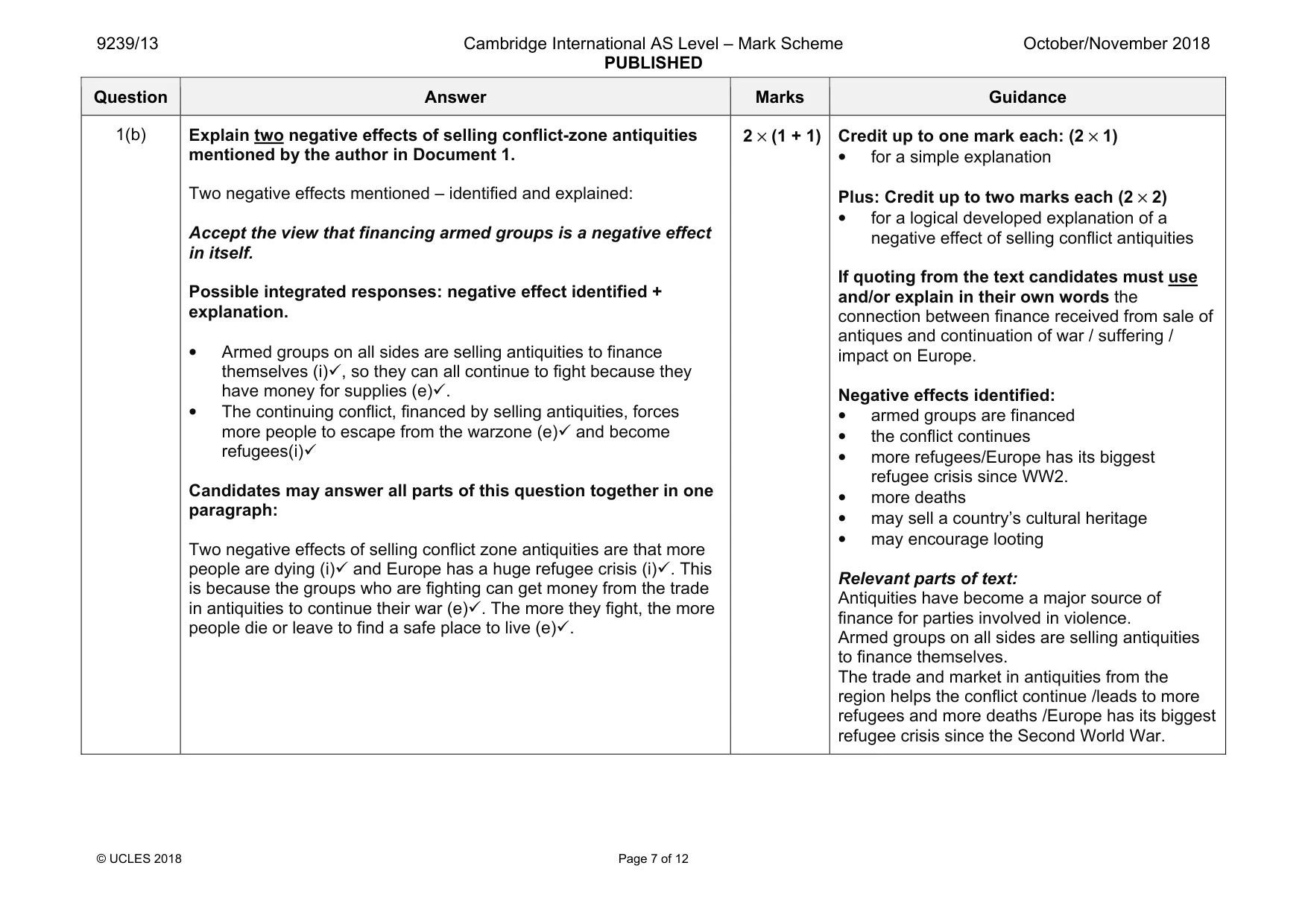
9239/13 Cambridge International AS Level – Mark Scheme PUBLISHED October/November 2018 © UCLES 2018 Page 7 of 12 Question Answer Marks Guidance 1(b) Explain two negative effects of selling conflict-zone antiquities mentioned by the author in Document 1. Two negative effects mentioned – identified and explained: Accept the view that financing armed groups is a negative effect in itself. Possible integrated responses: negative effect identified + explanation. • Armed groups on all sides are selling antiquities to finance themselves (i)9, so they can all continue to fight because they have money for supplies (e)9. • The continuing conflict, financed by selling antiquities, forces more people to escape from the warzone (e)9 and become refugees(i)9 Candidates may answer all parts of this question together in one paragraph: Two negative effects of selling conflict zone antiquities are that more people are dying (i)9 and Europe has a huge refugee crisis (i)9. This is because the groups who are fighting can get money from the trade in antiquities to continue their war (e)9. The more they fight, the more people die or leave to find a safe place to live (e)9. 2 × (1 + 1) Credit up to one mark each: (2 × 1) • for a simple explanation Plus: Credit up to two marks each (2 × 2) • for a logical developed explanation of a negative effect of selling conflict antiquities If quoting from the text candidates must use and/or explain in their own words the connection between finance received from sale of antiques and continuation of war / suffering / impact on Europe. Negative effects identified: • armed groups are financed • the conflict continues • more refugees/Europe has its biggest refugee crisis since WW2. • more deaths • may sell a country’s cultural heritage • may encourage looting Relevant parts of text: Antiquities have become a major source of finance for parties involved in violence. Armed groups on all sides are selling antiquities to finance themselves. The trade and market in antiquities from the region helps the conflict continue /leads to more refugees and more deaths /Europe has its biggest refugee crisis since the Second World War.
Mark scheme, page 8
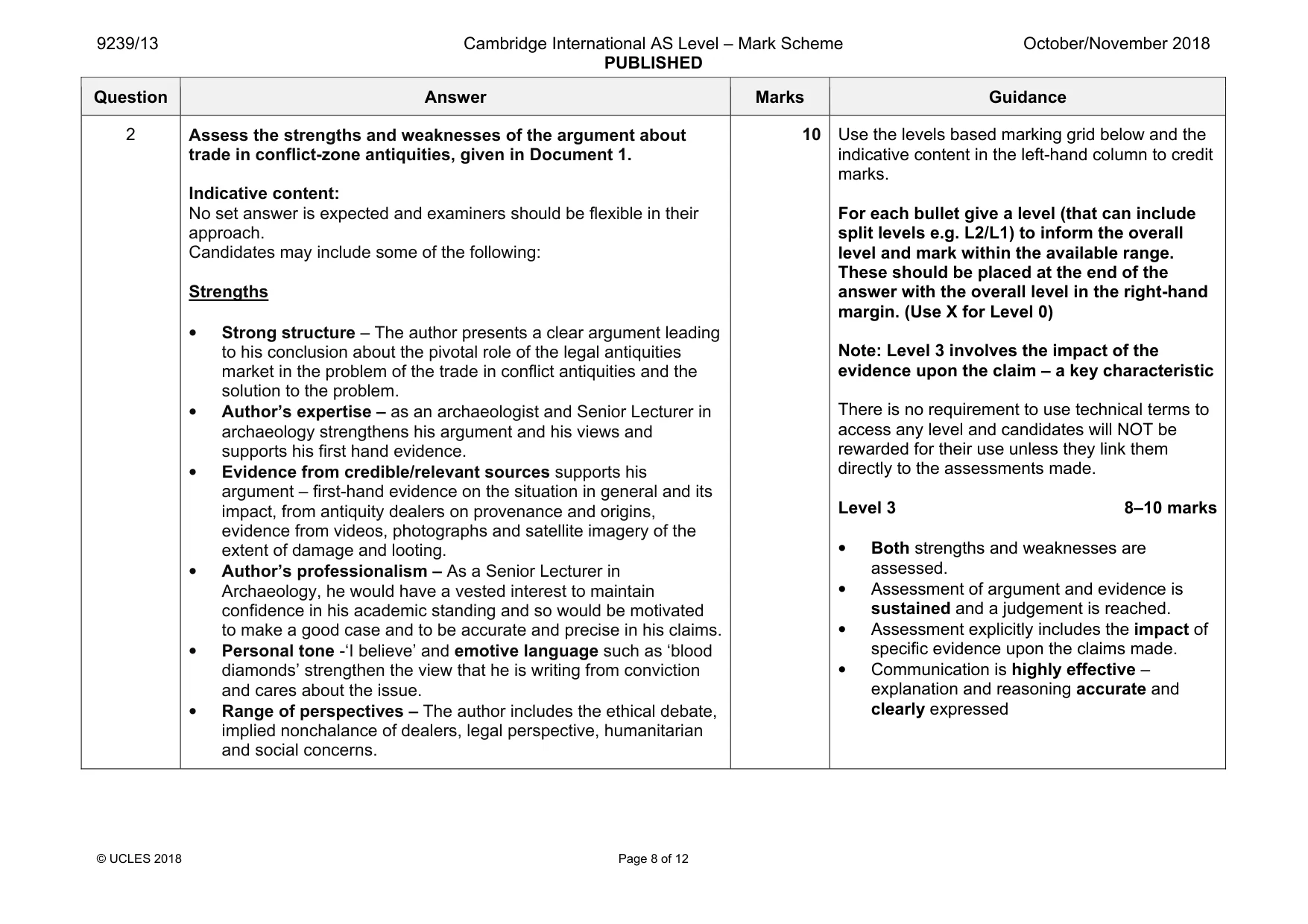
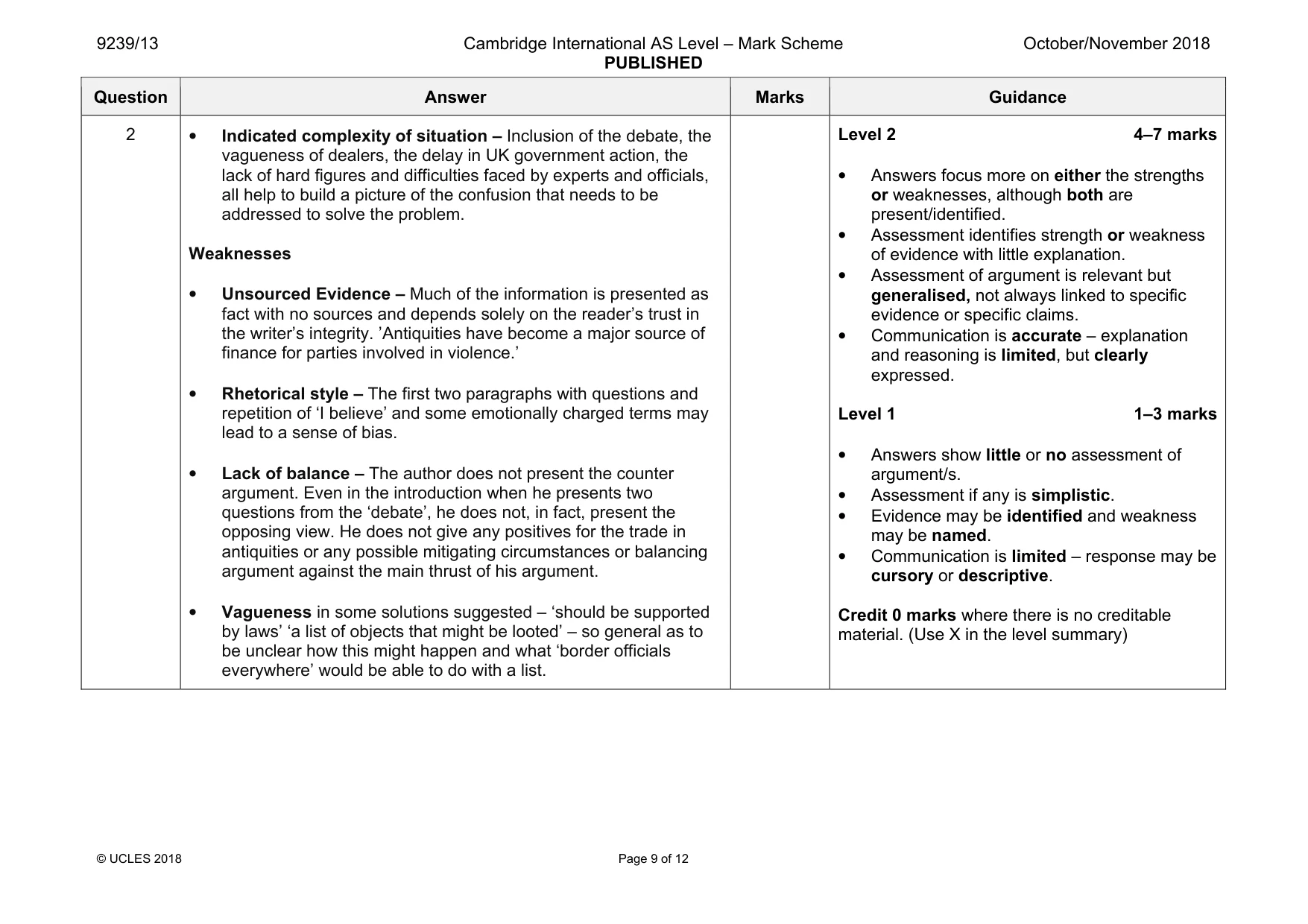
9239/13 Cambridge International AS Level – Mark Scheme PUBLISHED October/November 2018 © UCLES 2018 Page 8 of 12 Question Answer Marks Guidance 2 Assess the strengths and weaknesses of the argument about trade in conflict-zone antiquities, given in Document 1. Indicative content: No set answer is expected and examiners should be flexible in their approach. Candidates may include some of the following: Strengths • Strong structure – The author presents a clear argument leading to his conclusion about the pivotal role of the legal antiquities market in the problem of the trade in conflict antiquities and the solution to the problem. • Author’s expertise – as an archaeologist and Senior Lecturer in archaeology strengthens his argument and his views and supports his first hand evidence. • Evidence from credible/relevant sources supports his argument – first-hand evidence on the situation in general and its impact, from antiquity dealers on provenance and origins, evidence from videos, photographs and satellite imagery of the extent of damage and looting. • Author’s professionalism – As a Senior Lecturer in Archaeology, he would have a vested interest to maintain confidence in his academic standing and so would be motivated to make a good case and to be accurate and precise in his claims. • Personal tone -‘I believe’ and emotive language such as ‘blood diamonds’ strengthen the view that he is writing from conviction and cares about the issue. • Range of perspectives – The author includes the ethical debate, implied nonchalance of dealers, legal perspective, humanitarian and social concerns. 10 Use the levels based marking grid below and the indicative content in the left-hand column to credit marks. For each bullet give a level (that can include split levels e.g. L2/L1) to inform the overall level and mark within the available range. These should be placed at the end of the answer with the overall level in the right-hand margin. (Use X for Level 0) Note: Level 3 involves the impact of the evidence upon the claim – a key characteristic There is no requirement to use technical terms to access any level and candidates will NOT be rewarded for their use unless they link them directly to the assessments made. Level 3 8–10 marks • Both strengths and weaknesses are assessed. • Assessment of argument and evidence is sustained and a judgement is reached. • Assessment explicitly includes the impact of specific evidence upon the claims made. • Communication is highly effective – explanation and reasoning accurate and clearly expressed
Mark scheme, page 9
9239/13 Cambridge International AS Level – Mark Scheme PUBLISHED October/November 2018 © UCLES 2018 Page 9 of 12 Question Answer Marks Guidance 2 • Indicated complexity of situation – Inclusion of the debate, the vagueness of dealers, the delay in UK government action, the lack of hard figures and difficulties faced by experts and officials, all help to build a picture of the confusion that needs to be addressed to solve the problem. Weaknesses • Unsourced Evidence – Much of the information is presented as fact with no sources and depends solely on the reader’s trust in the writer’s integrity. ’Antiquities have become a major source of finance for parties involved in violence.’ • Rhetorical style – The first two paragraphs with questions and repetition of ‘I believe’ and some emotionally charged terms may lead to a sense of bias. • Lack of balance – The author does not present the counter argument. Even in the introduction when he presents two questions from the ‘debate’, he does not, in fact, present the opposing view. He does not give any positives for the trade in antiquities or any possible mitigating circumstances or balancing argument against the main thrust of his argument. • Vagueness in some solutions suggested – ‘should be supported by laws’ ‘a list of objects that might be looted’ – so general as to be unclear how this might happen and what ‘border officials everywhere’ would be able to do with a list. Level 2 4–7 marks • Answers focus more on either the strengths or weaknesses, although both are present/identified. • Assessment identifies strength or weakness of evidence with little explanation. • Assessment of argument is relevant but generalised, not always linked to specific evidence or specific claims. • Communication is accurate – explanation and reasoning is limited, but clearly expressed. Level 1 1–3 marks • Answers show little or no assessment of argument/s. • Assessment if any is simplistic. • Evidence may be identified and weakness may be named. • Communication is limited – response may be cursory or descriptive. Credit 0 marks where there is no creditable material. (Use X in the level summary)
Mark scheme, page 10
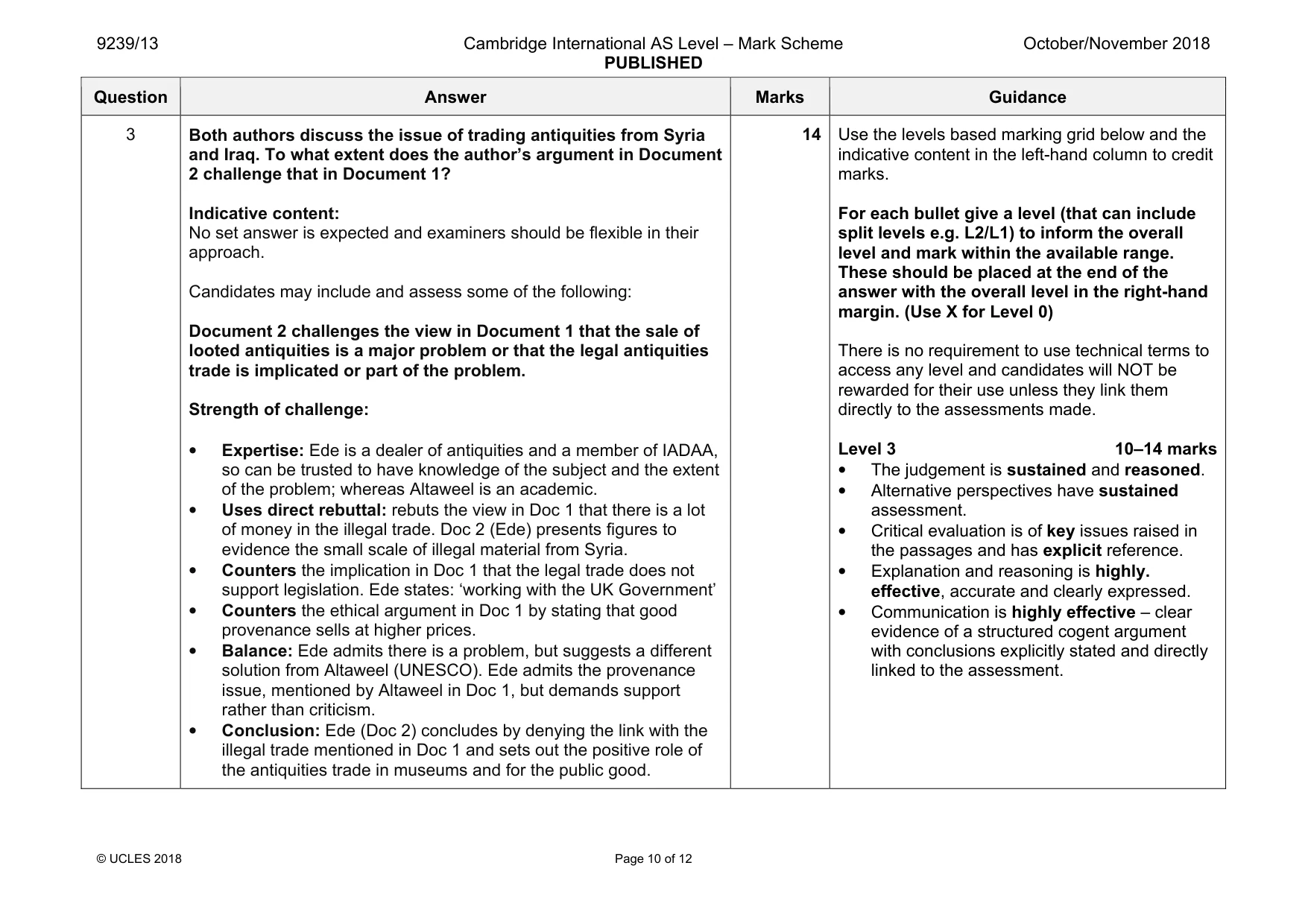
9239/13 Cambridge International AS Level – Mark Scheme PUBLISHED October/November 2018 © UCLES 2018 Page 10 of 12 Question Answer Marks Guidance 3 Both authors discuss the issue of trading antiquities from Syria and Iraq. To what extent does the author’s argument in Document 2 challenge that in Document 1? Indicative content: No set answer is expected and examiners should be flexible in their approach. Candidates may include and assess some of the following: Document 2 challenges the view in Document 1 that the sale of looted antiquities is a major problem or that the legal antiquities trade is implicated or part of the problem. Strength of challenge: • Expertise: Ede is a dealer of antiquities and a member of IADAA, so can be trusted to have knowledge of the subject and the extent of the problem; whereas Altaweel is an academic. • Uses direct rebuttal: rebuts the view in Doc 1 that there is a lot of money in the illegal trade. Doc 2 (Ede) presents figures to evidence the small scale of illegal material from Syria. • Counters the implication in Doc 1 that the legal trade does not support legislation. Ede states: ‘working with the UK Government’ • Counters the ethical argument in Doc 1 by stating that good provenance sells at higher prices. • Balance: Ede admits there is a problem, but suggests a different solution from Altaweel (UNESCO). Ede admits the provenance issue, mentioned by Altaweel in Doc 1, but demands support rather than criticism. • Conclusion: Ede (Doc 2) concludes by denying the link with the illegal trade mentioned in Doc 1 and sets out the positive role of the antiquities trade in museums and for the public good. 14 Use the levels based marking grid below and the indicative content in the left-hand column to credit marks. For each bullet give a level (that can include split levels e.g. L2/L1) to inform the overall level and mark within the available range. These should be placed at the end of the answer with the overall level in the right-hand margin. (Use X for Level 0) There is no requirement to use technical terms to access any level and candidates will NOT be rewarded for their use unless they link them directly to the assessments made. Level 3 10–14 marks • The judgement is sustained and reasoned. • Alternative perspectives have sustained assessment. • Critical evaluation is of key issues raised in the passages and has explicit reference. • Explanation and reasoning is highly. effective, accurate and clearly expressed. • Communication is highly effective – clear evidence of a structured cogent argument with conclusions explicitly stated and directly linked to the assessment.
Mark scheme, page 11
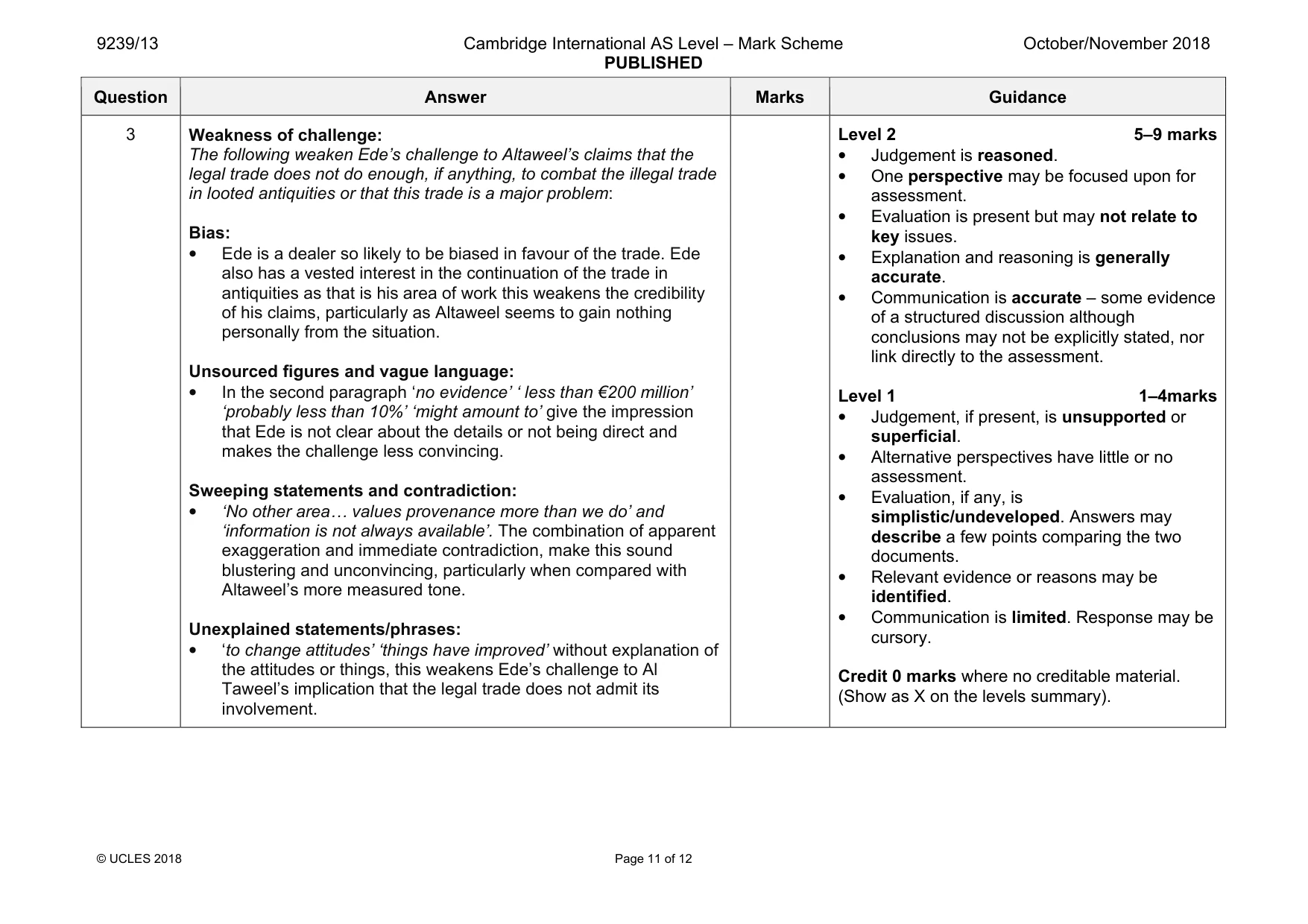
9239/13 Cambridge International AS Level – Mark Scheme PUBLISHED October/November 2018 © UCLES 2018 Page 11 of 12 Question Answer Marks Guidance 3 Weakness of challenge: The following weaken Ede’s challenge to Altaweel’s claims that the legal trade does not do enough, if anything, to combat the illegal trade in looted antiquities or that this trade is a major problem: Bias: • Ede is a dealer so likely to be biased in favour of the trade. Ede also has a vested interest in the continuation of the trade in antiquities as that is his area of work this weakens the credibility of his claims, particularly as Altaweel seems to gain nothing personally from the situation. Unsourced figures and vague language: • In the second paragraph ‘no evidence’ ‘ less than €200 million’ ‘probably less than 10%’ ‘might amount to’ give the impression that Ede is not clear about the details or not being direct and makes the challenge less convincing. Sweeping statements and contradiction: • ‘No other area« values provenance more than we do’ and ‘information is not always available’. The combination of apparent exaggeration and immediate contradiction, make this sound blustering and unconvincing, particularly when compared with Altaweel’s more measured tone. Unexplained statements/phrases: • ‘to change attitudes’ ‘things have improved’ without explanation of the attitudes or things, this weakens Ede’s challenge to Al Taweel’s implication that the legal trade does not admit its involvement. Level 2 5–9 marks • Judgement is reasoned. • One perspective may be focused upon for assessment. • Evaluation is present but may not relate to key issues. • Explanation and reasoning is generally accurate. • Communication is accurate – some evidence of a structured discussion although conclusions may not be explicitly stated, nor link directly to the assessment. Level 1 1–4marks • Judgement, if present, is unsupported or superficial. • Alternative perspectives have little or no assessment. • Evaluation, if any, is simplistic/undeveloped. Answers may describe a few points comparing the two documents. • Relevant evidence or reasons may be identified. • Communication is limited. Response may be cursory. Credit 0 marks where no creditable material. (Show as X on the levels summary).
Mark scheme, page 12
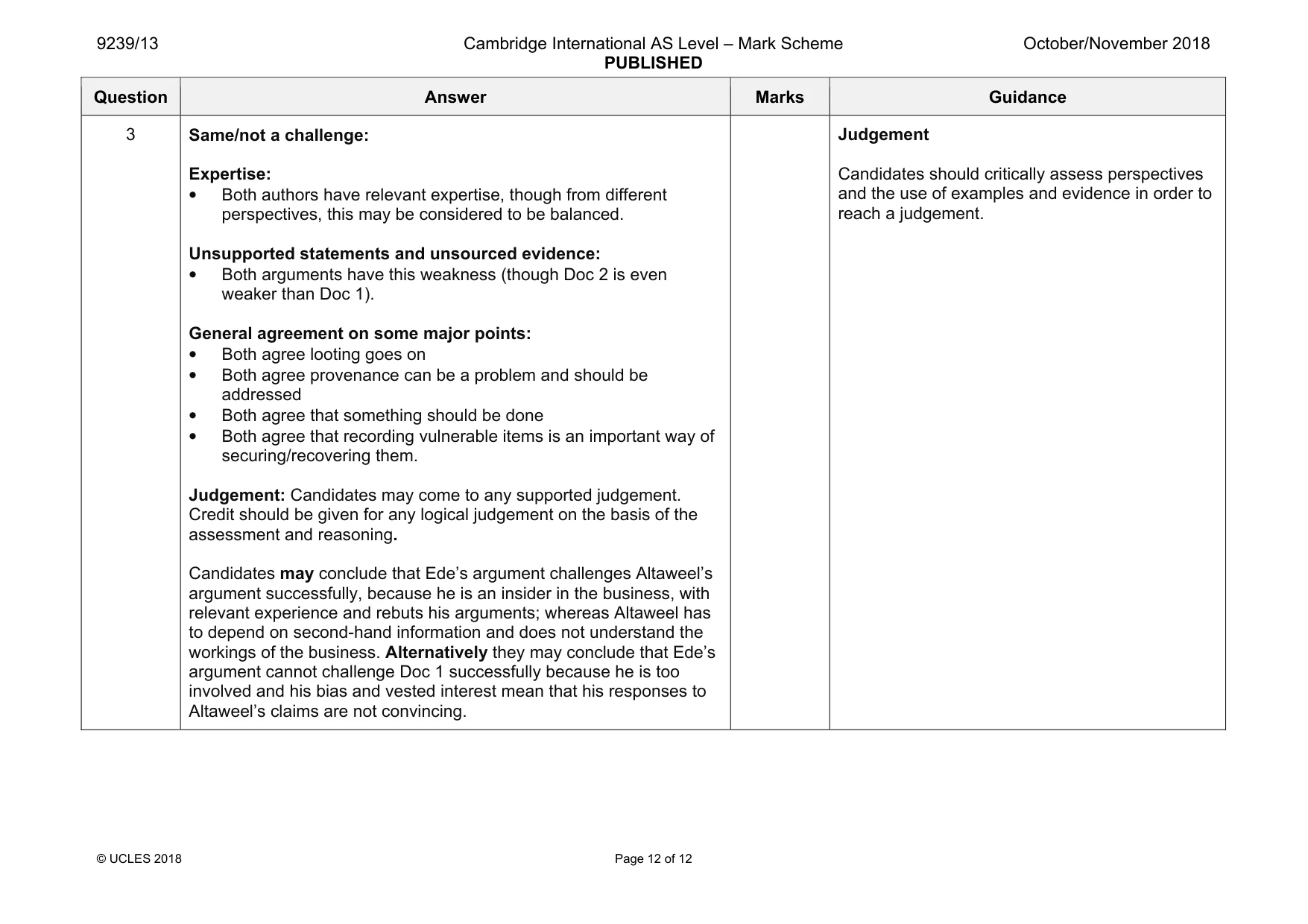
9239/13 Cambridge International AS Level – Mark Scheme PUBLISHED October/November 2018 © UCLES 2018 Page 12 of 12 Question Answer Marks Guidance 3 Same/not a challenge: Expertise: • Both authors have relevant expertise, though from different perspectives, this may be considered to be balanced. Unsupported statements and unsourced evidence: • Both arguments have this weakness (though Doc 2 is even weaker than Doc 1). General agreement on some major points: • Both agree looting goes on • Both agree provenance can be a problem and should be addressed • Both agree that something should be done • Both agree that recording vulnerable items is an important way of securing/recovering them. Judgement: Candidates may come to any supported judgement. Credit should be given for any logical judgement on the basis of the assessment and reasoning. Candidates may conclude that Ede’s argument challenges Altaweel’s argument successfully, because he is an insider in the business, with relevant experience and rebuts his arguments; whereas Altaweel has to depend on second-hand information and does not understand the workings of the business. Alternatively they may conclude that Ede’s argument cannot challenge Doc 1 successfully because he is too involved and his bias and vested interest mean that his responses to Altaweel’s claims are not convincing. Judgement Candidates should critically assess perspectives and the use of examples and evidence in order to reach a judgement.
What you needed in this session
Cambridge’s own grade thresholds for 2018 Oct/Nov, Paper 1 · Variant 3. A higher threshold means an easier paper — the bar moves with how the cohort did.