Cambridge A Level Global Perspectives and Research 9239 — 2017 Oct/Nov Paper 1 · Variant 2
9239/12/O/N/17 · 30 marks · ≈34 min
The question paper and its mark scheme, free to read here and free to download. This is Cambridge’s own paper, exactly as it was sat.
Question paper4 pages

Mark scheme12 pages
Answers below. Sit the paper first if you are practising.
Paper as text
Question paper, page 1
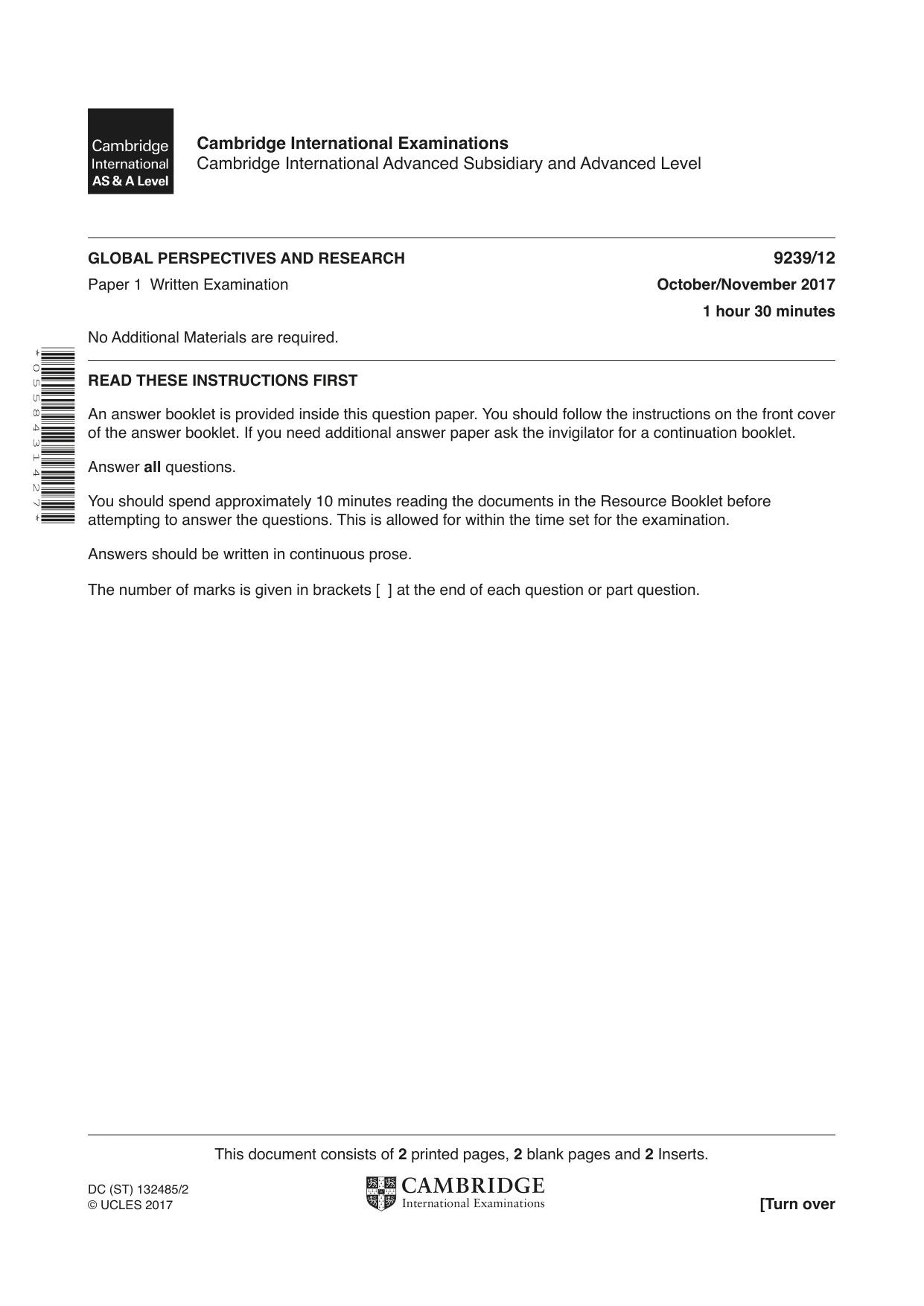
This document consists of 2 printed pages, 2 blank pages and 2 Inserts. DC (ST) 132485/2 © UCLES 2017 [Turn over Cambridge International Examinations Cambridge International Advanced Subsidiary and Advanced Level * 0 5 5 8 4 3 1 4 2 7 * GLOBAL PERSPECTIVES AND RESEARCH 9239/12 Paper 1 Written Examination October/November 2017 1 hour 30 minutes No Additional Materials are required. READ THESE INSTRUCTIONS FIRST An answer booklet is provided inside this question paper. You should follow the instructions on the front cover of the answer booklet. If you need additional answer paper ask the invigilator for a continuation booklet. Answer all questions. You should spend approximately 10 minutes reading the documents in the Resource Booklet before attempting to answer the questions. This is allowed for within the time set for the examination. Answers should be written in continuous prose. The number of marks is given in brackets [ ] at the end of each question or part question.
Question paper, page 2
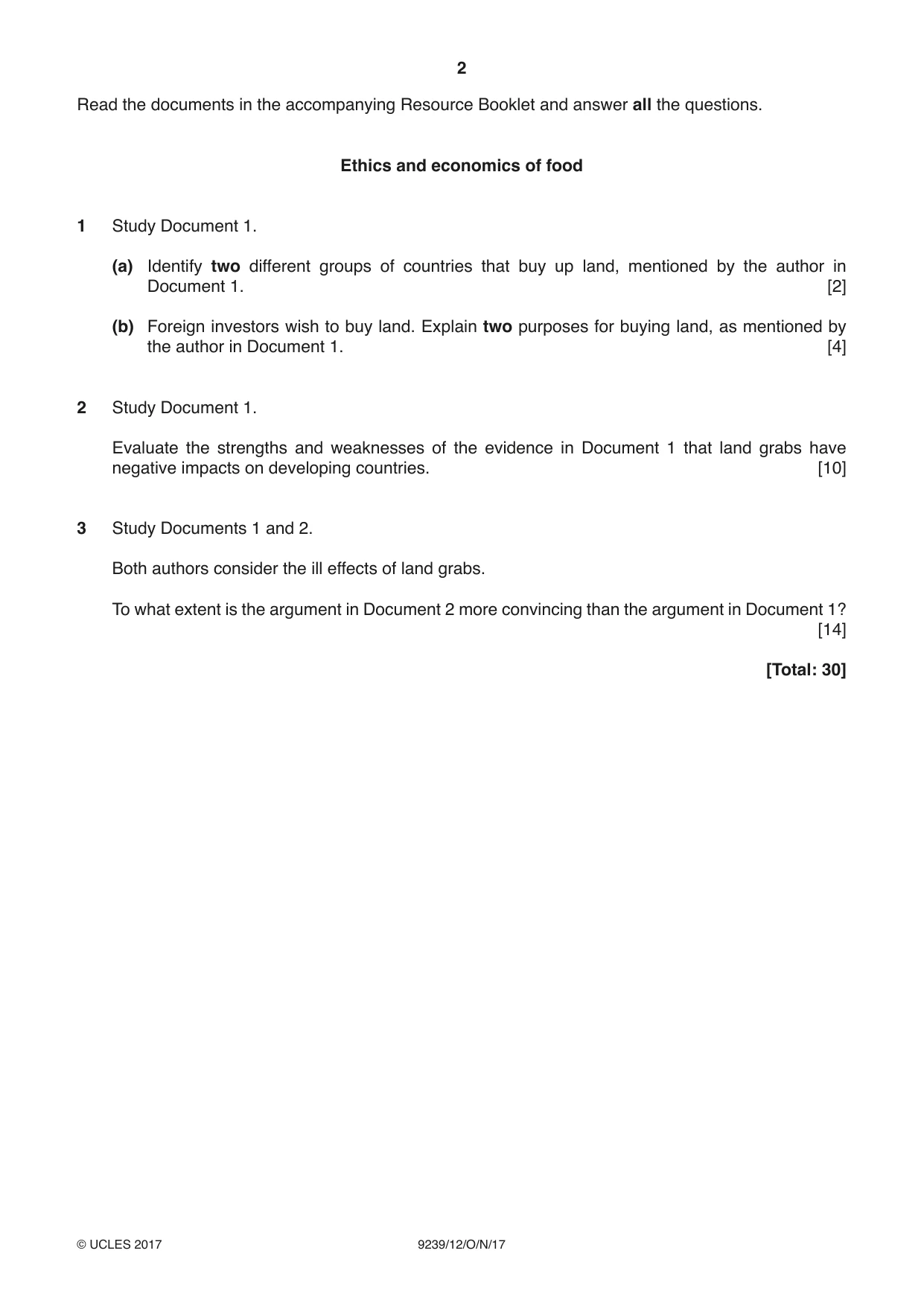
2 9239/12/O/N/17 © UCLES 2017 Read the documents in the accompanying Resource Booklet and answer all the questions. Ethics and economics of food 1 Study Document 1. (a) Identify two different groups of countries that buy up land, mentioned by the author in Document 1. [2] (b) Foreign investors wish to buy land. Explain two purposes for buying land, as mentioned by the author in Document 1. [4] 2 Study Document 1. Evaluate the strengths and weaknesses of the evidence in Document 1 that land grabs have negative impacts on developing countries. [10] 3 Study Documents 1 and 2. Both authors consider the ill effects of land grabs. To what extent is the argument in Document 2 more convincing than the argument in Document 1? [14] [Total: 30]
Question paper, page 3
3 9239/12/O/N/17 © UCLES 2017 BLANK PAGE
Question paper, page 4
4 9239/12/O/N/17 © UCLES 2017 Permission to reproduce items where third-party owned material protected by copyright is included has been sought and cleared where possible. Every reasonable effort has been made by the publisher (UCLES) to trace copyright holders, but if any items requiring clearance have unwittingly been included, the publisher will be pleased to make amends at the earliest possible opportunity. To avoid the issue of disclosure of answer-related information to candidates, all copyright acknowledgements are reproduced online in the Cambridge International Examinations Copyright Acknowledgements Booklet. This is produced for each series of examinations and is freely available to download at www.cie.org.uk after the live examination series. Cambridge International Examinations is part of the Cambridge Assessment Group. Cambridge Assessment is the brand name of University of Cambridge Local Examinations Syndicate (UCLES), which is itself a department of the University of Cambridge. BLANK PAGE
Mark scheme, page 1
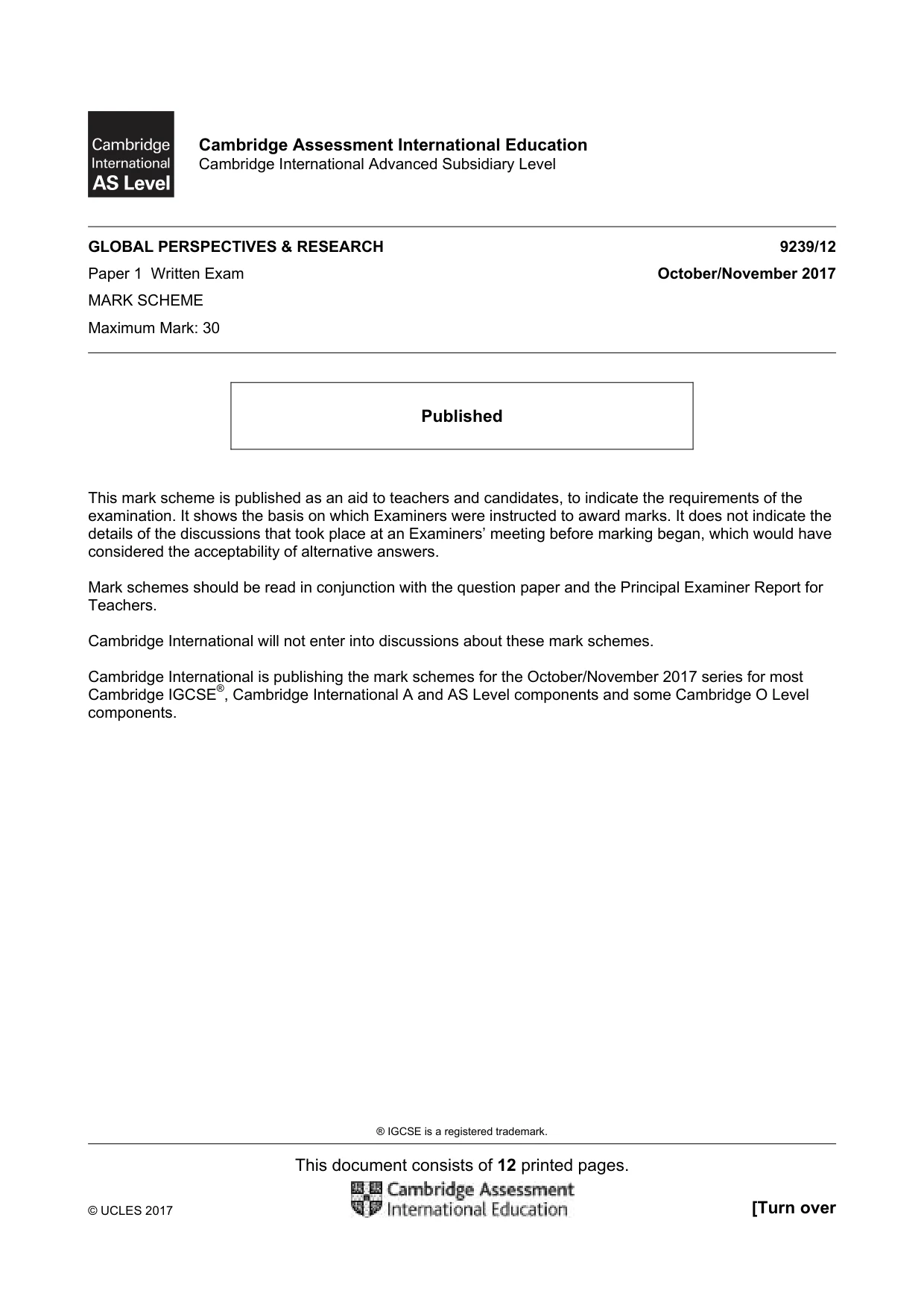
® IGCSE is a registered trademark. This document consists of 12 printed pages. © UCLES 2017 [Turn over Cambridge Assessment International Education Cambridge International Advanced Subsidiary Level GLOBAL PERSPECTIVES & RESEARCH 9239/12 Paper 1 Written Exam October/November 2017 MARK SCHEME Maximum Mark: 30 Published This mark scheme is published as an aid to teachers and candidates, to indicate the requirements of the examination. It shows the basis on which Examiners were instructed to award marks. It does not indicate the details of the discussions that took place at an Examiners’ meeting before marking began, which would have considered the acceptability of alternative answers. Mark schemes should be read in conjunction with the question paper and the Principal Examiner Report for Teachers. Cambridge International will not enter into discussions about these mark schemes. Cambridge International is publishing the mark schemes for the October/November 2017 series for most Cambridge IGCSE®, Cambridge International A and AS Level components and some Cambridge O Level components.
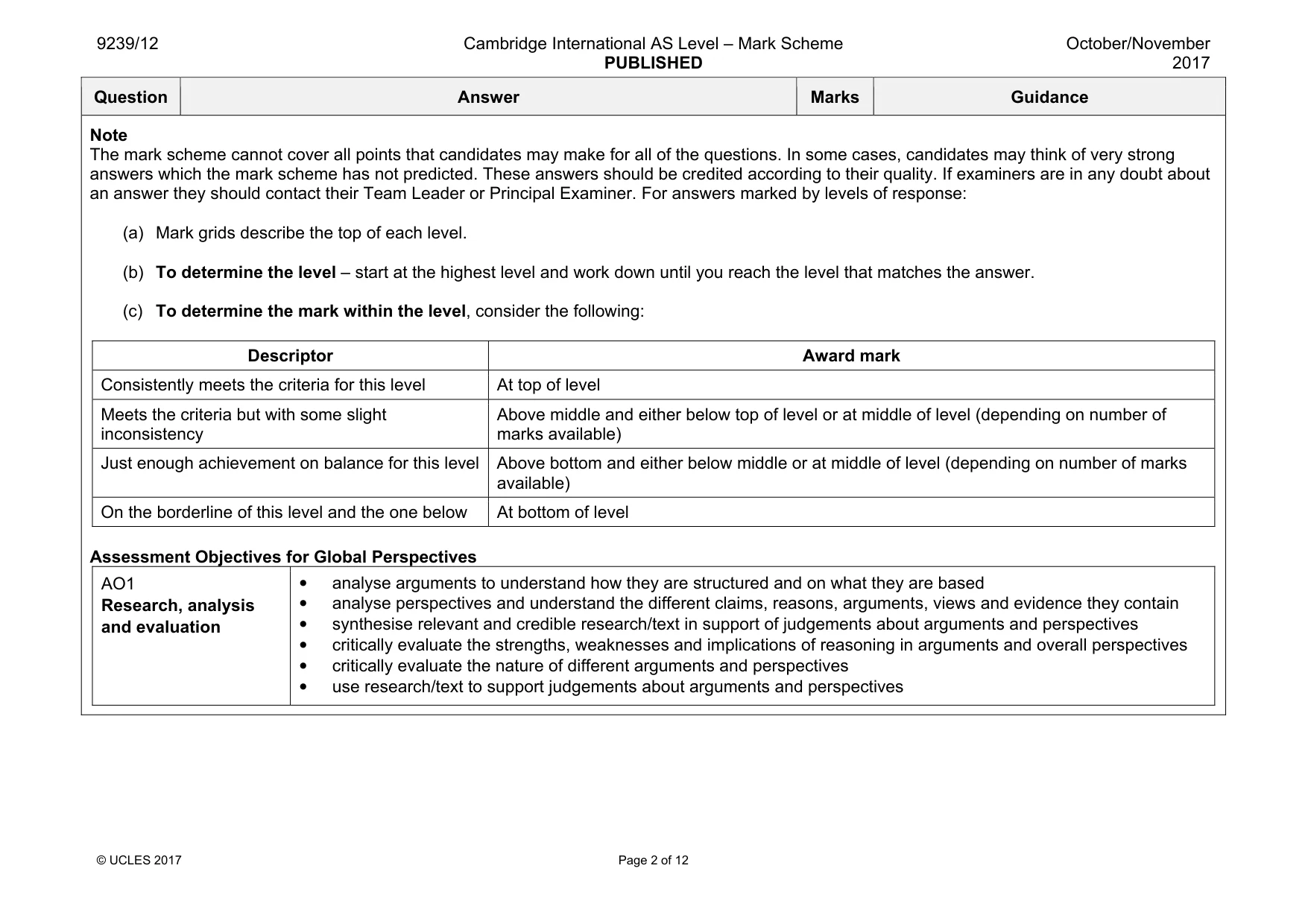
Mark scheme, page 2
9239/12 Cambridge International AS Level – Mark Scheme PUBLISHED October/November 2017 © UCLES 2017 Page 2 of 12 Question Answer Marks Guidance Note The mark scheme cannot cover all points that candidates may make for all of the questions. In some cases, candidates may think of very strong answers which the mark scheme has not predicted. These answers should be credited according to their quality. If examiners are in any doubt about an answer they should contact their Team Leader or Principal Examiner. For answers marked by levels of response: (a) Mark grids describe the top of each level. (b) To determine the level – start at the highest level and work down until you reach the level that matches the answer. (c) To determine the mark within the level, consider the following: Descriptor Award mark Consistently meets the criteria for this level At top of level Meets the criteria but with some slight inconsistency Above middle and either below top of level or at middle of level (depending on number of marks available) Just enough achievement on balance for this level Above bottom and either below middle or at middle of level (depending on number of marks available) On the borderline of this level and the one below At bottom of level Assessment Objectives for Global Perspectives AO1 Research, analysis and evaluation • analyse arguments to understand how they are structured and on what they are based • analyse perspectives and understand the different claims, reasons, arguments, views and evidence they contain • synthesise relevant and credible research/text in support of judgements about arguments and perspectives • critically evaluate the strengths, weaknesses and implications of reasoning in arguments and overall perspectives • critically evaluate the nature of different arguments and perspectives • use research/text to support judgements about arguments and perspectives
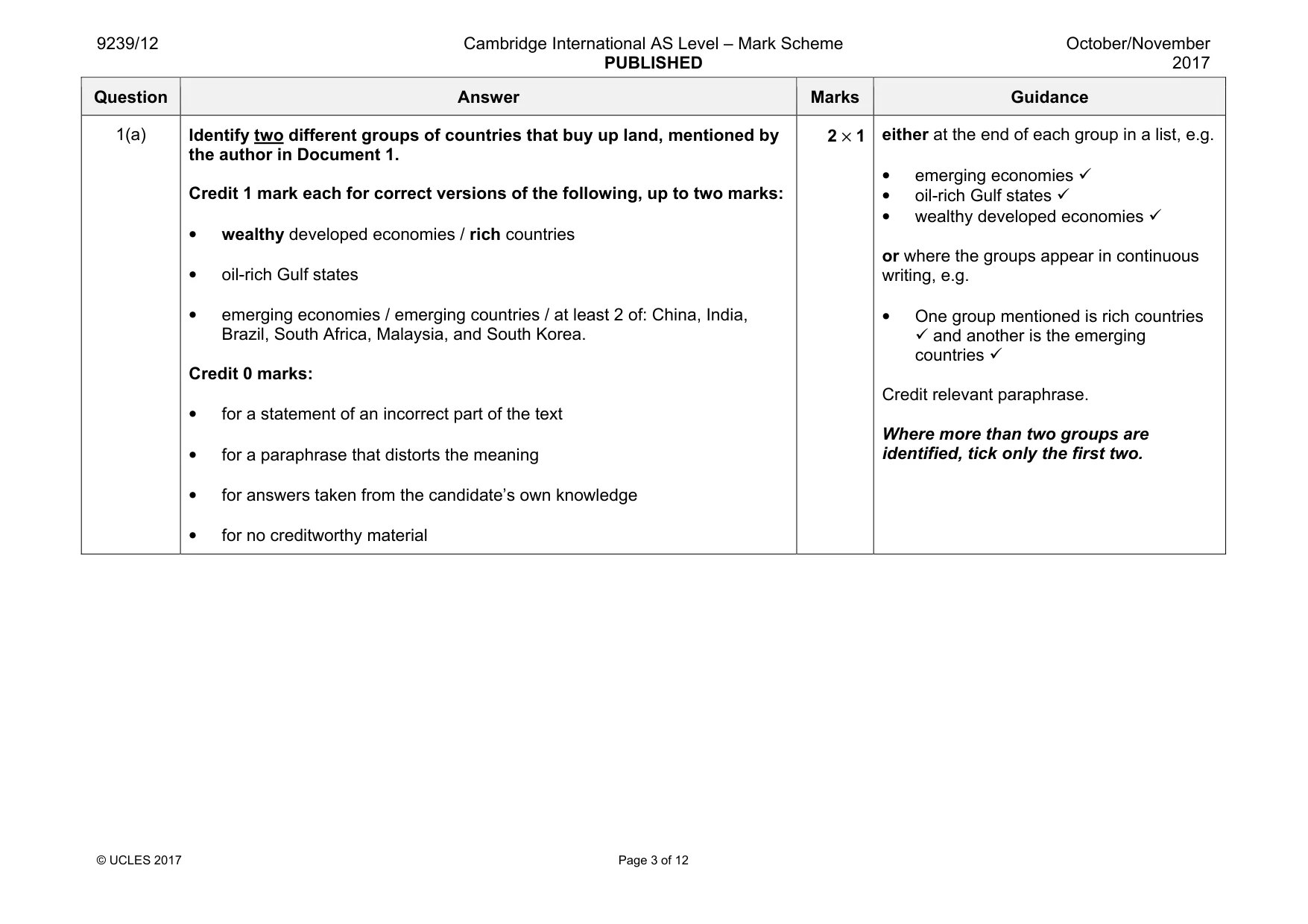
Mark scheme, page 3
9239/12 Cambridge International AS Level – Mark Scheme PUBLISHED October/November 2017 © UCLES 2017 Page 3 of 12 Question Answer Marks Guidance 1(a) Identify two different groups of countries that buy up land, mentioned by the author in Document 1. Credit 1 mark each for correct versions of the following, up to two marks: • wealthy developed economies / rich countries • oil-rich Gulf states • emerging economies / emerging countries / at least 2 of: China, India, Brazil, South Africa, Malaysia, and South Korea. Credit 0 marks: • for a statement of an incorrect part of the text • for a paraphrase that distorts the meaning • for answers taken from the candidate’s own knowledge • for no creditworthy material 2 × 1 either at the end of each group in a list, e.g. • emerging economies 9 • oil-rich Gulf states 9 • wealthy developed economies 9 or where the groups appear in continuous writing, e.g. • One group mentioned is rich countries 9 and another is the emerging countries 9 Credit relevant paraphrase. Where more than two groups are identified, tick only the first two.
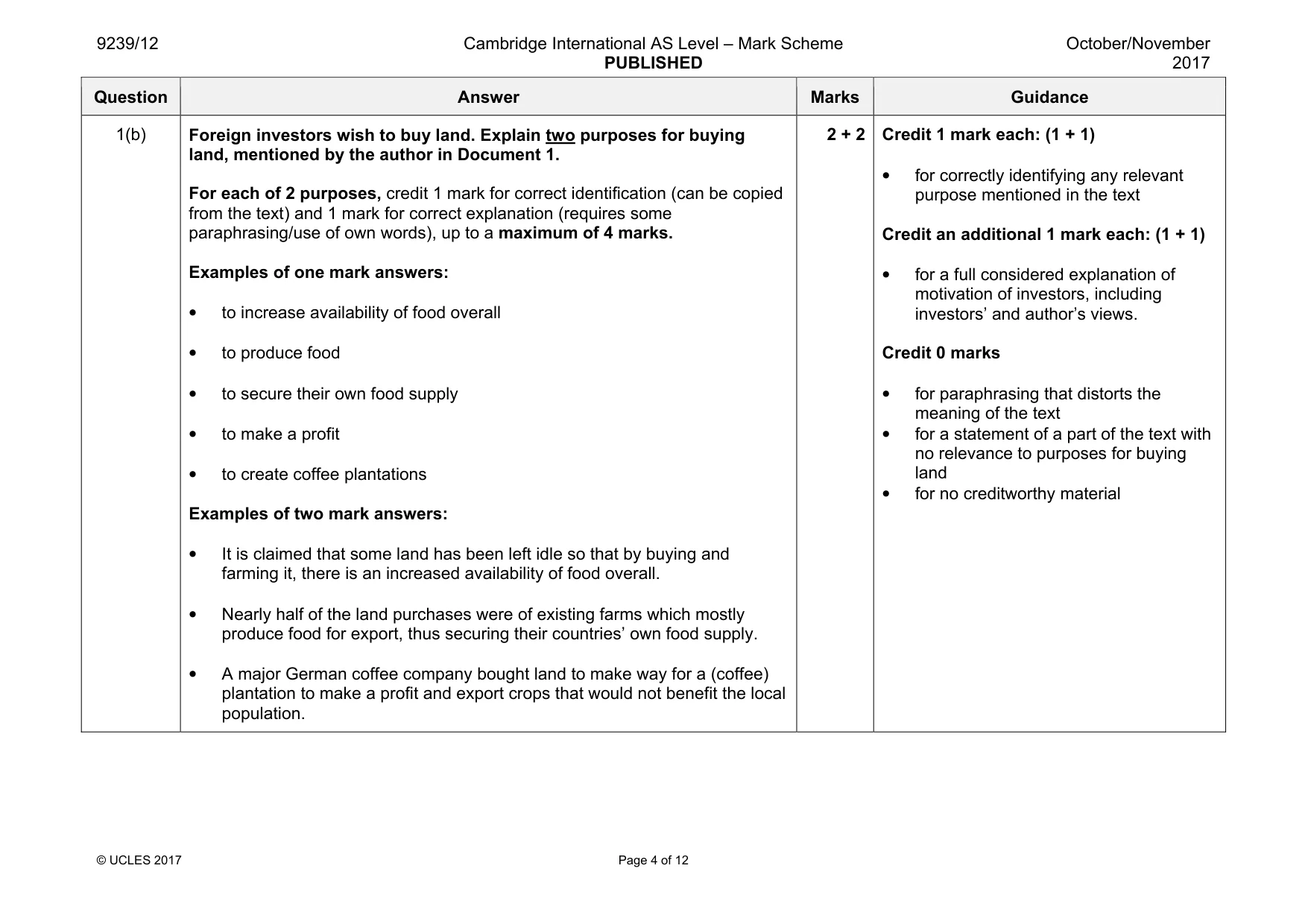
Mark scheme, page 4
9239/12 Cambridge International AS Level – Mark Scheme PUBLISHED October/November 2017 © UCLES 2017 Page 4 of 12 Question Answer Marks Guidance 1(b) Foreign investors wish to buy land. Explain two purposes for buying land, mentioned by the author in Document 1. For each of 2 purposes, credit 1 mark for correct identification (can be copied from the text) and 1 mark for correct explanation (requires some paraphrasing/use of own words), up to a maximum of 4 marks. Examples of one mark answers: • to increase availability of food overall • to produce food • to secure their own food supply • to make a profit • to create coffee plantations Examples of two mark answers: • It is claimed that some land has been left idle so that by buying and farming it, there is an increased availability of food overall. • Nearly half of the land purchases were of existing farms which mostly produce food for export, thus securing their countries’ own food supply. • A major German coffee company bought land to make way for a (coffee) plantation to make a profit and export crops that would not benefit the local population. 2 + 2 Credit 1 mark each: (1 + 1) • for correctly identifying any relevant purpose mentioned in the text Credit an additional 1 mark each: (1 + 1) • for a full considered explanation of motivation of investors, including investors’ and author’s views. Credit 0 marks • for paraphrasing that distorts the meaning of the text • for a statement of a part of the text with no relevance to purposes for buying land • for no creditworthy material
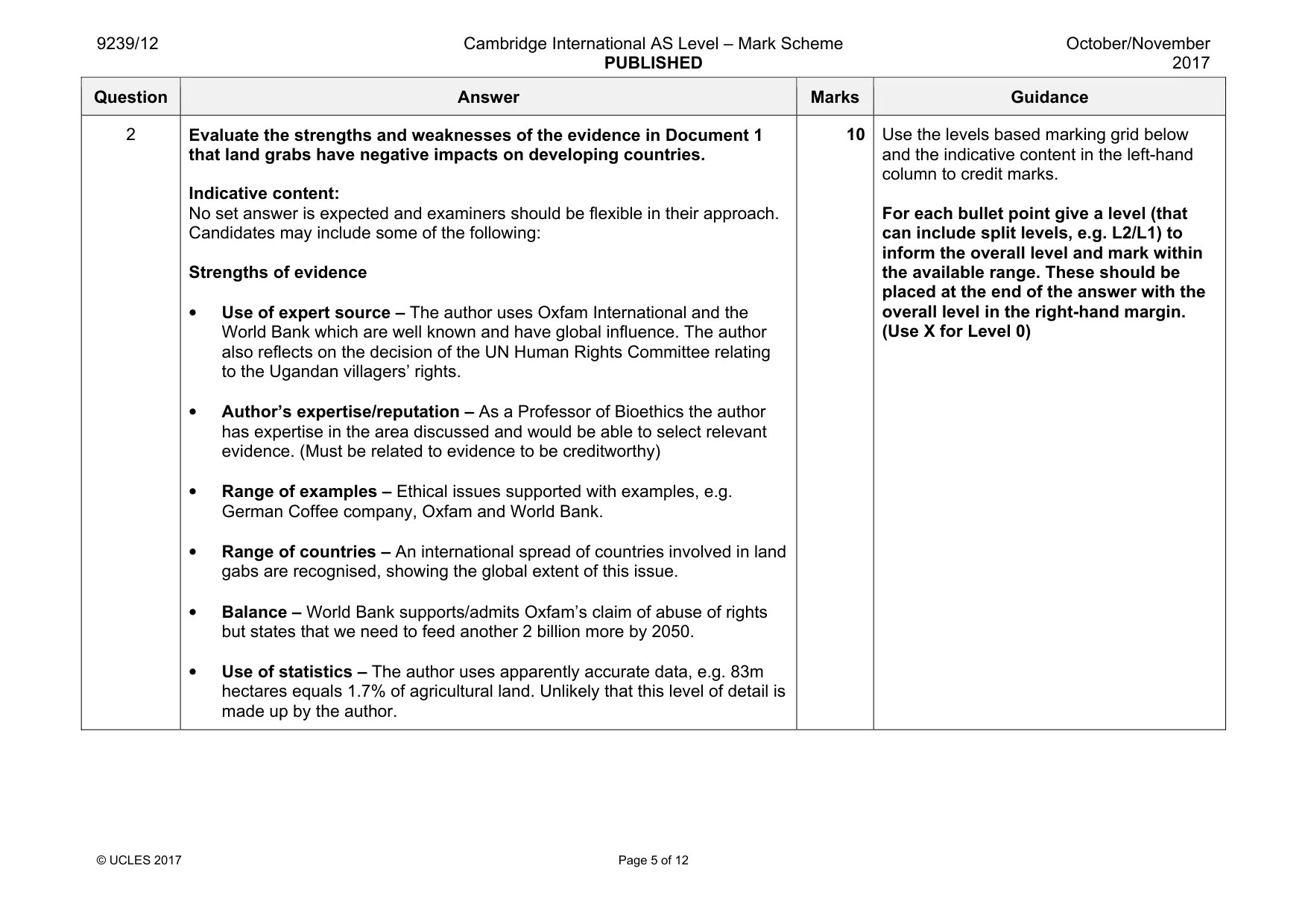
Mark scheme, page 5
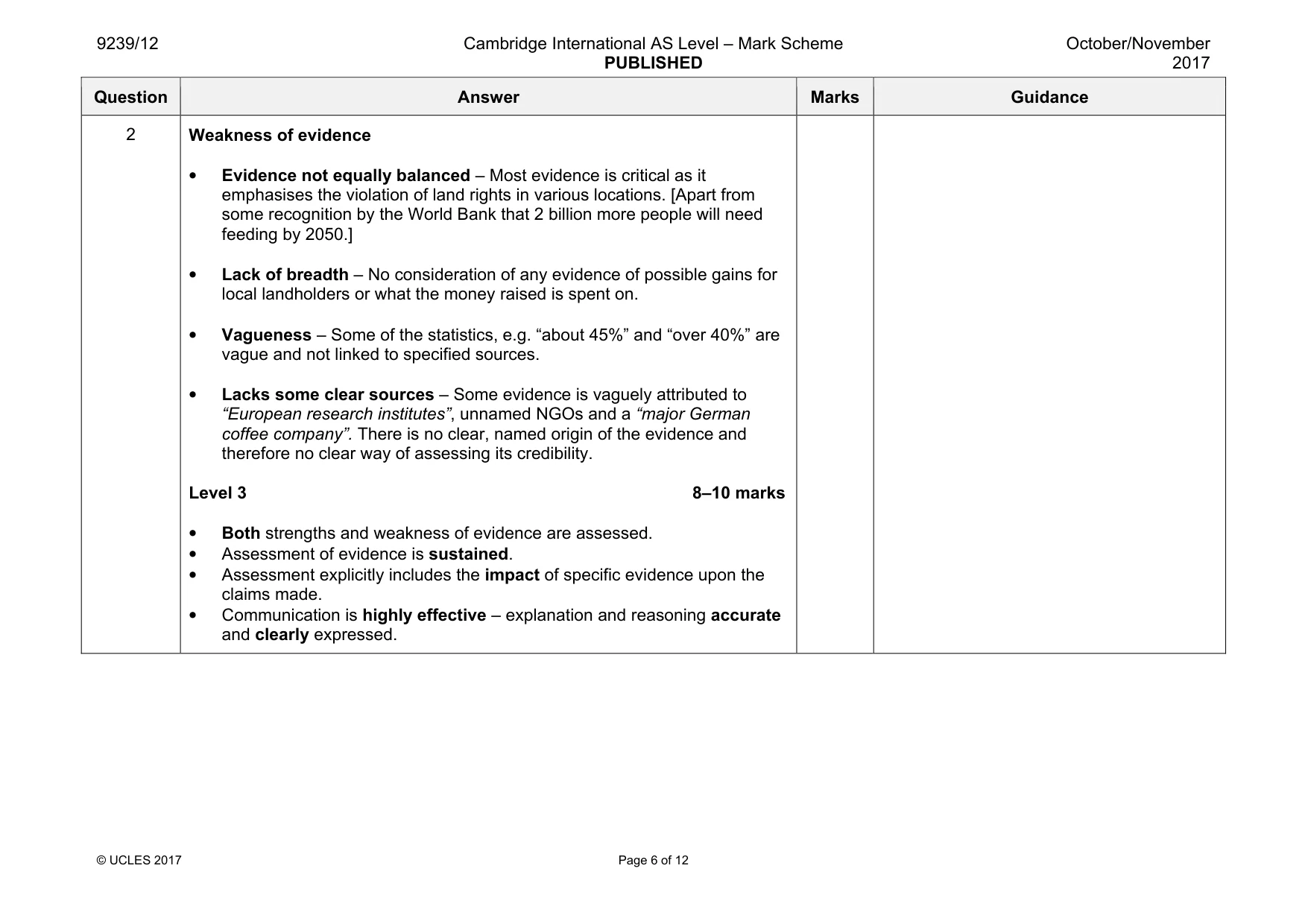
9239/12 Cambridge International AS Level – Mark Scheme PUBLISHED October/November 2017 © UCLES 2017 Page 5 of 12 Question Answer Marks Guidance 2 Evaluate the strengths and weaknesses of the evidence in Document 1 that land grabs have negative impacts on developing countries. Indicative content: No set answer is expected and examiners should be flexible in their approach. Candidates may include some of the following: Strengths of evidence • Use of expert source – The author uses Oxfam International and the World Bank which are well known and have global influence. The author also reflects on the decision of the UN Human Rights Committee relating to the Ugandan villagers’ rights. • Author’s expertise/reputation – As a Professor of Bioethics the author has expertise in the area discussed and would be able to select relevant evidence. (Must be related to evidence to be creditworthy) • Range of examples – Ethical issues supported with examples, e.g. German Coffee company, Oxfam and World Bank. • Range of countries – An international spread of countries involved in land gabs are recognised, showing the global extent of this issue. • Balance – World Bank supports/admits Oxfam’s claim of abuse of rights but states that we need to feed another 2 billion more by 2050. • Use of statistics – The author uses apparently accurate data, e.g. 83m hectares equals 1.7% of agricultural land. Unlikely that this level of detail is made up by the author. 10 Use the levels based marking grid below and the indicative content in the left-hand column to credit marks. For each bullet point give a level (that can include split levels, e.g. L2/L1) to inform the overall level and mark within the available range. These should be placed at the end of the answer with the overall level in the right-hand margin. (Use X for Level 0)
Mark scheme, page 6
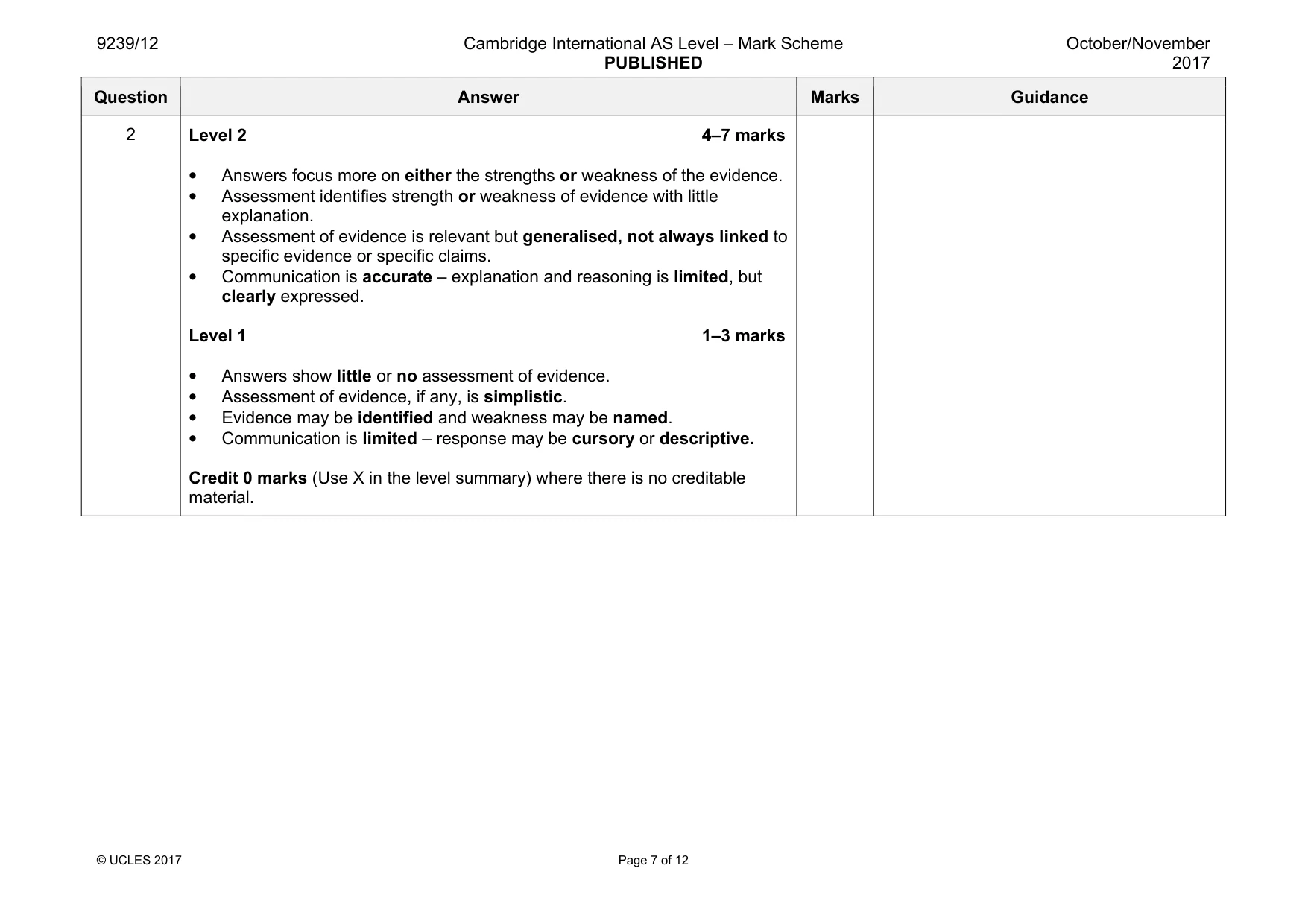
9239/12 Cambridge International AS Level – Mark Scheme PUBLISHED October/November 2017 © UCLES 2017 Page 6 of 12 Question Answer Marks Guidance 2 Weakness of evidence • Evidence not equally balanced – Most evidence is critical as it emphasises the violation of land rights in various locations. [Apart from some recognition by the World Bank that 2 billion more people will need feeding by 2050.] • Lack of breadth – No consideration of any evidence of possible gains for local landholders or what the money raised is spent on. • Vagueness – Some of the statistics, e.g. “about 45%” and “over 40%” are vague and not linked to specified sources. • Lacks some clear sources – Some evidence is vaguely attributed to “European research institutes”, unnamed NGOs and a “major German coffee company”. There is no clear, named origin of the evidence and therefore no clear way of assessing its credibility. Level 3 8–10 marks • Both strengths and weakness of evidence are assessed. • Assessment of evidence is sustained. • Assessment explicitly includes the impact of specific evidence upon the claims made. • Communication is highly effective – explanation and reasoning accurate and clearly expressed.
Mark scheme, page 7
9239/12 Cambridge International AS Level – Mark Scheme PUBLISHED October/November 2017 © UCLES 2017 Page 7 of 12 Question Answer Marks Guidance 2 Level 2 4–7 marks • Answers focus more on either the strengths or weakness of the evidence. • Assessment identifies strength or weakness of evidence with little explanation. • Assessment of evidence is relevant but generalised, not always linked to specific evidence or specific claims. • Communication is accurate – explanation and reasoning is limited, but clearly expressed. Level 1 1–3 marks • Answers show little or no assessment of evidence. • Assessment of evidence, if any, is simplistic. • Evidence may be identified and weakness may be named. • Communication is limited – response may be cursory or descriptive. Credit 0 marks (Use X in the level summary) where there is no creditable material.
Mark scheme, page 8
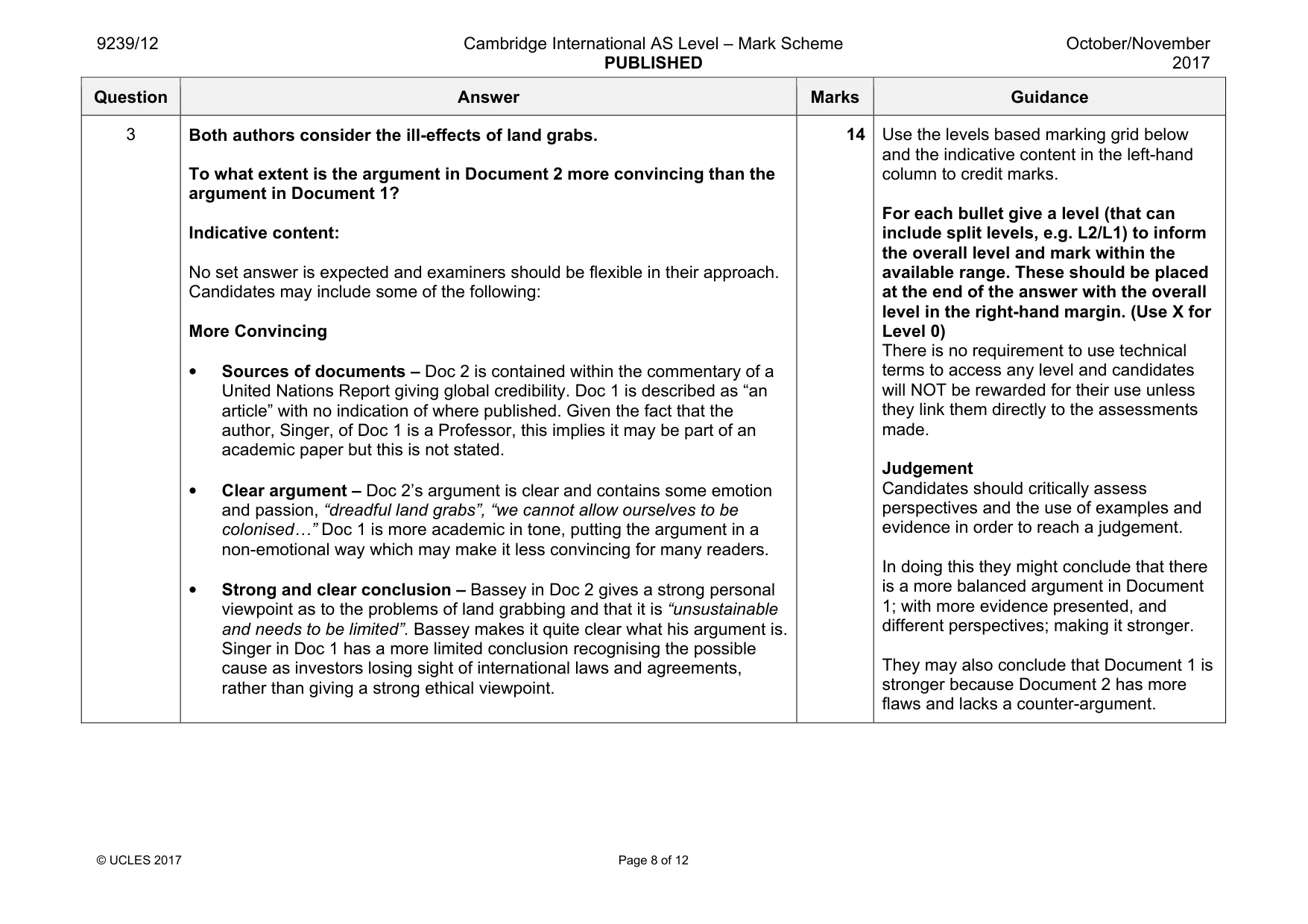
9239/12 Cambridge International AS Level – Mark Scheme PUBLISHED October/November 2017 © UCLES 2017 Page 8 of 12 Question Answer Marks Guidance 3 Both authors consider the ill-effects of land grabs. To what extent is the argument in Document 2 more convincing than the argument in Document 1? Indicative content: No set answer is expected and examiners should be flexible in their approach. Candidates may include some of the following: More Convincing • Sources of documents – Doc 2 is contained within the commentary of a United Nations Report giving global credibility. Doc 1 is described as “an article” with no indication of where published. Given the fact that the author, Singer, of Doc 1 is a Professor, this implies it may be part of an academic paper but this is not stated. • Clear argument – Doc 2’s argument is clear and contains some emotion and passion, “dreadful land grabs”, “we cannot allow ourselves to be colonised«” Doc 1 is more academic in tone, putting the argument in a non-emotional way which may make it less convincing for many readers. • Strong and clear conclusion – Bassey in Doc 2 gives a strong personal viewpoint as to the problems of land grabbing and that it is “unsustainable and needs to be limited”. Bassey makes it quite clear what his argument is. Singer in Doc 1 has a more limited conclusion recognising the possible cause as investors losing sight of international laws and agreements, rather than giving a strong ethical viewpoint. 14 Use the levels based marking grid below and the indicative content in the left-hand column to credit marks. For each bullet give a level (that can include split levels, e.g. L2/L1) to inform the overall level and mark within the available range. These should be placed at the end of the answer with the overall level in the right-hand margin. (Use X for Level 0) There is no requirement to use technical terms to access any level and candidates will NOT be rewarded for their use unless they link them directly to the assessments made. Judgement Candidates should critically assess perspectives and the use of examples and evidence in order to reach a judgement. In doing this they might conclude that there is a more balanced argument in Document 1; with more evidence presented, and different perspectives; making it stronger. They may also conclude that Document 1 is stronger because Document 2 has more flaws and lacks a counter-argument.
Mark scheme, page 9
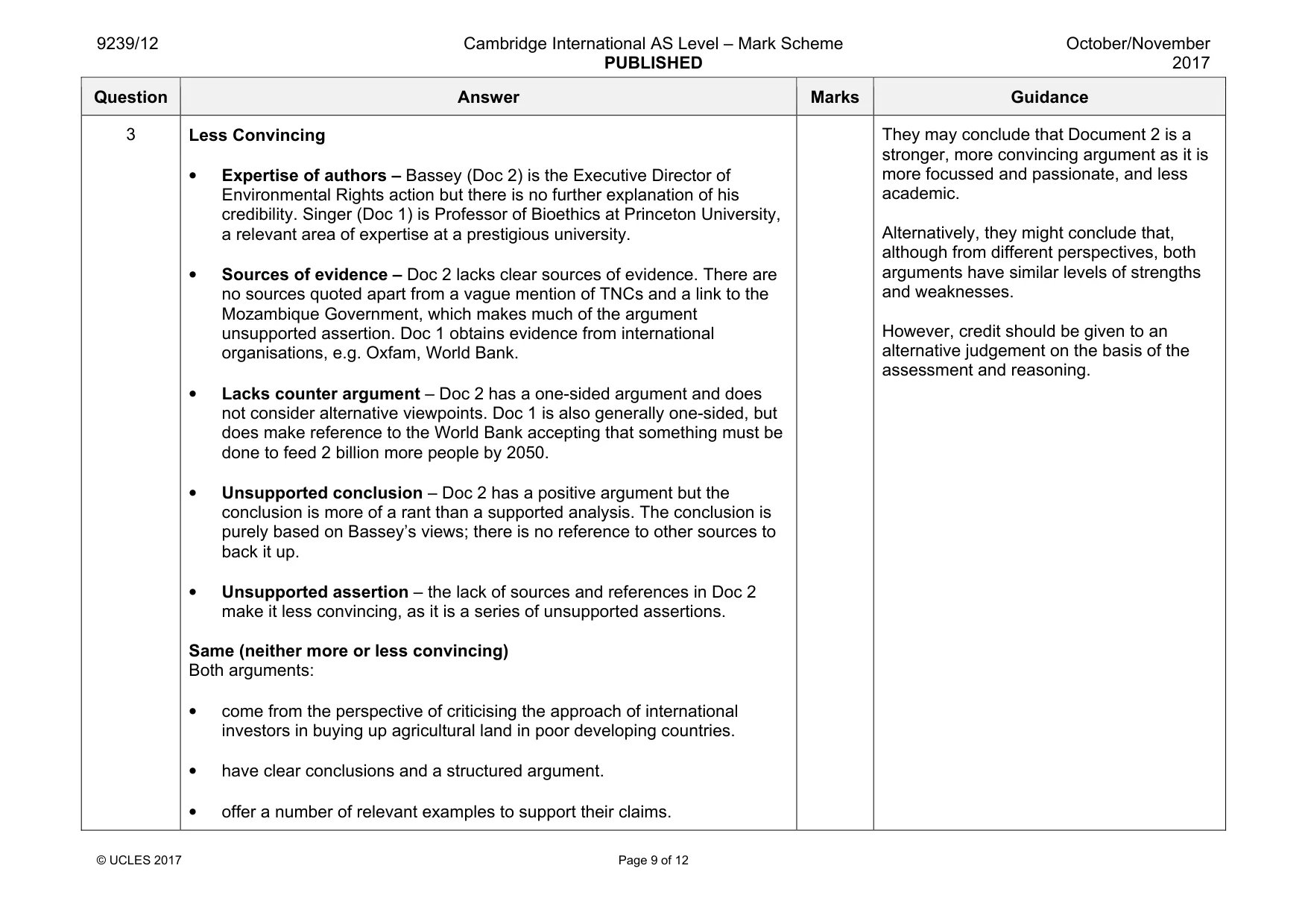
9239/12 Cambridge International AS Level – Mark Scheme PUBLISHED October/November 2017 © UCLES 2017 Page 9 of 12 Question Answer Marks Guidance 3 Less Convincing • Expertise of authors – Bassey (Doc 2) is the Executive Director of Environmental Rights action but there is no further explanation of his credibility. Singer (Doc 1) is Professor of Bioethics at Princeton University, a relevant area of expertise at a prestigious university. • Sources of evidence – Doc 2 lacks clear sources of evidence. There are no sources quoted apart from a vague mention of TNCs and a link to the Mozambique Government, which makes much of the argument unsupported assertion. Doc 1 obtains evidence from international organisations, e.g. Oxfam, World Bank. • Lacks counter argument – Doc 2 has a one-sided argument and does not consider alternative viewpoints. Doc 1 is also generally one-sided, but does make reference to the World Bank accepting that something must be done to feed 2 billion more people by 2050. • Unsupported conclusion – Doc 2 has a positive argument but the conclusion is more of a rant than a supported analysis. The conclusion is purely based on Bassey’s views; there is no reference to other sources to back it up. • Unsupported assertion – the lack of sources and references in Doc 2 make it less convincing, as it is a series of unsupported assertions. Same (neither more or less convincing) Both arguments: • come from the perspective of criticising the approach of international investors in buying up agricultural land in poor developing countries. • have clear conclusions and a structured argument. • offer a number of relevant examples to support their claims. They may conclude that Document 2 is a stronger, more convincing argument as it is more focussed and passionate, and less academic. Alternatively, they might conclude that, although from different perspectives, both arguments have similar levels of strengths and weaknesses. However, credit should be given to an alternative judgement on the basis of the assessment and reasoning.
Mark scheme, page 10
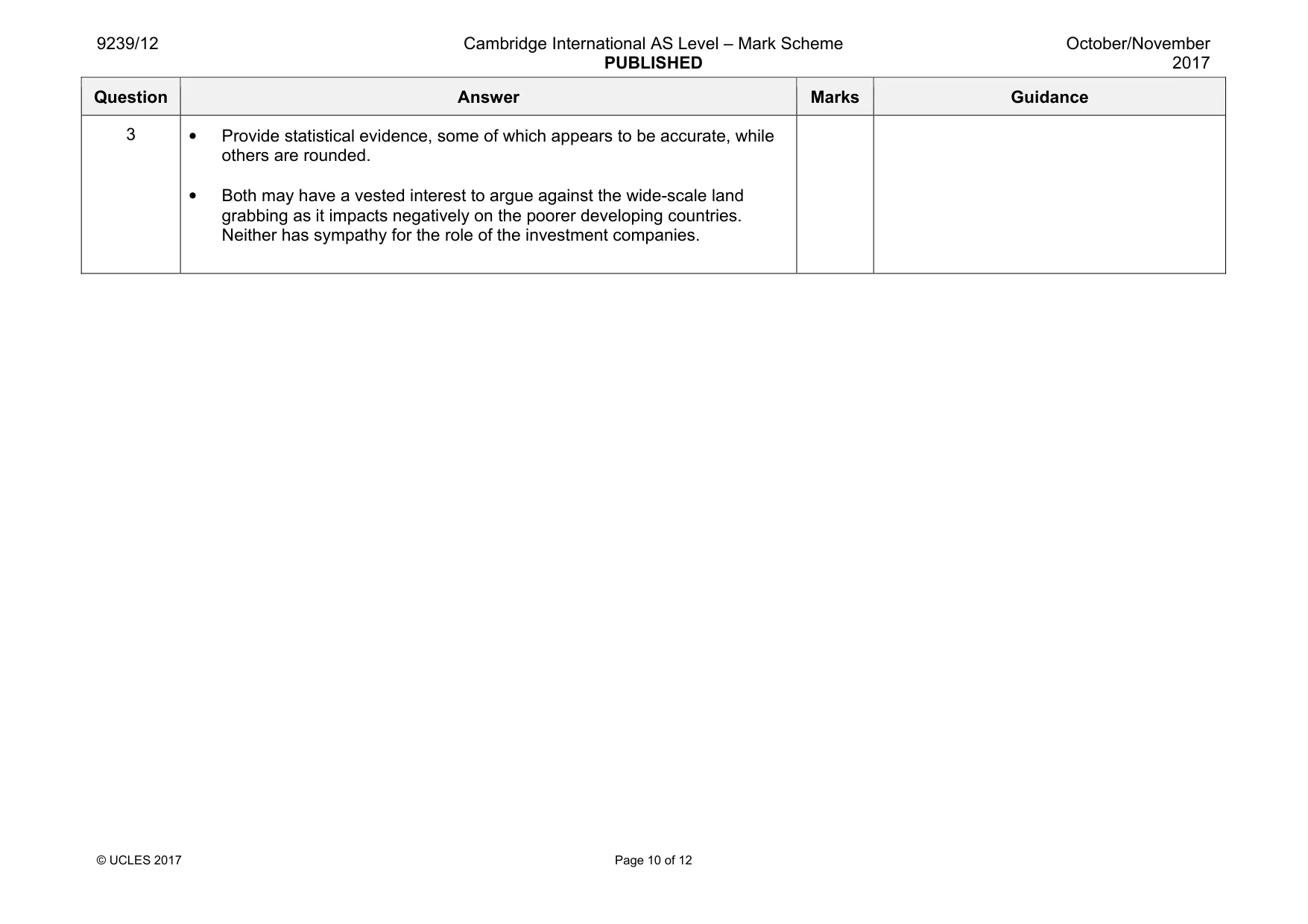
9239/12 Cambridge International AS Level – Mark Scheme PUBLISHED October/November 2017 © UCLES 2017 Page 10 of 12 Question Answer Marks Guidance 3 • Provide statistical evidence, some of which appears to be accurate, while others are rounded. • Both may have a vested interest to argue against the wide-scale land grabbing as it impacts negatively on the poorer developing countries. Neither has sympathy for the role of the investment companies.
Mark scheme, page 11
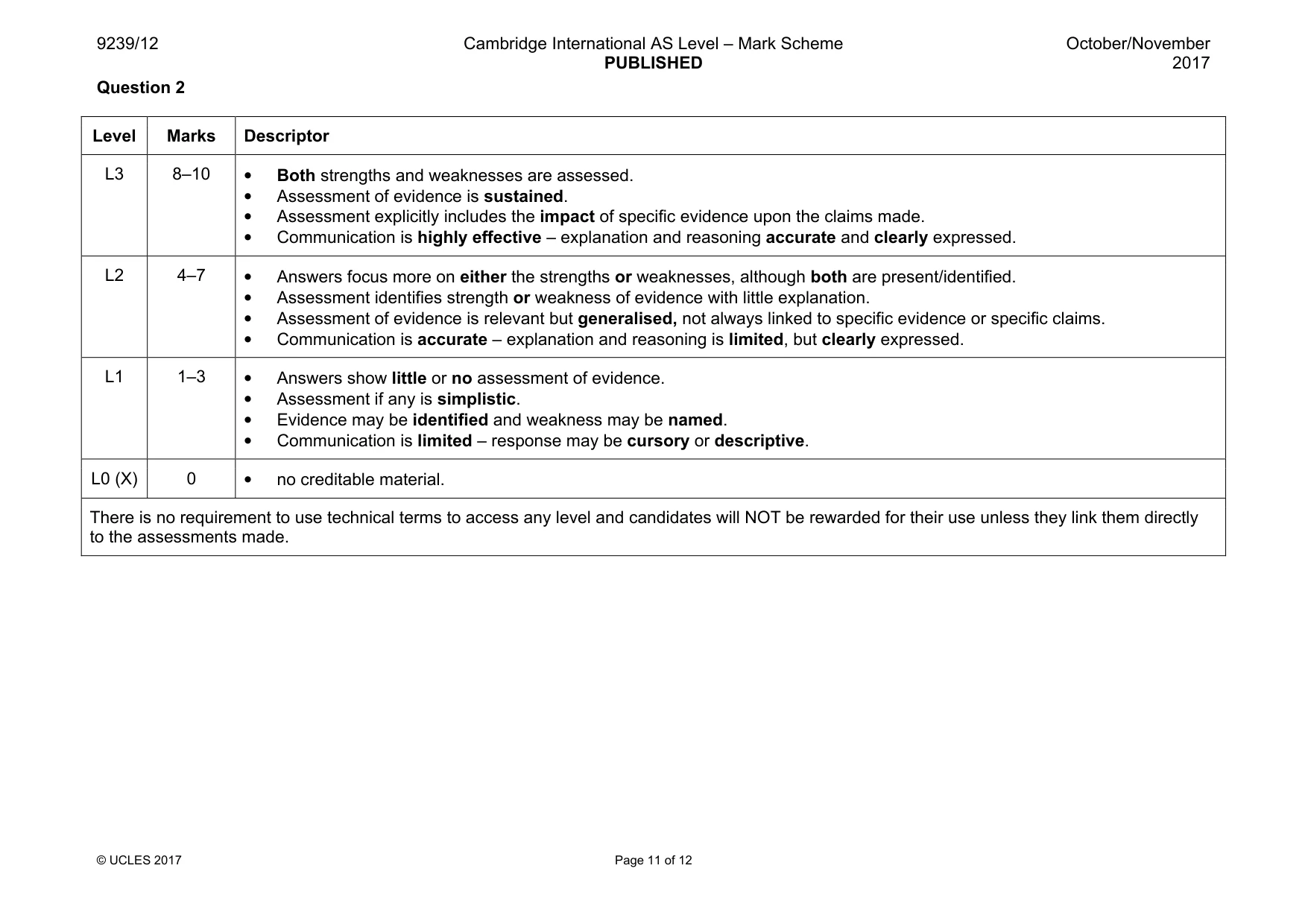
9239/12 Cambridge International AS Level – Mark Scheme PUBLISHED October/November 2017 © UCLES 2017 Page 11 of 12 Question 2 Level Marks Descriptor L3 8–10 • Both strengths and weaknesses are assessed. • Assessment of evidence is sustained. • Assessment explicitly includes the impact of specific evidence upon the claims made. • Communication is highly effective – explanation and reasoning accurate and clearly expressed. L2 4–7 • Answers focus more on either the strengths or weaknesses, although both are present/identified. • Assessment identifies strength or weakness of evidence with little explanation. • Assessment of evidence is relevant but generalised, not always linked to specific evidence or specific claims. • Communication is accurate – explanation and reasoning is limited, but clearly expressed. L1 1–3 • Answers show little or no assessment of evidence. • Assessment if any is simplistic. • Evidence may be identified and weakness may be named. • Communication is limited – response may be cursory or descriptive. L0 (X) 0 • no creditable material. There is no requirement to use technical terms to access any level and candidates will NOT be rewarded for their use unless they link them directly to the assessments made.
Mark scheme, page 12
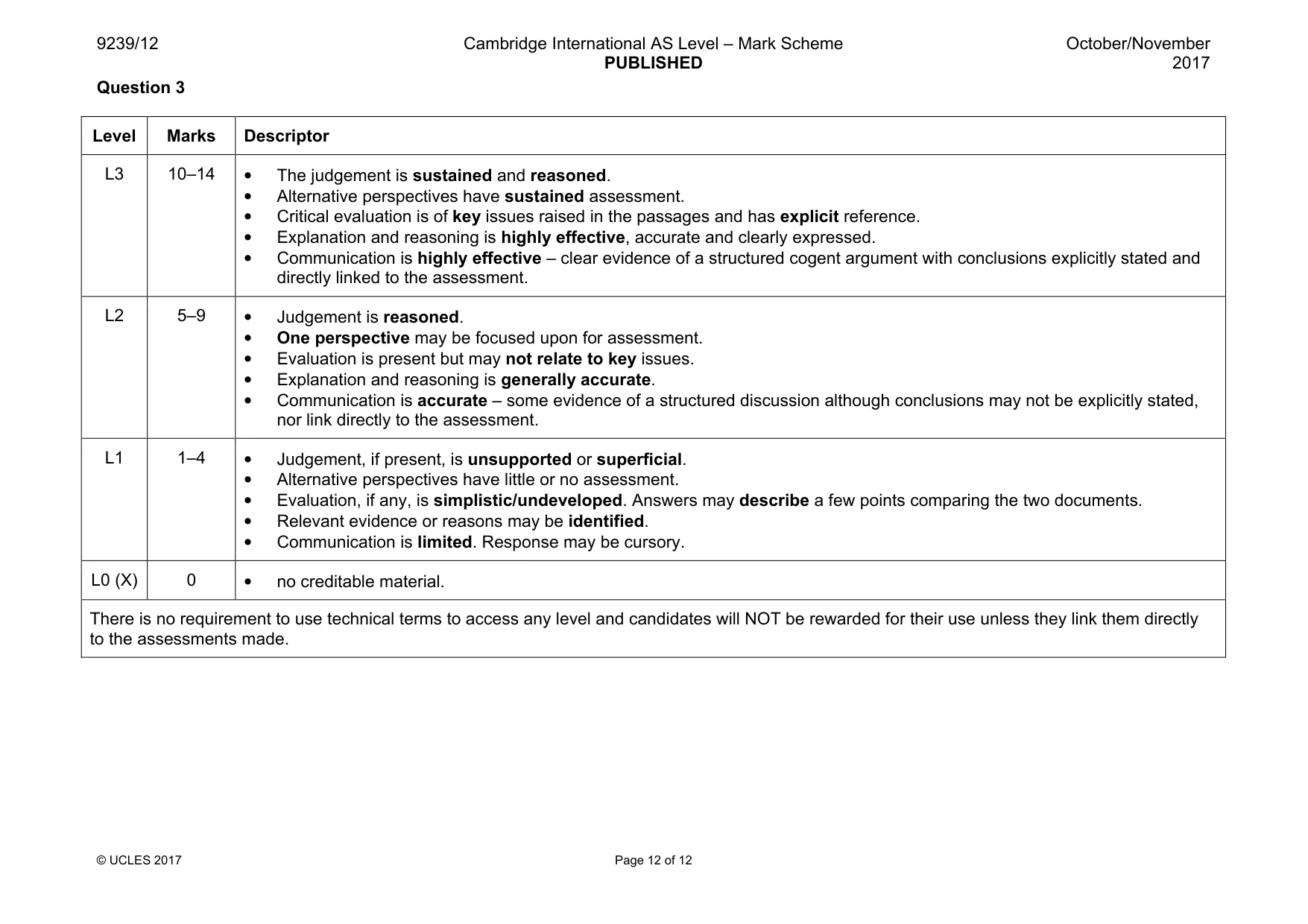
9239/12 Cambridge International AS Level – Mark Scheme PUBLISHED October/November 2017 © UCLES 2017 Page 12 of 12 Question 3 Level Marks Descriptor L3 10–14 • The judgement is sustained and reasoned. • Alternative perspectives have sustained assessment. • Critical evaluation is of key issues raised in the passages and has explicit reference. • Explanation and reasoning is highly effective, accurate and clearly expressed. • Communication is highly effective – clear evidence of a structured cogent argument with conclusions explicitly stated and directly linked to the assessment. L2 5–9 • Judgement is reasoned. • One perspective may be focused upon for assessment. • Evaluation is present but may not relate to key issues. • Explanation and reasoning is generally accurate. • Communication is accurate – some evidence of a structured discussion although conclusions may not be explicitly stated, nor link directly to the assessment. L1 1–4 • Judgement, if present, is unsupported or superficial. • Alternative perspectives have little or no assessment. • Evaluation, if any, is simplistic/undeveloped. Answers may describe a few points comparing the two documents. • Relevant evidence or reasons may be identified. • Communication is limited. Response may be cursory. L0 (X) 0 • no creditable material. There is no requirement to use technical terms to access any level and candidates will NOT be rewarded for their use unless they link them directly to the assessments made.
What you needed in this session
Cambridge’s own grade thresholds for 2017 Oct/Nov, Paper 1 · Variant 2. A higher threshold means an easier paper — the bar moves with how the cohort did.