Cambridge A Level Global Perspectives and Research 9239 — 2016 Oct/Nov Paper 1 · Variant 3
9239/13/O/N/16 · 30 marks · ≈34 min
The question paper and its mark scheme, free to read here and free to download. This is Cambridge’s own paper, exactly as it was sat.
Question paper4 pages

Mark scheme6 pages
Answers below. Sit the paper first if you are practising.
Paper as text
Question paper, page 1
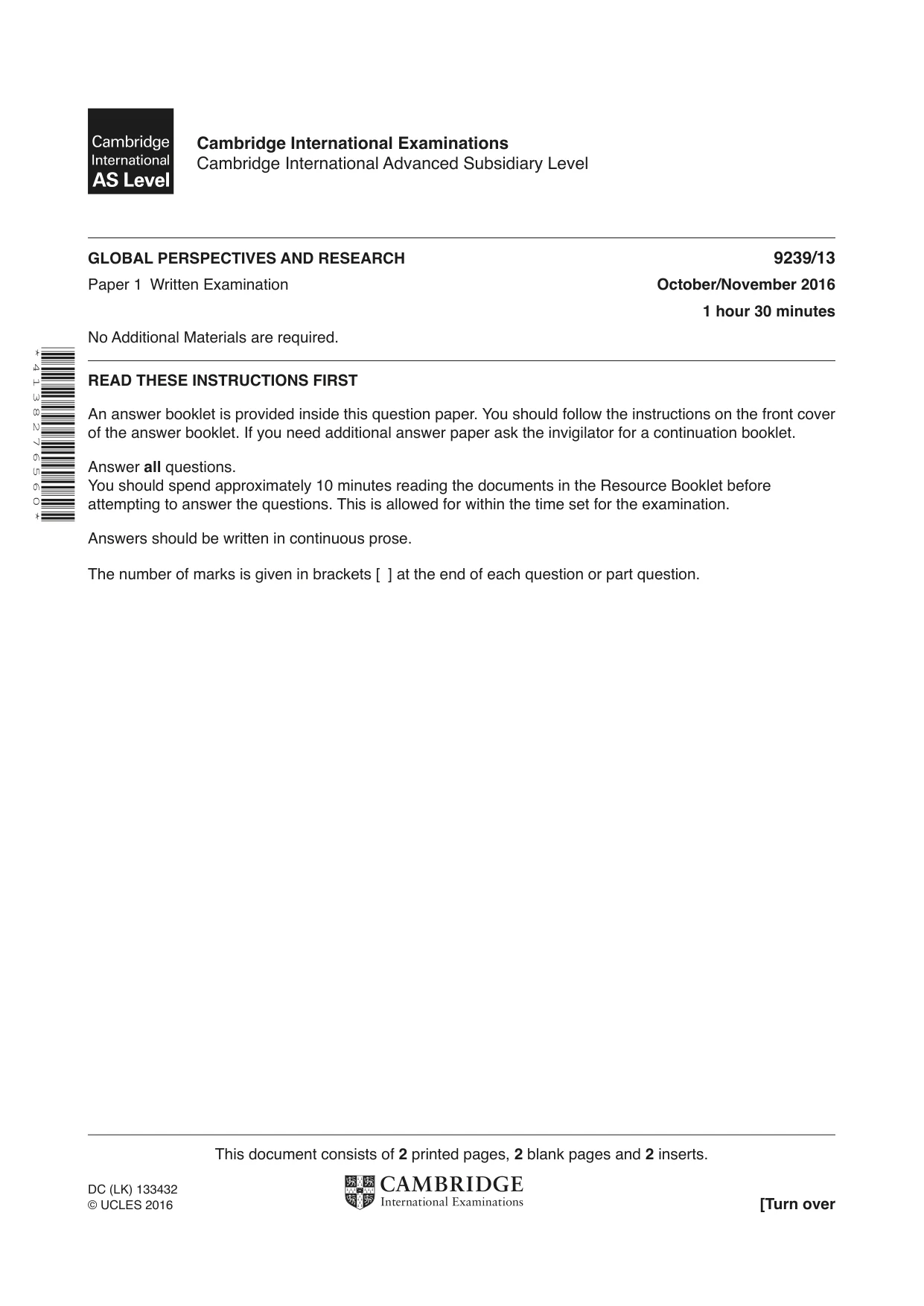
This document consists of 2 printed pages, 2 blank pages and 2 inserts. DC (LK) 133432 © UCLES 2016 [Turn over * 4 1 3 8 2 7 6 5 6 0 * GLOBAL PERSPECTIVES AND RESEARCH 9239/13 Paper 1 Written Examination October/November 2016 1 hour 30 minutes No Additional Materials are required. READ THESE INSTRUCTIONS FIRST An answer booklet is provided inside this question paper. You should follow the instructions on the front cover of the answer booklet. If you need additional answer paper ask the invigilator for a continuation booklet. Answer all questions. You should spend approximately 10 minutes reading the documents in the Resource Booklet before attempting to answer the questions. This is allowed for within the time set for the examination. Answers should be written in continuous prose. The number of marks is given in brackets [ ] at the end of each question or part question. Cambridge International Examinations Cambridge International Advanced Subsidiary Level
Question paper, page 2
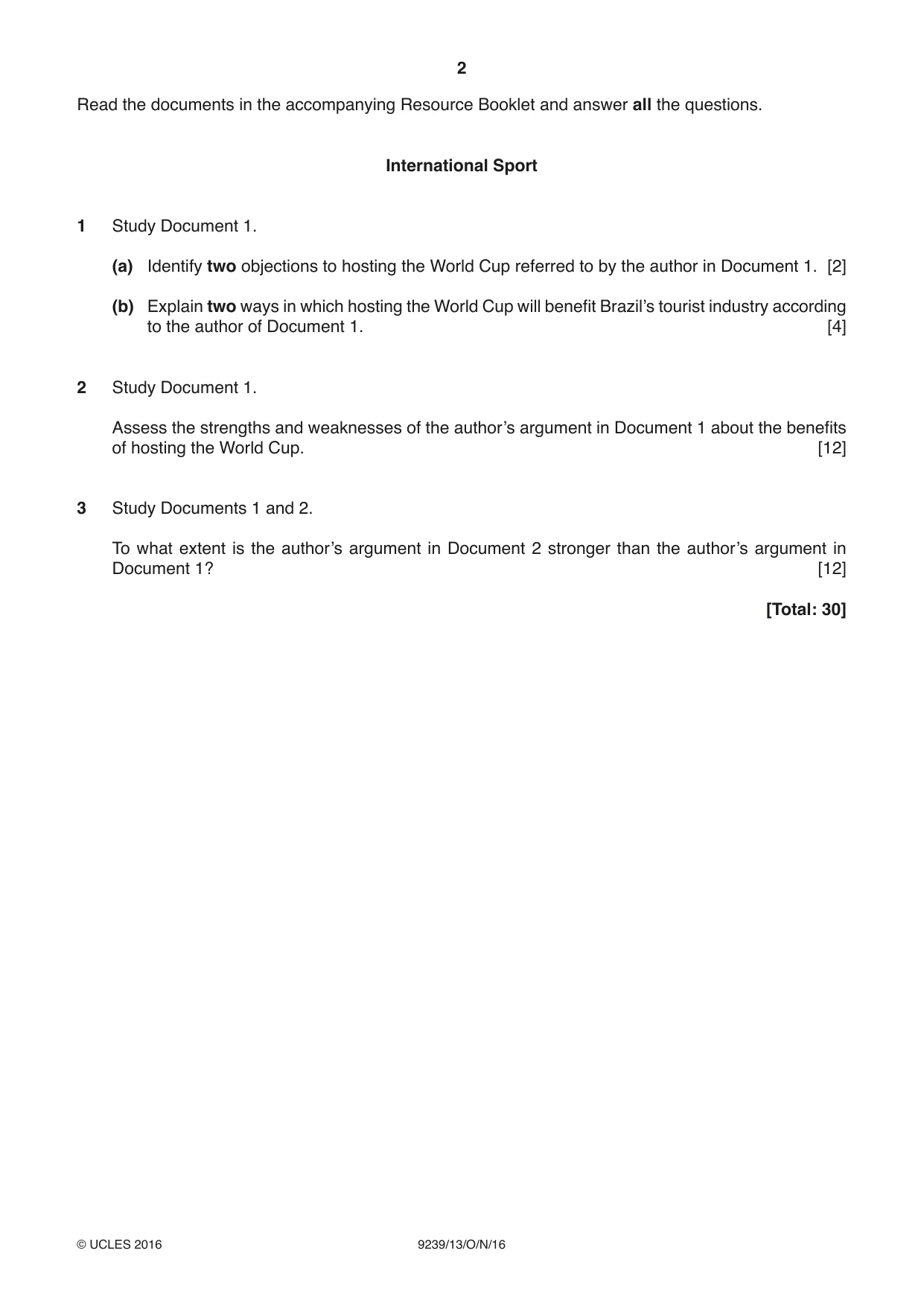
2 9239/13/O/N/16 © UCLES 2016 Read the documents in the accompanying Resource Booklet and answer all the questions. International Sport 1 Study Document 1. (a) Identify two objections to hosting the World Cup referred to by the author in Document 1. [2] (b) Explain two ways in which hosting the World Cup will benefit Brazil’s tourist industry according to the author of Document 1. [4] 2 Study Document 1. Assess the strengths and weaknesses of the author’s argument in Document 1 about the benefits of hosting the World Cup. [12] 3 Study Documents 1 and 2. To what extent is the author’s argument in Document 2 stronger than the author’s argument in Document 1? [12] [Total: 30]
Question paper, page 3
3 9239/13/O/N/16 © UCLES 2016 BLANK PAGE
Question paper, page 4
4 9239/13/O/N/16 © UCLES 2016 BLANK PAGE Permission to reproduce items where third-party owned material protected by copyright is included has been sought and cleared where possible. Every reasonable effort has been made by the publisher (UCLES) to trace copyright holders, but if any items requiring clearance have unwittingly been included, the publisher will be pleased to make amends at the earliest possible opportunity. To avoid the issue of disclosure of answer-related information to candidates, all copyright acknowledgements are reproduced online in the Cambridge International Examinations Copyright Acknowledgements Booklet. This is produced for each series of examinations and is freely available to download at www.cie.org.uk after the live examination series. Cambridge International Examinations is part of the Cambridge Assessment Group. Cambridge Assessment is the brand name of University of Cambridge Local Examinations Syndicate (UCLES), which is itself a department of the University of Cambridge.
Mark scheme, page 1
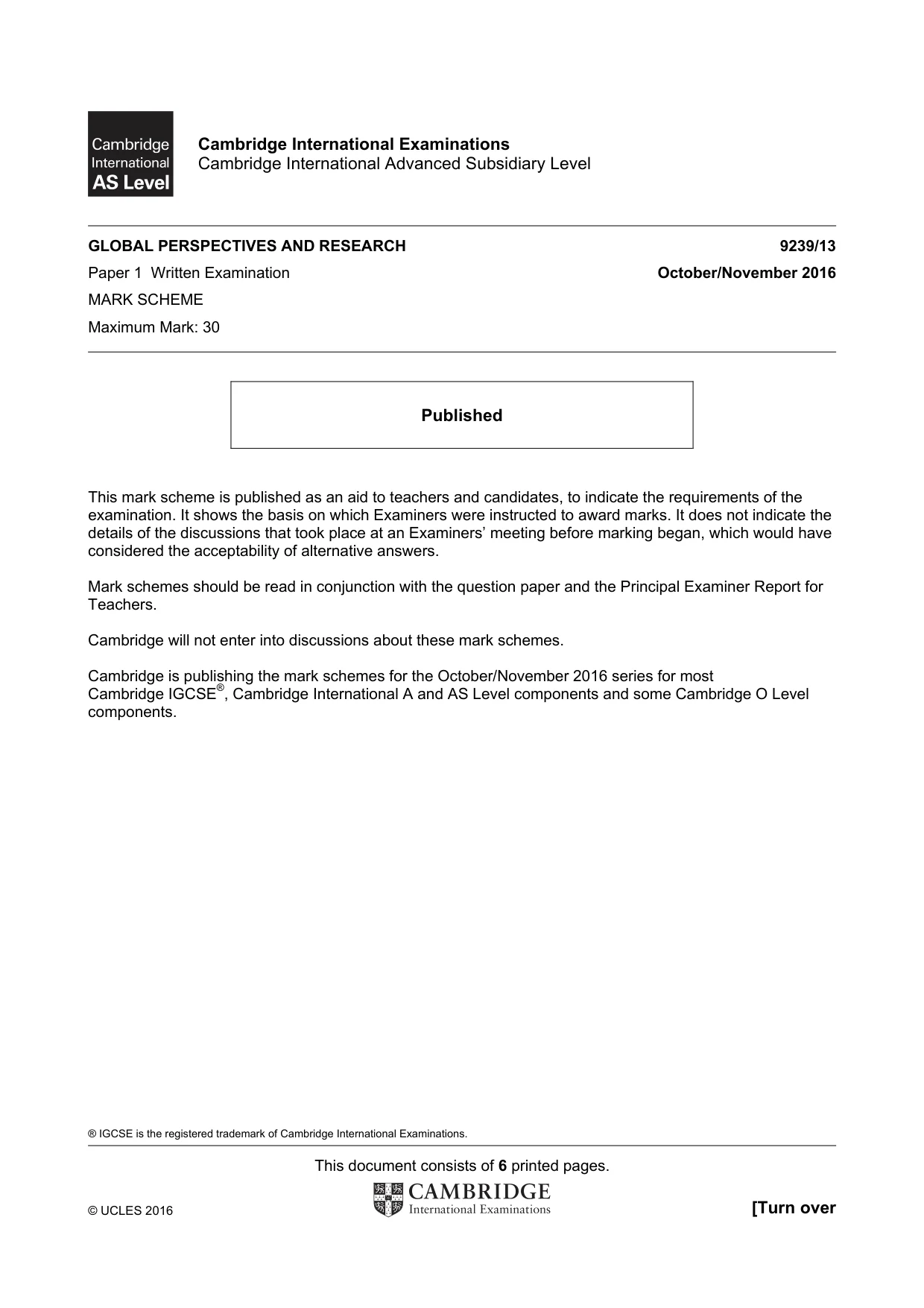
® IGCSE is the registered trademark of Cambridge International Examinations. This document consists of 6 printed pages. © UCLES 2016 [Turn over Cambridge International Examinations Cambridge International Advanced Subsidiary Level GLOBAL PERSPECTIVES AND RESEARCH 9239/13 Paper 1 Written Examination October/November 2016 MARK SCHEME Maximum Mark: 30 Published This mark scheme is published as an aid to teachers and candidates, to indicate the requirements of the examination. It shows the basis on which Examiners were instructed to award marks. It does not indicate the details of the discussions that took place at an Examiners’ meeting before marking began, which would have considered the acceptability of alternative answers. Mark schemes should be read in conjunction with the question paper and the Principal Examiner Report for Teachers. Cambridge will not enter into discussions about these mark schemes. Cambridge is publishing the mark schemes for the October/November 2016 series for most Cambridge IGCSE®, Cambridge International A and AS Level components and some Cambridge O Level components.
Mark scheme, page 2
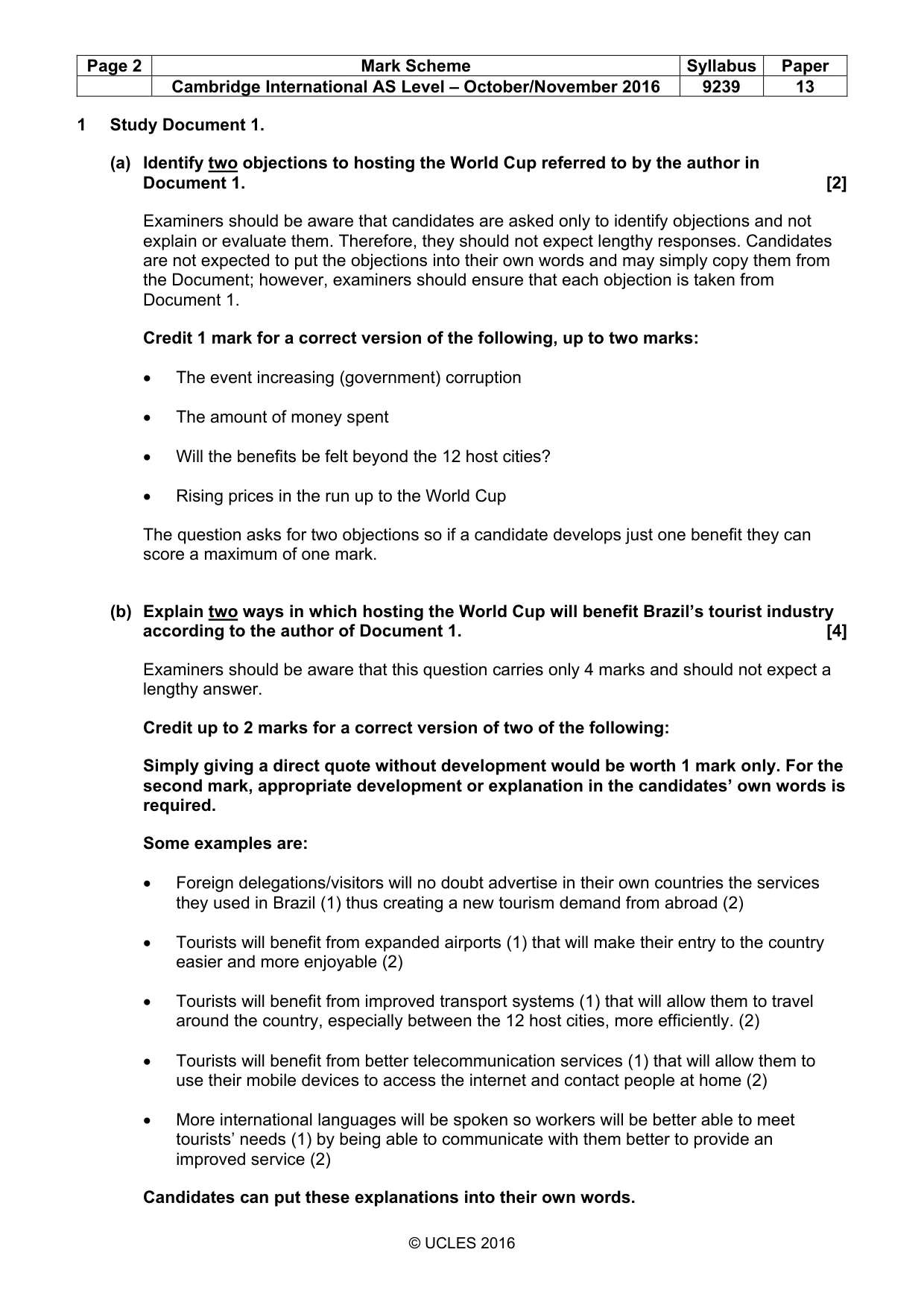
Page 2 Mark Scheme Syllabus Paper Cambridge International AS Level – October/November 2016 9239 13 © UCLES 2016 1 Study Document 1. (a) Identify two objections to hosting the World Cup referred to by the author in Document 1. [2] Examiners should be aware that candidates are asked only to identify objections and not explain or evaluate them. Therefore, they should not expect lengthy responses. Candidates are not expected to put the objections into their own words and may simply copy them from the Document; however, examiners should ensure that each objection is taken from Document 1. Credit 1 mark for a correct version of the following, up to two marks: • The event increasing (government) corruption • The amount of money spent • Will the benefits be felt beyond the 12 host cities? • Rising prices in the run up to the World Cup The question asks for two objections so if a candidate develops just one benefit they can score a maximum of one mark. (b) Explain two ways in which hosting the World Cup will benefit Brazil’s tourist industry according to the author of Document 1. [4] Examiners should be aware that this question carries only 4 marks and should not expect a lengthy answer. Credit up to 2 marks for a correct version of two of the following: Simply giving a direct quote without development would be worth 1 mark only. For the second mark, appropriate development or explanation in the candidates’ own words is required. Some examples are: • Foreign delegations/visitors will no doubt advertise in their own countries the services they used in Brazil (1) thus creating a new tourism demand from abroad (2) • Tourists will benefit from expanded airports (1) that will make their entry to the country easier and more enjoyable (2) • Tourists will benefit from improved transport systems (1) that will allow them to travel around the country, especially between the 12 host cities, more efficiently. (2) • Tourists will benefit from better telecommunication services (1) that will allow them to use their mobile devices to access the internet and contact people at home (2) • More international languages will be spoken so workers will be better able to meet tourists’ needs (1) by being able to communicate with them better to provide an improved service (2) Candidates can put these explanations into their own words.
Mark scheme, page 3
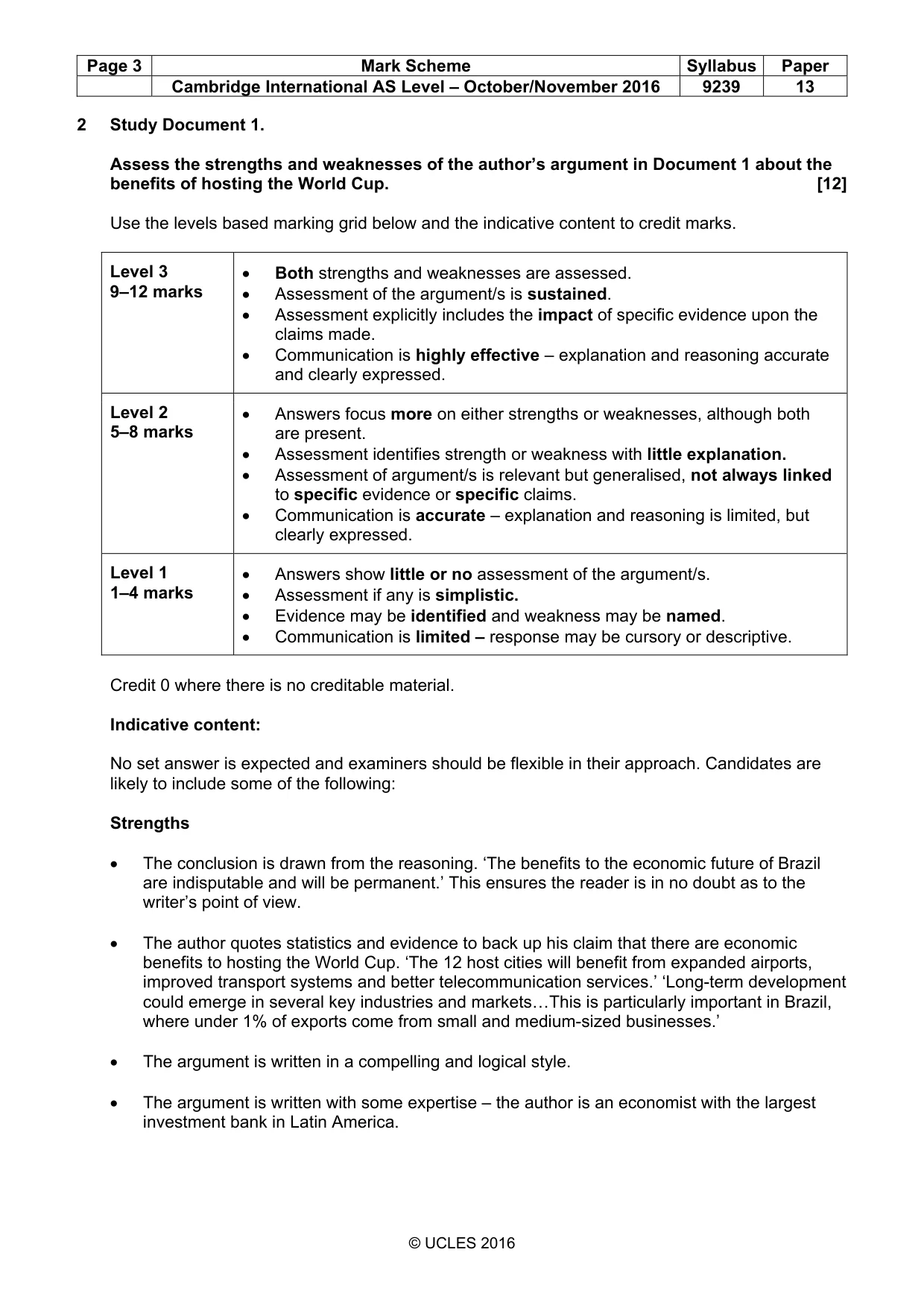
Page 3 Mark Scheme Syllabus Paper Cambridge International AS Level – October/November 2016 9239 13 © UCLES 2016 2 Study Document 1. Assess the strengths and weaknesses of the author’s argument in Document 1 about the benefits of hosting the World Cup. [12] Use the levels based marking grid below and the indicative content to credit marks. Level 3 9–12 marks • Both strengths and weaknesses are assessed. • Assessment of the argument/s is sustained. • Assessment explicitly includes the impact of specific evidence upon the claims made. • Communication is highly effective – explanation and reasoning accurate and clearly expressed. Level 2 5–8 marks • Answers focus more on either strengths or weaknesses, although both are present. • Assessment identifies strength or weakness with little explanation. • Assessment of argument/s is relevant but generalised, not always linked to specific evidence or specific claims. • Communication is accurate – explanation and reasoning is limited, but clearly expressed. Level 1 1–4 marks • Answers show little or no assessment of the argument/s. • Assessment if any is simplistic. • Evidence may be identified and weakness may be named. • Communication is limited – response may be cursory or descriptive. Credit 0 where there is no creditable material. Indicative content: No set answer is expected and examiners should be flexible in their approach. Candidates are likely to include some of the following: Strengths • The conclusion is drawn from the reasoning. ‘The benefits to the economic future of Brazil are indisputable and will be permanent.’ This ensures the reader is in no doubt as to the writer’s point of view. • The author quotes statistics and evidence to back up his claim that there are economic benefits to hosting the World Cup. ‘The 12 host cities will benefit from expanded airports, improved transport systems and better telecommunication services.’ ‘Long-term development could emerge in several key industries and markets…This is particularly important in Brazil, where under 1% of exports come from small and medium-sized businesses.’ • The argument is written in a compelling and logical style. • The argument is written with some expertise – the author is an economist with the largest investment bank in Latin America.
Mark scheme, page 4
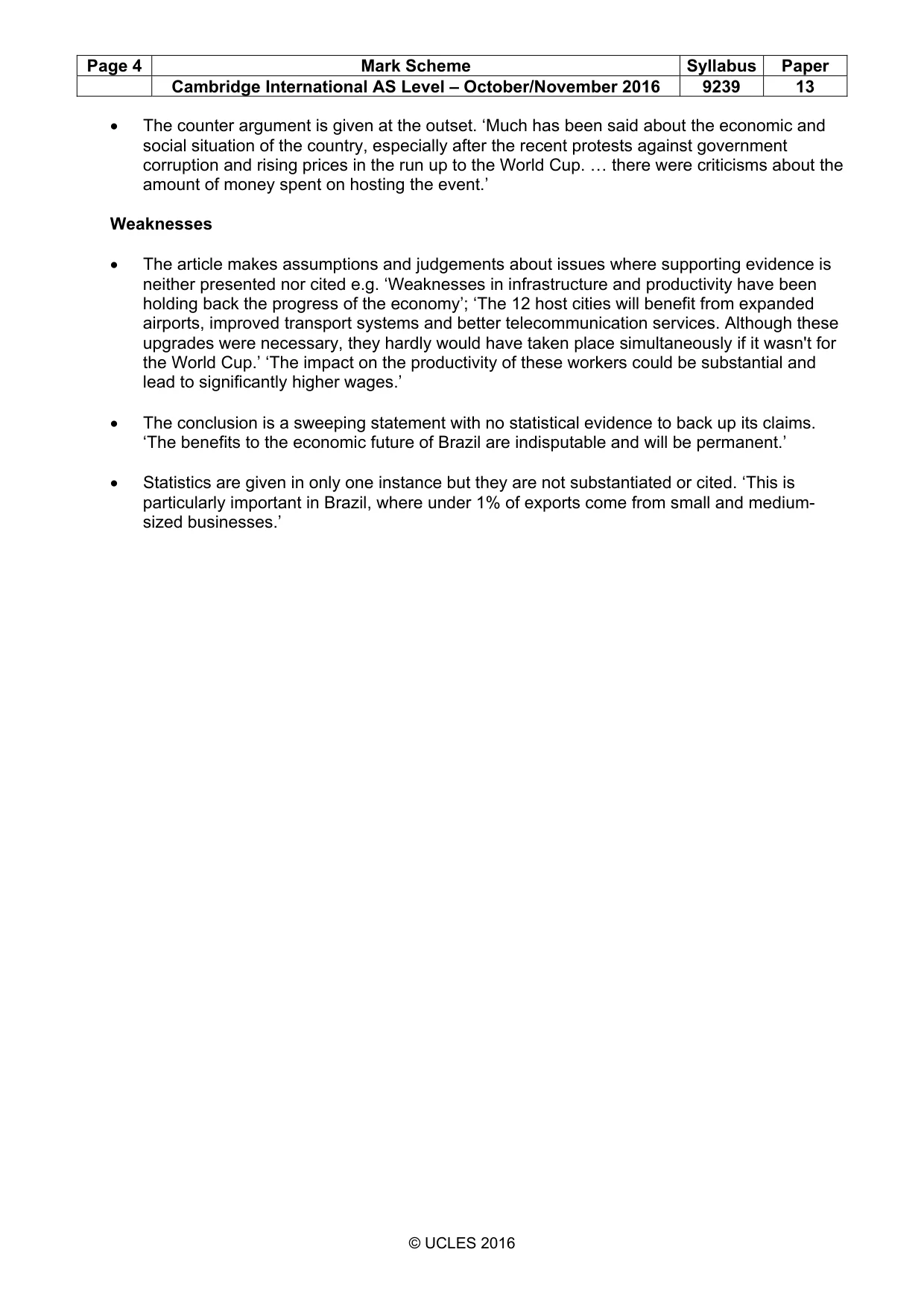
Page 4 Mark Scheme Syllabus Paper Cambridge International AS Level – October/November 2016 9239 13 © UCLES 2016 • The counter argument is given at the outset. ‘Much has been said about the economic and social situation of the country, especially after the recent protests against government corruption and rising prices in the run up to the World Cup. … there were criticisms about the amount of money spent on hosting the event.’ Weaknesses • The article makes assumptions and judgements about issues where supporting evidence is neither presented nor cited e.g. ‘Weaknesses in infrastructure and productivity have been holding back the progress of the economy’; ‘The 12 host cities will benefit from expanded airports, improved transport systems and better telecommunication services. Although these upgrades were necessary, they hardly would have taken place simultaneously if it wasn't for the World Cup.’ ‘The impact on the productivity of these workers could be substantial and lead to significantly higher wages.’ • The conclusion is a sweeping statement with no statistical evidence to back up its claims. ‘The benefits to the economic future of Brazil are indisputable and will be permanent.’ • Statistics are given in only one instance but they are not substantiated or cited. ‘This is particularly important in Brazil, where under 1% of exports come from small and medium- sized businesses.’
Mark scheme, page 5
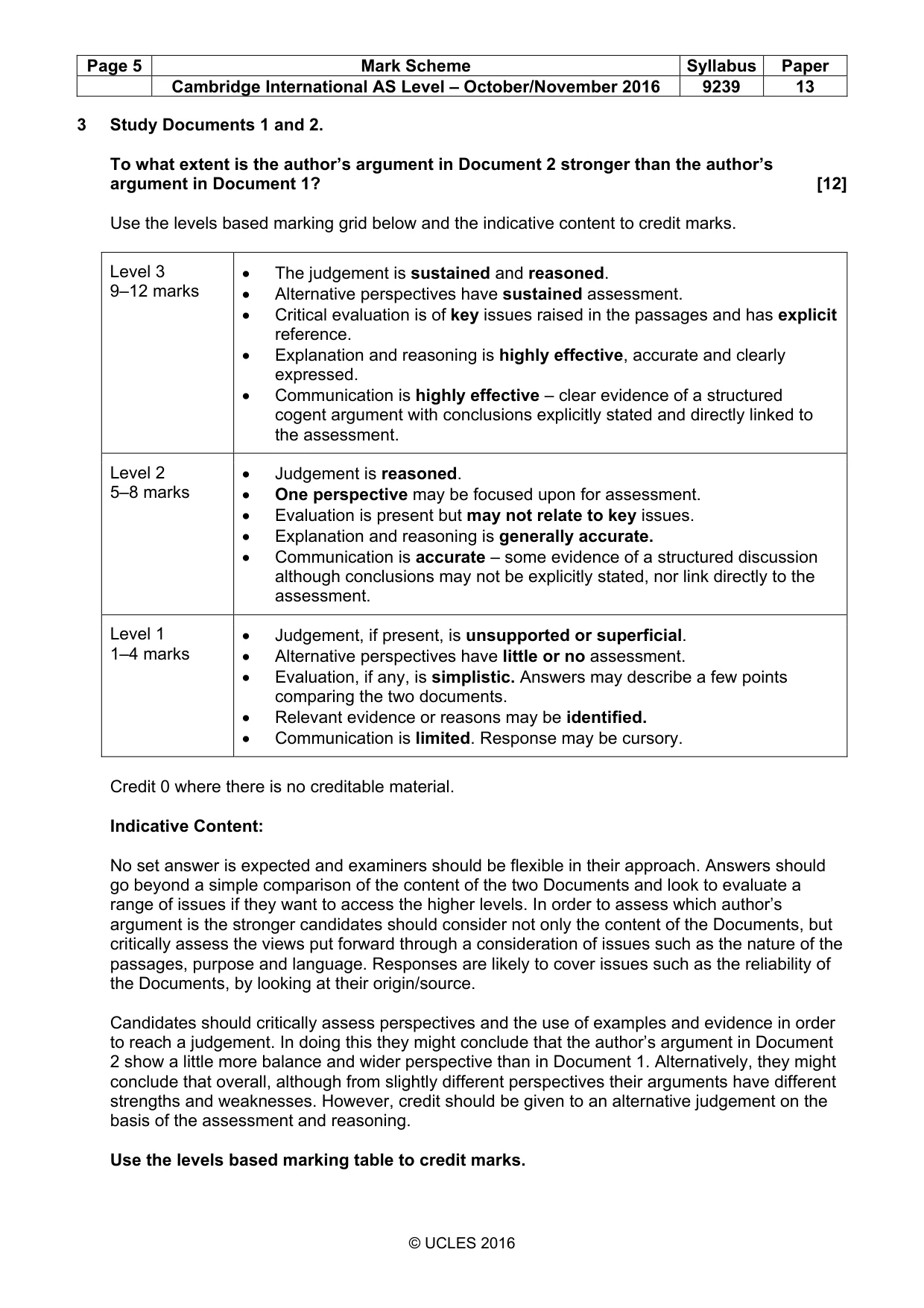
Page 5 Mark Scheme Syllabus Paper Cambridge International AS Level – October/November 2016 9239 13 © UCLES 2016 3 Study Documents 1 and 2. To what extent is the author’s argument in Document 2 stronger than the author’s argument in Document 1? [12] Use the levels based marking grid below and the indicative content to credit marks. Level 3 9–12 marks • The judgement is sustained and reasoned. • Alternative perspectives have sustained assessment. • Critical evaluation is of key issues raised in the passages and has explicit reference. • Explanation and reasoning is highly effective, accurate and clearly expressed. • Communication is highly effective – clear evidence of a structured cogent argument with conclusions explicitly stated and directly linked to the assessment. Level 2 5–8 marks • Judgement is reasoned. • One perspective may be focused upon for assessment. • Evaluation is present but may not relate to key issues. • Explanation and reasoning is generally accurate. • Communication is accurate – some evidence of a structured discussion although conclusions may not be explicitly stated, nor link directly to the assessment. Level 1 1–4 marks • Judgement, if present, is unsupported or superficial. • Alternative perspectives have little or no assessment. • Evaluation, if any, is simplistic. Answers may describe a few points comparing the two documents. • Relevant evidence or reasons may be identified. • Communication is limited. Response may be cursory. Credit 0 where there is no creditable material. Indicative Content: No set answer is expected and examiners should be flexible in their approach. Answers should go beyond a simple comparison of the content of the two Documents and look to evaluate a range of issues if they want to access the higher levels. In order to assess which author’s argument is the stronger candidates should consider not only the content of the Documents, but critically assess the views put forward through a consideration of issues such as the nature of the passages, purpose and language. Responses are likely to cover issues such as the reliability of the Documents, by looking at their origin/source. Candidates should critically assess perspectives and the use of examples and evidence in order to reach a judgement. In doing this they might conclude that the author’s argument in Document 2 show a little more balance and wider perspective than in Document 1. Alternatively, they might conclude that overall, although from slightly different perspectives their arguments have different strengths and weaknesses. However, credit should be given to an alternative judgement on the basis of the assessment and reasoning. Use the levels based marking table to credit marks.
Mark scheme, page 6
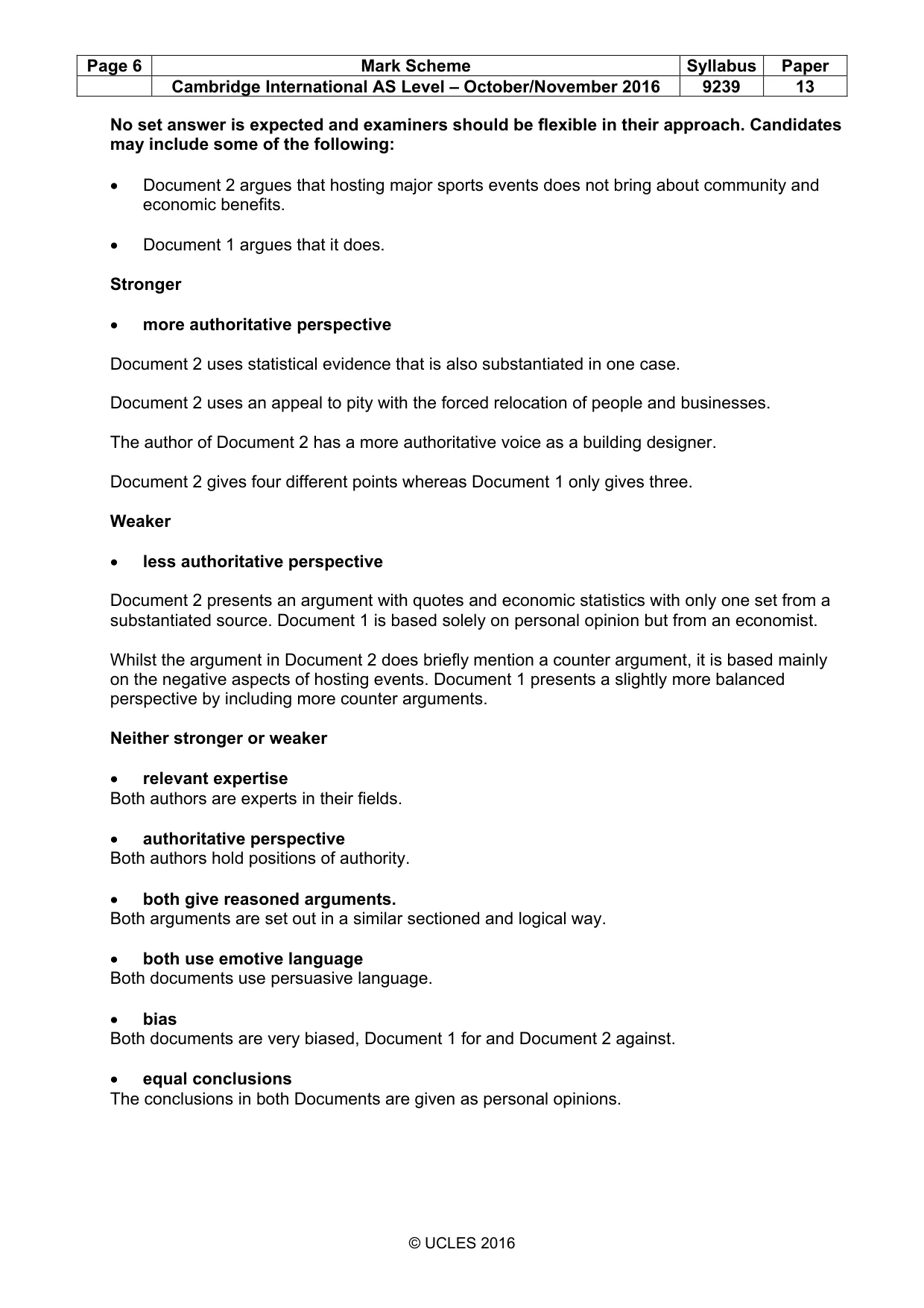
Page 6 Mark Scheme Syllabus Paper Cambridge International AS Level – October/November 2016 9239 13 © UCLES 2016 No set answer is expected and examiners should be flexible in their approach. Candidates may include some of the following: • Document 2 argues that hosting major sports events does not bring about community and economic benefits. • Document 1 argues that it does. Stronger • more authoritative perspective Document 2 uses statistical evidence that is also substantiated in one case. Document 2 uses an appeal to pity with the forced relocation of people and businesses. The author of Document 2 has a more authoritative voice as a building designer. Document 2 gives four different points whereas Document 1 only gives three. Weaker • less authoritative perspective Document 2 presents an argument with quotes and economic statistics with only one set from a substantiated source. Document 1 is based solely on personal opinion but from an economist. Whilst the argument in Document 2 does briefly mention a counter argument, it is based mainly on the negative aspects of hosting events. Document 1 presents a slightly more balanced perspective by including more counter arguments. Neither stronger or weaker • relevant expertise Both authors are experts in their fields. • authoritative perspective Both authors hold positions of authority. • both give reasoned arguments. Both arguments are set out in a similar sectioned and logical way. • both use emotive language Both documents use persuasive language. • bias Both documents are very biased, Document 1 for and Document 2 against. • equal conclusions The conclusions in both Documents are given as personal opinions.
What you needed in this session
Cambridge’s own grade thresholds for 2016 Oct/Nov, Paper 1 · Variant 3. A higher threshold means an easier paper — the bar moves with how the cohort did.