Cambridge A Level German - Language (AS Level only) 8683 — 2013 Oct/Nov Paper 3 · Variant 2
8683/32/O/N/13 · 40 marks · ≈45 min
The question paper and its mark scheme, free to read here and free to download. This is Cambridge’s own paper, exactly as it was sat.
Question paper2 pages
Mark scheme2 pages
Answers below. Sit the paper first if you are practising.
Paper as text
Question paper, page 1
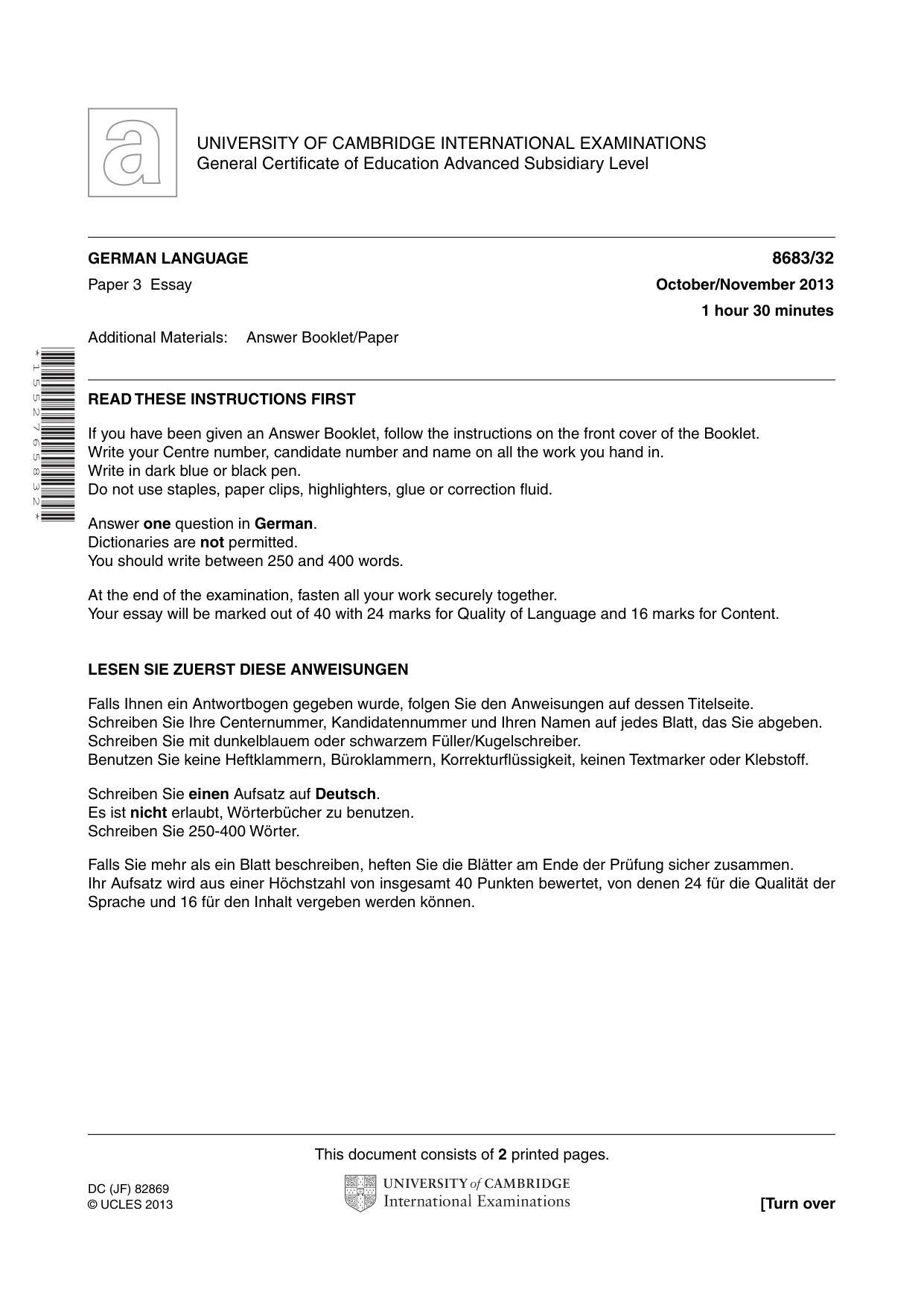
This document consists of 2 printed pages. DC (JF) 82869 © UCLES 2013 [Turn over UNIVERSITY OF CAMBRIDGE INTERNATIONAL EXAMINATIONS General Certificate of Education Advanced Subsidiary Level READ THESE INSTRUCTIONS FIRST If you have been given an Answer Booklet, follow the instructions on the front cover of the Booklet. Write your Centre number, candidate number and name on all the work you hand in. Write in dark blue or black pen. Do not use staples, paper clips, highlighters, glue or correction fluid. Answer one question in German. Dictionaries are not permitted. You should write between 250 and 400 words. At the end of the examination, fasten all your work securely together. Your essay will be marked out of 40 with 24 marks for Quality of Language and 16 marks for Content. LESEN SIE ZUERST DIESE ANWEISUNGEN Falls Ihnen ein Antwortbogen gegeben wurde, folgen Sie den Anweisungen auf dessen Titelseite. Schreiben Sie Ihre Centernummer, Kandidatennummer und Ihren Namen auf jedes Blatt, das Sie abgeben. Schreiben Sie mit dunkelblauem oder schwarzem Füller/Kugelschreiber. Benutzen Sie keine Heftklammern, Büroklammern, Korrekturflüssigkeit, keinen Textmarker oder Klebstoff. Schreiben Sie einen Aufsatz auf Deutsch. Es ist nicht erlaubt, Wörterbücher zu benutzen. Schreiben Sie 250-400 Wörter. Falls Sie mehr als ein Blatt beschreiben, heften Sie die Blätter am Ende der Prüfung sicher zusammen. Ihr Aufsatz wird aus einer Höchstzahl von insgesamt 40 Punkten bewertet, von denen 24 für die Qualität der Sprache und 16 für den Inhalt vergeben werden können. * 1 5 5 2 7 6 5 8 3 2 * GERMAN LANGUAGE 8683/32 Paper 3 Essay October/November 2013 1 hour 30 minutes Additional Materials: Answer Booklet/Paper
Question paper, page 2
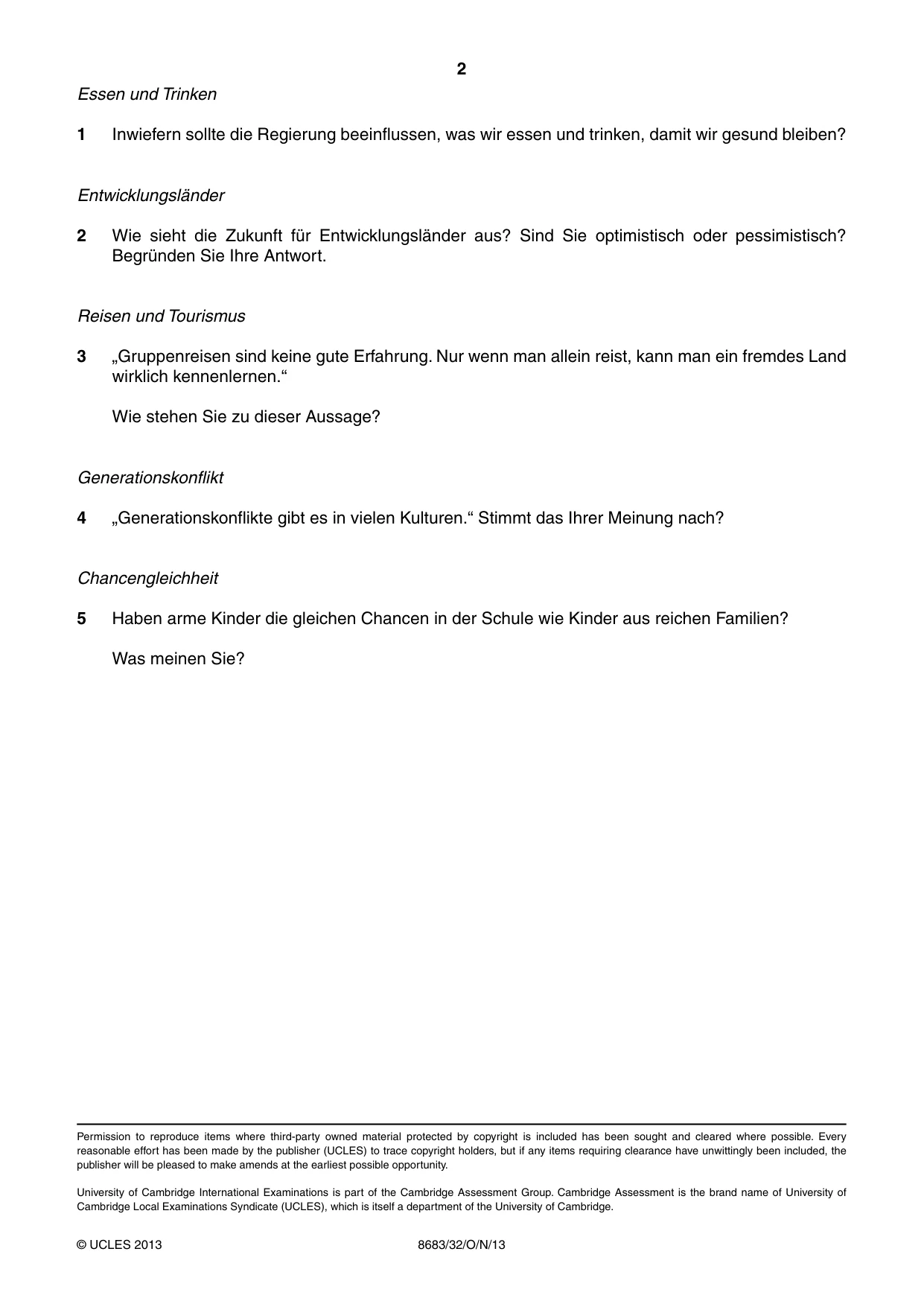
8683/32/O/N/13 © UCLES 2013 2 Permission to reproduce items where third-party owned material protected by copyright is included has been sought and cleared where possible. Every reasonable effort has been made by the publisher (UCLES) to trace copyright holders, but if any items requiring clearance have unwittingly been included, the publisher will be pleased to make amends at the earliest possible opportunity. University of Cambridge International Examinations is part of the Cambridge Assessment Group. Cambridge Assessment is the brand name of University of Cambridge Local Examinations Syndicate (UCLES), which is itself a department of the University of Cambridge. Essen und Trinken 1 Inwiefern sollte die Regierung beeinflussen, was wir essen und trinken, damit wir gesund bleiben? Entwicklungsländer 2 Wie sieht die Zukunft für Entwicklungsländer aus? Sind Sie optimistisch oder pessimistisch? Begründen Sie Ihre Antwort. Reisen und Tourismus 3 „Gruppenreisen sind keine gute Erfahrung. Nur wenn man allein reist, kann man ein fremdes Land wirklich kennenlernen.“ Wie stehen Sie zu dieser Aussage? Generationskonflikt 4 „Generationskonflikte gibt es in vielen Kulturen.“ Stimmt das Ihrer Meinung nach? Chancengleichheit 5 Haben arme Kinder die gleichen Chancen in der Schule wie Kinder aus reichen Familien? Was meinen Sie?
Mark scheme, page 1
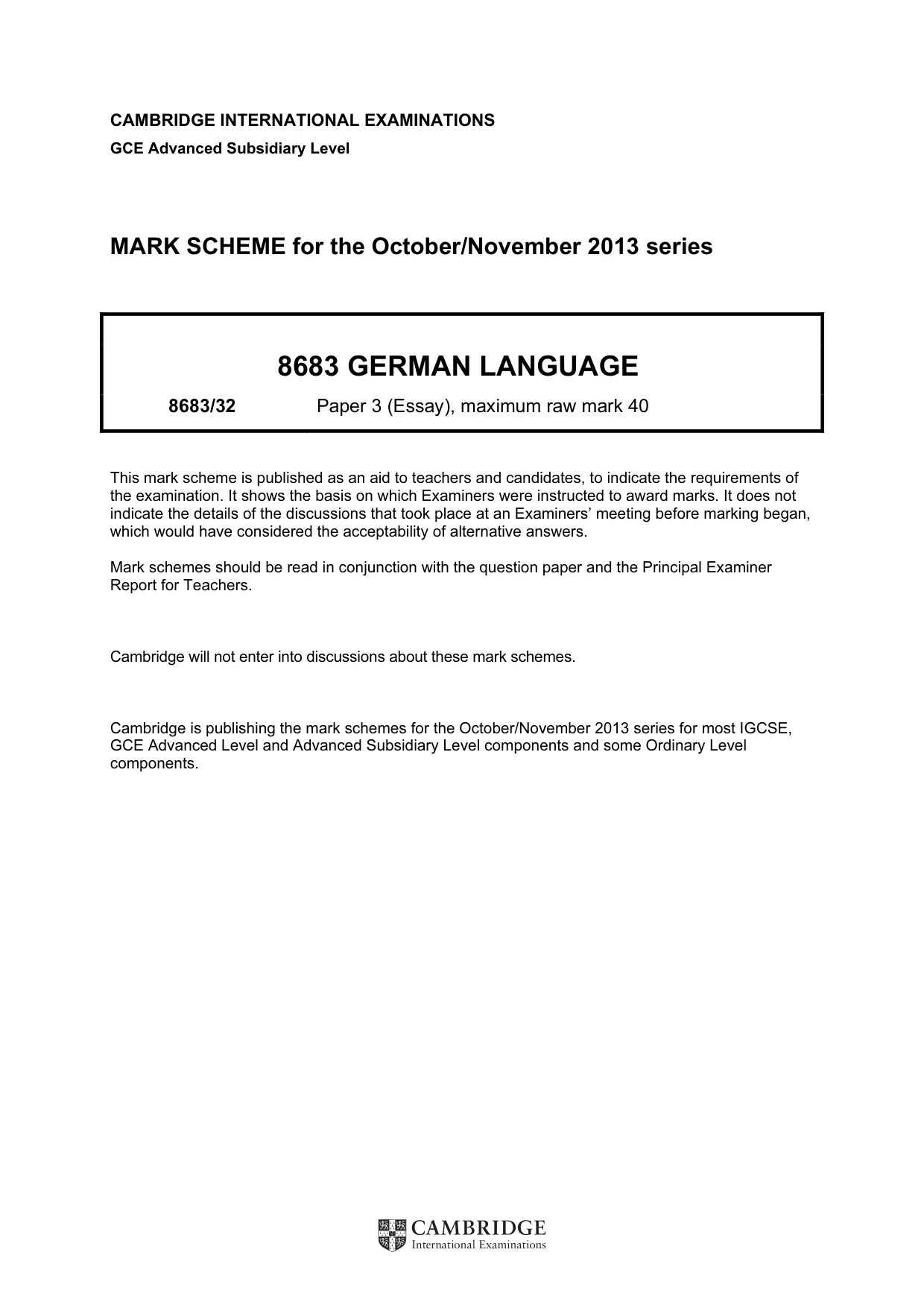
CAMBRIDGE INTERNATIONAL EXAMINATIONS GCE Advanced Subsidiary Level MARK SCHEME for the October/November 2013 series 8683 GERMAN LANGUAGE 8683/32 Paper 3 (Essay), maximum raw mark 40 This mark scheme is published as an aid to teachers and candidates, to indicate the requirements of the examination. It shows the basis on which Examiners were instructed to award marks. It does not indicate the details of the discussions that took place at an Examiners’ meeting before marking began, which would have considered the acceptability of alternative answers. Mark schemes should be read in conjunction with the question paper and the Principal Examiner Report for Teachers. Cambridge will not enter into discussions about these mark schemes. Cambridge is publishing the mark schemes for the October/November 2013 series for most IGCSE, GCE Advanced Level and Advanced Subsidiary Level components and some Ordinary Level components.
Mark scheme, page 2
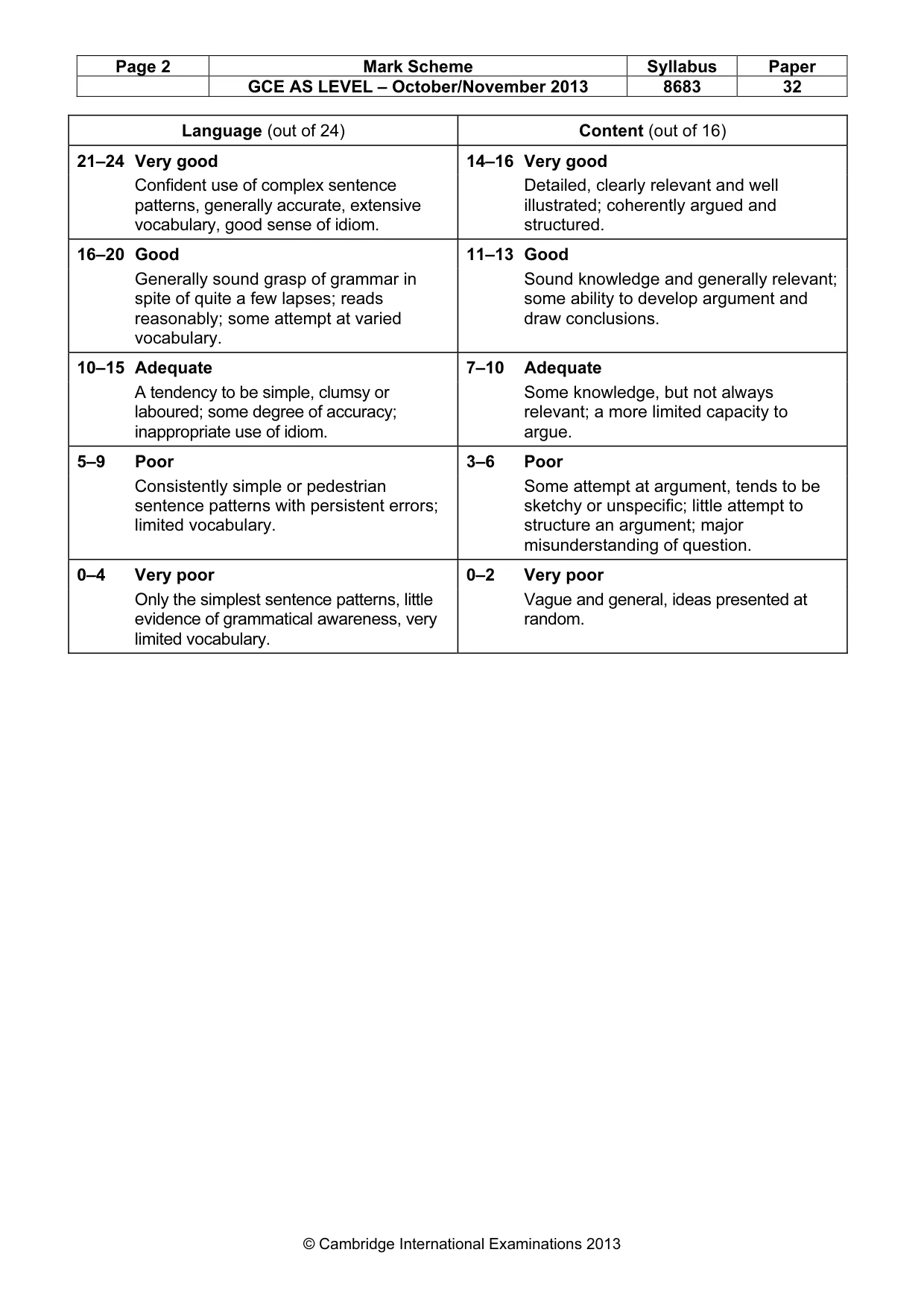
Page 2 Mark Scheme Syllabus Paper GCE AS LEVEL – October/November 2013 8683 32 © Cambridge International Examinations 2013 Language (out of 24) Content (out of 16) 21–24 Very good 14–16 Very good Confident use of complex sentence patterns, generally accurate, extensive vocabulary, good sense of idiom. Detailed, clearly relevant and well illustrated; coherently argued and structured. 16–20 Good 11–13 Good Generally sound grasp of grammar in spite of quite a few lapses; reads reasonably; some attempt at varied vocabulary. Sound knowledge and generally relevant; some ability to develop argument and draw conclusions. 10–15 Adequate 7–10 Adequate A tendency to be simple, clumsy or laboured; some degree of accuracy; inappropriate use of idiom. Some knowledge, but not always relevant; a more limited capacity to argue. 5–9 Poor 3–6 Poor Consistently simple or pedestrian sentence patterns with persistent errors; limited vocabulary. Some attempt at argument, tends to be sketchy or unspecific; little attempt to structure an argument; major misunderstanding of question. 0–4 Very poor 0–2 Very poor Only the simplest sentence patterns, little evidence of grammatical awareness, very limited vocabulary. Vague and general, ideas presented at random.
What you needed in this session
Cambridge’s own grade thresholds for 2013 Oct/Nov, Paper 3 · Variant 2. A higher threshold means an easier paper — the bar moves with how the cohort did.